
Living in a Collapsed Economy (4): The desperation and guilt of giving a young daughter in marriage 

The collapse of the economy has led families across Afghanistan to make desperate decisions, including, for some, giving young daughters in marriage in exchange for a bride price. To gain more insight into this, AAN’s Ali Mohammad Sabawoon sought to interview fathers of young brides. He identified about a dozen such men, but most felt too ashamed and remorseful to talk about it. The four men who did speak described the pressures that had led to their decision, one they never imagined they would have to make, and the emotional turmoil that accompanied it. Unfortunately, for all four men, the difficult decision to marry off their daughters did not end up solving their problems (with input from Kate Clark). 

Although there are no solid statistics to corroborate whether underage marriages are on the rise in Afghanistan,[1] anecdotal evidence, media reporting and the context of widespread and deepening poverty strongly suggests they are. The first report of the Special Rapporteur on the Situation of Human Rights in Afghanistan, published on 10 September 2022, which quoted some survey data, expressed concerns about “the reported surge of child marriage.”[2] Anecdotally, it also seems that more Afghans than in the past knew or had heard about families marrying off a young daughter. For this reason, the author decided to talk to such families to better understand how they had come to this decision and whether there was indeed a trend.

It turned out to be difficult to find people willing to be interviewed on the topic. While the author managed to identify and contact 11 fathers who had married off an underage daughter, and they all admitted to having done so, seven were unwilling to speak about it. Only four of the fathers agreed to an interview. Those who did speak – and most of the ones who did not – admitted to feeling guilty, depressed and ashamed over what they had done.

The four fathers who spoke to AAN were from Helmand, Kunduz, Laghman and Kabul city; the girls who were married (or promised in marriage) varied in age from 5 to 13. The two oldest girls, both 13 years old, had a wedding ceremony and moved into the houses of their husbands, respectively a 45-year-old mullah who already had a wife and the 20-year-old son of a business partner the father owed money to. Both fathers said they thought their daughters were happy in their new lives, although it would probably have been difficult for them to admit otherwise, and the girls themselves may have felt it impossible to ‘complain’ to their fathers if they were unhappy.

The arrangements for the two younger girls, a 11-year-old girl contracted to the 20-year-old son of a landowner and a five-year-old girl contracted to the seven-year-old son of a neighbour, were different. These girls were only promised in marriage. However, in Afghanistan, this ceremony, often translated as ‘engagement’ – kozdhda in Pashto and shirin khori in Persian – is considered binding and backing out of the subsequent marriage itself will bring enmity between the families. The families of these girls reached an agreement that the marriage would take place only after their daughters had reached puberty or the parents thought that their daughter was ready to be married. Till then, they would stay at their parents’ homes.

None of the girls were consulted about their marriage. In some cases, they were not even informed beforehand. The fathers generally feared they would cry a lot. All four of the fathers did say they had consulted their wives, and most also more widely within the family. One of the wives decided to meet the prospective groom to see if he and his family were suitable and herself agreed to the marriage; two opposed the marriage, but were eventually ‘persuaded’ or ‘gave in’, and the views of the fourth mother were not reported.

One striking feature of the interviews is that none of the fathers who spoke would normally have considered marrying off a young daughter. In all four cases, they felt the pressure to repay their debts was inescapable and there was no other way to find the money. All of them, including the ones who did manage to clear their loans, quickly found themselves again without money or income – no better off than before, but now having married off a young daughter.

The interviews were conducted in July/August 2022, by phone and in person, and have been lightly edited for clarity and flow.

1. Father of six children, 62 years old, Pashtun originally from Ghazni, living in Kabul city: “In our community, people call a bride price the ‘meat of a daughter.’ I’ve been eating my daughter’s meat and soon I will finish it.” 

I married my 13-year-old daughter to a 45-year-old mullah from our village in Muqur district in Ghazni province. We’re relatives, but not very close. He’s a wealthy man and already has another wife who’s older than him; he has three children from her. His brothers came to my home and said they wanted me to marry my daughter to their brother. I asked them to give me some time so I could talk their proposal over with my family. I consulted my close relatives, and my wife and son as well. After two weeks, we reached the decision that I should do it and give my daughter to the mullah.

I threw a party and invited the other family. The mullah’s six brothers and some of his other relatives came. I also invited some of my own close relatives, men and some women. At the [engagement] party, I gave my daughter to the mullah. We agreed on a bride price – 1,000,000 Pakistani rupees (about USD 5000). We also agreed that the jahez would be bought by the groom’s family.[3] So they were the ones who supplied all the necessary things for my daughter’s household, not me. 

Marrying my girl off at this early age was the most difficult decision I ever made in my life, and to a 45-year-old man who already had a wife. But speaking frankly, I had no other options left. I had been a police officer, first in Dr Najib’s era and then in the Karzai and Ghani eras. I was retired when Ashraf Ghani was president and had been getting at least some of my pension every year, but for the last two years, I didn’t receive any. My son was a police officer in the interior ministry in Kabul. He lost his job too. 

I was in debt for eight months of rent to the landlord – a total of about 50,000 afghanis (around USD 550) – and I’d also spent money on the wedding of my older daughter. She got married three years ago to a teacher, when she was 21. I only took money from the groom’s family to buy her jahez [so, no bride price] and I spent about 100,000 afghanis (around USD 1150) on the different ceremonies. We have to follow some of our traditions. If you don’t, people will laugh at you. I also owed about 70,000 afghanis (around USD 800) in loans from friends and relatives. I paid off these debts using the bride price I received for my younger daughter.

The wedding was about four months ago. The groom’s family paid the bride price in three steps. They gave me 400,000 rupees (around USD 2000) when the couple was engaged. Two months later, they gave me 300,000 (around USD 1500). I received the remaining 300,000 a few days before the wedding of my daughter.

Recently she came to my home. It was during Eid, she spent four days with us. I think she’s happy because she didn’t complain about her life. In the beginning, after she was engaged, she cried a lot. I was also very frustrated and anxious and I couldn’t sleep for several nights. For weeks, I felt exhausted and my heart didn’t want to speak to anyone. But there was nothing left that we could do, other than marry off my daughter so we could feed the rest of the family.

In the past, people would sometimes marry their daughters while they were still children, but for the last fifteen years or so, I hadn’t heard of any girl being married in childhood – at least not until recently. Now, the practice has increased again and I’ve been hearing about it again. 

I never imagined I would marry one of my daughters while she was still a child. And I’ve been spending my daughter’s bride price. In our community, people call this money the “meat of a daughter” because taking a bride price is completely illegal in Islam. But I’ve been eating my daughter’s meat and soon I will finish it. 

2. Father of five children, 40 years old, Tajik from Dasht-e Archi district, Kunduz province: “I really made a blunder. I married my underage daughter because of poverty and now I still remain in poverty.”

There are eight people in my family. I have two wives and five children. The daughter who I gave in marriage is my eldest child; she is 11 years old. She doesn’t go to school. My whole family, including my wife and brothers, are uneducated.

I used to have a job in the government where I received 13,000 afghanis as my monthly salary (nowadays worth around 150 USD). I was able to feed my family on this. When the government collapsed, I lost my job. I didn’t have any alternative, except to marry my daughter to someone. I married her to a 20-year-old man. He is the son of one of our villagers, but we’re not relatives. In our family it isn’t a custom to marry small girls, we always waited until puberty. I’m the only one within my family who’s marrying a daughter who’s still a child. 

I did this, even though her mother didn’t agree. But my other wife, who’s the girl’s step-mother, helped me make the mother of the girl agree. Finally, after about a month, she consented. We didn’t tell our daughter at first that we were getting her married. When she found out about it, she cried a lot.

We had a small celebration, in which the father-in-law of my daughter gave me 30,000 afghanis (around USD 350). At the engagement party, we repeated our agreement that my daughter wouldn’t be married until she reached puberty. We’d also decided that the father-in-law of my daughter would pay me the rest of the bride price within six months. The full bride price was 250,000 afghanis (around USD 3000).

But more than six months have passed and he hasn’t given me the remaining money yet.

He’s not a bad man. I thought he had enough money to give me, because he has more land than many of us in the village, but unfortunately it turns out he didn’t have the cash. He’d also made a plan to marry his daughter and I knew he would probably receive more money than me because his daughter was an adult. The bride price for a woman in our area is usually around 400,000 to 500,000 afghanis.

He did get his daughter married – to someone who is not from our village and not even from our tribe. I went to the engagement party. I think the bride price they agreed upon was 600,000 afghanis. But the father-in-law of my girl was only given 50,000 afghanis by his in-laws on that first day. Since then, he has received nothing.

I’m now helplessly waiting for the money he owes me. I really made a blunder. I married my underage daughter because of poverty, but now I still remain in poverty. I believe this happened to me because of the sin I perpetrated by marrying off my small daughter.

3. Father, 50 years old, Tajik from Nangrahar, living in Laghman province: “After I paid off the loan, very little money was left. I’ve now finished all of it. But I’m happy that at least one of my children can find a meal three times a day.”

I married my 13-year-old daughter to a young man of 20. I was indebted to shopkeepers for around 150,000 Pakistani rupees (around USD 750). Some were continuously demanding that I repay the loans. They were even going to my relatives and telling them that I should pay back the money I owed. Finally, I decided to sell my land. After that, I took the money and started a business with another person. We were buying cows and after a few days selling them in the market, making profit on the difference in price. We both invested in the business, but my partner, who was also from Nangrahar, invested more than me. 

After two months, we sold six cows with a profit of about 60,000 Pakistani rupees (around USD 300). The buyer took the cows and told us he’d send the money via hawala. We trusted him because we’d sold him cows twice before. But he went away and didn’t send us our money. He just disappeared. We still don’t know where he is. We searched a lot for that man, but we couldn’t find him.

My business partner gave me about 200,000 Pakistani rupees as a loan (around USD 1000), but after we didn’t find the person who robbed us of our money, my partner kept calling me to give him back his money. One day, he came to our home. I offered him tea and my daughter brought it in. When he saw my girl, he suggested I should marry her to his son, instead of paying him back his money.

I was very angry but said nothing. I just laughed, but I felt furious. When he left, I told my wife what the man had said. My wife wept but said nothing. She was also anxious about our economic circumstances. My business partner kept coming and asking me for his money. Finally, my wife said she would go to his home to meet his son and his wife. She went and when she came back, she said she’d agreed to the marriage. She said the boy was a good boy and his mother was a good woman, but I could see that she was unhappy about it.

Finally, we decided to marry our daughter to the son of my partner. We had small celebrations on both the engagement and the wedding day. My partner invited his close relatives and so did I. In our community, we don’t take too high a bride price. It’s not our custom. I only took 200,000 afghanis (around USD 2500). 

After I paid off the loan, very little money was left. I’ve now finished all of it. I go to the bazaar looking for work. Sometimes, I can find some, but most of the time I come back empty-handed. When my wife and children see me come home without finding any daily labour work, they become unhappy.

I think my daughter is happy with her new family. And I’m happy that at least one of my children can find a meal three times a day. At least one of my children is fed.

We didn’t consult our daughter because we knew if we talked it over with her, she would cry. And she did weep a lot on the day of her engagement, as did her mother. But we could do nothing else. I was in such a bad economic situation that I had to marry my girl at such a young age.

4. Father of three children, 36 years old, Pashtun from Helmand province: “I used to condemn people who gave their children in marriage. And I really regret what I did, but there was no other alternative.”

I married my five-year-old daughter to a seven-year-old boy in our village. I talked it over with my wife beforehand. She didn’t agree, but I persisted and finally she gave in because she knew there was no alternative. 

I owed 100,000 Pakistani rupees (around USD 500) after I bought a cow on credit. I thought I would graze the cow and sell the milk, and use the money to support my family and repay the loan. But the cow died. So, I tried to find a job in Lashkargah and elsewhere in Helmand. but I couldn’t find any work. For a while, I worked with a man in his shop, but then I lost that job too.

Three months after I lost my job, the due date to pay back my loan arrived. The man I owed money to kept coming to my house twice a week, asking for his money. After a month, I decided to shift my family to another district to hide myself from the man, because there was no way for me to find work and make money to repay the debt on the cow. But two months later, the businessman found me. He insisted a lot that I pay him back his money. 

When my neighbour found out I was in debt, he suggested that I marry my daughter to his son. We eventually agreed he would give me 300,000 Pakistani rupees (about USD 1,500).[4] He gave me 100,000 rupees in the week after we agreed to the match and said he’d pay the remaining money during the wedding. We agreed that the wedding would take place after my daughter’s 15th birthday, so in about ten years’ time.

After I received the money, I gave it to the owner of the cow. Now I don’t have any money left and I don’t know how to find work. I really regret what I did, but there was no other alternative. 

I always used to condemn people who gave their children in marriage. I even tried not to go to their engagement parties. Now I’m full of remorse. I didn’t consult my close relatives at the time, but I hear that my fellow villagers are criticising me a lot, though they don’t say anything to my face. The people castigating me are my close relatives, who I didn’t consult when I was making this decision.

The four child marriages in context

Child marriage, especially of girls, is not uncommon in Afghanistan. Young girls are sometimes married to close relatives to strengthen kinship ties. For example, two brothers living together in an extended family may want to reinforce their bonds and decide not to delay the engagement until a girl has reached puberty. In that scenario, a brother contracts his young daughter to a nephew, but the two would usually not actually get married until she was considered old enough.

There are also darker reasons for giving a young girl in marriage, for example, to end a blood feud. In a so-called bad marriage, the family of the person accused of murder or manslaughter gives a bride to a male member of the victim’s family. Such marriages, always relatively rare, have become rarer in recent years. For example, in the author’s community there have been only three cases of bad marriages in recent decades, all about 35 years ago; two were to settle of cases of elopement and one followed a murder. However, where they do take place, a young bride is often preferred by bride’s family, as she is less likely to object or be able to block the marriage. Young girls also fetch lower bride prices, so her family loses less than if they were to marry an older daughter.[5]

As our four interviews illustrate, a more common reason driving early marriage is economic distress, and the practice, usual in Afghanistan and many other countries, of the groom’s family paying money to the bride’s family in the form of a bride price (walwar in Pashto and toyana and sherbaha in Dari). In general, older girls (but not too old) fetch a higher bride price. However, if a family has no older unmarried daughters and they are in desperate need of money, they might feel forced to consider marrying off a younger girl, especially in times of extreme economic hardship.[6] In Islamic law, the groom should also pay a financial pledge, mahr, to his wife. In Afghanistan, as elsewhere, the mahr payment rarely reaches the bride. She can exempt the groom from paying it, or ‘voluntarily’ give it to her father.

The author has witnessed marriage agreements in his community between close relatives who wanted to strengthen the ties between their families by promising their children to each other, but these engagements rarely involved the payment of mahr or a bride price, because of the close ties between those involved. If they did, the payments were minimal. He has never witnessed the marriage of an underage girl that involved significant payments of money if her family had a comparatively good economic life.

Many Afghans consider the practice of child marriage harmful, saying it ends a girl’s childhood far too early and raises the risk of maternal mortality, as girls who get pregnant during puberty are more likely to die in childbirth. It also takes away the opportunity for girls to have a say in whether, when and to whom they will be married.

The Afghan Civil Law, ratified in 2009 by then president Hamid Karzai, fixed the marriage age at 18 for boys and 16 for girls, although girls who are 15 were allowed to marry if their guardian or the court agreed. Underage marriages, below the age of 15, were banned although the laws forbidding it were never actively enforced.[7] Regardless of the law, the age of first marriage has been slowly rising, at least it was up till 2016-17 when the last major nationwide survey of living conditions was carried out. At that time, nationally, 4.2 per cent of all women had been married before the age of 15 and 28 per cent before the age of 18.[8] The average age of first marriage at that time was 21.6 years for women and 24.4 years for men.

The survey, conducted by the Central Statistics Office, illustrated the rising age that Afghan women marry with a graph, reproduced below. A higher proportion of women now aged 35 and over in 2016-17 had been married by age 18, whereas for the younger age groups the percentage married at that age is lower: 58 per cent of those aged 30-35, 50 per cent of those aged 25-29 and 40 per cent of those between 20-24. In other words, the younger generations were, on average, getting married later. The graph also shows that the proportion of much younger girls, 15 and under, who were married had progressively fallen.
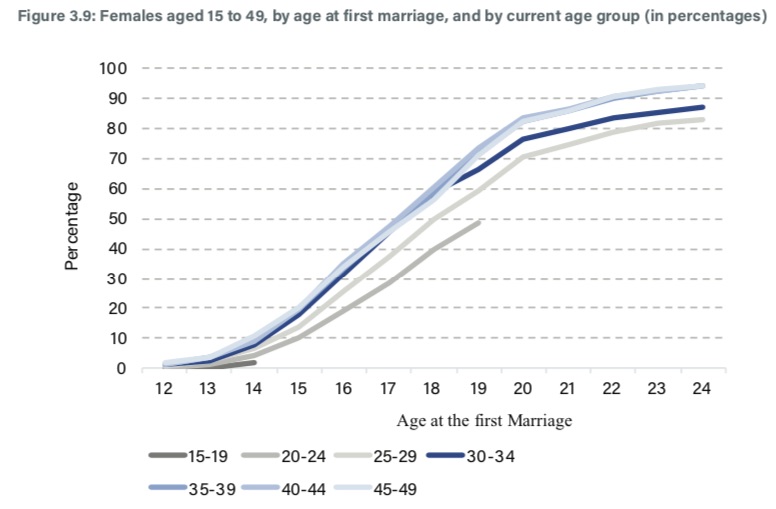
Source: Central Statistics Organisation (2018), Afghanistan Living Conditions Survey 2016-17. Kabul, CSO.


What do we know about the current situation?

The current leadership of the Islamic Emirate has not said anything about child marriage. The Taleban supreme leader Sheikh Hibatullah Akhundzada did issue a “decree regarding women’s rights” on 3 December 2021 which said, among other things, that forcing a girl or a widow to marry was illegal. However, he did not put a lower limit on the age at which girls could marry (see this Pajhwok report).[9] According to a Taleban judge, who gave his view to the author but did not want to be named, a girl must in principle have reached puberty to be married. However, if her guardian (wali), her father or grandfather, acts with her well-being in mind and there is “a good match” which could be lost while she grows up, exceptionally, he said, a prepubescent girl could be promised in marriage (kozdhda or shirin khori). The judge said that getting money in exchange for a girl of any age was illegal – haram – under Islamic law: any mahr paid had to go to the bride herself, while bride prices were illegal.

According to a recent report by Save the Children on children’s lives under Taleban rule, more than one in twenty (5.5%) of the 122 girls aged 9-17 whom they interviewed in May and June 2022 had, that year, “been asked to marry… to support their family.” The cases were more common for girls in female-headed households, which the charity said, “are experiencing the greatest financial pressures and gaps in meeting basic needs.”[10] The children in the study said that early marriages were happening:

…because families do not have enough money and are poor. Children recognise that this way of coping mainly affects girls, including very young ones. A few girls mentioned that if a girl in the family gets married, there is more money to take care of, and feed, her siblings. In addition, because older girls are no longer allowed to go to school, some parents believe that getting married instead will give them a chance at a better life.

Since the interviews for our report were only with fathers, they provide only limited glimpses into the feelings of the girls concerned, as well as their mothers. The Save the Children study did get a child’s-eye view of early marriage, although it seemed mainly from their peers, rather than the brides themselves. Girls aged 9 to 14 told the researchers how other girls in their community when they were married had been forced by their parents to give up school and/or move away to other areas. The girls worried that the same thing would happen to them and that “because of child marriage, they will never be able to go to school again, and that they will not have a future.” They said the possibility of having to marry an older man when they were still young was depressing, while they felt “frustrated and powerless” that their parents would not listen to them when it came to marriage.

None of the daughters of the four fathers interviewed had been ‘listened to’ when it came to their marriages. Girls who are engaged at this young age are never listened to. If they were, it is likely they would just cry.

Even so, of the eleven fathers contacted, most expressed shame about what they had done. They did not consider that marrying off their young daughters had been normal or good, but said that that in a situation when they were struggling to provide even food, they had been obliged to sacrifice one of their children to save the others.

The tragedy, of course, is that for most families the short-term injection of cash the marriage provided, while briefly solving the pressure and shame of owing large sums of money, did not solve the underlying problem. Most of these families were left still with no steady means of income and will be incurring more debt again soon.

Edited by Martine van Bijlert

References

References
↑1 The UN Population Fund (UNFPA) told AAN it was not currently measuring child marriage. It had earlier, under the previous regime, been giving technical and financial support for the National Action Plan to End Early and Child Marriage in Afghanistan (2017–2021), developed by the then Deputy Minister for Youth Affairs and the Ministry of Women’s Affairs. A UNFPA official in Kabul told the author that the plan was, however, never implemented.
↑2 The report of the Special Rapporteur on the Situation of Human Rights in Afghanistan cited a draft document, The UN Rapid Gender Analysis Afghanistan – Secondary Data Review (Draft 3), dated October 2021 (excerpts seen by AAN). It quoted surveys that had found “the overall rate of child marriage has increased in the face of the current economic crisis and humanitarian need, with 6% of households reporting the marriage of daughters earlier than expected.” The prevalence of child marriage as a strategy to cope with economic distress was, the report said, most common in Helmand Province, followed by Kandahar and Faryab. The Special Rapporteur’s report can be found by searching for A/HRC/51/6 on this page, see also AAN analysis here. More survey data can be found in the recent Save the Children report, Breaking Point: Children’s Lives One Year Under Taliban Rule, quoted elsewhere in this report.
↑3 The jahez are the things needed to run a household, which might include dishes and cooking utensils, bedding and furniture and for richer Afghans, washing machines, televisions and cars. The jahez is traditionally given to the bride by her father. The interviewee added that the bride price is customarily agreed on in Pakistani rupees by those living in southern and southeastern provinces or among people who are originally from these regions.
↑4 The interviewee also said: “Before the takeover of the Taleban, the bride price for a woman used to be 1,200,000 to 4,000,000 rupees (USD 6000 to 20,000), but now it’s less, around 800,000 to 1,200,000 rupees (USD 4,000-6,000) for a woman.” The bride price for young girls has always been lower.
↑5 For more background on how bad marriages and how bride prices are fundamental to assessing ‘blood money’, another means of assuaging a blood feud, see the 2011 AAN special report Pashtunwali – tribal life and behaviour among the Pashtuns by Lutz Rzehak.
↑6  For more detail about bride prices in Afghanistan see AAN’s 2015 report, “The Bride Price: The Afghan tradition of paying for wives”.
↑7 The Shia Personal Status Law provided no minimum age, but said that underage girls could be married only if their guardian proved theircompetency and puberty to a court and the marriage would be in the girl’s interest. The extraordinary gazette of the Law on the Elimination of Violence against Women (EVAW) fixed a punishment of not less than two years imprisonment for people marrying or giving in marriage underage daughters. But, as said before, this was not actively enforced.
↑8 In urban areas, the percentages of women married before the age of respectively 15 and 18 were lower, 2.1 per cent and 18.4 per cent respectively, and in rural areas, higher, 5 per cent and 31.9 per cent, respectively.
↑9 Bad marriages were not mentioned specifically by Hibatullah. However, they were banned by the first Taleban supreme leader, Mullah Muhammad Omar. It was reported at the time that he was prompted by a moving storyline in the popular BBC radio soap opera, New Home, New Life about the plight of a girl who had been given in such a marriage. See this media report and this AAN obituary of one of the show’s actors.
↑10  Breaking Point: Children’s Lives One Year Under Taliban Rule, August 2022, Save the Children. The charity said that of all the strategies adopted by households to cope with economic pressure, child marriage was not the only one affecting children. The main strategies were: children being sent out to do paid work, children having to migrate for work (6%), children leaving the household to stay elsewhere (4%), begging (2.5%) and child, early, and forced marriage (2%).

Living in a Collapsed Economy (4): The desperation and guilt of giving a young daughter in marriage 
read more

Nations Request the Lifting of Restrictions on Women in Afghanistan

The ambassador of Norway to the UN said that efforts are being made to facilitate direct communication between Afghan women and the Islamic Emirate.

Several nations requested the lifting of restrictions on women in Afghanistan during the UN Security Council Open Debate on Women, Peace, and Security.

The ambassador of Norway to the UN said that efforts are being made to facilitate direct communication between Afghan women and the Islamic Emirate.

“Afghanistan women continue to ask the international community to create the platform for them to engage directly with the Taliban, and we will continue to look for safe spaces for them to do so,” said Mona Juul, Permanent Representative of Norway to the United Nations.

“Holding such meetings and expressing support for Afghan women’s rights can definitely be inspiring in the current situation that Afghan women are in, and it shows that the world has not forgotten Afghan women. But until the declared commitments of the international community to defend and support Afghan women are actually upheld, Afghan women will not progress,” said Maryam Marouf Arween, a women’s rights activist.

During the debate, the China representative to the UN expressed his hope that women’s rights and interests would be protected in Afghanistan.

“China hopes that they will have their basic rights and their interest is protected and that they will integrate organically into the country’s economic and social life and become an important force in the peace and rebuilding of their country,” said Geng Shuang Deputy Permanent Representative of China to the United Nations.

At the Security Council meeting, US Ambassador Linda Thomas-Greenfield said that the US has formed a US-Afghan consultative mechanism.

“The US established the US-Afghan consultative mechanism. This mechanism systematically engages a diverse range of Afghan voices, particularly women and civil society leaders so their perspectives are integrated into our policy discussion,” said US ambassador to the UN Linda Thomas-Greenfield.

Ambassador R. Ravindra, India’s deputy permanent representative, called for the rights of women and minorities in Afghanistan to be respected.

However, Kabul said that human rights in Afghanistan are more fully respected now than ever before.

“Full immunity has been attained, and there is no threat to Afghanistan. Thousands of courts have been formed throughout the provinces and districts to serve the public and protect their rights. Anyone who has a problem with their rights should go to court, where their rights will be secured,” said Zabiullah Mujahid, a spokesman for the Islamic Emirate.

Many nations and international organizations have criticized Afghanistan’s restrictions on women, especially in the field of education, but the decision to reopen girls’ schools has not yet been made.

Nations Request the Lifting of Restrictions on Women in Afghanistan
read more

Ahadi: Freezing of Afghan Assets Was Political Decision

The United States established the trust fund and said it will transfer $3.5bn in Afghan central bank assets to the fund. 

Anwar ul-Haq Ahadi, a member of the Afghanistan Fund in Switzerland, said that Afghanistan’s frozen assets have been changed into a political issue.

Ahadi, in an exclusive interview with TOLOnews, said that although the Swiss-based trust fund was established more than a month ago, the $3.5 billion of Afghanistan’s frozen assets has not been transferred from the US Treasury Department.

“The freezing of these assets was a political decision, and the issue that Afghanistan’s current government has not been recognized yet is political. if the problems are solved, there is no need for this trust fund and it will be canceled. At that time, the money will be transferred to the Da Afghanistan Bank (DAB),” said Anwar Ul Haq Ahadi.

Ahadi is one of the four members of the trust fund, which was formed, according to the US, to prevent the misuse of 3.5 billion dollars of Afghanistan’s foreign reserves.

“Disbursement is based on a consensus, if one member of the fund disagrees with it, the assets will not be used. I will not agree with using the assets where there is no justification,” said Anwar Ul Haq Ahadi.

“The transfer of 3.5 billion dollars from Afghanistan’s foreign exchange reserves to the Bank for International Settlements (BIS) can help Afghanistan in maintaining the Afghan currency against foreign currencies,” said Seyar Qurishi, economist.

Meanwhile, Zabihullah Mujahid, spokesman for the Islamic Emirate, in an interview with a Turkish media outlet once again urged the United States to release the more than $9 million assets.

“More than nine billion dollars of Afghanistan that were entrusted to the US in banks, was blocked after the political changes in occurred in Afghanistan, now they (US) do not allow us to access the assets and imposed some restrictions on Afghanistan’s banks, we know that the assets are supporting money for our national currency, but the assets are the wealth of the people,” said Zabiullah Mujahid, spokesman for the Islamic Emirate.

The United States established the trust fund and said it will transfer $3.5bn in Afghan central bank assets to the fund.

Anwar ul-Haq Ahadi, former Minister of Commerce and Industry of Afghanistan, Shah Mohammad Mehrabi, a member of the Supreme Council of Da Afghanistan Bank, and Scott C. Miller, the US Ambassador to Switzerland, as well as a person from the Swiss Foreign Ministry, are the trustees of this fund and will decide on the assets of Afghanistan.

Ahadi: Freezing of Afghan Assets Was Political Decision
read more

Mujahid Says West Preventing Islamic Emirate’s Recognition

Mujahid said that some Muslim and regional countries are unwilling to recognize the Islamic Emirate because of issues they have with the United States.

The Islamic Emirate’s spokesman while traveling in Turkey said that the West, particularly the United States, has prevented the recognition of the Islamic Emirate of Afghanistan.

In an interview with the Turkish “Ilke News Agency,” Zabiullah Mujahid said that some Muslim and regional countries are unwilling to recognize the Islamic Emirate because of issues they have with the United States.

“The West is behind this; they prevent the recognition of and cooperation with an Islamic government. Although the Islamic Emirate of Afghanistan has made–and continues to make–great attempts, unfortunately, some pressures are applied,” Mujahid said.

“There is no doubt that the US government is attempting to stop everyone from recognizing the Taliban,” said Wahidullah Faqiri, a political analyst.

Mujahid said that Kabul wants to improve its political and economic ties with all nations, including the United States and Europe. Additionally, he urged investment in Afghanistan from the US and Europe.

“All nations should work with us and not be worried about us. We want to have good political and economic interactions with other countries, such interactions that would be trusted by both parties, including America and Europe. We asked Americans to invest in Afghanistan,” Mujahid said.

Officials of the Islamic Emirate have said that security issues in the nation have been resolved and that the international community should recognize the current Afghan government.

Mujahid Says West Preventing Islamic Emirate’s Recognition
read more

Treasures of Afghan History, Art and Culture

The New York Times

Oct. 19, 2022

The Guimet National Museum of Asian Arts in Paris is displaying the fruits of a century of partnership between France and Afghanistan.

PARIS — Before the Taliban demolished the Great Buddhas of Bamiyan in 2001, the figures were the world’s largest standing depictions of the deity. The destruction of the statues, which had stood for 1,500 years, remains one of the most tragic attacks on Afghanistan’s cultural heritage.

A relaxed Buddha, made of unbaked clay, from around the seventh century, discovered by Jean Carl in 1937 in an excavation by La Délégation Archéologique Française en Afghanistan, or DAFA.

Credit…RMN-Grand Palais (MNAAG, Paris)/Thierry Ollivier

With the Taliban’s return to power in 2021, that heritage has become more out of reach. But a new show at the Guimet National Museum of Asian Arts in Paris aims to bring attention to the endangered patrimony of Afghanistan by offering visitors a glimpse of some of its cultural riches. The exhibition marks a 100-year-old partnership with France to unearth and preserve Afghan treasures.

Much of what the rest of the world knows about Afghanistan’s cultural legacy was learned after the end of British influence in 1919. In 1922 a group, La Délégation Archéologique Française en Afghanistan (French Archaeological Delegation to Afghanistan), or DAFA, was founded after King Amanullah Khan of Afghanistan invited a French delegation to explore, excavate and help preserve the country’s ancient sites.

Over the next hundred years — except during periods of invasion or war — DAFA worked to uncover artifacts that filled the National Museum of Afghanistan in Kabul. With the consent of Afghan authorities, duplicates of some of those artifacts, as well as other finds, were donated to the Guimet, where Joseph Hackin, a DAFA director from 1925 until World War II, was its chief curator.

It was during this period that some of the most beautiful pieces were discovered, among them the so-called Bagram ivories, said Nicolas Engel, the museum’s current chief curator and the deputy director of DAFA from 2009 to 2013.

An excavation in Afghanistan, photographed by DAFA’s first director, Alfred Foucher, in 1924.
Credit…MNAAG, Paris, Dist. RMN-Grand Palais / image musée Guimet

A selection of such finds, along with paintings and photographs of the country’s heritage sites, are the subject of “Afghanistan, Shadows and Legends,” which opens at the Guimet on Oct. 26 and runs through Feb. 6.

It is part of the “Season of Afghanistan,” which also includes “Within a Thread’s Breath: Textile Creations by Afghan Women,” examining the country’s contemporary textile tradition.

“This museum is intimately connected to the history of the discovery of civilizations of Afghanistan,” Sophie Makariou, president of Guimet, wrote in an email. “Two years ago, together with the National Museum of Afghanistan, we had planned to bring pieces from their collection to Paris. With the fall of Kabul last year, we had to rethink the exhibition.”

A painted mural inside the niche of a Bamiyan Buddha, photographed in 1935. The walls of the niches were painted in the late seventh to early eighth centuries as backdrops for the Buddhas, which were destroyed by the Taliban in 2001.
Credit…RMN-Grand Palais (MNAAG, Paris) / Thierry Ollivier

Mr. Engel said, “Originally we wanted to create a dialogue between the two collections and then show a smaller version of this exhibition in Kabul. But things changed.”

Mohammad Fahim Rahimi, the National Museum’s director in Kabul, did not respond to emails for comment.

Without the artifacts from Kabul’s museum, the exhibition in Paris will still present 375 objects, mostly from DAFA searches and the Guimet’s own collections, with some on loan from the British Museum, the Louvre and France’s National Library.

The show covers a period from the Bronze Age to the 15th century. Bronze Age ceramics, the oldest pieces in the show, are shown alongside miniature paintings, silver plates and a large variety of sculptures in stucco and schist rock.

“A bust from Hadda draped in a Greek-style garment is a good example of the ‘Greco-Buddhist’ style of sculpture found in Afghanistan,” Mr. Engel said. “Paintings from 1935 depicting the niches of the Bamiyan Buddhas reveal their once colorful, painted murals.”

An intricately carved ivory plaque, part of the so-called Bagram ivories discovered by excavators under Joseph Hackin, a DAFA director and Guimet chief curator.
Credit…MNAAG, Paris, Dist. RMN-Grand Palais / Thierry Ollivier

The show also features the Bagram ivories, a rare collection of carved ivory plaques, owned by the Guimet, that were found in Bagram, about 40 miles north of Kabul. The ivories are estimated to date from the 1st or 2nd century.

They were found by DAFA in 1937 and 1939. Mr. Engel said that Mr. Hackin had been searching for a royal city in Bagram when his wife Marie, also known as Ria, stumbled upon two walled-off chambers.

“It is unknown whether the treasure was part of a royal stash or property of a merchant,” Mr. Engel said. “The ivories have Indian iconography; the bronzes and plasters are Roman style; the painted glass are similar to those found in Lebanon.”

The finding, Mr. Engel said, led them to conclude that Bagram had been at the crossroads of long-distance trade routes.

The ivories, as well as some belonging to the National Museum, were presented in a 2007 show at the Guimet titled “Recovered Treasures from Afghanistan” inaugurated by President Jacques Chirac of France and President Hamid Karzai of Afghanistan.

About 175 photographs in the upcoming show track a century of exploration in an unfamiliar and challenging land. Some, by the American photographer Steve McCurry, capture the vulnerability of Afghanistan’s heritage sites.

One image from 1992 shows Afghan youths playing at the foot of one of the Bamiyan Buddhas; another from 2003 shows children playing in an abandoned van next to the empty niche where a Buddha, by then destroyed, had stood.

A 1995 photograph shows armed soldiers sheltering inside the National Museum, shortly before the site was looted.

Until the 1950s, France was the only country allowed to excavate in Afghanistan. In 1950, the Afghan government allowed an American delegation to conduct archaeological activity, followed later by Italian, German and Japanese researchers.

Since 1925, the Guimet has regularly exhibited its collection of Afghan artifacts, which Mr. Engel described as some of the “most beautiful archaeological treasures outside of Afghanistan.” But, he added, the more exceptional pieces have remained inside the country, and preservation has been hindered by a lack of funds and international access, as well as poor conservation, as well as deficient conservation, particularly at the Minaret of Jam or the remains of the ancient Buddhist city of Mes Aynak.

“These are real and worrisome emergencies,” Ms. Makariou wrote in the catalog.

Still, Ms. Makariou wrote in an email, “Even if from a distance, we try to advance our understanding of the depths of Afghanistan’s cultural heritage.

“We must keep the flame of research burning.”

Treasures of Afghan History, Art and Culture
read more

Iran and Pakistan Officials Pledge to Act for Peace in Afghanistan

Pakistan’s special envoy for Afghanistan on a trip to Iran talked about the current situation in Afghanistan with Iranian officials.

Iran’s Foreign Ministry tweeted that Islamabad and Tehran will use all their capacity to ensure peace and stability in Afghanistan.

“The Islamic Republic of Iran will work with all its capacities to establish peace and prosperity in Afghanistan and for the people of Afghanistan,” said Hossein Amir-Abdollahian, Iran’s Foreign Minister.

“Pakistan and Iran have an played an important role in the past 43 years in Afghanistan, I hope they change their role to a constructive role for peace,” said Salim Paigir, political analyst.

Iran’s special envoy for Afghanistan also tweeted that in a meeting with his Pakistani counterpart there was a discussion about the current situation of Afghanistan and the people of Afghanistan, the stabilization process, and the fight against terrorism.

“We and our neighbors and other countries will continue efforts to fight against terrorism, improve people’s living conditions, and establish peace in Afghanistan,” said Hassan Kazemi Qomi, Iran’s Special Representative for Afghanistan.

“In the current situation, these countries have no choice but to cooperate because … Western countries try to create political, economic and security instability in this area,”said Javid Sandel, an international relations analyst.

The deputy spokesman of the Islamic Emirate said that Kabul urged that good relations be established with regional countries, and he said there is no security concern in Afghanistan.

“From our side, we do not have any concerns and our policy and position is that we do not want tension with any faction and we assure the regional countries that Afghanistan is not a threat to any other country,” said Bilal Karimi, deputy spokesman of Islamic Emirate.

Iran’s Foreign Ministry in a statement said that the cooperation of Iran and Pakistan could help the people of Afghanistan and reduce the devastating effects of Afghanistan’s situation in the region.

Iran and Pakistan Officials Pledge to Act for Peace in Afghanistan
read more

Group of Friends of Women in Afghanistan Calls for Reopening Girls’ Schools

They called on the “Taliban to immediately reverse the effective ban on girls’ secondary education in Afghanistan.”

The Group of Friends of Women in Afghanistan, with representatives from 27 countries, expressed deep concern regarding the increasing “erosion of respect for the human rights and fundamental freedoms of women and girls in Afghanistan by the Taliban,” including limiting access to education for women and girls.

They called on the “Taliban to immediately reverse the effective ban on girls’ secondary education in Afghanistan.”

The members of the Group urged the UN Assistance Mission in Afghanistan (UNAMA) to continue to closely monitor and report on the situation.

They also “request the Special Representative of the Secretary-General to continue to engage with all relevant Afghan political actors and stakeholders, including relevant authorities, on this issue, in accordance with the mandate of UNAMA.”

The schools for girls’ students above grade six have remained closed for more than one year and there has yet to be a final decision in this regard.

The students have repeatedly voiced concerns over their uncertain future.

“We request they fulfill their promises and reopen the girls schools beyond grade six,”  a student said.

“The only ambition that we have is the reopening of girls’ schools. With every night’s end and when morning comes, I think that they will now tell us to come to your school,” a student said.

The Islamic Emirate has yet to comment on the statement of the Group of Friends of Women in Afghanistan but earlier argued that human rights are ensured in Afghanistan.

“One day of closed schools will have massive historic and intellectual effects. I believe Afghan women have the ability in many areas, so not only schools will be reopened but also work opportunities should also be provided for them,” said Najibullah Jami, a political analyst.

The Group of Friends of Women in Afghanistan emphasized findings by the World Economic Forum that banning women from working in the government and formal sectors will cause Afghanistan’s GDP to contract by a minimum of $600 million in the immediate term and restrictions on women’s private sector employment could lead to a $1.5 billion loss of output by 2024.

Group of Friends of Women in Afghanistan Calls for Reopening Girls’ Schools
read more

Afghan women’s long and hard struggle for the right to divorce

By
Al Jazeera
Published On 20 Oct 2022

After years of abuse at the hands of her husband, 32-year-old Bano gathered the courage last year to file for divorce in northeastern Afghanistan.

“For four years, he beat me every day and raped me every night,” she told Al Jazeera, requesting that her name be changed because she is in hiding from her abuser. “If I resisted, he would beat me more.”

“He would humiliate and insult me because I could not get pregnant,” she said. “When the doctor told us that he was the one who needed fertility treatments, he came home and kicked me between the legs, blaming me for being barren.”

Just as Bano’s case was scheduled for a court hearing in Takhar province, the government collapsed in August 2021 and the Taliban returned to power.

“The judges were gone, the lawyers were gone, and with the help of the Taliban, my husband forced me to return to his house, threatening to kill my family if I didn’t,” she said.

After their takeover, the Taliban dismantled the existing judicial system, appointed their own judges and implemented their own version of Islamic law.

“There are no female lawyers operating any more, and none of the female judges has been allowed back to work,” said Marzia, a female judge before the Taliban takeover. She is also in hiding.

Taliban prejudice

Afghanistan had more than 300 female judges presiding over judicial departments that ranged from women’s issues to criminal and terrorism-related cases. Several hundred judges have since escaped to other countries, and some 70 female judges – if not more – are in hiding and unable to return to work.

“They tell us it is because they believe we [female lawyers and judges] are incompetent and do not have enough knowledge of Islamic law to work in this field,” Marzia said.

The Taliban acknowledged this position during a September news conference in which Hizbullah Ibrahimi, the head of the Taliban Supreme Court’s research and inspection directorate, dismissed the need for female judges.

“In the previous system, female judges decided cases based on specific laws and bills and did not have enough knowledge about jurisprudence and Shariah principles,” he said. “… We have not felt their need until now, and we have not understood the need for women judges to return.”

Marzia accused the Taliban of being prejudiced against women and failing to provide women their Islamic rights, including divorce.

“Without women in the judiciary, female victims cannot seek formal help and relief from the courts,” she said. “They don’t have access to their basic rights such as divorce. It is a big loss for women’s rights but also human rights as a whole. A significant population of the country has been cut off from accessing legal support.”

Justice ministry spokesman Abdul Hameed Jahadyar told Al Jazeera that divorce and family violence cases have been heard in the past year.

In Kabul alone, he said, 341 divorce cases “were settled”. He did not clarify how many divorces were actually granted.

“Any woman who wants to get a divorce can hire a male lawyer, and their case will be dealt with,” Jahadyar said. “In divorce cases, we first try to make peace between the parties and reconcile them.”

Large gender gap

The lack of women in the Afghan judiciary has left a severe gap in who has access to the justice system in Afghanistan, said Kevin Schumacher, deputy executive director of Women For Afghan Women (WAW), a United States-based non-profit organisation that works on violence against women and provides psycho-social and family counselling.

Before the Taliban takeover, WAW also provided legal support for families and operated shelters for women and children escaping abuse. Since then, however, the organisation has been forced to close down 16 shelters and 12 family guidance centres. The Taliban seized the properties, alleging that they were being used as brothels and promoting immorality.

Schumacher said that simply wasn’t true. “We were providing safe spaces along with counselling, mediation, family guidance and legal support,” he said.

“The forced closure of our domestic violence shelters left hundreds of our existing female clients in legal and social limbo,” he said. “These state-mandated shot-downs also brought thousands of ongoing family mediation and counseling services to an abrupt end.”

Many of the shelter clients had no choice but to go back to their families or reintegrate into a society where there is no social support network for them and no legal advocates to help fight their cases.

While the situation for Afghan women was not ideal prior to the Taliban takeover, Schumacher and Marzia argued that things have since gotten worse.

“The Taliban government wants to adhere to the Islamic rules, but they haven’t codified these laws,” Schumacher said. “As a result, no one knows for sure how to go about seeking or implementing justice. With a lack of judicial procedure, there’s discoordination, which is most affecting women’s access to justice.”

Stigma

Marzia said seeking a divorce in Afghanistan has always been a challenge for women.

“There is stigma towards the women, lack of awareness of their rights and also a general lack of compassion among police and judicial officials, but despite that, there were some protections in the form of institutions and mechanisms that women could appeal to,” said Marzia, who heard many divorce cases during her career as a judge.

“These women were forced to go back to their abusers who would hurt them even more as revenge for going to the courts,” she said.

Bano said she had a similar experience when she approached the Taliban courts recently after enduring more violence from her husband.

“About two months ago, he came home under the influence of opium and slapped me several times,” she said on the phone. “When I screamed, he went to the kitchen, heated a knife and burned my breasts with it. He then locked me in the bedroom and left. I was in a lot of pain, and the neighbours heard my wails and broke me out and took me to the clinic.

“Two weeks later, when my wounds had yet to heal, he brought a wild dog home. He then tied me to the ground, and let the dog claw my whole body as he laughed at me, saying, ‘Are you going to sue me now?’ My cheeks were torn and my eyes were swollen.”

Bano spent that night writhing in pain and begged her husband to let her go to the clinic the next morning. When he agreed, she grabbed the opportunity to escape. She took a bus to her brother’s home in a neighbouring province.

“When they saw my condition, they were shocked,” she said. “My mother fell to the ground.”

On the advice of an imam, they approached the local Taliban court.

“I went to the Taliban judge to show my mutilated face and body,” Bano said. “We thought that perhaps after witnessing the signs of my husband’s cruelty, they might offer me protection. Instead, a Taliban member called me a b**ch and cursed me for showing my face.”

“When we told them that we had applied for divorce with the previous courts, they beat my brother and me with the bottom of their guns for filing a case in the ‘infidel’s court’,” she said.

There is no such thing as a divorce in our court, they told her. “The judge said, ‘Your husband has the right to treat you however he likes because you are his wife. Even if he kills you, you have no right to get a divorce,’” she said.

The Taliban threatened to detain her and hand her over to her husband, Bano said, but before they could do so, she and her brother were able to flee the province with the help of the imam and remain in hiding, fearing for their lives.

“With the brief experience I had dealing with the previous courts, the situation was so much easier for women like me, to get a female lawyer, approach the courts with women judges and get a divorce, which is my Islamic right,” Bano said. “But with the Taliban in power, life is hell for women once again.”

SOURCE: AL JAZEERA
Afghan women’s long and hard struggle for the right to divorce
read more

STABILIZING AFGHANISTAN

Here’s how to promote projects inside Afghanistan that benefit and empower the people.

The Taliban waged an impressive military campaign and removed the prior government in August 2021. They know how to fight, but they clearly do not know how to run a government. The new Islamic Emirate of Afghanistan has not been able to get international recognition. Western nations have suspended most humanitarian aid while the World Bank and International Monetary Fund also halted payments. In February 2022, the United States seized the frozen reserves of the Afghan central bank, severely crippling the overall banking system. Just last month, the United States used part of these frozen funds to set up the Afghan Fund at the Bank for International Settlements in an effort to kickstart the economy without financially supporting the Taliban government, which has been systematically diverting international support to its own favored recipients.

The situation in Afghanistan is dire. Saad Mohseni, who has managed media operations in Afghanistan for 20 years, notes that it is difficult to overstate the multiple crises facing the country, including food shortages and sky-high food prices. According to the World Food Program, more than a third of the population is “marching to starvation,” and an astonishing 97 percent of the population risks falling below the poverty line by the end of 2022. Meanwhile, through its profound disenfranchisement of women—girls older than 12 have been banned from school—the Afghan government has become the most gender repressive in the world. Western intelligence experts are also concerned that the country is once again becoming a haven for terrorist groups. In the opinion of UN expert Richard Bennett, reprisals targeting opponents and a clampdown on freedom of expression amount to a further descent towards authoritarianism.

The Taliban have been totally unresponsive to pressures to change their fundamentalist policies despite the steadily worsening internal situation. One result is a growing resistance movement that encompasses the National Resistance Front (NRF) and the Afghanistan Freedom Front. So, the one positive aspect of the Taliban takeover—the secession of fighting—is in danger of disappearing, compounding the already dire situation.

In terms of alternatives, Anna Larson at the U.S. Institute of Peace sees stable democracy as an elusive prospect. Anatol Lieven at the Quincy Institute sees some potential for Taliban pragmatism and recommends that the Biden administration provide basic food and humanitarian assistance while keeping a watchful distance. Both Adam Weinstein and Saad Mohseni recommend sustained interaction with the Taliban to encourage moderating tendencies and help empower the realists.

The Taliban are notoriously fragmented. They had barely consolidated control in late 2021 when reports emerged of friction within the leadership. A more recent assessment notes that many policies still vary greatly from one province to the next as Taliban officials react to local community expectations. Many issues are still resolved via personal connections with influential Taliban figures, regardless of their official position in government. Opportunities abound to influence Taliban policies, not with pressures from outside but from within.

No international actor is interested in promoting new warfare in Afghanistan. The United States withdrew its troops. Russia is distracted by its intervention in Ukraine. China is involved in trade with Kabul but is not in any way promoting insurgency. Pakistan is presently overwhelmed with natural disasters. Turkey has been supportive of efforts to stabilize Afghanistan and promote development. There is some friction with Central Asia, especially low-level fighting on the Tajik border area, but none of these states has any interest in promoting the renewal of active hostilities.

On the contrary, there remains strong international interest in stabilizing Afghanistan. UN agencies and other international organization are working hard to prevent the country from slipping back into war and chaos.

Concrete Assistance

The United States and the international community want to support the Afghan people but without providing legitimacy to the repressive Talban government. There are no easy ways to help people at the bottom without helping the government at the top. The challenge is to develop projects that provide direct support to the Afghan people with a maximum impact at the lowest levels. These projects must be compatible with the Taliban’s basic principles and, where possible, satisfy the Taliban’s general interest in overall economic development. At the same time, these projects must meet international standards of transparency so that external support does not get diverted to the Taliban’s preferred projects.

Agriculture, the main component of the Afghan economy, is badly in need of basic improvements. One obvious possibility is providing better seed stocks, increasing crop diversity, and returning to traditional crops in areas where they have been deemphasized. Water usage is also a challenge as increasing temperatures and decreasing rainfall impact many areas of Afghanistan. This may require introducing more resilient crops, but even simple measures making water usage more efficient can provide significant benefits. Urban agriculture with hydroponic or aquaponic systems could also be introduced into Afghanistan, with facilities run entirely by women, which would be compatible with Taliban restrictions.

Agriculture needs a smoothly functioning support system. At the operational level, this means creating a network of reliable equipment providers and professional maintenance operations at the village level. This local network has to connect to reliable supply chains, both in supplying key ingredients such as fertilizer and in providing a route from farmer to customer, including export markets. At the high end, the support system needs to include agricultural processing. It is distressing, for example, that Afghanistan produces so much wheat but, because it has to send it abroad for processing, ends up buying foreign flour.

Opium remains a serious challenge. The previous Taliban government forbade it, but it became an important source of funds during the time of insurgency. Now that they have returned to power, the Taliban has officially condemned the drug, although practically it is difficult for them to destroy production. Fifteen years ago, there was a concerted efforted to turn opium into legitimate pharmaceutical products that are badly needed in the region. But both the U.S. and Afghan governments were against giving any legitimacy to opium, so the effort collapsed. But a new version of this approach to opium could be very attractive to sections of the current Taliban leadership as well as to international supporters.

Power generation remains a major challenge for the government, with almost total dependence on imported electricity. The most cost-effective approach is to reduce power use through increased efficiency in cities and in industries. Although earlier efforts to promote distributed local hydropower in Nangarhar province gradually faded away, the project could be revived. Solar, too, is a promising alternative for large sections of the country, as is biofuel, with a whole range of possible applications.

Education also provides a wide range of possibilities. Two are of particular interest. Afghan Education for a Better Tomorrow (AEBT) is an organization that links professors in the United States with universities in Afghanistan to provide classroom instruction at a professional level. AEBT and the Raqim Foundation also provide tele-medicine support with a satellite connection.

Transport is another area of potential foreign investment, particularly railroad expansion. A rail connection from Uzbekistan to Mazar-e-Sharif was established with help from the Asian Development Bank in 2010, but it was little used and associated rail developments languished. In 2020, another short rail link, this time from Iran into Herat, was established. Other efforts include a Five Nations Railway Corridor in the northern part of Afghanistan.

Finding Partners

There is a huge potential for projects that would directly benefit Afghans, be acceptable to the Taliban, and serve to empower local leaders and managers. The necessary starting point is assembling a local project team to identify specific projects. This team needs to discuss potential projects with local authorities and then build out a business plan, Then the team can discuss the project with potential supporters, including NGOs and international organizations. This effort needs to provide specific project outlines in some detail and with a clear route to implementation.

U.S. organizations, such as the Afghan-American Chamber of Commerce, the Society of Afghan Engineers, the Society for International Development, United States, and the Grand National Movement of Afghanistan could be very helpful in this regard. Such organizations could obviously provide technical and business support. They could also assemble working groups in specific areas of interest to identify potential projects, as well as possible staff and operational support, and assist them in the development of business plans. Finally, they could publicize projects to a wider audience including the Afghan diaspora.

Watching Afghanistan slip into greater poverty, hunger, and war is not the only alternative for those outside the country. In fact, outsiders can still partner with Afghans themselves in promoting development projects that provide concrete benefits to the population but also help to empower them to pressure the Taliban for internal change.

Ed Corcoran is a senior fellow at GlobalSecurity.org and a contributor to Foreign Policy In Focus. He was a strategic analyst at the U.S. Army War College, where he chaired studies for the Office of the Deputy Chief of Operations.

STABILIZING AFGHANISTAN
read more

They Forgot About Us’: Inside the Wait for Refugee Status

The New York Times

As the Biden administration prioritizes resettling people fleeing Ukraine and Afghanistan, many other refugees are waiting years in a system struggling to rebuild.

WASHINGTON — For the past eight years, Ahmed Mohamed Aden has been trying to reunite with the sons he left behind when he fled Somalia.

He sought help from immigration advocates in Wisconsin, where he was legally resettled. He filed reams of paperwork with the United Nations refugee agency. He submitted DNA samples to prove he shares a genetic relationship with his children, which he hoped would speed up processing.

But earlier this month, he learned that their applications were still pending, stuck in a backlog of people fleeing violence and persecution who hope to find sanctuary in America.

“I did everything I can,” an emotional Mr. Aden said, holding his head in his hands as the social worker assigned to his case explained that his children would not be joining him in Milwaukee any time soon. “I tried.”

Mr. Aden’s sons are among thousands of people living in limbo as delays in the U.S. refugee system stretch to an average of five years or more, according to government estimates.

The average wait used to be roughly two years, before the Trump administration gutted the refugee program with the intention of sealing off the United States from refugees and other immigrants. And the coronavirus pandemic forced many U.S. embassies to close or curtail their operations, allowing cases to back up even more.

Many of the people who have been in the pipeline for years have grown increasingly frustrated, saying they are being pushed to the back of the line as the Biden administration prioritizes those fleeing crises in Ukraine and Afghanistan.

Krish O’Mara Vignarajah, the chief executive of Lutheran Immigration and Refugee Service, said she understands that the Biden administration is working with an overburdened system inherited from the Trump years.

But, she said, her patience is wearing thin.

“We’re at a point in the administration that while we recognize how the Trump administration decimated the infrastructure, it can’t be an excuse for too much longer,” Ms. Vignarajah said. “Because lives depend on the administration stepping up.”

President Biden, who has promised to rebuild the refugee program, issued an executive order last year that directed his administration to cut the processing times to six months.

But in a report submitted to Congress last month, the White House acknowledged that the effort to provide temporary protection to roughly 180,000 people escaping Ukraine and Afghanistan “required a significant reallocation of time and resources” and “hampered the program’s rebound.” Last week, the administration said it would offer a similar status for up to 24,000 Venezuelans looking to escape their broken country, even as many more who cross the border would be expelled under a pandemic-era rule put in place by Mr. Trump.

The shift means people in desperate conditions in countries like Somalia, Eritrea and Myanmar are facing the prospect of even longer waits. More than 76,000 prospective refugees were in the system’s pipeline waiting to be cleared for travel as of this summer, according to State Department data obtained by The New York Times.

Mulugeta Gebresilasie, a case manager at a resettlement agency in Columbus, Ohio, said that refugees already in the United States have felt penalized as their loved ones languish in camps for displaced people.

“Suddenly, the resettlement agencies were focusing on Afghan people,” Mr. Gebresilasie said. “The African refugees told me, ‘They forgot about us. We have been waiting so many years.’”

The U.S. refugee system was designed to provide a legal pathway for displaced people to find protection in the United States. Applicants must be recommended by the United Nations, a U.S. embassy or a nonprofit, undergo interviews with American consular officers overseas and gather documents that can be difficult or impossible to procure in failed states: birth certificates, marriage certificates, travel documents, school records. They also undergo extensive medical and security vetting.

Once they are resettled, the refugees can petition for their immediate relatives to join them in the United States by providing DNA or other evidence of their relationship. The relative would then be interviewed at an embassy by a U.S. official before being approved for travel.

But millions of people are being admitted into the United States outside the traditional refugee program, diverting resources from those who have been waiting for years.

Much attention has been paid to migrants crossing the border in record numbers, in part because of decisions by Republican-led states like Florida and Texas to send some of them to liberal bastions like Martha’s Vineyard as a way to provoke outrage.

Those migrants can secure asylum if they can prove they would be persecuted at home; otherwise they face deportation. More than a million have been turned away on the basis of a Trump-era public health measure called Title 42, which allows the United States to expel people who would have otherwise been admitted for an evaluation of their asylum claims or placed into deportation proceedings.

In special circumstances, the United States government can grant “parole” to people from other countries, a legal tool that allows them to enter the country but does not automatically confer a green card or citizenship. That is what Mr. Biden’s administration has done in the cases of many refugees from Afghanistan, Ukraine and now Venezuela.

Over the past two years, the Biden administration has taken some steps to rebuild the overburdened refugee system, even as the president and his senior aides have debated how to unwind the Trump administration’s anti-immigration agenda. Mr. Biden has expressed concern about Republican attacks over his immigration policies, particularly as apprehensions at the U.S. southern border have hit record levels.

The White House named Andrew Nacin, a former WordPress developer who worked on immigration issues for the Obama administration, to lead the effort. Mr. Nacin is streamlining the White House’s digital services and is trying to apply some lessons learned from the scramble to assist Afghans and Ukrainians.

His team plans to expand a program, currently used for Afghans and Ukrainians, that has allowed private citizens to sponsor refugees who seek to move to the United States.

Officials also are developing a more efficient application system, modeled after the emergency response to help Afghans, that would allow refugees to do their medical exams, interviews and security screening in tandem rather than waiting years between each step.

While the administration has a goal of hiring nearly 400 refugee officers, it currently has just 240, according to data provided by Citizenship and Immigration Services.

The president has said he is committed to fulfilling a campaign promise to reverse Mr. Trump’s limits on accepting refugees. The administration recently informed Congress that it would set the annual cap on the number of refugees at a maximum of 125,000 people, the same level as last year.

Mr. Trump, by contrast, set the limit at 15,000, the lowest it has been in the history of the refugee program.

The refugee numbers include only those who are legally resettled in the United States; asylum seekers who cross the border from Mexico, for example, do not count toward the limit. Nor do the Ukrainians, Afghans or Venezuelans who come in under humanitarian parole.

But the United States has not even come close to hitting the 125,000-person limit, in part because it simply has not had enough personnel to get through the backlog.

By the end of 2021, the United States had tallied just 11,411 refugees, the smallest number since the establishment of the refugee program. The Biden administration resettled about 25,400 refugees this past fiscal year, according to the State Department.

In interviews, senior administration officials said it was unlikely they would hit their target in the coming year.

For some applicants, time has run out.

Redi Rekab, an Eritrean widower, applied more than four years ago for his two teenage children stranded in Ethiopia to join him in Columbus, Ohio. He thought their reunion was imminent after the family submitted DNA.

Almost two years later, there had been no movement in their case. His son, Tiferi, grew impatient.

A few weeks ago, Mr. Rekab, a 54-year-old warehouse worker, said he was shocked to receive a call from his son, who said he had reached Libya and needed money to pay a smuggler for onward travel. Mr. Rekab said that he has been trying, in vain, to persuade his son to wait a little longer for approval to make a fresh start in the United States, rather than take the perilous — and often deadly — trip by sea for an uncertain future in Europe.

“The U.S. didn’t help me bring my children,” Mr. Rekab said. “But they approved people from Afghanistan and Ukraine in a very short time. It shows the U.S. doesn’t value us.”

Back in Milwaukee, Mr. Aden says his sons, who are now 21 and 22, represent a gaping hole in the life he has built in the United States. They were babies when he left Somalia and young teenagers when he started the process to bring them to the United States eight years ago. He missed their entire childhoods.

His 13-year-old daughter, Aisha, who was born in Uganda while Mr. Aden waited for approval to come to the United States, has yet to meet her siblings.

“I kind of lost hope,” she said. “And I feel like they’re not going to come.”

Feroza Binti Abdul Rashid, a 32-year-old Rohingya Muslim — a minority group that has faced a campaign of ethnic cleansing — arrived in Milwaukee in the summer of 2021, but her husband has not even been interviewed by American authorities yet.

Through an interpreter, Ms. Rashid said her 5-year-old daughter will often point at airplanes in the sky and ask if her father is finally coming. Last week, she called her father on WhatsApp and said she would send him $2 to help fly him over.

“She always says: ‘I only need my dad. I don’t need anything else,’” Ms. Rashid said.

Zolan Kanno-Youngs is a White House correspondent covering a range of domestic and international issues in the Biden White House, including homeland security and extremism. He joined The Times in 2019 as the homeland security correspondent. @KannoYoungs

Miriam Jordan reports from the grassroots perspective on immigrants and their impact on the demographics, society and economy of the United States. Before joining The Times, she covered immigration at the Wall Street Journal and was a correspondent in Brazil, India, Hong Kong and Israel.

They Forgot About Us’: Inside the Wait for Refugee Status
read more