Afghan GDP Estimated to Further Contract This Year: World Bank

Amina Hakimi

Tolo News

19 October 2022

The Ministry of Economy said that the sanctions imposed on Afghanistan have affected the country’s economy.

The World Bank released a development update on Afghanistan, in which it estimated that the real GDP is projected to contract further in 2022, with an accumulated contraction of close to 30-35 percent between 2021 and 2022.

The report highlighted the economic and humanitarian challenges of Afghanistan.

The report said the economy of the country is now readjusting, and the international community’s ongoing off-budget support for humanitarian needs and basic services is expected to mitigate some of the negative impacts of the contraction but it will still be not sufficient to bring the economy back onto a sustainable recovery path.

“While there are signs of economic stabilization and resilience of Afghan businesses, the country continues to face enormous social and economic challenges that are impacting heavily on the welfare of the Afghan people, especially women, girls, and minorities,” said Melinda Good, World Bank Country Director for Afghanistan. “Living conditions showed slight improvements in the past few months, but deprivation remains very high across the country, and persistent inflation might further erode any welfare gains,” she said.

The Ministry of Economy said that the sanctions imposed on Afghanistan have affected the country’s economy.

“Due to the freezing of Afghan assets and due to sanctions on Afghanistan, the country faced a reduction in GDP. Promoting development projects in addition to humanitarian assistance is under consideration,” said Abdul Latif Nazari, deputy Minister of Economy.

“We hope our income will be better this year because the ground is paved for it. However, our fruits have been affected, our farmers have suffered heavy financial losses, but there have been a lot of exports from our mines,” said Khanjan Alokozai, a member of the Afghanistan Chamber of Commerce and Investment (ACCI).

The World Bank’s report said that Afghanistan’s Central Bank has lost its ability to manage payment systems and conduct monetary policy due to the freezing of offshore assets and its inability to print new afghani (Afs) notes

Afghan GDP Estimated to Further Contract This Year: World Bank
read more

Gay Afghan student ‘murdered by Taliban’ as anti-LGBTQ+ violence rises

The Guardian
Tue 18 Oct 2022
Death of Hamed Sabouri is latest in wave of attacks, with rights groups warning thousands are in hiding or trying to flee country

The abduction, torture and murder of a gay medical student, who was stopped at a traffic checkpoint by Taliban gunmen, is the latest victim of a string of violence against Afghanistan’s LGBTQ+ community, human rights groups warn.

Hamed Sabouri’s family and partner says he was detained at a checkpoint in Kabul in August and tortured for three days before being shot. Video of his execution was then sent to his family, who have now left Afghanistan for their own safety.

“The Taliban murdered Hamed and sent the video to his family and me,” said Bahar, Sabouri’s partner. “Hamed’s family have fled and I have been in hiding. We were like any other couple around the world in love but the Taliban treat us like criminals. They’ve killed the love of my life and I don’t know how I’ll live without him.

“I have been receiving threats from the Taliban again and I am now on the run. I have many friends from the LGBTQ+ community here in Afghanistan who have also keen kidnapped and tortured. I was arrested by the Taliban in August 2021 and again in May and June this year and was raped, beaten and tortured with electric shocks.”

LGBTQ+ rights organisations in Afghanistan say the mounting violence led many in the LGBTQ+ community to attempt to leave the country and forced thousands of others into hiding.

“The biggest fear that every LGBTQ+ person in Afghanistan has right now is that they will become the next Hamed Sabouri,” said Nemat Sadat, founder of LGBTQ+ rights group Roshaniya.

“This has been their predicament ever since the Taliban returned to power. The news of Hamed’s brutal death continues to put our community on edge but we won’t let Hamed’s life go in vain. We will continue to fight for the rights of LGBTQ+ Afghans to escape execution and live a long, and happy life in a free country.”

In an email Haseeb Sabouri, Hamed’s brother, confirmed that the family sold their two homes in Afghanistan and travelled to Turkey. “We fled from Afghanistan due to threats and murder of Hamed,” he said. “We fled because the Taliban came to our home every day to harass and threaten us.”

Gay Afghan student ‘murdered by Taliban’ as anti-LGBTQ+ violence rises
read more

Islamic Emirate Urges Turkey to Recognize Govt

Analysts believe that the Islamic Emirate must take tremendous steps to earn the recognition of the international community. 

The Islamic Emirate’s Spokesman Zabiullah Mujahid called on Turkey to engage in “deep” relations with Islamic Emirate and recognize its government.

Mujahid made the remarks in an interview with a Turkish TV channel.

The Islamic Emirate’s spokesman also urged the US to lift sanctions on Afghanistan.

“We want to have deep diplomatic relations with Turkey and other countries, so If God wills, the Islamic Emirate will be recognized through this and there will be further cooperation both in the diplomatic and economic sector,” Mujahid said.

Analysts believe that the Islamic Emirate must take tremendous steps to earn the recognition of the international community.

“The issue of lifting some restrictions on women’s work and travelling is important. The ensuring of some political and civil rights of the people is important and then, in general, the formation of an inclusive government is important,” said Shir Hassan Hassan, a political analyst.

“Turkey is an Islamic country and it is located both in Asia and Europe, and can play an important political and economic role as a liaison between the Islamic Emirate and the international community,” said Ahmad Khan Andar, a political analyst.

Speaking of women’s access to education, the Islamic Emirate’s spokesman said that efforts are underway to facilitate girls’ education under an Islamic format.

“The Islamic Emirate is paying all-out efforts to provide a safe and protected  environment under the Islamic format for women in education field and work,” Mujahid said.

Zabiullah Mujahid has left Kabul for Ankara to participate in the gathering of the Union of Scholars and Madrasas (İttihad’ul Ulema).

Islamic Emirate Urges Turkey to Recognize Govt
read more

Poverty Increasing in Afghanistan

The Secretary-General of the United Nations said in a tweet that COVID-19 is a big reason for poverty in the world. 

October 17th is the International Day for the Eradication of Poverty, and residents of Kabul said poverty is causing them severe challenges. 

On a street corner of Kabul, Malalai lives with her four children and she lost her husband last year. She said that after the death of her husband she faced economic challenges.

“I have lots of problems, there is no job, winter is coming, I don’t have funds for winter,” said Malalai, a needy woman.

The Ministry of Economic said that drought, restrictions on the banking system, freezing the country’s assets and the lack of economic infrastructure are the reasons for increasing poverty in the country.

In addition, they said that for progress economically they have prepared to modernize agriculture and the growth of industry.

“Drought, restrictions on the banking system, closing the country’s assets and lack of economic infrastructure are causes of poverty in Afghanistan,” said Abdul Rahman Habib, a spokesman for the MoE.

“Poverty is increasing in cities and villages, especially in the last year poverty in Afghanistan is mainly concentrated in rural areas,” said Seyar Quraishi, political analyst.

The Secretary-General of the United Nations said in a tweet that COVID-19 is a big reason for poverty in the world.

“Inequalities of opportunities & income are sharply on the rise, with millions plunged into poverty due to COVID19,” said Secretary-General of the UN.

Earlier, the Food and Agriculture Organization of the UN and WFP said in a report that by November of this year, nearly six million people in Afghanistan will be in an emergency situation due to starvation.

Poverty Increasing in Afghanistan
read more

Reopening of Girls’ Schools Under Consideration: Education Minister

The acting education minister made the remarks in a visit to the central province of Bamiyan.

The acting Minister of Education, Mawlawi Habibullah Agha, said that the reopening of girls’ schools beyond grade six is being considered.

The acting education minister made the remarks in a visit to the central province of Bamiyan.

Habibullah Agha said that the problems existing within the educational sector will be addressed soon.

“We will make a special mechanism for the girls’ schools. We will not plan it without any mechanism as in the previous government. The boys and girls were together. The Islamic system doesn’t allow it,” he said.

Meanwhile, female students above grade six expressed frustration over their uncertain future, calling on the Islamic Emirate to reopen their schools.

“The girls above grade six are deprived of school and are living in an uncertain fate. We call for the reopening of the schools,” said Zakia, a student.

Nargis, one of the students not allowed to attend school, is currently working at a shop in the Goshta area of Kabul.

“Since the schools remained closed, I am shopping here. I don’t like to work in the shop, I want to study,” she said.

Earlier, speaking at the gathering of the Union of Scholars and Madrasas (İttihad’ul Ulema), the Islamic Emirate’s Spokesman Zabiullah Mujahid said the reopening of the girls’ school is definite, however he didn’t give a certain time about its reopening.

Reopening of Girls’ Schools Under Consideration: Education Minister
read more

Report: Taliban killed captives in restive Afghan province

By RIAZAT BUTT

Associated Press
17 Oct 2022

ISLAMABAD, Pakistan (AP) — The Taliban captured, bound and shot to death 27 men in Afghanistan’s Panjshir Valley last month during an offensive against resistance fighters in the area, according to a report published Tuesday, refuting the group’s earlier claims that the men were killed in battle.

One video of the killings verified by the report shows five men, blindfolded with their hands tied behind their backs. Then, Taliban fighters spray them with gunfire for 20 seconds and cry out in celebration.

The investigation by Afghan Witness, an open-source project run by the U.K.-based non-profit Center for Information Resilience, is a rare verification of allegations that the Taliban have used brutal methods against opposition forces and their supporters, its researchers said. Since taking power in August 2021, the Taliban have imposed a tighter and harsher rule, even as they press for international recognition of their government.

David Osborn, the team leader of Afghan Witness, said the report gives the ”most clear-cut example” of the Taliban carrying out an “orchestrated purge” of resistance fighters.

Afghan Witness said it analyzed dozens of visual sources from social media — mostly videos and photographs — to conclusively link one group of Taliban fighters to the killings of 10 men in the Dara District of Panjshir, including the five seen being mowed down in the video.

It said it also confirmed 17 other extrajudicial killings from further images on social media, all showing dead men with their hands tied behind their backs. Videos and photos of Taliban fighters with the bodies aided geolocation and chrono-location, also providing close-ups of the fighters at the scene. These were cross-referenced with other videos suspected to feature the group.

“Using open-source techniques we have established the facts around the summary and systematic execution of a group of men in the Panjshir Valley in mid-September,” Osborn said. “At the time of their execution, the detained were bound, posing no threat to their Taliban captors.”

Enayatullah Khawarazmi, the Taliban-appointed spokesman for the defense minister, said a delegation is investigating the videos released on social media. He said he was unable to give further details as the investigation is ongoing.

Zabihullah Mujahid, the spokesman for the Taliban-run government, was not immediately available for comment.

Last month, Mujahid was reported as saying the Taliban had killed 40 resistance fighters and captured more than 100 in Panjshir. He gave no details on how the 40 men died.

The force fighting in the mountainous Panjshir Valley north of Kabul — a remote region that has defied conquerors before — rose out of the last remnants of Afghanistan’s shattered security forces. It has vowed to resist the Taliban after they overran the country and seized power in August 2021.

Ali Maisam Nazary, head of foreign relations at the National Resistance Front for Afghanistan, said: “The Taliban committed war crimes by killing POWs that surrendered to them point blank and the videos are evidence of this.”

Afghan Witness said it has credible evidence of a further 30 deaths due to last month’s Taliban offensive against alleged resistance fighters in Panjshir.

Report: Taliban killed captives in restive Afghan province
read more

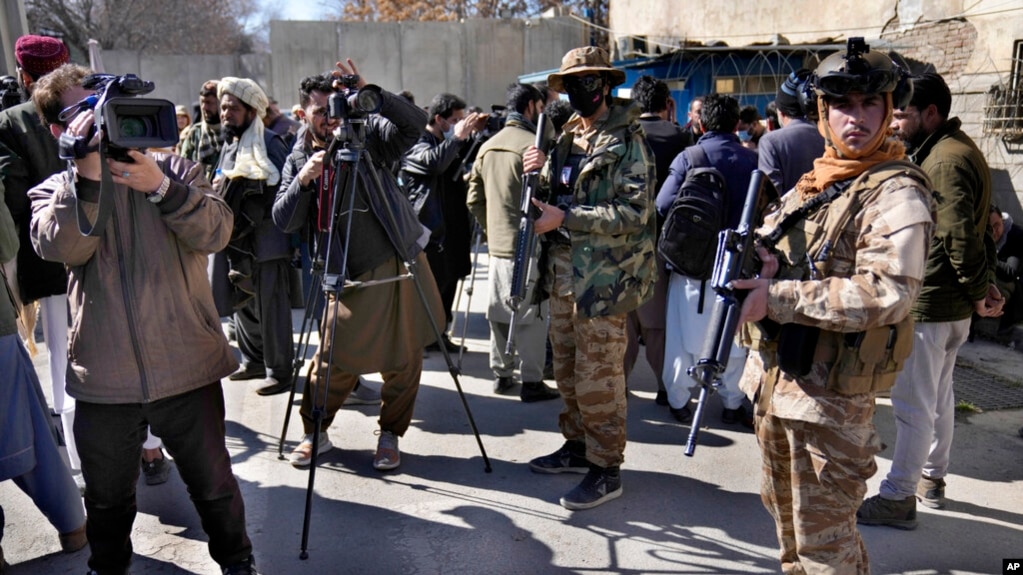
Taliban Ban Foreign Journalists on Misreporting Charge

FILE - Afghan cameramen cover a protest against US President Joe Biden in Kabul, Afghanistan, Feb. 15, 2022.
FILE – Afghan cameramen cover a protest against US President Joe Biden in Kabul, Afghanistan, Feb. 15, 2022.

After imposing a series of restrictions on Afghan journalists, including mandatory face masks for female television anchors, the Taliban now appear to be targeting foreign journalists they deem biased and critical of their governance.

In the latest move, Taliban authorities banned Stefanie Glinski, a freelance journalist, from returning to Afghanistan. Glinski had covered Afghanistan for various international media outlets over the past four years and recently reported on the desire of some Afghan women to flee Taliban rule.

“The Taliban contacted me regarding my work. I was told that ‘relevant [Taliban] departments have a few concerns’ & that they want ‘details.’ I was also accused of making allegations when I had clearly stated that it’s others making these allegations; I was simply reporting,” Glinski wrote on her verified Twitter account on October 10.

Glinski said the Taliban sought information, via WhatsApp, about her sources, but she refused, fearing doing so would put her contacts at jeopardy and compromise her journalistic integrity.

“They told me that the government will be holding all sides accountable from now onwards, and anyone found breaking the law or unable to substantiate reports […] will be dealt with according to the law, which includes cancellation of visas & non-entry to Afghanistan,” Glinski said on Twitter.

VOA reached out to Taliban chief spokesperson Zabihullah Mujahid and foreign ministry spokesperson Abdul Qahar Balkhi for comment, but neither answered his phone.

Lynne O’Donnell, a columnist for Foreign Policy magazine who was briefly detained by the Taliban in July, says she was “threatened, abused, detained, interrogated and forced to make false confessions, on Twitter & on video.”

Speaking to VOA, O’Donnell condemned the Taliban as “liars, fantasists, murderers, drug dealers, and terrorists.”

“Why would they want the truth of their method of staying in power through violence, arbitrary detention, torture and killing with impunity to be revealed to the world by journalists with integrity when their biggest aspiration is to gain the diplomatic recognition that would give them legitimacy?” she asked.

Rejecting O’Donnell’s allegations, Taliban authorities have accused her of openly supporting anti-Taliban forces and “falsifying reports of mass violations” by Taliban forces.

In August, the Taliban also detained a Pakistani journalist working for an Indian channel when he was seen filming the site of a U.S. drone strike in Kabul where al-Qaida leader Ayman al-Zawahiri was killed.

An Indian journalist who did not want to be named told VOA she was fearful of the Taliban’s new vetting and security procedures and had therefore delayed her return to Afghanistan.

Not surprising, no coincidence

“If visas have been stopped or withdrawn, it’s hardly surprising,” said Yvonne Ridley, a British journalist and author who was detained for 11 days by the Taliban in 2001 for illegally entering Afghanistan.

She said many countries, including the United States, deny visas to journalists suspected of biased reporting. U.S. officials have occasionally barred entry to journalists in recent years, such as a Yemeni journalist who was denied entry for a Pulitzer Prize ceremony in 2019.

Ridley said she recently visited Afghanistan without facing any restrictions.

“I managed to get access to all key ministers, and a main focus of my last trip was interviewing ordinary Afghan women who had never been given the chance to voice their opinions or views, ever,” she told VOA.

The Taliban are widely condemned for their restrictions on women’s education, livelihood and rights, but some Taliban officials, including high-profile Interior Minister Sirajuddin Haqqani, have sat for exclusive interviews with foreign female journalists.

Most foreign media outlets left Afghanistan immediately after the Taliban seized power last year. An exodus of Afghan journalists has ensued as hundreds of Afghan media personnel have left the country over the past year.

At least 215 of the country’s 540 media outlets have closed because of financial, social and political problems since last year, according to Reporters Without Borders.

“Two female foreign journalists have been targeted [by the Taliban], and we don’t think it’s a coincidence,” Pauline Adès-Mével, editor in chief of Reporters Without Borders, told VOA. “We consider it a big problem.”

Holding power to account

Backed by foreign donors, Afghanistan had a vibrant media landscape and progressive press laws prior to the return of the Taliban to power last year.

While Taliban officials say they are committed to a free press within the boundaries of Islam, independent observers point to their actions in limiting media freedoms and the many restrictions the Taliban have imposed on journalists.

As access to facts becomes more difficult in Afghanistan, rumors and misinformation often distort descriptions of actual events in the country.

“Access to information is [a] basic and internationally recognized right of every human being, and that doesn’t exempt Afghanistan,” said Adès-Mével. She said an information blackout will not serve the Taliban.

From O’Donnell’s perspective, journalists should hold groups like the Taliban accountable for their actions.

“Those who are not doing that are not doing their job,” she said.

Taliban Ban Foreign Journalists on Misreporting Charge
read more

The Daily Hustle: One young woman’s journey to an English course in Kabul

For many Afghans the first year of Taleban rule was marked by uncertainty and anxiety over the country’s sudden change in fortunes. Virtually every area of daily life, from banking and shopping to travelling around the country to marriage celebrations has been affected. We wanted to find out from a variety of people how an aspect of their daily life had changed and how they were negotiating this changed landscape. In this first instalment of a new series, AAN guest author, Rama Mirzada, writes about what it has been like for her, a young woman, to overcome her fears, and the anxiety of her family, at her leaving the house to enroll in an English language course.

I’m a 23-year-old Afghan woman, ambitious and with big dreams for my own future and the future of my country. In February 2021, I returned to Afghanistan from Pakistan where I had gone for undergraduate studies. I arrived home with my BA in International Relations in hand and a long-held dream of winning a coveted place at Oxford University in the UK for post-graduate studies.

That was the plan anyway.

Months later, the old government fell and on 15 August 2021, the Taleban entered Kabul the same day and with them a new era for Afghanistan began. Overnight, our country became a harder place for a woman to pursue her dreams. In those early months, I mostly stayed at home, trying to imagine what the new Afghanistan would look like and what this sudden change would mean for my own future. Life settled into a quiet routine – working from home, reading and helping my mother with chores around the house. I even started to learn Chinese online. I would leave the house once a month, with my mother in tow, to collect my salary. But I knew this was not sustainable. I had to put my anxieties and reservations aside and properly breach the four-wall confines of our house. I needed to re-engage with the world outside, renew my social relationships, upgrade my skills and revive my plans to get a master’s degree.

So in April 2022, I bought a black hijab and announced to my family that I intended to enroll in an English language course at one of Kabul’s universities. My loving parents were understandably anxious. They tried every argument they could think of to change my mind. In Afghanistan, where decision-making is often a whole of family affair, even our relatives chimed in to dissuade me. These were uncertain times, they said, no time for a girl to travel clear across town for any reason, least of all to take an English course. My parents asked if I couldn’t find a course online or closer to home. The chorus of naysayers was loud and compelling and I had to be strong to keep up my resolve. I even fibbed a little and told them my supervisor at work wanted me to improve my English writing skills – a white lie to further the cause of my education and independence.

Finally, after weeks of negotiations, sometimes lasting well into the night, they relented. The discussions about safety measures then began. They cautioned me against talking to people I don’t know, telling people where I work, and talking politics. They even hired a driver to take me to school and back. As I was leaving the house to register, my father said: “You don’t listen to anyone’s advice. That’s why I’m not going to say anything to you on this subject ever again.”

I’m not particularly brave. On the day I went to register, I was very anxious. As the car travelled the long distance between my home and the university, my parents’ words of caution were on replay in my head, but all that disappeared as soon as I walked into the university, anxiety gave way to relief. I was energised by the staff’s welcoming attitude to the women and girls who had, like me, come to register.

There were no Talebs inside the university and if anyone judged what I was wearing, I didn’t notice. I asked the staff about the rules of attire for female students – they were not too particular about this. They stressed, instead, that the classes were segregated by gender and that there were separate areas for male and female students. Later, but only much later, we were told that a delegation from the Taleban’s Ministry of Higher Education would spend ten days on campus. They would observe classes, examine the curriculum and ensure classes were in fact segregated by gender. We were cautioned to adhere to the hijab rules as defined by the new government. They have not come to inspect our classes yet.

We faced a new problem though: our class was undersubscribed. It had not reached the minimum number of students (ten) required to convene it. Our instructors said the school would have to cancel the class because it could not run courses at a financial loss. There were relatively few female students, in sharp contrast to the boys’ classes, which according to our instructors, were oversubscribed and bursting with students.

As it turned out, the numbers in our class slowly grew. A new student one day, another two the next, until we reached the requisite 10 girls enrolled in the class. Every time a new student walked into the classroom, my classmates and I would cheer and congratulate them and each other and our spirits rallied as we saw the possibility of the course being cancelled diminish.

For most Afghans, finding the spare cash to pay for the course in the current economic environment is difficult, if not impossible. The 11,000 afghanis (about USD 125) I paid for this three-month course is equivalent to one month’s rent for the family that lives next door to us. I can bear the cost because I have a job and live at home with my parents. In a country where most families have difficulty putting food on the table. I am fully aware of my privilege.

My parents have always pushed my siblings and me to excel at school, to persevere and aim high. Sometimes, I think they care more about our education than we do ourselves. These days, my mother scours the internet for post-graduate scholarships and sends me the ones she finds, even if they are unavailable to Afghans. Their support gives me the energy to dream big and stick with it. Behind every successful person are doggedly supportive parents. This is also a privilege.

In my lifetime, Kabul has always been a city of unexpected incidents – suicide bombings, sticky bombs, roadside IEDs and kidnapping. Things go back to ‘normal’ quickly and people return to their routines – work, school, shopping, family visits – grateful if the incident has not touched them and the people they love, but heartsick with grief for their neighbours and compatriots. They make some adjustments to their routines and hope the next dreaded attack does not come.

Yet ‘the next attack’ when it came, targeted students like me – women and girls taking a mock university entrance exam at the Kaaj Higher Education Centre in Dasht-e Barchi – a district in west Kabul inhabited mostly by Hazara Shia Muslims on 30 September 2022. Some 60 people, mostly women and girls, were killed in the attack.

The morning after, as I prepared to leave for school, I could read the concern in my parents’ eyes, but there was no longer any question of my not continuing with the course. In our house, the issue had already been debated and decided. And now after the attack, the stakes were even higher; people were taking to the streets in Afghanistan and abroad to protest against what they consider to be a genocide of Hazaras. Women and girls who, like me, are in education have a role to play in defining the future for ourselves and our daughters. Our job is to keep going.

There were fewer people at the university that morning. Only half of my classmates showed up. All were, no doubt, concerned about the possibility of a similar attack against our school. In the days that followed, students slowly started showing up for class and by the end of the week, the numbers were nearly back to normal.

We continue to arrive every morning on a campus segregated by gender. Although there are no male students in the building when female classes are in session – except for the instructors and university staff, who are mostly male – female students must leave the campus immediately after their classes end. Coaxed by the guards to make haste and vacate the premises, we make way for male students to enter the campus 30 minutes after our classes are dismissed. This doesn’t leave much time for us to get to know our classmates or have side conversations outside the classroom. But, for now, sharing space in a classroom where we can learn together is enough.

Edited by Roxanna Shapour and Kate Clark

The Daily Hustle: One young woman’s journey to an English course in Kabul
read more

Barnett Rubin: Counter-Terrorism ‘High Priority’ for US

According to Rubin, the Doha agreement does not specify that the US will recognize the Islamic Emirate.

Barnett Rubin, an Afghanistan expert with the Center on International Cooperation, said the US’s sending the deputy head of the CIA for talks with the Islamic Emirate indicates terrorism is a priority.

He made the remarks in an interview with TOLOnews.

Rubin said that there should be a process of discussing the elements of the sanctions.

“I prefer to say that there should be a process of discussing the elements of the sanctions because there are sanctions against the individual members of the Taliban, there are sanctions against the organizations and so on,” he said.

“I think the fact that the US sent the deputy head of the CIA … in addition to the officials in the State Department, shows that they put a very high priority on discussion of issues of terrorism,” he said.

According to Rubin, the Doha agreement does not specify that the US will recognize the Islamic Emirate.

“The Doha agreement doesn’t say that the United States will recognize the Taliban or an organization known as the Islamic Emirate of Afghanistan. It says it will recognize the government that results from negotiations among all the Afghan sides,” he said.

Barnett Rubin: Counter-Terrorism ‘High Priority’ for US
read more

Afghanistan Will Be Included in UNSC Meeting: Faiq

The Islamic Emirate said that there are no obstacles against human rights in the country and that the rights of the citizens have been ensured.

The Chargé d’Affaires of the Afghanistan Permanent Mission to the UN, Naseer Ahmad Faiq said the UN Security Council (UNSC) is expected to hold a meeting in which the situation of women, peace and security of Afghanistan will also be discussed.

The meeting will be attended by the Chargé d’Affaires of the Afghanistan Permanent Mission to the UN.

“In this meeting the countries that are not members of the UNSC will participate, including Afghanistan. The issue of the Afghan women and the concerns existing in this regard will be part of the discussion,” Faiq said.

Meanwhile, some of the women working in the former government called for their rights to be ensured.

“The women should be provided with their rights to education and work,” said Aynor Uzbek, a female rights’ defender.

“I hope the meeting focuses on the reopening of girls’ schools, women’s access to work, social and political activities,” said Marriam Marouf Arvin, a women’s rights defender.

The Islamic Emirate said that there are no obstacles against human rights in the country and that the rights of the citizens have been ensured.

“There is no concerns about the challenges of human rights in Afghanistan under the Islamic Emirate. The citizens of Afghanistan are provided with their rights within the Islamic Emirate and under Sharia,” said Bilal Karimi, deputy spokesman for the Islamic Emirate.

Afghanistan Will Be Included in UNSC Meeting: Faiq
read more