People head to the border before the expiration of a deadline for ‘illegal’ migrants to leave or face deportation.
Islamabad, Pakistan – Thousands of Afghan refugees and migrants in Pakistan are heading to the border to return home a day before a government-imposed deadline to leave the country expires.
Earlier this month, Pakistan’s interim interior minister, Sarfaraz Bugti, issued an October 31 deadline for all “illegal” refugees and migrants to leave, citing security concerns.
The government says more than four million foreigners live in Pakistan, a vast majority of them Afghan nationals who sought refuge over the last four decades after the Soviet invasion of Afghanistan in the 1980s.
More recently, after the Taliban regained power in 2021, Pakistani officials say between 600,000 to 800,000 Afghans migrated to Pakistan.
The Pakistani government claims nearly 1.7 million of those Afghans are undocumented.
Local media reports on Tuesday said nearly 100,000 Afghan immigrants have voluntarily gone back to their country from Torkham border crossing in Khyber Pakhtunkhwa and Chaman crossing in Balochistan provinces this month.
Bugti on Monday denied the repatriation drive was targeted against the Afghans. “Most of the undocumented people are from Afghanistan, and the impression that only people from Afghanistan are being evicted is wrong,” he told a news conference.
The government is also setting up deportation centres in all four provinces to detain foreigners until they are sent back. Rights groups and the United Nations have slammed Pakistan’s decision to evict the refugees.
The deportation order came during a dramatic surge in armed attacks in Pakistan, which the government blames on Afghanistan-based groups and nationals, allegations denied by the Afghan Taliban.
“There have been 24 suicide bomb attacks since January this year and 14 of them were carried out by Afghan nationals,” Bugti said on October 3 when he announced the repatriation plan.
Pakistan has reported more than 300 attacks this year, mainly in northwestern Khyber Pakhtunkhwa and southwestern Balochistan provinces bordering Afghanistan.
Adeela Akhtar, an Afghan refugee in Rawalpindi, told Al Jazeera she had “no idea what tomorrow [Wednesday] will bring” for her.
“If the police come to my door tomorrow, I will plead with them, implore them to let me stay. I cannot go back, but I don’t know how else to convince them to let me stay here,” said the 47-year-old widow and a mother of two children.
“If police come to my door tomorrow, I will plead them, implore them to let me stay. I cannot go back, but I don’t know how else to convince them to let me stay here,” she says.
Akhtar, a former school teacher in Kabul, moved to Pakistan 18 months ago after the Taliban took over as she feared for her safety. She said she applied for the Pakistani visa and made multiple visits to the United Nations High Commissioner for Refugees (UNHCR) office for securing documentation to facilitate her stay, but did not get any help.
“I have two children living here with me and I don’t want to put their lives in danger again,” she said.
Asad Khan, an Islamabad-based lawyer who provides legal aid to Afghan refugees, criticised the government’s move, saying it violated their fundamental rights.
“Pakistan’s constitution guarantees the dignity of man, and the same applies to refugees, too. We can say that under certain international laws, which have been ratified by Pakistan, sending these people back is illegal,” he told Al Jazeera.
Khan said removing Afghans who had been living in Pakistan for many years – and even decades – would be “deeply disruptive” to their lives.
“They have built homes, families and livelihoods here in Pakistan and now returning to Afghanistan surely poses significant challenges for them. The security situation in Afghanistan remains uncertain, economic opportunities are scarce, and access to essential services like healthcare and education is limited,” he said.
“Above all, the psychological toll of returning to a war-torn country cannot be understated. It is imperative that any such policy carefully considers the wellbeing and safety of these refugees and adheres to international obligations to protect vulnerable populations.”
In a statement on Tuesday, Human Rights Watch condemned Pakistan’s decision and said the government was using “threats, abuse, and detention to coerce Afghan asylum seekers without legal status to return to Afghanistan or face deportation”.
“Pakistan’s announced deadline for Afghans to return has led to detentions, beatings, and extortion, leaving thousands of Afghans in fear over their future,” said Fereshta Abbasi, the Afghanistan researcher at HRW.
“The situation in Afghanistan remains dangerous for many who fled, and deportation will expose them to significant security risks, including threats to their lives and well-being.”
SOURCE: AL JAZEERA
Thousands of Afghan refugees fleeing Pakistan as deportation deadline looms
More than 70,000 undocumented Afghans have returned home in recent weeks to meet a Wednesday deadline ordered by the Pakistani government.
The grandfather always feared this day would come.
In the four decades since he fled Afghanistan during the Soviet invasion, the man, Najmuddin Torjan, had been living illegally in Pakistan. He married there, had children and watched as they had children of their own. All the while, he felt the unease of making a life on borrowed land, seemingly on borrowed time.
This month, that time ran out. The Pakistani government abruptly declared that all foreign citizens living in the country without documents must leave by Nov. 1. Fearing arrest or prison, his family packed up everything: their clothes, their pots, their pans. The wooden beams from their ceiling. Their metal window frames and rusted doors.
After dismantling the place they had called home for three generations, they boarded a truck and joined a flood of Afghan migrants bound for the border.
“I tried my best in these 40 years to build a life,” said Mr. Torjan, 63, the truck parked behind him at the border. “It’s difficult. Now I’m starting again from zero.”
Mr. Torjan is one of more than 70,000 Afghans who have returned from Pakistan in recent weeks, according to the Pakistani authorities. The deportation order, which is largely seen as targeting Afghan migrants, is considered a sign of the increasing hostility between Pakistan’s government and the Taliban authorities in Afghanistan over militants operating in both countries.
In recent weeks, the 1.7 million Afghans living illegally in Pakistan have come under mounting pressure to leave, according to human rights groups and migrants. Landlords have suddenly evicted Afghan tenants, fearing large fines if they don’t. Employers have fired undocumented Afghan workers. The police have raided neighborhoods popular among Afghans, arresting those without paperwork.
But Pakistani officials have doubled down on the policy, declaring recently that there would be no extension of the deadline. They have established several deportation centers nationwide, signaling the government’s seriousness about detaining and repatriating Afghans.
More on Pakistan
Nawaz Sharif Returns: The three-time prime minister made a noisy return to Pakistan after years of self-imposed exile, seizing an opening in the country’s turbulent politics and economic disarray to attempt another dramatic comeback.
Imran Khan Corruption Case: An appeals court suspended Imran Khan’s three-year prison sentence, the latest twist in the political showdown between the former prime minister and the military establishment.
Cricket World Cup: When India and Pakistan meet on the cricket field, the game is often overshadowed by the icy relations between the two countries. Their latest match was no exception.
“After Nov. 1, no compromise will be made over illegally staying immigrants,” Sarfraz Bugti, the country’s caretaker interior minister, said Thursday at a news conference in Islamabad. “Those leaving the country voluntarily would have lesser difficulties than those nabbed by the state,” he added.
Map locating the Afghan Torkham border crossing between Afghanistan and Pakistan in Nangarhar Province. It also locates the town of Taxila, near Islamabad, the capital of Pakistan.
With the deadline approaching, many Afghans have faced devastating decisions about whether to try to stay in a country where they are no longer welcome or to return to one where they have not lived for decades.
Those who have opted to return have flooded border crossings in recent weeks, overwhelming the authorities and aid groups. About 4,000 people are repatriating every day, more than 10 times the number before the deportation policy was announced, according to aid groups.
At the Torkham crossing in Nangarhar Province, a mountainous piece of land along Afghanistan’s border with Pakistan, trucks piled high with decades’ worth of belongings trundle across the border each day, their engines straining. Families, many hungry and tired, lie under makeshift tents as they wait to be registered by aid groups offering small stipends. Some wait for hours; others days.
Hamisha Gul, 48, sat on a metal trunk next to stacks of cotton sacks stuffed with his family’s clothes, cooking utensils and tattered schoolbooks. His two young granddaughters, their matching green dresses caked in dust, lay on two of the bags sound asleep, while his 1-year-old grandson reached for his grandmother’s arms, sobbing.
“Take the boy — my hands are hurting. I can’t hold him,” his grandmother, Zulaikha, 52, said. Mr. Gul pulled him up from her feet and sat him on his lap. The boy buried his face in his grandfather’s chest.
“He didn’t sleep at all last night; he’s too tired,” Mr. Gul, 48, explained.
His family had left Afghanistan eight years earlier under financial strain: His son, Khan Afzal Wafadar, age 15 at the time, was supporting the entire family with the less than $3 a week he was making at a brickmaking factory.
After the family moved to the Taxila town near Islamabad, the Pakistani capital, Mr. Wafadar earned five times as much doing the same work. But this month, his boss told him to either provide legal immigration documents or leave the factory. Now 23, Mr. Wafadar said he worries about finding work in Afghanistan, where joblessness has soared since the U.S.-backed government collapsed.
“There’s a Pashtun proverb: ‘If your bed belongs to another person, they have the power to take it from you in the middle of the night,’” Mr. Wafadar said. “It’s their country; they can kick us out at any time.
As she grew up in Pakistan, her parents reminisced about the Afghanistan they remembered: the snow that blankets the capital, Kabul, in the winter. The lush mountains of the Hindu Kush. The huge lakes of bright blue water in the central valleys.
When her father said this month that the family would return, at first it felt like an adventure. The country is at peace now, he had told her, and women wear the same all-covering hijabs that Sapna did in Pakistan.
As they set off for the border, she and her 9-year-old brother painted the old Afghan flag with its red, green and black colors on the back of their hands and sang songs the entire way. She tried to put aside the warnings her friends gave her about the Afghanistan she was heading toward — and the restrictions on women the Taliban had imposed.
Upon passing the border fence, she saw the Taliban’s white flag. A sense of unease fell over her. She pulled the sleeves of her black hijab over the flag on the back of her hand.
“The old flag was beautiful,” she said. Then she whispered, “I can’t say anything negative about the white one now.”
Taliban officials have said they have established a high commission to provide basic services to returning Afghans and plan to set up temporary camps to house them. Still, many returning Afghans say that offers little solace. Among them are some of the roughly 600,000 people who fled in the past two years after the Taliban seized power, including journalists, activists and former policemen, soldiers and officials who worked for the U.S.-backed government.
For Abdul Rahman Hussaini, 56, returning to Afghanistan felt like entering enemy territory. When the Taliban took over, his former employers at a foreign nongovernmental organization advised him to apply for sanctuary in the United States under a program for Afghans who had worked for U.S.-funded organizations. The program required applicants to be outside Afghanistan to apply.
He and 11 relatives who went with him to Pakistan remained after their three-month visas expired, still awaiting word from the program. “We were living in fear every day; it was like we were in a prison,” he said.
Then came the news about the deportation policy.His landlord evicted him, and then, two weeks later, the police knocked on the door of a friend’s home where his family had moved.
Now, back in his homeland, he was overwhelmed with anxiety. He worried that any chance of U.S. sanctuary was gone. He feared retaliation from the Taliban for his prior work. He had no idea how he would provide for his family.
“Every moment,” he said, “my feeling of fear is growing.”
Zia ur-Rehman contributed reporting from Karachi, Pakistan.
Christina Goldbaum is the Afghanistan and Pakistan bureau chief for The Times.
‘I’m Starting Again From Zero’: Afghans Pour Out of a Hostile Pakistan
Andar district in Ghazni province was a battleground for most of the years of the Islamic Republic, from 2003 up until its fall in 2021. The conflict caused not only loss of life, but also severe damage and disruption to business. Andar’s economy is once again fully functional and, for the time being, it is bucking the national trend; it is flourishing. Guest author Sabawoon Samim* has delved deeply into how the final years of the insurgency affected local businesses and how, since the establishment of the Islamic Emirate, the restoration of security and the community’s past loyalty to the Taleban have shaped economic affairs within the district.
Introduction
For most of the last two decades, Andar district in Ghazni province was the site of intense battles. Its strategic location, lying on Highway One between Kabul and Kandahar and one of the ‘gateways’ to Ghazni city, as well as the fact that many Taleban fighters and leaders hail from Andar, made it a hotbed of the insurgency from its earliest days. AAN has studied this district comprehensively for many years, with reports on the conflict, economy, politics and culture. In 2015, it published, ‘Finding Business Opportunity in Conflict: Shopkeepers, Taleban and the political economy of Andar district’ which discovered how shopkeepers were trying not only to survive the conflict, but also manipulate frontlines and road closures to their benefit and their rivals’ disadvantage. This paper is a follow-up to the 2015 report and also comes up to date looking at how the district has fared since 2021.
It begins by briefly introducing the traditional economic structure of Andar as well as how it was transformed with the invasion of the United States and the installation of a new Republic government which received unprecedented amount of aid and military spending after 2001. It then details how the last years of the insurgency affected the local economy, a time when the conflict intensified and control of territory shifted in the Taleban’s favour. The final section explores the current economic state of affairs in Andar, at what has happened to the bazaars that were forced by conflict to close or move location, and at how in Andar, at least, the re-establishment of the Islamic Emirate of Afghanistan (IEA) has brought security and economic and political dividends.
Andar district in Ghazni province. Map by Roger Helms, 2023
Background
Historically, Andar had a largely subsistence economy, centred around agriculture and livestock, and to a far lesser extent, remittances from economic migrants. The main crops cultivated in the district have been wheat, beans, potatoes and grapes. People exchanged what they grew within local communities in order to meet their most basic needs. Only a small portion of the harvest was sold abroad, enabling the purchase of goods that were not locally available, such as fuel, clothing, and machinery, like water pumps, generators and radios. Livestock, as the second major economic pillar, provided other essential needs. Cows and sheep supplied food and wool, and their dried dung was used as a fuel, for cooking and warming homes during winter, and as a fertiliser. Donkeys and horses were the main means of transport. Economic migration to neighbouring countries, chiefly Pakistan and Iran, was a third, important economic strategy. Many families had someone working abroad who could send money back home so that the family could purchase necessary goods from the bazaar. For one community elder, life was then far more straightforward:
In the past, all we ate and used came from the community. Life was simple and we didn’t need most of the things that have now became a necessity in life. We didn’t go to Ghazni [city] for months. Even if we had important things we needed to buy, one man from the entire village would go and buy everything for everyone in the village. We didn’t know what oranges, okra or vegetables were. All we ate were potatoes, shkana [onion and potato soup] and natar [a dish of buttermilk and broken-up pieces of bread]. People also didn’t have the kinds of clothes people have nowadays. Unlike nowadays, people didn’t need to go to the doctor for treatment. We had our own, homemade treatments. There were no cars or motorcycles, and so we didn’t need to take them to the mechanic or fill them with fuel. Life wasn’t as complex as it is today.
This equilibrium really began to change in 2001 when Afghanistan drew global attention following the 9/11 attacks, the United States overthrew the Islamic Emirate and the Islamic Republic was established and an unprecedented amount of aid flowed into the country. The exceptionally high levels of development aid and military spending raised living standards and drove economic growth – although always with concerns that the growth was not sustainable. Roads, hospitals, schools and telecommunication services were established, connecting previously isolated and inaccessible rural areas to Afghanistan’s relatively modern and often culturally distinct urban centres, and the world beyond. Andar was no exception to these national trends.
The consumption of imported consumer goods soon became a well-entrenched norm. Local bazaars were the primary benefactors of this phenomenon, with merchants bringing in outside goods from major bazaars in cities such as Ghazni. These local bazaars grew in size and number and the imported goods they sold became more varied. This growing trade meant the bazaar business became a major source of income for people in the district. Hundreds of shops were newly established in the old bazaars and new bazaars were set up in different localities. Most villages saw one or two new shops.
The main beneficiaries of this new trade in Andar were the established bazaars of Mirai, Nanai and Chardiwal. Mirai bazaar is host to Andar’s district centre and government administration, while Nanai is located on Highway One that passes from Kabul through Andar to Kandahar and Chardiwal bazaar lies on the road between Gardez in Paktia and Ghazni highway.
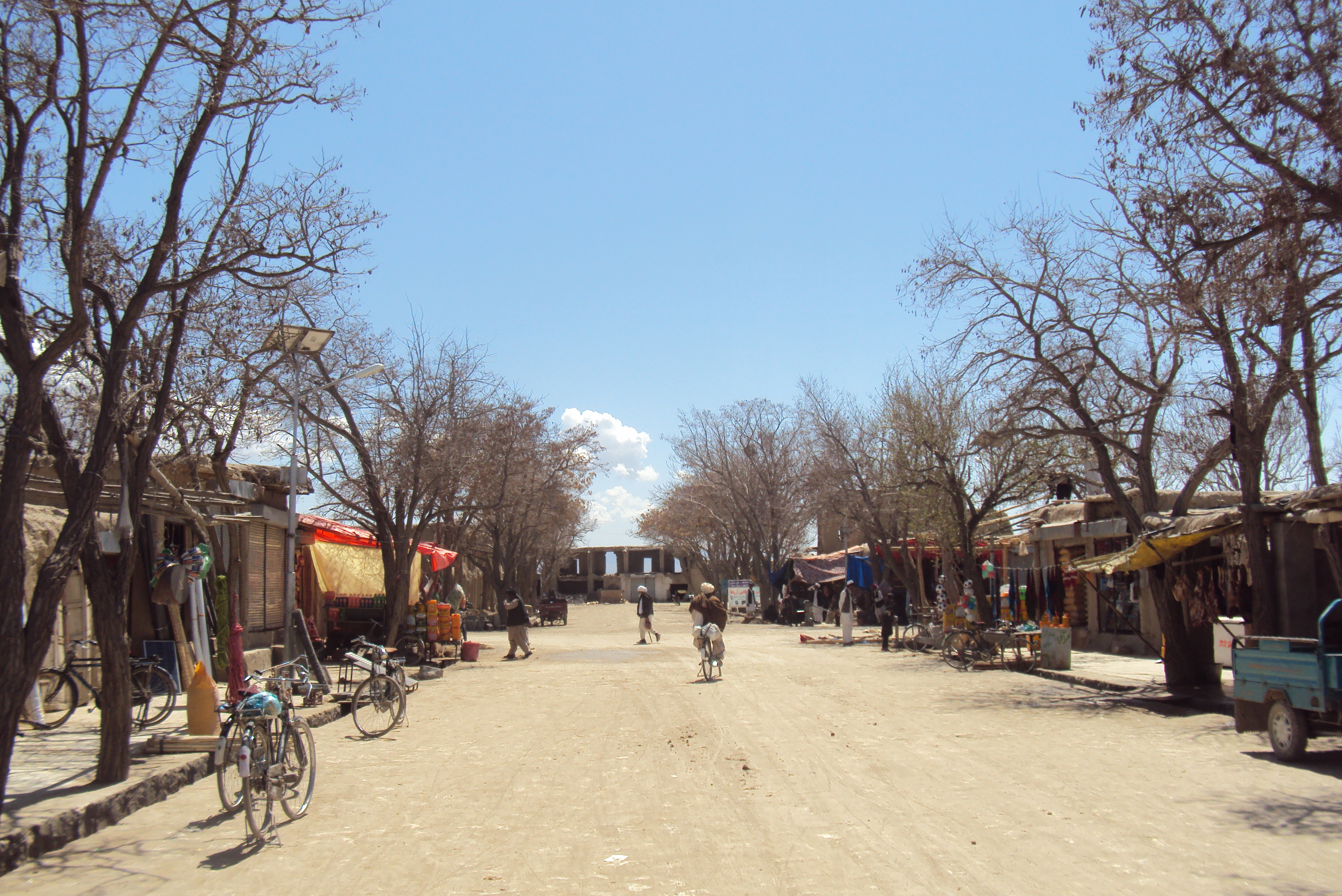
Mirai Bazaar in Andar district, Ghazni, in 2013 when it was still partly functional. From 2017 onwards when the conflict intensified, almost all traders moved their shops to Kamalkhil or Nazarwall. Photo: Fazal Muzhary, March 2013
Business in these bazaars flourished until the Taleban insurgency gained momentum in the area. The first blow to the bazaars of this growing insecurity was in 2009, when insurgents closed Mirai bazaar to prevent people from voting in the presidential elections. While the bazaar later reopened, it did not function properly after its first closure in 2009 during all the years of the insurgency (for more details see the 2015 AAN report).
With the conflict intensifying in the district, other bazaars also fell victim to it. Nanai was the site of vicious battles between the Taleban and Afghan National Security Forces (ANSF) as well as the US-led foreign forces when they were actively engaged in combat in the period up till 2014. The bazaar, though not formally closed until the end of the insurgency, was a frequent site for Taleban attacks, to the point where people did not dare visit it and it was de facto closed.
Chardiwal, while not host to any government administration, witnessed frequent attacks on passing ANSF convoys travelling to the Bandi Sardi military base and onto Paktika province. It also became too perilous for shopkeepers to do business and customers to visit.
One such businessman in Chardiwal was Anwar, who rented two large shops, selling chickens, vegetables, fresh fruit and beverages. He told the author that his shop was always crowded with customers as his prices were lower than the rest of the bazaar and he always made sure he had fresh fruit and vegetables in stock. Business was booming. Then in 2016, the Taleban planted a landmine in front of his shop in the middle of the night, which the next morning detonated beneath a passing Afghan National Army (ANA) convoy, killing and injuring one soldier and several civilians. Though Anwar survived, he was beaten in the aftermath of the attack by soldiers who blamed him for facilitating the attack.
A few months later, he said he received a phone call from a local Taleban commander who asked him to come to a mosque in a nearby village. When he went there, he was again beaten and imprisoned for a week, this time accused of helping the ANA. Anwar did not go into greater detail, but his story illustrates how vulnerable local businesses could be to the suspicions and allegations made by all of the warring parties.
The more the insurgency intensified, the more the bazaars suffered. However, around 2017, two of the three major bazaars, Mirai and Chardiwal, each received a severe blow. In October of that year, the Taleban besieged Mirai, Andar’s district centre, destroying dozens of shops that were hit by rockets and heavy machine gun fire, and causing the complete closure of the bazaar. Meanwhile, the Taleban also chose to destroy and seal the road connecting Ghazni to Paktika where Chardiwal bazaar is located. This led to Chardiwal’s complete closure as traders quickly vacated the bazaar and businesses collapsed. The ANA conducted several military operations to reopen the road, and also the bazaar, but faced intensive Taleban attack. Almost all operations failed. The entire bazaar was abandoned in the following year, leaving empty shops covered with bullet and rocket holes.
Anwar was one of those traders forced to abandon their shops. He left his thriving businesses and moved all the goods from his shops to his home. “When I calculated the loses [of abandoning the shops], it was over 200,000 kaldar [Pakistani rupees – roughly USD 1,800 at that time]. Most of the goods were wasted; others expired,” he told AAN.
By 2018, no major bazaar was fully functioning in Andar. Nanai remained technically open, although the clashes between the Taleban and Republic’s security forces meant a virtual shutdown. While business people had lost their trading centres they, along with the local population, did not give up, but found new ways to do business.
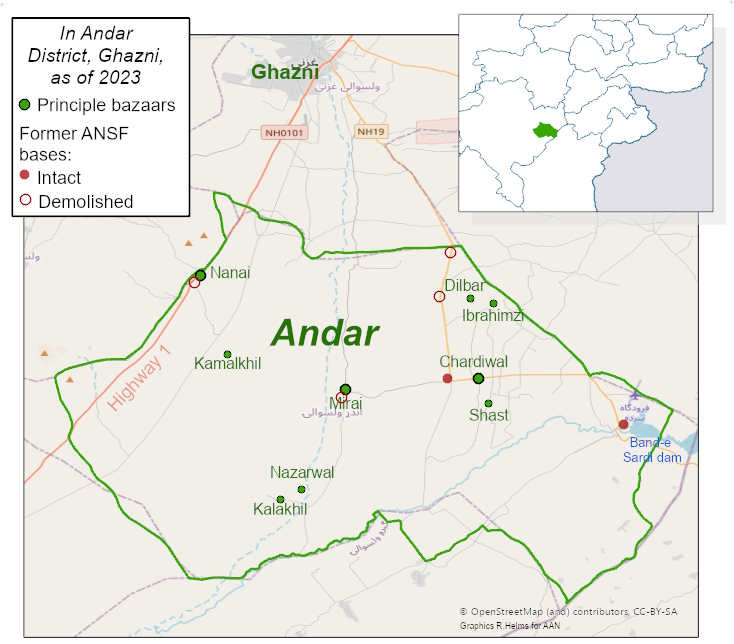
The bazaars of Andar district, Ghazni: the old ones, now re-established, are shown with larger circles, the ‘conflict bazaars’ where shopkeepers and customers fled are shown with smaller circles. Also shown are military bases. Basemap by Open Street Map. Graphics by Roger Helms for AAN, 2023.
War also creates bazaars
Andar was not a district where the conflict triggered major displacements. Aside from periods when there were major clashes between the Taleban and short-lived ‘uprising’ or local resistance forces, or sieges of the district centre, the vast majority of people, particularly in areas controlled by the Taleban continued to live in their homes (see an AAN report on the uprisings in Andar here).
When Mirai and Chardiwal bazaars closed, the local population could no longer meet their needs inside the district, so their only option was to travel to nearby Ghazni City. However, that journey was both costly and risky, as one shopkeeper described:
When the bazaars closed, people would go to Ghazni for their needs. They’d need more time and money to go there. Those who had cars were spending an extra 500 afghanis to fuel their cars. Those who didn’t were spending 200 afghanis on the bus fare. Importantly, it took an extra half-hour to get to Ghazni and then another half-hour to return. So, it was far away and difficult to get to. Clashes were routine on the road [to Ghazni] and passengers were often stuck in firefights.
Another interviewee also recounted the importance of local bazaars and the impact of their closure:
In the past, when we needed to repair a water pump or a car, we’d bring it to the mechanics in Chardiwal. Reaching there was easy and took less time than going to Ghazni. But when they closed, we’d travel to Ghazni just to purchase something or repair a machine or a car. [Traveling to Ghazni] was an additional burden on us.
Shopkeepers with businesses in the closed bazaars had to find ways to re-open them. It was their sole source of income and they wanted to respond to the needs of local people. They were also under pressure from the Taleban movement, which pushed shopkeepers to re-establish or move their businesses into the areas it controlled. This was in the Taleban’s interest for a number of reasons: it helped them win people over from the Islamic Republic, painting a good picture of their own then shadow government, as well as meeting their practical needs. The Taleban needed to purchase fuel, use mechanical services for their cars and motorcycles, have private clinics open for their wounded fighters and obtain raw materials for making IEDs and suicide bombs. These bazaars also served as hubs for the movement to gather, plan, drum up support and recruit.
As a result, a number of new bazaars were established in Taleban-controlled areas. In fact, the new bazaars were effectively the same old Chardiwal, Nanai and Mirai bazaars, only relocated to safe areas and splintered into pieces.
Mirai bazaar was steadily moved, from 2017 onwards, to a nearby village named Kamalkhil where a small bazaar had already existed. Another portion of it was established in Nazarwal, another nearby village. Almost everything that was available in Mirai moved to Kamalkhil or Nazarwall – from mechanics, doctors, and tailors, to photocopiers, clothes and mobiles.
The Chardiwal bazaar, for its part, had a similar fate. Initially, it was divided into two major and several minor parts. A substantial portion of it moved to Ibrahimzi, already a small bazaar and known for being the Taleban’s shadow district centre. At the same time, the Taleban re-routed the Ghazni-Paktika highway, away from the paved road and switching to a small, dirt track that passed through Taleban-controlled villages near Ibrahimzi. This, along with competition and the lack of space in Ibrahimzi led some shopkeepers to create a new bazaar, just three kilometres away from Ibrahimzi, along the now Ghazni-Paktika highway dirt track. The new bazaar was called Dilbar.
Anwar said his friends, after several months’ effort, managed to convince him to restart his business in Ibrahimzi. “I didn’t want to re-establish my shop because Ibrahimzi is so far from Chardiwal that I didn’t think I’d get enough customers there,” he said. Though the cost of relocation to a new place was heavy, he said his decision soon paid off and his shop again attracted enough customers in Ibrahimzi.
A short while after that, shopkeepers from the eastern parts of Andar also decided to set up a new bazaar, to meet the needs of the large population in those areas that did not have a replacement for the abandoned Chardiwal bazaar. The new bazaar was located in Shast village, only two kilometres from the paved road, and from Chardiwal. This was created after the Taleban cleared the remaining ANA and Afghan Local Police (ALP) bases from the road, leaving the area almost totally under their control. Shast bazaar quickly became well-known, attracting customers with its newly built shops and ample space, as well as its proximity to Chardiwal. Most of those shopkeepers from Chardiwal who had abandoned their businesses re-established them in Shast bazaar. It also attracted new businesses.
This was not an easy period for shopkeepers or customers and the disruption was sorely felt. Mirai bazaar in the district centre had enjoyed an easily accessible location, with a paved road, mobile networks and government administrations delivering official services. This was in sharp contrast with the new substitutes, KamalKhil and Nazarwall, which had none of these advantages. People living in the northern corner of the district, with its unpaved roads and long distances felt no longer served by anyone. Competition added further complications. The newly established Dilbar bazaar, for instance, became an alternative to the slightly less recently established Ibrahimzi bazaar, and attracted customers from the southern villages of Andar, who had previously had to travel to Chardiwal or Ibrahimzi. As a result, shopkeepers from Ibrahimzi tried to make trouble for the new Dilbar bazaar. According to one resident, they even complained to the Taleban about why the movement had given permission to establish a new bazaar.
By the end of 2018, most parts of Andar, including the district centre, had come under Taleban control. Andar district centre fell to the Taleban in October 2018 which resulted in the reopening of Mirai bazaar. As the fear of conflict abated, Mirai eventually grew back to what it had been, shopkeepers returned and new businesses opened. The situation in Nanai, however, did not improve. The attacks on the highway persisted; the bazaar suffered. The fate of Chardiwal, due to the proximity of two besieged ANA bases, also remained the same.
The new bazaars such as those in Kamalkhil, Ibrahimzi, Dilbar, Kalakhil, and Shast were flourishing, thanks in large part to the relative stability of Taleban control. As the conflict became restricted to only a handful of bases and checkposts, and the bazaars located far from government’s reach in the heart of Taleban areas, security was unprecedented for customers and the shopkeepers who had resettled from Chardiwal, Mirai and Nanai. The bazaars remained open till midnight. For customers, living in uncontested areas, life was relatively peaceful, so long as they did not wish to travel too far.
The end of the war and the economy of Andar today
The Taleban victory in 2021 brought deep relief to the residents of Andar. The burdens the war had placed on them and their economy had been severe throughout the insurgency, but particularly so after 2009. Although Andar like the rest of Afghanistan had seen general economic growth and development because of foreign funds coming into the country, still, local businesses in the district had suffered from the violence and upheavals, the atmosphere of suspicion and resulting harassment from both the Taleban and Republic’s forces. Many shopkeepers were forced to relocate, the cost of which was inevitably passed on to their customers. Others had their shops hit and burned during the violence.
Violence in Andar ended in July 2021, almost a month before the Taleban completed their grip over Afghanistan on 15 August, after the last two military bases in Andar surrendered to the Taleban. The Ghazni-Paktika highway and the road to Mirai were immediately reopened.
When the Emirate was re-established, international aid to Afghanistan immediately dried up, leaving the aid-dependent country’s economy in disarray. After a while, donors again started channelling humanitarian aid to Afghanistan to tackle the dire economic situation. The new authorities, for their part, also took some steps to stabilise the country’s economy (see thisAAN dossier on Afghanistan’s economy). The dramatic economic decline after August 2021 has bottomed out, but the economy remains fragile, with service, agricultural and industrial sectors continuing to contract and many families in dire poverty (see here for the World Bank’s annual development update, published this month, and its latest welfare monitoring survey).
However, the contraction of the economy since August 2021 has not affected Afghanistan’s different regions with equal magnitude. Some areas, such as Andar, which were badly affected by the war, have run contrary to the wider economic decline. The re-establishment of the Emirate and the end to conflict, fragmentation and instability in this district appears to have brought growth and new opportunities. While there are no official statistics to prove this, there are still ways to gauge the economic progress in Andar, or at least stability. One is to look at what has happened to the bazaars. They show an economy where people want to invest, where rents have increased and there are customers, indicating a possible increase in disposable income.
With the war over, roads across Andar reopened and the old bazaars came back to life. Mirai bazaar fully re-opened, having been only partly functioning since 2019 because of the broader insecurity and the closure of the paved road. Chardiwal also steadily started to reopen. The highway shifted back to the paved road that passed directly through Chardiwal. Local residents and shopkeepers more assuredly started to re-establish the damaged shops in Chardiwal as the prospects for the ANA and of the fight returning faded. Nanai bazaar also became secure as the Republic’s military base and passing convoys were no longer targets.
The three major bazaars in Andar once again grew larger in size. Businessmen and residents endeavoured to reap the benefits of the new business opportunities and moved their shops back to their original locations. The insurgency-era bazaars have all been abandoned, with the exception of Ibrahimzi and Kamalkhil, which still function, but are greatly reduced. Shop rents mirror the changing demand: in Chardiwalrent for a shop was roughly 50,000 Pakistani kaldar before August 2021, but almost tripled afterwards. For many, such as this shopkeeper in Chardiwal bazaar, they had first to invest before they could reopen:
The door of my shop was hit by an RPG during a clash. It was completely destroyed, along with many of the goods inside. I don’t exactly know whom, but one of the warring sides had entered my shop and looted whatever they could get themselves. The shops of my neighbours were completely burned when hit by mortarsor airstrikes. Shopkeepers suffered a lot of financial losses in these battles. When the war ended, I rebuilt my shop and bought a new door. The repairs cost me 150,000 kaldar [roughly 600 USD at that time].
In both Chardiwal and Mirai, there was also a demand for big new shops. The land surrounding the bazaar in both places belongs to the government and the new IEA administration decided to rent it to people who wanted to establish shops, markets and other businesses. They started giving official permission to rent out plots of land based on a fixed annual rate. This, in turn, created large-scale competition between businessmen. “Everyone was trying to get more land,” said a shopkeeper from Chardiwal. “People were using their personal connections with district [officials]. Some even sold their permission on to others.” The owner of a newly built market in Mirai, explained how he had decided to invest:
Anwar, the shopkeeper who relocated his business from Chardiwal to Ibrahimzi has also moved back. His old shops had been destroyed in the conflict and he had to rent new shops and build his business up again from scratch. Although rents are now twice as high as he paid earlier, he was not complaining: “I am grateful to Allah that now, no one beats me, no one imprisons me and the clashes are gone.”
Chardiwal bazaar in Andar, Ghazni, in satellite images from 15 August 2021 and 23 September 2023, new construction highlighted. Image from 2021 from Maxar Technologies. Image from 2023 from the European Space Agency’s Pleiades satellites. Graphics by Roger Helms for AAN, 2023.
The single major contributor to the growth of bazaars in Andar has been the end of the war. One resident of the district described how improved security had changed the dynamics of visiting Mirai bazaar in the district centre:
When I was going to the bazaar during the war, I’d try to do my shopping as quickly as possible. At specific times, known to be the patrol times of the ANA, the shops closed and people evacuated the bazaar just to avoid getting stuck in firefights. In particular, we’d go home before darkness, as the police checkposts were harassing people or they, themselves, were attacked. Now, in contrast, I come here whenever I want. Last week, we had a health emergency and I had to bring the patient to the doctor at midnight; so I went to Mirai. There were three doctors on duty. They checked her, gave her medicines and we returned at two in the morning. This would have been impossible two years ago.
Another resident recounts how different a visit to Nanai bazaar now is:
During the war, when we were going to Nanai, we weren’t sure whether we’d come back alive or not. On the one hand, there was a [government] checkpost near the bazaar, and the Taleban used to attack it, without care for the bazaar. On the other hand, checkpost soldiers were making problems for us, checking our mobiles, accusing peoples from our areas of being Taleban and Taleban supporters. They detained whomever they wanted on charges of being a Taleb or a Taleban tarasudchi [spy]. Now, you can go day and night and purchase whatever you want. No one asks you where you come from or where you’re going.
For shopkeepers, the new security environment means they can do business without fear, as one described below:
During the war, we had many problems. The Taleban were beating shopkeepers for selling things to army soldiers. Government forces were detaining shopkeepers for helping the Taleban plant landmines or passing on information about coming tanks, not to mention the arbaki [ALP] who were freely taking whatever shopkeepers had in their shops. Now, praise be to Allah, all this has ended. No one bothers you. No one labels and harasses you for being a Taleb or an arbaki.
Moreover, businessmen who brought goods from Ghazni City to the local bazaars, as one interviewee recalled, were compelled “to pay bribes to several police check posts” along the highway, which also ended with the end of conflict. He explained it below:
The bribes were too high and irregular. If there was a problem with the checkpost, they’d demand a big sum and if you didn’t pay it, you’d have been beaten and even shot. It led many tijaran [merchants] to stop importing goods because the harassment and its effects on businesses were unbearable.
Furthermore, with the cessation of hostilities, people from every sector of society now dare to freely travel to bazaars. During the insurgency, a large portion of people simply avoided traveling to certain areas and bazaars: those who lived under the Taleban were at risk of being labelled as pro-Taleban and harassed by the government side, which controlled the district’s main bazaars until as late as 2017. Then, after 2018, when control of most bazaars in the district fell to the Taleban, those seen as affiliated with the government found their freedom of movement was curtailed. These restrictions fragmented and harmed the district’s economy. Now, the bazaars are bustling, as one interviewee in Mirai described:
Look how many people are here. They are perhaps in the hundreds. Consider me, I’m not rich but come [to Mirai] thrice a week and every time I come, I buy something. Everyone does so. People eat [potato] chips and ice cream, their cars consume fuel. Some come here for the internet, and use credit cards. They buy bindai [okra] and vegetables. You see few people who don’t spend money while visiting bazaars. In fact, those who don’t have money don’t come. Yet, the bazaar is still overcrowded. I think in the next two years it will be difficult to handle the traffic without traffic police.
The economic basis for Andar’s recovery
At the start of this report, we looked at the three traditional pillars of Andar’s economy – crops, livestock and remittances. In Andar, as elsewhere, in certain areas, land could not be cultivated due to the risk of firefights. Several interviewees indicated their harvests had been burned, despite local Taleban ceasefires during harvest, because of clashes between the warring sides. These losses, of crops, homes and lives, are no longer happening.
When I saw people desperately searching for shops, I thought, well, now the war is over, people in Andar are rich, and rents have already soared, so why not invest here more than anywhere else? It doesn’t require much money, and when one sees the rush of people, it seems that things might work out well. I went to the district municipality, and asked permission to build a two-storey market. I started last summer [early 2022] and the work is half done. My estimation was correct: even before my market was completed, many people have asked to have one, two or three shops rented to them.
The persistent problem of drought has harmed the sector, but not so badly as it has in other provinces, including neighbouring ones. Whereas traditionalwatering systems (mainly karizes, or underground tunnels)[1] vanished long ago, most farmers now rely on solar-powered irrigation pumps, which also offer some protection from inflated fuel prices. The running costs are minimal. However, groundwater is declining, so along with the need to dig ever deeper wells and buy an additional solar panel each year to continue to reach the groundwater, there is the looming threat that it may run out or become too deep to access in the future.
However, one of the main reasons that Andar’s economy is functioning well is the other economic ‘pillar’ – remittances. These have probably replaced agriculture as the main sources of household income in the district. There has been a growth in economic migration to the United Arab Emirates, Saudi Arabia, Pakistan and Iran and the majority of families, according to the estimates of several community elders, have at least one member working abroad who sends money back home. This has kept the economy running, sheltering it from the worst impact of economic travails inside Afghanistan.
For Andar, there has been another new source of income, post-2021. It was long a base of Taleban support and has been rewarded by the new order. As well as supplying ordinary fighters and commanders, scores of fighters from the district were recruited to the Taleban’s Red Units (special units) and deployed during the insurgency against the Islamic State Khorasan Province (ISKP) in Nangrahar. Andar has another advantage. It hosts a grand madrasa, Nur al-Madaris, which is among the most highly respected and oldest religious institutions in Afghanistan, and is famous nationwide among Taleban.
Since the re-establishment of the Emirate, a significant number of residents from Andar have been appointed to senior government jobs. They include the Minister of Urban Development and Housing Hamdullah Nomani, the commander of the Khalid bin Walid Army corps (one of the eight corps) Abu Dujana, the former minister of education Shiekh Nurullah Munir, the Director-General of Dawat wa Irshad[2] Mawlawi Hashim Shahidwror and the Deputy Minister of Education Mawlawi Abdul Khaliq, as well as more than a dozen other mid-ranking officials.
The estimate from multiple Taleban officials and former commanders and fighters in conversation with the author is that thousands of men from the district, who were fighting or working with the movement, or who indirectly supported the insurgency, now hold government jobs. One interviewee, in his 60s, said that, as long as he could remember, “this is the first time so many people [from Andar] hold jobs in government.” Similarly, Andar residents whom the Taleban had previously prohibited from taking up jobs in the NGO sector, with the exception of the health and education fields where they were allowed to work, are now not only allowed, but actively favoured by the Emirate for these positions. The author has come across several incidents where Taleban introduced Andar residents for positions in NGOs operating in Ghazni province, thanks to their past loyalty to the Taleban.
International aid, which was difficult to deliver during the insurgency because of the violence, has also contributed a significant amount to the new economic stability in Andar. Humanitarian aid is delivered to the most underprivileged segment of society that lacks alternative sources of income, lifting the burden of those in direst need, as community leader in his 40s explained:
In Andar, those who have a musafir [someone who has migrated], or land or a job in government or an NGO have a good economic position. But what is good is that those who have none of these, now benefit from aid [mrasty]. The Taleban are bringing NGOs here and helping the poor regularly. They’ve got cards [proving their eligibility for suppor], and get food and cash from various NGOs.
Finally, there are also the costs associated with war and the old regime that no longer apply. Feeding and funding the Taleban used to be a daily burden for Andar residents. Locals were also bound to allocate a certain portion of their crops to the Taleban (ushr) and, in recent years, a tax on some of their assets (zakat). At the same time, they faced demands for bribes from the Republic’s security forces, often at each police and ALP checkpoint along the highway, and from officials in government offices.
The Taleban still collect taxes, but this time as the government, the majority of interviewees agree it is at a lower rate and is less of an annoyance than the illegal bribes they had to pay to the Republic’s security forces and officials. One interviewee recounted: “In the past, we paid taxes three times: first the official tax to the government, second, huge bribes to the police, and lastly, to the Taleban at checkpoints in their areas. Now, only the Taleban take a specific amount of money as tax.”
Before and after the fall: satellite images of Mirai bazaar on 15 August 2021 (from Maxar Technologies) and 23 September 2023 (from the European Space Agency’s Pleiades satellites), with new construction highlighted. Graphics by Roger Helms for AAN, 2023.
The end of the war – what has changed?
The cessation of violence had brought the people of Andar deep relief. Farming and trading can go on undisturbed, businesses have been re-established and the district’s affiliation with the Taleban has brought hundreds of jobs. Alongside all that, remittances have continued to flow. Overall, the economy in Andar is relatively stable, with some signs even that it is flourishing. One interviewee, for example, gave an unusual illustration of Andar’s relative wealth:
Since last winter, the number of beggars sitting on the Ghazni-Andar road has been increasing day by day. I’ve talked to many of them and most aren’t from Andar, but come from Ghazni city. Their numbers are growing because they collect a good amount of money – the people of Andar are wealthy and help the poor to a large extent. These beggars do a good business; otherwise, if they weren’t collecting good money, you wouldn’t have seen even one in that area.
Andar’s economy has countered the overall economic decline, at least in comparison with other areas in Afghanistan. So long as remittances keep coming in and there are funds to pay those working in governments and NGOs, the district should be fine – excepting the threat hanging over Afghanistan as a whole, of the climate crisis with its protracted and ever more frequent droughts and the fear that eventually, the solar-powered pumps will not be able to reach water. For now however, the battering this frontline district took for so long is over. Andar has weathered the political and economic turmoil of almost twenty years of war and its residents, whether shopkeepers, farmers or newly-appointed government employees, are enjoying the calm.
* Sabawoon Samim is a Kabul-based researcher whose work focuses on the Islamic Emirate, local governance and rural society.
Edited by Rachel Reid and Kate Clark
References
References
↑1
Karezes are gently sloping underground channels or tunnels built to lead groundwater from the interior of a hill to a village below for people to irrigate their crops. However, the groundwater level in Andar has fallen and the karezes dried up decades ago.
Certain parts of the district were also provided with water from the Band-e Sardi Dam. However, the ongoing drought has also resulted in the depletion of water in the dam.
↑2
This is a large directorate with a ministry-equivalent taskhkil (authorised personnel) and budget, which is tasked with ensuring the implementation of sharia within government institutions.
Finding Business Opportunity after Conflict: Shopkeepers, civil servants and farmers in Andar district
This comes as the Afghan refugees in Pakistan voiced concerns about their deteriorated condition.
The Interior Minister of the caretaker government of Pakistan, Sarfraz Bugti highlighted the deportation of “illegal Afghan refugees” as the November 1 deadline for Afghan nationals is reaching its end.
According to Bugti, the deportation process will begin on November 2, which will includes two to three rounds each week.
Bugti told the media that illegal foreigners with no travel documents, and those who reported themselves as Pakistani citizens, will be deported in the first phase. Afghan national card holders, people possessing POR (proof of registration cards), and refugees registered with UNHCR will be expelled in the second phase.
Bugti said that “this is not limited to Afghan citizens” and “we mention Afghanistan as unfortunately, most illegal foreigners are from there.”
The Pakistani government’s decision sparked reactions from the international community including the human rights watchdogs.
Meanwhile, Mumtaz Zahra Baloch, the spokesperson of the Ministry of foreign affairs of Pakistan, in a statement in response to media queries said “we have seen the press statement by the office of the UN High Commissioner for Human Rights.”
She claimed that the Illegal Foreigners Repatriation Plans (IFRP) applies to all illegal foreigners residing in Pakistan, irrespective of their nationality and country of origin.
“The government of Pakistan takes its commitments towards protection and safety needs of those in vulnerable situations with utmost seriousness. Pakistan will continue to work with our international partners to this end,” she added.
This comes as the Afghan refugees in Pakistan voiced concerns about their deteriorated condition.
“We should organize an open letter to send to the supreme judge, interior and refugees ministers of Pakistan, so we can meet them,” said Sial Mohammad Wisal, a member of the Afghan refugees council.
“Amid this cold season of winter, the Afghan refugees going to Afghanistan don’t have any shelter to live in,” said Mujahid Khan Shinwari, an Afghan refugee.
Meanwhile, the Islamic Emirate said that they have full preparation to provide essential health and food facilities for the Afghan refugees who are returning from Pakistan.
“Those who don’t have a caretaker in their families, the Islamic Emirate will provide them with assistance within its capacity. They will be helped in transport, having access to essential materials and food,” he said.
Pakistan has ignored consecutive calls of the international human rights organizations and world countries to ease its policies on the Afghan refugees.
Pakistan’s Bugti Outlines Plan for Deportations Following Nov. 1 Deadline
The deputy of the National Development Corporation said that the Islamic Emirate is trying to resume the work of national projects in various provinces.
The National Development Corporation (NDC) announced the resumption of the Afghan National Palace project, worth two billion Afghanis, in Kabul and said that it is supposed to be completed by the year 1405.
“The total budget of the project is about 2 billion Afghanis, which is paid by the National Bank, and the project is implemented by the National Development Corporation,” said Mirwais Arghandiwal, head of House Construction of the National Development Corporation.
“We were able to make changes in the project in the last two years when the Islamic Emirate came, for example, we added a heating center and changed the parking lot,” said Shaker Jalali, head of Bank-e-Milli Afghan.
The deputy of the National Development Corporation said that the Islamic Emirate is trying to resume the work of national projects in various provinces.
“Today, our elders, especially leaders of the Islamic Emirate, the Prime Minister, and other ministers, have always tried to do such national works,” said Abdul Wali Adil, deputy of the National Development Corporation.
Meanwhile, some engineers said that they are trying to advance the construction process of the project in a better way.
“We are sure we will complete the project on time and even before the deadline,” said Maiwand Dosti, head of the Afghan National Palace project.
Construction on the project was postponed for more than two years.
Meanwhile, the Afghanistan Chamber of Commerce and Industry urged the officials of the two-countries to boost facilities for the traders on the two sides.
Jamshid Kuchkarov, the Deputy PM– Minister of Economy and Finance of Uzbekistan, called for peace and stability in Afghanistan, saying it is important for the region, and he pledged that his country will cooperate in the transit, trade and agriculture sectors of Afghanistan.
Kuchkarov visited Afghanistan on Sunday and met with several officials of the Islamic Emirate including the Deputy Prime Minister for Economic Affairs, Mullah Abdul Ghani Baradar and the acting Minister of Industry and Commerce.
“The ministers of agriculture and water resources of Uzbekistan are among the delegation and want to use their experiences in Afghanistan,” he told a gathering held at the Arg.
Meanwhile, the office of the deputy PM also said that the two sides discussed trade, transit and economic relations as well as cooperation in railways, transport, the extraction of mines, water management and the facilitation of educational opportunities for Afghan youth.
“The visits of the senior delegation shows that the contacts between the two sides are strengthening. We hope we have good improvements in this meeting, particularly in the field of trade and transit,” Mullah Baradar said.
The acting Minister of Industry and Commerce, Nooruddin Azizi, said that efforts are underway to increase trade between Afghanistan and Uzbekistan to $3 billion and that the Hairatan port will be operating 24/7 from next month.
“The decision has been taken that our trade will be boosted from $600 million to $3 billion because the President has said to increase the trade rate to $2 billion but we are happy that we will increase it to $3 billion,” he said.
Meanwhile, the Afghanistan Chamber of Commerce and Industry urged the officials of the two-countries to boost facilities for the traders on the two sides.
“There was no security before in Afghanistan. There was only poppy cultivation… Afghanistan is now a good field for investment,” said Mohammad Younus Momand, first deputy of the ACCI.
An exhibition of the Uzbekistani products was also inaugurated with the presence of the delegation in the Chaman Hozori park of Kabul.
Uzbekistan Delegates Call for Peace in Afghanistan
Home Office has imposed a 15 December deadline to eject people who worked for UK in Afghanistan from hotels, say councils.
More than 1,000 Afghans in the UK face being made homeless days before Christmas after the Home Office imposed a fresh deadline to eject them from hotels.
The Local Government Association (LGA) revealed the number of at-risk Afghans, which includes families, after the Home Office last week imposed the new deadline of 15 December.
Meanwhile, separate new data reveals that more than 5,200 Ukrainian families are now receiving “homelessness support”, with 4,350 defined as homeless after relationships with UK families they were staying with “broke down”.
During a meeting on Thursday, council leaders pressed the immigration minister Robert Jenrick for more resources to help accommodate Afghans and Ukrainians, but none was offered.
Shaun Davies, chairman of the LGA, said: “Councils are becoming increasingly concerned over the numbers of Afghan and Ukrainian families presenting as homeless, which is likely to dramatically increase when Home Office accommodation is withdrawn as a result of the current clearance of the asylum backlog.”
An internal LGA briefing note on the plight of Afghan refugees who came to the UK in 2021 adds: “Councils remain hugely concerned that some families – some of whom are particularly vulnerable and will have ongoing medical conditions – may have to end up presenting as homeless, particularly given the lack of available housing stock for larger and multi-generational families.”
The LGA says some Afghans who served UK interests in Afghanistan could already be sleeping rough having been moved out of hotels by the government more than two years after being evacuated from Kabul.
In August, veterans’ affairs minister Johnny Mercer said he would have failed if Afghans who worked for the UK government ended up living on the streets. “That’s not happened. And that is not going to happen,” he said.
The crisis is compounded by a fresh arrival of Afghans who had been waiting in Pakistan for relocation and appear to have been housed in former Ministry of Defence properties, though councils believe it is likely some will have to be rehoused in hotels the government is determined to empty of asylum seekers.
The first flight bringing Afghan refugees from Pakistan to the UK arrived on Friday. Another 3,200 who have been waiting for UK visas after working for the UK government or the British army are still in Pakistan.
“Afghanistan households who were not included as part of the 2021 evacuation to the UK but are entitled to come as part of the existing resettlement schemes – potentially several thousand more people – are also likely to arrive in the coming weeks,” added the LGA briefing note.
Yet the situation facing Afghans in the UK is eclipsed by the level of homelessness experienced by Ukrainians who have fled the war with Russia. More than 4,000 have become homeless “due to their sponsorship breaking down” under the government’s Homes for Ukraine scheme.
The LGA note adds: “The LGA has been raising concerns with government on the growing number of Ukrainians presenting as homeless, and in particular those families facing temporary accommodation.”
More than 100,000 Ukrainians are still being supported by households across England.
A government spokesperson said: “The UK made an ambitious and generous commitment to the people of Afghanistan and, so far, we have brought around 24,600 people to safety.
“We do not recognise the Local Government Association figures as the vast majority of those still in interim accommodation have been pre-matched to settled accommodation.”
Afghans who fled Taliban to UK ‘set to be made homeless at Christmas’
To address the challenges of the earthquake affected people in Herat, Rodriques said that the UN needs a budget of $93.6 million.
The representative of the United Nations Development Program, Stephen Rodriques, said that the bans on the female Afghan workers has affected UN operations in the country.
In an interview with TOLOnews, Rodriques said that the ban caused millions of dollars of damage to the Afghan economy.
“In the last couple of years, the economy has contracted. After August 2021, we saw over 20 percent contraction,” Rodriques said.
Only 6 percent of women are working in Afghanistan, he said, adding that the UN is working with some countries and organizations to support the Afghan women entrepreneurs.
“We are with our partner, the embassy of Japan, IICA (Japan International Cooperation Agency), as well as the EU because it is not just this initiative that we have launched,” he said. We have launched a program with the European Union, where we collectively support women, especially small entrepreneurs and small business owners, so that they can have a job.”
Rodriques voiced concerns over the inflicting of damage to more than 114,000 people in the recent earthquakes in Herat, estimating the tally to increase.
“Our aim is to focus on a few specific areas; one is permanent shelters. As I mentioned, the winter is coming, so it is urgent that we begin to rebuild homes within a month. Homes that are stronger, homes that can stand future earthquakes,” he said.
To address the challenges of the earthquake affected people in Herat, Rodriques said that the UN needs a budget of $93.6 million.
Ban on Female Work Affecting Operations: Rodriques
KABUL, Afghanistan (AP) — U.N. agencies have reported a sharp increase in Afghans returning home since Pakistan launched a crackdown on people living in the country illegally. They urged Pakistan to suspend the policy before it was too late to avoid a “human rights catastrophe.”
Pakistan earlier this month said it will arrest and deport undocumented or unregistered foreigners after Oct. 31. Two provinces bordering Afghanistan have set up deportation centers. The government says the campaign is not aimed at a particular nationality, but it mostly affects Afghans who make up the bulk of foreigners living in the country.
U.N. agencies said Friday there are more than 2 million undocumented Afghans in Pakistan, at least 600,000 of whom fled after the Taliban takeover in 2021.
Afghanistan is going through a severe humanitarian crisis, particularly for women and girls, who are banned by the Taliban from education beyond sixth grade, most public spaces and many jobs. There are also restrictions on media, activists, and civil society organizations.
The International Organization for Migration and the U.N. refugee agency said tens of thousands of Afghans left Pakistan between Oct.3-15, with many citing fear of arrest as the reason for their departure.
“We urge the Pakistan authorities to suspend forcible returns of Afghan nationals before it is too late to avoid a human rights catastrophe,” the agencies said. “We believe many of those facing deportation will be at grave risk of human rights violations if returned to Afghanistan, including arbitrary arrest and detention, torture, cruel and other inhuman treatment.”
Pakistan insists that nobody will be mistreated after their arrest and says the deportations will be executed in a “phased and orderly” manner.
Its deportation campaign comes amid strained relations with its neighbors. Pakistan accuses the Taliban-led administration in Afghanistan of sheltering militants who go back and forth across the countries’ shared 2,611-kilometer (1,622-mile) border and stage attacks on Pakistani security forces.
The Taliban deny the accusations.
Sharp increase in Afghans leaving Pakistan due to illegal migrant crackdown, say UN agencies
Sunni Muslim group says on Telegram that it used parcel bomb to target sports club in Kabul.
The ISIL (ISIS) armed group has claimed responsibility for a blast at a sports club that killed four people in the Afghan capital.
The hardline Sunni Muslim group said on its Telegram channel on Friday that it had used a parcel bomb that ISIL fighters “placed in a room where [Shia Muslims] gather”.
The explosion occurred Thursday evening at a commercial centre in the Dasht-e-Barchi neighbourhood of Kabul, an enclave of the historically oppressed Shia Hazara community, according to police.
Police were still investigating the cause of the explosion, Kabul police spokesman Khalid Zadran said on Friday afternoon in a message to reporters.
He added that seven people were injured in the blast, revising the initial toll of two dead and nine injured.
Taliban authorities did not immediately respond to a request for comment.
The explosion ripped through a sports club several storeys up in the commercial centre, blowing out all the sides of the space and shattering windows and causing damage throughout the block, journalists with the AFP news agency witnessed on Friday.
An instructor at the club, which holds training in combat sports, told AFP the blast happened at the end of a busy boxing session that usually hosted some 30 people.
“The explosion was extraordinarily strong. The walls fell, the metal doors, glass and windows were broken,” said 26-year-old Sultan Ali Amiri, who was not in the club when the blast occurred. “There has been a lot of damage, punching bags and almost everything is destroyed”.
AFP journalists witnessed several heavy bags used for combat sports training on the floor of the club, others still hanging and pocked with fragments from the blast.
They have been persecuted for decades, targeted by the Taliban during their uprising against the former US-backed government as well as by ISIL.
The ISIL group, which considers Shia Muslims to be heretics, has carried out several deadly attacks in the same area in recent years targeting schools, mosques and gyms.
Images shared on social media shortly after the explosion showed a fire blazing in the sports club and boxing mitts among shattered glass on the ground.
The number of bomb blasts and suicide attacks has reduced dramatically since the Taliban ended their mutiny after seizing power in August 2021, expelling the US-backed government.
However, a number of armed groups – including the regional chapter of ISIL – continue to carry out attacks.
SOURCE: AFP
ISIL group claims blast that killed four in Afghanistan
The United Nations says aid workers are still in a “race against time” to remove rubble and rebuild after the devastating earthquake struck eastern Afghanistan last month, killing at least 2,200 people and cutting off remote areas.
The 6.0-magnitude quake on Aug. 31 was shallow, destroying or causing extensive damage to low-rise buildings in the mountainous region. It hit late at night, and homes — mostly made of mud, wood, or rocks — collapsed instantly, becoming death traps.
Satellite data shows that about 40,500 truckloads of debris still needs to be cleared from affected areas in several provinces, the United Nations Development Program said Wednesday. Entire communities have been upended and families are sleeping in the open, it added.
The quake’s epicenter was in remote and rugged Kunar province, challenging rescue and relief efforts by the Taliban government and humanitarian groups. Authorities deployed helicopters or airdropped army commandos to evacuate survivors. Aid workers walked for hours on foot to reach isolated communities.
“This is a race against time,” said Devanand Ramiah, from the UNDP’s Crisis Bureau. “Debris removal and reconstruction operations must start safely and swiftly.”
People’s main demands were the reconstruction of houses and water supplies, according to a spokesman for a Taliban government committee tasked with helping survivors, Zia ur Rahman Speenghar.
People were getting assistance in cash, food, tents, beds, and other necessities, Speenghar said Thursday. Three new roads were under construction in the Dewagal Valley, and roads would be built to areas where there previously were none.
“Various countries and organizations have offered assistance in the construction of houses but that takes time. After the second round of assistance, work will begin on the third round, which is considering what kind of houses can be built here,” the spokesman said.
Afghanistan is facing a “perfect storm” of crises, including natural disasters like the recent earthquake, said Roza Otunbayeva, who leads the U.N. mission to the country.
 Afghanistan Peace Campaign