Canada Admits Nearly 40,000 Afghans, Willing to Take More

The pledge, made by Ottawa in August 2021 when the Taliban seized power in Afghanistan, was driven by concerns for the safety of Afghans who had collaborated with Canadian programs and the former Afghan government.

In the past two years, Canada has successfully assisted the resettlement of at least 39,730 Afghans, as reported by Immigration, Refugees, and Citizenship Canada (IRCC).

More than half of these refugees have been admitted under a humanitarian program specifically tailored for human rights activists, journalists, religious and ethnic minority groups, and LGBTI individuals.

An additional 12,000 Afghans, who had worked for the Canadian government in Afghanistan before 2021, found safety in Canada through a special immigration visa program.

“Canada’s Afghan resettlement commitment is one of the largest on a per capita basis in the world and is second only to that of the United States in overall numbers,” Mary Rose Sabater, IRCC’s communication adviser, told VOA.

Among those resettled across Canada, at least 17,000 are women, many of whom are former government employees, lawmakers and civil society activists.

Afghan women have been disproportionately affected by the Taliban’s rule, which is often referred to as the world’s only gender-apartheid system, denying them fundamental rights such as education and employment.

Even after reaching the commitment of 40,000 Afghan refugees this year, Canada intends to maintain its flexibility in providing shelter to at-risk Afghans in the future.

“Afghans may also be eligible for regular immigration programs, including economic, family reunification and refugee resettlement programs … they may be referred for resettlement by the United Nations Refugee Agency and other organizations. Canadians can also continue to privately sponsor Afghan refugees,” Sabater said.

Canada’s government has earmarked approximately $615 million ($844.3 million Canadian) in resettlement services for the Afghan refugees including a 12-month income support program that pays for accommodation, food and health care.

Permanent residents

One distinctive aspect of Canada’s approach is the ease with which Afghans become permanent legal residents upon their arrival.

“Canada processes refugees overseas before admitting them to Canada,” said Sabater.

After residing in Canada for five years, of which three must be spent within the country, these permanent residents will be eligible to apply for Canadian citizenship.

In contrast, the United States is currently navigating legislative hurdles to approve the Afghan Adjustment Act, which is expected to establish legal pathways for long-term residence and naturalization of tens of thousands of Afghans who entered the U.S. under humanitarian parole in 2021.

While the act is mired in Congressional debates, the U.S. Department of Homeland Security recently extended the parole deadline until May 2025.

The U.S. military airlifted 124,000 individuals out of Kabul in August 2021 of which at least 77,000 were offered a temporary humanitarian parole in the United States.

“After reviewing the country conditions in Afghanistan and consulting with interagency partners, Secretary [Alejandro] Mayorkas determined that an 18-month TPS [temporary parole status] extension and redesignation is warranted because conditions, including armed conflict, that support Afghanistan’s TPS designation are ongoing,” the DHS said in a statement.

Canada Admits Nearly 40,000 Afghans, Willing to Take More
read more

UNSC Members Condemn ‘Exclusion of Women, Girls in Afghanistan’

The Islamic Emirate rejected claims of human rights violations in Afghanistan.

Some members of the UN Security Council condemned the what they called the “flagrant human rights abuses and discrimination against and segregation and exclusion of women and girls in Afghanistan.”

In a statement, the UNSC members said that “when we ensure conditions for women to fully participate in all decision-making processes we help advance international peace and security.”

“We condemn in the strongest terms the flagrant human rights abuses and systemic discrimination against, and segregation and exclusion of women and girls in Afghanistan, which may amount to gender persecution. We recall Afghanistan’s obligation to implement the provisions of instruments to which Afghanistan is a state party and by which it is bound,” the statement reads.

The Security Council signatories of the Statement of Shared Commitments for the principles of Women, Peace and Security, Albania, Brazil, Ecuador, France, Gabon, Japan, Malta, Switzerland, the United Arab Emirates, the United Kingdom, and the United States reaffirmed their commitment to women’s full, equal, and meaningful participation in all conflict prevention, resolution and peacebuilding efforts and to ensuring that a gender perspective is consistently applied to country situation and thematic issues – true to the spirit of Resolution 1325.

The Islamic Emirate rejected claims of human rights violations in Afghanistan and said that the rights of all citizens of the country are protected within the framework of Islamic Sharia.

“This misconception that there is discrimination against women; what we see in Afghanistan, is Sharia laws and it is free of discrimination, and we don’t believe in discrimination at all, whatever problems that our women and sisters have, we are trying to find solutions for them,” said Zabihullah Mujahid, the Islamic Emirate Spokesman.

“The Islamic Emirate should open universities and schools for our sisters as soon as possible, and facilitate work opportunities for our sisters in the framework of Islam and Sharia,” said Zakiullah Mohammadi, a university lecturer.

Earlier, the UN special rapporteur on human rights in Afghanistan, Richard Bennett, at the UNGA78 session, criticized what he considers to be the deterioration of the human rights situation in Afghanistan.

Speaking at the session, Bennett said that in addition to the demands of the world to reopen schools and universities, female students are still deprived of education in Afghanistan.

UNSC Members Condemn ‘Exclusion of Women, Girls in Afghanistan’
read more

Pakistan Moves to Create Deportation Centers as Afghan Migrant Deadline Nears


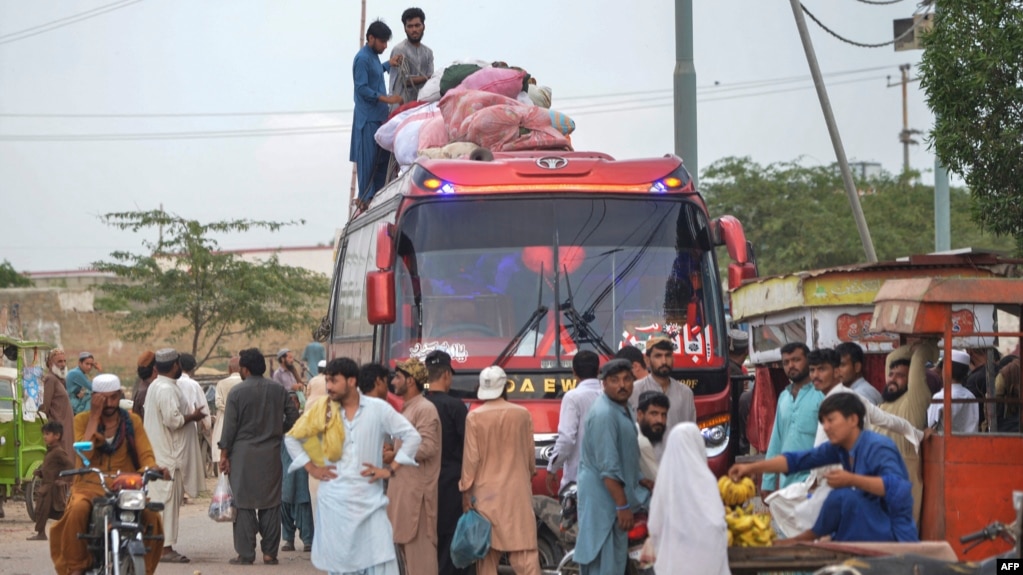
FILE - Afghan refugees board a bus from Karachi, Pakistan, to Afghanistan on Sept. 21, 2023. Afghans have poured into Pakistan by the millions during decades of wars. Pakistan on Oct. 3 ordered undocumented immigrants to leave the country by Nov. 1.
FILE – Afghan refugees board a bus from Karachi, Pakistan, to Afghanistan on Sept. 21, 2023. Afghans have poured into Pakistan by the millions during decades of wars. Pakistan on Oct. 3 ordered undocumented immigrants to leave the country by Nov. 1.

The Pakistani government approved the creation of several deportation centers for hundreds of thousands of illegally residing Afghan nationals they plan to arrest and repatriate to Afghanistan starting next month, VOA learned Tuesday.

Approval of the Illegal Foreigners Repatriation Plan comes ahead of the November 1 deadline the government set for all “illegal/unregistered foreigners” and those “overstaying their visa validity periods” to return to their countries of origin or face deportation for breaching Pakistan’s immigration laws.

Pakistani Interior Minister Sarfaraz Bugti, when announcing the deadline in early October, said an estimated 1.7 million Afghans are among those facing forcible eviction.

Official sources told VOA that special deportation centers would be established in the country’s four provinces: Punjab, Sindh, Baluchistan and Khyber Pakhtunkhwa.

Afghans detained in Punjab and Sindh will be transferred to centers in Rawalpindi and Karachi districts, respectively.

Khyber Pakhtunkhwa will have two deportation centers — in Nowshehra and Chamkani — while Baluchistan will house three facilities in the provincial capital of Quetta, and in Pishin and Qilla Abdullah districts. These two provinces line Pakistan’s nearly 2,600-kilometer (1,600-mile) border with Afghanistan and collectively host most refugee families.

The new plan empowers district administrations, police, prosecution and prison authorities to detain and deport illegally residing Afghan nationals. It specifies that individuals convicted of or currently on trial for minor offenses will be expelled, whereas those convicted of or facing trial for “serious crimes” will not be sent back to Afghanistan.

Islamabad has pledged to carry out the deportations in “a phased and orderly manner.” It has also clarified that the crackdown would not target 1.4 million Afghan refugees living legally in the country and around 900,000 others holding valid Afghan citizenship cards and formally registered in Pakistan as economic migrants.

The government has formally directed law enforcement agencies not to harass refugees there legally and those carrying Afghan nationality cards, although Afghanistan’s Taliban rulers and refugee families have alleged that some were subjected to police abuses, mistreatment and extortion.

The Taliban have called on Pakistan to review the deportation plan, decrying it as “inhumane” and “unacceptable.” However, they have lately set up special camps on the Afghan side of the border to provide immediate shelter, health, food and financial aid to families returning from the neighboring country.

Officials in both countries have confirmed that tens of thousands of Afghans have voluntarily returned to their home country since Islamabad announced the deadline nearly a month ago.

Taliban spokesman Zabihullah Mujahid, while speaking to an Afghan television channel Tuesday, urged Pakistan to treat Afghan refugees “humanely” and extend the period of deportation. He asked all the refugees to return to their country, claiming they have turned war-torn Afghanistan into a “safer and better” place.

The Taliban seized power from a U.S.-backed government in August 2021 when the United States and NATO troops withdrew from the country after nearly two decades of involvement in the Afghan war.

The Taliban takeover prompted hundreds of thousands of people to flee to Pakistan, fearing retribution for their association with Western forces. They included human rights defenders, former government officials, professionals, female activists and journalists. Many have since been relocated to the U.S. and other Western countries, while thousands are awaiting the processing of their applications for resettlement in the United States and Europe.

The Taliban imposed their strict interpretation of Islamic law, barring teenage girls from receiving an education and many women from work. The restrictions have discouraged many Afghan refugee families from returning to Afghanistan, saying their daughters cannot seek education or work there.

The United Nations also has urged Islamabad to suspend its plan to force out Afghans seeking refuge, warning it could expose them to persecution and other abuse by the country’s de facto Taliban authorities.

Pakistan Moves to Create Deportation Centers as Afghan Migrant Deadline Nears
read more

Afghanistan girls education activist Matiullah Wesa released by Taliban

Al Jazeera

An Afghan rights campaigner who advocated for girls’ inclusion in education has been released by Taliban authorities after seven months in jail.

Matiullah Wesa, who travelled the country campaigning for girls to have access to education, was arrested in March for “propaganda against the government”.

He was released on Thursday and was “on his way home”, his brother told the Agence France-Presse news agency.

A spokesperson for the Taliban administration confirmed Wesa’s release.

The UN’s top expert on human rights in Afghanistan, Richard Bennett, welcomed Wesa’s release but highlighted the plight of hundreds of other activists targeted by the Taliban.

“I welcome the release of Matiullah Wesa and call for the immediate & unconditional release of all #Afghanistan human rights defenders who are arbitrarily detained for standing up for their own rights & the human rights of others,” he wrote on the social media platform X, formerly known as Twitter.

Wesa, the founder of the nonprofit organisation Pen Path, had made promoting access to education his mission for more than a decade, visiting rural villages to help revive schools shuttered by violence and to open libraries.

Wesa pledged to continue these efforts after the Taliban took over Kabul in 2021 and enforced harsh restrictions on girls and women, including banning them from schools, parks and gyms and pushing them out of government jobs.

Crackdown on activism

Wesa’s arrest triggered protests from the United Nations and international rights groups, which warned that the Taliban was increasingly cracking down on “peaceful activism” in support of women’s freedoms.

“The Taliban first started with abusing, abducting and detaining women protesters,” Sahar Fetrat, Afghan researcher with the Women’s Rights Division at Human Rights Watch, told Al Jazeera at the time. “Now they have started to intimidate and abuse men for joining peaceful activism.”

“The Taliban fear Afghan men and women standing together and fighting for a better Afghanistan,” Fetrat said.

Afghanistan ranked last out of 177 countries in a report released on Tuesday by the Georgetown Institute for Peace, Women and Security that gauges women’s inclusion, justice and security in society.

Erosion of press freedoms

Wesa’s release comes shortly after the release of another high-profile detainee – French-Afghan journalist Mortaza Behboudi.

Behboudi, who had spent nine months in jail on suspicion of espionage for providing “illegal support to foreigners”, decried the worsening climate for journalists in Afghanistan.

“Everything is censored these days,” Behboudi said. “If I take a photo on the street, I risk being arrested. … There is no longer freedom of expression. There is no longer freedom of the press in Afghanistan.”

SOURCE: AL JAZEERA AND NEWS AGENCIES
Afghanistan girls education activist Matiullah Wesa released by Taliban
read more

A Shift Toward More Engagement with the Taliban?

For the United States, greater engagement with Afghanistan’s de facto authorities is the least bad policy option.
Since the Taliban retook power in Afghanistan in August 2021, the United States has found itself in a vexing dilemma — wanting to condemn and hold accountable the Taliban regime for persecuting women and girls, harboring terrorists and failing to govern inclusively, but also wanting Afghanistan to avoid famine and civil war, and achieve some economic and political stability. U.S. policymakers have thus tried to balance principle and pragmatism. To exert pressure on the Taliban, the United States has withheld diplomatic recognition and traditional development aid, frozen Afghan Central Bank assets and maintained sanctions on Taliban leaders. Yet it has also been the largest donor of humanitarian assistance, has not supported armed opposition to the Taliban and has effectively loosened sanctions to enable aid delivery and encourage economic activity.
This U.S. policy approach holds internal contradictions. Humanitarian aid is saving lives, while punitive policies simultaneously hamstring the Afghan economy and perpetuate poverty. Such inconsistencies in policy are unsurprising for a superpower with complex interests, and have featured in U.S. foreign policy for decades. But as the Taliban’s consolidation of power — and the limits of international leverage — become painfully clear, the United States and its partners appear to be moving toward a policy of more engagement with the regime.A shift toward more engagement is the least bad policy option; it affords more opportunities for progress over time, especially on the economy and livelihoods, than does disengagement or isolation. The international community can seek cooperation from the Taliban on issues of mutual interest, while keeping up pressure and withholding recognition until key demands on rights, governance and security are met.Outside actors should remain clear-eyed that expanded engagement — just like isolation — might not succeed in changing the Taliban’s reprehensible social policies. There are no easy or right answers here. Nevertheless, a coherent, longer-term strategy for engagement with the de facto Taliban authorities can help mitigate harm to the Afghan people and enable the United States to better address its security, humanitarian and rights interests in Afghanistan.

What Does ‘Engagement’ Mean, and What Is Driving Calls for More?

The word “engagement” is used frequently and loosely in discussions on Afghanistan, muddying the debate around policy choices. It can be defined as not only official meetings and communication, but also the concrete forms of collaboration that such dialogue facilitates, for instance on humanitarian and development aid, macroeconomic management, security, rights and governance, and regional and climate issues. To this author and as others have stressed, engagement does not mean diplomatic recognition of or fully normalized relations with the Taliban regime, but it does connote a relationship that maintains a two-way channel for communication and negotiation.

Despite the Taliban’s worsening record on human rights, especially those of women and girls, several factors are pushing the United States and its allies toward more engagement with the Taliban: 1) the depth of ongoing humanitarian need and Afghans’ depletion of safety nets; 2) the 2023 funding gap for humanitarian aid for Afghanistan, and growing interest in resuming development assistance; 3) the Taliban’s steady consolidation of political power; 4) the international community’s failure thus far to pressure the Taliban to reverse its policies of gender persecution; 5) regional states’ increasingly active diplomacy with the Taliban; and 6) the Taliban’s continued willingness to engage with the West, alongside some evidence that they have cooperated on certain issues.

As of August, the 2023 Afghanistan Humanitarian Response Plan had received only 26.8 percent of the overall $3.2 billion required (an amount that was itself revised down in June from the initial request of $4.6 billion). For the past year, amid other global needs, donors’ generosity has been giving way to an urgency to not create dependency on humanitarian aid, to improve efficiency and to focus more on livelihoods and the underlying economic crisis. Thus far, the Taliban’s human rights violations have been the main obstacle to such a move. Donor capitals have very limited, if any, political space to provide traditional development aid to a pariah regime.

But two years in, there is an increasing sense that Taliban rule is the reality that international actors must deal with — like it or not. Punitive tools, such as sanctions and suspending dialogue in response to egregious policies being announced, have not worked to moderate or reverse restrictions against women and girls. Further, regional states are intensifying their engagement with the Taliban, even signaling that they might break the consensus on nonrecognition that has held thus far. This puts pressure on the West to remain engaged in order to preserve what degree of influence it has. A more dire Afghan economic collapse could intensify existing cross-border threats — a concern deeply felt by the region. But Russia and China are not willing or able to commit the level of resources that the West can bring to bear. Without access to Western financial markets and resources, Afghanistan will likely remain mired in deep poverty, buffeted by climate-related crises and a source of insecurity.

Finally, not lost on policymakers is the perhaps surprising fact that the Taliban are a willing interlocutor. The Taliban are reportedly wary of falling prey to China’s model of foreign investment, and want a relationship with the West. That very desire, even if it exists unevenly among Taliban leadership, suggests that the United States and its allies do have leverage. This leverage is only exercised, however, through engagement. Further, the Taliban are not a monolith; internal differences have been on public display. While Kabul-based officials are not driving decision-making in Kandahar, they and others in the provinces influence policy implementation. Last spring, senior Taliban officials who publicly criticized the emirate’s policies and are known to support girls’ education chose loyalty to the emir over resignation from their posts. But these intra-Taliban debates suggest that at some point moderation of policies might be possible. On security issues, in periodic meetings between U.S. and Taliban officials, by all appearances the two sides are discussing counterterrorism and detainee issues.

This window of opportunity for engagement may not be open forever. Policymakers should seek to avoid going down a path that mirrors North Korea, Iran or Cuba. Decades of punitive policies and withheld engagement have failed to incentivize those regimes to change their behavior, and meanwhile have unintentionally perpetuated the poverty and suffering of these populations.

Arguments for and Against Engagement

All this adds up to an argument for more consistent engagement with the Taliban. The logic is that by pursuing regular dialogue and confidence-building measures on multiple tracks, the United States and its partners can better help the Afghan people and protect their own security interests. This logic holds that some form of relationship with the Taliban might achieve incremental wins on mutual interests, while conversely, isolation (or the status quo of limited, drifting engagement) is unlikely to change Taliban behavior. Moreover, isolation may well strengthen Taliban hardliners — as it appeared to do in the late 1990s — and weaken those who are open to cooperation with the West. It bears acknowledgment that some Afghans inside the country have called for more, not less, U.S. and Western engagement with the Taliban.

There are compelling concerns about the risks of engagement as well. Some voices urge less engagement and more stringent conditions on the Taliban before using any lever of Western influence. They argue that more engagement lends legitimacy to the regime. Political scientist Dipali Mukhopadhyay points out that “[f]oreign aid and engagement often end up insulating the regimes that receive them from the hard domestic work of accommodating political rivals, bargaining over power and resources, and offering rights and concessions to citizens.” Questions around engaging the Taliban have created a rift among civil society and rights activists.

Indeed, a critical question is where human rights fit in a framework that favors greater engagement. More engagement would mean delivering consistent messaging on human rights at various levels of government, keeping rights on the agenda and enabling the United States to track developments more closely. A more distant goal of engagement would be to influence Taliban leaders toward reversal or moderation of policies violating Afghans’ human rights, especially those of women and girls; or to work with those within the movement who already support moderating such policies. It would require months or years to assess the outcomes of this approach.

A recent Foreign Affairs poll asked more than 50 prominent U.S., Afghan and international experts on Afghanistan, “Should the United States normalize relations with the Taliban?” Responses overwhelmingly advised against normalization, but embedded in the answers was the more nuanced debate about ill-defined “engagement.” Many of the experts arguing strenuously against normalization wrote that some level of engagement — in the form of humanitarian aid, targeted development efforts and counterterrorism cooperation — is needed.

Most observers seem to agree on two key principles: 1) that the human and financial costs of supporting armed opposition against the Taliban would be too great and 2) that total isolation is not acceptable, as it risks an even deeper humanitarian crisis and precludes discussions on terrorist threats. There is, in fact, marked consensus on the need for outcome-oriented engagement that includes some degree of conditionality.

The core debate, then, is not whether to engage, but rather how and when. What are the optics of engagement, what policy tools should be used and should engagement be sustained despite the Taliban’s grave violations of human rights?

What Should More Engagement Look Like?

A longer-term strategy for actions to address Afghanistan’s enduring problems is sorely needed. This is why the United Nations (U.N.) secretary-general appointed Special Coordinator Feridun Sinirlioğlu of Turkey to lead an independent assessment that will provide “recommendations for an integrated and coherent approach” vis-à-vis Afghanistan by the international community.

We can expect that the assessment, due out in November, will make the case for greater engagement with the Taliban. U.S. policymakers should be looking for recommendations along these lines:

  • A multifaceted, international structure or process for regular engagement with the Taliban de facto authorities — one that can build confidence and trust among all sides, and enable measurable progress on certain tracks, while still applying pressure on the Taliban.
  • Greater clarity around what steps the Taliban need to take in order to fulfill Afghanistan’s international obligations and to obtain what the Taliban want, such as lifting of U.N. sanctions and a seat at the U.N.

In parallel, the United States needs to work out an approach to U.S. bilateral engagement with the Taliban. An effective framework would help the parties move past the policy incoherence that has caused confusion on the Taliban side in terms of what they think the United States wants. It would also enable modest wins in areas of mutual interest, while keeping up pressure on the Taliban on rights and counterterrorism. Elements of such a framework could include:

  • Numerous tracks for technical-level meetings on a range of issues, such as: macroeconomic management and the international financial system; the humanitarian response; agriculture, water and climate-related impacts; counternarcotics and drug treatment efforts; health and nutrition; border security and counterterrorism.
  • Raising human rights and governance issues consistently, at national and subnational levels of the Taliban de facto government. This could help U.S. officials identify where openings for progress exist across different sectors — whether on treatment and release of political prisoners, support for women in the private sector, girls’ education or media freedom — or where conditions are deteriorating.
  • More clarity on what the Taliban must do before the United States is willing to consider recognition, lifting of sanctions or other major steps toward normalization of relations. This kind of dialogue may be months or years away, but U.S. policymakers must think through the details of these steps in advance.

Talking to the Taliban does not preclude broader U.S. work on human rights and political freedoms. The United States should maintain support in whatever forms possible — advocacy, psychosocial support, online learning, documentation and investigation of human rights violations and in international courts — for individuals and organizations working on these issues in Afghanistan, like U.N. Special Rapporteur Richard Bennett. The biggest challenge for the United States and like-minded countries will continue to be helping the Afghan people achieve what most Afghans want for their country, while holding accountable the Taliban government for its repressive behavior.

A Shift Toward More Engagement with the Taliban?
read more

Narcotics Smuggling Has Stopped, Contrary Claims Are ‘Propaganda’: Mujahid

The spokesman for the Islamic Emirate said that in the past two years, the cultivation and trafficking of narcotics in Afghanistan has been widely prohibited. 

Zabihullah Mujahid said the allegations of drug smuggling from Afghanistan to other countries are propaganda against the Islamic Emirate.

The spokesman for the Islamic Emirate said that in the past two years, the cultivation and trafficking of narcotics in Afghanistan has been widely prohibited.

Yesterday, the Deputy Secretary-General of the Collective Security Treaty Organization claimed that drugs are flowing to countries in the organization from Afghanistan.

After the claims of the Deputy Secretary-General of the Collective Security Treaty Organization about narcotics smuggling to the members of this commitment from Afghanistan, the Islamic Emirate said that the cultivation and trafficking of narcotics in Afghanistan has been prohibited.

“Smuggling has been stopped, and we will not allow Afghanistan to be a country where drugs are exported. Unfortunately, instead of encouraging the fight against drugs, the reports that are being published are propaganda and this is not true,” said Zabihullah Mujahid, the spokesman of the Islamic Emirate.

Recently, the Deputy Secretary-General of the Collective Security Treaty Organization, on the sidelines of the 25th meeting of the UNODC Coordination Council in Minsk, claimed that drugs were flowing from Afghanistan to other countries.

“The leaders of the countries adopted the program, and we will now begin implementing it. I think this program will have a lot of impact and benefit,” said Valery Semrikov, Deputy Secretary-General of the Collective Security Treaty Organization.

A number of military analysts said that the Islamic Emirate, in seeking the trust of the world, had to prevent the cultivation and drug trafficking in the country.

“Not only does the Islamic Emirate have a responsibility to prevent drug trafficking to other countries, but neighboring countries, regional countries and beyond have responsibilities in this regard,” said Sadequllah Shinwari, a military analyst.

Concerns over the rise in drug trafficking to Central Asian countries comes as the Islamic Emirate banned the cultivation and sale of narcotics after coming to power.

Narcotics Smuggling Has Stopped, Contrary Claims Are ‘Propaganda’: Mujahid
read more

Kabul Asks UN to Hand Over Seat to Islamic Emirate

According to some analysts, the role of the United Nations is important in solving Afghanistan’s challenges.

The Islamic Emirate’s spokesperson, Zabihullah Mujahid, asked that Afghanistan’s seat in the organization be given to the current Afghan government on the occasion of the United Nations’ International Day.

Mujahid said that not handing over this seat to the Islamic Emirate will be an affront to the people of Afghanistan.

“This organization has separate goals. And we pursue a different path, which is independence, freedom and the Islamic system. It is natural that their path is different from ours, but great injustice has been and will be done to the people of Afghanistan if the chair is not handed over to the people of Afghanistan and the government,” the spokesman noted.

Following the collapse of the previous government, and the re-establishment of the Islamic Emirate, the seat of Afghanistan’s representative in the United Nations faces an unclear fate.

Meanwhile, the permanent representative of Afghanistan to the UN Human Rights Council in Geneva, Nasir Ahmad Andisha, said that the role of the UN in the Afghan issue is important and fundamental.

“The UN’s role is pivotal and fundamental in the case of Afghanistan. The only important office that is currently active in Afghanistan is the UN. Although its activities are limited in providing humanitarian aid, it will play a very important role as the largest international organization,” Andisha noted.

According to some analysts, the role of the United Nations is important in solving Afghanistan’s challenges.

“The UN came into existence over seventy years ago after the Second World War, the powers that are in the Security Council had won the war at that time,” said Tariq Farhadi, a political analyst.

The United Nations was formed on October 24, 1945, after 29 nations had ratified the Charter, and Afghanistan became a member of this organization in 1946.

Kabul Asks UN to Hand Over Seat to Islamic Emirate
read more

Kakar: Illegal Afghan Immigrants Must Leave Pakistan

The caretaker prime minister of Pakistan, Anwaar ul Haq Kakar, called on Afghans who are living in the country illegally to return to Pakistan after getting a visa.

Anwaar ul Haq Kakar said in a press conference that all illegal immigrants should leave that country.

“Those Afghans who have been living in Pakistan for more than 40 or 50 years should return to their country and get a passport and visa to return to the country so that what we are doing has a legal aspect,” said Kakar.

“Pakistan is against international conventions regarding the forced deportation of migrants,” said Asifa Stanikzai, a refugee issue analyst.

“Challenges have arisen for some people, especially in the Spin Boldak area, where our Afghans live and commute daily, and those people avoid getting passports and say it is a problem for them,” said Abdul Rahman Raofi, head of the Afghan refugee’s council in Pakistan.

“The situation is such that when we apply for a visa, it is repeatedly rejected, and it is not easily available to us,” said Sial Mohammad Wesal, an Afghan refugee.

the Ministry of Refugees and Repatriations calls these deportations of immigrants forced and said that 55 thousand families have been returned to the country through Spin Boldek.

“Unfortunately, our neighboring countries, Pakistan and Iran, have deported Afghan immigrants, who have been living there for many years, against the laws of the United Nations,” said Abdul Rahman Rashid, deputy of the Ministry of Refugees and Repatriation.

In the last three days, more than 6,000 Afghan refugees have returned to Afghanistan.

Kakar: Illegal Afghan Immigrants Must Leave Pakistan
read more

Bennett: Situation for Women, Girls Worsened Drastically Over Past 2 Years

In a part of his report, Richard Bennett also called for the canceling of restrictions on girls’ education in Afghanistan.

The UN special rapporteur on human rights in Afghanistan, Richard Bennett, at the UNGA78 session, criticized what he considers to be the deterioration of the human rights situation in Afghanistan.

Speaking at the session, Bennett said that in addition to the demands of the world to reopen schools and universities, female students are still deprived of education in Afghanistan.

According to the report, “Afghanistan is facing a convergence of challenges, including a deteriorating human rights situation due to the Taliban’s repressive policies and practices, a culture of impunity, an ongoing humanitarian and economic crisis, recent deadly earthquakes, and the possibility of massive involuntary returns, all of which require urgent action to avoid further suffering and potential instability in the country and the region.”

“I have reported repeatedly, as have others, that the situation for women and girls has worsened drastically over the past two years, in a step-by-step manner. For example, we are witnessing a continued narrowing of the permitted economic activity of women outside the home. As time goes by, more girls and women are missing out on education above sixth grade at school, and university.  The de facto authorities continue to claim that the suspension is temporary, however, it has already been in place for more than two years. They should meet their obligations under international law and reopen schools and universities for girls and women forthwith – with curricula in line with international standards,” the report reads.

In a part of his report, Richard Bennett also called for the canceling of restrictions on girls’ education in Afghanistan.

Meanwhile, the Chargé d’Affaires of the Afghanistan Permanent Mission to the UN, Naseer Ahmad Faiq, at the Third Committee, 78th UNGA session, expressed his concerns regarding the violation of human rights in Afghanistan.

“The deliberate suppression and systematic discrimination against the fundamental human rights and freedoms of women and girls in Afghanistan, including the right to education and the right to employment by the Taliban, represent a grave violation of human rights, amounting to gender persecution and gender apartheid,” Faiq said.

In the meantime, the Georgetown Institute for Women, Peace and Security in a report ranked and scored 177 countries on women’s status and ranked Afghanistan the last country on the list and Denmark at the top.

According to the report, “Of all country groups and regions, the Fragile States group performs worst. On average in these countries, 1 woman in 5 has experienced recent intimate partner violence, 6 women in 10 live in proximity to conflict, and maternal deaths stand at approximately 540 per 100,000 live births, more than double the global average of 212.”

“World’s concerns that there are violations of human rights in Afghanistan, this is a true, yes, the Islamic government has violated human rights in Afghanistan,” said Fazela Surosh, a women’s rights activist.

“They should create a standard government that has a constitution and acts according to the charter, the rules and the laws of the UN, so that a humanitarian crisis in our country can be prevented,” said Ahmad Khan Andar, international relations expert.

The Islamic Emirate considers the extension of the mission of the UN special rapporteur for Afghanistan Richard Bennett to be antagonistic.

According to the Islamic Emirate’s spokesman, Zabihullah Mujahid, Richard Bennett’s reports do not reflect the realities of Afghanistan.

Bennett: Situation for Women, Girls Worsened Drastically Over Past 2 Years
read more

UN Organizations Concerned By  Lack of Funds for Earthquake Victims

The spokesperson of the Ministry of Foreign Affairs has announced the aid of 50,000 dollars from China for the earthquake victims of Herat.

Organizations of the United Nations, including the World Food Program, the International Organization for Migration, and the United Nations Children’s Fund, have announced that the victims of the Herat earthquake need immediate humanitarian aid.

These organizations have said that they are facing a lack of funds.

“We are quickly running out of funds, and the affected communities need more than the emergency assistance to rebuild their lives,” the WFP said.

“People affected by the Herat earthquakes need immediate help. We’re on the ground to provide support, together with our partners,” said IOM.

“The lack of necessary coordination and joint cooperation between domestic organizations and foreign organizations in the field of aid has caused a series of declines in the level of need for aid, but it appears from the situation that the level of need for aid will increase with the arrival of the winter season,” said Shaker Yaqui, an economist.

Meanwhile, the United Nations Office for the Coordination of Humanitarian Affairs in Afghanistan wrote in a report that “more than 21,500 homes have been completely destroyed (8,429) – mostly in Herat, Injil and Zindajan districts – and severely damaged (17,088) in the earthquakes.”

The Ministry of Economy considers the assistance of the United Nations organizations to be a serious need for the victims of the Herat earthquake.

“Aid from the international community and the United Nations can help in the reconstruction of earthquake-affected areas and in the development and employment projects for many people,” said Habib Rahman Habibi, spokesman for the Ministry of Economy.

Meanwhile, an institution in Qatar has launched a campaign to collect food and medical equipment for the survivors of the Herat earthquake.

“Qatar Charity began distributing food baskets to those affected by the earthquake that struck Afghanistan recently, and this came in conjunction with the launch of its “Help Afghanistan” campaign to show solidarity with the Afghan people and help those affected by the earthquake.”

The spokesperson of the Ministry of Foreign Affairs has announced the aid of 50,000 dollars from China for the earthquake victims of Herat.

In the earthquakes nearly two weeks ago in Herat, dozens of villages in the Zindajan, Injil, and Kashk Rabat Sangi districts of the province were completely destroyed. In these earthquakes, hundreds of houses were seriously damaged in other parts of Herat.

UN Organizations Concerned By  Lack of Funds for Earthquake Victims
read more