
Islamic Emirate Allocates 2 Billion Afs for Returnees

The Islamic Emirate recently allocated two billion afghanis to refugees returning from Pakistan.

Officials said that the Islamic Emirate is working to provide facilities for migrants returning from Pakistan. 

At the same time, the Chinese ambassador in a meeting with the acting foreign minister also pledged that Beijing is ready to cooperate with the refugees returning from Pakistan.

The Islamic Emirate recently allocated two billion afghanis to refugees returning from Pakistan.

The officials of the Islamic Emirate emphasized that this fund was allocated for the purpose of providing shelter, food items and providing medical service to returnees.

“According to the decree of the leadership of the Islamic Emirate of Afghanistan, two billion Afs have been allocated for transfer to provide basic and necessary supplies for the refugees who return,”  said Latifullah Hakimi, Inspector General of the MoD.

“Refugees coming from Pakistan to Afghanistan are well appreciated and they are getting registered, they receive financial assistance and also food assistance with families, and if anyone needs treatment, our mobile team is there,” Zabihullah Mujahid said.

Meanwhile, Amir Khan Muttaqi, the acting Foreign Minister, met with the Chinese Ambassador to Kabul to discuss the security and economic issues and challenges for Afghan refugees following Pakistan’s decision to deport them.

China’s ambassador to Kabul pledged that Beijing is ready to cooperate with the refugees from Pakistan.

The Ministry of Economy also said that the Islamic Emirate has provided necessary assistance to returnees.

“A specific amount by the Islamic Emirate has been allocated for returning refugees to meet the basic and urgent needs of our compatriots,” said Abdul Latif Nazari, deputy minister of the economy.

The returning refugees said that all of their assets remain in Pakistan and they are facing many economic challenges.

“We call on the government to help us and they must do so urgently. Among these people are women with various illnesses,” said Zekrya Khan, a returnee.

According to the Islamic Emirate, more than 180,000 Afghan refugees have returned from Pakistan in the past four days.
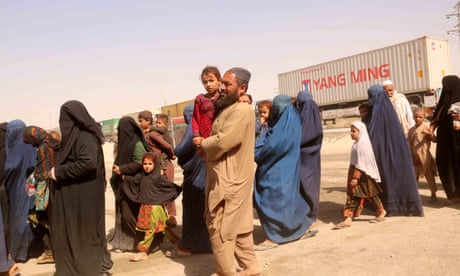
Islamic Emirate Allocates 2 Billion Afs for Returnees
read more

Taliban appeal to Afghan private sector to help those fleeing Pakistan’s mass deportation drive

Associated Press

ISLAMABAD (AP) — The Taliban on Saturday appealed to Afghanistan’s private sector to help people fleeing Pakistan’s mass deportation drive.

Pakistan is arresting and expelling all foreigners it says are in the country illegally, but the policy mostly affects Afghans because they are the biggest group of undocumented foreigners in the country.

The Ministry of Commerce and Industry in Kabul urged Afghanistan’s private sector to step forward and help.

The Taliban made a similar plea last month after devastating earthquakes killed thousands of people and flattened entire villages in the west, asking Afghanistan’s “wealthy compatriots” to help survivors and affected communities. Nobody from the Taliban-led administration was available for comment Saturday.

Afghans forcibly expelled from Pakistan are facing the worst situation of their lives, with no opportunities, the ministry said.

“The ministry invites the private sector to take action because of the profound humanitarian disaster caused by the forced migration of hundreds of thousands of the poor and needy. It is the duty of Islam and Afghans to stand up for their fellow countrymen.”

Afghanistan is overwhelmed by challenges, including years of drought, a beleaguered economy and the aftermath of decades of war. Millions are already internally displaced, raising concerns among the humanitarian community about the impoverished country being unable to support or integrate those leaving Pakistan.

Taliban social media accounts have shown senior officials at the Torkham border, in eastern Nangarhar province, shaking hands with returning Afghans and welcoming them home. Temporary camps are providing people with food, shelter, and health care, according to Taliban authorities.

As many as 250,000 Afghans left Pakistan before an Oct. 31 deadline to leave voluntarily expired. Tens of thousands are heading to border areas fearing detention and deportation as Pakistan security forces go door-to-door searching for undocumented foreigners.

Aid agencies have scrambled teams to border areas, describing chaotic and desperate scenes among returning Afghans.

People told Save the Children they have nowhere to live or money to pay for food, rent or transport after crossing the border. Some Afghan children born in Pakistan are in Afghanistan for the first time, the agency said.

The deportation drive marks a spike in tensions between Pakistan and the Taliban.

Pakistan says Afghans are responsible for carrying out suicide attacks in the country and accuses the Taliban of harboring such militants. The Taliban deny the allegations.

On Friday, senior Taliban figures again condemned Pakistan for its anti-migrant crackdown. They called the policy cruel and one-sided and demanded that Afghans be treated with respect and dignity.

The Taliban’s acting defense minister in Kabul, Muhammad Yaqoob Mujahid, issued a warning to Pakistan.

“Pakistan should face the consequences of its actions and reap what it sows,” he said. “What is going on right now will have a negative impact on relations between both countries.”


Taliban appeal to Afghan private sector to help those fleeing Pakistan’s mass deportation drive
read more

Afghan opium poppy cultivation plunges by 95 percent under Taliban: UN

Al Jazeera
Published On 5 Nov 2023

Poppy cultivation and opium production have plunged more than 90 percent in Afghanistan since Taliban authorities banned the crop last April, according to a UN report published on Sunday.

Poppy cultivation has dropped by around 95 percent – from 233,000 hectares at the end of 2022 to 10,800 in 2023 – since the Taliban officially banned poppy farming in April 2022, according to the report from the UN Office on Drugs and Crime (UNODC).

Opium production has taken the same path, falling from 6,200 tonnes to 333 tonnes over the same period giving a major blow to Afghan farmers who have experienced a staggering $1bn drop in their revenue.

UN officials said that while this trend could help in the fight against the illicit opium trade, it also presented risks to a vulnerable population that has long depended on the poppy trade for their livelihood.

“This presents a real opportunity to build towards long-term results against the illicit opium market and the damage it causes both locally and globally,” said Ghada Waly, executive director of UNODC.

“At the same time, there are important consequences and risks that need to be addressed for an outcome that is ultimately positive and sustainable, especially for the people of Afghanistan.”

The country has been facing humanitarian and financial hardships after the Taliban stormed to power in August 2021 following the withdrawal of US-led foreign forces. The group has struggled to revive the economy due to international sanctions and its financial and diplomatic isolation.

Humanitarian crisis

Opium poppy, which grows extensively in Afghanistan’s southern fields, contains the main opium ingredient used to manufacture heroin.

Afghanistan was previously the world’s top opium producer – responsible for over 80 percent of global supply – and a major source of heroin in Europe and Asia.

The Taliban once played a major role in this industry as well, generating an estimated $400m from the trade between 2018 and 2019 that helped fund its activities, US officials reported.

However, the group has pledged to eliminate this drug cultivation enterprise after seizing power, instituting a formal ban on the crop in April 2022. This proved devastating to rural farmers who long relied on the crop for their income, and compounded a humanitarian crisis that is among the worst in the world.

More than two years after the Taliban took over, Afghans continue to struggle with drought and the prolonged effects of decades of war and natural disasters. Today, more than 40 percent of Afghanis suffer from acute food insecurity and more than half rely on humanitarian aid.

UNODC executive director Waly said the loss of the opium trade was adding to the country’s humanitarian needs.

“Afghanistan is in dire need of strong investment in sustainable livelihoods to provide Afghans with opportunities away from opium,” she said.

The financial shock to the opiate supply chain could drive other illegal activities, like the smuggling of arms, people, or synthetic drugs, the recent UNODC report said.

A September report from the UNODC said that Afghanistan is the world’s fastest-growing maker of another drug methamphetamine, known colloquially as speed, crystal or meth. Seizures of the synthetic drug have increased amid a drop in poppy cultivation.

SOURCE: AL JAZEERA AND NEWS AGENCIES
Afghan opium poppy cultivation plunges by 95 percent under Taliban: UN
read more

Pakistan starts mass deportation of undocumented Afghans

in Islamabad

The Guardian

Pakistan has begun arresting and deporting Afghan refugees who missed Wednesday morning’s deadline for them to leave, a government minister has announced. At least 200,000 people have already returned to Afghanistan voluntarily, said Pakistan’s acting interior minister, Sarfraz Bugti.

The crackdown on unregistered foreigners, part of Pakistan’s new anti-immigrant policy, affects some 2 million Afghans thought to be in Pakistan without documentation.

Bugti said: “There will be no compromise against illegal refugees. We have the data on who are staying illegally in Pakistan. We are going door to door, and we have done geofencing. We will detain and deport them. We have arrested dozens across the country so far, including in the capital.”

Afghans would be put in buses, trucks or whatever was available to transport them to the border, said Bugti, and authorities would be tracking them to ensure they did not return. He attacked the west for not doing enough to help relocate Afghans at risk from Taliban retaliation if they return.

Pakistan’s policy of forcibly returning refugees has drawn widespread criticism from UN agencies and rights groups, and from the Taliban administration in Afghanistan, which has urged its neighbour to give undocumented Afghans more time. Although the numbers of Afghans crossing into Pakistan rose dramatically after the Taliban takeover, many others have been living and working in Pakistan for years.

Refugee holding camps have been established for the thousands waiting to cross the border. In Chaman, a border town with Afghanistan, more than 1,000 refugees are staying in temporary shelters, anxiously waiting their turn to be deported. Gul Mohammed, an Afghan in his 50s, said he does not know what he would do in his home country, having lived in Pakistan for many years and with family there.

“I will see what I can do to survive in Afghanistan after I reach there. I have tried to contact those who have reached Afghanistan to know how they are doing, but I failed. Uncertainty waits for many of us,” said Mohammed.

Pakistan started rounding up Afghan refugees before the deadline had expired, and police have been accused of the harassment of both illegal and legal refugees. In the Chaman camp, Saddam, who moved to Pakistan seven years ago, said the constant police raids had made him leave. “They were raiding, arresting and harassing us, and I was forced to leave for Afghanistan. The police were hurting our dignity by their cruel behaviour.”

Also in the camp was Mir Agha, 23, who said: “I was born and raised in Pakistan. All my siblings were born here. We had proof of refugee cards given by the UNHCR but they were scissored by the police after they arrested us.

“Pakistan is now home, not Afghanistan, and we will be refugees there. We can’t relate there. We are refugees in both countries. I’m worried about how I will survive and live there.”

Chaman district’s deputy commissioner Raja Athar Abbas said authorities have deported at least 4,000 people on Wednesday. For the 1,000 refugees in the camp, he said: “We are providing them boarding, lodging, food, medical and municipal services, and we have registered them with us before we deport them,” he said.

The UNHCR has raised fears over forced deportations, especially of minorities, journalists and women, who are at risk under the Taliban regime. Pakistan’s foreign ministry spokeswoman, Mumtaz Zahra Baloch, said these groups would not be forced to return: “The fear of deportation of journalists, activists and minority groups are in our notice and we will take due precautions.”

A line of women in burqas queue in the desert with children and men
‘We’re so fearful’: Pakistan rounds up Afghan refugees for deportation
But thousands of Afghans who worked for the US, Britain and other western countries before the Taliban takeover are stranded in Pakistan. Bugti said that if the west was so sensitive about the Afghan refugees, they should have done more to relocate them in the two years since the fall of Kabul. “We set a deadline for those Afghans who are supposed be relocated to the western countries such as the US, UK and other countries. If they are not taken to the west by the deadline, we have to declare them illegal refugees, then detain and deport them,” said Bugti.

A senior US official estimated that there are still 25,000 Afghans who could be eligible for resettlement in the United States. “We are actively reaching out to and communicating with those individuals. Many within these groups would be placed at risk if repatriated to Afghanistan,” said the official.

Pakistan starts mass deportation of undocumented Afghans
read more

Americans Detained in Afghanistan ‘Highest Priority’: Decker

Decker said on X that her country would not hesitate to make any effort to repatriate US citizens detained in Afghanistan.

Karen Decker, Chargé d’Affaires of the US Mission to Afghanistan, said that bringing Americans who are detained in Afghanistan back home is Washington’s priority.

Decker said on X that her country would not hesitate to make any effort to repatriate US citizens detained in Afghanistan.

“We will never stop working to bring home Americans wrongfully detained in Afghanistan. It is our highest priority,” she wrote.

The Islamic Emirate has not yet made any comment in this regard, but earlier the Islamic Emirate’s spokesman, Zabiullah Mujahid, told TOLOnews that some foreign nationals have been detained.

Political analysts said that the release of the foreign nationals would help improve the relations between Kabul and the international community.

“Both of the countries can consider the needs and release the prisoners, so the relations would be improved,” said Moeen Gul Samkanai, political analyst.

“If their [prisoners’] crime is not big, then based on our domestic laws, they could be pardoned, so there will be a [way] for positive engagement,” said Abdul Sadiq Hamidzoi, a political analyst.

In August this year, the US Special Representative for Afghanistan Thomas West and the Special Envoy for Afghan Women, Girls, and Human Rights, Rina Amiri, in a meeting with senior Islamic Emirate representatives in Doha, discussed the removal of restrictions on women and girls, including access to education and work; release of detainees; end to corporal punishment, and crackdowns on media and freedom of expression.

Americans Detained in Afghanistan ‘Highest Priority’: Decker
read more

Pakistan Continues Mass Deportation of Afghan Refugees

The refugees, with most of them facing an uncertain future, are temporarily settled in the Torkham area of Nangarhar.

Thousands of Afghan refugees are entering through Torkham crossing as Pakistan continues to implement mass deportations of refugees despite facing a backlash internationally. 

Drivers of passenger vehicles told TOLOnews that thousands of refugees are stranded on the other side of the Durand Line, facing a shortage of water and other essential needs.

The refugees, with most of them facing an uncertain future, are temporarily settled in the Torkham area of Nangarhar.

Youth, traders and other organizations are voluntarily engaged in helping the refugees, providing them with food and medical assistance.

“When we came here, we brought bread, beans, fresh fruits and oil with us,” said Shad Noor Mazlomyar, deputy head  of the Chamber of Craftsmen and Shopkeepers.

“We ask everyone including the shopkeepers, bakers and others to chip in,” said Ghulam Dastageer, craftsman.

The drivers said that the Afghan refugees on the other side of the Durand Line, whom Pakistan collected to deport to Afghanistan, face dire conditions and many have no access to water and other needs.

“When we talked to the people who were on the way, they told us that they had not eaten food for three to four days,” said Adel Shinwari, a deportee.

“The people are stranded on the streets in Lahore, Islamabad and across Torkham [crossing]. There are women and children among them who are based on the street,” said Abdul Wali Walizai, a deportee.

Islamic Emirate officials said that they provide meals for 40,000 refugees.

“We have talked with Kabul Silo [governmental bakery]. We have asked them to provide us with 100,000 loaves of bread. They have brought their six machines to the area,” said Sayed Ahmad Mustaqeem, deputy Minister of Rural Rehabilitation and Development.

Pakistan pushed hundreds of thousands of refugees to return to Afghanistan as the November 1 deadline announced by its caretaker government has passed.

Pakistan Continues Mass Deportation of Afghan Refugees
read more

Pakistan speeds up Afghans’ repatriation as deadline expires

By  and 

PESHAWAR, Pakistan, Nov 3 (Reuters) – Pakistan opened more border centres on Friday to speed up the return of tens of thousands of undocumented Afghans, an official said, two days after a deadline to leave or face expulsion expired and ignoring pleas to give the plan a rethink.

Pakistan has brushed off calls from the United Nations, rights groups and Western embassies to reconsider expelling more than a million of 4 million Afghans in the country, saying they had been involved in Islamist militant attacks and crimes that undermined the security of the country.

Afghanistan denies the accusations.

The U.N. refugee agency, the International Organisation for Migration and the U.N. Children’s Fund on Friday expressed concern for the safety of children and families affected by the expulsion, saying a humanitarian crisis was unfolding with winter on the way.

Mullah Hassan Akhund, prime minister in Afghanistan’s Taliban-led administration, also expressed reservations.

“It is 100% against all principles, come and talk face to face,” he said in a video-recorded statement.

Facilities at the main northwestern border crossing of Torkham have been increased three times to cater for the rising number of returnees, said Abdul Nasir Khan, deputy commissioner for Khyber district.

“Everything is normal now as the returnees no longer need to wait in queues for hours,” he told Reuters.

Those arriving in Afghanistan complained of hardships.

“We spent three days on border in Pakistan. We had very bad situation,” said Mohammad Ismael Rafi, 55, who said he lived for 22 years in the southwestern Pakistani border town of Chaman where he had a retail business.

“Thank God that we have arrived back to our country,” he said. It took him six days to leave his home in Pakistan with his 16 family members and belongings to reach a makeshift tent village on the other side of the border.

Rafi accused Pakistani officials of taking bribes, a charge Islamabad denies.

Afghan schoolboy Sarfraz, 16, who goes by one name, said he and his father had never visited Afghanistan and did not want to go there now. His grandfather migrated to Pakistan decades ago.

“Where should we go?” he asked in response to a Reuters query in northwestern Peshawar. “There is no work there. We’re poor people. We are being forced. We have to leave.”

TRANSIT CAMPS

The Taliban administration in Afghanistan, scrambling to cope with the sudden influx, has set up temporary transit camps where food and medical assistance will be provided.

Refugee groups have reported chaotic and desperate scenes at the camps.

Pakistani authorities started rounding up foreigners, most of them Afghans, hours before the deadline.

Many of the migrants fled Afghanistan during the decades of armed conflict since the late 1970s, while the Islamist Taliban’s takeover after the withdrawal of U.S.-led coalition forces in 2021 led to another exodus.

Khan, the official, said 19,744 Afghans had crossed the Torkham border on Thursday, 147,949 in total since the government announced the deadline.

More than 50,000 have left through southwestern Pakistani border crossing at Chaman, the minister for information in Balochistan, Jan Achakzai, told Reuters.

Pakistani authorities said they were open to delaying repatriation for people with health or other issues, including a seven-month pregnant woman who was told on Friday to stay in Pakistan until she had given birth.

Islamabad says many of the undocumented Afghans have obtained national identity cards through illegitimate means. The government has been identifying and blocking all such suspected cards.

Writing by Asif Shahzad; Reporting by Mushtaq Ali in Peshawar and Mohammad Yunus Yawar in Kabul; Additional reporting by Ariba Shahid in Karachi; Editing by Kim Coghill and Nick Macfie

Pakistan speeds up Afghans’ repatriation as deadline expires
read more

World Bank: Half of All Afghans Are Living in Poverty

It’s stated in the report that imports reached US$ 5.7 billion, showing a 27 percent growth.

The World Bank in its latest monthly report called the “Afghanistan Economic Monitor,” said that half of all Afghans are living in poverty.

According to the statement, from January to September 2023, total exports amounted to US$1.3 billion.

“From January to September 2023, total exports amounted to US$1.3 billion, representing a slight decrease of 0.5 percent compared to the same period in 2022, and Pakistan remains Afghanistan’s largest export market, accounting for 55 percent of total exports, followed by India at 29 percent.”

It’s stated in the report that imports reached US$ 5.7 billion, showing a 27 percent growth.

“Certainly, in these nine months, our exports have decreased, and the reason for the decrease is that we did not export coal from the country, and secondly, we had these problems at the borders with our neighbors,” said Khairuddin Maiel, deputy of the Afghanistan Chamber of Commerce and Investment.

Meanwhile, The Food and Agriculture Organization of the United Nations (FAO) and the World Food Programme (WFP) in a joint statement warned that acute food insecurity is likely to deteriorate further in 18 hunger hotspots – comprising a total of 22 countries.

“One of the main reasons why Afghanistan’s economy is in the current situation is that after the fall of the republic and the suspension of international aid, unfortunately, the economy has shrunk by 25% in the last two years,” said Sayar Qurishi, an economist.

Meanwhile, the Ministry of Economy emphasized that for economic progress in the country, it is necessary for the international community to remove the restrictions imposed on the economic sector.

“Our demand from the international community is not to make the people of Afghanistan suffer, and for the economic progress and development of Afghanistan. The removal of restrictions and obstacles is a necessity,” said Abdul Latif Nazari, deputy of the Ministry of Economy.

Earlier, the World Bank had written in a report that after the establishment of the Islamic Emirate, Afghanistan’s economy  has stagnated and the unemployment rate in the country has doubled.

World Bank: Half of All Afghans Are Living in Poverty
read more

Why Is Pakistan Expelling 1.7 Million Afghans?

Michael Kugelman
Foreign Policy

Islamabad’s policy of deporting all undocumented foreigners will have widespread repercussions.

On Wednesday, Pakistan began the process of expelling all undocumented foreigners, including 1.7 million Afghans—one of the country’s largest immigrant communities. Officials say the policy, which was first announced last month, will be implemented in phases, with migrants and refugees temporarily placed in holding centers before deportation.

Afghans in Pakistan have faced forced repatriations in the past but never on this scale. Islamabad claims the mass expulsion will protect public welfare and make Pakistan safer. But it’s likely that domestic politics and worsening relations with Taliban-led Afghanistan drove the government’s decision.

In recent weeks, Islamabad called on undocumented foreigners to leave voluntarily by Nov. 1. The government said on Monday that around 200,000 Afghan nationals had left over the past two months. Recent days have featured harrowing scenes of Afghan students hugging their Pakistani classmates goodbye and trucks lining up at the border piled high with Afghans’ belongings.

The potential repercussions of Pakistan’s draconian decision are devastating. Taliban-led Afghanistan is not prepared to accommodate masses of returnees, who will be greeted by a vast humanitarian crisis—15 million Afghans are acutely food insecure—exacerbated by drought, floods, and earthquakes. Afghanistan also faces severe global aid cuts and fewer international relief groups operating in its borders due to Taliban policies. Most returning girls and women won’t be able to attend school or work.

For decades, Pakistan has been a top destination for Afghans fleeing conflict, with several million entering the country since the 1970s, including at least 600,000 after the Taliban takeover in 2021. Pakistan prides itself on its ability to house so many Afghan refugees despite its constraints as a poor country. But human rights groups have documented Afghans facing years of discrimination at work, school, and at the hands of landlords and law enforcement. Some Pakistanis, including government officials, have accused Afghans of stealing jobs, dealing drugs, and participating in terrorism. Pakistani officials have previously ordered thousands of them to leave.

Likely for these reasons, many Afghans started to avoid Pakistan nearly a decade ago and instead fled to Europe via the Mediterranean. But for hundreds of thousands of Afghans desperate to escape their country in 2021, nearby Pakistan was the easiest option. They’re all vulnerable now—especially those who previously worked for the U.S. military and await approval to enter the United States on special immigration visas.

Islamabad insists its decision falls within applicable international norms—likely a reference to the many countries, including in the West, that deport undocumented immigrants. It emphasizes that the policy targets all undocumented foreigners, not just Afghans, and that legal immigrants aren’t affected (though reports emerged this week of some documented Afghans being deported, too). It is not clear whom, exactly, the policy will affect, but data in recent years suggests deportations may also impact migrants and refugees from Iran, Myanmar, and Sri Lanka.

Indeed, it’s clear that Afghans have become scapegoats as Pakistan weathers both one of its worst economic crises in years and a major resurgence of terrorism by the Afghanistan-based Tehreek-e-Taliban Pakistan (TTP). Last month, interim Interior Minister Sarfraz Bugti accused Afghans of being involved in organized crime and terrorism and indirectly accused them of hampering Pakistan’s economic recovery.

Some Pakistanis condemn the move and have staged protests against it in recent days, though there is no recent data suggesting how many might oppose it. At any rate, public opinion is unlikely to sway Islamabad. Pakistan is led by an apolitical caretaker government preparing the country for elections in January. The military, which exerts heavy influence over the caretaker regime, is likely driving the policy. (The army chief publicly endorsed the move and attended the meeting finalizing the plan.) But it’s letting the caretaker regime—which need not worry about political blowback—take any public flak.

Additionally, Pakistan’s relations with the Taliban have worsened because Islamabad thinks the group has not done enough to curb the presence of TTP fighters and bases in Afghanistan. Islamabad may be using the expulsion policy in part to compel the Taliban—which have condemned the move—to help more on counterterrorism. Sadly, vulnerable Afghans—from young new arrivals to older and established residents who embrace Pakistan as their only home—are becoming casualties of broader geopolitical machinations.

, the writer of Foreign Policy’s weekly South Asia Brief and the director of the South Asia Institute at the Wilson Center.

Why Is Pakistan Expelling 1.7 Million Afghans?
read more

Pakistan: 200,000 Afghan Nationals Returned Home


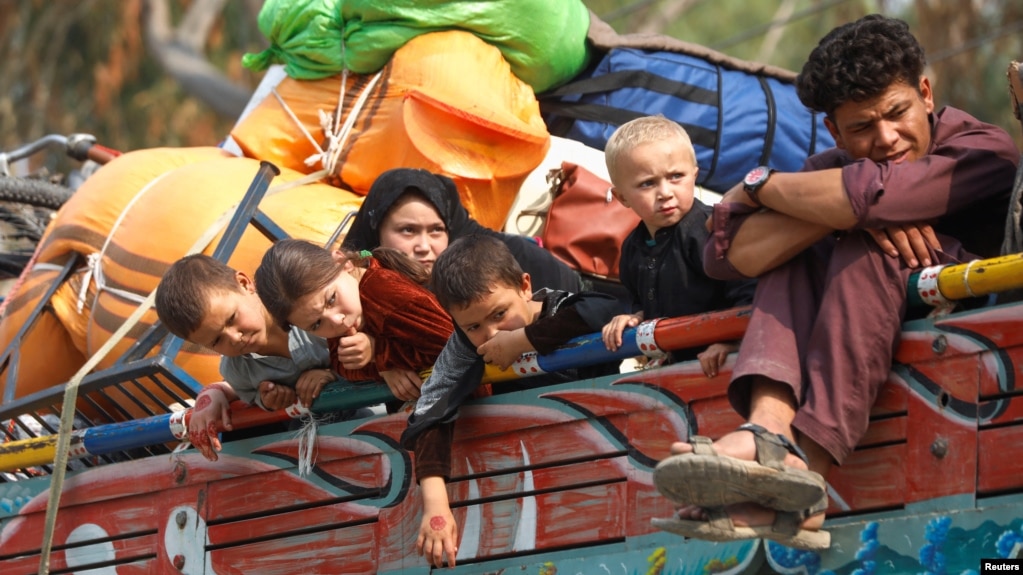
Afghan refugee children sit on a truck loaded with belongings as they and their families prepare to return home, outside the United Nations High Commissioner for Refugees repatriation centers in Azakhel town in Nowshera, Pakistan, Oct. 30, 2023.
Pakistan said Monday that almost 200,000 Afghan nationals voluntarily returned to Afghanistan over the past two months ahead of an official deadline for all illegally residing foreigners to leave or face deportation.

The Pakistani government has ordered “illegal/unregistered foreigners” and those “overstaying their visa validity periods” to return to their countries of origin by November 1.

Interior Minister Sarfaraz Bugti told a news conference Monday that individuals who remain in the country past the deadline will be detained and held in designated “holding centers” before being transported to the nearest Afghan border crossing and repatriated.

He reiterated that the crackdown was not aimed at any specific nationality, though he said the targeted community primarily comprises people from Afghanistan.

Bugti, when announcing the deadline in early October, said that an estimated 1.7 million Afghans are among those facing forcible return.

The U.N. refugee agency, UNHCR, reports Pakistan currently is hosting about 1.4 legally registered Afghan refugees and nearly 900,000 Afghans documented as economic migrants. Another 700,000 fled Afghanistan after the Taliban takeover in August 2021 and took refuge in the neighboring country.

“We have appealed to Pakistan to continue its protection of all vulnerable Afghans who have sought safety in the country and could be at imminent risk if forced to return,” said Matthew Saltmarsh, UNHCR spokesperson.

“UNHCR appreciates the announcements by Pakistan to exclude registered refugees and other categories of vulnerable Afghans from this exercise,” he said but noted that Afghanistan was going through a severe humanitarian crisis with several human rights challenges, particularly for women and girls.

Pakistan, while responding to UNHCR concerns, said Monday that its deportation plan applies to all illegal foreigners residing in the country, irrespective of their nationality and country of origin.

“The decision is in the exercise of Pakistan’s sovereign domestic laws and compliant with applicable international norms and principles,” Foreign Ministry spokesperson Mumtaz Zohra Baloch said in a statement. She emphasized again that legally registered Afghan refugees “are beyond the purview of this plan,” and government security agencies are directed to ensure their safety.

“The international community must scale up collective efforts to address protracted refugee situations through advancing durable solutions as a matter of priority. Pakistan will continue to work with our international partners to this end,” Baloch stated.

Pakistani officials defend their crackdown, citing a dramatic surge in deadly attacks in the country they say are being orchestrated by Taliban-allied fugitive militants out of Afghan sanctuaries. Islamabad maintains that Afghan nationals carried out several recent suicide bombings in Pakistan.

Taliban authorities rejected the charges and called on Pakistan to “reconsider its plan” of expelling Afghans. However, they have lately made emergency arrangements on the Afghan side to provide shelter, health care, food and other services to families returning voluntarily or are expected to be forced out of Pakistan after the November 1 deadline.

U.N. officials warn Pakistan’s deportation of “undocumented” foreign nationals risks triggering a human rights catastrophe.

“We are very worried that those who are deported face a whole host of human rights violations, including torture, arbitrary arrest and detention, severe discrimination, and lack of access to basic economic and social needs,” said Ravina Shamdasani, spokesperson for the U.N. high commissioner for human rights.

Shamdasani said women are of particular concern as the de facto Taliban rulers “have attempted to completely erase them from any public presence in society — from the workplace, from schools, from even public parks.”

Lisa Schlein contributed to this report from Geneva.

Pakistan: 200,000 Afghan Nationals Returned Home
read more