At least seven people were killed and 20 others were wounded in a blast that targeted a transportation bus in the Dasht-e Barchi area of Kabul, Kabul security department’s spokesman, Khalid Zadran said.
The security forces have arrived in the area.
Earlier, the residents told TOLOnews that ambulances were carrying the victims to the hospital from the site of the blast.
Witnesses told TOLOnews that the number of casualties is expected to be higher.
“We were drinking juice in this shop, when a blast occurred. We then saw the ambulances were moving here. There was a crowd and the streets were closed for traffic. It looks like the casualties will be higher. The number of wounded is said to be 20, and 10 were killed,” said an eye witness.
“The sound of the blast was high and there were high casualties,” said an eyewitness.
Meanwhile, the Islamic Emirate’s spokesperson said that women’s rights have been ensured in Afghanistan.
The UN Deputy Secretary-General has asked for attention to and an assessment of the restrictions on women and girls in Afghanistan.
Speaking at the opening ceremony of the International Conference on Women in Islam, Amina Mohammed said that investment in girls’ education can ensure a bright future not only for girls but also for their respective families and neighborhoods.
“The Taliban’s harsh restrictions and denial of divinely granted rights must be addressed as a matter of urgency. By investing in the education of our girls, we are not just uplifting individuals; we are securing a brighter future for our families, our sisters, communities, and neighborhood,” said Amina Mohammed, the United Nations deputy chief.
Saudi Arabia’s capital, Jeddah, is hosting the International Conference on Women in Islam and Indonesia’s foreign minister, who is also taking part in the conference, said that the Asian Group asks the Organization of Islamic Cooperation to suspend engagement with Afghanistan as the country imposes restrictions on women and girls.
“The Asian Group calls on OIC … to suspend the engagement in Afghanistan spearheaded by ulema’s mission. We want access of women to education and all aspects of Afghan society. This will result in tremendous result for Afghanistan’s recovery programs,” said Retno Marsudi, Foreign Minister of Indonesia.
Meanwhile, the Islamic Emirate’s spokesperson said that women’s rights have been ensured in Afghanistan.
“The issue of human rights particularly, the rights of women, have been resolved. The rights that have been given to sisters in Islam and Sharia, are the best rights which have never been seen elsewhere. We do have some problems in some areas which have not been addressed but these are exceptions,” said Zabiullah Mujahid, spokesperson for the Islamic Emirate.
The issue of women and girls continues to remain a hot topic between the international community and the Islamic Emirate since the latter came to power in August 2021.
Respecting the women and girls’ rights particularly rights to education and work is one of the preconditions for recognition of the Afghan caretaker government but the Islamic Emirate has always denied the claim.
UN Deputy Chief Reiterates UN’s Support for Afghan Women
This paper is an attempt to give an overview of the Afghan economy in light of two new World Bank reports, one on the economy, two years on from the re-establishment of the Islamic Emirate of Afghanistan (IEA), and a second on the welfare of households. The Emirate has not published budgets for this year or last, which makes the wealth of detail and analysis provided by these reports, both at the macro level and for families and businesses, important. This paper also draws on presentations by ministers and senior officials at televised ‘accountability sessions’ held over the summer in which the economy was a strong theme. The presentations were generally upbeat, portraying a picture of progress, but the larger general picture appears much bleaker, finds AAN’s Kate Clark.Figures on the state of the Afghan economy are scarce. The IEA has not published its budget for 2022/1401 or 2023/1402 (only an early mini-budget for the last quarter of 1400 (21 December 2021 – 20 March 2022)[1] and the Ministry of Finance made no appearance at the accountability sessions. This makes the publication of ‘Afghanistan Development Update: Uncertainty After Fleeting Stability’ by the World Bank especially important. With access to government data not available to the general public, including from the Ministry of Finance’s Financial Management Information System (AFMIS),[2] the report covers a range of indicators – the size of the economy (GDP), inflation, imports and exports, government revenues and spending priorities – as well as looking at the situation for businesses and households. Also published at the start of October was the third round of the Bank’s ‘Afghanistan Welfare Monitoring Survey’ which asked a representative sample of Afghan households from across the country about work, earnings, food security, access to aid, access to health services and school attendance.[3]
This paper also weaves in information presented in the 43 accountability sessions held over July and August in which ministries and other bodies outlined their achievements for the year in front of journalists and television cameras.[4] The sessions were generally confident and optimistic in tone. Senior officials provided a plethora of statistics – mines surveyed, roads built, licenses and permits issued, rubbish collected, trees planted, trials held, drug addicts treated, books published, training sessions held and so on – presenting an active government working well to serve the people. Some ministers also spoke about the Emirate’s hoped-for direction in the economic sphere, such as in trade, mining and infrastructure projects. However, data on budgets and staffing was patchy and varied from one institution to another, which makes comparisons difficult both between ministries and over time. Those presentations which mentioned changes to staffing, revenue or budgets were the most illuminating.[5]
This report also draws on earlier work by AAN on taxation and spending by the Islamic Emirate of Afghanistan (IEA) and on household economies (see our dossier published earlier this year, bringing these reports together).
Background to the current state of the economy
The collapse of the Islamic Republic and re-establishment of the Islamic Emirate brought both costs and benefits to the Afghan economy. On the one hand, the fact that the Republic disintegrated so precipitously resulted in minimal damage to government infrastructure. The Taleban were able to take over a functioning government apparatus, including public finance, and despite the exodus of many technically able Afghans, they still inherited a better-trained and educated workforce than they left in 2001.
The end to active conflict has also meant that it is now generally safer to travel, farm and indeed live without fear of airstrikes, bombs or fighting.[6] How that looks at its best can be seen in a recent AAN report on Andar district in Ghazni which had been embroiled in the conflict for almost two decades: its economy is now booming thanks to the bazaars re-opening, farmers being able to tend their fields unhindered by fighting, a high level of remittances and the fact that many men in this Taleban-loyal district have found jobs in the government.
However, the Taleban’s capture of power also prompted the economy into free fall, as donor countries abruptly cut off aid, international financial transitions were blocked, the banking system virtually collapsed, and United Nations and United States sanctions hampered trade and remittances. After the UN’s largest appeal for a single country in January 2022, aimed at supporting half of the population assessed to be at “immediate and catastrophic levels of need,” civilian aid did return to similar levels as during the Republic.[7] Even so, the total amount of money coming into Afghanistan remains far smaller than before because spending by the foreign armies and military assistance to the Republic’s armed forces always dwarfed civilian aid. While all three sources of income had declined during the second decade of this century, as countries scaled back their deployments and reduced assistance, even so, in 2019, the Afghan government still received 4.7 billion USD in military support and about 4 billion USD in civilian aid, the latter equally split between on and off-budget support.[8] In 2022, Afghanistan received about 3.5 to 4 billion USD in civilian aid, all off-budget and most of it (70 per cent) humanitarian (all World Bank figures).
During the Republic, the massive amounts of unearned foreign income provided jobs, boosted living standards, supported the afghani and paid for imports, but this ‘bubble economy’ could not survive the sudden removal of the funds in 2021. The magnitude of the foreign income was ultimately damaging to Afghanistan’s economy and to democracy and accountability, as the author explored in an earlier report.[9] However, the money should have tapered off, giving the economy time to adjust. Its sudden disappearance overnight in August 2021 pushed the economy into a catastrophic contraction, with devastating consequences for households, as AAN detailed in a series of reports.
The return of substantial amounts of civilian aid has helped to stabilise the Afghan economy. It has provided not only life-saving assistance but also jobs. The money coming into the economy has supported the domestic currency, the afghani, brought down inflation and stimulated demand. However, donors, who are reluctant to support the Emirate, have mainly funded humanitarian aid. This is meant to be a temporary measure aimed at saving lives until the government or other actors can step in with long-term sustainable plans. It is not intended to act as a long-term solution to address, let alone resolve, a complex humanitarian crisis like Afghanistan’s. It is especially problematic, warned United States Institute for Peace (USIP) William Byrd, when such aid is “a primary source of external financial support propping up the economy.” Moreover, that money and the support it gives to the Afghan economy is shrinking: the UN appeal for aid in 2023 has brought in far less than last year – 1.3 billion USD of reported funding, as compared to 3.9 billion USD in 2022 (see UNOCHA’s Financial Tracking Service).
In winter 2021/22, along with the return of civilian aid to Afghanistan came, not a lifting of US and UN sanctions, as the Emirate has continued to demand, but multiple, wide-ranging waivers to the sanction regimes. Even so, Afghan banks and their customers – business and personal – still do not have the access they used to have to easy international transactions, largely because of the unease felt by foreign corresponding banks in doing business in Afghanistan.
A final major difference in the economy pre and post-August 2021 is the Emirate’s focus on collecting revenue. Less fragmented and less corrupt than the Republic, it has appeared able to channel most revenue into the treasury (rather than much of it going into the pockets of officials and politicians or the insurgency, as previously). Without access to foreign budgetary support, this has become a necessity to keep the government afloat.
All in all, after the traumas of 2021, the economy has stabilised, albeit at a much lower level. This narrative of stabilisation, and even progress, is what the Emirate seeks to portray. Acting deputy Minister of the Economy Ali Latif Nazari, speaking at his ministry’s accountability session in the summer, said that in year one of its rule, the IEA had focussed solely on preventing economic collapse, but in year two, they had worked on boosting the economy: they formulated a development plan, sought to control inflation, collect tax transparently, monitor the ports and custom posts, keep the afghani stable and control fuel and other prices.
Nazari insisted that the Emirate does not consider itself dependent on foreign aid, but rather wants to use and take support from the potential that is inside Afghanistan. At the same time, the Emirate narrative is one of Afghanistan surviving hostile action from the Western states – sanctions, freezing the country’s reserves, banning leaders from travelling and so on. Nazari described the Emirate responding to this with “economic diplomacy,” based on what he called the “self-sufficiency theory.” In an anarchic world that is not unipolar and where national self-interest rules, Afghanistan can thrive: even if it had political tensions with particular countries, he said, they could still be friends economically because of shared economic interests. He spoke about the importance of trade, as did acting Minister of Foreign Affairs Amir Khan Muttaqi when he described Afghanistan’s “economy-oriented politics” which gave Afghanistan “the opportunity to maintain its political status in the region.”
Nazari made clear that economic growth is vital to the Emirate, as it was one of the ways a government gains political legitimacy; economic development – improving people’s livelihoods – reduces the distance between people and government. The Bank would agree, but warns that Afghanistan currently “lacks a self-sustaining indigenous growth engine for recovery.”
How the economy is faring now, two years on from the fall of the Republic and re-establishment of the Emirate, is the subject of the rest of this report. The first section looks at indicators like GDP, prices, the strength of the currency and imports and exports. It is followed by a scrutiny of government revenues and spending and finally an assessment of what all this means for households and businesses.
Source: World Bank ‘Afghanistan Development Update: Uncertainty After Fleeting Stability’, October 2023
How the Afghan economy is faring now
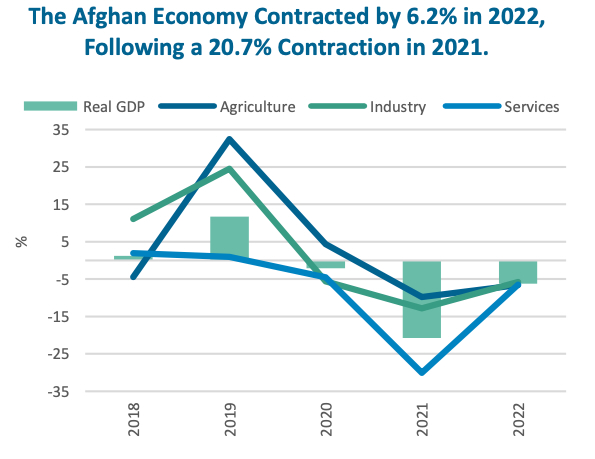
The size of Afghanistan’s economy, measured by its Gross Domestic Product (GDP) – the total value of all the goods produced and services provided during a year – is smaller than it was before the Taleban takeover. Moreover, the contraction has only slowed, not reversed. GDP, reports the World Bank, contracted by 20.7 per cent in 2021 and the decline has continued into 2022, albeit at a slower rate, by a further 6.2 per cent. The sector contributing most to GDP, services (45 per cent), shrank by 6.5 per cent, but with a considerable variation within that: wholesale trade (-8.9 per cent), health (-5.9 per cent), finance and insurance (-6.6 per cent), real estate (-5.2 per cent), dining and lodging (-4.2 per cent), and telecommunications (-4.7 per cent).
Agriculture, which contributes 36 per cent of GDP, shrank by 6.6 per cent, mainly because of bad weather causing poor harvests and problems for livestock. While the drought continued into 2023, better rain and snow is forecast this winter and spring, so there is hope that Afghanistan’s farmers will fare better in 2024.
Industry suffered an overall 5.7 per cent decline in 2022, again with substantial variation between sectors. There was a 10 per cent fall in manufacturing (including food and beverages and non-food), a 0.8 per cent fall in construction but growth of 4.1 per cent in mining and quarrying. “Dampened demand remains the top business constraint,” said the Bank, “followed by uncertainty about the future and limited banking system functionality.” It highlighted the Emirate’s restrictions on women’s work and education as only adding to the economy’s sluggishness.
Source: World Bank ‘Afghanistan Development Update: Uncertainty After Fleeting Stability’, October 2023
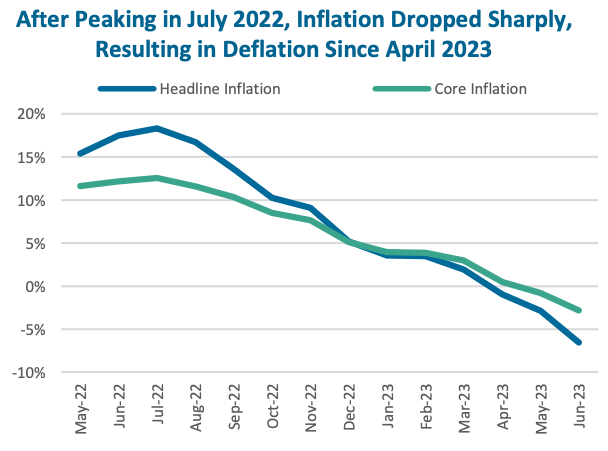
Inflation peaked in July 2022 at 18.3 per cent, but prices are now falling by 9.1 per cent overall. Measured year-on-year since July 2022, the Bank says food is 12.6 per cent and non-food items 5 per cent cheaper. What economists call ‘core inflation’, ie when food and fuel are stripped away, stands at -4.7 per cent. Some of the falling prices, says the Bank, can be explained by better supply of goods and the strengthening of the domestic currency, the afghani, which reduces the cost of imports. However, it warns that falling prices also “likely stem from the economy adjusting to a structurally lower aggregate demand level.” In other words, total demand for all finished goods and services produced by the economy is less than it used to be. Spending by households is down, as is investment by businesses. Anecdotally, it said, this could be attributed to “depleted savings, reduced public spending, and shocks to farmer income from poppy cultivation bans.”
The strength of the currency has been remarkable. This year, up to 24 August 2023, the afghani had appreciated against the US dollar by 7.3 per cent, said the Bank. With 83.1 afghanis buying one dollar, the value was 3.7 per cent higher than on 15 August 2021. In the last few months, however, the afghani has only continued to appreciate. As this report was published, just 72.9 afghanis were needed to buy one dollar. That strengthening is partly due to government actions.
It has banned the use of foreign currency for domestic transactions, including, a money exchanger told AAN, insisting that afghanis not dollars be used to buy houses and land, cash distributions by NGOs and when they buy staple goods, and when government departments purchase materials. Provinces where Pakistani rupees or Iranian riyals are commonly used for everyday purchases have been warned to stop doing so or face the law (see, for example, reporting on 13 September by the national broadcaster, Radio Television Afghanistan). A shopkeeper in Spin Boldak in Kandahar province described to AAN a public meeting in October in which government officials told people to stop using Pakistani rupees “on the order of the Amir,” a message repeated by loudspeaker to the townspeople. The shopkeeper said a mullah had come into his shop and tried to pay for something in rupees. When he refused, the mullah praised him and the shopkeeper realised if he had accepted the rupees, the authorities would have shut his shop, as they have done several other outlets which disobeyed the order.
The government has also banned the export of cash; an example of one high-profile arrest can be seen, on an Emirate website from 6 November 2023). As there has been only limited printing of afghani notes since August 2021, demand for the currency is boosted, and said money changers, the Central Bank is managing the currency well by selling dollars, as needed. Other reasons for the strong currency are external – the dollars brought in by the United Nations to pay for civilian assistance, as well as higher remittances. However, the Bank says that all this still does not fully explain the strength of the currency. Here, the Bank looks to Afghanistan’s recent puzzling import/export figures.
For years, Afghanistan has run a deep trade deficit, funded until 2021 by money coming into the country in the form of spending by foreign armies, military support and civilian aid. In 2020, for example, Afghanistan was importing goods at a value 7.6 times greater than the value of its exports. The precipitous contraction of the economy in 2021 shrank the demand for imported goods, and at the same time Afghanistan’s exports grew. In 2022, Afghanistan imported goods valued at 3.3 times more than the value of its exports.
Exports, those legally exported rather than smuggled out, have benefited from the change of government. 2022 was a record year, said the Bank: Afghanistan exported 1.9 billion USD worth of goods, far higher than the five-year-average, 2016-21, which was just 0.8 billion USD. There is strong foreign demand for certain Afghan goods, such as coal, precious gems, gold and other minerals, fresh and dried fruit and other agricultural produce. Additionally, in 2022, demands for Afghan exports was driven by Pakistani demand for Afghan coal, which is cheap by global standards, and food, following the devastating floods in that country. However, even more important perhaps, as David Mansfield and Alcis mapped, the Emirate, unlike the Republic, pursued stronger border controls, adopted and rigorously enforced Republic-era regulatory frameworks and border management systems and closed smuggling routes.
However, exports are now weakening. The Bank reports that while, overall, in the first seven months of 2023, exports increased by three per cent, since February, they have been falling, with coal exports – down by 12 per cent – especially hard hit.[10] Food comprises the largest type of export, with Pakistan and India as the main customers. With food exports to Pakistan declining in 2023, the Bank said India has become the biggest customer. It also says that “new (albeit small) markets are opening for Afghanistan’s food exports, including the United Arab Emirates, Uzbekistan, Tajikistan, Iran, and Iraq.”
Remarkably, however, given the contraction to the economy and reduced aggregate demand, imports have grown. In 2022, they amounted to US$6.3 billion and, in the first seven months of 2023, had already reached US$4.4 billion. That figure, which excludes humanitarian imports, represents a growth of 32 per cent, year-on-year. How can that be possible, given the shrinking economy and Afghans’ much reduced spending power? Increased remittances cover the cost of some of those imports – the estimated 1-1.2 billion USD Afghans abroad sent home in the first seven months of 2023 (a doubling in the amount of money sent compared to 2019). Some could be covered by the regular shipments of cash coming in via the UN to pay for humanitarian aid and support to basic services (1.8 billion USD in 2022 and around 1.12 billion USD in 2023). However, the World Bank calculates this would still leave a projected and unexplained gap of 1 billion USD for January-July 2023.
Moreover, despite all the economic problems, the afghani has been steadily appreciating against major trading currencies since the start of 2023. “Official data and economic theory can’t offer a clear explanation” for how this could happen, the Bank observes drily. It also stresses that the “foreign exchange market seems in balance, as there is no evidence of a parallel exchange market.” The answer to this improbable negative correlation between a contracting GDP, increasing imports and a strengthening currency lies, it says, in an “inflow of foreign currency not shown in any official record.” In other words, there is an informal income stream covering the trade deficit and supporting the afghani.
The nature of that income stream becomes clearer when the types of imports are detailed: high-end consumption goods and industrial raw materials, including prepared food, vehicles, spare parts, stone, glassware, chemicals and iron and steel. Imports of these goods in 2022-23 nearly doubled compared to the 2016-2020 average. Why would an economy whose industrial output has declined by 26 per cent since 2020 need a substantial increase in imports of industrial inputs like base metals and chemicals, the Bank asks and “Furthermore, importing high-end consumption goods… does not match the current situation in Afghanistan, where two-thirds of households experience significant deprivation and businesses operate below capacity due to low demand.”
Rather, it suggests that 1 to 1.5 billion USD of goods were, “according to sources and market insiders,” imported into Afghanistan, but “ended up in the Pakistani market instead of being consumed domestically.” These goods were not paid for out of Afghanistan’s foreign currency. The Bank also notes that as the afghani appreciated, the Pakistani rupee has depreciated, in roughly equal measure, further proof of what is happening. The Bank surmises that, following Pakistan’s decision in 2022 to take steps to reduce imports because of a balance of payments crisis, including limiting letters of credit for importers, demand for illegal imports via Afghanistan surged.
Importing goods into Afghanistan through Pakistan and immediately smuggling them back into Pakistan is incentivised by Afghanistan not having to pay Pakistani customs on goods destined for domestic consumption – allowed because it is a landlocked country. Famously, during the first Islamic Emirate, Afghanistan imported (and re-exported) large quantities of goods that were banned, for example, television sets and video recorders. What is called the Afghan Transit Trade never went away under the Republic. However, its magnitude appears to have increased significantly since Pakistan’s attempts to curb imports.
There have been mutterings about all this in Pakistan, with calls to ease restrictions on imports to eliminate the demand for smuggled imported goods (see recent reporting in The Nation) and moves to clamp down on smuggling from Afghanistan into Pakistan (see reporting from Pajhwok). If the Pakistani authorities do manage to prevent or even limit the scam, there would be a knock-on impact on Afghan government revenue – currently, it collects customs duties on those imports – and on the strength of the afghani and so the price of imported goods. Many of these are household necessities – food, fuel and medicine.
The Bank does not mention income coming into the country from trade in counter-narcotics. This has always been considerable. The UN Office on Drugs and Crime (UNODC) calculated that the total Afghan opiate economy in 2021, including domestic consumption and exports, stood at between 1.8 billion and 2.7 billion USD, equivalent to 9-14 per cent of the country’s licit GDP. Since then, in April 2022, the Emirate has banned opium poppy cultivation, processing and trade. It became clear in the autumn of that year, when poppy would have been sown, that the ban was largely enforced. Prices soared, meaning anyone with opium stocks has benefited because, according to Alcis and Mansfield writing in June 2023, trade, including cross-border, was not clamped down on (see also AAN reporting here).
In a new report, Alcis and Mansfield have given figures for the number of people “denied the ability to earn an income from growing poppy in 2023” – an estimated 6.9 million – and say it looks like the ban on cultivation will be maintained into a second year. They report growing evidence that households compelled to abandon poppy in Nangrahar are in economic distress – a pattern also emerging elsewhere, citing “[t]he sale of long-term productive assets, including farm equipment, jewellery, and land to meet basic expenses and send male family members abroad.” Their report also details how traders are now targeted, although not everywhere to the same extent: “The only route that has not experienced a rise in smuggling costs,” it says, “is the journey via Bahramchah in Helmand province, possibly reflecting continued privileges afforded to those in Helmand.” The economic impact of the bans on opium, hashish and methamphetamines is not yet settled; much will depend on how seriously and comprehensively they are enforced in future years. However, income from narcotics has been a significant part of the Afghan economy for many years – helping support the afghani, paying for imports and providing seasonal work and income to millions. Take that away and the repercussions will be severe.
Arezo Osmani (C), owner of Safe Path Prosperity Social Enterprise, inspects a fabric sanitary pad in her tailor workshop in Kabul. Photo: Wakil Kohsar, July 2023
Government revenue
Raising revenue domestically is of fundamental importance to the Emirate. With the Taleban victory in 2021, Afghanistan lost huge amounts of foreign budgetary support and the ability to borrow. As we reported in summer 2022, the Emirate has proved far better at collecting revenue, both taxes and customs, than the Republic had been. At that time, in summer 2022, customs were generally holding up, as were non-tax revenues (this category covers a variety of income sources, including profits from state-owned enterprises, royalties, concessions and fines). Revenues from mining have proved particularly important. Taxes on individuals and businesses were less than under the Republic, presumably because taxable income had fallen. More data has now come in via the World Bank: it said that in 2022, customs were 136 per cent of their 2019 level, while domestic revenues (tax and non-tax) were 67 per cent. As a share of total revenue, customs have also become more significant: in 2019, they were 38.2 per cent of total income, in 2022, 55.7 per cent.
Although the accountability sessions gave no indication of overall revenue generated, many ministries and other government agencies did provide reports of the revenue they had earned in 1401/2022: the Railway Authority said it collected 3.1 billion afghanis, up by 25 per cent on the previous year, and the Standards Authority 2.2 billion afghanis, while the Ministry of Foreign Affairs reported that its revenue was greater by 32 per cent than the target set by the finance ministry.[11] Breshna, the state electricity supply company, said it had raised 33.1 billion afghanis from private customers and 3.5 billion from government agencies and had pursued old unpaid bills and customers who had fiddled their electricity meters. It said that 180 million dollars of unpaid bills were still outstanding, owed by politicians and powerbrokers, many, presumably, not in the country. The sum is emblematic of the petty pilfering that characterised the Republic – the rich not paying for what they used. More than 500 cases, Breshna said, are now with the courts.
However, the Bank said that in 2023, the IEA’s revenue collection has not been so strong; domestic revenues have “struggle[d] due to the weak economy” and the first five months of the year saw “a mere 0.9 percent uptick year-on-year.” Non-tax revenues, it said, “underperformed,” falling to 34 per cent below target, mainly “due to weak collection by the Ministry of Mines and Petroleum, a significant [non-tax revenue] contributor.” Where revenues were more buoyant, as in 2022, were in taxes taken at the border, customs duties and Business Receipt taxes;[12] they rose by 13 per cent compared to the first five months of 2022. Customs now account for about 60 per cent of total revenues, mainly from crossings with Iran and Pakistan.
The accountability sessions (but not the World Bank reports) also gave information about two taxes which are not collected by the Ministry of Finance: zakat and ushr, the ‘Islamic taxes’ on the harvest and livestock that were introduced by the Emirate nationwide when it came to power. Acting Minister of Agriculture Mawlawi Attaullah Omari reported that in 1401/2022, his ministry had raised one billion dollars from these taxes. That represents a huge new transfer of resources from rural households to the state. The ministry’s assistant head of finance and administration, Mawlawi Fazal Bari Fazli said contributions were voluntary – although this was often not the experience of interviewees speaking to AAN for its special report on taxation published in September 2022. They described the collection of zakat and ushr as similar in nature to general tax collection and in some cases as it being imposed as a collective tax on a village. Fazli said the money went to the office of Supreme Leader Mawlawi Hibatullah Akhundzada, who then ordered its distribution. He insisted that money was only given to “vulnerable people such as orphans, the disabled and the poverty-stricken” and “no other activity was carried out with this money” (see also reporting by Pajhwok).
Government spending
Because the Emirate has to rely on revenues, the contrast with budgets under the Republic is extreme. The 2019 budget, bolstered by on-budget aid, was 424.3 billion afghanis. In 2022, said the Bank, the budget was 195.2 billion, just 46 per cent of what it had been. In 2022, the Bank also reported that the Ministry of Finance had used reserves of 1.3 billion afghanis to meet a shortfall in revenue, compared to spending.
Given these constraints, the Emirate has had to prioritise where it spends money. In general, operational needs come first (94.5 per cent of total spending), far outstripping development (5.5 per cent). Out of that operational budget, a handful of ministries and bodies take the lion’s share, said the Bank. The biggest spenders in 2022 were the Ministries of Interior (23 per cent of total operational spending), Defence (21 per cent) and Education and Higher Education (19 per cent). The other major security agency, the General Directorate of Intelligence (GDI), took eight per cent of operating expenditure.[13]
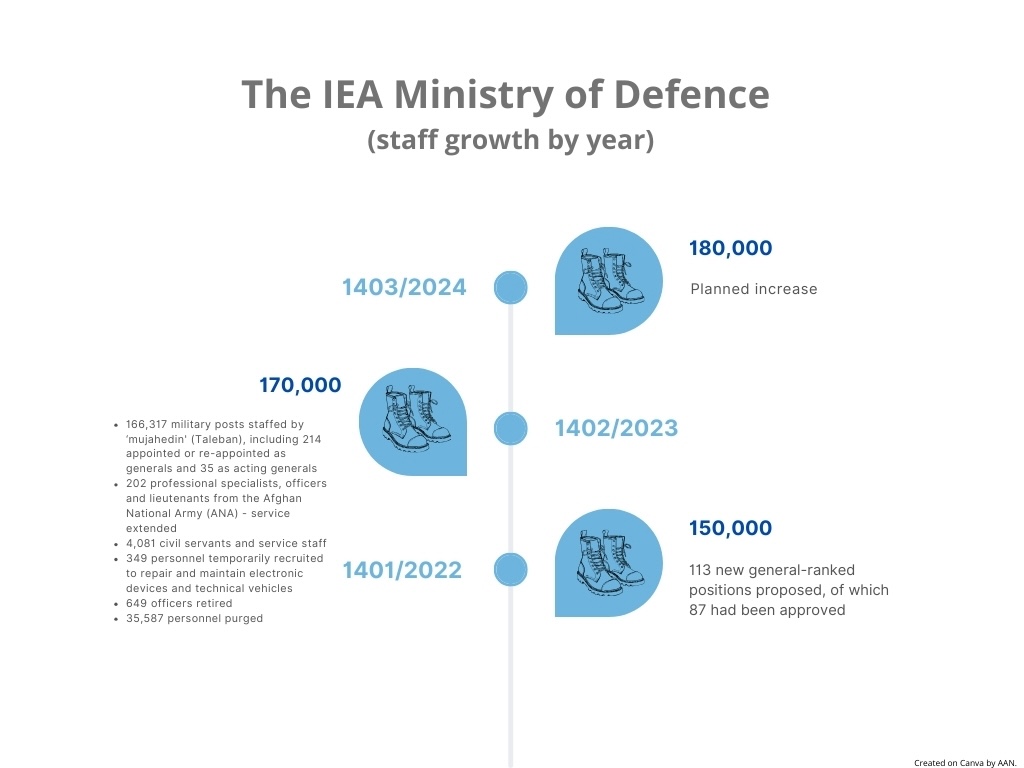
The scale of the money needed to pay the salaries of government employees and armed forces can be seen in some of the statistics on staffing given in the accountability sessions. The Ministry of Interior said it employs 161,000 people (including 1,955 women), a sharp decrease from the 200,000-strong workforce it reported last year (no explanation was given for this discrepancy). The Ministry of Defence, however, continues to grow.
Source: Ministry of Defence accountability sessions, 2022 and 2023
As to the other big spender, the Ministry of Education, while giving no numbers for the size of its school teaching staff, officials did say they had created 100,000 new positions in madrasas across the country.[14]
Among the lowest recipients of money was the Ministry of Public Health. The Bank (with access to data from the Ministry of Finance) reported it was allocated just two billion afghanis, or one per cent of total operational spending in 1401/2022. The ministry, at its accountability session, gave roughly similar figures: its 1401/2022 budget had been 4.2 billion afghanis (3.6 billion for operating and 576 million for development) and it had spent 54 per cent of that. This sum seems very low considering the size of the reported workforce – 111,109, with approval for 500 new posts.[15]
During the accountability sessions, acting minister Dr Qalandar Ebad said that foreign funding represented just ten per cent of the total budget. (He was answering a question from a journalist who cited a warning on 18 August 2023 by the World Health Organisation about “critical underfunding” to the sector and a decision by the International Committee of the Red Cross, reported the previous day, for example, by Reuters that it was to stop paying salaries and running costs for 25 hospitals. It had stepped in with temporary funding to keep them open in 2021, but has now returned “the full responsibilities of the health services to the Ministry of Public Health”).[16]
However, according to the UN, 457 million USD of aid was spent on the health sector in 2022 (see its Financial Tracking Service), equivalent to 38 billion afghanis. Not all that money would have been spent in Afghanistan, but what did arrive was significant. Moreover, cooperation with the Emirate in this sector is explicit. UNICEF, for example, a large recipient of health sector funding, says it works, “under the leadership of Afghanistan’s Ministry of Public Health… with partners to improve services and ensure quality reproductive maternal newborn child and adolescent health care, as well as expanded programme on immunization services for children and women.” This spending thus looks to dwarf the entire Public Health budget of the Emirate. Also worth noting is the World Bank’s citing “recent unconfirmed reports” suggesting that the Emirate had covered the shortfall in the hospital budget by “reallocate[ing] part of its contingency budget allocations” – funds set aside for expenditure that was not anticipated when the national budget was approved.[17]
One interesting point in the accountability sessions was Breshna reporting that it had paid off its debts. It said that in 1444 (according to the Islamic lunar calendar, equivalent to 1401 and 2022; see footnote 7), it paid off outstanding foreign debts to Uzbekistan (102 million USD), Tajikistan (80 million USD), Turkmenistan (56 million USD) and Iran (65 million USD). It also paid off outstanding debts totalling more than 20 million USD to various domestic electricity production companies.
Helping pay Breshna’s debts was considered in 2021 as a way of helping Afghanistan out of its economic crisis. Although it did not make it into the Humanitarian Response Plan, UNDP did float the idea in its 2021-22 Economic Outlook, published in December 2021, arguing that “An interruption of electricity imports might leave over 10 million people, a quarter of the population, in the dark. International humanitarian assistance to Afghanistan should ensure that electricity imports are not cut, but that, if they are, whatever little energy is produced internally will continue and therefore ease the stark everyday energy poverty of ordinary households.”[18] It appears that the Emirate has managed to pay these debts without such support.
Most Emirate spending is on operating costs, unsurprising given that money is tight. However, within that, there are choices of what to spend money on. The World Bank summed these priorities up:
[T]he ITA [interim Taleban administration] is utilizing available resources largely to pay for security, teachers’ salaries, and core civil and administrative functions while leaving donors to finance healthcare, food security, broader education needs, and the agri-food system.
For donors, this is a political concern, given that their aid to certain sectors frees up the IEA to sustain large, and indeed in the army, growing numbers of men in uniform. Since August 2021, this dilemma has hung in the air.[19]
Development Spending
Financing for development from any source has been minimal since August 2021, given donors’ reluctance to go beyond humanitarian and basic services funding and Emirate revenue constraints. In 2022, according to the Bank, the Emirate initially set aside 10.8 billion afghanis for 66 projects, with 20 more added at a cost of 1.39 billion afghanis, financed from contingency funds. 51 per cent of total development spending in 2022 went on the Qush Tepe Canal (5.46 billion afghanis), a major project to divert water for irrigation from the Amu Darya from Balkh province through Jowzjan to Faryab province.
Where the Emirate does have development funds, it has concentrated them on major infrastructure projects especially those providing irrigation. As well as the Qush Tepa Canal, which is overseen by the state-owned National Development Corporation, the Ministry of Water and Power mentioned several other water projects.[20] The gap between what needs to be done and what can be afforded was nowhere clearer than in the presentation by Breshna. It listed various achievements in the last year: fitting a new transmission cable and thereby tripling the electricity carried from the Kajaki hydroelectric dam to Kandahar (30 to 85 kilowatts) at a cost of just 3.5m USD (compared to a ‘foreign company’s bid of 20m USD); separating the supply of electricity to residential and business customers on industrial parks in Kabul and Nangrahar and improving supply to the latter and; the – soon to be inaugurated – first complete substation designed by Breshna engineers in Chimtal at a cost of 600k USD (compared to a foreign bid of 2.5m USD). It also mentioned some ambitious plans – to finish fitting a cable from Turghondi to Herat to improve the electricity supply to Herat city and another from Arghandi to Ghazni. However, it also lamented the loss of support it used to receive from the World Bank, Asian Development Bank, USAID, GIZ and other donors. In the past two years, it said it had received no assistance, and although the company had not collapsed, thanks to its employees and leadership, there was much it could not do.
The accountability session of the Ministry of Mines and Petroleum was also important for any discussion of the Afghan economy. This sector is a major earner for the government and has the potential to push growth. Acting minister Shahabuddin Delawar detailed numerous projects – contracts to prospect for minerals or to mine, already signed or out to tender. However, he also warned that exploiting a mine is time-consuming, with exploration taking at least three to seven years before extraction can start. In other words, the benefits accruing from not yet exploited minerals will take time to realise. Moreover, existing mines depend on market demand; if that falls, for example from Pakistan for Afghan coal this year, revenues will also fall.
However, Delawar was proud of the revenue that mines whose extraction was already underway under the old government were bringing in. His ministry, he said, pays “the salaries and expenses of the national army, the Ministry of Interior, the intelligence agency, and millions of government employees.” He also described how roadbuilding was paid for by mineral extraction. The ministry allocates a specific mine’s revenue for the construction of a specific road, with the ministry paying the Ministry of Public Works a share of the road-building cost. Acting technical Deputy Minister of Public Works Mawlawi Abdul Karim Fateh pointed to several roads, including Kandahar to Uruzgan, Salang to Parwan and sections of the Kabul to Kandahar highway as paid for in this way.
One of the themes running through the accountability sessions was the importance of trade to the Afghan economy, including a trope familiar from the time of the Republic, of Afghanistan as a future regional trading hub. Some of the actions needed to facilitate trade are political. Acting Foreign Minister Muttaqi, for example, highlighted how Foreign Ministry efforts to maintain good relationships with all our six neighbouring countries meant border crossings for goods had been kept open in the last year (for reporting on how damaging closed crossings are to farmers, see this April 2022 report from AAN). He also ascribed the success of the transit trade, with more than fifty-thousand vehicles moving goods across Afghanistan, linking south and Central Asia in the last 12 months, to their economy-oriented policy. However, other actions need money.
For example, acting deputy economy minister Nazari mentioned two large-scale energy projects, TAPI and CASA-1000, which are planned to cross Afghanistan and, he said, had prompted ‘recent’ regional level meetings. Both, however, are stalled. CASA-1000 is a project designed to transmit electricity generated from renewable energy sources in Kyrgyzstan and Tajikistan to Afghanistan and onwards to Pakistan (website here). Administered by the World Bank with funding from the Islamic Development Bank, US, UK and Australia, work in Afghanistan has halted since the 2021 Taleban takeover. TAPI, a project to deliver natural gas by pipeline to Afghanistan and on through to Pakistan and India, is also stalled; on 13 October, Afghanistan said it was ready to cover the costs of the Afghan sections (see ToloNews reporting), but disagreements between Pakistan and Turkmenistan over tariffs and costs remain (reporting from the summer in the Pakistan media here).
In summary, despite the Emirate talking up its progress and laying out plans for the future, the Afghan economy is contracting, showing weak demand, deflation and limited public spending, with much of it concentrated on operating costs for the security services. The consequences of all this for households and businesses are the subject of the final section of this report.
How households reported their capacity to cover food and non-food expenses, from World Bank Welfare Monitoring Surveys
How households and businesses are faring
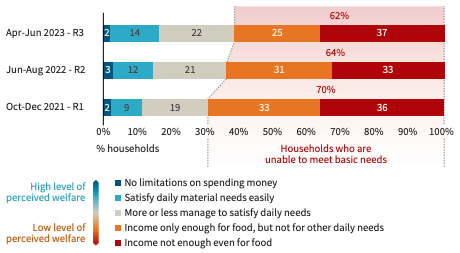
There has been a slight improvement in household welfare since the Bank conducted its last Welfare Monitoring Survey in summer 2022, albeit from very low levels. 62 per cent of households now report that they do not have enough income to pay for food or enough only for food but not other basic needs. That compares to 70 per cent in June-August 2022 and 64 per cent in October-December 2021 (for methodology, see footnote 3). Those figures indicate some recovery following the surge in the number of Afghans living in poverty caused by the collapse of the economy in 2021. However, that still translates into over half the Afghan population living in poverty, a level that is “similar in magnitude,” said the Bank, to what was observed before the regime change, at a time in which the intensity of conflict in Afghanistan was at its all-time high.” Poverty rates are highest in urban areas, the Bank said, although in the countryside, families are vulnerable to the vagaries of the weather, exacerbated now by the climate crisis.
Source: World Bank Afghanistan Welfare Monitoring Surveys: Round 1 (Oct-Dec 2021), Round 2 (Jun-Aug 2022), Round 3 (April-June 2023).
The Bank attributed this slight improvement in welfare to remittances having doubled since 2019, the inflow of humanitarian aid and some recovery in wage rates following their sharp fall in 2021. However, it also said, chillingly: “Recent gains in welfare have come at the cost of possibly exhausting all coping strategies and household resources.” In other words, many households have survived until now only at the loss of any resilience in the face of future economic shocks. That could be savings spent, debts incurred, belongings or land sold, young men sent away to work and boys taken out of school to work. Daughters may also have been married, either at a younger age or to unsuitable men (at the most extreme end, this involves child marriage (see AAN reporting here).
The Bank details how extra labour is being mobilised by women doing paid work – three times as many as in 2020 – primarily working at home producing textiles and garments and processing food to sell. The change is especially noticeable in rural areas, it said, where the share of women working in manufacturing increased from 15 per cent in April-June 2020 to 39 per cent in the same months in 2023. This is at the expense, it says, of women’s share of employment in agriculture. For Afghan women, almost all work in manufacturing – 96 per cent – is done at home. At the same time, population growth means the workforce is expanding faster than the economy can provide jobs: one in three young men, the Bank says, are currently unemployed.
The strengthening of the afghani has reduced the cost of imported goods, one factor causing prices to fall. This, in turn, translates into higher real wages for those in work, ie their wages can now buy more. However, while deflation has brought short-term relief, there is a danger of damaging longer-term consequences, says the Bank. When prices are falling, there is an incentive to delay purchasing until prices fall further. Reduced demand can lead to the private sector hesitating to invest, while a deflationary spiral could cause lay-offs. The Bank warns that “recent firm surveys already report a drop in demand as [their] most significant constraint.”
Many businesses are struggling to operate at full capacity. In the third round of the World Bank’s Private Sector Rapid Survey (March-April 2023), it found only just over half of the firms surveyed were fully operational, with another third operating below capacity. Small firms and firms owned by women were disproportionately affected, with only one-third fully operational, compared to 74 per cent of large firms and 58 per cent of firms owned by men. The biggest constraint firms reported was dampened demand, followed by uncertainty about the future and limited banking system functionality. For firms owned by women, they reported that their main constraints were struggling with Emirate restrictions on women’s economic activities and the limited availability of cash and liquidity. Companies also reported a less efficient payment system, the increased cost of doing business, poor availability of imported inputs and difficulty securing loans. Businesses continue to suffer from the strain on the Afghan banking system caused by the reluctance of foreign banks to authorise payments to and from Afghan bank customers – despite all the waivers to United States sanctions exempting most transactions (and making them, for foreign banks, legal under US law).
More positively, nearly half of the firms surveyed by the Bank reported an improvement in the security environment, although female owners were twice as likely to report a deterioration in security since the previous survey compared to their male counterparts.[21] Many firms also reported that their businesses “did not have to pay any unofficial payments or bribes” when paying taxes, clearing customs, participating in public procurement, or requesting government services.
As to what firms are doing to survive the contracting economy, the Bank said that “dialogue with the [interim Taleban authority] to address potential issues was the tactic most employed by male-owned businesses to lessen potential revenue effects” (not to take so much tax?), although fewer than half said they had managed to resolve their difficulties and less than ten per cent reported a “satisfactory resolution.” Women who owned firms, it said, had “more difficulty” engaging with the authorities and their primary coping strategy has been to allow female staff to work from home. Firms in general, it said, also described ‘survival strategies’ – laying off employees, shrinking investments and using hawala agents for making payments, especially for import-export, rather than banks. Those first two strategies – laying workers off and limiting investment – are profoundly worrying since they lay the path toward further shrinking demand and inhibitions on economic growth.
What next?
The Afghan economy has now contracted for two successive years. The current apparent stability feels very fragile in the light of multiple potential threats – from climate change, further reduction in aid, Pakistan clamping down on the import-export scam, prolonged deflation, large numbers of Afghans being forcibly returned from Pakistan and the shock of the ban on opium cultivation to the household income of multiple small and large farmers and landless labourers, and to the national economy. High population growth already outstrips any hope of the Afghan economy providing enough jobs. Then there is the self-inflicted wound of restricting women’s access to paid work and the decision not to educate girls beyond primary schooling, which says the Bank “further lower Afghanistan’s growth prospects.”
Growth is needed, as the Emirate recognises, but it is difficult to see where it might come from. Mining might eventually provide it. Better rain and snow this winter and spring should bring bigger harvests and grazing for livestock in 2024 than has been the case in recent years, but climate predictions are for more frequent droughts. Out-migration, which reduces pressure on employment and services and should boost remittances, is harder than ever for Afghans to undertake. Indeed, many living in Pakistan are threatened with forced repatriation. Major infrastructure projects, which could provide energy, irrigation and better connectivity, are difficult for poor countries to fund without international development aid, which is currently unavailable because of the political choices of both the Emirate and the major donors. Constraints on revenue also limit what the Emirate itself can do, even on a smaller scale, to boost development, although some might question its spending choices; half of government spending going to the security services at a time of peace may keep supporters loyal, but hardly helps the economy.
Deploying development aid, lifting sanctions and recognising the Emirate would all help free up the Afghan economy. For that to happen, there would need to be movement, by the Emirate and/or foreign powers, on a whole range of issues, from IEA policy on girls and women and the make-up of its government to its relations with international jihadist groups. The prospect of either side backing down on these issues seems, for the moment, small. Yet, without some break to the impasse, it is difficult to see how the economy can escape what the Bank has forecast – at best, stagnation and at worst, further contraction.
Edited by Martine van Bijlert
References
References
↑1
The Emirate has moved Afghanistan’s financial year back to the Afghan hijri shamsi (Islamic solar) calendar, with every year starting on the Spring Equinox (21 March) and year 1 dated to the Prophet Muhammad’s flight to Medina. For simplicity’s sake, the World Bank has continued to map the Western calendar onto this, so that, for example, it terms the current year, 1402 (21 March 2023 to 20 March 2024), as 2023. Occasionally, in the accountability sessions, officials also referred to the Islamic lunar calendar (hijri qamari), which starts from the same year, but counts a year as 12 lunar months
↑2
As well as AFMIS, the Bank’s monthly Afghanistan Economic Monitors cite ASYCUDA, the computer programme which tracks customs data and the Ministry of Finance, official statistics on prices and trade from the National Statistics and Information Authority (NSIA) and data on exchange rates collected and reported by the Afghan Central Bank. The Monitors also cite prices and wage data from all provinces collected by the World Food Programme and data on the availability of foreign exchange and cash from 22 provinces collected by the World Bank’s Third Party Monitoring Agent
↑3
The first two rounds of the survey took place in October-December 2021 and June-August 2022. The latest survey, conducted April-June 2023, included new information on “a limited set of consumption items and assets used to estimate monetary poverty.” The Bank said it had reinterviewed households previously contacted by the Income, Expenditure, and Labour Force Survey, which was run by the Republic-era National Statistics Information Authority in 2019-20 and 2021. For that survey, 12,811 unique telephone numbers were collected from 318 districts out of 339. About half of the original households could be recontacted; failure was usually because the phone was not working or not active. See pp 25-33 of the Bank’s latest Welfare Survey for more information about methodology.
↑4
The accountability initiative was pioneered by the second Ashraf Ghani administration, with the first sessions of its Government Accountability to the Nation Programme held in 2020 and then again in 2021. All the sessions, from both the Emirate and Republic, can be viewed on the Government Media and Information (GMIC) YouTube channel.
↑5
The figures and details quoted in this report from the various accountability sessions were communicated verbally and taken from video transcripts and may contain unintentional inaccuracies.
↑6
There are notable exceptions: Hazaras continue to be targeted in sectarian attacks, most recently in the bombing by ISKP of a sports club in the Dasht-e Barchi neighbourhood of Kabul, which killed four people and injured seven (see reporting by France 24 here). It is also now more difficult for unaccompanied women to travel because of IEA restrictions.
In January-July 2023, exports consisted of vegetable and fruit products (55 per cent of total), coal (22 per cent) and textiles (16 per cent). While coal exports fell by 12 per cent compared to the same period in 2022, exports of textiles increased by 49 per cent and food exports by 2 per cent. See pages 27-8 of the Bank’s report for greater detail on exports and imports.
↑11
Revenue collection during 1402, as reported by ministries and government bodies during the accountability sessions of August 2023:
Breshna: 33.12 billion afghanis from private customers and 3.5 billion afghanis from government customers, including past debts. It also reported it had paid debts of 303 million USD to neighbours and 23 million to domestic companies.
Ministry of Defence: 13 million afghanis net (127 million Afs gross)
Ministry of Foreign Affairs: 32 per cent more revenue than the target set by the Ministry of Finance.
Ministry of Higher Education: 207 million afghanis
Kabul Municipality: 4.2 billion afghanis in the last 11 months, “far more” than previous years and with a plan to increase these revenues.
Railway Authority: 3.1 billion afghanis, up by 25 per cent
Standards Authority: 2.2 billion afghanis
Ministry of Transport and Aviation: more than 8.9 billion afghanis
Ministry of Water and Energy: 3.7 billion dollars for specific projects
↑12
The business receipt tax is an inland tax but collected on imports through a withholding mechanism at the border. Firms can later file for adjustments, but generally nobody does; rather, it is subsumed into the business as a cost.
↑13
A few ministries and bodies gave figures for their budgets during the accountability sessions, including:
Ministry of Hajj and Awqaf
1402 operating budget 1.4 billion afghanis
Ministry of Martyrs and Disabled
1402 budget 12 billion afghanis
1401 budget: 13.5 billion afghanis (9.5 billion used/4 billion remained and taken back by Ministry of Finance; it said it had reached 75 per cent of beneficiaries).
↑14
Other ministries and bodies reporting increases in staff during the accountability sessions were:
Ministry of Hajj and Awqaf
1402: 9,870 staff, of whom 7,736 were religious workers – khatibs, imams, muezzins, mosque cleaners; this
includes 2,200 new religious employees and 370 new non-religious employees and contractors.
Ministry of Martyrs and Disabled
1402: 883 posts added (as of the accountability session, 555 had been hired), which would equal 1,969 (in 1401, staff was reported to have increased from 638 to 1,086).
Ministry of Public Works
1402: 2,637 staff, compared to 2,185 staff reported for 1401.
Transport and Aviation
1402: 4,450 staff, compared to 2,339 staff reported for 1401.
Academy of Sciences
1402: 521 staff (304 scientific, 118 administrative, professional or technical, 99 service staff), this includes 50 new posts.
The following ministries and bodies mentioned their current staffing levels during the accountability sessions:
Land-grabbing commission: 510 staff;
Ministry of Economy: 964 staff;
Ministry of Mines: 2,425 staff plus 818 at Afghan Coal Enterprise and 900 at Afghan Gas;
Environmental Protection Agency 1402 staff: 700; and
Supreme Court: 14,024 staff (2,917 judges, 1,785 administrative, 1,394 service jobs, 830 in the Law Department; 7,098 general security and executive posts related to the courts). It said the tashkil (authorised workforce) was complete and would not increase.
↑15
If the Bank’s figures for the operational budgets for Interior, Defence and Public Health are divided by the number of staff given for each ministry at the accountability sessions (a reasonable metric, given that salaries are the main part of operational spending), Health is a clear outlier: Interior is spending an average of 262k afghanis per person, Defence 231k per person and Health just 33k.
↑16
The ICRC’s Hospital Resilience Project supported 33 hospitals with a total capacity of 7,057 beds, reaching about 26 million people. The support included “paying the salaries of nearly 10,500 health workers (of whom around one-third are women) and buying medical supplies to limit the disruption of treatment of patients. It also includes cash assistance to buy fuel to run ambulances, ensure power continuity, provide food for patients and carry out necessary maintenance work.”
↑17
According to the Bank, a quarter of the entire 2022 budget was allocated to contingency codes, amounting to one-fifth of the total operating budget and one-third of the total development budget. They were concentrated in three ministries: Education, Interior and Defence. Contingency funds can be controversial because spending them is discretionary and whoever controls them can spend them as they wish, with little oversight or transparency. During the Republic, when contingency codes took up between about 6 and 11 per cent of the budget, there was condemnation of the power they gave the president, the lack of parliamentary oversight of how they were spent, and some scandalous examples uncovered by the media of where the money actually went. See, for example, this 7 December 2020 Etilaat-e Roz report alleging spending on ‘personal purposes’ such as “hundreds of millions of Afs from [the contingency code, 91 that] have been spent on buying and renting houses, armoured vehicles, apartments, [air] tickets, medical expenses, cash benefits [to senior officials] and other personal expenses.”
↑18
This risk of interrupted electricity imports was also cited fleetingly in the UN’s Transitional Engagement Framework (page 5), published on 26 January 2022, which it called “the overarching strategic planning document for the UN system’s assistance in 2022.” Some foreign donors liked the idea of assistance via the conduit of paying money to Afghanistan’s neighbours rather than getting ‘embroiled’ in the, to them, more messy policy decisions of sending aid to Afghanistan, given their reluctance to help the Emirate.
Head of the Minister of Water and Power’s Office Qari Muhammad Abdul Aziz mentioned work on the Kamal Khan Dam in Nimruz province; the Kajaki Dam in Helmand; tunnels for the Bakhsh Abad Dam in Farah; Shah wa Arus Dam in Kabul province; Tori Dam in Zabul and; Pashdan Dam in Herat.
↑21
In round 1 of the Private Sector Rapid Survey, conducted October-November 2021, 19 per cent of respondents were women. By the second round (May-June 2022), that had fallen to just under 14 per cent. Round 3 (March-April 2023) appears not yet to have been published.
Survival and Stagnation: The State of the Afghan economy
Afghanistan’s cricket team has won big games and many fans in an international competition, in a stark contrast to the pariah status of its government.
Want the latest stories related to Afghanistan? , and we’ll send them to your inbox.
The national flag they play under no longer exists officially. The anthem they stand for at the beginning of every game belongs to a republic that was toppled two years ago.
Yet Afghanistan’s athletes have become the unlikely — and widely celebrated — heroes of the Cricket World Cup that is underway in India. In a tournament followed by hundreds of millions of people across the globe, they have defeated the defending world champions and two former titleholders handily. Some of the team’s stars are so popular that entire stadium sections roar their name. When they win, players sing and dance from the dugout, to the team bus, to their hotel rooms.
The Afghan cricket team’s accomplishments are amplifying what has already been an astonishingly speedy rise in sports history. They also speak to the potential of a nation marked by frequent violent ruptures if it had a little bit of what this team has managed: continuity.
To play in this World Cup, the team has relied on delicate compromise, something that evaded Afghanistan’s political leaders and the many international stakeholders who failed to halt the country’s descent into a pariah state. The bizarreness of the circumstances is drowned out by the team’s success.
“People are praying for us at home, they are sitting for our matches, for us to win, because cricket is the only happiness in Afghanistan,” Rashid Khan, 25, one of the team’s biggest stars, told his teammates in a pregame huddle ahead of a victory last week.
He emphasized getting the basics right. But he underlined what was most important: “The biggest thing — keep smiling.”
In a country stuck in a spiral of gloom, even small celebrations feel like acts of defiance.
Since the Taliban takeover two years ago, Afghanistan’s aid-dependent economy has crashed, leaving nine out of 10 people in poverty. Nature has added to the misery with earthquakes that have wiped out entire villages, killing hundreds of people.
The Taliban regime — which restricts women to their homes, denying them the right to work or to an education beyond the sixth grade — is a government that is not recognized internationally. Its white flag does not feature in international sports competitions. Afghan teams play under the banner of the republic that fell in 2021.
The national anthem that is played before every game is also a relic. The Taliban do not have an anthem of their own because they consider public music forbidden by Islam.
But the Taliban cheer the cricket team’s success, and officials say they have assisted the team in achieving its current success. Fans in Kabul, Afghanistan’s capital, and other cities pour into the streets in celebration after every victory, and the rulers release celebratory messages even as they ignore the black, red and green brandished by the players and fans at the stadiums, and the renditions of the anthem.
In this environment, the players walk a tightrope. Mr. Khan and another of the team’s stars, Mohammed Nabi, have set up foundations that provide aid to the needy, rushing to help after the recent earthquakes.
Both have issued statements calling for restoring girls’ education.
“We stand in solidarity with our sisters and daughters of Afghanistan in demanding that the decision on high school ban for girls and university ban for women be reversed,” Mr. Khan said in a statement last year. “Every day of education wasted is a day wasted from the future of the country.”
Cricket has risen to prominence in Afghanistan only in recent decades. Some of the country’s earliest players learned the game at refugee camps in Pakistan, after fleeing the Soviet invasion of Afghanistan. The earliest seeds of the game within the country date back to the last time the Taliban were in power in the 1990s.
A more formal setup was created in the early 2000s, and the team’s rise from there was nothing short of a fairy tale. In just about a decade, Afghanistan climbed through the ranks, and began qualifying for several global championships, including three World Cups.
“We learned cricket as refugees,” said Raees Ahmadzai, a former player who is the assistant coach of the World Cup team. “The new generation is our product. We trained them in Afghanistan.”
Raees Ahmadzai, top left, and Hamid Hassan, top right, are former players who are now helping train the new generation of Afghan cricketers already making a name for themselves, including Ibrahim Zadran, 21, bottom left, and Noor Ahmed, 18.
Winning the current competition, which is in the daylong version of cricket, remains a long shot for Afghanistan. But the journey of Mr. Khan, the team’s star, illustrates just how far Afghan cricket has come.
A decade ago, Mr. Ahmadzai said he and his teammates got a $3 monthly salary and a $25 daily allowance when they traveled.
Mr. Khan raked in $600,000 when he first started playing in the Indian Premier League, cricket’s most lucrative competition, in 2017, when he was 18. Last year, he was snapped up by a new franchise for nearly $2 million.
He is one of the most in-demand cricketers in the world, playing in leagues in Asia, Australia, the Caribbean and the United States as a bowler and batter. He has more than 13 million followers on social media. When he is on the field, a mere glance at the crowd elicits cheers and screams. When the Afghan team bus is on the road in India, motorcycle riders compete to pull up to his window for a wave or even a dangerous selfie.
During practice, when the team breaks for evening prayer, the team lines up behind Mr. Khan on a plastic mat rolled out in a corner of the stadium. When the team wins, he is the first to break into dance, leading the celebrations boombox in hand.Image
Mr. Khan’s pathbreaking celebrity has inspired an entire generation of younger players, some of them already playing at his side.
As the team traverses India for the tournament, a small band of supporters follows it, waving the old flag from the stands and dancing to D.J. music outlawed back at home. India has barred Afghans from entering the country since the Taliban takeover, making only rare exceptions. Those in the stands are longtime refugees, as well as many who went to India as students and are now stranded there.
After every match the team has won — first against England, the defending champions, then against Pakistan and Sri Lanka — the players have taken a victory lap around the stadium, thanking the Afghan fans and the thousands of Indian fans who cheer for them.
When the team defeated Pakistan two weeks ago, the celebrations were particularly long and loud. There was also a political undertone: In recent weeks, tens of thousands of Afghan refugees have been forced out by Pakistan, whose military has long been seen as contributing to the instability in Afghanistan.
To get to that game, one fan, Akhtar Mohammed Azizi, had taken a 10-hour bus ride.
“It was such a great moment that I forgot everything else — I could only think of positivity and happiness,” said Mr. Azizi, who has been stranded in India since completing his business degree. “I forgot the lack of sleep, the hunger. We celebrated, we danced, we took selfies with the players.”
During a break from celebrations, Mr. Ahmadzai, the coach, and Mr. Khan, the star player, recorded a video for their fans back at home. They recited a Pashto poem that has been the team’s rallying cry for years before returning to dancing — in the dressing room, on the bus, and late into the night in the team hotel.
“Pull up your sleeves, get in and dance/
The poor man’s happiness comes only now and then.”
Cricket Gives a Nation Bowed by Violence a Reason to Stand Tall
As global attention centered on Gaza and the compounding upheavals and traumas triggered by Israel’s war on Hamas, another population is in crisis. Hundreds of thousands of Afghan refugees are being forced to leave Pakistan as the country implements an order from its interim government to remove undocumented people from within its borders. Of the roughly 4 million Afghans living in Pakistan, about 1.7 million people are thought to be in the crosshairs of this “repatriation” plan.
The Pakistani government set a Nov. 1 deadline for when people without legal documents — primarily Afghans, but also potentially asylum seekers from persecuted groups such as China’s Uyghurs and Myanmar’s Rohingya — to remain in the country must leave, or otherwise face arrest and deportation. A network of “holding centers” for detained migrants has been set up in Pakistan’s provinces, and locals report a surge in police harassment and abuse of Afghans living in the country. Close to 200,000 Afghan refugees have already returned to a homeland some do not even know, with the numbers rising.
Sarfraz Bugti, Pakistan’s caretaker interior minister, has framed the decision as one shaped by security imperatives, claiming that 14 out of 24 major terrorist attacks carried out this year within Pakistan have been by Afghan nationals. Pakistan is struggling to rein in the Pakistani Taliban outfits operating within the country; these factions have loose connections to the Taliban government next door in Afghanistan, which has denounced Pakistan’s planned expulsion of its nationals.
Many of the Afghans who have joined this exodus were born in Pakistan or fled to the country decades ago as children. “I was born in Pakistan, I’ve lived here for 42 years, I went to school in Pakistan,” a man identified as Nasim, who had traveled to the Torkham border crossing from the northern city Peshawar, told CNN. “I’ve never been to Afghanistan.”Post)
Now, their lives are subsumed in uncertainty and fear. More than 50 years of chaos and strife in Afghanistan have sent waves of refugees to neighboring Pakistan and Iran. The latest flow came after the Taliban’s 2021 takeover in Kabul, but many Afghans have resided in Pakistan since the days of the Soviet invasion. Reporters at border crossings detail tragic stories of Afghan families fleeing police extortion, vigilante violence and losing their businesses and property.
“Pakistan’s announced deadline for Afghans to return has led to detentions, beatings, and extortion, leaving thousands of Afghans in fear over their future,” Fereshta Abbasi, Afghanistan researcher at Human Rights Watch, said in a statement last week. “The situation in Afghanistan remains dangerous for many who fled, and deportation will expose them to significant security risks, including threats to their lives and well-being.”
According to the United Nations, 1.3 million Afghans are registered refugees in Pakistan and 880,000 more have legal status to remain. But a huge population of undocumented Afghans live in the country and are now being collectively punished for the actions of a handful of militants. “The large majority of such people are vulnerable Afghan refugees and stateless persons for whom Pakistan has been home for several generations,” wrote the Human Rights Commission of Pakistan last month in the wake of the government’s order.
“It is unacceptable to hold them to account for the wrongs of a select few,” it added. “They have a moral right to seek refuge in this country and to be treated with dignity and empathy.”
Western governments and international agencies also expressed alarm, warning of a new humanitarian crisis in a country like Afghanistan that is already crippled by a collapsed economy and the pariah status of its political leadership. Some returning refugees face persecution at the hands of the Taliban authorities. Others lament the inability to enroll their girls in schools, given the draconian edicts of the extremists in charge in Kabul. Many fear homelessness and destitution.
“I lived in Pakistan for more than a decade,” a man identified as Mohmand told Al Jazeera at a border crossing. “I have three children and a large, extended family, who are being pushed back after the government did not fulfill its promise of providing us proper documentation. I have no money, no roof. Where do I go back to?”
Unmoved, Pakistan’s caretaker government, guided by the country’s domineering military, is pressing ahead as it also prepares for elections scheduled Feb. 8. “The military, which exerts heavy influence over the caretaker regime, is likely driving the policy. (The army chief publicly endorsed the move and attended the meeting finalizing the plan.),” noted Michael Kugelman, South Asia director at the Wilson Center. “But it’s letting the caretaker regime — which need not worry about political blowback — take any public flak.”
Kugelman, writing in Foreign Policy, added that Pakistan may be trying to use the situation in its wrangling with Kabul: “Islamabad may be using the expulsion policy in part to compel the Taliban — which have condemned the move — to help more on counterterrorism. Sadly, vulnerable Afghans — from young new arrivals to older and established residents who embrace Pakistan as their only home — are becoming casualties of broader geopolitical machinations.”
Pakistan has a long, fraught history with the Taliban. The Islamist extremist organization received direct support and succor from Pakistan’s military establishment, and various wings of its leadership were allowed sanctuary in Pakistani cities. For years, the U.S.-backed government in Kabul blamed Pakistan for helping incubate the Taliban and enabling its militancy.
The tables have somewhat turned now, with Pakistani authorities frustrated with the inability of the Taliban in Kabul to check the infiltration and plots of the Pakistani Taliban. Those include separate attacks over the weekend on a police convoy and at an air force base. “The attacks have occurred as Pakistan carries out its repatriation plan for Afghans, which has been met with anger in Kabul,” noted a Sunday editorial in Pakistani daily Dawn. “Our security apparatus will need to remain extra vigilant and flush out not just the militants but also their facilitators.”
In a video statement, the Taliban’s acting prime minister Mohammad Hassan Akhund said that “if the current military and civilian rulers of Pakistan, or specifically the generals, have any problems with the Afghan government, they should solve them through negotiations. Come and talk face to face with us; don’t mistreat refugees for that.”
Mullah Muhammad Yaqoob, the Taliban regime’s defense minister, called on Pakistani officials not to treat Afghan refugees with “cruelty” and to protect their property and possessions. He issued an ominous warning to Islamabad: “As you sow, so shall you reap.”
The deportation campaign by Islamabad is cruel. Other countries have let down these refugees too
Human Rights Watch reports that refugees are now facing detentions, beatings and extortion by police. Others have been evicted by landlords or fired from jobs. The result is that Afghans believe they have no choice but to return to a country where they face a serious risk of harm. Iran, too, has repeated its threat to expel hundreds of thousands of undocumented Afghans. The UN high commissioner for refugees has repeatedly called for a bar on the forced return of Afghan nationals. It warns that minorities, journalists and women are at particular risk. “Due precautions,” says Pakistan’s foreign ministry, will be taken to ensure that those under greatest threat are not forced to return. But few have confidence given the abuses already taking place.
With a caretaker government in Islamabad, there is little political accountability for a decision thought to be driven largely by the country’s real rulers, the military. Afghans have become a scapegoat for Pakistan’s unquestionable economic woes. But the deterioration in bilateral relations is thought to be the primary cause of these expulsions. Islamabad wants to pressure the Taliban to act on surging cross-border terror attacks, and has also alleged that Afghan nationals in Pakistan have been involved in some of these attacks.
The acting interior minister, Sarfraz Bugti, is wrong to seek to justify this cruel policy, which saw the Taliban regime’s defence minister chide Pakistan with a proverb in Pashto: “As you sow, so shall you reap.” Mr Bugti has observed that the west should have done more to relocate Afghans if it is concerned about them. This might be a self-serving argument, but it is true. According to humanitarian groups, the $613m regional refugee response plan to support 7.3 million Afghans hosted in neighbouring countries is only 15% funded.
The failure of western countries to live up to their promises and their responsibilities is shameful. For hundreds of thousands of Afghans desperate to escape their country in 2021, nearby Pakistan was the only option. Yet EU states resettled just 271 Afghan refugees in 2022. Afghans had to move to a third country to apply for resettlement, but have been left vulnerable because their visas have expired during the lengthy process.
Astonishingly, around 3,000 Afghans who have been approved for refuge in Britain are stranded in UK-funded hotels in Islamabad, which Pakistani police have raided. Another 25,000 may reportedly be eligible for resettlement in the US. Other countries must press Pakistan to halt these removals; they have leverage since it needs international support to prop up its failing economy. But the rest of the world must make good on its promise to aid vulnerable Afghans.
The Guardian view on Pakistan’s expulsion of Afghans: don’t send them back to the Taliban
They want the Islamic Emirate to provide them with educational opportunities in the country like boys.
As the final exams of the fall semester are held in government universities, some female students said that they are currently in despair.
They want the Islamic Emirate to provide them with educational opportunities in the country like boys.
23-year-old Malika, who was a student of the Dari Persian Language and Literature Faculty, laments her inability to attend the fall exam and said that she has once again lost hope and wants to reopen educational institutions for girls.
“I hoped that one day we would receive good news and we would be able to participate in this exam, but when we did not hear any answer from higher education, we became very upset,” said Malika.
“Fall semester exams have started again at the universities and only the males go to schools and universities freely and it is a pity that the gates of education are closed for girls,” said Maryam, a student.
Some women’s rights activists also expressed concern about the absence of female students in universities and said that the Islamic Emirate should consider social justice for its survival.
“Social justice is the survival of a government. If governments do not respect social justice, a social crisis will arise, which will cause the downfall of the same system,” said Fazila Sarosh, a women’s rights activist.
At the same time, some officials of private universities said that more than 60% of their students were girls and now they are faced with challenges.
“We had almost 65% of the female category [students], who are all at home, and the remaining 45%, most of them were governmental staff who were either expelled from the country or they could not afford to live, they could not continue either,” said Gul Rahman Qazi, head of the private university.
The reopening of schools and universities for girls has been one of the constant demands of the citizens of the country as well as from the international community to the current government, but the current government has repeatedly emphasized that schools and universities will be opened to girls when the conditions are met.
Fall Semester Exams Held While Excluded Girls Look On
The Pakistani media reported on Monday that over 6,000 Afghan refugees have left Pakistan within the past 24 hours.
Thousands of Afghans are returning to Afghanistan as Pakistan escalates crackdowns on undocumented refugees to leave, brushing off calls by the UN, rights groups and Western embassies to reconsider expelling over 1.73 million Afghans.
The refugees meanwhile complained about mistreatment by Pakistan’s police, saying that their properties have been seized and destroyed. The refugees said that they are hiding from the police to protect themselves from being harassed.
“They don’t have the fare to travel to Afghanistan. They don’t know how to live in Afghanistan as the season is getting cold,” said Ayoub Laalporwal, an Afghan refugee.
“Everyone is at home. Even the [refugees] cannot go out to purchase their basic needs including food because if they are detained and deported, it will cause them problems,” said Sial Mohammad Wisal, a member of the Afghan refugees council.
This comes as the UN High Commissioner for Refugees Filippo Grandi said on X that the “large numbers of Afghans forced to leave Pakistan are facing grave hardship and risks.”
“Afghanistan is in the grip of a humanitarian crisis, compounded by the approaching winter,” he said. “I call on Pakistan to continue its long … tradition of providing safety to vulnerable Afghans.”
The Islamic Emirate’s spokesman, Zabiullah Mujahid, said that the embassies and consulates of Afghanistan are in contact with Pakistani officials to prevent the harassment of the Afghan refugees in Pakistan.
The Pakistani media reported on Monday that over 6,000 Afghan refugees have left Pakistan within the past 24 hours.
The Islamic Emirate’s consulate in Karachi, Abdul Jabar Takhari, said that the Pakistani military detained 400 Afghan refugees within the past 5 days.
“The consulates in Karachi and Peshawar have been instructed to share the complaints with the government of the country, so the police do not harass the people,” he said.
Former President Hamid Karzai, in his meeting with the UN deputy special representative for Afghanistan Markus Potzel, requested the continuation of the United Nations assistance for the people of Afghanistan, especially the victims of the Herat earthquakes and the refugees returning to the country from Pakistan.
Pakistan Continues Mass Deportations Amid Intl Calls for Reconsideration
The Afghans who have been deported from Iran voiced concerns about the mistreatment of the country’s government towards the refugees.
Officials at Herat’s Islam Qala crossing said that the number of refugees being deported from Iran has recently doubled—over 20,000 Afghans returned within one week.
The officials said that approximately 4,000 Afghan refugees have returned from Iran through Islam Qala port each day.
“The difference between Pakistan and Iran is that Pakistan has announced to expel the Afghan refugees but Iran is doing deportation in a hidden way,” said Abdullah Qayomi, an official at the Islam Qala border
The Afghans who have been deported from Iran voiced concerns about the mistreatment of the country’s government towards the refugees
They said that the police stormed into their houses during the night and detained them
“Pakistan started deportations and also Iran. I don’t know what their purpose is,” said Noor Ahmad, a deportee.
“There is a lot of detention. They beat [refugees] badly,” said Omid, a deportee.
Some of the refugees have claimed that their bosses have not paid their wages despite working for several months.
“They brought me to the camp while being captured with chains. Then they deported me and now I don’t have any money,” said Juma Gul, a deportee.
Earlier, Iran’s Interior Minister, Ahmad Wahidi warned that illegal Afghan migrants would be deported from its soil.
This comes as the deputy Prime Minister for Economic Affairs, Mullah Abdul Ghani Baradar, at the head of a high-level delegation, met with Wahidi in Tehran.
Number of Deported Refugees from Iran Has Doubled: Official
Shakira Aslami’s family is among thousands fearing an uncertain future as the Pakistani government cracks down on undocumented migrants.
Islamabad, Pakistan – On a recent October evening, 41-year-old Shakira Aslami was washing dishes in the tiny kitchen of her two-room apartment when she heard a commotion outside.
As she opened the door, her son rushed in. “They are here, the police are here,” Milad told his mother in a panic.
Shakira knew what she had to do: she searched the apartment for the bag that contained her family’s most prized possessions – their passports and visa papers – while her daughter, Lima, kept watch from the stairwell as three police officers made their way through the building.
“I could see from the stairs of our fourth-floor apartment, three men were on the first floor, shouting and yelling,” Lima recalled.
Shakira found the bag – a blue backpack that Lima used to take to school with her back in Afghanistan – and frantically pulled out the papers, just as the men began banging on her door.
She presented the passports and documents to the police officers – two of whom were in plain clothes and the other in uniform and carrying a gun. One of them, she said, “shouted that I cannot live here and tried to snatch the papers from me, threatening to arrest me”.
Her neighbours – almost all of them refugees like Shakira and her family who had fled Afghanistan for Pakistan after the Taliban returned to power in August 2021 – came out of their apartments and began remonstrating with the police officers.
“Our neighbours came out and shouted: ‘You cannot enter a house like this, a woman is alone there’,” she said. Shakira’s husband was at the market buying groceries and she was alone in the apartment with their four children – seven-year-old Mansoor, 10-year-old Masood, 13-year-old Milad and 17-year-old Lima.
Shakira said the police officers eventually left, but not without being bribed. On two occasions since, other police officers have visited her home, with each set more threatening than those who came before them.
“They said if we want to continue living here, we must give them something to stay quiet or else,” she said, adding: “This is what worries me the most. They know we all live here, they can come back anytime they want and throw us away.”
Living in limbo
Although Shakira was alarmed when the police first came, she was not surprised. She had heard about the Pakistani government’s campaign to repatriate undocumented Afghans by the end of October. She had even learned from neighbours that countdown advertisements were being placed in newspapers and on television as the deadline for people to leave approached.
Pakistan is home to almost 3.8 million Afghans. They fled to Pakistan in various waves in the decades since the Soviet invasion of the country in 1979. Between 600,000 and 800,000 are believed to have arrived since the Taliban returned to power in August 2021.
While the majority hold some form of documentation permitting them to stay in Pakistan, government officials say more than 1.4 million are undocumented. Among them are people who were born in Pakistan and have never even been to Afghanistan.
Shakira and her family arrived in Pakistan on a one-year visa in February 2022.
“My family applied for a visa extension in May – all six of us – but we have not received any response, neither to tell us it has been rejected or accepted,” she explained. “We had to pay close to 10,000 rupees ($30) per person to apply for a visa. If the government doesn’t want to issue us a visa, why take our money?”
To illustrate the point, Shakira’s husband, 40-year-old Ahmad Fahim, removed the family’s passports, identification documents, academic degrees and employment cards from the backpack and spread them out on the carpet.
“We are living in limbo and have no way to find out the fate of our application. Now, we are scared we may get thrown out of the country,” Shakira added, clear about one thing: she will not return to Afghanistan.
“Kill me here, or let me live, but I am not going to go back,” she said, defiantly.
‘Leaving our entire lives behind’
Back in Kabul, Shakira, a former history and geography teacher, worked as a medical technician in the same hospital where her husband was a logistics manager. They had a good life, jobs they enjoyed and a home that was a hub for friends and family who would gather there to appreciate Shakira’s cooking and hospitality.
Shakira remembers her home with pride. It had three bedrooms, two large drawing rooms – one for men and one for women – and was in an affluent neighbourhood popular with ethnic Tajiks like Shakira.
Ahmad Fahim, a broad-shouldered man with a friendly disposition and an expressive face, is an ethnic Uzbek. The two are paternal cousins and married almost 20 years ago after their union was arranged by their families. At first, they lived in their home province, Faryab, which is close to the border with Tajikistan before moving to Kabul, where they raised their family and built a happy life together.
“Our home had an open door for all our relatives and friends visiting the city. They’d come to stay with us, and I loved hosting them,” Shakira recalled with a smile as Lima brought kava, a beverage made by boiling green tea leaves with cinnamon and cardamom, in the thermos flask the family brought with them from Afghanistan. She poured it into glass cups and offered a bowl of brightly-coloured candies.
An old photo of Ahmad Fahim with his three sons in Kabul [Courtesy of Ahmad Fahim]
As Shakira described how she used to love to buy new home furnishings for their house, Ahmad Fahim interrupted her. “Even though we both earned well, it seemed as if she had a hole in her hand,” he joked, shaking his head.
“I like good things!” Shakira protested gently.
She had to leave all of those things behind – a favourite sofa and the family’s bedsheets were among the most painful possessions to part with.
Shakira had been a member of women-led groups that demanded greater rights for Afghan women and when the Taliban returned to power, she participated in several protests.
Her female manager at the hospital also participated in the protests and was warned by the Taliban authorities that if the marches did not stop, the participants would be imprisoned. Then, Shakira’s manager was fired and replaced by a Taliban official. A month later, Shakira and four other female employees of the hospital were told to stay home.
Fearing further reprisals, Shakira and Ahmad Fahim decided to leave the country. They applied for Pakistani visas and began selling off their belongings. A month later, they received their visas.
“We left our home one day after receiving our visa documents. I did not want to stay back for a second. I didn’t want to put myself or my family in any kind of danger,” Shakira said.
They headed for Torkham, the main border crossing between the two countries, “leaving our entire lives behind”.
They took only what they could carry with them – a suitcase, the thermos, a large quilt, the blue backpack, a laptop, a sewing machine and nearly 500,000 Pakistani rupees ($1,800).
‘Worth less than a rupee’
Now, their home is a sparsely furnished rented apartment in a low-income neighbourhood on the outskirts of Islamabad.
Since the government announced that undocumented Afghan refugees would be forcefully repatriated, Shakira said, it feels more like a prison than a home. Every time there is a knock on the door, she is filled with dread.
But it was not always this way, she explained, as light drifted in through the only window in the room and her husband and children sat around her. When they first moved in 16 months ago, the apartment felt like a refuge, she said; a huge improvement on the tent they had spent three months living in before they moved in.
It was difficult to find somewhere to live. With an influx of Afghan refugees arriving in the months after August 2021, rents in Islamabad had skyrocketed. And property owners often either charged a premium from Afghans or refused to rent to them. As they searched for a suitable place, Pakistan’s worsening economic situation and rising inflation ate up their savings – making it more and more difficult to find somewhere they could afford.
Shakira and Ahmad Fahim found odd jobs – she sewed clothes; he worked in laundries and as a barbecue chef in restaurants across the city.
“The problem is, because we don’t have any documentation, nobody wants to hire us, even though we were both working professionals in Kabul,” Shakira explained. Ahmad Fahim nodded.
He often takes odd day labourer jobs in the hope of making some money but says that employers sometimes take advantage of his undocumented status – refusing to pay him or paying him less than was agreed once he has done the work.
Ahmad Fahim worked at a restaurant in Islamabad as a BBQ chef [Courtesy of Ahmad Fahim]
But what hurts his pride the most, he said, is the xenophobia he has encountered. “I have met quite a few people while trying to find work,” he explained, emotion creeping into his voice. “Some of them have quite literally said I am worth less than a rupee. One person said I am not even a human, just because I am an Afghan without documentation.”
He said many Pakistanis suspect Afghans like him have dollars – believing that they must have worked for US organisations before the United States abandoned the country. “They see us as a golden goose for them to fleece and flog,” he said. But, he added, “if we had dollars, we’d have given bribes to get ourselves visas.”
Still, Ahmad Fahim said he does not tar every Pakistani with the same brush. “Most of the Pakistanis who are poor like us, I found to be the most helpful and supportive,” he explained.
There is one Pakistani man he recalls with particular fondness. Shortly after they arrived in Pakistan, Ahmad Fahim found work in a laundry in Rawalpindi. “It was one of the first jobs I got after moving to Pakistan, and my task was to press clothes and fold them at this small laundry shop,” he said.
“My co-worker was from Mardan [a city in Khyber Pakhtunkhwa province] and he realised my situation. Without even having to ask, he bought me a mobile SIM [card] himself. He just said, ‘Let me help you out, don’t thank me.’”
Without a Pakistani national identity card, Ahmad Fahim would not have been able to get a local mobile connection by himself. The two men stayed in touch until earlier this year when the Pakistani man moved back to his hometown and they lost contact with each other.
There are other Pakistanis who have shown compassion to the family. The couple are particularly grateful to a doctor in one of the hospitals in the city who provided free medication, a check-up and other treatment for their 10-year-old son Masood, who has type 2 diabetes.
“One insulin injection costs over 14,000 rupees [$50], almost as much as our rent. But God bless the doctor. It is a miracle to find such people in a city where you don’t know anybody,” Shakira said.
But mostly they have found support among other Afghan families. That is why this apartment once felt like a safe space. Afghan families occupied most of the apartments located along the five-storey building’s long corridors.
A young woman who lived with her family in one of the apartments would teach the children English. But when the Pakistani government began its repatriation campaign, her family decided to move back to Afghanistan.
“I wish I could get back in touch with her whenever she reaches Kabul so maybe she can teach us online,” Lima said wistfully. “Because now all I do at home is get into a staring contest with the walls.”
Shakira’s days are similarly spent stuck in the apartment. Her daily routine now involves cleaning the house, washing the clothes and dishes, teaching her children, who have not gone to school since they moved to Islamabad, and sometimes sewing clothes for other families in the building, in the hope of earning some money.
Even before the government announced that undocumented Afghans would be expelled, Shakira said, families like hers tried to stay under the radar as much as possible for fear of being picked up by the police.
“We were scared of being reported, and now with the government announcement, that fear has only multiplied,” Ahmad Fahim explained.
He avoids Pakistani acquaintances in case they report him or demand a bribe and also turns down jobs that are too far from home, in case the police come again and he is unable to get back in time to be with his family. Shakira and the children, meanwhile, avoid leaving the apartment. It is a big difference from the life they were used to in Kabul.
Milad said back in Afghanistan, he would play football outside with his older sister and other children from the neighbourhood. Lima said she misses being able to roam freely with her friends. “We had a great life, a normal life, and that is the one thing that I miss the most,” Lima reflected, adding: “I don’t think I can ever get that again.”
The highlight of Shakira’s week now is her weekly visit to a nearby market with a few other Afghan women from the building.
“I get to haggle a bit and now some of them know me, so I get an extra discount,” she said with a chuckle. “Besides, it’s not as if I buy a lot, only a little bit of potatoes, some lentils, red beans, and flour.”
To ensure the groceries last for the whole week, Shakira rations her family’s meals. Meat and rice, a staple of the family’s diet in Kabul, is off the menu here – as are many of the other dishes she used to cook in Afghanistan, including bolani, a type of flatbread filled with minced meat that her children loved, aushak, a dumpling filled with chives and topped with tomato sauce and yoghurt, and the traditional Afghan pilav.
“[In Afghanistan,] it was a routine for us to prepare dinner, sit together and tell each other about how we spent our day, and what we did,” Shakira recalled. “We still eat together, but obviously, we don’t have much to tell each other.”
‘Running out of hope’
But returning to the life they left behind is not an option for them, they said. “In earlier times, they [Taliban] were barbaric, and it was horrible. We had to wear burqas to cover ourselves completely and barely got a chance to go outside,” Shakira recalled, adding: “I don’t want that life again.”
“We cannot go back to Kabul any more,” Ahmad Fahim said categorically. “My wife could get caught by the Taliban, and my son won’t get the treatment he requires for his diabetes. I cannot put their life in peril knowingly. We won’t go back.”
But even as they remain resolute, the couple feels as though the walls of their lives are closing in on them.
“My wife and I spend nights awake just thinking and worrying what if the police carry out a raid,” Ahmad Fahim explained.
Shakira said her anxiety was now such that she could not sleep at all.
“God tells us to be grateful all the time,” Ahmad Fahim said softly, looking around at his children beside him. “I try to live day by day and say the same to my family, the way we used to in Kabul. But now I am running out of hope. I don’t know what I can do. I don’t know what choice I have.”
He has a strong faith, Ahmad Fahim said, and has always believed in miracles, but he acknowledged that for the first time, he was beginning to doubt there would be divine help for his family.
SOURCE: AL JAZEERA
‘Kill me here, but I am not going back’: An Afghan refugee in Pakistan
The United Nations says aid workers are still in a “race against time” to remove rubble and rebuild after the devastating earthquake struck eastern Afghanistan last month, killing at least 2,200 people and cutting off remote areas.
The 6.0-magnitude quake on Aug. 31 was shallow, destroying or causing extensive damage to low-rise buildings in the mountainous region. It hit late at night, and homes — mostly made of mud, wood, or rocks — collapsed instantly, becoming death traps.
Satellite data shows that about 40,500 truckloads of debris still needs to be cleared from affected areas in several provinces, the United Nations Development Program said Wednesday. Entire communities have been upended and families are sleeping in the open, it added.
The quake’s epicenter was in remote and rugged Kunar province, challenging rescue and relief efforts by the Taliban government and humanitarian groups. Authorities deployed helicopters or airdropped army commandos to evacuate survivors. Aid workers walked for hours on foot to reach isolated communities.
“This is a race against time,” said Devanand Ramiah, from the UNDP’s Crisis Bureau. “Debris removal and reconstruction operations must start safely and swiftly.”
People’s main demands were the reconstruction of houses and water supplies, according to a spokesman for a Taliban government committee tasked with helping survivors, Zia ur Rahman Speenghar.
People were getting assistance in cash, food, tents, beds, and other necessities, Speenghar said Thursday. Three new roads were under construction in the Dewagal Valley, and roads would be built to areas where there previously were none.
“Various countries and organizations have offered assistance in the construction of houses but that takes time. After the second round of assistance, work will begin on the third round, which is considering what kind of houses can be built here,” the spokesman said.
Afghanistan is facing a “perfect storm” of crises, including natural disasters like the recent earthquake, said Roza Otunbayeva, who leads the U.N. mission to the country.
 Afghanistan Peace Campaign