The expulsion of undocumented Afghans in Pakistan is underscoring tensions with Taliban-ruled Afghanistan.
Four million Afghans seeking refuge in Pakistan have been caught up in a government crackdown on immigration. What choices are left for those being forced to leave?
In this episode:
Abid Hussain (@abidhussayn), Al Jazeera Digital correspondent
Episode credits:
This episode was produced by Amy Walters, Sonia Bhagat and our host Malika Bilal. David Enders fact-checked this episode.
Our sound designer is Alex Roldan. Our lead of audience development and engagement is Aya Elmileik and Adam Abou-Gad is our engagement producer.
Alexandra Locke is The Take’s executive producer, and Ney Alvarez is Al Jazeera’s head of audio.
The Take: Forced to leave Pakistan, where can Afghan refugees go?
For his fellow exiles, Sadiq Fitrat Nashenas, an 88-year-old star from a golden era, evokes the Afghanistan they left behind, and one that could have been.
For four nights before the concert, the old master had trouble sleeping. In his dreams, he was haunted by defeat after defeat — a failed exam, a knockout in the boxing ring. During the day, an upset stomach reduced his diet to gentle soup.
But now, Sadiq Fitrat Nashenas, 88, one of the last living stars of a golden era for Afghan music, gingerly made his way through the crowd, after nearly 20 years away from the public stage. He had the thick spectacles of a long-retired professor, the neatly trimmed mustache and elegant outfit of a gentleman of a bygone era, and the shyness of an artist still uncomfortable with adulation after a lifetime of performance.
The audience stood in applause. Mr. Nashenas gently raised his hands and blew kiss after kiss, until he was helped by the elbow onto the stage and seated behind the harmonium he would play as he sang for the next three hours.
“Life is a stage of artistry,” he intoned, opening the night with Farsi verse. His booming voice put to rest rumors that age had brought a tremble to it. “Everyone comes, recites their song, and departs. But the stage always remains.”
Mr. Nashenas’s own life and artistry speak to the Afghanistan he left behind,and one that could have been.
There is a timelessness, a sense of continuity, to his music: poems penned half a millennium ago, set to rhythmic arrangements hundreds of years old, presented to a contemporary audience in several languages of West and South Asia. The music he developed, untouched by the region’s modern political and religious fractures, blended the great Farsi poetic tradition of Iran, the folk and oral heritage of Afghanistan and the vastness of India’s classical music.
He gave his concert last month in the Netherlands, far from an Afghanistan where, since the return of Taliban rule, public music is once again banned, musical instruments are smashed by state agents and musicians are hounded.
The venue was a “party center” tucked between auto dealerships in Beverwijk, a small town just outside Amsterdam. The place had the feel of a Kabul wedding hall: bright chandeliers; waist-high plastic flowers that had to be removed from the tables so you could see Mr. Nashenas and the band. Flasks of green tea and bowls of sugarcoated almonds made their way from a tea bar in a corner.
The audience of about 300 was made up of exiles. Old exiles from the Soviet invasion of 40 years ago. Fresh exiles from the Taliban’s takeover two years ago, the violent end to a brief dance with democracy. And exiles from wars and tragedies in between. For all, Mr. Nashenas’s music sent them back, in place and time.
Mr. Nashenas himself left Afghanistan in 1991, in the final days of its Communist government. He and his family were packed into a pickup truck, navigating through insurgent checkpoints, bound for Pakistan and, eventually, London.
He would never return. His heartbreak and anger were simply too deep.
But in his grief, music remained a refuge. He recorded and performed for large audiences in the United States, Europe and Australia. Eventually, advancing age and messy diaspora politics turned him away from bigger concerts, but he kept playing for himself and a small circle of friends. He decided to perform last month mostly to see if he still had it in him.
“I was just trying to hold on to my music, because music takes me to God, to the heavens,” he said. “Life without music is a mistake.”
A Secret
He was born Mohammed Sadiq Habibi in the southern Afghan province of Kandahar in 1935 — a time, he says, when Kandahar “had one doctor and two homeopaths.” The conservative Habibi family was well known. Seven generations of its men before him had trained as Islamic scholars, known as Mawlawis.
But his father, Mawlawi Mohammed Rafiq Habibi, was a conflicted man.
Although he had studied as a religious scholar, he worked as a bank clerk and was for years the Afghan state bank’s representative in Karachi, which was then a port city in undivided India. He dressed in suits and ties and was open to debating theological questions with his son about the existence of God.
It was his mother, though, who opened new worlds for him.
Some of his earliest memories involve listening to his mother, Bibi Hazrata, and other women of the family in Arghandab, a district of pomegranates and vineyards, as they sang folk songs at weddings and family gatherings. His mother was also his early interpreter of poetic verse. She did not have formal schooling, but classical poetry in those times was a pillar of education in the mosque and at home.
“My mother had a lot of interest in poetry, and knew the meanings well,” he said.
One of the first recordings he made, years later, for Radio Afghanistan was of a Pashto folk song he had heard as a child, which his mother helped him understand. On a bus ride from Kandahar to Karachi, the conductor softly sang the song.
I am going to visit my beloved today
May God shorten these earthly ropes.
The boy tugged at his mother and asked what “earthly ropes” meant. She described God as a puppet master of sorts, sitting in the heavens.
“All these distances in the world — the threads, the ropes are in God’s hand,” she told him. “Whenever he wants to connect the lover with the beloved, brother with brother, husband with wife, he pulls the strings and the distances disappear.”
As he searched for a voice and an identity as a youth, he wrote essays and poems. “No one noticed,” he said.
Until one day when, at 15, he was singing a song as he bathed. His mother heard him and asked him to sing it again.
“She liked it, and tears started rolling down her face,” he said.
“It was at that moment that I realized: I have found my path.”
Much of his early professional musical life was a secret. He finished his university degree, found a desk job at Radio Afghanistan and used that to get behind the microphone and record songs. For four years, even as his songs became famous, no one in the family knew the voice on the radio was his.
He had taken a stage name: Nashenas, which loosely translates as “unknown,” and which he would adopt as his surname.
But one day at the bank, a clerk who had learned the true identity of the new radio star congratulated Mr. Nashenas’s father on his son’s success. His father confronted him, not happy that something so big had been kept from him for so long.
“I said, ‘You are prejudiced against music; I was afraid of that,’” Mr. Nashenas said he replied.
His father denied that, but told his son he was worried that he could face humiliation in a society where “music and dance will take another 200 years before it is seen in the fine arts.”
“He was a man of his times, and I was of mine,” Mr. Nashenas said.
Neither of his parents lived to see the peak of his fame. But Mr. Nashenas knew that his father had come around to his choice, in his own quiet and proud way.
On his deathbed, his father kept a radio next to him at low volume. He said he was listening for the news. But Mr. Nashenas’s mother later told him that his father had been keeping an ear out for his songs.
The same contradictions that marked his father’s life went even deeper in Mr. Nashenas’s own: a secular man in a profoundly religious family; a rationalist in a society trapped in tribal ways. Mr. Nashenas’s formative education took place in the Soviet Union. At heart, he became a liberal.
After earning a doctorate in literature in Moscow, he worked as a civil servant and a diplomat. When Afghanistan began to disintegrate in the late 1980s and early 1990s, he had just returned from a diplomatic posting in Moscow. Kabul, where a Soviet-backed government was in power, was encircled by the mujahedeen, the religious guerrillas supported by the Americans. The city was choked, its residents fleeing to escape the constant barrage of insurgent missiles and the long lines at bakeries running out of bread.
Mr. Nashenas and his family left everything behind, including his savings in the bank and the money from the sale of their house. Just outside the Kabul city gates, a guerrilla cornered the famous musician, who had grown out his beard and put on dirty clothes as a disguise.
“Where are you coming from?”
“Kabul.”
“What do you do there?”
“I am retired.”
“What did you do before your retirement?”
When Mr. Nashenas lost patience and asked the young man to leave him alone, the fighter lifted his gun to his chest. Finger on the trigger, the guerrilla accused him of being a “communist and an infidel.” He could easily kill him right there and no one would care, the fighter told him.
Mr. Nashenas made it out of Afghanistan, settling in London with his family of five. He would not return, even during the 20-year American presence, a time when many believed in the promise of a new beginning. It was as if he could see that what was being built would not last.
“I am aggrieved by them,” he told an interviewer earlier this year. “The country owes me my 40 years’ pension; they didn’t even give me that.”
If he went back to Kabul now, he would not recognize it — not its streets, and perhaps not its people or their ways. As he withdrew into his corner of seclusion in London, his homeland was forever changed by three decades of bloody turmoil.
But he will sing for Afghanistan as long as he has music in him.
“It’s a connection of blood,” he said.
A Full Heart
Bano Bahar, a middle-aged artist with dirty-blond hair and a big infectious laugh, took her seat at the table right at the foot of the stage. She said that while she had listened to Mr. Nashenas’s music for decades, this was the first time she was getting to see him perform live.
Ms. Bahar kept scanning the corners of the hall, asking if the old master was there yet. She was a woman on a mission: She wanted to perform a duet with Mr. Nashenas. His manager said absolutely not.
“I will do whatever it takes to make it happen,” the woman on a mission said. “I will kick and scream like a child.”
Next to her at the table was an old leftist journalist, who had also been in exile for decades. He wore a beret, a goatee and a mischievous smile. His claim to fame: Three presidents had tried to kill him, he said, and he had been poisoned six times. (Another claim to fame: He was part of a youth group that pinned a picture of a communist president to the butt of a dog and unleashed it into the city. “It took a whole military squad to chase the dog,” he laughed.)
The crowd stood as Mr. Nashenas appeared at the top of the stairs, some coming forward to kiss his hands in reverence.
He took his seat behind the harmonium that had been part of his life for 70 years. His hands trembled as he tried to arrange his handwritten notes and lyrics. He was visibly nervous — and irritated by the chaos as well-wishers and prominent exiles welcomed him in speeches.
“Music will not die in Afghanistan, poetry will not die in Afghanistan,” said Ahmad Shah Farhood, a historian. “Despite all the oppressive regimes, music will live on.”
Finally, Mr. Nashenas began the performance, accompanied by a four-man band of exiles from all over Europe. There had been no rehearsals.
At the end of the first song, Mr. Nashenas gently threw his hands up in acknowledgment of the applause.
“Don’t forget that I am 88 years old — do not expect the voice of a 25-year-old,” he joked.
Ms. Bahar was so consumed, so in awe, that she forgot about her demand for a duet. With one hand, she held her phone and broadcast the concert on Facebook. With the other, she tapped the table to the beat. In between, she wiped the tears that mixed with her mascara.
Sometimes, the old master got stuck on a verse, forgetting a line in one of his 600 songs. As he searched through his papers, his apprentice, Arash Forogh, who was playing backup harmonium, picked up the song’s thread and completed the verse. Mr. Nashenas smiled in appreciation.
On two occasions when he couldn’t remember the verse, he threw it to the audience: “Does anyone remember the last verse?”
Of course they did.
Sometimes, his hands let go of the harmonium and his fingers danced to the tabla’s beat, to the rhythm of the words he sang. An old master in a little trance. Other times, he cupped the microphone tightly in both hands — an aged rock star lost in the crescendo.
At least once, when the jitters were washed away by the audience’s love, he looked up to the sky. Later, he described it as the silent gratitude of a secular man to the powers that might be out there, “but that our mind cannot comprehend.”
Far away from the region that shaped him, far away from the homeland lost to him so long ago, in a wedding hall tucked between car dealerships, his heart was full.
To loud applause, the old master said: “I will never forget this night in my life.”
Mujib Mashal is the South Asia bureau chief for The Times, helping to lead coverage of India and the diverse region around it, including Bangladesh, Sri Lanka, Nepal, Bangladesh and Bhutan.More about Mujib Mashal
An Old Master’s Song for the Nation That Broke His Heart
The deportation campaign by Islamabad is cruel. Other countries have let down these refugees too
Human Rights Watch reports that refugees are now facing detentions, beatings and extortion by police. Others have been evicted by landlords or fired from jobs. The result is that Afghans believe they have no choice but to return to a country where they face a serious risk of harm. Iran, too, has repeated its threat to expel hundreds of thousands of undocumented Afghans. The UN high commissioner for refugees has repeatedly called for a bar on the forced return of Afghan nationals. It warns that minorities, journalists and women are at particular risk. “Due precautions,” says Pakistan’s foreign ministry, will be taken to ensure that those under greatest threat are not forced to return. But few have confidence given the abuses already taking place.
With a caretaker government in Islamabad, there is little political accountability for a decision thought to be driven largely by the country’s real rulers, the military. Afghans have become a scapegoat for Pakistan’s unquestionable economic woes. But the deterioration in bilateral relations is thought to be the primary cause of these expulsions. Islamabad wants to pressure the Taliban to act on surging cross-border terror attacks, and has also alleged that Afghan nationals in Pakistan have been involved in some of these attacks.
The acting interior minister, Sarfraz Bugti, is wrong to seek to justify this cruel policy, which saw the Taliban regime’s defence minister chide Pakistan with a proverb in Pashto: “As you sow, so shall you reap.” Mr Bugti has observed that the west should have done more to relocate Afghans if it is concerned about them. This might be a self-serving argument, but it is true. According to humanitarian groups, the $613m regional refugee response plan to support 7.3 million Afghans hosted in neighbouring countries is only 15% funded.
The failure of western countries to live up to their promises and their responsibilities is shameful. For hundreds of thousands of Afghans desperate to escape their country in 2021, nearby Pakistan was the only option. Yet EU states resettled just 271 Afghan refugees in 2022. Afghans had to move to a third country to apply for resettlement, but have been left vulnerable because their visas have expired during the lengthy process.
Astonishingly, around 3,000 Afghans who have been approved for refuge in Britain are stranded in UK-funded hotels in Islamabad, which Pakistani police have raided. Another 25,000 may reportedly be eligible for resettlement in the US. Other countries must press Pakistan to halt these removals; they have leverage since it needs international support to prop up its failing economy. But the rest of the world must make good on its promise to aid vulnerable Afghans.
The Guardian view on Pakistan’s expulsion of Afghans: don’t send them back to the Taliban
The earth has continued to shudder in Herat province ever since the first of a series of deadly earthquakes hit the province on Saturday 7 October around 11am local time. They have destroyed entire villages and killed and injured thousands of people. Since then, dozens more tremors, including three powerful earthquakes have caused additional havoc in the region, leaving survivors wondering if the ground beneath their feet will ever stop moving. Later, they searched for relatives and neighbours in the rubble, burying their dead in mass graves and grappling to make sense of the scale of the disaster. In this report, AAN’s Roxanna Shapour, with input from Thomas Ruttig, looks at the damage and the science behind the quakes, at what the response has been so far and what is needed to help the victims of this disaster rebuild their lives and cope with their loses.
The first earthquake hit on 7 October at 11 in the morning, but there have been more earthquakes since. The earth hasn’t stopped moving for days. At first, people slept outside on the roadside, but then some people (whose houses were still standing) went back inside their homes. Unfortunately, another strong earthquake hit at night and they came rushing outside. Now, those who have tents are sleeping in them and those who don’t sleep in the open. People are panicked and afraid.
MASUMA JAMEH, A RESIDENT OF ZENDEJAN DISTRICT, 29 OCTOBER 2023.
Where were the earthquakes
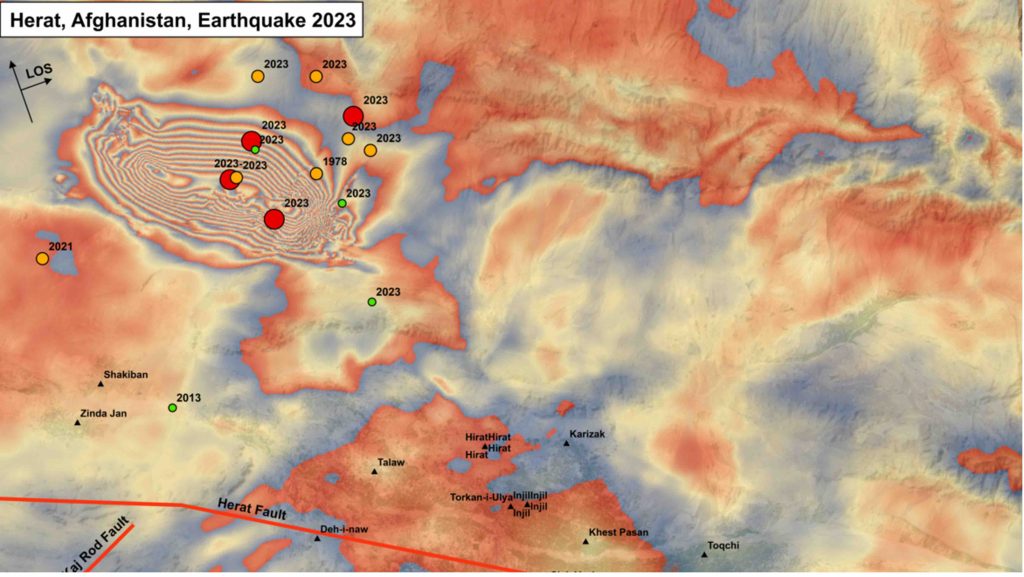
The epicentre of the 7 October earthquake, which measured 6.3 in magnitude on the Richter scale,[1] was in Zendejan district to the west of the provincial capital. About 30 minutes later, another 6.3 magnitude tremor hit the same area, followed by a third measuring 5.9. There have been no fewer than 35 aftershocks, all measuring 4 or above, as well as two more 6.3 magnitude earthquakes on 11 October and 15 October, according to data from the US Geological Survey (USGS).[2] In other words, the ground beneath people’s feet in Herat shuddered some 39 times in the span of three weeks. The dots in Figure 1 below, which uses InSAR satellite data, show the epicentres of quakes as of 10 October 2023, while the rings show where there were particularly strong changes to the earth’s surface.[3]
Figure 1: The Herat earthquake region, including epicentres as of 10 October. Source: GFZ/Najibullah Kakar (here).
The Herat earthquakes happened on fault lines on the Eurasian Plate,[4] The Indian Plate is pushing north-north-westwards at a rate of about 38mm a year, while the Arabian Plate pushes north at a speed of 23mm a year. The result, wrote Afghan seismologist Zakaria Shnizai with three colleagues, is that Afghanistan is “one of the most seismically active intercontinental regions in the world,”[5] with active faulting distributed widely across it. The north is “cut through by numerous earthquake faults,” they wrote, while in eastern Afghanistan, active faults raised “the great mountain ranges of the Hindukush and Pamir.”
The epicentre of the October earthquakes in Herat was between the Siakhubulak Fault in the north and Herat Fault in the south, as well as a third hitherto unmapped fault line between these two, which was detected in satellite images, as reported by Earthquake Insights (see figure 3). The first two major quakes were in Zendejan district and the second two in Injil district, both about 30 km from Herat city.
The fact that these earthquakes were very shallow, about 10 km, is one of the reasons they had such devastating effects, according to the Helmholtz Centre Potsdam – GFZ German Research Centre for Geosciences, which also reported that a region measuring 20 km x 30 km around the epicentre had risen by about 40 cm (see here).
Figure 3: Map of fault lines for the 7 October 2023 earthquakes. Source: Earthquake Insights.
What astonished seismologists was that there were earthquakes in this location at all. On a geological timescale, wrote Afghan Seismologist Najibullah Kakar in the GFZ report cited above, the Herat Fault, which stretches across Afghanistan east to west, must have played an active role, but it had seen no earthquakes for a thousand years.[6] Another seismologist, Jascha Polet, who is professor emeritus at California State Polytechnic University in Pomona, told National Geographic, “When the first two very similar magnitude 6.3 earthquakes occurred, I already thought that this was a fairly unusual sequence,” adding: “When the sequence then produced a quadruplet of these events, I was very surprised” (see here).
To understand what caused this unexpected quartet of tremors, National Geographic spoke to several seismologists. Some, such as the director of the Pacific Northwest Seismic Network at the University of Washington, Harold Tobin, have hypothesised that it was “most likely a domino effect”:
When the first quake struck on October 7, some of the stress from the geologic fault that slipped was transferred to another, already stressed fault. That caused it to rupture as well soon after –and this process happened twice more. This sort of transferal of stresses is seen all over the world, but in the case of these earthquakes, what’s unusual is that they have all been around the same magnitude and occurred in a very short period of time.
While most scientists agree with this theory, there are those who believe the earthquakes were a seismic event called a swarm, or a series of quakes of more or less the same magnitude happening around the same time and in the same region. Swarms of magnitude 6 or above are not common, Zachary Ross, a Geophysicist at the California Institute of Technology, told National Geographic, but he believes the ones in Herat were “fairly normal for earthquake swarms, in which we often see many earthquakes with similar magnitudes.”
Whatever natural phenomenon caused earthquakes, the absence of previous significant seismic activity in the region meant that residents, the government and humanitarian responders were caught off guard and were ill-prepared to deal with a disaster of this magnitude.
What do we know about the damage?
In its Herat Earthquake Response Plan (more on this later), which was released on 16 October 2023, the United Nations Office for the Coordination of Humanitarian Affairs (OCHA) estimated:
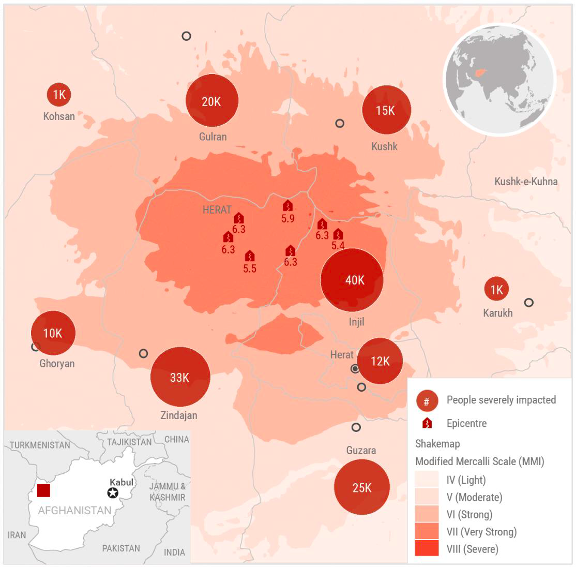
Between 7 and 15 October, four powerful (6.3 magnitude) earthquakes struck Herat Province, affecting 1.6 million people with high intensity shaking (MMI 6+)[7] and leaving at least 114,000 in urgent need of humanitarian assistance. Preliminary assessments show that the first two earthquakes on 7 and 11 October left 1,480 people dead and 1,950 wounded, with available satellite imagery indicating that 289 villages were very highly (11), highly (110) or moderately (168) impacted. An estimated 30 new villages across two districts were affected by the 15 October earthquake, with assessments ongoing.
Preliminary reporting by humanitarian responders estimated that 7,165 families were affected by the quakes (more than 43,000 people, based on an average of six persons per family) in six districts – Gulran, Herat, Injil, Kohsan, Kushk/Rabat-e Sangi and Zendejan (see OCHA Flash Update #6).
A later update, published on 2 November, put the number of households that have been affected at 48,000 in nine districts, mostly in Injil and Zendejan. It reports that some 48,000 household have been affected, including 30,430 houses either severely damaged (20,430) or completely destroyed (10,000), according to UNOCHA (see Afghanistan: Herat Earthquake Response Situation Report No. 2 here). The report also said:
More than 175,000 people in nine districts have been directly affected by these recent seismic events, with Injil and Zinjadan districts suffering the most severe consequences. Injil witnessed the destruction and damage of over 15,000 homes.
UNOCHA has also reported that 21,3000 non-residential structures, including 21 schools and 40 health facilities serving approximately 580,000 people, had also been damaged (see UN reporting here, here and OCHA Flash Update #7). Those affected included 7,500 pregnant women, many of whom were also bereaved (see this UN report). The extensive scale of the disaster means these figures are still likely to be adjusted upward as humanitarian teams continue to assess the damage.
• Initial multi-sectoral rapid assessments (MSRAF) indicate that more than 48,000 households have been affected by the recent earthquakes in Herat Province, including approximately 10,000 homes which have been completely destroyed and 20,430 severely damaged.
Table1: Number of people directly affected. Source: Herat Earthquakes: Flash Update #6/OCHA, 16 October 2023.
AAN spoke to Masuma Jameh from Zendejan district, who stressed how women and children were the prime victims of the earthquakes, but also that some children are now orphans:
Most of the casualties were women and children. Everyone is afraid, there is increasing anxiety and panic especially among women and children. The children are frightened every time the earth shakes. Also, hundreds of children are left without a parent or guardian. Their families were martyred [killed in the earthquake]. They need places to grow up and people to take care of them and look after their wellbeing and education.
Reports from the UN and others confirm her eyewitness testimony: women and children accounted for about 90 per cent of fatalities (see UNICEF here). Preliminary assessments of 178 villages that had been assessed as of 17 October 2023 found that women accounted for 58 per cent of adults who had lost their lives, 60 per cent of the injured and 61 per cent of persons reported missing, according to a report published by the Gender in Humanitarian Action (GiHA) (see Gender Update #2: Earthquake in Herat Province here).
The reason lies not just in the fact that many men from the region have gone to Iran for work, UNFPA’s representative in Afghanistan Jamie Nadal told the Associated Press, but also the time of the quake, 11 in the morning: “At that time of the day, men were out in the field…. The women were at home doing the chores and looking after the children. They found themselves trapped under the rubble.” AP also heard from the Norwegian Refugee Council which said that, “Early reports from our teams are that many of those who lost their lives were small children who were crushed or suffocated after buildings collapsed on them.” Increasing the casualties, said head of UNICEF’s office in Herat Siddig Ibrahim was that, “When the first earthquake hit, people thought it was an explosion, and they ran into their homes.”
Figure 4: The location and number of people directly affected. Source: Herat Earthquakes: Flash Update #7/OCHA, 20 October 2023.
The Herat maternity hospital has also sustained significant damage, with cracks that make it unsafe to provide services inside. The UN has provided tents for pregnant women to receive medical care (see CNBC here). Herat’s exquisite blue mosque and the Citadel, which dates back to 330 BCE, also suffered (see Xinhua reporting here). Indeed, said the head of the province’s Department of Information and Culture Ahmadullah Muttaqi, “There are no historical monuments in this province that were not damaged by the earthquake” (see this Salam Watandar report and these photos posted on X, formerly Twitter).
The earthquakes damaged several reservoirs, which are important sources of water and also caused the water table to rise in some areas. There are anecdotal reports that in Herat it has risen by 10 to 15 metres, architect Jolyon Leslie, an architect working on the restoration of historic monuments and is a long-term resident of Afghanistan, told AAN on 2 November: “It’s not unusual for aquifers to open up and come to the surface after an earthquake when the plates adjust.” Managing director of the media organisation, The Killid Group, Shahir Zahine, who had just returned to Kabul from Herat on 1 November, also confirmed these reports and said that there were reports of streams and other surface waters in locations that would not ordinarily see water at this time of year. The photo below, sent to AAN by Zahine, shows a wadi near Siah Ab village in Zendejan district; the water has appeared unexpectedly and out of season.[8]
A wadi near Siah Ab village in Zendejan district, filled with water out of season due to seismic shifts. Photo: Shahir Zahine/The Killid Group, 1 November 2023.
In a crushing turn of events, on 12 October, a sandstorm in Zendejan, Kohsan and Kushk/Rabat-e Sangi districts, which lasted for 24 hours, destroyed several hundred tents where survivors had been sheltering, including 60 per cent of those at the Gazergah Transit Centre (GTC) (see OCHA Flash Update #5 and these photos on the Indian magazine Outlook’s website). The storm had another unlucky consequence: “People took refuge from the storm inside buildings,” said Masuma Jameh. “Unfortunately, another strong earthquake hit at the same time as the storm and many more people were killed and injured.” Rescue operations continued after the storm ended, as a local journalist, who asked not to be identified, told AAN on 28 October:
The tents that had been given to the people couldn’t withstand the storm and those who were providing aid had to stop working for a time. As soon as the storm stopped, people started helping again. Around this time, special tools arrived and rescue dogs came from Uzbekistan. They searched and pulled many people out from under the ground – alive or dead.
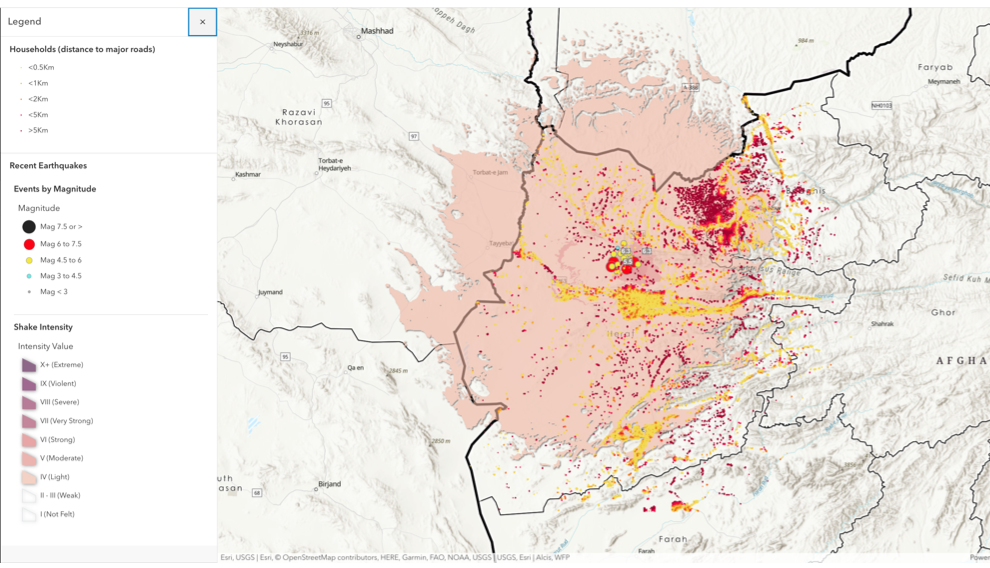
Satellite imagery analysed by the Geographical Information Services (GIS) organisation Alcis has provided a more comprehensive picture of the extent of the quakes and the complexities associated with the response (see Figures 5 and 6.) According to Alcis estimates, based on its analysis of satellite imagery, the number of people affected by the October earthquake could be significantly higher than preliminary estimates reported by UNOCHA and the Emirate. It estimates that as of the earthquake on 15 October (which Alcis counts as the third), a total of 512,992 compounds (residential dwellings) were affected. “Working on the assumption there are an average of 10 people per household,” it calculated that more than five million people – or about 12.5 per cent of the Afghan population – have been affected by the earthquakes. It also said that 160,706 of the household compounds were located more than four kilometres from a main road, meaning many communities had, at the time of the report, not yet been reached for assessment or assistance.
Figure 5: Residential compounds affected by the Earthquakes, by intensity. Source: Alcis website, based on the organisation’s 2023 mapping of all houses in Afghanistan. Figure 6: Locations of household compounds within the affected area and their distance to main roads. Source: Alcis website, see interactive map here.
The level of destruction in Herat province, especially by earthquakes classed as ‘moderate’,[9]) can be attributed, in part, to the nature of most structures in the area, according to seismologist Zakaria Shnizai speaking on the BBC’s Science in Action:
The houses [are] mostly of adobe construction with traditional building materials, flat or domed roofs made of dry mud which is supported by timber sitting on walls of mudbricks or stone blocks, cemented with dry mud…. [T]hese buildings are suited actually with Herat’s climate conditions including the cold winter and the hot summers…. The proximity of active faults when combined with traditional building styles make active villages very susceptible to even moderate earthquakes in the area.
The architect, Jolyon Leslie, acknowledges that traditional adobe constructions are more susceptible to earthquakes and that the dust from collapsed or damaged structures, which suffocates victims, has contributed to the high number of fatalities. Nevertheless, he argues that with proper reinforcement and the use of better fortifications, these structures remain the most appropriate options for housing in the area:
There’s a reason why the houses are built this way. Mud brick structures are cool in the summer and warm in winter, which is exactly what’s needed in this arid region. They do need to be better reinforced to withstand earthquakes, but I really think they’re the right structures instead of the modern prefabricated housing that is usually the default solution after natural disasters. Sure, they are easy solutions that are quickly delivered, but will people use them in the long term? With some support and technical assistance, people could build mud brick houses themselves and this could also create short-term jobs and put money back in the economy.
What has the response been?
Earthquakes are notoriously difficult to respond to. They happen suddenly and, most often, without any warning. They destroy homes and infrastructure, such as roads and disrupt communications, all of which hampers efforts by first responders and relief workers scrambling to get to the area. Rescuers are left working against the clock to pull survivors to safety from the rubble. Affected communities are devastated, shocked and stricken by grief, homeless and many with livelihoods also destroyed. All this was the case in Herat, as the local journalist described:
On the first day, there was little help for the people because Zendejan district is almost two hours away from Herat city by car. Most of the homes in the area were traditional mudbrick houses and none were left standing. No houses. The phone networks were down and it was difficult to get any information in or out. It was only on the second day, when news spread of the devastation, that members of the public and the local authorities started arriving. People were left to rescue family and neighbours in their own village and couldn’t go to the aid of people in other villages. And anyway, they were so consumed by the destruction in their own village that they couldn’t imagine that the same thing had also happened in other places.
In some villages, no one’s left alive and the living are either consumed by grief for their [lost] relatives or tending to injured family members. Most of the wounded have been taken to the hospital in Herat city. That first day, the public, the government and the institutions did not go to the rescue of the people. When help arrived the next day, [in many villages] there was no one left to guide [the rescuers] and because the houses were mostly destroyed, it wasn’t clear what was where and who was missing or needed help. The late arrival of assistance and the absence of locals to guide rescue teams contributed greatly to the high number of casualties.
In such times, it is often community members and ordinary citizens who rush to the aid of their neighbours. Local residents speaking to ToloNews told of how people from elsewhere in the province and further afield rushed to their villages to lend a helping hand (see ToloNews’ extended coverage here). Nearly everyone we spoke to told us about the extraordinary public response,[10]) including the local journalist:
There have been a lot of donations. Everyone’s helped as much as they could. And a lot of help came from Herat city and other provinces as well as from the local administration. They’ve been providing food, tents and other necessities.
Jolyon Leslie also told us how labourers on a historic site that is being restored responded to a call for help:
The public response has been really impressive. This isn’t surprising in Afghanistan where people show up to help each other. This time, the general public and also the private sector have really mobilised to help. The next morning after the earthquake, local officials went door to door to all the NGOs and asked what they could do to help. They came to us too and 70 of the men working on the site volunteered to go. They helped find survivors and dig graves.
Domestic response
The Emirate was quick to respond to the disastrous events in Herat province by sending search and rescue teams and an official delegation to survey the damage. The morning after the first two earthquakes, the spokesman for the Ministry of State for Disaster Management, Janan Saiq, gave a detailed account of the Emirate’s immediate response at a press conference. 35 teams, made up of more than a thousand people, had “gone to the site to help those trapped in villages under the rubble,” he said (see ToloNews here and an interview with Saiq on the channel’s Farakhabar programme here). He also said that acting Deputy Prime Minister Mullah Abdul Ghani Baradar was already in the province, heading a delegation of officials who included the provincial governor and officials from the Ministries of Economy, Refugees and Repatriation and Disaster Management, tasked with “addressing the challenges of earthquake victims and monitoring the fair distribution of aid.”
Saiq initially put the number of fatalities at over 2,400, later revised down to 1,000, with more than 2,000 people injured (see this Reuters report). He also estimated that 1,320 houses had been totally destroyed.[11]) A significant number of livestock were also lost in the earthquake, he added, but could not provide exact figures because the Emirate was focusing on rescue and relief efforts. These included providing water and sanitation, food and shelter. Acting Minister of Public Health, Qalandar Ebad, told ToloNews that nearly 60 health teams had been sent to the area, with “ambulances… and in every team of doctors, there are nurses and midwives who provide services for women.”
In an emergency cabinet meeting on 8 October, acting Prime Minister Mullah Muhammad Hassan Akhund ordered 100 million afghanis (USD 1.35 million) to be allocated for cash distributions to earthquake victims and appointed a special cabinet-level commission to oversee relief efforts.
The commission, which is comprised of the ministries of rural reconstruction, defence, interior, public health, disaster management and the Afghan Red Crescent Society, is “responsible for ensuring that everyone gets the help it needs and that there is no corruption involved,” Emirate Spokesman member Zabiullah Mujahid told DW (see here).[12]
The Emirate has also suspended the required administrative hurdles that are a requisite for NGO operations, an aid worker told the UAE’s English-language daily The National:
We don’t need any of the usual permits to do our relief work in the earthquake-affected areas…. Normally we face a lot of challenges and restrictions – getting permission can take up to four months. But the DFA [de facto authorities] recognises the seriousness of the situation. They have just asked us [international aid groups] to co-ordinate our activities with one another.
The only challenge we have faced is the DFA’s requirement that no female staff are allowed to work in the disaster area without a male escort. But we are very familiar with this restriction by now, so we were well prepared.
The Emirate is also building “2,146 modern houses in 20 affected villages,” which it hopes to complete before the onset of winter (see Tolonews here and BBC Pashto here). Shahir Zahine told AAN that he had seen some of the houses being constructed during his visit: “I’m not an expert in architecture, but they are building the houses quickly and the material being used seems to be of good quality.”
Zahine said he had travelled to the province to check on the well-being of the organisation’s staff –the building housing The Killid Group in Herat had been destroyed – and see what Killid could do to support the victims. It has now set up three mobile radio stations in the most affected districts (Gulrun, Rabat-e Sangi and Zendejan). During natural disasters, when means of communication are largely down, radio remains the most vital source for quickly disseminating up-to-date, accurate and lifesaving information to the public (see the UN’s International Telecommunication Union (ITU) here).
International response
UNOCHA launched an appeal on 16 October on behalf of UN agencies and NGOs, requesting 93.6 million USD to support some 114,000 people. The plan will focus on supporting those whose homes were severely damaged or destroyed for six months (October 2023 – March 2024). It clarifies that the emergency appeal’s activities and requirements are a sub-set of the 2023 Humanitarian Response Plan.
As Figure 7 shows, according to the Plan, over the next six months, aid organisations will work with local and national government officials to support the most vulnerable people in affected communities on a whole range of needs: “emergency shelter and basic household items; provision of trauma care, referrals to the medical facilities, provision of the medical kits/supplies and equipment, as well as mental health and psychosocial support services; therapeutic and supplementary feeding for those acutely malnourished, as well as malnutrition screenings; dignity kits; water trucking, latrine construction and hygiene kits; as well as food commodities and cash packages” (for a detailed breakdown by sector, see the Herat Earthquake Response Plan).
In the days following the earthquakes, several UN agencies launched separate appeals to mobilise funds for the victims of the Herat earthquakes in support of their earthquake response activities, including WFP (USD 19 million), UNHCR (USD 14.4 million), UNFPA (USD 11.6 million) and UNICEF (USD 20 million).[13] Several national and international NGOs have also launched appeals to raise funds for their planned responses to the earthquake. However, as Figure 8 shows, the response has, so far, fallen significantly short of the appeal, only USD 30 million (USD 15 million from donors and another USD 15 million from humanitarian pooled funds) or about 33 per cent of the amount needed to support survivors for the next six months (see the table below for a breakdown of pledges made and assistance provided so far).[14]
Table 2: International cash or in-kind responses as of this writing. Source: OCHA reporting and media reports.
The aftermath
The view from the ground is that assistance to the victims of Herat’s October 2023 earthquakes is, as yet, not nearly enough.
Aid has been distributed, Including tents, food, hygiene and other necessary items, but it’s not enough. Many people have lost their entire family and their houses have been razed to the ground. They have lost everything. Entire villages have been turned into dust. Most of the aid is from businessmen and from people from different provinces, Afghans living abroad and also some charities. Most of the work is being done by civil activists, especially women. From time to time, there are aid distributions from members of the public, but assistance from the government and international institutions has been slow to arrive.
MASUMA JAMEH, A RESIDENT OF ZENDEJAN DISTRICT
The local journalist we spoke to said the most pressing concern was the weather: “It’s getting colder every day and those who’ve lost their homes need shelter. They can’t go on living outdoors for very much longer.” Winters are harsh in this semi-arid region of Afghanistan, with overnight temperatures regularly falling to below freezing. Last year, Afghanistan witnessed the harshest winter in nearly 30 years, with temperatures falling in this area to below minus 25 degrees Celsius, according to UNOCHA (see here).
There are numerous photos and videos in news reports and on social media showing tents among the rubble heaps that were once villages. Matters are especially bleak in Herat city where many survivors, with nothing left in their home villages, have gone in search of shelter and other support. The provincial capital is now “a tent city: families are sleeping in open spaces in parks in small tents,” wrote the Director-General of the World Health Organisation, Tedros Adhanom Ghebreyesus, in a post on X on 16 October. The local journalist also described the scene to AAN:
The parks and streets of Herat city are filled with people who’ve arrived from the districts and also [the city’s] local residents. Those who have houses go home every day, but people aren’t spending the night there. They sleep on the street outside their houses or in parks or on pavements. Since the day of the earthquake, many people have been leaving Herat for Kabul and other provinces, but there is a shortage of cars [for hire], so it’s not easy to secure transport. The situation is very worrying because it’s so cold. Some people have tents, but most don’t and are forced to sleep in the open air in the cold. There are no tents for sale in the market, but some people have managed to find tarpaulin and plastic sheeting. Women and children are sleeping outside in the open during these cold nights. Many of them, especially the children, are sick with colds and more serious chest infections.
While there are plans underfoot by the Emirate to build over 2,000 permanent homes for Herat’s earthquake victims, aid workers are doubtful that such a massive undertaking will be completed in time to protect them from this winter’s freeze. They point to their previous experience in other disaster zones and argue for urgent distributions of winterised tents and assistance to help victims either rent housing or find shelter with host families.
The psychological fallout from the disaster is also significant. Not only have people lost their friends and families, their homes and their livelihoods, but the ground has been moving under their feet for the better part of a month. Many people whose homes have remained undamaged are fearful of being indoors when the next earthquake hits:
People are afraid to sleep indoors. They’re afraid of what might happen if a quake hits when they’re sleeping. So even those whose homes are still standing sleep outside. It’s remarkable to see how the number of tents swells up in the evenings. All open spaces – parks, the courtyards of mosques, even highways – fill up with tents. Families who don’t have proper tents use makeshift ones made of mosquito netting. In the morning, those who still have a house, take down their tents and go home – only the ones who have come [to Herat] from the districts or have lost their house stay.
SHAHIR ZAHINE, MANAGING DIRECTOR OF KILLID GROUP
It is not just the damage and loss of life from the earthquake that is a big worry. Money is also an ongoing concern. After the dead have been buried and the injured tended to, after survivors have been provided with adequate shelter and basic services such as health care and education, after provision has been made for the children who have lost their family, after all that, the government and aid organisations must turn their attention to making sure affected communities have appropriate support to rebuild their lives and get back on their feet. Local communities who have lost not only their homes and families but also farms, livestock, jobs and businesses need help to rebuild their lives, rehabilitate their farms, find jobs and restore at least some of what they lost in the disaster.
Edited by Kate Clark
References
References
↑1
According to the Richter Scale that measures earthquakes, those measuring 6.0 to 6.9 are considered ‘strong’ and 5.0 to 5.9 ‘moderate’ quakes. A 6.3 earthquake like the ones in Herat is capable of causing considerable damage to “ordinary substantial buildings with partial collapse” and “great damage in poorly built structures poorly,” according to this explainer on the Puerto Rico Seismic Network. Most well-built structures can withstand a 5.9 magnitude tremor, it says, but poorly built, weaker structures can sustain considerable damage.
↑2
In reporting the number of quakes and aftershocks, we are using data from the US Geological Survey (USGS) (see here). There are conflicting reports about the number of earthquakes with many, including the United Nations, reporting that four earthquakes took place. However, the region experienced 28 magnitude 4.1 or above aftershocks, which means that there were a total of 32 tremors in 7-19 October.
↑3
InSAR (Interferometric Synthetic Aperture Radar) is a technique for mapping ground deformation using radar images of the Earth’s surface that are collected from orbiting satellites (see USGS here).
↑4
The Earth’s rigid outer shell is fractured into seven or eight major plates and many ‘platelets’ which all slowly move.) the world’s third largest tectonic plate (67,800,000 km2) which spans Europe and most of Asia and sits between the North American and African Plates to the north and west, as well as many smaller ‘platelets’ (see figure 2). All of them are slowly moving. Afghanistan lies on “a southward-projecting, relatively stable promontory of the Eurasian tectonic plate,” wrote Boyd, Mueller and Boyd, but is surrounded by “active plate boundaries” to the west, south and east.(( Oliver S Boyd, Charles S Mueller and Kenneth S Boyd, ‘Preliminary probabilistic seismic hazard map for Afghanistan’, 2007, US Geological Survey Open-File Report 2007-1137.
There have been there have been ten magnitude 6.0 or greater earthquakes in Iran’s Khorasan province bordering Herat (see Wikipedia for a list of earthquakes in Iran), including the 7.3 magnitude Qayen earthquake in May 1997 (see USGS here) and the 7.1 tremor in September 1978 (see USGS here), which claimed some 15,000-25,000 lives (an estimated 80 per cent of the local population) and all but destroyed the historic city of Tabas and 90 surrounding villages (see ‘The 1978 Tabas, Iran, earthquake: An interpretation of the strong motion records,’ Bulletin of the Seismological Society of America, 1988, 78 (1), 142–171.
↑7
The Modified Mercalli intensity scale (MMI) measures the effects of an earthquake at a specific site using “key responses such as people awakening, movement of furniture, damage to chimneys, and finally – total destruction…. [It is considered to be] more meaningful measure of severity to the nonscientist than the magnitude because intensity refers to the effects actually experienced at that place” (see USG here).
↑8
A wadi is a valley or ravine that is dry except in the rainy season.
↑9
See footnote 1.
↑10
In addition to the numerous media reports and videos on social media also show members of the public helping with the rescue, there are also reports of Afghans inside the country and abroad responding with cash and in-kind donations (see for example ToloNews here and here, as well as this Deutsche Welle report). The private sector and celebrities have pledged support for the earthquake victims. For example, Afghanistan’s star cricketer, Rashid Khan, donated all his earnings from the 2023 Cricket World Cup and has launched a campaign to raise additional funds (see his post on X, formerly Twitter here).
↑11
While this figure is considerably lower than the numbers reported by other sources, including the UN, such inconsistencies are not unusual, especially in the days immediately after a natural disaster. It is often in the days and even weeks afterwards that a full picture emerges of the extent of the damage.
↑12
Several line ministries have announced donations from staff members to support victims of the Herat earthquakes, including the General Directorate of Intelligence (GDI) 24 million Afs (USD 325,000) from their salaries; Ministry of Education 11.34 million Afs (USD 153,000); and Ministry of Defence 36.57 million Afs (USD 494,000).
↑13
WFP’s USD19 million appeal will assist earthquake victims with food and cash-based transfers for three to seven months. Earlier this year, WFP was forced to reduce the amount of food families receive and to cut 10 million people in Afghanistan from life-saving food assistance due to a funding shortfall (see here). UNHCR has also launched an urgent appeal for USD 14.4 million to support some 8,100 earthquake-affected families, including refugees and IDP returnees, with tents, cash assistance, psychosocial and cash support and other relief items. UNHCR also plans to support orphaned, separated or unaccompanied children and persons with special needs, such as the disabled and the elderly (see here). UNFPA has asked for USD 11.6 million to support women and girls in the earthquake zone with maternal, reproductive health and psychological services; life-saving adolescent sexual and reproductive health services; and emergency supplies, including health, mother and child, dignity and menstrual kits as well as non-food items such as blankets and tarpaulin sheets for women and girls (see here). UNICEF has also launched an appeal asking for USD 20 million to support 200,000 beneficiaries, including 96,000 children with health, psychological and hygiene services, water and sanitation, cash assistance for 1,400 families and temporary learning spaces for children (see here).
↑14
According to media reports the Emirate declined an offer of assistance from Pakistan (see Khaama Press here and VoA here).
They say that education is one of their fundamental rights and the Islamic Emirate should open the gates of schools to girls as soon as possible.
Coinciding with World Science Day, girls who are students above the sixth grade want to reopen schools once again.
They say that education is one of their fundamental rights and the Islamic Emirate should open the gates of schools to girls as soon as possible.
“Eight hundred days is not a small number. A day for a girl to study is like a year, but it’s been 800 days since you deprived Afghan girls of education,” said Asma, a student.
Among the girls deprived of education, Shabnam, 18, is a young girl who dreams of becoming a doctor.
“Today is the World’s Science Day, and the largest part of the Afghan society, which are women, are deprived of their most basic right. My request to the caretaker government is to open the gates of schools to all Afghan girls as soon as possible,” Shabnam, a student, told TOLOnews.
On November 10th, World Science Day for Peace and Development is celebrated every year in different countries of the world.
A number of university teachers consider Afghanistan to be one of the countries where the education process has always been accompanied by challenges.
They say that the Islamic Emirate should put opening the gates of schools and universities on their agenda.
“Keeping a large part of the society, i.e. women and girls, from education is actually avoiding a religious order on the one hand and on the other hand, depriving this large and influential section of society from the blessing of literacy, which is actually a divine order,” said Hekmatullah Mirzada, a university scholar.
Meanwhile, Zabihullah Mujahid, the spokesman of the Islamic Emirate, says that the caretaker government is trying to make Afghanistan progress in various sciences.
“We want Afghanistan to be equal in sciences and reach the same stages that the countries of the world have reached, we are trying to progress in various sciences,” Zabihullah Mujahid said.
Earlier, Roza Otunbayeva, the head of UNAMA, at the Women in Islam conference in Jeddah, criticized what she called the violation of the rights of women and girls in Afghanistan.
The Turkish President, Recep Tayyip Erdoğan, also stressed the importance of stability in security in Afghanistan.
Ebrahim Raisi, the president of Iran, called on ECO members to support economic improvement and reconstruction in Afghanistan.
Speaking at the Economic Cooperation Organization (ECO), Raisi said Iran is ready to facilitate transit for any kind of humanitarian assistance to the people of Afghanistan.
He also stressed the need for the formation of an inclusive government in Afghanistan.
“I want to refer to Afghanistan, which is an important country in the neighborhood of the Islamic Republic of Iran and also a main member of ECO,” Raisi said. “We are still waiting for [the formation of] an inclusive, responsible, and responsive government with effective existence of all ethnic groups in Afghanistan. Of course, as we announced before, the ECO organization has to attend to a supportive program for Afghanistan to help the noble people of the country and to help with the reconstruction and economic development of that country.”
Meanwhile, speaking at the Economic Cooperation Organization (ECO), Pakistan’s caretaker prime minister Anwar ul Haq Kakar highlighted the significance of Afghanistan for regional connectivity and the execution of regional projects like CASA-1000, the Trans-Afghan Railway and TAPI.
“We are all aware of the fact that Afghanistan plays a critical role in regional connectivity. Connectivity projects such as CASA-100, Trans-Afghan railways, TAPI and others,” he said.
The Turkish President, Recep Tayyip Erdoğan, also stressed the importance of stability in security in Afghanistan.
He also said that Ankara had sent a shipment of 510 tons of food, health and clothing materials to Afghanistan on Tuesday.
Raisi at ECO Calls for Economic Support for Afghanistan, Inclusive Govt
Speaking at the conference, Raisi accused America of destruction, murder, slaughter and backwardness in Afghanistan.
Iran and Tajikistan once again called for the formation of an inclusive government in Afghanistan.
Iranian President Ebrahim Raisi said that the two nations seek the establishment of an inclusive government in Afghanistan that includes all ethnic groups and religions, during a joint news conference with President Imam Ali Rahman of Tajikistan.
Speaking at the conference, Raisi accused America of destruction, murder, slaughter and backwardness in Afghanistan.
“We believe that a government should be established in Afghanistan that represents all ethnicities, religions and the people of Afghanistan and can take lasting steps towards the progress of this country,” Raisi said.
“During the negotiations, we discussed the international and regional issues, especially the situation in Afghanistan, the Palestinian issue, and the problems of other regions of the world,” Imam Ali Rahman said.
However, Zabihullah Mujahid, spokesman of the Islamic Emirate, said that their government is inclusive and asked countries not to interfere in the internal affairs of Afghanistan.
“Afghanistan’s internal issues should be left to the Afghans, and other countries should not interfere in its type of system, because Afghanistan has been the source of external interventions for the past 40 years, which have had no results,” Mujahid added.
According to some political analysts, the Islamic Emirate should take practical steps for the sake of the country’s progress in forming an inclusive government.
“Afghans also want a government that they see themselves involved in, a government that does not belong to only one class, and the world has also told the Islamic Emirate. It is good for the Emirate to establish an inclusive government as soon as possible,” Wahid Faqiri, a political analyst, told TOLOnews.
Earlier, the acting foreign minister, Amir Khan Muttaqi, said that the international community has not yet provided a clear definition of the establishment of an inclusive government in Afghanistan.
Iran, Tajikistan Continue to Call for Inclusive Govt in Afghanistan
A number of refugees deported from Pakistan complain about the inappropriate treatment of the Pakistani military.
A number of refugees deported from Pakistan complain about the inappropriate treatment of the Pakistani military.
They say that now that they have returned to the country, there is a need for the caretaker government to address their challenges.
After the beginning of the process of forced deportation of Afghan refugees from Pakistan in the last nine days, more than 50 thousand immigrants have entered the country through Spin Boldak Kandahar.
Local officials of Kandahar pledged that they will continue their efforts to deal with the challenges of the deported refugees.
“6,000 families numbering 50,000 people have returned to the country since the beginning of November and this process is continuing,” said Ali Mohammad Haqmal, Information officer of Spin Boldak, Kandahar.
“Our mujahidin protect the security of people who come here all night. If they have any illness or problem, we will treat them,” said Hekmatullah Faizani, the security officer of the refugees camp in Spin Boldak.
A number of refugees who have been deported from Pakistan, complained of inappropriate treatment by the Pakistani military. According to these refugees, the Pakistani military has also confiscated their property.
“In Pakistan the refugees have big problems, the men were separated from their women and they knew nothing of every injustice they have done to them,” said Mohammad Barat, a deported refugee.
“We want them to give us land and give us some shelter,” said Abdul Bari, a deported refugee.
With the beginning of the process of deporting Afghan refugees from Pakistan, some merchants in Kandahar have also started the process of helping the refugees in this province.
Based on the information of the local officials of Kandahar, a number of refugee families who do not have shelter will be provided accommodation in temporary camps and some are moving to their provinces.
Over 50,000 Refugees Returned Through Spin Boldak in 9 Days
However, the Islamic Emirate’s spokesman, Zabihullah Mujahid, rejected the violation of women’s rights in the country.
The head of UNAMA, Roza Otunbayeva, once again criticized what she called the violation of the rights of women and girls in Afghanistan.
Speaking at the international conference “Women in Islam,” which was held in Jeddah, Saudi Arabia, by the OIC, Otunbayeva said restrictions on women and girls have been denied access to high schools and higher education.
“Women and girls, these restrictions have denied them access to high schools, higher education, and just about every sphere of social economic cultural, and political life. Regrettably, these limitations have become integral parts of the governing system presented by the Taliban…,” she added.
“As those doors of opportunity closed to the Afghan women, I think it is absolutely correct for Muslim countries to ask of the Afghan government as to who has given them the right to close the door of opportunity exclusively for women,” said the Minister of State for Foreign Affairs for the Cabinet of Pakistan, Hina Rabbani Khar.
“The time has come … this suspension has to stop. We the people of Afghanistan, women of Afghanistan, and you, the most important organization for the Muslim world, let’s repeat this message — and find a solution for women of Afghanistan,” said the head of the Afghan Women’s Association Fatana Gilani.
However, the Islamic Emirate’s spokesman, Zabihullah Mujahid, rejected the violation of women’s rights in the country and said that the issue of education in the country can be solved but it takes time to solve it.
“First, this is that the rights of the sisters will be addressed. Secondly, regarding the education of sisters, a part of their education has been suspended, which has not been denied, but the search is ongoing to find a suitable solution,” Mujahid noted.
This comes as more than eight hundred days have passed since schools above the sixth grade were closed for girls, an issue that has always had internal and external reactions, but the Islamic Emirate has yet to speak about the reopening of schools for girls.
Voices Raised to End Restrictions on Women, Girls in Afghanistan
Some economists added that half of Afghanistan’s population currently lives below the poverty line.
Several World Bank top economists voiced worries during a discussion at the US Institute of Peace over the deterioration of Afghanistan’s dire economic conditions.
“We see that in terms of monetary poverty, we still have half of the population that in 2023 is consuming below the poverty line,” said Silvia Redaelli, Senior Economist, the World Bank.
Naheed Sarabi, Director and Cofounder, Institute for Development and Economic Affairs, said at the discussion that the economic situation of women is getting worse.
“Feminization of poverty is a fact in Afghanistan, and it is getting worse and worse. It is not the restrictive policies of the Taliban that affect poverty and women’s activities, but there have been reports that in villages and rural areas people actually self-police because of fear, because of the environment that has been created,” Sarabi noted.
Meanwhile, some economists attribute the increase in economic challenges in the country to the imposition of restrictions by the international community, saying that to solve this problem, the Islamic Emirate should increase economic interactions with the countries of the region.
“One of the main reasons of the current situation of the country is because of the sanctions imposed by the went on the country,” Abdul Naseer Reshtia, an economist told TOLOnews.
The Ministry of Economy said that by launching large economic projects in the country, they are trying to provide job opportunities for the citizens.
“In order to overcome the economic challenges, the Islamic Emirate is working on development projects, strengthening of private sector and infrastructure, and the launching of large economic projects that provide employment,” said Abdul Latif Nazari, Deputy of the Ministry of Economy.
Previously, various UN agencies expressed their concerns about the economic crisis in Afghanistan, saying that nearly 30 million people in Afghanistan need humanitarian aid.
Half of Afghan Population Below Poverty Line: World Bank Economist
The United Nations says aid workers are still in a “race against time” to remove rubble and rebuild after the devastating earthquake struck eastern Afghanistan last month, killing at least 2,200 people and cutting off remote areas.
The 6.0-magnitude quake on Aug. 31 was shallow, destroying or causing extensive damage to low-rise buildings in the mountainous region. It hit late at night, and homes — mostly made of mud, wood, or rocks — collapsed instantly, becoming death traps.
Satellite data shows that about 40,500 truckloads of debris still needs to be cleared from affected areas in several provinces, the United Nations Development Program said Wednesday. Entire communities have been upended and families are sleeping in the open, it added.
The quake’s epicenter was in remote and rugged Kunar province, challenging rescue and relief efforts by the Taliban government and humanitarian groups. Authorities deployed helicopters or airdropped army commandos to evacuate survivors. Aid workers walked for hours on foot to reach isolated communities.
“This is a race against time,” said Devanand Ramiah, from the UNDP’s Crisis Bureau. “Debris removal and reconstruction operations must start safely and swiftly.”
People’s main demands were the reconstruction of houses and water supplies, according to a spokesman for a Taliban government committee tasked with helping survivors, Zia ur Rahman Speenghar.
People were getting assistance in cash, food, tents, beds, and other necessities, Speenghar said Thursday. Three new roads were under construction in the Dewagal Valley, and roads would be built to areas where there previously were none.
“Various countries and organizations have offered assistance in the construction of houses but that takes time. After the second round of assistance, work will begin on the third round, which is considering what kind of houses can be built here,” the spokesman said.
Afghanistan is facing a “perfect storm” of crises, including natural disasters like the recent earthquake, said Roza Otunbayeva, who leads the U.N. mission to the country.
 Afghanistan Peace Campaign