Ignoring Afghan women and girls is to do the Taliban’s work for them

In Afghanistan, women now talk about their futures in the past tense. I was on a Zoom call recently with two young university graduates in Kabul when I asked them about their plans. “I hoped to go …,” they answered. “I planned to do …”

But they won’t. They can’t. They have been judged and the verdict rendered: They are female, and for that, from the Taliban, there can be no mercy.

It’s been 11 months since the fall of Kabul, and the vanishing of women is nearly complete. The men who rule my country wield their control with a casual cruelty that can be breathtaking. Just this month, the Taliban told female employees of Afghanistan’s finance ministry — well-educated, well-qualified women barred from their workplace for these past 11 months — to send in male relatives to do their jobs because the ministry’s workload was becoming quite heavy.

Vanished. Just like the freedom to work in your chosen profession. The freedom to travel without a chaperone. The freedom to decide what you will wear in public. The freedom to go to school beyond sixth grade.

None of that will be necessary, the Taliban says. Not for Afghan women. The blue burqa awaits you. At puberty, your education ends, your autonomy ends. Your future is a memory you never had a chance to make.

Eleven months is all it took. The great vanishing of Afghan women is happening again before the eyes of the world, just the way it did in the 1990s when I was a child growing up under the Taliban’s first regime — a girl with no choice but to attend secret schools, walking frightened through Kabul’s streets among the blue shrouds of invisible women.

I am a woman now, in exile abroad, and I haven’t forgotten what those days felt like — just like I haven’t forgotten what I saw in the years after the Taliban’s retreat in 2001.

I haven’t forgotten the Afghan women who returned home, those educated exiles who had studied overseas and came back to take jobs in our public and private sectors and showed all of us that our futures were exactly that — our futures. Ours to shape.

In August, you’ll be seeing Afghanistan in the headlines again. It will be a year since the Taliban’s return and the U.S.-led evacuation of Kabul, an evacuation my students and I were part of. You’ll hear the stories of refugees scattered around the world, and of the immigration purgatory so many find themselves in, waiting for the chance to build new lives.

These refugees must have access to quality education — women and girls in particular. My school and I are committed to the effort, and the international community must make investment in these women and girls an aid priority, especially in those who will not soon leave the transit camps in which they live.

Many girls in these camps have not had schooling of any kind for a year or even longer. To ignore these girls is to do the Taliban’s job for them. The men who rule my nation fear what an educated girl can become and what an educated woman can create. I say, let them fear us.

They remember who led the way in reviving Afghanistan after the demise of their first regime. By investing in the education of Afghan refugees, we work to make that past prologue.

We are the women of Afghanistan. And our futures are ours.

Shabana Basij-Rasikh, a Washington Post Global Opinions contributing columnist, is co-founder and president of the School of Leadership, Afghanistan.
 Ignoring Afghan women and girls is to do the Taliban’s work for them
read more

U.S. kills al-Qaeda leader Ayman al-Zawahiri in drone strike in Kabul

The United States has killed Ayman al-Zawahiri, the leader of al-Qaeda and one of the world’s most-wanted terrorists, who, alongside the group’s founder, Osama bin Laden, oversaw the attacks of Sept. 11, 2001, President Biden announced Monday evening.

Zawahiri was killed in a CIA drone strike in Kabul over the weekend, according to U.S. officials who spoke on the condition of anonymity to discuss sensitive intelligence.

When U.S. forces withdrew from Afghanistan last August, Biden administration officials said they would retain capability for “over-the-horizon” attacks from elsewhere on terrorist forces inside Afghanistan. The attack against Zawahiri is the first known counterterrorism strike there since the withdrawal.

Speaking in a live television address from a balcony at the White House, Biden announced that days ago he had authorized a strike to kill Zawahiri. “Justice has been delivered, and this terrorist leader is no more,” Biden said.

The strike occurred at 9:48 p.m. Eastern time on Saturday, according to a senior administration official who briefed reporters on the operation. A drone fired two Hellfire missiles at Zawahiri as he stepped onto the balcony of a safe house in Kabul, where he had been living with members of his family, the official said.

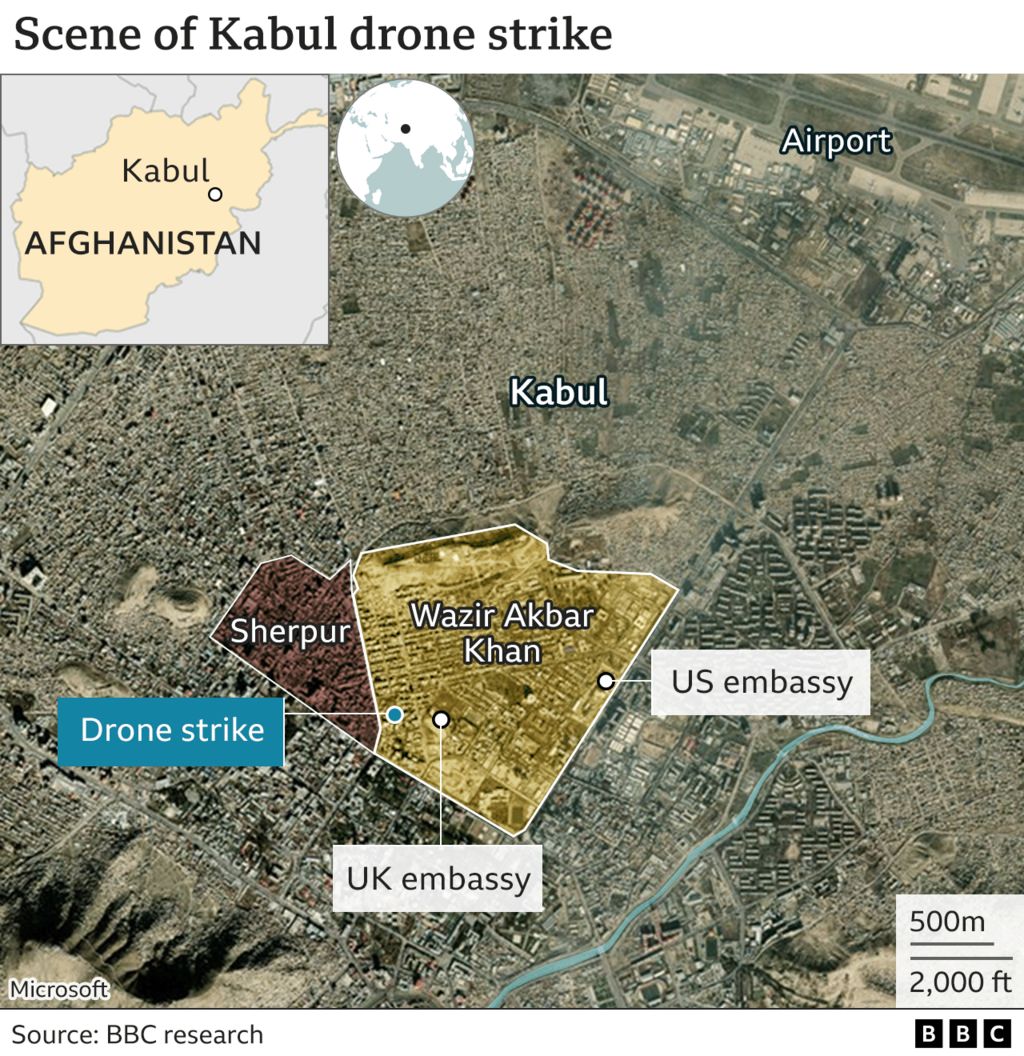
A loud blast was heard in the Shirpur neighborhood in central Kabul. The district, long a derelict area owned by the Afghan Defense Ministry, was converted into an exclusive residential area of large houses in recent years, with senior Afghan officials and wealthy individuals owning mansions there.

A few blocks away from the site, residents and shopkeepers spoke openly Tuesday morning about hearing the powerful blast. Some said they had been frightened by the roar and the ground shaking, while others said they had long been accustomed to such attacks during years of war.

“All the children ran away from the sound. We hadn’t heard anything like it since the old government was in charge,” said Haq Asghar, a retired army officer chatting outside a hardware shop. He said that Shirpur was tightly controlled by the Taliban, and that anyone occupying a house or shop had to provide detailed documents and information.

“Security is very good now. They definitely don’t let strangers settle in here,” he said.

Shirpur is divided between an older section of modest homes and shops, which is open to traffic, and a high-security section of ornate modern mansions, which is heavily guarded and closed to traffic. The house reportedly occupied by Zawahiri and his family appeared to be located in the secure section, behind a large bank and several guarded alleys lined with government compounds.

The intelligence community had tracked Zawahiri to the safe house and spent months confirming his identity and developing a “pattern of life,” tracking his movements and behavior, the official said. Intelligence personnel also constructed a model of the safe house, which was used to brief Biden on how a strike could be carried out in such a way that it lessened the chances of killing any other occupants or civilians, the official said, adding that intelligence agencies have concluded that Zawahiri was the only person killed in the strike.

“The United States continues to demonstrate its resolve and capacity to defend Americans from those who seek to do it harm,” Biden said, making it “clear again [that] no matter how long it takes, no matter how you hide … the United States will find you and seek you out.”

Senior administration national security officials were briefed in early April on the information that Zawahiri was believed to be living in the house, which he never left, the official said.

Biden received updates throughout May and June, and on July 1, he was briefed in the White House Situation Room by key Cabinet members and advisers, including CIA Director William J. Burns, Director of National Intelligence Avril Haines, National Counterterrorism Center Director Christine Abizaid and national security adviser Jake Sullivan, the official said.

The president met again with his top advisers on July 25 and continued to press the intelligence agencies on how they planned to conduct a strike with minimal civilian casualties, the official said. All his advisers “strongly recommended” the strike, which Biden then authorized, the official said.

Senior members of the Haqqani Taliban faction were also aware that Zawahiri was living in the house and took steps after the strike to conceal his presence, the official said, calling the terrorist leader’s presence in Kabul a violation of the Doha Agreement signed between the United States and the Taliban in 2020.

The agreement leading to the U.S. withdrawal from Afghanistan included a Taliban pledge not to allow terrorist groups with international aims to operate within their territory and to break all relations with those groups. While the Islamic State has been growing within Afghanistan and has claimed frequent attacks against the Taliban and civilian targets, al-Qaeda appears to retain a strong relationship with the Taliban government.

Zabihullah Mujahid, the chief Taliban spokesman, confirmed the drone strike early Tuesday, saying it had been “carried out by US unmanned planes” and had “struck a residential house in the Shirpur area of Kabul.”

In Shirpur on Tuesday morning, many people were confused about the source of the strike, which Taliban authorities initially had called a rocket attack that had not injured or killed anyone. Some blamed it on next-door Pakistan, and others had heard rumors that the Americans were behind it. But only a handful knew the strike had been announced by Biden in Washington.

“I heard Joe Biden did it,” said a man named Abdul Wali, who was changing money at a sidewalk stand. “This means Afghanistan still belongs to America. They can do whatever they want. If they can do a drone strike in the city, it means they are still in charge.”

Nobody in the community was willing to express an opinion about al-Qaeda, but several said they were concerned that the attack would spark a new round of violence.

“We have had so many years of war, and things were just beginning to settle down,” said Syed Agha, a jobless schoolteacher selling vegetables from a cart. “The conflict is past, and no one should have the right to violate our sovereignty. An attack like this could badly affect our future.”

In a tweet and an online statement in Afghan Pashto, Mujahid said the Taliban government “strongly condemned the attack,” terming it a “violation of international norms and the Doha peace deal.”

Zawahiri, whose face was familiar to millions of Americans from his videotaped diatribes against the United States, played an important role in turning al-Qaeda into a more lethal and ambitious terrorism organization, according to many of the investigators who hunted its leadership for decades. By merging his Egyptian-centric organization with bin Laden’s, the group became a far more dangerous and global terrorism group, analysts said. Zawahiri was indicted on a charge of the bombings of U.S. embassies in Kenya and Tanzania in 1998, attacks that first highlighted the growing threat from al-Qaeda.

Both bin Laden and Zawahiri escaped U.S. forces in Afghanistan in late 2001 after the 9/11 attacks, and Zawahiri’s whereabouts had long been a mystery. Bin Laden was killed in a raid by U.S. forces in Pakistan in 2011.

After bin Laden’s death, Zawahiri became the figurehead leader of al-Qaeda, but he was a hunted man in charge of a decimated organization. Lacking bin Laden’s loyal following, Zawahiri tried to command far-flung terrorist groups that often ignored his decrees and rejected his advice. In particular, he was overshadowed by the rise of the Islamic State and its bloody dominion for several years over parts of Syria and Iraq.

But with much of the group’s original leadership captured or killed, Zawahiri was perhaps the most visible reminder of al-Qaeda’s grim legacy.

“I just got chills up and down my spine,” said Charles G. Wolf, whose wife was killed at the World Trade Center in the terrorist attacks, when he learned about the U.S. strike. “It’s great to hear … I’m sure there will be someone else to step in his shoes, but I think it sends a signal that we are still going after terrorists regardless of politics.”

In a report issued last month, U.N. analysts said Zawahiri had been “confirmed to be alive and communicating freely,” with “regular video messages that provided almost current proof of life.” It noted that his “increased comfort and ability to communicate” coincided with last year’s Taliban takeover of Afghanistan.

“Al-Qaeda is not viewed as posing an immediate international threat from its safe haven in Afghanistan because it lacks an external operational capability” from there, “and does not currently wish to cause the Taliban international difficulty or embarrassment,” the report said.

Both the United Nations and the U.S. intelligence community have assessed that the operational threat from al-Qaeda is now centered in its African and Middle East affiliates. “Al-Qaeda probably will gauge its ability to operate in Afghanistan under Taliban restrictions and will focus on maintaining its safe haven before seeking to conduct or support external operations from Afghanistan,” the Office of the Director of National Intelligence assessed this year.

A former member of al-Qaeda who later joined the Islamic State downplayed the significance of Zawahiri’s death, noting that he was barely visible in recent years.

“I’m sure Biden will try to make it sound as if it’s something big, but actually it’s not significant for us at all,” said the member of the Islamic State who spoke on the condition of anonymity to discuss the al-Qaeda leader. “Ayman al-Zawahiri became the emir after bin Laden, and now he is a shaheed [martyr]. And that’s it for us. The significant question will be: Who will become the new leader now?”

In the wake of the strike on Zawahiri, the senior official said the administration warned the Taliban not to take any steps that would harm Mark Frerichs, a 60-year-old American civil engineer and Navy veteran who was kidnapped in Afghanistan in January 2020. The only known remaining American hostage in Afghanistan, he is believed to have been captured by the Haqqani network, a Taliban faction that during the Afghanistan war was based in Khost province, near the Pakistan border, and in Pakistan itself. Its leader, Sirajuddin Haqqani, is now interior minister in the Taliban government in Kabul.

The Taliban has denied any knowledge of Frerichs’s whereabouts. The director of a contracting company called International Logistical Support, he had traveled to Afghanistan numerous times during the U.S. military presence there. In May 2020, the FBI offered a $1 million reward for information leading to his release or rescue.

In April, the New Yorker published information from what it said was a video from a source who could not be verified, showing Frerichs pleading for his release. In it, he states that it was being recorded on Nov. 28, 2021. The magazine said Frerichs’s sister had confirmed that it was her brother.

Frerichs’s family has criticized both the Trump and Biden administrations, the former for signing a peace deal with the Taliban that did not mention him and the latter for implementing it.

Constable reported from Kabul. Ellen Nakashima, Devlin Barrett and Olivier Knox in Washington contributed to this report.

U.S. kills al-Qaeda leader Ayman al-Zawahiri in drone strike in Kabul
read more

What Zawahri’s Death Tells Us About Afghanistan’s Future

By JONATHAN SCHRODEN
Politico

The successful strike on Sunday against Ayman al-Zawahri —a man with no shortage of American blood on his hands — is a celebratory moment for President Joe Biden’s administration. For watchers of Afghanistan, it is also illuminating, like a flashbulb on the darkness that has enveloped Afghanistan since the American pullout a year ago.

According to initial reports, the Central Intelligence Agency used a drone to launch two Hellfire missiles at Zawahri after spotting him on the balcony of the Kabul safe house in which he was staying with his family. Even with the limited information now available, this assassination can tell us a great deal about the current security situation in the country, the state of U.S. capabilities to affect that situation and the future of Afghanistan and its people.

It also raises a host of questions that are yet to be answered.

Security is a growing worry

Since the U.S. withdrawal from Afghanistan and the Taliban’s nearly immediate takeover last August, the trend in security for the average Afghan has improved. Civilian casualties, for example, have declined as a result of the end of the long civil war waged by the Taliban against the U.S.-supported government.

However, the threat from terrorist groups of concern to the international community has steadily increased in the past year.

The most virulent of these is the Islamic State-Khorasan, an organization that was on the rebound even before the U.S. withdrew. Since then, IS-K has increased in size to between 1,500 and 4,000 fighters and is now one of the “most vigorous” regional networks of the Islamic State. The group, which routinely conducts attacks against Taliban security forces, has also engaged in horrific attacks against minority groups and rocket attacks against Afghanistan’s neighbors.

Al Qaeda is not as strong as IS-K in Afghanistan (likely numbering several hundred individuals). But unlike the adversarial relationship that IS-K has with the Taliban, al Qaeda enjoys close and abiding relations with the group that now governs the country. A recent United Nations report stated that since the U.S. withdrawal from Afghanistan, al Qaeda senior leaders had “enjoyed a more settled period” and had begun recruiting new members and funding in the country. That report further stated that the Taliban’s takeover had given Zawahri himself “increased comfort and ability to communicate” with al Qaeda’s followers.

The fact that Zawahri was killed in the middle of Kabul — in a neighborhood known to house senior Taliban figures — suggests that both he and the Taliban believed the country’s capital was an effective sanctuary for the world’s most wanted terrorist. Further, Zawahri’s habit of spending time on an open balcony, combined with reports that foreigners were detected in his neighborhood by local Afghans months ago, illustrates the increased sense of freedom that members of al Qaeda have enjoyed in Afghanistan over the past year.

‘Over-the-horizon’ counterterrorism is less effective — but it can work

Before the U.S. withdrew from Afghanistan, it was maintaining several thousand special operations forces in Afghanistan, accompanying counterterrorism strike platforms (e.g., drones), a CIA station and local partner forces such as the Afghan Army Commandos and the elite Ktah Khas. In the wake of the withdrawal, the U.S. lost all of those capabilities, and was left with no residual presence or partner forces in the country.

To mitigate those losses, the U.S. established an “over-the-horizon” counterterrorism cell in Qatar, intended to address threats in Afghanistan remotely. It has been flying routine drone sorties from its airbases there, through Pakistani airspace and over various regions of Afghanistan. Those drones provide the U.S. with some residual means of intelligence collection on terrorist activities in the country. But as of last December, according to the former commander of U.S. Central Command, the U.S. was “at about 1 percent or 2 percent of the capabilities we once had to look into Afghanistan.”

With a tiny fraction of the capabilities it once had, the U.S. has been far less effective at putting pressure on groups like IS-K or al Qaeda in Afghanistan, which accounts in large part for their expansion since last fall. And yet, the Zawahri strike illustrates that even with this small amount of capability, the U.S. remains able to find, fix and finish even the most elusive of terrorist targets there.

While the full details of Sunday’s strike have not yet been revealed, reports have emerged of the CIA having a “ground team” in place before and apparently after the strike was conducted. The infiltration or cultivation of such a team represents a notable expansion in U.S. intelligence capabilities in Afghanistan over the past six months and the successful strike will reignite the fears and reinvigorate the safety protocols of al Qaeda and IS-K leaders.

For Afghans, no good news

While Zawahri’s death is a victory for U.S. intelligence agencies and will likely hobble al Qaeda’s core cadre until a new leader is firmly at the helm, it nonetheless bodes ill for the average Afghan.

Over the past year, Afghanistan’s population of roughly 40 million people have suffered immensely. Financial aid to the country, which formed the predominance of its national budget before the U.S. withdrawal, has decreased precipitously and its economy has contracted by 30 to 40 percent since last August.

Prior to this strike, the U.S. had been engaged in regular talks with the Taliban on issues such as humanitarian aid, opening of secondary schools for girls and the possible release of Afghanistan’s sovereign wealth to a modified Central Bank. Through these talks, the U.S. aimed to inject more resources into the Afghan economy — without directly aiding the Taliban government — to ease the suffering of Afghans.

Now, with the news that Zawahri was not only in Kabul, but being sheltered there by the Taliban’s acting Minister of Interior, Sirajuddin Haqqani, the relationship between the Taliban and the U.S. is likely to move into a cold, tense phase. The Taliban have already condemned the strike as a violation of Afghanistan’s sovereignty and the sole formal agreement between the group and the U.S. that the two sides signed in Doha in 2020. The U.S., for its part, called the Taliban’s harboring of Zawahri a violation of the same agreement.

Negotiations were previously healthy enough that U.S. Special Representative Tom West was able to exchange proposals with the Taliban that were designed to jump-start macroeconomic assistance to the country. In this new atmosphere, it is doubtful that he will be given the same degree of latitude to meet with the Taliban, and it seems likely that no further progress on any of the issues he had been discussing with them will be made soon.

In the meantime, the one constant of the past four decades of Afghanistan’s history — the suffering of its average citizens — is likely to remain.

With new knowledge comes new questions

While the Zawahri attack illuminates a lot about the current situation in Afghanistan, it also raises a host of additional questions. For example, why did the Taliban allow Zawahri to come to Kabul? Was it to keep him safe from discovery and U.S. strikes elsewhere? Or was it to keep tabs on him and his activities, so as to prevent al Qaeda from attacking other countries from Afghanistan, as the Taliban has repeatedly pledged it would do?

Even more important, looking forward: If Zawahri was brought to Kabul and sheltered by the Taliban, who else are they hiding and protecting? Other leaders of al Qaeda? Leaders of other militant groups? And when will the Afghan people see relief from the cycle of terrorism, violence and suffering that they have endured for so long?

Yesterday’s announcement was a moment to celebrate. But it was only a moment. Today brings new knowledge, new questions, new targets, new challenges and new collateral damage in the unending war between the U.S. and al Qaeda.

What Zawahri’s Death Tells Us About Afghanistan’s Future
read more

Taliban under scrutiny as US kills al-Qaida leader in Kabul

By RAHIM FAIEZ and MUNIR AHMED

Associated Press
2 August 2022

ISLAMABAD (AP) — The U.S. drone strike that killed al-Qaida leader Ayman al-Zawahri on the balcony of a Kabul safe house intensified global scrutiny Tuesday of Afghanistan’s Taliban rulers and further undermined their efforts to secure international recognition and desperately needed aid.

The Taliban had promised in the 2020 Doha Agreement on the terms of the U.S. withdrawal from Afghanistan that they would not harbor al-Qaida members or those seeking to attack the U.S.

Yet a mastermind of the 9/11 terror attacks, who has called for striking the United States in numerous video messages in recent years, lived for months apparently sheltered by senior Taliban figures.

The safe house where al-Zawahri was staying in Kabul’s upscale Shirpur neighborhood was the home of a top aide to senior Taliban leader Sirajuddin Haqqani, according to a senior U.S. intelligence official. Haqqani is deputy head of the Taliban, serves as interior minister in its government and heads the Haqqani network, a powerful faction within the movement.

Still, there have been persistent reports of unease among Taliban leadership, particularly tensions between the Haqqani network and rivals within the movement.

The Taliban initially sought to describe the strike as America violating the Doha deal, in which the U.S. committed not to attack the group. The Taliban have yet to say who was killed in the strike.

The official, who spoke on condition of anonymity to The Associated Press as he wasn’t authorized to speak publicly to reporters. Al-Zawahri took over as al-Qaida’s leader after Osama bin Laden was killed in Pakistan in 2011, in an operation by U.S. Navy SEALs.

“The Taliban were aware of his presence in Kabul, and if they were not aware of it, they need to explain their position,” the official said.

Pakistan’s Foreign Ministry issued a very carefully worded statement, which referred to a “counter-terrorism operation by the United States in Afghanistan” but did not mention al-Zawahri. “Pakistan condemns terrorism in all its forms and manifestations,” it said. Pakistan has been lobbying for the world to give greater recognition and support to the Taliban government.

The strike early Sunday shook awake Shirpur, once a district of historic buildings that were bulldozed in 2003 to make way for luxury homes for officials in Afghanistan’s Western-backed government and international aid organizations. After the U.S. withdrawal in August 2021, senior Taliban moved into some of the abandoned homes there.

The targeted safe house is only a few blocks from the British Embassy, which has been closed since the Taliban takeover in August. Taliban officials blocked AP journalists in Kabul from reaching the damaged house on Tuesday.

The U.N. Security Council was informed by monitors of militant groups in July that al-Qaida enjoys greater freedom in Afghanistan under the Taliban but confines itself to advising and supporting the country’s new rulers.

A report by the monitors said the two groups remain close and that al-Qaida fighters, estimated to number between 180 to 400, are represented “at the individual level” among Taliban combat units.

The monitors said it’s unlikely al-Qaida will seek to mount direct attacks outside Afghanistan, “owing to a lack of capability and restraint on the part of the Taliban, as well as an unwillingness to jeopardize their recent gains” such as having a safe haven and improved resources.

During the first half of 2022, al-Zawahri increasingly reached out to supporters with video and audio messages, including assurances that al-Qaida can compete with the Islamic State group for leadership of a global movement, the report by the Analytical Support and Sanctions Monitoring Team said.

IS militants have emerged as a major threat to the Taliban over the past year, carrying out a series of deadly attacks against Taliban targets and civilians.

The Haqqani network is an Afghan Islamic insurgent group, built around the family of the same name. In the 1980s, it fought Soviet forces and over the past 20 years, it battled U.S.-led NATO troops and the former Afghanistan government. The U.S. government maintains a $10 million bounty on Serajjudin Haqqani for attacks on American troops and Afghan civilians.

But the Haqqanis, from Afghanistan’s eastern Khost province, have rivals within the Taliban leadership, mostly from the southern provinces of Helmand and Kandahar. Some believe Sirajuddin Haqqani wants more power. Other Taliban figures have opposed the Haqqanis’ attacks against civilians in Kabul and elsewhere during the insurgency.

Jerome Drevon, the International Crisis Group’s senior analyst studying Islamist militant groups, said the tensions are focused on how to direct the new regime — “how to share power … who gets what position, who gets to control what ministries, to decide the general policies and so on.”

The timing of the strike also couldn’t come at a worse time politically for the Taliban. The militants face international condemnation for refusing to reopen schools for girls above the sixth grade, despite earlier promises. The United Nations mission to Afghanistan also criticized the Taliban for human rights abuses under their rule.

The U.S. and its allies have cut off billions in development funds that kept the government afloat in part over the abuses, as well as froze billions in Afghan national assets.

This sent the already shattered economy into free fall, increasing poverty dramatically and creating one of the world’s worst humanitarian crises. Millions, struggling to feed their families, are kept alive by a massive U.N.-led relief effort.

The Taliban have been trying to reopen the taps to that aid and their reserves. However, al-Zawahri’s killing already has been seized upon by U.S. Secretary of State Antony Blinken as a sign that the Taliban “grossly violated the Doha Agreement and repeated assurances … that they would not allow Afghan territory to be used by terrorists to threaten the security of other countries.”

Taliban spokesman Zabihullah Mujahid alleged the U.S. violated the Doha Agreement by launching the strike. Afghanistan’s state-run television channel — now under the Taliban — reported that President Joe Biden said al-Zawahri had been killed.

“The killing of Ayman al-Zawahri closes a chapter of al-Qaida,” said Imtiaz Gul, the executive director of the Islamabad-based Center for Research and Security Studies.

Al-Zawahri’s death coincided with the 32nd anniversary of Iraqi dictator Saddam Hussein’s invasion of Kuwait — creating a sort of a bookend to al-Qaida’s era of militancy. Saddam’s invasion prompted the U.S. military presence in Saudi Arabia, which in turn was one factor that drove bin Laden to turn his guns on America, culminating in the 9/11 attacks.

Associated Press writers Jon Gambrell and Isabel DeBre in Dubai, United Arab Emirates, contributed to this report.

Taliban under scrutiny as US kills al-Qaida leader in Kabul
read more

A New Platform for Afghan Women and Civil Society

Anthony Navone

United States Institute of Peace

Monday, August 1, 2022

When the Taliban returned to power last August, many wondered if the previous two decades of progress and change in Afghanistan would temper the group’s previously draconian policies. But despite some initial rhetoric that hinted in the direction of reform, the Taliban have recommitted — rather than reconsidered — their repressive approach to governance. Over the last 11 months, the group has instituted massive rollbacks for women’s rights, as well as pushed marginalized groups further to the periphery in a country mired in economic and humanitarian crises.
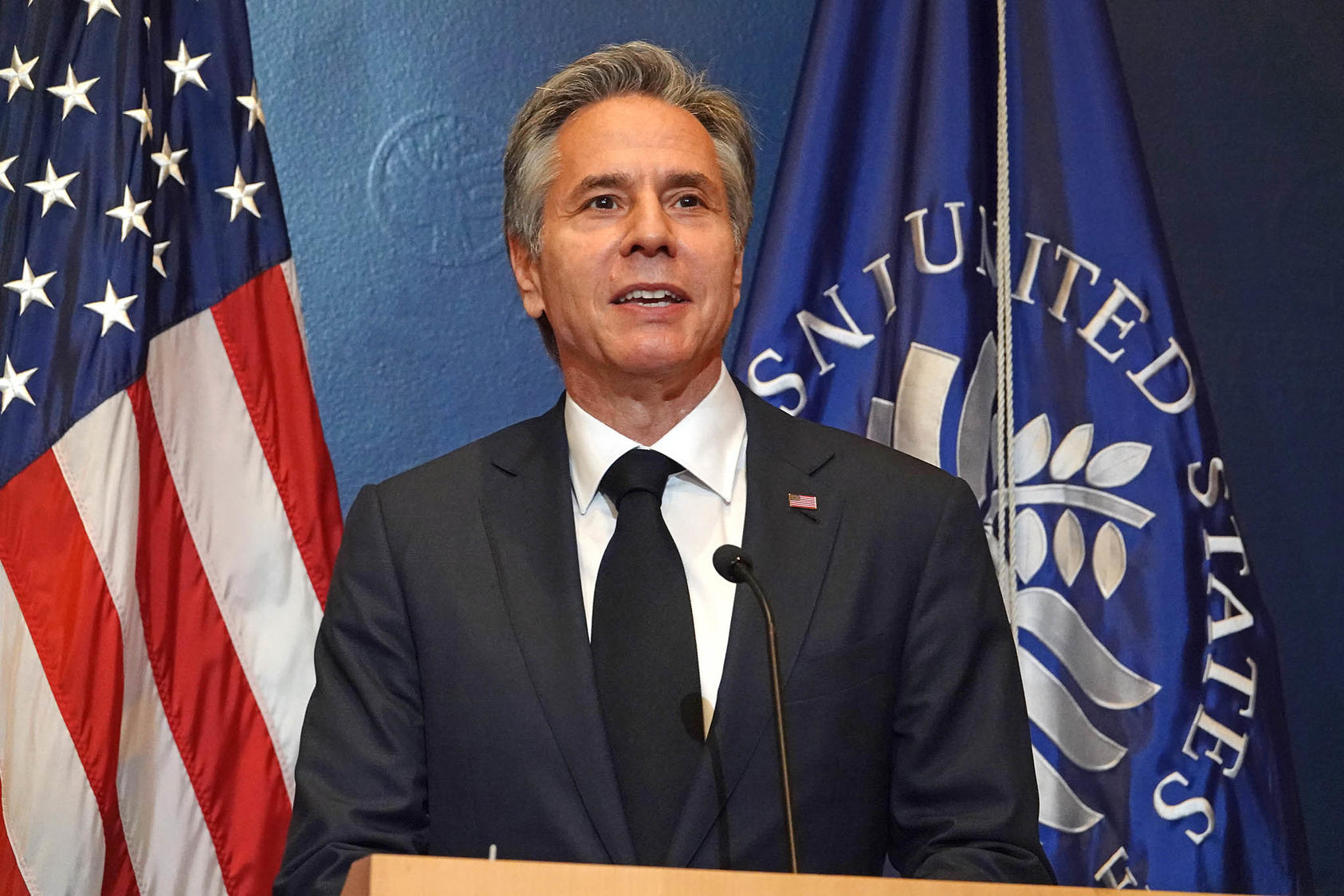
U.S. Secretary of State Antony Blinken speaking at USIP about the launch of the new U.S.-Afghan Consultative Mechanism.
However, “the women and girls of Afghanistan and other vulnerable targeted people have simply refused to back down,” said U.S. Secretary of State Antony Blinken.What these groups need now is a venue that elevates their voices. “They have lost their platform in Afghanistan,” said Rina Amiri, the U.S. special envoy for Afghan women, girls, and human rights. “They are seeking a place, a platform, to bring their voices together” now that women leaders and activists “are scattered all over the world.”To help coordinate and deepen Afghan engagement with U.S. government officials, the State Department has launched the U.S.-Afghan Consultative Mechanism (USACM). Comprised of various Afghan women’s coalitions, as well as civil society leaders, journalists, academics and religious scholars from inside and outside Afghanistan, the USACM will inform U.S. policy on issues ranging from documentation of human rights violations to the role of women in Islam.

“What we want to do is to make our partnerships with Afghan civil society more effective, more rigorous, more productive, more purposeful,” said Blinken as he introduced the USACM at a USIP event.

Constricting Women’s Role in Afghan Society

The launch of the USACM comes as the situation on the ground for Afghan women and girls continues to worsen. Prior to the fall of the former government, women and girls had expanded their access to education and economic mobility. Women comprised 38 percent of teachers, and 3,000 licensed and 54,000 unlicensed small-to-medium Afghan businesses were run by women. Women and girls “didn’t just study at schools, they ran them,” said Blinken.

But since August 2021, the Taliban have rapidly constricted women’s and girl’s freedoms, leading to a 75 percent drop in women’s employment compared to pre-takeover levels. Additionally, the Taliban have reinstated requirements for face coverings and drastically reduced women’s ability to travel freely or alone.

On the education front, the Taliban have ordered universities to enforce gender-segregated classrooms. And after originally assuring both Afghan girls and the West that girls’ education would reopen in March, the Taliban abruptly reversed course and the ban for girls in grades seven and up remained in place. The decrees have wrought havoc and often come without warning — many girls learned of the education ban as they arrived for their first day of classes.

The results have been devastating. Domestic violence is on the rise as women are further confined to their homes, with little agency to venture beyond their neighborhood. Some women, hit particularly hard by the economic crisis, have been cut off from accessing humanitarian aid as each Taliban decree constricts their movements more and more.

A Devastated Afghan Economy

Meanwhile, the sudden removal of women from the workforce has only worsened Afghanistan’s economic woes. The per capita income in Afghanistan in 2022 is expected to drop by 50 percent compared to a decade prior. This will be disproportionately devastating for women, “because as we all know, the last penny is spent on women in any household,” said Naheed Sarabi, the former deputy minister for policy at the Afghan Ministry of Finance.

Meanwhile, Afghanistan’s GDP is expected to fall by 5 percent, equivalent to roughly $1 billion. Sarabi says the rollback of women’s rights can be seen as one of the main drivers: “You’re losing the economic contribution of half of the population of Afghanistan … half the human capital of the country.”

For a country on the verge of famine and economic collapse, the Taliban’s decision to revert to the oppressive policies of decades past could prove catastrophic — not just for women and girls, but for all of Afghanistan’s future stability.

“Walking away is not a choice that any of us have,” said Amiri. “Not only from a moral imperative, but also from a strategic imperative,” as a fragile Afghanistan poses security risks to the region and international community at large.

The Taliban are Not the Only Reality

Afghanistan is a notably diverse country, with a wide range of cultural and ethnic groups that call it home. But many Afghan women worry that the international focus on the Taliban has drowned out that fact — especially given the Taliban’s unwillingness to reform.

Whether to engage with the Taliban — and how much — has been a difficult needle to thread for U.S. officials. “I continue to maintain that engagement with the Taliban is necessary, particularly to address the situation of Afghans inside the country that are facing a desperate situation,” said Amiri. But at the same time, she said, “I don’t want to give them space to present to the world that they’re engaging in good faith on these issues” when they continue to rollback progress and backtrack on prior assurances.

The troubling reality is that the Taliban control Afghanistan’s government. However, “the Taliban are the reality of the country, but they are not the only reality,” said Asila Wardak, a senior fellow at the Radcliffe Institute for Advanced Study at Harvard University and a founding member of the Women’s Forum on Afghanistan.Even with the crackdown on civil society, women’s groups are still making things possible “from very scratch, from nothing,” said Palwasha Hassan, a founding member of the Afghan Women’s Network and a senior fellow at Georgetown University’s Institute for Women, Peace and Security. “In those places that have been affected by the earthquake, woman have gone there not only to bring services, but also to try to engage with the local Taliban” on women’s and girl’s issues.

A New Consultative Mechanism

The persistence of these women and civil society groups has shown diverse voices still resonate throughout Afghanistan despite the Taliban’s best attempts to tamp them down. But in the face of a repressive regime, these voices need assistance to ensure they are heard.

“It’s very important that the international community doesn’t speak for Afghans,” said Hassan. Instead, the United States and others should “help Afghan themselves to be part of their own solution.”

In a hopeful development, forums offering this kind of platform have popped up around the world. But as these venues propagate, there’s concern that Afghan women and civil society leaders could end up “having separate, repetitive conversations,” said Amiri.

To help alleviate this propensity for repetition, the USACM combines the efforts of forums hosted by USIP; the Atlantic Council; the Georgetown Institute for Women, Peace and Security; and the Sisterhood is Global Institute.

“We are building on the feedback we’ve received,” said Amiri, adding that the United States doesn’t have to “start from zero,” but can instead partner with “platforms that have been engaging Afghans for decades.”

The consolidation is “shaping all these informal discussions into a formal discussion and shows the commitment of the U.S. government,” said Wardak. “We would like to be kind of a bridge between the woman inside Afghanistan and the woman in the diaspora and exile.”

Where Afghanistan Goes from Here

“Afghan women have told me it’s not just the Taliban that’s hurting women right now,” added Amiri. “It is the fact that donor funding has dried up and has left Afghan women in a very desperate situation.”

For Sarabi, the immediate solution is rather straightforward: “Political, social and economic empowerment go hand in hand … What woman need right now, short term, is access to finance in cash. Cash distribution could be a way to uplift them from the current poverty level, quickly.”

Hassan agreed that human rights and economic realities are intertwined for women in Afghanistan. “They are also concerned how to feed [their] children,” she said, noting that child marriage is on the rise because there is “no alternative” for some people.

While straightforward, this solution faces a major hurdle: With the Taliban in charge, most donors no longer have a presence on the ground in Afghanistan, leaving them unable to monitor or administer programs.To circumvent this issue, Afghan women suggest that mechanisms like the USACM connect international donors with local organizations to divvy up responsibilities. “There is room for … local organizations to be direct implementers” while “international organization can play the role of monitoring, evaluations and even capacity building,” said Hassan.Beyond immediate economic needs, Hassan said that as long as the Taliban continue to block girls’ education, “It’s important that we have alternatives for girls in Afghanistan that they can benefit from.” NGOs and other organizations have orchestrated peer-to-peer learning, online education, scholarships and home-schooling initiatives, “but they should not be considered a substitute for an education sector in Afghanistan or formal education,” added Hassan.

Because while international donors and local Afghan organizations can find ways to work around the Taliban’s harsh restrictions, women and girls won’t be able to fully regain their livelihoods and rights without the Taliban sanctioning their official return.

“[The international community] has the the financial leverage, the political leverage, the economic leverage to pressure the Taliban on behalf of the women’s movement, girls, education and protection of civil society organizations,” said Wardak.

Secretary Blinken acknowledged this, saying the United States continues “to urge the Taliban to reverse their decision on girls’ education, to make good on their commitment to the Afghan people, to allow girls to learn.”

But rather than incentivize the Taliban solely through punitive measures from international actors, Blinken added that the Taliban should reverse course because it’s the will of the people they govern —and the Taliban’s tactics to suppress it aren’t working: “In the face of threats, violence, [and] intimidation, the women and girls of Afghanistan and other vulnerable, targeted people … have never stopped believing in a brighter future for their country. They are determined to do all they can to make that future real.”

A New Platform for Afghan Women and Civil Society
read more

The killing of the top Qaeda leader offers lessons on 20 years of U.S. involvement in Afghanistan.

The New York Times

1 August 2022

The killing of Ayman al-Zawahri in Afghanistan — where planning for the Sept. 11 strikes began more than two decades ago, where the West once seemed poised to remake a fractured nation, and where the terrorist leader could feel comfortable again after the Taliban takeover last summer — speaks volumes about what America accomplished in a 20-year experiment. It also says a lot about where it failed.

On one level, it was a reminder of how little has changed. The Taliban are once again in charge of the country. They were harboring the known leader of Al Qaeda, just as they were 21 years ago. He was comfortably established in a safe house there, so comfortable that his family was nearby, and he had routines to take in the sunshine.

On another level, it was a reminder of how surveillance, drones and remote killing have changed the nature of the hunt for the terrorist group’s leadership. In 2001, America’s drones were largely still unarmed. In the ensuing 21 years they became armed, and the C.I.A. and the U.S. military perfected the art of hunting what they called high-value targets.

To get al-Zawahri took patience — two decades of patience. It validated President Biden’s commitment that, even after withdrawing U.S. troops last year, he would continue counterterrorism operations.

Which takes the story to one more lesson: If the original objective of going into Afghanistan was running these kinds of operations — finding the masterminds of the Sept. 11, 2001, attacks and the generation of terrorists who followed — then maybe it was possible to pursue the mission without trying to remake the country.

But the mission morphed. President George W. Bush celebrated the first inklings of democracy — elections — and the fact that girls could go to school. Military units helped irrigate the fields and built a court system. For a while, America imagined it was building a noisy, nascent democracy. But somehow it never took hold. Drones could not remake the underlying society, or rout the Taliban, who, in many different forms, have always existed. America succeeded at the tactical, but not at the strategic. Bin Laden and al-Zawahri were brought to justice, but just as the British discovered in the 19th century and the Soviets in the 20th, the society proved far harder to alter. Al-Zawahri is gone. The Taliban still rule.

David E. Sanger is a White House and national security correspondent. In a 38-year reporting career for The Times, he has been on three teams that have won Pulitzer Prizes, most recently in 2017 for international reporting. His newest book is “The Perfect Weapon: War, Sabotage and Fear in the Cyber Age.”

The killing of the top Qaeda leader offers lessons on 20 years of U.S. involvement in Afghanistan.
read more

Zawahiri’s killing was a Biden play for popularity – but it may have unintended consequences

The Guardian
2 August 2022

The death of the al-Qaida leader points to a potential shift in the complex dynamic between the US, Pakistan and the Taliban

A decade after US Navy Seals killed Osama bin Laden in a special operation in Pakistan, Ayman al-Zawahiri was killed in a US drone strike in Kabul.

Both men were synonymous with the image of al-Qaida. But more than anything, the killing of Zawahiri is a symbolic success for Joe Biden, whose approval rating has been dismally low recently. Even before the ill-fated military withdrawal from Afghanistan that led to the Taliban seizing power, the US president had been vigorously trying to avoid discussing the country in his media engagements. Unsurprisingly, he is now trying to capitalise on the drone strike that killed Zawahiri to seek redemption in Afghanistan.

While Zawahiri was involved in the planning of the 9/11 attacks, his more recent significance is more questionable. Al-Qaida may be one of the most notorious global jihadist groups since the collapse of the Soviet Union, but it has been competing in a crowded space of violent extremists including Islamic State – and its affiliates – in the Middle East, Asia and beyond.

The death of Zawahiri will not transform the nature of any threat facing the US and Europe from Afghanistan under the Taliban. But it underlines how imperative it is to ensure Afghanistan does not become so unstable and forgotten that it provides a ground for the incubation of terrorism and violent jihadists. Groups such as al-Qaida, Islamic State and previously the Taliban are experts in replacing leaders in quick succession without interrupting operations.

Crucially, Zawahiri’s killing unleashes several unknown consequences and political and security implications for different sides of the conflict in and around Afghanistan.

For months there have been unconfirmed reports of drones flying over the skies of Kabul. The Taliban have been presenting their regime as the first in decades to have total control over the Afghan territory. The US drone strike killing Zawahiri in Kabul’s Shirpur district – where some of the most ostentatious mansions were built by former US-backed warlords – defeats the Taliban’s claims of having full territorial control. The US-Taliban agreement signed in Doha in February 2020 states that the Taliban “will not allow any of its members, other individuals or groups, including al-Qaida, to use the soil of Afghanistan to threaten the security of the United States and its allies”. Acknowledging Zawahiri’s presence in Kabul will set the Taliban against the US, but admitting a lack of intelligence will lead to accepting defeat in establishing control.

As the Taliban are largely a loose union of different factions who were strongly united as an insurgency prior to August 2021, it is plausible that one or more factions among them were hosting and protecting Zawahiri. His death will put significant pressure on these internal fissures, especially if the US continues drone strikes in Afghanistan.

Because Afghanistan is landlocked, the over-the-horizon operations by US drones would have needed permission from one of the neighbouring states to enter the Afghan airspace. Iran, central Asian countries and China – which shares a mountainous border with Afghanistan – would not cooperate with the US on this. Pakistan, therefore, would be the logical option. If this US strike was carried out in cooperation with Pakistan, there are several major regional implications. Pakistan has strong relations with China, including the multibillion-dollar infrastructural project, the China-Pakistan Economic Corridor (CPEC). For nearly 20 years, Pakistan provided the Taliban sanctuary as the group waged a bloody insurgency against US, Nato and Afghan security forces that also killed tens of thousands of Afghan civilians. The former Pakistani prime minister Imran Khan celebrated the Taliban’s return to power in August 2021, and blamed the US for a heedless “war on terror”. But Khan was unseated in a no-confidence vote in April.

Pakistani-American cooperation on counter-terrorism operations in Afghanistan would underline a significant thawing of relations. It may impact Islamabad’s efforts to build further relations with China and Russia. However, Pakistan has been facing immense financial difficulties, with rising inflation and plummeting value of the local currency. Islamabad has been desperately trying to gain support from Washington, including by involving its army chief to secure a multibillion-dollar loan package from the International Monetary Fund (IMF). By cooperating on counter-terrorism with the US, Pakistan would naturally expect American support beyond military cooperation including securing financial packages.

It is too early to predict precise outcomes in Afghanistan and the region from this incident. But the US seems to have signalled that it is able to dominate the sky over the country, and that it is willing to act. By demonstrating that they can attack with such precision, the CIA and other US entities will force other jihadist groups underground. Taliban factions who do not enjoy the full patronage of the Pakistani security establishment will also be worried about renewed US-Pakistan cooperation on drone strikes inside Afghanistan.

It remains to be seen if the threat of US drone strikes will be used as leverage to influence Taliban behaviour. Military might did not defeat the Taliban insurgency, but the Taliban did not win militarily either. Ultimately, for all the talk of ending America’s “forever war” in Afghanistan, the Biden administration must acknowledge that 20 years of American involvement in Afghanistan has fundamentally transformed the nature of the country and its region. The US and the west must focus on longterm engagement with Afghanistan if the aim is to prevent the incubation of terrorist groups and global jihadists.

Hameed Hakimi is an associate fellow at Chatham House in London and a senior fellow at the Atlantic Council in Washington DC

Zawahiri’s killing was a Biden play for popularity – but it may have unintended consequences
read more

Students Call for Girls’ Schools to Be Reopened

Girls’ schools above sixth grade were shut down for about a year, and the Islamic Emirate has not decided whether or not to reopen them.

Following international calls for the reopening of girls’ schools above the sixth grade, some students from schools and universities have now asked the Islamic Emirate to reopen girls’ schools as soon as possible.

“We ask the Islamic Emirate of Afghanistan to provide the opportunity of education for all the people of Afghanistan, including boys and girls,” said Khatera, the organizer of the gathering.

The gathering’s organizers said in a resolution that the closing of girls’ schools is not justified by Sharia and that it will do significant harm to Afghan society.

“The current position of the government to close schools above the sixth grade for girls does not have any form of Sharia consideration, according to the principles of Islam,” said Sadia Sirat, a student.

However, some women’s rights activists stated that no one would benefit from the closing of girls’ schools.

“Keeping the doors of schools closed is not useful for the government but has its own problems, and this leads the people of Afghanistan to lose trust in the government,” Ai Noor Uzbek, a women’s rights activist told TOLOnews.

Girls’ schools above sixth grade were shut down for about a year, and the Islamic Emirate has not decided whether or not to reopen them.

Students Call for Girls’ Schools to Be Reopened
read more

Ayman al-Zawahiri: How US spies found al-Qaeda’s top man in Kabul

By Matt Murphy
BBC News

2 August 2022

Last year, during the chaotic US withdrawal from Afghanistan, President Joe Biden pledged his administration would not allow the new Taliban-led regime to make the country a safe-haven for terrorists.

The remarks were intended to indicate that, as far as Mr Biden’s White House was concerned, the decades-old war on terror was far from over.

Almost a year later, the president’s top security advisers approached him and suggested that intelligence officials may have located the leader of al-Qaeda, Ayman al-Zawahiri, in Afghanistan.

Identifying a high-value target

In background briefings, senior administration figures told reporters that they believed Zawahiri had returned to Afghanistan in the past year, following the collapse of the Western-backed government.

US spies had been carefully watching Afghanistan ever since the US withdrawal for signs that al-Qaeda leaders were slowly filtering back into the country, an adviser to Mr Biden said.

Zawahiri is said to have settled in a large compound with high, protective walls, in downtown Kabul with his wife and daughter.

The neighbourhood Zawahiri chose, a relatively well-to-do area called Choorpur, was home to foreign embassies and diplomats under the previous administration. Now, most of the Taliban’s senior officials live in its plush surroundings.

In early April, CIA officers first briefed Mr Biden’s advisers, and then the president himself, informing him that they had identified a network supporting the al-Qaeda leader and his family through multiple streams of intelligence, according to the briefings.

The spies had slowly established patterns of behaviour from the house’s residents, including the unique mannerisms of a woman that spies identified as Zawahiri’s wife.

Officials said they had recognised her use of terrorist “tradecraft”, which she used in an attempt to avoid leading anyone to her husband’s safehouse in Kabul.

They observed that after arriving at the house, Zawahiri never personally left the premises. But they did note his habit of appearing periodically on a balcony overlooking the property’s walls for short periods of time.

Plotting an historic raid

For Mr Biden, the opportunity to kill one of America’s most wanted men was fraught with risk.

Zawahiri was living in a dense residential neighbourhood, and the drone strike that accidentally killed 10 innocent people in Kabul, including an aid worker and seven children during the final days of the US presence in Afghanistan, will undoubtedly have played on his mind.

A graphic showing the location of Ayman al-Zawahiri's home
Presentational white space

Throughout May and June, the US leader was focused on the war in Ukraine and pushing through landmark legislation on gun control and climate change. But secretly a “very small and select” group of top intelligence officers began preparing several options to present to him.

Mr Biden had tasked intelligence officers with ensuring that civilians – including Zawahiri ‘s family and Taliban officials – weren’t accidentally killed in the attack.

On 1 July, Mr Biden gathered several top officials, including CIA Director William Burns and Director of National Intelligence Avril Haines, for a briefing.

Mr Biden was said to be “deeply engaged in the briefing and immersed in the intelligence” as he and his advisers gathered around a scale model of Zawahiri’s home that intelligence officials had constructed and brought to the White House.

“He was particularly focused on ensuring that every step had been taken to ensure the operation would minimise that risk,” a senior adviser said.

Mr Biden asked for information about the building’s structure and how a strike could affect it, before flying to Camp David for a weekend break.

Over the next few weeks, officials met at the White House situation room – a bunker-like command centre below the White House set up to allow the president to monitor crises at home and abroad.

They methodically planned the operation, trying to anticipate any questions the president could ask.

Meanwhile, a small team of lawyers came together to assess the legality of a strike, ultimately concluding that Zawahiri was a legitimate target based on “his continuing leadership role in al-Qaeda and his participation and operational support for al-Qaeda attacks”.

On 25 July, after convening his team one final time and asking his top advisers for their views, Mr Biden authorised the strike.

Taliban leaders scramble as US strikes

At 06:18 local time (01:38 GMT), two hellfire missiles fired by a drone smashed into the balcony of Zawahiri ‘s home, killing the al-Qaeda leader. Members of his family were unharmed, intelligence officials said.

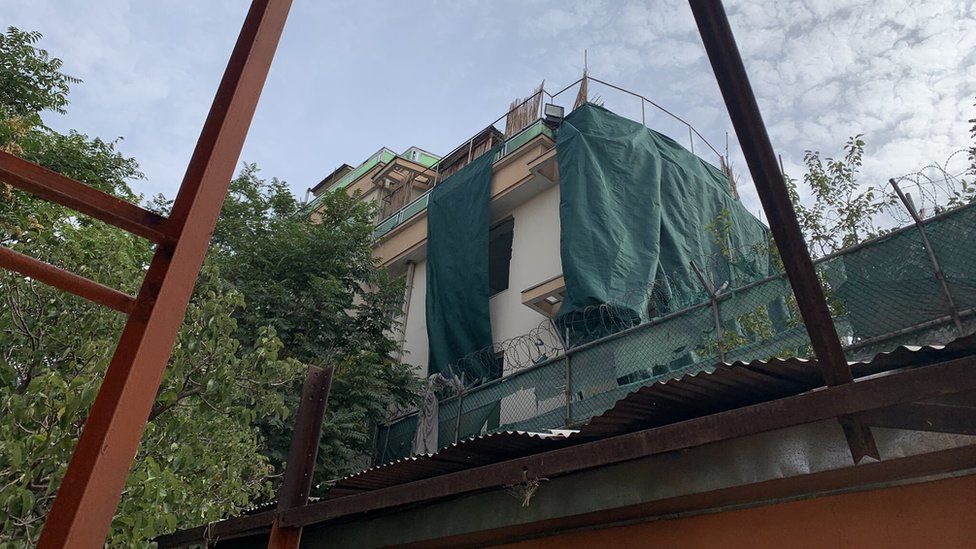
In the aftermath of the raid, the windows of the house appeared to have been blown out, but astonishingly little other damage seemed to have been done.

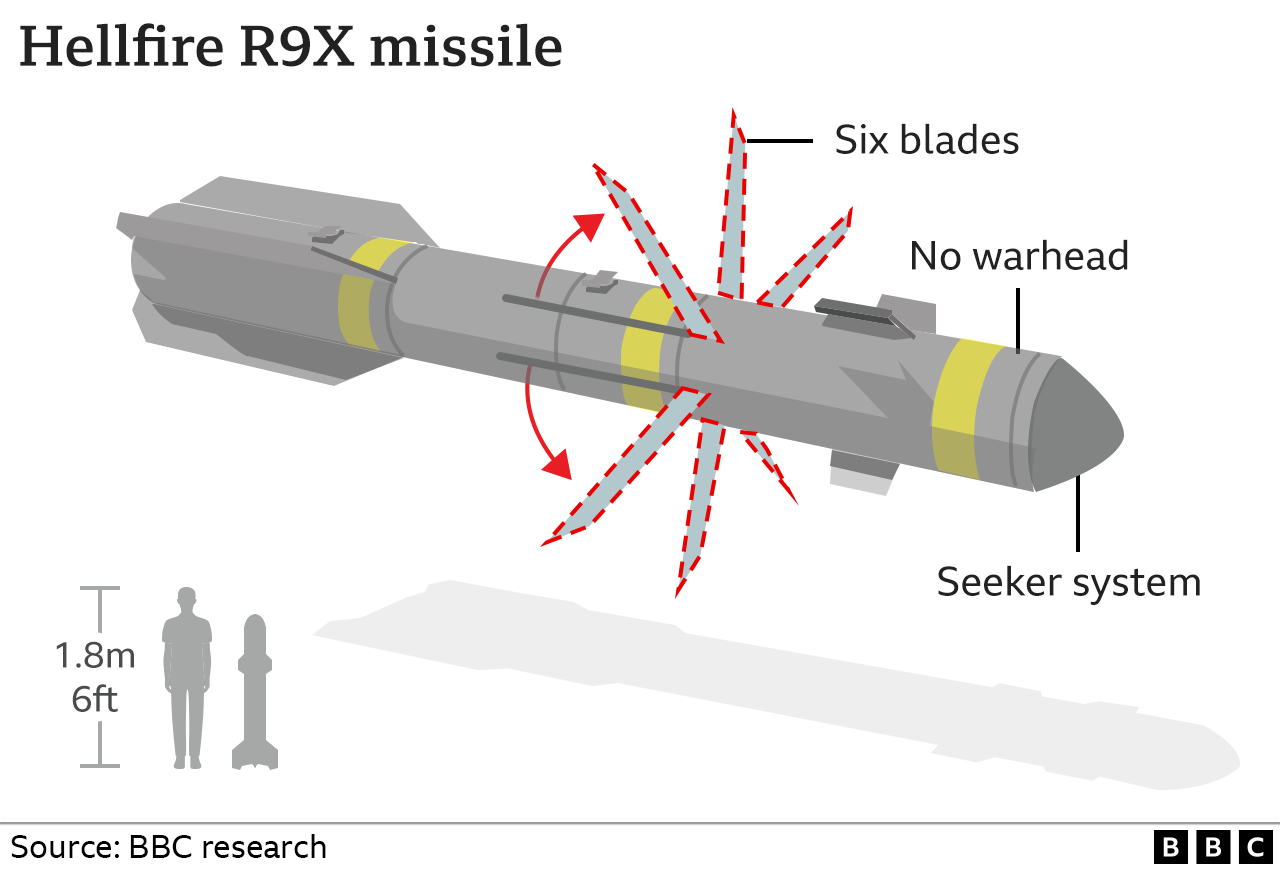
There are suggestions a little-known version of the Hellfire missile was used, one without an explosive warhead. This version – called the AGM-114R9X – instead deploys six blades which swing out from the side of the missile as it approaches the target.

A graphic showing the unique hellfire missile

It is the kinetic energy from this multi-bladed weapon’s speed that causes the destruction, as they slice through whatever they hit and minimises collateral damage.

Thousands of miles away in Washington, the president was informed of the strike’s success.

On Sunday, the Taliban’s ministry of the interior told the local Tolo news outlet that a rocket strike had hit an empty house, causing no casualties. They refused to provide additional details at the time.

But the Biden administration said soon after, fighters from the Haqqani network, an ultra-violent wing of the Taliban, rushed Zawahiri’s family away from the site and engaged in a broader effort to cover up his presence.

When a BBC reporter arrived at the house on Monday morning a Taliban cordon sharply brandished him away, aiming rifles at him and insisting that there was “nothing to see”.

The alleged location of the US strike
This is the suspected location of the strike in Kabul

US officials said “multiple streams of intelligence” had confirmed Zawahiri ‘s death, but emphasised that no American personnel were on the ground in Kabul. They refused to elaborate as to how they had confirmed the attack’s success.

Intelligence agencies jealously guard the identities of their spies, and James Clapper, a former director of national intelligence under President Obama, told the BBC that former US allies in Kabul may have provided some information.

It’s unclear what happened to Zawahiri’s body in the wake of the strike. Biden administration figures said the US had made no effort to retrieve Zawahiri’s remains, as they did in the wake of the raid that killed Osama Bin Laden.

Special forces retrieved Bin Laden’s body to confirm his identity, before burying it at sea to prevent his grave becoming a shrine to Islamists.

However, given the Taliban have cleaned the area, it is possible his remains have been retrieved.

As Mr Biden’s television address from a balcony of the White House beamed around the world, Taliban leaders issued a sharp condemnation of the US incursion into their territory. But their comments made no mention of Zawahiri.

There will now be speculation about how much knowledge senior Taliban leaders had about Zawahiri’s presence in Kabul and what assistance they might have been providing.

One resident told the BBC that Taliban fighters had been guarding the street and that the presence of “non-Afghan residents” was common knowledge among locals.

The suggestion seems likely to raise tricky questions for Taliban leaders.

Ayman al-Zawahiri: How US spies found al-Qaeda’s top man in Kabul
read more

Delaying Justice? The ICC’s war crimes investigation in limbo over who represents Afghanistan

Judges at the International Criminal Court (ICC) have still not made a decision to authorise, or not, the resumption of the court’s war crimes investigation in Afghanistan, ten months after the ICC Prosecutor urged them to expedite their approval. It means that, 16 years after the ICC began to look into Afghanistan, it has still yet to move beyond the preliminary examination stage. The judges appear to be deliberating over who now represents Afghanistan in order to decide whether a deferral request from the previous government still has standing. Since August 2021, Afghanistan has been ruled by the de facto, internationally unrecognised Islamic Emirate, while being represented abroad by diplomats appointed by the fallen regime of the Islamic Republic. AAN’s Ehsan Qaane explores the conundrum of representation that is currently delaying the court, but which also has wider reverberations for the issue of government recognition.

The flag of the fallen Islamic Republic of Afghanistan among the flags of all the state parties at the International Criminal Court in The Hague. Photo: Ehsan Qaane, taken in March 2016, but an ICC spokesperson said, it still hangs there.The flag of the fallen Islamic Republic of Afghanistan among the flags of all the state parties at the International Criminal Court in The Hague. Photo taken by Ehsan Qaane in March 2016, but, an ICC spokesperson said, it hangs there still.

Flashback

The judges of the Pre-Trial Chamber play an important role in the first phase of judicial proceedings at the International Criminal Court, including whether to authorise requests by ICC Prosecutors to proceed with investigations. In April 2019, the judges of the Pre-Trail Chamber (hereafter, ‘the judges’) turned down a request, made in 2017 by the previous prosecutor, to investigate alleged war crimes committed in Afghanistan or in the context of the Afghan conflict: she had named the Taleban, the Haqqani network, the United States military and CIA, and the then government’s security forces.[1] The Appeals Chamber reversed that decision in March 2020. However, before an investigation could begin, it was suspended by a deferral request from President Ashraf Ghani government that same month and submitted it under article 18(2) of the Rome Statute.

Ghani’s administration argued that the court’s intervention was not required because there were active domestic investigations into some of the alleged war crimes and crimes against humanity that the ICC was considering. One of the court’s fundamental principles, as defined in the ICC’s core legal texts, is the principle of “complementarity,” which holds that primary jurisdiction lies with the state on whose territory the alleged crimes were perpetrated. To support its request, the Afghan government submitted thousands of pages of information in Dari and Pashto relating to around 180 cases it claimed were being investigated. Our understanding was that the request, and particularly its heavy load of translation, was aimed at slowing down the court’s work and that it had little real merit – see AAN’s report on Appeals Chamber’s decision here and on Afghanistan’s deferral request here and here.

Karim Khan, the ICC Chief Prosecutor, was still considering Kabul’s deferral request when the Ghani government was forcibly ejected from power by the Taleban in August 2021. In September 2021, about a month after the fall of the Ghani government, he said that his team had not reached “a final determination” on whether to accept the supporting information as reasonable evidence of genuine domestic prosecutions or not. According to him, “further clarifications were still required for a relatively large proportion” of the information provided by the Afghan state.[2]

Nevertheless, on 27 September 2021, he requested that the judges accept an expedited decision to reopen the court’s investigation into war crimes in Afghanistan “notwithstanding the Deferral Request.” Khan explained that it was due to “the significant change of material circumstances” since August 2021, the laws and policies of the fallen regime, including the mechanisms Afghanistan had established to prosecute war crimes domestically, were no longer in place. He argued that neither the Taleban, as the de facto rulers of the country, nor those who represent Afghanistan abroad were “any longer able” to prosecute the war atrocities which come under the court’s scope of investigation. These facts, he said, “are not reasonably subjected to dispute.” (See AAN’s 2021 report about his request here).

Khan requested the judges to rule  “[o]n basis of an expedited procedure,” perhaps due to concerns about destruction of evidence by the Taleban, whose leaders would be one of the primary suspects in the investigation. Khan’s sense of urgency may also have been motivated by disquiet about the ongoing commission of war crimes in the country; on summary executions after August 2021, see Human Rights Watch reports here and here, Amnesty International reports here and here, on an attack on the Sikh community in Kabul, see a Radio Azadi report here and on attacks on Hazaras and Shias, see AAN’s report here.

Khan’s request was controversial. He proposed that because of the “the limited resources available” to his office, he would only to investigate the alleged war crimes of the Taleban and ISKP. By implication, this would mean a deprioritisation of the crimes attributed to the US military and CIA and the former government’s security forces. His predecessor, it should be noted, had concluded that there were reasonable grounds that the United States military and CIA had “resorted to techniques amounting to the commission of the war crimes of torture, cruel treatment, outrages upon personal dignity, and rape” and the Republic’s national security forces, …the war crimes of torture and cruel treatment, outrages upon personal dignity pursuant to article, and sexual violence (quotes from her 2016 Preliminary Examination Report; AAN analysis here).

Khan’s request to deprioritise the alleged war crimes of the former government and especially of the US military and CIA was a bombshell to victims and human rights advocates alike. To them, AAN reported, it looked like he was creating a “hierarchy of victims.” Many hoped the judges would revert to authorising the wider investigation. Instead, there have been ten months of waiting with, as yet, no decision. The hold-up stems from the old government’s request to defer the investigation.

Since the Prosecutor’s request, there were ten months of back and forth by the judges as they sought to identify the competent Afghan authorities before ruling on the request. Then, on 22 July 2022, they ordered the Prosecutor to provide them “any material received from Afghanistan in support of the [Afghanistan] Deferral Request” and “an assessment of the Deferral Request, or any other relevant observations and information,” by 26 August 2022. The assessment should also include “evidence to substantiate [the Prosecutor’s] assertions, in particular as the lack of ongoing domestic proceedings or the inaction of the authorities currently represent Afghanistan.”

Rule 54(1) of the ICC Rules of Procedure and Evidence, one of the core legal texts of the court, obliges the judges to themselves examine the supportive information provided by the state requesting a deferral before deciding whether or not to reopen the deferred investigation. However, in the Afghanistan case, as the Prosecutor has argued, the laws, policies and mechanisms for domestic proceedings which were established by the former regime are no longer in place following the regime change in August. Therefore, he suggested that the judges could decide his request “notwithstanding” the supportive information provided by Ghani’s administration. Khan added in his request that he would share the supportive information if the judges asked for it.

The implications of the judges’ 22 July request are not yet clear, and this report will not dwell on the request. Instead it looks about the judges’ push to find out who Afghanistan’s ‘competent authorities’ now are, who represents the country before the court.  How they have gone about that task in the last ten months raises questions about whether they have strayed into political territory, but also highlights wider questions about the recognition or not of a government which comes to power in circumstances the countries of the world find problematic.

Afghanistan’s right to observe

For the judges to rule on Khan’s request to authorise an investigation, they need to be assured that the court has informed Afghanistan about its right to make what is called an observation on the Prosecutor’s request, in other words that the State Party has been given the opportunity to express its support or opposition to the request.[3] The problem for the ICC, however, is: ‘Who’ now is Afghanistan?

Since 15 August 2021, the Taleban have ruled Afghanistan as the de facto government, but without being internationally recognised by any state, while the diplomatic missions appointed by the fallen regime have continued to claim they represent the country abroad, including in the United Nations, and the Netherlands where the ICC is based.

The Afghanistan embassy in the Netherlands has been the diplomatic channel between Afghanistan and the ICC since a meaningful relationship between them was established in 2016 (for more on this relationship, read this AAN report). The court and embassy are both located in The Hague city of the Netherlands. As per an agreement with the old government and article 87(1) of the Rome Statute, this is the channel through which the court should deal with Kabul. So for example, the Prosecutor informed the embassy on 3 September 2021 of his intention to request the resumption of the investigation.

Perhaps fearing the issue of who represents Afghanistan could cause delays, Khan suggested in his request that the judges set a deadline for receiving an observation from Afghanistan. If Afghanistan does not file its observation within the deadline, Khan said, the judges should not “abstain from rendering a decision promptly.” Rather they should avoid unnecessary delays in the proceedings.

From the judges’ perspective, it is vital to establish who the competent Afghan authorities are. They explained this in a letter made on 8 October 2021 to the United Nations Secretary-General and the ICC Bureau of the Assembly of States Parties for “information on the identification of the authorities currently representing the Islamic Republic of Afghanistan by Monday 8 November 2021.” The Prosecutor’s request, the judge’s letter said, “cannot… be legally adjudicated without addressing the question of which entity actually constitutes the State authorities of Afghanistan since 15 August 2021.” They said this question is “central to the triggering of the procedure under article 18(2).” The judges built their argument on the court’s complementarity mandate, which means that if a state, as the primary jurisdiction holder, is domestically providing justice to victims, the ICC’s direct intervention is redundant. To implement the principle of complementarity “orderly, meaningfully and effectively,” it is essential, they argued “that there be no uncertainty as to the representation and competent authorities of the concerned State.” They said that “at the heart” of the Rome Statute is article 18, which among other things, gives a state the legal power to stop an ICC investigation if it can prove its ability and willingness to deal with alleged crimes through the domestic courts.[4] Although the Prosecutor is satisfied that the Afghan authorities – whoever they might be – are not able or willing to try the alleged crimes themselves and so wants the judges to dismiss Ghani’s deferral request, the judges are apparently not yet convinced, or at least want to be clear who the competent authorities are before making a decision.

The judges’ letter to show that they are not convinced that the diplomats appointed by the former regime can truly represent Afghanistan before the court. However, they themselves cannot contact the Taleban authorities directly, as that would imply recognition. The judges also said in the same 8 October letter, they believe the decision of who represents a state is of a “political nature” and a matter of “constitutional and international law,” beyond the mandate of themselves, the Prosecutor, or “any organ of the Court’s purview.”

The two institutions did respond, but were of little help. The Bureau of the ICC Assembly of States Parties said, on 26 October 2021, that “due to its nature and functions, it [the Bureau] does not hold the type of information that is requested.” The UN Secretary General, meanwhile, told the judges on 18 October 2021, that the decision of government recognition was not his to make, but was “a matter for individual Member States.” He noted that the UN “General Assembly has not taken any [new] decision on the representation of Afghanistan.” Since then, a Taleban request for recognition from the UN was rejected by the UN Credential Committee, on 1 December 2021. Soon after, on 6 December 2021, the General Assembly agreed to keep the Republic’s Permanent Representative in office, with no end date, thereby ruling out any change on who represents Afghanistan to the UN for now. That means that Afghanistan is still represented by the Permanent Mission of Afghanistan to the UN which was introduced by the fallen Republic.

Nevertheless, the judges pushed on with trying to clarify what for them appears still to be a pressing issue. On 24 February 2022, they issued an invitation for Afghanistan to submit an observation on the Prosecutor’s request. The judges outlined their problem in the letter. Changes of government, they say, “have no impact on the continuity of States” and do not stop the business of the court. While “no state has formally recognised the group which ousted the government of Ashraf Ghani,” as they pointed out, numerous states, the UN and others have held talks and “have officially referred to the group that has seized power as the ‘Afghanistan de facto authorities’ or the ‘de facto government’ of Afghanistan, therefore regarding members of that group as the interlocutors of Afghanistan.” The judges stress that they are seeking observations on the request to investigate so as to “ensure the continuity of judicial proceedings in the most rigorous way.” For these reasons, the judges say:

…the Chamber invites pursuant to rule 55(2) of the Rules Afghanistan to provide observations on the Application for resumption of the investigation, no later than Friday 25 March 2022. Accordingly, the Chamber orders the Registrar to communicate the present order to the authorities currently representing Afghanistan. 

The judges appear to have thrown the ball to the ICC’s Registrar, who is the head of the Registry, which manages all the administrative functions of the ICC to contact the relevant authorities. In the same letter, the judge also “invites the Islamic Republic of Afghanistan to provide observations.” If the judges considered them one and the same, it would not have made two requests.

The Afghan ambassador to the Netherlands, Asif Rahimi, did respond privately to the judges, saying that due to “the security and political developments in Afghanistan” in August 2021, he was “unable to provide any further observations or submissions.” This was directly quoted in a confidential ICC report, which was mistakenly uploaded onto the ICC website as a public document for a few days (AAN read the report before it was removed and later received a copy from someone who had downloaded it).

On 7 April 2022, the judges wrote a second request, this time to the UN Secretary-General and to the United Nations Assistance Mission in Afghanistan (UNAMA), asking them to send on their invitation to submit observations to the “authorities currently representing the Islamic  Republic of Afghanistan.” They also “reiterate[d] the invitation to the Islamic Republic of Afghanistan to provide observations on the Prosecutor’s Application for resumption of the investigation.” Again there was a strange, double request, both directly to the Islamic Republic of Afghanistan, and to the UN to say who was now representing the Islamic Republic of Afghanistan, all at the same time that the already-agreed channel of communication to Afghanistan, the ambassador, is co-located with the court in The Hague.

Possibly the judges were hoping that someone other than Republic-era Afghan ambassador to the Netherlands, or his counterpart at the UN would respond. This was not to be. On 4 May 2022, the UN Secretary-General forwarded the judges’ invitation to Afghanistan’s Permanent Representative to the UN, who, in an interview with AAN on 20 May 2022 said he had sent his response to the court back through the UN.[5] He had made four points to the judges:

  • The Afghanistan embassy in the Netherlands remains Afghanistan’s focal point on matters related to the ICC and Afghanistan;
  • On 15 August 2021, the government of the Islamic Republic of Afghanistan collapsed and the Taleban took power by force;
  • Taleban rule is neither legitimate nor internationally recognised; and
  • The judges should act according to the provisions of the Rome Statute and the Court’s Rules of Procedures and Evidence.

Meanwhile, the Taleban have initiated no communication with the court. This is even though, as well as the invitation for ‘Afghanistan’ to make observations being published on the ICC website, the acting Taleban Foreign Minister, Amir Khan Muttaqi, was informed, unofficially by the Afghan ambassador to the Netherlands of the Prosecutor’s request to investigate and of the judges’ 24 February 2022 letter. This is according to a source at the embassy who spoke to the author in September 2021.

The conundrum of who represents Afghanistan

That the judges wish to be in contact with the competent and rightful authorities of Afghanistan is entirely appropriate. It is also reasonable for them to take the position that it is not in their mandate to decide who represents Afghanistan. However, by disregarding the Afghanistan embassy in the Netherlands as the agreed diplomatic channel between the court and Afghanistan, the judges seem to have made a political determination which may be outside their purview and negate the guidelines of article 87(1) of the Rome Statute which says requests should be “transmitted through the diplomatic channel or any other appropriate channel as may be designated by each State Party.”

The Afghan ambassador to the Netherlands appears to have interpreted the judges’ communications as an indication that the court regards the Taleban as a competent authority, according to an AAN source in the embassy. It was on this basis that he shared the judges’ invitation with the acting Taleban foreign minister through unofficial communication channels.[6]This communication was discovered by Afghan human rights defenders who asked to stay anonymous for security reasons. They pressured the ambassador to cease communications with the Taleban and instead inform the judges that Afghanistan has no observations to offer on the Prosecutor’s request. As a result, the ambassador wrote to the judges and advised them that he could not provide any observations or submissions in the current circumstances, back to Afghan human rights defenders (communication was shared in a WhatsApp group which the author is a member of). Yet, as was detailed earlier in this report, even after the Afghan ambassador’s reply, the judges sent out their second invitation for observations, on 7 April.

The Prosecutor and the Registrar’s position

In contrast to the judges, the ICC Prosecutor and Registrar both believe the Afghan embassy in the Netherlands is the only appropriate diplomatic channel. In his September request, Khan twice mentioned that he had notified the Afghanistan embassy in the Netherlands about his intention to file the request for a resumption of the court’s Afghanistan investigation per rule 54(2) of the Rules of Procedure and Evidence.[7] A source at the embassy, on condition of anonymity, confirmed the receipt of this communication.

The Prosecutor has, in his September 2021 request, acknowledged that the current ambiguities related to the legal standing of a de facto, unrecognised government mean he “cannot be assured of [his] practical ability to confer with the State authorities in question – for example, due to legal impediments in recognising the credentials of such authorities.” While this highlights the difficulties in direct communications with the Taleban, it also does not necessarily preclude the Taleban from submitting an observation. On another occasion, Khan noted that through public invitation on the ICC website and also the ICC Registry “[t]he Chamber has taken the requisite steps to alert the competent Afghan authorities […], and has provided with sufficient time to provide their observations.” By this, he could suggest that who see themselves as entitled to submit observation to the court (a possible reference to the de facto Taleban administration) were able to see the court’s first invitation on its website and could approach the court if they wished.

Khan may have suggested a way through the impasse the judges appear to have created for themselves when he advised avoiding attempts “to define the de jure and/or de facto authorities in Afghanistan at the present time.” They could instead leave it to the Taleban and the diplomats representing the former regime to decide whether or not to submit observations within an agreed period. This position seems reasonable.

The court’s Registrar has taken the same stance as Khan. On 25 March 2022, he reported to the judges, in confidence, that he had transferred the judges’ 24 February request to the Afghan embassy in The Hague “by way of note verbale,” an unsigned diplomatic note (the confidential report was mistakenly published on the ICC website. AAN has a copy of it). The Registrar added his communication was pursuant to article 87 (1) of the Rome Statute, which states that communication between the court and states should happen through diplomatic channels. The Registrar asserted that “the [Afghanistan] authorities did not designate any other appropriate channel following the ratification of the Statute.”

International law and government recognition

International law says that a government change does not affect a recognised state’s legal status. The ICC judges are certainly aware of this principle, as they quote it in their 8 October 2021 request for advice from the UN and ICC Bureau of Assembly of States Parties’ as to who are now the competent Afghan authorities. Recognition of a new state is different from recognition of a new government. There are a few theoretical provisions for the recognition of a new state in international law, for example, the 1933 Montevideo Convention, but there are no provisions for the recognition of a new government. While the latter is more a political matter than a legal one, it does, nevertheless, have many legal implications, including but not limited to the representation of the state internationally.

Changes in government are common and recognising a new government only becomes an issue if that government comes to power unconstitutionally, especially if it is violent, for example, through a coup d’état, revolution or, in Afghanistan’s case, seizure of power by an armed opposition group. In this case, whether or not to recognise the new de facto authorities is a matter for individual states; the UN itself has no power to decide on this matter, as highlighted in the UN Secretary-General’s first reply to the ICC judges. However, member states of the UN could use the UN Credentials Committee to impose a joint decision on a matter of international recognition, as they have done with the Taleban.

International law has competing doctrines regarding the recognition of unconstitutionally established governments. The Tobar doctrine (later known as the Wilsonian Policy) was articulated at the beginning of the 20th century by Carlos Tobar, Ecuador’s then Minister of Foreign Affairs. It holds that governments that have taken power unconstitutionally should not be granted recognition. Similarly, the Stimson doctrine posits that a territory cannot be acquired purely by aggression. This was articulated by then US Secretary of State Henry L Stimson in response to the Japanese occupation of the Chinese territory of Manchuria in 1931. In contrast, the Estrada doctrine, formulated by Genaro Estrada, Mexico’s Secretary of Foreign Affairs in the 1930s, asserts that recognition of a new government should be based on its de facto existence, rather than on other states’ assessment of its legitimacy. This policy is based on the principle of non-intervention and self-determination, in other words, it is not a matter for other states to decide who rules  a sovereign state.

In relation to the Taleban government, members of the UN have followed the Tobar or Stimson doctrines. No state has recognised the Taleban de facto government, which came to power by force after an almost 20-year-long insurgency. Instead, as in UN Resolution 2596, which extended UNAMA’s mandate, the UN Security Council expresses itself in ways that look like it has pre-conditions for the Taleban to fulfil to gain recognised. They are to do with establishing an “inclusive and representative government,” with “full, equal and meaningful participation of women,” upholding “human rights, including for women, children and minorities” and ensuring that Afghan territory is not “used to threaten or attack any country, to plan or finance terrorist acts, or to shelter and train terrorists.”

So far, Taleban policy and practice has opposed such demands promising – shuttering girls’ high schools, for example, and imposing other severe restrictions on the rights of Afghan citizens, particularly women (read AAN’s reports on Taleban restrictions on girls’ education here on freedom of speech here, rules on women’s clothing hereand our analysis of UNAMA’s report on human rights here). Additionally, their supreme leader Hibatullah Akhundzada’s speech to ulema in Kabul on 1 July 2022 told foreigners not to interfere in Afghanistan’s internal affairs.

Victims’ views: “Justice delayed is justice denied”

Always, even in a report about the machinations of the ICC and the complexities of international law, it is important to remember that, fundamentally, this is always about justice. The judges’ ten month search for the ‘competent authorities’ in Afghanistan represents yet another delay for victims. Set against that, in the meantime, the ICC Registry has ended a five-month consultation to collect the views and concerns of victims on the possible resumption of the court’s Afghanistan investigation. This was the second time the court had consulted victims, and is a necessary stage for the judges to give the go-ahead for an investigation or reject if they are not supportive. The first consultation, which concluded in January 2018 as the ICC Registry reported, found almost universal support from more than 6,000 victims for an investigation (see AAN’s report on the first consultation here).

According to the Registrar’s final report on the second consultation, which was submitted to the judges on 24 April 2022, 11,150 individual victims and 130 families shared their views in 16 representation forms, one from an individual, the rest made collectively. All demanded that the court authorises an investigation. The report quoted victims saying variously that “the ICC is the only court of justice” for Afghan war victims, and the investigation should be “immediately… approved,” “resumed” and “continued.” One victim said: “For many victims of gross crimes against humanity, attaining justice” was the “only way to relieve a small percent of the pain and trauma” they felt. Another submission reminded the court that “justice delayed is justice denied.”

Victims of war crimes allegedly committed on Afghan soil or in Poland, Lithuania and Poland in relation to the Afghan conflict have indeed been waiting a long, long time for the court to act. Afghanistan was in the preliminary examination phase from 2006 to 2017, the period when the Prosecutor reviews whether there are grounds for an investigation, the second longest in the court’s history, after Columbia. The Office of the Prosecutor finally sought authorisation to open an investigation in 2017. There was then a wait of two years while the judges of the Pre-Trial Chamber weighing up her request. In the end, in 2019, they rejected it, arguing that conditions at the time limited the prospects for a successful investigation and prosecution. That decision was overturned, on appeal, in 2020. Then, before an investigation could really get going, it was halted by the Ghani administration filing the deferral request.

Now, the ICC Prosecutor has made it clear he wants to resume an investigation, albeit only into the Taleban and ISKP. Yet, even reaching a decision on that has taken the judges ten months, and counting. They have already shown themselves reluctant to allow this investigation – in their original rejection of the previous Prosecutor’s 2017 request for one. Possibly, what we are seeing now is more foot-dragging, if their reservations remain.

Edited by Jelena Bjelica, Rachel Reid, Roxanna Shapour and Kate Clark

References

References
↑1 Based on the previous prosecutor’s preliminary examination, an investigation could cover the alleged war crimes and crimes against humanity perpetrated by the Taleban and its affiliated group, the Haqqani network, the US military and CIA, as well as the Afghan National Security Forces of the Republic regime since 1 May 2003 in Afghanistan and since 1 July 2002 for alleged crimes that took place in Poland, Lithuania and Romania where the CIA allegedly rendered men detained on Afghan soil (the dates are when the Rome Statute came into force). Since then, the Islamic State of Khorasan Province (ISKP) has also come into the purview of the prosecutor.
↑2 According to Khan’s September 2021 request: “The information provided in support of the Deferral Request established that, prior to 15 August 2021, the Afghan authorities had conducted domestic proceedings with regard to certain alleged crimes within the scope of the Deferral Request. However, while the Afghan authorities had submitted some information concerning a significant number of cases, the level of detail in that information varied widely to the extent that further clarifications were still required for a relatively large proportion. Likewise, for a number of cases, the proceedings were not sufficiently advance to form a view of their scope or likely impact.”
↑3 Rule 55(2) of the ICC Rules of Procedure and Evidence, one of the court’s core legal texts, obliges the judges to examine the ICC Prosecutor’s request for resumption of an investigation pursuant to article 18(2) of the Rome Statute and any observations submitted by a state that requested a deferral under the same article. Article 18(2) reads as follows: 

Within one month of receipt of that notification [related to Afghanistan, notification of initiation of an investigation pursuant to article 15 of the Rome Statute], a State may inform the Court that its investigating or has investigated its nationals or others within its jurisdiction with respect to criminal acts which may constitute crimes referred to in article 5 [of the Rome Statute] and which relate to the information provided in the notification to States. At the request of that State, the Prosecutor shall defer to the State’s investigation of those persons unless the Pre-Trial Chamber, on the application of the Prosecutor, decides to authorize the investigation.

It means that a state (ie Afghanistan) has the right to request a deferral of an authorised investigation if it can prove its ability and willingness to prosecute the alleged crimes domestically itself. Upon the state’s request, the Prosecutor must defer the investigation unless the Prosecutor determines that the supporting information provided by the state cannot prove the state’s claim. In this case, the Prosecutor must request the ICC’s Pre-Trial Chamber to authorise the resumption of the investigation. Alleged crimes here refer to article 5 of the Rome Statute which lists war crimes, crimes against humanity, crime of aggression and crime of genocide.

↑4 Article 18(2) basically says that a state has the right to request the deferral of an authorised investigation of the court if it can prove its ability and willingness to itself prosecute the alleged crimes domestically. Upon the request of the state, the Prosecutor then has to defer the investigation unless he or she determines that the provided supportive information by the state cannot prove the state’s claim. In that case, the Prosecutor has to request the Pre-Trial Chamber of the ICC for authorisation to resume the investigation.
↑5 On 3 June 2022, a document posted to the ICC websiteby the ICC Registry said the court had received a letter from the UN without specifying whom the letter was from. This could possibly have been the Afghanistan Permanent Representative’s response to the second invitation or from the UN itself. The letter itself was “classified as confidential, due to the sensitive nature of the information contained therein, and as agreed with the United Nations,” said the ICC Registry.
↑6 In March 2022, AAN asked the ambassador about his communication with the Taleban acting minister for Foreign Affairs, but he gave no answer.
↑7 This rule says that the prosecutor must “inform that State [here Afghanistan] in writing” when she or he requests the resumption of the court’s investigation under article 18(2).

Delaying Justice? The ICC’s war crimes investigation in limbo over who represents Afghanistan
read more