
If the Taliban take power again, will Afghans have died in vain?

Pamela Constable

April 18, 2021
The flawed U.S. presence lifted expectations about what kind of society they could have.

When I first heard this past week that President Biden had decided to send home the remaining U.S. troops in Afghanistan by Sept. 11, I felt the same chill of dread that many Afghans did. Would Taliban extremists sweep into Kabul as they did in 1996, whipping men late to mosque prayers and forcing women back into cloistered homes? Would local militias spring up to fight them, engulfing the exhausted country in the same kind of chaotic civil war that destroyed the capital in 1992? I thought back over the past 20 years, remembering all the people I had known or written about as a foreign correspondent, who’d sacrificed to bring their country into the free, modern world; the soldiers who had lost legs and lives in battle; the citizens who had braved Taliban threats to vote in national elections; the journalists and civic activists, college teachers and clerics who had died in countless suicide bombings and armed attacks.

If the American withdrawal leads to a Taliban takeover or a bloody civil war, as many experts predict, would the sacrifices of 158,000 Afghans, including 43,000 civilians, killed by wartime violence have been in vain?

I want to believe they would not. And the post-Taliban years — a period of extraordinary change in the culture, expectations, opportunities and worldly exposure of a once-isolated and tradition-bound society — support my optimism. Despite the petty, self-destructive behavior of the political elite, and despite the still-powerful hold of religious and tribal taboos, Afghanistan is a far different country than it was when the Taliban seized power in 1996. Even if the Taliban retakes control, that can’t be completely erased.

Since the Islamist regime collapsed in 2001, a new generation of young women and men has been educated and exposed to the world. Millions of people have cast ballots in several presidential and parliamentary elections. Elders and officials in remote villages now have access to mobile phones and the Internet. Some rural schools for girls have closed because of Taliban violence, but women work and study and hold public office. Afghanistan is still an impoverished, conservative Muslim country, but it is no longer a prisoner of the past.

When I think of the Afghans I knew or wrote about who died in wartime violence, I also think of the legacy they created and the people they inspired. Some were poor and unknown, like the gentle high school teacher I met in a southern village, whose home library was covered with his beautiful calligraphy and drawings of animals. The community was destroyed by the Taliban, but when he passed away later, one of his six sons called to tell me, in near-perfect English, that the others were all doing well.

Some were well-known civic leaders, journalists or political activists who died in suicide bombings or were targeted for assassination by the Taliban or the Islamic State. Yousuf Rasheed, the soft-spoken director of an election monitoring organization, was dedicated to the cause of democratic rule. I met him often to talk about the challenges of improving the country’s flawed and fraud-prone electoral system. Last Christmas, he was gunned down by unknown assailants waiting near his house, but within a few days his staff was back at work, determined not to show that they had been cowed.

Some were friends who had no political ambitions but welcomed journalists like me into their homes or establishments to escape from the relentless pressure of war reporting. Kamel Hamade was not an Afghan, but he was a gracious host and a fixture in Kabul life as the proprietor of a lively Lebanese bistro, where I often went on weekend nights. He discreetly served us wine in teacups and often refused to let us pay for dinner, saying we should spend our money helping homeless animals.

One night in 2014, Taliban commandos bombed the front door, then rushed in with guns drawn. They killed Kamel and all 21 diners; a cherished oasis was lost forever. But the outpouring of messages I received from people who had once gathered there — an engineer from Texas, a lawyer from Ireland, a veterinarian from Maine — reminded me of the astonishing commitments made by so many foreigners who moved to Kabul over the years, wanting to help rebuild a scarred and long-suffering nation.

One of the first Afghans I reached out to this past week was Nader Nadery, a senior official in the government of President Ashraf Ghani. I met him almost 20 years ago, soon after the Taliban fled Kabul, where he was working for a human rights group after being imprisoned by the Islamist regime. He recounted that in those early months, as Western officials and experts began flocking to the capital, all conveyed a similar message: “Every one of them stressed the importance of promoting democracy and human rights,” he said. “Those of us who had fought for those values felt inspired and empowered. We felt we were not alone.”

Now, Nadery says he is “sad and angry” about the U.S. troop withdrawal, the news of which has thrown the country into a state of panic and confusion. Yet he also said that the sacrifices made by Afghans who died trying to build a new, democratic nation had not been wasted and that Taliban religious hegemony would not be so easy to reimpose. “Some good people have paid the ultimate sacrifice, but the things they believed and fought for became the rules,” he said. “We are facing difficult times, but those beliefs cannot just be stamped out.”

There are still reasons to fear that other Afghans’ darkest predictions of extremist mayhem and violence will come true, and that the country’s history of brutal ethnic conflict and political revenge will return in the absence of American military force. Ethnic rivalries remain fierce, and warlordism lingers beneath the surface of modern Afghan life. Members of the Taliban remain committed religious fanatics, convinced that they have defeated the mighty United States and could easily retake power. They have essentially boycotted peace talks with Afghan leaders and rejected plans for new, internationally sponsored talks in Turkey. Ghani’s government is weak and divided, and the Afghan security forces, struggling to hold on, may lose both morale and capacity without American backup.

Over the years, some Afghans came to resent the American military presence as a foreign “occupation.” Anti-American riots erupted after a U.S. military vehicle accident killed civilians in 2006, and again in 2012 after reports spread that copies of the Koran had been thrown out and burned at a U.S. military base.

But other Afghans clung to the hope that the heavy price paid by their security forces was worth it and that there was still a chance for a peaceful settlement of the conflict. Just as a rising generation of young Afghan civilians has embraced democratic values and aspirations, the same has been true of the best soldiers and members of other security forces, many of them trained and mentored by American officers.

One was Lemar Safi, a young Afghan army captain who was killed in a Taliban ambush in northern Kunduz province in 2017. I never met him, but over the course of several conversations with his family and former commanding officer two years later, I came to think of him as representing the best of what the Afghan military could be — but often failed to achieve. Safi, 29, had earned a college degree in psychology, but something inspired him to join the army. His parents had lost one son in the civil war, and a second had been crippled in combat training; they were reluctant to let Safi enlist, but he insisted it was his duty. His former commander described him as highly motivated and eager to go out on high-risk operations.

By the time I interviewed his family in Kabul, Kunduz was again under heavy Taliban assault, but peace talks were underway between the group’s leaders and U.S. officials. Still grief-stricken, his relatives continued clinging to one hope. “Lemar’s death has been a heavy burden for our family to bear, but we don’t believe that his sacrifice was for nothing,” one of his brothers told me. “Thousands of soldiers like him have died for the same cause. He wanted to defend his country and its future as a democracy. He lost his life, but he did it for the sake of peace.”

Pamela Constable is a staff writer for The Washington Post’s foreign desk. She completed a tour as Afghanistan/Pakistan bureau chief in 2019, and has reported extensively from Latin America, South Asia and around the world since the 1980s.
If the Taliban take power again, will Afghans have died in vain?
read more

Biden, Trump, and the missing big picture in Afghanistan coverage

LAST SUNDAY, in the hours after Kabul fell to the Taliban, swathes of the mainstream US news media instantly savaged President Biden for losing Afghanistan. In the week since then, he has stayed under an intense spotlight. News organizations have disputed the accuracy of many of his claims about the situation on the ground—a “credibility gap,” Politico’s Playbook newsletter wrote over the weekend, “that is dominating the coverage right now and could threaten Biden’s standing with the public.” The credibility-gap narrative has extended overseas, with American commentators and foreign outlets alike stating that Biden has taken a wrecking ball to global perceptions of US prestige and reliability. “Our allies are furious,” Andrea Mitchell, chief Washington correspondent at NBC News, said on Meet the Press yesterday. “We have destroyed morale that [Biden] was rebuilding. I mean, it is a real problem for America’s leadership abroad.” Where doubts as to truthfulness and American world leadership go, Trump comparisons surely follow. The withdrawal has “undercut some of the most fundamental premises of Mr. Biden’s presidency,” Peter Baker wrote in a New York Times news analysis piece on Friday—that “unlike his erratic, self-absorbed predecessor, he brought foreign policy seasoning, adults-in-the-room judgment and a surfeit of empathy to the Oval Office.”

This framing—and the wider media frenzy over Afghanistan—has annoyed the White House. According to CNN’s Brian Stelter, Biden aides view the coverage as “overheated and out of step with the American public’s views” of the withdrawal, points echoed by his political allies. “The media tends to bend over backwards to ‘both-sides’ all of their coverage, but they made an exception for this,” Eric Schultz, who served in the Obama administration, told HuffPost. “As a Democrat, I’m very relieved and encouraged and heartened that the White House knows they’re speaking to the country, not just Playbook subscribers.” That the White House would be irked by critical coverage is not a surprise—and the public mood is not a reliable assignment editor for the press. Still, the outraged moral tone coursing through much of the coverage does indeed seem out of step with mainstream news organizations’ traditional self-conception: that they are disinterested chroniclers of the truth. As regular readers of this newsletter will know, I am no fan of that self-conception. What’s jarring here, rather, is the apparent inconsistency: these same outlets regularly cover suffering overseas—or, very often, hardly cover it at all—without the indignant editorializing. This has been true, in the all-too-recent past, of Afghanistan coverage. It is arguably true, in the present, of Haiti, where urgent health and political crises were further compounded by an earthquake that struck the day before the fall of Kabul, and has since been almost totally overshadowed by the latter story in the news cycle, despite some solid reporting from the ground. No American action directly precipitated the earthquake. But America is complicit enough in Haiti’s other crises that the story hardly exists in a separate moral sphere to the Afghanistan story. The issue here, perhaps, is not that the latter is overheated so much as other stories are underheated. In coverage of cruelty abroad, the double standard is the point.

Related: The journalists leaving Afghanistan, and those who haven’t made it out

In recent days, the likes of Matthew Yglesias and Hunter Walker have made the case that major US outlets will focus on humanitarian crises only when doing so, as Yglesias put it, “is complementary to aggressive use of American military force.” Others have pushed back, arguing that many reporters have worked closely with Afghans on the ground, and so are personally invested in their safety. This argument is wholly understandable—but it doesn’t resolve the double-standard problem; as with the public mood, the direct investment of Western journalists is not an adequate gauge of moral righteousness. Nor does it, in itself, defeat the Yglesias/Walker argument. As many observers have noted in recent days, the outrage in coverage has not only been driven by war reporters with track records of paying close attention to Afghanistan, but by Washington-based politicians and national-security pundits with well-established hawkish views—and in some cases, as The Intercept has reported, ongoing professional and financial ties to the military-industrial complex. Major outlets have treated such figures as expert observers, not as subjects with their own, deep complicity in the Afghanistan mess. Longtime opponents of military intervention, by contrast, have been much less visible.

Senior journalists have frequently argued that criticizing the execution of the withdrawal is not the same as advocating Forever War. This position makes sense, on its face; there is much to criticize in the withdrawal that is squarely on Biden, and there are undoubtedly many critics out there who are making such points without a hidden, bellicose agenda. Again, however, a double standard shows the limits of this position—namely, that the overall level of media focus on the withdrawal has massively dwarfed its focus on any number of prior horrors in Afghanistan that reflected poorly on the US military presence, rather than its absence. Even if you accept that the withdrawal is objectively a bigger story than such horrors—and that’s a big if—it doesn’t explain why so much current coverage is so lacking, as I wrote last week, in the basic context of how we got to this disastrous point. The news deals primarily in what’s new, but in this case, history isn’t some luxury that would have been nice to include if we had more time, but an essential, fundamental part of the story. You cannot honestly cover—let alone criticize—the execution of the withdrawal without addressing the execution of the entire war. In neglecting the latter, news outlets are, as New York’s Eric Levitz put it last week, “helping hawks recast an indictment of martial adventurism into an object lesson in the hazards of military restraint.”

Another strand of context has often been missing from coverage, too—that Biden’s withdrawal reflects a radical, possibly generational, redefinition of America’s role in the world, and that this demands serious media engagement, whether you agree with it or not. This redefinition started, arguably, under Trump, who it made it easier for the liberal press to dismiss it as unserious: Trump’s isolationist vision was inseparable from his racism and nativism, and besides, pundits assured us, Trump was an aberration from the finest traditions of American global leadership. When Biden won, these pundits hailed a return to the status quo ante; in many ways, this was fair—unlike Trump, Biden does prize cooperation with US allies—but it also misread how Biden would define the boundaries of that engagement. Biden is altogether harder to dismiss than Trump, and some good coverage in the past week has, indeed, engaged seriously on an intellectual level with his worldview. Other coverage has discredited Biden by lazy Trumpian association, writing off the withdrawal as the sort of awful thing the last guy would have done.

Sign up for CJR‘s daily email


One month after Trump took office, Bill O’Reilly, then of Fox, asked him about Vladimir Putin, referring to Putin as a “killer.” “We’ve got a lot of killers,” Trump replied. “You think our country’s so innocent?” Trump’s remarks were grist, at the time, for the frenzied Russia news cycle, and sections of the press savaged him, not unfairly, for excusing Putin’s behavior. At root, though, they communicated a deeper truth about America’s behavior on the world stage—perhaps the most profound of a presidency defined by thousands of lies. Contrary to the narrative of total, “America First” isolationism, Trump’s actions, in office, were often militaristic—not least early last year, when he assassinated Qassem Suleimani, Iran’s top general. The mainstream coverage of that episode was not perfect—but on the whole, it channeled broader skepticism than we’ve come to expect about the limits of military force, in no small part because such a notoriously reckless and dishonest president was the one administering it.

As I wrote at the time, a key challenge, going forward, would be for the press to “apply at least this level of attention and skepticism to future administrations,” since “governments of all stripes routinely lie about war.” Biden is no exception to this, and his demonstrable falsehoods about the situation on the ground deserve, urgently, to be called out. In his recent interviews and speeches, though, Biden has also been startlingly candid about how he sees the limits of American force—honesty that pundits have sometimes written off as a deficit of “empathy.” Again, you don’t have to agree with what he’s saying to understand its importance for American foreign policy. Many reporters and pundits, it seems, would rather stick their fingers in their ears.

Below, more on Afghanistan:


Other notable stories:

ICYMI: Journalism failed in Afghanistan too


Has America ever needed a media watchdog more than now? Help us by joining CJR today.


Jon Allsop is a freelance journalist. He writes CJR’s newsletter The Media Today. Find him on Twitter @Jon_Allsop.

Biden, Trump, and the missing big picture in Afghanistan coverage
read more

Petraeus: Doha Deal ‘Among the Worst Diplomatic Agreements’

Deputy spokesman for the Islamic Emirate, Bilal Karimi, rejected Petraeus’s remarks and called the Doha agreement effective.

The former head of US and NATO forces in Afghanistan and former head of the Central Intelligence Agency (CIA), David Petraeus, said the deal signed between the Islamic Emirate and US “has to rank among the worst diplomatic agreements” that the US has been party to.

“Moreover, the ultimate peace deal that we reached with the Taliban in 2020 that committed the US to withdrawal the following year, which we negotiated without the elected Afghan government at the table, has to rank among the worst diplomatic agreements to which the US has ever been a party,” Petraeus wrote in an article for the Atlantic Magazine. “We acquiesced to Taliban demands because the resulting agreement gave us, in the narrowest sense possible, what we wanted.”

Deputy spokesman for the Islamic Emirate, Bilal Karimi, rejected Petraeus’s remarks and called the Doha agreement effective.

“The Islamic Emirate believes in negotiations and engagement. We believe that there should be negotiations with all the countries over the concerns they have,” he said.

Petraeus said that the lack of sufficient commitment over the years had innumerable knock-on effects.

“The Doha agreement was a temporary step for the problems that the US should overcome,” said Asadullah Nadim, a political analyst.

This comes as Kabul and Washington accuse each other of violating the Doha agreement after a US drone strike hit a residence in Kabul. US President Joe Biden announced that Ayman al Zawahiri, leader of the al-Qaeda network, was killed in the strike.

The Islamic Emirate once again assured the international community that there would be no threat to the US from Afghan soil.

Petraeus: Doha Deal ‘Among the Worst Diplomatic Agreements’
read more

Ayman al-Zawahiri assassination: The Taliban’s biggest crisis

The drone attack that killed al-Qaeda leader Ayman al-Zawahiri has plunged the Taliban into an internal crisis. The group has been humiliated by a unilateral US military action and its relentless claims that it has denied space to “terrorists” have been exposed as lies.

This imperils two core, and contradictory, Taliban goals: Maintaining the legitimacy of the group’s rank and file, which includes hardened armed fighters and religious ideologues and securing badly needed financial assistance from an international community already reluctant to fund the Taliban because of concerns about its “terrorist” ties.

Initially, the Taliban are likely to respond to the raid on al-Zawahiri with defiance, insisting they were not harbouring a terrorist and hardening their resistance to addressing longstanding international demands, from letting older girls return to school to forming a more inclusive government. They may also take a harder line on sensitive negotiations with Washington on the delivery of humanitarian supplies and the unfreezing of Afghan Central Bank assets.

But over the longer term, al-Zawahiri’s killing could exacerbate existing fissures within the group. Such internal churn could provide openings for the emergence of factions espousing more conciliatory and practical views but it could also lead to dysfunction and danger that affect governance and raise questions about the viability of the Taliban’s future political control.

For nearly a year, the Taliban have celebrated their expulsion of foreign military forces and pledged to never let them return. That is why the drone raid was such an embarrassment for the Taliban leadership but also for the battlefield commanders and fighters that fought US forces for nearly 20 years. Since their takeover, the Taliban have made clear just how much they prioritise maintaining legitimacy from those constituencies: They have hosted ceremonies honouring the families of suicide bombers, and held military parades that showcase US weaponry, even while alienating common Afghans by limiting girls’ education and cracking down on journalists and activists. The group will need to appease an angry rank and file; simply shrugging off the raid and moving on will not cut it.

The Taliban could also face new threats from Islamic State in Khorasan Province, ISKP (ISIS-K), if they do not take a hard line towards the US. ISKP, a Taliban and al-Qaeda rival, has already benefitted from the al-Zawahiri killing because one of its most senior nemeses has been eliminated. But it can also gain propaganda mileage by accusing the Taliban of failing to anticipate the raid, or even of being complicit in it. ISKP fighters are clearly galvanised; this week, they attempted attacks on Shia observing the Muharram holiday.

The raid on al-Zawahiri also risks alienating the Taliban’s other hardliner allies present in Afghanistan, from the Pakistani Taliban to Lashkar-e-Taiba, all of which are aligned with al-Qaeda. These groups are united in their hatred of US military forces, especially when deployed on the soil of Muslim countries. Ironically, new Taliban tensions with fighters could strengthen the group’s narrative that it is distancing itself from “terrorists” – but they also raise the risk of these groups turning their guns on the Taliban.

Furthermore, in the immediate term, Washington will not be keen to engage with the Taliban. It is furious that al-Zawahiri lived in central Kabul, and believes some Taliban leaders knew he was there. With the US taking a tough line on the Taliban, and in no mood to discuss expanding assistance or unfreezing Afghan bank funds, the Taliban have little incentive to contemplate a more conciliatory position. US-Taliban relations, awkward and uneasy before the al-Zawahiri raid, are poised to become downright toxic.

But relations within the Taliban could become toxic, too. The group’s internal divisions are well known: There are differences between the fighter ranks and the civilian representatives long based in the Taliban political office in Doha; between ideologically-driven mullahs and more practically minded leaders who support more international engagement; and between the Haqqani network faction and Taliban authorities from Kandahar, the group’s birthplace.

An individual close to Sirajuddin Haqqani, the Taliban interior minister, reportedly owns the home that sheltered al-Zawahiri. This is unsurprising, given the especially deep ties between the Haqqanis and al-Qaeda. According to scholars Don Rassler and Vahid Brown, the Haqqani network has functioned within al-Qaeda “as an interdependent system.”

Many Taliban leaders likely are not happy that al-Zawahiri took shelter in Kabul. Others are likely furious that his presence has subjected the group to deep humiliation and a potential internal legitimacy crisis. And others likely fear someone within the group’s ranks shared al-Zawahiri’s location with the CIA. Al-Zawahiri himself once reportedly confided to al-Qaeda founder Osama Bin Laden that he did not trust Taliban leaders and they did not trust him.

The missile attack humiliated the Taliban. They also face the ire of the group’s rank and file. And they will now face even more difficulty in securing international support to address raging humanitarian and economic crises driven in great part by sanctions that prevent money from flowing into the country. This state of play means that those factions that support more pragmatic and conciliatory positions may have an opportunity to make a power play. And yet, the ideologues and hardliners will not bend. They hold some of the leadership’s top positions, and they embrace ideologies that reflect the Taliban’s fundamental identity.

In the past, the Taliban’s supreme leadership successfully suppressed internal revolts, often with force. That may happen this time, too. But that was easier to do when the group was an armed uprising, with much less stress, without the heavy responsibilities of governing and addressing immense policy challenges, without a galvanised rival like ISKP, and without an external event that could cause such dramatic internal shocks. Institutional divisions were previously casual distractions; today, they could become corrosive dangers. If these internal tensions become all consuming, governance and political control could face threats and provide openings for new armed opposition groups. This would mean the risk of renewed violence and civil war. In the most extreme scenario, the missile that tore through al-Zawahiri could tear apart the Taliban.

For now, the Taliban appear to be buying themselves time as they consider how to proceed: They refused to confirm al-Zawahiri was killed and instead promised an investigation. In the immediate term, the Taliban are likely to talk tough, condemn the raid, and double down on the same policies that have provoked international sanctions and prevented the inflow of much-needed overseas funding.

But eventually, the Taliban could face an inflexion point as they grapple with humiliation, a traumatised rank and file, more international opprobrium, and intensifying internal divisions – all of which will further tax their already-overwhelming governance responsibilities. Over their nearly 30 years of existence, the Taliban have never experienced such a serious crisis.

Michael Kugelman is deputy director and senior associate at the Woodrow Wilson International Center for Scholars.

Ayman al-Zawahiri assassination: The Taliban’s biggest crisis
read more

A year after Taliban’s return, some women fight for lost freedoms

By
Reuters
9 Aug 2022
  • Taliban mark their first year in power on Aug. 15
  • Women absent from senior government positions
  • High schools are closed to girls, frustrating ambitions
  • Many women have lost jobs, some strive to sustain protests

KABUL, Aug 9 (Reuters) – Monesa Mubarez is not going to give up the rights she and other Afghan women won during 20 years of Western-backed rule easily.

Before the hardline Islamist Taliban movement swept back to power a year ago, the 31-year-old served as a director of policy monitoring at the finance ministry.

She was one of many women, mostly in big cities, who won freedoms that a former generation could not have dreamed of under the Taliban’s previous rule in the late 1990s.

Now Mubarez has no job, after the Taliban’s strict interpretation of Islamic law severely limited women’s ability to work, required them to dress and act conservatively and closed secondary schools to girls across the country.

Under the new government, there are no women in the cabinet and the Ministry of Women’s Affairs was shut down.

“One war ended, but the battle to find a rightful place for Afghan women has started … we will raise our voice against every injustice until the last breath,” said Mubarez, who is among the most prominent campaigners in the capital Kabul.

Despite the risk of beatings and detention by Taliban members patrolling the streets in the weeks after the Western-backed government was toppled, she took part in several protests that broke out, determined to protect her hard-fought rights.

Those demonstrations have died down – the last one Mubarez took part in was on May 10.

But she and others meet in homes in private acts of defiance, discussing women’s rights and encouraging people to join the cause. Such gatherings would have been virtually unthinkable the last time the Taliban governed Afghanistan.

During one such meeting at her home in July, Mubarez and a group of women sat in a circle on the floor, spoke about their experiences and chanted words including “food”, “work” and “freedom” as if they were at an outdoor rally.

“We fight for our own freedom, we fight for our rights and status, we work for no country, organisation or spy agency. This is our country, this is our homeland, and we have every right to live here,” she told Reuters.

The country representative for UN Women in Afghanistan, Alison Davidian, said stories like Mubarez’s are being repeated across the country.

“For many women across the world, walking outside the front door of your home is an ordinary part of life,” she said. “For many Afghan women, it is extraordinary. It is an act of defiance.”

While rules on women’s behaviour in public are not always clear cut, in relatively liberal urban centres like Kabul they often travel without a male chaperone. That is less common in more conservative regions, largely in the south and east.

All women are required to have a male chaperone when they travel more than 78 km (48 miles).

STICKING POINT

The Taliban’s treatment of girls and women is one of the main reasons why the international community refuses to recognise Afghanistan’s new rulers, cutting off billions of dollars in aid and exacerbating an economic crisis.

Senior officials at several ministries said that policies regarding women were set by top leaders and declined to comment further. The Taliban leadership has said all Afghans’ rights will be protected within their interpretation of sharia.

Rights groups and foreign governments have also blamed the group for abuses and thousands of civilian deaths while fighting an insurgency against U.S.-led foreign troops and Afghan forces between 2001 and 2021.

The Taliban said they were resisting foreign occupation, and since returning to power have vowed not to pursue vendettas against former enemies. In cases where reprisals were reported, officials said last year they would investigate. read more

Afghanistan remains the only country in the world where girls are banned from going to high school.

In March, the group announced that female secondary schools would reopen, only to reverse its decision on the very morning that many girls had turned up excitedly for school. read more

Some have managed to enrol for private tutorials or online classes to continue their education.

“We are hopeful about schools reopening,” said Kerishma Rasheedi, 16, who started private tuition as a temporary measure. She wants to leave the country with her parents so that she can return to school if they remain shut in Afghanistan.

“I will never stop studying,” said Rasheedi. She moved to Kabul with her family from the northeastern province of Kunduz after their house there was hit by rockets during clashes in 2020.

The international community continues to advocate for female rights and leadership roles for women in public and political life. Some women said they have had to accept the new norms in order to make ends meet.

Gulestan Safari, a former female police officer, was forced to change her career after the Taliban stopped her from entering the police department.

Safari, 45, now carries out domestic chores for other families in Kabul.

“I loved my job … we could afford to buy everything we wanted; we could buy meat, fruit.”

Writing by Rupam Jain; Editing by Mike Collett-White and Susan Fenton
A year after Taliban’s return, some women fight for lost freedoms
read more

One Year Later, Taliban Unable to Reverse Afghanistan’s Economic Decline

Afghanistan’s economy was already deteriorating before the Taliban takeover of the country on August 15, 2021, suffering from severe drought, the COVID-19 pandemic, declining confidence in the previous government, falling international military spending as U.S. and other foreign troops left, human and capital flight, and Taliban advances on the battlefield. Then came the abrupt cutoff of civilian and security aid (more than $8 billion per year, equivalent to 40% of Afghanistan’s GDP) immediately after the Taliban takeover. No country in the world could have absorbed such an enormous economic shock — exacerbated by sanctions, the freezing of Afghanistan’s foreign exchange reserves and foreign banks’ reluctance to do business with the country.

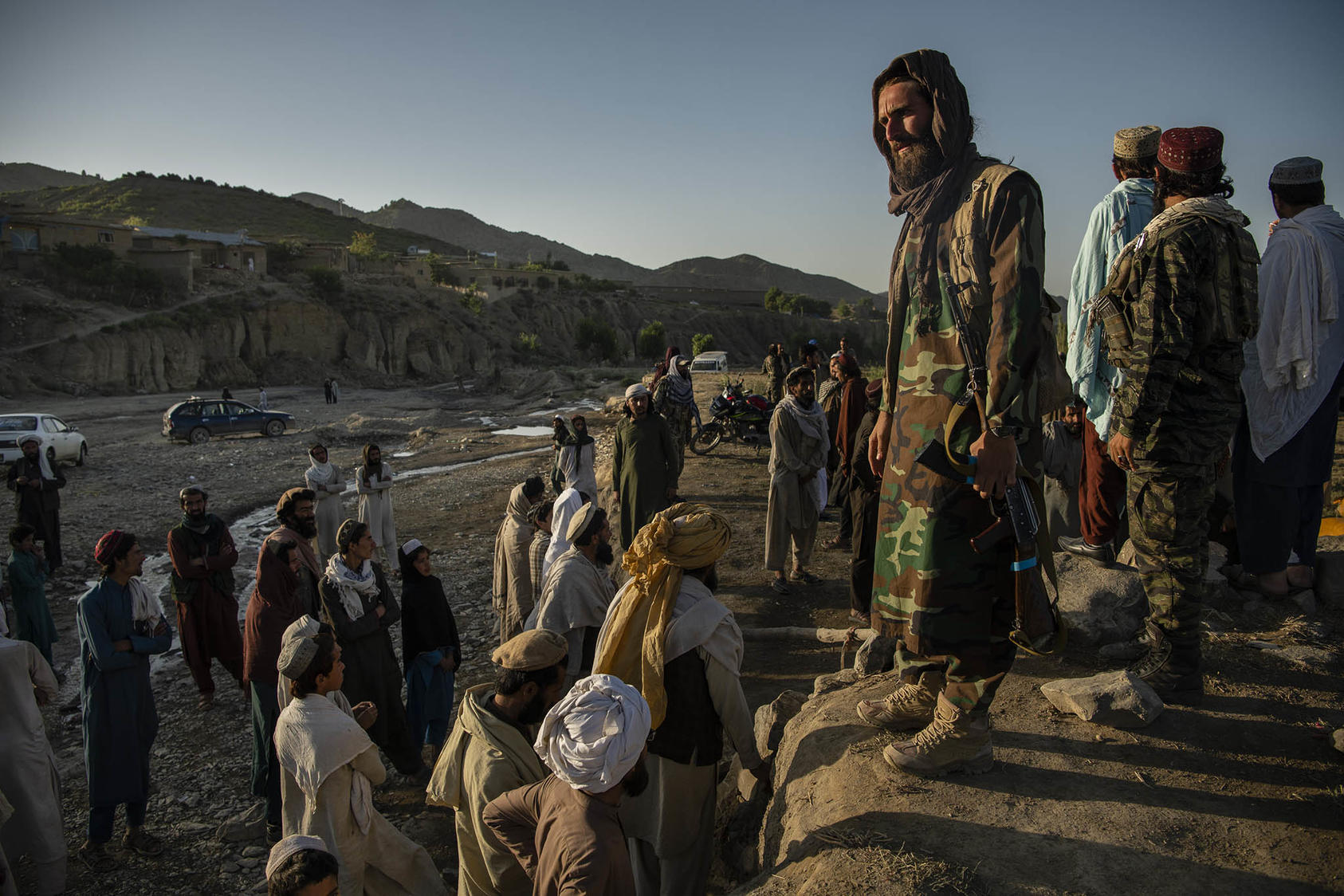
Taliban fighters guard an aid site and give instructions to survivors of the earthquake, in the Gayan district of Afghanistan, June 24, 2022. (Kiana Hayeri/The New York Times)
USIP’s William Byrd discusses the economic situation in Afghanistan a year since the Taliban came to power; the Taliban’s economic management performance; the economic, humanitarian and aid outlook; and priorities for the United States and other countries.

What is the state of the Afghan economy today?

The economy has shrunk by 20% to 30% since August 2021, a great many people have lost jobs and livelihoods, social services have been decimated, poverty and hunger as well as the humanitarian crisis have greatly worsened, hundreds of thousands of people have left the country, government agencies have been denuded of managerial and professional staff, many Afghan businesses have closed or downsized and the bottom has dropped out of already low investment.

After a free fall that lasted many months, the Afghan economy is stabilizing but at a much lower equilibrium, leaving people poorer and more vulnerable to privation, hunger and disease. There is no prospect for the economy to resume high growth let alone recover to pre-2021 levels in the foreseeable future.

Externally, the Afghan currency’s exchange rate has bounced back and is no lower than a year ago. Imports have declined sharply (reflecting the economic collapse and lack of international aid to finance imports) while exports have doubled in recent months. A series of U.S. Treasury announcements, culminating in General License 20 in February 2022, belatedly clarified that existing sanctions do not apply to Afghanistan as a jurisdiction, the Afghan government or government agencies, and public and private banks or firms.

Internally, Afghan businesses appear to have stopped further job losses and closures (while not coming anywhere near restoring pre-2021 levels of activity), goods are generally available in markets and wages seem to have stopped declining. Inflation remains high but is now the result of rising global food and energy prices not exchange rate depreciation or other domestic factors as was the case earlier. Mining has been a bright spot, with coal output and exports (mainly to Pakistan) on track to double this year to some four million tons.

This is not to say the economic situation is at all good, just that the free fall has stopped. The new equilibrium leaves most of the Afghan population — up to 70%, according to a World Bank survey — unable to afford food and other necessities, a “famine equilibrium” where many people would starve in the absence of humanitarian help.

How have the Taliban handled economic management over the past year? What have they done well?

Revenue collection at border crossings has been remarkable despite the steep drop in imports. Total revenues are on track to fall but by far less than the decline in the economy.

Arguably, the Taliban have taken a more positive (albeit simplistic) approach to the Afghan private sector than the previous government. Private firms have sometimes negotiated successfully with the Taliban over tax rates and other business issues of direct concern to them.

Taliban actions have greatly reduced corruption in customs and at road checkpoints (most of which have been removed). As a result, the overall burden on the private sector has been reduced even while formal tax receipts have held up. Also helping are the much-reduced financial inflows into the country which had previously enabled enormous corruption and waste. However, there are signs of some petty corruption in Taliban-controlled government agencies, extortion of nongovernmental organizations and the like.

Less large-scale corruption and the aid cutoff mean the adverse impact of the economic shock and subsequent adjustment has been disproportionately felt at the upper end of the Afghan income scale which benefited most from corruption, with smaller percentage reductions in incomes at the lower end.

The Taliban administration has generally kept to a responsible macroeconomic and monetary stance, unable to print new Afghani banknotes or to flood the country with dollars (limited to the U.N. cash shipments), and with withdrawals from banks limited to prevent their collapse.

What have the Taliban done badly?

Their complete lack of transparency on budget expenditures is unacceptable and may mask irregularities or more likely allocation of large amounts of funds to the security sector and other Taliban priorities.

Efforts to control the foreign exchange market and edicts not to use foreign currencies — even though not effectively implemented — betray a lack of understanding of market functioning and the advantages Afghanistan gains from free markets.

The large increases in coal and other mineral exports may further damage Afghanistan’s crumbling roads, and it is not clear whether the Taliban will be able to maintain roads and other essential infrastructure better than the previous government, let alone oversee large new infrastructure investments. Not to speak of the problematic environmental and social consequences of mining.

Taliban ideology is getting in the way of sound economic management. Their recently announced ban on opium, if implemented, would further shock the Afghan economy and take away the livelihoods of hundreds of thousands of rural people — an additional economic hit the country is simply unable to take. It remains to be seen whether the ban will be implemented.

Taliban restrictions on girls’ education and women’s roles in work would have disastrous longer-term economic consequences by limiting the participation of over half of the population in the economy.

What has been the impact of the economic situation and Taliban economic management on Afghans?

The improvement in security brought about by the Taliban victory and the end of major fighting has been favorable for the Afghan economy, benefiting many businesses and individuals. The same is true of the closure of most road checkpoints and much less corruption in customs.

In other respects, however, people are generally much worse off — though this is due primarily to the economic shock from the aid cutoff and should not be attributed solely or mostly to the Taliban’s management of the economy. Where the Taliban are more directly implicated is in the deterioration in social services (stoppage of female secondary education, less and lower-quality health care, especially for women and girls), the related loss of employment for a great many women and policy instability in certain areas such as foreign exchange and banking.

What is the outlook for the Afghan economy?

Unfortunately, Afghanistan is stuck in a low-level equilibrium trap with very slow economic growth (around or below the population growth rate — meaning the lives of most people will not improve anytime soon). Even this unattractive scenario is precarious and could be derailed by continuing drought, lower humanitarian aid, the Ukraine war’s impact on food prices or worsening security.

The continuing drought strikes at Afghanistan’s most precious natural resource — water — and will make it all the more difficult for agriculture to play its essential role in economic recovery and supporting livelihoods. Serious implementation of the opium ban would create a perfect storm for the rural economy, risking outright famine and large movements of people out of the country.

Though down sharply from pre-August 2021 levels, Afghanistan’s aid dependency remains high and is a continuing source of vulnerability. U.N. cash shipments, on the order of $1 billion to $1.5 billion per year, plus another perhaps roughly equal amount of non-cash humanitarian aid transfers, are essential both for human survival and for maintaining the degree of macroeconomic stability that has emerged. It is far from clear that this level of mainly humanitarian support can be sustained.

Other risks include the lingering effects of sanctions — really the fear of sanctions now that their scope has been clarified and narrowed, the weakness of the central bank partly reflecting its lack of access to frozen foreign exchange reserves and continuing problems with international financial transactions.

In the face of the current economic and humanitarian situation, what can the United States and other international donors do to help everyday Afghans?

Continuing current humanitarian aid is essential to avoid or mitigate a humanitarian catastrophe. But this is no long-term solution and would leave the country permanently dependent on such aid and vulnerable to any interruption. Humanitarian and other aid must be well-coordinated and cost-effective.

Donors will need to continue to strike a balance between maintaining food and other lifesaving assistance and providing some degree of support to basic services, livelihoods and modest economic growth, while not overly legitimizing or strengthening the Taliban regime. This is hard and will necessitate difficult trade-offs among these objectives.

The Taliban bear their own responsibility for the current economic situation. By ignoring and often openly flouting international priorities, they are making it more difficult for donors to sustain current aid let alone increase it (to compensate for rising food and other costs), and to restore normal international financial relations. They need to build on the more positive aspects of their economic management; appoint qualified, experienced officials to lead key economic agencies (the central bank and finance ministry); and become more responsive to international concerns not least in the economic field.

One Year Later, Taliban Unable to Reverse Afghanistan’s Economic Decline
read more

Accused Men, Women Publically Whipped in Zabul

Dozens of locals gathered to watch the public punishment.

Information and Culture department head Rahmatullah Hamad said that in Zabul two women and one man were publically whipped for committing adultery and another two men were whipped for robbery.

Earlier, the leader of the Islamic Emirate, Mawlawi Hibatullah Akhundzada, said that all previous laws will be considered null, and Sharia law will be implemented in the country.

Dozens of locals gathered to watch the public punishment.

“The Taliban succeeded. They said in their initial speech that the constitution and other laws of the former government are demolished and Sharia law will be implemented,” said Shir Hassan Hassan, a political analyst.

“First of all, Hudud has its own conditions which require an actual witness and a confession that is not forced. I am sure that these two issues have not been observed,” said Munisa Mubariz, a human rights activist.

The local officials in Zabul did not allow the press to cover the scene of the punishment, but the Information and Culture Dept head Rahmatullah Hamad said that two men were arrested on charges of robbery and they were given 20 lashes and one month in prison.

“One man and one woman were punished on charges of adultery, the man named (…) was hit 39 times and was sentenced to six years in jail. The woman named (…) was whipped 39 times and sentenced to two years in prison, and a woman named (…) who facilitated the illegitimate relations between the two of them was whipped 20 times and sentenced to six years in prison,” he told TOLOnews in a voice message.

“The decision made based on Sharia, it is natural that it will come into effect in Islamic governments,” said Bilal Karimi, deputy spokesman for the Islamic Emirate.

Earlier, the Provincial Governor of Parwan, Obaidullah Ameenzada, said that the leader of the Islamic Emirate, Mawlawi Hibatullah Akhundzada, ordered to cancel all laws and implement Sharia law in the country.

“He (Islamic Emirate’s Supreme Leader) said no, there is no difference between the law of Ashraf Ghani and Zahir Shan. We don’t accept the law of Zahir Shah and Ashraf Ghani, we want Sharia law,” he said.

This is the first time that the individuals are being punished based on Sharia law in public under the current government.

Accused Men, Women Publically Whipped in Zabul
read more

Senior TTP Member Killed in Paktia: Reuters

According to Reuters, Khurasani had a bounty of $3 million on his head. 

Abdul Wali, also known as Omar Khalid Khurasani, a senior member of the Tehreek-e-Taliban Pakistan, and three of his aides were killed in a roadside blast in southeastern Paktia province on Sunday, Reuters reported citing intelligence sources of Pakistan. 

According to Reuters, Khurasani had a bounty of $3 million on his head.

The Islamic Emirate said it will investigate the matter.

“Our investigation has been continuing in this regard to see what is the issue. What incident happened and where it happened,” said Bilal Karimi, deputy spokesman for the Islamic Emirate.

Khurasani and his aides were killed in an explosion from an apparent roadside bomb while travelling in a car in the southeastern province of Paktia on Sunday, the sources told Reuters on condition of anonymity.

Meanwhile, some sources said that Khurasani was present in the negotiations which were reportedly held between the TTP and Pakistani government in Kabul.

The political analysts gave various views on the killing of Khurasani.

“To gain money and weapons from the US, (Pakistan) should always declare an enemy and that enemy is now TTP. This is an enemy who could be controlled everywhere and they can eliminate it anywhere they want to,” said Sher Hassan Hassan, a political analyst.

“I think there are disagreements among the TTP. Usually, whenever there are peace negotiations, the hardliners are on one side and the moderates are on the other side. I think it is about the internal disagreements among the TTP,” said Waheed Faqiri, a political analyst.

Khurasani was the chief of Jamat-ul-Ahrar (JuA), a TTP branch that is designated a terrorist group by the United Nations and United States, according to Reuters.

Senior TTP Member Killed in Paktia: Reuters
read more

Officials: Girls’ Schools Closed Due to ‘Cultural Constraints’

On Sunday, the Deputy Minister of Education said that the delay in reopening girls’ schools was caused by problems in the curriculum for girls.

During his visit to the province of Khost, Noorullah Munir, the acting minister of education, stated that girls’ schools had been shut down due to cultural constraints. He expressed his hope that the Islamic Emirate’s leaders and the elders would agree to reopen girls’ schools.

“People are not sensitive to the education of their girls, but to their girls leaving the house, and the culture of Afghans is quite sensitive in this area. You know better that the Islamic Emirate is attempting to reach an agreement with the people and start this process,” he said.

Munir denies reports that the closure of the girls’ schools was caused by the change in the curriculum. He said that the Afghan curriculum has issues and that there is currently no plan to change it.

“We have never said that we would begin working on the curriculum right away. Bringing changes to the curriculum is the right of every nation, people, and every government,” he stated.

On Sunday, the Deputy Minister of Education said that the delay in reopening girls’ schools was caused by problems in the curriculum for girls.

“Three times work has been done on the available curriculum, still this issue has not been completed. God willing, we are responsible to our people over this issue, whether it is a man or a woman,” said Sayed Ahmad Shahidkhail, deputy of the Ministry of Education.

The Acting Minister of Education admits that more than 5,000 of the 20,000 schools in the country do not have buildings and need reconstruction and renovation.

Officials: Girls’ Schools Closed Due to ‘Cultural Constraints’
read more

One year after Afghan war, Biden struggles to find footing

By AAMER MADHANI

Associated Press
9 August 2022

WASHINGTON (AP) — The 12 months since the chaotic end to the U.S. war in Afghanistan haven’t been easy for Joe Biden.

The new president was flying high early in the summer of 2021, the American electorate largely approving of Biden’s performance and giving him high marks for his handling of the economy and the coronavirus pandemic.

But come August, the messy U.S. troop withdrawal from Afghanistan seemed to mark the start of things going sideways for him.

It was a disquieting bookend to the 20-year American war: the U.S.-backed Afghan government collapsed, a grisly bombing killed 13 U.S. troops and 170 others, and thousands of desperate Afghans descended on Kabul’s airport in search of a way out before the final U.S. cargo planes departed over the Hindu Kush.

The disastrous drawdown was, at the time, the biggest crisis that the relatively new administration had faced. It left sharp questions about Biden and his team’s competence and experience — the twin pillars central to his campaign for the White House.

As the one-year anniversary of the end of the Afghan war nears, the episode — a turning point in Biden’s presidency — continues to resonate as he struggles to shake dismal polling numbers and lift American confidence in his administration ahead of November’s critical midterm elections.

“It was a pivotal moment that he hasn’t ever really recovered from,” said Christopher Borick, director of the Institute of Public Opinion at Muhlenberg College in Pennsylvania. “Things were going really well in terms of how voters viewed him in terms of bringing stability to the economy and how the government addressed the pandemic, issues that are higher priorities to the American electorate than the war in Afghanistan. But Afghanistan cracked that image of competency, and he hasn’t ever really been able to repair it.”

The Afghanistan debacle was just the start of a series of crises for Biden.

As Biden was still dealing with fallout from the Afghan withdrawal last summer, COVID-19 cases began spiking again. Layered over that in coming were months were strains on the economy caused by inflation, labor shortages and the Russian invasion of Ukraine. The sum of it left Americans weary.

In the weeks before Afghanistan went sideways, Biden was riding high. His approval rating stood at 59% in a July 2021 poll by The Associated Press-NORC Center for Public Affairs Research. An AP-NORC poll conducted last month put his rating at 36%.

White House officials and Biden allies hope the president is now at another turning point — this one in his favor.

The administration has recently racked up high-profile wins on Capitol Hill, including passage of the $280 billion CHIPS and Science Act designed to boost the U.S. semiconductor industry. Congress also passed a program to treat veterans who may have been exposed to toxic substances from burning trash pits on U.S. military bases.

And over the weekend the White House sealed the deal on far-reaching legislation addressing health care and climate change that also raises taxes on high earners and large corporations, a package the administration says will also help mitigate the impact of high inflation.

The legislative victories followed Biden ordering the CIA drone strike in Kabul that killed al-Qaida leader Ayman al-Zawahri, who along with Osama bin Laden masterminded the 9/11 attacks. Biden says the operation validates the decision to withdraw from Afghanistan.

“I made the decision to end America’s longest war … and that we’d be able to protect America and root out terrorism in Afghanistan or anywhere in the world,” Biden told a Democratic National Committee virtual rally last week. “And that’s exactly what we did.”

Biden had other big legislative wins after the Afghanistan debacle.

In November, he signed into law a $1 trillion infrastructure deal to fund rebuilding of roads, bridges and other big projects In April, the Senate confirmed Biden’s history-making U.S. Supreme Court nominee, Ketanji Jackson Brown, who became the first Black woman to serve on the high court. And in June, Biden notched another win as Congress passed the most significant changes to gun laws in nearly 30 years.

But those legislative accomplishments weren’t rewarded with a boost in his standing with voters.

Eric Schultz, a senior adviser to former President Barack Obama, argues that there’s reason for the White House to hope that momentum is shifting with the recent legislative wins.

“The question is, ‘What did Democrats deliver when they swept into power in 2020?’” Schultz said. “And I think for Democrats running in November, we have an even better answer to that question than we did just a few weeks ago.”

Schultz added that the operation that killed al-Zawahri also offered strong evidence that Biden’s instincts as commander in chief were correct.

“Nobody thought Afghanistan was going to be a panacea of rainbows and unicorns after we left,” Schultz said. “But the president made the right decision that based on U.S. national security interests we could execute our counterterrorism imperatives without having thousands of troops on the ground.”

William Howell, a political scientist and director of the Center for Effective Government at the University of Chicago, said the biggest drag on Biden’s standing with Americans has been runaway inflation and an unrelenting pandemic.

But the Afghanistan debacle became a defining moment in the Biden presidency, he said, marking when the American electorate began questioning Biden’s ability to fulfill his campaign promise to usher in an era of greater empathy and collaboration with allies after four years of President Donald Trump’s “America first” approach.

“Afghanistan remains significant going forward as he tries to make that central 2020 argument of competency,” Howell said. “The images of Afghanistan are going to remain Exhibit A in the other side’s rebuttal of the competency claim.”

The administration, for its part, has pushed back that lost in the criticism of the U.S. withdrawal effort is that in the war’s final days, the United States pulled off the largest airlift in American history, evacuating some 130,000 U.S. citizens, citizens of allied countries, and Afghans who worked with the United States.

Biden continues to face criticism from immigrant refugee advocates that the administration has fallen short in resettling Afghans who assisted the U.S. war effort.

As of last month, more than 74,000 Afghan applicants remained in the pipeline for special immigrant visas that help military interpreters and others who worked on government-funded contracts move to the United States and pave the way for them to receive a green card. That total counts only the principal applicant and does not include spouses and children. More than 10,000 of that pool of applicants had received a critical chief of mission approval, according to State Department data.

Days after the unexpected fall of Kabul last year, national security adviser Jake Sullivan promised the White House would “conduct an extensive hot wash” and “look at every aspect” of the withdrawal from top to bottom.” But that effort has dragged on and is not expected to be completed before the Aug. 30 anniversary of Biden ending the war.

The White House has yet to detail how the president will mark the anniversary of a war that cost the lives of more than 2,400 U.S. troops and wounded nearly 21,000 more. Republicans are certain to resurrect criticism of the administration’s drawdown.

Senate Minority Leader Mitch McConnell noted to reporters that while taking out al-Zawahri was a triumph for the intelligence community, the moment also confirmed that the Taliban — ousted from power by U.S. forces after 9/11 to deny al-Qaida a haven — are once again harboring al-Qaida.

“It is noteworthy where Zawahri was: In Kabul. So al-Qaida is back as a result of the Taliban being back in power,” McConnell said “That precipitous decision to withdraw a year ago produced the return of the conditions that were there before 9/11.”

One year after Afghan war, Biden struggles to find footing
read more