 Afghanistan Peace Campaign
For generations, the tradition of ashar – voluntary, unpaid communal labour – was one of the strongest expressions of solidarity in rural Afghan society. Whether harvesting a neighbour’s wheat, building a home or cleaning an irrigation canal, ashar bound together families, villages and tribes through reciprocal obligation. This tradition has sharply declined across much of southeastern Afghanistan in recent years, weakened by the monetisation of labour, mechanisation, migration and the slow unravelling of the social bonds that once made collective work both necessary and expected. In this report, AAN’s Sharif Akram examines what ashar used to mean to rural communities, why it is disappearing and what its decline says about broader changes in society in the Afghan countryside.
Afghan rural society has long been characterised by strong social bonds at multiple levels: the extended family, village, qawm (a close-knit group of interrelated families bound by shared patrilineal descent, larger than the extended family but smaller than the tribe) and tribe. People depended on one another not only in times of crisis but also in routine daily tasks. The paternal grandfather, brothers, uncles and male cousins – the tarburna (patrilineal male relatives) – formed the innermost circle of social obligation. Beyond that came the village. While a tribe may be a broad and dispersed category, the qawm functioned as the primary unit of solidarity and mutual obligation, sometimes spanning several villages, with a strong say in individual and family decisions. Members were present at funerals and disputes and equally at weddings, harvests and communal feasts.
While the customs that held these communities together were numerous, this report focuses on one – ashar, the tradition of collective voluntary labour, in which villagers contributed their time and effort, without payment, towards tasks that benefited either a single household or the community as a whole. Ashar was, in many ways, the material expression of qawmi solidarity – the understanding that communities, bound by proximity, kinship or shared resources, had obligations towards one another and that this went beyond their own household. It is associated with Pashtunwali (the customary code of honour and ethics for Pashtuns), but is not exclusive to it. Ashar is also, overwhelmingly, a practice whereby men contribute their time and labour to each other’s households or to the community.
The report examines ashar as it used to exist in rural Pashtun communities until quite recently, traces its decline and analyses what that decline means for the broader social fabric. It is based on in-depth interviews with 18 individuals across Khost, Paktia, Paktika, Ghazni and Wardak provinces, conducted during October and November 2025. Respondents were all men, but of all ages from young to old; they included tribal elders and village leaders who had witnessed the transition from collective to individualised modes of work.[1]
The term for ashar varies by region. In Khost, the word pagra is used, possibly derived from pa gada (together). In other southeastern provinces, ashar is the common term. In some Persian-speaking parts of southeastern Afghanistan, it is sometimes called wandi. Throughout this report, ashar is used, rather than local variations, except in direct quotes. In many of the quotes, interviewees use ‘people’ to refer to ‘men’; we have kept this in the translations.
What is ashar?
Ashar, derived from the Arabic word hashr, meaning gathering or assembling, is a form of collective, voluntary labour that members of an extended family, village, tribe or even a district carry out for each other or for a common cause. It operates on the simple principle of reciprocal obligation: when a family or community needs labour for a task too large for one household to manage, villagers are called upon to help. A household who helps others today can also expect the same support when their turn comes. This creates a cycle of mutual dependency that reinforces social bonds across households and villages.
Interviewees consistently distinguished between two forms of ashar. The first was household-level ashar, for the benefit of a single family. The most common occasions were agricultural: harvesting wheat, threshing grain, ploughing fields or transplanting rice. Families that lacked sufficient labour – widows, the elderly or households whose men had migrated – were typical beneficiaries, but the practice was not limited to the needy. In Khost, a 70-year-old respondent recalled that “pagra was also done for the village khans and maliks (the big landowners). Usually, the khan or malik had a lot of land. Villagers would bring out several pairs of oxen and turn the khan’s land and the khan would only provide them with food.” But when poorer families ran out of grain, the khan would reciprocate. Life, as the respondent put it, “went on well in this way, with mutual cooperation.”
Beyond agriculture, household ashar extended to building and repairing mud houses, gathering firewood from the mountains and preparing for weddings and funerals. In Khost, ‘wedding firewood ashar’ was common: young men would gather wood. As one interviewee from the province described it, “‘[Someone would] say: So-and-so is getting married, let’s do a firewood pagra for him. And we’d bring more than enough firewood.’” Women also participated in certain forms of ashar. Interviewees in Khost recalled calling village women to spread mud on the roofs of houses that were being built. In mountainous areas, women from neighbouring households helped one another carry firewood, with the favour returned the next day.
Calling men to household ashar was informal. The person in need would tell friends and neighbours the evening before or announce in the mosque or village hujra (a community guesthouse where male villagers gathered) that he needed help with a particular task. Participants arrived early, already dressed and ready for work. The only obligation on the host was to provide food – typically the most valued food such as shirwa (homemade ghee) and dandakai, a popular meal made of rice, dried yoghurt and meat in Loya Paktia.
The second form was collective or village-level ashar. The cleaning and repair of jui (irrigation canals) before the planting season and the construction of mosques, village meeting places, roads, small bridges and ponds were all done through collective ashar. Each household was expected to contribute one or two men; participants brought their own tools and food and the work was organised by village elders, the malik or the mirab (water master). When tasks extended beyond one village – maintaining a shared kariz (underground irrigation channel), for instance – the labour was distributed proportionally, usually by the number of households or the degree of benefit enjoyed by each village. Ashar is, moreover, an overwhelmingly male activity: the labour mobilised through ashar is almost entirely male and the social institutions that organise it are led by men. Women have their own parallel forms of ashar, helping other women with tasks such as gathering firewood or household labour, but these operate in separate networks. Due to cultural constraints, this research was conducted with men only, so insights into women’s ashar are almost existent.
This distinction matters because the two forms have declined at different rates. Collective ashar has proved more resilient for a straightforward reason: communal infrastructure, such as canals and dams, affects everyone’s livelihood directly. If the canal is not cleaned, nobody can irrigate. The incentive to opt out is therefore weaker. Individual ashar benefits only one household at a time, making it easier for others to decline.
The spirit of ashar
Ashar was not merely a labour arrangement. It carried a strong social dimension and was, in many forms, as much a social occasion as a working day. Interviewees across all provinces recalled that participants worked with genuine enthusiasm and sincerity, treating the task as their own. One elder from Khost put it this way: “It’s not like nowadays, where workers don’t do their best and only pass time in order to get paid. In ashar, everyone was working sincerely and with all his abilities, like working on his own task.” A village elder from Paktia said he had worked “for another villager in the harvest season even for three consecutive days,” which meant leaving his own fields unattended. This was not unusual; it was expected.
In Khost, agricultural ashar – rice transplanting and harvesting in particular – was accompanied by dhol (drums) and later by music played through tape players. A respondent in his forties recalled the range of occasions that once existed:
Before, there was hardly any need to look for an excuse [to carry out] pagra (ashar). There was pagra at harvest time, pagra when turning the soil, pagra when planting rice, pagra when making mud bricks for rooms, pagra when bringing firewood, pagra when storing wheat grain, chaff and fodder. The young men would gather; there was work, but there was also enjoyment.
Ashar in this sense was not just a way of getting work done. It structured the social year, giving young men regular occasions to gather, work together and eat together. A village elder from Khost said: “When work is done collectively, it is full of blessings and far more effective than paid labour. We have tested it many times: both the quality and the speed of collective work are far better.” An elder from Paktika linked it directly to social cohesion: “When the young men go to each other’s houses, eat with each other and work with each other, it strengthens the bonds and keeps them together and united.”
Participation in ashar was not legally enforced, but it carried strong social expectations, backed by one of the most potent sanctions in Pashtun society – the desire, even necessity, of avoiding payghor, or shame. To be subject to payghor, a concept deeply embedded in Pashtunwali, is to be publicly shamed for failing to meet a social obligation – an intensely painful experience in a society where honour and reputation are paramount. In the context of ashar, refusing to participate without valid reason brought not only payghor, but also risked exclusion from future communal support. According to one respondent from Khost, “in the past, if someone did not participate in pagra, it would be considered payghor and they’d feel ashamed.” Those who could not attend due to a genuine obligation would seek permission from the person calling the ashar; only then was their absence tolerated.
For village-level work, the consequences were sharp. One interviewee from Paktika explained it:
If you didn’t share in others’ work, you’d remain alone in your own tasks, with no one coming to help you. If you didn’t participate in someone’s funeral ceremony, then no one would come to the funeral of your relatives. And no one can handle something like that alone.
A respondent from Wardak described a more formal punishment: “If someone failed to attend community ashars, he’d be made to pay nagha [compensation] – providing food to all the ashar participants or something else that the village had decided upon.”
Ashar was, in this sense, also a governance mechanism. It provided one of the bases through which communities enforced conformity with local customs and nerkh (customary law). A Paktika elder put it plainly:
In the past, families and individuals [acting] alone were very weak and no one could survive on their own. Therefore, everyone was bound to abide by the norms and by nerkh. No one could move away from the customs and traditions in a village because, if they did, no one would help them in their ceremonies and agricultural work. This was something no one could afford.
A tribal elder from Paktia summed it up: “It was like an obligation – not in the sense that it was absolute, but the way society was woven made it obligatory for everyone to be part of it, or face isolation – and no one could afford that.”
The decline of ashar
Ashar has not disappeared entirely, but across much of southeastern Afghanistan it has sharply declined. Collective ashar – canal cleaning, mosque repair, road maintenance – survives in a diminished form, particularly in remote areas. But household-level ashar has, in many places, been replaced almost entirely by paid labour. A Khost respondent described the shift, including in forestry work:[2]
Speaking of individual pagra, most occasions for it no longer exist. No one does pagra for bringing firewood, because the mountains and forests are not like they used to be. Ploughing with oxen and harvesting with sickles is no longer done. Tractors do all this work now.
Even where collective ashar persists, it has weakened. The same respondent noted the paradox:
Previously, even though there weren’t so many tools and resources, the village roads, canals and dams were maintained very well. But now, despite so many resources, there are shortcomings. The canals and dams are not as clean as before. Even village roads are in a bad condition and nobody cares much.
A young man from Ghazni made a similar observation:
In our village, there used to be only five cars and two tractors. In the neighbouring village, there were three cars and three tractors. And in the winter season, we’d go out and repair the tracks right up to the asphalted road. However, in the last five years, people don’t gather despite the fact that now the number of cars has risen to fifteen and tractors to seven in our village and a similar number in the neighbouring village. And we use the damaged, muddy tracks. It’s like people have lost their ability to work together and solve a common problem.
Interviewees identified several interrelated factors behind this decline. These are best understood not as isolated causes but as mutually reinforcing changes. Among them, the most frequently cited factor was the shift from a subsistence to a monetised economy. In the past, rural households operated largely outside the cash economy. Labour was exchanged for labour and ashar was the only way to mobilise the hands needed for large tasks. As cash became more widely available and daily wage labour emerged, this changed. An elder from Paktia explained:
In the past, there was very little money and very few things were bought with cash. People were content with the life they had and didn’t desire too many things, which meant they were not money minded. But now, everyone is trying to earn as much money as possible. So, when one can find a paid labourer for 300 afghani a day, why would he work voluntarily?
Paid labour did not merely provide an alternative to ashar; it actively undermined it. The same neighbours who would previously have worked for one another now offer their services for a daily wage. One Paktia interviewee described this: “Ten years ago, I was helped by villagers through ashar, but now when I ask them, they say they need to do this or that, but when I offer them a daily wage, they leave their work and work for me – in return for payment.”
In Ghazni, one man in his 50s recalled a time when being paid by a fellow villager would have been considered shameful: “It was like a shame to work for a villager and then get paid. There were some year-round labourers who’d work in exchange not for money but for wheat. But for occasional work, it was a shame to be paid.” That this is no longer the case marks a significant change in the moral economy of rural life.
A Khost respondent described the shift from both sides: “Now perhaps neither side wants it – instead of calling people to pagra, a family considers it better to pay money and get the work done. On the other hand, people also think that instead of participating in pagra, it’s better to do some work and earn a living.” When both the person who needs labour and the one who might provide it prefer to use cash, ashar becomes redundant. An interviewee from Ghazni illustrated the problem: on one occasion, he had arranged with two villagers to help him with his harvest, but two days later, both told him they had been selected for a musisa (NGO) project where they would get 500 afghanis [USD 9] per day, “so,” he said, “they couldn’t come and work with me.”
Mechanisation and changing livelihoods
A second factor is mechanisation, which has eliminated many of the tasks which had once made ashar essential. Harvesting used to require dozens of hands. Now, it can be done by one or two men using a machine. Ploughing, once performed with shared teams of oxen, is done by tractor. Firewood is bought from urban markets. “In the past,” one interviewee from Ghazni said, “harvest would be done by hand. Now it’s done by tractor, which consumes fuel [which is not free, and has to be paid for], and many people bought [tractors] in order to make a profit from them.”
The scarcity of tools and equipment also created bonds of interdependence. A Khost respondent described this: “Previously, many families couldn’t afford two oxen. So, one family would buy one ox, another would buy another, and at ploughing time, their partnership was formed by bringing both oxen together.” When each family can afford their own tractor, a respondent from Paktia said, that bond dissolves:
The work that once took a hundred people to do is now done by a single machine. And a machine is purchased and has maintenance costs and people buy it to make a profit. So, it’s not logical to gather a hundred people to work for free for days on end instead of a machine that does the same work by itself, all in one day – and makes a return of a few thousand afghanis.
A third factor leading to a decline in ashar is the diversification of livelihoods, which has left men with less time for communal work and, in some cases, has dissolved the reciprocal logic that used to sustain it. Government and private-sector jobs and commitments (such as university and school) leave little room for all-day voluntary labour. As one Khost respondent said: “In the past, our people had no other occupation; there was only farming. Almost everyone was engaged in agriculture, so they were compelled to help one another. Now, alongside farming, there are government and private jobs and people are also increasingly busy with small businesses.” A young man from Wardak, a university student in Kabul, explained the problem in practical terms:
Now everyone is busy. There’s no time for ashar. I only go to the village once every two weeks and that too on a Friday. This is the story of most of our young [men]. And on Friday, there’s a lot more to do than participate in someone’s ashar.
The shift away from ashar also reflects a deeper structural change – the declining centrality of agriculture itself. As market goods have replaced household production, even in small villages, most essentials are now purchased rather than grown. Many young men have left for the cities or abroad in search of paid employment and the proportion of households sustaining themselves solely by farming has dropped sharply. That has eroded the economic foundation of reciprocal labour. When most families were farming, exchanging labour made practical sense; each household needed something from the others. Such logic no longer works in a diversified cash-based economy. Another young respondent made a broader point about the breakdown of reciprocity:
In the past, people were all doing the same things and there was very little to do outside the village. And they all lived in the village. Now, people aren’t doing the same as one another and they’re not able to help other people. I’m a shopkeeper. No one can help me with ashar because that’s not their profession. I’m not a farmer and I can’t help others with farming. The reciprocal nature of things is no longer there.
Migration, war and the erosion of authority
Decades of conflict have driven massive displacement and migration, both to Pakistan and within Afghanistan, especially to the cities. Culturally, it has exposed rural Afghans to different ways of life, where collective labour plays no role. A Khost respondent said:
In the past, people mostly depended on farming, but over time, and especially when they moved to other areas, they saw different types of business. This changed their old way of thinking and many launched different businesses as well as farming. And what’s more important, they found out that the same things they were doing for free could be transformed into a form of business.”
The wars that began in 1979 also damaged the structures of authority on which collective ashar depended. At the village level, ashar was coordinated by the elders, maliks and mirabs, whose authority rested on customary legitimacy within the qawm system. After the Soviet invasion, as Roussel and Caley documented, “[T]he leaders of the uprising, more often than not of religious background, rapidly, and sometimes abruptly, replaced the leaders of their qawm, the traditional notables who had survived the government purges, thereby creating a new social category: the militia chiefs.”[3] Commanders were focussed on military mobilisation, not on ashar, and the elders who had once called for ashar found their standing diminished. One interviewee described this transition: “The khan of a village was a person who held great authority. He’d call for ashar and everyone would be present. Later, the khans lost their influence and each person became wealthy, each a ‘heavyweight’[4] unto themselves.”
During the Republic era, even though the maliks lost influence and commanders and insurgents gained it, the Taliban in areas under their control did use their authority to impose a form of collective work, though not, according to interviewees, in the spirit of maintaining social solidarity, but to solve practical problems. A respondent from Wardak described this:
When the Taliban were in our area [before 2021], in the winter, they’d announce in the mosque that the tracks had to be cleared of snow or repaired. All the villagers would participate out of fear. The Taliban did this because their mobility would be limited on muddy or snowy paths and they’d use the villagers to clear them. But since the Taliban are gone [as insurgents and become a government], the villagers have cleaned and repaired the routes just once in four years.
Population growth has compounded these pressures, as a resident of Khost explained:
The land that a few decades ago was farmed by one or two members of a family is now shared among ten or twenty, while the land remains the same size! There’s now more than enough men and wasael [technological tools] to make households self-sufficient.
Smaller plots require less labour, reducing the need to call upon neighbours. At the same time, fragmented holdings have reduced the agricultural surplus that once allowed wealthier families to reciprocate ashar by distributing grain in lean times.
The role of international aid
One striking argument that emerged during the interviews was that international aid has played a role in weakening collective ashar. Aid organisations periodically provided financial support for maintaining infrastructure – dams, canals, headworks – something that had previously needed communal labour. A younger Khost respondent was direct about this:
In my opinion, international aid organisations weakened the spirit of collective ashar among the people. This aid caused harm rather than benefit, because [by paying locals for refurbishment work] it took away the spirit of voluntary labour from the people, but the assistance didn’t continue. So now, people wait in hope that someone will appear again and provide assistance in exchange for work.
A shift in mentality
Underlying all of these factors is a broader shift in attitudes, described by a Khost man in his 40s:
At one time, people’s mentality was such that they led highly social lives and participated with others in grief, in joy and in voluntary cooperation. Now, the mentality is that, instead of being highly social, one should become self-sufficient and meet one’s own needs without others’ help. At one time it was considered manly to cooperate with others or ask for their cooperation. But now it’s considered manly to meet one’s needs without others’ assistance.
This inversion is significant. In the past, a man who refused ashar would face payghor. Today, as the same respondent noted, “People take pride in saying, ‘I don’t participate and I meet my own needs myself.’” The sanction that once enforced collective behaviour has not merely weakened; what was shameful is now a source of pride.
A resident of Paktia in his fifties also described another aspect of this change in attitude:
When you tell people to come and help as ashar, they say they have this or that work to do. This doesn’t mean that in the past people didn’t have work. The issue is that in the past, they valued [ashar] to the extent that they’d leave their own work and help, because they knew they’d need that villager’s help in the future. But now, no one sacrifices their work for others.
A Khost respondent was lyrical about his sense of loss:
It’s true that in the past, resources were scarce and life was full of hardships, but the love and pleasure that was in that life doesn’t exist today, with all its abundance of resources. Because now, everyone is trying to rely on themselves only.
New forms of collective action: from labour to fundraising
While traditional ashar has declined, it has not vanished without trace. In some areas, a new form of collective action has emerged, particularly among younger Afghans who run businesses and are living in cities or abroad. Rather than contributing their labour, they contribute money. In some cases, a young man from the area posts on social media calling on friends and fellow villagers – often those working in the Gulf countries or Afghan cities – to donate funds for a shared problem. One respondent from Paktika described one example of how this worked:
The road that connected five villages to the district centre was very damaged. No one was there to repair it, including the government. One day, a very active young man from Zangikhel posted on Facebook and asked his friends who were from the same district and also had businesses in Saudi and Dubai to donate money so that the route could be repaired. 300,000 afghanis [roughly USD 5,000] was donated. Then one person took responsibility for speaking to a construction firm and the road was rebuilt.
A respondent from Wardak described a similar initiative: “In our area, the district school building was very old and wasn’t big enough to host the number of pupils enrolled. So, the young men decided to collect donations from the wealthy people of the area. They collected a good sum and repaired the school.”
These initiatives represent a significant type of community self-help, but the form is fundamentally different. In traditional ashar, men gave their time and physical labour and this was itself the social bond: they worked side by side, ate together and reinforced their relationships through the act of working. In the new form, the contribution is financial. It can be made from thousands of kilometres away, by someone who has not set foot in the village for months or even years. The work itself is contracted out to a construction firm or to paid labourers. The communal meal, the drums, the shared effort do not exist at all.
This means that, while the new form may solve practical problems, it does not replicate the social function that traditional ashar performed. It does not keep communities physically together; it does not create regular occasions for bonding, dispute resolution and norm enforcement that made ashar a mechanism of self-governance, as well as a labour practice. On the contrary, monetary contributions vary enormously with economic status, easily becoming a competition in generosity displayed, that feeds into family prestige and local prominence, drawing yet another dividing line between the wealthy, who can donate conspicuously, and the poor, who cannot. Several interviewees also raised concerns about the misappropriation of donated funds for personal gain, a problem that could not arise when the contribution was labour, rather than money.
The consequences of the decline of ashar
The losses described in this report go beyond the disappearance of a labour arrangement. Because the practice was embedded in a wider system of social obligations, its erosion has weakened the mechanisms through which rural communities maintained their internal cohesion, enforced norms and protected their most vulnerable members.
The most visible consequence is the loosening of the social bonds that held villages together. Ashar was one of the main ways by which people maintained good social relations, resolved tensions informally and enforced conformity with nerkh. When participation in communal life was the price of communal support, individuals had strong incentives to stay within accepted norms. With paid alternatives now available, that leverage has weakened. “These days,” said one interviewee from Paktia, “if someone doesn’t participate in ashar, he’s not concerned that tomorrow, his fellow villagers won’t help him because he can hire people for money. He doesn’t need his fellow villagers.” A respondent from Wardak, in his fifties, drew a sharp contrast with the past:
In the past, occasions like ashar kept people together. While some injustices existed, it was never to the extent of nowadays. In the past, when someone in a village was dealing with a problem or couldn’t do a task alone, the entire village was with him and would consider his problem as their own. Now, when someone is dying because of a problem, no one knows and no one helps because people have become scattered and don’t care about each other. This is why God’s blessings [barakat] have gone from our lives.
Many interviewees described this erosion in very concrete terms. One elder from Paktia said:
Life was very good at that time. In the entire village, if even one man was present and the rest were out of the village, that one man would take care of all the families and their needs. Nowadays, people can’t leave their own home for a day because nobody else cares what might happen to it.
Another interviewee, also from Paktia, described how a single tractor could serve an entire village:
In the entire village, if someone had one tractor, that would mean the whole village could benefit from it. Now, everyone has their own and when a few people don’t have one and want a fellow villager to lend them his, he says they need to pay for it or even refuses them altogether. That kind of behaviour was never expected in the past.
A third interviewee recalled a night when a villager knocked on his door because his wife was sick and four neighbours with cars had refused to drive them to the clinic. “I took her, along with him,” he said. A tribal elder from Paktia’s Ahmad Abad district described a broader change:
Rural areas and villages have become like the cities. People who once were living like one family now take pride in not interfering with one another. In the past, if a child did something wrong, every elder in the village had the right to correct him, or even beat him and the parents of that child would be happy that the villagers had corrected their son. But now, when you tell someone not to do this or that they did something wrong, his family protests and says this is not your business.
An elder from Ghazni described the cultural consequences:
In our village, young men are imitating the fashions of infidels and no one dares tell them not to. In our time, no one dared to come to the mosque not wearing a khwalai and patkai [cap and turban], but now very few people wear it. When you ask them why, they say: Are you feeding me [ie do I owe you anything]? Everyone is their own boss these days.
The elders interviewed typically couched this change mostly in cultural terms. They resented their loss of authority to discipline others’ children or enforce how others dress and behave. However, the trend they describe bears a broader connection to the decline of practices of mutual help such as ashar, which arguably originally came into existence because of communities’ interdependence and not because of patriarchal and gerontocratic control over society.
The erosion of collective life is also visible in the changing role of the hujra, which was once the centre of village social organisation – the space where decisions were made, disputes mediated, guests hosted and ashar organised. An elder from Khost said: “In the past, there might have been one or a few hujras in the village, but everyone treated them as their own. Now, every family has its own hujra and has acquired the means to host guests.” The shared hujra both depended on and reinforced collective life. Its replacement by individually owned guest rooms mirrors the replacement of ashar by paid labour: both represent the privatisation and fragmentation of what was once communal. But the shift is not only in practice, but also in aspiration. In today’s economy, every household wants to achieve the status symbols that only the wealthy could once attain – their own guest room and their own hired labour. Communal arrangements that once softened inequality now feel like signs of poverty rather than sources of solidarity. And it is the less affluent who lose most: they cannot fully achieve the new expectations. Yet the old safety nets that once supported them are gone.
Even participation in social events has changed. In Khost, a respondent described how grave-digging, once a task young men competed to perform, had declined to the point where “villagers have become worried that if this continues, there might come a time when no one would go to dig the graves.” The solution was to impose a rule: one person per household must attend. That a task once performed enthusiastically now requires compulsion illustrates the scale of the change. The same respondent described participation in communal life as having become “somewhat contractual,” for example, “People attend weddings only to avoid causing offence, not out of genuine solidarity.”
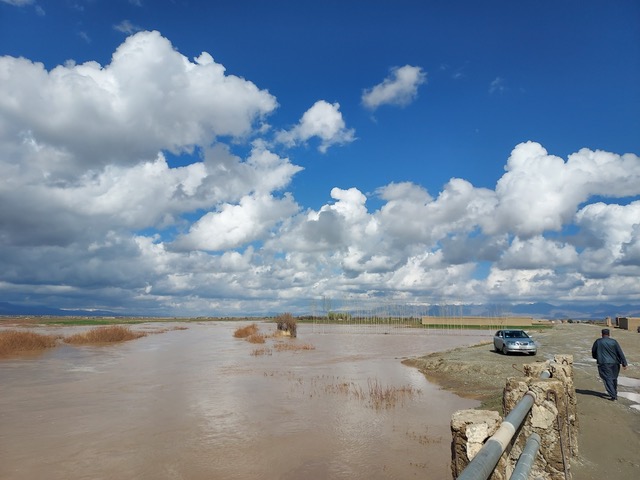
The consequences of neglecting collective maintenance can be severe. An elder described how floods had destroyed crops in two villages because a canal had not been cleaned for a decade, something another interviewee from Wardak described:
The main reason was that the canal [rod] was full of mud and dirt and no one had cleaned it in the last ten years. Such things were done, in our time, twice a year and therefore, when it rained, there’d be no problem. But in the past ten years, despite a lot of advanced technology, such as excavators and money, no one bothered to clean them out and the result was that the crops of the two villages were destroyed.
The decline has not affected all households equally. Wealthier families can hire labourers and buy machinery; for them, the loss of collective labour is manageable. For poorer households, the consequences are severe. In the past, ashar functioned as an informal safety net regardless of a family’s wealth; the village contributed labour for their harvest, construction or ceremonies. One interviewee described the new reality:
When you ask someone for ashar, he says, “I’m doing it on a daily wage basis, not as ashar.” And even in daily wage work, people don’t work properly and just want to stretch the task out so they can charge for two days. For a poor farmer, it’s difficult to pay such an amount of money.
An elder from Paktia explained that in the past, “men had no money and there were few men. And even if a household had more [men], they’d migrate for work, so no family could do their work alone.” A farmer from Khost described the costs of not being able to rely on ashar: “I grow beans on my land and from sowing until the harvest is done, I hire three men on a daily wage to help me for seven days. They take a good amount of money from me. Now, the costs are very high. I remember in the past, no one hired anyone and that money was saved as profit.” The disappearance of this safety net has made the poor poorer and the rich richer.
Tribal structures and village principles have weakened accordingly. One Khost elder observed, “Some young men even take pride in not being bound by these things.” A younger respondent similarly said that, “Now, anyone can build a house on their own, plant an orchard on their own and carry out farming and animal husbandry on their own.” This self-sufficiency might, in material terms, be thought of as ‘progress’, but interviewees consistently described it as a loss. The same young man added, “Today’s young men prefer to do everything by themselves. But they don’t understand that the pleasure that was in the old traditions and in cooperating with one another – it no longer exists.” Self-sufficiency, as one Khost elder noted, comes at a cost: “This situation has filled life with stress and confusion.”
Conclusion
The decline of ashar is not a simple story of modernisation replacing tradition. It is the result of several interacting pressures that reinforce one another, progressively dismantling the conditions that once made collective labour both necessary and natural.
What is lost is more than a labour practice. Ashar was a mechanism of social cohesion, an informal safety net, a tool of local governance, backed by the powerful sanction of payghor, and a source of communal identity. Its decline has weakened bonds between households, undermined the enforcement of nerkh, disproportionately harmed the poorest families and accelerated a rise in individualism that many communities view with ambivalence.
Yet the picture is not entirely bleak. Collective ashar survives in many areas, sustained by the simple logic that if the canal is not cleaned, nobody eats. In Khost, harvest ashar has found an unexpected afterlife among school students, who call on classmates for help and turn the work into a social outing. New forms of collective action have also emerged, with young Afghans abroad or in cities raising funds through social media for village infrastructure. These adaptations suggest that the impulse towards solidarity has not been entirely extinguished, even though the new forms do not replicate the social bonds that traditional ashar created.
It would also be too simple to read this decline purely as a tale of lost virtue. Some scholars have cautioned against romanticising rural Afghan solidarity, noting that “the cooperation and solidarity among rural Afghans assumed to be a community because they happen to live in the same place are at best limited.”[5] Ashar may have always been more fragile than nostalgia suggests and its decline may partly reflect the removal of the local power dynamics that compelled cooperation, rather than the loss of goodwill. What interviewees describe as a golden age was also, by their own account, a world of scarcity and constrained choices.
The decline of ashar offers a window into the broader transformation of Afghan rural society – the replacement of reciprocal bonds with transactional relationships, the growing stratification of village life and the tension between material progress and social fragmentation.
Edited by Fabrizio Foschini, Rachel Reid and Kate Clark
References
| ↑1 | Because of the difficulty of a man interviewing women in the southeast, all the interviewees for this report were male. |
|---|---|
| ↑2 | The interviewee refers here to the significant depletion of Khost forests due to the felling of trees for fuel during the decades of conflict. The availability of alternative fuels, which are easier to access, though more expensive, has probably contributed to the abandonment of collective forestry work, but the weakening of local community control was not necessarily good for the state of Afghan woodlands, with unsustainable logging practices still carried out by individual traders or companies. |
| ↑3 | See Frederic Roussel and Marie-Pierre Caley, ‘Les Manteqas: Le Puzzle Souterrain de l’Afghanistan’, unpublished paper, 1994, cited in ACTED, ‘Review of the Implementation of the AGORA Methodology in Afghanistan under SRDP IV,’ Paris, ACTED, 2023, p3. |
| ↑4 | The interviewee literally said that everyone considered themselves a man, the seven kilogrammes unit of weight, used, for example, for measuring wheat and flour. He means that everyone has come to think of themselves as sufficient unto themselves, that everyone claimed authority and no one accepted the authority of the khan. |
| ↑5 | See David J Katz, Community-Based Development in Rural Afghanistan: First, Assume a Community, Washington DC, United States Institute of Peace, April 2017, p1. |
Revisions:
This article was last updated on 7 Jun 2026
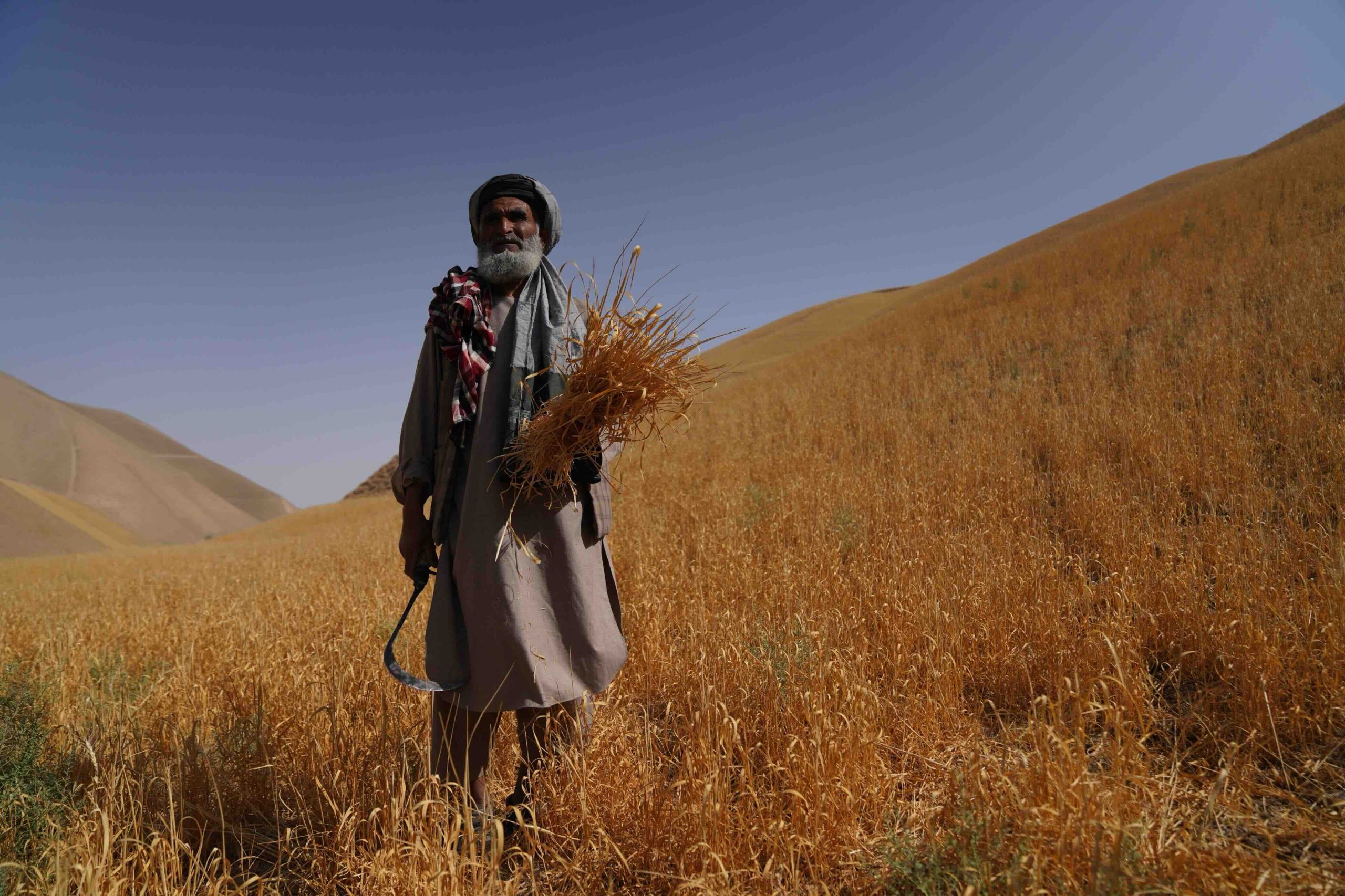 A farmer surveys his failed rainfed spring wheat in Khwaja Sabz Posh district of Faryab province, where in 2025 there was nothing to harvest in 90 to 100 per cent of all fields. Photo: Hashim Azizi/FAO, 7 July 2025