ISLAMABAD (AP) — Afghanistan’s Taliban-appointed foreign minister Wednesday asked Pakistani authorities to look for the reasons behind militant violence in their country instead of blaming Afghanistan.
The comments from Amir Khan Muttaqi came two days after Pakistani officials said the attackers who orchestrated Monday’s suicide bombing that killed 101 people in northwest Pakistan staged the attack on Afghan soil.
During a ceremony to inaugurate a drug addiction treatment center in the capital of Kabul on Wednesday, Muttaqi asked Pakistan’s government to launch a serious investigation into Monday’s mosque bombing in Peshawar.
He insisted that Afghanistan was not a center for terrorism, saying if that was the case then attacks would have also taken place in other countries.
“If anyone says that Afghanistan is the center for terrorism, they also say that terrorism has no border,” Muttaqi said. “If terrorism had emanated from Afghanistan, it would have also impacted China, Tajikistan, Uzbekistan, Turkmenistan or Iran.”
“We have to cooperate with each other, instead of blaming each other,” he said. “Both countries are brothers to each other and must work in a peaceful environment together.”
Authorities in Pakistan said Wednesday the death toll from Monday’s suicide bombing at a mosque in Peshawar increased by one to 101. It was not clear how the bomber was able to slip into the walled police compound in a high-security zone with other government buildings.
Pakistan Defense Minister Khawaja Mohammad Asif on Tuesday accused the Pakistani Taliban, or Tahreek-e Taliban-Pakistani, or TTP, of carrying out the attack, saying they were operating from neighboring Afghan territory. He demanded the Afghan Taliban take action against them. A TTP commander earlier claimed responsibility, but a spokesperson for the group later distanced the TTP from the carnage, saying it was not its policy to attack mosques.
During the nearly 20-year U.S. war against the Taliban insurgency in Afghanistan, militant groups blossomed in the tribal regions of Pakistan along the border and around Peshawar. Like the Taliban, they took root among the ethnic Pashtuns who make up a majority in the region and in the city.
Some groups were encouraged by the Pakistani intelligence agencies. But others turned their guns against the government, angered by heavy security crackdowns and by frequent U.S. airstrikes in the border region targeting al-Qaida and other militants.
Chief among the anti-government groups was the Pakistani Taliban. In the late 2000s and early 2010s, it waged a brutal campaign of violence around the country. Peshawar was the scene of one of the bloodiest TTP attacks in 2014, on an army-run public school that killed nearly 150 people, most of them schoolboys.
Taliban asks Pakistan not to blame them for violence at home
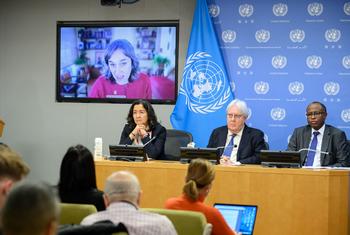
Sofia Sprechmann Sineiro (on screen), Secretary General of Care International, briefs reporters on the situation in Afghanistan after a recent visit to the country.
A UN-led group of humanitarians are hoping that the Taliban will allow Afghan women to again work with non-governmental organizations (NGOs) on the ground following last month’s ban, four senior aid officials told journalists in New York on Monday.
Representing the Inter-Agency Standing Committee (IASC), they stressed that the world’s largest humanitarian operation – supporting some 28 million people in Afghanistan – simply cannot function without women staff.
The officials reported on their mission to the country last week, in the wake of the edict prohibiting Afghan women from working with local and international aid agencies, announced on 24 December.
Days later, the de facto Taliban authorities authorized women to continue working in healthcare.
A similar exception was made in education, though focused on the primary level as Afghan girls and women have been barred from attending high school and university.
A clear message
In their meetings with the Taliban, the IASC mission expressed opposition to the ban, which they hoped would be rescinded, and advocated for exemptions in all aspects of humanitarian action.
They were told that guidelines are being developed, and were asked to be patient, said Martin Griffiths, UN relief chief and the IASC chair, speaking during a press conference at UN Headquarters.
“I’m somebody who doesn’t like to speculate too much, because it is a matter of speculation. Let’s see if these guidelines do come through. Let’s see if they are beneficial. Let’s see what space there is for the essential and central role of women in our humanitarian operations,” he said.
“Everybody has opinions as to whether it’s going to work or not. Our view is that the message has clearly been delivered: that women are central, essential workers in the humanitarian sector, in addition to having rights, and we need to see them back to work.”
Women’s vital role
Humanitarians will require $4.6 billion to fund their activities in Afghanistan this year.
Three years of drought-like conditions, economic decline, and the impacts of four decades of conflict, have left roughly two-thirds of the population, 28 million people, dependent on aid, with six million on the brink of starvation.
Women comprise 30 per cent of the 55,000 Afghan nationals working for NGOs in the country, according to Janti Soeripto, President and Chief Executive Officer of Save the Children.
“Without women on our teams, we cannot provide humanitarian services to millions of children and women,” she said.
“We won’t be able to identify their needs; communicate to female heads of households, of which there are many in Afghanistan after years and years of conflict, and to do so in a safe and culturally appropriate way.”
Lives at risk
Furthermore, many women aid workers are themselves the sole breadwinners for their families, which means many more households will go wanting.
“We’ve made it very clear that humanitarian aid must never be conditional, and it cannot discriminate,” said Ms. Soeripto. “We were not there to politicize aid. We cannot do this work without women in all aspects of our value chains.”
The loss of these valuable workers also comes as Afghanistan is facing its coldest winter in 15 years, with temperatures falling to nearly -30 degrees Celsius, resulting in numerous deaths.
The IASC mission visited a clinic on the outskirts of the capital, Kabul, run by the UN Children’s Fund (UNICEF) and a local partner.
Services restored
Critical health and nutrition services there are up and running again now that women staff are back on board, said Sofía Sprechmann Sineiro, Secretary General of CARE International.
The clinic’s staff also shared a horrific statistic, as 15 per cent of the children who seek help suffer from severe acute malnutrition.
“So, let there be no ambiguity. Tying the hands of NGOs by barring women from giving life-saving support to other women will cost lives,” she said, speaking from Kabul.
During their meetings with the de facto authorities, the humanitarian chiefs also pushed for the full inclusion of girls and women in public life.
Huge learning loss
More than one million Afghan girls have lost out on learning due to the order banning them from secondary school, which has added to losses sustained during the COVID-19 pandemic.
The university ban, announced last month, has further crushed their hopes, said Omar Abdi, UNICEF Deputy Executive Director for Programmes.
“We are very concerned about girls’ and women’s development and particularly their mental health. In 2023, if secondary school education remains closed, an estimated 215,000 girls who attended grade six last year will once again be denied the right to learn,” he said.
Despite the bleak outlook, Mr. Abdi pointed to a few positive signs.
Room for hope
Since the ban, some 200,000 girls continue to attend secondary schools in 12 provinces, and women secondary school teachers continue to receive their salaries.
“The officials we met in Kabul…reaffirmed that they are not against girls learning in secondary schools, and again promised to re-open once the guidelines are approved by their leader,” he said.
Meanwhile, the number of community-based education classes in private homes and other locations has doubled to 20,000 over the past year, serving some 600,000 children, more than half of them girls.
“These positive signs are the results of both the commitment from the de facto authorities and pressure from local communities to keep schools and community schools open,” said Mr. Abdi.
“As long as communities continue to demand education, we must continue to support both public and other forms of education, community-based classrooms, catch-up classes and vocational training.”
Afghanistan: Humanitarians await guidelines on women’s role in aid operations
Recent decrees by the Taliban barring Afghan women from attending university or working in NGOs are severely damaging the country both socially and economically, especially coming atop a ban on girls’ secondary education last year. The marginalization of half the population also highlights the “humanitarian dilemma” that aid donors and international agencies face: Afghanistan is highly dependent on humanitarian assistance, not only for saving lives and easing deprivation but also to stabilize its economy. The quandary for international donors is what to do when alleviating suffering benefits the Afghan economy and thereby the Taliban regime, even when that regime is harming its own people?
Humanitarian aid — around $3 billion a year now compared to total civilian and security assistance of $8 billion-plus annually before 2021 — has taken over pre-2021 aid’s role in shoring up Afghanistan’s weak economy in addition, of course, to saving many lives. While a considerable portion of humanitarian assistance is provided in-kind (mainly basic foodstuffs), much of the aid reaches Afghanistan in monetary form for local cash transfers, contractual payments for goods and services, salaries and other expenses.
United Nations humanitarian cash shipments of U.S. dollars into Afghanistan average about $40 million a week — a total of $1.8 billion since they began in December 2021. These inflows, similar to or slightly more than the Afghan central bank’s pre-2021 imports of cash dollars, have replaced the latter in stabilizing the country’s economy.
Unlike before the Taliban takeover, this money no longer goes directly to the central bank (Da Afghanistan Bank, or DAB), now under Taliban control. Instead, deposits are made in a private commercial bank. U.N. agencies and implementing partners then withdraw the money in U.S. currency or after the bank has converted funds into afghanis to pay local costs.
The U.N. cash shipments provide critically needed liquidity in the economy. They are used to pay for imports directly or to purchase domestic goods and services (including salary payments). Either way, they support Afghanistan’s balance of payments, which is characterized by a gap between imports and exports of roughly $4 billion per year, by providing much-needed foreign-sourced funding.
No One Should Want a Repeat of Afghanistan’s Economic Free-Fall in 2021
So, Afghanistan’s extraordinarily high aid dependency has continued, now on the shoulders of humanitarian support. Moreover, given the much more precarious situation faced by most Afghans — living near, at, or below the subsistence level — people’s dependence on external aid arguably is just as great as or even greater than pre-2021.
But by supporting a low-level economic equilibrium — albeit precarious and subject to downside risks — current humanitarian assistance creates similar issues regarding dependence and sustainability that arose with past aid. Recent Afghan history provides a striking demonstration of the problems that can occur. The August 2021 Taliban takeover and the resulting immediate cut-off of international aid plunged the country into a period of economic free-fall and precipitated the largest humanitarian crisis and U.N. humanitarian appeal in the world until the Ukraine war. No one should want a repeat of this disaster.
Humanitarian aid is not supposed to be conditioned on a government’s policies. That would be contrary to internationally accepted humanitarian principles, namely:
Humanity — human suffering must be addressed wherever found, with particular attention to the most vulnerable
Neutrality — humanitarian aid must not favor any side in an armed conflict or other dispute
Impartiality — assistance must be provided solely on the basis of need, without discrimination
Independence — provision of aid must remain autonomous from political, economic, military or any other objectives
However, the sheer size and economic importance of humanitarian aid for Afghanistan means it has important macroeconomic impacts. Moreover, by helping stabilize the macro-economy and shoring up incomes, it inevitably benefits the Taliban regime at least indirectly. The government generally benefits from a more stable economy where people are not starving, but this aid also means the Taliban can freely use their sizable resources from taxation — perhaps around $2 billion a year — for other purposes. As is true of all aid, resources are fungible in the bigger picture.
This issue is common to large humanitarian interventions in any conflict-affected country. But when the Taliban administration takes deliberate actions that harm large segments of the country’s population, we have arrived at the crux of a humanitarian dilemma.
Taliban Actions Against Women and Girls Complicate the Delivery of Humanitarian Aid
Comprising 30-40 percent of NGO employees, women include nutrition experts, team leaders, community health workers, vaccinators, nurses, doctors and heads of organizations. Moreover, aid that goes directly to women and girls — such as health and nutrition services, food and other aid to female-headed households or those whose males are away from home — must be delivered by Afghan women. It would be socially unacceptable in most of the country for men to bring humanitarian relief and services to Afghan women and girls. And asking female NGO employees to work at aid delivery points but never report to the office on work-related matters, which the Taliban might see as an acceptable compromise, would be unrealistic and unviable.
Over the medium term, the education bans will reduce the numbers of trained and professional women able to provide health and other humanitarian-related services, further constraining humanitarian aid.
Finally, Taliban actions against females in education and NGOs most likely mean that little if any development aid will be forthcoming in the near-term future. Hence humanitarian assistance will continue to comprise the lion’s share of international public financial flows into Afghanistan. The macroeconomic and financial implications of this aid need to be kept front-and-center and guide decision-making, in addition to responding to humanitarian needs.
Conditionality for Humanitarian Assistance?
Making humanitarian aid contingent on the Taliban reversing the recent restrictions they placed on women and girls may go against the humanitarian principle of nonconditionality. Moreover, if experience is any guide, imposing explicit conditions on aid is unlikely to work. It would provide the Taliban with a further excuse to misleadingly blame economic problems and human suffering on the international community’s actions.
Nevertheless, according to the British government, nearly half of NGOs in Afghanistan have paused their assistance following the Taliban ban on Afghan women working for NGOs. Inability to effectively deliver essential humanitarian aid without women is the prominent reason for these suspensions. Humanitarian principles require aid to be delivered in a non-discriminatory manner, and if that becomes impossible due to Taliban restrictions, questions arise over whether and to what extent the aid should continue. On the other hand, U.N. imports of cash dollars have resumed at high levels following a month’s gap during the winter holiday period, with no sign that they will decline in the immediate future. International aid donors are still developing their responses to the Taliban bans.
Even in the absence of explicit conditionality, the Taliban’s recent actions will dampen donors’ enthusiasm for continuing to fund humanitarian aid at current levels. Moreover, the distinction between humanitarian and basic development activities is somewhat fuzzy, so there could be a narrowing of the scope of humanitarian assistance to focus on the most life-saving activities (such as food aid and emergency health services). This would leave other important programs that are currently being carried out under the humanitarian umbrella vulnerable to cuts.
Donors’ aid fatigue over Taliban actions will further worsen the already deteriorating outlook for aid to Afghanistan in the face of competition from the massive humanitarian needs generated by the Ukraine war as well as other humanitarian crises. These trends also mean that the amount of cash dollars imported by the U.N. will at some point start to decline.
There needs to be clear and explicit international messaging about the effects of the Taliban’s bans on humanitarian aid, so the implications are abundantly clear both to them and to the Afghan people.
Proactive Strategizing and Planning Are Needed — Not Reactive, Disorganized Responses
Afghanistan’s humanitarian crisis is not like, say, a discrete natural disaster, affecting hundreds of thousands or perhaps 1-2 million people for a limited time. Most of Afghanistan’s more than 40 million people are facing severe hunger and deep poverty. This is an economic crisis for the entire country, one likely to extend for at least several years. The situation cries out for incorporating a macroeconomic, stabilization and sustainability perspective on humanitarian aid — not just reacting short-term to Taliban actions.
When humanitarian aid is as large and prolonged as in Afghanistan, effectiveness issues and cost-efficiency come to the fore. This will be particularly true when resource constraints tighten and funding declines, as almost surely will happen for Afghanistan in coming years.
For example, there is widespread recognition that cash assistance is more cost-effective than in-kind aid in meeting most humanitarian needs, and no more risky. Aid organizations globally are beginning to shift the composition of their assistance from in-kind to cash. So, one way to improve the cost-effectiveness of humanitarian aid in Afghanistan is to provide more of it in cash rather than in-kind.
Reducing Dependence on U.N. Cash Shipments
In the likely scenario that humanitarian aid declines over time, a smooth transition away from U.N. cash shipments must be planned to avoid a repeat of the August 2021 shock when aid abruptly stopped.
U.N. cash shipments need to be put on a planned trajectory and not allowed to haphazardly reflect aid agencies’ fluctuating needs for funds in-country and the availability of money from donors. It would make sense to pre-program a gradual, predictable decline in the U.N. cash shipments over time, to give the Afghan economy and people time to adjust, rather than injecting volatility through ups and downs, let alone precipitating another major economic shock if there is an abrupt drop.
Use of new technologies involving mobile phones and digital money transfers is increasing around the world, driven in part by the pandemic. A highly effective aid delivery mechanism which is already being piloted in Afghanistan, mobile phone-based digital cash transfers could progressively replace part of U.N. cash shipments, supporting Afghan women’s and their households’ humanitarian needs directly, as demonstrated by a successful recent pilot program.
The proposed Humanitarian Exchange Facility (HEF), preferably with streamlining and simplification of design to ensure that it is cost-effective and curbs excessive overhead, could be revived and partly substitute for U.N. cash shipments. Aid donors can incentivize the shift away from U.N. cash shipments in favor of mechanisms such as the HEF by requiring increased use of such channels.
Such options would require more cohesive, coordinated planning and deployment of humanitarian aid among U.N. agencies and on the part of donors. This is not how humanitarian business is normally conducted, but the nationwide crisis, the sheer amount of aid and the risks of future disaster in Afghanistan require such a holistic approach.
Wrestling with a Humanitarian Dilemma in Afghanistan
The bomber struck shortly before afternoon prayers, when the mosque in Peshawar’s bustling Police Lines district would be at its busiest. Hundreds of people, including many police officers, were inside as the device detonated, creating a blast so strong the roof and wall collapsed and 100 people were killed.
The attack on Monday was among the worst in years to hit Peshawar, a city in north-west Pakistan that has been ravaged relentlessly by deadly terrorist violence over decades. Hours after the attack, responsibility was claimed by a low-level commander from one faction of the Pakistan Taliban, known as Tehreek-e-Taliban Pakistan (TTP), as revenge for the death of a fighter in Afghanistan.
Suicide bombing kills worshippers at mosque in Peshawar, Pakistan
Later, an official spokesperson from the TTP distanced themselves from the incident, stating it was not their policy to target mosques. Yet it was just the latest escalation in an onslaught of violence claimed by TTP in the north-west province of Khyber Pakhtunkhwa, which in recent months has been in the grip of a deadly Taliban resurgence that the government and Pakistan’s powerful military appear powerless to control.
Only two weeks previously, a police station on the outskirts of Peshawar was targeted in a coordinated onslaught by well-equipped Taliban fighters. “The terrorists were armed with modern weapons and night vision glasses,” said Irshad Malik, an assistant sub-inspector who was in the police station during the attack. “They targeted officers with snipers and hurled hand-grenades at the police station.” Three officers were killed.
Raza Khan, another officer present, said security agencies were “under attack across the province”. “It is a scary situation,” he added. “The terrorists seem to be everywhere.”[
TTP, which is separate from the Taliban in Afghanistan but shares a similar hardline Islamist ideology, has waged a bloody insurgency in Pakistan for the past 15 years, fighting for stricter enforcement of Islamic sharia law. The group has been responsible for some of the deadliest terrorist attacks on Pakistan soil, including the 2014 Peshawar school massacre in which 132 children were killed.
After military operations in 2014 and 2017, which resulted in heavy bloodshed, they were largely suppressed. Yet since November, they have once again stepped up attacks after peace negotiations with the government failed and the group declared it was ending its ceasefire.
Since then, the security situation has deteriorated rapidly in Khyber Pakhtunkhwa, the province neighbouring Afghanistan, as the Pakistan Taliban have carried out almost a dozen deadly attacks targeting police and military posts. In one incident in December, Taliban detainees overpowered their guards at a counter-terrorism unit, seized control of the facility and held them hostage for more than 24 hours, leaving more than a dozen army and police officers dead.
Michael Kugelman, a senior associate for south Asia at the Wilson Center, said: “TTP’s intensifying attacks on Pakistani security forces are meant to send a simple but unsettling message: the state can’t stop them.”
The seemingly uncontrollable resurgence of the TTP in Pakistan had been forewarned by many observers since the return of the Taliban to power in Afghanistan in August 2020, after they seized control from the US-backed government and imposed brutal Islamic rule on the country. The triumph of the Taliban in Afghanistan was celebrated in Islamabad including by the then prime minister, Imran Khan, who said the country had broken from “the shackles of slavery”.
But promises by the Afghan Taliban not to shelter TTP fighters proved hollow and the relationship between the Pakistan government and the Taliban began to break down.
“Pakistan’s mistake was to think that the Taliban would be willing to help it curb TTP,” said Kugelman. “The Taliban’s track record has been consistent: the group doesn’t turn on its militant allies. It didn’t turn on al-Qaida, so why would it turn on TTP, with which the Taliban have been aligned ideologically for years?”
Meanwhile, misguided efforts by Khan’s government included 5,000 TTP fighters being brought back to Pakistan from Afghanistan to be rehabilitated and resettled in the tribal area of Khyber Pakhtunkhwa. The programme failed after ceasefire negotiations broke down and funding could not be found to resettle the fighters, leaving Pakistan with more TTP fighters freely roaming on home soil.
The defence minister, Khawaja Asif, who serves under the new government of Shehbaz Sharif, confirmed that the hundreds of TTP fighters had been brought over under the previous Khan government. Asif was critical of the failed rehabilitation plan, accepting that it had instead helped fuel recent terrorist activity in the country.
He said the TTP fighters “did not settle down like normal citizens. Instead they are going back to their old activities, creating an atmosphere of fear in these areas.”
Asif described the situation in Khyber Pakhtunkhwa as “bad without a doubt”. “They know it, we know it, everyone knows that Pakistani Taliban are using Afghan soil for terrorism in Pakistan,” he said. “We would like to avoid a military operation but if we are compelled to use force then we will have to.”
In Waziristan, a heavily militarised mountainous region bordering Afghanistan, which historically has been at the centre of Taliban attacks and brutal security operations in Khyber Pakhtunkhwa, locals described how the Taliban presence could be felt heavily once again. They said an influx of TTP fighters had come from Afghanistan and the Taliban were now controlling the many security checkpoints at night.
“For over a year we have seen TTP militants crossing into Pakistan,” said Anwar Khpalwak, from the local organisation The Voice of People. Locals described how Pakistan Taliban militants now roamed freely around the area, including in the bazaar, and said they had been involved in ransom, kidnapping and extortion of local businesses.
Local anger at the government and military was potent. Most had lost relatives to years of terrorist attacks and retaliatory military operations, and the return of the TTP meant only more violence and bloodshed. “We have lost most men and our widowed women would guard the house at night. We had peace for a very short period, and it seems the terrorists are back. We are tired of war,” said Malik Ala Noor Khan, 40, who lost 14 family members and joined a recent march calling for peace.
Many believed the TTP had only used the ceasefire with the government to regroup and reorganise so they could come back stronger. Manzoor Pashteen, the founder of the Pashtun Tahafuz movement (PTM) that works for peace in the violence-stricken tribal areas, said all the government’s negotiations with the Pakistan Taliban had “never yielded us peace”.
“These negotiations were only to give each other space for a few months,” he said. “In a way, these negotiations were a justification, a gateway to allow militant organisation in tribal areas.”
As hundreds of locals gathered recently in Wana, a town in Waziristan, they waved white flags of peace to protest against the violence that had once again imposed itself on their lives. “Through peaceful protests of the people, we will continue to challenge this war being fought on our soil,” said Pashteen. “This is not our war.”
North-west Pakistan in grip of deadly Taliban resurgence
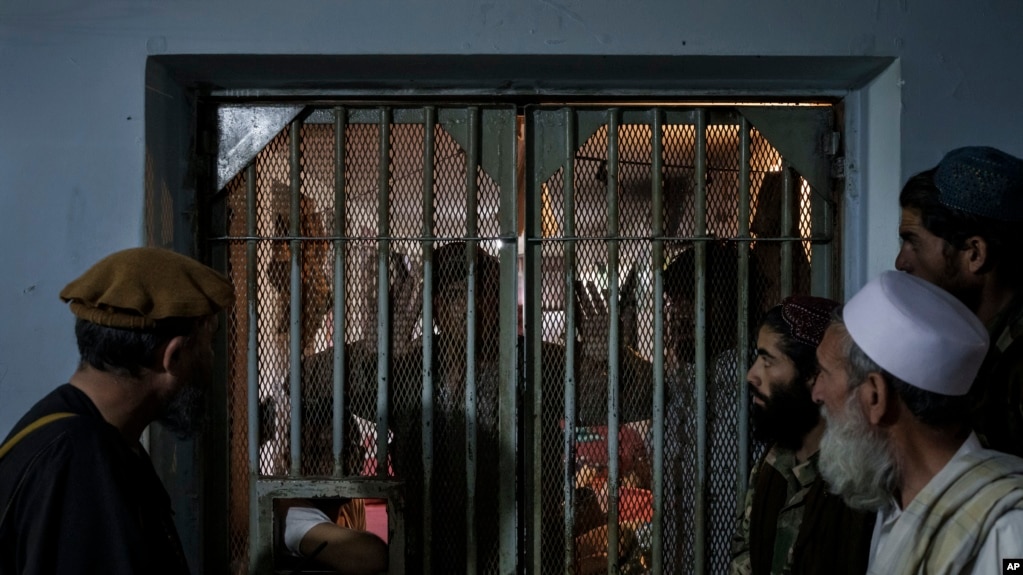
FILE – Taliban fighter talk to recently arrested prisoners in the Pul-e-Charkhi prison in Kabul, Afghanistan, Sept. 13, 2021.
Less than two years after releasing all prisoners held by the previous Afghan government, including suspected terrorists, the Taliban are rapidly refilling prisons with new inmates.
Over the past 18 months, de facto Taliban authorities detained more than 29,000 individuals on various charges such as theft, kidnapping, murder and moral crimes according to country’s top prison official.
“We have released some 15,000 inmates,” Mohammad Yusuf Mistari, the Taliban’s director of prisons, told VOA in WhatsApp messages. “Currently, there are approximately 14,000 inmates in the Islamic Emirate’s jails.”
Among the prisoners, up to 1,100 are women.
Taliban officials claim they have no political prisoners and that all the prisoners are held on criminal charges — a claim not confirmed by independent organizations.
But groups like Human Rights watch say the Taliban have opted for killing criminals associated with armed opposition groups — Islamic State and other Afghan militias that have increasingly posed serious security threats to the fledging Islamist regime —instead of keeping them in jails.
Under the Islamic Emirate’s strict interpretation of Sharia, acts such as drinking alcohol or extramarital relationships are considered criminal and carry severe penalties, while homosexuality and sodomy are punishable by death.
Since November, the Taliban have restarted public displays of punishment. Thieves have had their hands chopped off, adulterers have been flogged, and those found guilty of murder have been shot and killed in front of hundreds of male spectators.
More than 100 men and women have been publicly whipped, and at least two men have been executed so far, according to the U.N. Assistance Mission in Afghanistan (UNAMA), which monitors human rights in the country.
“Such barbaric punishments — often carried out against persons for activities that should not even be considered crimes, such as listening to music — constitute torture or cruel, inhuman or degrading treatment, and are prohibited under international law,” Patricia Gossman, associate Asia director at Human Rights Watch, told VOA.
Redoing torture
Various forms of torture have been widely practiced at formal and informal detention centers and jails in Afghanistan, according to UNAMA and various rights groups.
Hundreds of Taliban fighters reportedly died in extremely brutal detention conditions in late 2001 and early 2002 during U.S.-led military campaigns that toppled the Taliban with the help of local Afghan militias, according to reports by the New York Times and Physicians for Human Rights.
Torture of detainees was also prevalent under the former Afghan government, which incarcerated more than 30,000 individuals, a large number of whom were alleged Taliban insurgents, according to U.N. reports dating back to at least 2011.
Last year, the Taliban produced a film documenting the bitter experiences of some prisoners held at the Parwan Detention Facility beside Bagram Air Base, which the U.S. military operated until 2012 when it was transferred to the Afghan government.
“The Taliban seem to be repeating all the mistakes and abuses of the past, including those they complained that the Republic [former Afghan government] had been responsible for, like torture,” Gossman said.
Mistari, the Taliban’s top official for prisons, refuted the torture allegations.
“Our leaders have given us a 39-articles guidance in which it’s said that we should treat inmates nicely,” he said, adding that the guidance also states if a guard or a jail official is seen taunting prisoners, he should be transferred elsewhere.
“We have nothing to do with their crimes. We are only there to protect the prisoners, feed them and keep them,” Mistari added.
Food, cold
Maintaining the prisons and feeding the large inmate population has long been a challenge in Afghanistan.
The previous Afghan government received financial and technical support from international donors to manage its prisons and detention facilities.
Facing strict international sanctions, the Taliban appears to be unable to run the jails, feed and care for the large inmate population.
Even outside the Taliban jails, an overwhelming majority of Afghans face hunger.
Millions of Afghans Facing Catastrophic Hunger
Throughout 2022, the International Committee of the Red Cross (ICRC) provided three meals daily for some 12,000 inmates in Afghanistan.
“The ICRC continues to work with Afghan authorities to ensure humane and dignified conditions of detention across Afghanistan,” Lucien Christen, an ICRC spokesperson, told VOA.
Moreover, the humanitarian organization has donated blankets, shawls, jackets and socks to keep 20,000 prisoners warm during the frigid winter temperatures.
Cold weather has killed more than 120 Afghans over the past two weeks, Taliban authorities have confirmed.
Both UNAMA and ICRC have access to prisons in Afghanistan for monitoring purposes.
“De facto authorities do appear to be seeking to fulfil their obligations in relation to the treatment of detainees,” UNAMA reported in July 2022. “Progress is hindered by financial constraints, resulting at times in inadequate food, medical care and hygiene supplies for detainees, and the cessation of vocational education and training programs for prisoners that were previously funded by the international community.”
Some senior Taliban leaders, including current ministers and governors, have a history of incarceration inside and outside Afghanistan, including at the Guantanamo Bay Detention Camp, a U.S. military prison set up in 2002 where only one Afghan inmate remains.
Griffiths said if the Islamic Emirate does not reconsider its decision on women’s employment and education, it will be “catastrophic.”
Speaking at a joint press conference, the UN Under-Secretary-General for Humanitarian Affairs, Martin Griffiths, CARE International Secretary-General Sofía Sprechmann Sineiro, and officials of the United Nations Children’s Fund (UNICEF) emphasized the need to remove the restrictions imposed on women’s education and work.
Griffiths said if the Islamic Emirate does not reconsider its decision on women’s employment and education, it will be “catastrophic.”
The United Nations’ humanitarian operations in Afghanistan, in Griffiths’ opinion, were dealt a devastating blow by the ban on women working.
“It is a potential deathblow to many very important humanitarian programs and what we have described as one of the most difficult and priority areas for humanitarian assistance protections. If we don’t get those exceptions and if they are not reinforced… locally, then those activities won’t happen and this would be catastrophic,” Martin Griffiths said.
“Tying the hands of NGOs by barring women from giving lifesaving support to other women will cost lives. We are insisting on the repeal of the edict,” Sofía Sprechmann Sineiro said.
More than a million girls who should have been attending secondary schools have been denied an education for the past three years, said Omar Abdi, the deputy executive director for the program at UNICEF.
“The numbers are alarming, more than one million girls who should have been in secondary schools have lost out on learning for three years now, first due to Covid, and then in September 2021 due to the ban on attending secondary school,” Abdi said.
According to the United Nations, 28 million Afghans are in need of humanitarian assistance, and the restriction on women working has hampered relief operations.
UN, CARE Officials Express Concerns About Afghanistan at Press Conference
However, the Islamic Emirate considers the current government’s engagement with the international community a crucial step and a means of success.
Mohammad Sadiq, Pakistan’s special envoy for Afghanistan, said that Islamabad supports the continuous engagement with the current Afghan government, during a meeting with Thomas West, the US special representative for Afghanistan.
The Pakistani official tweeted that he spoke with the US special representative for Afghanistan on recent developments in Afghanistan.
“I underlined Pakistan’s support to continued engagement with Afghan Interim Government and humanitarian support to the people of Afghanistan,” Mohammad Sadiq said in a tweet.
“Discussions have been had over the recent developments, and the engagement with the current government in Afghanistan has also been stressed,” said Tahir Khan Andar, a Pakistani journalist.
However, the Islamic Emirate considers the current government’s engagement with the international community a crucial step and a means of success.
“I consider the interaction with the Islamic Emirate as a good and positive move. Governments who place emphasis on this have come to understand that cooperation is the only way to win, make progress and build trust,” said Zabiullah Mujahid, spokesman for the Islamic Emirate.
Some political analysts think that in order to solve the issues, the US special representative for Afghanistan should speak with the Afghans.
“The best way for Thomas West would be for him to speak directly with Afghans, the Afghan Islamic system, and the Islamic Emirate,” said Hatif Mukhtar, a political analyst.
“I don’t think that a new change will come and be really helpful for Afghanistan or create changes in the region,” said Sayed Bilal Ahmad Fatemi, another political analyst.
Thomas West, the US’s special representative for Afghanistan, is expected to travel to Germany and Switzerland after Pakistan in order to talk with US allies on shared interests.
Envoys West, Sadiq Meet on Afghanistan in Islamabad
By Richard Fontaine, the chief executive officer of the Center for a New American Security, and Lisa Curtis, the director of the Indo-Pacific Security Program at the Center for a New American Security.
Foreign Policy magazine
January 31, 2023, 9:33 AM
The Taliban’s rule isn’t inevitable or forever.
Eighteen months after the fall of Kabul, the situation in Afghanistan is moving from bad to worse. In addition to banning girls from secondary schools, the Taliban recently closed universities to women. Taliban officials also stopped women from working with nongovernmental organizations that distribute humanitarian aid in December, prompting international charities to suspend their work. The United Nations now reports that 6 million Afghans stand on the brink of starvation.
The United States has rightly continued to provide help to Afghanistan despite the Taliban conquest and stands today as the single largest donor of humanitarian assistance in the world. While such aid remains critical, Washington should not simply accept the Taliban’s coercive rule as an indefinite if unfortunate reality. By engaging with the political opposition, the United States can take steps toward a better Afghan future.
Traveling recently in Tajikistan and Turkey, we met with former Afghan officials, members of the diaspora, refugees, and others who look in anguish at Afghanistan’s plight. Kabul’s ambassador in Dushanbe, appointed by the previous government, holds meetings in the cold: The embassy’s budget for central heating has run out. Opposition figures in Turkey attempt to harmonize their political approaches but face constraints on their speech and activities imposed by the Turkish government. Each one laments the fall of Kabul and all urge the international community to not simply give up on Afghanistan.
The challenges go beyond the Taliban crushing the rights of women and girls. The new regime is overhauling the educational curriculum, ensuring that millions of boys will be subject to its hardline Islamist views. U.N. officials report that the Taliban has “precipitated the collapse of the rule of law.” Two-thirds of the entire population is expected to remain dependent on foreign aid this year. ISIS is active and deadly in Afghanistan, and the Taliban remains linked to al Qaeda.
The international community’s ability to alter these realities is now highly circumscribed. But it is not zero, and the United States should lead the effort to wrest from today’s perils a better tomorrow.
For all its inflexibility, elements of the Taliban seek internal legitimacy, including basic governance and services, not least to forestall an eventual uprising against their rule. They crave a measure of international legitimacy as well, including the ability to travel, acquire diplomatic status, and tap frozen assets and foreign assistance. They frequently visit the Gulf states and have sent representatives to diplomatic missions in Turkey, Russia, China, and Pakistan. Last summer, Taliban spokesperson Zabiullah Mujahid blamed Washington for blocking the regime from receiving wider international recognition. This provides a modicum of leverage.
Washington should seek to build on that leverage by engaging not only the Taliban itself but also the burgeoning political opposition now largely resident outside Afghanistan. It should reopen the embassy in Washington and allow the previous ambassador (or her representative) to return to it. Many, perhaps more than 60, Afghan diplomatic missions across the world remain open and staffed by members of the previous government. No country has recognized the Taliban as Afghanistan’s government, and in November the U.N. General Assembly criticized the its record on human rights, sending a message that member states will not recognize the Taliban under current circumstances. Such moves provide implicit support for engaging with non-Taliban political actors.
The enduring disunity among the opposition groups presents challenges to this approach. Divided over ethnic identity, power politics, corruption allegations, and prior service in the government of Ashraf Ghani, there are today three main opposition groups: the National Resistance Front, based in Tajikistan, led by Ahmad Masood, the “Ankara Group,” based in Turkey, comprised mostly of former warlords, and a group calling itself the National Movement for Peace and Justice, led by former members of the Ghani government. They are united by opposition to the Taliban and concern for Afghanistan but not a great deal else.
The United States should support a political office for the Afghan opposition in a third country, as the Taliban had in Doha for years, one that could serve as the focal point for the groups to unify, organize their political activities, and harmonize their engagement with the Taliban and the international community. While several members of the political opposition already engage individually with Taliban leaders, a formal office would give more weight to those discussions and encourage a more broad-based, Afghan-led negotiation process.
U.S. diplomats should also increase engagement with the diaspora who seek to build a different future for Afghanistan. They should press countries, particularly the Gulf states and Turkey, to enforce the ban on international travel by Taliban officials blacklisted by the United Nations. And the Biden administration must ensure that the millions of dollars in cash shipped into Afghanistan each week for use by the U.N. Assistance Mission—lifesaving support for many Afghans—does not line Taliban pockets, as is widely suspected by many former government officials.
If the United States wishes to send a clear diplomatic message about the unacceptability of the Taliban’s policies, it should formally discard the Doha deal signed in February 2020. Many Afghans interpret it not as a peace agreement but as a withdrawal measure that guaranteed Taliban rule. Secretary of State Antony Blinken has acknowledged that the Taliban “grossly” violated the Doha deal by harboring al Qaeda leader Ayman al-Zawahiri in downtown Kabul. Voiding the agreement would signal that America’s approach to Afghanistan is no longer premised on trust in Taliban promises.
All these measures, even taken together, will neither dislodge the Taliban nor dramatically empower the political opposition. The opportunity to exert more direct leverage was lost in the chaos of America’s withdrawal. But Washington should seek even modest steps to deny the Taliban international legitimacy, strengthen Afghanistan’s political opposition, and make clear that a better future is possible.
With its Kandahar-based, hardest-line elements in the ascendancy, the Taliban today hurriedly wrings from Afghanistan the basic rights of its people and the essential functions of its society. Yet if history is any guide, this faction will not rule forever. The effort to help Afghans shape a better alternative should begin now.
Richard Fontaine is the chief executive officer of the Center for a New American Security. He worked on the National Security Council staff and at the State Department during the George W. Bush administration. Twitter: @RHFontaine
Lisa Curtis is the director of the Indo-Pacific Security Program at the Center for a New American Security and served as senior director for South and Central Asia on the National Security Council staff.
To Help Afghanistan, Engage Its Political Opposition
Radio Afghanistan – run by state broadcaster National Radio-TV Afghanistan (NRTA); also operates Kabul Radio FM 93 in the capital and 32 provincial stations
Salam Watandar – non-profit production house, has 47 partner stations
Kilid Group (TKG) – US/EU-funded public media group comprising 11 local radios
AFTF has thirty members which include former government employees, Islamic Emirate officials, representatives of civil society, and academics.
The Afghanistan Future Thought Forum (AFTF), which describes itself as a “high-level, independent, non-partisan initiative” and includes “Taliban” participants, said in a statement the group has examined the key challenges and opportunities that the people of Afghanistan face and has offered its plan to the Afghan government and the international community.
In a press release, this forum, which convened its fifth session on the situation in Afghanistan at the Hamad Bin Khalifa University’s College of Public Policy in Doha on January 23-25 ,2023, asked that the Islamic Emirate lift its restrictions on women’s employment and education.
In support of a peaceful, stable and prosperous Afghanistan, the AFTF participants stressed the importance of reaching a political settlement based on dialogue, trust and consensus building.
“The interim government must lift restrictions imposed on female education and employment,” the media release reads.
“In reality, it does not have an Islamic aspect, and from an economic point of view, sadly, it affects the country, and our young people—of whom half are women—and are denied education,” said Tariq Farhadi, a political analyst.
“This issue shows that there is tension among the Taliban,” said Wahid Faqiri, another political analyst.
However, the spokesman of the Islamic Emirate said that the problem regarding women will be solved based on Islamic Sharia.
“The Islamic Emirate of Afghanistan is taking positive steps in all possible areas in terms of Sharia and law. The challenges are temporary, efforts are ongoing to resolve them and they won’t last forever,” said Zabiullah Mujahid, spokesman of the Islamic Emirate.
The Afghanistan Future Thought Forum (AFTF) emphasized the need for the international community to continue supporting the Afghan people under the leadership of the Afghans and with full and effective supervision.
“This procedure has been created in two chapters and eleven articles for the goal of better distribution of humanitarian aid,” said Abdul Rahman Habib, the spokesman of the Ministry of Economy.
AFTF has thirty members which include former government employees, Islamic Emirate officials, representatives of civil society, and academics.
Afghanistan Future Thought Forum Calls to Lift Restrictions on Females
The United Nations says aid workers are still in a “race against time” to remove rubble and rebuild after the devastating earthquake struck eastern Afghanistan last month, killing at least 2,200 people and cutting off remote areas.
The 6.0-magnitude quake on Aug. 31 was shallow, destroying or causing extensive damage to low-rise buildings in the mountainous region. It hit late at night, and homes — mostly made of mud, wood, or rocks — collapsed instantly, becoming death traps.
Satellite data shows that about 40,500 truckloads of debris still needs to be cleared from affected areas in several provinces, the United Nations Development Program said Wednesday. Entire communities have been upended and families are sleeping in the open, it added.
The quake’s epicenter was in remote and rugged Kunar province, challenging rescue and relief efforts by the Taliban government and humanitarian groups. Authorities deployed helicopters or airdropped army commandos to evacuate survivors. Aid workers walked for hours on foot to reach isolated communities.
“This is a race against time,” said Devanand Ramiah, from the UNDP’s Crisis Bureau. “Debris removal and reconstruction operations must start safely and swiftly.”
People’s main demands were the reconstruction of houses and water supplies, according to a spokesman for a Taliban government committee tasked with helping survivors, Zia ur Rahman Speenghar.
People were getting assistance in cash, food, tents, beds, and other necessities, Speenghar said Thursday. Three new roads were under construction in the Dewagal Valley, and roads would be built to areas where there previously were none.
“Various countries and organizations have offered assistance in the construction of houses but that takes time. After the second round of assistance, work will begin on the third round, which is considering what kind of houses can be built here,” the spokesman said.
Afghanistan is facing a “perfect storm” of crises, including natural disasters like the recent earthquake, said Roza Otunbayeva, who leads the U.N. mission to the country.
 Afghanistan Peace Campaign