Media watchdog urges release of journalist detained in Kabul

Associated Press

6 Feb 2023

PARIS (AP) —

Media watchdog Reporters Without Borders along with 14 French media outlets and production companies on Monday called on Afghanistan’s Taliban rulers to release a journalist imprisoned for a month in Kabul.

In a joint statement, RSF and French media said journalist Mortaza Behboudi, with dual French and Afghan citizenship, was arrested on Jan. 7 in the Afghan capital, two days after he arrived in the country as part of a reporting assignment. They said they decided to make the case public after trying in vain for a month to obtain his release.

RSF and French media called on Taliban authorities “to end this senseless situation” and that the “respected and appreciated” journalist was said to be “accused of spying.”

According to the statement, Behboudi, 28, began his career as a photojournalist at the age of 16 in Afghanistan, where he was born. He came as a refugee to Paris at 21 because he had been threatened in his home country and later worked as a freelance journalist for numerous French media.

Behboudi was awarded the Bayeux Prize for War Correspondents last year for a series of reports about life in Afghanistan under the Taliban regime.

Media watchdog urges release of journalist detained in Kabul
read more

The deepening chill of Afghanistan’s second Taliban winter

By

The Washington Post

Washing clothes in the snow, heating homes with scavenged trash, families struggle to survive

KABUL — In a yard ankle-deep with mud and snowy slush, a woman named Farzana, 32, squatted and scrubbed clothes in a bucket last week. When she stood, her hands were stiff and red. Her daughters were out begging for bread; her sons were collecting trash to use as stove tinder. At night, in a mud-walled hut on the outskirts of the Afghan capital, the family of seven would huddle together under blankets as the heat slowly died.

“I never imagined we would be living like this,” she said with a laugh of lingering disbelief. “We had a good house once, but it was destroyed by fighting in the war. My husband had work, but now there is none. As a mother, it pains me to send my children out in this awful cold, but we have no choice.”

As 40 million Afghans struggle through a second winter since the return of Taliban rule, many are facing conditions far worse than during the first. The weather has been exceptionally harsh, with temperatures often near zero at night. More than 160 people nationwide have died of hypothermia. So have at least 200,000 goats, sheep and other livestock. In isolated northern provinces, many roads are blocked by snow and little emergency aid can be delivered.

According to the World Food Program, nearly 20 million people face acute food shortages this winter, and 6 million face “emergency-level food insecurity.” Many foreign aid projects, which distributed food and supplies last winter across the country, have been cut back or suspended because of an impasse between international donors and Taliban authorities over women’s rights, especially new Taliban edicts banning women from attending college or working for foreign charities.

Afghan relief officials say they are struggling to fill the gap. At the Ministry of Disaster Management, officials are coordinating with other local agencies to provide emergency aid in vulnerable areas, sometimes using military helicopters to drop firewood, blankets and animal fodder. While officials are better organized than last winter, they say their limited resources, exacerbated by foreign financial sanctions, can reach only a small portion of the needy.

“Ten million Afghans need emergency help this winter, but we can barely cover half of that,” said Irfanullah Sharifzoi, spokesman for the Afghan Red Crescent Society, a private charity, which had stored winter supplies in some remote provinces but is now running out. “We can’t receive cash or goods from countries that want to help us, and others are using human lives as a tool to put pressure on our government.”

Foreign aid agencies, however, were outraged by the Taliban’s recent ban on Afghan women working in their programs and have demanded that it be rescinded. The order sent hundreds of female workers home just as winter aid efforts were ramping up. Peter Kessler, a spokesman for the U.N. refugee agency in Kabul, said this could cause a “catastrophic disruption” in delivering help to millions of women and children.

But harsh weather is only one factor in the deepening chill that has settled over Afghan society. People express feelings of accumulated frustration and fatigue, of dwindling options and mounting obstacles, of slipping down yet another rung on the economic ladder.

Last winter, many Afghans still had a cushion — a few valuables to sell, a few final pension payments, a forgiving landlord or a generous relative. By now, though, many have exhausted those fallbacks and fallen into debt.

Prices of food and fuel have skyrocketed in recent months, while the foreign-funded distribution programs that provided millions of Afghans with regular nourishment last winter — rice and flour, sugar and oil — have been sharply cut back. Families that could once afford to buy a month’s worth of coal or wood to heat their homes are now buying only enough to last a few nights.

On a recent day, two women approached an outdoor sales lot that was stacked with bulging sacks of wood. After poking through the wares and haggling over the price, they eventually left, carrying two small bags of wood chips that cost $2 and would last about five nights.

One of them, a mother of six named Malala, said her husband had lost his job with a foreign agency when the Taliban took over and has not found work since. When their savings finally ran out some months back, she said, “I had to sell my wedding jewelry. It was hard to give up those memories, but I couldn’t bear my children staring at me because they were hungry.”

Two blocks away, a taxi driver named Hajji Khalil was paying a coal seller for one sack worth about $12. Until this winter, he said, he had bought 18 sacks before cold weather arrived. “I always kept the house warm for my family all winter, but now few people take taxis and I am earning very little,” he said. “We are just eating to survive.”

One recent night under a freezing drizzle, a man named Zarlialai, 40, leaned against his rusty barrow. It was time to start walking home, but he was holding on to a fading hope that someone might need something carried — and to a sense of pride that he could still feed his wife and four children, even if he had to borrow again to pay the rent.

“I had a shop near here once. I bought and sold used shoes, and business was good,” he said, sighing. “That’s all gone now, but people still remember me. Sometimes they give me a little work or money.” Fumbling in his pocket, he counted some tattered bills and smiled. “That’s enough for 11 pieces of bread, so I can go home now,” he said.

The plight of farm animals this winter has also been unprecedented, with record numbers dying from cold and lack of fodder. With the country isolated from the modern world and with foreign investment at a standstill, more Afghans are turning to traditional rural livelihoods, especially raising and selling livestock.

At an open-air market on the city’s edge, hundreds of sheep, goats and cattle huddled on a snow-covered field while buyers and sellers bickered over prices. Some of the animals were coughing and trembling from the cold. Others did not survive the trip to the market at all.

Aman Sharifi, 45, said he brought about 40 animals from Daikundi province last month after he ran out of work and money. He loaded them into open trucks and set out for Kabul, but the roads were blocked by snow and the caravan was halted for days.

“It took us almost three weeks to get here, and it was really cold,” Sharifi said. “Six of the sheep died on the road, and I had to throw them out into the snow. Some of the cows got sick, so I had to sell them cheaply before they died, too. It was hard, but we’ve been through worse. Our only choice is to keep going.”

Pamela Constable is a staff writer for The Washington Post’s foreign desk. She completed a tour as Afghanistan/Pakistan bureau chief in 2019, and has reported extensively from Latin America, South Asia and around the world since the 1980s.
The deepening chill of Afghanistan’s second Taliban winter
read more

U.N. rights rapporteur urges release of detained Afghan education activist

KABUL, Feb 3 (Reuters) – The United Nations Special Rapporteur for Human Rights called on Afghanistan’s Taliban administration on Friday to release a university lecturer and education activist detained by security forces in the capital Kabul.

Local media reported Ismael Mashal had been distributing academic and other books on Kabul’s streets after tearing up his own diploma on live television in protest at a Taliban decision in December to ban female students from universities.

The decision came after Taliban authorities closed most girls’ high schools and barred most women from working for charity groups.
“(I am) concerned about yesterday’s arrest of peaceful education activist and university lecturer Ismael Mashal by the Taliban,” U.N. rights rapporteur Richard Bennett said on Twitter, calling for his immediate and unconditional release.

Abdul Haq Hammad, head of media monitoring at the Taliban information ministry, said Mashal had been arrested by security forces after gathering journalists, creating a crowd on the street and “creating propaganda against the government”.

Hammad said he had visited Mashal in detention and found he was being held in good conditions including heating, and had been able to contact his family.

It was not immediately clear whether Mashal would face formal charges or further punishment.

The international community has condemned Taliban restrictions on women, with some diplomats saying foreign capitals will not consider formally recognising the Taliban government unless it changes course.

The Taliban seized power in August 2021 when U.S.-led international coalition forces completed their withdrawal from Afghanistan after a 20-year presence, triggering the collapse of the Western-backed government.
Reporting by Kabul Newsroom Editing by Mark Heinrich
U.N. rights rapporteur urges release of detained Afghan education activist
read more

US: Taliban Should Meet Promises Before Seeking Legitimacy 

Ayaz Gul
Voice of America
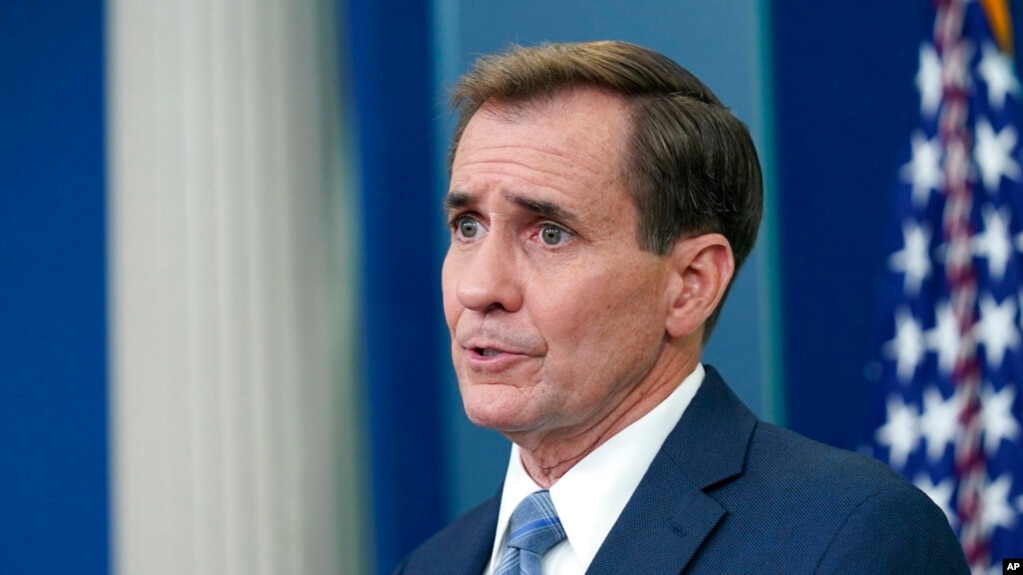
FILE - John Kirby, a National Security Council spokesman, speaks at the White House in Washington, June 23, 2022. Kirby told VOA the Taliban will continue to be isolated from the international community unless they reverse restrictions on women.
FILE – John Kirby, a National Security Council spokesman, speaks at the White House in Washington, June 23, 2022. Kirby told VOA the Taliban will continue to be isolated from the international community unless they reverse restrictions on women.

The United States Friday renewed criticism of Afghanistan’s Islamist Taliban for reneging on promises they would govern the country in a responsible way and respect the rights of all Afghans, including women.

John Kirby, the U.S. National Security Council coordinator for strategic communications, told VOA the Taliban will continue to isolate itself from the international community unless they reverse restrictions on women.

“So, if the Taliban wants to be considered legitimate, if they want the recognition of the international community, if they want financial aid and investment in their country, then they should meet their promises, meet their obligations, and behave accordingly,” Kirby stressed.

Takeover

The Taliban seized control of Afghanistan in August 2021 and have since implemented harsh restrictions that severely curtail the rights of women and girls to participate in social, economic and political life.

The hardline rulers have turned Afghanistan into the only country in the world where girls are banned from attending secondary schools and universities.

The Taliban also have banned Afghan women from working for national and international nongovernmental organizations that provide humanitarian aid to millions of people in the conflict-ravaged country. Women also have been ordered to stop using parks, gyms and public bathhouses.

The human rights concerns have deterred the global community from formally recognizing the Taliban as the legitimate rulers of Afghanistan.

The Taliban reject criticism of their polices, saying they are governing the country in line with Afghan culture and their interpretation of Islamic Sharia law — though scholars in Muslim-majority countries dispute those assertions, saying Islam gives full rights to women to work and seek education.

ISIS threat

Kirby also questioned the de facto rulers’ counterterrorism operations against Islamic State militants in Afghanistan.

“[The Taliban] are constantly under threat by ISIS in Afghanistan. … We know that ISIS remains still a viable threat, a credible threat, not just in Afghanistan, but in other parts of the world too,” Kirby said, using an acronym for the Islamic State terrorist group, which is also known as ISIL or IS.

The Afghan affiliate of the militant outfit, known as Islamic State Khorasan or ISIS-K, has routinely carried out high-profile attacks in the Afghan capital of Kabul, and elsewhere in the country in recent months, killing scores of people.

Neighboring Pakistan also increasingly alleged in recent days that fugitive leaders of the outlawed Pakistani Taliban, also called Tehrik-e-Taliban Pakistan (TTP), have increased cross-border terrorist attacks.

The latest attack occurred Monday when a suicide bombing ripped through a packed mosque in the Pakistani city of Peshawar, killing more than 100 people and wounding 225 others. The victims were mostly police officers.

Pakistani officials in Islamabad again pointed fingers at authorities in Kabul for not preventing TTP from launching cross border attacks and raising bilateral tensions. Taliban leaders reject the charges, saying they are not allowing any group to use Afghan soil for such activities.

Kirby noted Friday that the people of Pakistan remain under threat of terrorism from the Pakistani Taliban.

“There’s no question about that. And sadly, we’ve seen that borne out in recent days in a bloody, bloody way,” he said.

“We obviously will continue to stay in touch with Islamabad to see what we could do, what might be possible,” Kirby added when asked whether Washington would support Islamabad in countering the terrorist threat emanating from Afghanistan. He did not elaborate.

Detained teacher

Meanwhile, the United Nations demanded Friday that the Taliban release a university lecturer and education activist recently detained by security forces in the Afghan capital.

The detainee in question, Ismail Mashal, had reportedly been distributing academic and other books on Kabul’s streets after tearing up his own diploma on live television in protest of the Taliban’s decision to ban female students from higher education.

“It’s a very concerning development. The professor should be released immediately,” U.N. spokesman Stephane Dujarric told a daily briefing in New York. “This is just yet another sign of the backsliding, shall we say, that we are seeing in Afghanistan with the de facto authorities, especially on issues of education for women and girls.”

A senior Taliban official claimed in a statement that Mashal had been arrested by security forces for gathering a crowd of journalists and for launching “propaganda against the government.”

Abdul Haq Hammad, head of media monitoring at the Taliban information ministry, claimed that he had visited the detained lecturer and found he was being held in good conditions and had been able to contact his family.

US: Taliban Should Meet Promises Before Seeking Legitimacy 
read more

Amb. Thomas-Greenfield: We Judge Islamic Emirate on Its Actions

She further said that the US and United Nations are going to judge the Islamic Emirate on its actions.

Linda Thomas-Greenfield, US ambassador to the United Nations, said that the Islamic Emirate has not been recognized due to its policies imposed on women and girls in Afghanistan.

She further said that the US and United Nations are going to judge the Islamic Emirate on its actions.

“We are going to judge them on their actions and so for that reason, they are not recognized in the UN and we have not recognized them here …,” she said.

The Islamic Emirate has always reiterated that it has completed all the conditions required for official recognition.

The Islamic Emirate believes that it has made noticeable achievements during the past one and half years.

“We want UN officials to come  to Afghanistan and continue their interaction. They shared their concerns, we are working on them, the Islamic Emirate will endeavor to consider all concerns and problems until our islamic principles and country’s values allow us,” said Zabihullah Mujahid, spokesman for the Islamic Emirate.

Meanwhile, political experts believe that Islamic Emirate` government has not met the expectations of the international community, therefore the current goverment has not been recognized.

“Receiving legitimation would be an easy task for the Islamic Emirate when they respect the participation of people fairly in a political structure, the Islamic Emirate should respect the right of education and work for women, said Naseer Ahmad Taraki, political expert.

None of the regional or other countries has announced recognition for the Islamic Emirate, but a number of countries including Russian, Turkey, Iran, Pakistan, China and Japan have sent diplomats to Afghanistan.

Amb. Thomas-Greenfield: We Judge Islamic Emirate on Its Actions
read more

Kirby: If Kabul Wants Legitimacy, It Should Meet Its Promises

John Kirby said he considered Daesh a viable threat to the current government of Afghanistan and the world.

John Kirby, the US National Security Council coordinator for strategic communications, said that the Islamic Emirate will continue to isolate itself from the international community by reneging on their promises.

In an interview with the VOA, Kirby emphasized that if the Islamic Emirate wants to be recognized by the international community and wants financial aid and investment, it must fulfil its commitments.

“So, if the Taliban wants to be considered legitimate, if they want the recognition of the international community, if they want financial aid and investment in their country, then they should meet their promises, meet their obligations, and behave accordingly,” Kirby stressed.

Speaking to VOA, Kirby said: “They made promises in Doha, they made promises after they took over Kabul, that they would govern in a responsible way and that they would respect the progress that women and girls had made in Afghanistan, they specifically said that, and here we see them reneging on those promises.”

“The Americans are interested in working with the future government of Afghanistan on the condition that this government be impartial and not against it(America),” said Jawid Sangdil, an international relations expert.

In this interview, the US National Security Council coordinator for strategic communications said he considered Daesh a viable threat to the current government of Afghanistan and the world.

“[The Taliban] are constantly under threat by ISIS in Afghanistan. … We know that ISIS remains still a viable threat, a credible threat, not just in Afghanistan, but in other parts of the world too,” Kirby said.

The Islamic Emirate’s spokesperson, Zabiullah Mujahid, rejected these claims and said that the US had not kept its promise to the Islamic Emirate and had always worked to prevent recognition of the Afghan government.

“Unfortunately, the promises made by the US have not yet been fulfilled. The issue of the blacklists of Islamic Emirate officials have not yet been resolved, along with the normalization of relations between the US and Afghanistan, toward which we have made a final attempt in the past year and a half. Unfortunately, the US still continues to apply pressure,” Mujahid said.

Meanwhile, William Burns, the director of the Central Intelligence Agency (CIA), stated at a Georgetown University School of Foreign Service event that Daesh continues to be a threat.

“I think the successful US airstrike against Ayman al-Zawahiri, the co-founder of Al Qaeda directly responsible along with Bin Laden for the deaths of more than three thousand innocent people and 9/11 and many other acts of terrorism, was a demonstration of our continuing commitment as an agency and as a government,” Burns said.

The Islamic Emirate government has not been recognized by any country in the over a year and a half, although many of its neighbors, including Iran, Pakistan, China, and Uzbekistan, have diplomatic missions in Kabul.

Kirby: If Kabul Wants Legitimacy, It Should Meet Its Promises
read more

Afghanistan: single women and widows are struggling to find their next meal under Taliban restrictions

Professor of Gender & Development, University of East Anglia
The Conversation
February 3, 2023

Jamila*, a widow living in Herat, lost her husband in a suicide attack about eight years ago. She has an 18-year-old daughter who is blind and a 20-year-old son who lost both legs in a mine blast.

Jamila used to be a housemaid and bake bread for people in their homes. With this income she was able to feed her daughter and son, according to research carried out by Ahmad*, a former lecturer at the University of Herat and shared with me.

Since the Taliban gained control of the country, Afghanistan has been on the brink of universal hardship. As many as 97% of people are now estimated to be living in poverty, up from 72% in 2018.

The recent Taliban ban on women working in international and national organisations and women moving about public spaces has also affected women being able to find employment.

Because of the current situation Jamila has lost her clients and is now struggling to cope. She could not pay her rent and the landlord asked her to leave her home. She now lives in a small room that a kind family gave her in their yard. She has no source of income.

Previously about 10% of educated women in Afghanistan worked in national or international organisations to support their children. If less educated, they had a range of formal and informal jobs including working as housemaids, baking bread, washing clothes, cleaning bathrooms and babysitting, and in rural communities rearing small livestock and growing wheat, maize and vegetables.

Jamila said that previously under the former government her family received a monthly salary from the state ministry of martyrs and disabled affairs, which pays families of military veterans or those killed in the fighting, and that gave them enough money for bread.

The new government (the Taliban) has now stopped this salary … they don’t believe our lost ones are martyrs.

My son also had a job with the municipality office in a city parking lot, taking care of vehicles and collecting money from people parking their vehicles there. There were many handicapped people doing this kind of job. But now all of them, including my son, have lost their jobs.

The Taliban has appointed their own personnel in these parking areas. We have very few options left. A neighbour now drops my son near a bridge in the city where he begs people to help him with coins. He brings him back here in the evening. With the coins he brings, we can get only bread to survive until the next day.

Jamila is not an exception. She is one of thousands of women who have lost their jobs as a result of the new decrees. Many are acutely malnourished and don’t know where their next meal is coming from.

Single women and widows have practically no way of earning money. On-the-ground reports reveal that many households are supported by women as male members of their family were either killed or injured in the ongoing conflict.

It is not just food, but also shelter, water, fuel and warmth that contribute to survival, especially in bitterly cold temperatures. Ahmad, the former lecturer in Afghanistan, said:

Since COVID-19, my wife and I have tried to raise funds from friends to help poor families (especially widows). Very cold weather has been forecast for the western zone of Afghanistan in February.

There has been snow and the temperature has dipped to -25℃ at night early in 2023. One of my friends, who is in the US, helped us with some money locally to buy charcoal to help poor widows like Jamila cook food and warm up their rooms. My wife is also very frustrated and helpless in the current situation.

But, the plight of women-headed households, lacking adult males, is especially dire. In the absence of any social connection, they are increasingly food insecure, with few options to feed and care for their children.

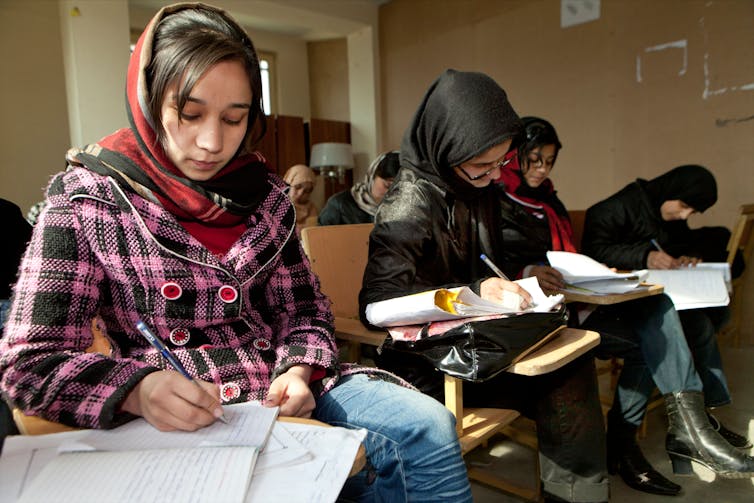
Girls writing down work in notebooks.
The Taliban have stopped girls going to school in Afghanistan. ton koene/Alamy

This follows Taliban decrees banning women from education at the secondary and university level and not allowing them to travel without a mahram (male close relative as chaperone). The Taliban also ordered the closure of all beauty salons, public bathrooms, and sports centres for women, important sectors of employment for women.

Overall, the dire situation in Afghanistan has increased the incidence of extreme hunger and malnutrition for both men and women, but women without husbands are being pushed into even more extreme poverty.

According to UN resident and humanitarian coordinator Ramiz Alakbarov, “a staggering 95% of Afghans are not getting enough to eat, with that number rising to almost 100% in female-headed households”.

The January 2023 high-level UN delegation led by Deputy Secretary-General Amina Mohammed called on the Taliban authorities to reverse the various decrees limiting women’s and girl’s rights for the sake of peace and sustainable development. While the backlash against women’s rights needs to be urgently addressed, the crisis of food and nutrition security facing single women, widows and separated women, is not being recognised by many outside the country.

According to the 2015 Demographic Health Survey, only 1.7% of Afghan households were headed by women. The January 2022 report from the UN World Food Programme places this at 4%.

As a former employee of the Afghanistan Central Statistical Organisation, responsible for population data collection in four districts of Bamiyan province, told us: “It is very difficult to collect accurate population data.” She said that previous data concerning women-headed households was now likely to be invalid.

While women’s rights are under attack in Afghanistan, the full effect of the ban on women’s work and mobility on single women, widows and separated women, is yet to be fully recognised. While appeals for help to the United Nations by teachers, professionals and civil society activists are rising by the day, negotiations are not progressing, and the delivery of humanitarian assistance is becoming increasingly challenging.

It’s difficult to estimate how long local communities, themselves struggling to survive, can keep women-led households and their families alive.

**All names in this article have been changed for security reasons

Afghanistan: single women and widows are struggling to find their next meal under Taliban restrictions
read more

Talking with the Taliban: a necessary exercise in frustration

By Edward Girardet

Global Geneva

UN Humanitarian Chief Martin Griffiths meets with Taliban leaders in Afghanistan. (Photo: UN)

UPDATE: At a UN press conference in New York on Monday 30 January 2023, UN Emergency Relief Coordinator Martin Griffiths stated that they were hopeful the Taliban would rescind at least some of their constraints, but could not say when or to what extent. “Our job is to identify the opportunities (of persuasion by the international community, local populations and within the Taliban themselves) and to advocate constantly for a fair and just Afghanistan,” he said.

While United Nations humanitarian chief Martin Griffiths appears to have made headway in convincing the Taliban to loosen some of their recently imposed constraints against women, it still looks as if everyone is shooting themselves in the foot when it comes to dealing with Afghanistan. The country’s hard-line rulers, whose dogmatism is not necessarily shared by all the movement’s factions, see no reason why they should buckle as they were the ones to have won the war. The international donors cannot be perceived as engaging with any hint of official recognition, while Pakistan, Iran and other regional players are not stepping up to mediate. For the UN, International Red Cross and 100-odd non-governmental organizations still operating out of Kabul, they must figure out how to help Afghans survive. As pointed out by knowledgeable sources, the only pragmatic option is to focus – to cite Winston Churchill – on long-term and discreet ‘jaw-jaw’ on multiple fronts if Afghanistan is to emerge from its dire humanitarian and economic imbroglio, including the possibility of renewed ‘war-war’.

“It’s a brutal situation because none of the key players are willing to back down,” said the representative of an international organization with several decades’ experience in Afghanistan and the region. “You cannot go in and tell the Taliban what to do. They’ll only hunker down even more because they don’t care what outsiders think. And the Americans and Europeans only want to talk about girls’ education and women’s rights, so that’s not going anywhere. The Taliban hardliners did not fight all these years to re-impose an equitable society. That’s the sad reality, but once this is recognized then perhaps the international community can start moving forward.”

As both he and other experienced observers point out, there is no single approach that will convince the Talib leadership to change its policies. The international community may be looking at months, possibly years, to achieve even limited reforms with different initiatives by respected groups and individuals ranging from international NGOs, such as the Norwegian Refugee Council and the Swedish Committee for Afghanistan, to the UN itself.

At one point, too, countries perceived as neutral such as Switzerland, Norway, Finland and Iceland might emerge as possible long-term mediators. When asked to comment, the Swiss Foreign Ministry maintained that while it remains in touch with key actors in Afghanistan and across the diaspora, and is fully prepared to offer its good offices, “any mediation requires a mandate and the consent of the parties to the conflict.” Switzerland has mediated in the past and played a crucial role in talking to all warring groups during the 1979-1989 Soviet occupation of Afghanistan. There is also pressure that ‘International Geneva’ embrace a more engaged mediation rather than messenger role. (See SwissInfor article)

The Swiss government helped bring representatives of the mujahideen, or holy warriors, to Geneva for talks during the late 1980s to promote peace negotiations with the Soviets. For its part, the U.S. Central Intelligence Agency had begun supporting Afghan rebels in July 1979 to fight the communist regime in Kabul. It drastially increased its military and funding backing when the Red Army invaded a few months later. (Photo: Wikipedia)

How to get the mediation process moving

“But it may take a respectedfigure – whoever that be, Afghan or otherwise – to initially open the door,” noted Michael Keating, executive director of the European Institute of Peace (EIP) in Brussels who first became engaged with Afghanistan during the UN’s Operation Salaam in the late 1980s leading to the Soviet Red Army withdrawal. “This will mean someone highly knowledgeable regularly visiting or even based in Kabul who is respected by the Taliban. We’re talking about a lot of tea-drinking and patience.”

“You can talk an Afghan into going to hell, but you can’t talk him into going to heaven.” (Afghan proverb)

Some believe that former president Hamid Karzai, a Pushtun from Kandahar, or Abudullah Abdullah, a Tajik-Pushtun from the Panjshir and former Chief Executive during the NATO occupation, could emerge as possible candidates. Others disagree arguing that neither command sufficient credibility or trust. While the last western-backed Afghan president, Ashraf Ghani, has proposed himself as a contender, he is widely regarded as corrupt and arrogant with little or no leverage left. As a result, finding a reputable Afghan with standing remains a critical challenge. As one analyst put it quoting an old Afghan saying: “You can talk an Afghan into going to hell, but you can’t talk him into going to heaven.”

British businessman and former journalist Peter Jouvenal (left) meeting with Taliban to discuss possible private sector investment prior to his arrest in Kabul in autumn, 2021. Despite being on good terms with various Taliban leaders, Jouvenal may have been the victim of factionalism within the Taliban and the principal reason behind his six-month detention. Despite his ordeal, Jouvenal believes that constant dialogue may prove the only way for the international community and the Talib leadership to come to terms with each other. (Photo: Peter Jouvenal family)

Some, too, including within the international aid and conflict resolution community, believe that the private sector could play a significant role. Peter Jouvenal, a British businessman and former journalist engaged with Afghanistan since 1980, who was arrested and held last year for six months by the Taliban, sees it as capable of nudging the current regime toward greater openness. “If the Taliban are able to see that more open investment is one of the only ways of helping the country back to recovery, then they may agree to re-establishing certain rights,” he said. “But they will only do it on their own terms, not if they’re pressured.” (See Global Insights article)

As for China, India, Turkey and Qatar, they are all exploring investment possibilities, notably mineral resources with an estimated worth of up to three trillion dollars yet remain hesitant as long as the Taliban go against the international flow. “The Chinese are not particularly looking to help resolve the Taliban’s political problems but are quite happy to engage with economic initiatives that can be exploited regardless,” said one international aid source in Kabul referring to Beijing’s efforts to develop the Mes Aynak copper mine, one of the world’s largest with up to 12 million tons of reserves. “We’re looking at significant potential investment initiatives, but these may drag out for years.”

Russia is reportedly seeking to purchase sophisiticated military hardware and ammunition abandoned by NATO forces in the summer of 2021 for its war in Ukraine. (Photo: TASS)

Russia, which previously supported the anti-Taliban resistance leading up to the US-led invasion in October 2001, is believed to be negotiating with the cash-hungry Taliban for the purchase of sophisticated military equipment for deployment in its war in Ukraine. Abandoned by NATO forces during their calamitous withdrawal from Afghanistan in August 2021, much of it, including ammunition, is lying in guarded but often exposed storage locations.

Many majority Muslim countries, such as Indonesia and Malaysia, which had diplomatic relations with Afghanistan in the past, disagree with the Taliban’s backtracking on women’s education and their right to work. As pointed out by one Dubai-based international lawyer, “some openly consider such constraints as un-Islamic and have made this point to the Taliban.” To date, no country recognizes the Taliban regime. and hence there is insufficient lobbying to generate the official representation at the UN that the de facto regime in Kabul seeks. Various Afghan diplomatic missions such as Geneva and Washington are still represented by pre-regime ambassadors, several of whom see themselves as possible players toward bringing about rapprochement, although it is unlikely that the Talib hardliners will cooperate with them.

Afghanistan is running out of time

For Keating, the main objective now is restoring economic activity. “Humanitarian aid is essential but not the answer. And western development aid is politically impossible,” he adds. “A complete collapse in trade, investment, jobs will deepen the humanitarian crisis, will not resolve the human rights situation and will make women and children even more vulnerable. Rebooting the banking system and investments to create jobs is fraught with complexity but may increase the chances of the kind of change the international community is seeking.”

According to UN estimates, a staggering 97 per cent of Afghans are now living in poverty, while two-thirds require basic humanitarian aid to survive. Out of a population of 40 million people, half face acute hunger. So Afghanistan, which now represents the world’s largest humanitarian operation with 28 million receiving aid, is running out of time.

As Martin Griffiths, head of the UN’s humanitarian operation (OCHA), maintains: “Without women working, we can’t deliver for the people who are in fact the primary objects of humanitarian assistance – women and girls. So it’s a practical matter. It’s beyond rights.” With many years’ experience dealing with the Taliban, Griffiths, who has just completed a dialogue foray to Afghanistan as part of an Inter-Agency Standing Committee (IASC) team, expressed hope that the leadership would be willing to rescind their recent ban on women working with international aid organizations. (For the moment, this does not affect Afghan women employed by the UN).

The Afghan Red Crescent Society providing humanitarian relief in Afghanistan. (Photo: IFRC)

“I think they’re listening,” Griffiths told the BBC of the Talib ministers he had met. “They told me they will be issuing new guidelines in due course which I hope will help us reinforce the role of women.”At the same time, Griffiths is fully cognizant that any long-term reforms may take a lot of subtle, under-the-radar negotiation to convince the Taliban.

Yet even this may not prove easy. As the Taliban’s head of Disaster Management, Mohammad Abbas Akhund, a cleric, told the BBC: “Men are already working with us in the rescue efforts and there is no need for women…” He strongly condemned the UN and other aid agencies for not respecting “our religious beliefs,” an allegation denied by Griffiths who said that such beliefs are always respected wherever the UN operates. Akhund further maintained that even if the UN halted its distribution of food to Afghanistan this would not change his government’s position.

For the moment, much of the work undertaken by UNAMA in Kabul is in the form of its own subtle diplomacy. “Maybe 95 percent of what we do is based on quiet discussions with the Taliban, ordinary Afghans and the different NGOs,” said one UNAMA representative. “This is the only way to know what really is going on.”

UN Deputy Secretary-General, British-Nigerian Amina Mohammed. (Photo: UN)

Nevertheless, UNAMA regularly helps organize official UN visits, such as the high profile four-day visit by a delegation in mid-January 2023 headed by UN Deputy Secretary-General Amina Mohammed, a British-Nigerian Muslim, to “appraise the situation, engage de facto authorities and underscore UN solidarity with the Afghan people.”

While the largely female delegation, including the director of UN Women, an agency focusing on women’s issues, met with select Talib leaders in Kabul, Kandahar, and Herat, it was not received by any key figures. The most notable, Haibatullah Akhundzada, the fundamentalist Pushtun Islamic scholar, cleric and jurist considered to be the supreme leader of the Taliban refused to meet with them. But then, as one international source in Kabul pointed out, “this is not surprising as he does not even meet with some of his own ministers.”

While the UN delegation sought to reach out to Afghan women but also NGOs and other organizations to emphasize the international community’s committment to female rights, it was criticized for playing to the gallery without contributing toward any real change other than to aggravate the hardliners. While Griffiths’ trip was perceived by some as a “to do” intiative by someone with significant background to Afghanistan, Mohammed’s was referred to as one more “for show”.

A similar largely women’s visit conducted during the first Talib rule in 1997 produced equally limited results. When a delegation headed by the European Union’s Emma Bonino together with CNN’s Christiane Amanpour sought to highlight the plight of Afghan women by filming in a Kabul hospital, their highly mediatic presence only managed to anger the new Jihadist leadership who ordered the temporary arrest of all 18-members of the group.

As a businesswoman, Hassina (middle) has also been active with her support for women and children, including widows. (Photo: Hassina Syed archive)

“Perhaps I shouldn’t say this as a woman, but many Afghans were shocked by the way she (Amina Mohammed) went about her visit,” said Hassina Syed, an Afghan businesswoman, philanthropist and politician. Syed, who was evacuated from Kabul in August 2001 to the United Kingdom, remains in close contact with Afghanistan, including the Taliban. “We are all deeply concerned by what is happening and we want to help, but you need to be serious about connecting with the Taliban.” (See Global Insights article)

Syed further stressed that if one is to make headway in bringing about genuine change, then one needs to operate with the right background experience based on a close knowledge of the country. “You need to work with quiet diplomacy and be in Afghanistan fulltime. That’s the way Afghans are. It takes a long time to build trust. You can’t just go in there and talk about women’s rights. They’re not going to listen to you.”

Another concern voiced by Afghans and international aid representatives is that some international donors would like nothing better than to disengage from Afghanistan. This is primarily for budgetary reasons but also because of other more immediate distractions such as Ukraine. As some donors have already noted, the international community fought a pointless war and spent billions of dollars trying to support Afghanistan’s long-term recovery to no avail, except, as some maintain, its ability – largely the result of efforts by UNICEF – to send millions of girls to school and to university. (See Global Insights article)

So why continue? The fact that much of the responsibility for this horrendous failure must lie with the West’s managerial incompetence, lack of vision and often blatant corruption is becoming increasingly forgotten. “These governments simply want out,” said an aid representative. Or, as one former US diplomat seeking to justify the Trump-Biden fiasco put it: “Contact us in a hundred years if you’re serious about change. Then we’ll help you.”

The Taliban: A Revolutionary Franchise

French helicopters overflying Kabul during the 2001-2021 NATO occupation of Afghanistan. The US-led Coalition forces fought the Taliban for nearly two decades from October 2001 to the summer of 2021. (Photo: Edward Girardet)

Another problem is that there is no one Taliban. It is a movement – a “revolutionary franchise” as one UN representative aptly put it – consisting of different factions, commanders, and leaders. While perhaps a majority of Taliban in leadership positions in different parts of the country may disagree with the hard-line approach imposed by Kandahar, which is rapidly becoming the real capital of Afghanistan, they are too afraid to step out of line. Rifts are steadily emerging among Talib ranks, including in the Kabul government, to the point of violent altercations and even fistfights.

As various aid workers have pointed out based on their contacts with the regime, many Taliban have nothing against women working or girls going to school. “But you’re dealing with an extremely narrow-minded and traditionalist vision at the top seeking to impose its own version of what the ‘new’ Afghanistan should look like,” said one aid source.

In many ways, Afghanistan is witnessing a replay of when the Taliban first took power in Kabul in September 1996, eventually controlling nearly 90 per cent of the country prior to the US-led invasion of October 2001. The Ministry of Vice and Virtue regularly announced new ‘Tali-bans’ such as the prohibition of girls to attend high schools, the playing of music, the taking of photographs, the wearing of high heels that “make noise in the streets”, or even the flying of kites. And yet, many Taliban did not fall in line with what the leadership of the new Islamic Emirate declared. Travelling in Afghanistan at the time, the further away one got beyond Kabul the more young Talib fighters wanted their pictures taken. Or they listened to Iranian and Bollywood pop songs on tape cassettes.

As part of an initiative which may now be revived, a Swiss-based NGO, Media Action International (MAI), collaborating with the BBC created Radio Education for Afghan Children (REACH) in 1998 to support the clandestine home schooling of girls throughout the country. Talib commanders regularly – and surreptitiously – stopped by REACH’s office in Peshawar to pick up freely distributed course books for their children and communities. “A lot of the Taliban wanted their girls to be educated,” said a former MAI programme director.

It is no different today. Numerous Taliban have made it very clear that they want their girls to be educated, including at university level. According to UNICEF an estimated 200,000 girls are currently attending high schools in 12 out of 34 provinces, largely because of local pressure. As these Taliban stress, only female doctors, teachers, and community workers should interact with their women, not males. So this means ensuring that enough qualified women are trained. Many, too, want their wives to work. They desperately need the revenue. According to sources, both families and communities, many of whom have no jobs or means of survival, are increasingly pushing their leaders to resolve the current crisis in Afghanistan.

“The Taliban are going to have to do something about this. They can’t continue as before, and they know it. The Pushtun Kandahari leadership may be bloody-minded, but one needs to give them a way of getting out of this doldrum without losing face,” maintained an international source in Kabul.

One is also seeing a somewhat different Taliban in the manner with which the franchise is organized. The Taliban today are far more multi-ethnic, including minorities such as Tajiks, Uzbeks and even Shia Hazaras. There is also far less interference from outsiders such as the Arab Jihadists, Pakistanis and other Islamic interests which dominated the first Talib rule of the late 1990s. Pakistan, which played a double game through its powerful military InterServices Intelligence Service (ISI) backing the Taliban right up to the NATO withdrawal, has far less influence today. Several incidents along the Afghan-Pakistan border also recently broke out in which a number of soldiers on both sides were reportedly killed and wounded. The Taliban are also at odds with ISIS, Al Qaeda and other Jihadist elements.

Nevertheless, as some observers point out, an emerging reality is that the Kandahar leadership may seek to impose even more Pushtun dominance over the country. Traditionally, Afghanistan has always been run by tribal Pushtuns, who have tended to encounter trouble whenever they sought to push their own interests over others, including rival tribal Pushtuns. In the long run, such control is unlikely to be accepted by Tajik, Uzbek and other ethnic groups currently collaborating with the Taliban, particularly if the humanitarian and economic situation deteriorates further.

Talib commander Azizullah Asif and eight of his fighters in Baghlan Province who reportedly joined the National Resistance Front in the summer of 2022 citing “oppression, cruelty and crimes” within the Taliban as the reasons behind their defection. (Photo: NLFA)

Insurgent groups, such as the National Resistance Front of Afghanistan (NRFA) headed by Ahmad Massoud, the son of assassinated guerrilla leader Ahmed Shah Massoud, have been attacking regime positions on a steady basis since last spring, 2022. So have various armed Hazara and other groups. They expect to increase their insurgency as soon as the snows melt. While resistance leaders met with US officials in December 2022 to discuss options, Washington, which backed the anti-Soviet mujahideen with weapons, training and funding during the 1980s, is cautious about whether it will again support armed revolt.

Another possibility is that the Taliban themselves could start imploding, particularly if former collaborators representing ethnic minorities in cities like Mazar-e-Sharif, Herat and Kunduz react to further imposition of hard-line Pushtun doctrine by Kandahar. For the moment, however, the emphasis is on peaceful resolution, possibly in the form of an internationally overseen Loya Jirgha, a traditional form of “grand gathering” bringing together all parties and ethnic groups possibly leading to a Swiss-style Federation of semi-independent regions. This system was proposed – and rejected – at the December 2001 Bonn talks by the leading donors in favour of top-down government from Kabul, a decision which may have cost Afghanistan long-term peace and the return of the Taliban.

Talking with the Taliban: a necessary exercise in frustration
read more

New Lives in the City: How Taleban have experienced life in Kabul

A large number of Taleban fighters have moved to Afghanistan’s cities since the movement’s capture of power, many of them seeing life in the city for the first time in their lifetime. These fighters, many of whom are from villages, had lived modest lives, entirely focused on the war. Their circumstances have changed entirely since the Taleban’s victory. Guest author Sabawoon Samim has interviewed five members of the Taleban who have come to live in Kabul, a city they had seen as being at the heart of the ‘foreign occupation’ with its ‘puppet government’ and a population degraded by Western ways. How have they found the actual Kabul and its people, and what do they think about having to earn a living for the first time, keep office hours and live in a city full of traffic and millions of other inhabitants?
In the aftermath of seizing power in Afghanistan in August 2021, a huge number of Taleban foot soldiers rushed to the country’s capital, Kabul. For many, born into rural families and with their adult lives spent primarily on the battlefield, it was the first time they had come to the capital. They had not even been born or were still children when the Taleban’s first emirate fell. Even their seniors, who had experienced life in a major city like Kabul, would find the Afghan capital of 2021 a very different place to when the Taleban had last ruled there – the ruins left by the civil war had long ago been re-built, the city itself had become vastly bigger and the population increased manifold. Some of those newcomers to Kabul have settled in the city and we wanted to find out how they had experienced this sudden shift and what they thought of Kabul – and Kabulis.

To this end, the author conducted in-depth conversations with five members of the movement about their new, post-takeover life. They ranged in age from 24 to 32 and had spent between six and 11 years in the Taleban, at different ranks: a Taleban commander, a sniper, a deputy commander and two fighters. They were, respectively, from Paktika, Paktia, Wardak, Logar and Kandahar provinces.

All the interviewees had spent their formative years within the Taleban, typically joining as teenagers. Following the fall of the Islamic Republic, they had secured jobs in the new government. Two were appointed to civilian roles, the other three to security jobs, one in the Ministry of Interior and two in the armed forces. All are now living in Kabul, without their families, and only return to their home provinces during vacations. Four out of the five interviews were conducted in October 2022 and the last in November, all face-to-face in Kabul. The interviews have been lightly edited for clarity and flow.

The interviewees refer to ‘the fatha’, pronounced fat-ha. This is the Arabic word for conquest or victory, used for when new lands are ‘opened up’ to Muslim victors, or lands ‘recovered’ from non-Muslims. The interviews also refer to the war as a jihad and themselves as mujahedin. They speak of going on ‘tashkils’, which are similar to deployments – specific periods of time when they were away fighting.

In the Taleban hierarchy, fighters were organised into ‘groups’, bands of a few dozen men under a sub-commander, known as a ‘sar-group’ (head of the group). Several groups formed a ‘dilgai’, headed by a senior commander, known as a ‘dilgai meshr’. He was directly associated with the Emirate’s Military Commission.

Throughout the text, the interviewees refer to their old commanders as ‘Mawlawi Sahib’, as a mark of respect, combining the term used for an advanced religious scholar with the word for ‘sir’.

Omar Mansur, 32, Yahyakhel district of Paktika province, married and father of five, head of a group

I was born in North Waziristan but spent my childhood in Yahyakhel. I started my education in the village mosque and then moved to a small madrasa that was built during the first emirate in the neighbouring district. At the time the Americans invaded, I was only 11 years old. Because of that invasion and the subsequent indiscriminate bombardments and night raids, I was determined that the jihad against the foreigners[1] was fard [obligatory in Islam]. I had only studied up to wara dawra [12th grade of madrasa] when I abandoned the rest of my madrasa studies, and for the next 14 years or so, I would go on tashkil.

The jihad was already in full swing in our district at the time. I did my first three tashkils in Yahyakhel and then relocated to Kunar province. The rest of my jihad was in various provinces, including Laghman, Nangarhar, Paktia, Paktika and Ghazni. I first became a deputy of our group in Mawlawi Sahib’s dilgai and then its commander.

Praise be to Allah, after the fatha, Mawlawi Sahib introduced me to the Minister of [name withheld] and told him to appoint me somewhere. I was appointed to a grade 3 position as head of office.[2]

I haven’t brought my family to Kabul. The rent of houses is very high for us since our salary is no more than 15,000 afghanis [roughly 180 USD]. It is fully sufficient for Yahyakhel but not for Kabul. As soon as, God willing, I have a good salary, I will bring my family here.

I had never been to Kabul before. We heard from the radio and people who travelled there that it was constructed very beautifully by the Americans and [Hamid] Karzai. But still, you know, it’s not as beautiful as it should have been. The Americans brought untold amounts of money, but rather than spending it on building the city to a higher standard,[3] most of it went into the pockets of [Marshal Qasem] Fahim [the late vice president and Shura-ye Nizar/Northern Alliance military leader], Karzai, and their like. Yet, I assume, it’s the most gorgeous city in Afghanistan. In contrast to Kabul, our Paktika seems very displeasing. It’s like the Karzai government only spent money on Kabul.

What I don’t like about Kabul is its ever-increasing traffic holdups. Last year, it was tolerable but in the last few months, it’s become more and more congested. People complain that the Taleban brought poverty, but, looking at this traffic and the large number of people in the bazaars and restaurants, I wonder where that poverty is.

Another thing I don’t like, not only about Kabul but broadly about life after the fatha, are the new restrictions. In the group, we had a great degree of freedom about where to go, where to stay, and whether to participate in the war.

However, these days, you have to go to the office before 8 AM and stay there till 4 PM. If you don’t go, you’re considered absent, and [the wage for] that day is cut from your salary. We’re now used to that, but it was especially difficult in the first two or three months.

The other problem in Kabul is that my comrades are now scattered throughout Afghanistan. Those in Kabul, like me, work from 8 AM to 4 PM. So, most of the week, we don’t get any time to meet each other. Only on Fridays, if I don’t go home, do we all go to Qargha, Paghman or Zazai Park. I really like Paghman and going there with friends makes me very happy. Such a place doesn’t exist in the entire province of Paktika.

What I like most in Kabul is its relative cleanness and how facilities have been modernised and improved, the buildings, roads, electricity, internet connection, and so many other things. You can find taxis even at midnight, hospitals are on the doorstep, and schools, educational centres, as well as madrasas are all easily available on every corner of the city. The other positive feature of Kabul is its ethnic diversity. You can see an Uzbek, Pashtun and a Tajik living in one building and going to the same mosque.

Some people have a very negative picture of Kabul. What I experienced here in the last years, though, is that one can come across the perfect Muslim and the worst. Unlike villages where a lot of people go to the mosque to impress others, people in Kabul go there just for the sake of Allah. Unlike the villages where people endeavour to be called generous, people here do charity for the sake of Allah – people know little about each other and so they don’t need to impress each other.

Similarly, there are plenty of bad and wicked people. They’re morally corrupt, Muslim only in name, sinners. I can’t make up my mind whether there are more good people or bad here, though there are both, and it’s up to you who you interact with. Living in Kabul could have either consequence; it could corrupt a very good mujahed or turn a very bad mujahed into a good man. It all depends on who you socialise with.

Huzaifa, 24, from Zurmat district of southeastern Paktia province, married and father of two, sniper

I grew up in Zurmat. I was around 13 years old when my father enrolled me in a nearby madrasa. I left it without finishing my studies after five years because a friend of mine convinced me to join him in the Taleban. My family tried their best to persuade, at first me to leave the Emirate, and then our commander to expel me from his ranks. They said if I came home, they’d get me engaged to someone. But once someone spends time in the group, leaving that friendly and endearing environment is difficult. There was love, sincerity and above all the thirst for martyrdom. Worldly pursuits were not even a minor part of life at that time. All we were doing was sacrificing in the way of jihad as hard as we could.

I was a lizari [sniper] and spent most of my time in Paktia, only on some occasions going to Khost and Paktika provinces. In the time of jihad, life was very simple. All we had to deal with was making plans for ta’aruz [attacks] against the enemy and for retreating. People didn’t expect much from us, and we had little responsibility towards them, whereas now if someone is hungry, he deems us directly responsible for that.

After the fatha, we moved to Kabul and our dilgai meshr was appointed head of a police district and later head of a directorate at the Ministry of Interior. I, along with a few other friends, were given masuliat (official jobs) in the police district the day we arrived in the city, while other friends were sent to the MoI.

It was the first time I ever saw Kabul. I haven’t seen all the provinces, but people say Kabul is the most beautiful city in Afghanistan. When I joined my group, I was of the idea that Kabul would be full of bad people, but to be honest, in the last couple of years, after we met some of the people living here, I realised I was wrong. Of course, it has plenty of negative aspects, like their support for the occupation, women not wearing proper clothing, youths flirting with girls and cutting their hair in a style even people in America might not adopt, but these are the problems that nowadays exist also in the rural areas.

After we arrived in Kabul, we were stunned by its complexity, its expanse, its size. We didn’t know where to go. Everything was strange to us and of course, we were strange to the local people – to the extent that they were afraid of talking loudly to us. When we came to our hawza [police district] and saw the compound, the weapons and the security measures, it was unbelievable how they’d abandoned such places without firing a single bullet. We were stunned by the cowardice of the [former] army and police. If even a very small number of them had tried to fight us, we couldn’t have made it to Kabul for years, given its complexity and the weapons they had. Praise be to Allah, [the victory] was directly because of His help.

One thing I don’t like about Kabul is that people have moved here from all of Afghanistan’s 34 provinces and among them, a large number of criminals from across Afghanistan have made their way here and turned the city into a hub for their illegal activities. We face a lot of difficulties in eliminating crime, particularly robbery.

And the savageness of people against each other, in particular against women – dozens of women approach the hawza on a daily basis and register their complaints. They’re victims, subject to different forms of brutality. The head of the hawza and all other mujahedin pay special attention to solving their problems. During the first days when women approached us, many mujahedin, including myself, were hiding from them because never in our whole lives have we talked to strange women. In the days that followed, the head of the hawza instructed us that sharia does allow us to talk to them because we are now the authorities and the only people that can solve their problems.

I prefer to live in Kabul. It has its good sides and its bad, in fact, not only Kabul but everywhere has positive and negative features. In Kabul, what’s good is that you have access to every facility. Most importantly, our jobs are here now, and it’s necessary to move our families here as well.

What I don’t like about the city is that it’s like a closed society. People live cheek-by-jowl but don’t interact with each other. This is in part bad, as people don’t cooperate with each other, but also has a positive feature: unlike the village, no one bothers you about what you do, what you wear, who comes to your home and who leaves it. People don’t interfere in your life and don’t talk about you behind your back.

There is another thing I dislike and that’s how restricted our lives are now, unlike anything we experienced before. The Taleban used to be free of restrictions, but now we sit in one place, behind a desk and a computer 24 hours a day, seven days a week. Life’s become so wearisome; you do the same things every day. Being away from the family has only doubled the problem.

I’ve made friends with three guys who are from our province but have been living here [in Kabul] for more than 15 years. We sometimes go to Qargha, Bagh-e Wahsh [Kabul Zoo], Sarobi and Tapa-ye Wazir Akbar Khan. To be honest, every time I go with them, they pressure me to play and listen to music in the car. At first, I was resisting, but now I have given in, with the one condition that they turn it off when passing through security checkpoints because many other Taleban don’t like it, and it’s bad for a Taleb to be seen listening to it.

Although my new friends are from good families and are good lads, there are a lot of bad circles of youths in Kabul who smoke, use drugs and do bad things, so it’s hard for us to become friends with them. Our nature and values differ, and therefore most of our friends don’t make many friends in Kabul because we don’t fit in with them. Despite this, some Taleban have now become friends with such youths and are inclined to do many bad things, such as going hookah cafes [qilun khana].

Kamran, 27, Sayedabad district, Wardak Province, married, father of two, deputy group commander

I graduated from a government school in Sayedabad and then abandoned any other studies for the sake of jihad at the age of 19. This has been my 8th year in the Emirate. Most of the time, the areas our group controlled were in the various districts of Wardak province. I participated in many battles. Sayedabad was a place in which the Americans left dozens of dead bodies. The intensity of Sayedabad battles is well-known throughout Afghanistan.

In the last three years, I was deputy to the commander of our group, responsible for most of the day-to-day activities we dealt with since the head of our group was busy doing other non-military stuff.

During the jihad, the fear of drones followed us like a shadow, and the area where we operated was geographically very small in the early years. When travelling along the road to Ghazni city, we frequently attacked the Americans with RPGs, dashakas [DShK, a type of heavy machine gun] and roadside bombs, inflicting dozens of casualties on them. They then came after us in retaliation. Their drones often bombarded our positions. Everywhere we went, went the fear of drones. Even though the situation changed in the last two or three years [of the fighting] – the Americans and government army [owrdu] completely disappeared from the scene – the danger of drones still affected our movement. In fact, excluding their bombardments, we never considered the Americans and their puppets superior to us, [certainly not] in face-to-face battles.

Circumstances have now, Praise be to Allah, changed completely. We can go wherever we want. There is freedom and liberty in the entire country.

I’d been twice to Kabul before the fatha, once for treatment to a doctor in Baharistan [a neighbourhood in Kabul’s PD2].[4] Both times, I was in fear of being arrested. At that time, Kabul was occupied, and the police were harassing men if they had a beard. During one of my visits, I was going from the Kampani area to Kot-e Sangi, and our bus was passing through a checkpoint near the Kampani bazaar. When they saw me, they immediately stopped the bus and started asking me questions. I was about to be captured but, Praise be to Allah, I deceived them. From that day, I started hating Kabul. However, you see, I’m now here in Kabul, but it is not the same Kabul I visited before. It’s now liberated and belongs to us, not the Americans.

I was appointed to a job in the Ministry of Interior. I’m sort of happy with my job but often miss the time of jihad. During that time, every minute of our life was counted as worship.

After the fatha, many of our friends abandoned the cause of jihad. Many others betrayed the blood of the martyrs on which foundation this nizam [the government] is built. Nowadays, people are fully busy gaining wealth and fame, more and more, in this worldly life. Previously, we were doing everything for the sake of Allah, but now it’s the opposite. The first priority of many is to fill their pockets and become famous.

If you ask me why I’m unhappy in the aftermath of the fatha, it’s that we immediately forgot our past. Then, we had only a motorcycle, a mukhabira, [a type of Walkie-Talkie] and a mosque or madrasa. Now, when someone’s nominated for a government job, he first asks whether that position has a car or not.[5] We used to live among the people. Many of us have now caged ourselves in our offices and palaces, abandoning that simple life.

I don’t interact with Kabulis much, given that here, the ministry is full of my fellow Taleban. Anyway, sometimes I sit with the employees of the former regime who still come to their jobs. They show themselves to be very good people and sincere to the Emirate, but I can tell you that, in reality, they hate us. I don’t exactly know why, but I’ve identified some possible reasons this past year. First, these employees were ‘doing business’ in the ministry, making illegal wealth through corrupt practices. Second, the Americans invested in them heavily, and they became so Westernised they now hate our real Afghan culture and Islam. When the Emirate came, their illegal business and corruption vanished entirely and they have nothing but their salaries. They are no longer able to make millions of afghanis. So, you tell me, why shouldn’t they hate us?

I’m very concerned about our mujahedin. The real test and challenge was not during the jihad. Rather, it’s now. At that time, it was simple, but now things are much more complicated. We are tested by cars, positions, wealth and women. Many of our mujahedin, God forbid, have fallen into these seemingly sweet, but actually bitter traps. They forgot their old comrades on whose shoulders they secured victory and instead seek the praise and approval of sycophants. The old, the real mujahed doesn’t know the meaning of sycophancy. So they are sidelined, while their places are filled by people who, until the past year, were against us in so many ways.

I’ve not considered living in Kabul [permanently with the family]. Of course, it’s beautiful from the outside, but it lacks tranquillity. In the village, people are with you in good times and bad, in life and death.[6] You have a community. You sit together with people, talk over problems and cooperate with them. In Kabul, it’s the opposite. People don’t have time to even give you directions, let alone help you, for example, with a wedding ceremony. People are hurrying and running after this worldly life. They feel like, if one day they don’t go to work, they would die of poverty. For me at least, I belong to the village, and I can hardly imagine surviving without it.

Abdul Nafi, 25, Logar province, Baraki Barak district, married, father of two, fighter

I grew up in Baraki Barak. I studied school up to sixth grade and then continued the rest of my education in a madrasa up to 12th grade, joining the Taleban from there – almost seven years ago.

At that time, we were doing jihad, it was a holy path and gave us real delight. During jihad, you couldn’t have known the difference between a commander and a foot soldier like me. We sat together, we talked without any inconvenience, and they were sympatric towards us. Our superiors fought shoulder-to-shoulder alongside us, and we all wept together for our martyrs. It was an environment of sacrifice. We fought the war with high morale and determination.

However, all that changed after the fatha. I am myself a mujahed, but now I struggle to get to see a small director, let alone a deputy minister or minister. This isn’t true of all of them, but many of the leaders have turned their backs on their comrades of the hard times.

On the second week of the fatha, I made it to Kabul. I hadn’t been there before. It seemed a very big city and I worried about how we’d all find our way around. Now, I might better know the streets of Kabul better than many Kabulis. I go home once a month, sometimes twice. In the village, I look like a haji because when a haji comes back from pilgrimage, his skin looks soft and his face pale and I’ve, similarly, come back from pleasanter weather and the cleaner environment of Kabul.

In the first days [of our coming to Kabul], our dilgai meshr was assigned to a key position in the Ministry of [name withheld]. He told two other comrades and me to be his guards. The rest of our dilgai was strewn about in Kabul and Logar. Mawlawi sahib is a very kind man and hasn’t abandoned his old friends. For the first five months, I was with him with no official status. He paid some of my expenses from his own salary. After that, he told me he’d appoint me to a job in the ministry and registered the two other friends as official guards. He said I’d easily learn how to work. Thus, I was appointed to a grade 4 position as executive director, and in the meantime, I continued my job as his guard. I live with him in his house. It’s a big villa that [a senior leader, name withheld] has given him. He’s always telling me to bring my family and live on one of the floors. But I’m hesitant because of the cost.

When I started my job, I didn’t have a clue how to deal with the tasks. Mawlawi sahib told me to take a computer course and an English course. Almost four months ago, I started both courses near our Ministry. I learned many computer programmes during this period. Not only that, I quickly learned the tasks related to my job. All the staff, including Mawalwi sahib, have been happy with my work. People blame the Emirate for all the professional people fleeing the country, but when I see the employees in our ministry, they’re neither professional nor educated. All of them were appointed through wasita [connections] and knew little about how to manage and do their jobs. You might not believe me, but I now do my work better than many of them. You might not believe what I say about learning the various aspects of my job and mastering Kabul streets, but let me tell you a fact about the Taleban: We are very smart and intelligent, and we are fast learners.

I sometimes miss the jihad life for all the good things it had. Similarly, in the beginning, I yearned for the village, but I’ve now become accustomed to my new circumstances.

In our ministry, there’s little work for me to do. Therefore, I spend most of my time on Twitter. We’re connected to speedy Wi-Fi and internet. Many mujahedin, including me, are addicted to the internet, especially Twitter.

In those first days, when we sometimes came out of the ministry to Macroyan bazaar, there were a lot of women wearing indecent clothes. We anticipated they would wear hijab,[7] but after the initial days when women feared the mujahedin a lot, their attire has actually become less proper.

Now, they’ve become assertive to the extent they’re entirely heedless of us. Many of our friends say that, apart from us coming and replacing the police and officials of the former regime, little has changed from the Republic’s time in Kabul. During the first few days, many of my comrades and I hardly dared to make our way to the bazaar because of them [women]. We hoped the situation would soon get better, but it didn’t. Even worse, one of my classmates in his computer course is also a woman. We sit in the same classroom. Although I despise women that don’t wear proper clothes, nonetheless, I can’t turn my back on the bazaar or my class because of them. If they’re unashamed, let us also be so. This is the only thing I never imagined a Taleb would encounter in his lifetime.

In the first days, everyone feared us and we had the chance to change many things, but I think in the last year, people observed us, interacted with us, and now no longer fear us because they understand that Taleban are neither Punjabis[8] nor any other sort of strange human being.

What I dislike about Kabul is its traffic and what I fear is its thieves. We have never seen this much congestion, and in comparison to Kabuli drivers, we can hardly make our way through the streets. I don’t know how people live in such a mess. The other thing is Kabul’s thieves. Although Taleban have had the good fortune to capture [many], rather than diminishing, they increase in number, day by day. I keep my pistol on my person all the time after two of our comrades were robbed.

Abdul Salam, 26, Dand district of Kandahar province, married, father of three, farmer

I joined the Taleban when I was 20. At the time, I was helping my father in farming and only joined the Taleban after my elder brother was martyred. I studied neither at madrasa nor at school.

I did all of my tashkils in Dand, Maiwand and Shah Wali Kot districts [in Kandahar province]. The time of jihad was very good for us. I myself, for example, was not responsible for contributing to the livelihood of the family since my other brothers took care of it. They did so because they understood that jihad is obligatory.

Not only this, but at that time, people would also do their best to help, shelter and buy us clothes, shoes and petrol for our motorcycles.

However, everything has changed since then. The family wouldn’t tell you blatantly to bring home your entire salary so they can feed your children because it’s no longer a jihad, and you should take that on your shoulders, but you could feel from their behaviour that this is exactly what they mean. Furthermore, when sometimes I want to come from home to Kabul, for example, and I don’t have a vehicle to go with, I come to the nearby road so a passer-by could pick me up and drive me to Kandahar. But once an old man with his old Corolla stopped, I thought he did so to pick me up, but he didn’t. Rather, he mockingly told me that now the entire government is in your hands, so you no longer deserve help, adding that now it’s your turn to pay back all the help we have given you.

Whatever happens in Afghanistan, people blame us. Even a minor misdeed by us makes it to the media that the Taleban are doing this and that. It’s like the cameras of the entire world are watching us.

I came from Kandahar almost two months after the fatha. Our friends who’d arrived before me were given control of a police district. I was also given a job there. Currently, I, along with a few other mujahedin, man checkpoints on the road.

Around my second month, I became fed up with this life and intended to leave the Emirate and start a small business. My friends drew me back from that, saying: If we all leave, who will run the government and what will happen to the Emirate? Living in a place where you don’t understand the language and don’t fit in with its environment isn’t easy, especially for a mujahed. Praise be to Allah, it’s now more than a year since I’ve been in Kabul. I only go to Kandahar every four or five months. Unlike others, the people of Loy Kandahar [Greater Kandahar] are very resistant to being away from family.

I hadn’t visited Kabul before. I thought Kabul would be a city full of evil. In fact, it’s not as evil as we assumed. I don’t know if all that was eliminated by the mujahedin or if we were mistaken about that from the beginning.

In Kabul, it’s very difficult for us to live. When we sometimes go to Haji mullah sahib’s [referring to a senior commander] home, it’s a very small place with an inflated rent. Unlike homes in Kandahar, people only have three rooms in a pocket-sized apartment. There is no separate guestroom.

Although now we can go everywhere without fear, the war is over, and an Islamic system is in place, it’s still difficult not to miss the days of the jihad. At that time, we weren’t under strict supervision, we weren’t curbed because the Emirate needed us, and as a consequence, they provided us with more freedom. Now, on the contrary, they don’t need us as much as they did at that time. Besides, they pay us money. There is a proverb in our area that money is like a shackle. Now, if we complain, or don’t come to work, or disobey the rules, they cut our salary. Unlike jihad, now particularly, when the battles are long gone and the risk is zero, the Emirate could find countless people to work with them in return for a salary.

I spend most of my time with my fellow Taleban. On Fridays, we go on mila [picnic] to Qargha, Paghman, or other places. From Saturday to Thursday, we’re busy manning the checkpoints day and night, but I’m trying to get a job in Kandahar.

What do the interviewees’ experiences of their new life tell us?

At the end of the war, the gravest risks to which our interviewees had been exposed, of bombardments and night raids, evaporated. They were the winning party and, as such, these rural Taleban fighters were rewarded with government jobs and significant privileges. Yet, victory also precipitated many difficulties for them. City life is so absolutely different from what they were used to, presenting unexpected problems but also unexpected delights. Three of our interviewees said they were going to bring their families and live permanently in Kabul, whereas two said they would leave them in the village and are actually hoping to be able to leave Kabul themselves at some point.

Broadly speaking, all of our interviewees preferred their time as fighters in what they considered a jihad. Then, their lives were simple. They had few responsibilities or complications. Everything they faced was associated with war and the battlefield and their behaviour was bound by the strict norms of the madrasa. Our interviewees perceived the jihad as a religious duty and living such a life or dying in this way was deemed a form of worship and an honour.

Integrating into the formal order of government administration has turned into a major headache for our interviewees. The old structures with which they were familiar and comfortable vanished with the takeover and the dynamics of their lives changed utterly. Interviewees remarked on how their leaders and commanders, who used to live among them, have now shut themselves away in far-off offices. They also feel the degree of sincerity shown by fighters towards each other has faded. They lost many of the freedoms they enjoyed throughout the insurgency. The shift to working within government structures has forced them to adhere to official rules and laws they never faced before. They find ‘clocking in’ for office work tedious and almost unbearable, although some said they were now getting used to the routine.

The trouble that victory has brought to their lives does not end there: they also now need to earn money to support themselves and their families, something that was not needed during the insurgency when their own expenses were covered by the movement and they were entirely exempted from family needs. Now, Taleban must provide for themselves and contribute to the family finances. The jihad, a religious duty which exempted them from such everyday concerns, is over: they now have to work for the survival of their families like everyone else. The sudden reversal of roles experienced by Taleban fighters, from being able to foment popular discontent against the corruption of the Republican government to being cast as the cause of the country’s current economic woes has made a deep impression on the respondents. Three of them mentioned this in their interviews.

For our interviewees, despite all these problems and hassles, life in peacetime Kabul has had its pleasing sides. Interviewees were delighted by the city’s sights and development and nearby places of natural beauty like Paghman and Qargha. They thought Kabul far better than their native provinces in terms of development and modern facilities. Contrary to their assumptions, most had been surprised to find both good and bad people living in Kabul as in the rural areas, and at least one pointed out that the social ills that nowadays exist in Kabul also exist in Afghanistan’s villages.

The social influence of living in an urban context on these Taleban is noticeable. Our interviewees had a negative picture of Kabul before the takeover, but living in the city has changed their perceptions. Their interaction with women has come a long way from what one could expect, given the Taleban movement’s conservatism. Our interviewee with the female classmate, for example, spoke to the author in the company of a fellow Taleb who, after the interview, jokingly told him, “Why didn’t you tell him the story about when your female classmate started a conversation with you, and you talked to her quite comfortably?” On the streets of Kabul, Taleban fighters have often given interviews and spoken to female YouTubers, an act that would have been completely forbidden throughout the movement’s past (see for example this, this and this video).

Some of our interviewees, and other Taleban, have slowly begun to look critically at their own attitudes and the way they dress and conduct themselves in public. One Taleban fighter told the author in early July 2022 that “I don’t know when we [Taleban] will learn to be like normal people. The style most of us have in Kabul [long hair and a style of wide, baggy piran tomban] is very strange at this time and in this situation. The time this style looked good is long gone and we need to adjust to these new circumstances.” The reduction in the number of Taleban carrying AK-47, M416 and M16 guns in bazaars is possibly also stemming from such considerations.

The Taleban Ministry for Promoting Virtue and Preventing Vice has been vehemently attempting to keep former fighters occupied with religious studies. This has been successful to some degree, but the bulk of the fighters are now both away from the strict environment of the madrasa and the movement’s rural bastions. Not only that, but working in ministries has meant their interest in religious studies has suffered significantly, with a considerable number registering themselves instead in English and computer classes, which they deem necessary if they are to strive in their new roles.

What may have prevented Taleban from undergoing a greater degree of change in attitudes and public behaviour is just how strong the norms established in the madrasa and the insurgency still are. This is in part due to the strict bonds of friendships the Taleban have built up. They still live and interact mostly with fellow Taleban and so there is a lot of mutual reinforcing of their social norms.

The conservative notions of our interviewees, who have interacted with non-Taleban, have eased a great deal. External influence and interactions with actual Kabulis have already made inroads into their thinking. However, the author has also encountered Taleban who have remained strictly within their old circles and say they dislike the city and condemn its inhabitants for not living in accordance with what they consider true Islam. They are also worried about comrades ‘back-sliding’. One scholar recently warned a gathering at a mosque in Kabul attended by the author that: “The mujahedin need to be ideologically and intellectually strengthened,” so, “they don’t fall into the traps of this shar ul-qurun [the worst of times.].”[9] Another Taleban-affiliated mullah at the same gathering said, “The possibility that we could go in the wrong direction is now at its highest, God forbid. I see many mujahedin turning away from the cause of jihad and sharia and instead chasing worldly pursuits.”

Maybe, some Taleban have wondered, should smart phones and the internet be banned for their former fighters, given they are, as claimed in an audio recording from one cleric that is circulating, among the biggest sources of “corrupt[ion] among the ranks of the mujahedin.” As to the reason why some Talebs from Kandahar prefer to stay there rather than getting jobs in the capital, according to a commander from that city who spoke to the author in December 2021, it is down to their concerns about “the immoral environment of Kabul [which] is very harmful to the faith of everyone, especially the mujahedin.”

Victory for the Taleban in August 2021 brought Afghans who had had little to do with each other suddenly face-to-face as the winning party took power in the cities. Rural and urban, fighters and civilians, madrassa and school-educated, victors and those they now rule, women outside in public with ‘open’ faces and men whose female relatives live in purdah are all now mixing.  Among some Taleban, the desire to keep the movement away from ‘city influences’ and indeed wrench the entire urban society ‘back’, as they see it, to true Islam, is strong. At the same time, others have come to have a more nuanced view of city life and a more realistic appreciation of its good and bad sides.

Edited by Kate Clark and Fabrizio Foschini

References

References
↑1 Literately, ‘Jews and Christians’, a term picked up from non-Afghan Islamist discourse and now used by Taleban generally to refer to non-Muslims.
↑2 Head and deputy of a directorate and head of a sub-directorate (amiriat) would be appointed as grades 1, 2 and 3 employees in a scale for civil servants going from 1 to 8, which the Emirate has kept from the Republic.
↑3 The post-2001 expansion of Kabul and other cities was the result of private and personal investment rather than overseas aid.
↑4 He did not talk about his second visit; perhaps it was for military purposes.
↑5 Directors and deputy directors are given a governmental vehicle.
↑6 ‘People are with you in your death and your life’ is a Pashto proverb which means that community members stand shoulder to shoulder with and help each other in ceremonies, funerals, weddings and in times of hardship.
↑7 ‘Hijab’ has a specific meaning in Afghanistan, as this AAN report explains: Strangers in Our Own Country: How Afghan women cope with life under the Islamic Emirate, stated:

Unlike other parts of the Muslim world, when Afghans refer to ‘hijab’, it is a reference to clothing that is bulky and covers both head and body and possibly face, either the chadori (burqa), which covers the face, or the abaya, with or without a niqab, or in some areas, an Iranian-style chador.

↑8 During the war, those opposed to the Taleban, government officials and others, used derogatory names for the Taleban, such as Pakistani and Punjabi, to imply they were so unpatriotic as to not even be considered Afghan.
↑9 Literally, the ‘evil of the centuries’. Many mullahs in Afghanistan say the world has almost reached its end and, 15 centuries since the Prophethood of Muhammad, which was khair al-qurun or the best of times, now is the worst when it comes to fitna (social disorder or chaos, which facilitates sin), immorality and irreligiousness.


New Lives in the City: How Taleban have experienced life in Kabul
read more

Islamic Emirate Leader: Intl Pressure Creates Mistrust

The leader of the Islamic Emirate visited the commanders and high-ranking officials of 207 Farooq, 203 Mansouri, 217 Omari and 201 Khaled bin Waleed corps.

The leader of the Islamic Emirate, Mawlawi Hebatullah Akhundzada, said at a meeting with army corps commanders that pressure from the international community on the current government will not be beneficial, but will instead create mistrust.

Mawlawi Hebatullah Akhundzada emphasized at this meeting that if they act against Sharia, the people will rise against the Islamic Emirate, according to a statement from the Islamic Emirate’s spokesperson, Zabiullah Mujahid.

“In this meeting, the security issues were discussed in order to be strengthened, as well as the issues of the nation, so that Afghanistan does not harm anyone and that we do not encounter harm from the outside,” Mujahid said.

In the statement, the leader of the Islamic Emirate visited the commanders and high-ranking officials of 207 Farooq, 203 Mansouri, 217 Omari and 201 Khaled bin Waleed corps.

Some political analysts do not consider the application of pressure to be beneficial for either side, and say that the problems should be resolved through dialogue and understanding.

“The solution is to change stance and achieve understanding with the international community,” said Shir Hassan Hassan, a political analyst.

“We hope that the discussion and talks with the international community and international organizations will continue on the basis of a shared definition of national interests that will close gaps between the government and the people,” said Mohammad Zalmai Afghanyar, a political analyst.

On Thursday, in response to the ban on women attending university and working for NGOs in Afghanistan, the US State Department imposed new visa restrictions on a number of current and former officials of the Islamic Emirate.

The US State Department in a press statement said that the Islamic Emirate cannot expect the respect and support of the international community until they respect the human rights and fundamental freedoms of all Afghans, including women and girls.

Islamic Emirate Leader: Intl Pressure Creates Mistrust
read more