Abdollahian Says Ban on Women’s Education Against Islamic Principles

Female students meanwhile asked the Islamic Emirate to remove ban on girls’ education and to reopen schools and universities for them.

Hossein Amir-Abdollahian, the foreign minister of Iran, said at a meeting with Sheikh Mohamed bin Abdulrahman al-Thani, the foreign minister of Qatar, that the banning of women from education in Afghanistan is wrong and is against Islamic principles.

Speaking at the meeting, Abdollahian said that Tehran is ready to work with the current Afghan administration to provide educational facilities for women and girls in Afghanistan.

“We consider denying Afghan women and girls an education a wrong action in conflict with the teachings of the merciful religion of Islam,” Abdollahian said.

The Organization of Islamic Cooperation (OIC) called the decree preventing the registration of women in the university entrance exams disappointing, and asked the Islamic Emirate to reconsider its decision.

“OIC General Secretariat expressed its disappointment over the decision announced on Saturday 28/1/2023 by de facto Administration in Afghanistan, banning female students from taking university entrance exams this year in all public and private universities across the country,” OIC tweeted.

“The Islamic Emirate should share its plan for the educational process with the Afghan people as soon as possible,” said Mawlawi Hasibullah Hanafi, a religious cleric.

Female students meanwhile asked the Islamic Emirate to remove ban on girls’ education and to reopen schools and universities for them.

“We ask the Islamic Emirate to open the doors of schools and universities to students,” said Negina, a student.

“The restrictions they imposed are not acceptable from the perspective of Islam or the people of the world, and I hope that they would lift these restrictions so that the women of Afghanistan can continue to grow as they have in the past,” said Manizha, another student.

Stefania Giannini, assistant director general for education at UNESCO, criticized the continued ban on women’s and girls’ education in Afghanistan.

“Currently, all Afghan girls and women above the age of 12 are denied access to secondary schools and, more recently, to universities following the decisions of the de facto authorities,” Giannini said.

Nearly 500 days have passed since girls in Afghanistan were denied access to education, and, most recently, the Ministry of Higher Education ordered private universities and other higher education institutions to forbid girls from enrolling in admission tests.

Abdollahian Says Ban on Women’s Education Against Islamic Principles
read more

Taliban warn women can’t take entry exams at universities

By RIAZAT BUTT

Asssociated Press
January 28, 2023

ISLAMABAD (AP) — The Taliban on Saturday doubled down on their ban on women’s education, reinforcing in a message to private universities that Afghan women are barred from taking university entry exams, according to a spokesman.

The note comes despite weeks of condemnation and lobbying by the international community for a reversal on measures restricting women’s freedoms, including two back-to-back visits this month by several senior U.N. officials. It also bodes ill for hopes that the Taliban could take steps to reverse their edicts anytime soon.

The Taliban barred women from private and public universities last month. The higher education minister in the Taliban-run government, Nida Mohammed Nadim, has maintained that the ban is necessary to prevent the mixing of genders in universities — and because he believes some subjects being taught violate Islamic principles.

Work was underway to fix these issues and universities would reopen for women once they were resolved, he had said in a TV interview.

The Taliban have made similar promises about middle school and high school access for girls, saying classes would resume for them once “technical issues” around uniforms and transport were sorted out. But girls remain shut out of classrooms beyond sixth grade.

Higher Education Ministry spokesman Ziaullah Hashmi said Saturday that a letter reminding private universities not to allow women to take entrance exams was sent out. He gave no further details.

A copy of the letter, shared with The Associated Press, warned that women could not take the “entry test for bachelor, master and doctorate levels” and that if any university disobeys the edict, “legal action will be taken against the violator.”

The letter was signed by Mohammad Salim Afghan, the government official overseeing student affairs at private universities.

Entrance exams start on Sunday in some provinces while elsewhere in Afghanistan, they begin Feb. 27. Universities across Afghanistan follow a different term timetable, due to seasonal differences.

Mohammed Karim Nasari, spokesman for the private universities union, said the institutions were worried and sad about this latest development.

“The one hope we had was that there might be some progress. But unfortunately, after the letter, there is no sign of progress,” he told the AP. “The entire sector is suffering.”

He expressed fears that if education did not restart for girls, then nobody would take entrance exams because student numbers would be so low.

Also, Nasari said private universities want the authorities to waive land taxes for universities built on government property, and waive taxes on universities in general, because they are suffering huge financial losses.

Afghanistan has 140 private universities across 24 provinces, with around 200,000 students. Out of those, some 60,000 to 70,000 are women. The universities employ about 25,000 people.

Earlier this week, U.N. humanitarian chief Martin Griffiths and leaders of two major international aid organizations visited Afghanistan, following last week’s visit by a delegation led by the U.N.’s highest-ranking woman, U.N. Deputy Secretary-General Amina Mohammed. The visits had the same aim — to try and reverse the Taliban’s crackdown on women and girls, including their ban on Afghan women working for national and global humanitarian organizations.

Taliban warn women can’t take entry exams at universities
read more

UN’s Mohammed Comments on Trip to Afghanistan

This comes as the spokesman of the US Department of State, Ned Price, said that Washington supports the people of Afghanistan.

The Deputy Secretary-General of the UN, Amina J. Mohammed spoke to reporters in New York about her recent trip to Afghanistan.

“In the case of the engagement with the Taliban, their messages were off one script – all the things they say they have done and that have not got recognition for. We reminded them that even in the case where they talked about the rights, edicts that they had promulgated for protecting women,” she said.

Referring to her recent visit to Afghanistan, Mohammed expressed concerns over the rights of women and said she hopes that this “trip has contributed to reinforcing our demands that these bans are reversed, reinforcing the demands of women’s rights and girl’s rights to be respected.”

This comes as the spokesman of the US Department of State, Ned Price, said that Washington supports the people of Afghanistan.

“We have also consistently stood up for the Afghan people, for the rights of the Afghan people. The rights that the Taliban committed to respecting, that includes the rights of women, girls, religious minorities, ethnic minorities. When we say all of the people of Afghanistan, we mean all of the people of Afghanistan,” Price said.

“Such bans in education and work will damage our society, particularly our people,” said Suraya Paikan, a women’s rights activist.

But the Islamic Emirate committed to ensuring the rights of all citizens within Islamic structure.

Islamic Emirate spokesman Zabiullah Mujahid said that the caretaker Afghan government believes in negotiations on the unsolved issues.

“We want the UN officials and other representatives to continue their engagement and contact. The concerns that they have and other observations, they should share it with us,” he said.

Two senior officials of the UN have visited Afghanistan after the Islamic Emirate issued back-to-back decrees that barred women from going to work and higher education.

The Islamic Emirate said that the decree was for a temporary period of time but there has yet to be any progress to allow females back to work and education.

UN’s Mohammed Comments on Trip to Afghanistan
read more

Muzzled in Afghanistan, Activists Protest Abroad


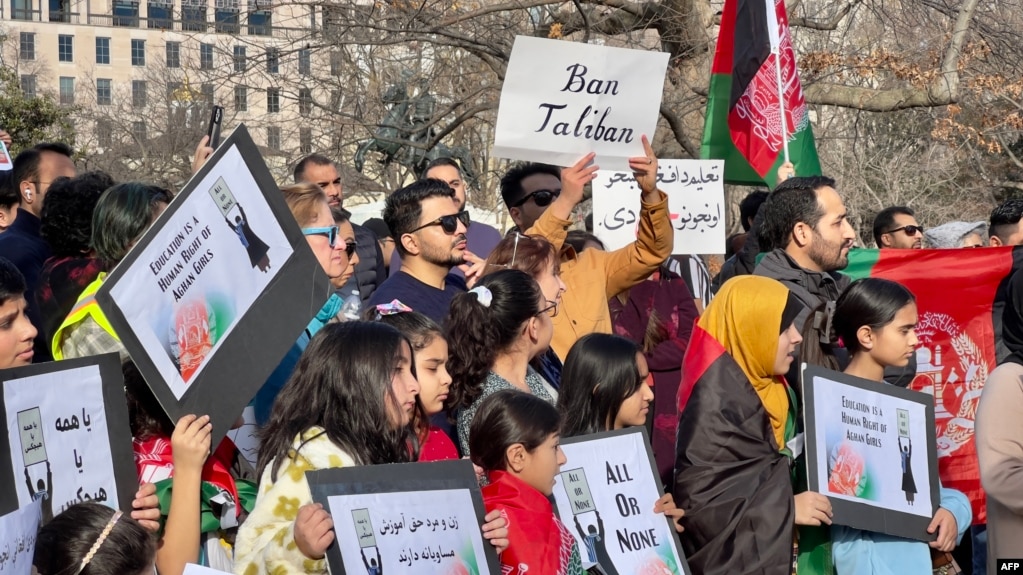
FILE - People demonstrate in front of the White House in Washington, January 1, 2023, against the Afghan Taliban regime's ban on higher education for women.
FILE – People demonstrate in front of the White House in Washington, January 1, 2023, against the Afghan Taliban regime’s ban on higher education for women.

From Lafayette Park in front of the White House to the streets of London, Toronto and many other cities around the world, activists have been staging small protests to condemn the Taliban’s repressive policies against women in Afghanistan and call for a stronger international response.

While they attract a relatively small number of participants, the protests have increased in frequency over the last year, largely in response to growing Taliban restrictions on women inside Afghanistan.

On January 14, fewer than 100 protesters showed up at Farragut Square Park in Washington to chant slogans against the Taliban’s recent edict banning universities and work for Afghan girls and women. On the same day, about three dozen protesters gathered in heavy rain in Los Angeles, making similar demands.

“In Los Angeles, we called for an end to the gender apartheid instilled by the Taliban,” Arash Azizada, an Afghan American community organizer, told VOA.

The protests take place as women and civil society activists inside Afghanistan have gone silent under Taliban rule.

‘We want to be their voices’

Human rights groups accuse Taliban authorities of forcefully banning protests, detaining and torturing activists, and censoring the media. The Taliban strongly reject the allegations and instead claim they have freed the country from a U.S. invasion.

The protesters outside Afghanistan say they show solidarity with Afghan women whose rights are being crushed under the Taliban’s undemocratic rule.

“We want to be their voices. We want to be their bridge to the world,” said Asila Wardak, a former Afghan diplomat and now a fellow at Harvard University who participated in several protests in the U.S.

The Afghan protesters are part of a widespread global chorus that demands the Taliban immediately reverse restrictions imposed on women’s work and education in Afghanistan.

Taliban Rebukes UN Over Call to Lift Bans on Afghan Women

But the Taliban have remained defiant, giving no clarity about when or whether the will be lifted.

“Anti-government protests outside the country that the government controls (e.g., anti-Iranian government protests that take place in Washington) do not seem to have much impact in the country that the protests concern,” Thomas Carothers of the Global Protest Tracker at the Carnegie Endowment told VOA by email.

“Repressive governments are usually able to control news of such events,” he said.

While U.S. and European officials have often voiced support for Afghan women and have imposed travel and economic sanctions on Taliban leaders and institutions, protesters say the international community should undertake meaningful action to dissuade and disable the Taliban from depriving millions of women of their basic rights.

“Just issuing statements of solidarity with Afghan women is not enough,” said Wardak. “The international community should facilitate opportunities for Afghan women to directly engage the Taliban and demand accountability.”

Azizzada, an activist in Los Angeles, said a meaningful response to the Taliban’s perceived misogyny would be for the U.S. and its Western allies to offer more asylum and educational opportunities for Afghans.

“If Afghan girls cannot learn in Afghanistan, they should be allowed to do so in the United States or elsewhere,” Azizzada said.

Local voices

Since the Taliban seized power in August 2021, more than 150,000 Afghans, among them many women leaders and activists, have been evacuated or given asylum in the U.S., Canada and European countries.

Many evacuees have engaged in high-profile advocacy for change in Taliban-ruled Afghanistan. Some activists have received prestigious awards and fellowships at elite universities, giving them a bully pulpit from which to write for and appear in prominent media outlets.

Now there are concerns that the activists in the Western countries are given too much attention at the cost of women inside Afghanistan.

“Efforts outside of Afghanistan should complement the activism of those inside the country and not hijack the narrative and present unrealistic solutions,” said Obaidullah Baheer, a Kabul analyst.

Even while women are not allowed to advocate for their rights inside Afghanistan, Baheer said, “it should not mean that their voices be ignored.”

That Afghan women have continued to suffer under the Taliban, despite protests and advocacy outside Afghanistan, is not disputed by some prominent activists.

Uprooted Women’s Rights Activist Wants Change Within Afghanistan

“I believe that protests have impacts on the situation,” Zarifa Ghafari, a former Afghan official who now advocates for Afghan women’s rights from Germany, told VOA. “But I do not have confidence in the scattered gatherings by Afghans, and you have not seen any positive result over the past one and one-half years.”

Taliban officials have largely ignored the Afghan protests abroad or labeled the protesters as Western puppets.

Inside Afghanistan, however, nearly all Afghans have rated their lives as “suffering,” and a majority have said that women are disrespected under the Taliban, according to a recent Pew survey.

Muzzled in Afghanistan, Activists Protest Abroad
read more

Ex-US Secretary Pompeo Discusses Ghani in Recent Book

However, some political analysts believe that Pompeo’s comments are not correct. They hold the US responsible for Afghanistan’s severe problems.

Former United States Secretary of State Mike Pompeo discusses the issues of Afghanistan, the former leaders of the country and the Doha Peace Agreement in his recently published book.

Pompeo referred to Ashraf Ghani, the former president of Afghanistan, as a “total fraud” in a section of his book, “Never Give an Inch, Fighting for the America I Love.”

Pompeo also said in his book that Ghani wasted the lives of American soldiers for his goals.

Some Afghans, however, took issue with these remarks: “Ashraf Ghani wanted a nationwide peace so that there would be no excuse for war. We disagree with the remarks of Pompeo,” said Kamal Sadat, the former deputy of youth of the Ministry of Information and Culture.

“With big management, he (Ghani) created administrative corruption … around his people. He left a collapsed, failed government,” said Sayed Noorullah Raghi, a political analyst.

“He wants to put the fault of Pompeo and Donald Trump on the shoulders of Ashraf Ghani and Abdullah Abdullah and thus he released this book. There is a possibility that Mike Pompeo will participate in the presidential election of 2024,” said Janat Fahim Chakari, a political analyst.

In one section of his book, the former secretary of state of the United States accused the former leader of Afghanistan of allowing American lives and aid to be wasted.

“I warned him that I would stop the transfer of $1 billion in American assistance if he refused to participate in the reconciliation process,” said Pompeo, adding that Ghani was quick to inform at least one US Senator about the threat.

Moreover, Pompeo called Ghani a “total fraud”, saying that he has met dozens of world leaders, and that Ghani was his least favorite. “Ghani was a total fraud who had wasted American lives and was focused solely on his own desire to stay in power,” Pompeo said.

“Never once did I sense that he was prepared to take a risk for his country that might imperil his power. This disgusted me,” he added.

“What the US officials and (former) US Secretary of State are saying about Ghani is one issue, but in fact Ghani has not trusted the process and even tried to sanction it and while the Doha process was going to be implemented, he left the country and caused the collapse of the whole system,” said Aziz Maarij, former diplomat.

The former US special envoy for Afghanistan’s reconciliation, Zalmay Khalilzad, also said on Twitter that Ghani’s connections with Washington led him to believe the US would maintain a robust military presence in Afghanistan.

“President Ghani felt he could ignore clear messages from Secretary of State Mike Pompeo, myself, and other US officials. Pres. Ghani had great familiarity and connections with Washington, members of congress, retired generals, and lobbyists,” he said.

“These connections led him to believe the US would maintain a robust military presence in Afghanistan, despite what he was being told by both administrations regarding American withdrawal. This was a tragic mistake by Pres. Ghani,” said Khalilzad.

However, some political analysts believe that Pompeo’s comments are not correct. They hold the US responsible for Afghanistan’s severe problems.

“They say the Afghan president wasted their money. When the president was in power and announced that 99 percent of the dollars coming to Afghanistan are going back to the foreign countries, why didn’t the US didn’t say anything then?” said Ahmad Ander, a political analyst.

“Ghani tried to remain in power and to scuttle the peace negotiations,” said Sayed Akbar Agha, a political analyst.

Ex-US Secretary Pompeo Discusses Ghani in Recent Book
read more

Iran Envoy Qomi Emphasizes Need to Hold National Dialogue in Afghanistan

In a special interview with TOLOnews, Qomi said his country wants an inclusive government to be established in Afghanistan.

Hassan Kazemi Qomi, Iran’s ambassador to Kabul, believes that beginning a political dialogue is the only way to resolve the current situation in Afghanistan.

In a special interview with TOLOnews, Qomi said his country wants an inclusive government to be established in Afghanistan.

“If the Islamic Republic talks, it talks as a brother, it speaks out of kindness, it speaks in the manner of consulting, and it does not mean interference. We experienced in Bonn a portion of the reality of Afghanistan that was not considered. See what happened,” Qomi, said.

He said that Iran interacts closely and seriously with the Islamic Emirate to support the people of Afghanistan in various sectors.

“On the basis of supporting the Afghan people, the Islamic Republic maintains a serious and strong interaction with the Taliban in the economic and commercial sectors,” Iran’s ambassador to Kabul added.

Hassan Kazemi Qomi claimed that the United States supports Daesh in Afghanistan.

However, the Islamic Emirate, regarding Qomi’s statements on inclusive dialogue, said that publicizing some individuals would harm the nation’s political society.

“Individuals and groups with a very bad record in Afghanistan–those who people hate– putting them up again will cause great harm to the political society of Afghanistan,” said Zabiullah Mujahid, the spokesman of the Islamic Emirate.

Hassan Kazemi Qomi, Iran’s ambassador to Afghanistan, said that more than five million Afghan immigrants live in Iran and that Iran has provided improved services for them, in an interview with TOLOnews.

Iran Envoy Qomi Emphasizes Need to Hold National Dialogue in Afghanistan
read more

Afghanistan: Taliban to set new rules on women’s aid work, UN says

Chief international correspondent
BBC News
25 Jan 2023

Taliban ministers have told a senior UN official they plan to draw up new guidelines to allow Afghan women to work in some humanitarian operations.

Martin Griffiths told the BBC he had received “encouraging responses” from a wide range of Taliban ministers during talks in Kabul, even if last month’s edict banning Afghan women working for NGOs is not reversed.

With Afghan women playing a crucial role in delivering aid, there is concern the ban is endangering urgent life-saving humanitarian operations in the country.

“It’s worth remembering that, this year, Afghanistan is the biggest humanitarian aid programme in the world ever,” Mr Griffiths, the UN’s Under-Secretary-General for Humanitarian Affairs, told me in Kabul.

The aid arithmetic is staggering. This year, agencies will try to reach 28 million Afghans, more than half the population, including six million who are, Mr Griffiths says, “knocking on famine’s door”.

This year is Afghanistan’s coldest winter in a decade, and it’s been cruel. In the past two weeks, more than 126 Afghans have perished in freezing temperatures, collapsing from hypothermia, or overcome by toxic fumes from gas heaters.

And winter’s icy blast strikes a people already living, perilously, on the edge. Providing aid to Afghanistan is of epic proportions too.

In a mud-and-straw home perched perilously on a steeply-sloped hill blanketed in snow in Parwan province north of Kabul, we met one family whose complaints were as bitter as the cold.

“No aid agencies visit us here,” lamented mother Qamar Gul, as the family huddled around a “sandali” – a traditional charcoal heater Afghans have relied on for centuries to keep warm. “No one came from the last government, no one from the Taliban government.”

Mother Qamrgul
Oamar Gul says no aid agencies visit her family home in Parwan province

This week, as the government’s military helicopters struggled to reach the most isolated communities completely cut off by colossal snowbanks and blinding storms, Mr Griffiths was holding back-to-back meetings in Kabul with senior Taliban government leaders about the new edict banning Afghan women from working with aid organisations.

“If women do not work in humanitarian operations, we do not reach, we do not count, the women and girls we need to listen to,” Mr Griffiths underlines when we meet at the UN’s sprawling compound at the end of his mission. “In all humanitarian operations around the world, women and girls are the most vulnerable.”

An aid official with decades of experience in tough environments, including Afghanistan, he was cautious, but clear, about the results of his high-stakes mission.

“I think they’re listening,” he said of the Taliban ministers he had met, “and they told me they will be issuing new guidelines in due course which I hope will help us reinforce the role of women.”

Mr Griffiths’s visit comes on the heels of last week’s flying visit by the UN’s second-in-command Amina Mohammed, a British-Nigerian Muslim woman whose presence underlined the UN’s growing alarm over a raft of Taliban edicts threatening to “erase women from public life”.

She told us her conversations were “very tough”. Some meetings were so candid, they were almost cut short. But she told us she was encouraged by a willingness to engage.

Mr Griffiths’s mission – representing the Inter-Agency Standing Committee (IASC), the UN’s highest-level forum to co-ordinate humanitarian aid – has been to delve into very specific details across a range of vital sectors from agriculture to sanitation and food deliveries.

No one realistically expects the ban, announced last month, to be reversed. But it seems to have many loopholes.

Mr Griffiths highlighted “a consistent pattern of Taliban leaders presenting us with exceptions, exemptions, and authorisations for women to work”. So far, a green light has been given to crucial areas like health and community education where women’s participation is essential.

But it’s also clear the most conservative of Taliban leaders are not for turning.

“Men are already working with us in the rescue efforts and there is no need for women to work with us,” insists the white-bearded cleric who heads the State Ministry for Disaster Management. When we sat down with him in his office, the acting minister Mullah Mohammad Abbas Akhund accused the UN and other aid agencies of speaking “against our religious beliefs”.

“I’m sorry, I don’t agree,” was Mr Griffith’s firm reply, emphasising that the UN and other aid agencies had been working in Afghanistan for decades. “We respect the customs and norms of Afghanistan, as we do in every country that we work.”

The race to deliver urgently-needed relief has been slowed by this painstaking process of dealing with an authority ruled by the most senior, most strict Taliban leaders. Other senior figures question edicts but cannot quash them.

But Mr Griffiths pointed out that humanitarian access was significantly better now since the Taliban swept to power in 2021. Areas previously cut off by threats of Taliban attacks or US-led military operations were now much easier to reach. Last winter, 11th-hour humanitarian interventions in remote regions, including the central highlands of Ghor, pulled families back from the brink of famine.

It’s a point Taliban officials constantly stress. The acting Minister of Foreign Affairs Amir Khan Muttaqi urged Mr Griffiths to share their “achievements and opportunities… instead of complaints and shortcomings”.

But as the worst of winter closes in, the window is closing for an urgent relief effort. Several aid agencies, who rely enormously on their Afghan female staff have already suspended their operations.

“I cannot think of an international priority as high as this one to keep this extraordinarily important massive programme alive,” is how the UN’s top aid official summed up this moment.

Afghanistan: Taliban to set new rules on women’s aid work, UN says
read more

Wrestling with a Humanitarian Dilemma in Afghanistan

Recent decrees by the Taliban barring Afghan women from attending university or working in NGOs are severely damaging the country both socially and economically, especially coming atop a ban on girls’ secondary education last year. The marginalization of half the population also highlights the “humanitarian dilemma” that aid donors and international agencies face: Afghanistan is highly dependent on humanitarian assistance, not only for saving lives and easing deprivation but also to stabilize its economy. The quandary for international donors is what to do when alleviating suffering benefits the Afghan economy and thereby the Taliban regime, even when that regime is harming its own people?
Humanitarian aid — around $3 billion a year now compared to total civilian and security assistance of $8 billion-plus annually before 2021 — has taken over pre-2021 aid’s role in shoring up Afghanistan’s weak economy in addition, of course, to saving many lives. While a considerable portion of humanitarian assistance is provided in-kind (mainly basic foodstuffs), much of the aid reaches Afghanistan in monetary form for local cash transfers, contractual payments for goods and services, salaries and other expenses.United Nations humanitarian cash shipments of U.S. dollars into Afghanistan average about $40 million a week — a total of $1.8 billion since they began in December 2021. These inflows, similar to or slightly more than the Afghan central bank’s pre-2021 imports of cash dollars, have replaced the latter in stabilizing the country’s economy.

Unlike before the Taliban takeover, this money no longer goes directly to the central bank (Da Afghanistan Bank, or DAB), now under Taliban control. Instead, deposits are made in a private commercial bank. U.N. agencies and implementing partners then withdraw the money in U.S. currency or after the bank has converted funds into afghanis to pay local costs.

The U.N. cash shipments provide critically needed liquidity in the economy. They are used to pay for imports directly or to purchase domestic goods and services (including salary payments). Either way, they support Afghanistan’s balance of payments, which is characterized by a gap between imports and exports of roughly $4 billion per year, by providing much-needed foreign-sourced funding.

The U.N. cash imports are a major reason why the exchange rate for the afghani has been reasonably stable and the falling inflation rate mainly reflects international price inflation rather than the domestically driven hyperinflation of the 1990s.

No One Should Want a Repeat of Afghanistan’s Economic Free-Fall in 2021

So, Afghanistan’s extraordinarily high aid dependency has continued, now on the shoulders of humanitarian support. Moreover, given the much more precarious situation faced by most Afghans — living near, at, or below the subsistence level — people’s dependence on external aid arguably is just as great as or even greater than pre-2021.

But by supporting a low-level economic equilibrium — albeit precarious and subject to downside risks —  current humanitarian assistance creates similar issues regarding dependence and sustainability that arose with past aid. Recent Afghan history provides a striking demonstration of the problems that can occur. The August 2021 Taliban takeover and the resulting immediate cut-off of international aid plunged the country into a period of economic free-fall and precipitated the largest humanitarian crisis and U.N. humanitarian appeal in the world until the Ukraine war. No one should want a repeat of this disaster.

Humanitarian aid is not supposed to be conditioned on a government’s policies. That would be contrary to internationally accepted humanitarian principles, namely:

  • Humanity — human suffering must be addressed wherever found, with particular attention to the most vulnerable
  • Neutrality — humanitarian aid must not favor any side in an armed conflict or other dispute
  • Impartiality — assistance must be provided solely on the basis of need, without discrimination
  • Independence — provision of aid must remain autonomous from political, economic, military or any other objectives

However, the sheer size and economic importance of humanitarian aid for Afghanistan means it has important macroeconomic impacts. Moreover, by helping stabilize the macro-economy and shoring up incomes, it inevitably benefits the Taliban regime at least indirectly. The government generally benefits from a more stable economy where people are not starving, but this aid also means the Taliban can freely use their sizable resources from taxation — perhaps around $2 billion a year — for other purposes. As is true of all aid, resources are fungible in the bigger picture.

This issue is common to large humanitarian interventions in any conflict-affected country. But when the Taliban administration takes deliberate actions that harm large segments of the country’s population, we have arrived at the crux of a humanitarian dilemma.

Taliban Actions Against Women and Girls Complicate the Delivery of Humanitarian Aid

Recent Taliban actions have jeopardized the delivery of aid to Afghanistan — both in general and specifically aid for Afghan women and girls.

Comprising 30-40 percent of NGO employees, women include nutrition experts, team leaders, community health workers, vaccinators, nurses, doctors and heads of organizations. Moreover, aid that goes directly to women and girls — such as health and nutrition services, food and other aid to female-headed households or those whose males are away from home — must be delivered by Afghan women. It would be socially unacceptable in most of the country for men to bring humanitarian relief and services to Afghan women and girls. And asking female NGO employees to work at aid delivery points but never report to the office on work-related matters, which the Taliban might see as an acceptable compromise, would be unrealistic and unviable.

Over the medium term, the education bans will reduce the numbers of trained and professional women able to provide health and other humanitarian-related services, further constraining humanitarian aid.

Finally, Taliban actions against females in education and NGOs most likely mean that little if any development aid will be forthcoming in the near-term future. Hence humanitarian assistance will continue to comprise the lion’s share of international public financial flows into Afghanistan. The macroeconomic and financial implications of this aid need to be kept front-and-center and guide decision-making, in addition to responding to humanitarian needs.

Conditionality for Humanitarian Assistance?

Making humanitarian aid contingent on the Taliban reversing the recent restrictions they placed on women and girls may go against the humanitarian principle of nonconditionality. Moreover, if experience is any guide, imposing explicit conditions on aid is unlikely to work. It would provide the Taliban with a further excuse to misleadingly blame economic problems and human suffering on the international community’s actions.

Nevertheless, according to the British government, nearly half of NGOs in Afghanistan have paused their assistance following the Taliban ban on Afghan women working for NGOs. Inability to effectively deliver essential humanitarian aid without women is the prominent reason for these suspensions. Humanitarian principles require aid to be delivered in a non-discriminatory manner, and if that becomes impossible due to Taliban restrictions, questions arise over whether and to what extent the aid should continue. On the other hand, U.N. imports of cash dollars have resumed at high levels following a month’s gap during the winter holiday period, with no sign that they will decline in the immediate future. International aid donors are still developing their responses to the Taliban bans.

Even in the absence of explicit conditionality, the Taliban’s recent actions will dampen donors’ enthusiasm for continuing to fund humanitarian aid at current levels. Moreover, the distinction between humanitarian and basic development activities is somewhat fuzzy, so there could be a narrowing of the scope of humanitarian assistance to focus on the most life-saving activities (such as food aid and emergency health services). This would leave other important programs that are currently being carried out under the humanitarian umbrella vulnerable to cuts.

Donors’ aid fatigue over Taliban actions will further worsen the already deteriorating outlook for aid to Afghanistan in the face of competition from the massive humanitarian needs generated by the Ukraine war as well as other humanitarian crises. These trends also mean that the amount of cash dollars imported by the U.N. will at some point start to decline.

There needs to be clear and explicit international messaging about the effects of the Taliban’s bans on humanitarian aid, so the implications are abundantly clear both to them and to the Afghan people.

Proactive Strategizing and Planning Are Needed — Not Reactive, Disorganized Responses

Afghanistan’s humanitarian crisis is not like, say, a discrete natural disaster, affecting hundreds of thousands or perhaps 1-2 million people for a limited time. Most of Afghanistan’s more than 40 million people are facing severe hunger and deep poverty. This is an economic crisis for the entire country, one likely to extend for at least several years. The situation cries out for incorporating a macroeconomic, stabilization and sustainability perspective on humanitarian aid — not just reacting short-term to Taliban actions.

When humanitarian aid is as large and prolonged as in Afghanistan, effectiveness issues and cost-efficiency come to the fore. This will be particularly true when resource constraints tighten and funding declines, as almost surely will happen for Afghanistan in coming years.

For example, there is widespread recognition that cash assistance is more cost-effective than in-kind aid in meeting most humanitarian needs, and no more risky. Aid organizations globally are beginning to shift the composition of their assistance from in-kind to cash. So, one way to improve the cost-effectiveness of humanitarian aid in Afghanistan is to provide more of it in cash rather than in-kind.

Reducing Dependence on U.N. Cash Shipments

In the likely scenario that humanitarian aid declines over time, a smooth transition away from U.N. cash shipments must be planned to avoid a repeat of the August 2021 shock when aid abruptly stopped.

U.N. cash shipments need to be put on a planned trajectory and not allowed to haphazardly reflect aid agencies’ fluctuating needs for funds in-country and the availability of money from donors. It would make sense to pre-program a gradual, predictable decline in the U.N. cash shipments over time, to give the Afghan economy and people time to adjust, rather than injecting volatility through ups and downs, let alone precipitating another major economic shock if there is an abrupt drop.

Use of new technologies involving mobile phones and digital money transfers is increasing around the world, driven in part by the pandemic. A highly effective aid delivery mechanism which is already being piloted in Afghanistan, mobile phone-based digital cash transfers could progressively replace part of U.N. cash shipments, supporting Afghan women’s and their households’ humanitarian needs directly, as demonstrated by a successful recent pilot program.

The proposed Humanitarian Exchange Facility (HEF), preferably with streamlining and simplification of design to ensure that it is cost-effective and curbs excessive overhead, could be revived and partly substitute for U.N. cash shipments. Aid donors can incentivize the shift away from U.N. cash shipments in favor of mechanisms such as the HEF by requiring increased use of such channels.

Such options would require more cohesive, coordinated planning and deployment of humanitarian aid among U.N. agencies and on the part of donors. This is not how humanitarian business is normally conducted, but the nationwide crisis, the sheer amount of aid and the risks of future disaster in Afghanistan require such a holistic approach.

Wrestling with a Humanitarian Dilemma in Afghanistan
read more

The Daily Hustle: How Afghan women working for NGOs are coping with the Taleban ban

Roxanna Shapour

Afghanistan Analysts Network

 facebook sharing buttonprint sharing button

Afghan women who were studying at university or working for NGOs have now had a few weeks to take in the implications of two decrees issued by Taleban leader Hibatullah Akhundzada which denied them a university education and banned them from working for NGOs. The announcements had come as successive blows to women who had already seen their rights and freedoms rolled back by the Emirate since it came to power in August 2021. For the latest instalment of The Daily Hustle, our series that features individual accounts about one aspect of daily life in Afghanistan, we hear from two women who used to go out to work, but since the latest decree, are no longer going..

Sonita supports her family of five – husband, two children and her elderly parents – with her salary working for an international NGO in Kabul as a project officer.

24 December 2022 was a very cold winter day. I’d been working in my room all day, wrapped up in several patus (traditional woollen blankets) with a hot water bottle on my lap. Around six in the evening, I heard my mother rustling as she quietly came into my room. I thought she’d come to fetch me for the evening prayer, but I could see something was wrong as soon as I saw her. Her face was ashen, taut with anxiety. “The Taleban have banned women from working for NGOs,” she said. I dismissed what she was saying with a wave of my hand and told her that it must be a rumour, but she shook her head and said it was being reported on all the television channels. I quickly started to check on social media, scrolling down timelines until I saw the decree – a few short lines in Pashto saying that women were no longer allowed to work for national or international NGOs. I sank deeper into my chair, wrapped the patus closer around me and started sobbing.

Khalida lives with her husband, two sons and four daughters in one of the most impoverished neighbourhoods in Kabul. She has worked for the same Afghan NGO as a cleaner for nearly two decades.

We didn’t have electricity in our neighbourhood that night, so we couldn’t watch TV. I found out about the ban from the chowkidar (guard) when I went to work the following day. I thought he was joking, but he didn’t look like he was. Then my manager told me to go home because the Emirate had made a rule that women couldn’t work for NGOs anymore. He said they’d keep paying my salary as long as they could afford it, even though I was no longer working. I wondered how long ‘as long as they could’ meant, but I didn’t ask.

I’ve been very lucky with work. I’ve been a cleaner at the same office for 18 years. My job is good and my organisation is stable and takes care of us. Last year, I used some of our savings to help my sons open a little shop in our neighbourhood, but the economic situation is bad and the shop makes only a little money. My husband is retired. He hasn’t received his pension since the Taleban came back. There are rumours that the government will start paying pensions and also give us all the money they owe, but we haven’t got any money so far. Now, I don’t know how my family would manage if I lost my job.

Facing an uncertain future

Sonita and her husband both lost their jobs when the Islamic Republic collapsed in August 2021, and she counts herself lucky because she was able to find work with an NGO:

I’m the only breadwinner in my family. Who is going to support my family now? For many Afghan women, working for an NGO is one of the only ways to earn a living. I count myself as one of the lucky ones because I was able to secure a job after the economy collapsed in the wake of the Taleban takeover. The job matters to me in so many ways. It’s the only source of income for my family. It keeps a roof over our heads and food on the table. It pays for books and pens for my children and my parents’ medical care. But the money also helps the economy. It’s a source of income for the shopkeepers in our neighbourhood where we buy things and the taxi drivers who drive me to work. I even use part of my salary to help those less fortunate than us.

My colleagues have been really supportive. They urge me to be strong and their reassuring tone is a comfort. My organisation has assured me that they will keep paying me until the situation is resolved and I can go back to the office. But this is not only about money. I love my job. It gives me satisfaction and a sense of purpose. Only two weeks earlier, my supervisor and I had done our annual appraisal and agreed on my work plan for 2023. What will happen now to those plans?

Khalida worries about making ends meet, even though her family owns their own home and they have some savings to cushion the blow:

I try to put a brave face on for my daughters. I joke around with them and talk about us visiting my parents in our village. After dinner and the evening prayer, after the girls have finished their evening chores and have gone to bed, my husband and I sit down with my sons to see how long we can survive on our savings and the meagre income from the shop. If we tighten our belts and keep our expenses down, we think we could stretch our savings out for another six months. I would also get severance pay, but I don’t know how much, and I don’t know if they could afford to pay that.

Thank God we own our own house. My husband gave me a small piece of land when we got married, and many years ago, with the help of some colleagues who loaned me money, I was able to build two rooms, a kitchen and a bathroom. So we don’t have to pay rent. We also keep some chickens, so we have some eggs every day and sometimes we cook one of the chickens. But I worry about our other expenses. Everything is so expensive now. My salary also supports my elderly parents in the village. My father is too old now to work the land. He rents it to one of my cousins, but that cousin hasn’t been able to make a go of it because of the drought and so he can’t pay my father any rent for the land. I don’t have any brothers and it’s up to my sister and me to support our parents.

Making plans to cope

Khalida is pragmatic about the possibility of being allowed to work again and talks about plans to keep at least one son employed:

I’ve been talking to the other two women who work in my office. They said our manager had told them that our jobs were not in danger and that they were talking to the Ministry of Economy to see if they could get exemptions or workarounds to the ban. They told me there was already an exemption for women health workers, but we’re not health workers, we’re cleaners.

My older son wants to go to Iran for work and leave my other son in Kabul to run the shop. But the economy is bad there too and their currency isn’t worth as much as it used to be. I don’t think he’ll be able to send any money back to us, even if he does go. I think the Taleban only want men to work. A few months ago, they said women [employees] should send the men in their families to work in their place. I’m thinking of asking my office if my older son could take my job. If it’s allowed, I could train him to do the cleaning, but I’m not sure they would agree.

Sonita moves between hope and dejection

My spirits rally when I see the news about international NGOs that have suspended their operations and issued statements condemning the ban and the UN delegation that came to Afghanistan to talk to the Emirate about reversing it. I know my own organisation, and others, will do their best to find a way to keep women working for NGOs, but I also have to be realistic about the future.

For the past sixteen months, I have stayed strong and remained optimistic. I focus on my work and my family’s well-being. But these days, there is little hope. I stay close to home and do a lot of housework. I grieve for myself and for all women in Afghanistan. I mourn all the freedoms that we’ve lost, one after another, in the past year and a half. I also spend a lot of time talking with my husband behind closed doors and in hushed voices, so my parents and children don’t hear us. We talk about all the doors that have closed, the possibilities that are no longer available, and the plans that might never be realised. We talk about leaving Afghanistan. A day might come when we will have to pack our bags and leave our homeland. But that day is not today.

Edited by Roxanna Shapour

The Daily Hustle: How Afghan women working for NGOs are coping with the Taleban ban
read more

ECO Meeting Stressed Need for Engagement With Afghanistan

The Islamic Emirate said that they want good relations in economic and political affairs with regional countries and the world.

Participants at the 26th meeting of the Economic Cooperation Organization’s Council of Ministers stressed the need for engagement with the caretaker government as well as peace and stability in Afghanistan.

The Pakistan Foreign Minister, Bilawal Bhutto Zardari, said that pushing the Afghan government into isolation will aggravate the suffering of the people of Afghanistan.

“Pushing the interim Afghan government to further isolation will further aggravate suffering of ordinary Afghans,” he said.

This comes as the Uzbekistan Foreign Ministry said in a statement that Minister Bakhtiyor Saidov met with Bhutto and discussed economic matters and issues related to Afghanistan.

The Islamic Emirate said that they want good relations in economic and political affairs with regional countries and the world.

“We praise those parts which suggest continuation of relations with Afghanistan and the empowerment of the government, security and stability. I must mention that  the Islamic Emirate wants good relations and calls for the cooperation of these countries with Afghanistan,” Islamic Emirate’s spokesman Zabiullah Mujahid said.

A former diplomat and political analyst, Aziz Maarij, told TOLOnews that in case “all members of the summit reach an agreement over providing aid to Afghanistan, or issue a resolution and urge the international community to provide assistance to Afghanistan, this meeting could be effective.”

There was no representative from Afghanistan at the summit.

Delegations of the Republic of Azerbaijan, Islamic Republic of Iran, Republic of Kazakhstan, Kyrgyz Republic, Islamic Republic of Pakistan, Republic of Tajikistan, Republic of Turkiye, Turkmenistan and Republic of Uzbekistan (host) as well as the ECO Secretary General participated in the meeting.

ECO Meeting Stressed Need for Engagement With Afghanistan
read more