Afghans studying in Pakistan had hoped they might avoid the collective expulsions that, since 2023, have upended life for over two million Afghans living there. However, as the scope of deportations has widened, students have found themselves unable to get study visas. Some have already been detained by Pakistani police and deported. Others have managed, for the time being, to evade the authorities or bribe their way out of danger, but live in fear of arrest and deportation. For female students, shut out of universities in their homeland, Pakistan has been an educational lifeline, and the threat of expulsion is catastrophic. To better understand the situation, Rama Mirzada heard from six students who have been deported or are living in fear of deportation.
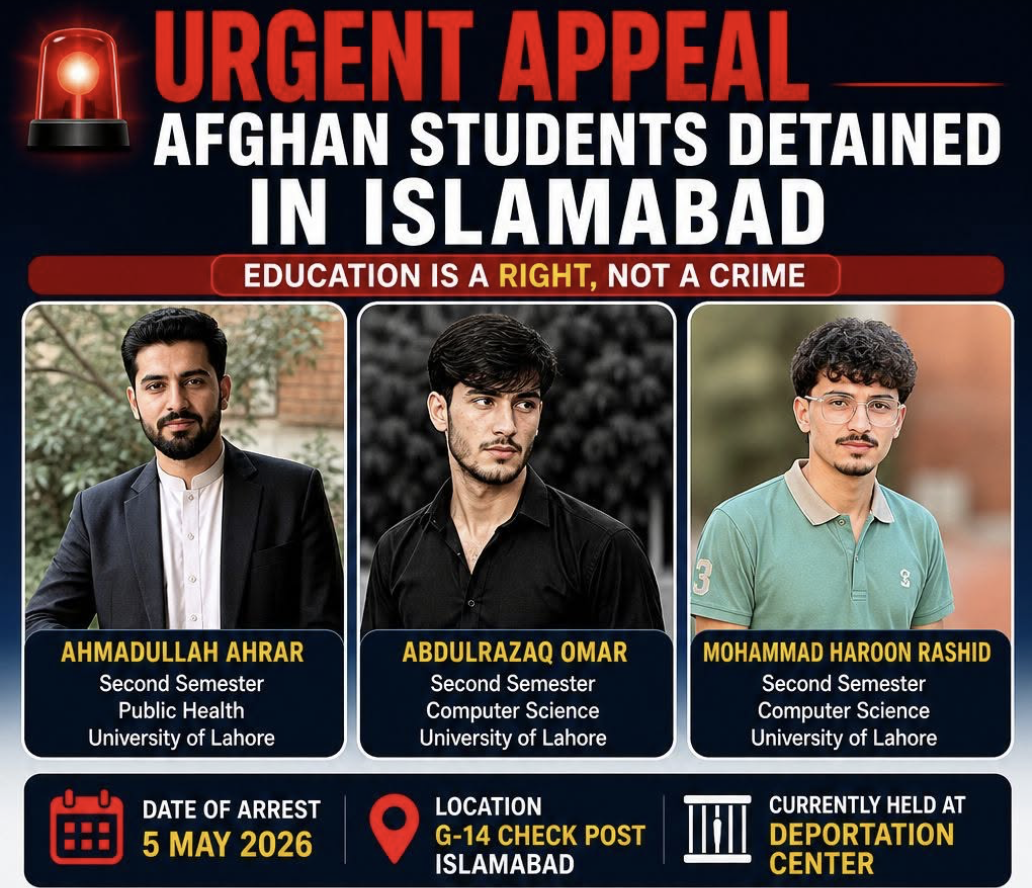
The alert circulated to try and help three Afghan students detained in May. The three were subsequently deported. Source: Facebook
On 5 May 2026, Afghan students in Pakistan shared an alert calling for the release of three students who were enrolled at the University of Lahore and had been arrested in Islamabad. The call went unheeded: later that month, the three were deported to Afghanistan. They are not alone. Many Afghan students in Pakistan have faced the same fate – or fear it. Although the exact number of Afghan students in Pakistan is unknown, every year, a thousand Afghans are awarded scholarships by the Pakistan government and thousands more go to Pakistan as self-funders, while others are already living in Pakistan. Students on scholarships eventually got their visas, after several months of anxious waiting. It is those who fund themselves who have not been granted visas. They include Afghan refugees living in Pakistan, many of whom were born in the country and have lived nowhere else.
Pakistan has hosted Afghan refugees for decades, and there have also been mass expulsions before, most notably in 2016, when over half a million people were expelled amid an earlier security impasse between the two countries (AAN). However, the current campaign has been far more intense. Relations deteriorated between the neighbouring countries after the Taliban regained power in 2021, as Islamabad accused the group it had supported during the insurgency of supporting Pakistani anti-government armed groups, notably Tehrik-e Taliban Pakistan (TTP). The TTP has escalated attacks in Pakistan since 2021 and Islamabad accuses the Emirate of providing it with a safe haven. The Emirate denies these accusations and has, in turn, accused Pakistan of violating Afghan sovereignty, particularly, since autumn 2025, when Pakistan launched airstrikes across the border (AAN).
The mass returns of Afghans began after September 2023, when Pakistan launched its Illegal Foreigners’ Repatriation Plan. More than two million Afghans returned or have been deported from Pakistan since then, according to the UN’s refugee agency, UNHCR, since then (data from October 2023 to 4 April 2026). The returns have continued despite warnings from UN officials and human rights organisations that collective expulsions are unlawful when, they say, Afghanistan cannot cope with an existing humanitarian crisis, and certain groups are at particular risk, for example girls unable to get an education beyond grade 6.
In the first phase, the Pakistani authorities targeted undocumented Afghans, followed by those with Afghan Citizen Cards (ACC), which are a form of temporary residence permit. In the third phase, Afghans who were officially recognised as refugees and had a Proof of Registration (PoR) card, some 1.4 million people, were told that their cards would not be renewed after 30 June 2025 and that they too would be deported (Dawn).
The problems for Afghan students began in summer 2025 as they tried to secure visas for the new academic year, which begins in September. They included new students, as well as those who were already enrolled (Hasht-e Subh and Displaced International). Without visas, students midway through a course could not return to Pakistan, or if they were already there, have had to live with the risk of arrest and deportation. A representative of the Afghan Students Union in Pakistan, Anayat Ullah Momand, said that although the government of Pakistan “had not shared any official announcement,” for self-funded Afghan students, “they have stopped the visa process.”
This report is based on interviews with six Afghan students studying in different parts of Pakistan – Islamabad, Lahore and Balochistan province – as well as the representative of Afghan Students Union. Two of the interviewees were on partially funded scholarships and four were entirely self-financed. The students were enrolled in bachelor’s or master’s degree courses in a range of academic fields, including medicine, business administration, international relations, economics and cybersecurity. At the time the interviews were conducted (22-26 April 2026), two had already been deported to Afghanistan. The students’ names have been changed for their protection.
Pursuing education in Pakistan after 2021
Pakistan has been an important educational hub for Afghan students for decades. Earlier generations of Afghans who studied in Pakistan have gone on to work in senior positions inside Afghanistan, in government institutions, the health sector, NGOs and private companies. In particular, thousands of Afghan students have benefited from the Allama Iqbal scholarship for Afghan Students programme, which has run since 2009 (Tribune). Its most recent phase was launched in 2024, for 4,500 students over five years, and covers the costs of graduate and post-graduate students, including tuition fees, living expenses and a book allowance (Higher Education Commission of Pakistan). These students have been able to study at all levels at a wide range of universities in various fields, including medicine, engineering, agriculture, management, political science and computer science. Self-financed Afghan students, on the other hand, bear every expense themselves, including visa costs. Although pursuing higher education in Pakistan has not been without its challenges, it remained a valuable opportunity until tensions between the two countries escalated and Pakistan’s policy toward Afghans began to change. Until 2025, there were few restrictions imposed on Afghans getting study visas.
The hassle of getting a visa
At the time of the interviews, none of the six had got a study visa and two of the six had already been deported to Afghanistan – one was in the last year of his master’s degree, the other in the third semester of her bachelor’s degree.
The experience of Somaya, who had been studying international relations in Pakistan since 2024, is typical. She had applied for a visa extension in January. It wasn’t given and four days after her visa ran out, on 8 March (ironically, International Women’s Day), she was deported. “As a result,” she told AAN, “I missed my exams. There might have been an option to request the Ministry of Foreign Affairs to help facilitate a visa, but the university staff refused to help.”
With so many Afghans desperate to get visas, middlemen have sprung up offering to help, often for hefty fees. Back in Afghanistan, Somaya has lost money twice in an attempt to get a visa so that she could return to Pakistan and sit her exams.
I contacted several individuals to help obtain a visa for me, but most told me it was impossible. Some promised to arrange a visa in exchange for money. In March 2026, one individual took 30,000 PKR [USD 107] from me and disappeared. Then another took 55,000 PKR [USD 197] and provided me with a visa that was fake. Both individuals took my money and vanished, but I couldn’t do anything because I was in Afghanistan and they were in Pakistan.
Another student, Burhan, had completed a bachelor’s degree in Pakistan after four years of study, in 2025, and was hoping to do a masters, but ran into visa problems:
The study visas were for one year only and mostly ran out during the autumn so we had to re-apply for an extension one or two months before the expiry date. Normally, it took two months or less to get our visas. In June 2025, right after my graduation, my visa expired. I’d applied to extend it two months before it expired and prepared all the documentation. Since I was hopeful I’d get my visa extension, as I had in previous years, I came back to Afghanistan for the summer holidays. I waited for around four months, but didn’t get a visa.
Burhan realised he had to abandon his plans for post-graduate study and cancelled his application for a student visa. In the end, he only got a ‘visit visa’ just to return to get his graduation certificate. For that, the system worked efficiently. “I paid USD 1,000,” he said, “and got the visit visa within 72 hours.”
Abdullah was a postgraduate student, who has been studying in Pakistan since 2019. Every year, he’d applied for a study visa before it expired. 2025 was no different. “I applied one-and-a-half months before the expiry date, but never got the visa. I stayed on in Pakistan without a visa for six months, until March this year.” This is when Abdullah was deported to Afghanistan, more on which below.
Nasrin had been looking forward to starting her studies in Pakistan in October 2025 but her application for a visa was rejected. Fearing she’d miss her classes, she applied for a medical visa, a common workaround for thwarted students. It cost her USD 290. She came to Pakistan in November 2025, began her studies and restarted an application for a study visa:
I got a bona fide letter from my university, which meant I could apply for the study visa, but the letter also needed a stamp from the Ministry of Interior. … The Afghan students’ representative told me the ministry charges each student 10,000 PKR (USD 36) to stamp the letter, though if the number of requests for students’ letters is high, then the middleman (kamishan kar) at the ministry charges less. [But it could be more.] Some students have had to pay 25,000 to 30,000 PKR [USD 89-107] to get the stamp.
As Nasrin explained, being in Pakistan does not make it easier to complete the process, particularly for those with expired visas, given the fear of deportation that looms over Afghans there:
We can’t travel to stamp the letters ourselves because we don’t have a visa and the police might arrest and deport us. There were some students who went to the ministry in person and were deported to Afghanistan. So, there’s a person at the university who collects [the letters] from the students and [gives them to] a person at the ministry, who is also given the money from us [for the stamp].
Many Afghans caught up in the recent wave of deportations were born in Pakistan and have never lived in Afghanistan. Although Pakistan’s Citizenship Act of 1951 generally grants citizenship through birth or descent, Afghans are routinely denied this right. Hadya is one such Afghan. She was born, went to school and started university in Pakistan. She has a Proof of Registration (PoR) card, proof that she is a refugee – although the cards were not renewed after 30 June 2025: “I never even had a visa,” she explained. “I didn’t apply for one because the high court in this province announced that Afghan students could study on their PoR cards, so I can keep studying, even though my family’s PoR cards are expired.” Her status is tenuous. Even if she is able to finish her studies, her right to remain will then evaporate, as it already has for her parents. Until she can graduate, she worries for her family: “It’s a tough time for my family members in Pakistan. When they go out of the house, it’s with the fear of arrest or deportation.”
Managing everyday life without a visa
Some Afghan students stay in Pakistan to continue their studies while they keep trying to renew their visa or try to keep studying without documentation. This makes daily life difficult. They live in fear of being stopped and questioned by the police. The Pakistan authorities can deactivate students’ SIM cards, and restrict access to bank accounts and hospitals by insisting that a person’s ID and visa status are checked. The combined impact of these practical restrictions, combined with the risk of arrest, makes it difficult for students to step out of university grounds.
Khaled was due to start his last year of university in 2025 when, in Afghanistan for the holidays, he ran into problems renewing his visa. So, he and his friends returned to Pakistan illegally. “We waited for our visas for an extra month,” he said, “but since we still hadn’t got them, we decided we had no choice but to travel to Pakistan, via Spin Boldak, without a visa. For each of us, we paid 65,000 PKR [USD 233] to cross the border.” They did manage to get into Pakistan, but continuing their studies has not been easy, said Khaled, and they have had to deploy various ‘workarounds’ in the hope of avoiding arrest.
I’ve got bank accounts and SIM cards from Pakistani friends. Sometimes, we manage to go out by using a road where there is no checkpoint. But even if we get round the checkpoints, we’re on edge because of the fear of arrest. Some hospitals also ask for a visa, so we try to get basic treatments from the clinic inside the university. Every weekend, me and my friends plan to go out, but we never do because of the fear of deportation. Most of the time, we order food and clothes online.
Nasrin said she had, sometimes, to go without food during Ramadan because she didn’t want to take the risk of going shopping.
There were times when I had nothing to eat in my room and couldn’t go out because the police had a checkpoint in front of my dormitory. When I was on my period, I couldn’t go out to purchase my needs. I faced so many challenges getting to Pakistan for my education, I didn’t want to waste this opportunity and so I’m very cautious. … My primary need is food. Although the food inside the dormitory is quite expensive and not good quality compared to outside, I choose to buy it here to avoid being arrested.
Still, she said, she lives in fear of the police.
Some people say: The police won’t disturb Afghan women, but I can’t trust them. Even if they don’t deport me, they’d ask me to give them money. Often the police release Afghan students after getting money from them.
Nasrin says that many Pakistanis seem to blame Afghans for Pakistan’s weak economy and insecurity. Because of this, she began to conceal her identity: “I try to hide that I’m Afghan, I tell people that we’re Iranian. Other than my university classmates, nobody knows that I’m from Afghanistan because I fear being detained and deported.”
Hadya also said she’s struggling on many fronts, including accessing good healthcare:
It’s difficult to manage everyday life here. … It’s impossible for us to visit the public hospital because they ask for documents, although the private hospitals don’t require it. We can’t travel from one city to another because the police will deport us. Since mid-2025, our lives have become so difficult in Pakistan.
Burhan said that he and his friends stopped going out when he was in Pakistan in order to avoid the police. “We’re like prisoners.” He relied on friends who had visas to get him things like a SIM card. He said he and his friends had to pay bribes to the police many times to avoid being arrested, including the last time he arrived in Pakistan, in November 2025.
Right after I came out of the airport, the police stopped me at a checkpoint and asked to see my police registration stamp, which would have been impossible for a passenger to get right at the airport. They made me wait for two hours and threatened me, saying they would take me to Hajji Camp and deport me. Finally, they took 8,000 PKR [USD 28] and let me g.
He and his friends now move around using side roads, or, he said, “go out with Pakistani friends to prevent being arrested or stopped by the police.” However, a week after his brush with the police at the airport, he and his Afghan friends were picked up by the police as they got out of a taxi on their way to get food. Although he had a visit visa and a police registration stamp and his friends had student visas, the police detained them:
The police put us into their vehicle and started abusing the Afghans among us, saying we’re all terrorists. They took us at nine at night and put us in the truck bed of their vehicle, then carried on patrolling the area. We remained in their car until three in the morning. The police were deliberately driving in a way that would hurt us in the truck bed, and forced us to pay them. Finally, one of them opened the conversation and asked each of us to pay them 50,000 PKR [USD 179] and they’d release us. But the head of our union found our location, intervened and got us freed us after we paid them 15,000 PKR [USD 53].
Abdullah was initially able to stay under the radar for a while in Pakistan because he was good at languages and had some connections in the police and Pakistani friends.
My visa expired in September 2025, but I stayed on in Pakistan without a visa for six months, until March 2026. Since my Urdu and English are good, whenever the police were speaking to me at checkpoints, they didn’t realise I was an Afghan. Some of the Pakistani police were also our friends because they’d graduated from the university where I’m studying. Also, because Afghan students can’t set up a bank account at Pakistani banks, I was getting SIM cards and a bank account from my Pakistani friends.
However, as will be seen, his luck eventually ran out.
Students deported
For many students, there is a limit to how long they can avoid (or bribe) the police. For Abdullah, the blow came when his friends were preparing for a graduation ceremony.
In March, nine of us students went out to have dinner. Afterwards, we went to a barbers because the next day there was a graduation ceremony at the Embassy of Afghanistan for Afghan students. The police arrested five of us. After bringing us to the police station, they initially agreed to release us in exchange for 70,000 PKR [USD 251] from each person, but then one of the police officials said: No. They transferred us to Hajji Camp [in Islamabad] and we spent a day there. The next day they transferred us to the border and deported us to Afghanistan via Torkham. All my belongings are still in Pakistan. My friends even brought my belongings to the camp, but the police didn’t allow me to take them.
Somaya told AAN she was arrested just four days after her visa expired, in March 2026. Her parents were visiting Pakistan so that her mother could get surgery and she had gone to meet them.
After I was arrested, they took me to Hajji Camp. I tried to contact my parents so they wouldn’t worry, but the police seized my phone. I remained there for two days during Ramadan. We didn’t have the right to call our families nor leave the room.
She described harsh conditions at the camp.
There were almost 60 people in one room. The windows were completely closed and the rest rooms were really dirty. It was Ramadan and they didn’t feed the children. For iftari [the evening meal when the Ramadan fast is broken], they were giving us only a few spoons of white rice in a plastic bag. They were throwing the food to us as if they were feeding animals. It was cruel.
Because Somaya was alone and could not contact her family, they feared the worst. Her mother tried to find her:
My mother followed the deportation route and came to Chaman after me. She stayed in Chaman for three days and waited for my deportation. After we returned to Afghanistan, my mother was hospitalised as she was already sick and spending the time in Chaman was not good for her health.
Female students in Pakistan
Because of the Emirate’s ban on women going to university, those who had the financial means and family support began seeking alternative ways to continue their education, ranging from enrolling in online universities to traveling abroad to study. Despite an initial wave of support from many countries, refugee and migrant policy has hardened in Europe and North America. That includes putting restrictions on study visas or even, in the UK, stopping them completely for Afghans (AAN). Until 2025, Pakistan had been one of the few places where Afghan women could pursue higher education. For Somaya, being deported was the final blow in her efforts to complete her studies.
Before the ban on education by the Taliban, I was in the third semester of midwifery training. I then travelled to Pakistan to continue my education despite family and economic problems. Again and again, I’ve been blocked in the middle of my educational journey. The effect on me has been terrible.
Studying in Pakistan had set her family back hundreds of dollars for visas and university fees, but had felt worth the effort:
I was just about surviving with the living expenses, for example, the dorm fee was only 25,000 PKR [USD 89] for the Pakistani students, but for us, it was 95,000 PKR [USD 341]. It was really difficult for me to manage because the economic situation in Afghanistan is bad and it was hard for my family to support me. But I was happy to get the opportunity to study in Pakistan because I was denied this right in my own country.
When she was deported, she even lost the valuables that she had kept in her room. Being deported, she said, has left her feeling hopeless: “All my efforts to get an education have been wiped out. I’ve lost my education. I don’t know whether I will ever be able to continue it.”
Nasrin said the fear of deportation is affecting her academic performance: “All the problems mean we cannot go out of the university. It’s worst during exams when I should be relaxed and able to focus on my studies instead of facing all these difficulties.”
Hadya, the student who studies on her PoR card, said that if her family is deported, they will not allow her to stay on in Pakistan without them, so she’ll be forced to leave too: “My family is staying in Pakistan for my education. They won’t allow me to stay in a dormitory or continue my education [if they’re not here]. They’re conservative.” Like Nasrin, the insecurity felt by her and her family overshadows everything: “After the deportations increased in my area, I couldn’t focus on my studies. I could hardly think about the future of my education and whether I could finish or not. I was just worried about being sent to Afghanistan because women have no rights to study or work there.
Appeals to the Pakistani authorities go unheard
Complaints about visa problems and the detention or deportation of Afghan students tend not to get very far. Afghan Students Union Representative in Pakistan Anayat Ullah Momand has a visa for his final year of medical studies thanks to a scholarship and so is in a position to try and help others. He said he has received hundreds of requests for help from students who have been denied visas, but the authorities “have not taken any action for Afghan students.”
Khaled reported that despite the student union sharing its concerns with Pakistan’s Higher Education Commission (HEC), the Ministry of Interior and the Afghan Embassy, none had accepted responsibility: “The Ministry of Interior said that senior government officials banned them from issuing visas, HEC said the Ministry of Interior isn’t approving visas and the embassy said it was all was out of their hands and they could not do anything.” Burhan also said that he and his student union had tried to help other students:
The union never got a satisfactory response. I and several other students personally met the Pakistani official responsible for Afghan students and other officials at HEC, several times. They promised that our visas would be issued in a few weeks, but we never got our visas. We also visited Pakistan’s Ministry of Interior several times. The behaviour of the officials at the ministry wasn’t good towards us. Sometimes they used bad language against us. Once, they ejected me from the ministry when I’d asked them to resolve our problems. They just kept telling us to wait.
Burhan said that, before 2025, they had given bribes to speed up the visa process, but that this stopped working:
Previously, we were paying 30,000 to 40,000 PKR [USD 107-143] as a bribe to the Ministry of Interior so that they would approve our visas, but even that failed to work. I paid twice to get a visa before the complete ban on student visas. If we paid the money, normally our visa was approved within 25 days, but if we didn’t pay, our visas were approved after three to four months. We had to pay up or we might miss our classes. … We paid the money to a middleman who had links at the ministry. In the first year, the price to approve our visas wasn’t that expensive, but later, they were demanding up to 70,000 PKR [USD 251] per student.
Somaya said that before she was deported, some friends had tried to get the university to intervene, “but the university staff behaved harshly with them.” She said she doesn’t think that officials want to help, no matter who makes representations to them.
The government of Pakistan is 100 per cent aware of the challenges Afghan students face in Pakistan because we shared our problems with our university and several times, we provided all the documentation for the Pakistani authorities. When they deported me, I told them it was only four days since my visa had expired and that I’d applied for a new visa but that their government hadn’t issued it. They told me it had nothing to do with them, nor did they care about it.
Abdullah and his classmates had petitioned officials from the Ministry of Interior, but this had no impact. He says the problem is deeper than a bureaucratic visa issue: “The situation has changed a lot for Afghan students over the past eight months. The police don’t accept any documents, including university cards or other documents. When I was in the camp, I met Afghans who were arrested even despite having visas.” Abdullah speculated that the troubles faced by Afghan students related more to Pakistan’s powerful intelligence agency, the Inter-Services Intelligence (ISI).
Based on my information, Pakistan’s Ministry of Interior has no authority anymore to issue visas for Afghans. Students, including myself, have received phone calls from an ‘unknown individual’ who told us to meet at a café and there he asked us questions about ourselves. We didn’t know that person, nor did he tell us who he was. The employees at the Ministry of Interior also told us they had no authority over issuing visas, so I think there is a possibility that Pakistan’s ISI [intelligence agency] is controlling visas.
Hadya’s family is so determined to protect the ability of her and her sisters to finish their education in Pakistan, they have taken legal action.
Since my other sisters are also studying here, my father filed a case at the high court to allow us live here until we all graduate. We’ve not received a response yet, but we’ve a letter that prevents the police from deporting us until the court announces its decision. The lawyer we hired told us it was nearly impossible to get a stay order [temporary court directive to prevent harmful or unlawful acts]. It’s just a hope.
She also thinks the Pakistani government is indifferent to their suffering.
The government is well aware of the problems that Afghan students face in Pakistan and they know that girls aren’t allowed to pursue their education in Afghanistan. But the Pakistani government doesn’t care about Afghans, whether you are happy or unhappy, they’ll deport you.
Conclusion
For many young Afghans, being denied the opportunity to study in Pakistan has been devastating. For young women in particular, the prospect of being deported to Afghanistan slams the door shut on their prospects to secure higher education. For Somaya, deportation has been a life-changing blow: “I’m so worried about my future now and fear that I’ll remain uneducated.” Khaled placed the blame squarely with politicians on both sides. “The two countries,” he said, “brought education into their political concerns.”
As long as relations between Afghanistan and Pakistan remain poor, Afghan students will lose out. Some may manage to cling on to their studies in Pakistan without a visa, but only by living in the shadows of their university grounds. For now, the scholarship route is the only viable option. Last year, more than 20,000 Afghans applied for the Allama Iqbal scholarship, competing for just 1,500 places (Ariana). Now that these scholarships are, for now at least, a golden ticket to getting a visa, one can only imagine the flood of applications in 2026, assuming, that is, that Pakistan keeps this last door open.
Edited by Rachel Reid and Kate Clark
 Afghanistan Peace Campaign


