Afghanistan in crisis: Drought, malnutrition and a worsening humanitarian situation

By Nancy Sarkis in Geneva
UN News

Imagine being one of a family of nine and sitting down to a meal of potato peelings and other scraps, boiled up into a soup. This is the harsh reality for many of Afghanistan’s most vulnerable families, forced on them by climate change and drought, widespread malnutrition and increasing restrictions on women, since the Taliban overran Kabul in 2021.

Aid agencies are doing what they can to help, including by identifying dangerously malnourished children in sparsely populated “ghost villages” where those who can leave do so, said Olga Cherevko from the UN aid coordination office, OCHA.

But with nearly 22 million people in need across Afghanistan and the UN’s $1.7 billion appeal only 14 per cent funded, life is “becoming impossible” in remote areas, the agency warns.

Survival strategy

Water scarcity is the main cause of strife for villagers in Bamyan province who struggle, far from Afghanistan’s major cities.

“This particular village that I went to, they told me that around half of the population had left, actually, because there’s simply no water to irrigate the lands, and so all the crops that they were growing, they dried up,” Ms. Cherevko told UN News. “People who could leave, they left.”

Those who have remained often do so because they have no choice; they cannot afford to leave.

Ms. Cherevko shared a striking example: “One of the men that I met had nine family members. He showed me what they were having for lunch.  It was essentially a bowl of what looked like rotten potato peelings, cooked into a soup just to survive.”

3.7 million children facing acute malnutrition in 2026

Today, an estimated 3.7 million children in Afghanistan suffer from acute malnutrition. Many cases go unrecognized and in some UN-supported clinics “children die because parents simply didn’t know what was happening; by the time they brought the child in, it was already too late”, Ms. Cherevko explained.

The UN is addressing this critical issue by providing screening and medical support, but also by visiting remote communities and raising awareness.
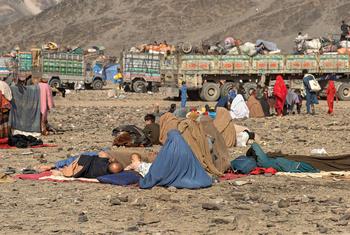
Afghan women and children in burqas rest on blankets on the ground at a border crossing with trucks and mountains in the background.
© UN Women/Sayed Habib Bidell Afghan women with their families arrive from Pakistan with their belongings at the Torkham crossing point (August 2025)

Forced returnees’ plight

Agencies also provide basic assistance and registration every day to thousands of people who are often forcibly returned to the country by its neighbours.

According to the UN refugee agency, UNHCR, around 8,000 people returned to Afghanistan in the week to 20 June 2026.

Most of these returnees have never lived in Afghanistan and did not choose to return. Their biggest concern is survival in a land of few opportunities.

“Once the buses drop them in towns, many have nowhere to go,” Ms. Cherevko explained. Some attempt to return to the countries they came from, only to be deported again. Despite this, many continue trying to leave Afghanistan, driven by desperation and a lack of alternatives.

Alarming situation for women and girls 

With Bamyan province fresh in her mind, Ms. Cherevko highlighted a recurring message from the Afghan women she visited: when opportunities for women are limited, the entire household suffers. Restrictions on education for girls decreed by the Taliban are denying them future employment. “All the women I spoke to are deeply worried about their daughters, who can no longer attend school and may have no future,” the OCHA worker said.

These restrictions are affecting the work of the UN and essential services in turn.

A shortage of female professionals, particularly doctors, has become critical, for instance. Now, when a female doctor leaves her position, it is often nearly impossible to replace her. This has limited women’s and girls’ access to life-saving healthcare drastically, including maternal and neonatal care, as well as services for malnutrition and education.

From January to April 2026, aid partners reached 5.9 million people in Afghanistan with at least one form of assistance. Of this number, 3.5 million received food assistance, underscoring the scale of acute food insecurity and the many other needs of millions of people “who require repeated and complementary support throughout the year to ensure their needs are adequately met”, OCHA said.

Afghanistan in crisis: Drought, malnutrition and a worsening humanitarian situation
read more

EU, UK Pledge Continued Support for Afghan Returnees 0 Comments

The two sides said they will continue, in cooperation with international organizations, to provide protection, humanitarian assistance, and support for rebuilding the lives of vulnerable Afghan families.

In a post on X, the European Union wrote: “On World Refugee Day, the EU reaffirms its commitment to refugees, returnees, IDPs and host communities. Together with UNHCR in Afghanistan and IOM in Afghanistan, we support protection, livelihoods and durable solutions, helping Afghans rebuild their lives with dignity.”

The UK Mission for Afghanistan also wrote on X: “humanitarian aid, including through IOM in Afghanistan, ensures that vulnerable families returning to Afghanistan receive the support they need to help rebuild their lives. No one should be left behind.”

Speaking to TOLOnews, Mohammad Khan Talibi Mohammadzai, a migration affairs activist, said: “Creating infrastructure and expanding cooperation to improve the situation of returning migrants can play an important role in addressing their challenges.”

Deported migrants often face difficulties upon returning to Afghanistan, including a lack of shelter, limited access to basic services, and unemployment, all of which contribute to harsh living conditions.

Access to employment opportunities, education, and adequate housing remains among the key demands of returnees.

Azizullah, a deportee from Pakistan, said: “We were deported from Pakistan and faced inappropriate treatment during the process. Now that we have returned home, we are struggling with many problems and challenges.”

Another migration affairs activist, Mohammad Jamal Muslim, added: “Afghan migrants in neighboring countries face numerous challenges, and many are being forcibly deported. It is necessary for responsible organizations and Afghan authorities to take immediate action to address the humanitarian situation and preserve the dignity of these migrants, especially during the summer season when their difficulties have intensified.”

These remarks come as the return of Afghan migrants from neighboring countries and other parts of the world has increased in recent years, while the need for humanitarian assistance and support remains significant.

EU, UK Pledge Continued Support for Afghan Returnees 0 Comments
read more

Astana Open to Mediating Afghanistan-Pakistan Disputes, Deputy PM Says

He added that Astana is ready to play a mediating role between Afghanistan and Pakistan if formally requested by both sides.

Serik Zhumangarin, Deputy Prime Minister and Minister of National Economy of Kazakhstan, referring to the recent tensions between Kabul and Islamabad, emphasized that his country’s position has always been based on resolving disputes through dialogue.

He added that Astana is ready to play a mediating role between Afghanistan and Pakistan if formally requested by both sides.

He further noted that Kazakhstan’s President has consistently called on the governments of Afghanistan and Pakistan to resolve their differences through dialogue and diplomacy.

Speaking to TOLOnews, Zhumangarin said: “Kazakhstan’s position has always been consistent: all disputes and conflicts should be resolved through dialogue. President Kassym-Jomart Tokayev has repeatedly urged the governments of Afghanistan and Pakistan to settle their differences through talks. If a formal request is made, Kazakhstan is prepared to provide the necessary platform and conditions for such discussions.”

Meanwhile, Zalmay Khalilzad, the former U.S. Special Representative for Afghanistan Reconciliation, has urged Pakistani officials to pursue dialogue with Kabul instead of escalating tensions.

Referring to a recent session of Pakistan’s parliament on the consequences of the closure of trade routes with Afghanistan, Khalilzad stressed that lawmakers should ask the government what its main demands from Kabul are and how Afghanistan has responded to those demands.

Khalilzad stated: “Pakistani parliamentarians who support diplomacy should do more to resolve problems with Afghanistan. They should press their government to negotiate an agreement that neither Afghanistan nor Pakistan will allow their territory to be used by groups or individuals to threaten the security of the other.”

According to Khalilzad, Afghan officials have proposed several measures to address Pakistan’s security concerns, including providing security guarantees, establishing joint coordination mechanisms, and even allowing a third party to participate in reviewing security-related concerns.

Commenting on the issue, political analyst Akhtar Mohammad Rasikh said: “Pakistan has never genuinely sought a path of brotherhood, humanity, Islamic solidarity, or good neighborly relations with Afghanistan, nor has it taken major steps for the prosperity of the people of the two countries.”

These remarks come as relations between Afghanistan and Pakistan have repeatedly been affected in recent years by security concerns, border clashes, and mutual accusations, while efforts to reduce tensions and promote dialogue continue.


Astana Open to Mediating Afghanistan-Pakistan Disputes, Deputy PM Says
read more

The Women Running Businesses Under Taliban Rules

By Elian Peltier

Elian Peltier interviewed a dozen female entrepreneurs, business owners and trade representatives across Afghanistan’s largest cities for this story.

The New York Times

June 21, 2026

The Taliban have imposed some of the world’s toughest restrictions on women and girls, but to ward off economic collapse and isolation, they have let women start businesses in Afghanistan, as long as they comply with a cascade of debilitating rules.

More than 10,000 Afghan women have business licenses — a tenfold increase in the past five years, according to the Afghanistan Chamber of Commerce and Industry. With another estimated 120,000 working without licenses, small businesses are the largest employers of Afghan women, according to the World Bank.

But that apparent boom does little to hide the shrinking horizons for women’s lives.

Those who dreamed of becoming lawyers, engineers or university professors have turned to carpet weaving, cosmetics or vocational training because they cannot work in government administration or for many nonprofits.

They also cannot run beauty salons, study midwifery or nursing, or speak with male clients, suppliers or banking officials.

The vast majority of Afghan women do not work at all — less than 7 percent of Afghan women were employed as of 2024, according to the U.N. Development Programme.

Those who do work have faced growing hurdles. The harassment and arrests of dozens of women by the morality police in June led to a rare public protest.

Still, as the Taliban approach the five-year anniversary of their return to power, Afghan women have turned to entrepreneurship as one of the last ways they can support their households and find a semblance of social life.

The map locates the cities of Herat, Mazar-i-Sharif, and Kabul in Afghanistan.

“The only remaining hope for women in Afghanistan is business,” said Behnaz Saljughi, a representative for female business owners in the province of Herat.

The 19-Year-Old Boss

Nasira Azizi, 19

On a recent morning in a warehouse in Mazar-i-Sharif, in northern Afghanistan, some 60 women knotted, trimmed and wove rugs under the watch of their boss, Nasira Azizi, 19.

Ms. Azizi was 14 when the Taliban swept back to power in 2021 and later barred millions of girls like her from studying beyond sixth grade. “I fell into depression,” Ms. Azizi said about the ban on education. “At home, you see the same faces all the time.”

The rug workshop opened up her world. “Here, there are at least more topics to discuss, more motivation to get the job done,” she said.

Ms. Azizi launched her business with financial support from the U.N. Development Programme, including a grant to create jobs for Afghan women who have been expelled from neighboring Iran and Pakistan in recent years.

She now has about 450 workers in two workshops and at home.

Her two brothers handle the rugs’ design and the marketing. Her father runs one of the workshops, where male employees clean the rugs before they are sold.

The rest — management, human resources, finances — falls to Ms. Azizi. “The business license is under my name,” she said.

‘We Need Bigger Pots’

Roqia Rezaei, 21, said she had dreamed of becoming a mining engineer before the Taliban took over Afghanistan. Unable to pursue that field, she taught English, but the Taliban government cracked down on private tutoring, and her students dwindled.

In 2022, she founded Magnolia, a soap business in Herat, one of Afghanistan’s largest cities. It now sustains her family of seven, she said.

The smell of turmeric wafted over Ms. Rezaei’s workshop on a recent afternoon as her mother stirred the simmering, gluey matter that would soon become soap. Rows of saffron-infused soap bars and dropper bottles filled with black seed oil sat in an adjacent room.

The setup remains rustic — two large stockpots, no automation — but Ms. Rezaei has her eye on Iran and Tajikistan as the next frontiers for her business, which she wants to turn into an international brand by 2030. An avid reader of psychology and management books, she spoke as two dozen certificates and online diplomas pinned to a wall towered over her.

“We need bigger pots and some machines,” Ms. Rezaei said.

A Bee Queen Defies the Rules

“This is one of the good things about the Taliban: The government is active in supporting women’s businesses. And yet, we face more restrictions by the day.”

Ghoncha Karimi, 39

The stories of female entrepreneurs in Afghanistan come with countless caveats.

Ms. Rezaei cannot travel alone to Kabul, the capital, to sell her soap. She needs a male companion. Ms. Azizi cannot advertise the care and finesse put into the rug-making process to male clients.

They often have to rely on their husbands, fathers or brothers to do business.

Or they defy Taliban restrictions.

In Herat, Ghoncha Karimi, 39, a beekeeper, said she sometimes dresses as a man when she travels to the outskirts of the city to tend to her bees.

With her husband struggling to find jobs as a day laborer, the honey Ms. Karimi produces from her 50 beehives makes up a significant portion of the family’s income. She is now known locally as the Bee Queen of Afghanistan.

But sales slumped in 2023 when the Taliban ordered her to stop receiving male clients in her shop, she said.

Twice in recent years, she lost her bees: once after the Taliban takeover when many women stayed at home out of fear, and again in 2023, when she was imprisoned for 20 days after a brawl with a Talib official over limitations on women.

‘I’m the Controller’

Afghan authorities say they encourage women to pursue vocational training programs, and they are also encouraging businesses to hire more of them, as long as the women respect the “principles of the country,” according to Samiullah Ibrahimi, the spokesman for the Afghan Ministry of Work and Social Affairs.

But critics say these measures are nowhere near enough.

When asked about key programs for women, Mr. Ibrahimi referred to a “committee for economic empowerment” that he said had provided work for 26 women this year — in a country of nearly 45 million people.

“Our mothers used to tell us that they worked hard so our future would be better and more peaceful,” said Fariba Noori, the acting head of Afghanistan’s Women’s Chamber of Commerce and Industry. “Our future did not become better or more peaceful. Now we tell our own children the same thing, but I don’t think that will happen.”

Families and conservative values are ever-present obstacles.

Waheeda Noorzai, 41, said she faced years of domestic abuse from her husband because of her professional ambitions. She has a master’s degree, but her husband, she said, does not know how to read or write.

“But after fighting, you become the queen of the family,” she said. “Now, all the girls in my family are at school, and my brothers say, ‘My daughter should be like you.’”

Ms. Noorzai now manages two dozen female employees with hearing impairments at the Norwegian Afghanistan Committee, a nonprofit promoting access to health care and economic inclusion.

And her husband follows her guidance on their two daughters’ educations, she said.

Ms. Rezaei started Magnolia soap when her family was in deep financial trouble. Her father, Cheraghali Rezaei, had driven several businesses to bankruptcy in the past, he said.

Yet in a lengthy interview at the family home, Mr. Rezaei claimed credit for the brand’s success.

“I’m in charge of the marketing, and that is what matters the most. If she’s a television, I’m the controller that can make her into the channel I want.”

As restrictions pile up, some female entrepreneurs say the risks of doing business are simply getting too high.

Ms. Karimi, the beekeeper, was imprisoned when her daughter was only 7. When she returned, her daughter told her, “Mommy, are you really released, or am I dreaming?”

After that episode, Ms. Karimi said, “I told myself, ‘Even if the Taliban hits me on the head, I will not raise my head again.’”

Yaqoob Akbary, Kiana Hayeri and Safiullah Padshah contributed reporting.

The Women Running Businesses Under Taliban Rules
read more

EU Calls for Global Action to Address Hunger Crisis in Afghanistan

The European Union’s humanitarian arm said its aid continues to support life-saving food and nutrition programs across the country.

As millions of families across Afghanistan continue to struggle with economic hardship and food shortages, the European Union has warned that the country is facing a severe hunger crisis.

The EU has called on the international community to increase financial assistance and take practical measures to support vulnerable people in Afghanistan.

The European Union’s humanitarian arm said its aid continues to support life-saving food and nutrition programs across the country.

“EU humanitarian aid continues to support lifesaving food and nutrition assistance in Afghanistan. But the hunger crisis has arrived. The world must step up – with more funding, more action and more solidarity,” the organization said.

Meanwhile, Afghanistan’s Ministry of Economy has urged the international community to separate humanitarian issues from political considerations.

A senior official at the ministry stressed the importance of maintaining humanitarian assistance to Afghanistan, describing support for vulnerable people as a responsibility of the international community.

Abdul Latif Nazari, Deputy Minister of Economy, said: “We call on the international community to separate humanitarian assistance from political issues and increase support for those in need across the country.”

Economic analyst Hasibullah Safi said that implementing large-scale development projects and attracting both domestic and foreign investment could help reduce unemployment and improve household incomes.

Residents of Kabul have also called for the creation of more job opportunities to address humanitarian and economic challenges.

Abdul Majid, a resident of Kabul, said: “To reduce poverty in the country, more employment opportunities must be created so families can earn a living.”

The United Nations previously reported that nearly 21.9 million people about 45 percent of Afghanistan’s population require humanitarian assistance, highlighting the continued severity of the country’s livelihood crisis.

EU Calls for Global Action to Address Hunger Crisis in Afghanistan
read more

Afghanistan strikes targets in Pakistan, raising cross-border tension

By Al Jazeera Staff and Reuters

Afghanistan has launched air strikes on what it called hideouts used by armed groups and “hostile intelligence circles” inside Pakistan, Kabul has announced.

The strikes, reported on Friday by Afghanistan’s defence ministry, were launched the previous day. The incident is the latest threat to the fragile ceasefire between the neighbours.

Hostilities have broken out several times over recent months, killing hundreds of people, and mediators led by China have so far failed to secure an agreement for a settled peace.

The hideouts, located in Pakistan’s Balochistan and Khyber Pakhtunkhwa provinces, both of which share a border with Afghanistan, were targeted by the “air force” on Thursday night, Afghanistan’s defence ministry said in a social media post.

The ministry said that the “bases” it described as belonging to ISIL-Khorasan (ISIS-K) had been “allegedly used in cooperation with certain hostile intelligence circles to plan and organise attacks against Afghanistan,” presumably referring to Pakistani intelligence.

The ministry said one of the sites targeted in the operation was a facility allegedly frequented by senior ISIS-K leaders. It added that “important targets” had been hit, based on preliminary information.

ISIS-K has claimed responsibility for attacks in Afghanistan in recent years that have killed civilians.

Responding to the reports on Friday, Pakistan’s Ministry of Information and Broadcasting dismissed the claims.

“The claims are false as usual,” the ministry posted on social media, calling Afghanistan’s reports “fake and nefarious statements”.

“Terrorist camps including that of Daesh [ISIL] and more than two dozen other terrorists organisations are factually located, run and patronised from inside the territories under control of Afghan Taliban regime,” the ministry added on X.

Since the Taliban returned to power in 2021, Pakistan has regularly accused Kabul of harbouring armed groups that launch attacks across their shared border, and has carried out numerous air strikes it says are aimed at such forces. Afghanistan has refuted all accusations.

Kabul did not specify how the attack – the first major ‌offensive action claimed by Kabul in months – was carried out.

Afghanistan has no fighter jets but is known to possess at least six aircraft and 23 helicopters, according to data from the London-based International Institute for Strategic Studies.

The Taliban forces are also known to have drones that have been used in fighting with Pakistan.

Afghanistan strikes targets in Pakistan, raising cross-border tension
read more

Afghanistan Accounts for Nearly Half of the World’s Exiled Journalists Since 2021, RSF Says

Khaama Press

Afghanistan has become the world’s leading source of exiled journalists, with hundreds forced to flee threats, arrests and growing restrictions on independent media, according to a new report by Reporters Without Borders.

AfghanPolitical Analysis

Reporters Without Borders (RSF) stated on Fiday, June 19 that at least 677 Afghan journalists have been forced to leave the country between 2021 and 2025 due to threats, detention, persecution and fears for their safety, making Afghanistan the largest source of exiled journalists worldwide.

According to the report, Afghan journalists account for nearly half of the 1,468 journalists whom RSF has assisted after fleeing their home countries during the past five years. The organization said Afghan journalists are now scattered across 28 countries, describing Afghanistan as a “global epicentre of journalist exile.”

RSF said no other country has experienced such a large-scale exodus of media professionals in recent years. By comparison, the organization supported 160 Russian journalists and 101 Myanmar journalists during the same period.

The report links the mass departure of journalists to the collapse of independent media following the Taliban’s return to power in August 2021. Since then, hundreds of media outlets have reportedly closed, thousands of journalists have lost their jobs and restrictions on press freedom have steadily increased.

The largest wave of departures occurred in 2022, when 183 journalists left Afghanistan. However, the trend has continued, with at least 82 additional journalists forced into exile in 2025 alone. RSF said journalists inside the country continue to face arrests, interrogations, censorship and increasing restrictions on reporting.

The report notes that bans on publishing images of living beings in several provinces have further constrained media operations, particularly affecting television broadcasters and visual journalists. Women journalists have been among the hardest hit, facing additional barriers to employment, education and participation in public life.

RSF warned that exile has not necessarily brought safety. Many Afghan journalists abroad continue to face legal uncertainty, financial hardship and the threat of deportation. The organization highlighted Pakistan as a particular concern, noting that since the launch of deportation campaigns against Afghan migrants in 2023, at least 50 Afghan journalists have reportedly been forcibly returned to Afghanistan.

The findings come amid broader concerns over shrinking civic space and restrictions on freedom of expression in Afghanistan. International human rights organizations and media advocacy groups have repeatedly warned that growing limitations on independent journalism are reducing public access to information and weakening accountability mechanisms.

AfghanPolitical Analysis

The report also comes as thousands of Afghans, including journalists, activists and former government employees, continue to face uncertainty in neighboring countries. Pakistan and Iran have accelerated deportation and repatriation campaigns in recent years, while many Afghan refugees remain stranded awaiting resettlement opportunities in third countries.

RSF called on governments to expand emergency visa programs, provide long-term residency pathways and halt the forced return of journalists to countries where they may face persecution. The organization warned that without stronger international support, many exiled Afghan journalists could face a new cycle of insecurity, displacement and professional exclusion.

Afghanistan Accounts for Nearly Half of the World’s Exiled Journalists Since 2021, RSF Says
read more

Amnesty International Says Returned Afghan Refugees Face Rights Violations

Amnesty International has warned that Afghan refugees who are returned to Afghanistan face serious human rights violations and worsening humanitarian conditions, as deportations from neighboring countries continue to increase.

Marking World Refugee Day on Saturday, Amnesty International said millions of Afghan refugees and migrants are facing growing pressure, detention and deportation in host countries. The organization added that many Afghans experience arbitrary arrests, family separations and other protection concerns before being returned.

In a statement posted on X, Amnesty International said that many deported Afghans return to one of the world’s most severe humanitarian crises, where they face insecurity, economic hardship and restrictions on fundamental rights.

The warning comes as international agencies report a sharp rise in returns from neighboring countries. The United Nations High Commissioner for Refugees (UNHCR) and International Organization for Migration (IOM) have repeatedly called for refugee returns to be voluntary, safe and dignified, while urging greater international support for returnees and host communities.

Pakistan has been at the center of the latest deportation wave. Prime Minister Shehbaz Sharif recently said that around 2.4 million Afghans have returned to Afghanistan since September 2023, including both voluntary returnees and those deported under Pakistan’s repatriation policies. Human rights groups and aid agencies have expressed concern about the impact of these large-scale returns on vulnerable families.

Afghanistan continues to face a deep humanitarian and economic crisis. Millions of people rely on humanitarian assistance, while women and girls remain subject to extensive restrictions on education, employment and public life under Taliban rule. Rights organizations say these conditions make reintegration particularly difficult for returning refugees.

The situation has become increasingly challenging for Afghan journalists, former government employees, women activists and others who fear persecution upon return. International organizations have urged governments not to forcibly return individuals who may face serious risks in Afghanistan.

Amnesty International called on governments to uphold international refugee protection standards and ensure that Afghan refugees are not returned to conditions that could place their safety, rights and dignity at risk.

Amnesty International Says Returned Afghan Refugees Face Rights Violations
read more

US Budget Bill Seeks to Block Transfer of Afghan Allies From Qatar to High-Risk Countries

By Fidel Rahmati

Khaama Press


A proposed US defense spending bill for 2027 includes provisions that could prevent the transfer of former Afghan allies from Qatar to Afghanistan or other countries deemed unsafe.

A draft US defense authorization bill for fiscal year 2027 contains measures aimed at protecting Afghan nationals who previously worked with American forces and are currently awaiting resettlement in Qatar, according to advocacy group AfghanEvac.

AfghanEvac President Shawn VanDiver said the preliminary versions of the National Defense Authorization Act being considered by the US Senate and House of Representatives include provisions related to former Afghan partners of the United States.

According to VanDiver, one provision would restrict the transfer of Afghans housed at a processing center in Qatar to Afghanistan or other countries considered high-risk from a security perspective. Another section proposes the preservation and protection of records related to Afghans who assisted US military operations.

The draft legislation also includes a proposal to extend the mandate of the Afghanistan War Commission, allowing additional time for completion of its final report on the two-decade US involvement in Afghanistan.

AfghanEvac warned, however, that uncertainty remains over implementation timelines. The organization noted that the processing facility in Qatar, which hosts more than 1,000 Afghans who previously worked alongside US forces, is expected to close by September 2026.

The issue comes as thousands of Afghans linked to Western governments and military missions continue to await relocation to the United States and other countries under special immigration and humanitarian programs. Advocacy groups have repeatedly warned that delays in processing applications leave many former interpreters, contractors and support staff in prolonged uncertainty.

The debate also coincides with a worsening humanitarian situation inside Afghanistan. International aid agencies report that millions of Afghans remain dependent on humanitarian assistance amid economic hardship, restrictions affecting women and girls, food insecurity and limited access to essential services.

Humanitarian organizations have further expressed concern over the growing influx of Afghan returnees from neighboring Iran and Pakistan. Since late 2023, millions of Afghans have returned or been deported from the two countries, placing additional pressure on already strained communities, public services and aid resources across Afghanistan.

Many Afghan refugees also remain in Pakistan while awaiting resettlement decisions, while others are being processed through temporary facilities in Qatar. Rights groups have urged Western governments to accelerate relocation programs, arguing that former Afghan allies face significant security risks if returned to Afghanistan before their cases are resolved.

If approved by Congress and signed by the US president, the proposed legislation would become law and could provide additional safeguards for vulnerable Afghans still seeking permanent resettlement.

US Budget Bill Seeks to Block Transfer of Afghan Allies From Qatar to High-Risk Countries
read more

IOM: Over 6M Afghans Returned From Iran, Pakistan Since 2023

International organizations and the Islamic Emirate of Afghanistan have repeatedly called on host countries to prevent the forced deportation of Afghan migrants.

The International Organization for Migration (IOM) has reported that more than 6.04 million Afghan citizens returned to Afghanistan from Iran and Pakistan between September 2023 to May 2026.

According to the report, beyond changing patterns of population movement, the scale and speed of this return wave have created significant challenges for reintegration and strengthening long-term resilience in Afghanistan.

The organization emphasized that effective reintegration strategies and timely support are essential for enhancing community resilience and the absorption capacity of host communities.

The report states that many returnees, some of whom have spent decades or even their entire lives abroad, arrive with limited social networks, little familiarity with local systems and norms, and restricted access to housing, livelihood opportunities, public services, civil documentation, and support mechanisms. The report also reads that effective reintegration strategies and timely assistance are therefore not only critical for the well-being and stability of returnees, but are also necessary for strengthening community resilience and the absorption capacity of host communities, contributing to greater social cohesion and solidarity.

Abdul Zohor Modaber, an economic analyst, said: “Some returnees possess valuable skills, expertise, and knowledge and can contribute productively to the country’s workforce and economy. However, others lack the necessary skills and education, and the government needs to provide them with full support.”

Nader Khan, who left for Pakistan 43 years ago and has now returned to Afghanistan at the age of 52, described the difficulties migrants have faced in recent years in Pakistan.

Speaking to TOLOnews, he said: “The detention and imprisonment of migrants increased, so we left and came back. We have no concerns; we have returned to our own country and will work here.”

Another returnee from Pakistan, Shah Mahmood, said: “Our request from the Islamic Emirate is to provide us with employment opportunities and educational opportunities for our children, especially our daughters.”

Experts believe that the forced return of Afghan citizens requires a coordinated response between aid organizations and the Islamic Emirate to ensure that returnees receive proper support.

Ali Reza Karimi, a migrant rights activist, said: “International organizations should support returnees through temporary shelter, humanitarian assistance, education, and job creation. At the same time, the Islamic Emirate of Afghanistan should facilitate returnees’ access to employment, education, and essential services.”

International organizations and the Islamic Emirate of Afghanistan have repeatedly called on host countries to prevent the forced deportation of Afghan migrants.

IOM: Over 6M Afghans Returned From Iran, Pakistan Since 2023
read more