In Afghanistan’s 15 provinces, at least one Swedish institution operates in the fields of education, health, child welfare, or other areas.
The Islamic Emirate on Tuesday suspended all Swedish activities in Afghanistan in reaction to a Swedish citizen burning the Quran.
Islamic Emirate spokesman Zabiullah Mujahid issued a statement saying that the Islamic Emirate in reaction to the burning of the Holy Quran in Sweden has stopped the activities of all institutions of this country in Afghanistan, and until this country apologizes to Muslims, its activities in Afghanistan will be stopped.
“Sweden allowed and insulted the Holy Quran; the Islamic Emirate condemns the evil and insolent acts and suspends all of Sweden’s activities in Afghanistan until Sweden begs for pardon from the Muslims,” said Bilal Karimi, deputy spokesperson for the Islamic Emirate.
In Afghanistan’s 15 provinces, at least one Swedish institution operates in the fields of education, health, child welfare, or other areas.
“As a Muslim nation, it can respond and continue to condemn these actions in a way that does not harm Afghanistan itself and the Afghan nation,” said Aziz Marij, a political analyst.
“Governments are aware that the Swedish government was not engaged; for example, Erdogan met with the Swedish Chancellor yesterday. In any case, it’s possible that the Norwegian or Danish committees will take over the Swedish committee’s operations,” said Tariq Farhadi, another political analyst.
Meanwhile, some local officials and residents of Mazar-e-Sharif at a gathering condemned the burning of the Quran in Sweden.
“Islam is alive throughout the world, and they cannot put Islam out by burning a holy Quran,” said Hekmatullah Obaid, a religious cleric.
Clerics shared their views:
“Islamic countries have the right to take any appropriate measures to prevent the repetition of these criminal acts and to protect the sanctity…,” said Fazl Hadi Wazin, a religious cleric.
This comes as two weeks ago an Iraq-born Swedish citizen tore a copy of the Quran and lit it on fire outside the Stockholm Central Mosque.
The act was condemned by other nations throughout the world, including Turkey, the United Arab Emirates, Iraq, and Morocco.
The Swedish Committee for Afghanistan addressed the issue in a statement:
“The Swedish Committee for Afghanistan, SCA, is seeking dialogue with the de facto authorities of Afghanistan to clarify if the directive of July 11 to suspend all Sweden’s activities in Afghanistan will affect our organization,” the SCA said in a statement.
According to the statement, the SCA is not a Swedish government entity, SCA is independent and impartial in relation to all political stakeholders and states and is funded by a broad range of donors.
“SCA strongly condemns all acts of desecration of the Holy Quran, as we do any attempt to create conflict or hostility between people based on religious belief, ethnicity, nationality, or any other division,” the statement reads.
Kabul Suspends Swedish Institutions in Afghanistan Over Quran Burning
In the meantime, some residents of the Kabul said that they do not have access to social services in the current situation.
On World Population Day, the UN Secretary-General Antonio Guterres emphasized the need to support the rights of women and girls in the world.
On Twitter Guterres asked the world to stand by the women who are fighting for their rights.
“Gender-based discrimination harms everyone – women, girls, men, and boys. Investing in women uplifts all people, communities, and countries. On World Population Day and every day, let’s stand with women and girls fighting for their rights,” he tweeted.
In the meantime, some residents of the Kabul said that they do not have access to social services in the current situation.
“There is no electricity at all in some Afghan provinces and villages. No water is available, and there are no medical facilities,” sai Fazl Rahman, a resident of Kabul.
“The population has grown. The weather has warmed up and that there is a lot of waste that spreads numerous diseases,” Mansour, a resident of Kabul, told TOLOnews.
World Population Day, observed on July 11, aims to raise awareness about global population issues and their impact on society.
“Population growth has various consequences. One is that it has environmental consequences; as the population grows, environmental problems in the communities increase, and on the other hand, it has consequences affecting other economic and social problems,” said Mohammad Baqer Mohseni, a university lecturer.
Even though the National Statistics and Information Authority (NSIA) has not released updated population numbers, according to official sources, the country’s population exceeded 34 million in the solar year 1401.
Guterres: Let’s Stand with Women, Girls Fighting For Their Rights
KABUL: Deputy Prime Minister of the Islamic Emirate for Political Affairs Mawlavi Abdul Kabir met with a number of religious scholars, youths and influential figures of the country’s central province of Maidan Wardak, his office said in a statement Monday. In the meeting, Mawlavi Kabir said that the current system has risen from the heart of the society, all Afghans have equal rights and discrimination has no place in the Islamic system, according to the statement.
Expressing the pleasure over the re-establishment of the Islamic system, the elders said that after decades for the first time the real representatives of the nation took the country’s affairs and this was as a result of efforts and sacrifices of the people, according to the statement. Also, they assured of their full support to the Islamic Emirate as well as assured of any necessary cooperation with the current system, the statement added. They shared problems related to their province with the PM Kabir, asking for the implementation of the development projects and distribution of electricity in their province.
Meanwhile, Deputy PM appreciated their sacrifices and efforts for supporting the Islamic Emirate and taking constructive and active part in Jihad and assured that special attention will be paid to address their challenges, the statement added. “The Islamic Emirate of Afghanistan (IEA) is a common home for all Afghans and all officials are ready to honestly serve for the war-affected people and country,” the statement quoted the deputy PM Kabir as saying. The Kabul Times
No discrimination in Islamic Emirate: Prime Minister
ISLAMABAD (AP) — Two children died as scores of Afghan families fled a Taliban demolition this week of their shantytown homes in Kabul, an international aid group said Tuesday.
The Norwegian Refugee Council said the demolition of the ramshackle settlement in the Pul-e-Shina area outside of Kabul this week left 280 families, or around 1,700 people, homeless. The group said it received reports of two children — one aged 4 and another aged 15 — dying as families evacuated their homes.
The group did not know the immediate cause of death. A spokesman for the Kabul municipality, Niamatullah Barakzai, said there were no deaths or injuries during the clearance operation.
More than 6 million people are internally displaced in Afghanistan, mostly due to decades of war. But worsening living conditions since the Taliban takeover in August 2021 — as U.S. and NATO forces were withdrawing from the country after 20 years of war — and increased economic hardship are also forcing people to move.
The economic collapse has driven large swaths of the population into poverty as the flow of foreign aid has slowed down, forcing people to seek work, shelter, and aid elsewhere.
The council urged the authorities to halt further evictions and to uphold their obligations under international law, which guarantees their rights against forced eviction.
“Internally displaced people who are living in these settlements are already on the brink of survival and struggling with the economic crisis — this raises serious concerns that evictions will exacerbate the already extreme humanitarian needs,” said Neil Turner, the Norwegian Refugee Council’s country director.
Barakzai, the Kabul official, denied houses were demolished in Pul-e-Shina. “We cleared the land that was illegally taken by people,” he said. “No one was harmed. The death of children is a lie. We have all the evidence and we will not allow anyone to illegally take an area.”
Nearly 80% of the previous, Western-backed Afghan government’s budget came from the international community. That money, now cut off, financed hospitals, schools, factories and government ministries. The pandemic, medical shortages, drought and malnutrition have made life more desperate for Afghans.
Aid group says 2 children died as families fled Taliban demolition of their Kabul shantytown
However, the Ministry of Information and Culture said that the Islamic Emirate is committed to providing information to journalists.
Journalists complained about the lack of access to information, saying that the Islamic Emirate’s spokespersons are not providing information to them on time.
“When we want to contact the spokesperson, they first do not answer and if they answer they say that they are not aware about it. Thus, they don’t provide information,” said Toba, a journalist.
“We say to the Islamic Emirate that we face serious problems when we don’t have access to information to convey it to the people,” said Samiha, a journalist.
This comes as the head of the Afghanistan National Journalists Union (ANJU), Masroor Lutfi, confirmed the challenges faced by journalists seeking access to information.
“If there is no serious attention paid to this, providing information to the people will be face serious problems,” he said.
However, the Ministry of Information and Culture said that the Islamic Emirate is committed to providng information to journalists.
“All of the governmental institutions and spokespersons are obliged to provide information on time and if there is any issue, if the spokespersons don’t provide information to the officials, the journalists can refer to the Ministry of Information and Culture,” said Mahajar Farahi, deputy Minister of Publication of the Ministry of Information and Culture.
Earlier, the Ministry of Information and Culture said that the mass media law and issue of access to information have been sent to the leadership of the Islamic Emirate for approval.
Journalists: Access Restricted to Timely Information From Interim Govt
With the Islamic Emirate taking over Afghanistan on August 15th, 2021, the Afghan assets in foreign reserves were frozen.
The Islamic Emirate has once again called on the international community to remove sanctions, saying that it is needed to facilitate engagement between the Islamic Emirate and the international community.
With the Islamic Emirate taking over Afghanistan on August 15th, 2021, the Afghan assets in foreign reserves were frozen.
In August 2022, the UN Security Council failed to reach an agreement on whether to extend travel exemptions for 13 Taliban officials.
According to TOLOnews findings:
– More than $9 billion in assets were frozen by the US and European countries.
– Restrictions were placed on the banking system and transfering money abroad.
– Travel bans were placed on 15 Islamic Emirate officials.
Islamic Emirate’s spokesman Zabiullah Mujahid said that restrictions on traveling by Islamic Emirate’s leaders does not benefit any side.
“About 14 to 15 officials have issues with traveling. It (travel ban) existed previously but it has been extended. This doesn’t benefit any side as the travels of the leaders are necessary for engagement with the world and development of Afghanistan,” he said.
Meanwhile, the Ministry of Economy (MoE) said that the imposed sanctions by the international community are affecting the life of the people of Afghanistan.
“The imposition of pressure policy and sanctions by some of the countries has affected our countrymen,” said Abdul Latif Nazari, deputy Minister of Economy.
But political analysts gave various opinions about the sanctions on the Islamic Emirate’s leaders.
“If the Taliban wants, they can bring reform as an independent government and accept the conditions to get out of the blacklist and travel bans,” said Aziz Maarij, a political analyst.
“The Afghan currency is in a good position due to the strategic deposits of Afghanistan’s assets which guarantees the international value of the Afghan currency, although it is frozen,” said Azeraksh Hafizi, an economist.
Islamic Emirate Urges Intl Community to Remove Sanctions
WASHINGTON (AP) — At 31 years old, Nasrat Ahmad Yar had spent most of his adult life working with the U.S. military in Afghanistan before escaping to America in search of a better life for his wife and four children.
He found work as a ride-share driver and even managed to send money back to Afghanistan to help family and friends. He liked to play volleyball with friends in the Washington suburb where many Afghans who fled their country now live. At 6-feet-5 inches, he had a powerful serve.
Last Monday night, worried about making rent, he went out driving and was shot and killed in Washington. No suspects have been arrested, but surveillance video captured the sound of a single gunshot and four boys or young men were seen running away. Police have offered a $25,000 reward for information leading to an arrest.
“He was so generous. He was so nice. He was always trying to help the people,” said Rahim Amini, a fellow Afghan immigrant and longtime friend. He said Ahmad Yar always reminded him, “Don’t forget the people left behind.”
Jeramie Malone, an American who came to know Ahmed Yar through her volunteer work with a veteran-founded organization bringing former Afghan interpreters to safety, also was struck by his generosity.
“He always wanted to be giving more than he was receiving and he was just really extremely kind.” In America, Malone said, “all he wanted was a chance.”
Afghans and U.S. military veterans gathered for a funeral service Saturday at the All Muslim Association of America in Fredericksburg, Virginia. Family and friends comforted Ahmad Yar’s children and wife as his casket was lowered into the ground with ropes and people used shovels to toss soil on top.
One of those in attendance was Matthew Butler, now retired from the military who met Ahmad Yar in 2009 at Bagram Airfield, then an American base north of Kabul, the Afghan capital. Ahmad Yar was his primary interpreter for two tours in the country.
Butler said Ahmad Yar was like a brother or a son to him, and he noted the military’s commitment to leaving no one behind — something he said now extends to Ahmad Yar’s wife.
“I pledged my support to his wife and his children, and said just because Nasrat is gone doesn’t mean my support to you is gone. I won’t leave you behind,” Butler said after the ceremony.
Amini said Ahmad Yar had worked for the U.S. military for about a decade as an interpreter and doing other jobs, seeing it as a way to help pave the way for the next generation in Afghanistan to have a better life.
While the U.S. has had a Special Immigrant Visa program for Afghans who worked closely with the U.S. government to come to America since 2009, Amini said his friend didn’t want to apply right away, preferring to stay in Afghanistan, where he felt needed.
He remembered Ahmad Yar saying: “I have guys here I need to support. … When I feel that they don’t need my support then I can go to America.”
Then, in August 2021, the U.S. pulled out of Afghanistan and the Taliban took over.
Mohammad Ahmadi, Ahmad Yar’s cousin, was already in America after also working for the U.S. military. The two talked on the phone about how to get Ahmad Yar and his family out of Afghanistan. Ahmadi said his cousin could see the Taliban soldiers walking through the streets of Kabul and was worried they would discover he’d been an interpreter for the U.S. military.
“He said, ‘I don’t want to get killed in front of my wife and kids,’” Ahmadi said.
When he wasn’t able to get out of the crowded Kabul airport, Ahmad Yar went to northern Afghanistan in hopes of getting into Uzbekistan. When that didn’t work, he and his family went to the northwestern city of Mazar-e-Sharif, where he and his family were able to get on a flight to the United Arab Emirates and then eventually travel to America.
Even when laying low in Mazar-e-Sharif, Nasrat would go out of his way to assist other Afghans who also had come to escape the Taliban — greeting them on arrival to the strange city, bringing their families to stay with his, and feeding them, while all waited for flights out, Malone said.
“Nasrat was very different, because even though he was needing help, he was always helping me,” she said.
While waiting at the interim transit camp in the United Arab Emirates, he asked for writing supplies for the children so he could teach them English before they arrived in the U.S., Malone said. “It was really important for him for his kids to get an education and for them to … have opportunities they never would have had in Afghanistan.”
His eldest child, a girl, is now 13, and the others are boys, ages 11, 8 and just 15 months old.
The family went first to Pennsylvania, but Amini said his friend was robbed there and decided to move to Alexandria, in northern Virginia. Amini said Ahmad Yar told him he’d fled to the U.S. “to be safe and unfortunately I’m not safe here.”
In northern Virginia, they both ended up being ride-share drivers and lived about 2 miles (3 kilometers) from each other. Like many in the Afghan diaspora there, they chatted throughout the day in a WhatsApp group text. And they played in a weekly volleyball game. Ahmad Yar was really good and no one could block his serve, Amini said.
Amini said they spoke Monday evening and the next thing he knew he was woken up by another Afghan friend who had somehow heard that Ahmad Yar had been killed.
In disbelief, Amini began frantically calling his friend. But it was the police who finally answered the phone: “The police officer said: ‘I’m sorry. Unfortunately he’s not alive anymore.’”
The police said in their report that they responded to a call about an unconscious person and found Ahmad Yar’s body. They rushed him to the hospital, where he was declared dead. On the surveillance video they released, one of the four suspected attackers shouted, “You just killed him.” Another answered, “He was reaching, bro.”
His wife is still in shock, said Ahmad Yar’s cousin, Ahmadi. But she said she and her husband had the same goal in coming to America — to provide a future for their children.
She told Ahmadi: “I have the same goal for them. They can go to school. They can go to college and become educated and good people for the society.”__
Associated Press videojournalist Serkan Gurbuz in Fredericksburg, Virginia, contributed to this report.
An Afghan man who spent years helping US forces in Afghanistan is shot and killed in Washington
My country, where the pursuit of knowledge was always venerated, is descending into darkness.
It has been almost two years since the Taliban took over Kabul. I, like many Afghans who worked hard to attain a good education, am struggling. Knowledge seems to be losing its value and books are no longer considered a precious possession.
When Taliban fighters arrived in the Afghan capital in August 2021, many of my friends rushed to the airport to try to leave, seeing no prospect for themselves in their home country anymore. The brain drain was immense.
People with masters’ degrees, PhDs, with multiple published books, professors, educators, medical doctors, engineers, scientists, writers, poets, painters – many learned people fled. A colleague of mine – Alireza Ahmadi, who worked as a reporter – also joined the crowd at the airport.
Before he left, he wrote on his Facebook page that he had sold 60 of his books on a variety of subjects for 50 Afghanis (less than $1). He never made it out of the country; he was killed in the bombing of the airport by the Islamic State in Khorasan Province.
I, too, decided to give away all my books – all 300 hundred of them, covering topics like international law, human rights, women’s rights and the English language. I donated them to public libraries, thinking that in a country ruled by the Taliban, they would be of no value to me.
I started searching for ways to leave the country. Evacuation was not an option for me so I decided to go to Iran, hoping I could find safe haven there like millions of other Afghans. But like my fellow countrymen and women, I faced contempt and hostility there. I soon lost all hope that I would be able to make a living in Iran. But I did find something that kept me going – my old love for books.
One day, as I walked along Enqelab Square in Tehran, I could not hold back from entering its bookstores. I ended up spending most of the little money I had on books about human rights and women’s rights that I had never seen in Afghanistan. Armed with these volumes, I decided to go back home and try to get back into my old way of life – surrounded by books and engaged in intellectual pursuits.
Upon returning, I started working on a book about the political rights of women within the international legal system and within Islam, which I managed to complete in about a year. I sent my manuscript to different publishers, but was repeatedly turned down because they found the subject too sensitive and thought that getting permission to publish it would be impossible.
Finally, Ali Kohistani of Mother Press agreed to take the book. He prepared the needed documentation and submitted the manuscript to the Taliban Ministry of Information and Culture to request formal permission to publish. Soon after, the committee tasked with book review sent me a long list of questions and critiques that I had to address.
I revised the book along the feedback they sent, but that was not enough to get permission. It has been five months now that we have waited for a final response and my despair is growing by the day.
Other publishers are also suffering from the arbitrariness of the commission’s decisions and long delays. They say books that the Taliban want to publish and that fall within their ideology do not face the same challenges. They see in this fraught process an attempt to suppress any thought that disagrees with the Taliban’s thinking.
Publishing permission delays and censorship are by far not the only problems Afghanistan’s book industry is suffering from.
Scores of bookstores and publishing houses have shut down in the past two years. In the book compound in the Pul-e-Surkh area of Kabul, which I use to frequent before the Taliban takeover, the majority of bookstores have now shut down.
The Taliban’s decision to ban girls and women from attending high school and university means they are no longer buying books as much. Boys and young men have also dropped out of school and universities, being demotivated to pursue an education that cannot guarantee them a job. This has severely shrunken the customer base of booksellers.
On top of that, the Taliban government has imposed high taxes on book sales, which have dwindled even further the declining income of bookstore owners and publishers.
Libraries throughout the country have also lost their readers, as fewer people go there to study or borrow books. Various book clubs, literary associations and reading initiatives have also stopped their activities. It is no longer seen as a value to own, read, or write books.
Overnight, Afghan book publishing has gone from being a flourishing sector – perhaps the most successful homegrown industry – to a struggling and risky business venture. Afghans have gone from being avid readers to not being able to afford books. I have gone from being a proud author and book owner to a despaired man who has tried and failed to hold on to an intellectual life in Afghanistan.
It is extremely painful to see this state of affairs in Afghanistan – a country with a long literary history and tradition. This land gave the world the likes of Jalal ad-Din Muhammad Balkhi (also known as Rumi), Ibn Sina Balkhi (also known as Avicenna), and Hakim Sanai Ghaznavi (also known as Sanai).
Reading, writing and disseminating knowledge were always highly regarded in my country. Afghan rulers of different dynasties have respected the freedom of thought and supported learning and knowledge production. Censorship, restricting education and devaluing books were never part of the Afghan tradition or culture.
No country in world history has ever prospered when its rulers had suppressed knowledge, education and free thought. Afghanistan is moving towards darkness and ignorance and that scares me. Killing books and killing knowledge will have horrible consequences for the future of this country.
The views expressed in this article are the author’s own and do not necessarily reflect Al Jazeera’s editorial stance.
Hujjatullah Zia is a journalist and senior writer in Daily Outlook Afghanistan Newspaper
Books are losing value in Afghanistan – this scares me
KABUL — Psychiatrist Shafi Azim spent much of his career attending to the trauma caused by two decades of fighting, which ripped apart buildings and families.
But over the past months, his hospital — Afghanistan’s primary mental health facility in Kabul — has filled with patients who say they are experiencing a different kind of suffering, he said. With the Taliban leadership severely restricting female education and work, there are mounting concerns about the mental health of girls and women. The restrictions and “sudden changes,” said Azim, appear to be at the root of the trauma suffered by most women and girls now seeking help at this hospital.
“They fear they will never be able to go back to work or school,” said Azim, 60. “They are isolated and become depressed.”
Mental health professionals at five Afghan hospitals and health centers shared similar accounts of a rising challenge. They said many women are receiving outpatient therapy and medication. Some have been encouraged by doctors to seek an escape in the shrinking number of activities that are still tolerated.
“As the circle of limitations and restrictions widens,” said a female mental health worker, “even women who were so far not directly impacted by the bans are now being dragged into it.”
The Taliban says that women’s lives have improved under its two-year rule. Supreme leader Haibatullah Akhundzada issued a ban on forced marriages shortly after taking power, and he vowed in a recent audio message that he wants women to live “comfortable” lives.
But many women tell a different story. A 29-year old participating in an art workshop for girls and young women in Kabul said she is afraid of the moments when her fellow students say they are starting to feel better. “These days, it actually just means they have given up hoping for a better life,” said the woman, who like others interviewed spoke on the condition of anonymity for fear of reprisals.
Resistance and resignation
Even before the Taliban came to power, a study published in the journal BMC Psychiatry found that about half of Afghan women suffered from high psychological distress.
Viviane Kovess-Masfety, one of the study’s authors, said no comparable study has been released since the Taliban takeover. It may be too soon to tell if psychological conditions blamed on the restrictions reflect mounting nationwide distress, she said, adding that the end of the war also may have prompted positive changes.
Butparticularlyin urban areas, the Taliban’s view of what women’s lives should look like has often been met with resistance, criticism and — increasingly — resignation, as the government has banned secondary and university education for women, prohibited them from working for nongovernmental organizations or U.N. agencies in many roles and restricted their access to public spaces. This week, the Taliban ordered beauty salons to close within a month, eliminating one of the last opportunities for women to work and socialize.
Representatives of Afghanistan’s health ministry, which granted The Washington Post access to visit several hospitals, did not respond to questions. The ministry has not released public data on mental illness among women.
In the main hospital of Herat in western Afghanistan, mental health department head Shafiq Umair said he had seen no cases of girls “shaken because they can’t go to school.” The world “thinks our women are weak, but they are very strong,” he said, adding that “our women aren’t interested in getting education.”
But a few yards down the crowded corridor, his colleagues were attending to a hospitalized 16-year-old whose mother recalled how her daughter’s mental health had deteriorated after the girl’s 80-year-old fiancé prohibited her from going to school. When she decided instead to teach younger students at a madrassa, a religious school, her fiancé banned that, too.
When her daughter is depressed, the mother said, she tells her that one day she will get back to teaching. “It’s the only way to motivate her these days,” she said.
Similar accounts are more widespread than the hospital’s management admits, according to one doctor, speaking on the condition of anonymity because he was not authorized to talk with journalists. He estimated that women who struggle to cope with Taliban-imposed restrictions and the more repressive climate account for about 80 percent of non-hospitalized patients in this facility.
“We prescribe them medication or therapy,” the doctor said hurriedly, while his supervisor was elsewhere. “And then we send them away.”
Vanishing opportunities
Eighteen-year-old Sayed has tried to help his sisters persevere, once they were barred from furthering their formal education.
He said he teaches his younger sister at their Kabul home. She usually stays in her room all day, he said, going through books and trying to keep up with the lessons she would have been able to take, had schools not been closed. “But at least she still has hope,” said Sayed.
His older sister is struggling. She was about to attend a university when women were banned last year. She signed up for English classes, only for those to be shut down as well. “Every time she tries to hold on to something, it disappears,” said Sayed.
As her life spiraled downward, he said, his sister sought help at a mental health facility multiple times in recent months.
Afghan psychologists said they must reconcile a growing gap between reality and the optimism they were taught to convey. When young patients come to her these days, “I no longer believe what I tell them,” said a female mental health counselor in Herat.
Another counselor in Herat said the best approach is urging women to forget about the opportunities of the past and to focus on what is still possible. With women banned from gyms and many parks, some psychologists are encouraging girls to turn to art workshops.
In a Kabul business center, more than a dozen girls and young women met on a recent morning to talk, paint and learn. In this neighborhood, which during its worst days before the Taliban takeover was shaken by daily terrorist attacks, dozens of art galleries have in recent months become a refuge.
Some of the girls here used to be on cycling teams or performed spinning kicks at Korean martial arts gyms. Now, their bikes are sold and many of their friends have fled.
The paintings on the walls show fall leaves tumbling from trees, crying children, and the face of a woman covered in blood after a terrorist attack on a nearby mixed-gender educational center.
A 29-year old woman recalled how she was signed up for the workshop by her husband after suffering from depression in recent months. Afraid of hospitals, she had hesitated to seek treatment, but found painting to be an effective therapy, she said. Her favorite drawing shows a child curling up in the cold and staring at a hot mug. It shows depression but also strength, she said, tightly gripping her pencil.
“The Taliban thinks they can destroy us — and they can. But they can’t change our minds,” said Sahar, 16, speaking in flawless English.
“We want to change the world,” her friend agreed.
Their teachers worry that this enthusiasm might not last. Months ago, the gallery was closed by authorities for several weeks, and recently the students’ participation in an upcoming art competition was canceled because their paintings showed faces, which the Taliban has told them is no longer allowed.
“We haven’t told our students yet,” the gallery owner said in a lowered voice.
Rick Noack is a Paris-based correspondent covering France for The Washington Post. Previously, he was a foreign affairs reporter for The Post based in Berlin. He also worked for The Post from Washington, Britain, Australia and New Zealand
As Afghan schools remain closed for girls, mental health crisis builds
The time of the summer harvest has come, bringing with it some temporary relief to millions of Afghan households struggling to feed themselves. Standards of living, which had already worsened well before the Taleban takeover of August 2021, plunged further with their capture of power and the resulting economic collapse. The impact was most keenly felt by the under-fives and pregnant or lactating mothers. Rates of child malnutrition have soared. Diminishing aid budgets and the recent announcement by the World Food Programme that its already reduced rations will shrink again by the end of October unless it gets more funding are fuelling fears that the worse is yet to come. In an attempt to better understand child malnutrition in Afghanistan Fabrizio Foschini and Rohullah Sorush (with input from Gulhan Durzai) have been scrutinising the statistics and hearing from healthcare professionals and parents and finding out how it varies over both time and geography.
When it comes to child malnutrition, specialised terminology is unavoidable. We have put together a glossary explaining the terms in the infographics in this report. Briefly, some of the acronyms used in the literature and in this report are: Global Acute Malnutrition (GAM), which is made up of Severe Acute Malnutrition (SAM) and Moderate Acute Malnutrition (MAM).
Afghanistan has long struggled with poverty and food insecurity, problems compounded by poor transport infrastructure and conflict which has hampered and fractured trade and aid logistics. These characteristics have historically made the remoter provinces of the country more prone to malnutrition. Yet all areas have suffered from the collapse of the Afghan economy following the Taleban takeover in August 2021. As documented in the three-instalment AAN series “Living in a Collapsed Economy” between 2021 and 2022 (see here, here and here), the livelihoods of nearly all classes of people have worsened. Three consecutive years of drought have only exacerbated food insecurity for many (see AAN reporting here and here).
According to the World Food Programme (WFP), Afghanistan is currently at its highest risk of famine in a quarter of a century, with nearly 20 million people – more than half of its population acutely food-insecure, including more than 6.1 million people who are on the brink of famine-like conditions. The situation has reached unprecedented emergency levels, and as always, it is taking a high toll, especially on children, with some 3.2 million under 5s and 840,000 pregnant and lactating women are suffering from severe or moderate acute malnutrition, according to the revised 2023 humanitarian response plan.
According to UNICEF, Afghanistan has one of the world’s highest mortality rates among under-fives. The World Health Organisation estimates that every day in Afghanistan, some 167 infants die of preventable diseases, while Save the Children has reported a 47 per cent increase in the number of malnourished children treated at its mobile health clinics from January to September 2022 (from 2,500 to 4,270). While food insecurity is the major driver in child and maternal mortality, lack of access to proper healthcare and medicine also makes illnesses such as pneumonia and measles so deadly in Afghanistan.
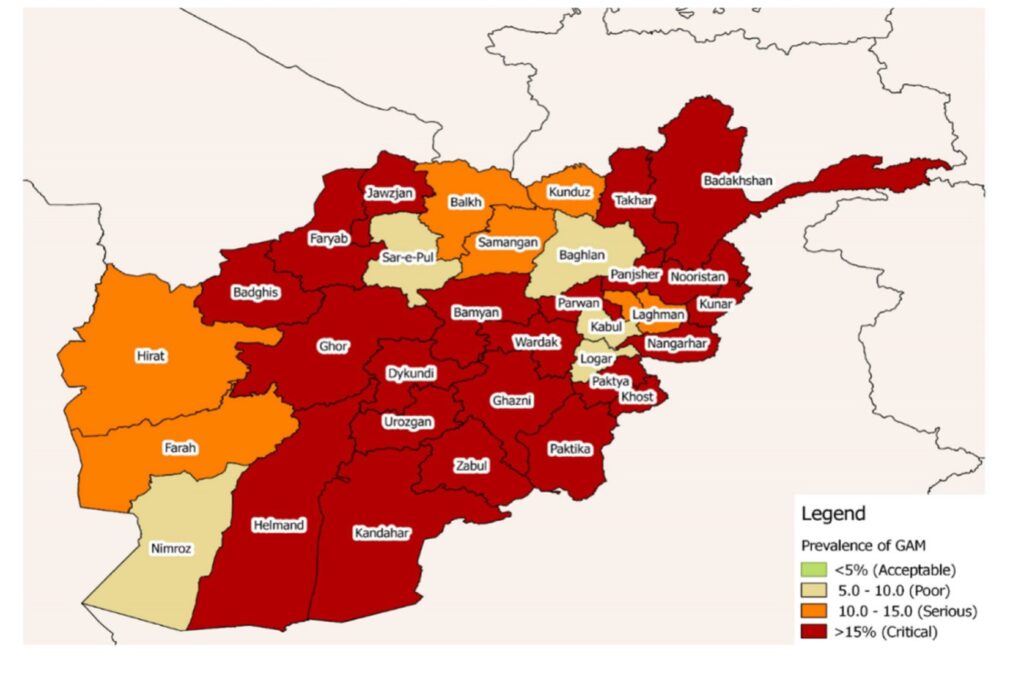
The most recent forecast from the Integrated Food Security Phases Classification (IPC) [1], the global standard for assessing food insecurity, “Afghanistan: Acute Malnutrition Situation for September October 2022 and Projection for April 2023”, was published in October 2022. It forecasted that in April 2023, 875,224 Afghan children would be suffering from Severe Acute Malnutrition (SAM) and 2,347,802 from Moderately Acute Malnutrition (MAM), while 804,365 pregnant and lactating women would also have acute malnutrition. The maps below show the situation in autumn 2022 and the progress of malnutrition across the country throughout winter-spring 2023.
[M]ore than 4.3 million households have borrowed simply for securing food. Many households have mortgaged their future, having sold productive assets such as their last female animals (1.1 million) or other income-generating equipment or means of transport (over 0.6 million), and even their houses or land (over 0.3 million). In many cases, households were forced to mortgage their children’s future by seeking recourse to child labor (more than 850,000) or marrying their daughters earlier than intended (nearly 80,000), to combat extreme food insecurity. (pp 63 – 64)
Map 1: Acute Malnutrition in September – October 2022
Source: IPC Afghanistan Acute Malnutrition Analysis September 2022 – April 2023
Map 2: Projected Acute Malnutrition for November 2022 – April 2023
Source: IPC Afghanistan Acute Malnutrition Analysis September 2022 – April 2023
This report aims to navigate the data about child malnutrition and provide an overview of the situation in Afghanistan, how malnutrition is influenced by economic, geographic and even cultural factors, how it has worsened through the past decade and how it is experienced today by those affected by it. To this end, AAN has interviewed three healthcare workers, who work directly with malnutrition children, each from the provinces of Daikundi, Helmand and Takhar, as well as eight parents from Daikundi (one), Helmand (two), Kabul (two) and Takhar (three) whose children are suffering from malnutrition.[2]
The geography of hunger
Conflict, poverty, drought, food insecurity, limited or no access to health services, poor water quality and sanitation, insufficient maternal nutrition and low immunisation rates for children resulting in a high disease burden have all contributed to the high child malnutrition rates in Afghanistan. Malnutrition is widespread across the country, but its prevalence is greater in some areas and some sections of the population. In this section, we map the geography of hunger in Afghanistan based on both spatial and human characteristics. The next section will look at how and why it has varied over time.
Rural areas tend to be more vulnerable to malnutrition because of their greater poverty rates, difficult logistics and lower awareness of the symptoms of malnutrition, but even more significantly, the lack of nearby medical facilities and availability of suitable treatments. As a subset of rural areas, remote and/or mountainous places tend to be even more greatly affected – and at the same time, the increased distance and costs associated with accessing healthcare mean fewer malnutrition cases are reported compared to the actual number.
Thus, isolated provinces such as Ghor, as well as rural areas in Takhar and Badakhshan provinces in the northeast, all comparatively poor and highly dependent on local crops, have suffered heavily from the recent years of drought and crop failure. According to a nurse from Rustaq district of Takhar, whose work has focused on malnutrition for some years, large single-income households are typically worst hit by the problem:
Children who are malnourished are more likely to come from low-income families, with only one person serving as the primary earner and supporting a large extended family. Families in Takhar are extremely impoverished, earning just 180-200 Afghans [a day]. But the households are very large: as many as 15 people need to be provided for by only one person, which leads to insufficient and uneven access to food for all the family members.
In Helmand, malnutrition is present in all districts, but affects particular areas more severely. As one NGO healthcare worker from Lashkargah remarked, the hilly northern districts, such as Musa Qala and Nawzad, or the southernmost, the desert districts of Khaneshin and Dishu, register more malnutrition cases. When interviewed by AAN, the health worker explained that:
The reason for the high cases of malnutrition [in those districts] is the economic status of families who are farmers and livestock breeders and have been affected highly by the drought.
However, the impact of malnutrition is also felt inside the towns and cities because of the loss of income faced by many urban residents after the withdrawal of the international military and an influx of internally displaced persons from rural areas; they have been forced to settle in precarious living conditions without access to safe water and sanitation.
When families become food insecure, it is specific age and gender groups that are affected the most. Children under the age of five are considered most at risk of malnutrition and related illnesses, which is why this age group is usually featured in relevant statistics. Pregnant and lactating mothers are a second vulnerable group.
International organisations working in healthcare in Afghanistan have reported an increasing trend of more newborns and infants being admitted as inpatients to their nutrition centres than in the past. According to a recent report by the international NGO, Médecins Sans Frontières (MSF),[3] the percentage of infants under six months of age admitted to their paediatric intensive nutrition centre in Herat has been reported “most concerningly” on the increase and reached 61.5 per cent of all patients in February 2023, while in MSF’s Kabul centre, the percentage of infants under one year old reached 67 per cent. According to the same MSF briefing note:
Breastfeeding in Afghanistan is challenged by the practice of child marriage, negative cultural beliefs related to breastfeeding, lack of family planning, poor access to clean drinking water, and limited access to information on optimal breastfeeding practices. (p 8)
These factors affect the above-mentioned age groups and are made worse by the absence or the prohibitive costs of safe replacement feeding, such as formula.
The healthcare worker from Lashkargah highlighted another pattern, that malnutrition takes a heavier toll on girls than boys, because in times of crisis, boys are more likely to be better-fed and taken care of – to the detriment of their sisters.
Girls are at risk in the family because of the culture and literacy levels. Boys are paid attention to and taken care of. I see it all the time that when boys are sick, their mothers bring them [to the hospital], but when girls are sick, [only] their grandmothers bring them to the clinic or hospital. When I ask why, they say boys are important and their mothers should take care of them. When there is little food, parents mostly try to feed their sons, rather than their daughters.
This trend is confirmed in reports from international organisations: for example, MSF reported that in 2022, girls faced a 90 per cent higher mortality rate compared to boys in their inpatient therapeutic nutrition centre in Kandahar, pointing to families’ deprioritising their daughters both in terms of providing food for them and seeking out medical care.
Such discrimination affects mothers as well. They are also deprioritised (or put others first) when it comes to food in the family, are then malnourished during pregnancy, often suffer anaemia after giving birth and have problems breastfeeding their babies, who in turn become victims of malnutrition. Other cultural traits, such as the frequent lack of family planning, only add to the problem, as one healthcare worker from Daikundi province described:
[I]lliterate families who don’t have any primary health education and only follow old traditions are also at risk of having malnourished children. They don’t have family planning, so they don’t consider intervals between births. Therefore, they give birth to children who are weak and then become malnourished. In addition, children who are born premature and children who are born on time but with low birthweights – because their mothers were malnourished during their pregnancy – are at risk of malnutrition.
Finally, some diseases with varying local or regional severity patterns, such as Acute Watery Diarrhoea (AWD) and Acute Respiratory Infections (ARI), often appear together with malnutrition, each contributing to the other’s morbidity. This is especially true in winter when food security deteriorates in many households. Malnutrition has, for example, been considered by some studies as a contributing factor – together with COVID-19 – to the deadly measles outbreak that hit many provinces of Afghanistan in 2022.
A chronology of hunger
While malnutrition has always affected some places more than others in Afghanistan, and girls more than boys, overall, it has been worsening over the last decade, and dramatically so after the Taleban takeover, which precipitated the collapse of Afghanistan’s economy.
In 2004, the National Nutrition Survey (NNS), which is conducted in Afghanistan every decade, found that 60.5 per cent of children under-five were suffering from stunting [4], while 8.7 per cent were suffering from wasting [5]. A decade later, the 2013 National Nutrition Survey showed a marked reduction in the number of stunted children under 5, down to 40.5 per cent, but the number of wasted under 5s had risen to 9.5 per cent. There was also an improvement in the number of underweight children from 33.7 per cent in 2004 to 24.6 per cent in 2013. The 2013 survey did, however, raise the alarm on the severity of child malnutrition, revealing eight provinces where general acute malnutrition levels were higher than the WHO threshold of 15%, marking a ‘Critical’ situation – Urozgan (21.6%), Nangarhar (21.2%), Nuristan (19.4%), Khost (18.2%), Paktia (16.7%), Wardak (16.6%), Kunar (16.2%) and Laghman (16%). In the decade that followed, the situation for children continued to deteriorate. After 2014, child malnutrition rates started to worsen (as the graph below shows).
The data for 2015 to 2020 were extracted from “2020 Afghanistan Nutrition Cluster Annual Report”; for 2021 and 2022 from the humanitarian response plan for each year respectively; and the 2023 revised humanitarian response plan.
Graph by AAN.
A key event affecting the incomes of many Afghans was the withdrawal of NATO troops from most areas of the country, as they handed over responsibility for security to the Afghan National Security Forces (further reading in this AAN Thematic Dossier). The transfer was completed by the end of 2014. It brought with it not only a deterioration of security but also a decline in the national income because the foreign armies had spent money and given aid. That income had been spread quite widely and often went to remote areas where the insurgency was strong. As bases and outposts closed locally, the loss of jobs and other sources of income was often substantial. Up to 2014, the standard of living had generally been rising in Afghanistan, but the NATO withdrawal marked the first of several economic shocks from 2015 to 2023 that had detrimental knock-on effects on the ability of many Afghan families to provide adequate nutrition to their children. The figures below tell this story.
In 2015, an estimated 1.2 million children under 5 (39% of this age group, based on WHO population estimates) suffered from general acute malnutrition (500,000 severely and 700,000 moderately) and some 250,000 pregnant and lactating women. That year, the Strategic Response Plan, published by OCHA and focused on addressing the most acute life-saving needs, aimed at assisting far fewer than that number – just under half a million under-fives (155,279 suffering severely and 210,265 moderately from acute malnutrition and 134,071 pregnant or lactating women) because, it said, the aid effort that year was “[c]onstricted by partner capacities, accessibility, and resource availability.”
By 2016, the number of malnourished under-fives had increased to some 2.9 million (some 58 per cent of the total), according to the 2016 Humanitarian Response Plan (HRP), which is the annual appeal for humanitarian aid. Nearly 1 million children were slated for assistance because they were acutely malnourished (365,000 severely and 632,000 moderately), twice as many as the previous year.
Malnutrition remained a heavy burden for the Afghan people in 2017, with 1.3 million under-fives in need of treatment for acute malnutrition, and with levels of SAM breaching emergency thresholds in 20 of Afghanistan’s 34 provinces, according to the 2017 Humanitarian Needs Overview (see also the 2017 Humanitarian Response Plan).
The prevalence of malnutrition continued to increase as the intensifying conflict endangered people’s livelihoods and made access to many areas more difficult for health organisations and other humanitarian actors. In 2018, acute malnutrition affected 2 million children under 5, with “a staggering 600,000 children (29 per cent) suffering from severe acute malnutrition (SAM)”, along with almost half a million pregnant or lactating women. 75 per cent of the affected children lived in 22 provinces, designated as ‘priority’ (see the 2018 Afghanistan Nutrition Cluster Annual Report).
2018 Malnutrition Severity Map, showing the prevalence of General Acute Malnutrition (GAM)
In 2019, the Afghanistan Nutrition Cluster Annual Report revealed two million acute malnutrition cases, including 600,000 suffering severely.
In 2020, the numbers again swelled, with acute malnutrition affecting 2.9 million children, 784,000 of them suffering severely (see the 2020 Afghanistan Nutrition Cluster Annual Report). There were also 650,438 malnourished pregnant and lactating women in need of supplementary nutrition. The onset of the Covid-19 pandemic that year had devastating consequences, pushing an additional 106,214 children into severe and 284,688 into moderate acute malnutrition and leaving 87,298 pregnant and lactating women in need of life-saving interventions. The number of provinces classified at emergency levels rose from 22 to 26 (for the economic effects of Covid-19, read this AAN report)
As the Taleban sued for control of the country in 2021, fighting intensified, making trade, travel, sowing and harvesting difficult for many. Malnutrition worsened, with an estimated 3.13 million children under 5 at risk of acute malnutrition, (895,000 severely and 2.2 million moderately) as well as 700,000 pregnant and lactating women (see this November 2021 Health Cluster Bulletin and the 2021 HRP).
The fall of the Republic in August 2021 and the ensuing economic collapse had pushed an unprecedented number of Afghan households into poverty by 2022. In that year, an estimated 3.88 million under-fives, with more than half facing acute malnutrition (1.08 million severely and 2.8 million moderately)[6], as well as 836,657 pregnant and lactating women. One million under-fives were believed to be at risk of death. (Figures from the 2022 HNO and HRP).
Child malnutrition in 2023: the view from the field
The Afghanistan Humanitarian Response Plan for 2023 estimated that acute malnutrition will affect over four million vulnerable individuals this year, including more than 840,000 pregnant and breastfeeding women and 2,300,000 children suffering moderately and 875,000 severely.
Interviews carried out by AAN with both health workers and the parents of children who have suffered or still suffer from acute malnutrition give an idea of how the situation is deteriorating due to the economic crisis and the shortages of medical care. Primary healthcare centres are often working under strained conditions, with reduced staff, equipment and stocks of medicines.
The country’s health system received a double shock in August 2021, both a brain drain of qualified staff, as reported by the media, and a reduction in international funding (see reporting by the Development News website, Devex), with primary and community healthcare suffering the most. The Taleban ban on women working, first to NGO workers in December 2022 and later to UN staff in April 2023, has further reduced humanitarian capacities to deliver programmes to fight malnutrition and poverty. Even though female healthcare workers are largely exempt from the ban, according to the Revised Humanitarian Response Planreleased by OCHA in June 2023, conditions on employing female healthcare workers, such as the necessity for them to be accompanied by a mahram (a close male relative), have resulted in, “additional costs and budgeting, shrinking donor funding, and potential challenges in meeting the minimum operational standards due to the limited capacity of implementing partners.” (pp. 38-39)
A glimpse at the increased difficulties encountered in helping malnourished children and their mothers can be gathered from these figures given by the Revised Humanitarian Response Plan:
[D]uring the first four months of 2023, approximately 14.7 million people received at least one round of food and livelihood support, compared to 19.1 million in 2022. Health care was provided to 5.4 million people, an increase from 4.7 million in 2022. Support to prevent and address acute malnutrition reached 2.4 million children and nursing mothers, down from 3 million in 2022. (p 11)
A veteran nurse from Takhar, interviewed in March, summarised standard procedures to treat malnutrition in place at her clinic, before detailing how they were now being forced to let patients down.
If the MUAC [measurement of the mid-upper arm circumference – a key indicator] is less than 11.4 cm, we usually treat [the child] in the clinic and they are hospitalised. If it’s between 11.5 and 12.5, we treat them by providing enough supplements and resources.… RUTF [ready-to-use therapeutic food] and RUSF [ready-to-use-supplemental food] are resources provided for malnourished children…. Children that weigh less than 3 kg, are shorter in height and have a poor appetite are usually hospitalised and given medication and milk. When they show improvements, or their weight increases to 4kg, we discharge them and give them the necessary resources.
Such standards, she said, have become difficult to adhere to since December 2022 because of faltering stocks of therapeutic food and the pressure on health centres brought about by the sheer number and desperation of ailing families:
For the past almost four months, we’ve have had very few resources left. The cases of severe and moderate malnutrition have increased significantly in this time. Because of fewer resources, we had to start providing patients with the foods available in our clinic…. Resources were not being cut before. I do not know if we are not getting any supplies because of the current government. We have been without resources for four months now. I believe the Agha Khan Foundation or the World Food Programme were providing for us, but this support has stopped…. Our clinic is very small. The rooms are cramped, we’re short on staff and we have a heavy workload.
Speaking to the interviewee again in June, she did say international support had now resumed, with resources being provided by UNICEF and the World Food Programme. However, her experience was not singular. Other clinics and healthcare centres are being put under pressure by a growing caseload and, often, fewer resources. According to a healthcare worker in Daikundi, in the past, the provincial hospital would not host more than 15 malnourished children at any given time, but in March 2023, the malnourishment ward was hospitalising 25 to 30 children every day.
Understaffed and overcrowded clinics mean severely malnourished patients get discharged as soon as they become even moderate acute malnourished levels. Ideally, they are provided with food supplements and all the necessary information and guidance to continue their treatment at home. However, this can result in improper handling of the therapy by families and cause recurring malnutrition in a child. The nurse from Takhar said:
Some children receive food from us, but we don’t see any improvement when they return. Most mothers have many children and distribute the food and resources we provide for the malnourished child to their other children. Some have even said their husbands or mothers-in-law eat the bars or biscuits we gave them for their malnourished children.
She added how, in winter, especially, it was not easy even to discharge patients:
When the children start to improve, we contact their families to come and get them, but they don’t show up. They choose not to pick up their wives and children because they are getting some food – beans and bread – and the clinic’s warm. [When they finally show up] their husbands tell us that they don’t have any food at home and it’s very cold there. Therefore, they should stay with us for some more days.
Family evaluation of the costs/benefit of referring their malnourished children for medical treatment can also get in the way of successful treatment, as is apparent from the nurse’s observations:
Some children receive only the first treatment, and their families don’t show up for the next appointment because of the cost of travelling long distances. They claim the cost of their journey is much higher than the food that we provide, so they don’t come back to finish the treatment.
In some instances, the opposite can also be true,she added:
Families keep coming back to us for support for their children, even when they aren’t classified as malnourished anymore, and when we can’t assist them, they become irate and shout that we’re lying and taking the aid for ourselves.
We heard several such accusations from health workers that families do not respect them – realistic reporting, especially for female staff. We also heard accusations about health workers from some of our interviews with parents, particularly that they keep the, by now, rare medicines from those most in need and put them instead on sale on the black market.
A mother from Takhar, her two-and-a-half son malnourished, claimed to have witnessed healthcare professionals taking some of the medical resources for themselves and their families. “They also sell products like ready-to-use therapeutic food in the form of biscuits and milk to the market,” she told AAN, adding that the abusive practice persisted notwithstanding inspection by a foreigner (whether a member of staff or monitor was not clear) and subsequent personnel changes or transfers in the hospital. She blamed the problem on the fact that most healthcare professionals had left after the collapse of the Republic and were replaced by new ones who were not satisfactory. She went up to say that the new doctors and nurses would provide good care only upon receiving gifts from patients and remarked – a Tajik herself – that they would be biased against Uzbek mothers, even uttering racist slurs against them.
Several parents also complained that their first visit to a clinic was the only time they received free nutrition treatment. Afterwards, they were told there were no resources to continue the treatment, as a forty-five-year-old mullah from Helmand recounted.
The first time we went [to the clinic], they gave us RUTF [ready-to-use therapeutic food] and some medicine. After that, every time we went, they said there was no RUTF and no medicine. Each time, they told me to visit the clinic next time because there might be RUTF and medicine, but there never was. I could buy the medicine in the bazaar but couldn’t find RUTF…. The medicine that comes for children is not given to anyone. They always make excuses and say nothing remains in the clinic. Now [my son] can eat bread little by little. He’s very weak, and when seasonal diseases come, he gets sick easily. He’s two years old but looks like he’s only one. He still can’t walk. He still crawls.
In the absence of therapeutic food, many families resort to the less expensive types of milk powder or, often, to even cheaper replacements such as sugar water. Another father from Helmand told AAN how all his four children suffered from malnutrition, but he was unable to provide them with nutritious food except, when possible, milk powder:
All my four children are malnourished. My eldest son is six years old, and he was very weak when he was born.… The village doctor told me I should take him to the clinic so they could give him nutritious food. I told him I couldn’t [because] the clinic is far from our home, and I didn’t have money to rent a car and take my son there. Then he told me to at least buy milk powder to help my son survive. Since he’s my first child and I love him, I borrowed some money from a neighbour and bought him milk powder.… The doctor also prescribed some vitamin syrup, but I couldn’t afford it. Then, when he grew a little bit, I soaked bread in water and gave it to him. He is still weak and thin.… My other children are malnourished too. My wife doesn’t have milk, so she can’t breastfeed. All my children grew up with milk powder. The first two can eat bread and other food now. But the other two are small and can only have milk powder. Sometimes I really can’t afford milk powder either. We boil water and add some sugar and give that to them instead of milk.
For him, the economic constraints leading to insufficient nutrition are at the roots of all the health problems of the family:
[Their] mother didn’t eat well during her pregnancy. Our [household] economy has not been good and she couldn’t eat well. I’m a farmer and have no other income. I get wheat, potato and beans from the farms. I work on another person’s land and the landlord only gives me one-quarter of the harvest…. Because of the drought, I can only keep a few sheep and those with a lot of difficulties. Everything’s expensive and there’s drought, so the harvest isn’t good. We can only have bread, potato and beans as our food. We can have meat maybe once in a few months.
The decline in household economies, coupled with a decline in available healthcare, is proving a lethal mix across the country. No longer limited to remote rural areas, malnutrition has crept into the very heart of Afghan cities. Here, a father from Kabul describes how poorly and weak his daughter has continued to be:
There wasn’t enough [food] at home when Mina was born. Her mother didn’t eat well either. Women need to eat well when they’re pregnant and breastfeeding, but my wife didn’t eat well because of our economic situation. She was anaemic and needed blood because she’d had an operation.… When Mina was born, she weighed one kilo and eight grammes, while a healthy newborn weighs three to four kilogrammes.[7]
I took [Mina] to a government hospital and they said she had mild malnutrition, so they didn’t give her nutrients. I took her to another hospital, and they gave her nutrients for one month. She is still weak and her hair doesn’t grow. If it grows, it soon falls out. When I take her to the doctor, they say she’ll be fine. But she doesn’t grow and I don’t know what to do. They don’t give her medicine or food when I take her to the clinic. They say that now she is fine and doesn’t need nutrients, or they make excuses and say they don’t have any nutrients. She’s three years old, but when you look at her, you think she’s less than a year. She doesn’t grow and she can’t walk. She’s very weak. Her bones can be seen under her skin. She can’t talk either. Now she’s almost three years old and she weighs only seven kilogrammes.
Mina’s story highlights the strong connection between mothers’ and children’s health. Pregnant women in Afghanistan are very much at risk of the same economic and medical shortages causing child malnutrition. Mothers are often the first to suffer when household economies weaken, as the nurse in Takhar recalled:
Just three days ago, we had a woman here who was eight months pregnant and in critical need of care: she was malnourished, which contributed to her anaemia, and desperately required a blood transfusion. The family lacked the money to locate and purchase blood, and because the transfusion wasn’t arranged on time, both the woman and the child died before her husband could secure transport from Takhar to Rustaq to donate blood. The woman’s husband was sobbing at her feet and asking how he would carry her [home]. The midwives gave him some cash by putting together 20, 30 or more afghanis, which they’d been given by patients as gifts. When he left, he said he could carry his wife home now, but who knows where he’d get the money for her shroud and funeral.
Conclusions
The economic and healthcare crisis, fuelled by the international withdrawal, the loss of capital and human resources and the discriminating policies by the Taleban that prevent women from studying, working and accessing healthcare, risk reversing one of the achievements of the past two decades in Afghanistan – the slow reduction in the country’s neonatal and child mortality rate (together with the maternal mortality rate, as pointed to in this recent article), previously among the highest globally and which risk returning so.
While the slow-burning, ever-intensifying humanitarian catastrophe befalling Afghanistan’s children is well-known to all international players, finding viable ways to prevent it seems elusive. The Taleban are unlikely ever to relent – or at least to take the first step in doing so – on their restrictive conditions for women working and other forms of gender-based segregation, while international donors are increasingly showing fatigue towards financing programmes in Afghanistan (see AAN report here).
Afghanistan has in the past been faring better, ie receiving more attention, than many other countries in crisis. However, that may be changing. The fact that donor commitments for the 2023 Humanitarian Response Plan have only been trickling in so far – only USD 632.2 million for an appeal of USD 4.6 billion as of this writing – leaves little room for optimism.
WFP announced in May 2023 that it would have to cut emergency assistance to four million people for the second month running due to severe funding constraints. Since the beginning of April 2023, eight million people have been left out of emergency food assistance due to persistent funding shortfalls. On 30 June, it had more bad news. “It’s five million people we are able to serve for another couple of months, WFP Country Director, Hsiao-Wei Lee, told Reuters: “But then beyond that we don’t have the resources. That I think conveys the urgency of where we stand.” She said the reductions would start in August, fall further in September and halt in October, according to the WFP’s estimates of current funds and financial assistance promised by donor countries in coming months.
Against the backdrop of this difficult scenario, the principal organisations focussed on delivering malnutrition support recommend against, among other things, financial cuts by donors and caution against the possibility of humanitarian actors disengaging from fieldwork due to the Emirate’s segregating policies. Instead, they advocate for prioritising feeding programmes for infants, young children and pregnant and lactating women to prevent dangerous forms of newborn malnutrition and trends of relapsing later. They also advocate for the timely treatment of moderate acute malnutrition to prevent these cases from becoming severe. They call for a redoubled focus on primary and secondary healthcare across the country to guarantee access to all portions of the population, improve the detection of pregnant and lactating women and child malnutrition and prevent cases from becoming too severe to be treated successfully.
The emergency assistance needed to fight malnutrition constitutes the most fundamental part of the humanitarian funding for Afghanistan, one that represents the future of Afghanistan embodied in the survival and the health of its next generation. To scrap it means to endanger the future for these children and for Afghanistan.
Edited by Roxanna Shapour and Kate Clark
References
References
↑1
IPC assesses acute malnutrition utilising anthropometric data, ie data related to measurements and proportions of the human body, from the National Nutrition SMART Survey (NNS), as well as other data related to the determinants of malnutrition, including feeding practices, morbidity, sanitation and hygiene, and food security.
↑2
All interviews were conducted by phone between February and March 2023. The provinces were selected because they have regularly displayed significant levels of child malnutrition and are representative of the situation in the central highlands, the south and the northeast, respectively. Interviews in Kabul offered insights on the situation in urban areas.
↑3
“MSF Briefing Note on Malnutrition and Health”, June 2023, pp 7, 8 (AAN has a copy).
↑4
WHO defines a stunted child as one who is too short for his or her age and is the result of chronic or recurrent malnutrition. Stunting is a contributing risk factor to child mortality and is also a marker of inequalities in human development. Stunted children fail to reach their physical and cognitive potential.
↑5
According to WHO, child wasting refers to a child who is too thin for his or her height and is the result of recent rapid weight loss or the failure to gain weight. A child who is moderately or severely wasted has an increased risk of death, but treatment is possible.
↑6
According to the 2022 National Statistics Yearbook the number of Afghan children under 5 years old stood at 6.17 million (see here).
↑7
The mentioned weight is very low indeed – typically babies require incubation if they are below 1.5 kilogrammes. The father made no mention of this having happened. It would seem a miracle if Mina survived without incubation at that weight.
The United Nations says aid workers are still in a “race against time” to remove rubble and rebuild after the devastating earthquake struck eastern Afghanistan last month, killing at least 2,200 people and cutting off remote areas.
The 6.0-magnitude quake on Aug. 31 was shallow, destroying or causing extensive damage to low-rise buildings in the mountainous region. It hit late at night, and homes — mostly made of mud, wood, or rocks — collapsed instantly, becoming death traps.
Satellite data shows that about 40,500 truckloads of debris still needs to be cleared from affected areas in several provinces, the United Nations Development Program said Wednesday. Entire communities have been upended and families are sleeping in the open, it added.
The quake’s epicenter was in remote and rugged Kunar province, challenging rescue and relief efforts by the Taliban government and humanitarian groups. Authorities deployed helicopters or airdropped army commandos to evacuate survivors. Aid workers walked for hours on foot to reach isolated communities.
“This is a race against time,” said Devanand Ramiah, from the UNDP’s Crisis Bureau. “Debris removal and reconstruction operations must start safely and swiftly.”
People’s main demands were the reconstruction of houses and water supplies, according to a spokesman for a Taliban government committee tasked with helping survivors, Zia ur Rahman Speenghar.
People were getting assistance in cash, food, tents, beds, and other necessities, Speenghar said Thursday. Three new roads were under construction in the Dewagal Valley, and roads would be built to areas where there previously were none.
“Various countries and organizations have offered assistance in the construction of houses but that takes time. After the second round of assistance, work will begin on the third round, which is considering what kind of houses can be built here,” the spokesman said.
Afghanistan is facing a “perfect storm” of crises, including natural disasters like the recent earthquake, said Roza Otunbayeva, who leads the U.N. mission to the country.
 Afghanistan Peace Campaign