The Taleban made their move against education for older girls about a month after they took over Afghanistan when they ordered secondary schools for boys to re-open, but made no mention of girls. Since then, there have been a few instances of false hope, notably in March 2022 when the government reneged on its promise to reopen girls’ secondary schools. Yet even before the fall of the Republic, many Afghan girls had no access to education – because of conflict in their area, or local conservative mores and a lack of female teachers, or because functioning schools did not exist. In this latest instalment of the Daily Hustle, we hear from one young Afghan woman about how elders in her community managed to open home schools for girls and appointed her as a teacher. That was five years ago. Now, there are rumours that the Taleban will close her school down. I live in one of the largest and most populated districts in our province in southeastern Afghanistan. During the Republic, there was a fight between the government and the Taleban over control of our province and danger was everywhere. We lived in fear of bombs, checkpoints and night raids, day and night. Because of the fighting we didn’t benefit as much as other provinces from the foreign aid that was coming into the country or from the development work the government was doing. There were few healthcare facilities in my area and the schools were closed most of the time, either because of the fighting or because there were no qualified people willing to come work here.
There are than 65 schools in my district – 20 of them are for girls – but the buildings are either neglected or were damaged in the fighting. Some only exist on paper. Over the years we learned that they call these ‘ghost schools’. In those years, the girls’ schools were not allowed to operate in the areas the Taleban controlled and where there were schools, there were few female teachers. But many people still wanted to educate their daughters. Finally, the tribal elders stepped in. They asked each village to find an educated woman in their own community who could teach girls ain their home. They asked the parents to pay the teachers whatever they could afford. This is how I came to run a school in our house five years ago.
A home school for girls in the village
I used to have big dreams of going to medical school in Kabul, but my father wouldn’t agree. He thought I’d be a burden on my brother and his family in Kabul and that I should stay in the village until my fiancé could get enough money together for us to get married. But my family could see that I was chafing for something to do and one day my father came home and said I could use the big room in our house as a classroom for girls. And so, armed with my high school diploma, I joined the ranks of literate women and older men who’d opened their homes to educate the girls of our district.
My home school started with 20 girls but as our reputation grew and people started to learn about the classes my class grew until I eventually had 50 students between 7 and 18 years old.[1] It was difficult for me to ask for money from the parents. I knew many of my students didn’t have enough to eat at home and paying fees for their daughters’ education was a hardship, so I didn’t press anyone to pay me. The parents gave me what they could afford, which came up to about 7,000-9,000 afghanis (100-150 USD at the time) each month.
A new curriculum
One day, after the Taleban came to power, UNICEF and an NGO came to our area. They said they wanted to establish community schools for girls and the elders told them there were already home schools in the district. So they met all the teachers and tested us to ensure we were qualified to teach primary school. They kept most of the existing schools and established some new ones. Now we have about 200 home schools in the district. UNICEF gives us educational materials including books, notebooks, school bags and pens for our pupils. They pay me 9,000 afghanis (now about 105 USD) each month so I don’t have to rely on the largesse of parents and it eases the financial burden on very poor families who’re struggling to survive.
The province’s Directorate of Education and UNICEF introduced new rules and a formal curriculum. They reduced the number of students from 50 to 35. Now the girls are between 7 and 12 years old. We cover two grades in one year, so it takes three years to complete the primary school curriculum. A team from the NGO and the district education office come twice a month to monitor my classes and make sure I’m sticking to the curriculum and the quality of teaching is up to par.
In the past, I taught my students Pashto, spelling, maths, religion, the biography of the Holy Prophet and the Quran. Now, with the new curriculum from the district’s education office, I teach Pashto, life skills, maths, calligraphy, art, religious education, which includes fiqh [Islamic jurisprudence] and hadiths[the sayings and actions attributed to the Prophet Muhammad], and the Holy Quran. The official school hours are 7 am to 12 pm. After lunch, I hold free Quran classes for the older girls.
My family is not in favour of the afternoon classes. They say I’m working too hard and that the girls tire me out. They’d like me to take a break in the afternoons and recharge my batteries for the next day, but I think it’s a good deed and will bring Allah’s blessings on our home and my life. It’s true, my pupils are lively and the classes can sometimes be raucous, but it makes me happy to educate young girls and make sure that they have literacy and numeracy skills and know the holy word.
Rumours fuel uncertainty
Lately, there have been rumours that the Emirate wants to close the home schools. People are very worried. I don’t understand why the government would do such a thing. The home schools use the official curriculum and, anyway, what could possibly be wrong with teaching girls to read, write and do arithmetic? There used to be war before, but now it’s their government [ie those who had been the armed opposition]. They are in charge and all the people want education. Now that the war is over, the government should create more facilities, refurbish the old schools and build new ones. Girls should be able to go to school, same as boys. If the Emirate has really made this decision [to close home schools], it could affect the lives of hundreds of thousands of pupils across the country. It seems like an injustice.
It’s not only education for girls [that is at stake] but also the livelihoods of the teachers. The salaries the teachers get also help keep their families afloat. People are suffering financially and the money they earn helps put food on the table. We are 12 in my family – my parents, four brothers, four sisters, my sister-in-law and me. I am the only one who works and my income supports the household.
My father used to work in the Gulf and send money home for the family, but times have been hard since he lost his job and came back home to Afghanistan. [One] brother has a university education, but he’s unemployed. He farms our land, but we have [only] a small plot and we don’t have water. We can’t afford to hire a drill to dig a well, so we have to buy water from other people. Another brother was a teacher in one of the schools in the district, but he lost his job after he fell ill and had to go to Pakistan for medical treatment. He’s trying to get a passport so he can go aboard for work. If he manages to get a visa and find a job in one of the Gulf countries, he can send money home and that will help ease our financial burdens. For now we must make do with my small income, and if the government closes the school, we’ll face serious difficulties. I’m not the only one. Times are hard for most families and for the teachers who have classes at home, the money they earn is a lifeline. Their lives will be devastated if the schools are closed.
Keeping hope alive
If there is one thing I’ve learned in my years, it’s that nothing is ever certain or forever. For now, we have the home schools and I must focus on the present and do my best to educate the girls that come to my classes. I’m hoping my fiancé will have enough money for us to get married this year. I don’t want the school to close after that, when I’m no longer living in the village. So I’m training my younger sister and my sister-in-law to take the school over when I move to Kabul with my husband. My fiancé is very supportive of my dream of becoming a doctor. Who knows, maybe by then the Emirate will allow women to go to university. Wouldn’t that be the best of dreams come true?
References
References
↑1
Despite the age range, all were getting a primary education: it was an opportunity even for older girls who had missed out on schooling when they were younger.
A State Department report released Friday faults the agency’s crisis management and awareness before and during the fall of Afghanistan, findings certain to be trumpeted by Republicans and other critics who have charged that bureaucratic lethargy played a significant role in the chaos and violence that unfolded nearly two years ago during one of the Biden administration’s darkest moments.
The report says that President Biden and his predecessor, Donald Trump, each failed to appreciate how a U.S. military pullout would affect the Afghan government’s stability, and that standard summer diplomatic rotations in the weeks ahead of Kabul’s collapse left the U.S. evacuation in the hands of personnel who in some cases had been in the country for only a few days or weeks.
Critical missteps identified in the report present fresh evidence of the mayhem thatleft Afghanistan’s future in the hands of the oppressive Taliban regime, cost the lives of scores of Afghans and 13 U.S. service members, and sent Biden’s approval ratings tumbling. The timing of its release — with little notice ahead of a long holiday weekend — alsois likely to draw anger from those who have said his administration has tried to downplay scrutiny of its actions during the spring and summer of 2021.
The State Department redacted large portions of the report, releasing 23 of its 87 pages, citing security concerns. The analysis focused primarily on actions and reforms inside the agency, rather than at the White House or the Pentagon, each of which already has produced accounts of the 20-year war’s calamitous final chapter.
The analysis takesaim at failings on multiple levels. At the top, officials gave “insufficient senior-level consideration of worst-case scenarios and how quickly those might follow” after Biden affirmed Trump’s decision to pull the U.S. military from Afghanistan.
Before the Afghan government’s collapse, “it was unclear who in the [State] Department had the lead” on preparations for a full evacuation of the country, the report found. It called the department’s participation in planning for an evacuation “hindered,” even though the U.S. military had been working on the effort ahead of the pullout.
Once the Taliban drew near Kabul and the United States began the full withdrawal, the Biden administration’s communications made the evacuation more chaotic and dangerous than it would have been otherwise, the report found.
“Constantly changing policy guidance and public messaging from Washington” about who was eligible to be relocated from Afghanistan “added to the confusion and often failed to take into account key facts on the ground,” it said. That exacerbated an already messy situation in which members of Congress, aid workers and others who had connections to Afghans were trying unilaterally to organize rescue missions for individuals and families, rather than allowing U.S. personnel on the ground to concentrate on a more systematic effort.
But there were lower-level problems, too. A June 2021 coronavirus breakout at the embassy led to a strict lockdown there, confining many personnel to their quarters in the bunkerlike facility, and making it harder to collaborate and receive classified briefings as the military pullout intensified, the report noted.
And because the State Department didn’t react to the instability in the country by extending the standard one-year hardship rotations of its diplomats, Kabul’s collapse came at an especially vulnerable moment for the embassy, since much of its staff had just turned over or were still on their way to the country.
The exit from Afghanistan, capped by a chaotic and deadly two-week evacuation from a single airfield in Kabul in August 2021, pulled more than 120,000 people from harm’s way in an extraordinary airlift effort spearheaded by the U.S. military.
Tens of thousands of others who had assisted the American war effort over two decades of conflict were left behind in an effort overshadowed by tragedy, including a gruesome suicide bombing, a botched U.S. drone strike that killed 10 innocent people, and surging crowds that resulted in some people being trampled to death.
The report also notes “differences in style and decision making” between the Trump and Biden administrations, “most notably the relative lack of an interagency process in the Trump administration and the intense interagency process that characterized the initial period of the Biden Administration,” which included an early focus on identifying Afghans who had worked with the U.S. government and were eligible for visas to get them out of the country.
In a Friday email to State Department personnel, Secretary of State Antony Blinken said that the review “affirmed what I and so many already knew to be true: our people in Afghanistan, in Washington, and at sites around the world demonstrated extraordinary courage, ingenuity, and dedication to mission in the face of complex and demanding conditions.”
The review “also detailed and made recommendations on several areas where we could have done better, and where processes and systems could be improved,” he wrote.
State Department officials said that they had already taken steps to implement lessons learned from the Afghanistan withdrawal, applying them in the lead-up to Russia’s invasion of Ukraine in February 2022, when the State Department was faster to pull personnel from its embassy in Kyiv than other countries, and to the evacuation from Sudan in April.
“What this report reveals is that in crises that are longer duration, that are particularly complicated, that occur at a large scale, that impact populations well beyond the official American community, we haven’t over time had the appropriate structure and resources available to provide that foundation, a steady, constant set of capabilities that we can draw on when we’re suddenly confronting something at scale,” said a senior State Department official, who briefed reporters on the condition of anonymity under ground rules set by the agency.
House Republicans have held a series of hearings this year as part of their investigation of the withdrawal. Rep. Michael McCaul (R-Tex.), chairman of the House Foreign Affairs Committee, has called the evacuation effort “disastrous” and said he intends to seek testimony from Biden’s top national security advisers, including Blinken, Defense Secretary Lloyd Austin and Gen. Mark A. Milley, chairman of the Joint Chiefs of Staff. McCaul called Friday for the full report to be released, saying the redacted pages were not classified.
He also has sought wider access to a July 2021 cable that U.S. diplomats posted to Afghanistan sent to Blinken using the State Department’s dissent channel, a forum for expressing views contrary to those of superiors. The top diplomat in early June agreed to allow committee members to read the cable.
To date, no U.S. official has been fired or forced out as a result of the dysfunction, something that some family members of U.S. troops killed in the airport bombing have criticized.
Tyler Vargas-Andrews, a Marine who lost an arm and a leg in the explosion, told McCaul’s committee in March thatthe operation was a “catastrophe,” defined by an “inexcusable lack of accountability and negligence.”
“The 11 Marines, one sailor and one soldier [killed] that day have not been answered for,” he told lawmakers.
In an earlier investigation performed by the U.S. military, numerous officials voiced frustration with what they perceived to be a lack of attention in Washington to how dire the situation was in Afghanistan as the Taliban swept across the country.
Military personnel would have been “much better prepared to conduct a more orderly” evacuation, said Navy Rear Adm. Peter Vasely, the top U.S. commander on the ground during the operation, “if policymakers had paid attention to the indicators of what was happening on the ground.”
Vasely’s comments, and other similar remarks, were previously downplayed by State Department officials. Jalina Porter, a State Department spokeswoman, said last year that “cherry-picked comments do not reflect the months of work that were well underway” and the totality of what U.S. diplomats undertook to facilitate the evacuation effort.
Another Biden administration spokesman, John Kirby, also has downplayed how chaotic the effort was, saying as recently as April that he didn’t “buy the whole argument of chaos” during the operation.
“It was tough in the first few hours,” Kirby said then, after the White House had provided Congress with its assessment indicating the evacuation should have been ordered sooner. “You would expect it to be; there was nobody at the airport and certainly no Americans. It took time to get in there.”
Michael Birnbaum is a national security reporter for The Washington Post, covering the State Department and diplomacy. He previously served more than a decade in Europe as The Post’s bureau chief in Brussels, Moscow and Berlin, reporting from more than 40 countries, and he covered climate and security from Washington. He joined The Post in 2008.
Dan Lamothe joined The Washington Post in 2014 to cover the U.S. military. He has written about the Armed Forces for more than 15 years, traveling extensively, embedding with five branches of service and covering combat in Afghanistan’
Biden administration failed to foresee Afghanistan mayhem, review finds
SHINDAND, Afghanistan — In the U.S.-built district hospital of Shindand in western Afghanistan, the surge in patients took doctors by surprise. As their wards filled up in recent months, they repurposed staff space to make room for more patients and resorted to prescribing single doses of drugs that should be taken in three doses. Some patients with severe conditions have been turned away because of a lack of available beds.
Almost two years after the Taliban came to power, Afghanistan’s rural health sector is rapidly deteriorating as the impact of a prolonged economic crisis starts to hit it with full force. Doctors, nurses and local officials said they face a surge in patients who until recently would have preferred to see private doctors for a small fee but have run out of savings.
A Washington Post visit to four hospitals and medical centers in western and central Afghanistan found alarming signs that the health system itself is now suffering from a lack of cash as foreign donors, distracted by other crises and weary of being seen as supportive of the new Afghan authorities, appear increasingly hesitant about spending more.
United Nations officials say Afghanistan is facing the world’s largest humanitarian crisis. But the Taliban-run government, eager to portray its medical system as a success story, maintains that its clinics are running just fine even as it appeals to the international community to provide more funding and drop sanctions. In an interview last month, Health Ministry spokesman Sharafat Zaman said that “fortunately,” the system is not “in an emergency situation.”
But numbers of patients seeking some services have increased by about 15 to 20 percent across the thousands of UNICEF-funded health facilities and have in some facilities almost doubled, even as the available funding remains roughly the same as before. The United Nations had recorded only about 10 percent of the funding required to meet its Afghanistan response plan earlier this month when it decided to massively scale down its budget. The World Food Program has already dropped 8 million Afghans from its emergency response programs in recent months.
In Shindand’s hospital, staff predict that those factors, combined with a prolonged regional drought, could double patient numbers over the next few months.
“This is the worst I’ve seen,” said 59-year-old Habibullah Mirzai, the longtime administrator at Shindand hospital.
No peace dividend
Few doctors are holding out hopes that the cash-strapped Taliban government will come to their rescue. And with the U.N.’s humanitarian response effort in Afghanistan one of its most poorly funded, many medical professionals express disappointment with the West that increasingly appears to run just as deep as their frustration with the Taliban-run government.
Just a few miles from what was once the country’s second-biggest air base hosting U.S. and other foreign soldiers, this expanse of wheat fields and mud-brick houses bore the brunt of the war. During the worst fighting, the hospital director hid in a corner of the malnutrition ward as mortar shells exploded outside the gates, he recalled.
Few people here could see any sense in the airstrikes, gunfire and IED explosions that sent patients to the wards on most days. But the foreign presence had ensured a steady inflow of money. Construction of the $5 million Shindand hospital was overseen by the U.S. Army Corps of Engineers.
After the Taliban takeover in August 2021, doctors shared many fears but at least one hope: Peace, they thought, would finally draw private relief organizations that had previously considered Shindand too dangerous.
It’s now clear that the opposite is happening. Development projects that could have provided economic relief are dormant. After the Taliban banned Afghan women from working at nongovernmental organizationsand U.N. agencies, some organizations pulled out of the country, while others reduced their presence.
By restricting women’s rights, “the Taliban abandoned half of our population,” said a senior hospital official in Shindand, who spoke on the condition of anonymity for fear of retaliation. “And now, as a result of that, the world has abandoned all of us,” he said.
Unpaid and overworked
The Western military pullout and subsequent decline in funding have been personal for many medical staffers in Shindand. As the Taliban made rapid gains and the West prepared to leave the country in summer 2021, members of the hospital’s staff, like many Afghan health workers, went unpaid for months. Their families struggled to survive, selling their furniture, carpets and motorbikes.
International help eventually returned, including through UNICEF, but lost salaries were never paid. The Organization for Health Promotion and Management, the local group that distributes funding to the hospital, said it recently hired new staff members to address shortages. But foreign donations, the organization said, are insufficient to expand overcrowded facilities.
The funding shortfall leaves Afghanistan increasingly unprepared for an epidemic or major natural disaster, according to humanitarian workers. There are growing concerns over a rise in the number of acute watery diarrhea cases in recent weeks, said Fouzia Shafique, UNICEF’s health lead in Afghanistan.
“This could potentially be a disaster,” she said, but “we are unable to buy all the supplies or deploy as many teams as we want to.”
Irandukht Noorzad, the 30-year-old head of a health center in the central Kalo valley, said her small facility would not be able to absorb substantial cuts in funding. Unemployed urban residents are moving back to this rural area and are putting more pressure on the clinic, and she fears her staff may resign instead of putting up with lower salaries and more work, Noorzad said.
The Afghan Health Ministry did not respond to questions about those concerns. In an earlier interview with The Washington Post, ministry spokesman Zaman blamed the previous U.S.-backed government for having neglected health-care access for decades. The new government, he said, has eased the pressure by launching the construction of 200 new health facilities since taking power.
Aid groups counter that the Taliban-run government does not deserve much credit. Afghanistan’s health system has only been able to grind on, they say, thanks to international support. UNICEF says it still pays the salaries of tens of thousands of health workers in Afghanistan.
That assistance is facing growing international scrutiny, as some critics view continued cooperation with the government as an acceptance of the Taliban’s ban on female Afghan NGO and U.N. employees.
Female health workers are still exempt from the Taliban ban, and doctors in rural areas said they have encountered few new challenges due to restrictions the Taliban has imposed on women. While the Taliban in many cases restricts women from traveling without a husband or male relative, similar practices were customary in many rural areas even before the Taliban takeover, doctors said.
But some recent interactions with the Taliban have unsettled doctors. A vaccinator in a clinic in western Afghanistan described how officials from the local vice and virtue department, tasked with shaping Afghan life according to the Taliban’s ideology, nearly derailed a recent coronavirus vaccination campaign when they objected to female vaccinators being trained by a male colleague.
The Taliban officials proposed installing a curtain between the male trainer and the trainees, but they eventually relented after the vaccinator asked them about the practical implications: “How do you explain from behind a curtain how to properly inject a vaccine?” he recalled asking them.
The Ministry for the Promotion of Virtue and Prevention of Vice did not respond to a request for comment.
A downward spiral
In the long run, the Taliban government’s restrictions on women are likely to have a more pronounced impact than is apparent today. Hospitals are already struggling to find female doctors as the government seeks to further segregate female and male sections, and December’s ban on women studying in universities is likely to aggravate those staff shortages.
The reluctance of foreign donors to fund Afghan projects could have ripple effects, too, said Omar Joya, an Afghan economist at the Bordeaux School of Economics in France.
The Taliban-run government recently applauded a World Bank report that found declining headline inflation, but Joya said high poverty rates and steep losses in income are more telling signs of a trend that is “not very encouraging.” If humanitarian aid decreases, the currency will inevitably depreciate, he said, raising the prices of gas and food.
Villages like Katasang in central Afghanistan could suffer the most. Fifteen years ago, Uzra Hussaini took an offer to serve as a village health worker here, prescribing drugs and referring patients. Even before the Taliban’s return, she was only paid $3.50 a month. Today, she gets half of that.
“I’ve dedicated my life to this,” said Hussaini, 30, whose dream of becoming a doctor was derailed as a teenager by her mother’s illness and her father’s death. She said she is “confused, disappointed and lost” as she worries that the world is turning its back on Afghanistan.
“My fear is that one day everyone will have either fled or died,” she said.
Rick Noack is a Paris-based correspondent covering France for The Washington Post. Previously, he was a foreign affairs reporter for The Post based in Berlin. He also worked for The Post from Washington, Britain, Australia and New Zealand.
In Afghan hospitals, feeling abandoned by the Taliban — and the world
June 30 (Reuters) – Food assistance to Afghanistan will shrink to nothing by the end of October under current funding projections, the World Food Programme’s country director told Reuters on Friday, as United Nations officials continue to warn against funding reductions amid Taliban restrictions on women.
The WFP has already slashed rations and cash assistance from 8 million Afghans this year, underscoring the severity of financial challenges aid agencies face in Afghanistan, home to what the United Nations considers the world’s worst humanitarian crisis.
“It’s five million people we are able to serve for another couple of months but then beyond that we don’t have the resources,” WFP Afghanistan Country Director Hsiao-Wei Lee told Reuters. “That I think conveys the urgency of where we stand.”
The reductions would start in August, fall further in September and halt in October, according to the WFP’s estimates of current funds and financial assistance promised by donor countries in coming months.
The United Nations has already had to slash its humanitarian plan funding request as donors hold back. International officials say the stall is in part due to competing global crises and strained government budgets, but also exacerbated by the Taliban administration’s restrictions on women that advocates say contributes to the funding decline.
Since December, Afghan female humanitarian staff are largely barred from work unless organisations gain exemptions from local officials.
Around 15 million Afghans in danger from lack of food are in need of assistance, according to WFP.
WFP needs $1 billion in funding to provide food aid and carry out planned projects between now until March, Lee said.
WFP would stay in Afghanistan and carry out its other work such as nutrition projects, Lee said, even if the projected cuts took place.
Lee said the restrictions on women were a “valid concern” from donors, but added that around half of WFP’s beneficiaries were women and girls and they were still able to reach women.
Lee added that the positioning of food for the country’s harsh winter must be complete by October to prepare for the colder months, and needed just over $100 million to carry out. Parts of mountainous Afghanistan get cut off by snow in colder months.
Currently the agency had no funds for the operation and was forced to decide soon whether to reduce rations earlier than otherwise projected as time ran out in order to get food in place.
“They’re very difficult conversations and very emotional ones …. our field staff in particular are constantly having to face conversations around why this assistance needs to be reduced,” she said.
“For someone who has a hungry child it’s really hard to understand why their hungry child is not selected for assistance but another family’s hungry child may be hungrier.”
Reporting by Charlotte Greenfield in Islamabad and Andrew Mills in Doha; Editing by Aurora Ellis
WFP set to run out of money for food assistance to Afghans in October
Economists suggested that humanitarian assistance to Afghanistan should be continued.
The United Nations has announced its Strategic Framework for Afghanistan for the period 2023-2025, outlining the priorities of the organization in support of the Afghan people.
The UN Assistance Mission in Afghanistan (UNAMA) said in a statement that the UN Strategic Framework articulates the UN’s approach to addressing basic human needs in Afghanistan.
The Strategic Framework, the statement said, is “prioritizing the needs and rights of those most vulnerable, including women and girls, children and youth, internally displaced persons, returnees, refugees, ethnic and religious minorities.”
“Our Strategic Framework is a robust offer of assistance to the people of Afghanistan to address their basic human needs and complement the ongoing delivery of lifesaving humanitarian assistance,” said Roza Otunbayeva, the UN Special Envoy for Afghanistan.
Meanwhile, head of the Islamic Emirate’s Political Office in Qatar, Suhail Shaheen, said that the humanitarian issues should be separated from political issues.
“To end poverty and create job opportunities, the UN may start development projects and end economic sanctions and separate humanitarian issues from political issues,” he said.
Economists suggested that humanitarian assistance to Afghanistan should be continued.
“The women lost their jobs and the educational departments are closed for the girls, the (UN) can help them and also in general help the Afghans, and this will benefit the Afghan economy,” said Nazukmir Ziarmal, an economist.
The political analyst Najibullah Shamal suggested that the interim government help the UN and international organizations in aid delivery.
“It is necessary that the current government helps the UN and other international aid organizations to attract aid so that further aid can be allocated to the Afghans,” said Najeebullah Shamal, political analyst.
The UNAMA statement said that the United Nations Country Team and partners have identified three complementary and mutually reinforcing joint priorities as it supports the basic human needs of the Afghan people:
UN Announces 2023-2025 Strategic Framework for Afghanistan
According to the commission, hundreds of political figures and former officials have received forms to return to Afghanistan.
The “Commission for the Return and Communications with Former Afghan Officials and Political Figures” said that at least 25 Afghans including political figures, former government officials and parliament members have returned to Afghanistan within the past month.
The commission’s spokesman, Ahmadullah Wassiq, said these individuals had left Afghanistan after the former government collapsed but returned through the mediation of the commission.
“Senior officials such as ministers, directors, deputy ministers, provincial governors and provincial security chiefs were among these officials,” Wassiq said.
According to the commission, hundreds of political figures and former officials have received forms to return to Afghanistan.
Meanwhile, the Islamic Emirate’s spokesman, Zabiullah Mujahid, said that many figures who are abroad are seeking to return to the country.
“For those who left (the country) and feel threatened, the main goal of the commission is to eliminate their concerns about risks. I assure you that we will welcome them,” Mujahid said.
An Afghan figure who lives abroad said that the political figures, former officials and professional figures who return to Afghanistan should be given jobs in government institutions.
“The wishes of the Afghan people should be fulfilled and also plans should be implemented to solve the current challenges that engulf Afghanistan,” said Mohammad Hakim Torsan, a political figure.
Based on the statistics of the commission, more than 520 political figures and former officials have returned to Afghanistan since the establishment of the commission.
25 Political Figures, Officials Returned Last Month: Commission
All of these countries have been among the ten least peaceful countries for the last three years, according to the IEP.
The Islamic Emirates reacted to the recent “Global Peace Index 2022” of the Institute for Economics and Peace (IEP), saying that the findings regarding Afghanistan are “unjust”.
The IEP said in the “Global Peace Index 2022″ that Afghanistan is the “least peaceful country in the world for the fifth consecutive year, followed by Yemen, Syria, Russia and South Sudan.”
All of these countries have been among the ten least peaceful countries for the last three years, according to the IEP.
The IEP said that Afghanistan recorded the largest reduction in deaths from armed conflict in 2022 with conflict-related deaths falling 90.6 per cent, from almost 43,000 to just over 4,000.
“Afghanistan recorded the fifth largest improvement in peacefulness in the 2023 GPI, however it remains the least peaceful country in the world. Although violence is still widespread throughout the country, the level of conflict has dropped considerably since the withdrawal of US troops in August 2021, and the subsequent Taliban takeover of the government,” the Index cited.
According to the IEP, the perceptions of criminality of Afghan civilians improved slightly, with the number of people who say they felt unsafe walking alone falling from 84 per cent to 77 percent.
The intensity of internal conflict improved, owing to fewer reported instances of hostilities between the Taliban and the National Resistance Front over the past year, the Index reads.
“Terrorist incidents in Afghanistan fell by 75 percent in 2022, with deaths from terrorism falling 58 per cent, leading to improvements on the terrorism impact and internal conflicts fought indicators,” the Index said.
The Islamic Emirate’s spokesman Zabiullah Mujahid said that the terrorist incidents have dropped over “99 percent” compared to “what is stated in the report”.
“They said that the number of casualties went up. They still say 4,000 civilian casualties — it is untrue. We may have casualties up to 1,000. There have been some Daesh attacks in the past years or one last year, but (Daesh) is controlled.
“There is insecurity in Afghanistan at the moment, but Afghanistan is not the most insecure country in the world. We should observe between security and safety,” said Sarwar Niazai, a political analyst.
The IEP said that the security situation in Afghanistan remains uncertain, “with an escalation in conflict between ISK and the Taliban remaining a strong possibility.”
“Various terrorist groups can take advantage of the poverty and misery of people and can bring back the proxy war of the world’s power to our soil and can make Afghanistan insecure,” said Andar Khan Ahmad, political analyst.
According to the IEP, while the conflict in Ukraine has had wide media coverage, a number of other internal conflicts around the world have recorded substantial declines in deaths, such as in Afghanistan, Syria, Nigeria and Somali.
Islamic Emirate Called IEP’s Findings on Afghanistan ‘Unjust’
The MoD spokesman Enayatullah Khwarizmi, said that the aircraft are the property of the people of Afghanistan.
The Ministry of Defense (MoD) reiterated its call to Central Asian neighbors Tajikistan and Uzbekistan to return Afghan aircraft that were flown out by former Afghan military personnel during the collapse of the republica government.
The MoD spokesman Enayatullah Khwarizmi, said that the aircraft are the property of the people of Afghanistan.
“Uzbekistan or Tajikistan are our neighboring countries. We want good relations with them and we call on them to return these (aircrafts) to us for the sake of neighborly and diplomatic manners. and we will reclaim them whenever it is possible,” Khwarizmi said.
In April 2022, the VOA reported from US defense officials that both Uzbekistan and Tajikistan had no plans to give the aircraft to the Islamic Emirate.
“The aircraft continue to be the subject of regional security engagement with the governments of Uzbekistan and Tajikistan,” a US Defense Department spokesperson, Army Major Rob Lodewick, said when asked about the fate of the planes and helicopters, a VOA report said.
However, reports were leaked to the media then that the US was secretly negotiating about the return of the aircraft from Uzbekistan and Tajikistan to Afghanistan.
Military analysts said that the interim Afghan government should engage with the US officials about the return of the aircrafts to Afghanistan.
“If the Taliban government wants to have this military equipment and helicopters back, it is better that it engages in negotiation with Americans. There is no other side but the Americans in this key issue,” said Asadullah Nadim, a military veteran.
“The light and heavy weapons and helicopters of Afghanistan which were taken to Uzbekistan and Tajikistan belong to the National Afghan Defense Forces… and should return. But these countries are not taking actions to conform to the Americans,” said Zalmai Afghanyar, a military analyst.
Based on unconfirmed reports, nearly 60 aircraft were flown by former Afghan forces to Uzbekistan and Tajikistan.
Kabul Urges Central Asian Neighbors to Return Aircraft
UNAMA has published its first stand-alone report on conflict-related civilian casualties since the Taleban’s capture of power on 15 August 2021. Casualties have plummeted since the takeover, but the threat remains, especially to some communities, from suicide attacks and roadside and magnetic IEDs. UNAMA has also found that suicide attacks, of which the Islamic State in Khorasan Province (ISKP) is now the main perpetrator, have become more deadly, ie greater numbers of civilians are killed and injured, on average, in each attack. UNAMA points to the many attacks on places of worship and on Hazaras as well as the Taleban’s heavy-handed approach to journalists trying to report attacks. AAN’s Kate Clark has been reading the report and brings her analysis of it here. UNAMA Human Rights Service’s report, “Impact of Improvised Explosive Devices on Civilians In Afghanistan (15 August 2021 – 30 May 2023)” can be read here.
The latest phase of Afghanistan’s decade-old conflict effectively ended soon after 15 August 2021 when the Taleban captured Kabul. In a matter of weeks, the movement would control the whole country as it defeated the last remnants of the Afghan National Security Forces (ANSF) that had fought on and as the final American and other foreign troops left. The end to the conflict between the three major armed actors of the post-2001 period – the Taleban, foreign military and the Islamic Republic’s security forces – brought with it a dramatic fall in the number of civilians killed and injured, although not to zero.[1]
Between 15 August 2021 and 30 May 2023, when UNAMA’s data set for this report ends, it recorded 3,774 civilian casualties, 1,095 people killed and 2,679 wounded.[2] The figures for that 21 month period were substantially lower, in terms of the average monthly civilian casualty toll, than for any single year since 2009 when UNAMA began systematically recording civilian casualties. In 2009, the average number of civilian casualties per month was almost three times greater than in those 21 months; in 2016, it was more than five times higher.[3]
The reduction in civilian casualties since 15 March 2021 is even more striking compared to the especially brutal months leading up to the fall of Kabul. The final quarter of 2020 was the worst ever recorded for civilian casualties; they rose as autumn became winter for the first time ever (see AAN reporting here). Then, in the first six months of 2021, UNAMA recorded almost 5,200 deaths and injuries, with nearly half taking place in just two months, May and June 2021.[4] In the face of these terrible casualty figures, AAN wrote that “any notion that the Taleban capture of territory since 1 May has been virtually bloodless has been demolished by UNAMA’s mid-year report on civilian casualties… The surge in civilian harm coincided with the Taleban’s push to take territory.”
Over the twelve and a half years between 2009 and 30 June 2021, when UNAMA published their final pre-takeover report, they recorded 55,041 civilians as having been killed or injured in the conflict. These are the casualties that UNAMA was able to verify – the actual figure will be even higher.[5]The respite from conflict-related violence, which came with the Taleban’s return to power, was for most people, immediate and has been lasting. Many have been able to travel for the first time in years, to farm without fear of artillery shells or air strikes and shop or go to work without fear of attack. However, not everyone has seen the risk of attack reduced. Although violence is now at much lower levels, it is far more targeted at particular communities. Moreover, most civilian casualties appear to be not collateral damage in attacks on military targets but the result of deliberate attacks on civilians and civilian objects.
UNAMA’s focus on IEDs in the report
Roughly three-quarters of the total number of civilians killed and injured in the period covered by UNAMA’s report, 15 August 2021 to 30 May 2023, were victims of IED attacks; UNAMA includes in this category both suicide attacks (IEDs fixed to the person) and IEDs fixed to vehicles or laid on roads or in buildings. That high number is why it has focused this report on IEDs and the “casualties of indiscriminate IED attacks in populated areas, including places of worship, schools and markets.” It does also make mention of two other sources of casualties since 15 August 2021 – targeted killings (148 civilians killed and injured) and people harmed by explosive remnants of war (639 civilians killed and wounded).
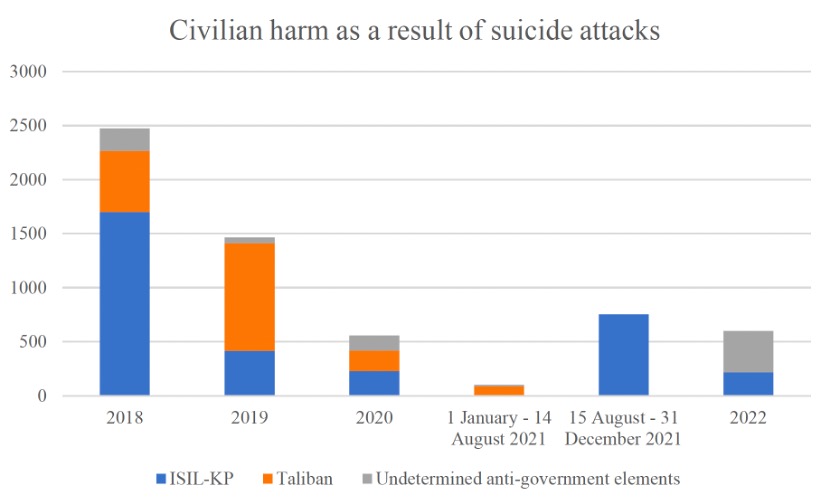
UNAMA attributes the majority of casualties from IEDs in the 21 month period under study to ISKP (1,701), but says “[a] significant number of casualties (1,095) … resulted from IED attacks which were never claimed and/or for which UNAMA was unable to attribute responsibility.” The increase in ISKP-authored attacks came after a period in which their use of this means of attack had reduced (see chart below).
Source: “Impact of Improvised Explosive Devices on Civilians in Afghanistan, 15 August 2021 to 30 May 2023”, UNAMA.
UNAMA also points to how suicide attacks have become more deadly since the takeover, with greater numbers of civilians now being killed or wounded, on average, in each attack. This is despite another trend, a drop in both the number of suicide attacks and resulting overall civilian casualties every year since 2018, from 50 attacks causing 2,473 civilian casualties in 2018 to 8 attacks causing 855 casualties in 2022 (see table below). However, from 2018 to 2020, the average number of civilians killed and injured in each suicide attack was never more than 49 (in 2018). In the period following the takeover in 2021, the number of casualties shot up to an average of 251 civilians killed or injured in each attack (all attributed to ISKP) and 75 per attack in the following year.
Data source: “Impact of Improvised Explosive Devices on Civilians in Afghanistan, 15 August 2021 to 30 May 2023”, UNAMA. Table by AAN.
Who is being targeted/harmed by IEDs?
UNAMA highlights three areas of concern: attacks on places of worship, attacks targeting Hazaras, and the harm done to civilians in attacks targeting the Taleban.
More than one-third of all civilian casualties recorded by UNAMA since the Taleban takeover have come in attacks on places of worship. It had documented a fall in the number of such attacks over recent years, but since the takeover, they have shot back up again. There were nine in 2018 and in 2019 (435 and 219 civilian casualties, respectively); six in 2020 (34 civilian casualties); one in 2021 before the takeover (35 casualties); four in 2021 after the takeover (583 casualties) and; 14 in 2022 (631 casualties). UNAMA attributed the majority of casualties resulting from these attacks to ISKP – nine separate attacks resulting in 853 civilian casualties (284 killed, 569 wounded). The chart below shows the civilian casualties resulting from such attacks over the past five years.
Source: “Impact of Improvised Explosive Devices on Civilians in Afghanistan, 15 August 2021 to 30 May 2023”, UNAMA.
More than half of all civilians killed and injured in attacks on places of worship were Shia Muslims (686 out of 1,218). Others targeted were Sufis (331) and Sunnis (196) – going from press reporting, it seems likely that most of the Sunnis targeted were Salafists, although UNAMA provides no detail here. Five Sikhs, among the last remaining members of what was a thriving community before the 1978 Saur Coup, were also deliberately killed and injured.
Ethnic Hazaras, the majority of whom are Shia Muslims, were killed and injured in large numbers not only in their places of worship, but also in schools and educational facilities, on public transport and in the crowded streets of neighbourhoods where they form a majority. Since the takeover, UNAMA has documented 345 Hazara civilians killed (95) or wounded (250).
UNAMA has detailed some of the attacks suffered by Hazaras in Kabul in this period, including two attacks in Muharram in August 2022, an IED explosion killing three civilians and wounding 54 others in a market on 6 August and an IED attached to a minibus that killed two people and wounded 22 others the following day. ISKP claimed both attacks.
That same year, three attacks on educational facilities in the Hazara neighbourhood of Dasht-e Barchi in Kabul also caused at least 236 more civilian casualties. On 19 April 2022, consecutive IED attacks were carried out, on the Abdul Rahim-e Shahid High School (18 killed, 44 wounded) and Mumtaz Educational Centre. Among those killed and wounded were 47 children (12 boys killed and 34 boys and one girl wounded) and four women (one killed and three wounded).
Later in 2022, on 30 September, a suicide attack against Kaaj Educational Centre, also in Dasht-e Barchi, left 168 people either dead (54) or wounded (114): most were young women and girls (48 killed and 67 wounded). The youngest victim was a 14-year-old girl injured in the attack.
If the number of civilian casualties in attacks on Shia places of worship and Hazaras are added together, the scale of the onslaught on these overlapping communities[6] is clear: out of a total of 2,814 civilians killed or injured in IED attacks in the 21 month period under study, 1,031 were Hazara and/or Shia. UNAMA attributed the majority of attacks against Hazaras to the sectarian ISKP, but a significant number, including the three attacks on schools and educational centres detailed above, remain unclaimed and unattributed. UNAMA gives no breakdown of the number of attacks on Shia places of worship it attributes to ISKP, but overall, it said a majority of attacks in the period against all places of worship were by the ISKP (9 out of 15.) Unfortunately, this is a pattern of targeting that predates the Taleban’s return to power, as can be seen in our in-depth January 2022 report by Ali Yawar Adili, which explored attacks on Hazaras/Shias and the authorities’ response, both during the Republic and the Emirate, “A Community Under Attack: How successive governments failed west Kabul and the Hazaras who live there”.
A final focus in UNAMA’s report are the civilians caught up in IED attacks that target the Taleban. It has verified 426 civilians killed (63) or wounded (363), both bystanders and civilian officials of the Islamic Emirate. More than two-thirds of these attacks, it said, were claimed by ISKP.
Conclusion
In its report, UNAMA calls on armed groups to “[c]ease the indiscriminate and disproportionate use of all IEDs, particularly in populated areas, and the targeting of civilians and civilian objects, such as places of worship and educational facilities.” It has also asked the Taleban to conduct “independent, impartial, prompt, thorough, effective, and transparent investigations into IED attacks, making the utmost efforts to identify and prosecute perpetrators of attacks” and, “[i]n consultation with affected communities, particularly Hazaras, increase efforts to strengthen security and protection measures in places of worship, educational facilities and other areas at risk of attack from IEDs.”
The Taleban, in their response to the report made by the Ministry of Foreign Affairs, have said Emirate security forces are actively and successfully pursuing ISKP and “the level of civilian casualties has dropped and is dismounting and with the passage of time, we will witness absolute decrease in insecurity.” The ministry also said the “security of places of worship, holy shrines, Madrassas, Shiite places of worship and learning centers … is a priority for the security forces.” Its attention to its duty to protect all Afghans, including Hazaras, was clear from the fact that “on some occasions, even the Mujahedin of the Islamic Emirate [have been] martyred defending the Shiite. For instance, on August 5, 2022, as a result of a huge explosion during Ashura ceremony in Sar-e-Kariz area, near Imam Baqir Mosque, several Mujahedin of the Islamic Emirate lost their lives.”
For the majority of Afghans, a major consequence of the Taleban takeover of Afghanistan to their daily lives, as the Taleban point out in their statement, has been the sudden drop in civilian casualties and an end to the threat of conflict-related violence. However, not everyone has been able to stop fearing attacks. For Afghanistan’s Hazaras/Shias, the risk of violent death from ISKP and others unknown has yet to diminish, as they go to school, to work, to the market or to pray in congregation.[7] Other groups are also at higher risk of attack – Sufis, Salafists and Afghanistan’s Hindus and Sikhs.
UNAMA’s report also points to another type of violence facing Afghan civilians – allegations of the Taleban’s heavy-handed approach to journalists trying to report on incidents.
UNAMA recorded a number of incidents in which journalists were prevented from accessing sites of mass casualty IED incidents for reporting purposes, including through excessive or inappropriate use of force, threats and arbitrary arrests and detention. For example, on 11 February 2022, de facto security forces beat a number of journalists who were attempting to report on an IED explosion which had occurred in the Grand Mosque of Qala-i-Naw, Baghdis province. The de facto security force members reportedly also fired in the air to disperse the journalists and prevent them from filming at the scene of the incident.
The Taleban’s statement responded by saying these accusations of curbs on journalists’ reporting of attacks were actually attempts to protect reporters:
If there were some instances of violence against journalists on the fields, the reason has been to prevent journalist casualties in case of a potential follow up explosion because the enemy always tries to add to the number of casualties by carrying out explosions among journalists and first responders and such prevention might have led to some grievances.
Both UNAMA in its July 2022 report and the UN Special Rapporteur on the Situation of Human Rights in Afghanistan, Richard Bennett, have alleged other threats to citizens from the state itself, including, in Bennett’s words from his February 2023 report, the Taleban government’s increased flouting of “fundamental freedoms, including the rights of peaceful assembly and association, expression and the rights to life and protection against ill-treatment,” his contention that it was “ruling Afghanistan through fear and repressive policies” and that the authorities’ “systematic violation of the human rights of women and girls” had deepened. (See AAN’s analysis of Bennett’s reports from September 2022 and February 2023; original reports can be found here). Taleban spokesperson Zabiullah Mujahed called the September 2022 report “biased and far from reality”, containing wrong information which had been misused. The rights of women and minorities and human rights were protected in Afghanistan, he said. (See reporting by to Bennett’s February report ToloNews in English here and in Dari here.)
UNAMA’s July 2022 human rights also documented a “clear pattern with regards to the targeting of specific groups by the de facto authorities.” These included former members of the ANSF, former government officials, individuals accused of affiliation with the armed opposition groups, ISKP, the National Resistance Front (NRF), journalists and civil society, human rights and women’s rights activists and those the Taleban authorities accuse of ‘moral crimes’. UNAMA also alleged that the Taleban’s general amnesty for former government officials, especially former members of the ANSF, had been violated. Mujahed called the report “inaccurate” and “propaganda.” There were no extrajudicial killings, he said, and if anyone did commit them, they would be punished based on sharia (see media reporting here).
What the various human rights reports point to is that, despite the end, largely, to armed conflict in Afghanistan and the falling away of the threat of conflict-related violence for most of its citizens, this is not yet a country at peace.
Edited by Roxanna Shapour
References
References
↑1
UNAMA says that: “a large proportion of the attacks carried out over the period covered by this report do not have a clear link to a situation which can be qualified as armed conflict.” Nevertheless, it says that for the purposes of this report, ‘civilian’ “refers to anyone who is not, or is no longer, a member of the armed forces of the parties to an armed conflict and was affected by an attack which may or may not have a clear link to a situation which can be qualified as an armed conflict.”
It outlines the legal context on pages 7 and 8 of the report, saying:
Widespread or systematic attacks directed against a civilian population (including religious and/or ethnic minorities) in which civilians are intentionally killed may constitute crimes against humanity. In addition, attacks deliberately targeting civilians and the murder of civilians are serious violations of international humanitarian law that amount to war crimes. International humanitarian law prohibits, and international criminal law criminalizes, attacks directed against places of worship which constitute cultural property.
In 2009, the year which previously had had the lowest number of civilian casualties, an average of 497 civilians were killed and injured each month (5,969 in total that year) while in the bloodiest year, 2016, there was an average of 954 casualties a month (11,452, in total that year). In comparison, since 15 August 2021, there has been a monthly average of 175 civilian casualties.
↑4
On average, 864 civilians were killed or injured each month from January to June 2021 (5,183 in total), rising to 1,196 civilians killed or injured in May and June 2021 (2,392 in total).
↑5
On its methodology, UNAMA says:
Civilian casualties are reported as ‘verified’ where, based on the totality of the information reviewed by UNAMA, it has determined that there is ‘clear and convincing’ information that civilians were killed or injured. In order to meet this standard, UNAMA requires at least three different and independent types of sources, i.e., victim, witness, medical practitioner, local authorities, community leader or other sources. Wherever possible, information is obtained from the primary accounts of victims and/or witnesses of incidents and through onsite fact-finding.
UNAMA does not claim that the data presented in this report are complete and acknowledges possible underreporting given the limitations inherent in the current operating environment in Afghanistan.
↑6
Afghanistan’s Shia population includes Sayeds, Qizilbash and Farsiwan, with Hazaras by far the largest group. Among ethnic Hazaras, the overwhelming majority are Shia ‘Twelvers’ (believing in twelve divinely appointed imams after the Prophet Muhammad), but there are also smaller communities of Sunnis, including Ismaili Shias that parted ways with Twelver Shia based on their belief that Ismail the son of the sixth imam should have succeeded him as the seventh imam).
OCHA noted in the report that located in one of the most seismically active regions in the world, Afghanistan has a long history of earthquakes.
Afghanistan is experiencing the most devastating impacts of climate change, according to the country’s envoy at the United Nations Human Rights Council meeting.
Speaking at the 15th meeting of the UN Human Rights Council on the issues of climate change and its impact on human rights, Mohibullah Taib, Counsellor of Human Rights at the Permanent Mission of Afghanistan in Geneva, said hundreds of thousands of people in Afghanistan face the possibility of being displaced due to climate change, and that natural disasters in the country’s north and northeast have also created a number of difficulties.
“In Afghanistan, the most vulnerable continue to remain at the highest risk from the devastating impacts of climate change. Afghanistan is prone to seasonal flooding, landslides, avalanches, droughts, other extreme weather events and earthquakes, leaving hundreds of thousands vulnerable to displacement. These natural disasters risk severe distractions, particularly in the north and northeast of the country,” said Mohibullah Taib, Counsellor of Human Rights at the Permanent Mission of Afghanistan in Geneva.
In the meantime, the United Nations Office for the Coordination of Humanitarian Affairs (OCHA) said in a report that climate projections available for Afghanistan suggest a future of higher temperatures, reduced rainfall, higher evapotranspiration and increased frequency of extreme events such as droughts, storms, floods, landslides and avalanches.
“Afghanistan is facing a complex crisis in which natural disasters and climate-related shocks affect communities already reeling from decades of protracted conflict and compounding crises. Afghanistan is extremely vulnerable to the impacts of climate change, ranked the 8th most vulnerable country in the Notre Dame Global Adaptation Index due to its high sensitivity and low adaptive capacity,” the report reads.
“The lack of water or unseasonal rains can have an unfortunate effect on the citizens and farmers of Afghanistan. They are forced to move to other cities,” said Kazem Homayoun, an environmentalist.
The Ministry of Agriculture, Irrigation and Livestock noted that last year’s droughts in Afghanistan’s northern parts resulted in a decrease in the quantity of crops collected there.
“This year, due to drought in the northern provinces, agriculture has been affected, but in the provinces where we have rain, there have been good crops compared to last year,” said Mesbahuddin Mostain, the ministry’s spokesperson.
OCHA noted in the report that located in one of the most seismically active regions in the world, Afghanistan has a long history of earthquakes – particularly in the mountainous Hindu Kush Region bordering Pakistan.
According to the report, in 2022, the number of recorded sudden-onset disasters, such as floods and earthquakes, was higher than preceding years and it is anticipated that this pattern may become the norm moving ahead.
Envoy of Afghan Mission in Geneva: Afghanistan Facing Dire Climate Change
The United Nations says aid workers are still in a “race against time” to remove rubble and rebuild after the devastating earthquake struck eastern Afghanistan last month, killing at least 2,200 people and cutting off remote areas.
The 6.0-magnitude quake on Aug. 31 was shallow, destroying or causing extensive damage to low-rise buildings in the mountainous region. It hit late at night, and homes — mostly made of mud, wood, or rocks — collapsed instantly, becoming death traps.
Satellite data shows that about 40,500 truckloads of debris still needs to be cleared from affected areas in several provinces, the United Nations Development Program said Wednesday. Entire communities have been upended and families are sleeping in the open, it added.
The quake’s epicenter was in remote and rugged Kunar province, challenging rescue and relief efforts by the Taliban government and humanitarian groups. Authorities deployed helicopters or airdropped army commandos to evacuate survivors. Aid workers walked for hours on foot to reach isolated communities.
“This is a race against time,” said Devanand Ramiah, from the UNDP’s Crisis Bureau. “Debris removal and reconstruction operations must start safely and swiftly.”
People’s main demands were the reconstruction of houses and water supplies, according to a spokesman for a Taliban government committee tasked with helping survivors, Zia ur Rahman Speenghar.
People were getting assistance in cash, food, tents, beds, and other necessities, Speenghar said Thursday. Three new roads were under construction in the Dewagal Valley, and roads would be built to areas where there previously were none.
“Various countries and organizations have offered assistance in the construction of houses but that takes time. After the second round of assistance, work will begin on the third round, which is considering what kind of houses can be built here,” the spokesman said.
Afghanistan is facing a “perfect storm” of crises, including natural disasters like the recent earthquake, said Roza Otunbayeva, who leads the U.N. mission to the country.
 Afghanistan Peace Campaign