OIC Calls for Inclusive Govt, Human Rights Protection in Afghanistan

Islamic Emirate’s delegation also attended the conference; however, the interim government has not yet said anything about the final statement of this meeting.

The Organization of Islamic Cooperation in its final statement of its 15th session of the Islamic State Conference asked for the establishment of an inclusive government, respect for human rights and support of the people in Afghanistan.

Combating terrorism, combating narcotics, and respecting the rights of ethnic minorities are other issues of this 34-article statement that the Islamic Emirate has been asked to observe.

“We stress the importance of full respect for the human rights of all Afghans and the need to protect the fundamental rights of Afghan girls and women, especially the right to education and work, and call for more communication with the de facto authorities on these issues. We also emphasize the need to make more efforts to address the challenges associated with ethnic groups, terrorism, drugs and social aspects for inclusive governance to achieve sustainable stability,” the statement said.

A delegation of the Islamic Emirate also attended the conference; however, the interim government has not yet said anything about the final statement of this meeting.

However, some political analysts say that for enhancing global interaction including that of the Islamic countries with Afghanistan, it is necessary for Kabul to pay attention to these demands.

“The Organization of Islamic Cooperation is not happy that girls’ education is limited or banned in Afghanistan under the name of religion,” said Tariq Farhadi, a political analyst.

“Islamic countries have a vital role in Afghanistan’s political, economic and social survival. The demands that have been made in the statement are right and are the demands of the people of Afghanistan,” said Salim Paigeer, another political analyst.

Representatives from over 50 Islamic countries of the world participated in the meeting of the Organization of Islamic Cooperation held in Gambia, and discussed various issues of the Islamic World.

OIC Calls for Inclusive Govt, Human Rights Protection in Afghanistan
read more

Phones, Islamic books and currency exchange. Some businesses are making money out of Taliban rule

BY RIAZAT BUTT
Associated Press

KABUL, Afghanistan (AP) — Yunis Safi, a businessman in Kabul, knows very well the importance of showing off your phone if you want something done.

“In Afghanistan, your phone is your personality,” he said, smiling, a jewel-encrusted ring on each hand. One boasts an emerald, the other a fat Russian diamond. “When you go to a meeting with the government, the better your phone, the more they respect you.”

Safi runs a phone shop in the posh Shar-e-Naw neighborhood. An armed guard stands outside. The iPhone 15 Pro Max adorns the shop shelves, retailing for $1,400. He has customers ready to part with this sum of money, which may come as a surprise to some given the country’s economic woes and more than half the population relying on humanitarian aid to survive.

Afghanistan’s finances were on shaky ground even before the Taliban seized power in 2021. The budget relied heavily on foreign aid and corruption was rife. The takeover sent Afghanistan’s economy into a tailspin, billions in international funds were frozen, and tens of thousands of highly skilled Afghans fled the country and took their money with them.

He has tapped into a diverse consumer base — the ones hungry for the latest iPhone release and those happier with simple handsets, which make up the bulk of his sales and sell for between $20 and $200.

The Taliban used to attack phone towers and threaten telecom companies, accusing them of colluding with United States and other international forces in helping track insurgents’ movements through mobile phone signals. Now, they’re investing in the 4G mobile networks.

The Communications Ministry says 2 million new SIM cards have been issued in the past two years and that subscriber numbers are increasing. Ministry spokesperson Enayatullah Alokozai said the government was plowing $100 million into the telecom sector and had fully restored hundreds of towers.

According to Trade Ministry figures, phone imports have risen. More than 1,584 tons of phones came into Afghanistan in 2022. Last year, it was 1,895 tons.

Safi said he has many Taliban customers and it’s the younger ones who prefer iPhones. “Of course they need smartphones. They use social media, they like making videos. The iPhone has better security than Samsung. The camera resolution, processor, memory are all better. Afghans use their smartphones like anyone else.”

Safi has the iPhone 15 Pro Max, wears an Apple Watch Ultra and owns three cars.

Business was bad immediately after the Taliban takeover but it’s improving, Safi said. “The people buying the new release iPhones are the ones with relatives abroad sending money to Afghanistan.”

At the raucous Shahzada Market in Kabul, hundreds of money exchangers clutch stacks of the local currency, the afghani, and noisily hawk their wares. They occupy every floor, stairwell, nook and cranny.

Abdul Rahman Zirak, a senior official at the money exchange market, estimates that $10 million changes hands daily. The diaspora sends mostly U.S. dollars to families, who exchange it for the afghani.

There used to be more ways to send money to Afghanistan before the Taliban seized control. But there are no more links to SWIFT or international banking and that’s a major reason why business is brisk at the market, he said.

“The work of money exchangers has increased and strengthened,” Zirak said. “Money transfers come from Canada, the U.S., Europe, Australia, Arab nations and other neighboring countries.”

Trade becomes hectic during the holidays. During the holy month of Ramadan, 20,000 people visited the market daily and it took more than 90 minutes to enter, he said.

Irfanullah Arif, who runs Haqqani Books, a specialist retailer of Islamic texts, is also upbeat about his fortunes. The majority of his customers are teachers and students at religious schools, or madrassas.

There are at least 20,000 madrassas in Afghanistan. The Taliban want to build more. Last year, the supreme leader reportedly ordered the recruitment of 100,000 madrassa teachers.

While Arif’s business suffered like everyone else’s in the chaotic aftermath of the takeover, there was another reason. “All the students left the madrassas and went to work for the (Taliban) government,” said Arif.

But there’s a price to pay for success. Arif imports everything and the Taliban are laser-focused on collecting revenue, even on Islamic literature.

Arif pays a tax of 170 afghanis ($2.36) on a carton of 100 books, the shipping cost for which is 500 afghanis ($6.95). Taxes on his bookstore have tripled under Taliban rule.

“That’s why books are expensive in Afghanistan,” he sighed. “With the increase of madrassas, our trade has gone up, but so have the taxes.”


Phones, Islamic books and currency exchange. Some businesses are making money out of Taliban rule
read more

Biden was silenced by criticism from families of troops killed in Kabul, book says. ‘Sir, are you still there?’

 in Washington

The Guardian

Fri 3 May 2024 05.00 EDT

Joe Biden was stunned into silence when he was told families of US service members killed in Kabul in August 2021 said that when the bodies were returned and the president met grieving relatives, he spent too much time talking about the death of his own son, Beau.

“I paused for the president to respond,” Jen Psaki, then White House press secretary, writes in a new book.

“The silence that followed was a bit too long. I worried for a moment that our connection had been lost.

“‘Sir, are you still there?’ I asked.”

Psaki left the White House in 2022, joining MSNBC. Her book, Say More: Lessons from Work, the White House and the World, will be published in the US next week. The Guardian obtained a copy.

On 29 August, the bodies of the Americans arrived at Dover air force base in Delaware, Biden’s home state. The president and the first lady, Jill Biden, attended.

“Of all the president’s duties,” Psaki writes, “this is high on the list of most heartbreaking. For President Biden in particular, it stirred feelings of his own despair about the death of his son Joseph Biden III, aka Beau.”

Beau Biden, a former attorney general of Delaware, went to Iraq with the national guard. He died of brain cancer in 2015, aged just 46.

Biden has questioned whether “burn pits” at US bases in Iraq might have caused his son’s cancer, championing legislation to help affected veterans. In her book, Psaki cites World Health Organization research which says burn pit emissions contain substances “known to be carcinogenic to humans”.

Psaki also notes how Biden endured the deaths in 1972 of his first wife, Neilia Biden, and their one-year-old daughter, Naomi, in a car crash in which Beau and his brother Hunter were critically injured. The president “often refers to these unique and disparate, but nevertheless unbearable, experiences of grief and loss as a way to connect with others”, Psaki writes.

But Biden’s visit with the grieving families at Dover stirred up significant controversy, and political attacks.

Psaki describes and dismisses as “misinformation” the claim, boosted by rightwing media, that Biden looked at his watch as the transfer of the bodies went on. Citing media fact checks, the former press secretary says footage shows Biden did so only after the remains had left the airport tarmac.

Complaints that Biden spoke too much about his own son were tougher to deal with, Psaki writes, particularly when the New York Times “pounced” on the story.

As it was part of her job to warn Biden about “unflattering” and “negative” stories, Psaki called him, though this instance was tougher than usual because “Beau was rarely, if ever, the focus of a negative story”.

“It was one thing to tell the president the media was planning to criticise his Covid response,” Psaki writes, “and quite another to say the media was planning to criticise the way he speaks about his son, who passed away tragically young.”

Still, she writes, Jill Biden had previously told her: “We’ve been through a lot. And we ask that you always be honest with us. Always tell us what’s coming.”

Psaki called Biden and warned him about the Times story, which would say he “referenced Beau’s death repeatedly while meeting with families of the soldiers who were killed in Afghanistan last week” and “quote a number of family members making critical comments”.

When the president finally answered her, Psaki says, he did so “in a softer voice than usual.

“I thought I was helping them. Hearing about how other people went through loss always helps me,” Biden said.

Psaki says Biden paused again, then said: “Thanks for telling me. Anything else?”

The Times story duly appeared – as did others like it.

One bereaved father, Mark Schmitz, told the Times he showed the president a picture of his son, L/Cpl Jared Schmitz, who was 20, and said: “Don’t forget his name.”

“I respect anybody that lost somebody,” Schmitz said, “but it wasn’t an appropriate time.”

Psaki also describes how she herself dealt with the controversy.

In the White House briefing room, she told reporters: “While [Biden’s] son did not lose his life directly in combat as [those killed in Kabul did] – or directly at the hands of a terrorist, as these families did … he knows firsthand there’s nothing you can say, nothing you can convey, to ease the pain and to ease what these families are going through.”

Psaki also said Biden was “deeply impacted by these family members who he met … talk[ing] about them frequently in meetings and [the] incredible service and sacrifice of their sons and daughters. That is not going to change their suffering, but I wanted to convey that still.”

Biden was silenced by criticism from families of troops killed in Kabul, book says. ‘Sir, are you still there?’
read more

Afghanistan third worst in world for press freedom


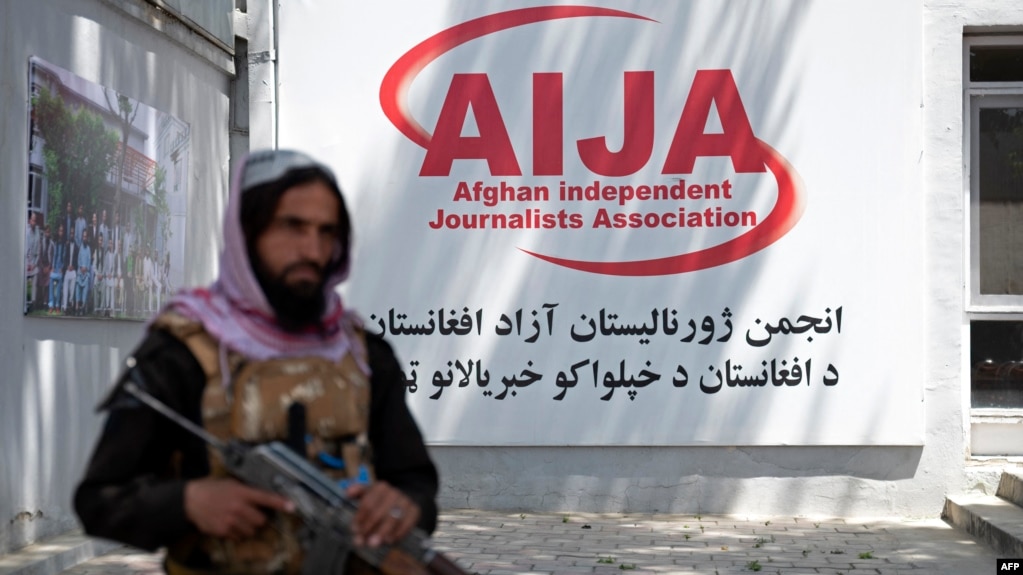
FILE - A member of Taliban security force keeps a vigil during an event organized to mark the 'World Press Freedom Day' at the office of the Afghan Independent Journalists Association (AIJA) in Kabul on May 3, 2023.
FILE – A member of Taliban security force keeps a vigil during an event organized to mark the ‘World Press Freedom Day’ at the office of the Afghan Independent Journalists Association (AIJA) in Kabul on May 3, 2023.

Media on the ground feel as though “no stories can be filed” without Taliban approval, said a Kabul-based journalist who asked not to be identified for fear of retaliation.

The journalist has been covering politics and security issues in Afghanistan for more than a decade. He said he used to be able to go straight to the scene of an incident, get eyewitness accounts and ask officials for their story.

“But no one can imagine doing that [now],” he told VOA. “We must have the Taliban’s account of a story first or else we cannot publish it.”

Dawood Mubarak Oglu


Government control over content is just one of the challenges the country’s journalists face, media advocates say. Female reporters face dress code regulations. And in April alone, Taliban officials in Khost province detained three journalists and blocked access to the privately owned channels Noor TV and Barya TV, according to media reports.

Officials said the broadcasters were not respecting “national and Islamic values.”

Afghan journalists try their best to cover stories, but it is challenging, said Gul Mohammad Graan, president of the Afghan chapter of the South Asian Association of Reporters Club and Journalists Forum.

“Censorship is increasing day by day. The Taliban aim to control what the media say,” Graan said. “By control, I mean, whatever they want is covered, and whatever they do not want is not covered.”

That environment is reflected in the 2024 World Press Freedom Index, which saw Afghanistan drop 26 points over the past year. The country ranks 178 out of 180, with 1 assigned to the country with the best media environment, in the report published Friday by Reporters Without Borders, or RSF.

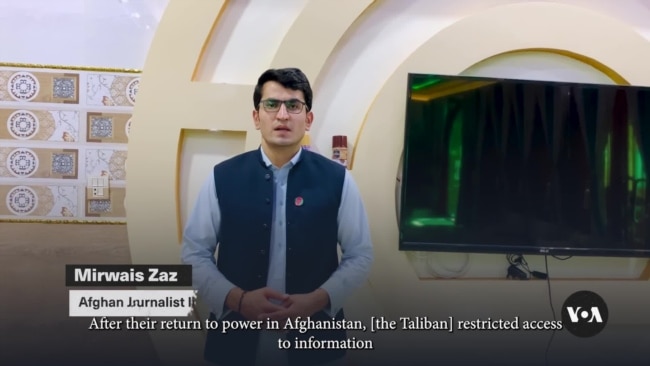
Mirwais Zazai
Mirwais Zazai

Under the Taliban, Afghanistan is the “most repressive country” in South Asia, said Célia Mercier, who covers the region for RSF. “Directive[s] of all kinds that are restricting press freedom,” she added.

Neither the Taliban spokesperson nor its Foreign Ministry responded to VOA’s request for comment. But the Taliban have previously said that media outlets have unrestricted freedom and support from the government if they follow the country’s laws and Islamic values.

The Afghanistan Journalists Center has recorded more than 450 media violation cases since the Taliban took power.

“These include three journalists killed, 219 detentions and 235 cases of threats and physical violence,” said Ahmad Quraishi, the center’s executive director.

Quraishi told VOA that when the Taliban took over, they announced that the country’s existing media law would remain in effect. But then “they issued about 17 edicts that are in opposition to media law,” he said.

Taliban Show ‘No Commitment to Press Freedom’

Beh Lin Yi, head of the Committee to Protect Journalists’ Asia program, said the Taliban try to control media so that Afghans and the world “won’t know what was going on in the country.”

Anonymous Afghan Journalist
Anonymous Afghan Journalist in the first four months of the Taliban’s takeover, according to RSF.

Among all female media workers including journalists, the drop-off was 73% during those months, according to RSF.

Those women who continue to work as journalists in Afghanistan face strict limitations. The Taliban require all women to wear the hijab. But female journalists were also told they must be covered from head to toe. And they also have to grapple with the restrictive mandates imposed on all Afghan women, such as not being allowed to travel more than short distances unaccompanied by a male relative.

“The limitations made it impossible for women journalists to continue their work,” said Farogh Tarin, who used to work for the Pajhwok News Agency in Kabul.

Farogh Tarin
Farogh Tarin\

“I was not allowed to go to events or attend conferences, interviews and protests. Therefore, I was forced to leave Afghanistan,” she told VOA.

Tarin left Afghanistan in March 2022 and is now living in France.

Despite the restrictions, journalists in the country and those in exile are still working hard to cover events.

One reporter in Khost province, who asked for anonymity, said there are limitations on coverage but “in general, we continue to report.”

Samiullah Jalalzai, Najiba Salam and Mohammad Ahmadi from VOA’s Afghan Service contributed to this report. This article originated in VOA’s Afghan Service.

Afghanistan third worst in world for press freedom
read more

Badakhan protesters reject Taliban’s ‘Islamic Emirates’ presence: Darayim

In videos circulated on social media, protesters in Badakhshan are heard expressing their opposition to the Taliban in the province, rejecting the “Islamic Emirates” presence.

The residents of Darayim district, Badakhshan province, staged widespread protests against The Taliban on Friday, May 3rd.

Residents of Badakhshan stated that protests continued following the killing of at least one person due to Taliban gunfire.

According to the video content, the demonstrations began when Taliban members entered homes under the pretext of destroying poppy fields but engaged in “harassment of women’s modesty” inside houses.

The protesters in Darayim district, Badakhshan, claim that Taliban members are harassing and abusing residents lane by lane and house by house.

One protester stated that even women’s modesty is violated, and the Taliban trespass on the “honor, religion, and privacy” of the people.

According to residents of Badakhshan, after initial protests, Taliban individuals opened fire on the crowd to suppress them, resulting in at least one casualty.

Protesters stated that after the death of this individual, residents of Darayim continued their march.

So far, the officials have not responded to the protests in Badakhshan province.

Badakhan protesters reject Taliban’s ‘Islamic Emirates’ presence: Darayim
read more

US provides $17 billion to Afghanistan post-withdrawal: SIGAR


The Special Inspector General for Afghanistan Reconstruction (SIGAR) of the United States says that following the collapse of the previous government in Afghanistan, the United States has allocated $17.19 billion to Afghanistan and refugees.

According to its latest report, released on Thursday, SIGAR added that this assistance includes $2.80 billion in humanitarian and development aid and a $3.5 billion package to the Afghanistan Reconstruction Trust Fund in Switzerland.

According to this report, the United States has allocated $5.36 billion for humanitarian aid, including natural and man-made disasters outside the country, to support Afghan refugees under the “Allies Reception” program until September 30, 2023.

Additionally, the US has transferred $3.5 billion, half of Afghanistan’s frozen central bank reserves in a US bank, to the fund in Switzerland.

According to SIGAR, the US remains the largest contributor to Afghanistan.

Amid a dire humanitarian crisis since the US withdrawal and the Taliban assuming control, this assistance comes as a crucial lifeline for Afghanistan. UN agencies report that over two-thirds of the population grapples with poverty, with children and women facing the brunt of the hardships, lacking access to basic necessities like food and shelter.

US provides $17 billion to Afghanistan post-withdrawal: SIGAR
read more

RSF: Afghanistan’s Press Freedom Ranking Drops 26 Places

According to the Reporters Without Borders (RSF) list, Afghanistan has dropped 26 places due to the deaths and arrests of journalists.

On World Press Freedom Day, Afghanistan has fallen from 152nd to 178th in the press freedom index.

According to the Reporters Without Borders (RSF) list, Afghanistan has dropped 26 places due to the deaths and arrests of journalists.

The Afghanistan Journalists Center (AFJC) also expressed concern over the restrictions on journalists and their continued detention, warning of adverse consequences.

The report from AFJC said: “On the occasion of May 3rd, World Press Freedom Day, we voice our deep concerns regarding the escalating restrictions on media and the ongoing widespread arrests of independent journalists in Afghanistan, cautioning against the adverse effects of this continuing trend.”

“From May 2023 to the present, journalists and media in the country have faced significantly more restrictions and problems in terms of enjoying their legal and fundamental rights than in the period one year prior,” said Ahmad Quraishi, the AFJC executive director.

Reporter Farahnaz told TOLOnews: “When journalists contact sources, they convey their statements to us via WhatsApp.”

The UN Women for Afghanistan, as well as Roza Otunbayeva, the Special Representative of the UN Secretary-General for Afghanistan, the spokesperson for the US Embassy in Afghanistan based in Qatar, and Amnesty International have expressed concern about the restrictions on journalists and media, emphasizing the neec to support and protect journalists.

The UN Women for Afghanistan stated: “80% of women journalists in Afghanistan have had to stop working due to restrictions, harassment and intimidation. On World Press Freedom Day and every day, we keep supporting media initiatives and women journalists who strive to advance women’s rights & gender equality.”

Roza Otunbayeva, the Special Representative of the UN Secretary-General for Afghanistan, said: “As we mark World Press Freedom day, we pay tribute to journalists across Afghanistan, who are doing their best to keep the nation informed,  often at great risk.  Their work is essential for an informed and prosperous nation, and for action on education, the environment, health, the economy, and good governance for all Afghans. They must be celebrated, supported, and protected.”

A part of Amnesty International’s statement reads: “Only when media workers are able to do their job without fear, the stories of Afghan people can come to the fore. Their right to freedom of expression must be prioritized and protected.”

Mario Crifo, the spokesperson for the US Embassy in Afghanistan based in Qatar, said: “The regulatory environment for media remains ambiguous, and access to information about government activities has been curtailed. Perhaps most importantly, and disappointingly, the number of women in the profession and the representation of women in Afghan media has declined—and so too have the opportunities for women to attain the education they need to be contributors and leaders in the media sector.”

However, the Islamic Emirate, emphasizing cooperation in various sectors with journalists, demands all media to operate with consideration for national and Islamic values.

Hamdullah Fetrat, the deputy spokesperson for the Islamic Emirate, said: “The recommendation of the Islamic Emirate of Afghanistan to the media is to continue their publications while considering Islamic and national values as well as Afghan customs.”

Previously, Reporters Without Borders (RSF) stated in its annual report that Vietnam, Russia, and Afghanistan are among the most dangerous countries for journalists.

RSF: Afghanistan’s Press Freedom Ranking Drops 26 Places
read more

USIP Claims: Threats to US from Afghanistan, Pakistan ‘Increasing’

Previously, the U.S. State Department had also urged the Islamic Emirate to adhere to its commitments made in the fight against terrorism.

The United States Institute of Peace (USIP) has claimed in a recent report that terrorist threats against America from Afghanistan and Pakistan are increasing.

The report alleges that a growing environment for terrorist groups in Afghanistan has emerged compared to before the U.S. withdrawal from the country. The Khorasan branch of Daesh is mentioned in this report as a threat beyond the region.

The report states: “The group’s final report highlights how a terrorist incident in or emanating from Afghanistan or Pakistan could trigger a regional or international crisis, undermine U.S. alliances, and derail attention from strategic competition. To avoid such a situation, the report offers preventive, sustainable measures that preserve national security interests without taking focus away from global strategic competition.”

The US House Foreign Affairs Committee Chairman Michael McCaul told The Washington Post, “I got a lot of briefings (about) the rise of the ISIS-K in Afghanistan. We don’t want Afghanistan to become a training ground for Al-Qaeda and ISIS-K again, but that is exactly what is happening, and it will become a threat to the homeland if we don’t pay attention to it.”

Meanwhile, the Russian Foreign Ministry has spoken in a meeting about Moscow’s cooperation with Tajikistan in combating terrorism and threats, including from Afghanistan.

Maria Zakharova, spokesperson for the Russian Foreign Ministry, said: “We would like to draw attention to the high level of interaction between the relevant authorities of Russia and Tajikistan in combating the terrorist threat. The objective basis for this is our similar positions on current issues of the international anti-terrorism and anti-extremism agenda, as well as the existence of common challenges and threats, including those related to the activities of several international terrorist organizations in Afghanistan and their harmful activities in spreading extremist ideology in the countries of the region.”

Although the Islamic Emirate has not commented on the U.S. Institute of Peace’s report or the Russian Foreign Ministry, it has previously vehemently denied the presence of terrorist groups on Afghan soil.

Zalmay Afghan Yar, a political expert, told TOLOnews: “This American report is political opportunism. Afghanistan’s national interests have been targeted by America and Pakistan over the past 43 years. If they want engagement, it should be centered on preserving mutual interests.”

Previously, the U.S. State Department had also urged the Islamic Emirate to adhere to its commitments made in the fight against terrorism.

USIP Claims: Threats to US from Afghanistan, Pakistan ‘Increasing’
read more

Women’s Presence Increases by 17% in Media: AJSC

Meanwhile, the spokesman for the Interior Ministry, Abdul Matin Qani, who was present in the program, assured further cooperation with the

On the eve of World Press Freedom Day, the Afghan Journalists Safety Committee (AJSC) in a program in Kabul said that the presence of women in the media has increased by 17% compared to last year.

Abdul Qadim Wyar, the head of the Afghan Journalists Safety Committee, also expressed concerns over challenges facing journalists and asked the Islamic Emirate to seriously address these challenges.

According to the findings of this organization, the number of male employees in the country’s media has also increased by 10%.

Abdul Qadim Wyar said: “Problems still exist, and journalists from various institutions are being arrested, which means that they are not respected by the Islamic Emirate to the extent that they should be.”

“Please protect the girls who are currently working in the information sector because they are the ones who have the experience and have worked,” said Farahnaz Fariborz, a journalist.

Meanwhile, The spokesman for the Interior Ministry, Abdul Matin Qani, who was present in the program, assured further cooperation with the media.

Qani said: “The Islamic Emirate is committed to freedom of expression within the framework of Islamic values, national interests, and the cultural values of the country, and we try to fully provide the right of access to information.”

“We and you are a very strong force and we can make a difference, thus our duty and yours as a journalist dictates that we must work for the survival of Afghanistan,” said Hafizullah Barakzai, head of the Afghan Journalists Union.

At the same time, officials from some media outlets again emphasized that all challenges faced by journalists in the country must be addressed. They have asked the interim government to ratify the media law as soon as possible.

Zabihullah Sadat, the head of TOLOnews, said, “Some media are currently facing economic problems, and if this situation continues, their doors may close, and a number of our professional colleagues may lose their jobs.”

“Our request is that they provide us with information in a timely manner, it is the right of the media,” said Najibullah Anwarzai, the managing director of Shamshad TV.

In the program, some members of the Afghan Journalists Union spoke about creating a fund to cooperate with journalists who are in bad economic conditions, emphasizing that the establishment of this fund will solve some of the economic challenges faced by journalists.

Women’s Presence Increases by 17% in Media: AJSC
read more

Despite Daunting Economic Headwinds, Afghan Private Sector Shows Signs of Life

Three years after the Taliban took control of Afghanistan, the country’s economy remains in a dismal state marked by depression-level price deflation, high unemployment and a collapse of GDP. Still, while the bad news for Afghans is well known, less visible are some green shoots in the country’s private sector that, if properly encouraged, could mitigate the situation. These range from small business activity to Taliban plans for major projects to the potential for an uptick in investment. Clearly nothing in those developments can stimulate a strong economic revival.
Yet should the Taliban, foreign donors and agencies, and the Afghan private sector manage to do more in their respective spheres, there is reason to hope for greater economic stability. That should benefit the Afghan people and the country’s neighbors, not least by easing pressures on Afghans to out-migrate in search of incomes.Signs of increased activity for Afghan businesses can be detected in projects underway and nearing completion; in missions abroad by trade and business delegations; in some new private investments; and in the fact that a few Western companies are operating again in Afghanistan. The percentage of small companies reporting a return to full operations after years of war and disruption has doubled in the past year amid a number of startups.  Announcements by the Taliban regime of mining, infrastructure, and other projects are significant. On the international side, recent initiatives like the World Bank’s “Approach 3.0” are intended among other things to support the Afghan private sector.

But the broader headwinds facing the macro-economy remain formidable. The continuing impacts of the shocks stemming from the August 2021 Taliban takeover — most notably the abrupt cut-off of development aid and security assistance — have been compounded by the Taliban’s rigorously enforced ban on poppy cultivation, declining humanitarian aid, and compulsory return of many Afghans from Pakistan.

Business Activities in Afghanistan

The stirring of the Afghan private sector was evident at a private sector conference in Istanbul on March 4, organized by the Afghan-American Chamber of Commerce and joined by USIP, and at individual meetings with Afghan business leaders there and subsequently in Dubai.

  • The Taliban are reporting new business creation in Helmand, where some 67 manufacturing firms — mostly in agro-processing — are said to have started operations in the past three years, along with similar reports from some other provinces. At a broader level, the number of private enterprises surveyed by the World Bank that reported being fully operational rose from 28 percent in May-June 2022 to 57 percent in March 2023, with 31 percent of firms in the subsample that responded to both surveys reporting their operating status had improved versus 16 percent reporting a decline.
  • The sole remaining Afghan private airline, Kam Air, has an expanding fleet of 12 aircraft with commercial flights operating among four Afghan cities and between Afghanistan and Dubai, Istanbul, Delhi and other regional cities. Several foreign airlines have resumed scheduled international flights to Kabul.
  • The Taliban retendered and awarded to a Chinese company the major Amu Darya oilfields project, with production reported to have started up. There are also reports that small-scale oil refineries are back in operation, using locally extracted crude oil purchased by the Taliban and then auctioned to refiners.
  • The Taliban have contracted three sizable cement projects, two with Afghan companies and one with a Qatari investor, with a reported total investment of $450 million. This presages significant progress toward self-sufficiency in a sector where it eminently makes sense given Afghanistan’s resource base and the high cost of transporting cement long distances from neighboring countries. The contrast with the previous government, which could not get major cement investments going due to a variety of reasons, one being corruption, is striking.
  • Numerous mining contracts have been issued, though many of them may be simply validating and taxing ongoing activities while the prognosis for large new projects is uncertain. There is clearly considerable ongoing activity in smaller-scale extraction of resources such as coal, talc, chromite, dimension stones, gemstones and lithium, the latter including at least for a time involvement of Chinese entrepreneurs.

On the international side, some larger Chinese companies appear to be expressing interest in the mining sector and infrastructure, and there are even a few U.S. and European businesses operating in Afghanistan. For example, a California-based telecom services company is actively supporting a major Afghan mobile phone company.

The World Bank’s Approach 3.0, announced in February, modestly expands the Bank’s engagement with Afghanistan, while maintaining its “principled approach” embodied in Approach 2.0, which is intended to ensure participation of women and girls in bank-financed projects. Approach 3.0 authorizes: (1) resumption of World Bank International Development Association (IDA) grants to Afghanistan, which had been stopped since August 2021, to complement continuing funding by the Afghanistan Resilience Trust Fund (ARTF); (2) completion of the $1.2 billion CASA-1000 project to transmit electricity from the Kyrgyz Republic and Tajikistan through Afghanistan to Pakistan; (3) bank staff to engage in technical meetings with senior Taliban officials; and (4) financing of small and medium-sized private Afghan businesses by the World Bank, including a recently approved microfinance project, and its private sector arm, the International Finance Corporation (IFC).

Afghan Economic Doldrums

Despite these positive signals, private sector activity along with Taliban business promotion is running up against the formidable challenges faced by the Afghan economy as a whole, enumerated above: plummeting humanitarian aid, the Taliban’s opium ban and the last year’s forced repatriation of Afghans from Pakistan (which appears to be resuming after a pause). These new shocks are reverberating atop those stemming from the August 2021 Taliban takeover — loss of more than $8 billion a year of civilian and security aid, the run on Afghan banks, freezing of some $9 billion of Afghan central bank assets in the U.S. and elsewhere and the stoppage of financial transactions with foreign banks, among other things.

The impact of all these shocks on aggregate demand in the economy, and on Afghans’ incomes, has been dramatic. GDP declined by more than a quarter in 2021 and 2022 and there is no sign of significant recovery in 2023, nor on the horizon in 2024 and beyond. According to the World Bank’s Afghanistan Welfare Monitoring Survey, the unemployment rate among surveyed households was close to 20 percent as of April-June 2023, and there is no reason to believe that more recent trends will be any better.

A striking symptom of low demand and lack of purchasing power in the country is the ongoing economy-wide price deflation. Headline inflation (year-on-year) started to decline in mid-2022, went below zero about a third of the way through 2023, and since then has been negative — reaching nearly minus 10 percent as of February 2024. These kinds of price declines are only seen in countries facing a deep economic recession, such as the U.S. Great Depression in the early 1930s when prices declined by 25 percent between 1929 and 1933. Mirroring these price declines is the appreciation of the exchange rate of the afghani by 20 percent vis-à-vis the U.S. dollar, which discourages exports and encourages imports — the opposite of what is needed given Afghanistan’s large trade deficit which calls for higher exports and lower imports.

What To Do?

Afghanistan’s economy will remain weak for the foreseeable future despite private sector activity and business interest in some projects. It would require major, unlikely actions to change this bleak picture.

On the Taliban side, reversing or at least mitigating their restrictions against female education and women working would, in addition to its direct benefits for Afghanistan’s economy and development, help loosen restrictions affecting international financial transactions and economic relations. And at least a de facto relaxation of the Taliban’s problematic, unsustainable opium poppy cultivation ban would restore part of the more than $1 billion a year in rural small farmers’ and wage laborers’ incomes that have been lost. Unfortunately, major changes like these do not appear to be on the cards.

Short of such game-changers, the Taliban administration should reverse recent price deflation and ensure that the Afghani exchange rate is not too strong. Reducing the amounts of U.S. dollars sold by the Central Bank at foreign currency auctions, and moderately increasing the printing and circulation of afghani banknotes, is the correct macro policy stance and would at least stop worsening the recession.

Second, avoid overtaxing the private sector. The regime has been successful in mobilizing tax revenue, especially customs receipts. However, actually collecting all the taxes on the books, which the previous government did not exploit due to lax effort and widespread corruption, would impose too heavy a burden on the private sector and further dampen economic activity. The Taliban should review of the existing panoply of taxes, simplify by abolishing duplicate and excessive taxes, and not impose new levies.

What can foreign donors and international agencies do? Absent unlikely changes in policies such as formal recognition of the Taliban government or the outright removal of sanctions, international actors can mitigate the economic headwinds by:

  • Slowing and making more predictable the inevitable decline in humanitarian aid while increasing basic development assistance to the maximum extent possible (including newly authorized World Bank assistance under Approach 3.0);
  • Maximizing the effectiveness of aid and its benefits for the economy and private sector by prioritizing local procurement from Afghan companies while moving away from importing goods that can be produced in Afghanistan and aid agencies importing goods on their own account;
  • Reducing over time the U.N. humanitarian cash shipments, which are high-cost, risky, and optics-wise problematic, and gradually replacing them with a combination of normal banking transactions, swap arrangements, and use of digital currency and e-money;
  • Exploiting the authorization for the World Bank and IFC to provide financing directly to Afghan private businesses, and encouraging other aid agencies to do the same (funding well-vetted Afghan private companies is no more risky and probably less risky than other forms of aid);
  • Engaging with Taliban officials on technical macroeconomic policy issues by the World Bank (permitted under Approach 3.0) — in particular to encourage the authorities to shift to more expansionary monetary and exchange rate policies; and
  • Getting international authorization and facilitation — if necessary — to arrange manufacture and circulation of more afghani banknotes to increase the money supply moderately.

Regional countries should facilitate — not block — trade between Afghanistan and its neighbors. Border closures should be avoided and not used for political leverage. Business travel and contacts should be encouraged, building on earlier initiatives. Large-scale deportations of Afghans by neighboring countries need to stop. Beyond their humanitarian consequences, they are economically harmful — especially for Afghanistan but also for neighboring economies, which make use of Afghan labor, and potentially damaging as well for regional security.

From a longer-term perspective, Afghanistan will need to make more and better use of its water resources, for both irrigation and hydroelectric power, which in turn will support the private sector in agriculture, agri-business and other activities. This will require cooperation by regional countries and receptivity to fair water sharing agreements and mutually beneficial water conservancy projects, which can regulate water flows as well as provide electricity to multiple countries.

What can Afghan businesses do? Though the Afghan private sector can sometimes be effective in pursuing narrow commercial issues such as tax relief, it seems unable to engage in effective collective action in furtherance of broader economic goals, let alone to pursue changes in social policies.

Sizable businesses with ongoing activities in Afghanistan should strive to stay in operation, even if there are no prospects for expansion in the short run. They should proactively seek, as appropriate, contracts with the aid community to provide imported and, increasingly, domestically produced goods and services, which will foster private sector development and improve aid effectiveness.

Sizable and successful Afghan businesses based in neighboring countries should not lose interest in Afghanistan, and they may be able to support exports of Afghan agricultural and processed goods and enhancing their value chains, as well as investing in import substitution.

The large amounts of Afghan expatriate financial capital in nearby countries may become available to augment the leverage of IFC and other international financing, which is now authorized and hopefully will materialize in the future.

There are no “silver bullets” that will revive Afghanistan’s economy, let alone stimulate the robust economic growth that is essential for national development. But taken together, the above actions by the key stakeholders will make a difference. They can mitigate the weakness of the country’s economy and help promote critically needed economic stability.

Despite Daunting Economic Headwinds, Afghan Private Sector Shows Signs of Life
read more