Taliban agrees to accept protesters’ demands and replace forces in Badakhshan: Official

Following public protests in two districts of Badakhshan, the Ministry of the Interior of the Taliban has stated that it is changing the structure of its forces in this province.

Abdul Matin Qaneh, spokesperson for the Ministry of the Interior, told the BBC that they have accepted the protesters’ demands in Badakhshan and plan to replace the forces in the province with new ones.

Mr Qaneh also stated that the killers of two individuals who died as a result of protests against the destruction of poppy fields in Badakhshan would be brought to justice. Meanwhile, residents of these two districts in Badakhshan demand that the two deceased be tried by the Taliban in a special court.

Two individuals were killed in shootings in the districts of Darayim and Argo in Badakhshan, and another was injured.

Argo is one of the districts in Badakhshan where poppy cultivation is most prevalent. The spokesperson for the Ministry of the Interior of the de facto administration says that the fight against poppy cultivation in the province continues and the situation has returned to normal.

It is reported that eight people have also been arrested during these protests, and a delegation led by Fasihuddin Fitrat, the Chief of Army Staff of the Taliban, has been sent to Badakhshan to resolve the tensions through dialogue.

For several days, protesters in the districts of Darayim and Argo in Badakhshan have been demanding the expulsion of “non-native forces” from the province following the killing of civilians and raids on poppy fields.

Taliban agrees to accept protesters’ demands and replace forces in Badakhshan: Official
read more

Fitrat Confirms Settlement with Badakhshan Protesters

The representatives of the protesters said that they have ended their protest following discussions with the officials of the Islamic Emirate.

The chief of staff of the Islamic Emirate, who went to Badakhshan Province to address the grievances of the protesters reacting to the security forces’ actions in destroying their poppy fields, states that the issue has been resolved after discussions with the representatives of the protesters.

“We have concluded that the controversy that occurred and the demonstrations that took place were due to some misunderstandings, which were properly resolved. The government has reached an understanding with the residents of that area, and the matter involving the heirs of the two individuals who were killed has also been settled,” said Fasihuddin Fitrat, the chief of staff of the Islamic Emirate.

The representatives of the protesters said that they have ended their protest following discussions with the officials of the Islamic Emirate.

“There is no opposition between the nation and the Islamic Emirate. No one here bothers anyone, and no one can influence this place based on their political desires from outside,” Obaidullah, representative of the protesters in Darayim district, Badakhshan.

“What had happened between the forces of the Islamic Emirate and the people of the district was a misunderstanding, and today’s meeting went very well,” said Mohammad Muzarab, representative of the protesters in Argu District, Badakhshan.

Residents of Argu and Darayim districts in Badakhshan Province protested on Friday and Saturday against what they considered the destruction of their fields, which resulted in two deaths. However, security forces stated that they have destroyed the poppy fields.

Fitrat Confirms Settlement with Badakhshan Protesters
read more

Religious Scholars in Politics: Islamic Emirate’s Perspective

The leader of the Islamic Emirate added in another part of his speech that scholars should prevent disputes, deviations, and disobedience. 

The leader of the Islamic Emirate said that Western countries are endeavoring to sever the ties between religion and politics in Muslim countries.

According to the Ministry of Higher Education, the leader of the Islamic Emirate, during the final day of a three-day seminar held by the ministry in Kandahar, said that advancing political matters is the right of the religious scholars.

Shiekh Hibatullah Akhundzada also emphasized the decree of general amnesty, stating that the Islamic Emirate harbors good intentions towards all Muslims around the world, including Afghans and the people of Palestine.

The Islamic Emirate leader’s statement said: “Western countries are striving to separate religion from politics; in Islamic countries, it is the right of the scholars to be involved in politics. If my decrees are against religious teachings, the scholars should not accept them.”

“In this matter, the esteemed scholars also have an important role in using media, pulpits, and public meetings to convey Islamic culture, Islamic customs, and the traditions of the Prophet Muhammad to the people,” said Hamdullah Fetrat, deputy spokesperson of the Islamic Emirate.

The leader of the Islamic Emirate added in another part of his speech that scholars should prevent disputes, deviations, and disobedience.

He also told the scholars not to accept his decrees if they are contrary to Sharia.

“The amnesty decree must be pursued with the same intensity, and observed so that we can create a peaceful environment, not only in not harming each other, but the amnesty decree should be followed across all areas concerning the people of Afghanistan,” said Salim Paigir, a political analyst.

Previously, the leader of the Islamic Emirate criticized foreign countries’ interference in the implementation of Sharia laws in his speech for Eid al-Fitr prayers at the Eidgah mosque in Kandahar.

Religious Scholars in Politics: Islamic Emirate’s Perspective
read more

Mullah Baradar: Vigilance Needed Against Intl Hindrance

They believe that Afghans must unite against these conspiracies by neighboring countries and the world.

The deputy prime minister for economic affairs, Mullah Abdul Ghani Baradar, said that global powers are trying to hinder the economic and political progress of Afghanistan.

Speaking at the graduation ceremony of the Islamic Emirate forces from the 201 Khalid bin Walid corp Training Center in Nangarhar, Mullah Abdul Ghani Baradar remarked that the Islamic Emirate is viewed with suspicion by countries worldwide. He emphasized the importance of vigilance among Afghans regarding this perception.

Mullah Abdul Ghani Baradar stated: “The great powers of the world look upon the Islamic Emirate with suspicion and still try to hinder our economic and political progress, but we must be vigilant and alert.”

Several experts on political and economic issues added that some countries do not want an independent system to exist in Afghanistan in order to achieve their goals.

They believe that Afghans must unite against these conspiracies by neighboring countries and the world.

“It is appropriate that we should not have divisions among ourselves so that we can confront the world. When we have a stable system in the country, we can demand our rights from the international community,” said Gul Mohammaduddin Mohammadi, a Political analyst.

“The sole goal of the Arabs is to eradicate the religion of Islam in Islamic countries, and they strive towards this goal,” said Shams ur Rahman Ahmadzai, another political analyst.

Previously, other officials of the Islamic Emirate had also asked countries around the world not to interfere in Afghanistan’s internal affairs and, instead of exerting pressure and imposing their demands, to pursue a path of dialogue.

Mullah Baradar: Vigilance Needed Against Intl Hindrance
read more

In First, Islamic Emirate Attends OIC summit, Pledges Cooperation

Mujahid told TOLOnews that the participation of the Islamic Emirate in this summit marks the start of the interim government’s interactions with Islamic countries.

The Islamic Emirate responded to the final resolution of the 15th summit of the Organization of Islamic Cooperation (OIC) in Gambia, stating that the measures concerning Afghanistan, as outlined in the resolution, have already been enacted by the interim government.

Zabihullah Mujahid, the spokesperson for the Islamic Emirate, told TOLOnews that the participation of representatives of the Islamic Emirate in this summit marks the commencement of the interim government’s interactions with Islamic countries.

He described the participation of a delegation from the interim government at this meeting as an achievement and added: “The resolution they issued includes all the work that has been done in Afghanistan, such as the rights of the citizens– that the people of Afghanistan have their rights, the inclusivity of the system — currently Afghanistan has a government where all ethnicities have their representatives and all provinces have their representatives, and also the topic of effectively combating external factions in Afghanistan. This was a very successful participation and it was the first time that the Islamic Emirate of Afghanistan participated in the meeting of the Organization of Islamic Cooperation, and this participation is a starting point for effective interaction with Islamic countries.”

Moeen Gul Samkani, a political analyst, said: “It would be better if we could have a grand assembly to discuss the world’s demands and alongside this discuss what the Afghans want from the world, and decide on these matters.”

Sayed Moqadam Amin, another political analyst, stated: “The task of the Islamic Emirate is political, within the framework of the law or rights it has fewer problems, meaning the elements that constitute a political system are completed here; however, in the political sphere, international standards are subject to a series of laws that undoubtedly need to be focused on.”

The final resolution of the 15th summit of the Organization of Islamic Cooperation emphasized the creation of an inclusive government, respect for women’s rights, and support for the people in Afghanistan.

Representatives from over 50 Islamic countries participated in this two-day summit in Gambia.

In First, Islamic Emirate Attends OIC summit, Pledges Cooperation
read more

The Daily Hustle: The ancient art of making surma

In Afghanistan, surma (kohl) has been used since ancient times by both men and women to enhance the eyes, for its healing properties and to protect the wearer against the evil eye. Traditionally made by grinding stibnite rock into a fine power, the use of the black concoction to line the eyes also has a religious aspect. According to accounts in the Hadith, the Prophet Muhammad used and recommended a form of surma, both for its medicinal qualities and as an adornment. It is therefore halal and its use permitted, or even encouraged. In recent times, however, this millennia-old practice has fallen out of favour with urban dwellers who are increasingly opting for imported eyeliners. There are also concerns about potential health hazards, if the surma has been made in unhygienic facilities, or, as is the case with some preparations, contains high levels of lead. AAN’s Sayed Asadullah Sadat has spoken to a man whose family has been supplying surma to Kabul’s residents for five generations about how the coveted black paste is made and what the future holds for this centuries-old tradition.

Surma, the family business

I’ve been selling surma in Kabul all my life. It’s a trade my brother and I inherited from my father 30 years ago, as he had from his father. My family has been selling surma for five generations and we have a reputation as among the most trusted vendors in Kabul.

There are four kinds of surma in Afghanistan. The best come from stibnite (ithmid) rocks from the mountains in Badakhshan and Ghorband.[1] These are the rocks I use to make my surma. I buy them from trusted traders who bring them to Kabul. The antimony from Badakhshan is a lightweight, ‘moist’ rock that makes for a true black surma. They say Badakhshi surma is ‘hot’[2] in nature and so good to use in winter to warm the eyes against the cold. The rock from Ghorband is heavier and it’s a ‘dry’ rock. It’s more difficult to grind into a fine powder and the colour is not a deep black like the surma the rock from Badakhshan produces. Ghorbandi surma is ‘cold’ and is best used in the warmer months. Both have healing powers and protect the eyes against all manner of ailments, especially air pollution.

There are other surmas, less expensive and of inferior quality on the market. One comes from Peshawar and is similar to the one from Ghorband. Another is imported from Russia. There are also commercial surmas, imported mostly from Pakistan and India, that are made by burning things such as apricot kernels into charcoal, but these don’t have the same benefits as rock surma and are also not considered halal.

Making surma then and now

As a boy, I learned how to make surma at my mother’s knee. Once a month, she would make surma from the rocks that traders brought from the mountains. First, she’d put the rocks in the fire to burn off the impurities. Then, she would grind them into a fine powder in her brass Russian-made mortar and pestle, sifting the powder several times through a mesh until she was satisfied with its fineness. Next, she’d melt beef fat, skimming off the foam until there was a clear liquid, the colour of gold, which she’d drip slowly into the powder until she had a paste. Finally, she’d wrap the paste into several paper parcels, which she weighed on a tarazu (traditional scale) to make sure they weighed three grams each. These little paper packets were my father’s stock for the month. He’d carry them in a small pouch on his route as he walked the streets of Kabul, hawking or calling at the homes of his regular customers.

In those days, my brother and I would sit next to my mother as her hands deftly turned rock first into fine powder and then into paste. She’d tell us the story of surma – where it came from, what it was used for and about the ancient people in distant lands who used it.[3] Slowly, as she recited verses from the Hadith about how the Prophet Muhammad used antimony, she’d line our eyes with surma to keep us healthy, ward off the evil eye and thank the Prophet for the bounties his gift was affording our family.

I still prepare surma much the same way my mother did, except modern appliances have made the job easier and faster. I now use a gas stove instead of a brazier, an electric grinder instead of my mother’s mortar and pestle, a battery-operated scale to weigh the packets and little plastic pouches instead of paper.

Health concerns and changing fashion

Business these days is not as good as it used to be in my father’s time. Many urban women, who used to wear surma as part of their makeup, have stopped using it in favour of eyeliner pencils imported from the West. They frown on surma, saying it’s old-fashioned and unhygienic. There are doctors and reports in the news that say it’s bad for the eyes and could lead to infections or even blindness, that surma contains lead and could poison the blood and cause all kinds of diseases. But I don’t think they’re aware that our surma, which comes from the antimony rocks of Badakhshan and Ghorband, does not have lead.[4] Anyway, my family has been selling surma for five generations, and in all this time, there’s never been a case of anyone having any trouble with our product.

We still have about 70 regular customers. Some shopkeepers buy from us and sell at a profit in their stores. We also do a fair amount of trade selling on the streets of west Kabul and sometimes customers call me on my mobile and ask for a delivery. Many families still use surma regularly. People still use surma at weddings and when babies are born. People also use it when they make a sacrifice, lining the eyes of the sheep [to be killed] with surma. This is not based on sharia, but it’s according to our own customs in Afghanistan.

The surma market is indeed dwindling, but there’s still enough custom for us to make a living. We buy the stibnite for 400 afghanis (USD 5.70) per kilo and can make about 1,000 afghanis (USD 14.90) per kilo after we process it. These days, we make about 7,000 afghanis (USD 99) a week, which my brother and I divide equally.

Surma, a dying tradition

My sons and nephews don’t want to take over the business. They say it’s a dying market and they don’t want to live hand to mouth. Two of my sons are in Iran chasing their dreams for a better future on construction sites along with their cousins. I have two other sons who are still here in Kabul. One works as a guard and the other as a driver. We always thought that at least one of the boys would carry the family tradition into the future. We wanted to modernise our operation, expand the wholesale side of the business, start selling to more and more shops and maybe even export to Pakistan and Iran. We had plans to buy some machines to do the grinding and mixing and invest in nicer, professional-looking packaging.

Now, my brother and I sit together to grind the rock and make surma in a melancholy mood and lament the end of our family as a long line of trusted vendors of surma. We will keep the tradition going as long as we can, hoping that at least one of our boys will come to see this tradition as a legacy worth saving.

Edited by Roxanna Shapour


References

References
↑1 Stibnite, an antimony-sulphide metalloid compound (Sb2S3), is the main natural source for the chemical element, antimony (atomic number 51).
↑2 In Afghanistan, as in the wider region, there is a belief that foods and other things ingested by humans have a hot (garm) or cold (sard) property, with a unique impact on the human body.
↑3 Just how ancient is testified to by the modern words used for surma. The Arabic name, koḥl, which was borrowed into English in the eighteenth century, was earlier used in Akkadian, another semitic language spoken 3,500 years ago. Greek and Latin borrowed a word from ancient Egyptian to get stibium. The Persian word, surma, comes from Azerbaijani – ‘to draw along’ (see Wikipedia).
↑4 Surma made from an alternative source, the rock, galena (lead sulfide), would contain lead.

The Daily Hustle: The ancient art of making surma
read more

Taliban face rare public uprising against their rule in northeastern Afghanistan

Afghanistan’s hardline Taliban leaders have threatened to militarily suppress unprecedented violent public protests in a northeastern border region against a nationwide ban on poppy cultivation.

The unrest erupted last Friday when the Taliban’s anti-narcotics forces began destroying poppy fields in Badakhshan province, prompting angry farmers to resist it with the support of local residents.

Multiple sources confirmed Sunday that Taliban security forces used firearms to disperse the demonstrators, killing two of them during the two days of protests.

Videos circulating on social media showed residents chanting slogans against reclusive Taliban supreme leader Hibatullah Akhundzada, who has banned poppy cultivation across Afghanistan through a religious decree. VOA could not ascertain the authenticity of the footage independently.

While Taliban authorities claimed Sunday the situation had returned to normal, residents said tensions were running high, and they were waiting for a high-powered government team to address their complaints.

Taliban spokesman Zabihullah Mujahid said in an overnight official announcement that their army chief, Qari Fasihuddin, a Badakhshan native, would lead the team to thoroughly investigate the violence and circumstances leading to it.

Mujahid said that an anti-poppy campaign in Badakhshan was under way in line with Akhundzada’s decree to prevent the cultivation of the illegal crop and its smuggling.

“This decree extends to all regions without exception. Regrettably, there have been incidents where offenders attempted to attack the security forces involved in the fight against poppy cultivation, resulting in tragic events,” he said.

Fasihuddin reportedly warned on Sunday that he would be compelled to deploy additional military forces to “quell the rebellion” if the demonstrations persist. He reiterated the Taliban’s resolve to eradicate poppy cultivation in Afghanistan and vowed to achieve this goal, come what may.

Badakhshan and surrounding Afghan provinces are ethnically non-Pashtun regions. The province borders Tajikistan and Pakistan.

The Taliban, who represent the country’s majority Pashtun population, were unable to take control of these provinces during their first stint in power in the 1990s.

Following their takeover of Afghanistan in 2021, the Taliban have successfully established control over all 34 Afghan provinces.

However, some experts argue that the public uprising in Badakhshan highlights the potential obstacles that the Taliban may face in maintaining their authority.

The international community has not yet formally recognized the Taliban government, citing its restrictions on Afghan women’s access to education and work, among other human rights concerns.

Afghanistan has faced dire economic problems since the Taliban takeover nearly three years ago. The Afghan banking sector largely remains isolated, and terrorism-related sanctions on Taliban leaders continue to deter donors from resuming financial assistance for development programs.

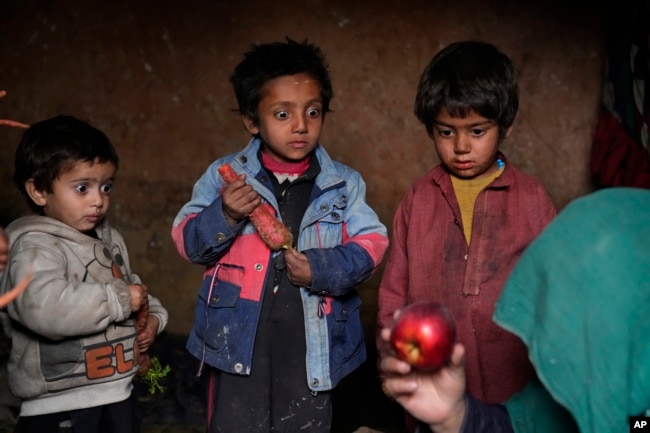
FILE - Internally displaced children look with surprise at an apple that their mother brought home after begging, in a camp on the outskirts of Kabul, Afghanistan, Feb 2, 2023.
FILE – Internally displaced children look with surprise at an apple that their mother brought home after begging, in a camp on the outskirts of Kabul, Afghanistan, Feb 2, 2023.

The restrictions have fueled unemployment and economic problems for the poverty-stricken country’s estimated 40 million population.

The World Bank noted in its latest report released on Thursday that the Taliban’s ban on opium cultivation precipitated a staggering $1.3 billion loss in farmers’ incomes.

Citing U.N. estimates, the report said that the opiate economy’s value has contracted by 90 percent, while the area under cultivation declined by 95 percent, costing Afghans 450,000 jobs at the farm level alone.

The World Bank report noted that Afghanistan’s economic outlook remains uncertain, with the threat of stagnation looming large until at least 2025. “For a sustainable future, Afghanistan needs to address harmful gender policies, invest in health and education, and focus on the comparative advantages it has in the agricultural and extractive sectors,” it said.

Afghanistan used to be the world’s largest opium-poppy producer until the Taliban imposed the ban on cultivation in early 2022.

The ban strictly prohibits the cultivation, production, usage, transportation, trade, export, and import of all illicit drugs in Afghanistan. Afghan poppy farming accounted for 85% of global opium production until recently, according to United Nations estimates.

Taliban face rare public uprising against their rule in northeastern Afghanistan
read more

Turkish Envoy Confirms Resumed Turkish Airlines Flights to Kabul

Tolo News’

5 May 2024

The Turkish Ambassador to Afghanistan announced the imminent resumption of Turkish Airlines flights to Kabul.

During a meeting with the acting Minister of Foreign Affairs, Amir Khan Muttaqi, Cenk Ünal emphasized the importance of maintaining relations between Kabul and Ankara and added that Turkish Airlines will soon resume its flights to Afghanistan.

Ferdows Behguzin, an economist, stated: “In the last four to five months, the revenue from Afghan air travel has been up to seven hundred and fifty million afghani, which has a very positive direct impact on the economic process and revenue collection.”

The Ministry of Foreign Affairs statement read that Amir Khan Muttaqi in the meeting expressed a desire to expand trade and economic relations between the two countries via the Lapis Lazuli route.

Mohammad Younus Momand, the deputy of the Chamber of Commerce and Investment, said: “The Lapis Lazuli route is one of the important trade routes for Afghanistan that can connect Afghanistan to Europe.”

Shabir Bashiry, an economist, said: “With the revival of this matter, the importance of Afghanistan becomes more prominent, fortunately due to our geopolitical position in the region.”

According to the deputy spokesperson of the Ministry of Foreign Affairs, the meeting also emphasized strengthening bilateral cooperation and the travel of delegations to Afghanistan and Turkey.

In the meeting, Amir Khan Muttaqi also welcomed Turkey’s action to halt trade with Israel due to its attacks on Gaza.

Turkish Envoy Confirms Resumed Turkish Airlines Flights to Kabul
read more

Tehran to Fence ‘Vulnerable Areas’ on the Afghanistan Border

The Islamic Emirate welcomed the border closure by Iran and stated that this will be coordinated with Afghanistan.

Tehran has once again emphasized border fencing along the Iran-Afghanistan border.

Sardar Qasem Rezaei, the Deputy Police Chief of Iran, stated that only vulnerable points along the Iran-Afghanistan border will be fenced.

“Physical barriers will only be created in vulnerable areas. In addition, our border guards and residents also participate in securing the border,” said Qasem Rezaei.

The Islamic Emirate welcomed the border closure by Iran and stated that this will be coordinated with Afghanistan.

Hamdullah Fetrat, deputy spokesman for the Islamic Emirate, pledged that all borders are under the control of the Islamic Emirate’s forces and Afghanistan’s soil poses no threat to any country.

“Afghanistan’s security and defense forces control all the geography and border lines of the country, and the fact that the Islamic Republic of Iran wants to fence in the border and vulnerable points is a good action and this will be done in coordination with the Islamic Emirate,” he added.

Some military and political experts believe that there is currently no need for fencing between Afghanistan and Iran.

Kamran Aman, a military analyst, told TOLOnews: “The condition of the border is such that whenever the opposite side wants to build a fence or a high wall or take any measure, it must have the agreement of the neighboring country.”

Mohammad Hassan Haqyar, a political analyst, said: “The border between Iran and Afghanistan is secure due to the efforts of the Islamic Emirate, and there is no need for fencing at this border.”

This comes as Iranian security officials had previously stated that they plan to block their borders to combat the entry of drug traffickers and armed terrorist groups into the country.

Tehran to Fence ‘Vulnerable Areas’ on the Afghanistan Border
read more

Afghan Embassy in India Confirms Gold Smuggling by Consul General

The former Afghan government’s embassy in India confirmed the allegation that Zakia Wardak, the consul general of Afghanistan in Mumbai, India, was accused of smuggling 25 kilograms of gold.

The embassy announced in a statement that Zakia Wardak was not associated with the former government of the country and was operating in coordination with the Islamic Emirate in India.

The statement said: “We would like to address the recent incident in Mumbai concerning gold smuggling allegedly involving an Afghan citizen. We acknowledge the regrettable nature of this event. However, it is important to clarify that the former mission of the Islamic Republic of Afghanistan in India asserts that the individual implicated has no affiliation with our former Republic’s mission.”

The Afghan embassy in New Delhi ceased its operations on October 1, 2023. The embassy had previously announced that the cessation of its activities was due to pressure from the Indian government and the Islamic Emirate to hand over the embassy.

Wais Naseri, a political analyst, said: “The fact that the Afghan embassy is controlled by individuals from the republic and they claim that this person is not associated with us, this is a result of the administrative corruption that exists under the Taliban rule. Unfortunately, this statement is from political competition. Unfortunately, Ms. Zakia Wardak, whether related to the Islamic Emirate of the Taliban or the former republic’s embassy, is mentioned as an Afghan diplomat.”

So far, the Islamic Emirate has not commented on the accusation against the Afghan Consul General in Mumbai.

Previously, following the cessation of the Afghan embassy’s activities in New Delhi, Shir Mohammad Abbas Stanekzai, the political deputy of the Ministry of Foreign Affairs had stated that the Islamic Emirate’s consulates in the cities of Mumbai and Hyderabad are active.

Some former diplomats say that if such a claim is proven, it will damage the diplomatic credibility of Afghanistan and its relations with other countries.

Aziz Maarij, a former diplomat, said: “It would greatly damage the reputation and prestige of a country, the credibility of Afghanistan and its people, and even the Afghan diplomatic apparatus.”

Waheed Faqeeri, an international relations expert, said: “If this crime is proven against her, it will make a bad name for Afghanistan, Afghan diplomats, and the Afghan diplomatic apparatus.”

Meanwhile, Zakia Wardak, in an interview with Times of India, expressed her surprise at the allegations against her. She is awaiting investigation in this matter.

On Friday, Zakia Wardak resigned from her position at the Afghan embassy in India by publishing a resignation letter.

Afghan Embassy in India Confirms Gold Smuggling by Consul General
read more