The Final Hours: An Afghan family’s flight to safety

An Afghan family’s flight to safety

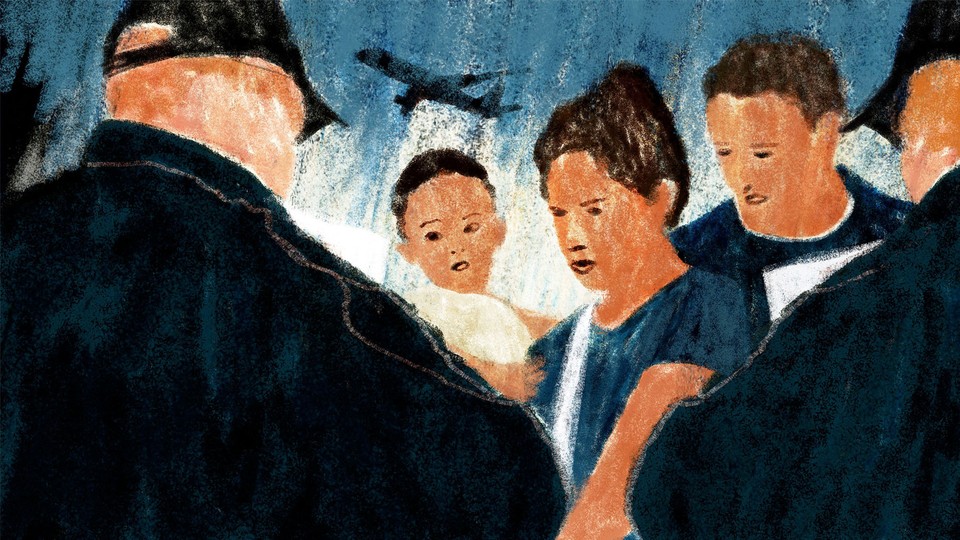
Illustration of a man and a woman holding a child, being questioned by officials with a plane overhead.
Illustration by Susie Ang
This is a story about what happens when you are stateless and powerless—the daily humiliations, the endless waiting, the impossible choices, the dependence on strangers, the danger in every official encounter, the high price of survival, the struggle for dignity.

Safia Noori and Fakhruddin Elham are a young Afghan couple who both served in the Afghan special forces, fighting alongside American troops in Afghanistan. After the fall of Kabul, they fled Taliban persecution in their own country, then escaped to Pakistan, where they lived as refugees with their two small children, waiting for the United States to make good on its promise to bring Afghan allies to this country. Last year, Donald Trump returned to power and broke that promise, closing the doors to resettlement. Around the same time, the Pakistani government stopped renewing the visas of Afghan refugees and began deporting them by the hundreds of thousands. The family became fugitives with no legal status, hiding from the police in Islamabad to avoid being sent back to death or misery in Afghanistan, trying to find a way to safety.

On March 24, this magazine published my story about Safia and Elham. (I gave them pseudonyms for their own protection, but can safely use their real names now.) That day, an acquaintance who leads an international humanitarian organization, and who had brought the family’s plight to the attention of high-level Spanish officials back in January, used my essay to nudge Madrid about the family’s request for asylum, and Madrid nudged its embassy in Islamabad, setting in motion the maddening, dreamlike events that followed.

The next day, on March 25, the Spanish ambassador sent a letter approving the family’s travel to Spain for “international protection.” The embassy instructed Safia to send copies of plane tickets for Madrid, as well as all-important exit permits from the government of Pakistan, before their visas could be issued.

Spain’s positive decision didn’t guarantee anything. The family now had to get out of Pakistan without being caught and deported. This was difficult for Afghans in any circumstance; two wars would make it even harder. The American and Israeli attacks on Iran had shut down commercial flights over much of the Middle East and left only one viable route from Islamabad to Madrid—through Istanbul on Turkish Airlines. The other war, between Pakistan and Afghanistan, received much less international attention, but it had turned Afghan refugees, already a despised underclass around the region, into pariahs in Pakistan. Safia and Elham became enemies of a state that wanted to punish them for the actions of a Taliban regime in Kabul that regarded them as traitors and infidels.

A few days before hearing from the Spanish embassy, Safia and Elham had paid $1,400 to a fixer at a “travel agency” that put them on a waitlist for three-month tourist visas issued through a Pakistani consulate somewhere in Afghanistan. (The official cost for such a visa was $8, but obtaining one the normal way, through Pakistan’s embassy in Kabul, was virtually impossible.) Safia explained to me that this sketchy document would keep them relatively safe from the police while they looked for some way to leave Pakistan, but it wouldn’t be official enough to legalize their status. Also, the $1,400 was just a deposit. Delivery of the visas, not including ones for the children, would eventually cost $3,100—or maybe more. The price fluctuated almost daily, as if visas were being sold like black-market gasoline. Now, with Spain allowing the family to travel to Madrid, the $1,400 was a sunk cost.

The Pakistani government finds ingenious ways to profit off the desperation of Afghan refugees. It requires every foreigner without a valid Pakistani visa to obtain permission to leave the country—a document called, without irony, a “Humanitarian Safe Passage Exit Permit.” Four of them would cost the family $2,650 in fines and fees for overstaying the expired visas that Pakistan refused to renew. Even then, the exit permits weren’t certain. Like most things in Pakistan, they depended on connections and bribes.

First, Elham had to register their 2-year-old son, Yusuf, who didn’t have an entry visa, because he had been born in Pakistan, but who couldn’t leave without being recorded in the national database. This task required Elham to spend a day driving around Islamabad in the car of his Pakistani landlord, who had become a kind of guardian angel to the family because he and Safia were both Shiite Muslims, co-religionists of an oppressed minority. To prevent Elham’s Afghan accent from giving him away at the many police checkpoints, the landlord claimed him as his mute brother.

But even with a Pakistani at his side, Elham was turned away from one registration office after another. “When they checked my documents and saw that I am Afghan, they told me to leave the office and said that this matter was not their responsibility,” he told me later. Finally, the landlord called a friend in the Interior Ministry, who got the matter resolved. But Elham’s day spent wandering through bureaucratic Islamabad, he told me, “truly shows how people take advantage of the suffering of others.”

Pakistan now required all Afghans to pick up their exit permits in person at the Interior Ministry—but this seemed a likely trap for arrest and deportation. The work-around, of course, meant yet another bribe, and on Friday, March 27, Safia and Elham transferred $600 through the “travel agency” to the bank account of a ministry employee. In exchange, they were told, the exit permits would be issued digitally the following Monday.

“I do not trust the government of Pakistan at all, not even one percent,” Safia wrote to me. “But this situation is about bribery, and I know that in such cases, once they receive the money, they usually complete the work. By Monday, everything should become clear.” Meanwhile, the family would shop for suitcases and clothing to prepare for their departure, which seemed more and more like a jailbreak.

I was sending money to their landlord by way of Western Union for their expenses. (When I described the situation to my editors at The Atlantic, they decided to have the magazine reimburse me for some of the money I spent on the family’s travel.) By now I was exchanging a dozen messages a day with Safia and Elham. As they came closer to escape, I found it hard to concentrate on anything other than getting them out. But every day threw an unreasonable, enraging obstacle in their path.

Monday arrived. Safia and Elham waited all day for their exit permits. In the late afternoon the Interior Ministry issued a single permit: for 2-year-old Yusuf. Apparently, the rest were delayed by a computer glitch. Their fixer at the “travel agency” reported that the other permits would come within an hour if the glitch could be solved. If not, then tomorrow. An hour passed. Night fell. Safia and Elham drank coffee to stay awake. “Only when the exit permits finally arrive will my heart become calm and I will be able to sleep,” Safia told me.

The next morning brought no permits. The word now was that they would be sent at two in the afternoon. Two o’clock came and went. The unofficial price had apparently gone up. At 4:30 Safia wrote with alarming news: “They have stopped all exit permits and are not approving them. They said that tomorrow I and all my family members must go in person to the Ministry of Interior, and only then there may be a possibility of approval.” By now just hearing the word Pakistan left Safia trembling. She was, she said, “going crazy from worry.”

I didn’t think it was a good idea for a family of Afghan refugees to show up at the heavily guarded Interior Ministry, which was subordinate to Pakistan’s intelligence service, a rogue agency widely accused of aiding terrorist groups, including the Taliban during the American war in Afghanistan. I reached out to everyone I knew with Pakistani government contacts who could spring the exit permits. A friend managed to reach a top official in the Foreign Ministry, who agreed to help.

But Safia had already made up her mind. Life in Pakistan was unbearable. She would gather her courage and move toward her dreams or be handed over to the Taliban and killed. She was ready to accept either outcome.

The next morning, April 1, the family’s landlord drove them to the white concrete Interior Ministry building. Safia, Elham, and the children went inside the reception hall—a cramped room where two men in civilian clothes sat behind a counter. Safia handed over their passports and receipts showing that they had paid for the exit permits.

According to Safia, as soon as the men realized that these were Afghans standing in front of them, their manner turned hostile. One of them glared at her. “Come back next week,” he told her. “Then your work will be done.”

As politely as possible, Safia explained that their papers were in order, their fines had been paid along with extra “fees,” and they urgently needed the permits so they could leave Pakistan.

The official’s face hardened. “Afghans have no right to speak here,” he said. “Leave the hall.” He threw the family’s papers on the floor.

Safia was 26 years old. The past five years had brought many blows. The loss of her career in the Afghan military after the fall of Kabul, and of any hope for a decent life in her native country. A suicide bombing outside the Kabul airport gate that left scores of corpses all around her in a sewage ditch and barely spared Safia, her husband, and the child in her womb. The family’s flight from Taliban pursuers across Afghanistan, during which they survived on rice, bread, and water and slept in strange houses and mountain caves. Safia’s overwhelming desire in the worst moments to end her own life, which only her husband’s sympathy and the thought of her unborn child prevented. The two weeks Safia spent all alone in a Kabul hospital as she struggled to give birth to their daughter, Victoria, while her family stayed away for their safety and hers. The decision to sell everything she owned, including her wedding dowry, to pay for a black-market passport, then say goodbye to her parents and siblings and escape with her husband and baby into Pakistan. The refugee years that followed—the forms and interviews and medical exams the family was put through as they waited in vain for America to make good on its promise to bring its Afghan allies to safety. Those last months spent hiding from Pakistani police in a sunless room. The daily insults of petty bureaucrats. The waste of her youth, her life.

But instead of breaking, Safia clung with all her strength to the only thing she hadn’t lost.

“I’ve done nothing wrong,” she told the men in the ministry. “I’m not a terrorist. I’m a woman.” She later told me that her voice shook and rose nearly to a shout. “You must not treat me this way. I deserve to be treated like a human being. We’re human beings! Look at my children—what is their fault? You should be happy we’re leaving your country. I’ll file a complaint if you don’t do your job. We won’t leave until you do it!”

She sat down in a chair as if she would never again get up. An hour passed. Then one of the men called her to the counter. “You are very stubborn,” he said, and disappeared with their documents into an inner office. Half an hour later he emerged and handed over the exit permits. “Go,” he commanded.

Safia laughed. “Soon I’ll go, and I will never see this place again.”

Elham was hearing stories of Afghan travelers at the Islamabad airport separated from other passengers by immigration officers, harassed with impossible demands, and shaken down for hundreds, even thousands, of dollars. One family missed their flight to asylum, their exit permits expired, and they were deported to Afghanistan.

I discussed these last-minute risks with an American lawyer named Tom Villalon—a member of a tiny nonprofit called Rescue Afghan Women Now that helps keep dozens of Afghan women who’d served in their country’s military alive in Afghanistan and Pakistan. (Last week, one of them, a widow with two young sons, was arrested and deported to Kabul. Pakistan is now deporting as many as 5,000 Afghans a day.) Villalon had a colleague who knew the brother of a senior Pakistani official, and this man agreed to contact the immigration chief at the airport to ensure that Safia and Elham would be allowed to leave. I can’t tell you the brother’s name, just as I have to keep the landlord’s name out of this story. Among all the grief that Pakistan caused the family, some Pakistanis treated them with extraordinary kindness, and for that they might be punished.

The Turkish Airlines flight was scheduled to depart Islamabad in the predawn hours of Friday, April 10. That night I was with my wife and daughter in Córdoba, in the south of Spain. We had come for a short vacation, but also in hopes of meeting Safia, Elham, Victoria, and Yusuf at the Madrid airport. A picture appeared on my phone: a family selfie inside the terminal, broad smiles; by chance, 4-year-old Victoria was wearing a T-shirt that read ESCAPE. Sometime before midnight in Spain—1:30 a.m. in Pakistan—Elham tried to reach me on WhatsApp, but the call was dropped. A few minutes later a text message came. Turkish Airlines would not let them board the flight.

Their luggage had been weighed, and they were about to receive boarding passes, when two airline employees noticed the family and demanded their passports. One of the employees, a young Pakistani woman, sneered: “Go away, dirty Afghans, damned Afghans. Sit there. No one will allow you to travel.”

When the family didn’t move, the other employee, a Pakistani man who seemed to be the manager, snapped: “The lady is telling the truth. Why don’t you go over there? Didn’t you hear what she said? Do you want us to call the police to force you to leave?” The family abandoned the ticket counter and went to sit down. The manager called Elham back and told him that they couldn’t board their flight without return tickets—to Kabul. Elham displayed their Spanish visas and the letter from the ambassador granting their request to travel to Spain for asylum, but it made no difference.

Elham had spent five years in the Afghan special forces, fighting alongside American troops. Military service had given him a highly respected place in society. Now, to save his family, he had to try to put an American journalist he’d never met on the phone with an airline employee who suddenly had the power to ruin their lives. But the manager continued to insult Elham and refused to talk with me, and it seemed as if the family’s chance at freedom was going to slip away at the very last minute. If they weren’t able to reach safety, I thought to myself, then the world was an utterly hopeless place.

Then Villalon, the American lawyer, discovered that Turkish Airlines had flights from Madrid through Istanbul to Kabul. I got online, bought four fully refundable tickets, and sent them to Safia’s email. Their sudden appearance on her phone seemed to upset the manager, but he had to let the family go. A few minutes later, Safia sent me a message: “My heart has grown very dark toward this place.”

The last station in this gantlet of abuse was immigration. The family was sent to Booth #8, but Booth #8 sent them to Booth #3. Booth #3 was empty. Then Booth #1 called them over. Several officers examined the passports and conferred. Elham overheard enough of their Urdu to realize that the officers were familiar with the names of his family. One of them told Elham. “We’ll check your documents and make sure there’s no problem.”

The children were exhausted and had begun to cry. “There’s no problem,” Elham said. “We paid a lot of money to put everything in order.” And he added—perhaps with a gleam in his eye, since he was about to recover a morsel of all that Pakistan had taken from him: “If you want, I’ll call the brother of the senior official right now.”

“No, no, don’t call. Your documents are fine.”

Passports stamped—the last trace of Pakistan. The family started toward the departure gate, but the immigration officer had one more thing to say.

“If they hadn’t reported your names to us, we wouldn’t have allowed you to leave from here. We would have deported you to Afghanistan tonight.”

“Why?”

Elham would never forget the answer.

“Because you are Afghans.”

On the sidewalk outside the departures hall of Terminal 1 at Adolfo Suárez Madrid-Barajas Airport, a dark-haired little girl in a yellow T-shirt is running toward me with outstretched arms. A minute later, in pictures taken by my daughter, Elham, Safia, Victoria, and Yusuf look impossibly young and hopeful.

And now they live in Madrid. Elham quickly mastered the metro, and Safia is competing with her husband in language acquisition, and Victoria and Yusuf love riding on playground swing sets. The Spanish government provides temporary housing in a neighborhood of outer Madrid, three meals a day, metro cards, Spanish lessons, recreational activities, and school for Victoria, while the family’s asylum request moves through the system. All alone in this strange country, Safia and Elham are determined to learn, work, and build a life for their children.

One day, Elham showed me a picture of a small desktop stand on which he’d placed the flags of Afghanistan and the United States. It made my heart sink. America didn’t deserve his unrequited loyalty. “Why not the Spanish flag?” I asked. After all, Spain had given his family the second chance that America denied them. Elham agreed: He would put a Spanish flag alongside the other two, which, he told me, stood for the bond between us.

When the Trump administration locked out Safia’s family and nearly all refugees, the rest of the world did the same. Pakistan and Iran have deported millions of Afghans back into misery; Canada, Australia, and other countries known for humanitarianism have narrowed the pathway to safety; most of Europe has shut itself off from desperate and oppressed people. Safia’s younger sister, a talented artist and writer, is stuck in Afghanistan, trying to resist a forced marriage to a Talib. Elham’s brother is being held in a Taliban prison because of Elham’s military service. It’s impossible for me to appreciate Spain’s generosity to this family without also thinking of the scale of injustice around the world, the toll of countless humiliations.

At night Safia still dreams of Pakistan. “It is as if our bodies have left, but part of our souls are still trying to escape,” she told me. “Those days left such deep marks on our spirits.” But after many years of only surviving, she said, “little by little I feel that a new chapter is opening before us. For the first time in a long time, alongside all the pain, I can also feel hope. I can feel that maybe life still holds beauty for us.”
The Final Hours: An Afghan family’s flight to safety
read more

We were doing well when I left

Tom Stevenson
London Review of Books
21 May 2026
Choosing Defeat: The Twenty-Year Saga of How America Lost Afghanistan 
by Paul D. Miller.
Cambridge, 545 pp., £35, October 2025, 978 1 009 61437 5

The United States​ brought the war on terror to practically every part of the world – landing military advisers on the Sulu archipelago in the Philippines, operating black sites in Poland and Romania, filling the cages of Guantánamo Bay. But the challenge to American power presented by the 11 September attacks came from a particular region: what Adam Garfinkle, a future speechwriter for both Colin Powell and Condoleezza Rice, referred to in 1999 as the Greater Middle East. Iraq would suffer what George W. Bush’s vice president, Dick Cheney, called the ‘full wrath of the United States of America’. Pakistan, Yemen and Somalia were subjected to a drone assassination programme. Iran was placed ‘right at the top of the list’ of America’s enemies by Cheney – even if it took his successors another two decades to get round to attacking it. But Afghanistan occupied a special place. The US would use the country, as Douglas Feith, who served in Bush’s administration, later put it, to ‘send signals to the Libyas, and the Syrias, and the Sudans, and the Iraqs and the Irans’. Once thought of as ‘the other war’ or the ‘good war’, Afghanistan became the forever war. By the time it ended in 2021 at least 175,000 people had been killed, not counting the far larger number of deaths caused indirectly by disease and malnutrition.

The basic story of the war can be told in relatively simple terms. A complacent empire struck at from its furthest periphery sought brutal retribution and enacted a bloody occupation. Eventually it grew tired and withdrew, leaving behind no great transformation. Many of those who had been involved in the war’s inception saw the chaotic Nato withdrawal in August 2021 as a betrayal both of Afghanistan and of the project of American power in the world. There are still eccentrics who believe the occupation failed because the US and its lieutenants were insufficiently committed to terrorising the locals. As with Iraq, the war in Afghanistan is not yet widely acknowledged to have been a crime rather than just a mistake, but even the political establishment in the West sees it as a cautionary tale.

An effort to rehabilitate the memory of the war may therefore seem to have a certain romantic quality. A former CIA officer enlisted in the war effort, Paul Miller is one of the few US officials of that period who focused his career on Afghanistan. From the CIA he made his way to the staff of Douglas Lute, adviser on Iraq and Afghanistan to both George W. Bush and Barack Obama. Between 2007 and 2009 Miller was director for Afghanistan and Pakistan on the US National Security Council, and was in the room when many of the major decisions of the war were taken. He has now set out to rescue its reputation from posterity. In his account, it was embarked on with fine intentions, even if it was conducted with carelessness. It dragged on for two decades and ended in a loss, but only because ‘every president who oversaw the war made major strategic errors’: Bush decided to invade Iraq; Obama announced the timeline for withdrawal during the surge; Trump gave the game away to the Taliban by negotiating that withdrawal; and Biden conducted the coup de grâce. If it hadn’t been for all that, the American adventure in Afghanistan could have been won.

Whether or not a war is winnable depends on its objectives. According to Miller, Afghanistan was ‘a clear-cut just war of self-defence’ which ‘just happened to require liberating an oppressed people’. In common with most accounts of the war, his neglects to mention that in September 2001 Afghanistan was in a state of incipient famine. In 1999 and 2000, the country had suffered drought and crop failures. A joint UN Food and Agriculture Organisation and World Food Programme mission found the ‘almost total failure of the 2001 harvest’, reporting that five million people would require international food shipments to survive. When the bombing campaign began that October the aid agencies were forced to suspend this programme. Médecins sans Frontières warned that ‘the air strikes, lack of aid and onset of winter will only magnify this catastrophe.’ Mass starvation was avoided by the concerted action of relief agencies when the air campaign abated in December 2001. But in September, when the decision was taken to attack, it wasn’t clear that this would be possible. No one seemed to care very much.

Miller argues that carpet-bombing perhaps the poorest country on earth as it faced famine was the only option. The standard argument used to justify the invasion was that the Taliban and al-Qaida were bound together by pact and thus were ‘indistinguishable’. But even if one were to accept that argument, the Taliban had no capacity to resist US action, so America could have ignored it – concentrating instead on trying to capture the al-Qaida leadership. This was never considered. As Donald Rumsfeld, the US secretary of defence, said in December 2001, ‘If you walked in and said “Here is Mr bin Laden” the problem would not go away.’ The invasion was ineffective in targeting al-Qaida’s leaders, who largely survived it and evaded capture. Some were captured at Tora Bora, but bin Laden lived for another decade, until the raid on Abbottabad. Khalid Sheikh Mohammed was captured in 2003, not by American soldiers but by Pakistan’s intelligence agency, the ISI, in Rawalpindi. Abu Hamza Rabia and Abu Laith al-Libi were assassinated by drone strikes in Waziristan in 2005 and 2008. Ayman al-Zawahiri survived numerous assassination attempts by drone before he was killed in Kabul in 2022.

Defences of the initial invasion often put great emphasis on the fact that the US had offered the Taliban the chance to surrender. Shortly after the 11 September attacks, the CIA’s Islamabad station chief, Bob Grenier, travelled to Quetta to meet the Taliban leaders Abdul Jalil Akhund and Akhtar Mohammad Osmani, who told him that the Taliban ‘would not risk the destruction of their nation for the sake of one man’. The CIA director at the time, George Tenet, is said to have passed a message via the ISI to the Taliban’s supreme leader, Mullah Omar, to say that the Taliban could avoid war if they gave up bin Laden. Omar refused to do so without proof that he had been responsible for 9/11. In Miller’s version, Bush and Cheney were models of emollience, and the fact that the US began marshalling its proxy forces on 12 September is merely evidence of prudent planning. But the idea that there was a real American attempt to avoid war is challenged by all serious scholarship. The US never entertained any option other than a full attack on Afghanistan. One reason for the Taliban’s obstinacy may have been that they knew what they were dealing with. As Wendy Chamberlin, the US ambassador to Pakistan, put it, ‘there was no inclination in Washington to engage in a dialogue with the Taliban.’ Miller disputes this. But the US certainly knew its demand that the Taliban hand over the al-Qaida leadership would never be accepted. As Bush himself would later write, it was intended to ‘firm up our justification for a military strike’.

The attack on Afghanistan began on 7 October and employed a combination of tactics – aerial bombardment and special forces working with local proxies. The CIA arrived in the Panjshir Valley with guns and cash for the Northern Alliance, a collection of mostly Tajik and Uzbek warlords who had a long history of collaborating with the agency – some of them had been involved in the destruction of Kabul in the 1990s after the fall of the communist regime. CIA officers handed $100,000 in cash to Abdulrab Rasul Sayyaf (who had palled around with bin Laden in the past). The UK Special Boat Service embedded with Abdul Rashid Dostum, whose men would soon herd hundreds of Taliban supporters into shipping containers to be suffocated to death, before bulldozing their bodies into holes in the desert. The notion that the CIA teamed up with Dostum, Fahim Khan and Gul Agha Sherzai to secure the principled liberation of Afghanistan is ludicrous, but Miller never questions it.

The air campaign mirrored the brutality meted out by the US’s local auxiliaries. Miller quotes Ryan Crocker, America’s first chargé d’affaires in Kabul, who described the devastation. ‘Just driving in from Bagram to Kabul, not a building standing ... whole city blocks of Kabul were gone,’ Crocker wrote. ‘It looked like pictures of Berlin in 1945.’ (This description is offered not as a reflection on the attack but to demonstrate the need for reconstruction programmes.) In only two months the US had achieved what it thought was a ‘stunning victory’. As the Taliban leadership withdrew to Pakistan, the CIA rode into Kabul and took over the Ariana Hotel. Tens of thousands of Northern Alliance supporters sought their share of the spoils. The ease of the assault demonstrated the weakness of the Taliban state that was allegedly ‘protecting’ bin Laden, who sought the safety of the Spin Ghar mountains rather than a Taliban bunker.

By early 2002 the US believed it had won the war. Miller thinks in hindsight that the ‘light footprint’ of the early occupation was a mistake. It doesn’t help his argument that the examples he offers of successful state-building by the US and its allies are the Balkans, Sierra Leone and Liberia. The merits and demerits of state-building were much debated. But in 2002 the US wasn’t willing to spend much on Afghanistan (the easy money didn’t start flowing until much later). Miller argues that the US prioritised counterterrorism and set aside ‘virtually no resources’ for roads, schools and hospitals during the first two years of the occupation. Having spent $4.5 billion on three months of war, it set up a paper-thin transitional government on shoestring funds.

The Afghan Interim Administration and the Transitional Administration that succeeded it were dressed up as governments, but in practice they were satrapies dependent on external sponsorship. Hamid Karzai was chosen to lead the administration because of his American connection, his claim to a Pashtun lineage and because unlike Zahir Shah – another possibility – he hadn’t once been king. Days before the invasion the CIA had told Karzai, then in Pakistan, to get on his motorbike and enter the country. With his past support for the Taliban absolved, the Americans gave him a security team. After he was informed by a satellite phone call from Bonn that he would head the new government he started travelling around with American bodyguards. Almost all the political figures in post-invasion Afghanistan had ties of some sort to US intelligence. And as Miller notes, ‘for all intents and purposes, there was no government outside of Kabul and a few provincial capitals well into 2005.’

In a story brimming with failures Miller sees the internationally sponsored government in Kabul as one of the ‘islands of success’, crediting Karzai’s administration with producing ‘a more open society’. Miller praises the new Afghan army and police forces for fighting off the Taliban for more than a decade. But while they were supposed to be building a professional army, US forces were hiring local militia members whenever they needed muscle. America spent billions of dollars on anti-narcotics programmes; the result was a net increase in poppy cultivation. Miller claims to admire the work of the academic Thomas Barfield on the American state-building endeavour. But unlike Miller, Barfield saw that post-invasion Afghanistan was a corrupt paper state dependent on international donations, offering little to the population and subject to the final authority of the US empire. As he put it in 2010, the ‘unexpected measure of goodwill from the Afghan people in 2002 was heedlessly squandered in the coming years by inept policies that failed to bring security to many regions’.

Soon enough the Taliban recovered from its defeat. It started ambushing coalition forces, downing helicopters, attacking the funerals of collaborating clerics and conducting suicide operations at Bagram airbase, withdrawing into tribal Pakistan when necessary. The British army redeployed to Helmand in 2006 in the hope that a reputation destroyed in Iraq might be rescued by fighting the insurgency alongside the reasonable Canadians and Dutch. But in the event they often ended up fuelling the violent conflict they were ostensibly there to prevent. That is, when they weren’t executing farmers in their beds in front of their wives. Somehow this didn’t help eliminate support for the Taliban.

Miller tries to finesse this by arguing that if the occupation forces behaved poorly it is because there were too few of them, and that if there had been more they might have been more professional. But given his claims about the merits of the occupation it’s unclear why he thinks there was an insurgency at all. His view seems to be that the Taliban, by some metaphysical means, conjured up a bitter struggle across the country against an impeccable project. When American planners realised how severe the insurgency was they sent in the marines, who couldn’t speak the local languages, to train Afghan police and soldiers who couldn’t speak English. Young men were plucked from their villages, given a couple of weeks of training and then sent to man rural checkpoints. In the best-case scenario, they answered to the corrupt Ministry of the Interior in Kabul; often they ended up working with the Taliban. Miller says he knew at the time that the situation was ‘dire’. But it’s difficult to square that with his general claim, which is that if the cheques for the phantom Afghan army brigades had arrived a year earlier it would all have been different.

Obama​ entered office in 2009 believing that the situation in Afghanistan could be turned around. The first year of his presidency put paid to that. His two major innovations were the drone campaign in Waziristan and the surge. In February 2009, the US deployed 21,000 more soldiers and another 30,000 arrived in December. At the height of the surge there were 150,000 US and coalition troops in the country. Miller is very critical of Obama’s decision to put a public timetable on the surge (stating that the bulk of US forces would return home in July 2011), which he sees as the hinge point in the whole war. The timetable was intended to send a message to the government in Kabul that it had a limited amount of time to get its act together, but in fact the pre-announcement meant that the Taliban knew when the American push would end. The surge ensured there were plenty of American soldiers around, but it also drew closer attention to the nature of the Afghan government, which was festering in a way that was obvious even to the US officials who visited. When Richard Holbrooke, the US special representative, and Vice President Joe Biden met Karzai they immediately saw the problem. In 2009, Holbrooke and Karzai tried to rig the upcoming elections in different directions. In the resulting mess Karzai remained in place. Miller holds the view that it was a great moral achievement that a certain percentage of women won office in these fraudulent elections – presumably so they could work alongside the CIA assets in the cabinet.

Miller is preoccupied by the reason American officials, and Americans in general, thought of the war in Afghanistan in the way they did. He records that in 2001 the war had near unanimous support in the US, and still had substantial majority support in 2008. But by the end of the surge in 2012 enthusiasm had been replaced by a sense of futility. Miller chalks some of this up to a ‘mood music of pessimism that would swell throughout the war’. But the real reason the Obama administration scaled back its ambitions was the feeling that the whole thing was beyond repair. Though the US is thought to have provided more than $130 billion to the Afghan state between 2002 and 2021, most of it went straight to security forces and much of the rest was siphoned off to accounts in the Gulf and Switzerland. Looked at from this perspective, the war in Afghanistan wasn’t ‘wasteful’ so much as an efficient vehicle for the transfer of public funds to arms companies and contractors.

The American military commanders and political appointees who circled in and out of Afghanistan in those years tended to cling to a common delusion. Miller has interviewed plenty who believe they made great progress when they were there – a sentiment captured in the phrase ‘we were doing well when I left.’ He is kinder to those who opposed withdrawal. Leon Panetta, CIA director and then secretary of defence under Obama, tells Miller it was an achievement that ‘for twenty years we were able to prevent Afghanistan from collapsing and having the Taliban take over.’ Some officials knew how bad the situation was. Miller takes to task Chuck Hagel, Panetta’s successor at the Pentagon, for believing the US was losing while also wanting to withdraw (if the war was being lost, that should have been an argument for persevering). The fate of the surge was another example of a lack of commitment among American political leaders to ‘the moral necessity of victory in a just cause’.

The first time US officials made formal contact with the Taliban was in 2010, when a former aide to Mullah Omar came to Munich. The US insisted the Taliban accept principles (inclusion, pluralism) that it claimed were hallmarks of the administration it had erected in Kabul. The Taliban said it wouldn’t talk to Karzai. It was two years before the talks were picked up again. The second round of negotiations was half-hearted, but it did lead to the establishment of the Taliban office in Doha, which Karzai worried might look like a government in exile. The main problem the US had in dealing with the Taliban was that it had little to offer: its soldiers were already going home in advance of a planned full handover to the Afghan government. But the Kabul administration was already starting to lose territory. Narrow defeats for government forces in 2014 were followed by routs in Kunduz and Helmand in 2015. Obama was soon talking of bringing the war to a ‘responsible conclusion’. Miller credits Peter Lavoy, a veteran of the national security bureaucracy, with persuading Obama not to withdraw in 2016 and to keep 12,000 troops in place.

From then on the occupation was a holding action. Most of the coalition soldiers were doing little fighting, with the exception of American and British special forces death squads, which continued to terrorise the countryside. When Trump entered office it was on a platform that included getting the US out of Afghanistan. But he ended up introducing another 3000 troops and increasing the rate of airstrikes. It wasn’t until September 2018 that he tasked the US special representative Zalmay Khalilzad and Mike Pompeo, the secretary of state, with reopening negotiations with the Taliban. The Doha Agreement signed by Pompeo and Abdul Ghani Baradar in February 2020 stipulated that the US would leave Afghanistan fourteen months later and that the Taliban would not give safe haven to al-Qaida (in addition to whatever was included in a classified annex about anti-terrorism co-operation). Khalilzad, who had been there from the start, knew the US presence had run its course, but seems to have believed that the government in Kabul would persist in some form for longer than it did.

The Taliban began its offensive just after May 2021, the withdrawal deadline in the agreement. The Afghan army nominally had more than 200,000 men and should have been capable of holding the territory Kabul controlled. But the real function of the Afghan army units wasn’t to fight: it was to reinforce the political balance in Kabul. Miller blames the US for withdrawing military supplies to the Afghan helicopter fleet, which is fair enough. Still, there’s no reason to think this would have changed anything. In August the Taliban captured all the provincial capitals, including Kabul, in a matter of days. Ashraf Ghani, who had become president in 2014, fled to Uzbekistan and then to the UAE.

The debacle of the US withdrawal, being closer to us in time, now looms larger than most of the malfeasances of the war itself. The US had to scramble to evacuate more than 100,000 people in two weeks. A suicide bombing at Hamid Karzai airport in Kabul killed 170 Afghans and 13 US troops. In return a US drone strike killed ten Afghan civilians (seven of them children). Miller considers the withdrawal the core defeat of the war and an unnecessary act of abandonment. If the government in Kabul was still unable to govern the country after twenty years, all the more reason to stay. The forever war, he argues, ‘was affordable, sustainable, and successful at the bare minimum goal of keeping the lid on Afghanistan’. He comes down hard on Biden for going through with the withdrawal, and charges him with thinking that the war in Afghanistan was fundamentally similar to the Vietnam War (of which Miller also seems to think Biden was too critical). He makes no mention of the Parthian shot of freezing the assets of Afghanistan’s central bank during yet another humanitarian crisis.

In reality, since the early days of the Obama administration US leaders had often seen Afghanistan as an extravagance they could no longer afford. As early as 2009, the political scientist Robert Jervis argued that the presence of the international coalition was a problem in itself. The Taliban had roots in Afghan society: it was never going to be excluded from the country’s future. ‘Withdrawal without winning’ was the probable result. Jervis argued that if the Taliban simply took over, as was likely, the US would not be threatened to a significant degree. And the supposed reputational damage was exaggerated. Would the US really ‘appear more resolute – and wiser – for fighting in Afghanistan’? If not, why not withdraw?

Despite years of discussion of the prospect, the withdrawal was greeted in much of the American press with hysterical laments over the death of the American empire. Miller is unwilling to reckon with the possibility that the manner of the war’s end revealed something about its nature. He refers to the withdrawal as ‘the Versailles of the war on terror’, a comparison that speaks for itself. But the scarpering retreat can be counted among the war’s less shameful episodes. In April 2023, Biden’s White House published its official version of events, in which it blamed the Trump administration for the loss of territory to the Taliban, and US intelligence agencies for excessively sanguine assessments of the Kabul government. The withdrawal was justified by two conflicting claims. The US ‘had become bogged down in a war in Afghanistan with unclear objectives and no end in sight’, but it had also ‘accomplished its mission in Afghanistan’. The report’s conclusion was more plausible: ‘The speed and ease with which the Taliban took control of Afghanistan suggests that there was no scenario – except a permanent and significantly expanded US military presence – that would have changed the trajectory.’

Because the war dragged on for as long as it did (Afghanistan is officially the longest war in US history), substantial reflections on its legacy appeared quite quickly. In 2021, Carter Malkasian published a major history of the war that made stinging criticisms of practically every facet of the undertaking. His conclusion was that the US had reanimated a brutal civil war and that the international intervention was ‘a blight on the peace and wellbeing of the people of Afghanistan’. Miller is superficially respectful of the breadth of Malkasian’s knowledge and his access to Pashto sources, but still accuses him of adopting the Taliban perspective. Lapsing into the rhetorical style of the early 2000s, he charges Malkasian with believing ‘the United States was an illegitimate, occupying power’ and implying ‘moral equivalence between the mistakes of the American war and the tyranny of Taliban rule’.

Miller himself sees the war in Afghanistan as a classic defeat of the will. If the US and its accomplices had summoned the fortitude, the war could have been won. There is a clear echo here of the idea that the US lost the Vietnam War on the home front – a view popular among former officials involved in its conduct. Perhaps it is more convenient, in both cases, to believe this than to accept that you have helped lead your country into a futile war that killed tens of thousands of people. The US may have ‘fought a selfish war with little regard for the Afghans’. But that was incidental. Another war had been possible. Just think, the US could still be in Afghanistan today.

Miller claims his book is a re-examination of the war and his part in it. But it is closer to an apologia. So much that is relevant to the story is absent. Torture plays little role in his account, despite its centrality to the spirit of those years. The name Salt Pit – a CIA black site near Kabul – does not appear. Neither does the Patriot Act. The only reference to special forces death squads is hidden in brief remarks about green berets ‘kicking down doors and doing night raids and putting bullets into bodies’. As for the role the US played in Afghanistan in the 1980s and 1990s, which created the conditions that attracted al-Qaida, Miller seems to think it better ignored. Only once is some introspection evident, when he admits that, fifteen years into the war, he came to the realisation that the public at home thought of ‘the American war in Afghanistan primarily as a war of retribution’.

American military power coloured by fantasies of retribution is once again being visited on the Greater Middle East. When the US and Israel began their deranged attack on Iran earlier this year, Trump referred to Afghanistan as the kind of debacle typical of his predecessors – one he would avoid. Pete Hegseth, the secretary of defence, stressed that Iran would not be ‘endless’ like Afghanistan but ‘realistic’. Holman Jenkins, a member of the editorial board of the Wall Street Journal, which has strongly supported the war in Iran, noted that even though ‘Afghanistan went on for twenty years’ it did not fatally injure the political prospects of the political leaders who prosecuted it. ‘Trump’s war is looking like a bargain in comparison and, by certain measures, even a victory.’

Who would want to rescue the reputation of the war in Afghanistan? Despite the efforts of some of those involved, its legacy is unlikely to improve with time and scrutiny. But bitter tastes fade. It’s possible to imagine a future in which disaster in Iran flatters by comparison the war in Afghanistan. The war was destructive for Afghanistan, but it wasn’t all that bloody for the home troops. And think of all the civilising we did. The tactics of mass torture and humanitarian bombing campaigns might be needed again. The damage the Afghanistan war did to America’s global position would be insignificant compared with the worst outcomes of the present war in Iran. Perhaps Afghanistan will once again come to be seen as a model rather than a warning.


We were doing well when I left
read more

No Flamingos, but Ducks, Geese and Grebes: Afghanistan joins an international bird census 

The first survey of birds to be carried out by an Afghan organisation since the fall of the Islamic Republic has taken place. It was also the first time that Afghanistan has taken part in the annual International Waterbird Census, a global effort involving 189 countries. A volunteer team, including expert ornithologists, visited six wetland sites, all potentially important stopover sites on the Central Asian Flyway, the mass migration of birds that takes place twice a year, between winter feeding grounds in India/Pakistan and summer breeding grounds in Central Asia and Siberia. That migration had yet to start when the survey took place, but volunteers from a new Afghan conservation NGO, Organization Rewild, assessed resident and over-wintering birds and habitats in places that might provide a safe place for birds to stop and rest – or possibly not, writes AAN’s Kate Clark, given the dangers posed to them by hunters and the drying up of wetlands. 

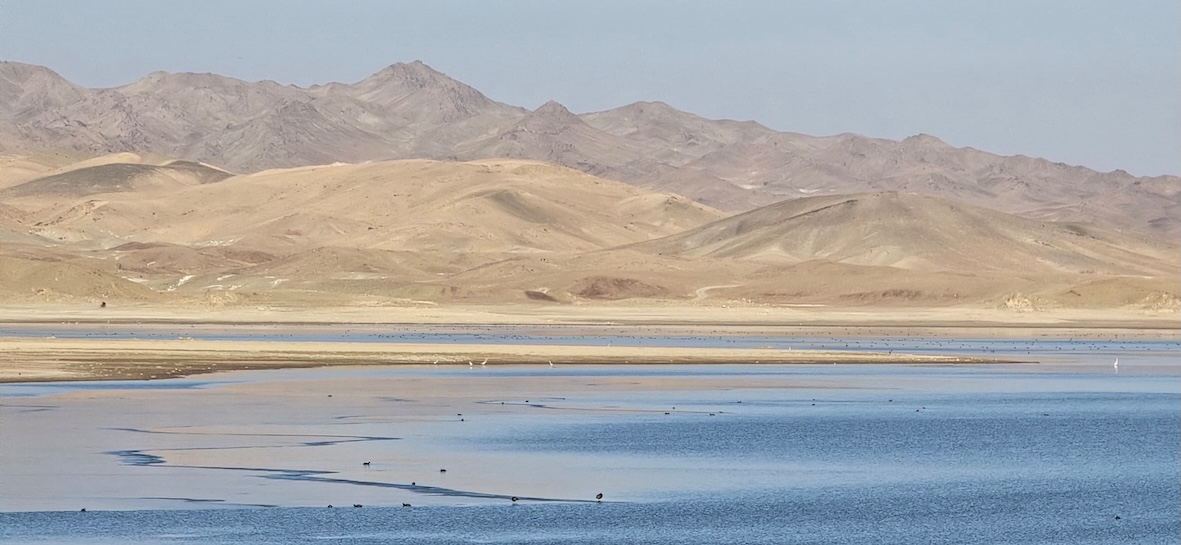
Waterbirds at Sardeh Dam, Ghazni province. Photo: Organization Rewild, 2026

Traveling across frozen valleys and remote wetlands, the team from Organization Rewild (OR) surveyed six key wetlands, from the reservoirs of the Kabul River to the reed-filled marshes of the Amu Darya floodplains, counted waterbirds, assessed habitat conditions, spoke with local communities about changes they have witnessed over the years, and walked across the dry basin of Ab-i-Estada – once a sanctuary for flamingos and a resting place for the now-lost Sibe­rian Crane of Central Asia. Shepherds spoke of lakes that no longer fill as they once did. Farmers described shifting seasons. Yet in hidden marshes along the Amu Darya, reeds still sheltered wintering birds, reminding the team that nature’s resilience has not disappeared. 
In this way, the volunteer scientists from a new NGO, Organization Rewild[1] began their account of their survey of six Afghan wetlands (read it on this map by clicking on Afghanistan). Afghanistan has been important for migrating birds, a place to rest on their great flight north in the spring and south in the autumn. Yet, over the last few decades, it has become more difficult for the flocks to land safely, as historic wetlands have dried up because of climate change and the extraction of ground water, and habitats and birds threatened by the encroachment of agriculture, pollution and hunting.[2]

The CEO of Organization Rewild, Ayub Alavi, has spent many years in conservation, working mainly with communities to establish protected areas, and in management and planning, including, most recently, setting up Rewild. Surveying birds was a new experience: “Joining the team in the field,” he said, “learning so much, was a joyful experience. I was so happy to get out, to travel and do some fieldwork.” They were fortunate, he said, to have two experienced ornithologists on the team: Mirza Hussain Rezai, who has ten years’ experience in wildlife monitoring and conservation projects, and Sayed Naqibullah Mostafawi, with 20 years’ experience, during which time, he has recorded 600 species of birds in Afghanistan, including the large-billed reed warbler, that had not been seen anywhere for a hundred years (AAN). The fourth team member, Noorullah Ahmadzai, is a para-veterinarian and climate adaptation expert.

The survey was undertaken as part of the International Waterbird Census, which has been carried out every year since 1967. “From coastal areas in northern Europe to tropical estuaries in Asia and Africa,” its website says, “volunteers and professionals alike,” have been joining “this global citizen science effort dedicated to tracking the health of waterbird populations and the wetlands they depend on.” For Organization Rewild, the survey was an opportunity to re-establish baseline information on wetland habitats and their waterbird populations, identify priorities for future wetland conservation and research but also to use the survey to work with Afghanistan’s national environmental authorities about the need for wetland conservation measures.

Organization Rewild’s team at work at Sardeh Dam. Photo: Organization Rewild, 2026.
The wetlands surveyed

Organization Rewild carried out its survey at the start of the year when many lakes and wetlands in Afghanistan are frozen, so they focused on six that they expected to be at least partially clear of ice and suitable for waterbirds. Two are natural wetlands:

Amu Darya Marshes at Sasukkhol (Ai Khanum), Dasht-e Qala district, Takhar province – a floodplain on the Amu Darya;

Ab-e Istada in Nawa district, Ghazni province, an alkaline lake, lying in a large depression created by the Chaman Fault system in the southern foothills of the Hindu Kush, fed largely by groundwater. Two rivers, the Ghazni and Gardez, also drain into Ab-e Istada, but rarely, is there any outflow (ie, it is endorheic). Before the war, the government had designated it a Waterfowl and Flamingo Sanctuary, with guards posted to prevent egg collection or other disturbance.

The other four sites are reservoirs. The first three were built for hydroelectricity and are collectively recognised as an Important Bird Area by BirdLife International:

Naghlu Dam in Sarobi district, Kabul province, built in the 1960s on the Kabul River;

Sarobi Dam, a smaller reservoir in the same district, eight kilometres south of Naghlu, where the Panjshir River joins the Kabul River, built in the 1950s;

Darunta Dam near Jalalabad city in Nangrahar province, further down the Kabul River, also dating from the 1960s.

The fourth reservoir was built to ensure water supply:

Sardeh Dam in Andar district of Ghazni province, fed by snowmelt from the mountains to the northeast which flows into the Gardez River (aka Jilga River, aka Sardeh River), built in the 1960s to ensure water supply to the south of Ghazni province.

The Wetlands of Afghanistan, with those surveyed in January 2026 in red. Source: Organization Rewild

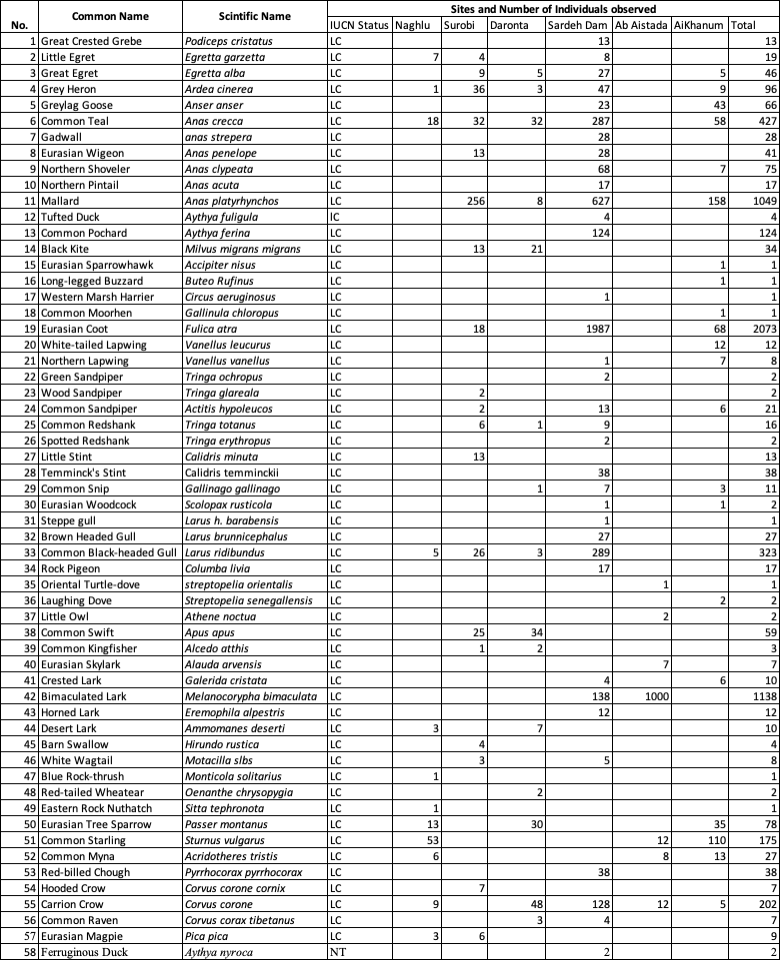
The best site, and the one which most surprised the team, was Sardeh Dam, which had not been monitored in the past. It offered, said Alavi “some opportunities for conservation, with acceptable outcomes, provided there were good efforts.” Sardeh supported the highest abundance and concentration of waterbirds recorded during the survey, especially in the shallower, more extensive eastern section, although its margins were being encroached on by farming. A deeper western basin next to the dam has some recreational infrastructure developed along its southern shore, including a pedal boat operation. The team counted 45 different species at Sardeh, many in sizeable numbers – almost 300 common teal, more than 600 mallard and almost 2000 Eurasian coots (see the list of birds at the end of this report for all six sites).

At Sarobi, the team had expected “a good number of birds, but because of net fishing and hunting – human activities,” said Alavi, “the birds couldn’t settle.” While it had the highest concentration of waterbirds of any site monitored in the eastern region, they were in far fewer numbers than at Sardeh, both species (19) and individuals – 32 teal and 18 coots, but still 256 mallard. The team observed little birdlife at Darunta – just 15 species. “Most obvious,” said Alavi, “was a group of black kites (Milvus migrans) roosting along the western side of the reservoir on one of the islands, playing with a piece of plastic – taking it for prey.”

At Naghlu, 12 species were observed, of which only four were waterbirds. At all three of the sites along the Kabul River, said Alavi, the team witnessed “the usual issue with any dam – there’s not been enough maintenance, and we see agricultural run-off, extending into what was wetland.” The result? “A space that was water is now salt, dust and soil.” Water levels were down, and around Sarobi and Darunta what had been marshy wetlands on the margins of the reservoirs were now being farmed. In the dry season, the team’s survey report (seen by the author) said, water from the Kabul River, which first enters Naghlu, is largely “untreated urban wastewater… a major source of pollution affecting the surface water quality of the reservoir and the outgoing downstream flows.”

On its visit to Ab-e Istada (a name that means ‘standing water’), the Rewild team found no ab whatsoever. This wetland had once measured approximately 13,000 hectares, including a surrounding mudflat zone ranging from 0.5 to 7 km deep (Scott). In 2026, said Alavi, Ab-e Istada was “entirely dry. There were no waterbirds at all.” He said that if there was water there in the spring, even temporarily, migrating birds might stop, “but it would be hard to restore its flamingo habitat.” That was a reference to a greater flamingo (Phoenicopterus roseus) colony, first mentioned by Babur, founder of the Moghul empire, that the emperor encountered in 1504 on his way from Dera Ghazi Khan to Ghazni and Kabul:

When we still had one körüh to go to Ab-e Istada, we became witnesses of a splendorous spectacle: From time to time, a red glow lit up, almost as the shine of the afterglow. … When we came closer we realized that this were gigantic swarms of wild flamingos.

Babur wrote that there were more than 10,000 or even 20,000 birds. AAN’s Thomas Ruttig cites this (with some interesting questions about translation) and mid-twentieth-century surveys putting the number of flamingos at 1,000 (1965), 4,000 (1966), 5,100, plus 1,000 young birds that had hatched on some of the islands (1969) and 2,900, with almost 12,000 at another site, Ab-e Nawur, also in Ghazni (1970). “Some flamingos were caught for the Kabul Zoo and successfully raised there,” wrote Ruttig, citing German ornithologist, Gunther Nogge. “Apart from the flamingos, some 40 other species of birds were spotted, among them different kinds of cranes and seagulls, herons, spoonbills, brown ibises, geese and ducks.” Historically, bird counts (from 1959 and 1977) at Ab-e Istada and the surrounding area comprised 122 species (cited by conservation biologist, Ahmad Khan).

Ruttig writes of the drying up of this wetland in the 1970s during the terrible drought of 1971, when snow and rain failed across Afghanistan. Even before that, in 1970, the newly built Sardeh dam had blocked one of the tributaries flowing into the wetland, reducing the water supply. That year, the water level dropped low enough for people to wade across to the islands where the flamingos bred. German ornithologists found evidence of hunting, which would have prevented any breeding.

A 2003 visit by the United Nations Environment Programme (UNEP) found the lakebed and inflow rivers completely dry and the water table approximately three metres below surface level. It said that, according to local people, “the lake has dried each year since 1999. In spring 2002 the lake filled for a brief period but was dry again within 10-15 days.” Locals reported that no flamingos had bred successfully for the previous four years. UNEP did observe numerous falcon trappers on the dry flats, looking for saker (Falco cherrug) and peregrine falcons (Falco peregrinus), which, it said, could be sold to local dealers for as much as USD 3,400. It also said local people were “active waterfowl and flamingo hunters.” A 2006 survey by Ahmad Khan described a lake of 13,000 hectares, surrounded by 14,000 hectares of mudflats. With good rains, Ab-e Istada may fill temporarily. However, droughts – now occurring more frequently and more severely because of the climate crisis – tube-well extraction of groundwater, encroachment of agriculture and the damming of one of the inflow rivers, suggest this wetland habitat may be lost. When the Rewild team visited, they observed just seven species, none of which were waterbirds. “There were only larks on the dry bed,” said Alavi, “and it was being grazed by sheep.”

The team found a more mixed picture at the Amu Darya wetlands. It comprises, they wrote, “heavily degraded riverine and floodplain wetland systems. At present, only fragmented remnants of these habitats persist, characterized by reedbeds, in­terspersed with stands [of] bushes along [the] riverbanks and on alluvial islands.” The Imam Sahib and Darqad areas have been recognised as Important Bird Areas (IBAs) by BirdLife International and were once designated a Royal Hunting Preserve. The team found one relatively intact area at Sasukhkol in Dasht-e Qala district. It lies at the confluence of the Panj and Kokcha Rivers and comprises approximately 450 hectares of marshland and riparian (river) woodland, in two patches, roughly two and six kilometres, respectively northeast of the Ai Khanoum archaeological site. This is one of the “last relatively intact wetlands … along the Amu Darya River in this region,” said the team, an example of a rare riverside ecosystem, once widespread in the floodplains and valleys of the arid regions of Central Asia. A 2007 survey by Stéphane Ostrowski, Ali Madad Rajabi & Hafizullah Noori for the Wildlife Conservation Society described the area:

With its diverse stands of poplar and willow trees and its shrubs of various genera such as Tamarix, Elaeagmus, and Hippophae, along with its patchwork of tall reed grass communities and grassland clearings, [which] offer oases for resident and migratory wildlife species. The Tugai forest ecosystem is also a resource of great value for water and soil conservation. It has evolved over thousands of years in response to successive periods of harsh and moist conditions. Typically Tugai areas are continuous but often narrow strips of forested areas along river valleys and constitute important corridors for wildlife. 

Yet, often, the 2007 surveyors wrote, tugai areas are the most fertile lands that can be irrigated and most have been converted to agriculture. What is left suffers from logging and grazing. Its destruction, it warns, “leads to an increase in river flow fluctuations, and river-bank erosion. In Afghanistan the last strongholds of this rare and fragile habitat are located on the relatively less accessible islands of the Amu Darya River.” The 2007 surveyors counted 72 species of birds in this area. Two decades later, in 2026, the Rewild team observed 21 species, including 13 waterbirds, but, their report said, the “presence of extensive dense marsh vegetation limited full visual coverage of the … area.”  They thought Sasukhkol could still provide suitable wintering and stopover habitat for waterbirds migrating along the Central Asian Flyway, albeit with some trepidation:

The wetland’s persistence to date has largely been due to the presence of permanently flooded and swampy basins, which have limited land conversion for agriculture and grazing. Extensive reedbeds con­tinue to offer important wintering and roosting habitat for waterbirds. The birds seem to be very calm and not very scared of nearby people. However, this condition is beginning to change, as border-control and trade in­frastructure are being developed in the area, along with the emergence of small-scale gold extraction activities. These developments pose increasing risks of habitat degradation and disturbance. 

Habitat degradation, they wrote, “is approaching critical levels, as much of the surrounding landscape has already been convert­ed to agricultural land and pasture, and large areas of swamp woodland have been cleared.” Artisan goldmining is also changing the land (see AAN’s August 2025 report, with details on goldmining in Takhar). There was one bright spot: “Field observations about [the] tameness of the waterbirds suggest that bird hunting pressure may currently be limited at this site.”

As to the general conclusion of the teams’ survey of eight wetlands, “Compared with reports from the past,” said Alavi, “the situation is not good. The birdlife is under stress and pressure. It’s very difficult to get a full picture because there are many wetlands we’ve not yet been able to visit. There are at least 28 sites that we’d like to visit. But from those we have seen, the picture is really not good.”

List of bird species observed at six wetlands in Afghanistan. Source: Organization Rewild, January 2026
Where are the birds?

Building up a regional picture of habitats and numbers and diversity of species is important for understanding how a phenomenon like the Central Asian Flyway is being affected by human activities, including the changing climate, and how birds may – or may not – be adapting. Alavi conjectured that the migrating flocks might, for example, have learned to avoid stopping on the Shomali plains, famous for its fowlers, and indeed, anywhere south of the Hindu Kush, if they possibly can.

“People play a major role in making it near to impossible for a healthy population of birds to overwinter and breed or stop over.” Those birds that survive trapping and shooting, he said, remember where to avoid and where it is safe to stop. “The birds may now be stopping in higher altitudes, far from communities, and if the weather allows, try to get as far as possible from people.” But, he said, “this needs a more in-depth and thorough assessment.”

The weather, Alavi said, is a crucial factor. Bad weather can mean migrating birds have no choice but to land near people, where there is “very little chance of them surviving.” In March last year, following two nights of heavy rain, he and Rezai had found a single hunter in Bagram district of Parwan province had captured 200 demoiselle cranes in one night. The birds had been forced to land in an area they would normally avoid as unsafe. Alavi and Rezai had been working on a project for the Wildlife Conservation Society, aimed at finding out more about the hunting and trapping of cranes in areas known for high hunting pressure during the migration period (report seen by author).

At the bird market in Kabul, Alavi and Rezai also found that, out of 15 shops they visited, two were selling live cranes – at a price of USD 100 for a pair. They also found three shops in Bagram District selling a total of 18 dead cranes for meat, each priced at about USD 7. In one village in Sayedkhel district, in Parwan province, they observed 13 trapping sites – artificial ponds surrounded by nets, with plastic lures and recordings of crane calls to attract birds in the hope of capturing them alive. Alavi and Rezai concluded that “most cranes taken in the Shomali Plain were captured for the pet trade, and a few were hunted for their meat.” The price of cranes has fallen significantly: in 2017, they were selling for USD 2,500, perhaps because there is less ‘easy money’ in Kabul to spend on luxuries, so less demand, or maybe the bad weather had driven supply up and prices down.

Demoiselle cranes (Grus virgo) that were captured after they were forced to land in bad weather in Bagram district of Kabul province, as they migrated north in spring 2025. Their eyes have been stitched shut to keep them calm and ease their domestication. They were to be sold in a local market, such as the Bird Market in Kabul, as pets. Photo: Ayub Alavi

The people of northern Shomali are famously avid hunters and trappers (see also a previous report by the author on a Bagram shopkeeper’s attempt to sell an inedible Great Black-Headed Gull, (Ichthyaetus ichthyaetus) as “very tasty” meat). The loss of adult and young birds during migration through these areas, write Alavi and Rezai, is thought to have been “the leading factor behind the decline and extinction of the Western Population of the Siberian Crane. Nowadays, the Demoiselle and Eura­sian cranes are the main species [that hunters] target between the last week of March and mid-April.”

An energetic response to a bleak outlook 

Despite the dismal picture for waterfowl and migrating birds presented by Organization Rewild’s survey, Alavi noted one positive – the good cooperation they had received from Afghanistan’s National Environment Protection Agency (NEPA). After they briefed NEPA on the survey, officials suggested they collaborate, for example, by the agency “dedicating staff to join us on field trips.” Alavi also said the head of NEPA suggested they provide NEPA with relevant reports, for example about hunting or conservation, that NEPA could use to lobby central government to better enforce the official ban on hunting (mentioned, for example, by Pajhwok). Better-managed wetland sites, where local communities are centrally involved, could bring benefits, and not just for birds and ecosystems: they can provide pleasant recreation sites, with the potential also for tourism.

Some joint work has now started. In March, ahead of the spring migration, Organization Rewild and NEPA set up a temporary Crane Conservation Taskforce which is carrying out, said Rewild, a media campaign highlighting “the prohibition of hunting, trapping, illegal trade and to avoid disturbance and to provide the safe passage for the cranes during the spring migration season across Afghanistan.” The taskforce has already undertaken field visits to stopover sites for migrant birds and known hunting hotspots. One was to the Shomali plain, lying across parts of Kapisa and Parwan provinces, north of Kabul, which functions, Rewild said, “as a critical migratory bottleneck for numerous bird species, including cranes, as they concentrate in this landscape prior to crossing the Hindu Kush range and continuing northward along the Central Asian Flyway.” It is also, as described previously, famous for its hunters.

The taskforce also visited Ab-e Istada in Ghazni where, Rewild says, the immediate need is to coordinate with the Ministry of Energy and Water and the relevant dam management authorities “to establish and maintain sustainable environmental flow regimes from the Sardeh and Hawz-e-Sultan Dams,” something which is critical to at least “partially restore hydrological conditions necessary for wetland recovery.” There is also a need to understand groundwater dynamics to to enable evidence-based water management and long-term restoration planning.”

One small, good piece of news is that, as of 7 April 2026, “following several days of sustained rainfall and the release of overflow from the Hawz-e-Sultan Dam [upstream of Ab-e Istada], reports indicated the presence of a substantial volume of water in this wetland.”

Alavi also spoke about how much conservation work there is to do. The team is keen to survey other wetlands, and other habitats where Afghanistan is important, such as the western deserts, with their endangered houbara bustards (Chlamydotis undulata), so beloved of Gulf Arab falconers, who have already hunted the species to near extinction in Arabia, but pay to come and hunt them in Pakistan and Afghanistan.[3] The team would also like to monitor vultures that migrate in spring and winter through the Salang Pass – lammergeiers (Gypaetus barbatus), Egyptian vultures (Neophron percnopterus) and griffon vultures (Gyps fulvus) – and work with local communities and government in the Bamyan plateau – important for birds of prey and mammals, and declared a protected landscape by the Republic. “Given the size and type of habitat,” said Alavi, “it would be a unique opportunity.”

Alavi’s experience is in community-based management of natural resources, but the hope is that the wetlands bird survey will be a first step in greater conservation efforts in Afghanistan. It was also important in its own right, the team wrote:

This was more than a bird count. It was a reconnection of Afghanistan to the global flyway, the first renewed national count. It re-establishes Afghanistan’s pres­ence in global waterbird monitoring and provides the first updated baseline in decades for some of the coun­try’s most important wetlands. The data will be shared with national authorities to support better wetland man­agement and conservation planning. 

Alavi recognises that, without funding, they could not replicate the methodology of earlier surveys, but even so, Organization Rewild’s 2026 Afghan wetlands bird survey, though limited, made plain the huge decline in habitats, in the number of species and the number of birds. The four-member team paid to carry out this research from their own pockets. Such voluntary work is unsustainable. Afghanistan certainly has the expert scientists to do far more, but without funding, it will be difficult to match outcomes with that expertise.

Edited by Fabrizio Foschini and Jelena Bjelica


References

References
↑1 Wetland, as defined by the Ramsar Convention on Wetlands, adopted in 1971 in Iran, includes “areas of marsh, fen, peatland, or water, whether natural or artificial, permanent or temporary, with water that is static or flowing, fresh, brackish, or saline, including areas of marine water where the depth at low tide does not exceed six meters.”
↑2 Organization Rewild (OR) describes itself as a conservation institution that brings together a multidisciplinary team of Afghan conservation professionals with up to two decades of field and technical experience in wildlife conservation, protected area management, ecological monitoring, and community-based natural resource management (CBNRM), supported by an international Scientific Advisory Board providing remote technical guidance. The organization’s work is grounded in applied ecological research, participatory conservation planning, and long-term capacity development at local and national levels.Alavi said a grant of USD 2,000 from the international NGO, Wetlands International, and invaluable help from the Central Asian Conservation Network in connecting them to Wetlands International, had enabled the team to carry out the the wetland surveys and bird counts.
↑3 Permits to hunt houbaras were reported in the first Emirate, under the Republic (see the author’s Bird Bomber: Police kill ‘dangerous’ houbara bustard, AAN, 5 December 2014), and more recently under the second Emirate (see Amin Kawa Arab Hunters Given Access to Afghanistan’s Endangered Wildlife Under Taliban Sanction, Hasht-e Subh, 16 November 2025, and Fabrizio Foschini’s already cited, Of Hunters and Hunted (2): Falconry, bird smuggling and wildlife conservation).


No Flamingos, but Ducks, Geese and Grebes: Afghanistan joins an international bird census 
read more

Iran moved aircraft to Afghanistan to escape U.S. airstrikes: CBS Claims

CBS News, citing U.S. officials, reported that Iran transferred some civilian aircraft to Afghanistan during recent tensions with the United States in an apparent effort to protect aviation assets.

Two U.S. officials told the network it remained unclear whether military aircraft were also moved to Afghanistan. However, Taliban spokesman Zabihullah Mujahid denied the report, telling CBS News that Iran had no need to move aircraft to Afghanistan.

An Afghan civil aviation official told CBS News that an Iranian civilian aircraft belonging to Mahan Air landed in Kabul shortly before the conflict began and remained there after Iranian airspace was closed.

According to the report, the aircraft was later moved to Herat airport after Pakistani airstrikes in Afghanistan prompted safety concerns.

CBS News also reported that several Iranian aircraft, including a reconnaissance version of the Lockheed C-130 Hercules, were later sent to Pakistan’s Noor Khan Air Base near Rawalpindi after a ceasefire announcement by U.S. President Donald Trump in April.

Pakistan rejected the claims, calling the report “misleading and provocative” and denying that Iranian aircraft were stationed at the military base.

Recent tensions between Washington and Tehran have raised concerns over wider regional escalation involving Gulf states, Pakistan and neighboring countries.

Pakistan has attempted to position itself as a diplomatic channel between Iran and the United States while maintaining close ties with both Tehran and Washington.

Iran moved aircraft to Afghanistan to escape U.S. airstrikes: CBS Claims
read more

U.N. says 13.8 million people face acute hunger in Afghanistan

The United Nations said more than 13.8 million people in Afghanistan are facing acute food insecurity, with women and children among the hardest hit.

The U.N. said in a new report that nearly five million children and pregnant or breastfeeding women in Afghanistan are suffering from malnutrition as hunger deepens across the country.

According to the report, Afghanistan is facing overlapping crises including economic collapse, unemployment and climate-related shocks, compounded by regional tensions that have increased food prices and worsened food insecurity.

The World Food Programme warned that growing pressure on aid operations has reduced supplies of specialized food used to treat malnutrition among women and children.

“Nutrition programmes are essential, not optional,” said John Aylieff, the World Food Programme’s country director in Afghanistan. He said food assistance remained a lifeline for millions of women and children but warned that funding cuts were already threatening lives.

Afghanistan’s humanitarian crisis has worsened since the 2021 political transition, which triggered economic isolation, banking restrictions and a sharp decline in international financial support.

Aid agencies have repeatedly warned that reduced humanitarian funding, combined with drought and rising living costs, is pushing millions of Afghans deeper into poverty and food insecurity.

U.N. says 13.8 million people face acute hunger in Afghanistan
read more

UNAMA Publishes New Human Rights Report on Afghanistan

The report added that since 2021, more than 2.2 million girls have continued to be deprived of secondary and higher education.

The UNAMA report on the human rights situation in Afghanistan covers incidents from January to March 2026.

In its latest human rights report, the United Nations Assistance Mission in Afghanistan (UNAMA) said that at least 312 people were subjected to corporal punishment in Afghanistan between January 1 and March 31, 2026.

According to the report, those punished included 269 men, 39 women, and four boys.

UNAMA said that on February 5 alone, eight people, including three women, were flogged in public in Bagram district of Parwan province.

The report also stated that during the first three months of the year, UNAMA documented 336 cases of arrests and detentions carried out by the Ministry for the Propagation of Virtue and Prevention of Vice.

UNAMA also expressed concern over restrictions on women, saying that Afghan female staff members are still barred from entering UN offices. The report noted: “March 31 marked the 205th day that Afghan female staff members were unable to access United Nations premises across the country.”

The report added that since 2021, more than 2.2 million girls have continued to be deprived of secondary and higher education.

It also documented 23 cases involving the arrest, detention, and mistreatment of former government officials and personnel.

Meanwhile, the Islamic Emirate has not yet reacted to the latest report.

UNAMA Publishes New Human Rights Report on Afghanistan
read more

EU invites Taliban members to discuss Afghan migrant returns

Mark Hallam with AFP
Deutsche Welle/DW
11 May 2026

The European Commission has invited officials from Afghanitan’s Taliban to discuss the returns of certain migrants. It’s controversial on humanitarian grounds, and because Brussels doesn’t recognize Taliban authority.

The invitation follows a preliminary meeting for “technical talks” that took place this January in Afghanistan, European Commission spokesman Markus Lammert said on Tuesday, classifying the planned Brussels discussions as a “follow-up.”

He said the invitation to Brussels “does not by any means constitute a recognition” of the Taliban as the Afghan government.

The EU does not formally recognize the Taliban’s leadership, after its sudden return to power amid the NATO withdrawal just over five years ago in early 2021.

Commission spokesman Lammert said that 20 EU members and Schengen countries originally requested the consultations last year.

Lammert said most had either been convicted of crimes or been deemed a security threat, or both.

“We’re speaking here about persons who pose a security threat. These are the persons that member states want to return,” Lammert said.

A letter was sent on Tuesday morning seeking to set a date for talks, after cooperation between Commission officials and Sweden.

Sweden and Germany had been among the countries pushing for movement on the issue, in Germany’s case after a high-profile knife attack by an Afghan national who had previously been ordered to leave the country featured heavily in the news in the closing weeks of the 2025 federal election cycle.

Given the security situation in Afghanistan, particularly since the Taliban’s return to de facto power in 2021, European countries have struggled to return migrants to the country on both political and legal grounds.

The Islamists are largely isolated internationally, albeit with more and more governments leaning towards partial recognition and cooperation, not least because of their restrictions on women and girls.

In 2024, the European Court of Justice (ECJ) ruled that the Taliban’s treatment of women constituted persecution.

“Every return decision has to be in line with EU and international law, including in particular fundamental rights,” Lammert said.

According to the UNHCR refugee agency, countries like Pakistan and Iran have deported more than 5 million Afghans since October 2023, many of them not by choice. NGOs report that many live in extreme hardship on their return, without homes or stable employment.

Edited by: Jenipher Camino Gonzalez

EU invites Taliban members to discuss Afghan migrant returns
read more

Over 370 Afghans killed in Pakistan conflict in first 3 months of 2026: UN

By AFP

At least 372 Afghan civilians were killed and 397 injured as a result of cross-border violence between Taliban forces and the Pakistani military in the first three months of 2026, the United Nations has reported, with more than half the deaths attributed to air raids on a drug rehabilitation facility in Kabul.

The UN Assistance Mission in Afghanistan (UNAMA), which monitors civilian casualties in Afghanistan, said its report, released on Tuesday, was based on checks with three different independent sources. The latest quarterly figure, which is higher than the casualties recorded for the period by UNAMA since 2011, included 13 women, 46 children (31 boys and 16 girls) and 313 men.Cross-border clashes between Afghanistan and Pakistan have escalated significantly since the Taliban returned to power in 2021, and exploded into “open war” at the end of February, according to Pakistan’s defence minister.

Islamabad accuses the Taliban government in Kabul of sheltering armed fighters, notably the Pakistan Taliban (also known by the acronym TTP), which is different from the group that governs Afghanistan. Afghan officials deny this and counter that Pakistan harbours hostile groups and does not respect its sovereignty.

The high proportion of men was attributed to the March 16 strikes on a Kabul drug treatment hospital, which admitted only male patients. At least 269 people were killed and 122 wounded in the attack, although “the real figure may be significantly higher”. Many bodies “were unrecognisable due to extensive burns”, according to the report.

UNAMA called on the warring parties to respect international law by refraining from targeting health facilities or from firing shells or grenades into civilian areas. In a written response, Pakistan insisted that its “actions were directed solely against terrorist and military infrastructure”.

“The leading cause of civilian casualties was air strikes (64 percent), with the remaining caused by indirect cross-border firing” and one “targeted killing” of an NGO worker, UNAMA said.

A female Afghan employee of an NGO in Nuristan was killed on March 19, during the festival of Eid al-Fitr, even though a ceasefire had been agreed a day earlier. “The NGO worker was shot in her right side and fell into the water and drowned with her three-year-old son,” the report said.

Since ceasefire talks took place in China in early April, Pakistan and Afghanistan have reportedly committed to avoiding any escalation. Incidents have decreased but have not stopped entirely. Seven civilians were killed and 85 wounded in shelling on April 27 at a university in Asadabad in Kunar province, according to Afghan authorities.

Over 370 Afghans killed in Pakistan conflict in first 3 months of 2026: UN
read more

Where is one of worst places to be a woman? Afghanistan.

The Conversation
Academic rigor, journalistic flair
Published: May 11, 2026

That’s what most people think when it comes to the topic of the women’s rights crisis under the ruling Taliban in Afghanistan. But this only tells part of the story.

Focusing on the word “rights” hides something more serious underneath: how people live and survive in this situation. What’s unfolding in Afghanistan is not just a women’s rights crisis, but a humanitarian disaster.

It affects how people access health care, education, food systems and basic supports and whether these system can function at all when half the population has been systematically removed from them. It forces families to deal with women’s limited access to work and services, often pushing households into deeper economic and social vulnerability.

The Taliban has steadily removed women from public spaces including work, health care and education. Recently, for example, female health-care workers were stopped at the gates of a United Nations office and banned from entering the facility by Taliban authorities.

These ongoing removals are incrementally creating a system that determines who has the right to exist, to provide assistance and to receive assistance.

What’s happening in Afghanistan is not simply gender discrimination; rather, it’s pushing an entire gender out of public systems altogether. The predicament of Afghan women is less a social problem and more a structural crisis that shapes institutions and everyday life.

Gender apartheid

This is why the situation in Afghanistan is increasingly referred to as a form of gender apartheid rather than a women’s rights crisis. The exclusion of women reveals how institutions are built and will be maintained in the future.

Gender apartheid refers to a situation in which people are banned from certain spaces or activities based on their gender identity.

This discriminatory and violent practice in Afghanistan has been widely documented and heavily reported on, but the situation continues to deteriorate daily.

Its effects are also accumulative, with each restriction reinforcing others and deepening the overall crisis. These systemic rights violations would be increasingly difficult to reverse even if political bodies and the ruling government changed tomorrow.

That’s because removing women from professional spaces leads to schools losing teachers, hospitals losing trained staff and aid networks losing access to half the population. And this loss isn’t temporary; it limits how systems can respond to the growing needs around them.

When women get barred from institutions, the problem isn’t just that these organizations suffer in their service delivery and performance. It also results in the loss of institutional memory — the skills, professional knowledge and experience that is no longer transferred to future generations.

Over time, institutions also scale down or suspend certain services due to a shortage of female workers. As services shrink, significant gaps appear in the networks of care and support leaving entire groups of people without consistent access to support.

The Taliban refusal to allow female workers into UN and UNICEF offices is one of many examples happening today in Afghanistan that ban qualified women from entering places where they can deliver urgent care and assistance.

This effective crackdown on women’s rights is blocking aid and support in a society where it’s desperately needed.

Male workers are also limited in the ways they can assist female patients due to Taliban gender norms and restrictions, so support for women cannot be simply reassigned to them. This affects several aspects of humanitarian aid including health care, food distribution and protection systems.

It also delegates the burden of these unmet needs into households where women must provide unpaid labour and care-giving responsibilities.

Taliban rule consequently delays or prevents life-saving interventions for women and children, a violation of the human right to survive.

It’s not just UN and UNICEF offices where women workers are banned from entry: they’re being turned away at other aid organizations, hospitals, schools and various public institutions in a widespread erosion of human rights. The Taliban has put in place a network of human rights violations across the entire humanitarian system.

Humanitarian aid also depends on access to information and correct data: who is hungry, who is unsafe and who needs protection. In Afghanistan, where women are limited in who they can interact with and where female staff are largely absent from outreach, surveys and home visits, this information becomes incomplete.

Poor data leads to incomplete distribution of assistance and mismatched allocation of aid. As a result, the most vulnerable populations can remain invisible in official assessments.

This invisibility especially affects households headed by women and those living in remote or rural areas with already limited access.

The impact of Aghanistan’s gender apartheid might not be visible to many outside the country, but in the near future, humanitarian systems will break down.

Future generations of female professionals have already been eliminated by the Taliban’s ban of girls from schools.

UNICEF estimates the ban could cost Afghanistan 25,000 teachers and health-care workers. In a country where women are prohibited from receiving care from male providers, banning women from both education and health-care work creates a profound medical emergency.

Read more: The Taliban wages war on women, but their voices roar on the page. Here are 5 essential books by Afghan women writers

Over time, systems will be redesigned without women as providers even as they remain central as recipients. As gender restrictions disrupt the flow of resources, knowledge and care, the capacity to deliver services is declining every day despite high demand. Many women are also pushed into informal or hidden work that is insecure and vulnerable to exploitation and abuse.

Gender apartheid in Afghanistan will not end through recognition alone. Naming systemic terror does not stop it and, without action, repeated exposure to crisis can instead normalize it through compassion fatigue. Humanitarian organizations now face a stark choice: operate under restrictive conditions and risk legitimizing them, or withdraw and leave people without support.

The longer the situation persists, the more the exclusion of women in Afghanistan risks becoming a normalized structure rather than an emergency. The question is no longer only how to restore what’s been lost, but whether systems once dependent on women’s participation can be rebuilt at all.

Where is one of worst places to be a woman? Afghanistan.
read more

US 2026 Counterterrorism Strategy Does Not List Afghanistan as a Threat

Najibullah Lalzoy
Tolo News
07 MAY 2026

The United States’ counterterrorism strategy for 2026, recently released by the White House, once again does not mention Afghanistan as a threat to the United States.

The report states, citing President Donald Trump, that the arrest of the perpetrator of the 2021 Kabul airport attack only 43 days after taking office demonstrates the current US administration’s commitment to combating terrorism.

Asia has been described as a safe haven for al-Qaeda and ISIS, and the report says these groups largely establish safe sanctuaries for themselves in these regions.

“Donald Trump, in 2025, rebuilt relations with several countries in South and Central Asia because these relations play an important role in reducing threats against the homeland. Europe must expand counterterrorism operations in Asia, and we are cooperating with them.” Reads part of the report.

According to the US report, this year’s priorities in counterterrorism efforts include combating drug cartels, al-Qaeda, ISIS, ISIS-Khorasan, and the Muslim Brotherhood.

The strategy also identifies confronting anti-American violent political groups as one of the US priorities, and considers threats emerging from the Middle East among the key objectives of counterterrorism efforts.

Meanwhile, regarding Europe, the report says it is one of America’s strategic counterterrorism allies, and that global security is tied to a stronger Europe.

US 2026 Counterterrorism Strategy Does Not List Afghanistan as a Threat
read more