 Afghanistan Peace Campaign
The first survey of birds to be carried out by an Afghan organisation since the fall of the Islamic Republic has taken place. It was also the first time that Afghanistan has taken part in the annual International Waterbird Census, a global effort involving 189 countries. A volunteer team, including expert ornithologists, visited six wetland sites, all potentially important stopover sites on the Central Asian Flyway, the mass migration of birds that takes place twice a year, between winter feeding grounds in India/Pakistan and summer breeding grounds in Central Asia and Siberia. That migration had yet to start when the survey took place, but volunteers from a new Afghan conservation NGO, Organization Rewild, assessed resident and over-wintering birds and habitats in places that might provide a safe place for birds to stop and rest – or possibly not, writes AAN’s Kate Clark, given the dangers posed to them by hunters and the drying up of wetlands.
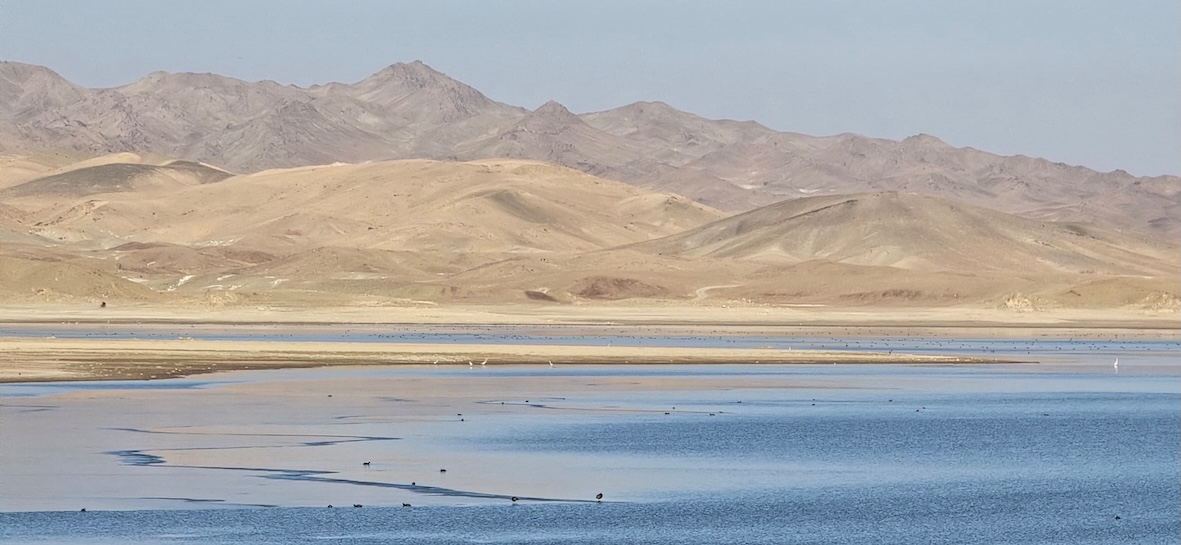 Waterbirds at Sardeh Dam, Ghazni province. Photo: Organization Rewild, 2026
The CEO of Organization Rewild, Ayub Alavi, has spent many years in conservation, working mainly with communities to establish protected areas, and in management and planning, including, most recently, setting up Rewild. Surveying birds was a new experience: “Joining the team in the field,” he said, “learning so much, was a joyful experience. I was so happy to get out, to travel and do some fieldwork.” They were fortunate, he said, to have two experienced ornithologists on the team: Mirza Hussain Rezai, who has ten years’ experience in wildlife monitoring and conservation projects, and Sayed Naqibullah Mostafawi, with 20 years’ experience, during which time, he has recorded 600 species of birds in Afghanistan, including the large-billed reed warbler, that had not been seen anywhere for a hundred years (AAN). The fourth team member, Noorullah Ahmadzai, is a para-veterinarian and climate adaptation expert.
The survey was undertaken as part of the International Waterbird Census, which has been carried out every year since 1967. “From coastal areas in northern Europe to tropical estuaries in Asia and Africa,” its website says, “volunteers and professionals alike,” have been joining “this global citizen science effort dedicated to tracking the health of waterbird populations and the wetlands they depend on.” For Organization Rewild, the survey was an opportunity to re-establish baseline information on wetland habitats and their waterbird populations, identify priorities for future wetland conservation and research but also to use the survey to work with Afghanistan’s national environmental authorities about the need for wetland conservation measures.

The wetlands surveyed
Organization Rewild carried out its survey at the start of the year when many lakes and wetlands in Afghanistan are frozen, so they focused on six that they expected to be at least partially clear of ice and suitable for waterbirds. Two are natural wetlands:
Amu Darya Marshes at Sasukkhol (Ai Khanum), Dasht-e Qala district, Takhar province – a floodplain on the Amu Darya;
Ab-e Istada in Nawa district, Ghazni province, an alkaline lake, lying in a large depression created by the Chaman Fault system in the southern foothills of the Hindu Kush, fed largely by groundwater. Two rivers, the Ghazni and Gardez, also drain into Ab-e Istada, but rarely, is there any outflow (ie, it is endorheic). Before the war, the government had designated it a Waterfowl and Flamingo Sanctuary, with guards posted to prevent egg collection or other disturbance.
The other four sites are reservoirs. The first three were built for hydroelectricity and are collectively recognised as an Important Bird Area by BirdLife International:
Naghlu Dam in Sarobi district, Kabul province, built in the 1960s on the Kabul River;
Sarobi Dam, a smaller reservoir in the same district, eight kilometres south of Naghlu, where the Panjshir River joins the Kabul River, built in the 1950s;
Darunta Dam near Jalalabad city in Nangrahar province, further down the Kabul River, also dating from the 1960s.
The fourth reservoir was built to ensure water supply:
Sardeh Dam in Andar district of Ghazni province, fed by snowmelt from the mountains to the northeast which flows into the Gardez River (aka Jilga River, aka Sardeh River), built in the 1960s to ensure water supply to the south of Ghazni province.

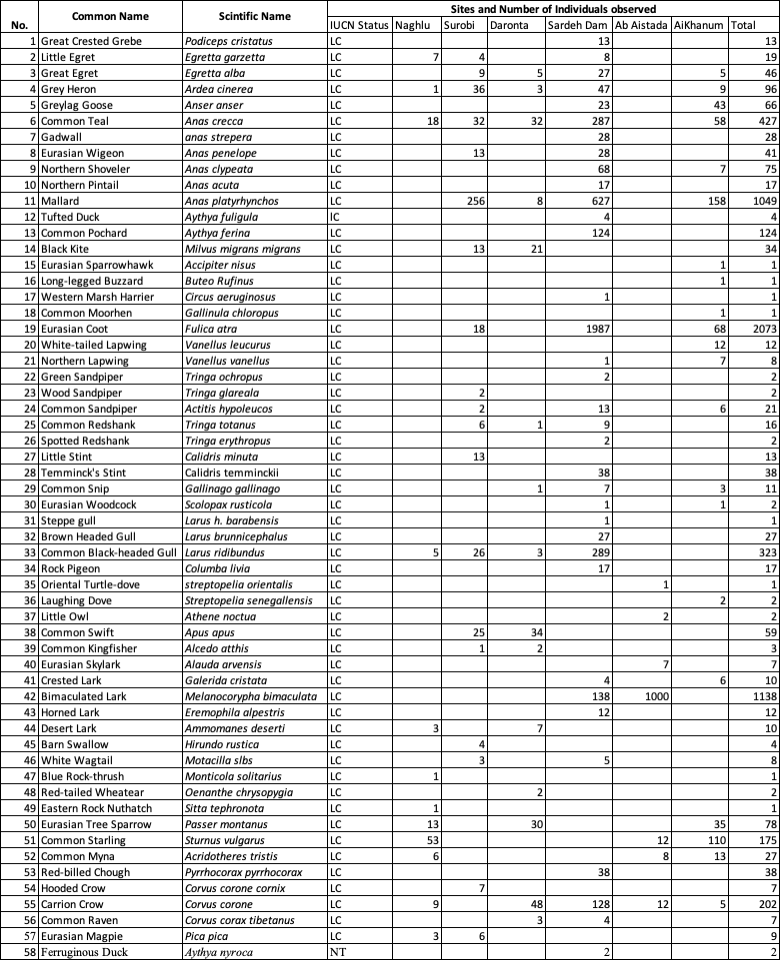
The best site, and the one which most surprised the team, was Sardeh Dam, which had not been monitored in the past. It offered, said Alavi “some opportunities for conservation, with acceptable outcomes, provided there were good efforts.” Sardeh supported the highest abundance and concentration of waterbirds recorded during the survey, especially in the shallower, more extensive eastern section, although its margins were being encroached on by farming. A deeper western basin next to the dam has some recreational infrastructure developed along its southern shore, including a pedal boat operation. The team counted 45 different species at Sardeh, many in sizeable numbers – almost 300 common teal, more than 600 mallard and almost 2000 Eurasian coots (see the list of birds at the end of this report for all six sites).
At Sarobi, the team had expected “a good number of birds, but because of net fishing and hunting – human activities,” said Alavi, “the birds couldn’t settle.” While it had the highest concentration of waterbirds of any site monitored in the eastern region, they were in far fewer numbers than at Sardeh, both species (19) and individuals – 32 teal and 18 coots, but still 256 mallard. The team observed little birdlife at Darunta – just 15 species. “Most obvious,” said Alavi, “was a group of black kites (Milvus migrans) roosting along the western side of the reservoir on one of the islands, playing with a piece of plastic – taking it for prey.”
At Naghlu, 12 species were observed, of which only four were waterbirds. At all three of the sites along the Kabul River, said Alavi, the team witnessed “the usual issue with any dam – there’s not been enough maintenance, and we see agricultural run-off, extending into what was wetland.” The result? “A space that was water is now salt, dust and soil.” Water levels were down, and around Sarobi and Darunta what had been marshy wetlands on the margins of the reservoirs were now being farmed. In the dry season, the team’s survey report (seen by the author) said, water from the Kabul River, which first enters Naghlu, is largely “untreated urban wastewater… a major source of pollution affecting the surface water quality of the reservoir and the outgoing downstream flows.”
On its visit to Ab-e Istada (a name that means ‘standing water’), the Rewild team found no ab whatsoever. This wetland had once measured approximately 13,000 hectares, including a surrounding mudflat zone ranging from 0.5 to 7 km deep (Scott). In 2026, said Alavi, Ab-e Istada was “entirely dry. There were no waterbirds at all.” He said that if there was water there in the spring, even temporarily, migrating birds might stop, “but it would be hard to restore its flamingo habitat.” That was a reference to a greater flamingo (Phoenicopterus roseus) colony, first mentioned by Babur, founder of the Moghul empire, that the emperor encountered in 1504 on his way from Dera Ghazi Khan to Ghazni and Kabul:
When we still had one körüh to go to Ab-e Istada, we became witnesses of a splendorous spectacle: From time to time, a red glow lit up, almost as the shine of the afterglow. … When we came closer we realized that this were gigantic swarms of wild flamingos.
Babur wrote that there were more than 10,000 or even 20,000 birds. AAN’s Thomas Ruttig cites this (with some interesting questions about translation) and mid-twentieth-century surveys putting the number of flamingos at 1,000 (1965), 4,000 (1966), 5,100, plus 1,000 young birds that had hatched on some of the islands (1969) and 2,900, with almost 12,000 at another site, Ab-e Nawur, also in Ghazni (1970). “Some flamingos were caught for the Kabul Zoo and successfully raised there,” wrote Ruttig, citing German ornithologist, Gunther Nogge. “Apart from the flamingos, some 40 other species of birds were spotted, among them different kinds of cranes and seagulls, herons, spoonbills, brown ibises, geese and ducks.” Historically, bird counts (from 1959 and 1977) at Ab-e Istada and the surrounding area comprised 122 species (cited by conservation biologist, Ahmad Khan).
Ruttig writes of the drying up of this wetland in the 1970s during the terrible drought of 1971, when snow and rain failed across Afghanistan. Even before that, in 1970, the newly built Sardeh dam had blocked one of the tributaries flowing into the wetland, reducing the water supply. That year, the water level dropped low enough for people to wade across to the islands where the flamingos bred. German ornithologists found evidence of hunting, which would have prevented any breeding.
A 2003 visit by the United Nations Environment Programme (UNEP) found the lakebed and inflow rivers completely dry and the water table approximately three metres below surface level. It said that, according to local people, “the lake has dried each year since 1999. In spring 2002 the lake filled for a brief period but was dry again within 10-15 days.” Locals reported that no flamingos had bred successfully for the previous four years. UNEP did observe numerous falcon trappers on the dry flats, looking for saker (Falco cherrug) and peregrine falcons (Falco peregrinus), which, it said, could be sold to local dealers for as much as USD 3,400. It also said local people were “active waterfowl and flamingo hunters.” A 2006 survey by Ahmad Khan described a lake of 13,000 hectares, surrounded by 14,000 hectares of mudflats. With good rains, Ab-e Istada may fill temporarily. However, droughts – now occurring more frequently and more severely because of the climate crisis – tube-well extraction of groundwater, encroachment of agriculture and the damming of one of the inflow rivers, suggest this wetland habitat may be lost. When the Rewild team visited, they observed just seven species, none of which were waterbirds. “There were only larks on the dry bed,” said Alavi, “and it was being grazed by sheep.”
The team found a more mixed picture at the Amu Darya wetlands. It comprises, they wrote, “heavily degraded riverine and floodplain wetland systems. At present, only fragmented remnants of these habitats persist, characterized by reedbeds, interspersed with stands [of] bushes along [the] riverbanks and on alluvial islands.” The Imam Sahib and Darqad areas have been recognised as Important Bird Areas (IBAs) by BirdLife International and were once designated a Royal Hunting Preserve. The team found one relatively intact area at Sasukhkol in Dasht-e Qala district. It lies at the confluence of the Panj and Kokcha Rivers and comprises approximately 450 hectares of marshland and riparian (river) woodland, in two patches, roughly two and six kilometres, respectively northeast of the Ai Khanoum archaeological site. This is one of the “last relatively intact wetlands … along the Amu Darya River in this region,” said the team, an example of a rare riverside ecosystem, once widespread in the floodplains and valleys of the arid regions of Central Asia. A 2007 survey by Stéphane Ostrowski, Ali Madad Rajabi & Hafizullah Noori for the Wildlife Conservation Society described the area:
With its diverse stands of poplar and willow trees and its shrubs of various genera such as Tamarix, Elaeagmus, and Hippophae, along with its patchwork of tall reed grass communities and grassland clearings, [which] offer oases for resident and migratory wildlife species. The Tugai forest ecosystem is also a resource of great value for water and soil conservation. It has evolved over thousands of years in response to successive periods of harsh and moist conditions. Typically Tugai areas are continuous but often narrow strips of forested areas along river valleys and constitute important corridors for wildlife.
Yet, often, the 2007 surveyors wrote, tugai areas are the most fertile lands that can be irrigated and most have been converted to agriculture. What is left suffers from logging and grazing. Its destruction, it warns, “leads to an increase in river flow fluctuations, and river-bank erosion. In Afghanistan the last strongholds of this rare and fragile habitat are located on the relatively less accessible islands of the Amu Darya River.” The 2007 surveyors counted 72 species of birds in this area. Two decades later, in 2026, the Rewild team observed 21 species, including 13 waterbirds, but, their report said, the “presence of extensive dense marsh vegetation limited full visual coverage of the … area.” They thought Sasukhkol could still provide suitable wintering and stopover habitat for waterbirds migrating along the Central Asian Flyway, albeit with some trepidation:
The wetland’s persistence to date has largely been due to the presence of permanently flooded and swampy basins, which have limited land conversion for agriculture and grazing. Extensive reedbeds continue to offer important wintering and roosting habitat for waterbirds. The birds seem to be very calm and not very scared of nearby people. However, this condition is beginning to change, as border-control and trade infrastructure are being developed in the area, along with the emergence of small-scale gold extraction activities. These developments pose increasing risks of habitat degradation and disturbance.
Habitat degradation, they wrote, “is approaching critical levels, as much of the surrounding landscape has already been converted to agricultural land and pasture, and large areas of swamp woodland have been cleared.” Artisan goldmining is also changing the land (see AAN’s August 2025 report, with details on goldmining in Takhar). There was one bright spot: “Field observations about [the] tameness of the waterbirds suggest that bird hunting pressure may currently be limited at this site.”
As to the general conclusion of the teams’ survey of eight wetlands, “Compared with reports from the past,” said Alavi, “the situation is not good. The birdlife is under stress and pressure. It’s very difficult to get a full picture because there are many wetlands we’ve not yet been able to visit. There are at least 28 sites that we’d like to visit. But from those we have seen, the picture is really not good.”
Where are the birds?
Building up a regional picture of habitats and numbers and diversity of species is important for understanding how a phenomenon like the Central Asian Flyway is being affected by human activities, including the changing climate, and how birds may – or may not – be adapting. Alavi conjectured that the migrating flocks might, for example, have learned to avoid stopping on the Shomali plains, famous for its fowlers, and indeed, anywhere south of the Hindu Kush, if they possibly can.
“People play a major role in making it near to impossible for a healthy population of birds to overwinter and breed or stop over.” Those birds that survive trapping and shooting, he said, remember where to avoid and where it is safe to stop. “The birds may now be stopping in higher altitudes, far from communities, and if the weather allows, try to get as far as possible from people.” But, he said, “this needs a more in-depth and thorough assessment.”
The weather, Alavi said, is a crucial factor. Bad weather can mean migrating birds have no choice but to land near people, where there is “very little chance of them surviving.” In March last year, following two nights of heavy rain, he and Rezai had found a single hunter in Bagram district of Parwan province had captured 200 demoiselle cranes in one night. The birds had been forced to land in an area they would normally avoid as unsafe. Alavi and Rezai had been working on a project for the Wildlife Conservation Society, aimed at finding out more about the hunting and trapping of cranes in areas known for high hunting pressure during the migration period (report seen by author).
At the bird market in Kabul, Alavi and Rezai also found that, out of 15 shops they visited, two were selling live cranes – at a price of USD 100 for a pair. They also found three shops in Bagram District selling a total of 18 dead cranes for meat, each priced at about USD 7. In one village in Sayedkhel district, in Parwan province, they observed 13 trapping sites – artificial ponds surrounded by nets, with plastic lures and recordings of crane calls to attract birds in the hope of capturing them alive. Alavi and Rezai concluded that “most cranes taken in the Shomali Plain were captured for the pet trade, and a few were hunted for their meat.” The price of cranes has fallen significantly: in 2017, they were selling for USD 2,500, perhaps because there is less ‘easy money’ in Kabul to spend on luxuries, so less demand, or maybe the bad weather had driven supply up and prices down.

The people of northern Shomali are famously avid hunters and trappers (see also a previous report by the author on a Bagram shopkeeper’s attempt to sell an inedible Great Black-Headed Gull, (Ichthyaetus ichthyaetus) as “very tasty” meat). The loss of adult and young birds during migration through these areas, write Alavi and Rezai, is thought to have been “the leading factor behind the decline and extinction of the Western Population of the Siberian Crane. Nowadays, the Demoiselle and Eurasian cranes are the main species [that hunters] target between the last week of March and mid-April.”
An energetic response to a bleak outlook
Despite the dismal picture for waterfowl and migrating birds presented by Organization Rewild’s survey, Alavi noted one positive – the good cooperation they had received from Afghanistan’s National Environment Protection Agency (NEPA). After they briefed NEPA on the survey, officials suggested they collaborate, for example, by the agency “dedicating staff to join us on field trips.” Alavi also said the head of NEPA suggested they provide NEPA with relevant reports, for example about hunting or conservation, that NEPA could use to lobby central government to better enforce the official ban on hunting (mentioned, for example, by Pajhwok). Better-managed wetland sites, where local communities are centrally involved, could bring benefits, and not just for birds and ecosystems: they can provide pleasant recreation sites, with the potential also for tourism.
Some joint work has now started. In March, ahead of the spring migration, Organization Rewild and NEPA set up a temporary Crane Conservation Taskforce which is carrying out, said Rewild, a media campaign highlighting “the prohibition of hunting, trapping, illegal trade and to avoid disturbance and to provide the safe passage for the cranes during the spring migration season across Afghanistan.” The taskforce has already undertaken field visits to stopover sites for migrant birds and known hunting hotspots. One was to the Shomali plain, lying across parts of Kapisa and Parwan provinces, north of Kabul, which functions, Rewild said, “as a critical migratory bottleneck for numerous bird species, including cranes, as they concentrate in this landscape prior to crossing the Hindu Kush range and continuing northward along the Central Asian Flyway.” It is also, as described previously, famous for its hunters.
The taskforce also visited Ab-e Istada in Ghazni where, Rewild says, the immediate need is to coordinate with the Ministry of Energy and Water and the relevant dam management authorities “to establish and maintain sustainable environmental flow regimes from the Sardeh and Hawz-e-Sultan Dams,” something which is critical to at least “partially restore hydrological conditions necessary for wetland recovery.” There is also a need to understand groundwater dynamics to to enable evidence-based water management and long-term restoration planning.”
One small, good piece of news is that, as of 7 April 2026, “following several days of sustained rainfall and the release of overflow from the Hawz-e-Sultan Dam [upstream of Ab-e Istada], reports indicated the presence of a substantial volume of water in this wetland.”
Alavi also spoke about how much conservation work there is to do. The team is keen to survey other wetlands, and other habitats where Afghanistan is important, such as the western deserts, with their endangered houbara bustards (Chlamydotis undulata), so beloved of Gulf Arab falconers, who have already hunted the species to near extinction in Arabia, but pay to come and hunt them in Pakistan and Afghanistan.[3] The team would also like to monitor vultures that migrate in spring and winter through the Salang Pass – lammergeiers (Gypaetus barbatus), Egyptian vultures (Neophron percnopterus) and griffon vultures (Gyps fulvus) – and work with local communities and government in the Bamyan plateau – important for birds of prey and mammals, and declared a protected landscape by the Republic. “Given the size and type of habitat,” said Alavi, “it would be a unique opportunity.”
Alavi’s experience is in community-based management of natural resources, but the hope is that the wetlands bird survey will be a first step in greater conservation efforts in Afghanistan. It was also important in its own right, the team wrote:
This was more than a bird count. It was a reconnection of Afghanistan to the global flyway, the first renewed national count. It re-establishes Afghanistan’s presence in global waterbird monitoring and provides the first updated baseline in decades for some of the country’s most important wetlands. The data will be shared with national authorities to support better wetland management and conservation planning.
Alavi recognises that, without funding, they could not replicate the methodology of earlier surveys, but even so, Organization Rewild’s 2026 Afghan wetlands bird survey, though limited, made plain the huge decline in habitats, in the number of species and the number of birds. The four-member team paid to carry out this research from their own pockets. Such voluntary work is unsustainable. Afghanistan certainly has the expert scientists to do far more, but without funding, it will be difficult to match outcomes with that expertise.
Edited by Fabrizio Foschini and Jelena Bjelica
References
| ↑1 | Wetland, as defined by the Ramsar Convention on Wetlands, adopted in 1971 in Iran, includes “areas of marsh, fen, peatland, or water, whether natural or artificial, permanent or temporary, with water that is static or flowing, fresh, brackish, or saline, including areas of marine water where the depth at low tide does not exceed six meters.” |
|---|---|
| ↑2 | Organization Rewild (OR) describes itself as a conservation institution that brings together a multidisciplinary team of Afghan conservation professionals with up to two decades of field and technical experience in wildlife conservation, protected area management, ecological monitoring, and community-based natural resource management (CBNRM), supported by an international Scientific Advisory Board providing remote technical guidance. The organization’s work is grounded in applied ecological research, participatory conservation planning, and long-term capacity development at local and national levels.Alavi said a grant of USD 2,000 from the international NGO, Wetlands International, and invaluable help from the Central Asian Conservation Network in connecting them to Wetlands International, had enabled the team to carry out the the wetland surveys and bird counts. |
| ↑3 | Permits to hunt houbaras were reported in the first Emirate, under the Republic (see the author’s Bird Bomber: Police kill ‘dangerous’ houbara bustard, AAN, 5 December 2014), and more recently under the second Emirate (see Amin Kawa Arab Hunters Given Access to Afghanistan’s Endangered Wildlife Under Taliban Sanction, Hasht-e Subh, 16 November 2025, and Fabrizio Foschini’s already cited, Of Hunters and Hunted (2): Falconry, bird smuggling and wildlife conservation). |