Kabul attack: Death toll rises to 35 mostly ‘girls, young women’

Al Jazeera

1 October 2022

Dozens of women have protested to call for more protection for the ethnic Hazara community in the wake of the attack.

The death toll from a suicide bombing at an education centre in the Afghan capital has risen to 35, according to the United Nations mission to the country, as women reportedly took to the streets to protest against the targeting of the Hazara ethnic minority.

At least 82 others were wounded in Friday’s attack at the Kaj education centre in Dasht-e-Barchi, home to a large Hazara community located in western Kabul, according to the UN mission.

The toll is higher than the casualty numbers Kabul authorities have so far released.

“Majority of casualties are girls and young women,” the mission tweeted on Saturday. “All names need documenting and remembering and justice must be done.”

No group has claimed responsibility for the attack, which occurred in a women’s section of the centre where young people had gathered to take a mock university exam.

However, the local ISIL (ISIS) affiliate, a rival to the Taliban, has claimed responsibility for similar attacks on education centres in recent years, including a suicide attack on an education centre in the same neighbourhood that killed 24 in 2020.

At least 85 people were also killed in another unclaimed attack near a school in Dasht-e-Barchi in May 2021.

The Taliban, which swept to power amid a foreign troop withdrawal in August 2021, has promised to bring stability to the country after 20 years of war, but a spate of recent violence has undermined that narrative.

On Friday, the AFP news agency reported that more than 50 women defied a Taliban ban on rallies to call for an end to violence against the Hazara people, who have alleged years of persecution by the ruling Taliban while being repeatedly targeted by ISIL attacks.

The group chanted “stop Hazara genocide, it’s not a crime to be a Shia”, as they marched past a hospital in Dasht-e-Barchi where several victims of the attack were being treated, according to an AFP correspondent.

Protesters later gathered in front of the hospital and chanted slogans as dozens of heavily armed Taliban, some carrying rocket-propelled grenade launchers, kept watch, according to the news agency.

Al Jazeera however, could not independently verify the reports of protests.

Women’s protests have become increasingly risky since the Taliban came to power, with numerous demonstrators detained in past rallies or broken up by Taliban forces firing shots in the air.

Rights groups have called on the Taliban to better protect the country’s residents.

Amnesty International described Friday’s attack as a “shamefaced reminder of the inaptitude and utter failure of the Taliban, as de-facto authorities, to protect the people of Afghanistan”.

Meanwhile, the organisation’s South Asia campaigner, Samira Hamidi, said the Taliban has done little to protect ethnic minorities since taking power.

“Their actions of omission and commission have only further aggravated the risk to the lives of the people of Afghanistan especially those belonging to ethnic and minority communities,” she said in a statement on Friday.

The Norwegian Refugee Council also condemned the attack, calling on the authorities to take steps to ensure that educational facilities are protected.

“An education centre filled with youth preparing for exams should be a venue for joy, focus and excitement – never awash with blood and horror,” Neil Turner, the Norwegian Refugee Council’s country director in Afghanistan, said in a statement.

SOURCE: AL JAZEERA AND NEWS AGENCIES
Kabul attack: Death toll rises to 35 mostly ‘girls, young women’
read more

Demands for Security in Kabul Mount After Attack on Education Center

Families of victims and residents of Kabul called on the Islamic Emirate to ensure the safety of the public and punish those responsible for Friday’s attack on the Kaaj educational center.

“We ask them to ensure the security of these educational centers and institutions so that our children can go and learn in peace,” said Murad, a Kabul resident.

“We are the students, first of all, they should ensure our security because we are the builders of the future of the country, not others,” said Fatema, a resident of Kabul.

On Friday morning, another young woman named Fatema, 21, went to take a test to get ready for this year’s college entrance exam, but she was killed in the blast.

The father of Fatema said that he picked up his daughter’s body from Ali Jinnah Hospital.

“We looked everywhere, combed the area, but we couldn’t find the body. They told us to go to the second floor because there were some injured. We went and found her,” said Abdul, Fatema’s father.

“At first, we did not believe the news. My father, my uncle, and my uncle’s wife all went. Then the boys told us that Fatima had been transported to the hospital,” said Marzia, Fatema’s cousin.

However, the Ministry of Interior said that the forces of the Islamic Emirate are working day and night to provide better security for the citizens of the country.

“We strongly condemn the enemy’s strikes on civilian targets, which proves their brutality and terror, and we ask the officials of the educational institutions to inform the security officials when holding special programs,” said Abdul Nafi Takoor, the interior ministry spokesman.

This comes after an explosion last Friday in Kabul caused seven deaths and more than 40 injuries close to the Wazir Mohammad Akbar Khan Mosque.

Demands for Security in Kabul Mount After Attack on Education Center
read more

Islamic Emirate Asks UNSC to Extend Travel Ban Exemptions

However, some political analysts said that the world’s political and economic sanctions are not beneficial to Afghanistan.

Over 40 days have passed since the end of the travel ban exemption for Islamic Emirate officials instated by the United Nations Security Council (UNSC).

Kabul once more requested that the United Nations Security Council extend the travel ban exemption of the officials of the Islamic Emirate, saying that adopting an isolationist policy would not benefit any side.

“Isolation policies are not in the benefit of any side. The Islamic Emirate wants good relations and good interaction with all sides, and this is in the interest of all sides,” said Bilal Karimi, deputy spokesman of the Islamic Emirate.

However, some political analysts said that the world’s political and economic sanctions are not beneficial to Afghanistan.

“There is no unity of thought in the Security Council on this issue as there was previously, and the only way European countries will accept their travel again is if Kabul gives a specific date for the opening of girls’ schools,” said Tariq Farhadi, political analyst.

Earlier, some diplomatic sources said that the UN Security Council members were divided over whether or not to extend the Islamic Emirate leaders’ travel ban exemption.

The travel ban exemptions for thirteen caretaker government officials, including the first deputy prime minister, Mullah Abdul Ghani Baradar, second deputy prime minister, Mullah Abdul Salam Hanafi, political deputy of the prime minister, Mawlawi Abdul Kabir and acting foreign minister, Amir Khan Muttaqi, have not yet been extended.

Islamic Emirate Asks UNSC to Extend Travel Ban Exemptions
read more

Suicide attacker kills at least 19 in Kabul school blast

Al Jazeera

Published On 30 Sep 2022

At least 27 others have been wounded in the explosion at the Kabul education centre in the Dasht-e-Barchi neighbourhood.

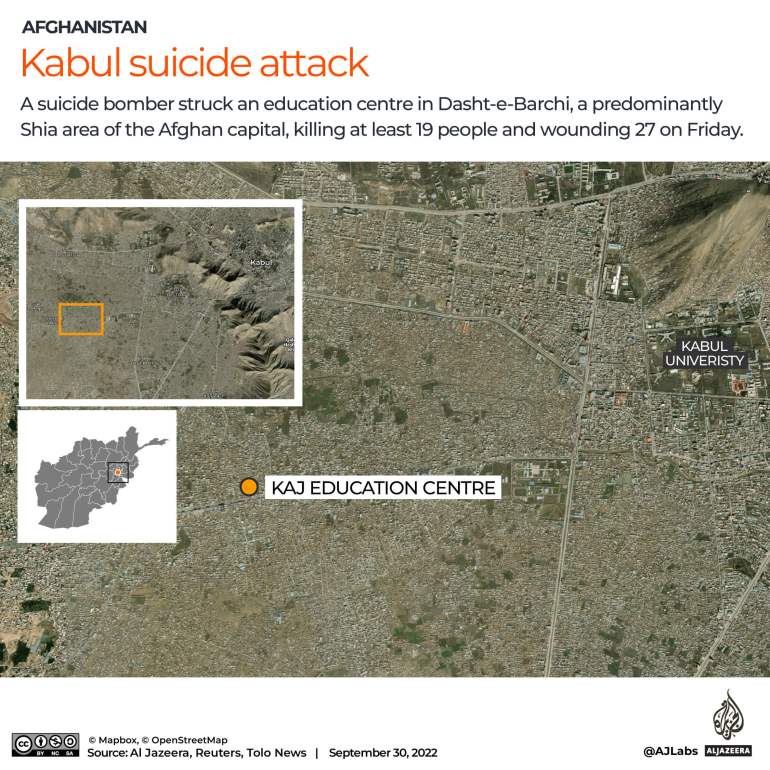
A suicide bomber has attacked an educational institute in the Afghan capital, killing at least 19 people.

As many as 27 others were wounded in the blast early on Friday, which occurred in the Dasht-e-Barchi neighbourhood of western Kabul, a predominantly Shia Muslim area home to the minority Hazara community, according to police spokesman Khalid Zadran.

“Students were preparing for an exam when a suicide bomber struck at this educational centre. Unfortunately, 19 people have been martyred and 27 others wounded,” he said.

Videos posted online and photos published by local media showed bloodied victims being carried away from the scene.

The victims included high school graduates, both girls and boys, who were taking a practice university entrance exam at the Kaj education centre when the blast went off, Zadran said. Schools are typically closed in Afghanistan on Fridays.

“Attacking civilian targets proves the enemy’s inhuman cruelty and lack of moral standards,” he said, without specifying who was believed to be behind the attack.

One wounded student said the victims were mostly girls.

“We were around 600 (students) in the classroom, but most of the casualties are among girls,” the male student told the AFP news agency from the hospital where he was being treated.

No group immediately claimed responsibility.

Interactive_KabulSept30_2022 Blast
(Al Jazeera)

Families rushed to area hospitals where ambulances were arriving with victims and lists of those confirmed dead and wounded were posted to the walls.

“We didn’t find her here,” said a distressed woman looking for her sister at one of the hospitals. “She was 19 years old.”

Resident Ghulm Sadiq said he was at home when he heard a loud sound. He went outside to see smoke rising from the education centre where he and neighbours rushed to help.

“My friends and I were able to move around 15 wounded and nine dead bodies from the explosion site … Other bodies were lying under chairs and tables inside the classroom,” he said.

Further details of the attack were not immediately available, although the official death toll was expected to rise.

Ethnic Hazara have alleged years of persecution by the ruling Taliban, which returned to power in the country following the withdrawal of United States-led forces in August 2021, and have been the victims of several attacks claimed by the rival ISIL (ISIS) group.

The Dasht-e-Barchi neighbourhood has witnessed some of the worst attacks in Afghanistan in recent years.

In 2021, before the Taliban takeover, at least 85 people – mostly female students – were killed and about 300 others wounded when three bombs exploded near their school in Dasht-e-Barchi.

No group claimed responsibility for that attack, but a year earlier, ISIL claimed responsibility for a suicide attack on an educational centre in the same area that killed 24, including students.

In April of this year, two deadly bomb blasts at separate education centres in the area killed six people and wounded 20 others.

‘Shamefaced reminder’

Since taking control, the Taliban government has emphasised that it is securing the nation following decades of war, but a series of attacks on mosques and civilian areas in recent months has challenged that narrative.

In the wake of the attacks, Samira Hamidi, Amnesty International’s South Asia campaigner, decried the killings as a “shamefaced reminder of the inaptitude and utter failure of the Taliban, as de-facto authorities, to protect the people of Afghanistan”.

“Since their takeover of Afghanistan, the Taliban have done little to put in place any measures for the protection of the public, especially of Shia-Hazaras who have been systematically targeted largely by the Islamic State (IS) in schools, mosques, training centers and public places,” she said in a statement.

“Instead, their actions of omission and commission have only further aggravated the risk to the lives of the people of Afghanistan especially those belonging to ethnic and minority communities.”

Education also remains a flashpoint issue in Afghanistan with the Taliban blocking many girls from returning to secondary education.

On Friday, Neil Turner, the Norwegian Refugee Council’s Country Director in Afghanistan, called on authorities “to take steps to ensure that educational facilities are protected against threats and attacks so that girls and boys can fully enjoy their education rights”.

SOURCE: NEWS AGENCIES

Suicide attacker kills at least 19 in Kabul school blast
read more

China’s and India’s Realpolitik Relations with the Taliban Regime

Brookings Institution

September 13, 2022


Guest Column

Though the first year of the Taliban’s return to power in Afghanistan has been characterized by a return to authoritarianism, a tanking economy and worsened relations with the West, two countries—China and India—have made the effort to position themselves closer to the new ruling regime. For China, this is a continuation of a long-standing policy that has seen relations steadily improve; for India, it is a surprising about-face. Both countries’ engagement with the Taliban is principally driven by counterterrorism considerations, with much less focus on human rights and political pluralism than the West has emphasized. But even this realpolitik approach is likely to generate only limited payoffs from the Taliban, even on counterterrorism issues.

China

Since 2001, China’s policy in Afghanistan has progressed from a non-engagement “observer” policy (2002-2010), to an economics-centered agenda (2011-2017), to a security dominated agenda (post-2018). The security agenda has remained dominant even after the Taliban regained power in August 2021.

China’s regional security agenda has focused on eliminating Uighur militancy and mobilisation in Xinjiang and preventing the flow of any external support to Uighur militants, such as from Afghanistan. This goal, coupled with the struggles faced by the anti-Taliban counterinsurgency, encouraged China to develop strong relations with the Taliban well before they returned to power—to the dismay of the Afghan government that had fervently hoped that Beijing would pressure Pakistan to sever its relations with the Taliban. While China preferred a stable Afghan government not dominated by the Taliban, it assessed that there was a substantial likelihood that the Taliban would return to power in some form, and therefore hedged its bets.

Equally disappointing to the Afghan government, China’s economic investments in the country remained far below what the administration of President Ashraf Ghani (2014-2021) had hoped. In 2016, China and Afghanistan signed a memorandum of understanding on the Belt and Road Initiative (BRI), that promised to fund $100 million worth of projects in the country. However, no concrete BRI investments have materialised and Chinese resource extractions have remained minimal. In May 2008, the Chinese Metallurgical Group Corporation (MCC)/Jiangxi Copper Company Limited (JCL) consortium won a thirty-year $3.4 billion lease for the second-largest copper mine in the world—Mes Aynak in the Logar province of Afghanistan. But since winning the bid, the copper production has been minimal to nonexistent.

In theory, Afghanistan sits on some $1 trillion worth of minerals, rare metals, oil, gas, precious stones, and other extractable resources. But developing them and bringing income to one of the world’s most impoverished countries has been hampered by persistent instability and conflict, out-of-control corruption, inadequate infrastructure development, and since the Taliban seized power, by Western sanctions.

Although, like all other countries, China has not officially recognised the Taliban, it has positioned itself far closer to the new regime than the West has. Beyond keeping its embassy in Kabul open, China has repeatedly denounced the “political pressure and economic sanctions on Afghanistan imposed by non-regional forces” and called for the unfreezing of Afghan assets held by the United States (US) and in Europe even before any progress is achieved on human rights and women’s rights in Afghanistan. However, China’s humanitarian assistance to Afghanistan remains a small fraction of the aid supplied by the West since August 2021.

Some Chinese state-owned enterprises have hinted at the possibility of (re)starting economic projects with the Taliban. In reality however, bilateral trade has remained very limited, amounting mostly to pine nut exports from Afghanistan to China. And despite imaginations of large potential sanctions-busting Chinese extraction of valuable commodities such as lithium, large Chinese economic involvement remains unlikely for the above reasons and uncertainty over whether the Taliban regime will survive more than a few years, given Afghanistan’s crippled economy.

On the most important issue—counterterrorism—China finds itself in a similar position as the US and much of the West vis-à-vis the Taliban. The Taliban has promised it will not allow Uighur attacks abroad into China or the flow of financial and material support to Uighur militants, but not anything beyond that. Various Chinese officials have demanded that the Taliban cut ties to other militant groups and act against the Uighur militants. But although the Taliban has never criticised China’s brutal repression of the Uighurs, its actions against Uighur militants have been limited. At first, the Taliban falsely claimed that Uighur fighters had left Afghanistan. In fact, there remained Uighur fighters and commanders in northern Afghanistan commanding Taliban non-Uighur units. Then, in May 2022, it relocated some Uighur militants away from the Chinese border, but did not expel them.

Among the principal reasons for why the Taliban has been light-handed with the Uighurs, (or for that matter other foreign militants) is the need to preserve the inflow of foreign funds and maintain internal unity. Such funding is dependent on the Taliban not reneging on its broader jihadi commitments. The Taliban also has its familial connections to foreign terrorist groups. Crucially, the Taliban also fears that acting against external jihadist groups would weaken the Taliban’s internal cohesion and cause defections, such as to the Islamic State in Khorasan (ISK), the Taliban’s principal armed rival. The only foreign fighters whom the Taliban did expel in the fall 2021 were the Baluchis, who target Pakistan and Chinese assets in Pakistan and whom Pakistan suspects of receiving assistance from Pakistan’s archrival, India.

India

Unlike China, India waited until the spring of 2022 before attempting even a modest rapprochement with the Taliban.

Throughout the 1990s, India was a staunch supporter of the anti-Taliban Northern Alliance, and after 2002, of the Afghan Republic, providing economic and limited military assistance. Unsurprisingly, it opposed the restart of US negotiations with the Taliban that led to the signing of a peace agreement in February 2020.

Thus, New Delhi’s decision to discuss the establishment of “diplomatic relations” with the Taliban and provision of limited humanitarian aid (like with China, a small amount of Western humanitarian aid) in June 2022, followed by the re-opening of the Indian embassy in Kabul in July 2022, represent a major policy rupture for India. The Taliban provided security assurances to the Indian embassy (as well as to embassies and diplomatic staff of all countries that return), but the ISK attack on the Russian embassy in Kabul on September 5, 2022, may weaken any stock India places in such promises.

Principally (and accurately), India has concluded that the Taliban remains firmly in power in Afghanistan and that the various armed opposition groups, such as the National Resistance Front, do not pose a major challenge. Following the dictum of keeping one’s enemies far closer than one’s friends (the latter of which India has not kept particularly close, bucking US entreaties that India condemn Russia’s invasion of Ukraine), India has calculated that reopening the embassy in Kabul and developing a limited relationship with the Taliban gives it at least eyes and ears on the ground in Afghanistan.

Like for China, security, principally counterterrorism considerations, have driven India’s Afghanistan agenda. In 1999, Pakistani terrorists hijacked an Indian airliner with 160 passengers and flew it to Afghanistan where the Taliban protected it from an Indian rescue assault. Moreover, India does not want to see Kashmir- and India-oriented terrorist groups sponsored by Pakistan—such as the Lashkar-e-Taiba (LeT) and Jaish-e-Mohammad (JeM)—to be given safe haven in Afghanistan.

The Taliban has given India the same promises as to everyone else: it will not allow terrorist groups to launch attacks from Afghanistan into other countries. But the Taliban’s counterterrorism actions will likely remain the same as with the West and China: promising and perhaps even foiling attack ploys, but not rounding up or expelling these terrorist groups. Indeed, both the LeT and JeM retain a presence in Afghanistan.

By reestablishing a presence in Afghanistan, India has also enjoyed bursting Pakistan’s hope to have its sole run of Afghanistan and potentially use Afghanistan as a place of strategic depth in military confrontations with India. Reportedly, the Taliban has expressed interest in sending some of its military units to India for training.

The Taliban has not lived up to Pakistan’s hopes of taking close direction from Islamabad and Rawalpindi (where Pakistan’s Inter-Service Intelligence or ISI, key sponsors of the Taliban for three decades, are located). Even the Haqqani branch of the Taliban which is very close to the ISI has not shut down the anti-Pakistan terrorist operations of the Tehrik-e-Taliban-Pakistan (TTP), but instead negotiated a series of unsatisfactory ceasefires. And like previous Afghan governments, the Taliban has challenged Pakistan over the demarcation of the Afghanistan-Pakistan border, even resulting in armed clashes.

India’s limited engagement with the Taliban fits well with India’s long-running ultra-realpolitik foreign policy. In Myanmar, where India has substantial economic and geopolitical interests, it has been unwilling to criticise the new military junta. Following the overthrow of the democratic government in February 2021, and more recently with the execution of pro-democracy activists, the most that New Delhi has been able to muster was to express its “deep concern”. In fact, India has positioned itself closely to the Myanmar junta, even sending Indian diplomats to attend the junta’s military parades.

Pluralism and Human Rights versus Limited Objectives

Only a limited focus on human rights, accountability, and pluralism animates India’s and China’s dealings with the Taliban. Both China and India have spoken of support for an inclusive government that incorporates non-Taliban and non-Pashtun factions. But along with Iran and Russia, their definition of inclusivity is different from the West’s, centering principally on the integration of key minority ethnic powerbrokers into the Taliban government, rather than true accountability and broad-based inclusivity.

Yet, the Taliban has not been willing to move even in that limited direction, running an exclusionary and Pashtun-centered government since its return to power. It has even marginalised its own ethnic minority commanders—Taliban Uzbek, Tajik, and Hazara commanders—who were critical in the Taliban’s takeover of minority-dominated areas in the country.

Both China and India have endorsed the return of girls to secondary schools in Afghanistan that the Taliban’s top leader Haibatullah Akhundzada banned. But neither Beijing nor New Delhi has issued strong or frequent statements about the issue. In my interviews, I learned from Western diplomats that, along with Russia and Iran, China has indicated to the Taliban leadership that it should not feel compelled to yield to Western pressure on issues such as women’s rights and that Beijing can act as an international interlocutor for the Taliban regime.

Divisions in the international messaging to the Taliban would weaken the capacity of the international community to shape the Taliban’s behavior regarding counterterrorism and domestic political dispensation. Already, the Kandahar power center around Haibatullah has been impervious to both external and internal inputs, including from other Taliban factions. The more internationally oriented segments of the Taliban, including the powerful terrorist commanders Mullah Yaqub and Sirajuddin Haqqani, are liable to calculate that they would unlikely be able to retain control of Afghanistan for more than a few years if the country’s economy remains buckled. Yet persisting internal repression of women, minorities, and political critics that have characterised the Taliban’s first year will, over time, likely jeopardise even Western humanitarian aid. There is little reason so far to believe that any future Chinese humanitarian and economic efforts in Afghanistan will offset the loss of Western development aid.

Equally, however, an isolation of the Taliban regime and persistent denials of development aid and financial liquidity are unlikely to alter its behavior either. Instead, they are more likely to drive it deeper into an inward- and afterlife-focused dogma, as well as likely into a civil war.

Yet a disintegration of the Taliban regime, leading to an Afghan civil war, remains even more contrary to international counterterrorism and humanitarian objectives. As things stand, the only outcome of such a possible civil war would be a more fragmented and unstable Afghanistan.


Dr. Vanda Felbab-Brown is the Director of the Initiative on Nonstate Armed Actors, and a Senior Fellow at The Brookings Institution. 

Acknowledgements: The research reported here was funded in part by the Minerva Research Initiative (OUSD(R&E)) and the Army Research Office/Army Research Laboratory via grant #W911-NF-17-1-0569 to George Mason University. Any errors and opinions are not those of the Department of Defense and are attributable solely to the author.

China’s and India’s Realpolitik Relations with the Taliban Regime
read more

Biden to Drip-Feed Afghanistan Its $3.5 Billion in Frozen Reserves

By
Foreign Policy
SEPTEMBER 20, 2022

The decision by the United States to release $3.5 billion of Afghanistan’s central bank reserves has sparked fears that the money will hand a jackpot to the Taliban, which have presided over the country’s slide into dire economic crisis since they took over more than a year ago. The money is to be transferred to an international financial institution based in Switzerland and administered by a group including former Afghan central bankers.

After months of back-and-forth conversations over whether—and how—to disburse at least a portion of the funds belonging to the former Afghan government that were frozen in the United States after the Taliban took over last year, the Biden administration has hit on a solution that pleases no one.

The United States has set up the Afghan Fund at the Bank for International Settlements in an effort to kick-start the economy before the winter exacerbates alarming levels of hunger and poverty. The U.S. Treasury said the money will help pay Afghanistan’s debts and bills, keeping the economy afloat, while critics said it will simply transfer liability for payments from the Taliban to the Afghan Fund.

Omar Joya, an economist formerly with the World Bank and Afghanistan’s central bank, described the Afghan Fund as a “windfall” for the Taliban, saying it effectively pays their bills while relieving them of responsibility for managing an economy suffering from the political shock of the republic’s fall as well as natural disasters that have disrupted agricultural production and supply chains.

“Transferring part of the reserves to a fund to finance humanitarian projects and reduce the fiscal pressures from the Taliban will not help much with the ongoing economic recession and crisis,” Joya said. “On the contrary, it will further support the Taliban leaders by easing fiscal pressures and providing them with windfall gains. Nothing will change for the poor. They will continue to cope with lack of jobs, no source of income, deprivation, soaring food prices.”

The Taliban, too, oppose the Afghan Fund, saying all central bank reserves—$7 billion held in the United States and $2 billion held in Europe and the Middle East—should be transferred to the central bank under their management.

“Foreign currency reserves belong to the people of Afghanistan and have been used for many years in light of the law for monetary stability, strengthening the financial system, and facilitating trade with the world,” said Habiburahman Habib, the Taliban’s economy ministry spokesperson. “Any action of the United States regarding the allocation, use, and transfer of the country’s foreign currency reserves is unacceptable, and we want to reconsider this matter.”

But the Taliban’s earlier brutality and their proven inability to govern since they took power ensured that the United States would not release the funds into the hands of a group run by terrorists. The Afghan government previously relied on international aid for around 80 percent of its revenue, but that has largely evaporated. Without income, people cannot buy staples, leading to documented reports of people selling children and body parts to feed their families. But the Taliban refused to comply with U.S. conditions for the release of the funds, including international anti-money laundering and counterterrorism financing measures, as well as independent oversight and auditing.

The Biden administration views the Afghan Fund as a sort of shock-absorber meant to keep the lights on and the credit rating passable. “The Afghan Fund will protect, preserve, and make targeted disbursements of that $3.5 billion to help provide greater stability to the Afghan economy. The Taliban are not a part of the Afghan Fund, and robust safeguards have been put in place to prevent the funds from being used for illicit activity,” the U.S. Treasury and State Departments said. “Disbursements from the Afghan Fund could include keeping Afghanistan current on its debt payments to international financial institutions, which would preserve their eligibility for development assistance, and paying for critical imports, such as electricity.”

But that still frees up funds for the Taliban, Joya argued. Under the current arrangement, the national electricity bill will be paid directly from the fund, meaning the Taliban can keep the money collected from customers by the state power company.

“The newly transferred $3.5 billion to the Afghan Fund must be recalled back and must remain with the frozen assets. They are supposed to function as foreign exchange reserves to facilitate payments for international transactions, not to fund or finance fiscal obligations or humanitarian operations,” Joya said.

The central bank’s assets were frozen when the Taliban took control on Aug. 15, 2021: As the country came under the control of sanctioned terrorists, business as usual was not an option. Ordinary people have not been able to access their own bank accounts, though some private banks have continued to operate payrolls and other functions. The World Bank has projected a decline in real GDP by one-third between the end of 2020 and the end of this year, saying around 70 percent of households cannot meet basic needs, including food.

The yearlong saga over the release of the funds has been controversial. Some Afghans accused the Biden administration of stealing from Afghanistan’s people. Many more were concerned the Taliban would find a way to seize the money, as they have seized much of the aid that has been funneled to the country since they took control. “It will be smoked inside a year, and then where will we be?” asked the head of a local charity, speaking anonymously, who described the Taliban pilfering international food and other aid over the past year.

The big debate is whether the fund is meant to fulfill traditional tasks of central bank reserves or act as a rainy day fund. Shah Mehrabi, a long-term member of the Supreme Council of Afghanistan’s central bank, said its priorities are inflation reduction and stabilizing the currency. Mehrabi is one of two Afghan economists on the four-strong board of the Afghan Fund; the other two are Swiss and American.

He said he wants to do auctions of U.S. dollars to the tune of $150 million a month to inject hard currency into the economy and take out afghanis, which are driving up prices. Aid salaries have injected some dollars into the economy, which have helped stabilize the currency, but they haven’t taken any local currency out, which is why inflation is still above 50 percent. But he has some conditions.

“Funds will only be released if conditions are met,” including halting a “brain drain” with the employment of competent technocrats to run the financial institutions, currency auctions, and independent monitoring, he said. “We will look at this as we go, and once we have access to economic data collected by the current regime, we will have a better idea.”

Abdullah Khenjani, a journalist and Afghanistan’s former deputy minister for peace, said the “unilateral” U.S. decision to set up the Afghan Fund “means that there is no common ground to seek and reach a rational decision with the Taliban regime,” which has not been held accountable for excesses like extrajudicial killings and banning education for girls.

Reserves are meant to backstop the banking system and the national currency, Khenjani said, not to pay power bills. “In the long term, it will be a disaster, another ingredient in the recipe of the failing Afghanistan economy,” he added.

Lynne O’Donnell is a columnist at Foreign Policy and an Australian journalist and author. She was the Afghanistan bureau chief for Agence France-Presse and the Associated Press between 2009 and 2017.

Biden to Drip-Feed Afghanistan Its $3.5 Billion in Frozen Reserves
read more

Taxing the Afghan Nation: What the Taleban’s pursuit of domestic revenues means for citizens, the economy and the state

On 15 August 2021, much in Afghanistan was overturned or radically altered. The insurgents became the rulers and the old elites fled. Afghanistan’s relationship with the rest of the world ruptured and the country became poorer overnight. It also went from being a state where the administration was reliant on foreign donors and military support to one where the government depends for funding on the domestic economy and its taxpaying citizens. AAN’s new special report is a first attempt at making sense of one of the most fundamental of these changes – the Emirate’s need to tax its citizens. Kate Clark, with research support from the AAN team, explores the ramifications of the Taleban’s serious-minded pursuit of taxation, the consequences to citizens across the country, to state power and the dilemmas it has created for donors.
Read “Taxing the Afghan Nation: What the Taleban’s pursuit of domestic revenues means for citizens, the economy and the state” here.

At the core of the new report are interviews with more than 100 Afghans from across the country who were asked first about their experiences of the Taleban takeover, and subsequently how the economic collapse was affecting their household economy. Taxation emerged as a significant theme. These interviews gave a good view of what was happening on the ground. They also ensured that Taleban fiscal policy was viewed first of all through a human lens.

From the interviews, a picture emerges of a new administration moving swiftly and seriously to collect revenue of all types and with far less corruption than the old regime. Not everyone we heard from felt their tax bill had been fair or drawn up according to the rules. Some described Taleban tax collectors as menacing and implacable, demanding money they could not afford. Others said negotiation was possible. Just one interviewee reported that tax collectors in his district were demanding bribes. The Taleban have also rolled out new taxes, in particular, on agricultural production. This represents a massive transfer of resources from the rural economy to the state. In some districts, they have demanded taxes that fall outside the rules, whether Ministry of Finance regulations or Islamic practice, and look to be extortionate.

The Taleban’s diligence in taxing the nation is driven by the very different position they are in compared to the Republic. It had no need to prioritise tax collection. For 20 years, much – possibly most – of the money paid out by taxpayers and traders importing goods was diverted into the pockets of corrupt officials and politicians and, to a lesser extent, the insurgency. Even so, there was always enough foreign money coming into the country that citizens scarcely felt the deficit. Public services continued. Meanwhile, the Taleban used the taxes they collected to run the insurgency while foreign money and, increasingly in the latter days of the Republic, taxpayers in government-controlled areas kept funding public services.

The Republic was dependent on foreign funding. That, in turn, made the Hamed Karzai and Ashraf Ghani administrations financially autonomous from the people. Indeed, often, they appeared more answerable to donors than their own citizens. In contrast, the Emirate needs to tax and, as our report shows, they are managing to raise large amounts of domestic revenue despite the massive contraction of the economy. In this, the Taleban could be said to be ‘doing well’. However, that is a slippery concept when it comes to taxation. If taxes pay for what a population wants – education, healthcare, better roads, a competent administration – they are usually seen as a public good. If people consider their rulers are taking their money without seeing the benefits, ‘unfair’ taxation can plant enmity towards the state.

One of the problems facing Afghan citizens today is that they do not know how the government is spending their money. The Taleban have released the barest details of their budget. Moreover, some types of taxation appear not to be included in official revenue figures.

Both citizens and donors need greater financial transparency from the Emirate. For donors, this is especially the case this year as they gear up to again provide funding for basic services, albeit in parallel systems that seek to avoid money going directly to the Taleban administration. Increased donor funding will inevitably free up money that the Emirate was spending on healthcare, support to farmers or other services, enabling it to be spent elsewhere – on security, intelligence or other sectors donors are least inclined to bolster.

Transparency is also important for the Taleban’s reputation. Until now, they have appeared far less corrupt than the Republic, largely because of their relatively clean revenue collection. However, collecting revenues is just one part of the cycle of public finance where corruption can manifest. Without openness on expenditure that better reputation cannot go unquestioned.

This new special report also asks what the Taleban’s tough approach to taxation means for households, given how poor, vulnerable and hungry so many Afghans are. In AAN’s previous work on household economies, we have seen again and again how even the poorest seek to help those in even worse need than themselves. Charity is embedded in the Afghan psyche and social fabric, but how well can people carry on helping others if the state is taking their marginal income?

Read the full report here.

Taxing the Afghan Nation: What the Taleban’s pursuit of domestic revenues means for citizens, the economy and the state
read more

Want more accountability for the Taliban? Give more money for human rights monitoring.

Ahead of the U.N. General Assembly last week, U.N. Special Rapporteur on Human Rights in Afghanistan Richard Bennett released his first report grading the Taliban’s treatment of Afghans’ rights. It was an F.  In the past year, the Taliban have engaged in a full-scale assault on Afghan’s human rights, denying women access to public life, dismantling human rights institutions, corrupting independent judicial processes, and engaging in extralegal measures to maintain control or to exact revenge for opposition to their rule. That is one of the main reasons — along with their continued support of al-Qaida and a refusal to form a more inclusive government — that Afghanistan has no representation at the U.N.

A Resource Gap

The grave human rights violations documented by the U.N. and brave Afghan human rights monitors are not being met with appropriate resources for investigations that could put pressure on the Taliban to reduce human rights violations or ultimately hold them accountable. Bennett’s team is strong but small, relying on limited trips to Afghanistan to investigate allegations of atrocities and lacking resources for translation of their work into Afghan languages. The special rapporteur can identify whether the Taliban are upholding their legal human rights obligations but not fully assess the scale and scope of violations or conduct detailed fact finding on specific cases.

The special rapporteur’s report also highlights a gap in U.S. resources. While the United States has taken some promising steps, including appointing Special Envoy for Afghanistan Women, Girls, and Human Rights, Rina Amiri, the diplomatic attention has not been matched by funding that could be used to shore up U.N. monitoring efforts and to maintain an Afghan civil society capable of documenting and reporting on the Taliban’s human rights practices. Amiri has no programming budget and the bureaus that normally fund local human rights monitors have seen their Afghanistan budgets slashed.

Protecting human rights in Afghanistan is both a policy priority and a national security priority for the United States. Taliban atrocities in the 1990s accelerated the involvement of neighboring countries that supported proxies in the Afghan civil war, which in turn created safe havens for al-Qaida to plan the 9/11 attacks. One of the few ways the current situation in Afghanistan could get worse is for there to be a civil war fueled by resentment over widespread human rights abuses.

The index of Bennett’s report reads like a textbook of all categories of human rights that are recognized and protected in U.N. treaties. Most notable, Bennett writes, “In no other country … are they [women and girls] as disadvantaged in every aspect of their lives.” The Taliban claim to be protecting women’s rights under their interpretation of Sharia, but that has meant “suspending girls’ secondary education, enforcing mandatory hijab wearing, stipulating that women must stay home unless necessary, banning women from undertaking certain types of travel without a close male family member (mahram) …” This list could go on and on.

Bennett also states that there are credible reports of retaliatory killings, torture, and arbitrary arrests in areas of ethno-political resistance to the Taliban. In two predominantly Tajik provinces north of Kabul, Bennet cited reports of “civilians being subjected to arbitrary arrest, extrajudicial killings and torture … some amounting to what appears to be collective punishment.”

Protecting Rights, Preventing Impunity

There is a natural tendency to read Bennett’s report and throw one’s hands up in despair. The Taliban haven’t changed; we have little leverage over them. Now what? The pursuit and protection of human rights in Afghanistan is a long game, however, and there is a human rights toolkit that should be applied in Afghanistan. It is also important to prevent impunity for atrocities from becoming entrenched, which increases the chances for more widespread and systematic violence.

First, Bennett has demonstrated that the scope and scale of the human rights violations warrants increased resources to conduct more detailed fact-finding on specific incidents, including forensic investigations as necessary to pursue accountability for violations, not just reporting on them. Bennet’s office also performs a vital public outreach function, including among Afghans that speak in local languages. More money for translation, strategic communications and dissemination of the reports would enhance the impact of his work.

Second, the profound implications of the Bennett report should trigger an increase in funding for U.S. government agencies that support human rights monitoring and advocacy in Afghanistan. Beyond Amiri’s policy mandate, the State Department and USAID should be funded to support Afghan human rights monitors on the ground or in the diaspora. Notably, the United States provided Afghanistan’s previous democratic government with millions in grants and technical support to Afghan human rights organizations. Yet now that violations are occurring at even greater orders of magnitude, the funding has dried up.

While it is manifestly more difficult for Afghan organizations to publicly discuss human rights under Taliban rule, there are brave civil society actors who are gathering evidence of abuses and pushing the Taliban to practice the Islamic ideals of justice they espouse. Combining quiet documentation work by Afghans in the country with secure evidence storage and more public advocacy by diaspora groups is one way to mitigate risk and apply more pressure on the Taliban — a model that has been used in Syria and by the Uyghur community.

Finally, the U.S. should support the International Criminal Court (ICC), which is considering a request by its prosecutor, Karim Khan, to renew its investigation into war crimes in Afghanistan. Following the Taliban takeover, Khan proposed to focus particularly on alleged crimes by the Taliban and ISIS in Afghanistan because “the gravity, scale and continuing nature of [their] alleged crimes … demand focus and proper resources.” Providing support to human rights defenders who can give evidence to the ICC will put further pressure on the Taliban and will not involve any investigation of U.S. forces — as some ICC critics fear.

The human rights situation in Afghanistan is getting worse and, unfortunately change is likely to be incremental. But the Taliban’s woeful scorecard over its first year is an urgent warning that more must be done to slow the rate of decline and hold the Taliban accountable. The good news is that this is a problem more resources can help to solve.

Want more accountability for the Taliban? Give more money for human rights monitoring.
read more

U.S. to Move Afghanistan’s Frozen Central Bank Reserves to New Swiss Fund

For almost seven months, Afghan central bank reserves frozen by the United States and set aside to somehow help the Afghan people, have sat, immobilized. Now those funds — $3.5 billion — are at long last on the move. On September 14, the U.S. and Swiss governments unveiled the “Fund for the Afghan People” as a Geneva-based foundation with its account at the Bank for International Settlements. The Fund will preserve, protect and selectively disburse this money. With this major policy step accomplished, new questions arise: What do these developments mean, what are realistic expectations for the reserves, and what needs to happen next?
The establishment of the Fund marks important progress in implementing the Biden administration’s plan for this half of Afghanistan’s more than $7 billion of foreign exchange reserves frozen over a year ago. First and foremost, moving them to the Fund will physically remove the money from U.S. jurisdiction and away from any vulnerability that they might at some point be subjected to civil proceedings related to suits by 9/11 victims’ families and others. And from a positive perspective, the move makes it possible to utilize this portion of the reserves for specific purposes involving banking, finance and economic stabilization, but not going through the Taliban administration.
Possible uses of the reserves include, according to the Fund’s governing bylaws and the U.S. announcement:
  • Provide Afghan banking sector liquidity.
  • Keep Afghanistan current on its debt service obligations (an aim critical to maintaining the country’s eligibility for new funding from international financial institutions).
  • Support exchange rate stability.
  • Transfer funds, as appropriate, to public Afghan financial institutions, or for any other purpose that benefits the Afghan people approved by the Fund’s Board of Trustees.
  • Pay for critical imports like electricity.
  • Pay for essential central banking services like SWIFT payments.

The bylaws lay out the basic structure of the Fund. The Board of Trustees, its decision-making body, consists of two U.S.-based Afghan professionals with extensive experience including working for Da Afghanistan Bank (DAB — Afghanistan’s central bank) in the past, plus the U.S. ambassador to Switzerland and an official representing the Swiss government. The accounting firm Deloitte based in Geneva serves as the review body for the Fund, and the Fund will be subject to external audit as per Swiss law. The Fund can make disbursements from the interest income earned by the reserves or by using a portion of the reserves themselves.

A Promising Step Forward

While the Fund’s establishment is a significant accomplishment, it is just the beginning. The devil will be in specifics yet to be worked out.

Under the bylaws, the founding Board of Trustees has full flexibility and discretion to take the Fund forward as it sees fit. Board decisions have to be unanimous, and on that basis it has the ability inter alia to:

  • Appoint or remove board members and add new board members.
  • Change the location of the Fund.
  • Set disbursement policies.
  • Set compensation and expense reimbursement policies (though board members do not earn salaries).
  • Delegate management of assets and management more generally.
  • Set up bodies such as a secretariat or advisory committee for the Fund.
  • Amend and adopt by-laws.

This flexibility is necessary, but it means that decisions made by the founding board will be critical for the success of the Fund moving forward.

In the meantime, on August 26 a federal magistrate judge in New York issued a carefully reasoned and extensively documented recommendation that based on relevant U.S. laws, the remaining half of Afghanistan’s central bank reserves cannot be turned over to 9/11 plaintiffs.

Generally in line with and elaborating on the Department of Justice’s February 11 Statement of Interest regarding the reserves, the recommendation provides some grounds for hope that this portion of the reserves also will at some point become available for Afghanistan. The ultimate outcome cannot be firmly predicted, of course. The judicial process will entail several more stages — motions by the parties, District Court judge’s ruling, possible appeals to higher courts — probably taking years, before a final decision.

Don’t Expect Too Much — And What to Do Next

Expectations for the Fund need to be modest. Though freezing the reserves exacerbated Afghanistan’s economic problems, the main cause of the economic collapse was the sudden cut-off of some $8 billion a year in civilian aid and security assistance when the Taliban took over, along with the loss of billions of dollars of international military expenditures in-country as the last U.S. and other foreign troops left. Clearly, releasing half or even all of the frozen central bank reserves would not by itself resolve the country’s economic crisis.

A few recommendations for the short run:

Be very cautious about expanding the size of the board beyond the current four members. The requirement of unanimity in decision-making is understandable, but the larger the board the greater the risk of crippling gridlock. A representative from an international financial institution could be considered, or perhaps the European Union (possibly with a view toward consolidating the $2 billion of Afghan central bank reserves held in Europe into the Fund), but adding more than one or two members with a requirement for unanimity in decisions most likely would turn out be unwieldy.

Lean but effective management will be key. The quality of the Fund’s manager will make the difference between success and failure, based on experience with other, more complex trust fund arrangements such as the relatively successful Afghanistan Reconstruction Trust Fund. Making the right selection may be one of the board’s most important — and earliest — decisions.

The decision-making process for Fund actions needs to be clear and well-documented. It can be simple, given the likely limited number of discrete disbursements that will occur, but it should include a short description of the action being taken, its expected results, and an ex-post assessment by the Fund of what was achieved and any lessons learned.

An advisory committee may be needed to offer the board practical experience and expertise. It is important, however, that this body does not become an arena to debate political viewpoints.

A credible, outside entity should be hired to evaluate the Fund’s actions and results. Financial audits are already required by Swiss law, but a broader assessment by an independent party would strengthen accountability and boost the Fund’s credibility.

The Fund must operate with the maximum possible transparency. Given the highly unusual nature of the Fund, making its decisions, main processes and results available to the public will be essential to its credibility and success.

Once the Fund is on a sound footing and operational, beyond small, targeted disbursements, it could explore the possibility of leveraging its size and status to support trade financing and cooperative arrangements with state-owned banks of Afghanistan’s neighboring countries. Such agreements would promote smooth cross-country commercial banking transactions, without necessarily using significant amounts of the reserves for these purposes.

Looking Forward, the Taliban Need to Step Up

Over the longer term, the objective according to both the U.S. and Swiss announcements, is to preserve most of the reserves for their eventual return to DAB. However, the United States said that it will not support return of these funds until DAB demonstrates its independence from political influence and interference, and that it has instituted adequate anti-money laundering and countering-the-financing-of-terrorism (AML/CFT) controls, as well as completing a third-party needs assessment and taking on board a reputable third-party monitor.

During the final years of the pre-August 2021 Ghani administration, DAB was gravely weakened by politicized personnel changes and micromanagement, triggering a flight of managers and professionals that accelerated after the Taliban takeover. As a result, DAB currently has very limited capacity and its top leadership team consists of senior Taliban figures, one of whom is under U.S., U.N. and EU counterterrorism sanctions. Given the lack of external monitoring and the end of the IMF program, which had provided support and oversight to DAB before August 2021, the institution would face serious challenges in managing and making productive use of any reserves it receives.

Moreover, rapidly dissipating the reserves for short-term needs would squander this important buffer and leave Afghanistan no better off. A proper use of Afghanistan’s central bank reserves — or those of any country — is to cushion and manage macroeconomic adjustment. In Afghanistan, for example, running down reserves gradually would give the economy precious time to adjust to the loss of aid. Reserves also provide a backstop for the commercial banking system, which requires they be maintained at a decent level.

What is needed to strengthen DAB is clear enough: reaffirming its legal autonomy, which is enshrined in current Afghan law; appointing a well-qualified, non-political leadership; bringing back as much of its veteran professional, technical and managerial staff as possible; and drawing on external technical support and oversight as needed.

The eventual return of the reserves to the DAB, and to a large degree Afghanistan’s economic stability and revival overall, will depend on seeing those reforms implemented. Only the Taliban can decide whether it will go ahead and do what needs to be done.

U.S. to Move Afghanistan’s Frozen Central Bank Reserves to New Swiss Fund
read more

Thomas West Says Afghan National Dialogue Needed

The deputy spokesman for the Islamic Emirate, Bilal Karimi, said that there is no need for national dialogue in the country.

The US special envoy for Afghanistan Thomas West said without a serious “national political dialogue” about the future of the country among Afghans who have “genuine support in their community, I really do fear…. we could see a return to civil war in time.”

But the Islamic Emirate said that there is no need for national dialogue in the country.

The US special envoy for Afghanistan made the remarks at the Center for Strategic and International Studies.

West said that Washington would support a stable Afghanistan in which the rights of all its people are ensured.

“We wish to see and to support the emergence of a peaceful and stable Afghanistan that never again harbors terrorists … in which the rights of all its people, women and men, boys and girls are upheld,” he said.

The deputy spokesman for the Islamic Emirate, Bilal Karimi, said that there is no need for national dialogue in the country.

“There is peace and security in the country. All the challenges that previously existed are currently solved. The time for negotiations was when there was war in the country and there were many sides—there was an invasion—now here is a central government and the people are in a calm situation,” said Bilal Karimi, deputy spokesman of the Islamic Emirate.

The Islamic Emirate has repeatedly reacted to the international community’s calls to form an inclusive government in Afghanistan, saying that the government is inclusive.

“The foreigners should not be present at such meetings because when the foreigners, regional countries and European countries interfere in Afghan internal affairs it does not bring results,” said Javid Sandel, an international relations analyst.

Thomas West Says Afghan National Dialogue Needed
read more