LONDON, Feb 13 (Reuters) – Eight Afghan journalists who worked for the BBC broadcaster won a legal challenge on Monday against Britain’s refusal to relocate them from Afghanistan, which they said put them at high risk of being killed by the Taliban rulers.
The journalists’ lawyers told London’s High Court in December that the government had “betrayed the debt of gratitude” owed to them by refusing to relocate them after the Taliban’s takeover of Afghanistan in August 2021.
Representatives for the government had argued that none of the eight were eligible for relocation under its Afghan Relocation and Assistance Policy (ARAP) programme.
David Blundell, a lawyer for the Ministry of Defence, said the Taliban’s perception that the BBC is a part of the British government was irrelevant.
But Judge Peter Lane said in a written ruling that the perception was “clearly relevant” to the risks the journalists faced.
The decision on whether to relocate the eight will now have to be taken again, which their lawyers said would have be done within three weeks.
The journalists were embedded with military personnel and worked on British government-funded projects, the lawyers said.
As part of their work, they spoke out against the Taliban and exposed corruption and abuse, resulting in numerous threats and attacks by Taliban fighters, the lawyers added.
Erin Alcock, who represented the journalists, said her clients have been “living in fear for over 18 months”.
A spokesperson for the Ministry of Defence said the department does not comment in detail on specific legal cases, but was considering potential next steps.
Reporting by Sam Tobin; Editing by Alex Richardson and Andrew Cawthorne
Afghan journalists win case against UK government over relocation
Kabulov added that Moscow is trying to create this approach and China has supported it.
The Russian special envoy for Afghanistan, Zamir Kabulov, said that Moscow has proposed the creation of a new regional approach for Afghanistan.
In an interview with THE WEEK magazine, Kabulov said that this format will be like the “G5” format in which the countries of India, Pakistan, Iran, China and Russia will participate.
“In order to build a so-called regional approach, we want to build a core format, like a G5 with India, Pakistan, Iran, China and Russia. We believe that it can be an engine for not only building regional consensus, but also for doing something in order to implement this consensus and let the current rulers of Afghanistan know that they should listen to us,” Kabulov added.
Kabulov added that Moscow is trying to create this approach and China has supported it.
The Russian special envoy for Afghanistan also noted that Russia does not want to interfere in the internal affairs of Afghanistan, but it cannot hide its disillusionment with the way the current government is handling the situation.
“We care about ordinary Afghans as they suffer the most. We, of course, try not to interfere in the internal affairs of other countries. But we cannot hide our disillusionment with how the Taliban is handling the situation,” Russian envoy added.
Kabul supports any action that may improve commerce, the economy, and ties with Afghanistan, said Bilal Karimi, deputy spokesperson for the Islamic Emirate.
“Any move that will help develop economic and commercial relations with the Islamic Emirate of Afghanistan and its people is a good move,” Karimi said.
Meanwhile, some political analysts consider the development of a new framework for Afghanistan as an effort to safeguard the regional interests of these nations.
“Any sort of format needs to contain two crucial components. First of all, it needs to consider the various realities of Afghanistan. And secondly, Afghanistan shouldn’t be used as a means of competition between the present powers,” said Sayed Jawad Sajadi, a political analyst.
“If Afghanistan is involved in it and they honestly endeavor to keep the region secure, the better for Afghanistan and the region,” said Janat Fahim Chakari, another political analyst.
Moscow Seeks to Form Regional Group of Nations to Influence Kabul
The Islamic Emirate welcomes the humanitarian assistance provided by the world community to Afghanistan.
The UNHCR’s deputy high commissioner for refugees, Yumiko Takashima, said that humanitarian aid to Afghanistan needs to be continued.
In an interview with TOLO News, Takashima said that ninety-eight percent of the people of Afghanistan are below the poverty line and more than half of the country’s population needs urgent aid.
“One of the things that I have been requesting of donors is that please, we see suffering every day. We are here in Afghanistan because we want to help people, so, please let us help, and I really hope that there will be the situation where we can really help people with all the support from donors, but right now it is becoming more and more difficult,” she said.
This UN official said that the recent decisions of the Islamic Emirate have had a bad effect on humanitarian aid.
The deputy of the United Nations High Commissioner for Refugees noted that the organization has helped nearly 1,300 families in Paktika province in the building of their houses.
The Islamic Emirate welcomes the humanitarian assistance provided by the world community to Afghanistan.
“The world must maintain and expand its cooperation with the Afghan people. The problems must be solved. It is in everyone’s best interest to contribute to Afghanistan’s stability and security. The Islamic Emirate is grateful for the assistance that has been provided so far. it is the Islamic Emirate’s responsibility to distribute the help in a transparent manner,” said Zabiullah Mujahid, the spokesman of the Islamic Emirate.
Meanwhile, some economists believe that the continuation of humanitarian aid to Afghanistan is crucial in the current situation.
“More than ever, the people need aid from the international community, and the growth of women’s business also contributes to a decrease in social poverty,” said, an economist.
Earlier, the UN said that more than 28 million people in Afghanistan need help.
UNHCR Deputy Calls for Continued Aid to Afghanistan
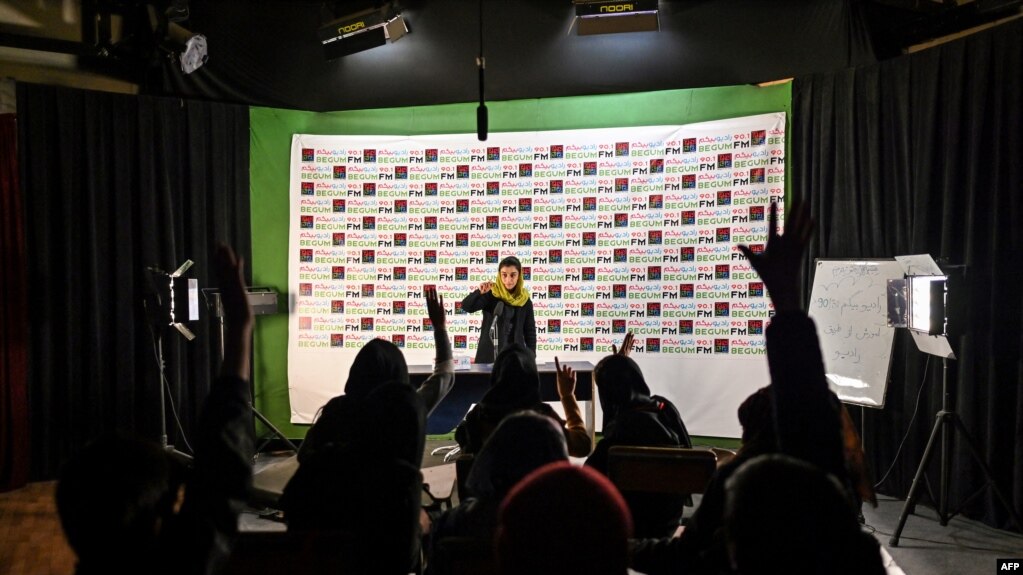
FILE – Students attend a class on-air at Radio Begum in Kabul, Nov. 28, 2021. Approximately 34% of radio stations have ceased operations since Afghanistan’s Taliban returned to power in 2021.
ISLAMABAD — Economic hardship and media restrictions stemming from the 2021 return to power of Afghanistan’s Taliban have reportedly forced approximately 34% of radio stations to shutter operations in the country, rendering hundreds of men and women jobless.
The Afghan Independent Journalists Union (AIJU), a Kabul-based local media monitor, released the figures Monday to mark World Radio Day.
AIJU President Hujatullah Mujadidi told VOA that 345 radio channels were operating in the country before the Taliban takeover in August 2021, employing nearly 5,000 people, 25% of them women.
But 117 stations have since ceased broadcasting due to economic problems, Mujadidi said, adding that 1,900 people, more than half of them women, subsequently lost their jobs.
The remaining 228 stations employ more than 1,800 workers, including a few dozen women.
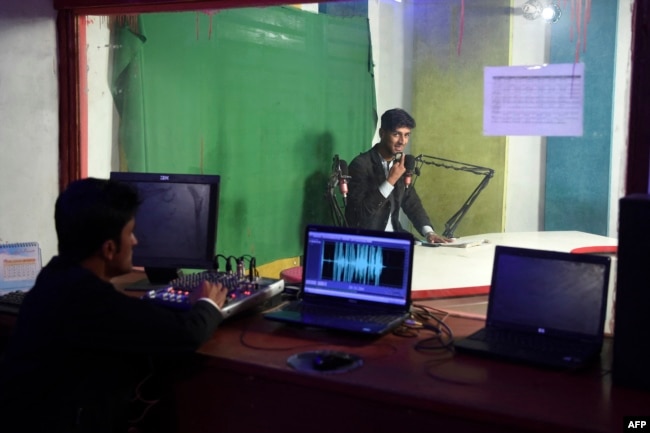
FILE – Afghan media personnel work inside a broadcast control room at Hamisha Bahar Local Radio station in Jalalabad, Dec. 11, 2021.
International sanctions on Taliban leaders and the suspension of financial assistance have deepened economic troubles in the largely aid-dependent country, multiplying challenges facing the Afghan media industry.
Critics say increasing censorship and alleged abuses of journalists by Taliban authorities have severely undermined the Afghan free press.
The United Nations Assistance Mission in Afghanistan reported last November that more than 200 journalists had suffered “arbitrary arrest, ill-treatment, threats, and intimidation” since the Taliban retook the country.
Hundreds of Afghan journalists have since fled to neighboring Pakistan and other countries, fearing reprisals for their critical reporting while the Taliban were waging a deadly insurgency against the United States-backed former Afghan government in Kabul.
Global media watchdog Reporters Without Borders says within the first three months of the Taliban takeover in 2021, 43% of Afghan media outlets were shuttered, and 84% of female journalists lost their jobs.
Taliban authorities reject the accusations of abuse and blame the closures on lack of funding. Critics question that assertion.
The Taliban recently blocked access to VOA’s Pashto and Dari sites and the websites for Azadi Radio, run by VOA’s sister network, Radio Free Europe/Radio Liberty.
Taliban officials have not yet commented on the allegations they blocked the VOA sites.
On Sunday, chief Taliban spokesman Zabihullah Mujahid said at a televised event in Kabul that foreign media outlets that “only publish negative news” and “don’t reflect [Taliban] achievements” would not be allowed to operate. He did not elaborate.
The Islamist rulers are also under fire for their sweeping restrictions on Afghan women, who are barred from receiving an education and from most workplaces in the country.
No foreign government has yet granted legitimacy to the Taliban regime over human rights concerns, especially the treatment of Afghan women.
Dozens of Radio Channels Stop Broadcasting in Taliban-Ruled Afghanistan
Gordon Brown is chairman of the UN’s Education Cannot Wait fund and was UK prime minister between 2007 and 2010
The Guardian
12 Feb 2023
As a child, Ramzan’s fight for an education almost cost her her life. Worldwide, there are 222 million children out of school who urgently need our help
Shazia Ramzan has spent most of her young life fighting for her right – and the right of all girls – to go to school. In 2012, at the age of 14, sitting alongside her friend Malala Yousafzai on a bus that was going from school to her home, in the Swat valley in the north of Pakistan, she was shot at by an extremist intent on stopping girls from getting an education. She suffered injuries from which she, Malala and their friend Kainat took months to recover.
Now completing a nursing degree at Edinburgh University, and preparing to start her own nurses’ training school in Pakistan, Shazia almost always has the needs of girls in her home area in her thoughts. In her time between classes, she is raising funds for Pakistani charities that are quietly but effectively helping Afghan girls who have been losing out on their education since the Taliban shut them out of the country’s secondary schools.
There are 5 million girls in Afghanistan who are currently out of school, and they urgently need our support. Many have risked everything by demonstrating in the streets of Kabul. While sooner or later the regime will find that they cannot forever oppress brave women who have known what it is like to be free, for now the young protesters face arrest and torture.
‘Between classes, she is raising funds for Pakistani charities that are quietly but effectively helping Afghan girls.’ Shazia Ramzan.
Theirs is an untold story of courage and resilience. Girls in Afghanistan are also at risk of punishment beatings if they attend underground schools run by their parents and teachers. Many more are fleeing across the border into exile in Pakistan in the hope of an education.
But, sadly, those who have crossed the border are joining Pakistan’s ever-lengthening queue for schooling that is already 23 million children long. This is not just because of the country’s recent floods, which have closed 27,000 schools, but because of Pakistan’s long-term failure to invest in girls’ education.
Step back and the picture becomes even graver: these girls are only a fraction of the world’s 222 million crisis-affected children who are in dire need of educational support. Of them, 78.2 million, including 42 million girls, do not go to school at all, while the others are suffering so many disruptions in their education that they fail to acquire even the most basic literacy and numeracy skills.
Their numbers, so large that they already exceed the combined populations of Germany, France and Britain, are rising every year. More than 100 million people are refugees or internally displaced because of conflicts and civil wars, from Ukraine and Myanmar to the Democratic Republic of the Congo, Sudan, Ethiopia and Somalia.
A large number of children today, though, are exiled from their homes not because of war but because they are the victims of droughts, floods and other climate-induced disasters, or of natural disasters. In Turkey and Syria the dead are still being counted, but we must also address the urgent needs of the living, all those forcibly displaced by a 7.8-magnitude earthquake from which it will take years to recover. Even if we manage to feed, shelter and treat the victims, there will be little cash left over to provide temporary schooling, unless we do better than in the past; the child victims of the earthquake could spend years excluded from education.
In Turkey and Syria, as elsewhere, it will be girls who will suffer most: they are 35% more likely to be out of school than their male contemporaries, according to data from Unesco. And we have been warned to expect that by 2030 many of them – an additional 10 million girls – will have been forced into child marriages, the number of girl brides rising yet again after years when forced marriage was on the decline.
Children should not have to wait for wars to end, or for the effects of natural disasters to subside, for the opportunity to learn and thrive. It is to finance the education of the forgotten 222 million that Education Cannot Wait (ECW), which I chair, was created in 2017. Its replenishment conference will take place in Geneva this week in the presence of Andrew Mitchell and other international development ministers from all over the world.
Seeking to bridge the divide between humanitarian aid, only 2% of which was spent on education, and development aid, which always comes too late to deal with refugee crises, ECW is asking donors for $1.5bn to support its new strategic plan. Initiatives that will prevent child labour, early marriage and trafficking include the provision of safe schools in countries where Boko Haram still abduct girls from their classrooms; the expansion of online learning; and of double-shift schools that, piloted in Lebanon, use school buildings more effectively by teaching local children English and French in the morning and Syrian refugee children Arabic in the afternoon.
We know from unspeakable recent tragedies that hope dies when food convoys and rescue workers cannot get through to besieged towns, and when flimsy boats carrying refugees capsize at sea. Hope also dies when children are locked out of education and denied the chance to plan and prepare for their future. At the age of 11, 12 and 13, young people should be optimistic and excited about great opportunities that lie ahead, but I cannot forget hearing from charity workers in a refugee camp in Moria, Greece, who had discovered three refugees in their early teens so desolate that they were planning a joint suicide. For them, behind barbed wire in an insanitary camp with no schooling and little else, there was only the bleakness of despair.
But hope can come alive, even in the harshest and least promising places in the world, if we offer children the chance of an education. It is the one way to honour the international community’s as yet unredeemed promise set out in sustainable development goal 4 – to be the first generation in history where every single boy and girl, stateless or not, goes to school. As Shazia’s work of mercy reminds us, it is also a moral obligation that we owe to the next generation. Instead of developing some of the potential of only some children in some parts of the world, we should be developing the potential of every child everywhere.
The story of Shazia Ramzan, Malala’s schoolfriend, shows why education must be a right for all children
The head of this department said there are no political prisoners incarcerated and and 15,000 people have been released after their cases were investigated.
The Directorate of Prisons Affairs said that out of 14,000 people imprisoned across the country, 1000 of them are women.
Officials of this department said that all of these prisoners have criminal cases.
“Currently there are 14,000 prisoners and more than 1000 of them are women,” said Mohammad Yusuf Mistari, the director of the prison’s affairs.
The head of this department said there are no political prisoners incarcerated and and 15,000 people have been released after their cases were investigated.
“We check thousands of cases and 15,000 people have been released and nearly to 3,000 prisoners will be released soon, and our prisons have the capacity for 20,000 prisoners,” said Mohammad Yusuf Mistari, the director of prison affairs.
Some women prisoners in Pule e Charkhi prison called on the Islamic Emirate to investigate their cases in a timely manner and to rule on them transparently.
Meanwhile, some analysts said that prisoners’ cases must be investigated transparently.
“Every prisoner from the arrest has some rights and their investigations and trial must be according to law and done transparently,” said Subhan Ullah Misbah, an analyst.
After the Islamic Emirate, the number of prisoners in Pule e Charkhi was zero.
Officials of the Directorate of Prisons Affairs said that currently most of the prisoners are arrested for murder, drug trafficking and theft, and other crimes.
More Than 1000 Women Imprisoned in Afghanistan: Prison Authority
TOLOnews reached out to a professional who is at home now since the Islamic Emirate ordered a nationwide ban on female workers at NGOs.
Deputy Foreign Minister Sher Mohammad Abas Stanekzai said that the Islamic Emirate will provide access to work and education to all citizens particularly women and girls.
Stanekzai praised the activities of the aid organizations in the country.
“Currently, the government of the Islamic Emirate wants to create work and even education opportunities for all Afghan sisters and brothers inside the country based on an Islamic format and Afghan tradition and Sharia. The work is underway in this regard, and we hope to fix it soon,” he said.
TOLOnews reached out to a professional who is at home now since the Islamic Emirate ordered a nationwide ban on female workers at NGOs.
Giti, who worked for one of the NGOs, said that she is concerned about her future.
“There are some girls who do not have father or a caretaker or brother so they need to work to meet the expenses of their families,” she said.
This comes as the Ministry of Economy said that at least 260 organizations are active in the social and economic spheres.
“The Islamic Emirate has provided various facilities for the activities of the organizations, the security discussions and procedures which we created provides them with facilities and they are under our focus in this regard,” said Abdul Latif Nazari, deputy Minister of Economy.
The economists said that there is a need for the continuation of international aid to alleviate the ongoing poverty in the country and that women are necessary for the economic growth of the families.
“The ban on female work that also caused a reduction in GDP affects the property of the families,” said Meer Shikib, an economist.
Following the decree of the Ministry of Economy to ban females from working at the NGOs, many organizations halted or reduced their activities.
Females Will Get Jobs, Education Within Islamic Framework: Stanekzai
According to representatives of the embassy, Islamabad pledged that after this Afghan immigrants would not be imprisoned in Pakistan.
The Embassy of Afghanistan in Pakistan said that Pakistani officials have pledged to address the issues with issuing visas to Afghan citizens and to better facilitate this in the future.
According to representatives of the embassy, Islamabad pledged that after this Afghan immigrants would not be imprisoned in Pakistan.
“During the meeting, several important issues were discussed and an understanding was achieved, including the visa challenges of Afghans, which Afghans cannot get easily,” said Zarif Qasemi, in charge of consular affairs of the Afghan Embassy in Islamabad.
However, Pakistani visa applicants in Kabul said that they are facing serious problems to obtain a visa.
Noor Wais Malyar, a resident of the province of Khost, said that he needs to take his ill wife to Pakistan for treatment but so far he has been unable to obtain a visa.
“We save money and wait for two to three months, but we still get nothing,” he said.
According to representatives of many travel agencies, the Pakistani embassy rejects many visa applications.
“40% of people who apply for a Pakistani visa get their visas, while for 60% them the applications are rejected,” said Noor Rahman Noor, head of a travel agency.
Nearly 1,200 Afghan immigrants have been freed from Pakistani prisons in the past month, according to statistics from the Afghan embassy there. However, there are still 1,800 Afghan immigrants detained in Pakistani prisons.
Pakistan Has Pledged Help With Visas for Afghans: Embassy
Welcome to The Azadi Briefing, a new RFE/RL newsletter that unpacks the key issues in Afghanistan. I’m Abubakar Siddique, a senior correspondent at RFE/RL’s Radio Azadi. Here’s what I’ve been tracking and what I’m keeping an eye on in the days ahead.
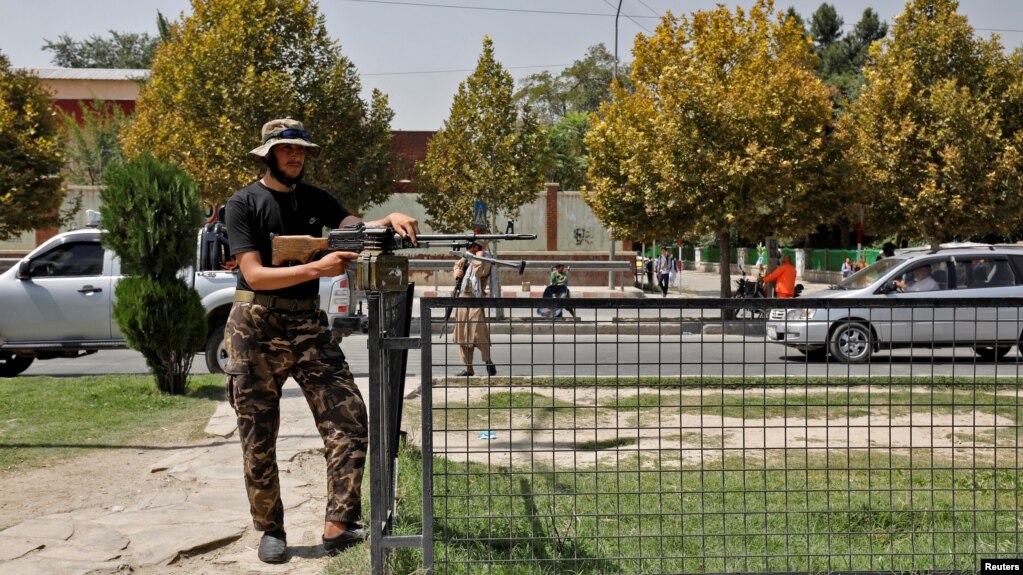
A Taliban fighter stands guard after a blast in front of the Russian Embassy in Kabul in September.
The Key Issue
Taliban-ruled Afghanistan has witnessed a diplomatic exodus in recent weeks.
Saudi Arabia closed its embassy in Kabul and evacuated its staff on February 2. The Taliban claimed the departure was temporary. But sources told Reuters that the Saudi mission had relocated to neighboring Pakistan due to security reasons.
Reports have also surfaced about the United Arab Emirates (U.A.E.) closing its mission in the Afghan capital.
Saudi Arabia and the U.A.E., historical allies of the Taliban, were among only a handful of countries that kept their embassies open after the Taliban seized power in August 2021. The others included Iran, China, Russia, India, and Turkey.
The recent departure of foreign diplomats and embassy staff from Afghanistan appears to be in response to heightened fears over possible attacks by Islamic State-Khorasan (IS-K), a rival of the Taliban. The extremist group has targeted the Russian and Pakistani embassies in Kabul in recent months and threatened other missions.
Why It’s Important: The exodus is likely to further isolate the Taliban’s unrecognized government, which has been hit by international sanctions.
By attacking or threatening foreign missions in Afghanistan, IS-K militants appear to be trying to undermine the Taliban’s ties with its key foreign backers and scuttle efforts by the Kabul authorities to attract international trade and investment.
Following IS-K’s attack on a Chinese-owned hotel in Kabul in December, Beijing advised its citizens to leave Afghanistan as soon as possible.
What’s Next: More countries could close their embassies or cut their staff in Afghanistan due to security threats. That also applies to the United Nations and foreign NGOs who have staff in the country.
More departures would be a blow not only to the Taliban’s attempts to gain international recognition, but international efforts to ease the devastating humanitarian crisis that has gripped Afghanistan.
The Week’s Best Stories
Afghan university professor Ismail Mashal made headlines in December when he ripped up his degrees on live TV to protest the Taliban’s ban on female education. He followed that up by walking around Kabul and donating books to girls and women. On February 2, Mashal’s challenge to the Taliban authorities landed him in prison after he was arrested.
Mahbouba Seraj, an Afghan women’s rights activist, has been shortlisted for the Nobel Peace Prize. Even as many activists fled Afghanistan after the Taliban takeover, Siraj remained in Kabul to operate a network of women’s shelters. Seraj told Radio Azadi that winning the prize would be a “great honor for me and for Afghanistan.”
What To Keep An Eye On
The Taliban said on February 8 that at least 100 Afghan nationals had been killed or injured in the recent earthquakes in Turkey and Syria.
Members of the Afghan community in Turkey have said the death toll is likely much higher. More than 70,000 Afghans are estimated to live in areas in southern Turkey affected by the earthquakes.
In total, more than 22,000 people have died in the February 6 earthquakes.
Why It’s Important: Turkey is home to about 3.8 million refugees, including more than 300,000 Afghans. Some of them fled to Turkey following the Taliban takeover.
Ankara has not afforded many Afghans asylum or refugee status. Instead, they have been placed under a “temporary protection regime” that puts them in a position to be resettled to a third country or be deported.
That status could complicate or prevent Afghans affected by the earthquake in Turkey from accessing life-saving humanitarian aid.
If you enjoyed this briefing and don’t want to miss the next edition, subscribe here. It will be sent to your inbox every Friday.
Abubakar Siddique, a journalist for RFE/RL’s Radio Azadi, specializes in the coverage of Afghanistan and Pakistan. He is the author of The Pashtun Question: The Unresolved Key To The Future Of Pakistan And Afghanistan.
The Azadi Briefing: A Diplomatic Exodus From Afghanistan
At this date, the report said that 72,269 applications were awaiting a decision.
The UK House of Commons Defense Committee released a report on Afghanistan’s withdrawal, in which it highlighted the Doha agreement and fall of the former Afghan government; the evacuation and relocation of eligible Afghans; mental health of veterans and learning lessons from Afghanistan.
The report was chaired by the Conservative MP Tobias Ellwood.
The report said that several thousand eligible Afghans– whose safety is by definition at risk in Afghanistan–still remain to be evacuated under the ARAP (Afghan Relocations and Assistance Policy) over a year after the end of “Operation PITTING,” and it asked the government “to set out what action they are taking to ensure safe passage to the United Kingdom for these people.”
The report cited that in addition to the 5,000 ARAP-eligible individuals, including their family members, who were relocated to the UK during “Operation PITTING”, a further 6,600 individuals had been relocated under the scheme as of 3 November 2022.
At this date, the report said that 72,269 applications were awaiting a decision.
According to the report, in the UK MOD’s (Ministry of Defense) judgement, the vast majority of these were likely to be ineligible:
“The MOD judged that the vast majority of these were likely to be ineligible. According to their estimates, approximately 4,600 ARAP-eligible Afghans (including dependents) had not yet been relocated to the UK. Some of these had successfully settled elsewhere and were not expected to take up the offer of relocation.”
The report also expressed concerns over Afghanistan’s situation, saying that the country faces “multiple inter-connected crises, from governance, to the humanitarian situation, to the exclusion of women and girls from society.”
The reported quoted the words of one of a series of ‘one-year-on’ think pieces as:
“The plight of Afghans is worsening. The economic situation is dire, malnutrition rates are increasing, women’s rights are being curtailed, there is continuing migration and internal displacement, and the health care system is crumbling.”
The report cited the UK’s MOD’s evidence about the Doha agreement, saying that it makes clear that the agreement limited options in relation to future presence in Afghanistan.
“The Rt Hon Ben Wallace MP, Secretary of State for Defense, told us that the UK played no part in the Doha Agreement and criticized the agreement for withdrawing coalition ISR (intelligence, surveillance and reconnaissance) and air support and, in doing so, removing from the battlefield,” it said.
1000s of Afghans Who Helped UK Forces Remain Stranded: Report
The United Nations says aid workers are still in a “race against time” to remove rubble and rebuild after the devastating earthquake struck eastern Afghanistan last month, killing at least 2,200 people and cutting off remote areas.
The 6.0-magnitude quake on Aug. 31 was shallow, destroying or causing extensive damage to low-rise buildings in the mountainous region. It hit late at night, and homes — mostly made of mud, wood, or rocks — collapsed instantly, becoming death traps.
Satellite data shows that about 40,500 truckloads of debris still needs to be cleared from affected areas in several provinces, the United Nations Development Program said Wednesday. Entire communities have been upended and families are sleeping in the open, it added.
The quake’s epicenter was in remote and rugged Kunar province, challenging rescue and relief efforts by the Taliban government and humanitarian groups. Authorities deployed helicopters or airdropped army commandos to evacuate survivors. Aid workers walked for hours on foot to reach isolated communities.
“This is a race against time,” said Devanand Ramiah, from the UNDP’s Crisis Bureau. “Debris removal and reconstruction operations must start safely and swiftly.”
People’s main demands were the reconstruction of houses and water supplies, according to a spokesman for a Taliban government committee tasked with helping survivors, Zia ur Rahman Speenghar.
People were getting assistance in cash, food, tents, beds, and other necessities, Speenghar said Thursday. Three new roads were under construction in the Dewagal Valley, and roads would be built to areas where there previously were none.
“Various countries and organizations have offered assistance in the construction of houses but that takes time. After the second round of assistance, work will begin on the third round, which is considering what kind of houses can be built here,” the spokesman said.
Afghanistan is facing a “perfect storm” of crises, including natural disasters like the recent earthquake, said Roza Otunbayeva, who leads the U.N. mission to the country.
 Afghanistan Peace Campaign