The Observer view on Afghanistan: withdrawal should be a cause for lasting shame in Britain and the US

9 April 2023
Governments on both sides of the Atlantic are still failing to take responsibility for abandoning the Afghan people to the Taliban

The fall of Kabul in August 2021 and the accompanying chaotic evacuation of US and UK forces, foreign nationals and limited numbers of Afghan civilians marked the end of a 20-year, western war-fighting and nation-building intervention in Afghanistan begun after the 9/11 attacks.

It also marked the starkest, most humiliating reverse for US and British foreign policy in recent memory. It is extraordinary that, almost two years later, no one in either government has taken responsibility for this fiasco.

A report on the Afghan collapse, published last week by the Biden administration, perpetuates this brazen refusal to accept that ministers, senior officials and intelligence chiefs on both sides of the Atlantic fell down on the job. At least President Joe Biden and the US secretary of state, Antony Blinken, were actually at their desks as the crisis unfolded. Boris Johnson, the then foreign secretary, Dominic Raab, the Afghanistan minister, Tariq Ahmad, and the Foreign Office permanent secretary, Philip Barton, all went on holiday.

The US report reads like a schoolboy’s excuses for failing to do his homework: defensive, self-justificatory, unapologetic and even self-congratulatory. It is crystal clear that what the report calls “the intelligence and military consensus” in early 2021 that the Afghan army and security forces “would be able to effectively fight to defend their country and their capital, Kabul” after an allied withdrawal was hopelessly, foreseeably wrong.

It is also clear that, despite a “deliberate, intensive, rigorous, and inclusive decision-making process”, Biden’s pressing ahead with the withdrawal ordered by Donald Trump was rash and mistaken and led to disaster. US troops paid with their lives in the Hamid Karzai airport suicide bombing at its Abbey gate. Innumerable Afghans died as Taliban insurgents closed in for the kill. They are still dying.

For some, the report looks like a partisan attempt to shift blame on to Trump, when Republicans are investigating Biden’s actions. While politically self-serving, its skewering of Trump is fully justified. The master deal-maker condemned Afghanistan to a Taliban-ruled future through his giveaway 2020 Doha agreement, which excluded the Afghan government and pledged a rapid US military withdrawal and prisoner releases in exchange for risibly vague Taliban promises to talk peace. To some extent, the agreement tied Biden’s hands.

The US report uncomfortably recalls the UK government’s self-exculpatory Afghan post-mortem, published last year, partly in response to excoriating criticism by the Commons foreign affairs committee. It conceded that there were “areas of its crisis response which need improvement”. Tom Tugendhat, former committee chair, was blunter. “It is clear that leadership within the Foreign Office fell desperately short before, during and after the UK’s withdrawal from Afghanistan,” he said. As we have suggested before, it is never too late for Raab to resign.

Retrospective inquiries are important but do little to help the Afghan people, day-to-day victims of a huge humanitarian crisis and a violently oppressive, misogynistic Taliban regime. Yet what is the government doing? It is slashing UK aid to Afghan women and girls while abjectly failing refugees and evacuees. The fall of Kabul represented a great betrayal. The betrayal continues.
The Observer view on Afghanistan: withdrawal should be a cause for lasting shame in Britain and the US
read more

Afghanistan Ranked 4th in World Crime Index for 2023

The World Population Review placed Afghanistan third for highest crimes rates in the world in 2022.

Afghanistan ranked fourth among countries with the highest crimes rates in 2023 according to the World Population Review website.

The report said that crime is present in various forms, including corruption, assassinations/contract killings, drug trafficking, kidnapping, and money laundering.

“Afghanistan supplied 85% of the world’s illicit opium in 2020. The Taliban, which regained control of the country in 2021, has pledged to stamp out the opium industry, but it is such a vital part of the country’s struggling economy that it will be difficult to eliminate,” the report said. “Widespread unemployment adds additional fuel for many of the country’s crimes, such as robbery and assault.”

The World Population Review ranked Venezuela on top, followed Papua New Guinea and South Africa.

“The interim government should try to find more space among the people, so that the people can help them in the prevention of crimes,” said Torek Farhadi, a political analyst.

But the Islamic Emirate denied the report, saying that the rate of crimes has dropped significantly.

“We don’t confirm these findings and investigation. The graph of crimes has dropped in Afghanistan massively,” said Zabiullah Mujahid, Islamic Emirate’s spokesman.

Political and military analysts said that only the implementation of law and discipline can pave the way for the reduction of crime in society.

“Only with the implementation of laws can you ensure discipline in the society and prevent issues such as corruption, crime and terrorism,” said Sarwar Niazai, a military veteran.

“The Islamic Emirate is committed to taking actions to serve the people of Afghanistan and to prevent any type of corruption,” said Hatif Mukhtar, political analyst.

The World Population Review placed Afghanistan third for highest crimes rates in the world in 2022.

Afghanistan Ranked 4th in World Crime Index for 2023
read more

UN Afghan Staff to Stay Home Another 26 Days: Source

However, the Islamic Emirate has not yet commented on this.

The suspension of work of the UN Afghan national staff in Afghanistan has been extended for another 26-days, a source privy to the issue told TOLOnews.

The source said the Afghan employees of the UN will continue their work from home.

The move to suspend work for 48 hours was made in solidarity with the female Afghan UN staff—which has been extended until May 5 of this year.

According to the source, very few of the UN employees in Afghanistan come to work to do the essential duties.

However, the Islamic Emirate has not yet commented on this.

“All of the decisions that the UN has taken over the past two years did not have any result. This issue will also not have any result. The Taliban knows that the work will proceed anyway whether it is through the office or home. So, the UN should press the Taliban somehow and make them lift the decision regarding women in Afghanistan,” said Ay Noorbik, a women’s rights defender.

UN Secretary General Antonio Guterres said on Twitter that female UN staff members are “essential to carry out our work, including the delivery of life-saving aid.”

“The voices of women and girls remain underrepresented in humanitarian decision-making. But when they are included, the outcomes are stronger for all,” he said.

“When the people are losing their jobs either in the private sector or charity committee or government departments, it can have a major impact on the lives of the people,” said Seyar Qureshi, an economist.

“It is necessary for the continuation of this aid that facilities should be provided and there should be no excuse to create obstacles against this aid,” said Azeraksh Hafizi, an economist.

UN Afghan Staff to Stay Home Another 26 Days: Source
read more

UN food agency: $800m urgently needed for Afghanistan

Associated Press
10 April 2023
FILE - The symbol of the United Nations is displayed outside the Secretariat Building, Feb. 28, 2022, at United Nations Headquarters. The U.N. said Wednesday, April 5, 2023, that it cannot accept a Taliban decision to bar Afghan female staffers from working at the agency, calling it an “unparalleled” violation of women's rights. (AP Photo/John Minchillo, File)

ISLAMABAD (AP) — The U.N. food agency said Monday it urgently needs $800 million for the next six months to help Afghanistan, which is at the highest risk of famine in a quarter of a century.

Aid agencies have been providing food, education and health care support to Afghans in the wake of the Taliban takeover of August 2021 and the economic collapse that followed it. But distribution has been severely impacted by a Taliban edict last December banning women from working at national and international nongovernmental groups.

The U.N. was not part of this ban but last week it said the Taliban-led government has stopped Afghan women from working at its agencies in the country. Authorities have yet to comment on the restriction.

The World Food Program said women aid workers play a vital role in delivering the agency’s food and nutrition assistance and that it it will make “every possible effort” to keep this going, while also trying to ensure the active involvement of female staff.

“The WFP urgently needs $800 million for the next six months to continue providing assistance to people in need across Afghanistan,” the organization said. “Catastrophic hunger knocks on Afghanistan’s doors and unless humanitarian support is sustained, hundreds of thousands more Afghans will need assistance to survive.”

The U.N. said Monday that its Afghan operations remain severely under-funded, with $249 million reported to be confirmed for 2023, nearly one-third of the amount received for the same period in 2022.

It said Afghanistan is dealing with its third consecutive year of drought-like conditions, a second year of crippling economic decline, and is still suffering from decades of conflict and natural disasters.

“The total ‘immediate’ funding requirements to address critical gaps for the coming three months is $717.4 million,” according to a statement from the agency’s office for humanitarian affairs. “This is all part of an overall funding gap of $4.38 billion across the humanitarian response for 2023.”

It previously said that Afghanistan is its lowest-funded operation globally, despite being the world’s biggest humanitarian crisis.

The Taliban takeover drove millions of Afghans into poverty and hunger after foreign aid stopped almost overnight. Sanctions on Taliban rulers, a halt on bank transfers and frozen billions in Afghanistan’s currency reserves restricted access to global institutions and the outside money that supported the country’s aid-dependent economy before the withdrawal of U.S. and NATO forces.

The country’s acting foreign minister, Amir Khan Muttaqi, said Afghanistan’s assets have been illegally and unjustly frozen. He called for Afghanistan’s seat at the U.N. to be handed over to the Taliban-led government. It is still held by the government of former President Ashraf Ghani.

In a video statement shared Monday by the Foreign Ministry’s deputy spokesman, Hafiz Zia Ahmad, Muttaqi said U.N. offices and other international institutions are open in Kabul. He did not directly address the ban on female Afghan U.N. staffers in his remarks.

“They are active here, so our relationship is good so far,” said Muttaqi. “We are trying to represent Afghanistan at the United Nations, it is the right of Afghans. But now (Afghanistan’s seat) is in the hands of someone who does not represent Afghanistan, does not represent the people, and there is no other group that represents them.”

UN food agency: $800m urgently needed for Afghanistan
read more

Taliban ban restaurant gardens for families, women in Herat

Associated Press

10 April 2023

KABUL, Afghanistan (AP) — The Taliban have banned families and women from restaurants with gardens or green spaces in Afghanistan’s northwestern Herat province, an official said Monday. The moves followed complaints from religious scholars and members of the public about mixing of genders in such places, he said.

It was the latest in a slew of restrictions imposed by the Taliban since they took power in August 2021. They have shut girls out of classrooms beyond sixth grade and women from universities, most types of employment, including jobs at the United Nations. They are also banned from public spaces such as parks and gyms.

Authorities say the curbs are in place because of gender mixing or because women allegedly are not wearing the hijab, or Islamic headscarf, correctly.

The outdoor dining ban only applies to establishments in Herat, where such premises remain open to men. Baz Mohammad Nazir, a deputy official from the Ministry of Vice and Virtue’s directorate in Herat, denied media reports that all restaurants were off limits to families and women, dismissing them as propaganda.

It applied only to restaurants with green areas, such as a park, where men and women could meet, he said. “After repeated complaints from scholars and ordinary people, we set limits and closed these restaurants.”

Azizurrahman Al Muhajir, who is head of the Vice and Virtue directorate in Herat, said: “It was like a park but they named it a restaurant and men and women were together. Thank God it has been corrected now. Also, our auditors are observing all the parks where men and women go.”

Nazir also denied reports that sales of DVDs of foreign films, TV shows and music are banned in the province, saying that business owners were advised against selling this material because it contradicted Islamic values.

Shopkeepers who did not follow through on the advice eventually saw their shops closed, Nazir added. He also denied local media reports that internet cafes have shut down in Herat, but said that gaming arcades were now off-limits to children because of unsuitable content. Some games insulted the Kaaba, the cube-shaped structure in the Great Mosque at Mecca toward which Muslims turn when praying, and other Islamic symbols.

“Internet cafes, where students learn and use for their studies, are necessary and we have allowed them,” Nazir said.

Taliban ban restaurant gardens for families, women in Herat
read more

State Department review of US withdrawal from Afghanistan includes far more findings than White House document

In this photo from the US Central Command Public Affairs office, US Marines assist with security at an evacuation control checkpoint during an evacuation at Hamid Karzai International Airport in Kabul, Afghanistan, on August 20, 2021.
WashingtonCNN — 

The State Department’s review of the US withdrawal from Afghanistan has far more findings in it than the document about the withdrawal that the White House released Thursday afternoon, according to a source familiar with the report.

While the White House’s document focused on President Joe Biden having been “severely constrained” by the conditions created by former President Donald Trump, the State Department report has more than two dozen recommendations – some specifically related to how the department could have better prepared, including during the Biden administration, the source said.

“The Biden administration inherited a deadline without a clear plan of how to get there, but they then undertook their own review. And in April, Biden decided to go ahead with it and delayed the withdrawal timeline. So they did not exactly take the blueprint they were given in that regard. So some of that is a bit disingenuous to say that their hands were completely tied,” the source said, explaining their view on the need for the Biden administration to take some ownership for the conduct of the withdrawal.

The White House document does note that upon reflecting on the withdrawal, the State Department and the Pentagon “now prioritize earlier evacuations” when faced with a degrading security situation. But the document also defends the time for when the evacuation from Afghanistan occurred, citing interagency meetings and decision-making at the time.

The White House document also says that the US government now errs “on the side of aggressive communication about risks” when there is a destabilizing security environment.

But it is unclear why the White House document assessing the challenges and decisions surrounding the withdrawal did not cite the wide number of recommendations from the State Department report, which was the result of an intensive 90-day review. A spokesperson for the National Security Council, or NSC, said the document was a “separate product” that was “informed” by the various departments’ reviews.

The State Department’s much more detailed after-action report was sent to Capitol Hill on Thursday, but otherwise the department has not widely released any of the findings more than a year after the report’s completion. The report itself was launched by Secretary of State Antony Blinken in December 2021. Employees who worked on the chaotic evacuation have clamored for details as to what the department learned from the after-action report.

An NSC spokesperson said the department’s reviews “were not undertaken for public release but to improve internal processes.”

On Thursday, the department scrambled to put together a town hall for employees to discuss the report with Blinken and Undersecretary for Management John Bass, who was a key official in the Afghanistan withdrawal, according to three employees who attended the event.

Blinken described the report to employees without sharing it. He said that it detailed the processes, systems and mindsets that could have been improved, including the need for more urgent preparations for worst-case scenarios, employees said.Blinken said contingency preparations were inhibited by concerns that they would be too visible and would prompt concerns by Afghan officials, employees told CNN. The top US diplomat also pointed to competing and conflicting views in Washington about how to prioritize categories of evacuees, and he acknowledged that the department’s database technology and communications infrastructure were inadequate.
The employees said that, according to Blinken, the report makes 34 recommendations. They include strengthening the department’s crisis-response capabilities, appointing a single senior official for future complex crises, enhancing crisis communications such as call centers, building a so-called red team to challenge assumptions and running more tabletop exercises, employees said.

But for many employees, the town hall only led to more frustrations about a lack of full transparency. The source familiar with the full report explained that the findings were purposefully not classified so they could be widely shared if the department chose to do so, but so far that has not happened.

At least one employee was emotional during the town hall, criticizing how hastily it was arranged and the decision not to share the full report. Blinken cited concerns about politicizing the report and looking backward instead of forward, employees said.

The State Department did not respond to a request for comment regarding the town hall or any plans to share parts of the department’s report more widely.

This story has been updated with additional information.

State Department review of US withdrawal from Afghanistan includes far more findings than White House document
read more

UN Tells Afghan Staff to Stay Home Until Taliban Clarifies Ban on Female Aid Workers


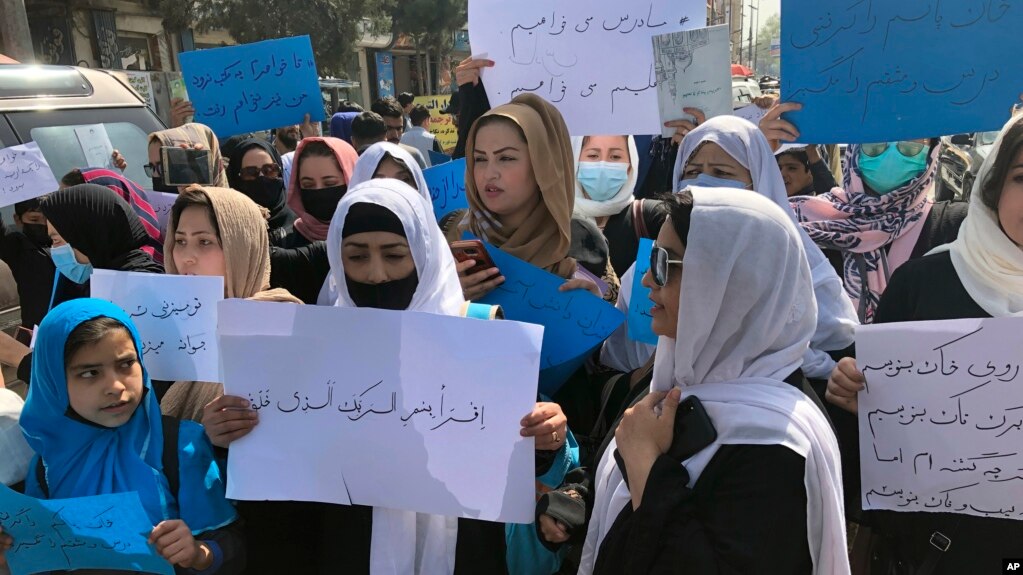
FILE - Afghan women protest during a demonstration in Kabul, Afghanistan, March 26, 2022. The U.N. said April 5, 2023, it cannot accept a Taliban decision to bar Afghan female staffers from working at the agency.
FILE – Afghan women protest during a demonstration in Kabul, Afghanistan, March 26, 2022. The U.N. said April 5, 2023, it cannot accept a Taliban decision to bar Afghan female staffers from working at the agency.

Afghan women and men who work for the U.N. Mission in Afghanistan stayed home Thursday while the United Nations sought clarification on the Taliban’s statement ordering all local female employees to be fired because of their sex.

U.N. spokesperson Stephane Dujarric said in New York that the Security Council was briefed on the issue Thursday and that the organization was continuing to engage with the Taliban.

“Afghan women and men are essential to all aspects of the U.N.’s work in Afghanistan. Afghan women’s meaningful participation is essential to reach safely and effectively populations in need with principled and quality assistance. Afghan women will not be replaced by men,” Dujarric said.

This week’s order by the Taliban to fire all female employees was the first time the world body has received such an order since its inception in 1945. The order followed the Islamist group’s previous edicts terminating women’s right to work, education and many other basic liberties.

“Banning Afghan women from working with the U.N. in Afghanistan is an intolerable violation of the most basic human rights,” Secretary-General Antonio Guterres tweeted on Wednesday.

Some Afghan activists said the Taliban’s latest order marked the time for the international community to take drastic action.

“United Nations! Stand with your female employees and suspend your activities in Afghanistan,” said activists from a group calling itself Afghanistan’s Women Protester Movements Coalition.

In a statement, the group said the U.N. should suspend its operations in Afghanistan until Afghan women were allowed to return to work.

‘Don’t abandon Afghans’

Afghanistan is the largest humanitarian operation in the world for the U.N., requiring a $4.6 billion appeal for funding this year.

UN Launches $4.6B Appeal for Afghanistan, Warns of Drop in Funding

More than half of Afghanistan’s estimated population of 38 million suffers from severe hunger and 6 million of them are facing famine, the U.N. said.

“The world cannot abandon the people of Afghanistan at this precarious moment,” Ramiz Alakbarov, the U.N. humanitarian coordinator for Afghanistan, said in a statement on Wednesday.

Despite Alakbarov’s plea, the U.N. reported this week that it still was far short of funding its Afghan operations.

“Despite Afghanistan being the world’s largest and most severe humanitarian crisis, the 2023 appeal has received less than 5% of its requirement, making it the lowest funded aid operation globally,” the U.N. humanitarian coordination body said on Monday.

The drop in aid was anticipated and linked to the Taliban’s bans on Afghan women.

Speaking at the U.N. Security Council last month, Roza Otunbayeva, the head of the U.N. Assistance Mission in Afghanistan (UNAMA), warned that “funding for Afghanistan is likely to drop if women [are] not allowed to work.”

“The U.N. cannot and must not leave Afghanistan but instead [should] have a harder look as to why their approach and strategy in Afghanistan is failing,” Heela Najibullah, a conflict resolution researcher at the University of Zurich, told VOA.

UNAMA still talking to Taliban

Established in 2002 immediately after the Taliban were ousted from power by a U.S.-led coalition, UNAMA, primarily a political mission with humanitarian and human rights priorities, has an annual budget of about $180 million, 22% of which is funded by the United States.

“Taliban rulers generally view UNAMA’s role less as an impartial political mission and conduit with the world and more as a proxy mission under Washington’s thumb,” Javid Ahmad, senior fellow at the Atlantic Council, told VOA.

Not recognized by any government, the Taliban have also been denied Afghanistan’s permanent representation at the U.N. in New York.

That has left UNAMA as the main international organization still talking to the group.

“UNAMA has been managing a nearly impossible task to be tough on the Taliban … while at the same time engaging in dialogue with the Taliban and avoiding being kicked out of the country,” Scott Worden, director of Afghanistan and Central Asia programs at the U.S. Institute of Peace, told VOA.

Suspending all U.N. activities would seriously exacerbate the already dire humanitarian crisis in Afghanistan, but some still debate the pros and cons of suspending UNAMA’s political mission.

“It may prove to be a forcing mechanism and focus energy toward a faster solution to the fundamental problems of Taliban governance,” Worden said, adding that such a move could shock the conscience of some Taliban members who have quietly opposed the extreme decisions of their supreme leader.

Unseen Taliban Leader Wields Godlike Powers in Afghanistan

But Ahmad of the Atlantic Council said walking away could empower Taliban factions who seek international isolation.

“There are powerful elements among Taliban rulers who desire to establish an ideological hermit kingdom like North Korea in order to insulate themselves from external pressure in the face of internal dissent. UNAMA’s disengagement will only expedite that process, something that could later become dangerously unmanageable,” he said.

VOA U.N. correspondent Margaret Besheer contributed to this report.

UN Tells Afghan Staff to Stay Home Until Taliban Clarifies Ban on Female Aid Workers
read more

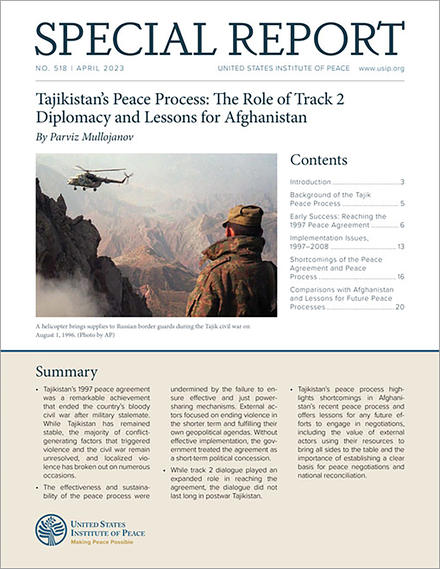
Tajikistan’s Peace Process: The Role of Track 2 Diplomacy and Lessons for Afghanistan

The peace process that ended the Tajik civil war in the late 1990s successfully combined both official and civic channels of communication and negotiation from its start. This report argues that although the agreement and its implementation were far from perfect, the Tajik experience contains valuable lessons on power-sharing arrangements, reconciliation, reintegration, and demobilization for the architects of future peace processes, and provides important insights into the shortcomings of the 2018–21 peace process in neighboring Afghanistan.

Summary

  • Tajikistan’s 1997 peace agreement was a remarkable achievement that ended the country’s bloody civil war after military stalemate. While Tajikistan has remained stable, the majority of conflict-generating factors that triggered violence and the civil war remain unresolved, and localized violence has broken out on numerous occasions.
  • The effectiveness and sustainability of the peace process were undermined by the failure to ensure effective and just power-sharing mechanisms. External actors focused on ending violence in the shorter term and fulfilling their own geopolitical agendas. Without effective implementation, the government treated the agreement as a short-term political concession.
  • While track 2 dialogue played an expanded role in reaching the agreement, the dialogue did not last long in postwar Tajikistan.
  • Tajikistan’s peace process highlights shortcomings in Afghanistan’s recent peace process and offers lessons for any future efforts to engage in negotiations, including the value of external actors using their resources to bring all sides to the table and the importance of establishing a clear basis for peace negotiations and national reconciliation.

About the Report

This report assesses the peace process that ended the Tajik civil war in the late 1990s and highlights aspects of the Tajik experience to aid in understanding the failures of Afghanistan’s 2018–21 peace process. It includes perspectives from interviews with stakeholders in Tajikistan, Afghanistan, and Europe. The report was commissioned by the Afghanistan and Central Asia programs at the United States Institute of Peace.

About the Author

Parviz Mullojanov is a political scientist and historian in Central Asia. He was a member of the Inter-Tajik Dialogue, a track 2 diplomatic initiative that worked to resolve Tajikistan’s civil war. He is also a former chairman of the board of the Open Society Institute Assistance Foundation–Tajikistan and a former member of the EU and Central Asia Monitoring Research Group.

Tajikistan’s Peace Process: The Role of Track 2 Diplomacy and Lessons for Afghanistan report cover
Tajikistan’s Peace Process: The Role of Track 2 Diplomacy and Lessons for Afghanistan
read more

OIC Secretariat Has ‘Grave Concerns’ on Afghan Female UN Workers Ban

The German mission for Afghanistan on Twitter said “we strongly condemn the Taliban’s” ban on women working for UNAMA.

The General Secretariat of the Organization of Islamic Cooperation (OIC) called on the interim Afghan government to revisit its decision regarding barring Afghan female staff of the UN agencies in Afghanistan from working.

He also expressed “grave concerns” over the ban, saying that the new “edict will intensify the successive restrictive measures imposed on women and girls, including banning them from governmental organizations.”

The ban has faced continued reactions by many world countries and international organizations.

The German mission for Afghanistan on Twitter said “we strongly condemn the Taliban’s” ban on women working for UNAMA.

“It puts millions in acute danger and blatantly violates human rights. Women are essential to humanitarian assistance,” the German mission said on Twitter. “We are now coordinating further steps with our international partners.”

The deputy spokesman for the US Department of State, Vedant Patel, said that women are central to humanitarian and civil society operations around the world.”

“In Afghanistan in particular, only women are able to reach some of the most vulnerable, in part because many of the most vulnerable households are woman-headed and male aid workers cannot enter,” he told the reporter in Washington D.C.

This comes as the Stephane Dujarric, spokesman for U.N. Secretary-General, said that Afghan women will not be replaced by men.

“Afghan women and men are essential to all aspects of the UN’s work in Afghanistan. As we’ve said repeatedly, Afghan women’s meaningful participation is essential to reach safely and effectively populations in need with principled and quality assistance,” he said.

Political analysts said the ban will face Afghanistan with various types of challenges.

“As the ban on female’s education and girls led the fate of the Afghan generation to darkness, the ban on women’s work, especially for the women who are the only breadwinners of their families, is causing different challenges,” said Saleem Kakar, a political analyst.

The UN Security Council held an emergency meeting to discuss the Afghan interim government’s new decision about female employees of the UN in Afghanistan.

OIC Secretariat Has ‘Grave Concerns’ on Afghan Female UN Workers Ban
read more

Afghanistan evacuation should’ve happened sooner, White House concedes

The White House said Thursday that it now prioritizes the early evacuation of Americans during security crises overseas, offering a tacit admission of fault two years ago in Afghanistan as the Biden administration provided Congress with long-awaited internal assessments of its chaotic response to Kabul’s impending collapse.

The material sent to Capitol Hill, which is classified and has not been made public, includes reviews conducted by several government agencies directly involved in the operation and the fateful decision-making that preceded it. A separate summary of events released by the National Security Council does not expressly accept blame for the administration’s miscalculations; it does, however, acknowledge how the hard-learned lessons of Afghanistan inspired officials to act with much greater urgency during subsequent emergencies.

The documents’ disclosure is certain to invite a fresh round of political feuding as House Republicans press ahead with oversight hearings scrutinizing the closing days of America’s longest war. The White House had faced intensifying pressure to turn over the agency assessments, which were mostly completed last year, and their transmission Thursday — as Washington prepared to pause for a long holiday weekend — appeared designed to minimize attention.

In a statement, Rep. Michael T. McCaul (R-Tex.), chairman of the House Foreign Affairs Committee, suggested that the materials transmitted to Congress were incomplete, and he implored the administration to declassify “as much as possible” as lawmakers investigate “why the withdrawal was such a disaster.”

GOP leaders have portrayed the U.S. departure from Afghanistan as a deadly fiasco for which President Biden and his top advisers have ducked accountability. An estimated 170 Afghans were killed alongside 13 American troops in a suicide attack outside Kabul’s airport. Days later, Air Force drone operators killed 10 civilians, including seven children, believing incorrectly that they were targeting another would-be bomber.

The White House has maintained that Biden had few options after his predecessor, President Donald Trump, signed a deal with the Taliban in 2020 that required U.S. forces to leave the country. With its summary, the White House again sought to fault Trump for the chaos, even as it acknowledged that the Biden administration has handled later crises — in Ukraine and Ethiopia — far differently after what transpired in Kabul.

“We now prioritize earlier evacuations when faced with a degrading security situation,” the summary said, noting that the administration withdrew some personnel from the U.S. Embassy in Ethiopia in November 2021 “despite the vigorous objections of the Ethiopian government,” and last year evacuated personnel from the U.S. Embassy in Kyiv nearly two weeks before Russia’s invasion of Ukraine.

But the White House summary glosses over other key details about the evacuation from Afghanistan that cast the Biden administration in a negative light, including that Biden had ordered the withdrawal of all U.S. troops despite recommendations from defense officials who wanted the commander in chief to keep a force of about 2,500 in Afghanistan to help prevent the U.S.-backed government from collapsing.

The document makes no mention either that senior U.S. military officials who participated in the evacuation expressed frustration with the administration when interviewed as part of an earlier Defense Department investigation. In documents first reported on by The Washington Post last year, the senior commander during the mission, Rear Adm. Peter Vasely, told military investigators that the United States would have been “much better prepared to conduct a more orderly” evacuation “if policymakers had paid attention to the indicators of what was happening on the ground.”

A senior administration official, speaking on the condition of anonymity because the matter remains so politically volatile, said that, for days before Taliban fighters swept into the capital on gun trucks, senior Pentagon officials recommended against launching the evacuation. The operation began Aug. 14, after Biden’s senior national security advisers changed their recommendation, the official said. The Taliban seized control of Kabul the following day, after Afghan President Ashraf Ghani fled the country.

Biden, who pledged to end the war while campaigning for president, later altered the deadline to say that U.S. forces would be out by Sept. 11, 2021, the 20th anniversary of terrorist attacks on the United States that precipitated the invasion.

The evacuation pulled from harm’s way more than 120,000 people — Americans and Afghans who aided the war effort — in less than three weeks, but it was an operation that appeared on the brink of spiraling out of control for days before catastrophe struck.

With few good options to ensure security outside the airport where thousands had massed, desperate to catch a departing flight, U.S. military officials reached an uneasy agreement with the Taliban. Militant fighters were posted outside to maintain order while coalition troops processed those seeking entry. Service members involved in the mission have since said that they witnessed Taliban foot soldiers routinely beating civilians attempting to reach the airport and executing some of them.

John Kirby, a spokesman for the National Security Council, told reporters at the White House that it is “undeniable” that Trump officials’ decisions and lack of planning “significantly limited” the options that were available to Biden.

When Biden took office, Kirby said, he inherited a force of about 2,500 troops in Afghanistan, the fewest that had been there since 2001. The Special Immigrant Visa program run by the State Department to consider which Afghans deserved refuge in the United States for assisting the U.S. war effort also had been “starved for resources,” Kirby said, creating an uphill climb for the administration to move quickly to assist Afghan allies in harm’s way.

“Do not underestimate the effect that Doha agreement had on the morale and the willingness to fight of the Afghan defense forces,” Kirby said.

Despite civilian deaths and U.S. troops describing problems with food shortages, sanitation and people sneaking into the airport without screening, Kirby sought to make the case Thursday that the evacuation went well. “I’m sorry, I just don’t buy the whole argument of chaos,” Kirby said. “It was tough in the first few hours. You would expect it to be; there was nobody at the airport and certainly no Americans. It took time to get in there.”

Sen. Roger Wicker (R.-Miss.), the top Republican on the Senate Armed Services Committee, also condemned the White House’s framing of the Afghanistan withdrawal. “Instead of addressing honestly and openly the substantial flaws in its decision-making process, the Biden administration has provided the public a full-throated and deeply partisan explanation of its indefensible Afghanistan policy,” he said.

Asked whether anyone in the U.S. intelligence community would be held responsible for failures in Afghanistan, Kirby said: “It’s really hard. I’ve yet to see an intelligence assessment that ever was 110 percent certain about something. They get paid to do the best they can.” He acknowledged, however, that “clearly, we didn’t get things right,” including “how fast the Taliban were moving across the country” during the first two weeks of August 2021, secret capitulation deals that had been made with Afghan security force commanders, and “how fast they were going to fold.”

The inspector general also determined that the “stage had been set” for collapse long before, by multiple U.S. administrations and the Afghan government, which failed to build units that were self-sustainable.

Meryl Kornfield contributed to this report.

Afghanistan evacuation should’ve happened sooner, White House concedes
read more