
The Taliban’s Successful Opium Ban is Bad for Afghans and the World

The Taliban have done it again: implementing a nearly complete ban against cultivation of opium poppy — Afghanistan’s most important agricultural product — repeating their similarly successful 2000-2001 prohibition on the crop. But the temptation to view the current ban in an overly positive light — as an important global counter-narcotics victory — must be avoided. This is particularly true given the state of Afghanistan’s economy and the country’s humanitarian situation. Indeed, the ban imposes huge economic and humanitarian costs on Afghans and it is likely to further stimulate an outflow of refugees. It may even result in internal challenges for the Taliban itself. And, in the long run, it will not have lasting counter-narcotics benefits within Afghanistan or globally.
Phasing out Afghanistan’s problematic drug economy will be essential over the longer term — not least to contain widespread addiction within the country. But this ban, lacking any development strategy and especially at a time when the economy is so weak that displaced opium poppy farmers and workers have no viable alternative sources of income, is not the right way to start on that path.

The Taliban’s Highly Successful Opium Ban

Satellite imagery analyzed by Alcis and associated research by David Mansfield, an independent researcher who has conducted extensive fieldwork and analysis on Afghanistan’s opium sector and rural economy for more than a quarter-century, show that the Taliban opium ban, announced in April 2022, has been remarkably successful in sharply reducing opium poppy cultivation. In Helmand, by far Afghanistan’s largest opium-producing province, the area of poppy cultivation was cut from over 129,000 hectares (ha) in 2022 to only 740 ha as of April 2023. The reduction in Nangarhar, another long-standing opium producing province, is also impressive — only 865 ha this year compared to over 7,000 ha in 2022.

This is the pattern more broadly in south and southwest Afghanistan. Reductions in other provinces such as Badakhshan will be more limited, but these areas produced much less opium in the first place. Though the full picture is not yet clear, Afghanistan may approach the 90 percent reduction in cultivation achieved during the Taliban’s previous opium ban in 2000-2001. This is an undeniable achievement, particularly given the much larger size of the opium economy this time around (an estimated 233,000 ha in 2022 versus some 82,000 ha in 2000).

How was the ban implemented so successfully? As Mansfield argues, the Taliban took a relatively sophisticated, staged approach that evolved and intensified over time. The announcement of the ban was not accompanied by eradication of 2022’s bumper crop of poppy fields that were about to be harvested, which would have met fierce resistance. This gave rise to uninformed speculation that the ban was not serious. The Taliban did engage in eradication of the much smaller spring and summer crops subsequently planted in 2022, intended to deter others.

There were also major efforts during 2022 to crack down on ephedra, the main ingredient for Afghanistan’s thriving methamphetamine industry. These actions sent strong signals to the rural population in advance of the fall 2022 planting season, which, along with outreach and threats, effectively deterred planting of opium poppy in the south and southwest of the country. As a result, the bulk of the reduction in poppy cultivation reflected people not planting in the first place, and this was complemented by eradication of some remaining poppy fields soon after planting.

Unlike the Taliban’s previous opium ban, the current ban encompasses trade and processing of opiates, not just poppy cultivation. But just as the standing 2022 winter crop was exempted from eradication, it appears that trade in opium produced in 2022 and earlier has been allowed to continue. With the sharp decline in opium poppy cultivation for this year’s harvest, the bulk of ongoing trade must be in the ample supplies of “older” opium (UNODC estimated that Afghan opium production was 6,800 metric tons in 2021 and 6,200 metric tons in 2022). It remains to be seen whether this is a temporary dispensation or will be more permanent. In 2000-2001, trade in opiates was never hindered.

Immediate Economic Damage

The economic shock from the opium ban is enormous: Not including adverse effects on downstream processing, trade, transport and exports, Afghanistan’s farm-level rural economy has lost more than $1 billion per year worth of economic activity as calculated by Mansfield, including as much as hundreds of millions of dollars that had accrued to poorer wage laborers and sharecroppers. These people and their families, already at the margin of subsistence and lacking other job opportunities in Afghanistan’s very weak economy, will be at even greater risk of hunger, malnutrition and associated health problems.

This economic shock comes on top of a significant reduction of humanitarian aid in store for this year — likely at least a $1 billion reduction compared to the $3 billion of humanitarian aid delivered in 2022. Thus Afghanistan’s mostly poor, deprived population will be doubly squeezed.

Moreover, replacing poppy with wheat (as has been happening during the current opium ban) is economically unviable for Afghanistan’s rural sector as a whole and especially for households owning limited or no land. Most Afghans don’t achieve food security by growing their own food. Rather, people make ends meet by growing cash crops or producing other agricultural products (e.g., livestock and dairy), which can be sold to provide resources to purchase food needs, or by working other jobs. Wheat is a low-value crop and a poor substitute for opium, though it does serve as a temporary recourse for people who may expect to return to opium poppy later, in particular for landowners whose fields are ample enough to serve their own family’s food needs. Fruits and other tree crops would be more viable substitutes for opium poppy over the long run but require significant time and investments.

Another, related outcome is that more people will try to leave Afghanistan, going to nearby countries and then onward to Turkey and Europe. As Mansfield documents, the cost of people smuggling is low compared to the potential rewards of being employed in and sending remittances from Europe. Moreover, other alternatives for the poor that were available before August 2021 (like finding work in cities, other rural on-farm and non-farm activities, or the Afghan National Army) are now limited to nonexistent.

Delayed and Longer-term Impacts

Additional damage from the opium ban will materialize with a delay, over the coming months and years.

An important buffer for better-off rural households is the inventories of opium they have built up from the 2022 bumper crop. Landowning households able to hold on to their opium inventories have benefited from capital gains as the price rose, and can sell off some of them to offset the loss of this year’s crop, while growing wheat and other crops to feed their families. (It should be noted that the Taliban as a movement and now as a governing regime do not hold sizable inventories of opium.)

This buffer will erode over time. Suffering will increase among middling farm households as they exhaust what inventories they have of opium and are forced into more harmful coping mechanisms, as poorer households have already done in response to broader economic privation: selling livestock and other remaining assets, eschewing medical care and medicines, eating less and lower-quality food, sending family members out of the country, or even marrying off daughters prematurely.

The impact of the opium ban on drug supplies and prices in other countries, and ultimately in Europe, will not be immediate. After the 2000 Taliban ban, it took about 18 months to two years for the impacts to play out in Europe, as Mansfield notes, in the form of effective price increases through adulteration of the purity of heroin on markets, which exacerbated risks to problem drug users from overdoses. Such impacts probably would become significant this time around if the opium ban is effectively implemented for a second year.

What Happens Next?

The big question now is whether or not the poppy ban will be maintained for a second year.

Historically, there have been examples of successful opium bans in Afghanistan, both nationally (2000-2001) and regionally (Nangarhar province for a number of years, significant reductions in Helmand on two occasions). But maintaining these bans has invariably proved difficult. It is unclear what the Taliban would have done during the late 2001 planting season, after the 2000 ban weakened them politically in key rural areas and arguably contributed at least in part to their surprisingly rapid defeat by international forces after 9/11. There were already signs of increasing resistance against the ban, which suggest that it could not have been fully maintained even if the Taliban had remained in power. And the provincial-level bans during the Islamic Republic period became increasingly hard to sustain over time as privation and resistance against them grew.

So, implementation of the ban for a second year can be expected to face increasing resistance. As more influential middle-sized and larger landowners in the south and southwest deplete their opium inventories they are unlikely to be as accepting as they were in the first year and could even lobby against continuation of the ban. As a core Taliban constituency, their voices will be heard, though to what effect remains to be seen. And in the east and northeast, where landholdings are small and resistance already significant, it may well snowball if the ban is enforced for a second year.

The political blowback within the Taliban from the ban, limited and manageable so far, thus may intensify if the ban continues to be seriously implemented into 2024. In addition to influential landowners, Taliban figures associated with the drug industry may increasingly weigh in or actively try to subvert the ban, at least locally.

However, the serious, sustained effort that went into implementing the opium ban in its first year, and the political and personal capital Emir Haibatullah Akhundzada has invested in this effort, suggest that it will continue and there won’t be an outright reversal. And the economic shock and human suffering will continue and worsen as long is the ban is implemented.

International Response?

There will probably be a counter narcotics-driven, knee-jerk response that the effectively implemented Taliban opium ban is a good thing. However, history amply demonstrates that banning opium in Afghanistan by itself is not sustainable, nor does it address the drug problem in Europe and elsewhere. And it won’t stop rampant drug use within Afghanistan. Supply-side measures will not work if not backed up with sensible development interventions to help make them sustainable. This is especially true given the weak Afghan economy and lack of ample non-drug income earning opportunities. And simply put, these measures will not reduce drug consumption unless accompanied by effective demand reduction measures.

The Taliban opium ban may provide a well-grounded justification for more humanitarian assistance. As with that aid as a whole, however, this would just be a band-aid to provide temporary relief unless and until the opium ban is rescinded or undercut. Moreover, any bump to humanitarian aid that may materialize will at best maintain it closer to the existing level, not result in an increase from last year.

Some forms of basic needs rural development aid could be helpful — agricultural support, small-scale rural infrastructure, income generation, small water projects, investments in agro-processing and marketing, and the like. It would make sense to orient any basic needs assistance that becomes available for Afghanistan in these directions, while recognizing that the modest amounts of money involved will at best have a marginal impact. Custom-made, standalone “alternative livelihoods” projects should be avoided, especially if designed, overseen or implemented by counter-narcotics agencies, which lack development expertise. It is broader rural development that will over time make a difference, as part of a healthy, growing economy that generates licit jobs and livelihoods opportunities.

And finally, the international response must acknowledge not only the overall damage that the opium ban is causing for the Afghan economy, but also the likely upsurge in outmigration that will result. Trying to block people flows at the Afghan border will work only imperfectly, and to the extent it is successful will worsen privation and hunger within the country.

Overall, while understanding the extraordinary success of the Taliban’s opium ban and what it tells us about the Taliban’s strength and effectiveness as a governing regime, the international response must be clear-eyed about the very real costs the ban imposes both on Afghanistan and the world, on top of the other very serious economic and social problems the country faces.
The Taliban’s Successful Opium Ban is Bad for Afghans and the World
read more

The Growing Threat of the Islamic State in Afghanistan and South Asia

BY: Abdul Sayed;  Tore Refslund Hamming

United States Institute of Peace

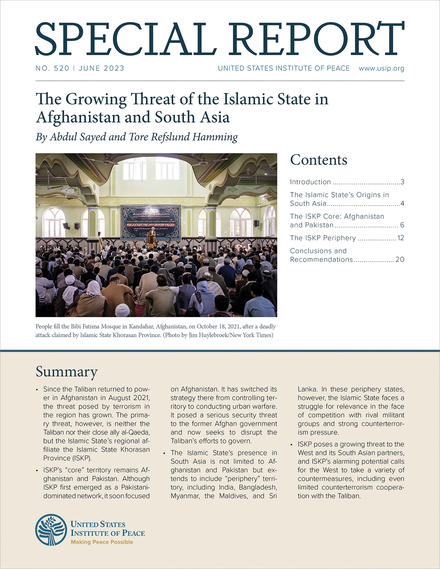
When the Taliban took control of Afghanistan in 2021, counterterrorism experts were alarmed at the possible resurgence of Islamist terrorist groups within the country. This Special Report lays out why those concerns, particularly about the regional Islamic State affiliate known as Islamic State Khorasan Province (ISKP), were well-founded. The report discusses the likely trajectory of ISKP’s activities in South Asia and recommends measures to minimize potential threats to the West and build regional resilience to extremism.

Summary

  • Since the Taliban returned to power in Afghanistan in August 2021, the threat posed by terrorism in the region has grown. The primary threat, however, is neither the Taliban nor their close ally al-Qaeda, but the Islamic State’s regional affiliate the Islamic State Khorasan Province (ISKP).
  • ISKP’s “core” territory remains Afghanistan and Pakistan. Although ISKP first emerged as a Pakistani-dominated network, it soon focused on Afghanistan. It has switched its strategy there from controlling territory to conducting urban warfare. It posed a serious security threat to the former Afghan government and now seeks to disrupt the Taliban’s efforts to govern.
  • The Islamic State’s presence in South Asia is not limited to Afghanistan and Pakistan but extends to include “periphery” territory, including India, Bangladesh, Myanmar, the Maldives, and Sri Lanka. In these periphery states, however, the Islamic State faces a struggle for relevance in the face of competition with rival militant groups and strong counterterrorism pressure.
  • ISKP poses a growing threat to the West and its South Asian partners, and ISKP’s alarming potential calls for the West to take a variety of countermeasures, including even limited counterterrorism cooperation with the Taliban.

About the Report

This report analyzes the origin, status, and future of the Islamic State in South Asia and the threat it may pose to the West. Drawing on primary sources issued by ISKP and associated networks and individuals, the report explores the situation and prospects of the Islamic State not only in its regional “core” territory of Afghanistan and Pakistan, but also in its “periphery” territory, including India, Bangladesh, Myanmar, Sri Lanka, and the Maldives. The work was supported by the Asia Center at the United States Institute of Peace.

About the Author

Abdul Sayed is an independent researcher on jihadism and the politics and security of the Afghanistan-Pakistan region. Tore Refslund Hamming is senior research fellow at the International Centre for the Study of Radicali-sation at King’s College London and director of the research consultancy Refslund Analytics.

The Growing Threat of the Islamic State in Afghanistan and South Asia report cover
The Growing Threat of the Islamic State in Afghanistan and South Asia
read more

West Meets with Head of Afghan Business Council in UAE

Sader Khail said that the two sides agreed they should work together to solve the problems Afghans are facing.

Haji Obaidullah Sader Khail, head of the Afghan business council in the UAE, said that he met with the US special representative for Afghanistan, Thomas West and “spoke about the Afghan business community and Afghan people’s problems.”

Sader Khail said that the two sides agreed they should work together to solve the problems Afghans are facing.

“We talked about these issues and assured him that we will work on it to find a solution for them so that the problems ahead of the Afghan traders can be solved and continue their business,” he said.

Meanwhile, the Islamic Emirate’s spokesman Zabiullah Mujahid said that US officials should not neglect the realities in Afghanistan at their meetings.

“The visits that Thomas West began were different from his other visits. I meant it should be beneficial and bring a proper and clear result for Afghanistan and also for the US,” Mujahid said.

This comes as the acting head of the Afghanistan Chamber of Commerce and Investment (ACCI) said that the challenges ahead of the traders inside Afghanistan should also be addressed.

“The international community should help in construction, industry and economic fields of Afghanistan,” said Mohammad Younsu Momand, acting head of the ACCI.

Earlier, US special envoy for Afghanistan Thomas West said on Twitter that he met in Dubai with Presidential Advisor Anwar Gargash to discuss shared interests in Afghanistan.

“Appreciate the principled leadership UAE has shown in prioritizing the rights of Afghan women and girls in its engagement. Look forward to continued UAE-US collaboration in support of Afghan people,” he said.

West Meets with Head of Afghan Business Council in UAE
read more

US announces re-parole process for Afghan nationals in the country

WASHINGTON, June 8 (Reuters) – The U.S. Department of Homeland Security (DHS) announced a new process on Thursday that will enable Afghan nationals to renew their parole and continue to live and work in the United States.

“The new process is streamlined and will be at no cost, and will provide for a two-year renewal of parole for qualifying individuals,” the DHS said in a statement.

Afghan nationals are encouraged to pursue a permanent status in the United States for which they may be eligible, the DHS added.

“The renewal requests will be considered on a case-by-case basis for urgent humanitarian reasons and for a significant public benefit,” the DHS said.

Reporting by Kanishka Singh in Washington; Editing by Leslie Adler
US announces re-parole process for Afghan nationals in the country
read more

Halt to Education-Focused Intl Organizations Would Be ‘Step Back’: UN

Tolo News

8 June 2023

The UN secretary-general’s spokesman Stéphane Dujarric said the reported decision of the interim Afghan government to halt operations of organizations aiding Afghan education would be “horrendous”.

Asked about UNICEF’s concerns regarding the possible halt to operations of international organizations aiding the Afghan educational sector, the UN secretary-general’s spokesman, Stéphane Dujarric, said: “If this would come to pass this would be another horrendous step backwards for the people of Afghanistan.”

“We’ve not gotten anything official, anything in writing,” he said, adding “every person has a right to an education.”

“The closing of the girls’ schools and closing of the private organizations in the field of education, these are the issues that have slowed down the educational growth in Afghanistan,” said Suraya Paikan, a women’s rights activist.

The Islamic Emirate’s spokesman, Zabiullah Mujahid, neither denied nor confirmed the issue but said that the people of Afghanistan need assistance in various areas including education.

“The people of Afghanistan need to be supported in various areas, particularly in education, but the independence of the people of Afghanistan should be considered. The Islamic values and national interest should be considered. The assistance should be coordinated with the government,” Mujahid said.

Political analysts said that the ban on the activities of the international organizations in the educational sector will harm the future of Afghanistan.

“This will have a negative impact on the education of children and the quality of education in Afghanistan,” said Aziz Maarij, political analyst.

Earlier, UNICEF said in a statement that “as the lead agency for the education cluster in Afghanistan, UNICEF is deeply concerned by reports that over 500,000 children, including over 300,000 girls, could lose out on quality learning through Community Based Education within a month if international non-governmental organizations working in the field of education are no longer allowed to operate and if handovers to national NGOs are done without comprehensive assessment and capacity building.”

Halt to Education-Focused Intl Organizations Would Be ‘Step Back’: UN
read more

At least 11 killed in Afghanistan mosque explosion

Al Jazeera

An explosion near a mosque in northern Afghanistan killed at least 11 people at a memorial service for the Taliban’s provincial deputy governor, who died in an attack earlier this week, officials said.

A former Taliban police official was among those killed and more than 30 others were wounded in the explosion near Nabawi Mosque on Thursday, according to Abdul Nafi Takor, the Taliban-appointed spokesman for the interior ministry.

Takor said there were concerns that the number of casualties could rise further.

The explosion happened during the memorial service for Nisar Ahmad Ahmadi, the deputy governor of Badakhshan who was killed in a car bombing on Tuesday. That attack in Faizabad, the capital of Badakhshan, also killed the deputy governor’s driver and wounded 10 other people.

Moazuddin Ahmadi, the Taliban official in charge of information and culture, said Safiullah Samim, a former Taliban police chief in Baghlan, was killed in Thursday’s blast.

Former Afghan President Hamid Karzai condemned the attack, saying in a tweet that the bombing of mosques is an act of “terrorism” and goes “against human and Islamic standards”.

There was no immediate claim of responsibility for the attack. The ISIL (ISIS) armed group claimed responsibility for the car bombing on Tuesday.

The Taliban administration has been carrying out raids against members of ISIL, which has claimed several major attacks in urban centres.

Hundreds attend funeral

Several senior Taliban officials attended Ahmadi’s funeral, which took place on Wednesday, along with hundreds of residents of Faizabad.

The Taliban military chief, Fasihuddin Fitrat, denounced the attacks in Badakhshan and asked people to cooperate with Taliban security forces and report suspicious activities in their areas.

In December, a car bombing killed Badakhshan’s provincial police chief as he was on his way to work.

The ISIL regional affiliate – known as the Islamic State in Khorasan Province – said at the time that it had carried out that attack. The group said it had parked an explosive-laden car on the road and detonated it when the police chief was close by.

SOURCE: NEWS AGENCIES
At least 11 killed in Afghanistan mosque explosion
read more

Afghan women in mental health crisis over bleak future

By Yogita Limaye

“I just want someone to hear my voice. I’m in pain, and I’m not the only one,” an Afghan university student tells us, blinking back tears.

“Most of the girls in my class have had suicidal thoughts. We are all suffering from depression and anxiety. We have no hope.”

The young woman, in her early twenties, tried to end her own life four months ago, after female students were barred from attending university by the Taliban government in December last year. She is now being treated by a psychologist.

Her words offer an insight into a less visible yet urgent health crisis facing Afghanistan.

“We have a pandemic of suicidal thoughts in Afghanistan. The situation is the worst ever, and the world rarely thinks or talks about it,” says psychologist Dr Amal.

“When you read the news, you read about the hunger crisis, but no-one talks about mental health. It’s like people are being slowly poisoned. Day by day, they’re losing hope.”

Note: The BBC has changed or withheld the names of all interviewees in this piece, to protect them.

Dr Amal tells us she received 170 calls for help within two days of the announcement that women would be banned from universities. Now she gets roughly seven to 10 new calls for help every day. Most of her patients are girls and young women.

In Afghanistan’s deeply patriarchal society, one worn out by four decades of war, the UN estimates that one in two people – most of them women – suffered from psychological distress even before the Taliban takeover in 2021. But experts have told the BBC that things are now worse than ever before because of the Taliban government’s clampdown on women’s freedoms, and the economic crisis in the country.

It’s extremely hard to get people to talk about suicide, but six families have agreed to tell us their stories.

Nadir is one of them. He tells us his daughter took her own life on the first day of the new school term in March this year.

“Until that day, she had believed that schools would eventually reopen for girls. She had been sure of it. But when that didn’t happen, she couldn’t cope and took her own life,” he says. “She loved school. She was smart, thoughtful and wanted to study and serve our country. When they closed schools, she became extremely distressed and would cry a lot.”

It is evident that Nadir is in pain as he speaks.

“Our life has been destroyed. Nothing means anything to me anymore. I’m at the lowest I’ve ever been. My wife is very disturbed. She can’t bear to be in our home where our daughter died.”

We have connected his family and others quoted in this piece to a mental health professional.

The father of a woman in her early twenties told us what he believes was the reason behind his daughter’s suicide.

“She wanted to become a doctor. When schools were closed, she was distressed and upset,” he says.

“But it was after she wasn’t allowed to sit for the university entrance exam, that’s when she lost all hope. It’s an unbearable loss,” he adds, then pauses abruptly and begins to cry.

The other stories we hear are similar – girls and young women unable to cope with their lives, and futures coming to a grinding halt.

We speak to a teacher, Meher, who tells us she has tried to take her own life twice.

“The Taliban closed universities for women, so I lost my job. I used to be the breadwinner of my family. And now I can’t bear the expenses. That really affected me,” she says. “Because I was forced to stay at home, I was being pressured to get married. All the plans I had for my future were shattered. I felt totally disoriented, with no goals or hope, and that’s why I tried to end my life.”

We started looking into this crisis because we saw multiple articles in local news portals reporting suicides from different parts of the country.

“The situation is catastrophic and critical. But we are not allowed to record or access suicide statistics. I can definitely say though that you can barely find someone who is not suffering from a mental illness,” says Dr Shaan, a psychiatrist who works at a public hospital in Afghanistan.

A study done in Herat province by the Afghanistan Centre for Epidemiological Studies, released in March this year, has shown that two-thirds of Afghan adolescents reported symptoms of depression. The UN has raised an alarm over “widespread mental health issues and escalating accounts of suicides”.

The Taliban say they are not recording suicide numbers, and they didn’t respond to questions about a surge in figures. Because of the stigma attached to it, many families do not report a suicide.

In the absence of data, we’ve tried to assess the scale of the crisis through conversations with dozens of people.

“Staying at home without an education or a future, it makes me feels ridiculous. I feel exhausted and indifferent to everything. It’s like nothing matters anymore,” a teenage girl tells us, tears rolling down her face.

She attempted to take her own life. We meet her in the presence of her doctor, and her mother, who doesn’t let her daughter out of her sight.

We ask them why they want to speak to us.

“Nothing worse than this can happen, that’s why I’m speaking out,” the girl says. “And I thought maybe if I speak out, something will change. If the Taliban are going to stay in power, then I think they should be officially recognised. If that happens, I believe they would reopen schools.”

“In Afghanistan, as a man, you are brought up to believe that you should be powerful,” she says. “But right now Afghan men can’t raise their voice. They can’t provide financially for their families. It really affects them.

“And unfortunately, when men have suicidal thoughts, they are more likely to succeed in their attempts than women because of how they plan them.”

In such an environment, we ask, what advice does she give her patients?

“The best way of helping others or yourself is not isolating yourself. You can go and talk to your friends, go and see your neighbours, form a support team for yourself, for instance your mother, father, siblings or friends,” she says.

“I ask them who’s your role model. For instance, if Nelson Mandela is someone you look up to, he spent 26 years in jail, but because of his values, he survived and did something for people. So that’s how I try to give them hope and resilience.”

Additional reporting by Imogen Anderson and Sanjay Ganguly

Afghan women in mental health crisis over bleak future
read more

OCHA: Afghans Needing Humanitarian Aid Rises to 28.8M

A new OCHA report said that the estimated number of people in need of humanitarian assistance in Afghanistan has increased to “28.8 million (up from 28.3 million at the beginning of 2023).”

“Between June to December 2023, humanitarian partners require $2.26 billion to deliver prioritized multi-sectoral assistance to 20 million people,” the report said.

Afghanistan is facing a severe humanitarian crisis and economic hardship as billions of dollars of Afghanistan’s foreign assets remain frozen.

“I come to work on the street, God willing, I earn 50 to 100 Afs or sometimes I even cannot make any money,” said Mohammad Hossien, a resident of Kabul.
“We call on the government to help us,” said Mohammad Musa, a resident of Kabul.

Economists said that there is a need for economic assistance to prevent a humanitarian crisis in the country.

“Within the past two years, most of the aid was for humanitarian purposes and humanitarian crises. Unfortunately, in the meantime, there has been no economic aid that can alleviate the humanitarian crisis and also create job opportunities,” said Seyar Qureshi, an economist.

The Islamic Emirate meanwhile said that the interim government is planning to launch development projects to alleviate poverty and humanitarian crisis in the country.

“The Islamic Emirate’s plan for reduction of poverty, improvement of exports and strengthening of national economic projects as well as strengthening transit locations is steadfast,” said Abdul Latif Nazari, deputy minister of the Economy.

Meanwhile, Reuters reported that the United Nations and humanitarian agencies have revised the budget for Afghanistan’s aid plan for 2023 to $3.2 billion, down from $4.6 billion earlier in the year.

The UN Office for the Coordination of Humanitarian Affairs said in a statement that a “changing operating context” in the wake of Taliban administration restrictions on female aid workers had contributed to the revised plan, according to Reuters.

OCHA: Afghans Needing Humanitarian Aid Rises to 28.8M
read more

The Daily Hustle: Being a widow in Afghanistan

Roxanna Shapour

Afghanistan Analysts Network

The word most often used by Afghans to refer to widows is bisarparast (without someone to take care of you). In Afghanistan’s highly patriarchal society, where men are expected to be the breadwinners and opportunities for women to work are relatively few, being a widow is likely to be socially and economically precarious. They are often stigmatised, passed over for jobs and considered burdens on their families. One of the legacies of almost a half-century of war in Afghanistan it the high number of widows – there are no official statistics, but news reports put their number at two million or more. The position of widows without sons is even more insecure, especially since the Taleban takeover has intensified the requirement for women to have a close male relative to act as a chaperone (mahram) and legal guardian. The subject of our latest Daily Hustle is such a widow, an older woman who never had children and who has learned to live on her wits to survive widowhood, economic upheaval and her marginal status in society. 

A daughter’s legacy 

There is a pear tree outside the room in the house that I share with my three brothers and their families. It grew from a cutting taken by my father from a tree in his father’s garden in our ancestral village, brought with him to Kabul when he and my mother moved here in search of work and a better place to raise a family. This is the house I grew up in and this room is my birthright. The room and the pear tree outside its window – a daughter’s inheritance amounts to half of a son’s share – are the only things I own in this world .

I am the only daughter and the youngest in my family. I’m also a childless widow.

I spent my girlhood at home doing chores and caring for my parents, who, by that time, were ailing and needed me to look after them. So, I never expected to get married. But after my mother died, my father came home one day with a man he said had asked for my hand. I was 25 years old – an old maid by Afghan standards – and lucky to have found a husband. He was a distant relative several years older than me, with a grown son from his first marriage. His first wife had died in childbirth and my husband, unable to care for his son, had left him in the care of his grandmother. That son still lived in our remote village in Afghanistan’s central highlands.

Our wedding night was the first I had spent away from my father’s house. We lived in the piyada khana (outbuilding) at the bottom of the garden of the guesthouse of the small NGO where my husband worked as a driver and odd-job man. He was a gentle, caring man with a great sense of humour. He always treated me with respect. He never beat me and never mistreated me. Eventually, the NGO also hired me as a cleaner and we settled into a routine. Later, his son and wife came to Kabul in search of work and lived with us for a time before they moved into their own place and got going on starting their own family. These were happy years and I thought they would last forever.

The precarious life of a widow

My husband died unexpectedly from a heart attack ten years after I married him. I had to move back to my room in my father’s house. Society cannot abide a woman living alone in a house full of strangers without a mahram. By then, my brothers were married and had children of their own. At first, they weren’t happy giving me back my room, but they came around to the idea when they realised I could contribute to household expenses and ease their financial burdens. With the help of my stepson, I fixed my room, put carpeting down and bought new toshaks (floor cushion or narrow mattresses). Several months later, the manager of the NGO gave me an old TV that was no longer being used in the guesthouse. The arrival of the TV raised my status in the household and my room became the gathering place in the evenings. When we had electricity, we used to watch Turkish soap operas over dinner.

Then, the NGO closed its guesthouse and I was suddenly without a job. I had worked there for 15 years and never considered the possibility that I might lose my livelihood. It was the only job I had ever had and I didn’t know how to find another. My old colleagues used their contacts to find me jobs, but they never lasted. First, there was the woman who didn’t like how I cleaned and thought I was too old and, later, a foreign organisation with a big guesthouse in Wazir Akbar Khan [an affluent neighbourhood in Kabul]. That job paid well, but the NGO eventually downsized and moved its staff into one of the big compounds near the airport. I again lost my job.

After my husband died, I’d been forced to start thinking about my future. My late husband was a good man, but not so good at planning for the future or putting away a nest egg for a rainy day. I used to give him all my salary, so I had no savings. I had been left only with the room I’d inherited from my father. I also knew I couldn’t count on my brothers for financial support. Instead, it was my stepson and his wife who were my safety net.[1] He had a good job and he and his wife are warm and generous people, but their family was growing and I couldn’t contemplate having to impose on their goodwill into my old age. So, every month, I started saving some of my salary. I resisted all efforts to get me to open a bank account. Instead, I bought gold, mostly bangles as well as other gold trinkets – savings that I could see and touch and keep on my person at all times.

Facing an uncertain future 

Finally, after two years of working sporadically and living mostly on the generosity of my stepson, I was introduced to a young couple who’d moved back to Afghanistan from America. The wife was pregnant and they needed someone to clean the house and care for the baby when it was born. I worked for this family for five years. I was there when their daughter took her first steps and spoke her first words and later, also, when they came back from America with their second daughter. I had grown to love this joyful young family and knew they cared for me in return.

But this was not to last. Afghanistan was changing. There were peace talks in Doha and rumours that the Taleban were going to come back to power soon. Finally, [President] Ashraf Ghani ran away and the Taleban came into Kabul the same day. The young couple I worked for started making plans to leave the country. When the Taleban took power, their jobs disappeared and they decided to return to America, where their families lived and where they had a support system. So, on a cold December morning, several months after the Taleban came back to Kabul, they left. There were tears and hugs and promises that they’d soon return.

Their departure took an emotional and financial toll on me. Once again, I was facing an uncertain future. Most people were busy making plans to leave Afghanistan and there were no jobs to be had for a middle-aged widow. My former colleagues, who’d helped me find work in the past, were no longer in Afghanistan. They called to check I was OK and some occasionally sent money. Luckily, I’d grown my savings into a long row of gold bracelets and I had some cash – several months’ salary – that the family had given me before they left. When the banks closed after the Taleban takeover, my gold bracelets kept food on the table for my brothers and my stepson’s family. I sold them one by one and got a good price for them too. The price of gold had gone up and I was able to sell them for much more than I’d paid. But with each bracelet sold, I watched my little nest egg dwindle and still I had no job.

Counting my blessings

I am truly blessed to have people who care about me. Once again, friends and former colleagues clamoured to help. Finally, with the help of a former colleague, I got a job cleaning a small organisation’s office. The work is easy, but the pay is low. I don’t think I can ever make enough money to replenish my savings. Still, I’m not complaining. For now, I earn enough to make ends meet and keep my sisters-in-law from complaining that they might have another mouth to feed.

On my way to work every morning, I walk past a group of burqa-clad women, each indistinguishable from the next, huddled together in front of the neighbourhood bakery. They are widows like me. They sit there all day, waiting for a kind passer-by or the baker to give them some bread. They must be from the neighbourhood. I probably know some of them, but any gesture of recognition would be a terrible breach of their abero (dignity). If I have any extra money, I buy a few pieces of bread for them. As I walk away, I say a prayer for them and thank God for his blessings.

Edited by Roxanna Shapour


References

References
↑1 This is unusual and not something expected of a stepson in Afghan culture. Rather, it should be a widow’s birth family, especially her brothers, who look after her, if needed.


The Daily Hustle: Being a widow in Afghanistan
read more

Nearly 80 primary schoolgirls believed poisoned in Afghanistan

The Guardian

Associated Press

Sunday, 4 June 2023

Nearly 80 girls were poisoned and hospitalised in two separate attacks at their primary schools in northern Afghanistan, a local education official said on Sunday.

He said the person who orchestrated the poisoning had a personal grudge but did not elaborate. The attacks took place in Sar-e-Pul province over Saturday and Sunday.

It is thought to be the first time this kind of assault has happened since the Taliban swept to power in August 2021 and began their crackdown on the rights and freedoms of Afghan women and girls.

Girls are banned from education beyond sixth grade, including university, and women are barred from most jobs and public spaces.

The poisonings happened in Sangcharak district, said Mohammad Rahmani, who heads the provincial education department. He said 60 students were poisoned in Naswan-e-Kabod Aab school and 17 others poisoned in Naswan-e-Faizabad school.

“Both primary schools are near to each other and were targeted one after the other,” he told the Associated Press. “We shifted the students to hospital and now they are all fine.”

The department’s investigation is ongoing and initial inquiries show that someone with a grudge paid a third party to carry out the attacks, Rahmani said.

He gave no information on how the girls were poisoned or the nature of their injuries. Rahmani did not give their ages but said they were in grades one to six.

Neighbouring Iran has been rocked by a wave of poisonings, mostly in girls’ schools, dating back to November last year. Thousands of students said they were sickened by noxious fumes in the incidents. But there has been no word on who might be behind the incidents or what, if any, chemicals were used.

Nearly 80 primary schoolgirls believed poisoned in Afghanistan
read more