ICRC: Unemployment has Damaged Lives of Millions of People in Afghanistan

The ICRC called on the international community and development organizations to resume investing in Afghanistan.

The International Committee of the Red Cross (ICRC) said in a report that the number of unemployed people has significantly increased over the past two years in Afghanistan.

According to the report, “in addition to other humanitarian crises, unemployment has damaged the lives of millions of people in Afghanistan. People living with disabilities are among the most affected.”

The ICRC called on the international community and development organizations to resume investing in Afghanistan.

“The ICRC welcomes any decision that will enable Afghan families to better cope with the dire economic condition and calls on the international community and development organizations to resume investing in Afghanistan, to prevent the situation from worsening further,” the report reads.

“A large part of this aid is necessary to be used for large infrastructural and economic projects in order to make the employment environment favorable for the people and to reduce the economic problems of the people,” said Darya Khan Baheer, an economist.

In the meantime, some residents of Kabul asked the Islamic Emirate and relief organizations to provide work opportunities.

“The Islamic Emirate should increase employment opportunities for poor and destitute people,” said Saifullah, a resident of Kabul.

According to the Ministry of Economy, to reduce poverty in the country, it is necessary to invest in infrastructure projects.

“As much as Afghanistan’s economic infrastructure is strengthened, to that extent we will overcome poverty. Our effort is to direct the international community’s aid to infrastructure and development projects,” said Abdul Latif Nazari, the deputy of the Ministry of Economy.

A International Committee of the Red Cross report stated that nearly twenty million people in Afghanistan, which constitutes 44% of the country’s population, do not have access to sufficient food.

Based on the ICRC report, nearly 20 million Afghans (44 percent of the population) do not have enough to eat, and an estimated 34 million Afghans (79 percent) live in poverty.

ICRC: Unemployment has Damaged Lives of Millions of People in Afghanistan
read more

Yaqoob Mujahid Denies Internal Disputes Within Islamic Emirate

The acting defense minister also mentioned US violations of Afghan airspace, saying that US has always done so.

Acting Minister of Defense Mawlawi Mohammad Yaqoob Mujahid denied claims of disputes within the Islamic Emirate and said that any disputes that harm the system do not exist in the Islamic Emirate government.

In an interview with TOLOnews, Yaqoob Mujahid emphasized that reports made by international organizations concerning violations of human rights in Panjshir are untrue.

“I have worked and served for a very long time, and I myself have a lot of information in this system. There isn’t any division, opposition, confrontation, or anything else that would be detrimental for the system. This is just a process of propaganda against the system,” he added.

Referring to claims of human rights violations he said: “Where is it in Panjshir? When and how did it happen? In what form and to whom did it happen? It is only based on false reports, slander and propaganda they create and then spread. We request that what is being broadcast, as reliable institutions, should be impartial.”

The acting defense minister also mentioned US violations of Afghan airspace, saying that US has always done so.

According to Mawlawi Mohammad Yaqoob Mujahid, violating Afghanistan’s airspace is a violation of the Doha Agreement, and Washington has repeatedly violated this agreement.

“Airspace has been violated. It is still occupied by the Americans. I have explained this in the past as well,” Yaqoob Mujahid said.

In response to a question asking where Afghanistan would be in five years, the Acting Minister of Defense said he hoped for the development in the nation and the removal of challenges to education.

Yaqoob Mujahid Denies Internal Disputes Within Islamic Emirate
read more

Calls in Oslo for Islamic Emirate to Fulfill Commitments

The meeting was also attended by envoys from the US, UK, Qatar, Italy, India and Pakistan.

Participants at the meeting in Oslo, Norway on the Afghan situation stressed the need for the formation of an inclusive government in Afghanistan and discussed the Islamic Emirate’s commitments to the international community as well as the education of girls, a source told TOLOnews.

The second day of the meeting was held on Wednesday, and members of the Islamic Emirate were in attendance.

The UN Secretary General special envoy for Afghanistan, Roza Otunbayeva, attended the meeting, the source said.

According to the source, participants at the meeting also emphasized the need to start an intra-Afghan dialogue, as called for in the Doha agreement.

“There should be good efforts for the political situation and political engagement between the Islamic Emirate and international community. When political engagement is not taking place between the Islamic Emirate and the international community, we can never attract the humanitarian aid of the international community to our country,” said Ahmad Andar, political analyst.

The deputy spokesman for the Ministry of Foreign Affairs, Zia Ahmad Takal, told TOLOnews that Abdul Qahar Balkhi from the Foreign Ministry, Shamsuddin Mansour from the Interior Ministry and Rohullah Omar from the Defense Ministry participated in the meeting.

Also, Jafar Mahdawi from Hezb-e-Sar Jangal, Amin Karim from Hezb-e-Islami, and Kawun Kakar and Qahramana Kakar represented the civil society in this meeting.

“The international conference on Afghanistan will have legitimacy when the role of women is significant and women are supported politically,” said Nazillah Hassanzada, women’s rights activist.

The meeting was also attended by envoys from the US, UK, Qatar, Italy, India and Pakistan.

Meanwhile, the head of the Islamic Emirate’s Political Office in Qatar, Suhail Shaheen, said that the achievements of the Islamic Emirate and stance of the interim government on various issues will be specified in this meeting.

“The participation of the delegation of the Islamic Emirate’s government in the meetings on Afghanistan is needed so that the realities in Afghanistan and also the stance of the Islamic Emirate is conveyed to the international community,” he said.

The meeting is running from June 13 to 15.

Calls in Oslo for Islamic Emirate to Fulfill Commitments
read more

Former Afghan Pilots Remain Grounded, Hunted by Taliban

Lynne O’Donnell
By , a columnist at Foreign Policy and an Australian journalist and author.
Foreign Policy
12 June 2023
Afghanistan’s top guns have no easy path to a new life.

Pilots trained at great expense to the U.S. taxpayer to fly for the Afghan Air Force during the 20-year war against the Taliban, who could have become assets as military and commercial fliers, have been grounded by the very partners who promised to keep them in the air. Many are hiding from Taliban death squads, almost two years after the extremists’ victory, and many of those who escaped the country are living in poverty, nursing fading hopes for freedom in the West, according to American trainers who’ve been trying to help them find safety and work.

The United States spent more than $80 billion training and equipping Afghanistan’s security forces, including thousands of pilots who each cost between $1 million and $6 million to train. They flew attack helicopters, fighter jets, and supply planes, giving Afghan forces their only real edge over the Taliban—until maintenance contractors were withdrawn in a move that sealed the end of the war on Aug. 15, 2021. While the Afghan army and police were derided for being shy of battle, stuffed with “ghost” soldiers and corrupt leaders who sold equipment to the enemy, the air force and special forces earned respect and did the bulk of the fighting after U.S.-led forces pulled back from the front lines in 2014. U.S. President Joe Biden pledged to “our Afghan partners” in July 2021 that the United States would “ensure they have the capacity to maintain their air force.” Five weeks later, the war was over.

A handful of former Afghan Air Force pilots have thrown their lot in with the Taliban, flying the left-behind Black Hawks that have started falling out of the sky for lack of maintenance. The majority of pilots went into hiding or fled arbitrary Taliban justice as reports emerged of torture, killings, and dismemberment. Families often share the retribution. Those who escaped to Pakistan, Iran, Uzbekistan, and Tajikistan fear deportation as their visas expire. A few who made it to Britain could be sent to Rwanda under a scheme to rid the country of migrants and asylum-seekers. Stuck in visa jams with no special status, like that for military interpreters granted “special immigrant visas” in the United States, the pilots’ fate seems sealed as obstacles to getting to Allied countries, let alone accepted into their militaries, appear insurmountable.

Many are relying on the efforts of people such as James Papp, a retired U.S. Army Apache helicopter pilot who helped train hundreds of Afghan pilots in the United Arab Emirates between 2018 and 2021. Through his organization, 2430 Group, he’s supporting 34 people (18 pilots, many with families) in the Pakistani capital, Islamabad. He sees little hope for their onward movement despite their education, skills, and fluency in English.

When the Afghan Republic collapsed in August 2021, 75 pilots were training in the UAE, and another 80-odd were in Slovakia; all eventually resettled in the United States, Papp said. “But many were left behind. It’s been a long and difficult time. A lot of organizations and people with money who said they could help have disappeared,” he said.

U.S. and European defense sources said some of the pilots had approached the militaries in the United States, Australia, and other NATO member and partner states about joining but initial interest fizzed. The biggest obstacle is citizenship, a fundamental requirement that takes years. George Lefevbre, a former U.S. Army pilot, said the pilots’ training was specific to Afghanistan’s war, fighting insurgents over mountains and deserts. Few countries recognize the military training of others, he said, and the United States has no program to retrain the pilots for civilian flying. Lefebvre trained 200 Afghan Air Force Black Hawk pilots. The Afghan Air Force also flew Russian Mi-17 helicopters, fixed-wing Lockheed C-130 Hercules and Cessna 208 Caravans, Super Tucano ground-attack aircraft made by Brazil’s Embraer, and the smaller MD530 attack helicopters.

“They are scattered now as there is no program to help them go one way or another—they are on their own,” Lefevbre said. “There are NGOs or people like me trying to help, but there is no way to get them into the United States unless they get a sponsor.” They also lack the experience and certification for commercial employment. Even if they had a way to get certified as civilian pilots, they’ve been out of the cockpit so long, “they’d have to start from scratch,” he said.

Former Afghan pilots who spoke to Foreign Policy said they feared for their safety if their identities were revealed. They’re no strangers to Taliban terror tactics. The extremists began targeting pilots long before they won the war, to eliminate the biggest threat to their foot soldiers. Without air cover—including close air support, casualty evacuation, resupply, and redeployments—it’s likely that Afghan forces would have been overrun by the Taliban much earlier than they were.

The former pilots told of their fear as the Taliban began hunting down former military personnel, searching door to door in cities, towns, and villages across the country. One who flew Black Hawks said that in the months after the Taliban victory, he and his wife moved almost daily and hid in basements before making their way to Pakistan. Now living in Islamabad on expired visas, supported by Papp, the former pilot said he feared arrest and deportation by the Pakistani police, who regularly round up Afghans, jail those without valid papers, and send them back over the border to Afghanistan. “The constant fear of retaliation by the Taliban and the isolation of being in hiding for so long have taken an extreme toll on the both of us,” he said. “My wife is pregnant, and the stress of our situation has caused some complications in her pregnancy. We have been seeking a way out of our situation for over a year but have not been successful in our effort thus far.”

Another former Black Hawk pilot living in Islamabad with his wife and 1-year-old daughter described his career trajectory: four years at the military academy, two years at the air force academy, basic training in the UAE, specialist training in Slovakia, and then deployment to Kandahar Airfield in 2020. Until the end of the war, he flew into some of the hottest battlefields in Kandahar, Helmand, Uruzgan, and Zabul provinces, he said. Like many Afghans who have fled the Taliban, the 30-year-old has applied for resettlement in the United States; others are taking their chances seeking refugee status in a third country via the U.N. system.

In the meantime, these Pakistan-based pilots said, they are stuck in a country riven by political and economic turmoil, with no work or income, trying to pay for housing and unable to afford health care. All fear that the day the police knock on the door and they cannot pay bribes to stay out of jail is getting closer. “Of course we all hope that one day we can continue with our flying careers. But right now, because of the situation, it doesn’t matter where we go from Pakistan,” the 30-year-old former pilot said. “We just hope for evacuation from here.”

Former Afghan Pilots Remain Grounded, Hunted by Taliban
read more

Positive Steps Taken on Water Treaty: Tehran

Kanaani also urged the Islamic Emirate to cooperate regarding the water rights.

The spokesman for Iran’s foreign ministry, Nasser Kanaani, said that an agreement has been made and positive steps have been taken regarding the Helmand Water Rights Treaty

Kanaani told a press conference that a delegation from Tehran arrived in Afghanistan and that there have been constructive negotiations between the two sides.

“There have been good negotiations with high level officials of the interim government in Afghanistan. It was agreed that the Afghan side will take new positive steps and essential actions should be taken in this regard,” he said. Kanaani also urged the Islamic Emirate to cooperate regarding the water rights. “Fulfillment of this right is a gesture that can point toward strengthened cooperation between the two countries,” Kanaani said.

Meanwhile, the Ministry of Energy and Water (MoEW) said that the meetings between the two sides continue to address the issue.

“The occasional meetings between the commissioners of the Islamic Emirate and Islamic Republic of Iran have been continuing. The meetings focus on determining the situation of the year with the appropriate amount of water, normal years and abnormal years,” said Matiullah Abid, a spokesman for the MoEW.

Political analysts suggested that the sides should focus on negotiations to solve the problems.

“If a legal issue is mentioned, it should be solved through legal paths, the legal issues should not become politicized and the issues should not lead to political and military turmoil,” said Wais Naseri, a political analyst.

Positive Steps Taken on Water Treaty: Tehran
read more

Blinken: ‘We Have Relocated More Than 97,000 Afghans to US’

In the meantime, a number of Afghan refugees in the Abu Dhabi camp said that their fundamental desire is to be transferred to the US.

US Secretary of State Antony Blinken said that overall more than 97,000 Afghans have been relocated to the United States.

Speaking at a signing ceremony to renew the Memorandum of Understanding (MOU) between the US Department of State and the #AfghanEvac Coalition on Monday, June 12, Blinken said that US is working with AfghanEvac to relocate more Afghans faster.

“So thanks to the leadership that we’ve seen, thanks to our state and local partners, thanks to the generosity of our fellow citizens, we’ve relocated more than 24,000 Afghans to the United States and third countries since September 2021. Overall – (applause) – overall, we have relocated more than 97,000 Afghans to the United States – Afghans who are going to school, who are starting new jobs, who are settling into their communities,” he said.

US Secretary of State further stated: “This job is not yet done. The Memorandum of Understanding that we will shortly sign will allow us to keep sharing information with one another, to coordinate our outreach to additional civil society partners, to guide our ongoing efforts to find more, and better, ways to serve our Afghan partners – both those already here, and those yet to come – and keep pace with their evolving needs.”

“There is still so much more to be done, and I am grateful to be here today to reaffirm that we will continue to do this vital work together,” said Shawn VanDiver, head of AfghanEvac.

In the meantime, a number of Afghan refugees in the Abu Dhabi camp said that their fundamental desire is to be transferred to the US.

“Sadly, even though the US government has announced that it will speed up the process of reviewing the immigration cases of Afghans in the Abu Dhabi camp, we did not see this speed up,” said Feraidon Azhand, an Afghan journalist and refugee in Abu Dhabi.

AfghanEvac is a coalition of more than 200 organizations working alongside the US government to support Afghan relocation efforts.

Blinken: ‘We Have Relocated More Than 97,000 Afghans to US’
read more

Islamic Emirate Delegation Attends Meeting on Afghanistan in Norway

The Norwegian Refugee Council meanwhile said that the meeting is a huge opportunity to discuss the challenges of Afghanistan.

Norway’s foreign minister Anniken Huitfeldt announced the ministry “invited three people from the civil service in Kabul to participate in this year’s Oslo Forum,” adding “they are not from the political leadership of the Taliban.”

At the forum, which is ongoing now, these representatives are meeting “Afghan civil society and representatives from other countries to talk about the major challenges in Afghanistan,” Huitfeldt said.

Islamic Emirate foreign ministry spokesman Hafiz Zia Ahmad Takal confirmed that a delegation of the Islamic Emirate is participating in the meeting.

According to Takal, Abdul Qahar Balkhi from the Foreign Ministry, Shamsuddin Mansour from the Interior Ministry, and Rohullah Omar from the Defense Ministry participated in the meeting.

The meeting is due to be held for three days.

“The Norway meeting is organized by NGOs which have the experience of negotiations with the groups—that have a background of violence—and for that, they receive money from their government. Those who traveled from Kabul lack the authority for negotiation,” said Torek Farhadi, political analyst.

The Norwegian Refugee Council meanwhile said that the meeting is a huge opportunity to discuss the challenges of Afghanistan.

“We understand that there will be representatives of many countries at the conference and it is a huge opportunity to discuss the challenges of Afghanistan, including the humanitarian situation. The drivers of humanitarian crisis we are facing here including the dire economic situation can only be solved through dialogue. We hope the dialogue will continue including with the return of diplomats to Kabul, Afghanistan,” said Neil Turner, Country Director for Afghanistan.

Meanwhile, some Afghan women’s rights activists said such meetings will not help the situation of women in Afghanistan.

“This meeting may take one week or three days, such meetings cannot change the condition of Afghanistan, only negotiations happen there,” said Suraya Paikan, a women’s rights activist.

“Organizing such meetings have not had and will not have a benefit for the people of Afghanistan, particularly for the women in Afghanistan who are deprived of all types of rights,” said Laila Bssim, a women’s rights activist.

Islamic Emirate Delegation Attends Meeting on Afghanistan in Norway
read more

UNSC Report: ‘Taliban Have Reverted to Exclusionary Policies of Late 1990s’

Shaheen noted that no threat has been posed to any country from Afghanistan and that it will not happen in the future.

An annual report by the United Nations Analytical Support and Sanctions Monitoring Team for the UN Security Council Committee has criticized what it considers the return of the Islamic Emirate to “exclusionary” policies of the late 1990s.

According to the report, the threat of terrorism is rising in both Afghanistan and the region, and “there are indications that al-Qaida is rebuilding operational capability.”

“The Taliban, in power as the de facto authorities in Afghanistan under Hibatullah Akhundzada, have reverted to the exclusionary, Pashtun-centred, autocratic policies of the Taliban administration of the late 1990s,” the report reads.

The report says that after August 2022, the operations of Daesh’s Khorasan branch are becoming more sophisticated and lethal (if not more numerous) in Afghanistan.

“After so many years of war in Afghanistan, a national discourse is necessary for different political groups to come together and find a solution for the country’s future; otherwise, monopoly of power will remain,” said Torek Farhadi, a political affairs analyst.

“It is hard to judge the veracity of the matter, but if the Taliban don’t clarify this matter, the consequences of these words will return to the Taliban,” said Sayed Jawad Sajjadi, a university lecturer.

The UNSC report noted that the “Taliban have not delivered on the counter-terrorism provisions under the Agreement for Bringing Peace to Afghanistan between the United States of America and the Taliban.”

“The link between the Taliban and both Al-Qaida and the Tehrik-e-Taliban Pakistan (TTP) remains strong and symbiotic. A range of terrorist groups have greater freedom of maneuver under the Taliban’s de facto authorities. They are making good use of this, and the threat of terrorism is rising in both Afghanistan and the region,” the report reads.

“The Doha agreement was violated first by the Americans, and then the (Islamic) Emirate was not very committed to it. No doubt, the current Islamic Emirate has some flaws, but the international community was not committed regarding Afghanistan as it ought to have been,” said Mohammad Hassan Haqyar, a political affairs analyst.

“They should not discriminate and have a coherent and transparent fight against terrorism in general if they want to win the trust of the international community and Afghanistan,” said Asadullah Nadim, a military affairs analyst.

Meanwhile, Suhail Shaheen, the head of the Islamic Emirate’s political office in Doha, called the UNSC report away from the truth and said that all ethnic groups have a share in the current government.

Shaheen noted that no threat has been posed to any country from Afghanistan and that it will not happen in the future.

“We have always said that decisions and judgments about Afghanistan should not be based on the reports of some biased media in the world, but the reports about Afghanistan should be based on the ground realities and they should be corrected,” he said.

This comes as the Illicit drugs expert David Mansfield in a report last week citing satellite imagery, said that poppy cultivation in Afghanistan has been reduced to levels not seen since 2001 with cultivation in the south of the country down by at least 80% compared with last year, but in the UNSC report says that it is still too early to make a judgment about this.

UNSC Report: ‘Taliban Have Reverted to Exclusionary Policies of Late 1990s’
read more

At least 11 killed in Afghanistan mosque explosion

Al Jazeera

An explosion near a mosque in northern Afghanistan killed at least 11 people at a memorial service for the Taliban’s provincial deputy governor, who died in an attack earlier this week, officials said.

A former Taliban police official was among those killed and more than 30 others were wounded in the explosion near Nabawi Mosque on Thursday, according to Abdul Nafi Takor, the Taliban-appointed spokesman for the interior ministry.

Takor said there were concerns that the number of casualties could rise further.

The explosion happened during the memorial service for Nisar Ahmad Ahmadi, the deputy governor of Badakhshan who was killed in a car bombing on Tuesday. That attack in Faizabad, the capital of Badakhshan, also killed the deputy governor’s driver and wounded 10 other people.

Former Afghan President Hamid Karzai condemned the attack, saying in a tweet that the bombing of mosques is an act of “terrorism” and goes “against human and Islamic standards”.

There was no immediate claim of responsibility for the attack. The ISIL (ISIS) armed group claimed responsibility for the car bombing on Tuesday.

The Taliban administration has been carrying out raids against members of ISIL, which has claimed several major attacks in urban centres.

The group has targeted Taliban administration officials and claimed the killing of the governor of northern Balkh province in an attack in March.

Hundreds attend funeral

Several senior Taliban officials attended Ahmadi’s funeral, which took place on Wednesday, along with hundreds of residents of Faizabad.

The Taliban military chief, Fasihuddin Fitrat, denounced the attacks in Badakhshan and asked people to cooperate with Taliban security forces and report suspicious activities in their areas.

In December, a car bombing killed Badakhshan’s provincial police chief as he was on his way to work.

The ISIL regional affiliate – known as the Islamic State in Khorasan Province – said at the time that it had carried out that attack. The group said it had parked an explosive-laden car on the road and detonated it when the police chief was close by.

SOURCE: NEWS AGENCIES
At least 11 killed in Afghanistan mosque explosion
read more

Inside the Taliban’s war on drugs – opium poppy crops slashed

By Yogita Limaye
BBC News, Afghanistan
June 6, 2023
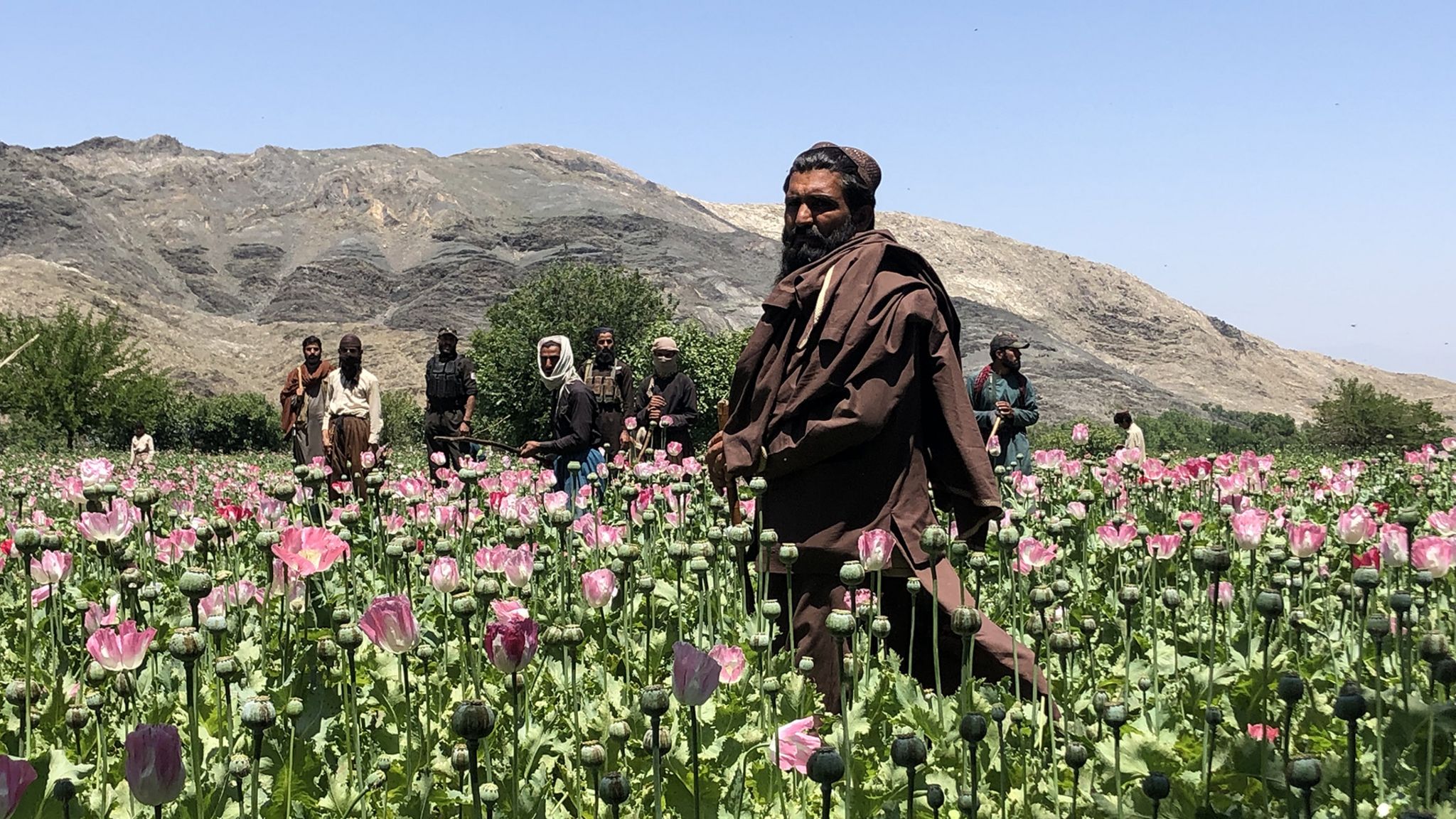
Taliban destroy poppy heads against a mountain background

Within a matter of minutes, Abdul and a dozen other men raze the poppy crop which covered the small field. Then the armed men, all wearing a shalwar kameez (a traditional Afghan tunic with loose fitting trousers), most with long beards and some with kohl-lined eyes, pile into the back of a pickup truck and move on to the next farm.

The men belong to a Taliban anti-narcotics unit in the eastern Nangarhar province of Afghanistan, and we’ve been given rare access to join them on one of their patrols to eradicate poppy farming. Less than two years ago the men were insurgent fighters, part of a war to seize control of the country. Now they’ve won and are on the ruling side, enforcing the orders of their leader.

In April 2022, Taliban supreme leader Haibatullah Akhundzada decreed that cultivation of the poppy – from which opium, the key ingredient for the drug heroin can be extracted – was strictly prohibited. Anyone violating the ban would have their field destroyed and be penalised according to Sharia law.

A Taliban spokesman told the BBC they imposed the ban because of the harmful effects of opium – which is taken from the poppy seed capsules – and because it goes against their religious beliefs. Afghanistan used to produce more than 80% of the world’s opium. Heroin made from Afghan opium makes up 95% of the market in Europe.

The BBC has now travelled in Afghanistan – and used satellite analysis – to examine the effects of the direct action on opium poppy cultivation. The Taliban leaders appear to have been more successful cracking down on cultivation than anyone ever has.

We found a huge fall in poppy growth in major opium-growing provinces, with one expert saying annual cultivation could be 80% down on last year. Less-profitable wheat crops have supplanted poppies in fields – and many farmers saying they are suffering financially.

We travelled to provinces including Nangarhar, Kandahar and Helmand, drove through bumpy, mud roads, walked for miles in remote, mountainous areas, making our way through farmland, leaping across gurgling streams to see the reality on the ground.

The Taliban decree wasn’t applied to the 2022 opium harvest, which according to the United Nations Office on Drugs and Crime (UNODC) increased by a third over 2021.

This year though, is very different. The evidence we saw on the ground is backed up by imagery taken from above.

David Mansfield, a leading expert on Afghanistan’s drugs trade, is working with Alcis – a UK firm which specialises in satellite analysis.

“It is likely that cultivation will be less than 20% of what it was in 2022. The scale of the reduction will be unprecedented,” he says.

A large number of farmers have complied with the ban, and Taliban fighters have been destroying the crops of those that haven’t.

Toor Khan, the commander of the Taliban patrol unit we are with in Nangarhar, tells us he and his men have been destroying poppy fields for nearly five months, and have cleared tens of thousands of hectares of the crop.

“You’re destroying my field, God destroy your home,” one woman shouts angrily at the Taliban unit as they raze her poppy field.

“I’d told you this morning to destroy it yourself. You didn’t, so now I have to,” Toor Khan screams back. She retreats indoors.

Her son is detained by the Taliban, released with a warning a few hours later.

Toor Khan (right) razing a poppy field to the ground along with Taliban members
Toor Khan (right) razing a poppy field to the ground along with fellow Taliban members

The Taliban go armed and in large numbers, because there have been instances of resistance from angry locals in this area. At least one civilian was killed in a shooting during the eradication campaign and there are reports of other violent clashes.

Farmer Ali Mohammad Mia has a stricken look on his face as he watches the unit destroy his field. Pink poppy flowers, green bulbs and broken stems cover the ground when they are done.

Why did he cultivate poppy despite the ban, we ask.

“If you have no food at home, and your children are going hungry, what else would you do,” he says. “We don’t have large pieces of land. If we grew wheat on them we would make a fraction of what we could from opium.”

Farmer Ali Mohammed Mia

The ban on poppy growing forces farmers such as Ali Mohammed Mia to cultivate cheaper crops, like wheat

What is remarkable is the speed at which the Taliban carry out the job using only sticks. Six fields, each between 200-300 sq m in size, are cleared in just over half an hour.

How do they feel about destroying a source of income for their own people who are going hungry, we ask Toor Khan.

“It is the order of our leader. Our allegiance to him is such that if he told my friend to hang me, I would accept it and surrender myself to my friend,” he says.

Helmand province in the south-west used to be Afghanistan’s opium heartland, producing more than half of the country’s opium. We travel there independently of the Taliban’s anti-narcotics unit, to see first-hand how it now looks.

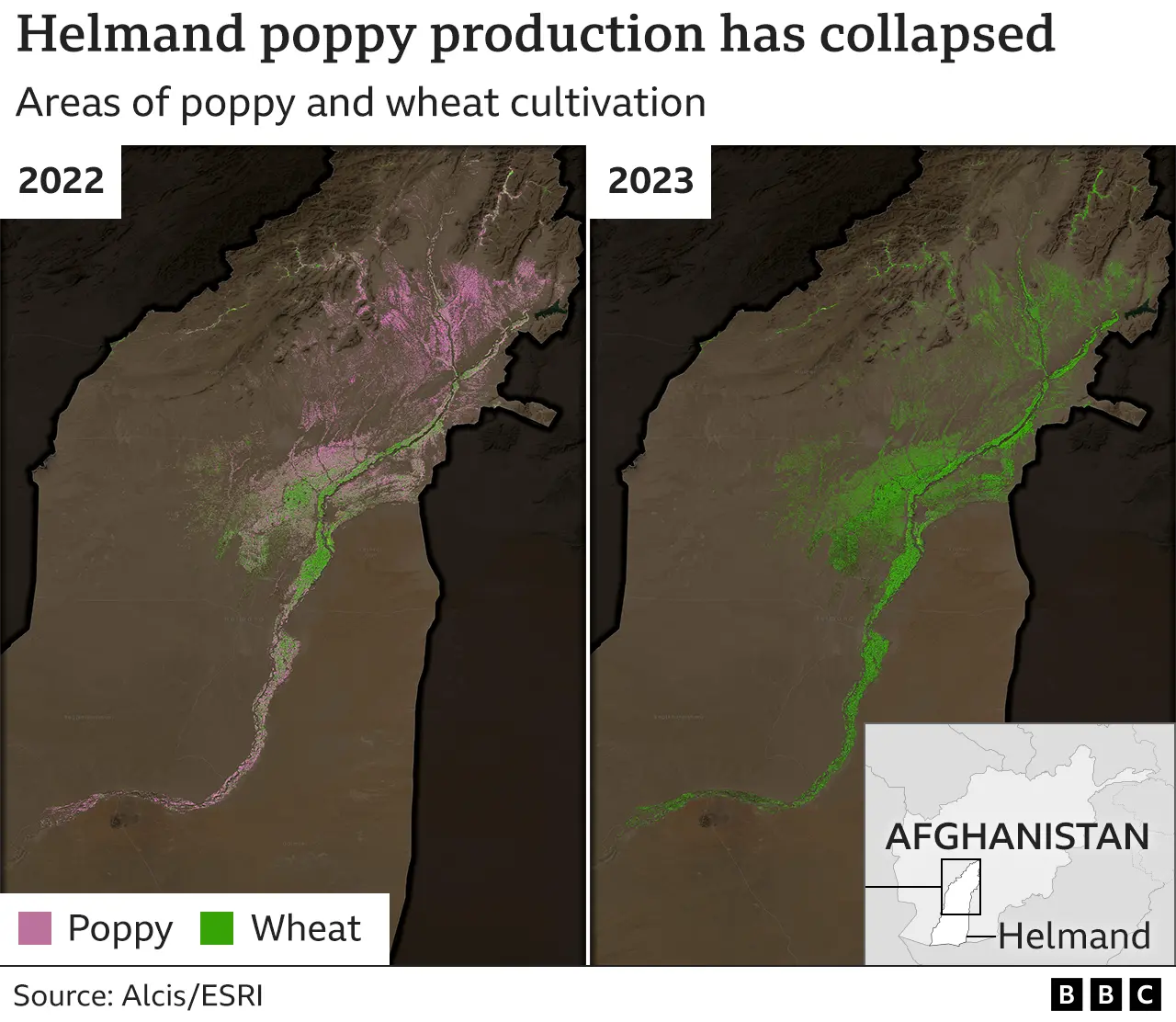
Last year when we were in the province, we saw swathes of land covered with poppy fields. This time we can’t spot a single field of the crop.

Graphic: Helmand poppy cultivation has collapsed - shows two satellite pics of the province (2022 and 2023) demonstrating the fall-off in poppy farming

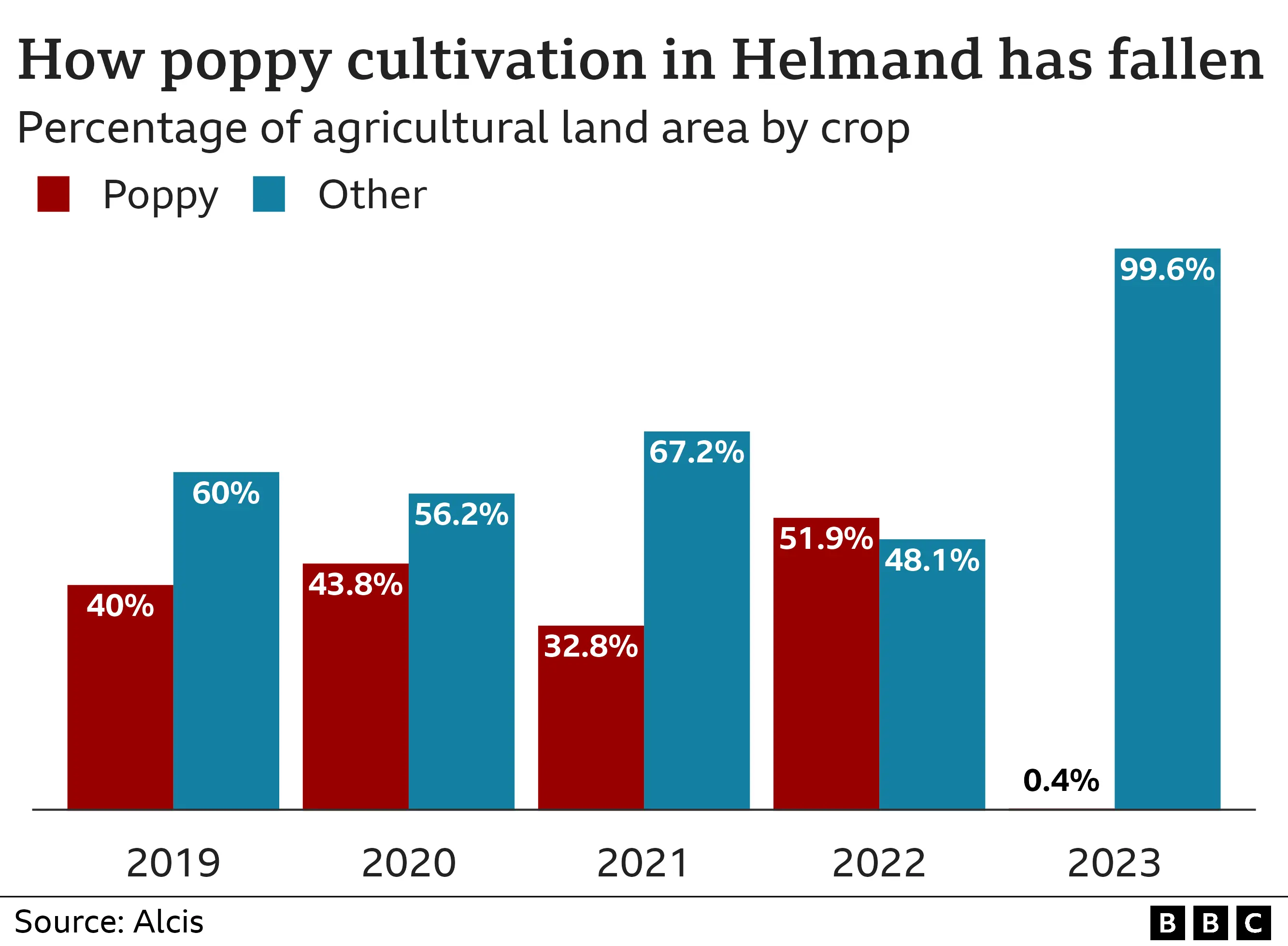
Alcis’s analysis shows that poppy cultivation in Helmand has reduced by more than 99%. “The high resolution imagery of Helmand province shows that poppy cultivation is down to less than 1,000 hectares when it was 129,000 hectares the previous year,” says David Mansfield.

We meet farmer Niamatullah Dilsoz in the Marjah district – south of Helmand’s capital, Lashkar Gah – while he is harvesting wheat. Last year, he grew poppy in the same field. He tells us farmers in Helmand, a Taliban stronghold, have all but complied with the ban.

“A few farmers tried to grow poppy in their courtyards hidden behind walls, but the Taliban found out and destroyed those fields,” Niamatullah says.

Except for the sound of wheat stalks being cut and the calls of birds, it is quiet in the farm. During the war, the field was a front line. Helmand was where UK troops had a base and where they fought some of their fiercest battles.

Graph: How poppy cultivation in Helmand has fallen (shows drop from 51.9% of crops in 2022 to 0.4% in 2023)

Niamatullah is in his early twenties. This is the first time in his life that he doesn’t fear being hit by a bomb when venturing out. But for a people already battered by a long war, the opium ban has struck a crushing blow, coming as it does amid an economic collapse which has caused near universal poverty in Afghanistan. Two thirds of the population don’t know where their next meal will come from.

“We are very upset. Wheat earns us less than a quarter of what we used to make from opium,” he says. “I can’t meet my family’s needs. I’ve had to take a loan. Hunger is at its peak and we haven’t got any help from the government.”

Farmer Niamatullah harvesting wheat in his fields
Niamatullah harvests the wheat he now grows in place of poppies

We ask Zabiullah Mujahid, the Taliban government’s main spokesman, what his government is doing to help people.

“We know that people are very poor and they are suffering. But opium’s harm outweighed its benefits. Four million of our people from a population of 37 million were suffering from drug addiction. That is a big number,” he says. “As far as alternative sources of livelihood go, we want the international community to help Afghans who are facing losses.”

He rejects assertions by the UN, the US and other governments that opium was a major source of income for the Taliban when they were fighting against Western forces and the previous Afghan regime.

How can they expect international organisations to help, when the Taliban government has jeopardised their operations and funding by banning women from working for all NGOs, we ask.

“The international community should not link humanitarian issues with political matters,” replies Mujahid. “Opium isn’t just harming Afghanistan, the whole world is affected by it. If the world is saved from this big evil then it is only fair that Afghan people receive help in return.”

At the source, the impact of the ban on opium prices is already evident. In Kandahar, the spiritual home of the Taliban and traditionally another major poppy-growing area, we meet a farmer who is holding on to a small stash of his harvest from last year – two plastic bags, each about the size of a football, filled with dark, smelly opium resin. We’re hiding his identity to protect him.

“Last year just before the ban, I sold a bag like this for a fifth of what I could get now. I’m waiting for the price to increase further so it can sustain my family for longer. Our situation is very bad. I’ve already taken a loan to buy food and clothes. Of course, I know opium is harmful, but what’s the alternative?” he asks.

Two bags of opium resin
Despite the crackdown, a farmer we spoke to still hoped to sell his harvest of opium

It might take a while for the price impact to filter down the chain of illicit drug trafficking to the street price of heroin.

“While opium and heroin prices remain at a 20-year high, they’ve been falling over the last six months, despite such low levels of poppy cultivation this year,” says Mansfield. “This suggests there are significant stocks in the system, and the production and trade in heroin continues. Seizures in neighbouring states and beyond also indicate a shortage of heroin is not imminent.”

Mike Trace – a former UNODC official – was a senior UK government drugs policy adviser when the Taliban’s first regime banned opium cultivation in 2000, a year before the US-led invasion of Afghanistan.

“That didn’t lead to a massive and immediate impact on Western prices and markets, because there is an awful lot of stockpiling by the actors along that drug-trafficking route,” he says. “That’s the nature of the market and it hasn’t fundamentally changed for the last 20 years.”

Poppies in field, photographed from close-up

Billions of dollars were spent by the US in Afghanistan to try to eradicate opium production and trafficking, in the hope of cutting the Taliban’s source of funding.

They launched airstrikes on poppy fields in Taliban-controlled territory, burnt opium stocks and conducted raids on drug laboratories.

But opium was also grown freely in areas controlled by the US-backed former Afghan regime, something the BBC witnessed prior to the Taliban takeover in 2021.

For now, the Taliban appears to have accomplished in Afghanistan what the West couldn’t. But there are questions about how long they can sustain it.

As far as heroin addiction in the UK and the rest of Europe goes, Mike Trace says a dramatic reduction in opium cultivation in Afghanistan is likely to alter the type of narcotics consumed. “People are likely to turn to synthetic drugs which can be far more nasty than opium.”

Additional reporting by Imogen Anderson and Rachel Wright

Inside the Taliban’s war on drugs – opium poppy crops slashed
read more