Mohammad Nasir Akhund Appointed Finance Minister

Ahmad Wali Haqmal, a spokesman for the Finance Ministry, said that Mohammad Nasir Akhund has good experience in finance

Based on the decree of the Islamic Emirate’s leader, Mohammad Nasir Akhund has been appointed acting minister of Finance. 

Ahmad Wali Haqmal, a spokesman for the Finance Ministry, said that Mohammad Nasir Akhund has good experience in finance and there will be a positive change in the country’s financial system.

“He has good experience in the financial sector, and with his appointment, positive steps will be taken in the financial affairs of Afghanistan,” said Ahmad Wali Haqmal.

“Mohammad Nasir Akhund was the deputy of the revenue and customs in the finance ministry before and now he is appointed as acting minister in this ministry, and the changes roles of an individual in a system and government is a normal thing,” said Bilal Karimi.

Before this, Hedayatullah Badri was the head of the Ministry of Finance for almost two years and after that he was appointed the head of Da Afghanistan Bank.

Mohammad Nasir Akhund Appointed Finance Minister
read more

What caused deadly Afghan-Iran border clashes? What happens next?

Al Jazeera

Published On 30 May 2023

The two countries call to de-escalate the situation after deadly clashes erupt apparently over river water-sharing dispute.

Last week, deadly clashes broke out between Afghan and Iranian guards at their border raising fears of a new conflict.

Both sides have accused each other of initiating the shooting in which at least two Iranian and one Afghan guard were killed. However, they have issued measured statements aimed at de-escalating the situation.

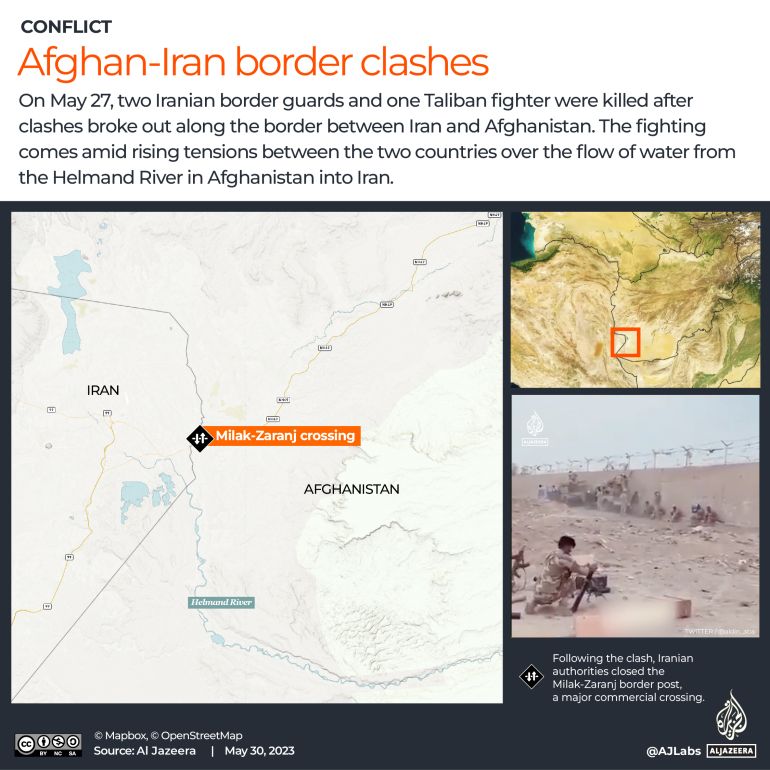
Following the border violence, Iranian authorities closed the Milak-Zaranj border post, an important commercial crossing – and not the site of the clash – until further notice, Iran’s IRNA news agency reported.

Despite a treaty in place since 1973 on the sharing of Helmand River waters, the two sides have wrangled for decades. The river flows from Afghanistan towards eastern Iran.

What caused the fighting?

The reasons for the clashes are still unknown but the shooting at the border post between the Afghan province of Nimroz and Iran’s Sistan-Baluchistan province comes as Iranian President Ebrahim Raisi earlier this month accused Afghanistan’s Taliban rulers of restricting the flow of water to Iran’s eastern regions in violation of the 1973 treaty.

“We will not allow the rights of our people to be violated,” Raisi said on May 18.

The Taliban, which has denied the accusation, called on to “solve the problem” in accordance with the treaty. The Taliban, which remains diplomatically isolated since it came to power in August 2021, said it wanted “good relations” with Tehran.

According to Sina Toossi, a senior non-resident fellow at the US-based think tank Center for International Policy (CIP), there is a “lack of clear demarcation and understanding of border boundaries and rules” on both sides.

Interactive_Afghanistan-Iran borderclashes
(Al Jazeera)

Iranian officials have repeatedly blamed the Taliban for its disregard for international laws and border protocols since its takeover of Afghanistan two years ago. Clashes have erupted on multiple occasions, but have rarely led to casualties and have been routinely blamed on “misunderstanding”.

A day before the border clashes, Iran’s Foreign Minister Hossein Amirabdollahian called on the Taliban to “follow legal framework” to resolve the water dispute.

“In recent years, this treaty has not been adhered to by Afghanistan’s rulers, including the Taliban,” CIP’s Toossi told Al Jazeera, adding that Kabul has delivered only “a fraction of the agreed amount”.

“It has been exacerbated by Iran’s worsening drought conditions, making the water issue increasingly critical,” he said.

The Taliban issued a statement saying it did not want to “fight with its neighbours”.

What is the Afghan-Iran water dispute?

The Helmand River, which is more than 1,000km (621-mile) long and flows across the border, is being dammed on the Afghan side to generate electricity and irrigate agricultural land.

Drought has been a problem in Iran for some 30 years, which has worsened over the past decade, according to the United Nations Food and Agriculture Organization (FAO). The Iran Meteorological Organization says that an estimated 97 percent of the country now faces some level of drought.

According to the Helmand Water Treaty signed by Afghanistan and Iran half a century ago, Afghanistan should annually share 850 million cubic metres of water from Helmand with Iran.

It also calls on both sides to address their differences via diplomatic channels and, if that fails, through an advisory board headed by a mutually chosen arbitrator.

Iran has accused Afghanistan of failing to adhere to the treaty on several occasions and has opposed its decision to construct dams on the river.

How have both countries reacted to the clashes?

The Taliban leadership has called for the resolution of such issues “through diplomatic channels”.

“We don’t want relations with our neighbouring countries to deteriorate. The Islamic Emirate of Afghanistan is never in favour of escalation,” Hafiz Zia Ahmad, deputy spokesman of the Ministry of Foreign Affairs, told Saudi Arabian newspaper Arab News on Monday.

Analyst Toossi believes the border clashes have prompted both sides to de-escalate the situation and “reaffirm their commitment to dialogue and cooperation”.

He said there is an indication that Iran is open to dialogue, given that the Taliban’s acting foreign minister met an Iranian envoy to discuss the Helmand River water rights on the day of the clash.

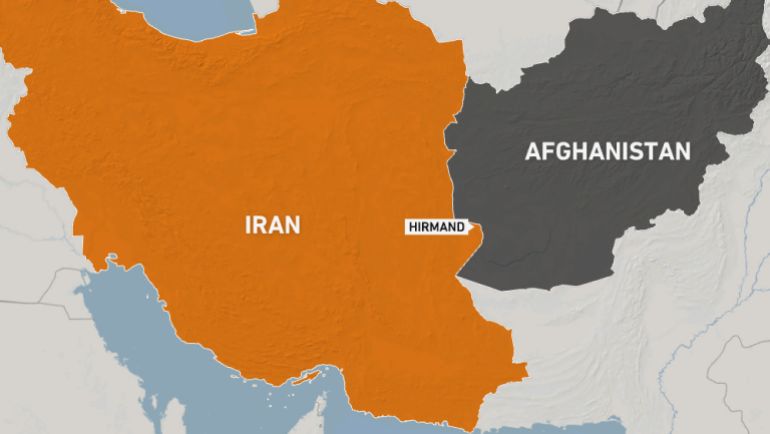
Iran Afghanistan Map
Hirmand county along the Iran-Afghanistan border [Al Jazeera]

Where does the Afghan-Iran relationship stand?

As Kabul and Tehran are “trying to balance their interests and concerns”, according to Toossi, their relationship remains in a state of “uncertainty”.

“It is not clear whether the Taliban have pulled back their fighters from the border or whether they will abide by the agreement in the future,” he said after videos showed large numbers of Taliban fighters approaching the border with Iran last week.

Additionally, while Iran has held a dialogue with the Taliban, it has not officially recognised them as the legitimate rulers of Afghanistan.

The Shia-majority country has called for the formation of an inclusive government that represents all ethnic and religious groups in Afghanistan.

“Iran has expressed concerns about the security and welfare of the Afghan people, especially the Shia Hazara minority, who have faced persecution and violence from the Taliban in the past,” said Toossi.

SOURCE: AL JAZEERA
What caused deadly Afghan-Iran border clashes? What happens next?
read more

Afghan Women Who Aided U.S. Military Wait for Asylum in America

The New York Times

Reporting from Westchester County, N.Y., and Dallas

Members of the Afghan Army’s all-female platoon are some of the roughly 70,000 Afghans living in the United States whose temporary status has left them with an uncertain future.

It was almost 3 a.m. in New York, but Nazdana Hassani refused to fall asleep.

She stared at her phone, closing and refreshing WhatsApp, hoping that her mother’s internet had been restored at her home in Afghanistan.

She tried three more times, but the call would not go through.

The last time Ms. Hassani saw her mother in person was August 2021, days before the Taliban seized control of Kabul.

Ms. Hassani, 24, served in the Afghan National Army’s Female Tactical Platoon, a squad of all women that accompanied U.S. Special Operations troops on missions seeking out high-level Taliban, Al Qaeda and ISIS targets. As the Taliban took over two summers ago, Ms. Hassani faced a decision: live under a repressive government as a woman who worked alongside the U.S. Army, or flee her home country for the United States.

Of the 45 Afghan women who served in Ms. Hassani’s platoon, 39 escaped amid the chaotic withdrawal of U.S. troops nearly two years ago.

Now Ms. Hassani and most of her platoon are among the tens of thousands of Afghans living in the United States as humanitarian parolees, a temporary legal status. This month, the Biden administration announced a plan to allow Afghans to apply for a parole extension so they can continue living and working in the United States after their status expires in August. It is unclear if the extensions, if granted, would be for two years, as they were the first time.

For those who were in the platoon, the goal is to stay in the United States long term and to have their families, who are still in Afghanistan, join them. Ms. Hassani and nearly all of the platoon members have applied for asylum — a protected status for those fearing persecution in their home country — but the system is severely backlogged. Only three of the women so far have been granted asylum, which enables them to obtain a green card and bring their families over.

Senator Amy Klobuchar, a Democrat from Minnesota, has sponsored the Afghan Adjustment Act, a bill that would create a legal pathway for permanent residency for Afghans who worked alongside Americans during the Afghanistan conflict.

“So many of our Afghan allies risked their lives and their loved ones’ safety to protect our service members,” Ms. Klobuchar said.

The legislation stalled in the last Congress amid Republican concerns about the vetting of applicants, but Ms. Klobuchar said she was working with Republicans to build support for another attempt later this year.

Ms. Hassani, who works at a gift shop in a quiet suburb of Westchester County, N.Y., shares an apartment with two Afghan women whom she met at a shelter for evacuees in 2021.

The only piece of art in Ms. Hassani’s room is a painting propped up by the foot of her bed.

“I made this when I first came to the U.S.,” she said. “Some volunteers at the camps gave us paint and canvas.”

Joining the army was Ms. Hassani’s childhood dream. The youngest member of the platoon, she was born just months before the start of America’s two-decade war in Afghanistan.

“I remember my mom telling us, the Americans, they are here for us, they are good people,” Ms. Hassani said.

The idea for Ms. Hassani’s platoon came about a decade into the war, when the U.S. military decided it needed female troops to help patrol rural villages. It was considered culturally insensitive for the male soldiers to search or talk to Afghan women.

Mary Kolars, an Army captain who worked closely with the platoon, said having them on missions was invaluable. “They had information about tribal affiliations, they could look at a village and tell us what doesn’t fit, they helped us search for high-ranking targets.”

Today, most of the platoon members are scattered across the United States working minimum-wage service jobs.

Since arriving, Ms. Hassani clings to memories of her adventures in the army.

“I try to be grateful for my life here,” she said. “But my life and job, it’s all just very different now.”

Last month, Ms. Kolars, Ms. Hassani and nearly all of the platoon members in the United States traveled to Washington, D.C., to lobby Congress to pass the Afghan Adjustment Act.

“Every day hurts, because I know that my family is not safe in Afghanistan,” Ms. Hassani said.

She and other members of the platoon said they underwent extensive background checks to serve alongside the American military. The women also said that they had to obtain written permission from male relatives to join the Afghan Army. Those documents contained information about the women’s families and remained in Afghan government files after Kabul fell.

Many of the women said that since then, relatives have been threatened, tortured or killed by Talibs, according to Ms. Kolars. She and other American soldiers who worked with the platoon said they think the Taliban has used the documents to track down family members.

“It’s just hard, to live life with this constant anxiety about the family that is back home,” said Jawida Afshari, 34, who served in the platoon for nearly a decade and who helped train recruits, including Ms. Hassani.

Both women interviewed for asylum last October — Ms. Afshari was granted asylum, while Ms. Hassani’s application is still pending.

Ms. Afshari, who works at a Chick-fil-A near her Dallas apartment complex, said she often finds herself thinking about life before Kabul fell. She had been weeks away from obtaining a law degree at Kabul University.

“I am so lucky, because the women in Afghanistan, they can’t work at restaurants, they can’t leave the house,” Ms. Afshari said. “But it can be hard to remember how long I worked and studied at home, and how that was all taken away so quickly.”

While she waits for the opportunity to apply for a green card, Ms. Afshari tries to carve out pockets of joy from her life in Dallas. Most of her neighbors are immigrants from Iraq and Mexico. “None of us can speak English, but we find a way to talk,” she said with a laugh.

The day she discovered an Arabic grocery store nearby that stocks halal meats, Ms. Afshari cooked a feast of Afghan shawarma for her neighbors.

Mahnaz Akbari, the commander of the platoon, also does not have asylum. She has used her English language skills to work for a nonprofit in Washington. She said she tries to keep morale high even when the women are exhausted, often through group video calls.

While cooking dinner in her Silver Spring, Md., apartment last week, Ms. Akbari propped up her phone on the kitchen counter, waiting for platoon members on the West Coast to join.

During these calls, the women exchange photos, share Afghan recipes that can be made using American groceries and advise one another on questions about life in the United States. How many credit cards are you supposed to open? Is going to the D.M.V. as bad as people say? Ms. Hassani said those calls have become a lifeline.

In the weeks after her asylum interview, Ms. Hassani was consumed by anxiety, wondering why there had been no update on her case. She kept replaying the interview in her head, wondering if she had somehow made a misstep. Ms. Hassani said Ms. Akbari’s support helped her stay calm.

“Mahnaz takes time to cheer us up,” she said, “so we don’t give up.”

Luke Broadwater contributed reporting.

Ava Sasani is a reporter for the National desk. 

A version of this article appears in print on May 30, 2023, Section A, Page 12 of the New York edition with the headline: Afghan Women Who Aided U.S. Troops Live in Uncertainty in America.
Afghan Women Who Aided U.S. Military Wait for Asylum in America
read more

Afghan Farmers Face Locusts, Flooding

According to the Ministry of State for Disaster Management, in one month, nearly 20,000 acres of agricultural land was destroyed

The Chamber of Agriculture and Livestock said that the invasion of locusts, and flooding have seriously damaged the agricultural sector of the country. 

“We are witnessing another setback from locusts in the north of the country, which have challenged our farmers and their land, which is more than a thousand acres of land. If the government doesn’t help us, our farmers and country will face big losses,’ said Merwis Haji Zada, deputy of the Chamber of Agriculture and Irrigation.

According to the Ministry of State for Disaster Management, in one month, nearly 20,000 acres of agricultural land was destroyed and 42 people died and 45 others were injured due to flooding.

“In the last month, in different parts of the country, due to floods and rain, there have been human and financial losses, leaving 42 dead and 45 injured, destroying 341 houses and 19,573 acres of agricultural land,” said Shafiullah Rahimi, a spokesman for the ministry.

According to the ministry, flooding have also caused financial loss in Kapisa, Maidan Wardak, Takhar, Badakhshan, Ghor, Kandahar, Kunar, Nuristan, Khost, Daikundi and Nangarhar.

“Land and labor are major and fundamental factors of a country’s economy, and flooding and natural disasters can have negative and unfavorable effects on the country’s economy,” said Abdul Zahor Mudaber, a political analyst.

The Ministry of State for Disaster Management said that in the past month, 341 houses and 20,000 acres have been destroyed and 13,000 animals have been lost due to flooding.

Afghan Farmers Face Locusts, Flooding
read more

At Least Three Are Killed in Clashes on Iranian-Afghan Border

The fighting comes amid rising political tension between the two countries over the flow of water from the Helmand River in Afghanistan into eastern Iran.

At least three people were killed and several others injured after clashes broke out along the Iranian-Afghan border on Saturday night, according to Iranian state media and an Afghan official, escalating tensions between the two countries amid a heated dispute over water rights in recent weeks.

At least two Iranian border guards were killed in the fighting, which began around noon on Saturday and ended after six hours along the southwestern border of Afghanistan, according to Iranian state media and Afghan news reports. One soldier with the Taliban administration in Afghanistan was also killed, the Afghan Ministry of Interior said.

Officials from both countries accused the other of initiating the clashes. An official in southeastern Iran said that calm had returned to the border area on Saturday night, according to Iranian state media.

The skirmishes come amid rising political tension between the two countries over the flow of water from the Helmand River in Afghanistan into eastern Iran, a region that has been plagued by drought. The mouth of the river is along the border in southwestern Afghanistan and southeastern Iran, where the clashes took place.

In recent weeks, Iranian officials have accused the Taliban administration of violating a decades-old treaty between the two countries by restricting the flow of water out of Afghanistan, an accusation Taliban officials have denied.

The issue of water has been a flashpoint between Afghanistan and Iran for centuries. The two countries are bound by the Helmand River, the longest river in Afghanistan, which flows from the foothills of the Hindu Kush mountain range and feeds into wetlands along the country’s border with Iran. The river is a critical source of drinking water, as well as agriculture and fishing, in southern Afghanistan and southeastern Iran.

In the 1940s and ’50s, Afghan governments constructed two major dams along the Helmand River, giving Afghanistan the power to cut off the flow of water into Iran and alarming Iranian officials as the country experienced periods of intense drought. Though the two countries signed a treaty on sharing water resources in 1973, it was never ratified, and the flow of water from the river has remained a heated point of contention ever since.

Since the Taliban seized power in August 2021, the Iranian authorities have maintained relations with Afghanistan, and in February, Iran became one of a few foreign governments to accept Taliban-appointed diplomats in their country.

But this month, President Ebrahim Raisi of Iran warned the Taliban administration not to violate the terms of the 1973 water treaty and urged the Afghan government to allow Iranian hydrologists to check the river’s water levels.

“We will not allow the rights of our people to be violated,” Mr. Raisi said.

On Saturday morning, the Taliban administration’s minister of foreign affairs, Amir Khan Muttaqi, met with Iran’s top diplomat in Afghanistan, Hassan Kazemi Qomi, to discuss the water dispute, among other issues, according to Hafiz Zia Ahmad, the deputy spokesman for the Afghan Ministry of Foreign Affairs.

After the clashes broke out along the border, the Afghan Ministry of National Defense called for the two countries to reach a negotiated settlement.

“Making excuses for war and negative actions is not in the interest of any of the parties,” the ministry said in a statement.

Safiullah Padshah contributed reporting.

Christina Goldbaum is a correspondent in the Kabul, Afghanistan, bureau. 

A version of this article appears in print on May 29, 2023, Section A, Page 4 of the New York edition with the headline: At Least 3 Are Killed in Clashes On the Iranian-Afghan Border
At Least Three Are Killed in Clashes on Iranian-Afghan Border
read more

Kabul Does Not Want Tension With Anyone Including Neighbors: Karimi

Since the Islamic Emirate swept into power, there have been many clashes with Iran—although the two sides stressed negotiations to solve the issues.

Days after the armed disputes between the Islamic Emirate and Iranian border guards, Kabul said that it does not want tensions with any side including neighbors.

On Saturday, the Islamic Emirate’s forces and the Iranian border guards engaged in fighting which left two Iranian military personnel killed, according to Iranian media. One member of the Islamic Emirate forces was also killed in the clash, said an Islamic Emirate official.

The Islamic Emirate’s deputy spokesman, Bilal Karimi, said that the two sides are discussing the issue.

“The stance and policy of the Islamic Emirate is in general that it doesn’t want tensions with any side particularly the neighboring countries and regarding this small dispute that happened at a local level between the two neighboring countries along the border, the officials of the two sides are in contact and any incidents that happen, they will find a solution,” he said.

Meanwhile, the Iranian Minister of Interior, Ahmad Wahidi, said that the fighting was not very severe.

“It was a small clash and was solved. There were negotiations with the Taliban side. We don’t have a problem now and the border is calm. The border is open for travel,” he said.

The analysts suggested that the conflicts between Afghanistan and Iran should not lead to a proxy war between the two countries.

“These problems of theirs should be solved via negotiations and diplomatic ways. Also, the Taliban side said that they do not let their neighbors be threatened from Afghan soil,” said Samar Sadaat, military analyst.

“The current government of Afghanistan should stop itself from fighting along the border with the neighboring countries including Iran. The issues should be solved via negotiations,” said Asadullah Nadi, military analyst.

Since the Islamic Emirate swept into power, there have been many clashes with Iran—although the two sides stressed negotiations to solve the issues.

Kabul Does Not Want Tension With Anyone Including Neighbors: Karimi
read more

At least three killed in shooting at Iran-Afghan border

29 May 2023

Two Iranian border guards and one Taliban fighter have been killed after shooting broke out near a border post between Iran and Afghanistan, sharply escalating rising tensions between the two countries amid a dispute over water rights.

“Today, in Nimroz province, Iranian border forces fired toward Afghanistan, which was met with a counter-reaction,” Afghan interior ministry spokesman Abdul Nafi Takor said in a statement.

“The situation is under control now. The Islamic Emirate [Afghanistan] does not want to fight with its neighbours,” the spokesman said, without identifying the victims.

He said one person had been killed on each side and several injured. However, Iran’s official IRNA news agency later said two Iranian border guards had been killed and two Iranian civilians injured.

The semiofficial, English-language newspaper Tehran Times said three Iranian border guards were killed.

The violence came as Iranian President Ebrahim Raisi this month warned the Taliban not to violate a 1973 treaty by restricting the flow of water from the Helmand River to Iran’s eastern regions. Afghanistan’s Taliban rulers have denied the accusation.

Enayatullah Khowarazmi, Taliban Ministry of Defence spokesman, said “Unfortunately, today once again in the border areas of Kong district of Nimroz province, there was a shooting by Iranian soldiers, [and] a conflict … broke out.”

“The Islamic Emirate of Afghanistan considers dialogue and negotiation to be a reasonable way for any problem. Making excuses for war and negative actions is not in the interest of any of the parties,” Khowarazmi said.

Iran, in turn, accused Taliban forces of shooting first.

IRNA quoted Iran’s deputy police chief, Qasem Rezaei, as saying, “Without observing international laws and good neighbourliness, Taliban forces started shooting at the Sasoli checkpoint … drawing a decisive response.”

Following the clash, Iranian authorities closed the Milak-Zaranj border post, a major commercial crossing – and not the site of the clash – until further notice, IRNA said.

According to the outlet, Iran’s border guards said in a statement they had “used their superior heavy fire to inflict casualties and serious damage”.

The advocacy group HalVash, which reports on issues affecting the Baluch people in the predominately Sunni province of Sistan and Baluchestan, quoted residents in the area as saying that the fighting took place near the Kang district of Nimroz. It said some people in the area had fled the violence.

Raisi’s remarks directed to the Taliban on Iran’s rights were some of the strongest yet over the long-running concerns about water in Iran. The Helmand River, which is more than 1,000 kilometres long and flows across the border, is being dammed on the Afghan side to generate electricity and irrigate agricultural land.

Drought has been a problem in Iran for some 30 years, but has worsened over the past decade, according to the UN’s Food and Agriculture Organization (FAO). The Iran Meteorological Organization says that an estimated 97 percent of the country now faces some level of drought.

Earlier on Saturday, the Taliban’s acting Foreign Minister Amir Khan Muttaqi met an Iranian envoy to Afghanistan to discuss the Helmand River water rights, according to tweets from Afghan Ministry of Foreign Affairs official Zia Ahmad.

But tensions have otherwise been rising. Another video posted online in recent days purportedly showed a standoff with Iranian forces and the Taliban as Iranian construction workers tried to reinforce the border between the two countries.

In recent days, pro-Taliban accounts online also have been sharing a video with a song calling on the acting defence minister, Mullah Mohammad Yaqoob, to stand up to Iran. Mullah Yaqoob is the son of Mullah Mohammad Omar, the Taliban’s late founder and first supreme leader.

SOURCE: AL JAZEERA AND NEWS AGENCIES
At least three killed in shooting at Iran-Afghan border
read more

Norway Refugee Council Chief Says European Envoys Should Return to Kabul

He suggested that suspension due to the “Taliban’s policies” is politicizing humanitarian assistance.  

The Secretary General of the Norwegian Refugee Council, Jan Egeland, said that he is lobbying for his country’s ambassador — as well other European ambassadors — to return to Afghanistan.  

In an interview with TOLOnews’ Hamid Bahram, Egeland said that Norway has recognized Afghanistan “for a very long time” and that regimes have come and gone but Oslo has recognized the country.

“In diplomacy. You don’t recognize regimes or governments — you recognize countries. My country — Norway — has recognized Afghanistan for a very long time… regimes have come and gone, governments have come and gone but we recognized Afghanistan and our ambassador should come very soon. I am lobbying for that. I am lobbying for the European ambassadors to come back… I am glad to see the European Union already. They should come and engage with the Taliban authorities,” he said.

Egeland, who also visited Kandahar, said that the Islamic Emirate’s official told him that the ban of girls’ education will be lifted with “guidelines.”

“They told me two things. Number one that the ban on female education and female work in humanitarian organizations is going to be lifted through the issue of guidelines and that these guidelines were nearly finished. So we are hoping to see the guidelines very soon, so we can restart work with the female colleagues across Afghanistan and girls can come back to secondary school to other schools—to universities,” Egeland said.

He suggested that suspension due to the “Taliban’s policies” is politicizing humanitarian assistance.

“When people say I dislike the Taliban … so we have to withdraw money from Afghanistan, I think that is politicizing aid because the aid is there to for the poorest of the poor, for the hungry, etc… they should engage with the Taliban leadership and tell them like I do that we disagree. Engagement is much better than withdrawal of aid to the poorest,” he said.

Norway Refugee Council Chief Says European Envoys Should Return to Kabul
read more

Gender Persecution in Afghanistan: Could it come under the ICC’s Afghanistan investigation?

Since their return to power in August 2021, the Taleban have enacted successive laws and orders which apply to women and girls, but not to men and boys. Earlier this month, United Nations experts reported their assessment that these measures violated women and girls’ rights to education, work, freedom of movement, health, bodily autonomy and decision-making, peaceful assembly and association, and access to justice and amounted to ‘gender persecution’. One of the experts has also asked the International Criminal Court to consider whether the crime against humanity of gender persecution was taking place in Afghanistan. In this Q&A, Ehsan Qaane* unpacks the term as it exists in international law, and in that light, analyses whether the court might consider Taleban restrictions on women as amounting to gender prosecution and whether an investigation could lie within its mandate.

Introduction

Since the Taleban regained power in Afghanistan in August 2021, they have imposed multiple orders and regulations on Afghan women and girls that do not apply to men and boys. [1]Two United Nations independent experts, Special Rapporteur on the Situation of Human Rights in Afghanistan Richard Bennet and Chair of the Working Group on Discrimination against Women and Girls Dorothy Estrada-Tanck, have concluded that these restrictions, which they say are “violating girls’ and women’s rights to education, work, freedom of movement, health, bodily autonomy and decision-making, freedom of peaceful assembly and association, and access to justice,” amount to “gender persecution.” In a statement, published on 5 May 2023 at the end of an eight-day joint visit to Afghanistan, they also shared their concerns that these measures have:

…decimated the system of protection and support for those fleeing domestic violence, leaving women and girls with absolutely no recourse. They have imposed extreme modesty rules and detained women and girls for alleged “moral crimes”. These measures have reportedly contributed to a surge in the rates of child and forced marriage, as well as the proliferation of gender-based violence perpetrated with impunity. We are also particularly concerned by the fact that women who peacefully protest against these oppressive measures encounter threats, harassment, arbitrary detentions and torture…. We are alarmed about widespread mental health issues and accounts of escalating suicides among women and girls.

Earlier, Bennett asked the Prosecutor of the International Criminal Court (ICC), whose office has been looking into war crimes and crimes against humanity in Afghanistan since 2006, to consider whether the “crime of gender persecution” was taking place there (see Bennett’s report to the UN Human Rights Council, published on 6 February 2023, and AAN’s analysis of it.)

This report first unpacks the legal basis for the experts’ use of the term ‘gender persecution’, [2] before delving into whether and on what grounds the ICC could prosecute the Taleban for allegedly perpetrating it.

1. What is gender persecution?

‘Gender persecution’, as a crime against humanity, was first criminalised by the Rome Statute, the treaty that established the International Criminal Court (ICC) and which was adopted in 1998 and came into force in 2002. The term refers to “any crime within the jurisdiction” of the ICC perpetrated on the basis of the gender of the affected individual or individuals. The crimes falling under ICC jurisdiction are genocide, crimes against humanity, war crimes and the crime of aggression (see articles 5 to 8 of the Rome Statute). Furthermore, article 7 outlaws the “persecution against any identifiable group or collectivity on political, racial, national, ethnic, cultural, religious, gender as defined in paragraph 3, [3] or other grounds that are universally recognized as impermissible under international law” (article 7(1)(h)) [4] and ‘persecution’ as the “intentional and severe deprivation of fundamental rights contrary to international law by reason of the identity of the group or collectivity” (article 7(2)(g)).

An act, considered a crime within ICC jurisdiction and which violated the fundamental rights of women and girls as a collectivity, could therefore amount to gender persecution if it reached ICC thresholds: the act or acts would need to be “systematic or widespread,” “intentional” and involve the “severe deprivation of fundamental rights contrary to international law.”

Some of the criminal acts under ICC jurisdiction and considered crimes against humanity when “committed as part of a widespread or systematic attack directed against any civilian population, with knowledge of the attack” are listed in paragraph (1) of article 7 of the Rome Statute:

[M]urder; extermination, enslavement; deportation or forcible transfer of population; imprisonment or other severe deprivation of physical liberty in violation of fundamental rules of international law; torture; rape, sexual slavery, enforced prostitution, forced pregnancy, enforced sterilisation, or any other form of sexual violence of comparable gravity; enforced disappearance of persons; the crime of apartheid; other inhumane acts of similar character intentionally causing great suffering, or serious injury to body or to mental or physical health.

There is one ongoing case in front of the ICC, which includes some of the acts listed above. The Malian, Al-Hassan Ag Abdoul Aziz, is standing trial for various war crimes and the crimes against humanity of torture, rape, sexual slavery and other inhumane acts, including, inter alia, forced marriages and persecution. It is alleged he perpetrated these acts as a member of the armed group, Ansar Eddine, and the “de facto chief of Islamic police” at a time when the city of Timbuktu fell under the control of his group and al-Qaeda in the Islamic Maghreb, in 2012 and 2013 (see ICC notes on the case here). The trial has been described as ‘ground-breaking’, for example by The Guardian when it was launched in 2018, because it was the first to go to ICC trial with charges that included “the crime of persecution on the grounds of gender.” The judges of the ICC are currently deliberating their verdict.

Any case against the Taleban would be somewhat different, centring on their alleged deprivation of fundamental rights of women and girls. This term is not defined in the Rome Statute, but examples of these rights have now been listed in a new policy on the crime of gender persecution published by the ICC’s Office of the Prosecutor in December 2022 (paragraph 24):

[T]he right: to life; to be free from torture or other inhumane or degrading treatment or punishments; to be free from slavery or the slave trade, servitude and retroactive application of penal law; to freedom of assembly, opinion, expression, movement and religion, including the right to be free from religion; rights to equality, dignity, bodily integrity, family, privacy, security, education, employment, property, political or cultural participation, to access to justice or health care. Human rights violations can constitute a severe deprivation of fundamental rights on their own or when considered cumulatively.

The phrase ‘fundamental rights’ and the Office of the Prosecutor’s explanation of what this term means has expanded the scope of gender persecution beyond the acts mentioned in articles 6, 7 and 8 of the Rome Statute to violations of social, political, economic and civil rights. These are preserved in international human rights documents like the Universal Declaration of Human Rights, Convention on the Elimination of All Forms of Discrimination against Women (CEDAW) and other human rights conventions. However, to be addressed by the ICC, the violations must pass the court’s high thresholds of being “systematic or widespread,” “intentional” and involving the “severe deprivation of fundamental rights contrary to international law by reason” of gender.

The Office of the Prosecutor’s policy says that gender persecution could be “enforced by means of violence or destruction, or occur via the imposition of regulations,” and significantly, that it cannot be “ignored, dismissed or justified on the basis of culture.” [5] Under international law, crimes against humanity are jus cogens, ie the principles which form the norms of international law that cannot be set aside or made ‘legal’ through domestic legislation. Another example would be torture, which is also illegal in all circumstances. [6]

Whether this new policy was brought in because of the Islamic Emirate’s restrictions on women and girls and the need to address them is not known. [7] However, it does represent a major development in the understanding of the law.

2. Is there a legal formula for analysing whether the Taleban’s policy on Afghan women and girls amounts to gender persecution?

To argue whether the Taleban’s discriminatory bans against Afghan women and girls amount to the crime against humanity of persecution on the basis of gender or not, Taleban policy must be assessed in accordance with article 7 of the Rome Statute and other relevant documents like the Office of the Prosecutor’s “Policy on the Crime of Gender Persecution” and the ICC’s “Elements of Crimes”. The formula these documents provide is that the crimes must be:

  • intentional (referred to as the ‘mental element’);
  • involve the severe deprivation of fundamental rights contrary to international law on the basis of gender (the ‘actual element’) and are;
  • carried out in a systematic or widespread manner (the ‘contextual element’).

This paper uses this formula to analyse whether the Taleban have intentionally, systematically and in a widespread manner deprived Afghan women and girls of their fundamental rights to employment and political participation because of their gender.

The choice to scrutinise these rights complements another recent report which examined the Taleban’s alleged deprivation of Afghan women and girls’ rights to education, freedom of movement and assembly. That analysis, by professor of law and special advisor on gender persecution to the Office of the Prosecutor, Lisa Davis, used a somewhat different method of legal argument and was published by the City University of New York (CUNY) School of Law in March 2023.

3. What does international law say about the right to work and to political participation?

Political participation as a fundamental right, including specifically for women, has been secured in several international human rights instruments, including the Universal Declaration of Human Rights, the Convention on the Political Rights of Women, the International Covenant on Civil and Political Rights, and, more importantly, the Convention on the Elimination of All Forms of Discrimination against Women (CEDAW) of which Afghanistan is a signatory. For example, article 7 of CEDAW declares:

States Parties shall take all appropriate measures to eliminate discrimination against women in the political and public life of the country and, in particular, shall ensure to women, on equal terms with men, the right: (a) To vote in all elections and public referenda and to be eligible for election to all publicly elected bodies; (b) To participate in the formulation of government policy and the implementation thereof and to hold public office and perform all public functions at all levels of government; (c) To participate in non-governmental organizations and associations concerned with the public and political life of the country.

Additionally, article 8 of CEDAW obliges states to ensure women have “the opportunity to represent their government at the international level and to participate in the work of international organisations,” like the UN. [8]

Article 11 of CEDAW defines the right to work as the ‘inalienable right of all human beings.” It obliges states to “eliminate discrimination against women in the field of employment” and to provide, among many other rights, equal opportunities and benefits for women and men. [9]

Violating rights mentioned in these paragraphs could amount to the crime against humanity of gender persecution if they fit the formula mentioned earlier.

Analysis of Taleban policy vis-à-vis Afghan women’s political participation and their access to work

a. The actual element: Have women been severely deprived of their fundamental rights to political participation and work, contrary to international law

The Taleban’s Islamic Emirate consists of one executive and one judicial body. It has no independent legislative branch (the Taleban formally dissolved Afghanistan parliament on 17 May 2022). The highest authority, policymaker and lawgiver in the land is the Emirate’s supreme leader, Mullah Hibatullah Akhundzada, known by the title of Amir ul-Mu’minin (the leader of the believers). He sits in Kandahar and is advised by a 20-member ulema shura (council of Islamic scholars), but ultimately, all decisions are his. Under his supervision and at the top of the executive branch, an acting all-male cabinet is chaired by a prime minister and has a membership of around two dozen acting ministers (on the initial cabinet appointments, see this AAN report and this BBC report).

The highest judiciary body is a high council of six senior male judges, chaired by Sheikh Abdul Hakim Haqqani under the command of Hibatullah (on the Taleban’s judiciary structure, see this video on the Taleban Supreme Court’s website). All female judges were fired after the Taleban came to power.

No women have been appointed, nor allowed to remain in post, to any position involved in policymaking, administrative rule or judicial in any organ of the Taleban government or state institution.

Under the previous administration, the Islamic Republic, although representation was far from equal, women were appointed to policymaking positions as cabinet ministers, deputy ministers and ambassadors to other countries and international organisations like the United Nations. An Inter-Parliamentary Union report, published in January 2021 and quoted by CNN, noted that 6.5 per cent of ministerial positions were held by women in President Ashraf Ghani’s administration. Such positions were both political and administrative. Women had the right to vote and to nominate themselves for any elected position, including the presidency (there were female candidates for both president and deputy president). There were also no legal restrictions on their membership in the High Council of the Supreme Court, although no female judges were ever appointed.

The 2004 constitution, which the Taleban suspended during the first days of their return to power, guaranteed the vote for both men and women and a quarter of the seats of the lower house (wolesi jirga) of the parliament were reserved for women (see article 83) (on the suspension of the constitution, see this ToloNews report). According to CNN, women occupied 27 per cent of parliament seats. Female lawmakers were also members of the upper house (meshrano jirga) and provincial councils.

Since the Taleban takeover, women were also blocked from attending the only national-level jirga called. Such gatherings are forums for discussion and were attended by both men and women during the Republic. In June 2022, the Taleban organised an ulema jirga, attended by more than 3,500 ‘representatives’ from Afghanistan’s 400 plus districts. Most were ulema, although traders, businessmen and elders were also invited – but no women. At the end of the jirga, which discussed the most serious political affairs of the country, the participants pledged loyalty to the Taleban’s supreme leader, Hibatullah Akhundzada, and opposed armed resistance against the his government (see Etilaatroz reporting). When asked about the absence of women, Deputy Prime Minister Mawlawi Abdul Salam Hanafi said they were not necessary – they were “somehow involved” because “their sons will be part of the gathering” (see Radio Liberty’s report).

Under the Republic’s constitution, women and men were, in principle, equal (see article 22), albeit the personal status law, concerning marriage, guardianship of children and inheritance, was discriminatory. Discrimination against women in practice in government, civil service, the courts and other institutions was rife (the United States Special Inspector General for Afghanistan Reconstruction’s 2020 ‘lessons learned’ report on US support for gender equality has lots of interesting detail and data on this). At the same time, there was a space for women to try to occupy. Struggle was a given, but they might also see success. Institutions were also established to support women’s political participation and promote gender equality, for example, the Ministry of Women’s Affairs and the Afghanistan Independent Human Rights Commission. There were also special courts, police and prosecutorial units, especially when it came to the Elimination of Violence against Women (EVAW) Law, adopted by presidential decree in 2009 by President Hamid Karzai (see HRW’s report on special courts and units, AAN’s reports on EVAW Law) and gender units in each ministry and independent directorates. The Taleban dissolved all these entities when they came to power (for detail, see the UN Special Rapporteur on Human Rights Situation in Afghanistan’s first report to the UN Human Rights Council published in September 2022.)

Women used to work in all branches of the state (civil servants, military personnel, judges and prosecutors and also as defence lawyers), although forming a higher proportion in the middle and lower posts. With the exception of health workers and teachers of primary-aged girls, women who worked in the public sector have been asked to stay at home because they are women. Most are required to come in regularly to sign their hazeri (timesheet) and are still paid. However, in some sectors, all women were fired, for instance, judges and journalists working in state-own media outlets. (For more on this and salary payments in general since the Taleban returned to power, see AAN’s March 2023 report, What Do The Taleban Spend Afghanistan’s Money On? Government expenditure under the Islamic Emirate.)

Afghan women have also been banned from working in NGOs, UN agencies and embassies. Female defence lawyers are not allowed to practice law (see the International Law Assistance Consortium’s report on the justice sector). Women cannot be actresses.

The Taleban have not outlawed women working in the private sector, including private media outlets, but discriminatory conditions apply, for example, compulsory dress code (hijab), segregation of the workplace and the need for a mahram, a close male relative acting as a chaperone. A mahramis not required according to the Taleban’s own rules unless a woman travels more than 78 kilometres from her home, but women may be targeted by the Vice and Virtue police if outside and alone (see AAN reporting of a recent UN report on corporal punishment and the death penalty, available here).

Women who protested these discriminatory measures have been subjected to arbitrary threats, harassment, arrests and torture, according to this Human Rights Watch report and this report by the UN Special Rapporteur from September 2022. Male political opponents have also been subject to arbitrary arrest and torture (see this report by Amnesty International).

Mental element; perpetrating of the actual element by knowledge and intent

The ‘mental element’ means that the authorities issuing discriminatory orders and regulations know their content and intend to implement them. Furthermore, the authorities must know that these fundamental rights are persevered in international law and, therefore, that their decisions and/or actions violate international law and norms.

The Taleban’s intent, indeed their core belief that, women should be treated differently from men and, specifically, that it is against divine law for them to act as political or religious leaders, and that their place is in the home (by implication not in paid employment) can be drawn out from a book authored by their chief justice Abdul Hakim Haqqani. He is an influential figure who was a teacher to many Taleban’s senior members including their Supreme Leader, Hibatullah. He wrote a forward to the book, thereby endorsing its contents.

The book, written in Arabic with the title, “Al-Emarah al-Islamiah wa Nedhamuha” (the Islamic Emirate and its System), and published in April 2022, argues that under sharia: women should stay at home as their homes are their ‘cover’ (al-satr); they should stay with their children and parent them; women are weak and; their intellect and religion are deficient (naqes al-aql wa al-din). Thus, they cannot be imams (leaders) or judges. Haqqani further elaborated his argument as to why women cannot become leaders. First, they would have to go out in public and meet men other than close relatives, which he said was forbidden in sharia. Second, ruling is difficult, and women are weak: a weak person cannot rule over others. Third, women are not permitted to rule over men. Here, he cited a hadith (the words of the Prophet Muhammad) – “A people which has a woman as a leader will never prosper” [10] – and a text from the Quran, “Men are the guardians of women.” [11] A woman, he said, could neither be an imam al-kubra (big leader), managing both religious and worldly affairs, nor an imam al-suqra (small leader) leading congregational prayers.

It could be argued that when it comes to political participation, neither men nor women currently enjoy that right in today’s Afghanistan. Therefore, the question of gender persecution does not apply to this right. There are no elections, and senior appointments are skewed heavily on the basis, not only of gender, but also ethnicity (most senior figures are Pashtun) and background (most are clerics) (see AAN analysis of the cabinet from autumn 2021). Nevertheless, no man is barred from holding posts in the Emirate because he is a man. Women have no such opportunities, neither in principle nor practice, because of the Taleban’s belief that their place is in the home and they cannot have a leadership role.

Since before the Taleban’s return to power, the accusation that the Emirate violates women’s fundamental rights has been one of the primary sources of international criticism, including from Islamic countries, directed against it. That their intention to deal with women differently from men, knowing this is contrary to international law, can also be seen in the explicit distinction the Taleban draw between sharia and international law and norms. They argue that the latter are ‘human-made’ and where contrary to Islamic law, as they perceive it, are irrelevant and may even be harmful to human wellbeing. Their supreme leader Hibatullah, for example, has ordered his provincial governors to put aside human-made law and implement sharia (see this BBC Persian report from 28 June 2022). A similar argument was made in the Ministry of Foreign Affairs’ response to the May 2023 UNAMA report, “Corporal Punishment and the Death Penalty in Afghanistan” (published in an annex to the report):

[I]t should be stated that 99 per cent of the people of Afghanistan follow the holy religion of Islam and Islamic principle, therefore, the laws are determined in accordance with Islamic rules and guidelines, in the event of a conflict between international human rights law and Islamic law, the government is obliged to follow the Islamic law.

b. Contextual element: has the deprivation of the fundamental right to work and to political participation been systematic or widespread?

Intentionally perpetrating a criminal act is classed as a crime against humanity if the act is committed systematically or in a widespread manner. ‘Systematic’ here means the act must be pre-planned or be continued or repeated over an amount of time which leaves an organised nature of a pattern. In other words, it must not result from coincidence, randomness or human error.

‘Widespread’ here means the act and/or its consequence must be grave in scale. The measurement of gravity itself is complex: how many persons need to be affected, and how badly must these persons be affected to count a criminal act as ‘grave’? The interesting point about gender persecution is that article 7 of the Rome Statute acknowledges that there could be just one victim if they were severely deprived of their fundamental rights based on their gender. ‘Gravity’, here, is measured according to the quality or severity of the criminal act and/or its consequences rather than the number of victims.

The deprivation of Afghan women of their fundamental right to work and to political participation is systematic. It has been enforced by orders issued and executed, with rights increasingly restricted, creating a pattern of gender persecution since the Taleban’s return to power. A final point to make when considering the ‘mental element’, whether acts were perpetrated with knowledge and intent, is to look at how orders and regulations have successively and systemically chipped away at women’s rights to employment and political participation (see a detailed timeline in footnote [12]).

The Taleban’s policy of depriving women of political participation and work is widespread. Afghan women have lost any role in political-administrative public institutions (see this UN Women’s report from July 2022). The instruments and mechanisms supporting women’s political participation and employment had been dissolved. Afghan women are generally prohibited from working in government jobs and with NGOs and UN agencies outside the healthcare sector and girls primary education. Where women can work, they face additional discriminatory conditions imposed on them, like compulsory dress code, segregation from their male colleagues, restricted movements and censorship, as reports have detailed (for example, see this UN experts’ statement and this Crisis Group’s report).

How might the ICC act on the Taleban’s alleged gender discrimination?

It is a principle of criminal law that individuals, not institutions, have criminal liabilities. International criminal law is no exception. Perpetrators of crimes against humanity cannot enjoy impunity under international law, but should be brought to justice either in domestic or international courts. The ICC could be one of those courts with jurisdiction and an obligation to respond, if it considered the Taleban’s actions to amount to the crime of gender persecution.

This report has focused on two fundamental rights – the right to work and to political participation. However, Lisa Davis’s conclusion on whether the Taleban have deprived Afghan women and girls of their rights to education, freedom of movement and assembly is strong. According to her, “These and other acts likely amount to the crime against humanity on the basis of gender (gender persecution) under the Rome Statute.” She argues that gender persecution is “the only holistic charge that recognizes crimes committed on the basis of gender,” and that it is “a vital tool for holding perpetrators accountable.”

The Taleban orders restricting women and girls’ rights, including to work, education, and political participation, have been issued by specific individuals, including but not limited to the Supreme Leader, the Minister for the Propagation of Virtue and Prohibition of Vice, the Minister of Economy, Minister of Education and Minister of Higher Education. Although in the Emirate, the Supreme Leader has supreme power and bears ultimate responsibility for all law, policy and practice, when it comes to the execution of the bans, almost all senior members of the Taleban have been involved. Each of them, as an alleged perpetrator, could have criminal responsibility.

The ICC, as a permanent international criminal court, has a responsibility to end impunity for international crimes, including the crime against humanity of gender persecution if perpetrated on the territory of a member state or on the territory of any state which has accepted the court’s jurisdiction. Afghanistan has been a state member since May 2003 (see AAN’s dossier on the ICC-Afghanistan).

The Office of the Prosecutor of the ICC has been mandated to investigate any alleged crimes within the court’s jurisdiction perpetrated on Afghanistan soil since May 2003. The alleged gender persecution perpetrated by the Taleban could lie under the investigatory mandate of the Office of the Prosecutor. Gender persecution is within the ICC’s subject-matter jurisdiction as a crime against humanity. The alleged gender persecution by the Taleban has been perpetrated on Afghanistan’s territory, at least since August 2021.

The alleged ongoing gender persecution in Afghanistan could be a relatively easy and quick case for the Office of the Prosecutor to build. Evidence to prove the necessary elements (actual, mental and contextual) are publicly available. The alleged perpetrators are known and victims and eyewitnesses accessible. However, it would be one of just many crimes, some ongoing, dating back to May 2003, which the ICC has examined or is investigating. These include the use of torture by US military forces and the CIA, and by the forces of the Republic, and for the Taleban and the Islamic State in Khorasan Province (ISKP), among other allegations, intentionally directing attacks against the civilian population, humanitarian personnel and protected objects.

The ICC Prosecutor, Karim Khan, has already stirred up controversy over his desire to prioritise the investigation of the Taleban and ISKP and deprioritise US and Republic forces’ alleged crimes (see AAN’s October 2021 report, Creating a Hierarchy of Victims? ICC may drop investigations into US forces to focus on Taleban and ISKP for more on this). Given what Khan has said are the scarce resources at his disposal, choosing to focus on gender persecution, if it were at the expense of investigating other crimes, would need to be carefully backed up and argued.

* Ehsan Qaane worked for AAN from 2012 to 2022, including as Country Director, and is now a research fellow with the Raoul Wallenberg Institute for Human Rights and Humanitarian Law (RWI), based in Lund, Sweden.

Edited by Kate Clark and Roxanna Shapour

References

References
↑1 For example, the orders that ban women and/or girls from secondary schools, universities, gyms, parks and from working for NGOs and UN agencies.
↑2 The experts also spoke of “gender apartheid” and “femicide,” terms also used by advocacy groups and activists, including, most recently, the leading African humanitarian and women’s rights activist Graça Machel (media coverage here). ‘Apartheid’ has a legal definition, but relates to racial discrimination only: it is the implementation and maintenance of a system of legalised racial segregation in which one racial group is deprived of political and civil rights and is considered is a crime against humanity. ‘Gender apartheid’ has no legal definition. Nor does ‘femicide’, although the Oxford English Dictionary defines it as “the killing of a woman or girl, in particular by a man and on account of her gender.” There are no legal national or international institutions which could address any act which these terms might describe. 

Another term used by the experts was “systemic gender-based discrimination,” which they said was “unparalleled anywhere in the world.” ‘Gender discrimination’ is used in international human rights instruments like the Convention on the Elimination of All Forms of Discrimination against Women (CEDAW).

This paper prefers to use the term ‘gender persecution’ for its legal analysis. It is the strongest existing term providing legal grounds for criminal accountability mechanisms to address severe systemic or widespread gender-based violence or discrimination. As it is in accordance with the ICC legal system, it is also a crime that the ICC has jurisdiction over and which it has an obligation to investigate.

↑3 The Rome Statute defines gender as “refer[ing] to the two sexes, male and female, within the context of society.”
↑4 Article 7(1)(h) of the ICC’s Elements of Crimes on the crime against humanity of persecution says: 

(1) The perpetrator severely deprived, contrary to international law, one or more person of fundamental rights. (2) The perpetrator targeted such persons by reason of the identity of a group or collectivity or targeted the group or collectivity as such. (3) Such targeting was based on political, racial, national, ethnic, cultural, religious, gender as defined in article 7, paragraph 3, of the Rome Statute, or other grounds that are universally recognised as impermissible under international law. (4) The conduct was committed in connection with any act referred to in article 7, paragraph 1, of the Rome Statute or any crime within the jurisdiction of the Court. (5) The conduct was committed as part of a widespread or systematic attack directly against a civilian population. (6) The perpetrator knew that the conduct was part of or intended the conduct to be part of a widespread or systematic attack directed against civilian population.

↑5 See paragraphs 24 and 27 of the Policy on the Crime of Gender Persecution. Paragraph 27 says: “The Office recognises that human rights violations prohibited under international law are not culturally determinative. Breaches of fundamental rights cannot be ignored, dismissed or justified on the basis of culture.”
↑6 For more details on jus cogens see this document published on the UN’s website.
↑7 The author saw a draft copy of the policy in which measures taken by the Taleban and ISIS against women were named as examples of gender persecution as a crime against humanity. The author, in a side event with ICC prosecutor Karim Khan and his deputies, asked about these examples. Two days later, the final version of the policy was published on the court’s website giving only ISIS as an example.
↑8 Article 8 of CEDAW says; “State Parties shall take all appropriate measures to ensure to women, on equal terms with men and without any discrimination, the opportunity to represent their government at the international level and to participate in the work of international organisations.”
↑9 Article 11 of CEDAW states: 

1. States Parties shall take all appropriate measures to eliminate discrimination against women in the field of employment in order to ensure, on a basis of equality of men and women, the same rights, in particular: (a) The right to work as an inalienable right of all human beings; (b) The right to the same employment opportunities, including the application of the same criteria for selection in matters of employment; (c) The right to free choice of profession and employment, the right to promotion, job security and all benefits and conditions of service and the right to receive vocational training and retraining, including apprenticeships, advanced vocational training and recurrent training; (d) The right to equal remuneration, including benefits, and to equal treatment in respect of work of equal value, as well as equality of treatment in the evaluation of the quality of work; (e) The right to social security, particularly in cases of retirement, unemployment, sickness, invalidity and old age and other incapacity to work, as well as the right to paid leave; (f) The right to protection of health and to safety in working conditions, including the safeguarding of the function of reproduction. 2. In order to prevent discrimination against women on the grounds of marriage or maternity and to ensure their effective right to work, States Parties shall take appropriate measures: (a) To prohibit, subject to the imposition of sanctions, dismissal on the grounds of pregnancy or of maternity leave and discrimination in dismissals on the basis of marital status; (b) To introduce maternity leave with pay or with comparable social benefits without loss of former employment, seniority or social allowances; (c) To encourage the provision of the necessary supporting social services to enable parents to combine family obligations with work responsibilities and participation in public life, in particular through promoting the establishment and development of a network of child-care facilities; (d) To provide special protection to women during pregnancy in types of work proved to be harmful to them. 3. Protective legislation relating to matters covered in this article shall be reviewed periodically in the light of scientific and technological knowledge and shall be revised, repealed or extended as necessary.

↑10 لن یفلح قوم ولوا امرهم امرا (lan yufleha qawmun wa law amrahum amarahu)
↑11 الرجال قومون علی النساء (Al-rujala qawamuna ala al-nisa)
↑12 A detailed timeline of various orders and announcements is: 

  • On 17 August 2021, two days after capturing Kabul, Taleban spokesperson Zabiullah Mujahed, in his first press conference, mentioned four times that women would have the right to work and study ‘within an Islamic framework’ and according to Taleban regulations. He gave the education, health and criminal justice prosecution sectors as examples of where women could work. He made no mention of politics or senior appointments. Nor did he explain what an Islamic framework or Taleban regulations might be, but when asked, he told reporters to wait for a future announcement about regulations and laws (for a full press conference transcript, see this Al-Jazeera report).
  • On 24 August 2021, Mujahed told working women to stay home, calling the order “a very temporary procedure.” Taleban security forces, he said, were “not trained (in) how to deal with women – how to speak to women. Until we have full security in place… we ask women to stay home” (see this BBC report).
  • On 27 August 2021, Mujahed announced that the Ministry of Public Health had told “all women employees in the centre and provinces that they should attend work regularly,” as this Reuters reported. Reuters also mentioned that “women have been discouraged from going to work and even turned away from their offices.”
  • This has remained the situation for most female government workers ever since. They have been blocked from returning to work, except for health workers, teachers in girls’ primary schools and a few other minor exceptions, such as women in the security services needed to deal with, guard or search other women.
  • On 23 August, the Taleban’s Education Commission announced to its “dear compatriots” that following the closure of schools because of coronavirus and the postponement of their reopening “due to the takeover of provincial capitals and Kabul,” all primary schools should reopen for lessons on 28 August. As to the start-back date for secondary schools, it said: “Instructions will be given later.” When the announcement came on 17 September 2021, the Ministry of Education asked schoolboys and male teachers only to return to school, but made no mention of girls or female teachers (see AAN reporting). After secondary schools for girls were briefly allowed to open in March 2022, they were shut again by order of Hibatullah. Female teachers who had taught boys in primary or secondary schools were also blocked from doing so. The only female teachers legally allowed to work are those in girls’ primary schools (grades 1 to 6).
  •  In September and early October 2021, Supreme Leader Hibatullah appointed an all-male acting cabinet (see AAN reporting).
  • On 21 November 2021, the Minister for the Promotion of Virtue and Prohibition of Vice issued guidelines for the media, which imposed compulsory ‘Islamic hijab’ on female journalists and media staff and banned the broadcasting of dramas and films with women appearing in them.
  • On 7 May 2022, the Virtue and Vice minister ordered women to wear ‘sharia hijab’, defined as loose clothing covering the body, head and face, except for the eyes, either a burqa (best) or black abaya and shawl (permitted) (see AAN’s report and BBC’s report). “Not venturing out without cause,” the order also said, was “the first and best type of adherence to Sharia hijab.”
  • On 21 May 2022, the Virtue and Vice minister banned female anchors and other women from any on-screen television presence unless they fully covered their faces, except for their eyes (see Human Rights Watch’s report).
  • On 29 June 2022, the Taleban organised a grand ulema jirga, a gathering of Muslim clerics from Afghanistan’s provinces and districts to discuss major political, economic and social concerns in Kabul. Politicians, traders and businessmen were also invited, but women were not invited.
  • On 24 December 2022, the Minister of Economy banned women from working for domestic and international NGOs (see BBC and AAN reporting). In an interview with BBC Pashto on 30 December, Mujahed said the Emirate wanted to preserve Afghan women’s “dignity and chastity” and that because NGOs were not under the control of the government, the risk to women was high (reported by BBC Persian). The ban has also hit some embassies (see AAN reporting).
  • On 4 April 2023, the Taleban banned Afghan women from working with UN agencies in Afghanistan.

Gender Persecution in Afghanistan: Could it come under the ICC’s Afghanistan investigation?
read more

‘War on women’: Taliban curbs on Afghan females a ‘crime’

Rights groups have denounced severe restrictions imposed on women and girls by the Taliban in Afghanistan as gender-based persecution, which is a crime against humanity under international law.

In a new report, Amnesty International and the International Commission of Jurists (ICJ) underscored how the Taliban crackdown on Afghan women’s rights, coupled with “imprisonment, enforced disappearance, torture and other ill-treatment,” could constitute gender persecution under the International Criminal Court (ICC).

What is happening in Afghanistan is “a war against women” that  amounts to “international crimes” that are “organized, widespread, systematic”, said Agnes Callamard, Amnesty’s secretary general.

Without elaborating, she called for the international community to dismantle “this system of gender oppression and persecution”.

The Taliban seized power in Afghanistan in August 2021 as United States and NATO troops were in the final weeks of their withdrawal from the country after two decades of war.

Despite initial promises of a more moderate rule, the Taliban started to enforce restrictions on women and girls soon after their takeover, barring them from public spaces and most jobs, and banning education for girls beyond the sixth grade.

The measures harked back to the previous Taliban rule of Afghanistan in the late 1990s, when they also imposed their strict interpretation of Islamic law.

Harsh Taliban edicts prompted an international outcry against the already ostracised group, whose administration has not been officially recognised by the United Nations and the international community.

The report by Amnesty and ICJ – titled The Taliban’s war on women: The crime against humanity of gender persecution in Afghanistan – cited the ICC statute that lists gender-based persecution as a crime against humanity.

In the report, Santiago A Canton, the ICJ secretary general, said the Taliban’s actions are of such “magnitude, gravity and of such a systematic nature,” that they qualify “as a crime against humanity of gender persecution”.

Both organisations called on the International Criminal Court to include this crime in their continuing investigation into what is happening in Afghanistan, and take legal action. They also called on countries “to exercise universal jurisdiction” and hold the Taliban accountable under international law.

The report also accused the Taliban of targeting women and girls who have taken part in peaceful protests by detaining, forcibly disappearing them and subjecting them to torture in custody. The Taliban has also forced them to sign “confessions” or “agreements” not to protest again, it said.

Amnesty also documented cases of women and girls being forcibly married to members of the Taliban. The report said those who refused such marriages were “subjected to abduction, intimidation, threats and torture”.

The report cited the case of a 15-year-old girl who was forced to marry a Taliban figure despite her family’s objections in the northeastern province of Takhar in August 2021. And that of a 33-year-old female journalist and social activist who was forcibly married to a Taliban commander the following month.

“We simply cannot afford to fail the women and girls of Afghanistan,” said Canton.

The Taliban has also targeted journalists, the LGBTQ community, rights activists and ethnic minorities, the report said.

Amnesty and ICJ also shared a summary of the report’s findings with the Taliban-appointed Foreign Ministry in Kabul, requesting a response. None was immediately provided, the groups said.

SOURCE: AP

‘War on women’: Taliban curbs on Afghan females a ‘crime’
read more