Afghans who recently arrived in US get temporary legal status from Biden administration

BY REBECCA SANTANA
Associated Press

WASHINGTON (AP) — The Biden administration said Thursday it was giving temporary legal status to Afghan migrants who have already been living in the country for a little over a year.

The Department of Homeland Security said in the announcement that the decision to give Temporary Protected Status to Afghans who arrived after March 15, 2022, and before Sept. 20, 2023, would affect roughly 14,600 Afghans.

This status doesn’t give affected Afghans a long-term right to stay in the country or a path to citizenship. It’s good until 2025, when it would have to be renewed again. But it does protect them from deportation and give them the ability to work in the country.

A relatively small number of people are affected. On Wednesday the administration announced it was giving Temporary Protected Status to nearly 500,000 Venezuelans in the country.

But many Afghans who would benefit from the new protections took enormous risks in getting to the U.S., often after exhausting all other options to flee the Taliban-controlled Afghanistan. Supporters have argued that they are deserving of protection.

“Today’s decision is a clear recognition of the ongoing country conditions in Afghanistan, which have continued to deteriorate under Taliban rule,” Eskinder Negash, who heads the U.S. Committee for Refugees and Immigrants, said in a statement.

Separately, the Department also continued the protected status for a smaller group of Afghans — about 3,100 people. That group already had protection but the administration must regularly renew it.

The news Thursday would not affect tens of thousands of other Afghans who came to the country during the August 2021 American airlift out of Kabul or Afghans who have come over the years on special immigrant visas intended for people who worked closely with the U.S. military or government.


Afghans who recently arrived in US get temporary legal status from Biden administration
read more

Developing Afghanistan’s mines will uplift Afghans

Abdullah Azzam

Adviser to the government of Afghanistan

Al Jazeera

Recently signed contracts will help the country tackle unemployment, underdevelopment and currency issues.

Afghanistan is one of the world’s most resource-rich nations in the world, boasting over 1,200 mineral fields. According to estimates, its mineral wealth is worth $3 trillion and it includes resources such as gold, chromite, copper, iron, lead, zinc, coal, natural gas, petroleum, precious stones, lithium, talc, and various rare earth elements.

Recognising the transformative potential these resources could have for the Afghan economy, the interim government of Afghanistan has sought various ways to develop them. On August 31, Afghan government officials inked seven mining agreements with local and international corporations.

These landmark contracts entail long-term commitments spanning five to 30 years. The projects include the development of four iron blocks in Herat, one lead and zinc block in Ghor, the gold reserves in Takhar, and the copper resources of Aynak Two. The participating companies are poised to invest more than $6bn over the next three decades.

The revenues from these projects and the associated development and job opportunities will give a major boost to the Afghan economy. They are essential for improving the wellbeing of the Afghan people.

It is currently not possible to estimate the exact profits the government will receive from these projects, as exploration of the mining sites is ongoing. However, per the contracts, the Afghan state retains 56 percent of the shares in the gold mine, 12 percent in the copper one, 20 percent in lead one, and 13 percent in each iron block. Apart from that, the finance ministry will also levy relevant taxes on these projects which would create another revenue stream for the state.

The economic benefits stemming from these contracts extend beyond revenue generation. Notably, they are expected to catalyse industrial development across the country.

For example, the lead and zinc project, given to the Kabul-based Afghan Invest company, comes with the added responsibility of completing the remaining 13 percent of a 500-kilovolt power interconnection project which would ensure the import of electricity from neighbouring Turkmenistan. This would help meet our growing energy demands and supply electricity to almost all industrial parks in the country, allowing their operational hours to be extended from 12 to 24.

Increasing the power supply could also help develop Afghan agriculture. Currently, the majority of agricultural activities in the country rely on manual labour; better access to electricity could help with the mechanisation of this sector. According to the head of the Afghanistan Chamber of Industry and Mines (ACIM), Shirbaz Kaminzada, the additional supply of electricity from Turkmenistan could boost agricultural and industrial production to the account of $2bn.

Furthermore, the power interconnection project would also lower the electricity bill of the country. Turkmenistan’s electricity is sold at lower prices; importing it would decrease costs and allow the Afghan government to negotiate better rates with its other two power suppliers: Uzbekistan and Tajikistan.

The development of the iron mines will also benefit the industrial development of Afghanistan, as it will supply iron ore to numerous steel factories in the country. Simultaneously, the lead mine will ensure a consistent supply of raw materials for eight domestic battery-producing companies, potentially transforming Afghanistan into a battery-exporting nation.

These mine projects will also benefit the country by helping tackle the high unemployment rate resulting from the termination of employment for Afghans working for foreign contractors and subcontractors following the withdrawal of foreign troops in 2021.

Activities related to the projects are expected to create job opportunities for more than 50,000 individuals across various fields. These include jobs for geologists, engineers, miners, machine operators, transportation personnel, equipment manufacturers, logistics specialists, and security personnel.

Furthermore, the mining companies are obligated to invest in community development initiatives as part of their contracts. This will create additional employment opportunities in healthcare, education, and other sectors aimed at enhancing the quality of life for local communities. These initiatives have the potential to alleviate poverty and elevate living standards, particularly in severely underserved provinces, such as Ghor.

The mining projects will also help the Afghan government with another major issue: the instability of the Afghan currency. Following the withdrawal of foreign troops and the departure of numerous contractors, depositors in Afghan banks swiftly transferred hundreds of millions of dollars to foreign accounts, leaving the country grappling with a severe shortage of foreign currency.

This depletion negatively impacted the value of the Afghani and banks faced the looming threat of bankruptcy. Da Afghanistan Bank had to resort to urgent monetary stabilisation policies to save the Afghan currency and it succeeded, but the country is still in need of foreign currency.

The mining projects are poised to bolster the influx of foreign currency into the country. Each of these seven mines boasts European and Asian partners who are well-equipped to facilitate the export of processed materials to international markets. This influx of foreign currency is expected to contribute significantly to the Afghani’s stabilisation, fortifying the nation’s economic outlook.

The views expressed in this article are the author’s own and do not necessarily reflect Al Jazeera’s editorial stance.

Developing Afghanistan’s mines will uplift Afghans
read more

UN Survey: Women’s Rights Crucial for Taliban Recognition

80% of women in Afghanistan reported a drop in their ability to undertake income-generating activities under the Taliban.
Hundreds of women in Afghanistan say the United Nations should not recognize the Taliban government until women’s access to work and education is restored, according to a new survey.

About 46% of the 592 Afghan women who spoke to U.N. surveyors in July said the world body should not recognize the Taliban as the government of Afghanistan “under any circumstances.”

Half of the survey respondents said that any recognition of the Taliban government should hinge on tangible improvements in women’s rights, including their rights to education and work.

Since seizing power in 2021, the Taliban have shuttered secondary schools and universities for girls, leaving countless young women without access to education, and have enforced sweeping restrictions on women’s employment.

The Islamist regime has also imposed myriad other restrictions on women’s social rights such as access to sports and entertainment sites prompting the U.N. and human rights organizations to call Afghanistan a country under “gender-apartheid.”

“They [survey responders] expressed concern that recognition would only encourage the de facto authorities to continue becoming stricter in their policies and practices against women and girls,” the U.N. Assistance Mission in Afghanistan (UNAMA) said in a report on Tuesday.

The Taliban’s appeals for international recognition have met with resounding calls for change. Many countries have demanded that the regime abandon its misogynistic policies, form an inclusive government, and respect human rights.

However, Taliban officials contend that their “Islamic Emirate” is inclusive and respects human rights, albeit within the framework of Islamic Sharia law.

“Steps toward normalization, I think, are not going to be possible. And I think there will remain remarkable unity among the international community until and unless we see a significant change in their [Taliban] treatment of the population,” Thomas West, United States’ Special Representative for Afghanistan, said last week.

“We will not give up until Afghan girls’ rights to education and women’s rights to work are restored,” Toor Pekai, the mother of Nobel Peace laureate Malala Yousafzai, told VOA Afghanistan service in an online interview on Monday.

The U.N. survey has also revealed remarkable setbacks in women’s health, income and social influence under the Taliban rule.

“Women consulted frequently describe their lives as that of prisoners living in darkness, confined to the home without hope of a future,” states the UNAMA’s report.

Most of the women surveyed, 80%, reported a drop in their ability to undertake income-generating activities.

In July, the Taliban banned women’s beauty salons in Afghanistan, depriving some 4,000 women of income.

This loss of income has had a profound impact on women’s social and familial roles, diminishing their influence in household decision-making.

“Sixty-nine percent reported that feelings of anxiety, isolation and depression had grown significantly,” the U.N. report says.

The plight of Afghan women is further exacerbated by a deepening humanitarian crisis in the country and a sharp reduction in humanitarian funding.

A U.N. appeal for $3.227 billion for 2023 has received less than 28% of the required funding as of September 19. This shortfall has forced aid agencies to cut essential food aid and health care services, affecting millions of vulnerable Afghans, including women and children.

UN Survey: Women’s Rights Crucial for Taliban Recognition
read more

US Business Delegation Makes Rare Visit to Taliban-Run Afghanistan


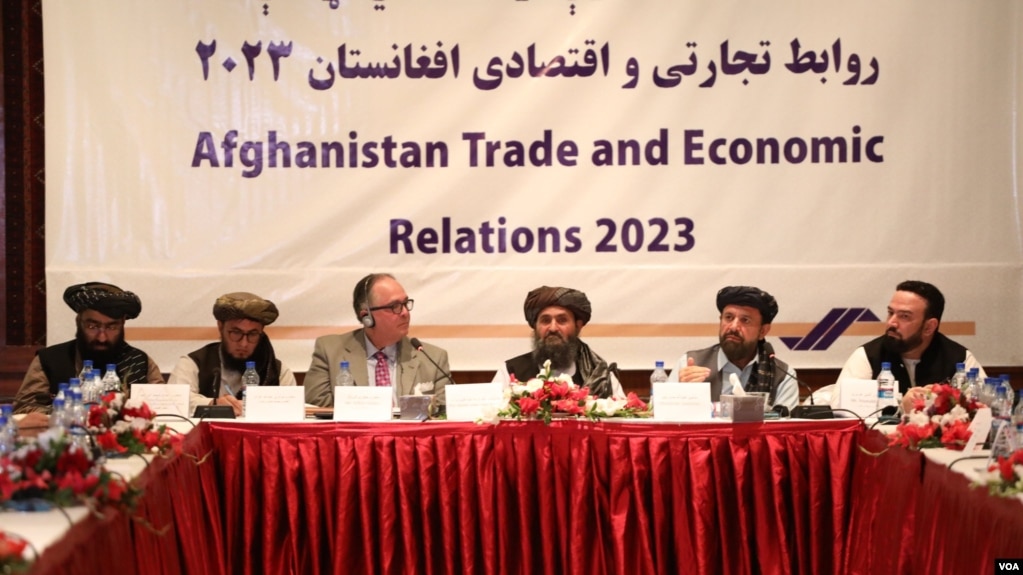
President of the U.S. Afghan American Chamber of Commerce Jeffrey Grieco, third from left, and Taliban Deputy Prime Minister for Economic Affairs Abdul Ghani Baradar, center, co-host a business meeting in Kabul, Afghanistan, on Sept. 6, 2023. (Taliban Economic Commission via VOA)
An American private sector delegation opened meetings in Afghanistan with officials and local counterparts Wednesday in the first interaction since the Taliban seized power from a U.S.-backed government two years ago.

Jeffrey Grieco, president of the Afghan American Chamber of Commerce, or AACC, in the United States, is leading the delegation.

Addressing a televised meeting in Kabul of business representatives that Greico co-hosted with Taliban Deputy Prime Minister for Economic Affairs Abdul Ghani Baradar, he said the U.S. government backs the visit.

A spokesperson from the U.S. State Department acknowledged that a delegation from the American Chamber of Commerce in Afghanistan and “individuals with business interests” had traveled to Kabul.

“The United States stands with the people of Afghanistan as they work to rebuild their economy,” the spokesperson told VOA in an emailed statement.

American businessman Grieco credited de facto Afghan authorities for establishing peace in the country, saying they have also “greatly eliminated” corruption. “It’s not all gone, but it’s mostly gone.”

He said his team is seeking to elevate private sector activities and explore ways to ease hardships facing Afghans over the past two years.

“The next year is going to be equally hard as the donors are reducing funding for Afghanistan, both humanitarian food security and other funding, at a key moment when Afghanistan needs funding for humanitarian purposes,” he said.

On Tuesday, the U.N. World Food Program announced that a “massive funding shortfall” had forced it to cut rations for 10 million people in the country this year, warning that time is running out to avert catastrophe in Afghanistan.

“The private sector can be a powerful agent of change and an agent of support when a country like Afghanistan is suffering,” Grieco said at the event, where local women business leaders were also in attendance.

“We think that business is the way to increase knowledge and increase more program activities for the core in Afghanistan, and you are great examples for us,” he told the Afghan female participants.

Barader said in his keynote speech that his government had established nationwide “comprehensive security” and “straightforward investment regulations” to attract domestic and foreign investments in Afghanistan.

The Taliban deputy prime minister cited several mining contracts signed in Kabul last month with Asian and European investors, including some from China, Turkey, Iran and Britain, worth almost $6.5 billion.

Grieco pledged to work closely with Bradar’s office to promote business-to-business ties, stressing the need for the Taliban to ensure security and protection of investment assets.

“What we saw and heard this week is that the Emirate government is ready for a market-based economic system for Afghanistan,” Grieco said, using the official title of the Taliban administration, the “Islamic Emirate of Afghanistan.”

“The last [Afghan] government didn’t even understand what a market-based economic system is,” he said.

The president of the U.S.-based AACC said his team has been working in Washington with banking sector representatives to help facilitate the return of Afghanistan’s frozen foreign exchange reserves of about $9 billion.

Grieco explained to the audience that the funds are in the U.S. central bank and European countries. He noted that the money cannot be returned to Afghanistan’s central bank for the time being due to economic sanctions on the Taliban.

“We need the Afghan Bankers’ Association to work tougher now to figure out how to approach the return of the commercial bank assets because there has been a change in our government’s thinking in the last few months,” Grieco said. “They are now willing to consider the return of those assets.”

While speaking to the Kabul gathering, Arthur Groom, a longtime international gemstone investor in Afghanistan, said that while some U.S. investors left the country after the Taliban takeover, his company stayed.

“We need to change some minds … because all I have heard here in many meetings is that it’s not safe here, women are not happy here, and the kids aren’t going to the schools, it’s dirty here. It’s completely opposite from what I saw,” Groom said.

Groom said his investment in Afghanistan aims to bring technology into the country to modernize the mining sector and teach modern technology in gem-cutting to enable locals, including the government, to benefit from their natural resources.

The Taliban reclaimed power in August 2021 as the U.S.-led NATO troops withdrew from the country after almost 20 years of war with the then-Taliban insurgents.

The new fundamentalist authorities have since imposed their strict interpretation of Islamic law, known as Sharia, banning girls from schools beyond the sixth grade, barring many women from workplaces, including those working for aid agencies, and prohibiting their entry into public parks, gyms and bathhouses.

The restrictions have deterred the international community from recognizing the Taliban government. However, Afghanistan’s neighbors and many regional countries have retained or reopened their embassies in Kabul following the power shift two years ago.

The Taliban said they had established peace in Afghanistan and almost eliminated illicit narcotics production to address international concerns, arguing that their policies align with Afghan culture and Islam.

“The rest is our internal matter, and no one should interfere in it like we don’t interfere in other countries’ affairs,” Taliban Foreign Minister Amir Khan Muttaqi said last week in a speech in Kabul in response to criticism of their treatment of Afghan women and other alleged human rights abuses.

The U.S. State Department spokesperson said in remarks to VOA that it continues to advise U.S. citizens against traveling to Afghanistan because of civil unrest, armed conflict, crime, terrorism and kidnapping. “The Department of State assesses that the risk of kidnapping or violence against U.S. citizens in Afghanistan is high,” the spokesperson said.

US Business Delegation Makes Rare Visit to Taliban-Run Afghanistan
read more

New UN Report Charts the Emirate’s Treatment of Detainees: Allegations of torture and ill-treatment

Kate Clark

Afghanistan Analysts Network

UNAMA has released its first report dedicated to the treatment of detainees since the Taleban takeover and alleges that the use of torture by the police and General Directorate of Intelligence (GDI) is “systemic.” The report details methods of torture familiar to earlier generations of detainees – electric shocks, beating and suspension – but also a new one – waterboarding – presumably learned from the CIA. The report also traces violations of due process, such as forced confessions, being held incommunicado, not notifying a detainee’s family of the arrest. Upholding these rights, UNAMA says, is crucial for preventing torture and helping to ensure fair trials. The Islamic Emirate has denied the allegations. AAN’s Kate Clark has been reading the report and the Emirate’s rebuttal.

UNAMA has reported regularly on the treatment of security detainees since 2011; its earliest reports on the arbitrary detention of ‘non conflict-related detainees’ were published in 2009. All can be read here.

Previous reports by AAN concerning torture and detentions have included extensive reporting from the Islamic Republic era and the actions of the then intelligence agency, the NDS, Afghan police and CIA-proxy forces, as well as United States forces, both CIA and military, operating at CIA black sites, US military forward operating bases, Bagram airbase and Guantanamo Bay. 

UNAMA has said it had documented more than 1,600 human rights violations and that just under half of these were acts of torture and ‘ill-treatment’, which includes cruel, inhuman or degrading treatment or punishment. The allegations were drawn from more than 130 in-depth interviews, carried out between 1 January 2022 and 31 July 2023 with Afghans, including 24 women, who had been held in police lock-ups, GDI detention centres and provincial prisons. It covers both security and criminal detainees.[1] The reported violations took place in 29 of Afghanistan’s 34 provinces.

UNAMA attributed just over half of the violations (57 per cent) to the GDI, the body charged with maintaining Afghanistan’s “internal and external security, which encompasses treason, espionage, terrorism and anti-government propaganda,” and just under half (47 per cent) to the police, who come under the command of the Ministry of Interior; the police have “jurisdiction over general law enforcement and public security.” The remaining one per cent of violations were allegedly carried out in Afghanistan’s prisons.

As to those whom UNAMA documented as having been abused while in detention, 24 per cent were journalists or civil society activists; 21 per cent were former government officials (seven per cent civilians; and 14 per cent, security and defence personnel); nine per cent were (actually or perceived to be) affiliated with armed groups (NRF or ISKP) and the remaining 44 per cent were individuals with no particular affiliation. Two per cent had been detained (only by the GDI) because they were family members of people whom it wanted information about.

Unlike most of its previous reporting, UNAMA did not distinguish between detainees held on ‘ordinary’ criminal and security-related charges. It has also not identified the facilities where torture was most prevalent. The historical pattern for security-related detainees under the Republic, and under earlier governments, was for the bulk of torture to be committed in a few locations, especially certain intelligence agency directorates, such as Counter-Terrorism (numbered successively as Directorate 5, 90, 241) and Investigations (17, 40, 501) in Kabul, and by particular police and other forces – Kandahar police and NDS featured prominently in UNAMA reporting during the Republic era, for example, as did the various CIA-proxy forces. UNAMA does not say whether such clustering in the use of torture has persisted into the new era, but if it were able to do so, identifying the facilities and forces would add an extra level of accountability to UNAMA reporting.

Ill-treatment during arrests

UNAMA’s report has documented how arrests are often accompanied by ‘excessive force’; international human rights norms require the use of force to be proportionate and as a measure of last resort only. Numerous interviewees, said UNAMA, recounted how security forces had come to their place of work or home or dragged them from cars, delivering “beatings and kicks, including when they were already on the ground, and being struck with the butts of weapons… insulting [them], often restrain[ing] their hands, as well as blind-folded or hooded them, and forced individuals into vehicles to be transported elsewhere.” Rarely did the officials produce warrants or clearly identify themselves.

UNAMA said the experience for the detainee was “akin to being kidnapped rather than arrested,” particularly when an arrest was accompanied by beating, restraints, blindfolding or hooding. It said this alone “would instill a justifiable fear in those detained of imminent harm or being killed, causing mental suffering which could meet the threshold of severity required to constitute torture or other forms of ill-treatment.”

Torture under the Islamic Emirate of Afghanistan

The descriptions of torture and ill-treatment once detainees were in custody, reported to UNAMA, will sound familiar to anyone who has monitored detentions in Afghanistan over the decades. Here are the accounts of two individuals:

For eight days, I was tortured, it was always at night not during the day. I was taken to a room specifically for torture. There were different methods of torture used on me. I was beaten four or five times and when I was becoming unconscious then they threw water on me to make me come around, be conscious. It was becoming cold at night. During the first two days they were beating my feet. I couldn’t wear shoes as my feet were swollen. Then they beat me with power cables and pipes. Then they used a portable electric shock machine on me.

Interview of 25 May 2023, GDI custody, quoted by UNAMA p24

He told his fighters to lay me down without giving me the chance to answer his questions. They kicked me up to my head, and all parts of my body. Two of them took a piece of wood and beat me. I cried for help. Four of them held my hands and feet, and one of them put his foot on my neck and pressured it that affected seriously my breathing. I felt that I would lose my life. After this they stopped torturing me. 

Interview or 9 November 2022, police custody, quoted by UNAMA p 24

UNAMA listed the following methods of torture being used:

  • being beaten by numerous means, including being punched or kicked, struck with the butts of weapons, typically around the head or shoulders, or with other instruments, such as metal piping or cables, to their backs or the soles of their feet, often while restrained. Some described the beatings as so severe they lost consciousness. UNAMA said beatings comprised the overwhelming majority of the 259 instances of physical aggressions and were attributable to police and GDI alike;
  • receiving electric shocks to various parts of their body, causing some to lose consciousness (11 instances, 4 attributable to police; 7 to GDI);
  • being choked or suffocated, including by hand or wire, or having a towel or plastic bags placed over their heads or faces (9 instances, one attributable to police, 8 to GDI);
  • being hung from the ceiling by their hands (4 instances, all attributable to de facto GDI) and cuffed in stress positions (3 instances, attributable to de facto GDI);
  • having pipes with water forced in their mouths (5 instances, 3 attributable to police and 2 to GDI);
  • being left outside in cold weather during winter for extended periods (2 instances, both attributable to GDI); and
  • seeing a GDI member place a big stone on the stomach of another detainee whose hands were cuffed.

The security services of the Islamic Emirate appear to mostly use the same torture methods as their predecessors. Beatings, suspension, stress positions and electric shocks have been reported by former detainees back through the 2000s, the 1990s and 1980s to when, in 1980, the KGB helped set up the Afghan intelligence agency in the form it now takes (for more detail on 1978-2002 period, see the Afghanistan Justice Project report). However, there is a new twist – forcing water into the mouths of prone detainees so that they experience drowning. The CIA did not invent ‘waterboarding’, but did introduce it to Afghanistan in their interrogations of ‘War on Terror’ detainees. Presumably, some of Afghanistan’s current security officials learned the technique through experience. (For more on the history of this method of torture and its current, euphemistic name, see this 2008 article from The New York Times Magazine.[2])

The UNAMA report also documented other acts “causing mental suffering that in the circumstances of detention and coercive interrogation could amount to torture.” They included threats to kill detainees or their family members, blindfolding and restraining detainees for extended periods during custody or throughout coercive questioning. Detainees were also “frequently” screamed at and insulted, including calling women ‘prostitutes’ and men ‘infidels’, ‘bad’ or ‘false’ Muslims’, ‘dogs’ and ‘sons of the Americans’, and having their heads forcibly shaven.

“Numerous interviewees,” UNAMA said, described being blindfolded or hand-cuffed when “taken from their cells, including for questioning, and stayed that way for the duration of their interrogations.” This meant they could not identify who was questioning them and were made “vulnerable to abuse.” The experience of hooding, wrote UNAMA, of being unable to see their interrogators “would have heightened the fear, stress and sense of perceived threat.” It says:

While sensory deprivation of itself can cause psychological effects, including fear, anxiety, high levels of stress, disorientation, and a sense of powerlessness, the Committee Against Torture has found that questioning while applying “hooding under special conditions” constitutes torture, and this is particularly evident where hooding is used in combination with other coercive methods of questioning.

UNAMA also reported the deaths of 18 individuals in custody in the period under review; 11 had been held by the GDI and five by the police.[3] Six of the individuals were former members of the ANSF (the Republic-era Afghan National Security Forces), six “actual or perceived” members of armed opposition groups, such as the Islamic State in Khorasan Province (ISKP) and National Resistance Front (NF), and six unaffiliated with other groups of interest. UNAMA stresses that these deaths were distinct from “the numerous instances of extra-judicial killings committed by de facto authorities, including by de facto security forces, occurring outside contexts of custodial detention,” which this report does not detail.

Forced confessions and other violations of procedural safeguards

The other violations documented by UNAMA were of procedural safeguards and the right to due process. They include being forced to make a confession – it reported 80 instances of this, including at least 40 where the detainee had reported torture or ill-treatment before being forced to sign documents. In almost all instances, reported UNAMA:

[I]nterviewees signed or thumb-printed documents without having read the documents or having had their content explained. In several instances where interviewees expressly asked to know the content, de facto security officials refused to let interviewees read the document or refused to read it aloud to blindfolded or illiterate interviewees.

Where torture is used, said UNAMA, it aims to “obtain forced confessions or other information.” A primary driver of torture, mentioned in previous UNAMA reports focussing on security detainees, is the Afghan criminal justice system’s acceptance of a confession as enough in itself to convict a person without any other supporting evidence.[4] That appears to be unchanged and is a theme which will be returned to.

UNAMA has also documented multiple instances of the following violations: being kept in solitary confinement; not being told the reasons for arrest; not being told of the right to a lawyer; or being allowed to see a lawyer; not having a lawyer present during interrogations; not having their family notified of the arrest and not allowing family contact; no medical check-up; inadequate healthcare and lack of access to independent medical personnel and; not being brought promptly before a judge to whom they could challenge the lawfulness of their detention.

Torture and ill-treatment flourish amid secrecy and lack of due process. Keeping detainees incommunicado, without access to family, lawyers, independent medical personnel or a judge, can, in UNAMA’s words, “increase the risk of undocumented torture and abuse.” It also increases the likelihood that detainees will not get a fair trial.

Laws regarding torture and ill-treatment and the Emirate’s response to the UNAMA report

The prohibition against torture in international law is absolute. Several orders issued by the Emirate’s Supreme Leader, Mawlawi Hibatullah Akhundzada, have suggested that torture is permitted with a court order, but is otherwise strictly banned as an act of zulm (oppression). (Read the orders in the original Pashto and Dari and AAN’s unofficial translation here and our analysis here).[5] At the same time, a Code of Conduct on Reforming the Prisoners’ System, issued by decree by Hibatullah in January 2022, has, said UNAMA:

[N]umerous articles that prohibit torture or ill-treatment of persons deprived of their liberty. The Code of Conduct is clear that security officials, prisoners’ guards and prison personnel are prohibited from torturing, tormenting or punishing prisoners (art. 33). In particular, the Code instructs de facto security authorities to refrain from torture or ill-treatment which “contravenes Sharia principles, ethics and human dignity” of suspects or criminals, starting from the point of arrest, through transfer (arts. 3, 5). It cites as examples of behavior to be avoided, torturing or tormenting suspects, using foul or insulting language in front of people or relatives, and sitting on people’s head or stomachs.

The Code of Conduct, reports UNAMA, says that detainees are “not to be tortured in any way during their detention and nor are confessions to be obtained through force or duress” (article 36) and that security officials “shall not try to extract confessions from a suspect.” They shall also “refrain from threatening, torturing, and videoing them because such a confession does not fall within the orbit of the court’s judgment” (article 39).

Most significantly, says UNAMA, the Code says, “[a] judge cannot pass judgement based on another’s investigation, or testimony or confessions which the investigator or interrogator heard. Recourse requires that the judge hears the confession or witness evidence, deems it admissible and bases their judgment upon it” (article 39). It also cites an instruction to the Supreme Court made by Mawlawi Hibatullah in September 2022 that a confession without evidence has no legal value unless made in front of the judge.

The responses to the report from the Ministry of Interior, GDI and Office of Prisons Administration, and the Supreme Court, collated by the Ministry of Foreign Affairs and published as an appendix to the UNAMA report, make it clear that officials do understand that, under the law, there is an absolute prohibition against torture.

The Ministry of Interior pointed to Decrees 1521 (a copy of which AAN has not seen) and 29 as prohibiting corporal punishment and the torture of detainees and said the ministry’s Human Rights Directorate has also dispatched 16 committees who have visited 60 police units in the capital and provinces to monitor the force. The GDI said the UNAMA report suggested the GDI carried out torture “purposefully and as a means of obtaining confessions,” but that, according to its own code of conduct, this was “prohibited and in all cases of detainees’ torture, the offenders were treated strictly and in accordance with the policy.” The Prisons Administration said: “Fortunately, Sharia (Islamic religious, social, and cultural values), which have been approved to protect and respect fundamental and Islamic rights, prohibit the torture of people even for the purpose of obtaining the truth.”

All three bodies gave detailed rebuttals of the report, including the ways in which they were carrying out their work lawfully. However, the scale and apparent routine nature of the torture reported by UNAMA indicates a gap between what officials have asserted and what actually happens on the ground.[6]

Two of UNAMA’s recommendations – it made similar ones also during the Republic – were to the Supreme Court that it should:

  • Issue clear instructions to de facto judges to ensure that any statement of an accused used in court has been made with full and informed consent, and to ensure that coerced or other unlawfully obtained statements are not admitted or relied upon under any circumstances as evidence in court proceedings;
  • Issue clear instructions to de facto judges to ensure that any allegations that confessions were coerced or unlawfully obtained while in custody are fully investigated and those responsible are held to account.

In response, the Supreme Court said it “appreciates efforts exerted by UNAMA,” but repudiated the allegations. It said it assigns delegations to monitor the situation of detainees and has an inspection team that visits the provinces and monitors the situation of detainees “at close quarters.” It called UNAMA’s accounts of torture, deaths in custody and of the previous administration’s police officers and other employees being killed “far from reality” because such acts would “contravene the Islamic principles.” The Supreme Court did not respond to the issue of forced confessions or relying solely on a confession to convict a person.

Law and practice under the Emirate and the Republic 

In the past, the problem with torture in Afghanistan has lain not in a lack of laws prohibiting it, but in their not being implemented.

Under the Republic, there were at least eight legal instruments prohibiting the use of torture; they included treaty obligations (which still apply) and various laws.[7] Yet, the use of torture against security detainees only really diminished after domestic pressure mounted on countries providing soldiers for the NATO mission. In the end, ISAF decided it could not hand over security detainees to the NDS unless the NDS stopped torturing them and brought in various mechanisms to help/put pressure on the NDS to change its ways (see AAN reporting on this from 2011, 2012, 2013and 2015). That focus did bring down the overall incidence of torture, only for it to rise again after the end of active military engagement by ISAF in 2014, albeit never to the same high levels. In its last report published under the Republic in February 2021, there was a mixed picture: overall, UNAMA was still documenting that one in three security detainees had been tortured; within that, however, the use of torture by the NDS was dramatically lower than had been reported in 2011, by the police, it was somewhat down, and the CIA proxies, the NDS Special Forces and Khost Protection Force, and the Afghan Local Police (ALP) were still using it extensively. In 2023, UNAMA also reported that almost half of the security detainees interviewed had been asked to sign or thumb-print documents which they had not read.

In other words, the use of torture fell, but it was still resorted to, particularly in some facilities and by some forces, in the last years of the Republic. There was still impunity for torture. Despite all the laws and fine words from the Afghan government, both the police and NDS could carry out, order or permit torture without any fear of prosecution or even sacking or demotion. Indeed, UNAMA tracked NDS directors and senior police being promoted after its reporting had identified them as being in command of facilities where torture was carried out. Speaking to officials in private, the author was given the impression that they believed that the fact of the insurgency meant torture was necessary for information-gathering. There was no taboo on using it, at least for security-related (mostly suspected Taleban) detainees. This was also evident in the frequent reliance on confessions by judges, even in the face of allegations of torture.

Similarly, torture against detainees suspected of terrorism or of having information about terrorists was carried out on the 2002 orders of then US President, George Bush, by the CIA and US military. Used in Afghanistan and elsewhere, the torture was referred to euphemistically as ‘enhanced interrogation methods’. In 2014, President Barak Obama admitted to America’s use of torture, but declined to hold anyone accountable (press conference transcript here). He was speaking ahead of the release of a US Senate Intelligence Committee that documented the CIA’s use of torture. An earlier report by the Senate Committee on Armed Services, ‘Inquiry into the Treatment of Detainees in U.S. Custody’, had also documented the use of torture by military personnel. Yet, no US official has been held accountable for this policy in a court of law and the only investigations/prosecutions have been into officials accused of using unauthorised interrogation techniques. Even then, investigations have been administrative rather than criminal, and into low-ranking officials; any punishment has been limited to disciplinary actions, even when detainees were killed. Those ordering and sanctioning the breaches have remained untouched by the law.[8]

That failure by the US and Republic-era governments and courts to hold those carrying out and ordering torture accountable was a factor in leading the former Chief Prosecutor of the International Criminal Court, Fatou Bensouda, to recommend an ICC investigation in 2017.[9] She had reported in 2016 that there were reasonable grounds that the United States military and CIA had “resorted to techniques amounting to the commission of the war crimes of torture, cruel treatment, outrages upon personal dignity, and rape” and the Republic’s national security forces had committed “the war crimes of torture and cruel treatment.” (At the same time, Bensouda also recommended the ICC investigate war crimes and crimes against humanity allegedly committed by the Taleban.)

This report by UNAMA does not distinguish between security detainees and the wider population of detainees, nor does it focus on particular facilities. Nor does it try to draw direct comparisons between the incidence of torture then and now. However, one clear conclusion that can be drawn from UNAMA’s report is how patterns of abuse continue. That waterboarding has been added to the list of methods of torture used by the Afghan state is horrifying, but hardly a surprise, given it may have been used by US forces on some of those now in power in Afghanistan.

In the 2002-­21 era, both American and Afghan politicians and security officials who ordered or carried out torture enjoyed impunity, as had those in power in Kabul in earlier generations. For the cycle to be broken, as UNAMA has repeatedly called for over many years, there has to be accountability, safeguards and a change in what evidence is allowed in court. In this report, UNAMA has put forward many practical suggestions as to how the current government could safeguard the dignity and safety of detainees and allow fair judicial processes. So far, at least, while it has good rules on paper, the Islamic Emirate does not seem to be implementing them.

Edited by Rachel Reid

References

References
↑1 Almost all of UNAMA’s previous reporting covered security detainees only.
↑2 In the article, William Safire describes it as one of the “bland bureaucratic euphemisms” that are coined to “conceal great crimes,” but it is also a torturer’s joke. “It refers to surfboarding,” he says. The torturers are “attaching somebody to a board and helping them surf. Torturers create names that are funny to them.”
↑3 Two of the deaths were in prisons, but UNAMA says their deaths were not attributable to torture or ill-treatment.
↑4 See for example, UNAMA’s 2011 report on the treatment of security detainees: 

In almost all criminal cases in Afghanistan, including national security prosecutions, the case against the defendant is based on a confession, which the court usually finds both persuasive and conclusive of the defendant’s guilt. In most cases confessions are the sole form of evidence or corroboration submitted to courts to support prosecutions. Confessions are rarely examined at trial and rarely challenged by the judge or defence counsel as having been coerced.

↑5 For example, Decree 8, Vol 5, 4 November 2019 says: 

If kashf ul-haal [information gathering] is required from a suspect, only provincial and intelligence officials have the right to keep them in custody for this, and this detention should not go beyond a month. If there is need for more time to collect information, an extension should be requested from the court. Using ta’zib [torture] should be avoided during detention because the authority for ta’zib and tazir punishments [punishments given at the judge’s discretion, rather than being specified in the Quran] lies with the court. If others opt to torture or punish someone, it is not justice but zulm [oppression]. Preventing zulm is a wajeb [obligation], while allowing it to happen is haram [forbidden].

Decree 29, 15 March 2022 says:

If kashf ul-haal is required from a suspect, only security and intelligence officials have the right to keep them in custody for this purpose, but the detention should not exceed ten days. If more time is needed to gather information, an extension should be requested from the court. Likewise, no one can release a prisoner once their sentence is complete without a court order. Any kind of torture should be avoided during detention because torture and tazir are the sole prerogative of the courts. This would not be justice but cruelty: preventing cruelty is a duty, while permitting cruelty is forbidden. 

Compare also order 65, vol 6, 2 November 2020.

↑6 One snapshot, possibly representative, possibly not, of the proceedings of a court in Helmand can be seen in a short documentary film by Victor Blue and Ross McDonnell and published on The New Yorker website. ‘Swift Justice’ shows a judge ordering a man accused of stealing away to be beaten in order to gain a confession. He also rules that a widow does not have to marry her brother-in-law who is insisting on his right to marry her; instead, the judge rules that the woman can go home to her father’s house instead, as she and her father had been asking for.
↑7 Instruments criminalising torture in Afghanistan include: 

Penal Code 1976

If the public service official tortures the accused for the purpose of obtaining a confession or issues an order to this effect, he shall be sentenced to long imprisonment.

7 October 1976, article 275

United Nations Convention Against Torture, acceded 1 April 1987

Constitution of Afghanistan 2004

No one shall be allowed to order torture, even for discovering the truth from another individual who is under investigation, arrest, detention or has been convicted to be punished.

26 January 2004, article 29

Presidential Decree No 129 To Implement The Afghan Fact-Finding Delegation’s Suggestions On The Presence Of Torture And Ill-Treatment In Detention Centres

The Attorney General of the Government of the Islamic Republic of Afghanistan is ordered to prosecute those who violate article 51 of the Prisons and Detentions Law [3] in the light of the findings of the delegation’s report which has reported on the torture and mistreatment of detainees and prisoners, this in order to prevent torture and mistreatment and the conviction of any innocent detainee in the future.

Issued by Hamed Karzai, 16 February 2013, article 1

Criminal Procedure Code 2014

[T]he judicial police officer, prosecutor and court themselves or through means of another person, in any case, are not allowed to force the suspect or accuse to confess using misconduct, narcotics, duress, torture, hypnosis, threat, intimidation, or promising a benefit. If the statements of the suspect or accused person are taken in violation of the provision set forth in paragraph of this article, they shall not be admissible.

5 May 201, article 22

Optional Protocol to the Convention against Torture, acceded April 2017

Decree on the Prohibition of Torture 2017, which later became the Law on the Prohibition of Torture 2018

It defined torture for the first time in Afghan law as:

[A]n act which causes pain or physical or psychological suffering against a suspect, an accused or a convict or any other person for the purpose of forcing [the individual] to confess, give information or force another person to give information or to force an individual not to do an act. (article 3)

5 March 2017

2018 Law on the Prohibition of Torture;

Revisions to the Penal Code 2018

These improved the definition of torture, punishments and other mechanisms for its prevention and provided for compensation for victims of torture.

↑8 A 2017 report by the author detailed the lack of accountability in the US criminal courts in the light of a civil case against the two psychologists who had designed and overseen the implementation of the CIA torture programme which had won compensation for two survivors of CIA torture and the family of Gul Rahman. He was an Afghan who had died of hypothermia after being left semi-naked on a bare concrete floor in a CIA black site near Kabul in November 2002. See ‘Held Accountable for Torture: CIA psychologists compensate family of dead Afghan’.
↑9 The judges of the Pre-Trial Chamber declined to order an investigation into crimes against humanity and war crimes allegedly taking place in Afghanistan at all, a decision overturned on appeal. However, the current Chief Prosecutor has decided to prioritise the investigation of crimes allegedly committed by the Taleban and ISKP, and ignore, for now, those of US and former Afghan government forces. See AAN’s latest report on this, from July 2022: ‘Delaying Justice? The ICC’s war crimes investigation in limbo over who represents Afghanistan’.
Kate Clark

New UN Report Charts the Emirate’s Treatment of Detainees: Allegations of torture and ill-treatment
read more

Chinese Investments in Afghanistan: Strategic ecnomic move or incentive for the Emirate?

When the West withdrew from Afghanistan, many assumed its acquisitive neighbour, China, would reap the economic benefits of the change of government in Kabul. Afghanistan has immense, but largely untouched mineral and hydrocarbon wealth, including strategically valuable metals, such as lithium. That assumption was fed in the first half of 2023 by a flurry of high-level business meetings and some potentially significant contracts between Chinese companies and the Islamic Emirate, including on mining projects. Given the perilous state of Afghanistan’s economy, major investment could help Afghans, as well as potentially giving the Emirate a more stable economic footing. Yet, in reality, Chinese engagement in Afghanistan is still tentative. This raises the familiar question of whether the Chinese government is pursuing real economic interests there or using them to incentivise the Emirate to play along with its security concerns. AAN’s Thomas Ruttig tries to decipher the real deals from the spin, and weighs the arguments in the debate over what Beijing’s primary motivations is – security or economy?
You can preview the report online and download it by clicking the link below.

In the first six months of 2023, there was a series of business deals and contacts between Chinese companies and Islamic Emirate of Afghanistan (IEA) officials in mining and other sectors, supported by China’s leadership in Beijing and its embassy in Kabul. The Afghan media, including state-owned media outlets, covered these deals and meetings between IEA officials and Chinese business delegations extensively and a number of Western researchers have also weighed in on the issue. The coverage has been conspicuously less widespread in Chinese, perhaps reflecting Afghanistan’s relative insignificance for it. Yet, what might seem like ‘small fry’ projects for China – a mere ‘slip road’ in its global Belt and Road Initiative – hold the potential to inject significant income into the Afghan economy and the Emirate’s lean coffers.

While China’s policy remains difficult to read, it is not indecipherable. Its activity in Afghanistan appears big because of two facts: first, the United States-led West has left, and this has opened more space for other actors; secondly, there is relative peace, making business easier. That does not mean, however, that China will (or is inclined to) step in with investments to match the amounts the US invested in Afghanistan between 2001 and 2021.

China’s engagement in Afghanistan needs to be seen in the context of its long-term strategy to secure access to strategic resources, including land and food and, increasingly, its global rivalry with the US. Afghanistan is not an unimportant piece on this chessboard. Given its wealth in minerals, gas and oil, the country has long-term potential for Chinese companies, small or large, private or state-owned, particularly if it remains relatively stable under the Emirate. However, only two years after the Taleban’s second takeover, it is probably too early to say whether China and its (state-run or state-owned subsidiary) companies have now, in contrast to the two decades of the Islamic Republic, really started to work, including on such mega projects as the Ainak copper mine in Logar province.

This report brings together available details on the deals and highlights some contradictions and question marks in the media coverage. It also considers China’s engagement under the Islamic Republic of Afghanistan in order to provide context, and finds that although, at first glance, the Chinese players involved have changed, there is, in fact, some continuity.

Edited by Roxanna Shapour and Rachel Reid

You can preview the report online and download it by clicking the link below.

Thomas Ruttig

\

Chinese Investments in Afghanistan: Strategic ecnomic move or incentive for the Emirate?
read more

Two Years of the Taliban’s ‘Gender Apartheid’ in Afghanistan

Afghan women and girls deserve moral and material support to sustain their resiliency against the Taliban’s worsening repression.

Two years after the Taliban takeover of Afghanistan, the human rights situation in the country is abysmal, with women and girls experiencing the worst of the regime’s policies. There is growing evidence that the Taliban are committing the crime against humanity of gender persecution of women and girls, an assertion Human Rights Watch made in a new report. This summer, the World Economic Forum slated Afghanistan last of the 146 countries it ranked in a study on gender gaps. The U.N. special rapporteur on the situation of human rights in Afghanistan said in a special report that the Taliban’s “large-scale systematic violations of women’s and girls’ fundamental rights in Afghanistan … [constitute] gender persecution and an institutionalized framework of gender apartheid.” The scope of the Taliban’s women’s rights restrictions is truly unprecedented.

Advocates often apply the term “gender apartheid” to describe two-tiered systems of men making all the decisions about political and social affairs and assigning themselves agency in all public spaces while women are relegated to work that can be done from home or traditional gender roles of child-raising and homemaking. This is the situation Afghan women and girls find themselves in today.

Tightening the Noose

In the Taliban’s first press conference after taking Kabul in August 2021, spokesperson Zabiullah Mujahid said that the Taliban were “committed to the rights of women within the framework of Shariah” and that the group would not discriminate against women. While the Taliban have made similar claims in the past, these words quickly proved hollow.

Indeed, immediately after seizing power the Taliban prohibited girls from attending secondary schools and transformed the Ministry of Women’s Affairs, tasked with safeguarding women’s rights in all 34 provinces, into the ironically titled Ministry for the Prevention of Vice and Promotion of Virtue. This marked the beginning of a string of more than 140 orders and decrees that have thoroughly dismantled all existing mechanisms, laws and institutions that were put in place to protect against human rights violations and promote women’s rights.

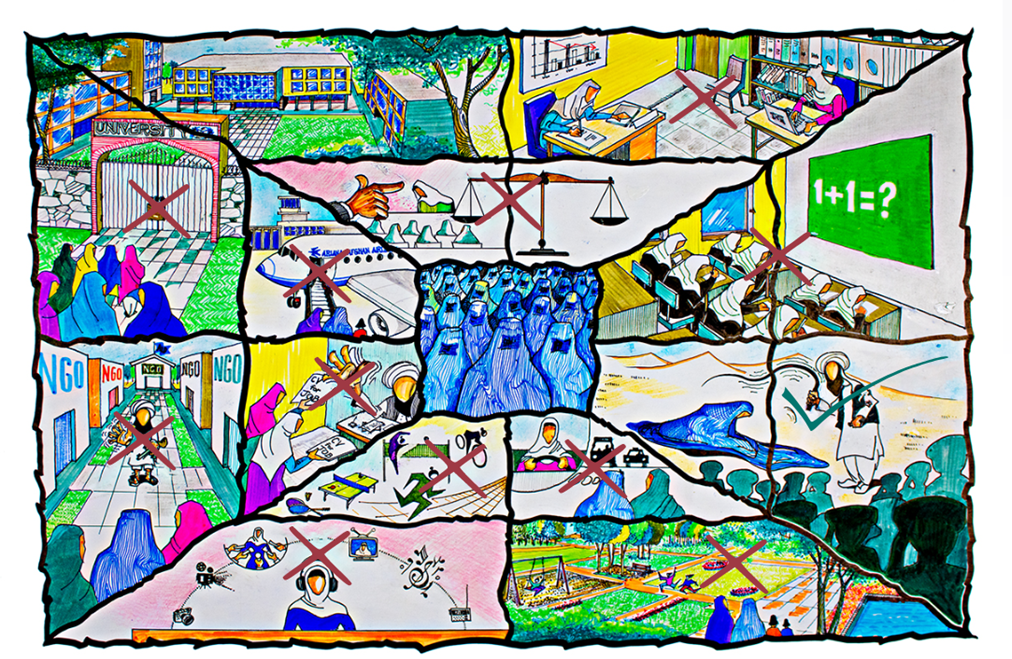
This graphic depicts what Afghan women see through their burqas and serves as a portal to learning more about Taliban restrictions on women’s social and political life.
The regime has renamed and repurposed the Attorney General’s Office, which is now called the General Directorate for Monitoring and Follow up of Decrees and Directives. The Taliban also eliminated institutions like the Afghan Independent Human Rights Commission, the Commission to Eliminate Violence Against Women, shelter and safe houses for battered women, civil society-led protection and empowerment programs and women-led organizations. They also rescinded laws and policies geared toward eliminating violence and harassment against women.

By the end of 2021, the Taliban’s first four months in power showed that they were not going to treat women any different than they did during their previous rule in the 1990s. In the early period of their current rule, Taliban decrees and edicts restricted women from working or teaching at public universities, from working for the government, or traveling beyond 45 miles away from the home without a mahram (or male guardian). The Taliban decreed that women must be accompanied by a mahram — even during surgery — while visiting male health providers

In the last two years, it continued to get worse. The Taliban decreed that the best form of hijab — which they use as a synonym for women’s covering or clothing — is for Afghan women to wear a burqa (i.e., to be fully covered from head to toe) or to simply stay home. The Taliban also banned women from working for the U.N. and NGOs and restricted women from entering public parks and participating in sports. The regime also invalidated thousands of divorce cases decided under the previous government. Their most recent decree called for the closure of beauty salons, leaving some 60,000 women without an income to support their families.

These restrictions and rules continue to be more brutal and draconian. Whereas two years ago, women could travel a short distance without a mahram, today women must have a male guardian to even leave the home. In 2021, women were banned from many jobs, but could work for NGOs or the United Nations. Today, as noted above, they cannot work for these organizations. Until December 2022, universities were open for women, but now female students and instructors are not allowed to enter public or private university campuses.A longer-term threat that has also emerged over the last two years, which would perpetuate the Taliban’s misogyny over future generations, is the “madrassafication” of the education system in Afghanistan. This has three forms: the curriculum of the regular public schools is being revised to accord with the Taliban’s interpretation of Islam; girls and boys are being encouraged to attend madrassas rather than public schools; and new “jihadi madrassas” are being created in every province that provide boys with military and Islamic education. The Taliban are also putting more investment into madrassas for both boys and girls. Parents are further incentivized to send their girls to madrassas because there are fewer harassing raids, like expelling girls under the age to 12 who are taller or physically bigger for their age.

An archive of the Taliban’s decrees and edicts infringing on the rights of Afghans. 

A majority of Afghan citizens oppose the Taliban’s draconian female education restrictions and there are reports of local communities quietly looking the other way. But the Taliban have increased enforcement — establishing the Female Moral Police Department in August 2022, who are deployed to public and private educational institutions and women-only markets to inspect women’s hijab.

But Afghan women are not prepared to concede all that they had achieved over the last two decades. Many have bravely gone to the streets to demand their basic rights despite being met with Taliban violence and repression. While most public protests have largely subsided, they have been replaced with indoor protests with women and girls holding signs in Dari, Pashto and English rejecting Taliban policies. Outside the country, women have issued statements, launched media campaigns and even conducted hunger strikes to urge world leaders and the U.N. to recognize the Taliban’s gender apartheid and hold the regime accountable for crimes against humanity.

It has now been 725 days that girl students above sixth grade have not been able to attend school and 265 days since universities have stopped accepting female students. Under the Taliban today, Afghan women are deprived of their livelihoods, identity, education, employment, leisure, travel, sports and equal access to humanitarian aid. The Taliban dictate what women should or shouldn’t do in the privacy of their homes, even prohibiting listening to music. As a result, Afghan women face serious mental health issues including fear, anxiety, anger, helplessness, insomnia, lack of self-respect and thoughts of suicide and self-harm. The Taliban’s anti-women policies have emboldened the country’s patriarchal norms.

Now What?

The Taliban’s leadership has shown over the last two years that they are unwilling to deliver on the promises about women’s rights made during the Doha Agreement negotiations with the United States. Indeed, they are putting measures in place to effectuate generational change that is alien to hundreds of years of Afghan culture. The response must have equal scope and resolve: to push back with arguments, resources and accountability measures at local, national and international levels over many years.

While a parade of Islamic religious authorities has declared that both traditional and mainstream interpretations of Islam do not relegate women to being objects or second-class citizens, this argument has so far failed to overcome the Taliban’s desire for what they claim is a “100% Islamic system.”

A more pragmatic motivation for social decrees against women could be to avoid defections by the most radical of the Taliban’s supporters to ISIS or other more extreme terrorist groups. The Taliban’s success as an insurgency movement relied on recruiting young male fighters who are themselves from conservative rural areas and/or educated in radical madrassas — often in Pakistan — and were attracted to fight based in part on a call to rid Afghan society of un-Islamic Western values, particularly an alleged disrespect to women. If the Taliban do not deliver on these fighters’ visions of a so-called “pure” Islamic society, this argument goes, they may fight for ISIS and seek to overthrow the Taliban.

“The situation for women and girls is dire and catastrophic. Their rights have been more or less wiped out,” said Richard Bennett, the U.N. special rapporteur for human rights in Afghanistan. 

The problem is that the Taliban’s overriding lesson from their unexpected victory after a grueling decades-long insurgency is that loyalty is one of the most important Islamic virtues and unity is the key to success. Therefore, even though there are plenty of private dissents from important Taliban leaders over women’s rights restrictions, the religious authority of the emir, Sheikh Haibatullah Akhundzada, and the practical recognition that a divided Taliban is weak means that Haibatullah’s distasteful decrees are nonetheless obeyed.

So, what can the international community do? In the face of dogmatic Taliban resistance to change, an “all-of-the-above” strategy has the best chance of success. This should include:

  • Continuing to apply public and private pressure from all sides to prevent normalization of the Taliban’s gender apartheid as other forces of change are applied.
  • Giving political and financial support to international accountability mechanisms including the International Criminal Court, U.N. special rapporteur and entities documenting human rights violations.
  • Providing asylum and protection to victims and survivors of Taliban’s atrocities.
  • Tying international sanctions to women’s rights abuse, not just counter-terrorism rationales.
  • Giving Afghan women a seat at the table in all international diplomatic fora where Afghanistan is being discussed.
  • Funding women’s rights advocacy groups in Afghanistan and abroad along with supporting Afghan media to have female reporters and guests and to cover women’s rights stories.
  • Funding private education of girls through all available means — online for those with internet access; underground for those with community-based “secret schools”; through scholarships at high school and university levels to study abroad.
  • Amplifying messages of Islamic scholars and political leaders from Muslim majority countries that show how classical Islamic scholarship and contemporary practice in the Muslim world contradict the Taliban’s restrictive women’s rights decrees — especially to religious leaders and constituents in Afghanistan that are not Taliban but may not know about comparative Islamic practices.

A fundamental principle of international law is that the world has an obligation to combat atrocities committed in another jurisdiction, including for crimes against humanity like gender persecution and gender apartheid. To that, one can add an extra degree of moral duty for the United States and allied donor countries that created the conditions for the Taliban’s return to power without meaningful safeguards for the rights of women, which were a central objective of the West’s governance and democracy policies.

Afghan women deserve moral and material support to sustain their resiliency against the Taliban’s gender persecution. The United States and the international community should continue to firmly communicate to the Taliban that their regime’s legitimacy is dependent on protection, respect and guarantee of the rights of all Afghans regardless of their gender and social and political affiliation, and fulfillment of their obligation under international laws and conventions to which Afghanistan is a party to. The United States and the international community must make it clear that there will be legal accountability for the crimes against women that have occurred.

Two Years of the Taliban’s ‘Gender Apartheid’ in Afghanistan
read more

Afghanistan’s Two Years of Humanitarian Crisis Under the Taliban

The Taliban’s takeover of Afghanistan in August 2021 immediately exacerbated the country’s precarious humanitarian situation, leaving millions in need of food assistance and other support. Two years later, the situation remains dire, with Afghan women and girls acutely affected by the Taliban’s draconian restrictions on their daily lives. The international community continues to struggle to find a balance between providing desperately needed aid while also pressuring the regime in Kabul to moderate its hardline policies. While Afghans need emergency assistance, the country will continue to deal with cycles of crises until its deep-seated economic challenges are addressed.
Mercy Corps’ Dayne Curry, Norwegian Refugee Council’s Becky Roby, CARE USA’s Ellen Bevier and the International Rescue Committee’s Anastasia Moran discuss the humanitarian situation facing the country, how woman and girls have been impacted by the Taliban’s restrictions, and how the United States can help address the crisis.

It’s been two years since the Taliban took control of Afghanistan. Can you tell us what you are seeing as far as humanitarian needs are concerned?

Curry: The humanitarian response in Afghanistan simply cannot keep pace with the country’s worsening conditions. More than 29 million remain in need, over half of whom are children, while 15.3 million people are experiencing acute food insecurity. Almost 60% of households face barriers accessing safe water, and cholera and other diseases pose significant threats. Meanwhile, 22.1 million people require protection assistance, and 8.7 million children need education support.

These needs skyrocketed with the collapse of the former government and the subsequent suspension of international aid. Two years later, shocks from recurrent drought and seasonal flooding continue to threaten Afghanistan’s critical agriculture sector and limit access to clean water. Additionally, policies restricting individual freedoms, particularly those of women and girls, impede the humanitarian response, and Afghanistan’s authorities lack the capacity to provide services to their people.

Compounding these challenges is the reality of the international community’s declining commitment to Afghanistan. Support for long-term economic growth all but ended with the suspension of development assistance. Though some humanitarian assistance continues, the U.N.’s request is less than 30% funded, and humanitarian organizations must navigate a complex set of sanctions that complicate aid delivery. While programs in food security and health are better funded than others, the funding shortfall for clean water and irrigation exacerbates the impacts of the drought on agriculture, livelihoods and health. In summary, this combination of political and environmental factors has only served to deepen humanitarian needs over the past two years.

What are the key factors driving the humanitarian need in Afghanistan?

Roby: Today’s humanitarian crisis in Afghanistan is primarily a political one. Since the Taliban’s takeover, the regime has enacted a series of egregious edicts and restrictions that have had a devastating impact on the population, particularly for women and girls. These policies have vastly undermined the country’s international relations resulting in political and economic isolation.

As a mark of moral outrage, Western donors and international financial institutions, including the World Bank, have ceased, paused or greatly reduced funding to development programs. Meanwhile, the economic collapse in the immediate aftermath of the Taliban takeover has transitioned into chronic economic paralysis, caused largely by overcompliance to sanctions and banking sector de-risking and exacerbated by the choices of the country’s leadership.

While humanitarian actors provide life-saving assistance, these interventions cannot by themselves improve the situation for affected Afghans, leaving the population trapped in a cycle of repeated, protracted crises. The Afghan people need long-term sustainable solutions, and this requires not only increased humanitarian assistance, but greater economic stability and the resumption of development assistance. None of which will happen if the politics remain paralyzed.

We have seen the Taliban issue several new edicts over the past two years. How have these edicts impacted women and girls in Afghanistan?

Bevier: Since the de facto authorities came to power, they have implemented policies aimed to erase women and girls’ participation in public life, including bans on girls’ education beyond the sixth grade and women’s employment in humanitarian work. Women and girls in Afghanistan already faced increased protection risks and higher levels of humanitarian need before the regime change in Kabul. Studies indicate that 87% of Afghan women had experienced at least one form of physical, sexual or psychological violence, and 62% experienced multiple forms. With more than 17 million people facing acute hunger in 2023, women and girls are disproportionally affected and become more likely to resort to high-risk coping strategies.

The edicts against education and NGO work have deepened the vulnerability of Afghan women and girls by increasing the barriers to access aid. The education ban has also hindered educational outcomes and led to mental health challenges for women and girls who are now uncertain of their futures and isolated from support systems.

The work of national and local NGOs, especially women-led organizations, bears the brunt of these constraints including funding gaps. Despite these challenges, NGOs continue to operate in sectors and locations where the participation of female staff in the response is possible and where aid can be delivered in a principled manner.

As Afghan women and girls experience increased restriction and humanitarian need, the international community must stand beside them. Support to national and international NGOs, including women-led organizations, must continue to ensure that women and girls have a lifeline amid the myriad challenges they face.

Can you describe what you see as some of the biggest challenges for providing aid in Afghanistan?

Moran: Afghanistan is a complicated operating environment — as are many contexts where aid is required. The banking system’s inability to fully function requires workarounds, including U.N. cash shipments to pay staff and run operations. But many local NGOs lack access to either international money transfers or the U.N. cash system.

Humanitarian actors do face bureaucratic constraints, but we respond by negotiating to ensure delivery of aid based on need can continue. Despite these barriers, humanitarian actors are still able to operate at scale and in a principled way today. Amid a multitude of challenges, the biggest threat to our work today is dire underfunding, exacerbated by a high degree of misinformation and politicization of the situation in Afghanistan. While some worry that aid to the Afghan people enables the Taliban, humanitarian assistance does not go through governments or de facto authorities in Afghanistan or anywhere else. It is provided independently through U.N. agencies and NGOs to directly help civilians regardless of whose control they live under. NGOs, U.N. agencies and donors have layers of robust monitoring and reporting measures. In fact, the humanitarian response in Afghanistan is one of the most scrutinized responses globally.

What actions can U.S. policymakers take to address the current crisis?

Moran: Underfunding poses an existential threat. Lifesaving programs are shutting down, over 200 health facilities have stopped services and hard-won progress to bring down food insecurity is in jeopardy. The United States should scale up its own humanitarian aid and galvanize other donors to do the same. Congress should meet the Biden administration’s appeal for additional humanitarian aid as part of its supplemental funding request. Moreover, the United States should direct more funding to local civil society organizations, including women-led ones, who face the highest risk of closure.

But 40 million Afghans also need more than short-term stop gap measures. The World Bank-managed Afghanistan Resilience Trust Fund (ARTF) could be part of a more systematic approach to break the cycle of crisis. It funds basic services, including major health and education programs, as well as livelihood programs to reduce aid dependency — all delivered independently via the U.N. and NGOs. The United States should lead efforts to replenish this dwindling fund, extend it past its 2025 expiration and expand its scope, including support for small-scale infrastructure projects, the rehabilitation of basic systems and climate resilience programs.

Longer term, the crisis will not abate until the underlying economic drivers are addressed. This requires continued engagement with foreign banks to allow financial transactions, a regular process to bring new banknotes into the country and ease the liquidity crisis and technical assistance to help the Central Bank meet international banking standards and create conducive conditions for the eventual return of frozen Afghan assets.

Across these lines of effort, there remains an urgent need to strengthen the collective approach to international engagement, including via the independent assessment underway mandated by U.N. Security Council resolution 2679, to identify clear conditions and strategies to address the complex political, economic, development and humanitarian crises underway.

Dayne Curry is the Afghanistan country director at Mercy Corps.

Becky Roby is an advocacy manager for NRC in Afghanistan at the Norwegian Refugee Council.

Ellen Bevier is a senior humanitarian policy advocate at CARE USA.

Anastasia Moran is the associate director for U.S. Advocacy at the International Rescue Committee.

Afghanistan’s Two Years of Humanitarian Crisis Under the Taliban
read more

THE FINAL DAYS

By Franklin Foer

The Atlantic

October 2023 issue

Joe Biden was determined to get out of Afghanistan—no matter the cost.

August 1

August is the month when oppressive humidity causes the mass evacuation of official Washington. In 2021, White House Press Secretary Jen Psaki piled her family into the car for a week at the beach. Secretary of State Antony Blinken headed to the Hamptons to visit his elderly father. Their boss left for the leafy sanctuary of Camp David.

They knew that when they returned, their attention would shift to a date circled at the end of the month. On August 31, the United States would officially complete its withdrawal from Afghanistan, concluding the longest war in American history.

The State Department didn’t expect to solve Afghanistan’s problems by that date. But if everything went well, there was a chance to wheedle the two warring sides into some sort of agreement that would culminate in the nation’s president, Ashraf Ghani, resigning from office, beginning an orderly transfer of power to a governing coalition that included the Taliban. There was even discussion of Blinken flying out, most likely to Doha, Qatar, to preside over the signing of an accord.

It would be an ending, but not the end. Within the State Department there was a strongly held belief: Even after August 31, the embassy in Kabul would remain open. It wouldn’t be as robustly staffed, but some aid programs would continue; visas would still be issued. The United States—at least not the State Department—wasn’t going to abandon the country.

There were plans for catastrophic scenarios, which had been practiced in tabletop simulations, but no one anticipated that they would be needed. Intelligence assessments asserted that the Afghan military would be able to hold off the Taliban for months, though the number of months kept dwindling as the Taliban conquered terrain more quickly than the analysts had predicted. But as August began, the grim future of Afghanistan seemed to exist in the distance, beyond the end of the month, not on America’s watch.

That grim future arrived disastrously ahead of schedule. What follows is an intimate history of that excruciating month of withdrawal, as narrated by its participants, based on dozens of interviews conducted shortly after the fact, when memories were fresh and emotions raw. At times, as I spoke with these participants, I felt as if I was their confessor. Their failings were so apparent that they had a desperate need to explain themselves, but also an impulse to relive moments of drama and pain more intense than any they had experienced in their career.

During those fraught days, foreign policy, so often debated in the abstract, or conducted from the sanitized remove of the Situation Room, became horrifyingly vivid. President Joe Biden and his aides found themselves staring hard at the consequences of their decisions.

Even in the thick of the crisis, as the details of a mass evacuation swallowed them, the members of Biden’s inner circle could see that the legacy of the month would stalk them into the next election—and perhaps into their obituaries. Though it was a moment when their shortcomings were on obvious display, they also believed it evinced resilience and improvisational skill.

And amid the crisis, a crisis that taxed his character and managerial acumen, the president revealed himself. For a man long caricatured as a political weather vane, Biden exhibited determination, even stubbornness, despite furious criticism from the establishment figures whose approval he usually craved. For a man vaunted for his empathy, he could be detached, even icy, when confronted with the prospect of human suffering.

When it came to foreign policy, Joe Biden possessed a swaggering faith in himself. He liked to knock the diplomats and pundits who would pontificate at the Council on Foreign Relations and the Munich Security Conference. He called them risk-averse, beholden to institutions, lazy in their thinking. Listening to these complaints, a friend once posed the obvious question: If you have such negative things to say about these confabs, then why attend so many of them? Biden replied, “If I don’t go, they’re going to get stale as hell.”

From 12 years as the top Democrat on the Senate Foreign Relations Committee—and then eight years as the vice president—Biden had acquired a sense that he could scythe through conventional wisdom. He distrusted mandarins, even those he had hired for his staff. They were always muddying things with theories. One aide recalled that he would say, “You foreign-policy guys, you think this is all pretty complicated. But it’s just like family dynamics.” Foreign affairs was sometimes painful, often futile, but really it was emotional intelligence applied to people with names that were difficult to pronounce. Diplomacy, in Biden’s view, was akin to persuading a pain-in-the-ass uncle to stop drinking so much.

One subject seemed to provoke his contrarian side above all others: the war in Afghanistan. His strong opinions were grounded in experience. Soon after the United States invaded, in late 2001, Biden began visiting the country. He traveled with a sleeping bag; he stood in line alongside Marines, wrapped in a towel, waiting for his turn to shower.

On his first trip, in 2002, Biden met with Interior Minister Yunus Qanuni in his Kabul office, a shell of a building. Qanuni, an old mujahideen fighter, told him: We really appreciate that you have come here. But Americans have a long history of making promises and then breaking them. And if that happens again, the Afghan people are going to be disappointed.

Biden was jet-lagged and irritable. Qanuni’s comments set him off: Let me tell you, if you even think of threatening us … Biden’s aides struggled to calm him down.

In Biden’s moral code, ingratitude is a grievous sin. The United States had evicted the Taliban from power; it had sent young men to die in the nation’s mountains; it would give the new government billions in aid. But throughout the long conflict, Afghan officials kept telling him that the U.S. hadn’t done enough.

The frustration stuck with him, and it clarified his thinking. He began to draw unsentimental conclusions about the war. He could see that the Afghan government was a failed enterprise. He could see that a nation-building campaign of this scale was beyond American capacity.

As vice president, Biden also watched as the military pressured Barack Obama into sending thousands of additional troops to salvage a doomed cause. In his 2020 memoir, A Promised Land, Obama recalled that as he agonized over his Afghan policy, Biden pulled him aside and told him, “Listen to me, boss. Maybe I’ve been around this town for too long, but one thing I know is when these generals are trying to box in a new president.” He drew close and whispered, “Don’t let them jam you.”

Biden developed a theory of how he would succeed where Obama had failed. He wasn’t going to let anyone jam him.

In early february 2021, now-President Biden invited his secretary of defense, Lloyd Austin, and the chairman of the Joint Chiefs of Staff, Mark Milley, into the Oval Office. He wanted to acknowledge an emotional truth: “I know you have friends you have lost in this war. I know you feel strongly. I know what you’ve put into this.”

Over the years, Biden had traveled to military bases, frequently accompanied by his fellow senator Chuck Hagel. On those trips, Hagel and Biden dipped in and out of a long-running conversation about war. They traded theories on why the United States would remain mired in unwinnable conflicts. One problem was the psychology of defeat. Generals were terrified of being blamed for a loss, living in history as the one who waved the white flag.

It was this dynamic, in part, that kept the United States entangled in Afghanistan. Politicians who hadn’t served in the military could never summon the will to overrule the generals, and the generals could never admit that they were losing. So the war continued indefinitely, a zombie campaign. Biden believed that he could break this cycle, that he could master the psychology of defeat.

Biden wanted to avoid having his generals feel cornered—even as he guided them to his desired outcome. He wanted them to feel heard, to appreciate his good faith. He told Austin and Milley, “Before I make a decision, you’ll have a chance to look me in the eyes.”

The date set out by the Doha Agreement, which the Trump administration had negotiated with the Taliban, was May 1, 2021. If the Taliban adhered to a set of conditions—engaging in political negotiations with the Afghan government, refraining from attacking U.S. troops, and cutting ties with terrorist groups—then the United States would remove its soldiers from the country by that date. Because of the May deadline, Biden’s first major foreign-policy decision—whether or not to honor the Doha Agreement—would also be the one he seemed to care most about. And it would need to be made in a sprint.

In the spring, after weeks of meetings with generals and foreign-policy advisers, National Security Adviser Jake Sullivan had the National Security Council generate two documents for the president to read. One outlined the best case for staying in Afghanistan; the other made the best case for leaving.

This reflected Biden’s belief that he faced a binary choice. If he abandoned the Doha Agreement, attacks on U.S. troops would resume. Since the accord had been signed, in February 2020, the Taliban had grown stronger, forging new alliances and sharpening plans. And thanks to the drawdown of troops that had begun under Donald Trump, the United States no longer had a robust-enough force to fight a surging foe.

Biden’s speech contained a hole that few noted at the time. It scarcely mentioned the Afghan people, with not even an expression of best wishes for the nation the U.S. would be leaving behind.

Biden gathered his aides for one last meeting before he formally made his decision. Toward the end of the session, he asked Sullivan, Blinken, and Director of National Intelligence Avril Haines to leave the room. He wanted to talk with Austin and Milley alone.

Instead of revealing his final decision, Biden told them, “This is hard. I want to go to Camp David this weekend and think about it.”

It was always clear where the president would land. Milley knew that his own preferred path for Afghanistan—leaving a small but meaningful contingent of troops in the country—wasn’t shared by the nation he served, or the new commander in chief. Having just survived Trump and a wave of speculation about how the U.S. military might figure in a coup, Milley was eager to demonstrate his fidelity to civilian rule. If Biden wanted to shape the process to get his preferred result, well, that’s how a democracy should work.

On april 14, Biden announced that he would withdraw American forces from Afghanistan. He delivered remarks explaining his decision in the Treaty Room of the White House, the very spot where, in the fall of 2001, George W. Bush had informed the public of the first American strikes against the Taliban.

Biden’s speech contained a hole that few noted at the time. It scarcely mentioned the Afghan people, with not even an expression of best wishes for the nation that the United States would be leaving behind. The Afghans were apparently only incidental to his thinking. (Biden hadn’t spoken with President Ghani until right before the announcement.) Scranton Joe’s deep reserves of compassion were directed at people with whom he felt a connection; his visceral ties were with American soldiers. When he thought about the military’s rank and file, he couldn’t help but project an image of his own late son, Beau. “I’m the first president in 40 years who knows what it means to have a child serving in a war zone,” he said.

Biden also announced a new deadline for the U.S. withdrawal, which would move from May 1 to September 11, the 20th anniversary of the attack that drew the United States into war. The choice of date was polemical. Although he never officially complained about it, Milley didn’t understand the decision. How did it honor the dead to admit defeat in a conflict that had been waged on their behalf? Eventually, the Biden administration pushed the withdrawal deadline forward to August 31, an implicit concession that it had erred.

But the choice of September 11 was telling. Biden took pride in ending an unhappy chapter in American history. Democrats might have once referred to Afghanistan as the “good war,” but it had become a fruitless fight. It had distracted the United States from policies that might preserve the nation’s geostrategic dominance. By leaving Afghanistan, Biden believed he was redirecting the nation’s gaze to the future: “We’ll be much more formidable to our adversaries and competitors over the long term if we fight the battles for the next 20 years, not the last 20.”

August 6–9

in late june, Jake Sullivan began to worry that the Pentagon had pulled American personnel and materiel out of Afghanistan too precipitously. The rapid drawdown had allowed the Taliban to advance and to win a string of victories against the Afghan army that had caught the administration by surprise. Even if Taliban fighters weren’t firing at American troops, they were continuing to battle the Afghan army and take control of the countryside. Now they’d captured a provincial capital in the remote southwest—a victory that was disturbingly effortless.

Sullivan asked one of his top aides, Homeland Security Adviser Elizabeth Sherwood-Randall, to convene a meeting for Sunday, August 8, with officials overseeing the withdrawal. Contingency plans contained a switch that could be flipped in an emergency. To avoid a reprise of the fall of Saigon, with desperate hands clinging to the last choppers out of Vietnam, the government made plans for a noncombatant-evacuation operation, or NEO. The U.S. embassy would shut down and relocate to Hamid Karzai International Airport (or HKIA, as everyone called it). Troops, pre-positioned near the Persian Gulf and waiting at Fort Bragg, in North Carolina, would descend on Kabul to protect the airport. Military transport planes would haul American citizens and visa holders out of the country.

By the time Sherwood-Randall had a chance to assemble the meeting, the most pessimistic expectations had been exceeded. The Taliban had captured four more provincial capitals. General Frank McKenzie, the head of U.S. Central Command, filed a commander’s estimate warning that Kabul could be surrounded within about 30 days—a far faster collapse than previously predicted.

McKenzie’s dire warning did strangely little to alter plans. Sherwood-Randall’s group unanimously agreed that it was too soon to declare a NEO. The embassy in Kabul was particularly forceful on this point. The acting ambassador, Ross Wilson, wanted to avoid cultivating a sense of panic in Kabul, which would further collapse the army and the state. Even the CIA seconded this line of thinking.

August 12

at 2 a.m., Sullivan’s phone rang. It was Mark Milley. The military had received reports that the Taliban had entered the city of Ghazni, less than 100 miles from Kabul.

The intelligence community assumed that the Taliban wouldn’t storm Kabul until after the United States left, because the Taliban wanted to avoid a block‑by‑block battle for the city. But the proximity of the Taliban to the embassy and HKIA was terrifying. It necessitated the decisive action that the administration had thus far resisted. Milley wanted Sullivan to initiate a NEO. If the State Department wasn’t going to move quickly, the president needed to order it to. Sullivan assured him that he would push harder, but it would be two more days before the president officially declared a NEO.

With the passage of each hour, Sullivan’s anxieties grew. He called Lloyd Austin and told him, “I think you need to send someone with bars on his arm to Doha to talk to the Taliban so that they understand not to mess with an evacuation.” Austin agreed to dispatch General McKenzie to renew negotiations.

August 13

austin convened a videoconference with the top civilian and military officials in Kabul. He wanted updates from them before he headed to the White House to brief the president.

Ross Wilson, the acting ambassador, told him, “I need 72 hours before I can begin destroying sensitive documents.”

“You have to be done in 72 hours,” Austin replied.

The Taliban were now perched outside Kabul. Delaying the evacuation of the embassy posed a danger that Austin couldn’t abide. Thousands of troops were about to arrive to protect the new makeshift facility that would be set up at the airport. The moment had come to move there.

Abandoning an embassy has its own protocols; they are rituals of panic. The diplomats had a weekend, more or less, to purge the place: to fill its shredders, burn bins, and disintegrator with documents and hard drives. Anything with an American flag on it needed destroying so it couldn’t be used by the enemy for propaganda purposes.

Wisps of smoke would soon begin to blow from the compound—a plume of what had been classified cables and personnel files. Even for those Afghans who didn’t have access to the internet, the narrative would be legible in the sky.

August 14

on saturday night, Antony Blinken placed a call to Ashraf Ghani. He wanted to make sure the Afghan president remained committed to the negotiations in Doha. The Taliban delegation there was still prepared to agree to a unity government, which it might eventually run, allocating cabinet slots to ministers from Ghani’s government. That notion had broad support from the Afghan political elite. Everyone, even Ghani, agreed that he would need to resign as part of a deal. Blinken wanted to ensure that he wouldn’t waver from his commitments and try to hold on to power.

Although Ghani said that he would comply, he began musing aloud about what might happen if the Taliban invaded Kabul prior to August 31. He told Blinken, “I’d rather die than surrender.”

August 15

the next day, the presidential palace released a video of Ghani talking with security officials on the phone. As he sat at his imposing wooden desk, which once belonged to King Amanullah, who had bolted from the palace to avoid an Islamist uprising in 1929, Ghani’s aides hoped to project a sense of calm.

During the early hours, a small number of Taliban fighters eased their way to the gates of the city, and then into the capital itself. The Taliban leadership didn’t want to invade Kabul until after the American departure. But their soldiers had conquered territory without even firing a shot. In their path, Afghan soldiers simply walked away from checkpoints. Taliban units kept drifting in the direction of the presidential palace.

Rumors traveled more quickly than the invaders. A crowd formed outside a bank in central Kabul. Nervous customers jostled in a chaotic rush to empty their accounts. Guards fired into the air to disperse the melee. The sound of gunfire reverberated through the nearby palace, which had largely emptied for lunch. Ghani’s closest advisers pressed him to flee. “If you stay,” one told him, according to The Washington Post, “you’ll be killed.”

From the March 2022 issue: George Packer on America’s betrayal of Afghanistan

This was a fear rooted in history. In 1996, when the Taliban first invaded Kabul, they hanged the tortured body of the former president from a traffic light. Ghani hustled onto one of three Mi‑17 helicopters waiting inside his compound, bound for Uzbekistan. The New York Times Magazine later reported that the helicopters were instructed to fly low to the terrain, to evade detection by the U.S. military. From Uzbekistan, he would fly to the United Arab Emirates and an ignominious exile. Without time to pack, he left in plastic sandals, accompanied by his wife. On the tarmac, aides and guards grappled over the choppers’ last remaining seats.

When the rest of Ghani’s staff returned from lunch, they moved through the palace searching for the president, unaware that he had abandoned them, and their country.

At approximately 1:45 p.m., Ambassador Wilson went to the embassy lobby for the ceremonial lowering of the flag. Emotionally drained and worried about his own safety, he prepared to leave the embassy behind, a monument to his nation’s defeat.

Wilson made his way to the helicopter pad so that he could be taken to his new outpost at the airport, where he was told that a trio of choppers had just left the presidential palace. Wilson knew what that likely meant. By the time he relayed his suspicions to Washington, officials already possessed intelligence that confirmed Wilson’s hunch: Ghani had fled.

Jake Sullivan relayed the news to Biden, who exploded in frustration: Give me a break.

Later that afternoon, General McKenzie arrived at the Ritz-Carlton in Doha. Well before Ghani’s departure from power, the wizened Marine had scheduled a meeting with an old adversary of the United States, Mullah Abdul Ghani Baradar.

Baradar wasn’t just any Taliban leader. He was a co-founder of the group, with Mullah Mohammed Omar. McKenzie had arrived with the intention of delivering a stern warning. He barely had time to tweak his agenda after learning of Ghani’s exit.

McKenzie unfolded a map of Afghanistan translated into Pashto. A circle had been drawn around the center of Kabul—a radius of about 25 kilometers—and he pointed to it. He referred to this area as the “ring of death.” If the Taliban operated within those 25 kilometers, McKenzie said, “we’re going to assume hostile intent, and we’ll strike hard.”

McKenzie tried to bolster his threat with logic. He said he didn’t want to end up in a firefight with the Taliban, and that would be a lot less likely to happen if they weren’t in the city.

Baradar not only understood; he agreed. Known as a daring military tactician, he was also a pragmatist. He wanted to transform his group’s inhospitable image; he hoped that foreign embassies, even the American one, would remain in Kabul. Baradar didn’t want a Taliban government to become a pariah state, starved of foreign assistance that it badly needed.

But the McKenzie plan had an elemental problem: It was too late. Taliban fighters were already operating within the ring of death. Kabul was on the brink of anarchy. Armed criminal gangs were already starting to roam the streets. Baradar asked the general, “Are you going to take responsibility for the security of Kabul?”

McKenzie replied that his orders were to run an evacuation. Whatever happens to the security situation in Kabul, he told Baradar, don’t mess with the evacuation, or there will be hell to pay. It was an evasive answer. The United States didn’t have the troops or the will to secure Kabul. McKenzie had no choice but to implicitly cede that job to the Taliban.

Baradar walked toward a window. Because he didn’t speak English, he wanted his adviser to confirm his understanding. “Is he saying that he won’t attack us if we go in?” His adviser told him that he had heard correctly.

As the meeting wrapped up, McKenzie realized that the United States would need to be in constant communication with the Taliban. They were about to be rubbing shoulders with each other in a dense city. Misunderstandings were inevitable. Both sides agreed that they would designate a representative in Kabul to talk through the many complexities so that the old enemies could muddle together toward a common purpose.

Soon after McKenzie and Baradar ended their meeting, Al Jazeera carried a live feed from the presidential palace, showing the Taliban as they went from room to room, in awe of the building, seemingly bemused by their own accomplishment.

They gathered in Ghani’s old office, where a book of poems remained on his desk, across from a box of Kleenex. A Talib sat in the president’s Herman Miller chair. His comrades stood behind him in a tableau, cloth draped over the shoulders of their tunics, guns resting in the crooks of their arms, as if posing for an official portrait.

August 16

the u.s. embassy, now relocated to the airport, became a magnet for humanity. The extent of Afghan desperation shocked officials back in Washington. Only amid the panicked exodus did top officials at the State Department realize that hundreds of thousands of Afghans had fled their homes as civil war swept through the countryside—and made their way to the capital.

The runway divided the airport into halves. A northern sector served as a military outpost and, after the relocation of the embassy, a consular office—the last remaining vestiges of the United States and its promise of liberation. A commercial airport stared at these barracks from across the strip of asphalt.

The commercial facility had been abandoned by the Afghans who worked there. The night shift of air-traffic controllers simply never arrived. The U.S. troops whom Austin had ordered to support the evacuation were only just arriving. So the terminal was overwhelmed. Afghans began to spill onto the tarmac itself.

The crowds arrived in waves. The previous day, Afghans had flooded the tarmac late in the day, then left when they realized that no flights would depart that evening. But in the morning, the compound still wasn’t secure, and it refilled.

In the chaos, it wasn’t entirely clear to Ambassador Wilson who controlled the compound. The Taliban began freely roaming the facility, wielding bludgeons, trying to secure the mob. Apparently, they were working alongside soldiers from the old Afghan army. Wilson received worrying reports of tensions between the two forces.

The imperative was to begin landing transport planes with equipment and soldiers. A C‑17, a warehouse with wings, full of supplies to support the arriving troops, managed to touch down. The crew lowered a ramp to unload the contents of the jet’s belly, but the plane was rushed by a surge of civilians. The Americans on board were no less anxious than the Afghans who greeted them. Almost as quickly as the plane’s back ramp lowered, the crew reboarded and resealed the jet’s entrances. They received permission to flee the uncontrolled scene.

But they could not escape the crowd, for whom the jet was a last chance to avoid the Taliban and the suffering to come. As the plane began to taxi, about a dozen Afghans climbed onto one side of the jet. Others sought to stow away in the wheel well that housed its bulging landing gear. To clear the runway of human traffic, Humvees began rushing alongside the plane. Two Apache helicopters flew just above the ground, to give the Afghans a good scare and to blast the civilians from the plane with rotor wash.

Only after the plane had lifted into the air did the crew discover its place in history. When the pilot couldn’t fully retract the landing gear, a member of the crew went to investigate, staring out of a small porthole. Through the window, it was possible to see scattered human remains.

Videos taken from the tarmac instantly went viral. They showed a dentist from Kabul plunging to the ground from the elevating jet. The footage evoked the photo of a man falling to his death from an upper story of the World Trade Center—images of plummeting bodies bracketing an era.

Over the weekend, Biden had received briefings about the chaos in Kabul in a secure conference room at Camp David. Photographs distributed to the press showed him alone, talking to screens, isolated in his contrarian faith in the righteousness of his decision. Despite the fiasco at the airport, he returned to the White House, stood in the East Room, and proclaimed: “If anything, the developments of the past week reinforced that ending U.S. military involvement in Afghanistan now was the right decision. American troops cannot and should not be fighting in a war and dying in a war that Afghan forces are not willing to fight for themselves.”

August 17

john bass was having a hard time keeping his mind on the task at hand. From 2017 to 2020, he had served as Washington’s ambassador to Afghanistan. During that tour, Bass did his best to immerse himself in the country and meet its people. He’d planted a garden with a group of Girl Scouts and Boy Scouts and hosted roundtables with journalists. When his term as ambassador ended, he left behind friends, colleagues, and hundreds of acquaintances.

Now Bass kept his eyes on his phone, checking for any word from his old Afghan network. He moved through his day dreading what might come next.

The situation was undeniably bizarre: The success of the American operation now depended largely on the cooperation of the Taliban.

Yet he also had a job that required his attention. The State Department had assigned him to train future ambassadors. In a seminar room in suburban Virginia, he did his best to focus on passing along wisdom to these soon‑to‑be emissaries of the United States.

As class was beginning, his phone lit up. Bass saw the number of the State Department Operations Center. He apologized and stepped out to take the call.

“Are you available to talk to Deputy Secretary Sherman?”

The familiar voice of Wendy Sherman, the No. 2 at the department, came on the line. “I have a mission for you. You must take it, and you need to leave today.” Sherman then told him: “I’m calling to ask you to go back to Kabul to lead the evacuation effort.”

Ambassador Wilson was shattered by the experience of the past week and wasn’t “able to function at the level that was necessary” to complete the job on his own. Sherman needed Bass to help manage the exodus.

Bass hadn’t expected the request. In his flummoxed state, he struggled to pose the questions he thought he might later regret not having asked.

“How much time do we have?”

“Probably about two weeks, a little less than two weeks.”

“I’ve been away from this for 18 months or so.”

“Yep, we know, but we think you’re the right person for this.”

Bass returned to class and scooped up his belongings. “With apologies, I’m going to have to take my leave. I’ve just been asked to go back to Kabul and support the evacuations. So I’ve got to say goodbye and wish you all the best, and you’re all going to be great ambassadors.”

Because he wasn’t living in Washington, Bass didn’t have the necessary gear with him. He drove straight to the nearest REI in search of hiking pants and rugged boots. He needed to pick up a laptop from the IT department in Foggy Bottom. Without knowing much more than what was in the news, Bass rushed to board a plane taking him to the worst crisis in the recent history of American foreign policy.

August 19–25

about 30 hours later—3:30 a.m., Kabul time—Bass touched down at HKIA and immediately began touring the compound. At the American headquarters, he ran into the military heads of the operation, whom he had worked with before. They presented Bass with the state of play. The situation was undeniably bizarre: The success of the American operation now depended largely on the cooperation of the Taliban.

The Americans needed the Taliban to help control the crowds that had formed outside the airport—and to implement systems that would allow passport and visa holders to pass through the throngs. But the Taliban were imperfect allies at best. Their checkpoints were run by warriors from the countryside who didn’t know how to deal with the array of documents being waved in their faces. What was an authentic visa? What about families where the father had a U.S. passport but his wife and children didn’t? Every day, a new set of Taliban soldiers seemed to arrive at checkpoints, unaware of the previous day’s directions. Frustrated with the unruliness, the Taliban would sometimes simply stop letting anyone through.

Abdul Ghani Baradar’s delegation in Doha had passed along the name of a Taliban commander in Kabul—Mawlawi Hamdullah Mukhlis. It had fallen to Major General Chris Donahue, the head of the 82nd Airborne Division, out of Fort Bragg, to coordinate with him. On September 11, 2001, Donahue had been an aide to the vice chairman of the Joint Chiefs, Richard Myers, and had been with him on Capitol Hill when the first plane struck the World Trade Center.

Donahue told Pentagon officials that he had to grit his teeth as he dealt with Mukhlis. But the Taliban commander seemed to feel a camaraderie with his fellow soldier. He confided to Donahue his worry that Afghanistan would suffer from brain drain, as the country’s most talented minds evacuated on American airplanes.

In a videoconference with Mark Milley, back at the Pentagon, Donahue recounted Mukhlis’s fears. According to one Defense Department official in the meeting, his description caused Milley to laugh.

“Don’t be going local on me, Donahue,” he said.

“Don’t worry about me, sir,” Donahue responded. “I’m not buying what they are selling.”

After Bass left his meeting with the military men, including Donahue, he toured the gates of the airport, where Afghans had amassed. He was greeted by the smell of feces and urine, by the sound of gunshots and bullhorns blaring instructions in Dari and Pashto. Dust assaulted his eyes and nose. He felt the heat that emanated from human bodies crowded into narrow spaces.

The atmosphere was tense. Marines and consular officers, some of whom had flown into Kabul from other embassies, were trying to pull passport and visa holders from the crowd. But every time they waded into it, they seemed to provoke a furious reaction. To get plucked from the street by the Americans smacked of cosmic unfairness to those left behind. Sometimes the anger swelled beyond control, so the troops shut down entrances to allow frustrations to subside. Bass was staring at despair in its rawest form. As he studied the people surrounding the airport, he wondered if he could ever make any of this a bit less terrible.

Bass cadged a room in barracks belonging to the Turkish army, which had agreed, before the chaos had descended, to operate and protect the airport after the Americans finally departed. His days tended to follow a pattern. They would begin with the Taliban’s grudging assistance. Then, as lunchtime approached, the Talibs would get hot and hungry. Abruptly, they would stop processing evacuees through their checkpoints. Then, just as suddenly, at six or seven, as the sun began to set, they would begin to cooperate again.

Bass was forever hatching fresh schemes to satisfy the Taliban’s fickle requirements. One day, the Taliban would let buses through without question; the next, they would demand to see passenger manifests in advance. Bass’s staff created official-looking placards to place in bus windows. The Taliban waved them through for a short period, then declared the placard system unreliable.

Throughout the day, Bass would stop what he was doing and join videoconferences with Washington. He became a fixture in the Situation Room. Biden would pepper him with ideas for squeezing more evacuees through the gates. The president’s instinct was to throw himself into the intricacies of troubleshooting. Why don’t we have them meet in parking lots? Can’t we leave the airport and pick them up? Bass would kick around Biden’s proposed solutions with colleagues to determine their plausibility, which was usually low. Still, he appreciated Biden applying pressure, making sure that he didn’t overlook the obvious.

At the end of his first day at the airport, Bass went through his email. A State Department spokesperson had announced Bass’s arrival in Kabul. Friends and colleagues had deluged him with requests to save Afghans. Bass began to scrawl the names from his inbox on a whiteboard in his office. By the time he finished, he’d filled the six-foot‑by‑four-foot surface. He knew there was little chance that he could help. The orders from Washington couldn’t have been clearer. The primary objective was to load planes with U.S. citizens, U.S.-visa holders, and passport holders from partner nations, mostly European ones.

In his mind, Bass kept another running list, of Afghans he had come to know personally during his time as ambassador who were beyond his ability to rescue. Their faces and voices were etched in his memory, and he could be sure that, at some point when he wasn’t rushing to fill C‑17s, they would haunt his sleep.

“Someone on the bus is dying.”

Jake Sullivan was unnerved. What to do with such a dire message from a trusted friend? It described a caravan of five blue-and-white buses stuck 100 yards outside the south gate of the airport, one of them carrying a human being struggling for life. If Sullivan forwarded this problem to an aide, would it get resolved in time?

Sullivan sometimes felt as if every member of the American elite was simultaneously asking for his help. When he left secure rooms, he would grab his phone and check his personal email accounts, which overflowed with pleas. This person just had the Taliban threaten them. They will be shot in 15 hours if you don’t get them out. Some of the senders seemed to be trying to shame him into action. If you don’t do something, their death is on your hands.

Throughout late August, the president himself was fielding requests to help stranded Afghans, from friends and members of Congress. Biden became invested in individual cases. Three buses of women at the Kabul Serena Hotel kept running into logistical obstacles. He told Sullivan, “I want to know what happens to them. I want to know when they make it to the airport.” When the president heard these stories, he would become engrossed in solving the practical challenge of getting people to the airport, mapping routes through the city.

From the September 2022 issue: “I smuggled my laptop past the Taliban so I could write this story”

When Wendy Sherman, the deputy secretary of state, went to check in with members of a task force working on the evacuation, she found grizzled diplomats in tears. She estimated that a quarter of the State Department’s personnel had served in Afghanistan. They felt a connection with the country, an emotional entanglement. Fielding an overwhelming volume of emails describing hardship cases, they easily imagined the faces of refugees. They felt the shame and anger that come with the inability to help. To deal with the trauma, the State Department procured therapy dogs that might ease the staff’s pain.

The State Department redirected the attention of its sprawling apparatus to Afghanistan. Embassies in Mexico City and New Delhi became call centers. Staff in those distant capitals assumed the role of caseworkers, assigned to stay in touch with the remaining American citizens in Afghanistan, counseling them through the terrifying weeks.

Sherman dispatched her Afghan-born chief of staff, Mustafa Popal, to HKIA to support embassy workers and serve as an interpreter. All day long, Sherman responded to pleas for help: from foreign governments’ representatives, who joined a daily videoconference she hosted; from members of Congress; from the cellist Yo‑Yo Ma, writing on behalf of musicians. Amid the crush, she felt compelled to go down to the first floor, to spend 15 minutes cuddling the therapy dogs.

The biden administration hadn’t intended to conduct a full-blown humanitarian evacuation of Afghanistan. It had imagined an orderly and efficient exodus that would extend past August 31, as visa holders boarded commercial flights from the country. As those plans collapsed, the president felt the same swirl of emotions as everyone else watching the desperation at the airport. Over the decades, he had thought about Afghanistan using the cold logic of realism—it was a strategic distraction, a project whose costs outweighed the benefits. Despite his many visits, the country had become an abstraction in his mind. But the graphic suffering in Kabul awakened in him a compassion that he’d never evinced in the debates about the withdrawal.

After seeing the abject desperation on the HKIA tarmac, the president had told the Situation Room that he wanted all the planes flying thousands of troops into the airport to leave filled with evacuees. Pilots should pile American citizens and Afghans with visas into those planes. But there was a category of evacuees that he now especially wanted to help, what the government called “Afghans at risk.” These were the newspaper reporters, the schoolteachers, the filmmakers, the lawyers, the members of a girls’ robotics team who didn’t necessarily have paperwork but did have every reason to fear for their well-being in a Taliban-controlled country.

This was a different sort of mission. The State Department hadn’t vetted all of the Afghans at risk. It didn’t know if they were genuinely endangered or simply strivers looking for a better life. It didn’t know if they would have qualified for the visas that the administration said it issued to those who worked with the Americans, or if they were petty criminals. But if they were in the right place at the right time, they were herded up the ramp of C‑17s.

In anticipation of an evacuation, the United States had built housing at Camp As Sayliyah, a U.S. Army base in the suburbs of Doha. It could hold 8,000 people, housing them as the Department of Homeland Security collected their biometric data and began to vet them for immigration. But it quickly became clear that the United States would fly far more than 8,000 Afghans to Qatar.

As the numbers swelled, the United States set up tents at Al Udeid Air Base, a bus ride away from As Sayliyah. Nearly 15,000 Afghans took up residence there, but their quarters were poorly planned. There weren’t nearly enough toilets or showers. Procuring lunch meant standing in line for three or four hours. Single men slept in cots opposite married women, a transgression of Afghan traditions.

The Qataris, determined to use the crisis to burnish their reputation, erected a small city of air-conditioned wedding tents and began to cater meals for the refugees. But the Biden administration knew that the number of evacuees would soon exceed Qatar’s capacity. It needed to erect a network of camps. What it created was something like the hub-and-spoke system used by commercial airlines. Refugees would fly into Al Udeid and then be redirected to bases across the Middle East and Europe, what the administration termed “lily pads.”

In September, just as refugees were beginning to arrive at Dulles International Airport, outside Washington, D.C., four Afghan evacuees caught the measles. All the refugees in the Middle East and Europe now needed vaccinations, which would require 21 days for immunity to take hold. To keep disease from flying into the United States, the State Department called around the world, asking if Afghans could stay on bases for three extra weeks.

In the end, the U.S. government housed more than 60,000 Afghans in facilities that hadn’t existed before the fall of Kabul. It flew 387 sorties from HKIA. At the height of the operation, an aircraft took off every 45 minutes. A terrible failure of planning necessitated a mad scramble—a mad scramble that was an impressive display of creative determination.

Even as the administration pulled off this feat of logistics, it was pilloried for the clumsiness of the withdrawal. The New York Times’ David Sanger had written, “After seven months in which his administration seemed to exude much-needed competence—getting more than 70 percent of the country’s adults vaccinated, engineering surging job growth and making progress toward a bipartisan infrastructure bill—everything about America’s last days in Afghanistan shattered the imagery.”

Biden didn’t have time to voraciously consume the news, but he was well aware of the coverage, and it infuriated him. It did little to change his mind, though. In the caricature version of Joe Biden that had persisted for decades, he was highly sensitive to shifts in opinion, especially when they emerged from columnists at the Post or the Times. The criticism of the withdrawal caused him to justify the chaos as the inevitable consequence of a difficult decision, even though he had never publicly, or privately, predicted it. Through the whole last decade of the Afghan War, he had detested the conventional wisdom of the foreign-policy elites. They were willing to stay forever, no matter the cost. After defying their delusional promises of progress for so long, he wasn’t going to back down now. In fact, everything he’d witnessed from his seat in the Situation Room confirmed his belief that exiting a war without hope was the best and only course.

So much of the commentary felt overheated to him. He said to an aide: Either the press is losing its mind, or I am.

August 26

every intelligence official watching Kabul was obsessed with the possibility of an attack by ISIS-Khorasan, or ISIS‑K, the Afghan offshoot of the Islamic State, which dreamed of a new caliphate in Central Asia. As the Taliban stormed across Afghanistan, they unlocked a prison at Bagram Air Base, freeing hardened ISIS‑K adherents. ISIS‑K had been founded by veterans of the Pakistani and Afghan Taliban who had broken with their groups, on the grounds that they needed to be replaced by an even more militant vanguard. The intelligence community had been sorting through a roaring river of unmistakable warnings about an imminent assault on the airport.

As the national-security team entered the Situation Room for a morning meeting, it consumed an early, sketchy report of an explosion at one of the gates to HKIA, but it was hard to know if there were any U.S. casualties. Everyone wanted to believe that the United States had escaped unscathed, but everyone had too much experience to believe that. General McKenzie appeared via videoconference in the Situation Room with updates that confirmed the room’s suspicions of American deaths. Biden hung his head and quietly absorbed the reports. In the end, the explosion killed 13 U.S. service members and more than 150 Afghan civilians.

August 29–30

the remains of the dead service members were flown to Dover Air Force Base, in Delaware, for a ritual known as the dignified transfer: Flag-draped caskets are marched down the gangway of a transport plane and driven to the base’s mortuary.

So much about the withdrawal had slipped beyond Biden’s control. But grieving was his expertise. If there was one thing that everyone agreed Biden did more adroitly than any other public official, it was comforting survivors. The Irish journalist Fintan O’Toole once called him “the Designated Mourner.”

Accompanied by his wife, Jill; Mark Milley; Antony Blinken; and Lloyd Austin, Biden made his way to a private room where grieving families had gathered. He knew he would be standing face to face with unbridled anger. A father had already turned his back on Austin and was angrily shouting at Milley, who held up his hands in the posture of surrender.

When Biden entered, he shook the hand of Mark Schmitz, who had lost his 20-year-old son, Jared. In his sorrow, Schmitz couldn’t decide whether he wanted to sit in the presence of the president. According to a report in The Washington Post, the night before, he had told a military officer that he didn’t want to speak to the man whose incompetence he blamed for his son’s death. In the morning, he changed his mind.

Schmitz told the Post that he couldn’t help but glare in Biden’s direction. When Biden approached, he held out a photo of Jared. “Don’t you ever forget that name. Don’t you ever forget that face. Don’t you ever forget the names of the other 12. And take some time to learn their stories.”

“I do know their stories,” Biden replied.

After the dignified transfer, the families piled onto a bus. A sister of one of the dead screamed in Biden’s direction: “I hope you burn in hell.”

Of all the moments in August, this was the one that caused the president to second-guess himself. He asked Press Secretary Jen Psaki: Did I do something wrong? Maybe I should have handled that differently.

As Biden left, Milley saw the pain on the president’s face. He told him: “You made a decision that had to be made. War is a brutal, vicious undertaking. We’re moving forward to the next step.”

That afternoon, Biden returned to the Situation Room. There was pressure, from the Hill and talking heads, to push back the August 31 deadline. But everyone in the room was terrified by the intelligence assessments about ISIS‑K. If the U.S. stayed, it would be hard to avoid the arrival of more caskets at Dover.

As Biden discussed the evacuation, he received a note, which he passed to Milley. According to a White House official present in the room, the general read it aloud: “If you want to catch the 5:30 Mass, you have to leave now.” He turned to the president. “My mother always said it’s okay to miss Mass if you’re doing something important. And I would argue that this is important.” He paused, realizing that the president might need a moment after his bruising day. “This is probably also a time when we need prayers.”

Biden gathered himself to leave. As he stood from his chair, he told the group, “I will be praying for all of you.”

On the morning of the 30th, John Bass was cleaning out his office. An alarm sounded, and he rushed for cover. A rocket flew over the airport from the west and a second crashed into the compound, without inflicting damage.

Bass, ever the stoic, turned to a colleague. “Well, that’s about the only thing that hasn’t happened so far.” He was worried that the rockets weren’t a parting gift, but a prelude to an attack.

Earlier that morning, though, Bass had implored Major General Donahue to delay the departure. He’d asked his military colleagues to remain at the outer access points, because there were reports of American citizens still making their way to them.

Donahue was willing to give Bass a few extra hours. And around 3 a.m., 60 more American-passport holders arrived at the airport. Then, as if anticipating a final burst of American generosity toward refugees, the Taliban opened their checkpoints. A flood of Afghans rushed toward the airport. Bass sent consular officers to stand at the perimeter of concertina wire, next to the paratroopers, scanning for passports, visas, any official-looking document.

An officer caught a glimpse of an Afghan woman in her 20s waving a printout showing that she had received permission to enter the U.S. “Wow. You won the lottery twice,” he told her. “You’re the visa-lottery winner and you’ve made it here in time.” She was one of the final evacuees hustled into the airport.

Around 7 a.m., the last remaining State Department officials in Kabul, including Bass, posed for a photo and then walked up the ramp of a C-17. As Bass prepared for takeoff, he thought about two numbers. In total, the United States had evacuated about 124,000 people, which the White House touted as the most successful airlift in history. Bass also thought about the unknown number of Afghans he had failed to get out. He thought about the friends he couldn’t extricate. He thought about the last time he’d flown out of Kabul, 18 months earlier, and how he had harbored a sense of optimism for the country then. A hopefulness that now felt as remote as the Hindu Kush.

In a command center in the Pentagon’s basement, Lloyd Austin and Mark Milley followed events at the airport through a video feed provided by a drone, the footage filtered through the hazy shades of a night-vision lens. They watched in silence as Donahue, the last American soldier on the ground in Afghanistan, boarded the last C-17 to depart HKIA.

Five C‑17s sat on the runway—carrying “chalk,” as the military refers to the cargo of troops. An officer in the command center narrated the procession for them. “Chalk 1 loaded … Chalk 2 taxiing.”

As the planes departed, there was no applause, no hand-shaking. A murmur returned to the room. Austin and Milley watched the great military project of their generation—a war that had cost the lives of comrades, that had taken them away from their families—end without remark. They stood without ceremony and returned to their offices.

Across the potomac river, Biden sat with Jake Sullivan and Antony Blinken, revising a speech he would deliver the next day. One of Sullivan’s aides passed him a note, which he read to the group: “Chalk 1 in the air.” A few minutes later, the aide returned with an update. All of the planes were safely away.

Some critics had clamored for Biden to fire the advisers who had failed to plan for the chaos at HKIA, to make a sacrificial offering in the spirit of self-abasement. But Biden never deflected blame onto staff. In fact, he privately expressed gratitude to them. And with the last plane in the air, he wanted Blinken and Sullivan to join him in the private dining room next to the Oval Office as he called Austin to thank him. The secretary of defense hadn’t agreed with Biden’s withdrawal plan, but he’d implemented it in the spirit of a good soldier.

America’s longest war was now finally and officially over. Each man looked exhausted. Sullivan hadn’t slept for more than two hours a night over the course of the evacuation. Biden aides sensed that he hadn’t rested much better. Nobody needed to mention how the trauma and political scars might never go away, how the month of August had imperiled a presidency. Before returning to the Oval Office, they spent a moment together, lingering in the melancholy.

This article was adapted from Franklin Foer’s book The Last Politician: Inside Joe Biden’s White House and the Struggle for America’s Future. It appears in the October 2023 print edition with the headline “The Final Days.” When you buy a book using a link on this page, we receive a commission. Thank you for supporting The Atlantic.

Franklin Foer is a staff writer at The Atlantic.

THE FINAL DAYS
read more

Afghanistan Discussed at UN General Assembly

Uzbekistan’s President Shavkat Mirziyoyev also said in the discussion that leaving Afghanistan alone would be a grave mistake.

The leaders of Qatar, Iran, Uzbekistan and Turkey discussed Afghanistan among other issues at the 78th session General Debate of the United Nations General Assembly.

In this discussion, Turkey and Iran emphasized the necessity of forming an inclusive government in Afghanistan.

“Regardless of political motives the transport transformation of the interim government into an inclusive administration in which all segments of society are fairly represented will pave the way for Afghanistan and will be positively received in the international arena,” Recep Tayyip Erdoğan, president of Turkey, said.

“In Afghanistan, Iran insists on an inclusive government with the participation of Afghan groups and population, but the assistance of the world is needed in order to address the crisis of refugees who have been driven from their land from Afghanistan, a great many of whom are given refuge in Islamic Iran today,” Iran’s President Ebrahim Raisi said.

Although US President Joe Biden did not say anything about Afghanistan, Qatar and Uzbekistan underlined their concerns about the humanitarian situation in Afghanistan and demanded that humanitarian help to the Afghan people continue.

Speaking at the general debate of the 78th Session of the General Assembly of the United Nations, Sheikh Tamim bin Hamad Al Thani, Amir of the State of Qatar, asked the current Afghan government to stick to its commitments in the Doha Agreement.

“Regarding the situation in Afghanistan, we continue to coordinate international efforts and facilitate dialogue with the UN and the countries concerned, in addition to the caretaker government of Afghanistan, to ensure compliance with the Doha agreement to avoid the recurrence of past mistakes and to prevent Afghanistan from spiraling into a difficult-to-manage humanitarian crisis or becoming a safe haven for terrorist individuals and groups. We also have to work to ensure that the Afghan people receive the needed international support and assistance and enjoy human rights, particularly minority rights and women’s rights to education and work,” Sheikh Tamim noted.

Uzbekistan’s President Shavkat Mirziyoyev also said in the discussion that leaving Afghanistan alone would be a grave mistake.

“Leaving Afghanistan again alone with its own problems would be a grave mistake. Ignoring, isolating, and imposing sanctions only exacerbates the hardships faced by the ordinary Afghan people. We believe that humanitarian aid to the Afghan people should not be reduced,” he said.

Meanwhile, the Global Centre for the Responsibility to Protect, Open Society Foundations as well as ministers of various countries in a statement reiterated their “strong concerns” over the Afghan women situation in Afghanistan and urged the Islamic Emirate to lift these restrictions immediately and to safeguard humanitarian principles.

The joint statement of Albania, Belgium, Cabo Verde, Costa Rica, Croatia, Denmark, France, Germany, Guatemala, Liechtenstein, Luxembourg, Malta, and Spain stated that “since (the Islamic Emirate) returned to power in August 2021, women and girls have been slowly but surely erased from public life through a series of edicts targeting them.”

According to the statement, “an inclusive and representative political process with the full participation of all Afghans, including women and girls, and persons belonging to ethnic and religious groups and minorities, is required to ensure sustainable peace, stability, and prosperity in Afghanistan.”

Jalil Abbas Jilani, foreign minister of the caretaker government of Pakistan, while delivering his remarks at an Asia Society event said that engaging the Afghan interim government is much more likely to deliver results.

“We also share the international community’s concerns over human rights situation in Afghanistan, especially issues related to women’s rights, girls’ education and women’s employment. We will continue to raise these issues with the Afghan interim administration. We believe that instead of coercive measures, engaging the Afghan interim government is much more likely to deliver results,” Jilani noted.

However, the Islamic Emirate has not commented on the remarks of the leaders of these countries, but it denies the violation of women’s rights in Afghanistan.

“The rights of the people of Afghanistan have been ensured in accordance with the Islamic law and the national interest of the country. The internal issues of Afghanistan are related to the people of Afghanistan. But in meetings which are held abroad regarding Afghanistan the representative of the Afghans should talk about their issues,” said Bilal Karimi, Deputy Spokesman of the Islamic Emirate.

More than 140 leaders attended the opening of the 78th session General Debate of the United Nations General Assembly on Tuesday at the UN headquarters in New York.

The Islamic Emirate requested that the Debate’s organizers take steps to ease sanctions on the Islamic Emirate before the holding of the debate.

Afghanistan Discussed at UN General Assembly
read more