Some political analysts think that if this meeting does not provide a result, it will not have any impact on the situation in Afghanistan.
The fifth Moscow Format meeting on Afghanistan will take place Friday in Kazan, Russia.
Earlier, the Russian special envoy for Afghanistan, Zamir Kabulov, said that this meeting will focus on the topic of inclusivity of the current Afghan government, counterterrorism, and drug-related crime.
Amir Khan Muttaqi, the acting foreign minister of the Islamic Emirate, who went to Russia to attend the meeting, met with various Russians before the meeting.
“Russia is one of the close-by nations to Afghanistan and one of the superpowers that may play an essential and crucial role in Afghanistan. I wish Afghans would embrace such meetings,” said Salim Paigir, a political analyst.
The US Department of State’s spokesman Matthew Miller, addressing a press briefing, said that a US representative will not be attending the Moscow Format meeting.
“I don’t have much to say about that other than that we’re aware of the Moscow format meeting taking place. We are not members of the Moscow format, so a US representative will not be attending,” Miller noted.
Some political analysts think that if this meeting does not provide a result, it will not have any impact on the situation in Afghanistan.
“It is the responsibility of Muttaqi, who should have been to [the Moscow Format meeting] with a very excellent strategy and plan to satisfy the East and the West that we are fighting terrorist groups in Afghanistan and that our land will not be used against your land,” said Zakiullah Mohammadi, a political analyst.
Previously, the Russian Ministry of Foreign Affairs said that the joint statement of the participating nations will be approved at the end of this meeting.
The Moscow Format Meeting to Take Place on September 29
Speaking at the press conference, Mohammed said that the situation of women and girls is getting worse day by day in Afghanistan.
UN Deputy Secretary-General Amina Mohammed once again called for pressure on the current Afghan government to ensure the women’s and girls’ rights to education and work in Afghanistan.
Speaking at the press conference, Mohammed said that the situation of women and girls is getting worse day by day in Afghanistan.
“There is a Women in Islam conference that is coming up that will be taking on some of these issues, you will know that the OIC had sent a mission recently to Afghanistan so we think the neighborhood’s important as well (to) create that pressure and that momentum, they’re part of the international community and they’ve got to put pressure to make sure that women’s rights are back where they should be in Afghanistan,” the UN Deputy Secretary-General said.
According to some women’s rights activists, the Islamic Emirate should provide the rights of employment and education to women and girls, in order to attract the trust of the world.
“The Islamic Emirate government must first establish credibility at the national level if it hopes to earn credibility at the international level. How long they would continue to disregard women and how far they would go to violate their rights,” said Tafsir Seyaposh, a women’s rights activist.
“It is the responsibility of the world and the current authorities of Afghanistan to pay serious attention to the alarming situation that Afghan women have and the situation that has isolated Afghanistan,” said Suraya Paikan, a women’s rights activist.
Although the Islamic Emirate has not yet commented on the remarks of UN Deputy Secretary-General Amina Mohammed, it has previously denied the violation of women’s and girls’ rights saying that their rights are ensured in Afghanistan in accordance with the Islamic principles.
UN Deputy Sec-Gen Calls for Applying Pressure on Interim Afghan Government
Members of the United Nations Security Council, except Russia and China, on Tuesday issued a resounding condemnation of the Taliban’s relentless persecution of women in Afghanistan, calling on all member states to take urgent action to hold the country’s leadership accountable.
The U.N. Secretary-General’s Special Representative for Afghanistan, Roza Otunbayeva, said since seizing power in 2021, the Taliban have issued over 50 decrees with the explicit aim of erasing women from public life.
The decrees have included the closure of secondary education for women, including universities, the prohibition of women’s entry into entertainment and sports facilities, the total exclusion of women from government, and the denial of most jobs for women.
Sima Bahous, executive director of U.N. Women, told the same meeting that the Islamist government has imposed extreme patriarchal gender norms that flagrantly deny women their basic human rights.
Afghan women “tell us that they are prisoners living in darkness, confined to their homes without hope for the future,” said Bahous.
Karima Bennoune, an international human rights expert, urged the United Nations to officially recognize and codify the gender apartheid system that has taken hold in Afghanistan.
“A powerful aspect of the gender apartheid approach is that [it] not only implicates the perpetrators of apartheid, but it means, as was the case with racial apartheid in South Africa, that no member state can be complicit in or normalize the Taliban’s illegal actions and that they must take effective action to end this situation,” Bennoune told the Security Council meeting.
Codifying gender apartheid in international laws, Bennoune said, would make it clear that there can be no recognition of the Taliban government by any member state, and that the country should not be granted a seat at the U.N.
Hundreds of Afghan women who participated in a U.N. survey in July voiced a similar sentiment, saying that any recognition of the Taliban government should be contingent on concrete improvements in women’s rights, including access to education and the ability to work.
UN Survey: Women’s Rights Crucial for Taliban Recognition
Despite the Taliban’s ban on Afghan women working for U.N. agencies and nongovernmental organizations, Special Representative Otunbayeva emphasized the importance of continuing diplomatic engagement with the Taliban.
“Dialogue is not recognition,” she said. “Engagement is not acceptance of these policies. On the contrary: dialogue and engagement are how we are attempting to change these policies.”
No Condemnation by Russia, China
Calling the Taliban’s policies abhorrent and unacceptable, nearly all council members, except for Russia and China, demanded that Taliban leaders end their misogynistic policies.
In her remarks to council members, Anna Evstigneeva, deputy Russian representative to the U.N., said that “we closely listened” to the statements made by the head of U.N. Women and Bennoune, but she did not condemn the Taliban policies.
Instead, she used the platform to criticize the United States and NATO for their two-decade-long war in Afghanistan and their subsequent abandonment of the country, leaving it mired in humanitarian crises.
“We are keen to develop relations with Kabul,” said Evstigneeva, adding that a Taliban delegation, along with representatives from Indonesia, Turkey and several regional countries, have been invited to a meeting about Afghanistan in Kazan, Russia, on Friday.
A Chinese representative went as far as to urge Taliban authorities to respect the rights of Afghan women and form an inclusive government.
China recently appointed a new ambassador to Kabul.
China Appoints First Ambassador to Afghanistan Since Taliban Return
Chinese companies have also signed mining contracts with the Taliban government.
UN Security Council Takes Aim at ‘Gender Apartheid’ in Afghanistan
UNITED NATIONS (AP) — The U.N.’s most powerful body must support governments seeking to legally declare the intensifying crackdown by Afghanistan’s Taliban rulers on women and girls “gender apartheid,” the head of the U.N. agency promoting gender equality said Tuesday.
Sima Bahous, executive director of UN Women, told the Security Council that more than 50 increasingly dire Taliban edicts are being enforced with more severity, including by male family members. That is exacerbating mental health issues and suicidal thoughts especially among young women and is shrinking women’s decision-making even in their own homes.
“They tell us that they are prisoners living in darkness, confined to their homes without hope or future,” she said.
Under international law, apartheid is defined as a system of legalized racial segregation that originated in South Africa. But a growing consensus among international experts, officials and activists says apartheid can also apply to gender in cases like that of Afghanistan, where women and girls face systematic discrimination.
“We ask you to lend your full support to an intergovernmental process to explicitly codify gender apartheid in international law,” Bahous urged the 15-member council, including its five permanent members: the United States, Russia, China, Britain and France.
There is no existing international law to respond to “mass, state-sponsored gender oppression,” Bahous said. But she said the Taliban’s “systemic and planned assault on women’s rights … must be named, defined and proscribed in our global norms so that we can respond appropriately.”
The Taliban took power in August 2021 during the final weeks of the U.S. and NATO forces’ pullout from Afghanistan after 20 years of war. As they did during their previous rule of Afghanistan from 1996 to 2001, the Taliban gradually reimposed their harsh interpretation of Islamic law, or Sharia, barring girls from school beyond the sixth grade and women from almost all jobs, public spaces, gyms and recently closing beauty salons.
The Security Council meeting on U.N. Secretary-General Antonio Guterres’ latest report on Afghanistan took place on the final day of the annual meeting of world leaders at the 193-member U.N. General Assembly.
On Wednesday, Zabihullah Mujahid, the main spokesman for the Taliban government, slammed the council meeting for focusing on domestic Afghan matters of “women’s education and their work” instead of issues such as security, peace and stability.
“It was necessary to discuss the end of the blacklist in the United Nations, the removal of sanctions, the release of seized assets,” Mujahid said on X, formerly known as Twitter. He said the U.N. gathering should also have discussed “the recognition of the Islamic Emirate of Afghanistan” as the Taliban call their government.
No country has recognized the Taliban, and the assembly’s credentials committee hasn’t either, primarily over its effort to relegate women to their homes and failure to form an inclusive government. This has left U.N. recognition with the now-ousted previous government led by Ashraf Ghani. For the third year, its representative did not speak at the high-level gathering.
Bahous said that over the past year, UN Women collaborated with the U.N. political mission in Afghanistan known as UNAMA and the U.N. International Office for Migration to interview over 500 Afghan women.
Among their key findings, she said:
— 46% think the Taliban should not be recognized under any circumstances;
— 50% think the Taliban should only be recognized after it restores women’s and girls’ rights to education, employment, and participation in government.
The women interviewed said the dramatic shrinking of their influence on decision-making, not just at the national or provincial level but also in their communities and homes, is driven by increased poverty, decreasing financial contribution and “the Taliban’s imposition of hyper-patriarchal gender norms,” Bahous said.
In a grim sign of women’s growing isolation, she said, only 22% of the women interviewed reported meeting with women outside their immediate family at least once a week, and a majority reported worsened relations with other members of their family and community.
Bahous said the restrictions on women have led to an increase in child marriage and child labor, and an increase in mental health issues.
“As the percentage of women employed continues to drop, 90% of young women respondents report bad or very bad mental health, and suicide and suicidal ideation is everywhere,” she said.
Roza Otunbayeva, the U.N. special envoy for Afghanistan and head of UNAMA, welcomed the recent visit of a group of Islamic scholars from the Organization of Islamic Cooperation’s member nations to Afghanistan to focus on girls’ education, women’s rights and the need for inclusive governance.
The scholars stressed that these requirements are “integral to Islamic governance around the world,” she said. “We urge that these visits continue. They are part of a vital conversation between the de facto authorities and the international community helpfully mediated by the Islamic world.”
Otunbayeva told reporters afterward that compared to the last visit of Islamic scholars, this time they left Afghanistan “quite satisfied.”
“We’ll see what will be resolved” at the upcoming International Conference on Women in Islam, she said. That conference, co-sponsored by the OIC and Saudi Arabia, will take place in the Saudi city of Jeddah in November.
The U.N. envoy was asked whether any change in the Taliban’s hard-line policies on women and government functioning is possible as long as its leader, Mullah Hibatullah Akhundzada, makes the final decisions.
“He’s the producer of decisions,” Otunbayeva replied. She said she heard from a Cabinet member that more than 90% of its members support allowing girls to study, but as soon as such views get to the southern city of Kandahar, where Akhundzada is based, they are blocked.
“So, far he is unreachable,” Otunbayeva said. She said she tried to bring the entire ambassadorial corps to Kandahar for meetings with the provincial governor and others, but the meeting was canceled.
The U.N. envoy said the mission is in constant contact with Taliban officials in the capital, Kabul, “even as we continue to disagree profoundly and express these disagreements.”
Recently, Otunbayeva said, provincial councils composed of religious clerics and tribal elders have been created in each of Afghanistan’s 34 provinces, aiming to provide accountability and listening to local grievances, but they also report to the Taliban leader.
It’s too early to judge their performance, but Otunbayeva noted that the councils for the predominantly Shiite provinces of Bamiyan and Daikundi have no Shiite members.
She appealed to donors to support the $3.2 billion humanitarian appeal for the country, which has received just $872 million, about 28% of the needed funding.
Many programs have been forced to close just as winter is approaching and people are most in need, Otunbayeva said. “This means that 15.2 million Afghans now facing acute food insecurity could be pushed towards famine in the coming months.”
Edith M. Lederer, chief U.N. correspondent for The Associated Press, has been covering international affairs for more than 50 years.
Associated Press writer Rahim Faiez in Islamabad contributed to this report.
As mental health worsens among Afghanistan’s women, the UN is asked to declare ‘gender apartheid
The representatives of tourism in Afghanistan urged the Islamic Emirate to resolve the tourism-related issues in the country.
Sher Mohammad Abbas Stanikzai, the deputy minister of Foreign Affairs said that baseless criticism by neighboring countries will negatively affect bilateral relations between Afghanistan and its neighbors.
Speaking at the celebration ceremony of World Tourism Day in Kabul, the deputy Foreign Minister said neighboring countries are blaming Afghanistan for the spread of terrorism from its soil to gain the satisfaction of world powers, which is not a rational solution.
“Criticizing Afghanistan and baseless claims in every single conference and gathering will negatively affect relations between countries which is in favor of no country.” said Sher Mohammad Abbas Stanikzai, the Deputy Minister of Foreign Affairs. “We want people’s problems to be resolved. We are against creating any kind of problems not only in Afghanistan but also in other countries. No matter if they are Afghans or nationals of other countries, we want to bring facilities”, said Khairullah Khairkhwa, acting Minister of Information and Culture.
In the meantime, the deputy minister of information and culture for publications, Hayatullah Muhajir Farahi, said that more than four thousand foreign tourists have visited different parts of Afghanistan since the Islamic Emirate came to power. Muhajir Farahi has called on world countries to help the Islamic Emirate rebuild Afghanistan’s historical monuments. “4,200 tourists from different countries have visited different parts of Afghanistan since the Islamic Emirate has come to power,” said Hayatullah Muhajir Farahi, the deputy minister of information and culture for publications
The representatives of tourism in Afghanistan urged the Islamic Emirate to resolve the tourism-related issues in the country.
“Those who break the [tourism] rules in the country should be recognized and held accountable so that tourism firms are not blacklisted or their authorities are not arrested,” said Ali Asghar, head of a tourism company.
The Ministry of Information and Culture said that to provide further facilities for tourists in the country, they are working on making modern hotels in the country’s historical and recreational areas like Aryob Zazai of Paktia province, Sayad of Kapisa province, and Nuristan and Ghor provinces.
‘Baseless’ Criticism By Neighbors Will Affect Bilateral Ties: Stanikzai
The Foreign Ministry wrote in a statement that in the meeting Saeeduich said that Moscow is ready to cooperate with Afghanistan.
The acting foreign minister, Amir Khan Muttaqi, said that the current Afghan government has diplomatic ties with a number of countries, and that those relations are growing daily.
Muttaqi, who traveled to Russia to take part in the Moscow Format meeting, said that security in the nation is presently ensured and that world concerns have also been addressed.
“Diplomatic ties with numerous nations are very good and expanding day by day. The fact that Allah Almighty gave security to Afghanistan after 45 years, both Afghanistan itself and its neighbors now reached security,” Muttaqi noted.
Muttaqi in a meeting with President Vladimir Putin’s adviser, Ruslan Edelgeriyev, emphasized strengthening political and economic relations between the two countries and taking practical steps in the trade sector.
The Foreign Ministry wrote in a statement that in the meeting Saeeduich said that Moscow is ready to cooperate with Afghanistan.
“It is the duty of our embassy in Russia to facilitate businessmen so that we can achieve more in this field and bring Afghan products to Russia,” the acting foreign minister noted.
“The expansion of political, economic, commercial, and educational cooperation was highlighted in the conversation with the adviser to the Russian president, and it was believed that Afghanistan and Russia have common interests in the region, so it is necessary to develop cooperation in various fields,” said Abdul Latif Nazari, deputy of the Ministry of Economy.
During his trip to Moscow, acting foreign minister, Amir Khan Muttaqi also visited the Embassy of the Islamic Emirate in Russia.
Earlier, the Russian special envoy for Afghanistan, Zamir Kabulov, said that the new Moscow Format meeting on Afghanistan will take place on September 29 in Kazan.
Muttaqi Says Kabul’s Relations With World Countries Growing
The number of Afghan refugees moving along the Balkan Route has remained very high this summer. In particular, a great proportion in their earlier 20s and often under-age Afghans seem to be taking the long trip to central, western and northern Europe. From Turkey, they usually cross Greece and Bulgaria in order to reach Serbia. Once there, most Afghans opt for the ‘Western Balkan route’ leading through Bosnia, Croatia, Slovenia and finally Italy – where routes for further possible destinations split once again. Among these countries, Croatia became, in January 2023, the European Union’s foremost external border facing the Balkan Route, while non-EU Serbia, remains a midway staging point for migrants, beyond the EU borders yet conveniently close to their final destinations. During a recent visit to Croatia and Serbia, and through long-term observation from the vantage point of Trieste, the Italian city close to Croatia and Slovenia where one of the western branches of the Balkan Route leads, AAN’s Fabrizio Foschini has sought to understand what is happening to Afghans transiting through these two, very diverse yet closely connected, countries. In Savamala, traces of past frequentation by migrants, such as cheap hostels and restaurants, are still visible in the neighbourhood, which is now the site of major building projects. Photo: Fabrizio Foschini, 25 July 2023. A country in the EU: Croatia
Almost ten years ago, a young Afghan told me the story of how he had been unwittingly tricked by Croatia’s membership of the EU. After an odyssey of several months across Bulgaria, Serbia and Hungary – he was one of those low-budget DIY travellers who, without even a GPS, counted only on their skills to make it to their destination – he had managed to cross the Serbian-Croatian border undetected. Coming out of a plum tree orchard where he had spent the night, and still wet from having waded a creek to get there the previous evening, he walked into a Croatian hamlet and inquired from the first person he met his basic whereabouts: “Which country am I in? Is it in the European Union?” “Yes!” was the somewhat upbeat reply “This is Croatia, we’re in the EU!”It took my friend, who had hurried to the nearest police station and duly applied for asylum, hoping his roaming was over, some days to understand that the people he had met were highly enthusiastic because Croatia had in fact just joined the EU a few days previously, in that fateful July of 2013. It took him some more time to realise that the country had no proper reception system yet and offered no viable chances to asylum seekers, at least not to Afghans.[1] He eventually decided – and managed – to leave Croatia and told me his tale when he was freshly arrived in Trieste, where he would apply for – and eventually obtain – asylum.
Croatia’s position in refugees’ mental geography of the so-called Balkan Route has become clearer since those early days, and more sharply defined: had my friend hit the border four or five years, later he would not have thought of grabbing the chance to seek asylum there. Croatia is now largely seen by migrants as an obstacle to overcome during their hoped-for movement westwards and its security forces and government’s attitude as uncompromisingly hostile.
Maybe it is not so paradoxical that Afghan migrants’ increasingly poor perception of Croatia has developed in the same years that saw the completion of Croatia’s accession to full EU membership. In January 2023, it made the last two big steps forward, with the adoption of the EU’s common currency, the euro, and entry into the Schengen Agreement, a treaty which led to the creation of the Schengen Area in which internal border checks have largely been abolished. Bulgaria and Romania are members of the EU, but not Schengen, while Greece, a Schengen member, has a sea border with the rest of the Union, something which facilitatesits control of migrants’ movement. That leaves Croatia, together with Hungary to the north, the main external border for those approaching the EU from the southeast. EU strategies and concerns about what it deems ‘the migrant crisis’, therefore inform Croatia’s policies and behaviour towards migrants more than the internal political debate about them. This is also because, so far, despite the migrants having a highly visible presence, very few have stopped and settled in Croatia.
However, an increase in the number of asylum requests filed in Croatia during the first months of 2023 pointed to possible imminent changes in the country’s position and role in migration along the Balkan Route, and inspired this research and report. Let us then first have a look at some numbers.
Asylum seekers in Croatia: inflow and outflow
In the first six months of 2023, the most important entry to the EU for Afghans remained what is known as the Western Balkan route. [2] It was along this route that the European Border and Coast Guard Agency, Frontex, listed the highest numbers of detections of illegal border crossings by Afghan nationals – 6,392 – far more than the 2,437 detections along the Eastern Mediterranean route (from Turkey into Greece or Bulgaria or from Turkey by sea to the Greek islands or to Italy).[3] The Frontex numbers look to be an undercount given the increasing trend in migration in recent years. Moreover, in 2022, in Croatia alone, the Ministry of Interior reported far more: 14,877 illegal border crossings and 1,390 asylum requests provided by the Ministry of Interior.
Actual figures for Afghans travelling along the Western Balkan route must be even higher, given there are also undetected border crossings by Afghans. For example, in 2022, Hungary effected more than 25,300 pushbacks of Afghan nationals to Serbia, according to its police statistics (quoted by the Asylum Information Database – AIDA). A majority of Afghans, moreover, unlike Syrians who typically try to cross north into Hungary (the most direct route to their destinations in northern Europe), opt to keep moving west, from Serbia through Bosnia and then Croatia, on the western branch of the Balkan Route which leads towards Italy. This will be the specific focus of this report. [4]
The constant flow of Afghans arriving at Italy’s north-eastern border further provides a glimpse of the overall numbers moving through Croatia. In 2022, the number of migrants crossing from Slovenia into Italy, traced by the Border Police of Trieste, or who spontaneously presented themselves to the authorities there, amounted to around 13,000. This figure coincides roughly with the number of migrants in transit assessed by a group of solidarity organisations active in the city, which also estimated that over half were Afghans, (see their recent report). In particular, according to them, in the third quarter of 2022, Afghans made up 75 per cent of the total number of migrants transiting through Trieste. In the case of non-accompanied minors arriving in Trieste, Afghans accounted for 85 percent of the total during 2022.
In Croatia itself, these two trends, the increase in the numbers of overall arrivals and of Afghans, were also monitored. In 2022, 12,872 asylum requests (of all nationalities) were made, against a mere 3,039 of 2021 (see AIDA’s annual country report about Croatia). Then in 2023, the first partial data showed an enormous jump in asylum requests: by 20 March, as many as 6,280 individuals had applied for asylum in Croatia, an 800 percent increase compared to the same period in 2022. By 30 June, according to the Ministry of Interior’s statistics Croatia had received 24,367 asylum requests, among them, the majority (5,925) filed by Afghan nationals.
It was difficult not to link the new pace of asylum requests with the changed political and economic situation of 2023 – Croatia joining the Schengen agreement and adopting the euro. The game-changer of being inside Schengen, for example, was mentioned by an unnamed police official to the Croatian daily, Vecernji List:
Previously they went to Slovenia, a Schengen member and sought asylum there because then they could no longer be returned to a country outside of Schengen. Now that Croatia in is Schengen, they don’t need to wait to arrive in Slovenia, so they’re asking for asylum here.
Was it possible that a Croatia now in Schengen could become more attractive as a destination for migrants, and that those who had just transited through it, could become more interested in trying to stay, given the country’s fast-expanding economy and its hunger for cheap seasonal labour in tourist sector? Moreover, this year, Croatia fell into line with most other EU countries with respect to the waiting time imposed on asylum seekers before they can legally seek a job; it was brought down from nine months to just three.
A second look at the situation however quickly dispelled this theory. Firstly, the assumption that all asylum requests would lead to those seeking asylum remaining in Croatia is misleading. A number of factors point to relatively few new asylum seekers stopping in the country for good. They include the fact that the increase in asylum requests in Croatia was paralleled by migrants transiting through to Trieste. Also, the numbers of recorded illegal entries into Croatia and Slovenia (the next country along the route westwards to Italy) during the first six months of 2023 were roughly equivalent – 26,871 and 25,431 respectively (see for example figures given in this report by Ansa). This points to the outflow of migrants from Croatia into Slovenia keeping pace with the number of new arrivals, including those who applied for asylum. In 2021, researchers at the University of Zagreb had assessed that almost 90 per cent of those applying for asylum in Croatia left the country after a short time, leaving their requests pending. The current estimate is that around 85 per cent do so.
Further elements reinforce the likelihood that few of the new asylum seekers stop in Croatia for good. As already mentioned, so far, Afghans constitute by large the most numerous group of asylum seekers in Croatia this year. Yet it is realistic to infer that, in the case of Afghans even more than that of other national groups, the great majority leave the country and move westwards. According to information shared by a Zagreb-based independent organisation offering legal assistance and advocacy for asylum seekers the Centre for Peace Studies (Centar za mirovne studije, CMS), asylum requests made by Afghans in Croatia are usually rejected, even after appeal (in both the 2nd and 3rdinstances). Despite an increased focus on Afghans on the part of the European Council on Refugees and Exiles (ECRE) and its partner organisations in Croatia, such as CMS, this is not yet reflected by changes in the asylum policy at the national level. Only a negligible number of Afghans, mostly individuals who worked with NATO forces and could prove direct collaboration with Croatians, managed to settle in Croatia after being evacuated in 2021. Few Afghans would choose to stop in a country showing such reticence in granting asylum, especially when they are so close to more attractive destinations deeper inside the EU.
Croatian police behaviour towards Afghans likely plays another key role in keeping them on the move. The country’s borders with Bosnia and Serbia, are heavily patrolled, along with transit routes in the interior of the country; according to the Croatian Prime minister 6,700 police guard and patrol the border. The Croatian police often engage in so-called ‘pushbacks’ – that is, the immediate and illegal expulsion of individuals who may have applied for asylum, if given the opportunity.
Migrants intercepted by the police not only close to the border, but even at greater distances from it, are routinely brought back and forced to re-enter Bosnia on foot, without a formal transfer to Bosnian authorities, and usually through deserted tracts of the border far away from their original crossing point.
CMS estimated around 25,000 pushbacks to Bosnia in the years 2019-21 (smaller numbers of pushbacks towards Serbia have also taken place). The overall number of pushbacks may have slightly diminished in 2022 –the Danish Refugee Council counted 3,461 pushbacks to Bosnia; however, Afghan nationals constituted the main victims of this practice, with 919 such cases. In the first six months of 2023, the volume of pushbacks involving Afghans has continued unabated, with 475 recorded.
Instances of police abuse against migrants have been consistently reported and denounced by NGO workers and the media, in Croatia and elsewhere over the past few years and have recently been detailed in a major report by Human Rights Watch. Leaving aside the issue of ‘chain-pushbacks’, which involve more than one country, in this case Slovenia and Italy (more on this later), such abuses range from the blanket denial of access to asylum to arbitrary detention, theft and damage of personal property, physical violence and degrading treatment. As documented in a CMS report, police officers who take part in such operations most often have their faces covered to avoid identification and likewise cover up the pushback as instances of prevention of illegal border crossings.
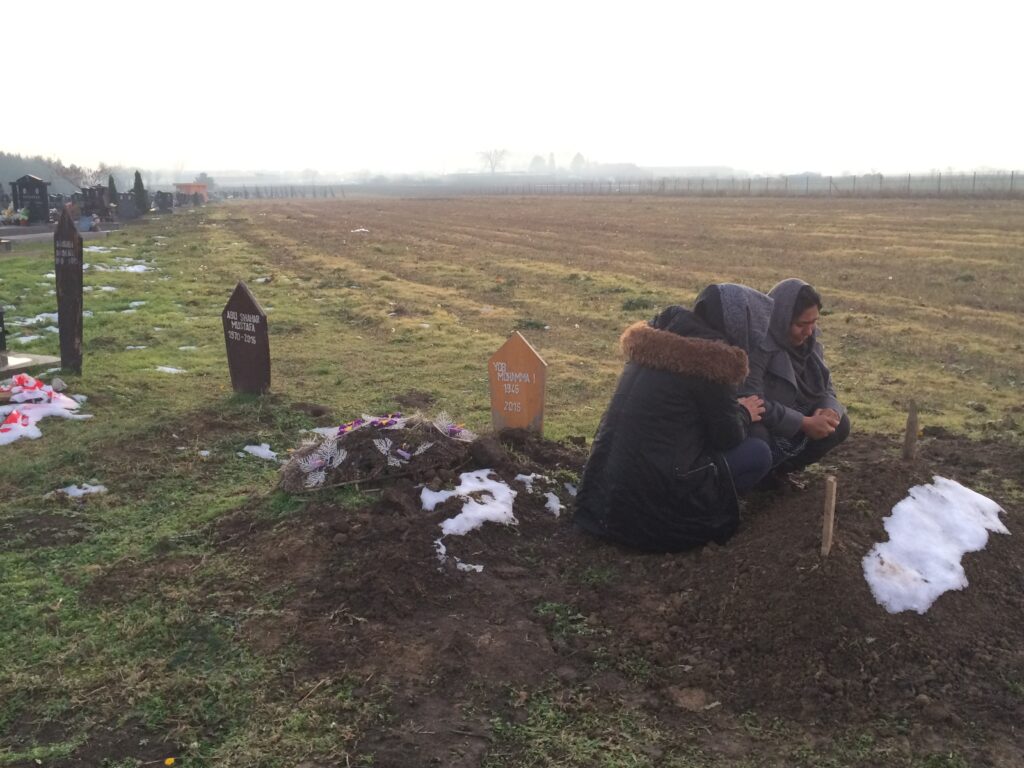
Despite a ruling by the European Court of Human Rights that held Croatia responsible for the death of a six-year-old Afghan girl, Madina Hosseini, who was run over by a train after being pushed back by the police to Serbia in 2017, the Croatian police continue with its abusive practices. They have evidently become engrained in the operational routine of Croatian police forces tasked by their and other European governments, which support Croatian border control economically and operationally through Frontex, with checking unauthorised migration. The actions of the Croatian police should be considered an integral part of the deterrence measures put in place to ‘protect’ the whole of the European Union, not just their own country: the push-backs are just one of a range of measures – bureaucratic hurdles, low recognition rates and threats of deportations – variously deployed by different EU countries.
The mother and the sister of Madina Hosseini, the young Afghan girl run over by a train after being pushed back from Croatia, at her graveside in the Serbian border town of Šid. Photo: Jelena Bjelica, 28 December 2017.
Even when Afghans are not subjected to pushbacks, NGO workers reported that this nationality is are often treated worse than other migrant groups such as the (far fewer) Syrians, so that the idea that they are not welcome in Croatia is quickly and firmly impressed upon the transiting migrants. A number of conversations with Afghan refugees travelling through Croatia corroborated this point.
Talking to Afghans outside of Porin Hotel
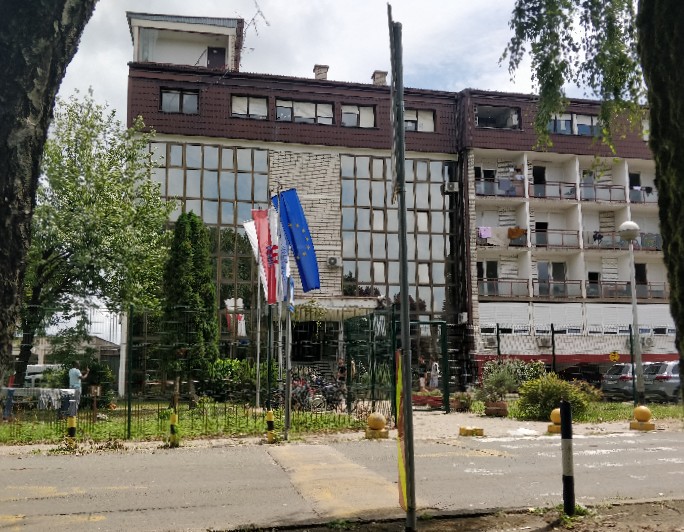
The main reception centre in Croatia is in the former Hotel Porin, on the southern outskirts of Zagreb. The centre opened in 2011 with a capacity of 600. Although meant for single men, it currently hosts a mixed population which include several families.[5]The authorities might have considered its location, away from the city centre, convenient. It has proved uncomfortable for those living there. There is a foul-smelling major waste disposal nearby, a huge and largely abandoned freight train exchange station and untended expanses of grass. The area swarmed with ravenous mosquitoes even more than the average Zagreb suburbs in the wet and stormy summer of 2023.
The entrance gate of the Hotel Porin, the main reception centre for asylum seekers in Croatia, in the southern outskirts of Zagreb. Photo: Fabrizio Foschini, 21 July 2023.
The camp is closed to all but government personnel and the Red Cross. Médecins Sans Frontières used to have access but has recently suspended its operations there. However, Afghan migrants are regularly to be found moving around the old hotel’s fenced precincts, squatting in the greenery that surrounds it, exchanging information or walking back from the city after a failed departure. At lunch time, in particular, many Afghans who have not been able to secure accommodation in the complex try to obtain some food from their acquaintances inside.
For someone who used to speak to migrants on the Balkan Route a few years back, and to those arriving in Trieste, the first contact with Afghans in 2023 Croatia was telling. The first person, a particularly sombre-looking young man from Maidan Wardak, apologised profusely in Dari for requesting to see my ID. He would not talk to me unless he could reassure himself beyond any doubt that I was not linked to either the Croatian security forces or Frontex.
I‘ve just been let out of police detention, you know. I spent last night in the hold-up. I’d arrived here yesterday morning, the police identified me and sent me to the camp [Porin]. I left the camp shortly after and went to the train station to catch a train and continue my journey. However, before the train started, the police checked it, carriage by carriage, and there was no place to hide. They were very angry at me for leaving the camp, and even more so for having taken the train. They said, “You have no right to board trains or buses here, you can only move around the way you came – walking.” They brought me to the police station and kept me there for the night. As soon as I’d fall asleep, somebody would make a noise or shake me to force me to stay awake. Then they let me go, but told me: “Go on or we’ll deport you back to where you came from.” The Croatian police don’t care about us applying for asylum. They only want to fingerprint us because the more fingerprints they take, the more money they receive from the EU.
According to CMS in Zagreb, Afghans crossing into Croatia face three possible legal outcomes, if caught by the police and identified as migrants. Some migrants receive access to asylum applications and are subsequently sent to Porin or another reception centre – from where most eventually resume their trip westwards. A second possibility is that the person receives a ‘return decision’, a seven-day warrant ordering them to leave Croatia. 30,000 such decisions were issued in 2022, in particular to migrants from Burundi (who used to be able to travel to Serbia without visas) but also to many Afghans. Reportedly, this practice is continuing without a clear pattern and leaves migrants facing an uncertain fate. The return decision in fact can result in their being allowed to continue traveling, or their being held and then pushed back to Bosnia. A third option – an expulsion decision – has also become more frequent this year (more details in this analysis by Balkaninsight), especially after a ministerial summit of the western Balkan countries and the EU in Rome in April 2023. Migrants may be issued an expulsion decision, which results in Bosnia formally readmitting them. They are delivered to the Bosnian police. This is reported to have happened even after a person asked for asylum in Croatia.[6]
Whichever they get – authorised to ask for asylum, given a seven-day warrant to leave the country or a formal expulsion decision – it is difficult for migrants to make sense of any of it. At least when it comes to Afghan nationals, there were many complaints about the paucity of translation services – and communication in general – on the part of the police. The complaint of a young man from Takhar province, formerly a member of the Afghan National Army (ANA), was echoed by nearly all his compatriots: “There’s never an interpreter with them [the police], the paperwork is all in Croatian and many policemen don’t even bother to try to speak English with you.”
Most Afghans AAN spoke to were convinced they had not applied for asylum in Croatia, although they had given their fingerprints to the European Asylum Dactyloscopy Database (Eurodac). According to the Dublin Regulation, once a person is identified by the Croatian police, their asylum request is up to Croatia to process, because it was their EU country of entry, even if they do not afterwards complete their application there.[7] They are also be liable to be sent back to Croatia, if they travelled on to another EU member state. The readmission of Dublin cases to Croatia is a relatively frequent instance, and actually one on the rise since Croatia’s accession to Schengen, especially by countries with big volumes of Afghan asylum seekers, such as Switzerland. The phenomenon led a group of Croatian NGOs to travel to Bern in mid-June to meet the Swiss Secretary of State for Migration to advocate for a stop to the practice. They cited the lack of sufficient capacity in their country’s reception system for accommodating refugees (read about the delegation in the Swiss press). Being sent back, of course, does not necessarily prevent migrants from trying to travel west again and apply for asylum elsewhere.
The Porin hotel was fully booked during the days AAN was in Zagreb. Afghans hanging around the hotel said that some newcomers had been made to sleep in the hallways and others could simply not be accommodated inside and slept rough in abandoned wagons in the nearby railway area. When the author visited in late July, the rough sleeping was especially grim, as Zagreb was hit by a quite unprecedented hurricane. It caused extensive damage and several deaths in the city. The Croatian capital was ravaged by bouts of heavy rains and wind for the full following week.
One of the Afghans who was sleep rough outside Porin was a young boy from Dand-e Ghuri in Baghlan province. Hardly looking as old as the 16 years he claimed, he had been sent by the Croatian police to what he termed “a camp for minors” (likely the reception centre in Kutina) upon arrival. He left it after just one day, however, and proceeded to Zagreb, but could not find a place inside Porin. While waiting for some sympathetic compatriot to bring him food from inside the hotel, he related what had led him to leave in haste the arguably better reception he would have received at the camp for minors:
I left my country two years ago, shortly before the fall of the Republic. I wasted a lot of time in Turkey because I had no money to pay for the next leg of the trip. I worked as a shepherd near Istanbul, and also in the city, but it was never enough. My family sold everything in order to have me out of Afghanistan. They sold the last sack of rice, even some of the little land they owned. My little sister is at home. My whole family is only waiting for me to get to some place where I can start to help them. It’s two years I’ve been gone and not a single time have I been able to send some shirini [literally “sweets”, presents or sums of money given as gifts to relatives, friends or associates] to my father. There’s no money left at home. How could there be? We are sharecroppers: one quarter of our harvest the Taleban take as taxes, one quarter goes to the landlord, one quarter is just for our own consumption to eat and stay alive, and with the sale of the remaining quarter you have to meet all the other expenses of the family. … The time I spent in Turkey, the way I used to slave for a small sum of money there made me reflect a lot. Now I need to get somewhere fast, somewhere I can get an education, find a good job, start a different life.
As for where this more favourable final destination could be, in the minds of those traveling, there are a few recurrent ideas. While some mention France and potentially further, possibly to the UK, or Switzerland, most seem to be directed to Germany. However, the majority of those interviewed by AAN declared they aimed first to get to Italy, and so were trying to catch a train or bus to Rijeka, Croatia’s Adriatic seaport, only 50 kilometres away as the crow flies from its ‘twin’ city in Italy, Trieste.
Migrants cannot fly, however, or even, apparently, be allowed to take a bus or train, but must only walk. Two former members of the ANA from Mazar-e Sharif related what had happened to them the day before:
Yesterday, we went to the main station to catch a train, but the police were on the platform and sent us back to the camp [Porin]. They called a taxi and forced us to take it and followed us in their car. The taxi driver had first said the ride would cost 30 euros and we gave it to him, but then he started saying that it was 30 for each of us and got angry at our refusal to pay the additional money, so he stopped the cab after just a couple of blocks and the police came and threw our backpacks out of the car and we had to walk back to the camp. The policemen told us we could continue our trip, but not by any form of transport. They even threatened us: Go quick, move on or we’ll deport you back to Afghanistan.
Taxi drivers are a key component in what Afghans call ‘the Game’, played along this section of the route, both as transporters of migrants for short distances, but also, often, as police informers.
From Serbia onwards, the role of traffickers is much less direct and their presence ‘on the ground’ negligible. Of course, there are those traveling under more high-profile and costly arrangements, such as direct transport by vehicle, which according to one police investigation can cost up to 5,000 euros from Bosnia to Italy or up to 8,000 euros if somebody wants to get further west, for example to Spain. However, most migrants, especially single young men, are left to themselves after they leave Serbia and cross the border into Bosnia. The traffickers keep in touch over the phone and provide guidance by sending GPS positions which they must reach, stage by stage.
A short distance from the gates of Porin, the author met a group of Afghans squatting in the tall grass, listening attentively to a twenty-year old from Bagram talking in Pashto with smugglers on his phone. He was telling them about the difficulty of boarding public transport and the poor conditions of his and his companions’ feet after the tiresome trekking they had been forced to do in the previous days and afterwards recounted to the author his recent journey.
I arrived two days ago. I slept outside Porin, I cannot enter [the complex] or eat there as I gave no fingerprints to the police – I actually have not met any so far. I came all the way with a friend from my district. We paid 3,000 USD to travel from Turkey to Serbia. During that part of the trip, we always had a rahbalad [guide] with us and when we were detained for some days in Bulgaria, somebody from our smuggler network waited until we were out and guided us into Serbia. From Serbia onwards, we were alone. Now it works through “locations” only. The smugglers give you a series of locations via GPS and you follow them: a station, a road, a border crossing. From Belgrade, they brought us to a river border and told us to jump into the water to get into Bosnia. On the other side we took a taxi. It cost 50 euros for each of the passengers to be brought close to Bihac. Then we went to a camp called Lipa and after around a week, we crossed into Croatia. On the way, there were people coming back to the camp whose phones had been broken or stolen by the Croatian police. We crossed a forest which had no paths. Luckily we met no police, although we could hear the drones buzzing over our heads. Then we walked until Zagreb. Now we are waiting for the new location from our contact. … Altogether, for the trip Bosnia to Italy (with locations) you pay 700 USD if the trafficker is a rafiq [a friend or associate], otherwise 800 USD.
The chances are that somebody among the migrants gets a discount if he becomes a jelawro (‘lead-the-way’), informally taking charge of a small group and keeping in touch with the smuggler network to enhance the group’s possibilities of successfully arriving at the next stage (and the smugglers’ of getting paid in full). Recently, there have been press reports about an increase in the number of traffickers arrested by the Croatian police. According to CMS, many of these arrests have been made among migrants who had reached Rijeka or other places far from the border with Bosnia. This could point towards their real role, as jelawros, rather than real members of a smuggling network.
Besides providing a barrier on behalf of the EU at the border with non-EU Bosnia (it became a candidate country only in December 2022), Croatian police efforts seem directed at keeping pressure on migrants to move on once they are inside Croatia. Over the past few years, for example, the route from Zagreb to Rijeka (by train or bus), from Rijeka (by train) to the inland town of Buzet on the Istrian peninsula (the westernmost area of Croatia which bulges out into the Adriatic Sea), and from there on foot across Slovenian territory (at its narrowest point – around 15 km) and into Italy, had become well-established. Police crackdowns on migrants in Rijeka have recently caused part of the flow to shift towards Pula, a seaport at the tip of the Istrian peninsula: which would be a counterintuitive detour for those trying to get to Italy. The aim of this ‘keeping migrants on the move’ is probably to make sure one single route does not become too prominent and crowded, with the risk of it developing into a public scandal or something which could tarnish the image of the country advertised as a tourist paradise.
Crossing Croatia is not as gruelling as crossing Bulgaria with its higher levels of abuse and violence or an impassable obstacle such as Hungary. Still, it comes like a cold shower for migrants convinced that they have finally overcome the harshest part of their trip, that they are finally on the doorstep of western Europe and that with that, will come better standards of reception and human rights, as one man said:
In Serbia and Bosnia, the people are good and the police don’t bother us migrants.In Croatia, we’re treated like animals. Elsewhere, the violence, the hostile behaviour is on the border and once you’ve made it away from there, you’re fine, people aren’t hostile and the police don’t bother you. So, once you’ve arrived here in Zagreb from the forests on the Bosnian border, you think you’ve come out of the jangal [the jungle, here used also in a figurative sense] and reached ‘the city’. But then, you realise that the behaviour of the police here in the capital is the same as on the border. Actually, the police here mistreat you as you would expect someone to do in the jungle, while out there in ‘the jungle’ [referring here to the refugee camps of the Bosnian Una-Sana canton, located in forested areas] people were treating us in a more civilised way.
The Zagreb government’s hostile attitude is compounded by the migrants’ own lack of interest in remaining in Croatia; hence, they seldom reach out to the very committed organisations which offer legal aid and other forms of support. The positive perception of police and Bosnian and Serbian people’s attitudes noted by the two ex-soldiers from Mazar and many other migrants AAN spoke to reflected their personal experience, that is, of a relatively swift and smooth crossing. However, the full picture is not so rosy nor so simple in Serbia and Bosnia, which have been at the centre of the ‘migrant crisis’ for years, as the author discovered when he took a closer look at the situation of Afghan migrants still in Serbia.
Talking and walking in Belgrade
For many migrants, having experienced a first taste of the EU in Greece or Bulgaria, Serbia may look like a comparatively relaxed stage of the trip. Access to asylum-seeking is available, but not everywhere: according to members of a Serbian NGO providing legal and psychosocial support to migrants, Klikaktiv, the police do not easily provide the possibility to register outside Belgrade and even in the capital, this opportunity is not available at all times. Despite improvements in the reception capacity of the 17 camps active across Serbia, for which the EU is the major funder, not many possibilities are offered to those who apply for asylum besides accommodation. The wait to legally seek employment amounts to nine months and, before a positive decision has been made, according to migrants solidarity organisations in Belgrade, no language or professional courses are available. At any given moment, there are around 3,000 migrants hosted in the reception centres, but very few opt to remain in Serbia. Most move quickly on to Bosnia and Croatia.
Serbia’s role is mainly one of transit, and in recent years, of an increasingly swift transit. According to the annual report by the Serbian Commissariat for Refugees and Migration, 124,127 migrants were registered and hosted in reception centres during 2022. On average, they stayed in the country for 16 days, a considerable decrease from the 30 days of 2021 or the 36 of 2020. Reportedly, over 73,000 migrants had already transited through Serbia’s camps in the first six months of 2023. Afghans were the most represented nationality to pass through the Serbian reception centres in 2022, amounting to over 36 per cent of the total.
It is often vulnerable cases, families or people with medical conditions who access reception centres out of their own free will. They may need to stop for a short while in order to recover, while other migrants try to continue on their path almost immediately. Outside the official camps, there is indeed another migrant population in Serbia, estimated at between 3-4,000 and constantly flowing into and out of the country and thereby renewing itself. This is centred on smugglers’ rented safehouses and the many squats located on the northern border with Hungary. At the western border with Bosnia, there is also a constant flow, but far less ‘housing’ because it is easier and quicker to cross.
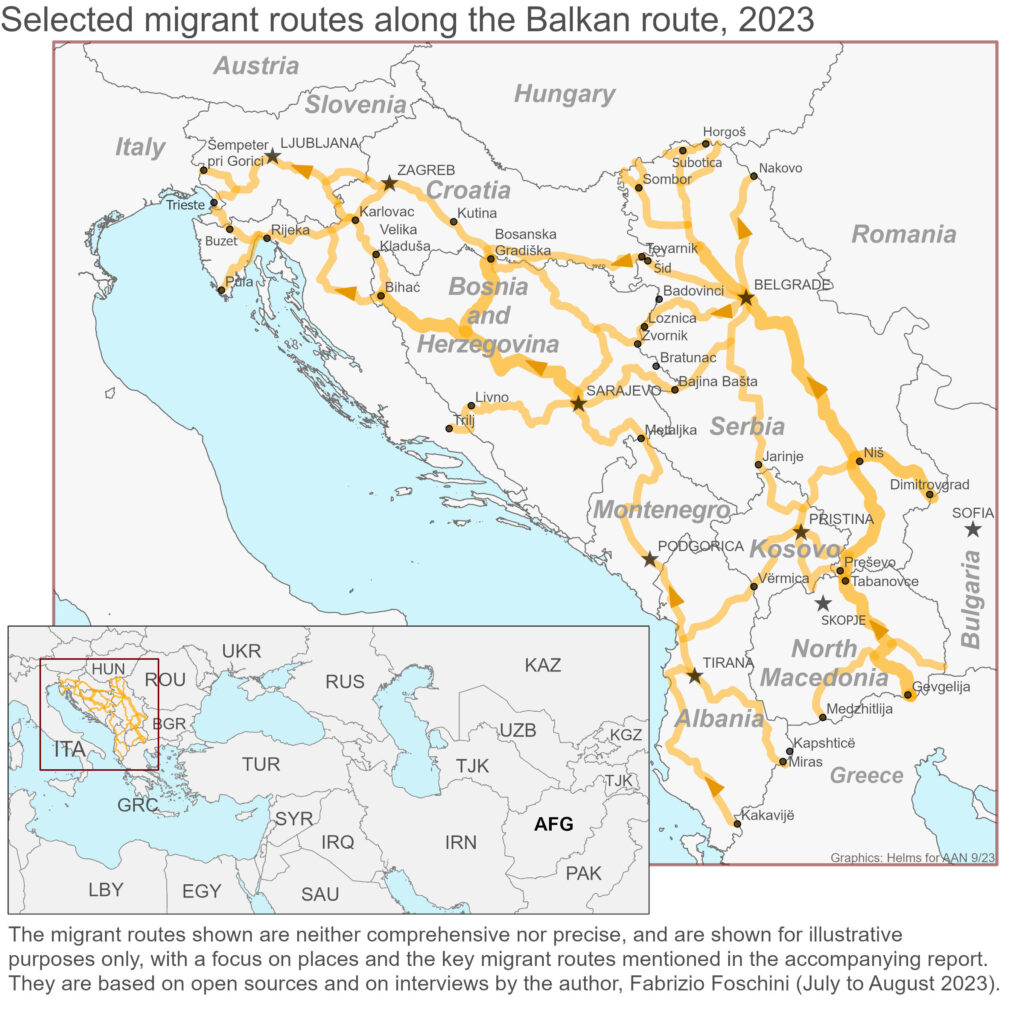
The crossing into Bosnia is also the route generally favoured by Afghans, many of whom therefore end up stopping in Serbia for only a couple of days. According to both migrants and NGO workers interviewed by AAN, crossing into Bosnia is now relatively easy. From Belgrade, migrants move to minor border crossings near quiet towns in western Serbia such as Loznica. Migrants described wading or swimming across rivers – though crossing the Drina, which largely marks the border between the two countries, would require along most of its course advanced swimming skills – read here about migrants stranded mid-river. Different interviewees related also crossing rivers by bridges, either secretly, through a system of ropes hung under the bridge, or quite openly – just walking across. At some minor border crossings, such as Ljubovija, migrants can be taken across the river into Bosnia directly by car: according to the Serbian NGO, Klikaktiv, it is relatively common to see cavalcades of vehicles with non-local plates crossing this and other nearby ‘sleepy’ border towns. Some migrants may be picked up by cars on the Bosnian side. These ‘all-inclusive’ migrants who pay more and travel fast, stay with smugglers throughout, and are often brought directly to the Croatian frontier and even beyond.[8] The average migrant, however resorts to public transport once on the Bosnian side.
Map by Roger Helms for AAN
On both sides of the frontier, the police often opt to close their eyes to migrants’ crossing, or can be bribed by smugglers if necessary. The lax attitude of the police in Serbia has often been commented positively on by migrants and looks to be a constant from AAN’s previous visit to the country’s migrant squats in 2016 (read this and the other reports from the series). However, things might be changing in this respect, as episodes of violent repression of migrants at border crossings have recently been documented and seem to be on the rise. Klikaktiv has also reported police pressure on migrants trying to use public transport to reach Belgrade from the south.
The shift in Serbian police attitudes is not happening only at the borders: a short walk in downtown Belgrade in the same places researched in 2016 at the height of the ‘first Balkan Route crisis’, showed that a lot had changed in the city as well. The area of the once dilapidated central train station in the Savamala neighbourhood, that has since been relocated, has been transformed into a new upscale Belgrade Waterfront project, radically changing the city skyline and profile of the neighbourhood. This means also that migrants’ presence in the area, previously a ‘natural’ hub for those transiting, is nowadays less tolerated.
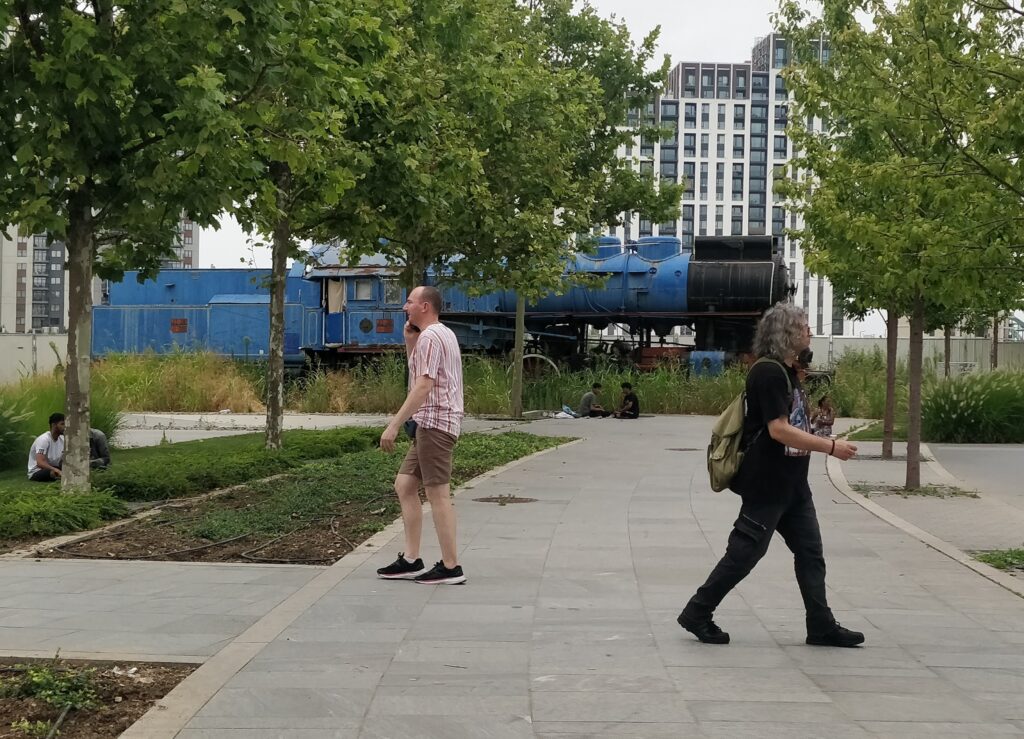
Around the remains of the old train station in Savamala (read here a report on BBC Serbian about its past glory, and last days), the absence of refugees is made more conspicuous by the signs of their previous presence: PCO shops, where people could phone home or contact smugglers, and kebabs once lining the main avenue are now shut, together with the cheap hostels that would accommodate families or migrants coming to Serbia in a more high-profile way.[9] Tents and shacks have disappeared and illegal squats inside the abandoned wagons near the old train station have been removed. Serbian police are known to raid such urban squats in order to destroy them and deport their occupants to the camps inŠid near the Croatian border or in Preševo near the border with North Macedonia (read this report by Klikaktiv).
By mid-2023, only a few migrants were visible around Belgrade’s former main railway station in the Savamala neighbourhood. In the past, it was a busy hub. Photo: Fabrizio Foschini, 25 July 2023.
The nearby park, universally known by migrants as ‘Afghan Park’ since at least 2015, where smugglers used to hold court (read this instalment of the previous AAN series on Afghan migrants in Serbia) now looks to be only frequented by migrants part-time. With the coming of spring and then summer, it started to fill again with newcomer migrants arriving from the Bulgarian or Macedonian border, but they do not spend all their time there and are frequently rounded up and forcibly relocated by the police to camps far away from the city.
Arriving at Afghan Park one morning shortly after 11am, the author could witness from afar such an operation. Two dozen migrants, seemingly Afghans, had been made to sit on the grass while a dozen police agents counted and identified them in order to have them board a big police bus, already waiting by the side of the road. Some civilians stayed there throughout the process, possibly NGO workers who had come with their own translator to make sure the migrants were advised and accounted for and that none ended being pushed out of Serbia.
Moving a couple of lanes above the park, in front of a line of shops selling hiking gear, a few migrants were apparently waiting for the police operation to be over before moving out of cover. Three were Afghans from the southeast, speaking Pashto over the phone and a bit uneasy about speaking Dari to a stranger. They hurried to declare that they were already accommodated in a camp at the outskirts of the city and had only come to town to do some shopping.
Walking down another lane leading back to the park, there was another group of Afghans who had apparently left it in the wake of the police arrival. They were mostly Pashto speakers as well, with at least two very young boys among them. Although arguably keen to put more distance between them and the police bus on the other side of the road, they did not look over-concerned by it (the vehicle was also shielding them from the agents inside the park). However, the conversation with them was cut abruptly short by an old lady from a balcony above, who started protesting loudly that it was not permitted to talk to migrants (arguably taking the author for a local). She kept urging the migrants to go back and immediately report to the police in the park, as it was not allowed for them to stay in the city. Indeed, the Afghans did not look at ease stopping anywhere in the area and kept hurrying onwards, so the interview had to be continued while walking several hundred metres. It was a full reversal of how easy it was to spot and engage in conversation with migrants in Belgrade only a few years back. The information they provided was necessarily sketchy, but its interpretation made somewhat easier by the circumstances.
They had not been stopped by the Serbian police and had kept clear of the camps. Although they claimed they were sleeping in various city parks, they seemed to be following a clear leader – a tall, bearded guy walking a few dozen metres ahead of them – and had shopping bags full of food with them. They said they would stop to rest for a couple of days before hitting ‘the game’ towards Bosnia. When asked if they were ‘khod-andaz’ (migrants who self-organise their trip) or were with smugglers, they seemed to find the idea funny and replied “We’re with smugglers, of course.” They added that the police in the park did not see them and they did not wish to be seen, else the police might bring them back to the camps “two hours away [located in the south of Serbia.” They complained that the Serbian police were making some problems for migrants, that people were forced to go to the camps and that the police sometimes sent some of their number back to Bulgaria.
On returning to the park, I found it deserted. The migrants had boarded the police bus, which seemed now ready to start. The whole process had taken around one and a half hours. A few more Afghans, altogether not more than half a dozen, were squatting or sleeping in the more secluded parts of the park esplanade in front of the old train station, now a restored monument, not creating even a visible trouble to passers-by. Ironically, above their heads, a big travel agency placard atop an unfinished building promised that with it: “Every day, you could go to Turkey”.
Discussions with NGO workers and researchers at Belgrade University confirmed the impression that, regardless of the still significant numbers of migrants passing through Belgrade, they are much less visible in the city. The causes for this are the authorities’ changed attitude, as well also the nature of the operations run by the smuggling networks in Serbia. Migrants constitute a minor source of concern for the Serbian government, provided they do not become too visible in central areas of the city. To disincentivise their presence, besides raids and forced relocation to camps out of the city, the authorities have discontinued the provision of services to migrants in the area. The main hub offering assistance to migrants in the city centre was Miksalište. It had been transformed over the years from a volunteer organisation to a state-run info point (read this paper on its history and the transformations of migrants reception in Belgrade), forced to relocate in 2016 due to the demolitions planned for the Belgrade Waterfront and was shut down for good on 31 December 2022.
The withdrawal of the state left a free hand once again to the smugglers, not only to arrange for the migrants to cross frontiers in a swift way, but to organise every other aspect of their stay in Serbia. Today, migrants who do not seek reception in the government camps are fully dependent on the smugglers for transport, accommodation, food and communications – hence the lack of need for PCO shops and food stalls. This of course, has its backlashes. Migrants who cannot pay smugglers can face serious abuses and are often exploited for labour or sex. Many such migrants have to work for the smugglers in assisting the accommodation or transport of other migrants and are kept in isolation and are very difficult to access, whether by NGOs keen to help, or the security forces. The situation is of particular concern for vulnerable categories, such as unaccompanied minors – Klikaktiv assessed that in the first six months of 2023, there were three times as many of these crossing Serbia compared to the same period last year.
Recently there have also been numerous instances of violence between smugglers, believed to be caused by competition between rival groups. The string of violence started in July last year, with a shooting between two rival groups of Afghan smugglers in a squat near the northern border with Hungary, which ended in one member killed and also caused serious injuries to an Iranian girl who was caught in the crossfire. The episode made some impression on the Serbian media back then, but this year, despite several similar incidents – at least five, including one recorded in March on the border with Bosnia which resulted in the death of an Afghan – they have not attracted much public interest nor police reaction. The fact that they happened in liminal places, such as migrants’ squats or in remote border towns and did not involve Serbian nationals, has so far kept the profile of such crimes low in the eyes of the state and public. Klikaktiv, however, denouncing the threat posed by smugglers to migrants and NGO workers, indeed all citizens, lamented the lack of political will to deal with the problem on the part of the authorities (see their most recent report).
Where does the Balkan Route end?
During the 1990s, when the civil wars that resulted in ethnic cleansing and mass displacement across the territories of former Yugoslavia, the use of the old terms ‘Balkanisation’ and ‘Balkanise’ as pejoratives denoting fragmentation, chaos, insecurity and unlawfulness was revamped.[10] A joke about the Balkans’ physical borders, told by people writing about the region at that time, suggested the impossibility of even ascertaining where ‘the Balkans’ started or ended, as no country coming out of the dissolution of Yugoslavia would accept being called part of the ‘Balkans’, and would cast the label with its now stained connotation onto its neighbour.
Nowadays, it could prove equally hard to define where the Balkan Route starts or ends, judging by the behaviour of the EU states. Is the situation faced by Afghan migrants at the supposed end of the route radically different? Legal provisions may be different, but the reality is not.
A long chain of push-backs of thousands of migrants, including many who intended to apply for asylum, from the Italian border near Trieste to Slovenia, and from there to Croatia and Bosnia, was ongoing between 2019 and 2021. The ‘chain push-backs’ were exposed only through the work of independent organisations and lawyers who investigated complaints made by some deported asylum seekers. The sensation the news made and a court sentence back then put a stop to such practices, but recently, authorities at the regional and national level have been openly advocating for their resumption.
Meanwhile, Trieste’s train station, just inside Italy, and the square in front of it are crowded with hundreds of migrants, half of them transiting through the city on their way to further destinations, the other half waiting to access a reception programme after having applied for asylum in Italy. Waiting times for a place to sleep in the city can now last more than fifty days (read here about conditions in Trieste). A reception system made of small flats scattered across the city, that once worked very effectively, has been hampered by cuts to funding and the preference given to the creation of big hubs that relocate high numbers of migrants away from the cities. The identification of the venues for such hubs has, however, become a bone of contention between the administrations and their constituencies, as communities stand up and reject them, while political parties squabble over responsibilities (read reports in Italian and English). Transfers to reception programmes in other parts of Italy have been blocked since November 2022 because of the priority given to arrivals by sea over those who travel by land They have only just recently, sporadically, resumed in the face of the crisis.
Italy is not a lone example of controversial and ineffective policies. Austria has reinstated border controls with Italy and even fenced part of its border with Slovenia in 2015 at the height of the ‘Balkan Route Crisis’. It has maintained these controversial measures, which are a de facto breach of Schengen, even in the face of diplomatic tensions, and despite the fact that most of its migrants currently arrive from Hungary (across a border which Austria also controls). At the other end of the Alps, France likewise reinstated border controls in 2015 and proceeds routinely to effect “entry refusals” against migrants coming from the Italian side of the border, even when they are traced well inside its territory (read about it in this AIDA report).
As for the Balkans, speaking in strictly geographical terms, they remain the battleground of choice for the externalisation of migration control strategies implemented by various EU countries or groups of countries (see this recent paper on the role of, for example, the Salzburg Forum, which brings together several Central European states in a security partnership). Such externalisation of migrant control strategies is often done in a controversial or chaotic manner, despite the refugee crisis having been one of the EU’s long-term concerns for over a decade now. The current trend sees an extension of the externalisation of such practices to non-EU countries in the region, such as Serbia and Bosnia (read this paper on the subject).
It is unclear whether a more comprehensive set of EU policies aimed at dealing with the migration crisis on its south-eastern borders will appear any time soon. It seems likely that, for the time being, the conditions met by Afghans crossing Serbia and Croatia will remain far from ideal. Serbia, with no obvious chance for a quick accession to the EU, will likely retain a somewhat permissive environment for transiting migrants. However, if the partnerships with the EU in border security and reception system were to be expanded, there might be a change in that equation. This would also depend on the levels of economic aid and/or political concessions that the EU is willing to make to get Serbia to act to block migrants moving westwards. On one hand, additional incentives could be created for migrants to apply for asylum in Serbia and have their cases processed there; this would include language and vocational courses and the possibility of being relocated to an EU country at a later date. On the other, Serbia could also become a country to which the EU could return unwanted migrants and failed asylum seekers, thanks to its position exactly outside of the EU and that it is not bound by the EU’s legal framework. Such a development is already being reported for Bosnia, whose policy and attitudes towards migrants is even more linked to EU policies and funding (read about an agreement allowing Bosnia to repatriate Pakistani migrants).
As for Croatia, for the time being the possibility that it could itself become a target destination for Afghan asylum-seekers must be excluded, despite its entry into the Schengen area and the burgeoning touristic sector which could offer jobs. These potential attractions are countered by the unwelcoming attitude of the security and political forces, low wages, language difficulties and, even more so, the lack of a diaspora community to link up with. Until a thorough rethinking of EU migration policies comes into being or the Union’s external frontiers are pushed somewhere else, the hostile reception given to migrants in Croatia is unlikely to change. Moreover, Croatia’s long and tortuous border risks it being relegated to its role in the 16th to 18th centuries in the Hapsburg Empire, of being a Militärgrenze, a military frontier, where normality and the rule of law are sacrificed in order to protect the tranquillity of what lies behind – in exchange for dubious economic or political benefits.
Afghan migrants, trying to move from Turkey towards central and western Europe, are faced with a series of countries displaying varying policies and attitudes, from outright hostility and violence to laissez-faire and opportunism. Such inconsistency en route continues well beyond the Balkans for the many among the transit population aiming at destinations further afield, such as France, Germany or the UK. Theirs is not an experience of moving from the wild ‘jangal‘ to the lawful ‘city’ – the Dari and Pashto word used by migrants, paytakht, ‘at the throne’s feet’, conjures even more the idea of law and order connected to it. Rather, the experience of those travelling through the West Balkan route amounts to a rough introduction of what they will encounter deeper into the European Union, a set of migration laws and policies which are unclear and uneven from one country to another.
Edited by Jelena Bjelica and Kate Clark
References
References
↑1
A reception system for asylum seekers of sorts in Croatia did exist in 2013, but it had only recently been expanded and become more effective. Croatia has received nearly 47,000 asylum requests since 2004, when the first laws about asylum were passed, of which more 40,000 were filed in the last seven years, after the announced ‘closure of the Balkan Route’, ie, the humanitarian corridor of September 2015 to March 2016, following Germany’s Angela Merkel’s announcement that Syrians fleeing the civil war could be welcomed. Only a tiny fraction of the asylum requests, 1,015, have received a positive answer, according to information given by the Centre for Peace Studies in Zagreb, 19 July 2023.
↑2
Frontex data about the Western Balkan route refers to border crossings between EU and non-EU countries, between Bulgaria and Hungary and Serbia, Croatia with Bosnia and Greece with North Macedonia and Albania. It does not include Croatia’s detection of irregular migrants deeper inside its territory – see an example of Frontex’s methodology here.
↑3
In the last few years, an alternative sea route has emerged from Turkey directly to the southern shores of Italy. More expensive than the land route to Italy, it is sought by those, including many families, who cannot contemplate the hardships of the land route. It is nevertheless no less dangerous, as the shipwreck off Cutro in February 2023, which cost almost one hundred lives tragically proved. Half of them were Afghans, but there were also Pakistanis, Syrians, Iranians, Palestinians, Somalis and others, reported AP.
↑4
As further background readings on Afghan migration to Europe, see two AAN dossiers presenting several reports on Afghan migrants here and here.
↑5
Besides Porin, there exists a reception centre for vulnerable cases in Kutina, some seventy kilometres southeast of the capital, which has been recently renovated and can host up to 140 people; and two transit centres in Trilj and Tovarnik, close respectively to the borders with Bosnia and Serbia, where migrants caught crossing the border can be detained until moved elsewhere or readmitted to the neighbouring countries. Minors, among them many Afghans, are reportedly often hosted in structures meant for problematic minors, despite the objections raised against this practice by the NGO community in Croatia.
↑6
A similar bilateral agreement permitted Slovenia to readmit a number of migrants to Croatia in past years. This practice has been diminishing since 2022, when Croatia started refuse further readmissions (see this report on Slovenia by AIDA).
↑7
The Dublin Regulation is actually a series of treaties among EU countries aimed at combating so-called ‘asylum-shopping’ by migrants, that is, the attempt to reach deeper into central and northern Europe for what they consider more favourable destinations. The argument is that asylum-shopping creates undesirable volumes of illegal movement across the Union. However, by ordering that asylum seekers must be transferred back to the countries of first entry (and fingerprinting), the agreements have arguably increased such movements, as the so-called “Dubliners”, usually after long and frustrating waits, relocate in order to avoid being deported to places they do not want to be, usually moving to third EU countries to try their chances there. A more common criticism of the Dublin Regulation is that, if implemented systematically, it would lay all the burden of the reception of asylum seekers and the processing of their cases on the southern and eastern countries of the EU.
↑8
At official border crossings where document checks are regularly carried out, some migrants can also try to use forged documents to cross. However, only a small number of migrants can afford to buy such documents and their purchase and use are more often linked to attempts to travel via airports and seaports.
↑9
Between 2017 and 2018, for example, Iran was temporarily granted a visa-free status by the Serbian government (read this report about its revocation). Back then, many Iranian nationals would travel to Belgrade only in order to proceed further to the EU and seek asylum there. As they were often traveling with their families many would rent cheap rooms rather than join the illegal squats.
↑10
These terms with its pejorative meaning have been in use in English (and corresponding terms in German, French and Italian, among other languages) since the 1920s in reference to the Balkan Wars of the late 19th and early 20th centuries.
Fabrizio Foschini
Keep on Moving on the Balkan Route: No quarter for Afghan asylum seekers in Croatia and Serbia
The caretaker prime minister of Pakistan further stated that despite some challenges in the relationship, it wants to engage with Afghans.
The caretaker prime minister of Pakistan, Anwaar ul Haq Kakar, claimed that there are training camps for Tehreek-e-Taliban Pakistan (TTP) in Afghanistan.
In an exclusive interview with media outlet The News Maker Kakar said that Pakistan has raised its concerns regarding terrorist groups on Afghan soil with the current government of Afghanistan.
“We are not here to judge the intentions of that de facto government. Yes, we have a concern because the groups like TTP they do reside on Afghan soil. We do raise such issues with them. There are training camps on their soil which is a point of concern for us,” Kakar added.
The caretaker prime minister of Pakistan further stated that despite some challenges in the relationship, it wants to engage with Afghans.
“I’m hopeful that we will engage with the Afghans despite some challenging times in our relationship, because it is in the common interest of both nations that such groups are eliminated from this region,” Kakar noted.
Meanwhile, Zabihullah Mujahid, the Islamic Emirate spokesman, said that Afghan soil is not a threat to any country, and it wants to have good relations with all nations, including Pakistan.
“Afghanistan does not want to interfere in the internal affairs of any nation, it does not want its soil to be used against other countries, and we have good relations not only with Pakistan, but with all countries,” Mujahid added.
“Such statements by Pakistani officials harm the relations of both countries, and if they make such statements, they should provide documentation and proof that the TTP is in Afghanistan,” Javid Momand, a political analyst, said.
Last week, Asif Durrani, Pakistan’s Special Representative of Afghanistan, led a delegation to Kabul to talk with officials of the Islamic Emirate officials regarding the challenges the two countries face.
Pakistan PM Claims TTP Has Training Camps in Afghanistan
He also called on the international community to increase support to the humanitarian response in Afghanistan.
The head of UNAMA, Roza Otunbayeva, in her briefing to the UN Security Council, said the policies of the current Afghan government that drive the exclusion of women are “unacceptable to the international community.”
UNAMA in a statement quoted Otunbayeva as saying that “UNAMA’s human rights efforts are focused on engaging and enabling the de facto authorities to establish an inclusive, responsive system of governance, including policing, that respects human rights norms and standards. It is time to support strengthened engagement with the relevant components of the de facto authorities through appropriate means to increase their knowledge and further compliance of law enforcement actions with international norms.”
Speaking to the UN Security Council meeting on the situation in Afghanistan, the US deputy ambassador to the UN, Robert A. Wood, voiced concerns over restrictions on women and girls in Afghanistan, saying:
“We urge the Taliban to roll back these restrictions and allow women and girls to have access to education which will enable their full, equal and meaningful participation in the society.”
He also called on the international community to increase support to the humanitarian response in Afghanistan.
“Now more than ever the international community must rally together and increase pledges and support to the humanitarian response,” Wood said.
The UK representative to the UN, speaking at the UN Security Council meeting on Afghanistan, said: “Over two years since the Taliban seizure of power, our dominant concern remains the Taliban systematic assault on the rights of women and girls,” and “Afghanistan remains one of the poorest and most climate vulnerable countries in the world.
Its prospects further dimmed by a significant brain drain as a result of migration, persecution and uncertainty.” The UK representative added: “We know the progress the Taliban has made in tackling ISKP, and we underscore the importance of continued action against terrorist groups within Afghanistan.”
The UK representative said that the people of Afghanistan remain a priority for the UK.
The Russia representative to the UN, speaking at the UN Security Council meeting on Afghanistan, said: “As we see, Afghanistan was a staging country for the breaking in of the American regional strategy, a place for the testing of various weapons, a place for laundering of billions of dollars…”
Th Russian representative noted: “Western countries have no concern about the Afghan people, including women and girls nor … about the unprecedented humanitarian crisis.”
KABUL (Reuters) -The Taliban are creating a large-scale camera surveillance network for Afghan cities that could involve repurposing a plan crafted by the Americans before their 2021 pullout, an interior ministry spokesman told Reuters, as authorities seek to supplement thousands of cameras already across the capital, Kabul.
The Taliban administration — which has publicly said it is focused on restoring security and clamping down on Islamic State, which has claimed many major attacks in Afghan cities — has also consulted with Chinese telecoms equipment maker Huawei about potential cooperation, the spokesman said.
Preventing attacks by international militant groups – including prominent organisations such as Islamic State – is at the heart of the interaction between the Taliban and many foreign nations, including the U.S. and China, according to readouts from those meetings. But some analysts question the cash-strapped regime’s ability to fund the program, and rights groups have expressed concern that any resources will be used to crackdown on protesters.
Details of how the Taliban intend to expand and manage mass surveillance, including obtaining the U.S. plan, have not been previously reported.
The mass camera rollout, which will involve a focus on “important points” in Kabul and elsewhere, is part of a new security strategy that will take four years to be fully implemented, Ministry of Interior spokesman Abdul Mateen Qani told Reuters.
“At the present we are working on a Kabul security map, which is (being completed) by security experts and (is taking) lots of time,” he said. “We already have two maps, one which was made by U.S.A for the previous government and second by Turkey.”
He did not detail when the Turkish plan was made.
A U.S State Department spokesperson said Washington was not “partnering” with the Taliban and has “made clear to the Taliban that it is their responsibility to ensure that they give no safe haven to terrorists.”
A Turkish government spokesperson didn’t return a request for comment.
Qani said the Taliban had a “simple chat” about the potential network with Huawei in August, but no contracts or firm plans had been reached.
Bloomberg News reported in August that Huawei had reached “verbal agreement” with the Taliban about a contract to install a surveillance system, citing a person familiar with the discussions.
Huawei told Reuters in September that “no plan was discussed” during the meeting.
A Chinese Foreign Ministry spokeswoman said she was not aware of specific discussions but added: “China has always supported the peace and reconstruction process in Afghanistan and supported Chinese enterprises to carry out relevant practical cooperation.”
ELECTRICITY CUTS, RIGHTS CONCERNS
There are over 62,000 cameras in Kabul and other cities that are monitored from a central control room, according to the Taliban. The last major update to Kabul’s camera system occurred in 2008, according to the former government, which relied heavily on Western-led international forces for security.
When NATO-led international forces were gradually withdrawing in January 2021, then-vice president Amrullah Saleh said his government would roll out a huge upgrade of Kabul’s camera surveillance system. He told reporters the $100 million plan was backed by the NATO coalition.
“The arrangement we had planned in early 2021 was different,” Saleh told Reuters in September, adding that the “infrastructure” for the 2021 plan had been destroyed.
It was not clear if the plan Saleh referenced was similar to the ones that the Taliban say they have obtained, nor if the administration would modify them.
Jonathan Schroden, an expert on Afghanistan with the Center for Naval Analyses, said a surveillance system would be “useful for the Taliban as it seeks to prevent groups like the Islamic State … from attacking Taliban members or government positions in Kabul.”
The Taliban already closely monitor urban centres with security force vehicles and regular checkpoints.
Rights advocates and opponents of the regime are concerned enhanced surveillance might target civil society members and protesters.
Though the Taliban rarely confirm arrests, the Committee to Protect Journalists says at least 64 journalists have been detained since the takeover. Protests against restrictions on women in Kabul have been broken up forcefully by security forces, according to protesters, videos and Reuters witnesses.
Implementing a mass surveillance system “under the guise of ‘national security’ sets a template for the Taliban to continue its draconian policies that violate fundamental rights,” said Matt Mahmoudi from Amnesty International.
The Taliban strongly denies that an upgraded surveillance system would breach the rights of Afghans. Qani said the system was comparable with what other major cities utilize and that it would be operated in line with Islamic Sharia law, which prevents recording in private spaces.
The plan faces practical challenges, security analysts say.
Intermittent daily power cuts in Afghanistan mean cameras connected to the central grid are unlikely to provide consistent feeds. Only 40% of Afghans have access to electricity, according to the state-owned power provider.
The Taliban also have to find funding after a massive economic contraction and the withdrawal of much aid following their takeover.
The administration said in 2022 that it has an annual budget of over $2 billion, of which defence spending is the largest component, according to the Taliban army chief.
MILITANCY RISKS
The discussion with Huawei occurred several months after China met with Pakistan and the Taliban’s acting foreign minister, after which the parties stressed cooperation on counter-terrorism. Tackling militancy is also a key aspect of the 2020 troop-withdrawal deal the United States struck with the Taliban.
China has publicly declared its concern over the East Turkestan Islamic Movement (ETIM), an armed separatist organisation in its western Xinjiang region. Security officials and U.N. reports say ETIM likely has a small number of fighters in Afghanistan. ETIM couldn’t be reached for comment.
The Islamic State has also threatened foreigners in Afghanistan. Its fighters attacked a hotel popular with Chinese businesspeople last year, which left several Chinese citizens wounded. A Russian diplomat was also killed in one of its attacks.
The Taliban denies that militancy threatens their rule and say Afghan soil will not be used to launch attacks elsewhere. They have publicly announced raids on Islamic State cells in Kabul.
“Since early 2023, Taliban raids in Afghanistan have removed at least eight key (Islamic State in Afghanistan) leaders, some responsible for external plotting,” said U.S. Special Representative for Afghanistan Thomas West at a Sept. 12 public seminar.
A July U.N. monitoring report said there were up to 6,000 Islamic State fighters and their family members in Afghanistan. Analysts say urban surveillance will not fully address their presence.
The Afghan “home base” locations of Islamic State fighters are in the eastern mountainous areas, said Schroden. “So while cameras in the cities may help prevent attacks … they’re unlikely to contribute much to their ultimate defeat.”
Reporting by Mohammad Yunus Yawar in Kabul and Charlotte Greenfield in Islamabad; Additional reporting by Jonathan Landay in Washington, David Kirton in Shenzhen, Liz Lee in Beijing, and Ece Toksabay and Tuvan Gumrukcu in Ankara; Editing by Katerina Ang
Taliban weighs using U.S. mass surveillance plan, met with China’s Huawei
The United Nations says aid workers are still in a “race against time” to remove rubble and rebuild after the devastating earthquake struck eastern Afghanistan last month, killing at least 2,200 people and cutting off remote areas.
The 6.0-magnitude quake on Aug. 31 was shallow, destroying or causing extensive damage to low-rise buildings in the mountainous region. It hit late at night, and homes — mostly made of mud, wood, or rocks — collapsed instantly, becoming death traps.
Satellite data shows that about 40,500 truckloads of debris still needs to be cleared from affected areas in several provinces, the United Nations Development Program said Wednesday. Entire communities have been upended and families are sleeping in the open, it added.
The quake’s epicenter was in remote and rugged Kunar province, challenging rescue and relief efforts by the Taliban government and humanitarian groups. Authorities deployed helicopters or airdropped army commandos to evacuate survivors. Aid workers walked for hours on foot to reach isolated communities.
“This is a race against time,” said Devanand Ramiah, from the UNDP’s Crisis Bureau. “Debris removal and reconstruction operations must start safely and swiftly.”
People’s main demands were the reconstruction of houses and water supplies, according to a spokesman for a Taliban government committee tasked with helping survivors, Zia ur Rahman Speenghar.
People were getting assistance in cash, food, tents, beds, and other necessities, Speenghar said Thursday. Three new roads were under construction in the Dewagal Valley, and roads would be built to areas where there previously were none.
“Various countries and organizations have offered assistance in the construction of houses but that takes time. After the second round of assistance, work will begin on the third round, which is considering what kind of houses can be built here,” the spokesman said.
Afghanistan is facing a “perfect storm” of crises, including natural disasters like the recent earthquake, said Roza Otunbayeva, who leads the U.N. mission to the country.
 Afghanistan Peace Campaign
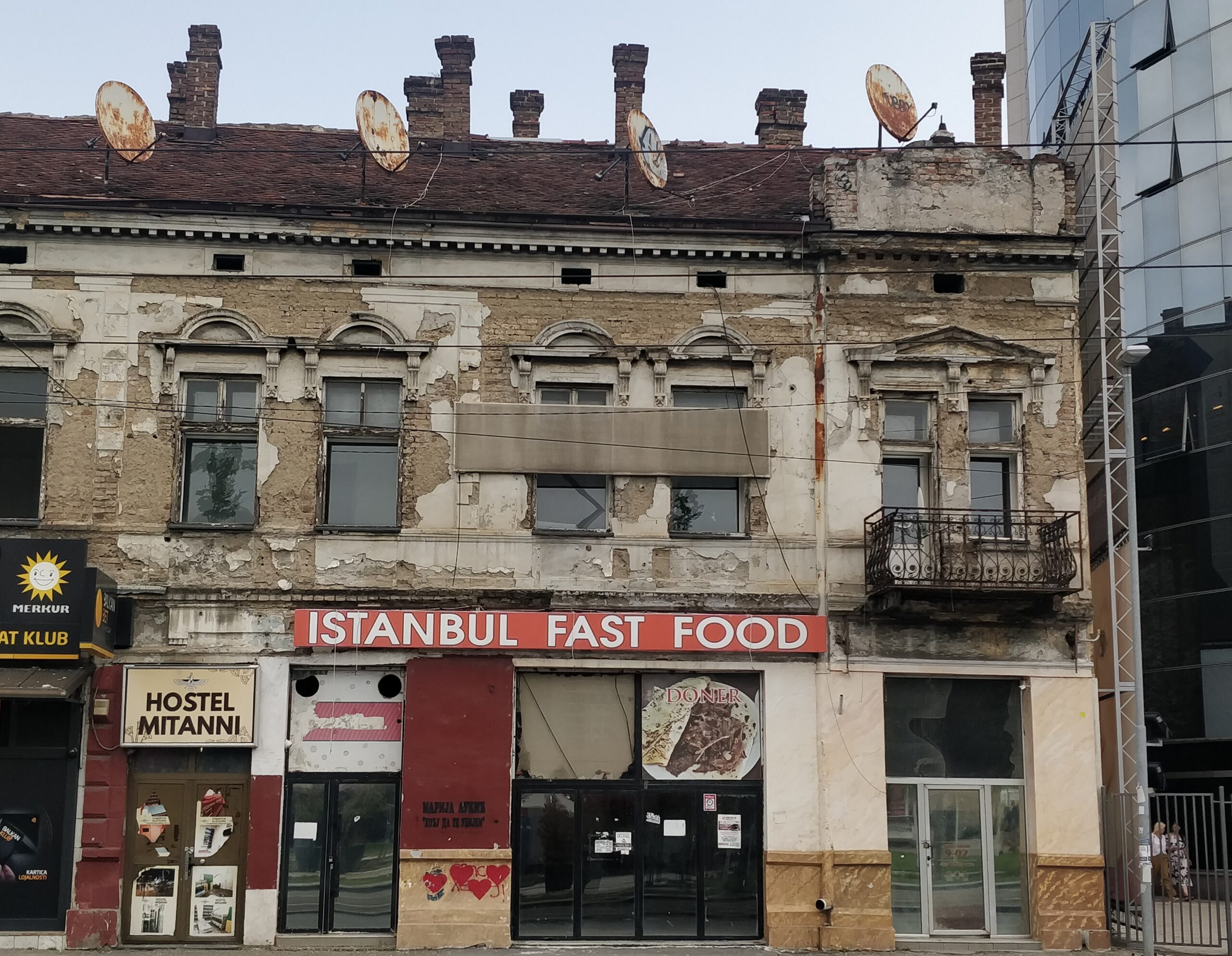 In Savamala, traces of past frequentation by migrants, such as cheap hostels and restaurants, are still visible in the neighbourhood, which is now the site of major building projects. Photo: Fabrizio Foschini, 25 July 2023. A country in the EU: Croatia