Women’s Market Opens in Kabul

Meanwhile, some women who have come to this market to buy things asked the Islamic Emirate to provide work opportunities for women in the country.

A company established an exclusive women’s market in Kabul, providing more than a hundred female businesswomen an opportunity to find employment.

According to the person who established this market, the goal of creating this market is to provide women who have been out of work for the last two years with greater employment opportunities and facilities.

“The main purpose of creating this market is to provide convenience for all the women who live inside Afghanistan in the current situation,” said Rajmana Khaliqi, the founder of the market.

The sole breadwinner of her family, Olya Ahmadyar, a shopkeeper at the market, said that she has been in business for more than 18 years and that she can confidently sell her products at this shop.

“We are pleased that this location has been established because there was previously nowhere for our items to be sold. We are getting orders and have sales,” Ahmadyar said.

Businesswomen at the market expressed their gratitude for the establishment of this secure space for women and asked the Islamic Emirate to support businesswomen.

“It is really good, especially for women, since here the ones who provide are also women, and the ones who buy are also women, which means that women serve women,” Shukria Ahmadyar, a businesswoman said.

“I ask the Islamic Emirate to support us in selling our products,” said Feroza, a businesswoman.

Meanwhile, some women who have come to this market to buy things asked the Islamic Emirate to provide work opportunities for women in the country.

“We ask the Islamic Emirate to let women work, so that they stand on their own feet. Because there are women who do not have men in their family to work for them, that’s why they have to work,” said Mina, the head of the restaurant.

According to officials, this market has a restaurant, a lawn, and more than 30 shops managed by women. Every day, women go here to make purchases.

This market covers an area of around 20 acres and was constructed at the personal expense of 50 million afghani.

Women’s Market Opens in Kabul
read more

UN urges Afghanistan’s Taliban government to stop torture and protect the rights of detainees

BY RAHIM FAIEZ
Associated Press

ISLAMABAD (AP) — The United Nations said Wednesday it has documented more than 1,600 cases of human rights violations committed by authorities in Afghanistan during arrests and detentions of people, and urged the Taliban government to stop torture and protect the rights of detainees.

Nearly 50% of the violations consisted of “torture and other cruel, inhuman and degrading treatment,” the U.N. Assistance Mission in Afghanistan said.

The report by the mission’s Human Rights Service covered 19 months — from January 2022 until the end of July 2023 — with cases documented across 29 of Afghanistan’s 34 provinces. It said 11% of the cases involved women.

It said the torture aimed at extracting confessions and other information included beatings, suffocation, suspension from the ceiling and electric shocks. Cases that were not considered sufficiently credible and reliable were not included in the report, it said.

The Taliban have promised a more moderate rule than during their previous period in power in the 1990s. But they have imposed harsh measures since seizing Afghanistan in mid-August 2021 as U.S. and NATO forces were pulling out from the country after two decades of war.

“The personal accounts of beatings, electric shocks, water torture, and numerous other forms of cruel and degrading treatment, along with threats made against individuals and their families, are harrowing,” U.N. High Commissioner for Human Rights Volker Türk said in a statement issued with the report.

“This report suggests that torture is also used as a tool — in lieu of effective investigations. I urge all concerned de facto authorities to put in place concrete measures to halt these abuses and hold perpetrators accountable,” he said.

The U.N. mission, or UNAMA, uses the term “de facto authorities” for the Taliban government.

Its report acknowledges some steps taken by government agencies to monitor places of detention and investigate allegations of abuse.

“Although there have been some encouraging signs in terms of leadership directives as well as an openness among many de facto officials to engage constructively with UNAMA, and allow visits to prisons, these documented cases highlight the need for urgent, accelerated action by all,” Roza Otunbayeva, the U.N. secretary-general’s special representative for Afghanistan and head of the mission, said in a statement.

The report said of the torture and other degrading treatment that 259 instances involved physical suffering and 207 involved mental suffering.

UNAMA said it believes that ill-treatment of individuals in custody is widely underreported and that the figures in the report represent only a snapshot of violations of people in detention across Afghanistan.

It said a pervasive climate of surveillance, harassment and intimidation, threats to people not to speak about their experiences in detention, and the need for prisoners to provide guarantees by family members and other third parties to be released from custody hamper the willingness of many people to speak freely to the U.N. mission.

The report said 44% of the interviewees were civilians with no particular affiliation, 21% were former government or security personnel, 16% were members of civic organizations or human rights groups, 9% were members of armed groups and 8% were journalists and media workers. The remainder were “family members of persons of interest.”

In a response that was included in the report, the Taliban-led Foreign Ministry said government agencies have taken steps to improve the human rights situation of detainees, and that Islamic law, or Shariah, prohibits torture. It also questioned some of the report’s data. The Ministry of Interior said it has identified only 21 cases of human rights violations.


UN urges Afghanistan’s Taliban government to stop torture and protect the rights of detainees
read more

Afghan health professionals – thousands of female among them – are defying daily challenges to provide critical care.

ISLAMABAD (AP) — The mental health of Afghan women, who have suffered under harsh measures imposed by the Taliban since taking power two years ago, has deteriorated across the country, according to a joint report from three U.N. agencies released Tuesday.

Nearly 70% reported that feelings of anxiety, isolation and depression had grown significantly worse between April and June, an increase from 57% in the preceding quarter, according to the report from U.N Women, the International Organization for Migration and the United Nations Assistance Mission in Afghanistan.

Afghan women were interviewed online, in-person and in group consultations as well as via individual telesurveys. In total, 592 Afghan women across 22 of Afghanistan’s 34 provinces took part.

The women spoke of suffering from psychological problems including depression, insomnia, loss of hope and motivation, anxiety, fear, aggression, isolation and increasingly isolationist behavior, and thoughts of suicide.

The Taliban, upon taking power in 2021 as U.S. and NATO forces were pulling out of the country following two decades of war, promised a more moderate rule than during their previous period in power in the 1990s. But they have instead imposed harsh measures, many of them targeting women.

They have barred women from most areas of public life and work and banned girls from going to school beyond the sixth grade. They have prohibited Afghan women from working at local and non-governmental organizations. The ban was extended to employees of the United Nations in April.

Opportunities to study continued to shrink as community-based education by international organizations was banned and home-based schooling initiatives were regularly shut down by the de facto authorities — a term use by the U.N. for the Taliban government.

Afghanistan is the only country in the world with restrictions on female education and the rights of Afghan women and children are on the agenda of the United Nations General Assembly in New York.

Taliban spokesmen were not immediately available to comment on the report Tuesday, but in the past Taliban officials have cited Shariah, or Islamic, law to support their policies regarding women and girls.

Last month, Mohammad Sadiq Akif, the spokesman for the Taliban’s Ministry of Vice and Virtue, said that women lose value if men can see their uncovered faces in public.

The report found that 81% of women had not engaged at all with local Taliban authorities on issues important to them between April and June 2023. This finding was consistent with engagement levels in the previous quarter, said the report.

Forty-six percent of women said international recognition of the Taliban government should not happen under any circumstances, while 50% warned that recognition should only occur under specific conditions contingent on improving women’s rights. These include restoring education and employment and forming an inclusive government.

The women expressed concern that recognition would only encourage the Taliban government to continue becoming stricter in their policies and practices against women and girls.

Afghan women specifically urged the international community to continue political and economic sanctions against the Taliban, including by not granting exemptions to a travel ban. They urged an increase in engagement with the Taliban on gender equality and women’s rights, including by engaging community and religious leaders in awareness and advocacy efforts.

The women said they want support for initiatives that provide counseling and psychological services and they want access to international scholarships and safe migration options for women and girls to study and work overseas.

Afghan health professionals – thousands of female among them – are defying daily challenges to provide critical care.
read more

Key Afghanistan-Pakistan border crossing reopens after nine days

By

Al Jazeera

Islamabad, Pakistan – A key border crossing between Pakistan and Afghanistan has been reopened for pedestrian and vehicular traffic after remaining closed for nine days, following an exchange of fire between the security forces of the two countries.

Muhammad Anas, an official in Khyber district of Pakistan’s northwestern Khyber Pakhtunkhwa province, where the Torkham border crossing is located, confirmed the development to Al Jazeera on Friday.“We opened the border gates after 7.30am today [Friday]. Immigration and custom officials arrived to resume their duties as normal, and both pedestrian and vehicular traffic was allowed to pass through,” he said.

Afghan officials in Nangarhar province on the other side of the border also confirmed the opening of the main crossing between the two nations through which hundreds of people and vehicles cross every day.

The crossing was closed on September 6 after a deadly exchange of fire between Pakistani and Afghan border forces, killing at least two Afghan soldiers and wounding several others.

Pakistan accused Afghanistan of “constructing unlawful structures” near the crossing and said unprovoked and indiscriminate firing by the Afghan forces led to its closure.

The ruling Taliban government in Afghanistan rejected the allegations and said it was only repairing an old security post when Pakistani security forces opened fire on them.

The Taliban blamed Islamabad for causing hindrances and delays in opening the transit point.

Pakistan Torkham
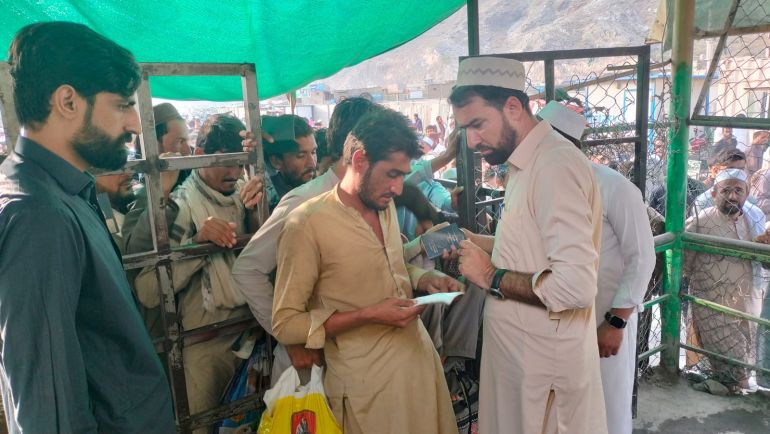
People at the Torkham border crossing on the Pakistani side [Pakistan’s Federal Investigation Agency]

Qari Nazim Gul of the All-Pakistan Customs Agents Association, told Al Jazeera the closure caused traders losses worth millions of rupees.

“We had hundreds of trucks lined up at the border. This repeated closure of Torkham gate causes suffering for people like us who are trying to earn a living or those who are just seeking to meet their families. This needs to end,” he said over the telephone.

Ties between Pakistan and Afghanistan remain frosty. Pakistan has repeatedly accused Afghan officials of harbouring fighters belonging to the outlawed Tehreek-e-Taliban Pakistan (TTP) armed group.

Afghan authorities deny the charges, saying they do not allow any armed group to use their soil for launching attacks on neighbouring countries.

In recent months, the TTP, ideologically aligned with the Afghan Taliban, has drastically increased its attacks on Pakistani security forces.

Earlier this month, on the day Torkham was closed, the group killed four Pakistani soldiers and lost 12 of its members in an attack in the Chitral district of Khyber Pakhtunkhwa.

SOURCE: AL JAZEERA
Key Afghanistan-Pakistan border crossing reopens after nine days
read more

The Daily Hustle: Crossing the Durand Line to visit family in Pakistan

Ali Mohammad Sabawoon • Roxanna Shapour

Afghanistan Analysts Network

The story of Afghan families is often one of loved ones separated by long distances and national borders. Every year, many Afghans who have family living in neighbouring countries make the hours and sometimes days-long journey overland from Afghanistan, braving long bus rides, hours waiting to cross borders and the demands for payment by border guards all to spend some precious time with their families. In the latest instalment of The Daily Hustle, our series of individual accounts about an aspect of daily life in Afghanistan, AAN’s Ali Mohammad Sabawoon spoke to a traveller about his family’s overland journey from Kabul to Quetta to visit his mother and siblings.

Every winter, I travel with my wife and eight children to Quetta in Pakistan to spend a month with other family members who’ve been living there for the past three decades. This is a special time of year when we all gather as an extended family and renew the bonds of kinship. I hadn’t managed to make the journey for two years and my mother, who’s getting on in years, insisted we shouldn’t miss the gathering this year.

Getting from Kabul to Quetta is not an easy feat. You have to take an overnight bus from Kabul to Kandahar (nine hours), then a minibus to Spin Boldak (two hours), then it takes up to seven hours to cross the border and, finally, another six hours from the border to my family’s home, again in a minibus. In other words, it takes a little over 24 hours door-to-door. It’s also expensive. All told, it costs about USD 250 for my family of ten and there are also presents to be bought for my mother, siblings and their children.

By the time we arrived at the Spin Boldak-Chaman crossing, called the Friendship Gate or Da Dosti Darwaza in Pahsto, a large crowd was already waiting. But there were also some pleasant surprises. The crossing has improved significantly since the last time I was there two years ago. The Emirate has built two large modern halls: one for men and another for women. There were chairs to sit on and stalls selling snacks, tea and water to people waiting to cross. The children were tired from the overnight journey and getting restless, so I asked my wife to find a place for them to rest while I completed the formalities.

I’m from Kandahar and our ancestral home in the city is noted as my address on my tazkira (national identity card), so I’m allowed to travel to Pakistan without a visa – that’s the rule. But my uncle and his three sons, who were travelling to Quetta with us, don’t have a local address. They had to hire a laghari (guide)to take them across the border unofficially. Luckily a Taleb we had known for years was there at the crossing. He told us there had been incidents when guides robbed people and abandoned them halfway, in the middle of nowhere. Now, the Taleban had registered the guides in their system. He said he’d help us find a registered guide. After a while, he came back to the hall with another man and waved us over. He said he’d agreed to charge 2,500 Pakistani rupees (around eight US dollars) for each person.

I watched as the guide took my uncle and nephews to a row of people sitting in makeshift ‘offices’; some of the people working there took photographs, while others made laminated colour copies of Kandahari tazkiras, signed and stamped and looking very much like the genuine article. We agreed to meet on the other side of the border at Manda, the dry riverbed where the Quetta-bound vehicles stop to take on passengers.

For us, the formalities on the Afghan side were easily completed and we crossed that side of the border pretty quickly. But getting into Pakistan is another matter. It’s a long and arduous process. You have to pass through seven or eight checkpoints in the no-man’s land between the two countries.

The penultimate stop is the biometric cabin, where they take your picture and fingerprints and check them against their database to make sure you don’t have a record. I waited for about two hours before, finally, it was my turn. At least seven men – regular Pakistan soldiers and uniformed militiamen employed by the Pakistani military – each with his own computer, were sitting at desks inside the cabin. I walked up to one of the desks where a soldier took my ID and looked it over. He noted that I spoke English and Urdu and asked if I was a teacher. I told him I’d once been a teacher but was no longer teaching. He then nodded and gestured with his hand, rubbing his thumb against his fingers, the universal gesture indicating an expectation of money. I told him I didn’t have any money, but he looked dubious and said I should search my pockets. He shook his head and said he wanted 1,000 rupees (around USD 3.50). After I paid him, he took my picture and asked me to put my fingers on the biometric device, but the machine wasn’t working and he wrote on the back of my tazkira “fingerprint not captured.”

I walked out of the cabin and looked around for my family. It was then my wife’s turn to do the same with the children in the women’s section. I poured myself some tea from the thermos we’d brought from home and sat down to wait. An hour later, my wife came out of the cabin with the kids and handed me our documents. I saw that someone had written “travelling with a woman and eight children” on the back of my tazkira.

As we were leaving the biometric area, we were stopped by a militiaman who also checked my tazkira. He claimed I wasn’t registered in the system. He looked up at one of the several CCTV cameras, pointed to two teenage boys standing next to him and instructed me to give them 4,000 Pakistani rupees (around USD 13). It was a show for the cameras, a way to take a bribe and not be seen to take a bribe. I’ve heard they do give some money to the children at the end of the day, but most of the loot they keep for themselves. I had no choice but to pay up. If I were to decline or make a fuss, we’d have been delayed for several hours or, God forbid, could have been turned back altogether.

As one hour gave way to the next, the crowd was getting more and more impatient and truth be told, I was a little afraid a dispute might break out between people in the queue or a firefight between the Afghan and Pakistani soldiers on opposing sides of the border, as sometimes happens. These clashes are not unheard of. There have been several in the past decade in the very place where I was standing. On this day, things were relatively orderly, though, and the Pakistani militiamen were not beating people in the crowd as they’ve sometimes done in the past. A man I was chatting to in the queue told me that last year, an Afghan border guard, who was upset about a video of a Pakistani border guard manhandling an Afghan woman at the Torkham border in Nangrahar province that was making the rounds on social media, had shot and killed a Pakistani militiaman.[1] Now, he said, the Pakistanis were very careful about how they treated people crossing the border.

Finally, the last hurdle. An angry-looking man in civilian clothes asked for my ID. He looked it over and sent me to a nearby cabin where they were vaccinating people for Covid-19. I’d forgotten my vaccination card at home and, even though I’d been immunised several times, I had to get another shot or pay 600 Pakistani rupees (USD 2) to avoid the jab. I’d been planning on getting a booster vaccine when I returned from my trip, so I happily offered my arm to the medic. And with that, I was finally allowed to step out of the crossing point and join my family, also newly vaccinated, in Pakistan.

My uncle and his sons, who’d been smuggled into Pakistan, had arrived at the bus stop several hours before us! They were waiting at Manda and ready to go. They’d already secured a minibus to carry our entire group the rest of the way to my family’s house in Quetta, which took another six hours.

It was already dark by the time we arrived, dusty and road weary, in need of a wash and some sleep. But the fatigue disappeared entirely as soon as we walked up to the gate. The whole family was waiting for our arrival. There were hugs and cheers, as well as some tears. There was tea ready to pour and my mother’s famous sweet bread rolls baked especially for us. In the lively sitting room, the children made shy, tentative gestures to reacquaint themselves with their cousins, but as for me, I was already thinking of the long journey back.

Edited by Roxanna Shapour

References

References
↑1 This is likely the incident the man in the queue was referring to (see AVA news agency here).

Ali Mohammad Sabawoon

More from this author

Roxanna Shapour

More from this author

The Daily Hustle: Crossing the Durand Line to visit family in Pakistan
read more

Afghan students urge India to extend visas and restart scholarships

By  and 

NEW DELHI, Sept 13 (Reuters) – Hundreds of Afghan college students living in India despite the expiry of their student visas staged a protest in New Delhi on Wednesday to urge the Indian government to extend their stay and allow them to resume their studies.

India has in the past offered scholarships to thousands of overseas students from countries such as Afghanistan to pursue undergraduate and post-graduate degrees.

But after the return of the Taliban in Afghanistan in August 2021, many Afghan students in India were reluctant to return home due to fears of possible reprisals and a lack of opportunities due to the country’s economic crisis, the students say.

“The Indian government has not released scholarships for the current academic session (which started in July) and after the expiry of our visa we are living under constant fear of police arrest,” said Arsalan Qayumi of the Afghanistan Students’ Association, which staged the New Delhi protest.

“The students are neither getting scholarships nor permission to work in India,” he said.

Kumar Tuhin, director general of the Indian Council for Cultural Relations (ICCR), a unit of the Ministry of External Affairs, ICCR, said: “We understand that Afghan students are facing problems and the government is serious about addressing their concerns.”

He said no student would be forced to leave the country against their wishes, adding that the External Affairs Ministry would likely soon decide on the scholarships issue.

The ICCR has previously offered study grants to nearly 1,000 Afghan nationals to pursue undergraduate and postgraduate studies in India.

These grants consisted of a monthly stipend of between 25,000 rupees ($301) and 28,500 rupees to Afghan students, on top of subsidised tuition fees and travel expenses.

But for the last two years students say they have faced problems accessing these funds and many have left their studies or moved to other countries.

“I want to continue my studies in India, but the government has not released our stipends,” said Parwana Hussaini, who came to India in 2016 for higher studies. “I don’t want to go back, and I want to continue my higher studies.”

($1 = 82.93 rupees)

Reporting by Manoj Kumar and Mayank Bhardwaj; Editing by David Holmes

Afghan students urge India to extend visas and restart scholarships
read more

Taliban hail China’s new ambassador with fanfare, say it’s a sign for others to establish relations

Associated Press

KABUL, Afghanistan (AP) — The Taliban on Wednesday hailed China’s new ambassador to Afghanistan with fanfare, saying his arrival is a sign for other nations to come forward and establish relations with them.

The Taliban seized power in August 2021 as U.S. and NATO forces withdrew after two decades of war. Their leaders are under sanctions and no country recognizes them as Afghanistan’s legitimate rulers. The country’s seat at the United Nations is still held by the former Western-backed government that was led by Ashraf Ghani.

Only a handful of nations have working diplomatic missions in Afghanistan, including China, the world’s second-largest economy. The two sides have been open about their desire for closer ties, especially commercial ones.

Ambassador Zhao Sheng’s car swept through the tree-lined driveway of the Presidential Palace escorted by a police convoy. He was greeted by uniformed troops and met top-ranking Taliban officials, including Mohammad Hassan Akhund, who heads the administration, and Foreign Affairs Minister Amir Khan Muttaqi.

It is the first time since the Taliban takeover that an ambassador to Kabul has been afforded such lavish protocol.

Muttaqi said the two countries had special ties and that Zhao’s nomination was a “significant step with a significant message.” He did not elaborate further.

The Taliban’s chief spokesman, Zabihullah Mujahid, told The Associated Press that it is tradition for new ambassadors to present their credentials to the head of the country.

“It also signals to other countries to come forward and interact with the Islamic Emirate,” said Mujahid. “We should establish good relations as a result of good interactions and, with good relations, we can solve all the problems that are in front of us or coming in the future.”

He did not answer questions on what Zhao’s presence meant for the Taliban’s demand for official recognition.

The international community, wary of the Taliban’s rule when they were last in power more than 20 years ago, has withheld official recognition and Afghanistan’s assets abroad have been frozen.

A statement from China’s embassy in Afghanistan issued Wednesday urged the international community to maintain its dialogue and encourage the country to put in place an inclusive political framework, adopt moderate policies, combat terrorism and develop friendly external relations.

It said certain countries need to “draw lessons” from what happened in Afghanistan, abandon double standards on combating terrorism, return the country’s overseas assets, and lift sanctions.


Taliban hail China’s new ambassador with fanfare, say it’s a sign for others to establish relations
read more

The Taliban have waged a systematic assault on freedom in Afghanistan, says UN human rights chief

Associated Press

ISLAMABAD (AP) — The Taliban have waged a systematic assault on the freedom of Afghanistan’s people, including women and girls experiencing “immeasurably cruel” oppression, the U.N.’s human rights chief said Tuesday.

United Nations High Commissioner for Human Rights Volker Turk said that human rights are in a state of collapse in Afghanistan more than two years after the Taliban returned to power and stripped back institutional protections at all levels. He urged U.N. member states to help fill the void.

“The shocking level of oppression of Afghan women and girls is immeasurably cruel,” Turk said during a meeting of the U.N. Human Rights Council in Geneva. “Afghanistan has set a devastating precedent as the only country in the world where women and girls are denied access to secondary and higher education.”

The Taliban regained control of Afghanistan on August 15, 2021, as U.S and NATO forces withdrew from the country after more than two decades of war. They initially promised a more moderate approach than during they during their previous rule from 1996 to 2001 but gradually reimposed their harsh interpretation of Islamic law, or Sharia.

Along with excluding girls and women from education beyond sixth grade, most forms of employment and many public spaces, the Taliban have harassed or beaten women at checkpoints for failing to wear a hijab, or Islamic headscarf, according to a report Turk presented to the Human Rights Council. They have ordered women to return home from markets for shopping without a male guardian.

With female lawyers and judges excluded from working or practicing law, women and girls have less ability to obtain legal representation and access to justice, the report stated.

The Taliban edicts have prompted an international outcry. But officials, including the supreme leader Hibatullah Akhundzada, have told other countries to stop interfering in Afghanistan’s internal affairs.

Nobody from the Taliban was immediately available for comment on the U.N. report.


The Taliban have waged a systematic assault on freedom in Afghanistan, says UN human rights chief
read more

Protest Held in Nangarhar Over Closing of Torkham Crossing

Dozens of people held a demonstration around Torkham area in Nangarhar province to protest the closing of the crossing by Pakistan.

The protestors said that Pakistan has been repeatedly closing the Torkham crossing under various pretexts during fruits and vegetable season.

They called on the officials of Afghanistan and Pakistan to resolve their political issues through diplomatic paths.

“When the season of fruits and vegetables arrives, you (Pakistan) close the path, make problems. You attack our checkpoints. Why?” said Wahidullah, a trader.

“The problems which are among the governments, you should solve it by any means, we don’t have any problems with it. But please don’t make obstacles for the transports,” said Farman Gul Shinwari, head of the free transport union in Nangarhar.

“Our call and proposal to Pakistan is to reopen the path so the problems of the people on both sides are solved,” said Faridon Khan Momand, a former member of the parliament.

Meanwhile, Mumtaz Zahra Baluch, spokesperson of Pakistan’s foreign ministry, reacted to the statement of the Afghanistan Foreign Ministry regarding the closure of Torkham crossing, saying that the statement comes as a “surprise as the Interim Afghan authorities know fully well the reasons for the temporary closure of the Pakistan-Afghanistan border at Torkham.”

Baluch said in a statement that Pakistan cannot accept the construction of any structures by “Interim Afghan Government inside its territory since these violate its sovereignty.”

“On the 6th of September, instead of a peaceful resolution, Afghan troops resorted to indiscriminate firing, targeting Pakistan military posts, damaging the infrastructure at the Torkham Border Terminal, and putting the lives of both Pakistani and Afghan civilians at risk, when they were stopped from erecting such unlawful structures,” the statement claimed.

This comes as the Afghanistan-Pakistan Joint Chamber of Commerce said that due to the closure of Torkham, the traders on both sides of the crossing have suffered around $1 million.

“Right now, it is estimated that both Pakistan and Afghanistan suffered more than $1 million,” said Khanjan Alokozai, head of the Afghanistan-Pakistan Joint Chamber of Commerce.

This comes as the meeting which was held between the officials of Afghanistan and Pakistan about the reopening of Torkham crossing ended with no result.

Protest Held in Nangarhar Over Closing of Torkham Crossing
read more

Blinken Defends US Troops Exit from Afghanistan

The Islamic Emirate meanwhile said that the US presence in Afghanistan was affecting both countries.  

The US Secretary of State Antony Blinken has once again defended the decision about the withdrawal of US troops from Afghanistan, saying “we want to make sure, and as a result of what the President did we can make sure, that we’re not going to have another generation going to Afghanistan to fight and die there as we had for 20 years.” 

Blinken made the remarks with Jake Tapper of CNN’s State of the Union program “So we did the right thing,” he said. “But of course, we will look very hard at everything, every aspect of the decisions that we made to make sure that we get it right every time going forward, and that everyone who was involved feels that appropriate justice has been done to the sacrifice of their loved ones.”

Meanwhile, Chairman of the House Foreign Affairs Committee, Rep. Michael McCaul, also said in an interview with CNN they have invited officials from the State Department and White House for testimony.

“We want to talk to Jen Psaki, the messages she was sending out from the White House were so different from what was happening on the ground. You know John Kirby made the comments that there were no weapons left behind, which is insane,” he said.  “…There (are) 7 billion dollars of weapons. And I can show the types of the weapons and the cash. They were left behind. Ned Price, you know the State Department, making rosy comments… we sent letters to have them testified.”

The Islamic Emirate meanwhile said that the US presence in Afghanistan was affecting both countries.

“Both sides suffered heavy damages. Boh the US and its partners have sustained both human and economic losses. There was a major disaster in Afghanistan, tens of thousands of our citizens were martyred,” said Bilal Karimi, deputy spokesman for the Islamic Emirate.

Blinken Defends US Troops Exit from Afghanistan
read more