In late 2005, I travelled there to see it for myself. I stayed at the small American base in Lashkar Gah, the low-rise provincial capital, partly because there was already an advance British team there and I was hoping to find out more about their plans. They included soldiers, diplomats and intelligence officers.
Pashtun-majority Helmand had been an important source of recruits for the Taliban in the past and it has an even longer history of tribal feuds and land disputes, exacerbated by the communist era and the civil war. But in the early 2000s, the provincial governor appointed by President Karzai was keeping a lid on these tensions.
Sher Mohammad Akhundzada was a warlord figure with a predatory reputation and a puppeteer’s command over tribal politics. His father had been governor before him; his uncle was a celebrated mujahideen commander. Sher Mohammad ran Helmand as his own fiefdom, employing patronage and violence, underwritten by government funds, but also – it was widely reported – by profits from the local drugs trade.
One afternoon, I watched as Sher Mohammad lectured a gathering of tribal elders about the evils of cultivating opium. He was going through the motions of rallying support for a Western-funded initiative to encourage farmers to grow more wheat and other legal crops instead of opium poppy. “It’s against the law and we need to stop doing this,” the governor said.
Seated under a colourful sun awning strung over the yard of Sher Mohammad’s compound, the elders looked bored. Some were dozing. One stood up to offer an old excuse for farming poppies. “Opium is not outlawed in the Qur’an,” he said. “But alcohol and prostitution are, and the government is doing nothing to stop this.” The governor smiled, but didn’t engage.
Sher Mohammad had quick, darting eyes, on constant alert. He was only in his thirties at the time.
“It’s good to see you here,” he said, unconvincingly, when I was introduced, but he talked the talk on drugs. British forces needed “to stop smuggling across the border with Pakistan,” he said. What I didn’t know then was that the Americans had searched his compound around that time and found a substantial cache of opium there – enough to make several million dollars’ worth of heroin. He later claimed it was a store of confiscated drugs that was due to be destroyed.
Privately, US officers described the governor as ‘totally corrupt’. But one said, “We need him right now.” Helmand was a backwater for the Americans then, and they were content to have him keep the peace in his own rough-handed way. The governor was no model of governance, but he wasn’t challenging Karzai’s authority.
As it geared up for its expedition to Helmand, the Blair government saw the situation through a London lens. It could not have its soldiers working with a suspected narco baron, especially as it was also supposed to be fighting the drugs trade. Sher Mohammad had picked up the signals. “Don’t say bad things about me,” he warned me after we spoke.
Locals who had heard the British were coming had their own lens, tinted by the past. “Why are the Angrez coming?” several people asked me when I visited Lashkar Gah’s main bazaar with a translator. Angrez is the Pashto word for the English. I tried to explain the goals of the British as best as I understood them, but I had no idea how my answers sounded when they were passed on in Pashto.
A few weeks after my trip to Helmand, I heard that Sher Mohammad Akhundzada, or SMA, as the British called him, had been replaced. But they did not secure the Helmand governor’s cooperation. He was left stewing with resentment and a lot of armed men he could no longer afford to pay. This meant that even before the main UK force deployed, an important segment of opinion was against them. It also created a fertile audience for the narrative that the British were invading.
Speaking a few years later, Sher Mohammad confirmed that he had subsequently encouraged his men to switch sides. “The government stopped paying for the people who supported me,” he said. “I sent 3,000 of them off to the Taliban because I could not afford to support them, but the Taliban was making payments.”
As the fighting intensified, it was portrayed back in the UK as a simple bad guys vs good guys battle between a resurgent Taliban and the legitimate Afghan government. ‘Here, in this extraordinary piece of desert, is where the future of the world’s security is going to be played out,’ said Tony Blair on a visit to the main British base in Helmand.
It was a statement remarkable both for its hyperbole and its hubris. As Ed Butler, who commanded the first British deployment to Helmand later acknowledged, the Taliban were no threat to the UK or the West. Blair could hardly admit that his own government’s decisions had helped stoke local violence.
Instead of a fight for the world’s future, Britain had stumbled into a regional civil war that it didn’t understand. That was the conclusion of Mike Martin, a former British officer who served in Helmand and learned good Pashto, allowing him to dissect the intricacies of its parochial power struggles. He saw first-hand how Britain’s local allies were manipulating their ignorance.
While some of Sher Mohammad’s men took up arms against British troops, others were part of UK-supported police forces who often used their position to muscle in on rivals’ drugs income. So-called local ‘Taliban’ turned out to be militias created by villages “to keep the [British-backed] district ‘police’ out,” said Martin.
British soldiers had to work with ‘police officers’ credibly accused of raping children. Having blacklisted Sher Mohammad, the British ended up cooperating with people with far worse records.
Some British funds went into building up government capacity, but far more went into smashing up Helmand villages with air strikes and artillery, claiming the lives of an untold number of Afghans in the process.
Two years into the campaign, around 140 British personnel had died, with the worst casualties still to come as reinforcements were sent in. Among the new troops was a young second lieutenant called Harry Wales, better known as Prince Harry.
Having initially resisted British pressure to dismiss the Helmand governor, President Karzai was furious at the disaster that had ensued. “We removed Akhundzada [the governor] on the allegation of drug running and delivered the province to drug runners, the Taliban, to terrorists, to a threefold increase of drugs and poppy cultivation,” he told a gathering of Afghan parliamentarians in 2008.
By then, Sher Mohammad was one as well, as Karzai had made him a senator in the upper house. He couldn’t resist gloating. “When I was governor of Helmand for four years, NATO did not drop a single bomb on the province. No civilians were killed and no districts fell to the Taliban,” he said. “If I were still there, I am sure things would be the same as before.”
Helmand may not have started as a battle between the British army and the Taliban, but it ended as one. Ultimately the Taliban could claim success in sending the ‘Angrez’ back home defeated. They had won the fourth Anglo-Afghan War.
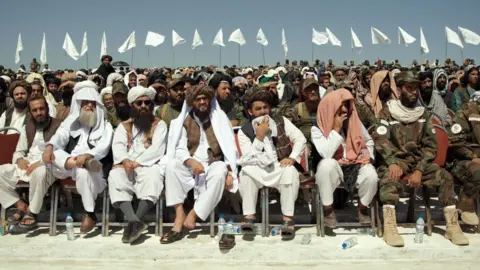
Documentary Hollywoodgate has been a hit at international film festivals
In August 2021, the world watched desperate scenes of multitudes fleeing Afghanistan as the Taliban swept into the capital, Kabul.
Having regrouped in the decades after being driven out by the invasion that followed the 11 September attacks and emboldened by the agreed withdrawal of the remaining US forces, the Taliban deposed the elected government.
But while thousands left, some had been trying to get into the country – including Ibrahim Nash’at, an Egyptian journalist and film-maker based in Germany.
After much persistence, Nash’at succeeded in getting permission to stay in Afghanistan for up to a year to film primarily with the country’s then newly appointed Commander of the Air Force, Malawi Mansour, along with a young Talib lieutenant, MJ Mukhtar, who in the film dreams of joining the air force and longs to avenge himself against the Americans.
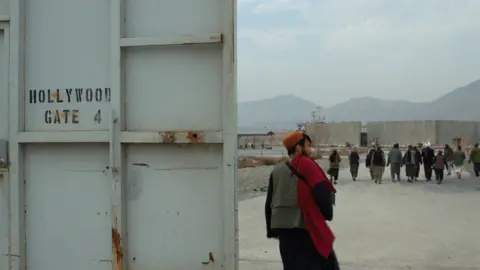
Now, three years on from the Taliban’s return to power, the result is the documentary Hollywoodgate, named after the abandoned CIA military base where much of the filming took place.
Who are the Taliban?
Ten days that shook Afghanistan
But in seeking to tell the tale of the country’s new era, Nash’at found himself in an uncomfortable and often fraught position with a new government that had become known for execution and repression during its first stint in power.
“That little devil is filming,” an unknown Taliban military figure comments to Mukhtar in Nash’at’s presence. “I hope he doesn’t bring us shame in front of China.”
On another occasion, Mansour says casually in front of Nash’at that “if his intentions are bad, he will die soon.”
Asked about it, Nash’at says: “I actually didn’t understand what they were saying at the time. I’d asked the translator not to tell me bad things they said about me. I didn’t want to freak out.”
Nash’at says he wanted to make a film about “this crazy space that was American, and now it’s occupied by the Taliban”
Although frequently told to stop filming, he acquired more than enough footage for this fly-on-the-wall style story, where audiences see the vestiges of American troop life such as treadmills (Mansour asks in the film for one to be sent to his house), signs for unisex toilets and a fridge containing alcohol, but also some of the $7bn (£5.4bn) stockpile of weapons that the US confirmed later it had left behind, including around 73 aircraft and 100 military vehicles.
“These monsters spent their last days here destroying everything,” says one of them about the Americans, as Mansour and his team inspect the former CIA base for the first time by torchlight.
The US military command said at the time that military equipment had been rendered “impossible” to use again, although Nash’at films some aircraft repairs being carried out and the documentary features scenes where his officials assure Mansour that some are fixed and ready to be tested in the air.
Questions for the US
Nash’at tells BBC News he was “shocked” to discover all that had been left behind.
“When I first saw the word ‘Hollywoodgate’ on the base from the road, that was it for me,” he says.
“I thought I would make a movie about this crazy space that was American, and then it’s occupied by the Taliban Air Force. I thought it might be about how they sleep in American beds, but it’s become much more about the weapons.”
“It’s unbelievable these things even exist,” he continues. “It’s really a question for the American authorities, why did they leave all of this behind? How many more warehouses did they leave full? And right until the end of my filming, I never thought they [the Taliban] would be able to fix them.”
However, later scenes of the film, filmed one year later in August 2022, show a military parade at Bagram Air Base in front of the Afghan prime minister and minister of defence, with much of the US weaponry on triumphant display, as they host diplomatic visitors from countries including Russia, China, Pakistan and Iran. Mansour orders a flypast of several aircraft.
US media networks have since reported that weapons left behind in Afghanistan have surfaced in other conflicts around the world.
“The movie really shows the transformation of the Taliban from being a militia into a military regime,” the director claims.
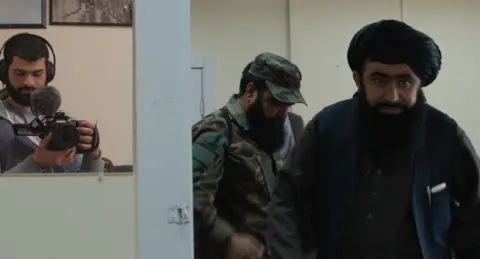
Ibrahim Nash’at, seen in the mirror, filming the Taliban
Nash’at didn’t get to film anything after that parade, he says, because immediately afterwards the film-maker felt he had to flee, as he was told to report to intelligence officials and have his footage inspected. He went to Kabul airport instead.
“They said to me, ‘Hey, come to our office tomorrow with all your material, we want to check it,’” he recalls. “For me, this was a huge alert. So I left Afghanistan at once.”
“I know from these kinds of regimes the moment you go down that road, it’s going to be a downward spiral, it’s never going to be something good,” he says.
Nash’at explains that he went into the country as most others were trying to leave, “because as a journalist, I learned when something is no longer the hot story, no-one cares about it any more. I wanted to go in and do the opposite.”
What ultimately got him access, he adds, was that in during his career, he had “filmed with world leaders, and they [the Taliban] saw images of me with presidents”. And the film comes with a prestigious pedigree, as it is co-produced by Canadian Odessa Rae, also behind the Oscar-winning documentary Navalny.
Nash’at argues that “for me, the name Hollywoodgate is a representation of what this movie is about. It’s a film about the Taliban trying to show that they understand propaganda.
“It’s also about the Hollywood stories that we’ve been told about this kind of military world. It has so many layers for me, I feel that it’s a scandal sponsored by Hollywood itself. It functions like a Greek theatre where the failure of the US-led occupation of Afghanistan is played out.”
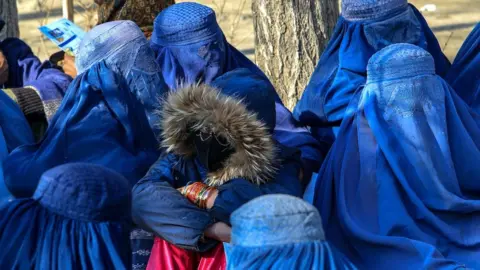
Afghan women are rarely seen on camera in the documentary
Nash’at’s filming was restricted according to the orders of the Taliban commanders he filmed with. The New York Times review of the film calls it a “frustrating documentary” as a result.
“There is no question that the director… faced tremendous danger in shooting… but the risks required to make this documentary also highlight its limitations,” it says.
However, the Guardian’s review of the film points out: “If his finished film is light on probing interviews and rigorous analysis, there’s an obvious reason: his subjects all hate him.”
Ibrahim is philosophical about this. “I think with these kinds of situations, when you take such a risk, know that there’s risk involved, then you’ll live the rest of your life knowing that there’s a risk involved. And it’s something I’ve come to accept.”
He also emphasises that his voiceover at the start of the movie tells the audience that the Taliban wanted the audience to see some of the images he filmed.
“I ask the audience, despite that, ‘may I show you what I saw?’” he says. “My job as a filmmaker is to raise questions and hope the spectators will pick up these questions and try to find answers for them. My goal is that we can see through the ways they present themselves and understand the truth of their ambitions for control—of women, of their countrymen, of their larger geo-political region.”
Ordinary Afghans are usually portrayed in the film observed from a car or truck. There are no women in this film at all – just a couple filmed in passing.
One particularly poignant image is of a woman dressed in a burka, sitting in an icy road. Other women, shapes in burkas, sit outside a shop. It looks like they are begging, but it is not clear.
The UN estimates that more than two-thirds of the country does not have enough food, and that the situation has got worse because of the economic sanctions on women.
“It’s painful to watch these images and know this is the reality. It’s very ugly. What’s happening there, it’s just painful,” Nash’at says.
“When I left, I was haunted by the futility of the material I had, thinking I might not be able to convey the pain of the Afghan people.
“Even if I was with the Taliban, I can see in people’s eyes the fear they have, the sadness, the tiredness. The poverty levels are on a scale I’ve never seen in any other country, and I’ve travelled a lot. It’s really sad that this country is where it is today and that nobody really cares about what’s happening to it.”
“I did choose to go to Afghanistan. I did choose to make this from Afghanistan,” he admits.
“All of the suffering that I’ve gone through in making the film, this is nothing compared to the daily suffering of the Afghans.”
Hollywoodgate is in UK cinemas and available on Curzon Home Cinema now.
‘That little devil is filming’: Director’s time with the Taliban
In an explosion targeting a police ranger vehicle in the Dara Noor district of Nangarhar, at least six students from a religious school were killed, while another student and four Taliban members were injured.
A spokesperson for the Taliban police command in Nangarhar stated that these students and their teachers were traveling to the Dara Noor district for educational purposes.
According to a statement released by the Taliban, the explosion occurred at 12:30 PM on Thursday on the route of the Taliban ranger in the village of Shimal. The statement reports that four students were killed instantly, and two others, all minors, succumbed to their injuries on the way.
The Taliban police spokesperson in Nangarhar reported that five students and one teacher from the religious school were killed in the explosion.
Abdul Basir Zabli mentioned that all the victims were residents of Nooristan and were traveling to Dara Noor for educational purposes.
No group has yet claimed responsibility for the explosion, and detailed information about the nature of the incident remains unclear.
The increasing frequency of such attacks reflects a broader pattern of violence. ISIS, as a major adversary of the Taliban, has escalated its campaign of bombings and targeted assaults against the Taliban, contributing to the instability in the region.
The lack of clarity about the perpetrators highlights the ongoing challenges in ensuring safety and security in volatile areas. Efforts to address these threats must be intensified to protect innocent lives and mitigate further violence.
Six killed, five injured in explosion in Eastern Afghanistan
The United Nations Population Fund (UNFPA) has issued a warning regarding the high maternal mortality rate in Afghanistan, stating that the country urgently needs 18,000 midwives.
The organization has warned that failing to address this urgent need in Afghanistan endangers many lives. Globally, UNFPA estimates that 900,000 skilled (trained) midwives are needed, with the immediate requirement for 18,000 midwives in Afghanistan being highlighted as “urgent.”
According to the report, the number of health centers supported by UNFPA, which was active in 2021, has increased sixfold this year. Over the past three years, the organization has assisted in treating more than five million Afghans in remote areas.
Despite the increase in healthcare facilities, Afghanistan’s health system suffers from significant deficiencies, with a shortage of skilled midwives being a serious concern contributing to high maternal mortality rates.
The UN emphasizes the urgency of recruiting skilled midwives in Afghanistan’s health system, asserting that their inclusion will help prevent maternal deaths and improve overall healthcare outcomes in the country.
Meanwhile, addressing the shortage of midwives in Afghanistan is crucial for improving maternal health and reducing mortality rates. The international community’s support and immediate action are essential to ensure that this pressing need is met and to enhance the country’s overall health infrastructure.
UN urges immediate need for 18,000 midwives in Afghanistan
In a newly released report, this organization said that the number of returnees from Pakistan in July has decreased compared to May and June.
The United Nations High Commissioner for Refugees (UNHCR) has reported a decrease in the deportation of Afghan migrants from Pakistan.
In a newly released report, this organization said that the number of returnees from Pakistan in July has decreased compared to May and June.
In May and June, each month saw thirty-eight thousand people returning to the country.
The UNHCR report states: “In 2024, return figures reached its peak in May and June with some 38,000 returns each month, July showed a decrease, and so far also August.”
Ghulam Rasool said that he was four years old when he went to Pakistan with his family, and now he is 45 years old. He and his eight-member family returned to the country from Pakistan three days ago.
Ghulam Rasool, one of the returnees from Pakistan, said: “Now it’s good. A year ago, the situation had become very tight. Cold is coming, winter is coming, spring is coming, they said nothing. You will understand that winter cannot stay here.”
Hamidullah, another returnee, said that he used to teach in a school in Pakistan. He, who left Pakistan for the country three days ago, said his family has not yet reached Kabul and he is waiting for them here.
Hamidullah added: “We came to our homeland. We have this request from the Islamic Emirate that those migrants who are coming, are currently being treated well and are being helped. Another request we have is that those who don’t have homes have economic problems, or other issues, or work-related problems, should be assisted.”
Earlier, the government of Pakistan extended the deportation process of Afghan migrants holding the Proof of Registration (PoR) cards until June 30, 2025.
UN: Deportation of Afghan Migrants from Pakistan Has Decreased
A group of trainee female doctors from Afghanistan have travelled to Edinburgh to complete their medical degrees after the Taliban forced them to quit studying.
The 19 women arrived in the UK on Tuesday after a three-year campaign by the parents of Linda Norgrove, the kidnapped Scottish charity worker who was killed during a botched rescue attempt by US special forces in 2010.
The Linda Norgrove Foundation, set up and run by her parents, John and Lorna, from their home in Uig, in the Western Isles, said the students had in effect been confined to their homes in fear for their lives since the Taliban regained power.
The foundation worked with UK and Scottish government officials to arrange safe passage and student visas for the women. They have been given places at four medical schools after Scottish ministers changed the law to treat them as home students eligible for free tuition.
It said significant effort had gone into negotiating legal and bureaucratic hurdles to bring them to the UK, including organising English language tests and arranging university interviews via Skype.
It then negotiated their travel to Pakistan to apply for UK visas, Pakistani visas, biometrics, student funding, UK bank accounts and student accommodation. All told, it spent about £60,000.
Many of the women were based in Kabul, but others came from remote provinces, including Bamyan, Wardak and Daykundi. They flew to the UK from Islamabad in Pakistan.
In a statement issued by the foundation, one of the students, Omulbanin Sultani, said the Norgroves and their assistant “had saved our lives in every sense of the word” by supporting them over the last three years.
“It fills me with immense pride and joy to stand here today on this beautiful day,” she said. “But let me tell you, being here was not as easy as these words make it seem. We endured a thousand days of suffering to reach this point.”
Another student, Zahra Hussaini, 19, who had completed her first year of medicine when the Taliban regained power, said it was a dream to arrive in the UK. She said she hoped that by the time she qualified, it would be safe to return home.
“Our journey here will be long enough, maybe for eight years, nine years, and I think during this time many alterations and changes will come to Afghanistan,” she said. “I am hopeful that the situation won’t remain the same.”
John Norgrove said it was heartening the UK and Scottish governments had collaborated so closely on the project.
“Finally these 19 incredibly talented young women get their future back with the opportunity of a tremendous education and a career. The alternative for them in Afghanistan wasn’t good,” he said.
Linda Norgrove, then 36, was working for the US charity Development Alternatives Incorporated when she was kidnapped by Islamist militants in Kunar province in September 2010. Her death, apparently caused by a US fragmentation grenade thrown during the rescue attempt, caused consternation in the US and UK, and led to a joint inquiry by both governments.
Afghan women arrive in Edinburgh to finish medical degrees denied under Taliban
ISLAMABAD (AP) — The United Arab Emirates on Wednesday accepted the credentials of the Taliban’s ambassador to the oil-rich Gulf Arab state, the biggest diplomatic coup for Afghanistan’s rulers who are not officially recognized as the country’s legitimate government. The development, the first Taliban ambassador since one was appointed to China last December, underscored the international divide over how to deal with the government now in Kabul.
The Ministry of Foreign Affairs in Kabul confirmed the news about Badruddin Haqqani in a post on the social media platform X. The ministry did not respond to requests for information about Haqqani, who was previously the Taliban’s envoy to the UAE.
Sirajuddin Haqqani is the current leader of the powerful Haqqani network, a militant movement allied with the Taliban, and a designated global terrorist. He is wanted by the United States for his involvement in deadly attacks and is also on several sanctions lists.
In a separate development Wednesday, a U.N.-appointed rights expert decried the Taliban’s decision to bar him from Afghanistan. The special rapporteur on the situation of human rights in Afghanistan Richard Bennett has frequently criticized the Taliban’s treatment of women and girls.
Bennett said the Taliban’s announcement that they would no longer grant him access to Afghanistan was “a step backwards and sends a concerning signal” about their engagement with the U.N. and the international community on human rights.
“I urge the Taliban to reverse their decision and reiterate my willingness and availability to travel to Afghanistan,” Bennett said.
A spokesman for the Foreign Ministry in Kabul warned that Bennett’s activities were detrimental to the interests of Afghanistan and the Afghan people.
“It was deemed appropriate that Bennett continue his unprofessional conduct from the comfort of his office instead of tiring himself with needless travels,” the spokesperson, Abdul Qahar Balkhi, told The Associated Press in a message.
The UAE accepts credentials of Taliban ambassador in a major diplomatic win for Afghanistan’s rulers
Iran’s Deputy Director of the Anti-Narcotics Department, Mohammad Zarei, announced on Wednesday that Tehran and Kabul have agreed to collaborate on combating drug trafficking and narcotics.
Zarei informed Iranian media that this decision was reached during a meeting between representatives from both parties. The discussion covered various aspects, including drug prevention, reduction of demand, and treatment for drug addicts.
He also mentioned that the agreement includes exchanging information about drug control efforts, providing educational services, and forming joint committees to address the issue.
Zarei emphasized that the two sides have committed to enhancing coordination to effectively utilize the shared information in countering and dismantling drug trafficking networks.
This agreement marks a significant step in strengthening regional cooperation against drug trafficking. By pooling resources and expertise, Tehran and Kabul aim to more effectively tackle the pervasive issue of narcotics that impacts both countries.
The collaboration reflects a growing recognition of the need for coordinated efforts in addressing the complex and cross-border nature of drug trafficking.
Iran and Afghanistan join forces to combat drug trafficking
The United Nations Children’s Fund (UNICEF) reported in its latest update that in 2024, 23.7 million people in Afghanistan, including 12.3 million children, have requested humanitarian aid.
The report highlighted that in the first six months of this year, UNICEF provided mental health and psychosocial support services to 2.8 million children and their guardians, including 26% of women.
The report also noted that heavy rains and flash floods in May affected 21 districts in Badakhshan, Baghlan, and Takhar provinces, resulting in 180 deaths and 280 injuries.
Additionally, UNICEF stated that it delivered drinking water services to 442,000 people, sanitation services to 269,000 people, and health protection services to 528,000 people in the first half of this year.
Amid this dire humanitarian crisis, the forced deportation of Afghan refugees from neighboring countries has further exacerbated the situation.
Many of these refugees, fleeing conflict and economic instability, now face the additional hardship of being returned to a country struggling to provide even basic services.
International organizations and human rights groups have expressed deep concern over these forced deportations, urging the global community to take immediate action to prevent further deterioration of the humanitarian situation in Afghanistan.
UNICEF: 23.7 million in Afghanistan need humanitarian aid
Officials at the Ministry said that the construction of the Wakhan Road is significant for expanding Afghanistan’s economic relations with China.
The Ministry of Rural Rehabilitation and Development said that the preliminary work on the Wakhan Road, including road construction, excavation, and graveling of 50 kilometers, has been completed.
The construction of this road, which connects Badakhshan to the Yarkand region of China, began last year from the Bazai Gonbad area of Pamir with a length of over fifty kilometers, and it has now reached the zero point between China and Afghanistan.
Officials at the Ministry of Rural Rehabilitation and Development have said that the construction of the Wakhan Road is significant for expanding Afghanistan’s economic relations with China.
Najibullah Haroon, spokesperson for the Ministry of Rural Rehabilitation and Development, told TOLOnews: “From the Bazai Gonbad area of the Wakhan district of Badakhshan to the zero point of China, the preliminary work of constructing the 50-kilometer dirt road at a cost of 369 million afghani has been completed.”
Meanwhile, some residents of Badakhshan said that the implementation of infrastructure projects in this province plays an important role in creating job opportunities.
“The Silk Road has been a long-standing dream of the people of Badakhshan, and we are very happy that this road is being opened and used for trade,” Mirajuddin, a resident of Badakhshan, told TOLOnews.
“Roads should be built, and bridges constructed. With such a situation, the movement will increase, and Afghanistan will be connected to China,” Qara Khan, a resident of Pamir Badakhshan, said.
Meanwhile, the Chamber of Commerce and Investment said that connecting Afghanistan to China through the Wakhan Corridor also plays an important role in expanding economic and trade relations.
“If this route is opened to Afghanistan, I think we can export all of Afghanistan’s products, including minerals and raw materials, to China,” Khairuddin Mayel, the deputy of ACCI, said.
“If the Wakhan Corridor is completed and connects Afghanistan to China, it will be very important in the extraction of minerals, the export of raw mineral materials to China, and imports from China,” Sakhi Ahmad Paiman, the first deputy of the Chamber of Industries and Mines said.
The Wakhan Corridor extends nearly 500 kilometers from the city of Faizabad, the center of Badakhshan, to the Yarkand region of China, passing through border heights at an altitude of 5,000 meters above sea level.
Preliminary Work on Wakhan Road to China Completed
The United Nations says aid workers are still in a “race against time” to remove rubble and rebuild after the devastating earthquake struck eastern Afghanistan last month, killing at least 2,200 people and cutting off remote areas.
The 6.0-magnitude quake on Aug. 31 was shallow, destroying or causing extensive damage to low-rise buildings in the mountainous region. It hit late at night, and homes — mostly made of mud, wood, or rocks — collapsed instantly, becoming death traps.
Satellite data shows that about 40,500 truckloads of debris still needs to be cleared from affected areas in several provinces, the United Nations Development Program said Wednesday. Entire communities have been upended and families are sleeping in the open, it added.
The quake’s epicenter was in remote and rugged Kunar province, challenging rescue and relief efforts by the Taliban government and humanitarian groups. Authorities deployed helicopters or airdropped army commandos to evacuate survivors. Aid workers walked for hours on foot to reach isolated communities.
“This is a race against time,” said Devanand Ramiah, from the UNDP’s Crisis Bureau. “Debris removal and reconstruction operations must start safely and swiftly.”
People’s main demands were the reconstruction of houses and water supplies, according to a spokesman for a Taliban government committee tasked with helping survivors, Zia ur Rahman Speenghar.
People were getting assistance in cash, food, tents, beds, and other necessities, Speenghar said Thursday. Three new roads were under construction in the Dewagal Valley, and roads would be built to areas where there previously were none.
“Various countries and organizations have offered assistance in the construction of houses but that takes time. After the second round of assistance, work will begin on the third round, which is considering what kind of houses can be built here,” the spokesman said.
Afghanistan is facing a “perfect storm” of crises, including natural disasters like the recent earthquake, said Roza Otunbayeva, who leads the U.N. mission to the country.
 Afghanistan Peace Campaign