The U.S. State Department spokesperson has stated that Afghanistan remains a priority in U.S. foreign policy. Matthew Miller mentioned that Afghanistan-related matters are being handled by the U.S. Chargé d’Affaires for Afghanistan, the U.S. Special Envoy for Women in Afghanistan, and the U.S. State Department.
On Tuesday, October 1, during a press briefing, Miller was asked if Afghanistan continues to be a priority for U.S. foreign policy, to which he replied, “Of course, it is.”
Matthew Miller added that currently, Karen Decker, the U.S. Chargé d’Affaires for Afghanistan, Rina Amiri, the U.S. Special Envoy for Women in Afghanistan, and Mark Pommersheim at the U.S. State Department are leading efforts on issues related to Afghanistan.
These statements come as U.S. Secretary of State Antony Blinken announced that Thomas West, the U.S. Special Representative for Afghanistan, will be stepping down from his role.
According to Blinken, Thomas West will now become the head of the Office of Sanctions Coordination at the U.S. State Department.
In a statement on Tuesday, the U.S. Secretary of State praised Thomas West for his contributions over the past four years, noting that he effectively implemented U.S. policies regarding Afghanistan.
Meanwhile, Afghanistan continues to face a dire humanitarian crisis under the current regime’s suppressive policies. The Taliban has banned education for girls beyond the sixth grade and restricted employment opportunities for women, leaving many families in poverty and despair.
The international community has expressed deep concern over these regressive measures, which have worsened living conditions for Afghan women and children. With limited access to education and employment, the country’s long-term development prospects remain bleak, and humanitarian aid is urgently needed to address these critical challenges.
Washington states Afghanistan remains US Foreign Policy priority
It is almost a year since, on 3 October 2023, Pakistan’s Prime Minister announced its decision to enact the Illegal Foreigners’ Repatriation Plan. Since then, more than 700,000 Afghans have returned to their homeland. These returns were not voluntary. Some Afghans were deported, while others fled in fear of arrest and expulsion. Some, born in Pakistan, had never before set foot on Afghan soil. AAN’s Ali Mohammad Sabawoon has spoken to five returnees in different provinces and, together with AAN’s Jelena Bjelica, explores how they have been managing this utter upturning of their lives.
I returned from Pakistan around a year ago. I was the only one in my family without a Proof of Registration card. I was afraid the Pakistani police would arrest and deport me to Afghanistan and that my family would remain in Pakistan. I didn’t even dare to travel to the city. Finally, I decided to return with my family to Afghanistan.
Gul Muhammad, from Balkh province, is one of five returnees from different provinces whom we interviewed about their experience, having lived for most of their lives in Pakistan, of returning to Afghanistan and how they have been managing their lives, families, finances and the schooling of their children. They were among more than 722,000 Afghans who returned to Afghanistan between 15 September 2023 and 16 September 2024, according to the United Nation’s High Commissioner for Refugees (UNHCR) latest count, released in mid-September 2024. Out of this number, 33,400 were deported.[1] In this report, we speak about ‘returnees’, but, of course, many of those crossing into Afghanistan have never set foot on Afghan soil before. Born and brought up in Pakistan, the children or grandchildren of refugees, for some, this was their first time in Afghanistan.
According to UNHCR’s figures from March 2024 (see figure 1 below), there are about three million Afghans living in Pakistan; that is about a tenth of the 30 million Afghans who have ever lived as refugees there. Millions of Afghans fled east in the 1980s and 1990s to find safety during the various phases of the war in Afghanistan, the occupations and general turmoil. Most have since returned. Voluntary repatriations began as early as the late 1980s and included the mass repatriation that took place during the Islamic Republic in the early years of Hamid Karzai’s rule, incentivised by international donors and UNHCR and promoted as evidence of the success of the Islamic Republic ‘project’. However, there have also been deportations, including the mass forced returns of 2016 and 2017.[2] Over the years, many Afghans have also re-migrated to Pakistan. The most recent large outflux was after the re-establishment of the Islamic Emirate of Afghanistan (IEA) when, according to Pakistani government figures reported to UNHCR, 600,000 Afghans crossed into Pakistan in the 17 months from August 2021 to 31 January 2023.
The three million Afghans now living in Pakistan are divided into three categories, as per their registration status (see figure 1 below): holders of Proof of Registration cards (PoR), jointly issued by UNHCR and the Pakistani government since 2006;[3] holders of Afghan Citizen Cards (ACC), issued by the Pakistani government since 2017;[4] and undocumented Afghan refugees.[5] What documents individuals hold – or do not hold – in Pakistan also affects the amount of support given by UN agencies if they return to Afghanistan: UNHCR only looks after the PoR card-holders, and supports any returning voluntarily, while the ACC holders and undocumented receive less substantial support by the International Organisation for Migration (IOM).
Figure 1: The approximate number of Afghans in Pakistan, broken down by their registration status. The number of undocumented Afghans includes those newly arrived between 2021 and 2023. UMRF refers to Unregistered Members of Registered Families. Source: UNHCR Situation report March 2024.
On 3 October 2023, Islamabad endorsed a plan to repatriate over a million foreigners, largely Afghans, who did not hold valid documents. The IEA urged Pakistan to hold off going ahead with the plan until the spring. In spite of these pleas, Islamabad gave a tight one-month deadline to the refugees to depart or it said it would forcibly deport them (see this UNHCR update and this Border Consortium update).
Almost two months later, at the end of November, Human Rights Watch (HRW) warned that Pakistani police and other officials were carrying out mass detentions of Afghans, seizing property and livestock and destroying identity documents in order to compel them to leave en masse. Around the same time, Islamabad decided that only those Afghans who held Pakistani visas would be allowed to enter Pakistan and that the Afghan ID card was no longer acceptable for any cross-border travellers any longer.[6] It called this “the first phase of refugees’ deportation.”
A UNHCR and IOMPakistan Flash Updatefrom 24 April 2024 found that most of those who returned (half a million at that point) were undocumented Afghans (89 per cent), followed by Proof of Registration holders (9 per cent) and Afghan Citizen Card holders (2 per cent). Among the deportees (around 30,000), 94 per cent were undocumented and 6 per cent had a Proof of Registration card. The most common reason given by undocumented and ACC holders for leaving Pakistan was fear of arrest (89 percent). “Returnees were most likely to return from Quetta (19 percent) and Peshawar (17 percent),” the report said, “and were most likely to go to Nangrahar (26 per cent), Kandahar (23 per cent) and Kabul (16 per cent).”
The returns continued into 2024, reaching their peak in May and June (38,000 returns in each of those months), the UN Agency for Refugees said. Finally, on 10 July 2024, ten days after the Proof of Registration cards, held by 1.45 million Afghan refugees, had expired, the Pakistan government approved a one-year extension (see Al Jazeera reporting). This granted the cardholders a stay until 30 June 2025.
Leaving Pakistan: Fear of deportation
Like Gul Muhammad from Balkh, whose words began this report, all our other interviewees – from Laghman, Kunduz, Kandahar and Helmand – left Pakistan because they feared being deported. All had been living in Pakistan since the 1980s and all returned to Afghanistan at some point during the last year. Two were registered refugees in Pakistan, with PoR cards, and three were unregistered, although Gul Muhammad’s family had been living in Pakistan for 37 years and he was the only unregistered member of his registered family.
Our interviewee from Kandahar province, father of eight, Hashim Khan, had lived in Pakistan for 43 years. He said he had returned because he was afraid he would be forcibly deported, despite the fact that he was registered in Pakistan and had a PoR card:
I returned now because I was afraid I’d be deported. There were families who had PoRs but were, nonetheless, deported. I was afraid that my family would be deported, and we’d also lose the money which the UNHCR gave us. … I don’t trust the Pakistani government. [However] they announced several times that after the deportation of the undocumented refugees, they’d turn to documented refugees.
He remembers the deportations of 2016/17, but said, then the Pakistani government was going only after individuals:
[At that time], they’d arrest individuals and deport them. The focus was on individuals, not entire families. There were people from our village who were arrested many times – they were jailed and then deported – but they actually had the chance to return to their families [in Pakistan] on the very same day. [For example], in 2017 a person from our village was arrested when he was travelling from a district to Quetta city. He was deported to Spin Boldak and delivered to the Afghan government, but the Pakistani police told him and other arrestees that they’d wait until they’d [the deportees] returned to Chaman and would then give them a lift back to Quetta, if they paid a bribe. I mean, the police were arresting and deporting people at different times, but it was not strict like it is now, that there wouldn’t be any way to cross the border back and the only option [once deported] is to stay in Afghanistan.
Hashim Khan was so afraid of deportation that he sold everything he had for half its value:
I had a cow which was worth 400,000 Pakistani Rupees (1,450 USD). I sold it for 200,000 Pakistani Rupees (720 USD). Everything lost its value and was worth practically nothing.
Helmandi Hashmat Khan, who has five children, had lived in Pakistan for 42 years and, like his countryman from Kandahar, had been registered in Pakistan. He said:
I came back from Pakistan last year on the brink of a harsh winter. I wasn’t deported. I willingly returned because I was hearing different kinds of rumours every other day. Sometimes they were saying that all refugees would be deported and sometimes that PoR holders would [be allowed to] stay. I was tired of hearing these rumours and, meanwhile, I was afraid of deportation.
The interviewee originally from Kunduz, who heads a household of 12, Khodaidad, had lived as an undocumented refugee in Pakistan for 38 years. He left after one of his sons was arrested by the Pakistani police:
Our family migrated to Pakistan 38 years ago because of the fighting. We returned once before to Afghanistan in 2017 and settled in Kabul. I bought a property in Kabul and built a house in Bagrami district because I didn’t have anything in Kunduz. We re-migrated to Pakistan again two months after the IEA takeover in 2021 because the economic situation didn’t look good. But last year, as the government of Pakistan turned harsher towards undocumented refugees, I packed up my belongings and told my son to rent a truck. He was arrested while searching for a rental track and kept in custody for two days and a night. I paid a bribe of 25,000 Pakistani Rupees (90 USD) to the police to get him released. As soon as he was free, we rented a truck and left Pakistan.
Laghmani Muhammed Ishaq was born in Pakistan and had lived his entire life as an unregistered refugee, making a living as a shopkeeper. He decided to return to Afghanistan with his wife and four children because his Pakistani friends and acquaintances were warning him that, this time, their government was serious about deportation.
My family migrated to Pakistan around 40 years ago. My father said that we migrated because of fighting in the country. I was born in Pakistan, but I don’t have refugee documents. Last year, I was so afraid the police would arrest me, I even didn’t dare go to my shop. I wasn’t deported, but I was sure that the police would deport me if they’d arrested me. We’ve been seeing and hearing of refugees being deported every day. I decided to return to my country. The government of Pakistan made the rules stricter many times during our presence in Pakistan in the past. But before, they only arrested people they found on the open roads between cities – they were not going after the shopkeepers or searching people’s houses. Even the Pakistani government officials that were customers in my vegetable shop, told me it is best to close the shop and leave. This is the first time I shifted my family to Afghanistan. I’d never tried before because I knew there is no job or house waiting for me and there was always the imminent risk of fighting.
Returning to Afghanistan: Where is home?
Housing and accommodation is a major problem for Afghan returnees. According to a December 2023 Save the Children survey of returnees, only a third had a place to return to,[7] with worse figures reported by UNHCR: they found only 17 per cent of returnees had no need of accommodation in their final destination. The majority of returnees do not own a property in their place of origin. Some had lost property due to neglect and the passage of time or in the destruction of war or it had been taken by cousins and nephews and land divided between multiple members of the family.[8] UNHCR found that, generally, those forced to return often chose not to live where they or their family were originally from because there were no job opportunities there or they did not have enough money to build a house.
Among our interviewees, just one had returned to his place of origin, two had returned to their province but not their district and two had headed elsewhere in the country. Possibly the most fortunate among the five was Khodaidad from Kunduz province, who has settled in Bagrami in Kabul province where he had bought land in 2017.He was the only one of our five interviewees who had a place to return to.
Muhammad Ishaq from Laghman province, by contrast, is now living with his wife and four children under the blue sky:
I don’t have a house to live in. A relative of ours has temporarily given me some land in the outskirts of the city. It’s walled land, but without a house. I’ve erected a tent, and we live in that tent.
He is not unusual. Nearly one in six returnee families are living in tents, according to the Save the Children survey.
Gul Muhammed from Balkh has rented a house, but said he can hardly afford to pay the rent and feed his six children:
I chose to settle in the provincial capital, Mazar-e Sharif for two reasons. First my home in our village was ruined in the fighting and I don’t have enough money to rebuild it. Second, I want my children to go to school. I’ve rented a house and pay 4,000 afghanis (55 USD) each month.
Hashim Khan, originally from Kandahar who returned from Quetta, told AAN he had neither house, nor land. He had rented a house in Daman district for 3,000 afghanis (40 USD) a month, but was struggling to pay the rent. He said he had heard the Islamic Emirate would provide housing for returnees, but “so far nobody has given me anything.”
The interviewee from Helmand, Hashmat Khan, has settled in Marja district of this province. Hebought a house with the money he had and spent more than half his savings to make it home. He is among the lucky minority who brought their assets back with them. Only a third of returnees had managed to do this, the Save the Children survey found, while 31 per cent of returnees (at the Spin Boldak crossing) and 12 per cent (at Torkham) indicated that their assets had been confiscated. “Most of the families,” said the report, had faced another hurdle: “[D]ue to their livelihood status, [they] did not have the means to transport their household assets back into Afghanistan and had opted to leave them behind or dispose of them.”
Feeding a family without a job
The lack of job opportunities, together with an insufficiency of aid, are two key difficulties facing returnees. Nearly half (47 percent) of those surveyed by Save the Children said there were no jobs in Afghanistan, with 81 percent saying they did not have skills that could lead to employment.
Among our interviewees, only two have been lucky enough to find work – of a sort. Hashim Khan from Kandahar said he had managed to open a shop in a cabin (ghorfa) in the district where his family lived. However, his earnings could not meet the needs of his family:
I’ve rented a cabin for 2,500 afghanis (35 USD) and I’m selling spices there because I have experience in this. But I can’t earn enough money to feed my family. I earn 150-200 afghanis [2.5-3 USD] a day, which is hardly enough to pay the rent of the house and the cabin. We’re buying food with the money UNHCR gave us. But I still hope that my small initiative will flourish.
The returnee from Helmand province, Hashmat Khan has also managed to find a job for himself, but said it was not only dangerous but also did not earn him enough money to support his family well:
I don’t have that money to start a small business. The only skill I have is driving. I tried to find a driving job, but I couldn’t… I went to Spin Boldak to talk to the people who [illegally] traffic cars to Quetta. Sometimes, I find a car to drive it and take it to a district of Quetta. This is a very risky job because it is possible that I could be arrested and jailed or killed by the police of either country, while I try to escape from them and I still don’t make enough to feed my children. It is also hard and tiresome.
Gul Muhammad from Balkh province recalled how he lost his job in Pakistan:
I was a teacher in an NGO school in an Afghan refugees’ camp in Quetta. I was fired by the NGO because I didn’t have a PoR card. The NGO told me I should have PoR because my salary had to be transferred to the bank and for that, I had to have a bank account, and it wasn’t possible for a refugee to open a bank account without a PoR card.
He said that upon return to Afghanistan he could not find a job and that he had married off his 16-year-old daughter for her bride price:[9]
I tried to find a job but failed to do so. In searching for work, unfortunately, I had an accident. Both my feet and one arm were broken. I can’t work now,and my life was badly affected. I’ve installed a shop in a cabin in front of my house and my 13 years old son is running it. But this shop can’t feed our family. Finally, I was compelled to marry my 16-year-old daughter off to someone. I know how bad it is to give a daughter and take the money, but what could I do?
Khodaidad, from Kunduz, who now lives in Kabul, said three members of his household were in constant search for work, but could hardly ever find any:
Our household is badly affected economically. I had some money when returning from Pakistan and bought a rickshaw for one of my sons and thought it would earn us some money here. But it didn’t. Finally, I sold it for less than I’d bought it. My other son and I’ve been going to the square near us. Hundreds of men are waiting there for work, but there is no work for them. For the last twenty days, we’ve been going to the square but finding no job.
Khodaidad, like around 40 percent of returnees surveyed by Save the Children, had to borrow food or rely on friends and relatives. He said he had no other option but to take a loan from relatives in Pakistan:
We can hardly earn 200 afghanis (3 USD) a day, but we spend more than three times that, 600 afghanis (6 USD), every day. So far, I’m indebted to the tune of 100,000 afghanis (1,400 USD) to my relatives living in Pakistan. Each month, I ask them to send me a loan because I don’t have food for my family members to feed them.
The returnee from Laghman province, Muhammad Ishaq, is desperate because he is jobless and has to rely on his family:
There are no jobs at all. Sometimes my relatives help me and buy some flour and other food for me. My heart is bursting now. I don’t know what to do.
Unemployment and economic distress in Afghanistan have, on many occasions, compelled people, especially young men, to attempt to cross to Iran and Pakistan and take any odd job that might earn them a passage to Turkey, where they do the same until they might earn enough to pay to cross into Europe. This is why they often readily accept hard, even life-threatening jobs. The current conditions in Afghanistan might trigger some returnees to think about trying to make the perilous journey to Europe, either themselves or young men in the family, although typically money, in some form is needed[10] (for more, see this 2022 AAN report ‘Between the Devil and the Deep Blue Sea: No good options for Afghans travelling to and from Turkey’).
A joint initiative of the Danish Refugee Council (DRC), the International Rescue Committee (IRC), and the Norwegian Refugee Council (NRC), the Asia Displacement Solution Platform (ADSP), which works to contribute to the development of comprehensive solutions for displaced populations across Asia, said in its May 2024 report:
Afghans are once again facing return to a context where conditions for sustainable reintegration are not met. Rights organisations have documented prior attempts to return Afghans, while research has shown that, if the causes of the initial departure remain unaddressed, returnees will probably leave again.
Deprived of education
While they were in Pakistan, Save the Children said, more than two-thirds of child returnees in the families surveyed had been going to school. That ratio is now reversed. Almost two-thirds (65 per cent) are now not going to school.[11] The majority (85 per cent) told Save the Children they did not have the necessary documents to register and enrol their children in Afghan schools. All our interviewees were also concerned that their children were being deprived of education, but blamed not lack of documents, but lack of schools. The sons of the interviewees in Balkh and Laghman were going to school, although their older daughters could not, while the returnees now in Kabul and Kandahar said there were not even nearby schools for their sons and younger girls. Hashmat Khan from Helmand also faced difficulties getting his only child of school age to school, but had managed to invest in transportation:
One of my sons was going to school in Pakistan. None of the others had reached school age. My son goes to school now as well. The school is around two kilometres away from my house. I bought a bicycle for him and he cycles to school every day.
Hashim Khan from Kandahar said that out of his eight children,
… four were going to school in Pakistan. My two elder daughters were in class eight and a son and one daughter were reading in class two. None of them go to school now because there’s no school in the village where I live. Even if there had been a school there or a high school for girls in the district centre, my older daughters couldn’t go because there’s a ban on girls’ schooling above class six.
Khodaidad, from Kunduz province, currently living in a village in Kabul, province had a similar story:
All my children – three sons and two daughters – were going to school in Pakistan. Two boys were in class four and one in class six and both my daughters were in class three. None of them go to school now because there aren’t any schools near our house. It’s a one-and-a-half-hour walk to reach the nearest school. We’d need to rent at least a rickshaw for them, if not a car. But we can’t afford either. We’re very unhappy to see them deprived of their education.
Gul Muhammad from Balkh province said he had chosen to settle in Mazar-e Sharif so that he could send his children to school, but the ban on girls’ schooling had dictated a different reality:
I didn’t return to my village, I chose to live in Mazar-e Sharif, instead. I thought my children would go to school. My eldest daughter had graduated from grade six in Pakistanand my sons and small daughters were in lower grades. My eldest daughter can’t continue [her education] because the IEA has banned girls [going to school] beyond grade six.
A morsel of aid
Upon arrival in Afghanistan, not all returnees are treated equally. Those with PoR cards who opted to return voluntarily receive a package of assistance from UNHCR. They are given one-off cash assistance of 375 USD per individual “to cover transportation and other immediate needs upon arrival” and each family should be granted 700 USD three months after arriving in their place of origin (see information about UNHCR’s care package here). Since 15 September 2023, some 109,700 individuals returning from Pakistan have been provided with cash assistance in Kabul, Kandahar and Jalalabad encashment centres, including over 69,500 PoR cardholders, the UNHCR reported in its 16 September 2024 update. However, undocumented returnees and ACC cardholders receive no assistance from UNHCR. They get more limited help, packages of food and non-food items, from IOM.
The Border Consortium, a collaborative initiative comprised of various humanitarian organizations aimed at addressing the needs of returnees and vulnerable populations in Afghanistan, particularly those returning from Pakistan, reported on 23 September 2024 that about 85 per cent of 553,4000 returnees had been assisted between 15 September 2023 and 30 June 2024 by different agencies. The Border Consortium report said that each returnee family received from the IEA government upon arrival a cash grant of 4,000 afghanis (60 USD) for families of two and up to 10,000 afghanis (140 USD) for families of five or larger and a sim card.[12]
Two of our interviewees, from Helmand and Kandahar and an interviewee from Balkh, who is an unregistered member of registered family, said they had received help from UNHCR on arrival into Afghanistan, but not yet the second amount of 700 USD which had been due in their area of origin after three months. For example, Kandahari Hashim Khan said:
A day after our arrival from Pakistan, I was provided with more than 2,600 USD by UNHCR [for his family of ten]. The IEA also granted me 10,000 afghanis (140 USD) and two free mobile SIM cards. I spent only one night in the waiting area, in a camp located in Takhta Pul district of Kandahar. After that, I came to Daman district of the province.
Our two other interviewees who were unregistered in Pakistan were assisted by IOM with food and non-food items when they arrived in Afghanistan and also said that, since then, they had received no aid. The returnee from Kunduz, who now lives in Kabul, said:
When our household arrived in Torkham, we were provided by the IEA with 30,000 afghanis (430 USD) for the whole household. As my two sons are married, they calculated us as three families, so they gave 10,000 afghanis (140 USD) to each family. They also gave us three cards, one for each family and told us that, with these cards, we’d receive food items for the first six months. After arriving in Kabul, we went to the Department of Refugees in Kabul and registered ourselves. But since then, we haven’t received any of the promised food items.
Muhammad Ishaq, the returnee from Laghman province, said that when he arrived in Nangrahar, the IEA gave him 20,000 afghanis (300 USD):
I was also provided with a food card, and told I’d receive rations for six months. They told me to keep the card on me. So far, I haven’t received anything, and the card has expired.
Afghan returnees from Pakistan, without question, are in a precarious situation, especially given that the whole country is struggling both with what the World Bank has called a “persistently stagnant” economy (AAN analysis here) and declining humanitarian aid. The Bank reported that the economy contracted by a quarter after the re-establishment of the Emirate. Meanwhile, the Afghanistan Humanitarian Needs and Response Plan for 2024 has received only a quarter of the required 3.06 billion USD in funding, while the United Nations Strategic Framework for Afghanistan, 2023–2025, had, by August 2024 received only a third of the 2.9 billion USD required to meet the basic human needs of people in Afghanistan for 2024 (see the UN Security Council latest regular quarterly report on situation in Afghanistan, released on 9 September 2024).
Tough prospects
Being forced to uproot themselves, with little or no time to prepare, mostly unable to bring assets with them and not having a home or job to come back to – this is the uncertain and undesirable nature of ‘return’ for most Afghans arriving from Pakistan. Adding to this unappealing proposition is the difficulty of getting an education for their children, who are generally used to going to school; the boys and younger girls may get to school if there is one nearby, but older girls are now forced to sit at home. It comes as no surprise then that some returnees like Hashmat Khan from Helmand are venturing into illegal activities, such as vehicle smuggling, to try to scrape together a living. Most, however, still hope for some kind of help or financial aid that will help get them through this tough time.
The UN Secretary General, Antonio Guterres, recently expressed his concern about “the challenges in scaling up capacities to absorb returnees and enable their sustainable reintegration,” a reason why, he said, “it is essential that the humanitarian appeal be funded sufficiently to help to address the immense needs of the Afghan people, particularly the most vulnerable.” The amount of humanitarian aid coming to Afghanistan, however, is in decline, while needs, are not.
These began after the December 2014 attack on the Army Public School in Peshawar. The TTP had claimed responsibility, describing it as revenge for Operation Zarb-e Azb, the Pakistani military’s offensive in North Waziristan that had begun in summer 2014. However, as Human Rights Watch said in November 2015, hostility towards Afghan refugees increased sharply during this period. The report said that during the second half of 2016, over a million Afghans were returned from Pakistan, more than half of whom had been registered with the Pakistani government. “Many were compelled to return to Afghanistan at short notice after receiving 48-hours and/or a week’s notice to leave Pakistan,” the report said.
The UNHCR and the Pakistani National Database and Registration Authority (NADRA) started the issuance of PoR cards for Afghan refugees in Pakistan in 2006. The PoRs expired several times, but were renewed or their duration extended via an announcement. A Pakistani English newspaper, The Balochistan Times, reported on 10 July 2024 that the government of Pakistan had granted a one-year extension to PoR cardholders (see here). Before this, in April 2024, PoR cardholders were given a two-month extension, which ended on 30 June 2024. There are around 1.3 million Afghan refugees with PoR card currently living in Pakistan.
↑4
Between August 2017 and February 2018, the Pakistan government itself started registering all undocumented Afghan refugees by issuing them with Afghan Citizen Cards. These were originally valid until October 2019. The ACCs were part of Pakistan’s ‘Comprehensive Policy on the Voluntary Repatriation and Management of Afghan Nationals’, which was adopted in February 2017 (see European Union Agency for Asylum report here). Around 800,000 Afghans have been issued with this type of card.
↑5
There are around 800,000 undocumented Afghan refugees in Pakistan, according to UNHCR-IOM flow monitoring. Their number fluctuates. In 2017, there were 600,000 to 700,000 undocumented refugees (see here). These are people who were unable to get PoR or ACC cards and live in constant fear of deportation, while also being unable to access basic services like health and education. They cannot get formal employment and work in them informal sector which makes them easy prey for manipulations and exploitations.
↑6
Before this, Afghan ID card (tazkira) holders from Afghanistan were allowed to commute through Spin Boldak. The visa system had already been imposed on the Torkham crossing point to Peshawar in 2014.
↑7
The Save the Children survey was published in April 2024 and was based on data collected from 485 returnee households and 240 households in host communities in Nangarhar (60 per cent of families surveyed), Kunar (22 per cent) and Laghman (18 per cent). A survey questionnaire and key informant interviews were used for the primary data collection in November 2023. 73 per cent of the respondents were male and 27 per cent female.
“During this assessment, the returnees were asked about the type of place they currently live in, with 38 per cent indicating they live in their own house, 36 per cent being hosted by relatives, 15 per cent living in an unsecured area in tents, 9 per cent living in rented houses, and one per cent mentioning another” (see page 10).
↑8
The Border Consortium update from September 2024 found that among those who have lived in Pakistan longer than a decade renting a house is more common. The report suggested that length of stay may have an impact on social relationships in the return country.
↑9
See this AAN report which heard from fathers who married off far younger daughters because of poverty or debt.
↑10
Afghans without visas trying to get to Iran have to pay money to smugglers. It is usually taken as a loan from compatriots who are already in Iran and then the travellers have to earn money to pay off the loan to their fellow Afghans.
Going to Pakistan without a visa did not use to need paid help from smugglers, or at least far less than going to Iran. However, these days, it costs around 5,000 afghanis (USD 70), including the rent of a vehicle, to get there especially if going from Helmand to Baluchistan province.
↑11
International NGOs have pointed out the education deficit facing returnees, for example, the Norwegian Refugee Council (NRC), said on 6 May 2024: “The recent forced return of over 540,000 Afghans from Pakistan has left thousands of children in need of educational support. Many of the returning children are now out of school. It’s hard for them to get an education in Afghanistan, where resources are already stretched thin.” (See NRC’s tweet here).
↑12
The IEA also promised housing and land for returnees. An IEA official said on 9 December 2023 that the IEA would distribute 200,000 places for shelters in different provinces to returnees who do not have shelters, Afghan news agency, Pajhwok reported. The report said that the families with less than ten members would receive ten biswas (1,250 square meters) of land, while families with more than ten members would be granted 15 biswas (1,900 square meters) of land. No media has reported actual IEA distribution to date.
However, on 10 July 2024, the spokesman of the Ministry of Refugees and Repatriation, Abdul Mataleb Haqqani, told RTA that construction work was ongoing on 46 townships in 28 provinces for returnees and that when these were completed, shelters would be distributed to the returnees (see RTA report here).
Returning from Pakistan: How are Afghan returnees coping back in their homeland?
The Taliban said Monday that their security forces had killed and captured several “key members” of a regional Islamic State affiliate for plotting recent terrorist attacks in Afghanistan, alleging that the suspects had crossed over from Pakistan.
Zabihullah Mujahid, the Taliban spokesperson, listed the claims and so-called successes against Islamic State-Khorasan, or IS-K, locally known as Daesh, in a formal statement without providing evidence to support them.
The assertions came after the country’s three immediate neighbors and Russia jointly urged the de facto Kabul government this past Friday to take “visible and verifiable actions” against transnational terrorist groups, including IS-K, on Afghan soil.
Mujahid said the IS-K operatives in question had been involved in several recent attacks in Afghanistan. They included a suicide bombing in the Afghan capital earlier this month and a May gun attack in the central city of Bamiyan, he added.
Both attacks resulted in the deaths of at least ten people, including three Spanish tourists, with IS-K claiming credit for them at the time.
The Taliban spokesperson said that IS-K insurgents had established “new operational bases and training camps” in the Pakistani border provinces of Baluchistan and Khyber Pakhtunkhwa after fleeing Afghan counterterrorism security operations.
“From these new bases, they continue to orchestrate attacks, both within Afghanistan and in other countries,” he claimed, noting that “some of the arrested individuals had recently returned to Afghanistan from the Daesh Khorasan training camp” in Balochistan.
Islamabad has not immediately responded to the Taliban’s allegations, which came two days after neighboring Pakistan, China, and Iran, along with Russia, at a meeting in New York this past Friday, urged the Taliban to eradicate bases of IS-K and other transnational terrorist groups in Afghanistan.
The ministerial meeting warned that these Afghan-based terrorist entities “continue to pose a serious threat to regional and global security.” According to a joint statement released after the huddle, the participants recognized the Taliban’s efforts in combating IS-K.
“They called on de facto authorities to take visible and verifiable actions in fulfilling the international obligations and commitments made by Afghanistan to fight terrorism, dismantle, and eliminate all terrorist groups equally and non-discriminatory and prevent the use of Afghan territory against its neighbors, the region, and beyond,” the statement stressed.
It identified the groups in question as IS-K, al-Qaida, Eastern Turkestan Islamic Movement, ETIM, which opposes China, anti-Iran Jaish ul-Adl, and the Tehrik-i-Taliban Pakistan, TTP, as well as the Baloch Liberation Army, BLA, both waging attacks on Pakistani security forces and civilians.
The United Nations, in a recent security assessment, also described TTP as “the largest terrorist group” in Afghanistan, with several thousand operatives, noting that IS-K activities in the country are also turning into a significant regional threat. It noted that the group had intensified cross-border attacks in Pakistan since the Taliban regained power three years ago and is being facilitated by the de facto Afghan rulers.
A new report issued Monday documented nearly 1,000 deaths of civilians and security forces in Pakistan during the first nine months of 2024. The Islamabad-based independent Center for Research and Security Studies stated that most of the fatalities resulted from attacks by TTP and BLA-led insurgents.
Pakistani authorities have consistently urged Kabul to extradite TTP leaders and militants to Islamabad for trial for instigating deadly violence in the country.
The Taliban has rejected Pakistani and U.N. allegations, saying they are not allowing any foreign groups, including TTP, to threaten other countries from Afghanistan.
The United States has designated TTP and BLA as global terrorist organizations.
Taliban asserts new gains against Afghan-based IS offshoot amid skepticism
Nazdana fled from Afghanistan with her divorce documents
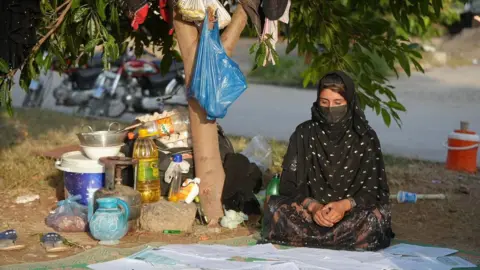
There is a young woman sheltering under a tree between two busy roads clutching a pile of documents to her chest.
These pieces of paper are more important to Bibi Nazdana than anything in the world: they are the divorce granted to her after a two-year court battle to free herself from life as a child bride.
They are the same papers a Taliban court has invalidated – a victim of the group’s hardline interpretation on Sharia (religious law) which has seen women effectively silenced in Afghanistan’s legal system.
Nazdana’s divorce is one of tens of thousands of court rulings revoked since the Taliban took control of the country three years ago this month.
It took just 10 days from them sweeping into the capital, Kabul, for the man she was promised to at seven to ask the courts to overturn the divorce ruling she had fought so hard for.
Hekmatullah had initially appeared to demand his wife when Nazdana was 15. It was eight years since her father had agreed to what is known as a ‘bad marriage’, which seeks to turn a family “enemy” into a “friend”.
She immediately approached the court – then operating under the US-backed Afghan government – for a separation, repeatedly telling them she could not marry the farmer, now in his 20s. It took two years, but finally a ruling was made in her favour: “The court congratulated me and said, ‘You are now separated and free to marry whomever you want.'”
But after Hekmatullah appealed the ruling in 2021, Nazdana was told she would not be allowed to plead her own case in person.
“At the court, the Taliban told me I shouldn’t return to court because it was against Sharia. They said my brother should represent me instead,” says Nazdana.
“They told us if we didn’t comply,” says Shams, Nazdana’s 28-year-old brother, “they would hand my sister over to him (Hekmatullah) by force.”
Her former husband, and now a newly signed up member of the Taliban, won the case. Shams’ attempts to explain to the court in their home province of Uruzgan that her life would be in danger fell on deaf ears.
The siblings decided they had been left with no choice but to flee.
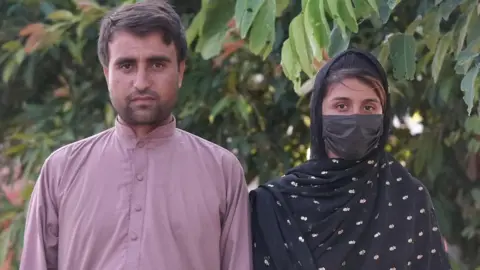
Nazdana and her brother Shams say they had to flee to save their lives
When the Taliban returned to power three years ago, they promised to do away with the corruption of the past and deliver “justice” under Sharia, a version of Islamic law.
Since then, the Taliban say they have looked at some 355,000 cases.
Most were criminal cases – an estimated 40% are disputes over land and a further 30% are family issues including divorce, like Nazdana’s.
Nazdana’s divorce ruling was dug out after the BBC got exclusive access to the back offices of the Supreme Court in the capital, Kabul.
Abdulwahid Haqani – media officer for Afghanistan’s Supreme Court – confirms the ruling in favour of Hekmatullah, saying it was not valid because he “wasn’t present”.
“The previous corrupt administration’s decision to cancel Hekmatullah and Nazdana’s marriage was against the Sharia and rules of marriage,” he explains.
But the promises to reform the justice system have gone further than simply reopening settled cases.
The Taliban have also systematically removed all judges – both male and female – and replaced them with people who supported their hardline views.
Women were also declared unfit to participate in the judicial system.
“Women aren’t qualified or able to judge because in our Sharia principles the judiciary work requires people with high intelligence,” says Abdulrahim Rashid, director of foreign relations and communications at Taliban’s Supreme Court.
\
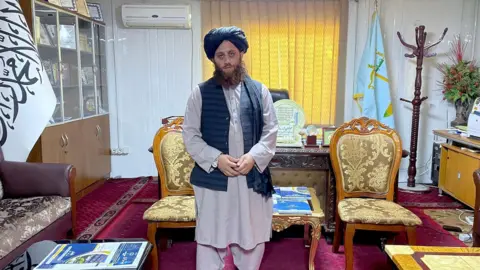
Abdulrahim Rashid, Director of foreign relations and communications at Taliban’s supreme court
‘If we can’t speak, why live?’ – BBC meets women after new Taliban law
The hospital struggling to save its starving babies
The Afghan women who escaped to get an education abroad
For the women who worked in the system, the loss is felt heavily – and not just for themselves.
Former Supreme Court judge Fawzia Amini – who fled the country after the Taliban returned – says there is little hope for women’s protections to improve under the law if there are no women in the courts.
“We played an important role,” she says. “For example, the Elimination of Violence against Women law in 2009 was one of our achievements. We also worked on the regulation of shelters for women, orphan guardianship and the anti-human trafficking law, to name a few.”
She also rubbishes the Taliban overturning previous rulings, like Nazdana’s.
“If a woman divorces her husband and the court documents are available as evidence then that’s final. Legal verdicts can’t change because a regime changes,” says Ms Amini.
“Our civil code is more than half a century old,” she adds. “It’s been practised since even before the Taliban were founded.
“All civil and penal codes, including those for divorce, have been adapted from the Quran.”
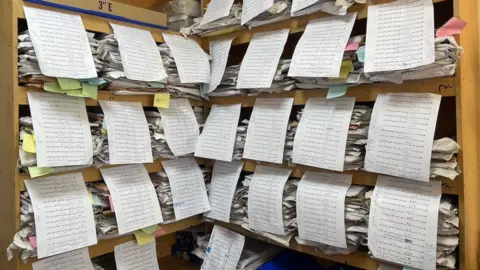
A shelf for resettled court cases of the previous government at Taliban’s supreme court
But the Taliban say Afghanistan’s former rulers simply weren’t Islamic enough.
Instead, they largely rely on Hanafi Fiqh (jurisprudence) religious law, which dates back to the 8th Century – albeit updated to “meet the current needs”, according to Abdulrahim Rashid.
“The former courts made decisions based on a penal and civil code. But now all decisions are based on Sharia [Islamic law],” he adds, proudly gesturing at the pile of cases they have already sorted through.
Ms Amini is less impressed by the plans for Afghanistan’s legal system going forward.
“I have a question for the Taliban. Did their parents marry based on these laws or based on the laws that their sons are going to write?” she asks.
Under the tree between two roads in an unnamed neighbouring country, none of this is any comfort to Nazdana.
Now just 20, she has been here for a year, clutching her divorce papers and hoping someone will help her.
“I have knocked on many doors asking for help, including the UN, but no-one has heard my voice,” she says.
“Where is the support? Don’t I deserve freedom as a woman?”
The BBC has been unable to reach Hekmatullah for comment.
A child bride won the right to divorce – now the Taliban say it doesn’t count
Meanwhile, some Afghan refugees in Iran have criticized what they describe as increasing restrictions imposed by the Iranian government on Afghan citizens.
Eskandar Momeni, Iran’s Minister of Interior, told reporters that his country can no longer accept Afghan citizens and that the deportation of illegal migrants is one of Iran’s top priorities.
The minister also said that the Iranian law enforcement forces are at the forefront of this issue, and in line with the demands of the people and the government, this matter has been placed on their agenda. He further clarified that all necessary plans for the implementation of this decision have been prepared.
The Interior Minister said: “They are our brothers. We share many commonalities; however, our country can no longer accommodate them. All of the country’s resources and subsidies are being spent on this, and therefore, our top priority, with a proper plan, is to deport those who have entered the country illegally.”
At the same time, some Afghan refugees in Iran have criticized what they describe as increasing restrictions imposed by the Iranian government on Afghan citizens. These refugees claim that their residency documents have been declared invalid by the Iranian government, and their bank cards and SIM cards have been deactivated.
Mehdi Alizadeh, an Afghan refugee in Iran, told TOLOnews: “There has been violence; they have been insulted and humiliated. They have insulted their nation and land, and even those migrants who have legal documents have been deported.”
Akbar Soltani, another Afghan refugee in Iran, said: “Since 2021, census forms or residency permits for migrants have been declared invalid, and there have also been issues with SIM cards and bank cards for migrants.”
In recent months, restrictions on Afghan migrants in Iran have increased, with Iranian officials, including the Chief Commander of Law Enforcement Forces, repeatedly emphasizing the deportation of Afghan migrants from the country.
The Islamic Emirate welcomed the stance of these four countries regarding dialogue with Afghanistan’s interim government.
A quadrilateral meeting of Russia, Iran, China, and Pakistan was held on the sidelines of the 79th UN General Assembly session to discuss the situation in Afghanistan.
The Russian Foreign Ministry announced in a statement that participants in the meeting emphasized that without dialogue and cooperation with the interim government, there is no solution for Afghanistan.
The statement from the Russian Foreign Ministry read: “On September 27, the foreign ministers of the regional quartet – Russia, China, Iran and Pakistan – held their third meeting on the Afghanistan agenda on the sidelines of the 79th session of the UN General Assembly. Foreign Minister Sergey Lavrov took part in the event. The parties compared their approaches to the Afghanistan settlement and underscored that there was no alternative to establishing mutually respectful dialogue and partnership relations with the current authorities of Afghanistan.”
Fazl Rahman Orya, a political analyst, told TOLOnews: “Eastern powers like Russia have been engaging with the new Afghan government since day one, and this engagement continues. For the Western world, there is no other option but to engage with the Afghan government as well.”
At the same time, the Iranian Foreign Ministry also issued a statement, noting that the meeting was hosted by Iran’s Foreign Minister. According to the statement, Seyyed Abbas Araghchi warned about Afghanistan’s security situation during the meeting and emphasized the need to form a united front against terrorists.
Sayed Abbas Araghchi, Iran’s Foreign Minister, stated during the quadrilateral meeting: “Terrorist groups like Daesh not only threaten the people of Afghanistan but also the security of the region. Neighboring countries cannot allow terrorism and violent extremism to take root in Afghanistan.”
The Islamic Emirate welcomed the stance of these four countries regarding dialogue with Afghanistan’s interim government, stating that such dialogue paves the way for improved political relations.
Hamidullah Fetrat, the Deputy Spokesperson for the Islamic Emirate, said: “We welcome and affirm the positive stance of Russia, China, Iran, and Pakistan, which consider dialogue with the Islamic Emirate and political dialogue as the only solution. The reality is that dialogue and political discourse between countries facilitate positive engagement.”
Sayed Muqadam Amin, another political analyst, stated: “There is a need to establish regional and even global convergence to obtain firsthand information, which could serve as a good plan for coordinating against terrorism.”
During the meeting, Iran’s Foreign Minister highlighted his country’s hosting of more than six million Afghan refugees and called on the international community to cooperate with the countries hosting these refugees.
Quadrilateral Meeting Stresses Cooperation with Islamic Emirate
Sharif also emphasized the need for an inclusive government and respect for women’s rights in Afghanistan.
The Islamic Emirate has rejected the statements made by the Prime Minister of Pakistan at the UN General Assembly, who claimed the presence of terrorist groups in Afghanistan. The Islamic Emirate once again pledged that Afghanistan will not pose a threat to any country.
Hamidullah Fetrat, the Deputy Spokesperson for the Islamic Emirate, told TOLOnews that the interim government supports positive regional policies and will not allow any foreign group to operate in Afghanistan.
The deputy spokesperson of the Islamic Emirate said: “Afghanistan does not pose a threat or danger to any country. We do not permit foreign groups to operate in Afghanistan, nor do we allow anyone to use Afghan soil as a threat to others.”
Shehbaz Sharif, the Prime Minister of Pakistan, claimed at the UN General Assembly that terrorist groups are present in Afghanistan and that the Islamic Emirate should take action against them.
During the 79th session of the UN General Assembly, Sharif also emphasized the need for an inclusive government and respect for women’s rights in Afghanistan.
Shehbaz Sharif said at the session: “We endorse and share the international expectation, that the Afghan Interim Government would respect human rights, including the rights of women and girls, and promote political inclusion. In particular, the interim government must take effective actions to neutralize all terrorist groups within Afghanistan, especially those responsible for cross-border terrorism against neighboring countries.”
Australia’s Foreign Minister also criticized the restrictions imposed on women in Afghanistan during the session, stating that these restrictions hinder Afghanistan’s progress.
Penny Wong, Australia’s Foreign Minister, said: “Australia will join Germany, Canada and the Netherlands to take unprecedented action to hold Afghanistan to account under international law for the Taliban’s treatment of women and girls.”
Rashid Meredov, the Foreign Minister of Turkmenistan, also emphasized during the session that supporting the people of Afghanistan is the most crucial aspect for ensuring regional security.
The Foreign Minister of Turkmenistan stated: “The most important aspect of ensuring security is cooperation in the Afghan direction and support for the people of Afghanistan in their aspirations to begin peaceful, constructive work to rebuild the economy and social sphere and solve humanitarian problems.”
On the sidelines of the 79th session of the UN General Assembly, the Foreign Minister of Uzbekistan and the UN Secretary-General also discussed the situation in Afghanistan.
Kabul’s Response to Sharif: Terrorist Groups Not in Afghanistan
USAID supported major projects in Afghanistan, including CASA-1000, but halted its operations after the Islamic Emirate’s return to power.
The Economic Affairs Office of the Prime Minister has announced that dozens of domestic and foreign companies are interested in investing over $5 billion in Afghanistan.
According to the statement from the Economic Affairs Office, domestic and foreign investors aim to invest in sectors such as agriculture, infrastructure, industry, energy, mining, telecommunications, healthcare, and transportation in the country.
Hamidullah Fitrat, the deputy spokesperson of the Islamic Emirate, said: “Domestic and foreign companies have shown interest in investing approximately 5.348 billion dollars in agriculture, infrastructure, industry, energy, mining, telecommunications, healthcare, and transport sectors.”
Meanwhile, the Minister of State for International Cooperation of Qatar discussed the situation in Afghanistan and development projects in the country during a meeting with the Deputy Administrator of the U.S. Agency for International Development (USAID).
Mohammad Nabi Afghan, an economic expert, commented on the activities of the US Agency for International Development (USAID), saying, “USAID was very active and greatly supported the private sector, particularly in assisting farmers with fruit exports and in infrastructure projects.”
Sayed Masood, another economic expert, highlighted the importance of USAID’s activities, saying, “I believe if USAID resumes its operations in Afghanistan after three years, it will create a sense of regional trust.”
The Ministry of Economy has emphasized the significance of USAID resuming its activities for the country’s economic growth and stressed the need for USAID and other organizations to restart their operations in Afghanistan.
Abdul Latif Nazari, Deputy Minister of Economy, told TOLOnews: “USAID can help Afghanistan in economic development, including the growth of agriculture, trade, and small and medium-sized industries, as well as managing natural resources like the environment and infrastructure issues such as water supply, electricity, and road construction.”
USAID supported major projects in Afghanistan, including CASA-1000, but halted its operations after the Islamic Emirate’s return to power.
A group of Republican lawmakers is introducing a new bill that would cease all aid dollars to Afghanistan over concerns of interception by the Taliban.
“The Biden-Harris administration’s disastrous withdrawal has plunged the country back under Taliban rule, and now it turns out that our taxpayer dollars are being used to the benefit of the Taliban,” Rep. Josh Brecheen, R-Okla., sponsor of the legislation, told Fox News Digital.
“This legislation is needed so we can ensure that no more of our tax dollars are being irresponsibly used in Taliban-controlled Afghanistan.”
The House bill is co-sponsored by Republican Reps. Tim Burchett of Tennessee, Ralph Norman of South Carolina, Nick Langworthy of New York, Barry Moore of Alabama, Erlic Burlison of Missouri, Matt Rosendale of Montana and Randy Feenstra of Iowa.
The U.S. is the largest donor to Afghanistan. It spent a total of $21 billion on the nation and Afghan refugees who have been evacuated since the withdrawal. However, critics say much of that aid ends up in lining the pockets of the Taliban, who they say have taken control of nongovernmental organizations (NGOs) in the country.
The United Nations (U.N.), meanwhile, has flown in some $2.9 billion in U.S. currency cash to Afghanistan since the Taliban seized control, the bulk of that being from funds allocated by the U.S., and at least some of which ends up in the Taliban-controlled central bank, according to the SIGAR report from July.
The Taliban “taxes” this cash at multiple points of distribution.
The bill would prohibit federal agencies from giving any direct cash assistance to Afghanistan and prohibit any taxpayer dollars from going to the U.N. for the purpose of assisting Afghanistan. It also prohibits Federal Reserve Banks from selling U.S. currency to the U.N. for the purpose of direct cash assistance to Afghanistan.
In a briefing to the U.N. Security Council on March 6, Roza Otunbayeva, the U.N.’s special representative for Afghanistan, did not mention the money going to Da Afghanistan central bank but said it was necessary to get medical care and food for Afghans.
The shipments have “injected liquidity to the local economy that has in large part allowed the private sector to continue to function and averted a fiscal crisis,” Otunbayeva told the council.
In a letter provided in response to the SIGAR report, the State Department said the U.N. was in charge of managing the cash transfer program.
“We remain committed to providing critical, life-saving humanitarian assistance to the Afghan people. We will continue to monitor assistance programs and seek to mitigate the risk that U.S. assistance could indirectly benefit the Taliban or could be diverted to unintended recipients,” the letter said.
For 20 years prior to the Taliban takeover, Afghanistan received some $8 billion in foreign assistance per year, representing 40% of its gross domestic product and financing three quarters of the government’s public expenditures. When the U.S. and other foreign entities stopped supplying aid, the country fell into an economic crisis – and aid dollars began flowing once again.
The Taliban are to be taken to the international court of justice for gender discrimination by Canada, Australia, Germany and the Netherlands in a groundbreaking move.
The move announced at the UN general assembly is the first time the ICJ, based in The Hague, has been used by one country to take another to court over gender discrimination.
Afghanistan, prior to the 2021 Taliban takeover of the country, ratified the convention in 2003.
In the first legal move of this type since the Taliban took over, it is expected that Afghanistan would have six months to provide a response before the ICJ would hold a hearing and probably propose provisional measures.
Advocates of the course argue that even if the Taliban refuse to acknowledge the court’s authority, an ICJ ruling would have a deterrent effect on other states seeking to normalise diplomatic relations with the Taliban. Signatories to the ICJ are expected to abide by its rulings.
There has been concern that the UN has held talks with the Taliban in which women’s issues have been excluded from the agenda in an attempt to persuade the Taliban to attend.
The initiative has the support of three female foreign ministers: Penny Wong from Australia, Annalena Baerbock from Germany, and Mélanie Joly from Canada. It is also being backed by the Dutch foreign minister, Caspar Veldkamp.
In the latest round of suppression in Afghanistan the Taliban have decreed that Afghan women are prohibited from speaking in public, prompting an online campaign in which Afghan women sing in protest.
At a UN side event this week the actor Meryl Streep said: “A female cat has more freedom than a woman. A cat may go sit on her front stoop and feel the sun on her face. She may chase a squirrel into the park. A squirrel has more rights than a girl in Afghanistan today because the public parks have been closed to women and girls by the Taliban. A bird may sing in Kabul, but a girl may not.”
The countries involved in the litigation say they are willing to negotiate with the Taliban in good faith to end gender discrimination, but will, if the necessary stages prove fruitless, seek a hearing at the ICJ.
Last month, the Taliban published a new set of vice and virtue laws that said women must not leave the house without being fully covered and could not sing or raise their voices in public.
Streep spoke alongside Afghan activists and human rights defenders, who called on the UN to act to protect and restore the rights of women and girls in Afghanistan
Asila Wardak, a leader of the Women’s Forum on Afghanistan, said that the system of what has been described as gender apartheid being imposed on women and girls in Afghanistan, was not just an Afghan issue, but part of the “global fight against extremism”.
Akila Radhakrishnan, strategic legal advisor on gender justice at the Atlantic Council thinktank, said: “This case, by centering violations of women’s rights not only has the potential to deliver much needed justice to the women and girls of Afghanistan, but also forge new precedents for gender justice.”
Taliban to be taken to international court over gender discrimination
The United Nations says aid workers are still in a “race against time” to remove rubble and rebuild after the devastating earthquake struck eastern Afghanistan last month, killing at least 2,200 people and cutting off remote areas.
The 6.0-magnitude quake on Aug. 31 was shallow, destroying or causing extensive damage to low-rise buildings in the mountainous region. It hit late at night, and homes — mostly made of mud, wood, or rocks — collapsed instantly, becoming death traps.
Satellite data shows that about 40,500 truckloads of debris still needs to be cleared from affected areas in several provinces, the United Nations Development Program said Wednesday. Entire communities have been upended and families are sleeping in the open, it added.
The quake’s epicenter was in remote and rugged Kunar province, challenging rescue and relief efforts by the Taliban government and humanitarian groups. Authorities deployed helicopters or airdropped army commandos to evacuate survivors. Aid workers walked for hours on foot to reach isolated communities.
“This is a race against time,” said Devanand Ramiah, from the UNDP’s Crisis Bureau. “Debris removal and reconstruction operations must start safely and swiftly.”
People’s main demands were the reconstruction of houses and water supplies, according to a spokesman for a Taliban government committee tasked with helping survivors, Zia ur Rahman Speenghar.
People were getting assistance in cash, food, tents, beds, and other necessities, Speenghar said Thursday. Three new roads were under construction in the Dewagal Valley, and roads would be built to areas where there previously were none.
“Various countries and organizations have offered assistance in the construction of houses but that takes time. After the second round of assistance, work will begin on the third round, which is considering what kind of houses can be built here,” the spokesman said.
Afghanistan is facing a “perfect storm” of crises, including natural disasters like the recent earthquake, said Roza Otunbayeva, who leads the U.N. mission to the country.
 Afghanistan Peace Campaign