Six days on a small boat in rough seas: my terrifying, death-defying escape from the Taliban

Between the crowd and the entrance to the airport, Pordale could see a Taliban checkpoint, where heavily armed men were holding lists in their hands and checking people’s documents. Pordale, whose father had until that morning held a high-ranking position in the democratic government, knew that their chances of getting to the airport and on to an evacuation flight were blown.

Pordale turned to tell his father that they had to get away, but he had disappeared, vanished without a trace into the crowd. “At that point I didn’t know I’d never see him again,” he says. “But I did know that I was now on my own and it was up to me to find a way of getting out of Afghanistan.”

The Taliban’s advance across Afghanistan in the chaotic days before the withdrawal of US and UK troops had been so fast and everything had unravelled so quickly that Pordale says he and his father had not thought of an escape plan. “My mother and my siblings were already in Turkey and I’d stayed in Kabul to help my father, but in those days when the provinces were falling to the Taliban, my father just couldn’t accept that this could happen and everything we’d been working towards would disappear,” he says. “It was only that morning of the 15th, when we woke up and realised that [President] Ashraf Ghani had fled, that we came to our senses.”

Sam Pordale with Coventry’s former lord mayor and lady mayoress, Jaswant Singh Birdi and Krishna Birdi
Sam Pordale with Coventry’s former lord mayor and lady mayoress, Jaswant Singh Birdi and Krishna Birdi. Photograph: Courtesy of Sam Pordale

Pordale’s life to this point had been spent in the highest circles of status and wealth in Afghanistan, thanks to his father’s positions in the military and government. But the huge security risks that came with his father’s work had also meant that his childhood was isolated and lonely. “Me and my siblings only really had each other because we weren’t allowed to go out and play. We only left the house to go to school and we changed schools all the time, so we didn’t have friends,” he says. “My mother would never let us sleep anywhere near a window, so we’d have our beds in the corridors because the house could come under attack. And my father was always facing assassination attempts. By the time I was a teenager I’d survived two suicide bombing attacks on different schools.”

Looking back, Pordale says that the isolation from everyday life had also made him arrogant and entitled. “We really had no contact with the outside world,” he says. “If we did leave the house, we would go with an armed escort. We grew up just accepting that our family had a lot of power.” Then all that wealth and power vanished overnight. “That morning the government fell, we called everyone we’d been working with in the US and UK governments to ask for help, but nobody answered,” he says. “All these powerful allies and friends were gone in an instant.”

Getting closer to the checkpoint, Pordale knew he had to flee. He shouldered his way through the crowd and ran through the streets of Kabul before he found shelter in a shop. “I had nothing: no money, no luggage. We’d gone to the airport in such a panic,” he says. “The only person I could think to call was this dodgy guy who was connected to everyone, including the Taliban, but our family had helped his mother when she was sick. He was the only one who answered the phone to me that day.”

Pordale was told to wait, and after an hour someone turned up and said they were there to take him to Iran. He took a bus to the border, then crossed into Iran hidden in a compartment under the floor of a minivan.

In Iran, he was put under the floor of another bus, compressed into a small space just a few feet above the road for a journey that lasted nearly two days. Trapped in the dark, with the heat and the pain, he kept trying to locate parts of his body to make sure he was still alive. “It was like nothing existed outside the inside of the bus,” he says.

When he finally made it to Istanbul, he turned up dishevelled and filthy at his mother’s front door. “They hadn’t heard from me since Afghanistan fell,” he says. “So it was a shock to them all.” The family were reunited, but because Pordale had crossed into Turkey illegally he didn’t have the paperwork he needed to work or stay in the country. In 2022, a few months after he had arrived, Turkey began an aggressive deportation of illegal Afghan migrants back over the border into Afghanistan. “Many people I knew who had stayed in Afghanistan or who had got sent back were getting arrested or just went missing,” says Pordale. “I knew people who had been killed. I was terrified of being sent back.”

Like many other Afghans who had fled to Turkey, he felt that the only thing he could do was to move on towards Europe. Pordale called the people who had got him into Turkey and they told him to go to a market in the centre of Istanbul. “It was like a shopping centre for people smugglers,” says Pordale. “People would just be standing there outside shops yelling in multiple languages offering different packages to get you to Europe.”

Pordale was told that the cheapest route was overland through Bulgaria, with prices starting at £1,500. The most expensive, at about £8,000, was the sea crossing to Italy. He managed to get together the money to go to Italy and prepared to leave. The smugglers took Pordale and a group of about 60 others, mostly Afghans, to İzmir on the Turkish coast, and one night they did a long night trek in silence to a deserted beach to meet their boat. “When we saw the boat I thought, I’ve made a big mistake, because it was just this little fishing boat. It couldn’t have been more than 14 metres long,” he says. “People were sitting literally on top of each other, piled up. There were parents trying to keep hold of babies. I managed to sit on a small kitchen sink, sort of crouching on top of it but my legs were bent underneath me.”

Pordale is now co-president of Warwick Student Action for Refugees
Pordale is now co-president of Warwick Student Action for Refugees. Photograph: Courtesy of Sam Pordale

They were told the journey would take three days; in the end it took six. “On the third day everyone ran out of food and the sea was so rough that the water started coming in the boat,” he says. “We were all soaking wet and terrified. People were going crazy. One guy just started screaming, ‘We’re all going to die,’ and at that moment I did just want to die so this could be over.”

On the sixth day at sea, they were spotted by an NGO rescue boat and taken to Sicily, and then, after being processed, to a reception centre. After a few days there, Pordale decided to keep moving towards the UK. “My family had worked a lot with the British government and I felt this sense of brotherhood,” he says. He also spoke fluent English. “I experienced such bad racism in Italy that going to the UK felt like my only chance to be accepted and do something useful.”

He walked most of the way from Italy to France with another group of refugees. “Most of the time I was just putting one foot in front of the other but sometimes it would just hit me, what had happened in Afghanistan and how not just me but also hundreds of thousands of other normal people had been reduced to something that felt less than human. There were moments on that journey when I thought, if I die here, nobody will know what happened to me. I’m nobody, nothing. I barely exist.”

He describes his time in the migrant camps in Calais waiting to cross to the UK as “the most degrading, humiliating experience you could imagine”. He says there was no violence inside the camps from the Kurdish smugglers running the place, “but once you start the journey to the boat, that is when it starts”. He says that on his first attempt at crossing the Channel, the boat was in such a bad condition that the smugglers were beating people to make them get onboard. “I paid them £1,800 for the crossing and it took nine attempts to get to the UK.” He doesn’t remember much about the journey itself, “because by that point I didn’t care if I lived or died. It felt like just another thing that was happening to me.”

Sam Pordale, seated and smiling, on the University of Warwick campus
‘In Afghanistan it never would have occurred to me to do something purely to help someone else, but I discovered volunteering was something I loved.’ Photograph: Fabio de Paola/The Guardian

When he finally arrived in the UK (he says he has no idea where he landed) on 16 April 2022, eight months after he had escaped Afghanistan, Pordale says he was treated “like a human being for the first time in months. But when I spoke to my mother I just wanted to get off the phone. I had caused them all these financial problems and all this worry. They were alone in Turkey, and I had failed them.”

He was taken to an asylum hotel in Coventry, “where water was running down the walls and the toilets were broken”, he says. “After the first month I just felt myself slipping into this deep depression. I thought, this can’t be my life.”

At his asylum accommodation, Pordale had come into contact with the Red Cross, and he started walking three hours back and forth each day to one of their drop-in centres to volunteer as an English teacher. “In Afghanistan it never would have occurred to me to do something purely to help someone else, but I discovered volunteering was something I loved,” he says. “Just to feel active and useful and part of something, it brought me alive again.”

He also knew that his fluent English was the reason he had been treated so humanely by the immigration officials he had met since he got off the boat. “I could express what I’d been through. I could form a connection,” he says. “I wanted to help other people to do that too.”

His manager at the Red Cross put him forward for an interview for an academic research programme looking at the barriers that refugees faced accessing higher education. He was shocked to learn that he was allowed to apply to study at UK universities, so he applied for five undergraduate courses across the country.

Meanwhile, he was moved by the Home Office from Coventry to Stockton-on-Tees, where he started volunteering at Citizens Advice, helping local people navigate problems with benefits and jobseeking. “I would sit there and local people would tell me it was all the immigrants’ fault that they couldn’t get a job, and they should all go back to where they’d come from. I would say, ‘Well, I’m a refugee,’ and they’d say, ‘Oh not you, the others.’”

Pordale was profoundly shocked by the poverty and desperation he saw in Stockton. “Many people were living in worse conditions than people in rural Afghanistan,” he says. “So much poverty! Some people would sit and cry because they hadn’t eaten in three days. They felt that nobody cared about them and they were right.”

When protests kicked off in Middlesborough over the summer, Pordale watched the TV coverage of people attacking buildings housing asylum seekers and recognised some of the people he had helped get universal credit or housing benefit. “They were only believing what they’d been told, but they were angry with the wrong people, and the damage the riots have caused to the mental health of many refugees is huge.”

At the beginning of 2023, he was told he had been awarded a full scholarship to study politics and international studies at the University of Warwick. It was “the most miraculous thing that has ever happened to me”, he says. He started university in September 2023 with “no money, no clothes, no suitcase”, but now the campus feels like home. “I know everyone here,” he says. “From the lecturers to the cleaners, everyone is my family.” He intends to stay at Warwick to get a PhD and then spend his life trying to open up higher education opportunities to refugees and asylum seekers.

The first week he enrolled he also joined the university’s Student Action for Refugees group and is now the president. “I went back to the same asylum hotel I was first taken to in Coventry, but this time to teach English,” he says. Sometimes he thinks back to his life a few years ago and can’t believe what he has been through. “The idea I could become a refugee overnight would have seemed crazy,” he says. “But laws, governments, your rights, they can all disappear in a second and all you’re left with is yourself. I just want to make the best of every chance I have to live a good life.”

Six days on a small boat in rough seas: my terrifying, death-defying escape from the Taliban
read more

Cricket must challenge gender apartheid in Afghanistan

Mike Stein would like the ICC to have the moral and political courage to lead a multilateral boycott

Two additional points come to mind. First, England acted alone in 1968 in cancelling their tour to South Africa after the prime minister, John Vorster, banned the team for including the “mixed-race” player Basil D’Oliveira. England’s decision put pressure on the International Cricket Council, which introduced a moratorium on all international tours in 1970, resulting in South Africa’s exclusion from international cricket until Nelson Mandela walked free from prison in 1990.

Second, as Liew suggests, India is the key player, holding both the cricketing and economic cards that represent major barriers to effective action: the former as a consequence of the individualisation and privatisation of cricket through the Indian Premier League, weakening players’ country ties, and the latter as a result of India’s economic self‑interest in Afghanistan.

The only hope would be if the ICC had the moral and political courage to lead a multilateral boycott, as it did in 1970, and the member states were prepared to back them. But that seems unlikely, as the England and Wales Cricket Board and other participants are refusing to take part in a boycott of an international competition. Gender apartheid remains unchallenged by cricket in 2025.

Mike Stein
Pudsey, West Yorkshire

Cricket must challenge gender apartheid in Afghanistan
read more

White House: Pakistan still victim of Terrorism from across the border

The White House National Security spokesperson stated that the people of Pakistan continue to suffer from terrorist attacks coming from the Afghanistan border. John Kirby emphasized that the United States will continue to cooperate with Pakistan in countering terrorism.

In a press briefing on Wednesday, Kirby mentioned that Islamabad has never been a “formal ally” of the United States and that no official treaty has been signed between the two countries. However, he noted that the U.S. has collaborated with Pakistan over the past two decades in addressing terrorist threats along the Afghanistan-Pakistan border.

Kirby further acknowledged that despite this, the U.S. and Pakistan have worked together for several decades to combat terrorism, which “still persists between Afghanistan and Pakistan.”

He emphasized that these threats continue to linger along the border, highlighting the ongoing nature of the security challenges in the region.

Pakistan has accused the Afghan Taliban of supporting insurgents against the country, but the Taliban has consistently denied these allegations. Over the past three years, Islamabad has repeatedly called on the Afghan Taliban to expel the Tehrik-i-Taliban Pakistan militants from Afghanistan and hand over their leaders.

Pakistan is experiencing a severe surge in militant violence, with 757 people killed and nearly as many injured in the first eight months of 2024, according to data from the Pakistan Institute for Conflict and Security Studies (PICSS).

For decades, Pakistan has been a key U.S. partner, first in the fight against Soviet influence in Afghanistan and later in the war on terrorism. However, during the two decades of U.S. and NATO presence in Afghanistan, Pakistan is said to have sheltered Taliban leaders, with former Afghan government officials claiming Islamabad supported the group’s insurgency.

The continuing tensions between the U.S. and Pakistan highlight the complexity of their relationship in the fight against terrorism. While cooperation persists, the historical grievances and ongoing security threats pose significant challenges to deeper bilateral collaboration.

As both countries navigate these issues, the future of their partnership will depend on continued diplomatic efforts to address mutual concerns, including counterterrorism measures and the stability of the Afghanistan-Pakistan border region.

White House: Pakistan still victim of Terrorism from across the border
read more

Pakistan denies military presence in Wakhan Corridor, reaffirms Afghanistan’s sovereignty

The spokesperson for Pakistan’s Ministry of Foreign Affairs once again denied the entry of Pakistani military forces into the Wakhan Corridor of Afghanistan. Shafqat Ali Khan stated, “This region is part of Afghanistan, and we respect its territorial integrity.”

In a press conference in Islamabad on Thursday, January 16, the spokesperson reiterated that the Wakhan Corridor is part of Afghan territory, and Pakistan recognizes the sovereignty and territorial integrity of Afghanistan. Previously, former Pakistani Foreign Ministry spokesperson, Mumtaz Zahra Baloch, had made similar statements.

“Wakhan corridor is part of Afghan territory. There is no question of having any designs over any neighbours sovereign territory”, he said in his weekly briefing.

Recently, reports on social media claimed that the Pakistani army had entered the Wakhan region of Badakhshan and intended to declare the area part of its own territory.

The Pakistani Foreign Ministry spokesperson also called on the Taliban to take action against “terrorists” who have sought refuge in Afghanistan.

According to Ali Khan, Pakistan seeks good and strong relations with Afghanistan but emphasized that “the main issue is the presence of terrorist sanctuaries within Afghanistan,” and both countries are in contact through multilateral interactions on this matter.

Pakistan has repeatedly accused the Afghan Taliban of collaborating with and supporting armed groups opposed to Pakistan, particularly the Tehrik-i-Taliban Pakistan (TTP). However, Taliban officials have consistently denied these allegations.

The ongoing tensions regarding the Wakhan Corridor and the issue of cross-border terrorism continue to strain relations between Pakistan and Afghanistan. Both countries face a critical need for diplomatic cooperation to address these challenges and ensure long-term stability in the region.

As regional security concerns grow, it will be essential for both nations to engage in transparent dialogue to resolve their differences, particularly regarding border security and counterterrorism efforts.

Pakistan denies military presence in Wakhan Corridor, reaffirms Afghanistan’s sovereignty
read more

UN warns of rising child malnutrition in Afghanistan

The United Nations Office for the Coordination of Humanitarian Affairs (OCHA) in Afghanistan has warned of a potential rise in child malnutrition cases this year, adding that climate change in 2025 will affect the lives of hundreds of thousands of children in Afghanistan.

In a report published on Wednesday, January 15, OCHA stated that over half a million children in Afghanistan will face the risk of malnutrition this year.

The United Nations highlighted that climate change has already impacted the lives of hundreds of thousands of children in Afghanistan, emphasizing that this phenomenon limits people’s ability to provide food for their families.

According to OCHA’s statistics, around 22.9 million people—nearly half of Afghanistan’s population—rely on humanitarian aid for survival.

The organization attributes Afghanistan’s lack of progress and rebuilding efforts to an unstable economy, decades of war, natural disasters, climate impacts, and political instability and oppressive policies in the country.

This highlights the incompetence of successive regimes and governments over the decades, unable to effectively address critical issues, resulting in ongoing crises that continue to harm the country and its people.

OCHA also noted that unemployment and poverty in Afghanistan affect approximately 48% of the country’s population.

Afghanistan remains one of the countries most vulnerable to climate change, with thousands of lives already impacted by its consequences. The ongoing challenges highlight the urgent need for comprehensive international support to address both immediate humanitarian needs and long-term development goals.

UN warns of rising child malnutrition in Afghanistan
read more

Ministry of Economy Calls on UN to Focus Aid on Development Projects

Several other UNAMA officials, including Indrika Ratwatte, the deputy head of the organization, also attended the meeting.

The acting head of the Ministry of Economy has called on the United Nations to focus its 2025 aid on development projects in Afghanistan.

Abdul Rahman Habib, the spokesperson for the Ministry of Economy, told TOLOnews that Din Mohammad Hanif, the acting minister of the ministry, and Roza Otunbayeva, the head of UNAMA, discussed the effective and transparent implementation of humanitarian aid in Afghanistan.

Several other UNAMA officials, including Indrika Ratwatte, the deputy head of the organization, also attended the meeting.

Regarding this meeting, Abdul Rahman Habib added: “The acting Minister of Economy emphasized that this year, international organizations should focus their efforts on implementing development projects to address the livelihood challenges of the people and reduce poverty and unemployment.”

Meanwhile, some experts believe that coordinating the humanitarian aid of international relief organizations with the Islamic Emirate is crucial for better implementation of projects. They see utilizing this aid for developmental and job-creation programs as highly valuable.

Abdul Jabbar Safi, head of the Kabul Industrialists Association, told TOLOnews: “As requested by the Ministry of Economy, this aid should be used to create jobs for the people.”

Abdul Ghaffar Nazami, an economic analyst, stated: “These organizations must provide the Afghan government with regular reports on their activities. It is the right of the Afghan people and government to know who these aids are being distributed to.”

Every year, with the arrival of winter, challenges such as poverty and unemployment worsen, increasing people’s reliance on humanitarian assistance.

Ministry of Economy Calls on UN to Focus Aid on Development Projects
read more

Countries Call for Lifting Restrictions on Women in Afghanistan

A statement from Germany’s foreign ministry said that the Islamic Emirate must adhere to Afghanistan’s commitments to international laws.

Germany, Austria, the Netherlands, and Canada have urged the Islamic Emirate to remove the current restrictions on women.

A statement from Germany’s foreign ministry said that the Islamic Emirate must adhere to Afghanistan’s commitments to international laws.

The statement said: “We have repeatedly and urgently called on Afghanistan and the de facto Taliban government to meet all of Afghanistan’s obligations under international law and to lift all legal restrictions on women and girls. In particular, women and girls must no longer be denied the right to an education.”

“It’s been almost a month since they closed institutes to girls. I am one of the midwifery students. My request is that all women should be able to continue their studies,” Fazila, a midwifery student, told TOLOnews.

The United Nations Convention on the Elimination of all Forms of Discrimination Against Women (CEDAW) is one of the most important international documents supporting women’s human rights. The German Foreign Ministry stressed that Afghanistan is also a signatory to this convention, and the “Taliban”, after taking power in Afghanistan, must abide by it.

The statement from Germany’s foreign ministry said: “Together with Australia, Canada and the Netherlands, Germany has decided to hold Afghanistan and the de facto Taliban government accountable for violations of the UN Convention on the Elimination of All Forms of Discrimination against Women (CEDAW). By citing the dispute resolution mechanism referred to in the Convention, we have jointly called on Afghanistan to meet its obligations under the Convention.”

“One of the most important international documents for supporting women’s rights is the UN Convention on the Elimination of all Forms of Discrimination Against Women. Under the current circumstances in Afghanistan, Afghan women are facing extreme restrictions. To remove these restrictions, this convention needs to be implemented to eliminate discrimination in political, economic, cultural, and social spheres,” Bahara Ataei, a university professor, told TOLOnews.

The Islamic Emirate has not yet commented on this matter, but it has previously stated that women’s rights in Afghanistan are ensured based on Islamic laws.

Countries Call for Lifting Restrictions on Women in Afghanistan
read more

Muttaqi Urges Global Aid in 4th Meeting With UN Agencies

Muttaqi also stated that to support the private sector, the Islamic Emirate has recently allocated 33,000 hectares of land for industrial parks.

Amir Khan Muttaqi, acting foreign minister, in the fourth meeting between the Islamic Emirate and United Nations agencies in Kabul, called on the international community to continue assisting Afghanistan.

The acting foreign minister also stated that to support the private sector, the Islamic Emirate has recently allocated 33,000 hectares of land for industrial parks.

It was noted that economic stability, health and nutrition, education, livelihoods, food security and agriculture, combating narcotics, climate change, and issues related to refugees and internally displaced persons were among the topics discussed at the fourth meeting between the leaders of the Islamic Emirate and UN agencies at the Ministry of Foreign Affairs.

The acting foreign minister said: “As far as the Islamic Emirate is concerned, all government institutions are committed to ensuring the security of organizations operating here. Similarly, we are committed to cooperation, transparency, preventing corruption, and providing travel facilities. We assure you that you can continue your assistance with confidence.”

Muttaqi also reassured foreign organizations that the Islamic Emirate is committed to the security of all entities and will provide additional facilities in terms of cooperation, transparency, anti-corruption efforts, and travel facilitation.

The acting foreign minister added: “Recently, 33,000 hectares of land have been allocated for industrial parks. Most small businesses have been exempted from taxes, and overall, the tax rates have been significantly reduced compared to the past.”

The acting foreign minister, in a meeting yesterday regarding his recent visit to the United Arab Emirates, stated that the UAE intends to allocate a support package worth $400 million in various sectors to Afghanistan in the current year.

Muttaqi Urges Global Aid in 4th Meeting With UN Agencies
read more

Afghans evacuated by US in chaos of withdrawal are languishing in foreign camps, documents reveal

Afghan citizens who fled the country with American assistance after the US’s chaotic withdrawal from Afghanistan remain stranded in third countries, new documents shared exclusively with the Guardian suggest, some at prison-like facilities and many with no clarity about their prospects for resettlement.

US officials won’t say exactly how many Afghans remain at such sites, where they were taken after the withdrawal that involved hundreds of thousands fleeing for their lives during the Taliban’s lightning takeover in 2021. Some advocates estimate that “hundreds” remain stranded in temporary facilities in up to three dozen countries.

A set of government records published on Tuesday offers previously undisclosed details about the US government’s involvement with operations at these sites. The records describe family separations, deteriorating mental health conditions, inadequate facilities and fears of forcible repatriation.

The documents, which offer a snapshot up to the fall of 2023, were obtained by the Center for Constitutional Rights, Abolitionist Law Center and Muslim Advocates following litigation against the Departments of Defense, State and Homeland Security.

Sadaf Doost, an attorney and human rights program manager at Abolitionist Law Center, told the Guardian that advocates filed the records requests to seek information about conditions at a half dozen sites where they knew Afghans were being held. But the documents they obtained indicate that evacuated Afghans with pending applications to enter the US have been “detained, held, or otherwise forced to remain in limbo” in at least 36 countries, the groups wrote in a briefing guide.

“Other records we’ve obtained reveal letters upon letters of tireless appeals Afghan nationals made to US government officials – from detailing the lack of access to US embassies, lawyers and humanitarian and immigration-rights organizations to the untenable conditions to the collective trauma the community continues to endure,” Doost added.

It is not clear from the documents how many of the 36 countries are housing the evacuees in holding facilities; the advocates say they know of five facilities in four countries – the UAE, Qatar, Kosovo and Germany. As of April 2023, records show that 2,834 Afghans with pending US applications were in Qatar, 1,256 in the United Arab Emirates, 259 in Kosovo, and dozens more in other countries.

The Departments of Defense and Homeland Security did not respond to requests for comment. A spokesperson for the state department wrote in a statement to the Guardian that US government efforts to resettle eligible Afghans have been ongoing since 2021. While officials process their cases, applicants are “allowed to be present on third country platforms with the permission of the host country”, the spokesperson said, with the US covering the costs. The spokesperson added that the US issued more than 33,000 special immigrant visas for Afghans in the fiscal year 2024.

“US government efforts to resettle eligible Afghans with a legal immigration pathway to the United States have been ongoing since the suspension of operations at Embassy Kabul in August of 2021. These efforts continue today.”

‘Seems cruel to me’

More than 1.6 million people left Afghanistan in the chaotic aftermath of the US’s announcement in July 2021 that it would leave the country after fighting a two-decade war there. In the final days of the withdrawal the following month, US officials coordinated a rushed evacuation of about 120,000 people to dozens of countries around the world.

More than 190,000 Afghans have been resettled in the United States since then, according to the state department spokesperson, but the newly released records suggest that many of those stuck abroad have pending applications to enter the US on humanitarian or other grounds. A different public records request published in 2023 by the American Immigration Council shows that from January 2020 to April 2022, only 114 of 44,785 applications for humanitarian parole – which allows individuals in urgent situations to enter the United States when they are not otherwise eligible – or less than 0.3%, had been approved. Officials are also currently processing more than 20,000 “special immigrant visas” applications by Afghans who worked for the US government, and have rejected about 40%, Reuters reported.

Little is known about what US officials have referred to as the “lily pad” sites where some of them remain. The term is also used to informally refer to foreign countries’ facilities with a temporary presence of US personnel. Some of the sites are makeshift, government-run refugee housing facilities, others are on former US military bases. (The department spokesperson said the sites were now referred to as “platform locations”.)

Human rights advocates have previously raised concerns about some of these sites, in the UAE, Kosovo and Qatar. In 2023, Human Rights Watch warned that up to 2,700 Afghans were being arbitrarily detained at “Emirates Humanitarian City”, a logistics hub in Abu Dhabi where Afghan evacuees had been “locked up for over 15 months in cramped, miserable conditions with no hope of progress on their cases”.

The group found that Afghans at that camp were subjected to around-the-clock surveillance and constraints on movement and denied access to legal counsel, visitors and journalists, while poor medical care resulted in sometimes life-threatening complications. Several people told human rights investigators at the time that they were not allowed to leave the site.

Other sites were no better, with reported suicides and hunger strikes by Afghans at processing sites in Qatar and Kosovo. The Kosovo site earned the nickname “little Guantánamo” among residents because those held there were told that if they left the premises, their applications for US resettlement would be thrown out.

In one case described in the documents, an elderly woman with dementia was brought to the US while her “caregiver” remained in the UAE, a state department official wrote in an email to colleagues, indicating that the plan was to move the woman into a nursing home. “Which seems cruel to me,” the official wrote. Another email exchange references someone who made it to the US while their “vulnerable mother and brother” remained in the UAE.

More than 17,000 people moved through the UAE site between August 2021 and January 2022 but fewer than 50 remain there today, according to the department spokesperson, who said that the US is “working with the UAE to determine resettlement options for the remaining population”.

US officials have denied in the past having a presence at sites where Afghans are being held abroad, but the records show they were involved in the establishment of at least some of them. The documents include agreements between the US and five countries – Qatar, Oman, Kuwait, Italy and Germany – detailing conditions for what the US called at the time the “temporary” relocation of Afghan citizens to these sites. In the agreements, US officials pledged to contribute to the “safety and comfort” of Afghans held in third countries, including providing for meals, medical care and educational needs. They promised the host countries to help maintain “order” at the sites, including by conducting “joint” patrols.

Such agreements were to be “short-term”, ranging from one month to under a year. But the records show that at least some were formally extended, in one case – in Qatar – at least through September 2023.

‘They made promises to prioritize Afghans’

Laila Ayub, an immigration attorney and co-director of Project ANAR, an advocacy group founded by Afghan American women to help Afghans resettling in the US, told the Guardian thousands of people who were promised pathways to special visas in return for their work with the US remain in Afghanistan or third countries. Many, she added, had grown so desperate that they have chosen to make their way to the US via treacherous routes through Latin America and the US-Mexico border. Others have returned to Afghanistan, despite the risks they face there.

“Decades of US foreign policy directly displaced many Afghans,” she added. “[US officials] made specific promises that they would prioritize Afghans and that they would give them a pathway, and we just haven’t seen that promise fulfilled.”

This week, a bipartisan group of more than 700 US veterans and current and former officials wrote a public letter urging the incoming Trump administration to preserve special visa and resettlement options for Afghans at risk, increase resources allocated to their processing, and protect them from broader immigration enforcement, which Trump has said would be his administration’s priority.

Shawn VanDiver, a US navy veteran and founder of #AfghanEvac, a group that works with the state department to help resettle Afghans and organized the letter, said that he fears that Donald Trump may shut down refugee arrivals like he did during his first term in office.

“We need a better wartime allies program,” VanDiver said, praising officials’ efforts to resettle an enormous number of people while noting that the process remains flawed. “The system is working as designed, but the system is designed to be difficult. It’s designed to make it hard.”

Afghans evacuated by US in chaos of withdrawal are languishing in foreign camps, documents reveal
read more

Why India is reaching out to the Taliban now

Soutik Biswas
BBC News

14 Jan 2025

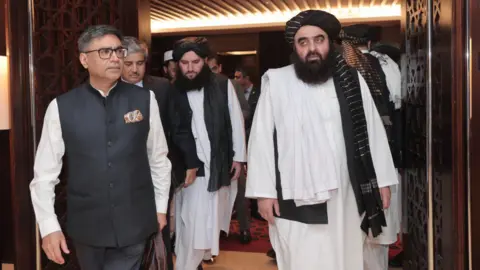
Mea india Foreign Secretary Vikram Misri during a meeting with Acting Foreign Minister of Afghanistan Mawlawi Amir Khan Muttaqi, in Dubai. (Photo Credit: X/@MEAIndia)
India’s foreign secretary Vikram Misri met acting Afghan foreign minister Amir Khan Muttaqi in Dubai

India’s latest diplomatic outreach to Afghanistan’s Taliban government signals a marked shift in how it sees the geopolitical reality in the region.

This comes more than three years after India suffered a major strategic and diplomatic blow when Kabul fell to the Taliban.

Two decades of investment in Afghanistan’s democracy – through military training, scholarships and landmark projects like building its new parliament – were swiftly undone. The collapse also paved the way for greater influence from regional rivals, particularly Pakistan and China, eroding India’s strategic foothold and raising new security concerns.

Yet, last week signalled a shift. India’s top diplomat Vikram Misri met Taliban acting foreign minister Amir Khan Muttaqi in Dubai – the highest level of engagement since Kabul’s fall. The Taliban expressed interest in strengthening political and economic ties with India, calling it a “significant regional and economic power”.

Talks reportedly focused on expanding trade and leveraging Iran’s Chabahar port, which India has been developing to bypass Pakistan’s Karachi and Gwadar ports.

How significant is this meeting? Delhi has now given the Taliban leadership the de facto legitimacy it has sought from the international community since its return to power, Michael Kugelman of the Wilson Center, an American think-tank, told me.

“The fact that this treatment is coming from India – a nation that never previously had friendly relations with the Taliban, makes this all the more significant, and also a diplomatic triumph for the Taliban,” he says.

Since the Taliban’s return to power in Afghanistan, countries have adopted varied approaches toward the regime, balancing diplomatic engagement with concerns over human rights and security. China, for example, has gone far: it has actively engaged with the Taliban, focusing on security and economic interests, and even has an ambassador in the country.

No country has formally recognised the Taliban government, but up to 40 countries maintain some form of diplomatic or informal relations with it.

That’s why experts like Jayant Prasad, a former Indian ambassador to Afghanistan, are more circumspect about India’s outreach.

For the past three years, he says, India has maintained contact with the Taliban through a foreign service diplomat. India had closed its consulates in Afghanistan during the civil war in the 1990s and reopened them in 2002 after the war ended. “We didn’t want this hiatus to develop [again], so we wanted to engage. It is very simply a step up in relations,” he says.

India has “historical and civilisational ties” with Afghanistan, Foreign Minister S Jaishankar told parliament in 2023. India has invested more than $3bn (£2.46bn) in over 500 projects across Afghanistan, including roads, power lines, dams, hospitals and clinics. It has trained Afghan officers, awarded thousands of scholarships to students and built a new parliament building.

This reflects a lasting geopolitical reality. “Irrespective of the nature of the regime in Kabul – monarchical, communist, or Islamist – there has been a natural warmth between Delhi and Kabul,” The Indian Express newspaper noted.

Mr Kugelman echoes the sentiment. “India has an important legacy as a development and humanitarian aid donor in Afghanistan, which has translated into public goodwill from the Afghan public that Delhi is keen not to lose,” he says.

Interestingly, relations with Delhi appear to be easing amid rising tensions between Afghanistan and Pakistan. Pakistan claims the hardline Pakistani Taliban (TTP) operates from sanctuaries in Afghanistan.

Last July, Pakistan’s Defence Minister Khawaja Asif told the BBC that Pakistan would continue attacks on Afghanistan as part of an operation aimed at countering terrorism. Days before talks between India and the Taliban, Pakistani airstrikes killed dozens in eastern Afghanistan, according to the Afghan government. The Taliban government condemned the strikes as violations of its sovereignty.

This marks a sharp decline in relations since the fall of Kabul in 2021, when a top Pakistani intelligence official was among the first foreign guests to meet the Taliban regime. At the time, many saw Kabul’s fall as a strategic setback for India.

“While Pakistan isn’t the only factor driving India’s intensifying outreach to the Taliban, it’s true that Delhi does get a big win in its evergreen competition with Pakistan by moving closer to a critical long-time Pakistani asset that has now turned on its former patron,” says Mr Kugelman.

There are other reasons driving the outreach. India aims to strengthen connectivity and access Central Asia, which it can’t reach directly by land due to Pakistan’s refusal of transit rights. Experts say Afghanistan is key to this goal. One strategy is collaborating with Iran on the Chabahar port development to improve access to Central Asia via Afghanistan.

“It is easier for Delhi to focus on the Afghanistan component of this plan by engaging more closely with the Taliban leadership, which is fully behind India’s plans as they would help enhance Afghanistan’s own trade and connectivity links,” says Mr Kugelman.

Clearly, India’s recent outreach helps advance its core interests in Taliban-led Afghanistan: preventing terrorism threats to India, deepening connectivity with Iran and Central Asia, maintaining public goodwill through aid, and countering a struggling Pakistan.

What about the downsides?

“The main risk of strengthening ties with the Taliban is the Taliban itself. We’re talking about a violent and brutal actor with close ties to international – including Pakistani – terror groups that has done little to reform itself from what it was in the 1990s,” says Mr Kugelman.

“India may hope that if it keeps the Taliban on side, so to speak, the Taliban will be less likely to undermine India or its interests. And that may be true. But at the end of the day, can you really trust an actor like the Taliban? That will be the unsettling question hovering over India as it continues to cautiously pursue this complex relationship.”

Mr Prasad sees no downsides to India’s current engagement with Afghanistan, despite concerns over the Taliban’s treatment of women. “The Taliban is fully in control. Letting the Taliban stew in its own juice won’t help Afghan people. Some engagement with the international community might pressurize the government to improve its behaviour.”

“Remember, the Taliban is craving for recognition,” says Mr Prasad. “They know that will only happen after internal reforms.” Like bringing women back into public life and restoring their rights to education, work and political participation.

Why India is reaching out to the Taliban now
read more