Funding cuts to Afghanistan are the biggest threat to helping the country’s women, the chief of a top aid agency warned Sunday.
Jan Egeland, the secretary-general of the Norwegian Refugee Council, said women and girls were bearing the brunt of dwindling financial support for nongovernmental groups and humanitarian assistance to Afghanistan.
The NRC helped 772,484 Afghans in 2022. That number fell to 491,435 in 2023. Last year, the aid agency helped 216,501 people. Half of its beneficiaries are women.
Egeland, who has made several visits to Afghanistan since 2021, said: “We see one after the other peer organization cutting programming and staff in the last two years. The biggest threat to programs helping Afghan women is funding cuts. The biggest threat to the future well-being of Afghan women is (the lack of) education.”
Sanctions against the country’s new rulers, a halt on bank transfers and frozen billions in Afghanistan’s currency reserves have cut off access to global institutions and the outside money that supported the aid-dependent economy before the withdrawal of U.S. and NATO forces.
Organizations like the Norwegian Refugee Council have helped keep public services afloat through education and health care programs, including nutrition and immunization.
But women and girls face more obstacles in accessing health care and education because of restrictions imposed by authorities and an ongoing shortage of female medical professionals, also exacerbated by Taliban decrees.
Egeland said Afghan women and girls had not forgotten world leaders telling them their “number one priority” was education and human rights. “Now we can’t even fund livelihood programming for widows and single mothers,” he told The Associated Press by telephone from the western province of Herat.
Advertisement
The international community provided humanitarian assistance in many countries where they disagreed with local policies. But opposition to Taliban policies, together with a “general starving” of aid funding in many countries, was worsening the shortfall in Afghanistan, he said.
Egeland said most of his discussions with Taliban officials on his trip were about the need to resume classes for women and girls. “They still argue that it will happen, but the conditions are not right,” he said. “They say they need to agree on what the conditions are.”
Funding cuts to Afghanistan are the biggest threat to helping women, aid agency chief warns
Chile, Costa Rica, Spain, France, Luxembourg, and Mexico are the six countries that initiated this process, which has since been joined by others.
The UK government has joined the group of countries that have referred Afghanistan’s violations of women’s human rights to the International Court of Justice (ICJ).
The UK Minister for Women and Equalities stated in the country’s parliament that Britain is seriously concerned about the situation of women’s and girls’ rights in Afghanistan.
Anneliese Dodds, the UK Minister for Women and Equalities, said: “We are deeply concerned by the appalling erosion of the rights of women and girls in Afghanistan, and we are seeking to use every avenue to exert pressure. I remind the House that on 9 January I announced that the UK had formally joined the list of countries pledging political support to the initiative to refer Afghanistan to the International Court of Justice for violations of the convention on the elimination of all forms of discrimination against women.”
Hadiya, a student, told TOLOnews: “The demand of all Afghan women in these circumstances is to be able to study and work because it is their fundamental right to access education and employment.”
Alamtaba Rasooli, a women’s rights activist, commented on the restrictions on women in Afghanistan: “The Islamic Emirate’s government is obligated to lift these restrictions and deprivations, and the United Nations is also responsible for taking practical steps in this regard.”
The UK’s move to join this initiative comes a day after the Islamic Emirate reacted to a Human Rights Watch report on Afghanistan, stating that no actions have been taken against anyone’s rights in the country.
Salim Paigir, a political analyst, emphasized the importance of engagement with Afghanistan’s caretaker government. He stated: “Pressure is not effective. It would be better to engage, and the Islamic Emirate of Afghanistan should also accept the legitimate demands of the Afghan people and the international community.”
This comes after Karim Khan, the prosecutor of the International Criminal Court (ICC), said that six countries had requested he investigate crimes committed against Afghan women under the renewed rule of the Islamic Emirate in Afghanistan.
Chile, Costa Rica, Spain, France, Luxembourg, and Mexico are the six countries that initiated this process, which has since been joined by others.
UK Joins Call for Justice on Afghan Women’s Rights Violations
Pezeshkian said that he also discussed cooperation in the South Caucasus, Syria, and the Middle East with Vladimir Putin in Moscow.
Masoud Pezeshkian, president of Iran, emphasized the importance of maintaining peace and stability in Afghanistan during a press conference with his Russian counterpart.
Masoud Pezeshkian stated that in his meeting with Vladimir Putin, President of Russia, they discussed various topics, including regional cooperation and Afghanistan.
The Iranian president, who traveled to Russia after visiting Tajikistan, said during a joint press conference with Vladimir Putin: “We exchanged views on a range of regional issues, including the Middle East and the Caucasus, and emphasized the importance of maintaining peace and stability in Afghanistan.”
Pezeshkian said that he also discussed cooperation in the South Caucasus, Syria, and the Middle East with Vladimir Putin in Moscow.
For more than three years, Iran and Russia have been among the countries maintaining close relations with the Islamic Emirate, with representatives from these countries occasionally visiting Afghanistan.
The caretaker government has also stated that strengthening relations between Tehran and Moscow is beneficial for Afghanistan.
Hamdullah Fitrat, Deputy Spokesman of the Islamic Emirate, stated: “Afghanistan has good relations with both Russia and the Islamic Republic of Iran. We emphasize strengthening these relations further, as regional stability and security benefit all countries, and Afghanistan’s security is particularly important for everyone.”
Previously, during a joint press conference with Tajikistan President Emomali Rahmon in Dushanbe, the Iranian president said that they had discussed regional developments, including the situation in Afghanistan and border security.
Pezeshkian and Putin Stress Stability in Afghanistan
According to the EU report, Afghans represent one of the world’s largest refugee populations, with 2.6 million registered globally.
The UN Refugee Agency (UNHCR) and the European Union (EU) have signed a new agreement to continue to support displaced Afghans and host communities in Afghanistan, Iran, Pakistan, and countries in Central Asia.
According to this agreement, with substantial EU funding of €36 million, hundreds of thousands of Afghan refugees, returnees, and internally displaced persons (IDPs) will benefit from essential protection, livelihood opportunities, and other basic services.
Veronika Boskovic Pohar, chargée d’affaires of Delegation of the European Union to Afghanistan, said: “The EU will continue our strong support to Afghans on the move. This new contribution to UNHCR is part of a bigger EU effort in the area of migration.”
According to the EU report, Afghans represent one of the world’s largest refugee populations, with 2.6 million registered globally. Of these some 2.2 million are in Iran and Pakistan.
Additionally, some 3.2 million people remain internally displaced within Afghanistan and hundreds of thousands have returned from neighbouring countries since September 2023.
UNHCR’s Representative in Afghanistan, Arafat Jamal, said: “This longstanding partnership with the European Union marks a significant step forward in our efforts to support Afghan returnees and refugees in host countries.”
Although war is no longer the main cause of displacement, international organizations and the United Nations speak of the existence of a humanitarian crisis in Afghanistan.
The report states that child labor, related violence, and restrictions on women are among the important factors that have caused the migration of Afghan citizens.
In 2021, six women — two pilots and four cabin crew — participated in Afghanistan’s first-ever all-female flight. It was a historic moment. Their photos and videos were shared all over the world. Then, a few months later, their lives were turned upside down when the Taliban toppled the Afghan government and took over the country.
It was all smiles on Flight 104 out of Kabul on a sunny February day in 2021.
The all-women crew was dressed in company uniform — dark, navy suits and saffron-colored headscarves.
The flight was operated by one of Afghanistan’s national carriers — Kam Air.
The women on that flight made history by taking part in the country’s first all-female commercial flight. It was short, about 90 minutes, and it went from the capital, Kabul, to the city of Herat in the west.
This was a big deal because it showed how far Afghan women had come since the Taliban ruled their country in the 1990s. Little did the crew know that a few months later, their lives would be turned upside down when the Taliban took over the country once again in August of 2021.
Now, as the fourth anniversary of that flight approaches, the women and others who witnessed the moment are reflecting on the experience and the setbacks to women’s rights in Afghanistan under Taliban rule.
“There were concerns about the safety of the women, the safety of me involved in this, the [flight], hijacking, all these kinds of things,” said aviation enthusiast and YouTuber Josh Cahill, who documented the whole journey. Cahill reviews airlines in different countries, and the project was part of a public relations campaign for Kam Air.
At the time, the Taliban were fighting a bloody battle with the Afghan army, and American forces were withdrawing after two decades of war in the country.
War aside, every woman operating that flight had fought hard against a patriarchal society that saw them as less than their male counterparts.
“We agreed on not having any announcements during the flight just because Afghans are very conservative — some of them, not all of them — but some being aware that, ‘Oh, there’s only women in charge on this flight,’ they wouldn’t feel comfortable,” Cahill explained.
Mohadese Mirzaee was the co-pilot. That day, she was working alongside Veronika Borisova, a Ukrainian pilot.
Mirzaee became interested in flying at an early age. She was good at math and science, and for her 16th birthday, her mom took her to one of the air bases in Afghanistan to chat with some of the pilots.
“They were like, ‘Oh nah, why do you want to become a pilot? You can join the tower [and] become an air traffic controller, which is also a very good job,’ but that was not what I wanted. And they were like, “No, you’re too small, you’re too young, you’re not fit to fly,”” she said.
It was hard not to feel disillusioned, Mirzaee recalled.
In 2015, Mirzaee traveled to Canada on a student exchange program. There, she signed up for flight lessons and learned the basics. When the exchange program ended, she returned to Afghanistan.
This time, she said, she tried to get into a training program at Kam Air.
“I called this company every single day, to the point that they were so sick of me and they were like, ‘OK, fine, yeah, just come to the office, bring your documents and we’ll talk to you,’” she recalled.
Mirzaee spent the next few years in intense training.
The US-led invasion of Afghanistan brought so much death and devastation, but it also created an opening for women like Mirzaee to pursue their dreams. Education was more widely available to Afghan women and girls, despite the security challenges.
Mirzaee had worked so hard to become a pilot that she didn’t even have time to think about her achievement, she said. Not until she took part in that all-female flight in 2021.
“I had the time to realize what I have actually done. I was waiting for that moment my whole life.”
The video of the flight was released on March 8, 2021, to coincide with International Women’s Day. It went viral, and Mirzaee said she was flooded with messages from Afghan girls who told her they wanted a future in aviation, too.
Now, they had a role model that Mirzaee didn’t have.
Nargis Mahmoodi was also on that flight. She said she felt extremely proud to be part of the team that made history. Mahmoodi grew up in a refugee camp in neighboring Pakistan. Her family was forced to leave Afghanistan because of the war.
Mahmoodi’s family supported her decision to become a flight attendant, sh
amily all the time and to be in close proximity with other, unrelated men,” she explained.
After the video came out, all of the women involved in that flight worried about their safety. The Taliban were against women receiving this type of spotlight. They frequently threatened and carried out attacks against Afghans who cooperated with foreigners and, in their words, “promoted un-Islamic behavior.”
Six months after their flight, the Taliban took control of Afghanistan, unleashing total chaos. Thousands of people rushed to Kabul Airport with the hope of leaving on one of the last remaining flights.
“Everything happened [at] such a fast pace, it was really hard to keep up,” said Cahill, the YouTuber.
Cahill had left Afghanistan but remained in touch with the women. He found out that Veronika Borisova, the captain of the all-female flight, was scheduled to fly out of Kabul the night that the capital fell to the Taliban.
The airport was a mess, he said. There was no air control tower or flight plan. But this was their only chance.
“They took off into uncontrolled airspace. So, she had to make sure [herself that] there was no traffic,” Cahill explained. “She was also concerned about surface-to-air missiles being fired by the Taliban.”
Mirzaee also managed to get on that plane.
“I was thinking about everything that we have done and how we lost it quickly. It’s just unbelievable [that] in a matter of months I was at the highest point of my life and then the lowest point of my life,” she said.
They eventually made it to Ukraine, and from there, Mirzaee moved to Bulgaria, where she now works as a cargo plane pilot. Borisova works for the same company.
Mahmoodi, the flight attendant, was left behind. After a failed rescue attempt and a month of hiding from the Taliban, she made it out to Pakistan and from there to Brazil, where she lives now.
Today, Mahmoodi works in customer service at a company in São Paulo. She said she has learned Portuguese and gotten more accustomed to the new culture.
One of the flight attendants, Arefa Ahmadi, claimed asylum in the US; another, Shagufa Haidary, lives in Germany. Cahill and the crew haven’t been able to reach the fifth member of the all-female flight, Freshta Darwish.
Meanwhile, every time Mirzaee hears the news about yet another restriction on women in Afghanistan, her heart breaks.
The Taliban have barred women from getting an education beyond the 6th grade or working in most professions.
“Right now, we’re not using half of our population, so obviously, our country is not going to reach anywhere,” Mirzaee said.
Mahmoodi in Brazil said that sometimes she dreams of flying again.
She wasn’t able to take her uniform when she fled Afghanistan, because she was afraid of getting into trouble with the Taliban at one of the checkpoints.
The only item she did manage to take with her was her saffron-colored headscarf, which she keeps in a safe place.
They were part of Afghanistan’s first-ever all-female flight. Then their lives were turned upside down.
WASHINGTON (AP) — Defense Secretary Lloyd Austin will bid farewell Friday to the forces and personnel he has led through a tumultuous term that had three major military crises, a global pandemic and a personal brush with cancer that became a flashpoint for the way it was mishandled.
Austin, 71, spent 41 years of his life in a military uniform. He retired as a highly decorated four-star general who earned a Silver Star — an award given for gallantry in action — for leading troops from the front in the initial 2003 invasion of Iraq.
He is one of the many Pentagon leaders who have served in combat and has “dust on his boots” — something President-elect Donald Trump’s choice for defense secretary, Pete Hegseth, has falsely claimed is his distinction and why he is needed to restore a military hollowed out by “woke” diversity initiatives.
Advertisement
“There have been a lot of narratives out there about how capable, how weak our military is,” Austin said in an interview with The Associated Press. “You’ve just got to look at the things we have done, that we continue to do, at a moment’s notice.”
Austin retired from the Army in 2016 only to be asked to return to the Pentagon by President Joe Biden in 2021, making history as the nation’s first Black defense secretary.
He took the helm of the Pentagon at the height of COVID-19 and just weeks after the Jan. 6, 2021, attack on the Capitol by a mob of Trump’s supporters. His early months saw the department working through a divisive COVID-19 vaccine mandate for the force and a deep dive to determine whether there was a wider extremism problem in the ranks. More than 230 people with a military background were arrested in connection with the deadly Jan. 6 insurrection.
Austin repeatedly said he believed extremism was not a problem. Indeed, service members and veterans who radicalize make up a tiny fraction of a percentage point of the millions who have honorably served, though an Associated Press investigation last year found it was on the rise.
Advertisement
But it would be the shocking collapse of the Afghan government to the Taliban that would forever mar Austin’s tenure. The U.S. withdrawal had been previously negotiated by Trump, and, because of that, there were only 2,500 U.S. forces in Afghanistan when Biden took office.
To this day, there’s a deep sense of betrayal among some veterans over the loss of Afghanistan, which became a key part of Trump’s return to office.
Biden’s decision to move forward with the withdrawal led to a chaotic two weeks in August 2021, when the Air Force evacuated more than 124,000 people from Afghanistan in just 17 days.
Air Force C-17s and chartered aircraft landed at Kabul airport in a non-stop operation, but then 13 U.S. service members and 170 Afghans were killed by a suicide bomber just days before the last U.S. service member left.
All the hard-won gains by women and for democracy began being dismantled by the Taliban.
“There was a lot of speculation on what would happen if we left Afghanistan. The world was going to come to an end. We were going to get attacked every day, and that just hasn’t happened,” Austin said. “Some horrible things have happened in terms of women’s rights. We’ll just have to continue to work on those things.”
Advertisement
The Biden administration was still reeling from the withdrawal when it began warning that Russian President Vladimir Putin was assembling hundreds of thousands of troops along Ukraine’s border and was preparing to invade. In response to the invasion, Austin created the Ukraine Defense Contact Group, a coalition of more than 50 partner nations that have sent more than $126 billion in weapons and training to Kyiv in the three years since.
Austin directed two aircraft carriers to sail immediately to the region, and in the year since, the widened conflict has spilled into the Red Sea, disrupting trade and engaging the U.S. Navy in the most intense running sea battle since World War II.
The Navy has engaged not only drones but also anti-ship ballistic missiles fired by Iranian-backed Houthi rebels in Yemen and ballistic missiles fired at Israel directly by Iran.
Advertisement
On one of Austin’s final days in office, the Defense Department’s inspector general released a report on his mishandling of his prostate cancer diagnosis in late 2023, when he failed to inform the White House of being hospitalized and incapacitated following complications with his treatment.
“I don’t want my health to be a media circus,” Austin texted his chief of staff while hospitalized. It became just that, and after revelations that he had not notified Congress for days that he was incapacitated, new processes were instituted to prevent the lack of notification from happening again.
Austin, the first Black defense secretary, ends his term marred by Afghanistan but buoyed by Ukraine
New Delhi — The first high level diplomatic meeting held between India and the Taliban leadership marked a significant step in rebuilding New Delhi’s influence in Afghanistan, according to analysts. They say New Delhi’s growing engagement with the Taliban is prompted by strategic considerations in the Central Asian country that has important implications for its security and is likely to deepen amid growing tensions between the Taliban and Pakistan.
In the meeting between Indian foreign secretary Vikram Misri and acting Taliban Foreign Minister Amir Khan Muttaqi, held in Dubai last week, India agreed to consider engaging in development projects in Afghanistan “in the near future” and provide more support to the health sector and refugee rehabilitation. Both sides also discussed boosting trade ties.
Calling India a “significant regional and economic partner,” the Afghan foreign ministry said in a statement that “we want to strengthen political and economic relations with India.”
The engagement marked a major shift since the Taliban takeover of Afghanistan in 2021, which was seen as a huge diplomatic setback for India’s two-decade long efforts to build deeper ties with Kabul.
“New Delhi’s approach is a pragmatic one, grounded in the view that isolating the Taliban will make it tougher to achieve its goals in Afghanistan,” Michael Kugelman, director of the South Asia Institute at the Wilson Center, told VOA in emailed comments.
The Taliban’s return had raised fears in New Delhi that Afghanistan will become a haven for militants from Pakistan who have been at the forefront of a three-decade violent separatist insurgency in Indian Kashmir.
But analysts point out that the Taliban leadership has built confidence in New Delhi by not doing anything that goes against India’s security interests.
“They have observed their commitments to not allow anti-India terror activity on their soil quite scrupulously. So the level of engagement has been upgraded steadily,” said Sushant Sareen, senior fellow at the Observer Research Foundation. “Afghanistan is seen as the epicenter of the arc of instability in this region and it is critical for India’s interests to be present there.”
India’s détente with the Taliban began in 2022 when it started dispatching food and medicine as part of humanitarian aid to Afghanistan. In the same year, it reopened its mission in Kabul with a small “technical team.”
The engagement between the two countries likely will gain momentum amid tensions between Kabul and Islamabad over Pakistan’s allegations that the Taliban support militants linked to the outlawed Tehrik-i-Taliban Pakistan, or TTP, in carrying out attacks against Pakistani civilians and security forces.
“India’s outreach to the Taliban is certainly easier given Pakistan’s messy ties with the Taliban,” Kugelman said. “And given the reality of India-Pakistan rivalry, New Delhi likely sees an opportunity to exploit Pakistan’s tensions with the Taliban and pursue closer ties with the Taliban, to gain an upper hand in a longstanding competition between India and Pakistan for influence in Afghanistan.”
During last week’s meeting between Misri and Muttaqi, India underlined “its readiness to respond to the urgent developmental needs of the Afghan people.”
Before the Taliban takeover in 2021, India was the largest regional provider of development aid to Kabul and had invested about $3 billion in projects that included schools, roads, dams and hospitals. Many of those projects had stalled after the Taliban takeover. Some could restart, analysts say.
“The Indian goal is to protect the good things India has done over the decades, and renew its developmental activities,” said Chintamani Mahapatra, founder of the Kalinga Institute of Indo Pacific Studies in New Delhi. “Afghanistan is a very important country for us, so India is interested in engaging the Taliban rather than isolating it, no matter who is in the seat of power. And to achieve stability, there needs to be a modicum of economic development.”
Both sides also agreed to promote the use of Iran’s Chabahar port for supporting trade and commercial activities – the port, which India is helping develop, is seen as crucial for both sides. India wants to strengthen connectivity via Afghanistan and Iran to Central Asia which it cannot access directly by land due to Pakistan’s refusal of transit rights. For landlocked Afghanistan, which has to rely heavily on Pakistani land routes and seaports to conduct trade, the Chabahar port provides an alternate route.
The Taliban also has urged New Delhi to issue visas to Afghan businessmen, patients and students — a process that virtually halted after its takeover because of the closure of Indian consulates, security concerns and because India, like most countries, does not officially recognize the Taliban. But New Delhi will take a calibrated approach toward potential visitors from Afghanistan, according to analyst Sareen.
“India is not ready to open the floodgates for Afghans coming into India. New Delhi will remain cautious, but it will continue to deepen the engagement. Because while India has reservations on some aspects of the Taliban’s policies towards women and its ideology, realism is guiding Indian policy. After all, it cannot pretend that Afghanistan does not exist anymore. We are virtually their next door neighbors,” Sareen said.
India’s decision to build ties with the Taliban at a time when countries like Russia and China are strengthening relations with Kabul, is likely to find support in countries like the United States.
“As the U.S. contemplates how to approach the Taliban when it comes to sensitive but pressing issues, from Americans still being held captive in Afghanistan to concerns about Islamic State terrorism, it will likely find it useful that a key US partner has decided to opt for the path of engagement,” Kugelman said.
New Laws, Regulations Compound Abuses Against Women, Girls
(Bangkok) – Afghanistan’s human rights situation worsened in 2024 as the Taliban intensified their crackdown on women and girls and minority groups, Human Rights Watch said today in its World Report 2025. The Taliban authorities detained journalists and critics and imposed severe restrictions on the media. Afghanistan’s economic crisis left 23 million in need of humanitarian assistance, disproportionally affecting women and girls.
For the 546-page world report, in its 35th edition, Human Rights Watch reviewed human rights practices in more than 100 countries. In much of the world, Executive Director Tirana Hassan writes in her introductory essay, governments cracked down and wrongfully arrested and imprisoned political opponents, activists, and journalists. Armed groups and government forces unlawfully killed civilians, drove many from their homes, and blocked access to humanitarian aid. In many of the more than 70 national elections in 2024, authoritarian leaders gained ground with their discriminatory rhetoric and policies.
“Three years into Taliban rule, the suppression of rights and freedoms has only intensified,” said Fereshta Abbasi, Afghanistan researcher at Human Rights Watch. “Governments should press the Taliban to end their abuses against women and girls, while urgently supporting the creation of a comprehensive United Nations accountability mechanism.”
The Taliban announced a new law prohibiting women from traveling or using public transportation without a male guardian, and from singing in public or letting their voices be heard outside their home. The Taliban also detained women and girls for not abiding by the prescribed dress code.
The Taliban arbitrarily detained and tortured journalists and other critics. In September, they banned live broadcasts of political programs, criticism of the group, and limited interviews to individuals from a preapproved list.
The Islamic State Khorasan Province (ISKP), the Afghan affiliate of the Islamic State (ISIS), carried out attacks that injured and killed civilians, on ethnic and religious minorities, especially the Hazara, as well as on the Taliban. On May 18, ISKP issued a statement threatening nongovernmental organizations, the media, and foreign aid agencies.
Afghanistan’s economic crisis left more than half of the population – 23.7 million people – in need of urgent humanitarian assistance in 2024, with 2.9 million at emergency levels of hunger.
Afghanistan’s donors should provide assistance aimed at reaching those most in need and crafting durable solutions to Afghanistan’s economic crisis, Human Rights Watch said.
The report also mentions that critical journalists were arrested, and additional restrictions were imposed on the media this year.
Human Rights Watch (HRW) in its 2024 annual report expressed concern over what it describes as worsening human rights conditions in Afghanistan.
According to the report, restrictions on women have intensified this year, with women in Afghanistan facing serious obstacles to employment, freedom of expression, and movement.
The report states: “The situation in Afghanistan worsened in 2024 as the Taliban authorities intensified their crackdown on human rights, particularly against women and girls. Afghanistan remained the only country where girls and women were banned from secondary and university education, while also facing significant barriers to employment and freedom of movement, assembly, and speech.”
“2024 was painful for us because we stayed at home; we couldn’t attend courses or continue our studies,” Anahita, a student, told TOLOnews.
“Our demand from the Islamic Emirate is to reopen all schools and universities for girls,” said Beheshta, another student.
The report also mentions that critical journalists were arrested, and additional restrictions were imposed on the media this year.
Afghanistan’s economic crisis is another aspect highlighted in the Human Rights Watch report, stating that this crisis has left 23 million people in need of humanitarian aid.
The report said: “The Taliban also detained journalists and critics and imposed severe restrictions on the media. Afghanistan’s economic crisis left 23 million in need of humanitarian assistance; women and girls were disproportionally affected.”
“Instead of humanitarian aid, they should assist with large-scale projects to create long-term job opportunities,” said Abdul Haseeb Safi, an economic analyst.
Meanwhile, Zabihullah Mujahid, spokesperson for the Islamic Emirate, rejected the report, stating that ensuring citizens’ rights within the framework of Islamic rulings is the responsibility of the interim government, and no one is allowed to violate individuals’ rights.
Mujahid commented: “The measures taken for our sisters are based on Islamic Sharia principles, and we are also seeking solutions for some social issues. However, no one’s rights have been violated.”
This comes as the international community continues to link normalizing relations with the interim government to ensuring women’s rights in the country—a condition the Islamic Emirate has consistently viewed as a means of applying pressure on the government.
HRW Expresses Concern Over Increasing Restrictions on Women in Afghanistan
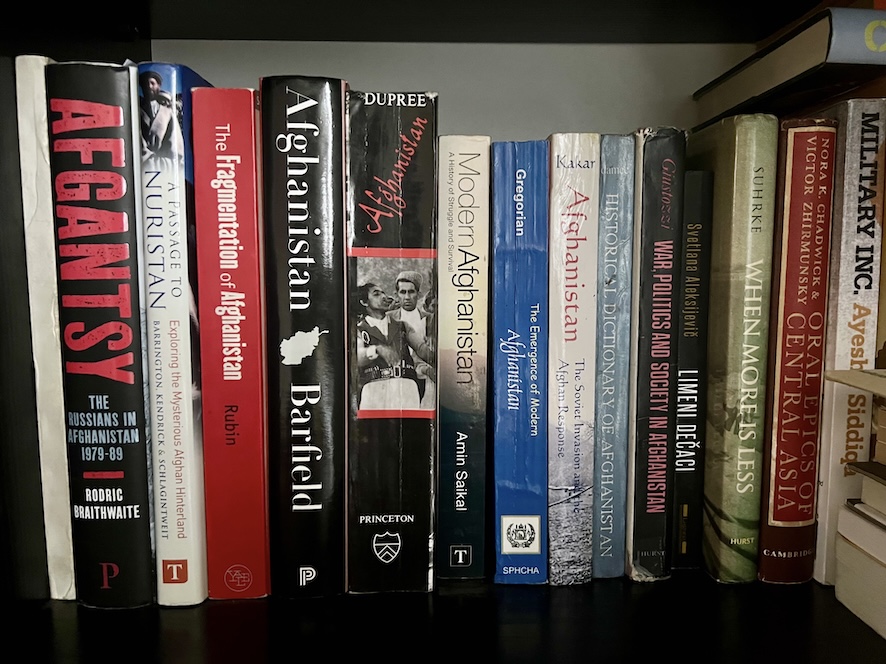
We thought we would start 2025 by asking AAN writers and friends to recommend books about Afghanistan. Their choices are eclectic, ranging across the academic and journalistic, memoirs and fiction, books written by Afghans and others. Our recommended reads include one book which its reviewer believes will become a standard work for universities teaching about Islam in Afghanistan and the work of a fiction writer who seemingly tells stories in an effort to make sense of Afghanistan’s violent history and its impact on his own life. Our reviewed books also include an excoriating scrutiny of the post-2001 ‘project’, which, its reviewer says, “forces readers to ask: In a conflict so riddled with miscalculations and shifting allegiances, can anyone truly claim to have won?” We hope you enjoy these reviews as much as we enjoyed reading the books.
Annika Schmeding, Sufi Civilities: Religious Authority and Political Change in Afghanistan, Stanford University Press, 2024
Islam is everywhere in Afghanistan, in almost every facet of society, but despite this, it is underrepresented in the English-language academic literature. Annika Schmeding’s newly published book Sufi Civilities – based partly on her PhD dissertation work – is one of the few lengthy monographs fully dedicated to analysing a facet of Islam in Afghan society. As this is anthropology, the case study is not on the practice of the majority or the whole, but of a narrower group, urban Sunni Sufis.
There is a lot a reader can choose to focus on in this book. Someone with a background in international development may have their attention caught by the story at the beginning where a Sufi gathering is jokingly referred to by a local as the “real civil society,” while a reader like myself with a political science background will start scanning immediately for references to the political power and influence of Sufis – or lack thereof. An item of interest for scholars, students and adherents of Islam will be Schmeding’s analysis of Sufism’s relationship with those imams and ulama (Islamic scholars) who are outside Sufi circles – or even hostile to Sufism, and her clear description of the role within Sufism of leadership and leadership selection.
Readers less interested in the topics above, considering them mundane or exhausting (just more ‘politics and war’), may enjoy Schmeding’s lengthy analysis of the role of dreams and dream interpretation among Afghanistan’s Sufis, or her extensive discussion of the more common theme of gender in society and the surprisingly prominent role played by women in Sufi communities. Poetry is another topic that appears regularly throughout the book.
Overall, the adaptation of the Sufis of Afghanistan to the massive changes brought about by war, migration, ideological competition and the accompanying social upheavals is the main focus of Schmeding’s book. Adherents of various Sufi communities have both resisted and cooperated with and joined various state and insurgent forces over the last 40 years, what she terms as “alignment” versus “resistance”. Schmeding adds to these choices the third choice of “strategic distance” to describe Sufis seeking “distance from the source of power and the potential for violence,” with distance being both physical (relocating somewhere else in the country or abroad) and political/social (avoiding relationships with government officials or armed opposition groups).
Within the extreme upheavals of the last several decades, Schmeding convincingly argues for the Sufis’ “remarkable dexterity in their ability to adapt” as they choose between various strategic positions under changing conditions. Schmeding’s field research ended before the Taleban’s 2021 return to power. In her conclusion and epilogue, she discusses the urban Sufi communities’ adaptation to once again living under Taleban rule after a 20-year break. Past history suggests, she says, that Sufism will survive once again.
This book sits firmly with the sub-field of the anthropology of Islam. For those coming from the fields of history, political science and perhaps sociology, who want to comb the text for useful analysis, they can easily find a clear and focused discussion of the role of religion during times of war and social upheaval, with both individuals and institutions as units of analysis. Those readers who are rightfully wary of academic literature and its intentional and unintentional confusing and obtuse writing style, you can be assured that Schmeding’s writing is clear and easily understood. Her focus on people makes for engaging story-telling throughout the text. Sufi Civilities will remain for decades a mandatory (English-language) text for understating the role of Islam in Afghanistan.
Reviewed by Christian Bleuer
Ulrik Høj Johnsen, Schuyler Jones, Torkil Funder and Taj Khan Kalash (eds), Toward the Horizon: Lennart Edelberg and the Danish Hindukush Research, Moesgaard Museum, 2021
Moesgaard Museum, just south of the Danish university city of Aarhus, is a striking example of modern northern European (‘Skandinavian’) architecture. Built into the slope of a hill, its large glass windows look down on early 19th century Moesgaard Manor. Built as a poorhouse, today it is the home of the Aarhus university’s Department of Archaeology and Anthropology.
What’s more important to us is in the museum’s storage: a large Nuristan collection, that began to be compiled during the 1947-50 Third Danish Expedition to Central Asia, the first one going to Afghanistan. (The two earlier ones went to Mongolia.)[1] That expedition took place roughly fifty years after the area had been forcibly incorporated into Afghanistan by Abdul Rahman, the ‘Iron Amir’ (r1880-1901), in the winter of 1895/96. After that, Kabul changed the area’s name from Kafiristan (land of the heathen) to Nuristan (land of light), referring to the people having become Muslim.[2]
The 1947-50 expedition was led by ethnologist Henning Haslund-Christensen, who tragically died from illness in Kabul in September that year and is buried there. Its four other core members were: historian of religions Halfdan Siiger (1911-99), who later worked on the (not yet converted to Islam) ‘Kalash Kafir of Chitral’ across the Durand Line; zoologist Knut Paludan (1908-88), whose main work is Birds on Afghanistan, Copenhagen 1959, today a rare book; the film photographer Peter Rasmussen, who later produced the documentary ‘Kafiristan – the land of Heathens’; and Lennart Edelberg (1915-81), a schoolteacher who taught in Denmark’s oldest town, Ribe, and was a botanist-turned-ethnologist. One of their Afghan collaborators, Ahmad Ali Motamedi, later became the director of Kabul’s National Museum.
It was for the ethnologist Edelberg that, in 2021, Moesgaard Museum dedicated a set of articles brought together in the book, Toward the Horizon: Lennart Edelberg and the Danish Hindukush research. The collection is based on papers presented at a seminar held in 2016 by Moesgaard Museum, in cooperation with Aarhus University, in the tradition of earlier International Hindukush Cultural Conferences organised, among others, by Edelberg, in Denmark and Pakistan.[3]
Toward the Horizon is a richly illustrated tome that contains articles on new research on Nuristan (each with rich bibliographies) and posthumous tributes to Lennart Edelberg and his scientific career. Edelberg visited Nuristan four times, the last time in 1970. By then, he had become a paragon of Danish Afghanistan-shenasi (experts).[4]
While most contributors to this book are Western, there is also a Nuristani originating from Afghanistan, Kakhail Nuristani, and a Kalash from Pakistan, Taj Khan Kalash, who is also one of its editors.
In his article, Kakhail Nuristani related how a 2012 New York Times article by author Adam Klein helped re-establish contact between Nuristan and the Danish research community that had been lost during the most recent Afghan wars. Kakhail had met Klein at a workshop for Afghan writers in the United States and told him the story of his grandfather, ‘Wakil’ Abdullah (he became a member of parliament). Abdullah had hosted Edelberg during a Danish expedition in the 1960s and was even visited at home by Denmark’s king, Frederik IX, and the then crown princess, Margrethe, during a state visit to Afghanistan. (A Danish prince had also participated in Edelberg’s 1953/54 expedition.)
According to Kakhail, his grandfather’s knowledge had “greatly informed” Edelberg’s 1984 book on Nuristani architecture, Nuristani Buildings (published by Jysk Arkæologisk Selskab, Moesgaard). In return, Abdullah was invited to Denmark where he opened the Nuristan collection after it was moved from the capital Copenhagen to Moesgaard, which opened as a museum in 1970. During his stay, he was knighted by Denmark’s royal family.
The custodian of Moesgaard’s Nuristan collection and one of the editors of Toward the Horizon, Ulrik Høj Johnsen, came across Klein’s article and reached out to Kakhail. Nuristani-Danish contacts were revived.
There is plenty of interesting detail in this volume, but one paragraph was particularly intriguing and provoked ideas for fresh research. Co-editor Schuyler Jones’ contribution mentions the bāri, a caste of artisans in Nuristan (p180). (I use the phonetical transcription here to indicate the pronunciation, ie that the ‘a’ is a long one.) Jones – a United States-born, retired professor of anthropology at Oxford University with ten fields trips to Nuristan to his pedigree – writes of the bari and their relationship with the landowning atrožan:[5]
The social standing of the bari in Nuristani society is at odds with the contribution they make to the very people who hold them in such low esteem. The largest social and political group in Nuristani society is that of the land-owning and livestock-herding atrožan. The bari occupy a separate class, and the main rules they must follow are: they may not marry outside their class, they may not own livestock [and mostly not land and grazing rights], and they may not eat with atrožan. There are other restrictive rules, of course. And yet, the bari make all the houses and other buildings, they make all the furniture, they make the shoes, the blacksmiths among them make the tools, they do the [famous Nuristani] carving, and do the weaving. [They also make all the weapons the Nuristani warriors and hunters use and all the wooden bowls and clay pots and jars for their households.] In short, the bari produce all the material culture that is so characteristic of Nuristan…
The bari, whom the atrožan do not even address by name, just “bari,” live in separate, lower parts of the Nuristani villages that even have separate names.[6] They represent roughly ten per cent of Nuristani society and although not all Nuristan’s villages have them, most have one or a few families. Those who don’t, can ‘borrow’ or even ‘buy’ them.
This is unfortunately more or less all that you learn about the bari in Toward the Horizon – and actually also in Edelberg and Jones’ standard work, simply entitled Nuristan, published in Graz, Austria in 1979 – apart from one more important thing: the reason why Wakil Abdullah was able to help Edelberg with his book on Nuristan architecture was – he was a bari himself (p106). This is why he knew everything about building in Nuristan.
For more information on the bari, you have to go back to other, partly much earlier literature.[7] Yet even there, there are only smatterings. One problem is that most literature on Nuristan only touches on this particular group and related aspects of class or caste in passing. Edelberg’s impressive bibliography, which is attached to Toward the Horizon, does not include any publications that have ‘bari’ (or something like ‘class structure’) in its title.
Another problem is that literature on Nuristan has concentrated and still concentrates mainly on its pre-Islamic culture. Even the book reviewed here leaves it unclear how the bari-atrožan relationship developed after the local people’s mass conversion to Islam. The fact that the paragraph about the bari quoted above is written in the present tense obscures this problem. It also omits to speak out that the bari were, as Austrian Nuristan expert Max Klimburg put it in a 2004 article, “socially stigmatized,” namely as “formerly enslaved” and then living “in a form of bondage.” This is the gravest shortcoming in Toward the Horizon.
To our rescue, Klimberg writes:
In theory, Islam liberated the bari, but their social position is still largely the same as before and intermarriage with any ‘genuine’ Nuristani is still all but impossible. … At present, the bari’s main problem is under-employment, as they face competition from outside craftsmen, called in to build houses in a new style.
The fact that the builder Abdullah became his area’s representative in the Afghan parliament under Zaher Shah (r1933-73), as Wakil Abdullah Khan, speaks for possible upward social mobility for former bari after Islamisation.
Apart from this, Taj Khan Kalash, in his article for Toward the Horizon, also looks at Muslim-Kalash interaction over the past century and in today’s Pakistan. This makes his contribution one of the most valuable.
In that sense, one important merit of Toward the Horizon is that it prompts two research questions. Firstly, how has Islam shaped, and is still shaping Nuristan and Nuristanis? [8] Secondly, did Islamisation, now complete, with only a few pre-Islamic artefacts kept in the community lead to greater equality between the former atrožan and the bari?[9] As a first step, it would be good if a researcher compiled what has already been published about Kafir/Nuristani class society in the existing literature, scattered as it is in its margins, to make it possible to move on from there. Does the fact that Wakil Abdullah made it, as a bari, to member of parliament show there could be more social mobility among the Nuristani than when they were all still ‘kafir’?
Moesgaard’s Nuristan collection, unfortunately, is no longer on permanent display. But Toward the Horizon provides insights into it, and for researchers, it should be possible to access this volume.
The book is available at the Museum’s shop or online via Unipress.
Reviewed by Thomas Ruttig
Anand Gopal, No Good Men Among the Living: America, the Taliban, and the War Through Afghan Eyes, Metropolitan Books/Henry Holt and Company, 2014
Anand Gopal’s No Good Men Among the Living is a standout work of investigative reporting and storytelling that grips you from its opening pages and immerses readers in the tragic realities of America’s war in Afghanistan. Through the interwoven lives of three Afghans – a Taleban commander, a US-backed warlord and an Afghan woman – it provides a rare, deeply humanising perspective on the failures of the ‘war on terror’ in Afghanistan.
Gopal traces the complex trajectories of his protagonists in vivid detail. Akbar Gul, a former Taleban commander, renounces violence and attempts to integrate into civilian life by opening a small business but is thwarted by corruption and police brutality that, eventually push him back to the Taleban. Jan Muhammed, warlord and close ally of Hamed Karzai, exploits American support to crush rivals, amass wealth, and terrorise civilians. Heela, a housewife, endures the horrors of war and personal tragedy yet rises to a position in the Afghan Senate, embodying resilience amidst chaos.
The book excels in showing how these personal stories illustrate broader failures. Gopal examines the unintended consequences of American actions, including civilians killed and injured, indiscriminate raids and support for corrupt warlords, all of which alienated many Afghans. The war also created a system where local leaders manipulated US forces for personal gain, fabricating enemies to get the US to target their rivals. By selectively targeting the Taleban while ignoring other factions’ crimes, the US deepened feelings of injustice and hindered efforts at reconciliation and peace-making.
Gopal’s ability to illuminate the nuances of Afghanistan’s shifting alliances is particularly striking. In a country where today’s ally can be tomorrow’s enemy, the rigid binaries imposed by the US were not only ineffective but also counterproductive.
The book’s title, drawn from a Pashtun proverb – “There are no good men among the living, and no bad ones among the dead” – captures the moral ambiguity that pervaded the war. No group, Afghan or foreign, emerged untainted. The US, ostensibly there to fight terrorism, found itself entangled in a war where clear distinctions between good and bad, ally and enemy, were impossible.
Gopal’s account forces readers to confront the harsh realities of war, leaving them questioning not just the war’s execution but its very purpose. This is essential reading for anyone seeking to understand how Afghanistan’s history, shaped by both external and internal forces, led to turmoil.
While no single volume can fully encapsulate Afghanistan’s intricate history and its implications for the present, No Good Men Among the Living provides a critical and thought-provoking examination of how and why things went so tragically wrong. It prompts readers to wonder: Could Afghanistan have taken a more hopeful path if the US had better understood the country’s intricate socio-political fabric?
Ultimately, the book also compels reflection on the true meaning of victory in war. It challenges the conventional notions of triumph – planting flags, securing territory, or building institutions. It suggests that the war was not about democracy, jihad, freedom, or honour, but about resisting externally imposed categories and designs. Survival itself becomes the most enduring form of resistance. Gopal’s storytelling forces readers to ask: In a conflict so riddled with miscalculations and shifting allegiances, can anyone truly claim to have won?
Reviewed by Gulhan Durzai
Martine van Bijlert, Peace, Peace they say, Rainfed Press, 2024
We don’t often get the opportunity to recommend a book by one of our own, so it’s a special pleasure to highlight Martine van Bijlert’s collection of poems. Written over three years, from 2022 to 2024, during her participation in a peace poetry postcard exchange,[10]Peace, peace they say, is a profound journey of personal reflection and artistic expression, shaped by the echoes of war and highlighting the complexities of living in our time.
Each poem is as a window into van Bijlert’s thoughts as she grapples with the fragile interplay between peace and war, the longing for hope amid chaos and the unshakable resilience of the human spirit. In this way, she challenges the reader to bear witness not only to her own struggles but also to examine their own lives and consider the roles they have played – and continue to play – in shaping the world we live in. This collection is far more than mere personal reflections, it is a powerful commentary that is at once timely and timeless and is essential reading for all those who seek connection and understanding in a fractured world.
“I knew better how to talk about peace, before I worked in peace building,” she writes in the foreword, striking a chord with those who have borne witness to the chaos of conflict and the indelible scars it leaves behind on both the geography and the human spirit, and the price exacted by the quest for that precious thing we call peace:
In poem after poem, she reminds the reader of what it means to strive for peace only to find another war, of the resilience required to endure, and the emotional imprint that persists long after “the silence after the shooting stops,” long after “politicians come rushing in,” long after the drums of a new conflict that’s been smouldering in the shadows start beating again:
Through her poetry, she invites the reader to reflect on the meaning of peace: “We can’t call peace what isn’t peace, but we also can’t disparage what is or what could be. … We should speak of it, even if we can’t find the words. Because we need to hear from people who no longer know what to say.” In the end, the poems are overwhelming and comforting in equal measure because van Bijlert gives words to what many of us have witnessed, finding a language to articulate our collective longing for peace.
Reviewed by Roxanna Shapour
Jamil Jan Kochai, 99 Nights in Logar, Penguin, 2019and The Haunting of Hajji Hotak and Other Stories, Penguin, 2022
Afghan-American author Jamil Jan Kochai is acknowledged as one of the younger literary voices of the diaspora. Following his first novel, published to acclaim in 2019, 99 Nights in Logar, Kochai published a collection of short stories in 2022, The Haunting of Hajji Hotak and Other Stories. The two works differ in format and scope, but the common threads running between them are multiple – and this review will look at both.
99 Nights tells the story of American-Afghan children visiting their relatives in Logar province in 2005. Even before Kochai makes a direct reference to Adventures of Huckleberry Finn – having the book as one of the kids’ summer reads – the tone of the narration and the narrator’s point of view cut a powerful and striking similarity to Mark Twain’s two masterpieces. The abundance of aunts and uncles in Kochai’s novel reinforces this, replicating a leitmotiv from the Mississippian Tom Sawyer-Huckleberry Finn universe.
That being said, the context in which the stories unwind are far apart. Twain’s tales were set in mid-19th century America, a time of wanderlust. The Afghanistan of the early 2000s is a place where just crossing out of the garden gates into the outside world represents a major breach of the rules, a source of danger and trauma for the protagonists – the Afghan-American narrator and three of his Afghan teenager cousins (though one is actually uncle to the others), on a hunt to bring back the house dog.
Anybody slightly familiar with the realities of out-of-home interactions in rural Afghanistan, with fellow humans and the landscape, cannot but recall how navigating the world just beyond one’s safety zone, whether home, street, or, at most, village, appeared at first inexplicably daunting. This before realising, out of experiences lived or related, the reasons for that: invisible dangers or red-lines connected to family rivalries, competition for resources, and social constraints, even before the risks of common criminality or political violence. During their quest to find the dog, the protagonists go through a series of extraordinary events, happening to or merely related to them. These are described in a peculiar mixture of the fantastic and the realistic, reflecting the different types of awe and exaltation felt by the diverse group of Afghan and Afghan-American boys, at their first adventure in the open.
After a cohesive and captivating start, the narrative does wander off, in the end, far more than the teenager runaways do. In the second half, the structure of the novel, as per the title, references A Thousand and One Nights. To the voice of the main protagonist, the quasi-autobiographical Afghan-American boy, Marwand, framed tales are added, interspersed within the overall storyline. These are told by different narrators and with a number of recurring characters met by the protagonist, who are sometimes heavily stylised figures bearing a symbolical value. For readers not accustomed to such narrative meandering, typical of magic realism from South Asia (think of some of Salman Rushdie’s work), the plot may seem to lose focus towards the end.
In the plot, there is a symbolic reference to the recent history of Afghanistan and the country’s relations with America. Budabash, the house guard dog, had suffered at the hands of the young American narrator during a previous visit to Afghanistan, made in the 1990s. Returning from America, wiser and guilt-ridden, the narrator hastens to greet Budabash with the brightest of intentions, hoping to reconcile and forge a friendship. But a decade on, the dog has turned into a monstruous wolf and bites the now grown-up boy – a wound that stays open and becomes infected. The missed encounter between the boy and the dog can be understood as symbolic of that between America and Afghanistan, together with the acts of retaliation that follow it – and that culminate in the dog running away and amok, and the narrator’s vain research for him. The metaphor can be extended as well to the complex relationship between the author and his ancestral abode (Budabash means ‘dwelling’ in Farsi).
Despite the book’s title, which sounds like it is intended to draw a Western audience in, hinting that the book aims at a broader public, the text includes a high number of Pashto and Dari words, with nothing but the context to help a non-Afghan reader understand them. Moreover, at the end, Kochai choses to have the narrator/author’s father relate events from the anti-Soviet jihad in a Pashto-only chapter, with no translation provided. This is a key episode, the fateful night when his father’s younger brother was brutally killed by the Russians and the family decided to flee to Pakistan, an event of recurring importance throughout the novel and others of Kuchai’s works. This raises a question of who Kochai’s targeted readership is. Should Afghan authors, who necessarily are now mostly in the diaspora, concentrate foremost on the Afghans outside the country as their readership who know both English and Dari and Pashto? The question is probably answered by Kochai’s second work, the collection of short stories titled The Haunting of Hajji Hotak and Other Stories.
Unlike the novel, the short story format allows Kochai to explore a wider range of settings and tones, addressing in the process a broader audience of American readers who may or may not have previous knowledge of Afghanistan. Some stories actually achieve the remarkable result of shedding light on contemporary American society through the prism of the Afghan diaspora, a relatively small immigrant community, by using familial and intimate settings.
In the story that lends its title to the collection, an Afghan-American family comes under FBI surveillance. The FBI officer is himself the narrator. Through his eye, omniscient, yet run-of-the-mill, and ultimately unable to limit his role to that of an observer – quite the narrator’s position, though seldom acknowledged by authors – the people being surveilled shine out in all their humanity. This proves a perfect story-telling mechanism, ensuring no pauses or gaps in the narration’s rhythm. As readers, we see their characters develop as we eavesdrop on their casual chatter and daily routine. One takeaway here could be that the only way America is interested in observing and narrating the experiences of the Afghan community – and other Muslims in the US – is, because of its fears of radicalisation, by surveillance and attempts at control. This bitter consideration is only mitigated by the FBI officer’s realisation that, beyond security paranoia, “there is so much more to learn” about the intricacies of the Afghan family’s daily lives.
Despite Kochai’s eclectic choice of themes and settings, many stories bear proof of a profound unity in his work of so far. His own more or less fictionalised family members are easily recognisable in Hajji Hotak’s house and they and the characters from his novel also return in the short stories. The recurrent familial spirit of the martyred uncle haunts the pages of the short stories as well, as an inescapable presence in the family’s universe, no matter what continent they find themselves on – or in what dimension. The initial story, ‘Playing Metal Gear Solid V: The Phantom Pain’, sees the protagonist dive into a popular action video game, whose newest instalment is set in the Afghan war, only to end up trying to sew back together his family’s torn past by, in the game, saving his uncle’s life.
Kochai’s returning over and over again to his own family’s history proves everything but repetitive. On the contrary, it creates a familiar universe which slowly makes it possible even for readers alien to any Afghan experience to grasp its underlying knots and fault lines. It is as if the author had decided to work his material, that which matters most to him, in order to get to know it more thoroughly, by looking at it and writing about it. This he does by treating it from a multitude of points of view. From the eyes full of magic of a young American-Afghan kid catapulted into mud-walled villages in the midst of nowhere, to the wrier glances of that same boy, grown-up and at home in California, from the attentive scrutiny of a FBI officer, to a formal resume, which lists the existential phases of the pater familias through jihad, exile and immigrant work in the US. This multitude of voices also deprives the reader of the comfort of knowing who is telling the true story and where the truth might lie.
Short stories seem the best format for Kochai to convey to readers his fascinating, deeply personal, yet poignant vision of Afghanistan and America. The very novel, 99 Nights in Logar, originated from a short story and – against the backdrop of the many masters in American literature who favoured this form of storytelling – one cannot but hope that Jamil Jan Kochai will write more. And if you missed his novel back in 2019, this author’s recommendation is to first get acquainted with Kochai’s universe through his second work, The Haunting of Hajji Hotak.
Reviewed by Fabrizio Foschini
Saad Mohseni with Jenna Krajeski, Radio Free Afghanistan: A Twenty-year Odyssey for an Independent Voice in Kabul, HarperCollins, 2024
Saad Mohseni’s memoirs of his and his siblings’ journey in establishing independent radio and later TV channels is an interesting read within the modern history of independent media in Afghanistan. His book is a reminder of some key political events between 2001 and 2023, such as the presidential elections, that also, simultaneously, offers an intimate account of the role of the national media mogul in these events
Mohseni’s family left Kabul in 1978 following the coup de état, when Saad’s father was posted to Tokyo. He was then 12 years old, the eldest of four siblings – his two brothers Zaid and Jahid and his sister Wajma. Later, the family emigrated to Australia after his father resigned his post on the eve of the 1979 Soviet invasion of Afghanistan. They settled in Australia, but nostalgia for the homeland was so powerful that the family kept looking for chances to work in or about Afghanistan. During the 1990s, Mohseni went to Uzbekistan on the Afghan border to look for business opportunities and started a newsletter – his very first and only experience of being a journalist.
After the fall of the first Islamic Emirate in 2001, the Mohseni brothers arrived in Kabul to find businesses to invest in. They were pursuing an idea for almond exporting until Afghanistan’s culture minister, who was also a friend of their father’s, planted an idea for a radio station. Arman FM was established with a small grant from USAID in April 2003 and from it, over the years, the Moby Media empire grew to include several TV and radio stations, not only in Afghanistan, but in Pakistan, India, the Middle East and east Africa, and a pan-regional Persian-language station, Lemar.
The book is a dynamic read that takes us into inner workings of Afghan society: Mohseni tells us about the importance of “a family connection” – family and friends’ relations – in starting and running a business. A careful sequencing of chapters maintains the book’s pace, as it jumps from nostalgic reminiscing about the early 2000s to events that happened as recently as 2023, that is Mohseni’s recounting of how TOLO TV covered the first presidential elections in 2004 just a few days after the station was launched, to a chapter on how it has been navigating the growing number of restrictions imposed on the media by the Islamic Emirate in 2023. Although Mohseni has not returned to Afghanistan since August 2021, he says he regularly participates online in the editorial meetings of his TV station.
Mohseni’s criticism of how the United States and the West in general left Afghanistan in August 2021 – sometimes interwoven with sardonic undertones – is memorable. For example, he writes:
I found myself, bewildered at an embassy reception or think tank meet and greet, comforting Western politicians as they confessed to feelings of guilt over the way the international community left so suddenly, abandoning Afghans. “It’s not your fault,” I’d tell them, as though they were a child and Afghanistan a glass of spilled milk. I’d started to feel like an aging actor at a Hollywood party, once attractive and now making a case for my own relevance.
Two chapters – one about his mother and the other about his sister – are a delicate attempt to speak about the position of Afghan women in society. He writes:
… my mother’s relationship to Afghanistan is different from mine. She was in her thirties when the country that she had grown up in changed so abruptly and then changed so many times more that it must have felt like living through a series of earthquakes. She is a woman in a country that by conservative tradition or through government decree has so often tried to control women’s lives and silence their voices. After she spends time with the women at Moby, she returns to Melbourne or Dubai a little depressed. “They say that the country and the government must think they are completely worthless,” she says. “And what can I tell them? They are right.”
Overall, this was a nice and entertaining read about Afghanistan – a welcome change from the norm.
Reviewed by Jelena Bjelica
Hassan Abbas, The Return of the Taliban: Afghanistan after the Americans Left, Yale University Press, 2023
The Return of the Taliban by well-known Pakistani-American author, Hassan Abbas, looks in turn at specific topics to do with the post-2021 regime in Kabul, including its composition and structure, religious ideology, international relations and the challenges it faces.
For me, the chapter on the Islamic Emirate’s international relations was particularly interesting. Hassan Abbas explores its relations with Pakistan, China, Iran, Qatar, Russia and India. Regarding the Emirate’s Taleban’s relations with China, he quotes the acting Deputy Prime Minister of the IEA, Mawlawi Abdul Salaam Hanafi, saying:
Afghanistan can play a great role in creating important corridors. We want to be connected to China through our Badakhshan province. . . . The geostrategic position of Afghanistan could lead the country to play a positive role in linking neighbouring countries in the region and beyond.
The author delves into the Taleban’s relations with Russia. He describes how the Soviet Union’s failed invasion of Afghanistan drastically changed Moscow’s relationship towards Afghanistan. He describes how Russia initially extended its support to the United States in combat operations against the Taleban in the early years of the US intervention. He also describes the Afghanistan Contact Group (ACG) in the Shanghai Cooperation Organisation (SCO) in 2005 to support Kabul’s fight against drugs and crime.
Abbas describes the pivoting of Russia’s calculations and approach after 2015 and how the Kremlin and the Taleban came together to cooperate because they both wanted to fight ISKP and its expanding presence in Central Asia. Russia opened up active channels of communication with the Taleban in a number of international forums, based on their mutual anti-US sentiment – a fresh start appeared to be established.
Additionally, Abbas writes, the SCO was crucial in “facilitating a conversation between the Afghan government and the Taliban, specifically during the withdrawal of NATO troops in 2016 [sic].[11] Russia invited the Taleban to several rounds of peace talks in Moscow, which helped, says Abbas, officials to understand the core interest of the Taleban. This was an insight into how Russia played a key role in helping the Taleban to better articulate their position, spread their narrative of the war and improve how they were perceived globally. Although the world has not recognised the Taleban government yet, certain countries do want to have relations with the IEA. This indicates the development of Taleban regional diplomacy.
According to Abbas, it is Pakistan that influences the Taleban more than any other country. He mentions former chief ISI General Faiz Hameed travelling to Kabul soon after the Taleban retook power and playing a key role in forming the first Emirate cabinet. Abbas says Hameed also resolved quarrels and helped the Emirate put aside their internal divisions. He quotes a Pakistani general saying he told the Taleban to give the former Chief Executive of the Republic, Dr Abdullah Abdullah and former President Hamid Karzai some symbolic position just to show the world that their government was an inclusive one, although the Taleban had their own ideas.
In another part of the book, Abbas mentions the Tehrik-e Taleban Pakistan (TTP), sister organisation to the Afghan Taleban. He says that a year after the return of Taleban to power in Afghanistan, Pakistan witnessed a more than 50 per cent increase in ‘terrorist activities’. Pakistan tried to negotiate with the TTP through the Afghan Taleban, but to little avail. According to Abbas, the Taleban have helped Pakistan only half-heartedly in pursing the TTP because both groups enjoyed a mutually beneficial relationship for a long time. This, he said, has resulted in creating tensions between Afghanistan and Pakistan.
I highly recommend this book because, along with delving deep into the Emirate’s international relations, it provides the reader with an in-depth analysis of the events leading to the Taleban’s takeover as the US was withdrawing from Afghanistan. It gives the reader a more detailed and nuanced picture of the Taleban than one gets from media reporting.
Reviewed by Rohullah Sorush
Edited by Kate Clark
References
References
↑1
The Nuristan collection was permanently on display from 1970 to 2001. Currently, Moesgaard museum’s permanent exhibition concentrates on prehistoric and Viking history.
↑2
Local people were partly converted to Islam by force, the central temple of their religion, most shrines, carved statues and other expressions of their old faith destroyed. Others – mostly among the younger generation – joining voluntarily, hoping to become part of modernising Afghanistan and finding employment and education outside their own community.
↑3
The museum holds the Nuristan material collected Edelberg, Siiger and also by Hamburg ethnologist Wolfgang Lentz (1900-86), participant of the 1935 German Hindukush expedition. Edelberg also worked in Luristan, Iran.
↑4
Other well-known Danish specialists on Afghanistan include Klaus Ferdinand (1926-2005), who specialised in nomadism, anthropologists Jan Ovesen (1945-2016) and Asta Olesen (Islam and Politics in Afghanistan, 1995) and now retired ethnographer Svend Castenfeldt. Fortunately, there is also a young generation of Danish researchers on Afghanistan, for example Erik Hansen who worked for UNESCO in the Kabul museum and in Herat, and musicologist Christer Irgens-Møller.
↑5
According to Austrian Nuristan expert Max Klimburg, atrožan is only used by the Prasun-speaking Nuristani of the Waigal valley; the Kati Nuristani call them adze. The Nuristani are not one, but consist of various ethnic groups with different, mostly mutually incomprehensible languages. See a map in this article.
↑6
There are several towns called Barikot in Afghanistan and Pakistan, one in Kunar province, one at Swat River in Khyber Pakhtunkhwa province, kot being Pashto for dwelling place, related to kotá, room. There is also a Barikot area in Kabul, just west of Deh Mazang Square, which used to have a cinema of the same name but which was destroyed during the 1990s factional wars.
↑7
Earlier literature mentioning bari or other castes considered lowly include: Wolfgang Lentz and Albert Herrlich of the 1935 (Nazi) German ‘Hindukush expedition’ Herrlich calls the bari ‘slaves’ (in Deutsche im Hindukusch, Berlin 1937, pp 232-7) with its very detailed expedition reports also contains a very long chapter on skull-measuring and other methods that were designed to underpin Nazi racial theory in general and their idea they may find fellow-‘Aryans’ in the Nuristanis of the Hindukush (or more on this, see a 2015 article by the author for AAN).
Herrlich mentions another category of ‘slaves’, the lane (singular: lawin) but says they only exist among the Kantos Kafirs, whose social position he describes as Dienstknechtschaft (indentured servitude) but that, in contrast to the bari, they are considered – and consider themselves – part of the Nuristani ‘tribes’ and assumes they might be impoverished Nuristani but also says they could be sold and bought. This was confirmed in a 1974 paper by Jones who, however, calls this group the šewala and categorises them as “unspecialised labourers,” or rather labourers that produce low-tech items, such as “baskets, claypots, and leather goods” (p46-7). Particularly working with leather is considered unclean or at least lowly not only in Nuristan/Kafiristan but also other parts of Afghanistan’s and India’s societies. All this is reminiscent of India’s caste system; some researchers believe that Nuristan’s old religion was a branch of Indic religions.
↑8
Klimburg also does not elaborate beyond what we quoted above. Another short hint comes from Manuel Schmaranzer’s 2009 diploma thesis at Vienna University where he writes (my translation) that “after Islamisation, a separate form of ‘Nuristani Islam’ developed and one culture was not replaced by the other in a few years.” He also notes that “political reports from this period compiled by Schuyler Jones show that there were repeated uprisings against the [islamicising] Afghans” (p73).
↑9
Christoph Reuter, in his 2023 ‘road trip’ book reviewed by this author here, mentions that he saw a old-style carved chair when travelling in Nuristan, and the embarrassment he created when asking the owner, who had it hidden away by then, to see it again during a second stay.
↑10
This was an initiative where people wrote poems about peace and sent them on post cards to each other.
↑11
This appears to be a reference to the end of the NATO-led ISAF mission, which took place on 31 December 2014. That involved a drawdown of troops and handing over security responsibility to the Afghan armed forces. However, foreign troops stayed in Afghanistan as part of NATO’s (non-combat) Resolute Support mission, with the US alone also running a ‘can-be-combat’ mission, until the full withdrawal in August 2021.
Recommended Reads from AAN Writers: The poetry of peace, magical realism in Logar, class in Nuristan, Sufis
The United Nations says aid workers are still in a “race against time” to remove rubble and rebuild after the devastating earthquake struck eastern Afghanistan last month, killing at least 2,200 people and cutting off remote areas.
The 6.0-magnitude quake on Aug. 31 was shallow, destroying or causing extensive damage to low-rise buildings in the mountainous region. It hit late at night, and homes — mostly made of mud, wood, or rocks — collapsed instantly, becoming death traps.
Satellite data shows that about 40,500 truckloads of debris still needs to be cleared from affected areas in several provinces, the United Nations Development Program said Wednesday. Entire communities have been upended and families are sleeping in the open, it added.
The quake’s epicenter was in remote and rugged Kunar province, challenging rescue and relief efforts by the Taliban government and humanitarian groups. Authorities deployed helicopters or airdropped army commandos to evacuate survivors. Aid workers walked for hours on foot to reach isolated communities.
“This is a race against time,” said Devanand Ramiah, from the UNDP’s Crisis Bureau. “Debris removal and reconstruction operations must start safely and swiftly.”
People’s main demands were the reconstruction of houses and water supplies, according to a spokesman for a Taliban government committee tasked with helping survivors, Zia ur Rahman Speenghar.
People were getting assistance in cash, food, tents, beds, and other necessities, Speenghar said Thursday. Three new roads were under construction in the Dewagal Valley, and roads would be built to areas where there previously were none.
“Various countries and organizations have offered assistance in the construction of houses but that takes time. After the second round of assistance, work will begin on the third round, which is considering what kind of houses can be built here,” the spokesman said.
Afghanistan is facing a “perfect storm” of crises, including natural disasters like the recent earthquake, said Roza Otunbayeva, who leads the U.N. mission to the country.
 Afghanistan Peace Campaign