Magnitude 5.6 earthquake strikes Hindu Kush region, Afghanistan, EMSC says

By Reuters

The quake was at a depth of 121 km (75 miles), EMSC said, and the epicentre 164 km east of Baghlan, a city with a population of about 108,000.
EMSC first reported the quake at a magnitude of 6.4.

Reporting by Mrinmay Dey in Bengaluru; Editing by Tom Hogue

Magnitude 5.6 earthquake strikes Hindu Kush region, Afghanistan, EMSC says
read more

Afghan refugees need to stay in America

Opinion

The Washington Post
April 17, 2025

Kristi Noem is wrong to assert that conditions in Afghanistan have improved.

Four men accused of murder were executed by gunfire last Friday in crowded sports stadiums across Afghanistan. The Taliban leader defended these public killings as necessary under sharia law.

That night, U.S. Homeland Security Secretary Kristi L. Noem announced that the Trump administration would revoke temporary protected status (TPS) for Afghans who evacuated to the United States after their country fell to the Taliban in 2021. This sets the stage for more than 9,000 people to be deported, beginning May 20. A DHS spokeswoman says Noem made this decision based on a “review of the conditions in Afghanistan.”

To claim the situation has improved enough for Afghans to safely return is to turn a blind eye to the Taliban’s draconian rule, which is especially barbaric for women and girls. The government does not allow girls to receive education beyond sixth grade. In December, seeking to close what it saw as a loophole, the Taliban banned women from studying to become midwives or nurses. Some provinces bar male doctors from treating female patients, which means denying women any medical care. No wonder Afghanistan has the world’s highest rate of maternal mortality outside Africa.

Many women in Afghanistan don’t leave home because they fear the morality police, who enforce strict gender segregation and require that they wear hijabs. Women are not to look at men other than their husbands or relatives. Last year, the Taliban restricted women from even raising their voices in public.

In 2023, Alejandro Mayorkas, Noem’s predecessor as DHS secretary, extended TPS for Afghans for 18 months. The people needed protection, he said, because there was a “serious threat posed by ongoing armed conflict; lack of access to food, clean water and healthcare; and destroyed infrastructure, internal displacement and economic instability.” These conditions still exist.

Adding insult to injury, as DHS seeks to repatriate Afghans, the Trump administration has cut critical humanitarian assistance to the country. Last week, the White House reversed recent cutoffs in emergency food aid to Somalia, Syria and Iraq but maintained the cuts on Afghanistan. The U.N. World Food Program says this will mean the end of food assistance for 2 million Afghans, including more than 650,000 malnourished children, moms and pregnant women. The country’s total population is about 40 million.

Action Against Hunger, an aid agency, warns that the cuts threaten children’s lives. This week, the group is closing its therapeutic feeding unit in Kabul because of earlier cuts to the U.S. Agency for International Development. “The children who came to the feeding unit often could not walk or even crawl,” the Associated Press reports. “Sometimes they were unable to eat because they didn’t have the energy.”

In pushing to expel Afghan refugees, the United States finds itself aligned with Pakistan and Iran. All three governments say they’re no longer willing to support large migrant populations. Pakistan wants to expel more than 3 million Afghans this year. Iran announced plans in September to send away 2 million.

Afghans who can prove that they directly assisted the U.S. war effort are still able to stay in America through the Special Immigrant Visa program. But advocacy groups say TPS has offered a layer of stability to people going through the arduous process of trying to secure the special status, which requires documentation that can be difficult to obtain. Applying for asylum is another option, but this system has a backlog of more than 2.6 million cases, and applicants must credibly demonstrate a specific personal risk if they’re sent home, rather than general fear or systemic oppression.

The Taliban craves international recognition. In the interest of “normalizing” ties, the group has freed four Americans from its custody since the start of the year. Last month, the U.S. government lifted bounties on three Taliban leaders, including the interior minister, who organized attacks against the U.S.-based government that fell in 2021.

Ideally, U.S. courts will step in before any Afghans are forced onto planes headed back to Kabul. On March 31, U.S. District Judge Edward Chen temporarily paused DHS’s attempt to revoke TPS status for Venezuelans, because letting it take effect could “inflict irreparable harm,” and said the Trump administration had failed to show “real countervailing harm” in letting the program continue.

The same is true in the case of Afghans. There is no harm in letting their TPS status continue — and no good that can come from sending them back, subjugating innocent women and children to Taliban abuse.

Afghan refugees need to stay in America
read more

Russia Removes Taliban from Terrorist List

Khaama Press

Russia has officially lifted its two-decade-long ban on the Afghan Taliban, removing the group from its list of designated terrorist organizations. The move, confirmed by Russian state media on Thursday, marks a significant shift in Moscow’s diplomatic posture toward the de facto rulers of Afghanistan.

The Russian Supreme Court’s decision to lift the ban, imposed in 2003, takes immediate effect and paves the way for broader engagement between the Kremlin and the Taliban. Although no country has formally recognized the Taliban-led government since it seized power in August 2021 following the withdrawal of U.S. and NATO forces, Moscow has gradually deepened its ties with the group in recent years.

President Vladimir Putin previously described the Taliban as a partner in combating terrorism. Russia now views cooperation with the group as a strategic necessity, especially amid growing regional security threats from extremist organizations.

One such group is Islamic State Khorasan (ISIS-K), which claimed responsibility for the deadly March 2024 attack on a concert hall near Moscow that killed at least 145 people. U.S. intelligence pointed to ISIS-K as the orchestrator, further fueling Russia’s concern over the militant presence in and around Afghanistan. The Taliban, for its part, maintains it is actively targeting ISIS-K and other extremist factions operating on Afghan soil.

Despite these developments, the Taliban remains isolated on the international stage due to its human rights record—particularly concerning women’s rights. The group has imposed sweeping restrictions on Afghan women, including banning them from secondary and higher education and limiting their public presence without a male guardian. The Taliban claims its policies are aligned with Islamic principles.

Western governments continue to insist that meaningful engagement and recognition will depend on the Taliban’s willingness to uphold international human rights standards.

Russia’s latest move, while not constituting formal recognition of the Taliban government, signals a pragmatic step toward deeper relations and regional coordination.

Russia Removes Taliban from Terrorist List
read more

UNICEF warns of severe Therapeutic Food shortage in Afghanistan due to budget cuts

Khaama Press

The United Nations Children’s Fund (UNICEF) in Afghanistan has warned of a severe shortage of lifesaving therapeutic foods due to global budget cuts.

Dr. Tajudeen Oyewale, UNICEF’s Head of Office in Afghanistan, shared a message on X on Thursday, April 17, stating that 3.5 million children under the age of five in Afghanistan are suffering from malnutrition this year, with 1.5 million of them at risk of severe acute malnutrition. Oyewale emphasized the urgent need for support to save these children’s lives.

The situation has been exacerbated by the reduction of international financial aid. On Wednesday, Cobi Rietveld, the head of the organization “Action Against Hunger” in Afghanistan, highlighted that the cut in U.S. financial assistance would result in the death of many children.

The humanitarian crisis in Afghanistan continues to deepen, with the lack of necessary resources threatening the lives of millions of children. The situation calls for immediate and significant action from the international community to prevent further loss of life.

Despite these dire conditions, the international community must prioritize the wellbeing of Afghan children and provide the financial and material support needed to address the crisis effectively.

The situation in Afghanistan highlights the urgent need for continued international aid to prevent further suffering and loss of life, particularly among vulnerable children.

As global financial constraints affect humanitarian efforts, it is crucial for governments and organizations to renew their commitments to providing necessary resources and support to Afghanistan.

UNICEF warns of severe Therapeutic Food shortage in Afghanistan due to budget cuts
read more

CSTO expresses concern over increasing threats from Northern Afghanistan provinces

Khaama Press


CSTO officials are concerned about the rising threats from northern Afghanistan provinces, particularly related to terrorism, extremism, and drug crimes.

The Collective Security Treaty Organization (CSTO) has expressed concern over the situation in Afghanistan and the growing threats from its northern provinces. According to the CSTO press office, the organization is particularly concerned about the rise in terrorism, extremism, and drug-related crimes originating from Afghanistan. These challenges are seen as direct threats to regional security and stability.

Natalia Kharitonova, spokesperson for the CSTO, explained in an interview with the Russian newspaper Izvestia on April 15 that Afghanistan has become a source of considerable concern for the organization. She emphasized that the CSTO members are worried about the increasing threats from Afghanistan, particularly from the northern regions bordering Central Asia. These threats are contributing to heightened security risks in the region.

Digital newspaper subscription

Kharitonova further pointed out that CSTO member countries have called for more regional cooperation to combat terrorism and drug trafficking. The growing concerns about Afghanistan’s instability have led to calls for stronger coordination and joint actions to address these pressing issues in the region. The CSTO is working on measures to enhance regional security in response to these emerging threats.

In light of these concerns, the CSTO has placed special importance on strengthening the border security of Tajikistan, which shares a long border with Afghanistan. Kharitonova noted that a targeted intergovernmental program aimed at improving the security of Tajikistan’s border with Afghanistan is of critical significance to the CSTO. This program is seen as essential for safeguarding the security of all CSTO member states.

The issue of border security was discussed in detail during a meeting between CSTO Secretary General Imangali Tasmagambetov and Tajikistan’s President Emomali Rahmon in Dushanbe on on Friday. The two leaders focused on measures to bolster border defenses, with special attention given to the planned intergovernmental program to enhance Tajikistan’s border security. The program is scheduled to begin in 2025 and will unfold over five years, with a phased approach to strengthening the border.

The CSTO’s concerns about Afghanistan highlight the growing instability in the region and the need for cooperative regional security efforts. The planned border security program between CSTO members, especially Tajikistan, demonstrates the organization’s commitment to addressing these security threats comprehensively. Through increased coordination and focused action, the CSTO aims to safeguard the security and stability of its member states in the face of rising challenges.

CSTO expresses concern over increasing threats from Northern Afghanistan provinces
read more

Karzai and Norwegian Ambassador discuss strengthening ties, Girls’ Education in Afghanistan

Khaama Press

Karzai emphasized the importance of girls’ education for Afghanistan’s development, while discussing strengthening diplomatic ties with Norway.

Hamid Karzai, the former president of Afghanistan, met with Norwegian Ambassador to Kabul, Per Albert Ilsaas, to discuss strengthening bilateral relations. Karzai emphasized the importance of expanding cooperation between Afghanistan and Norway, particularly in the fields of education and humanitarian efforts.

In the meeting, Karzai stressed the critical role of education, especially for girls, in Afghanistan’s development and progress. He called for serious attention to this issue, highlighting how empowering young girls with education is essential for the country’s future.

Furthermore, Karzai pointed out that national reconciliation is key to achieving lasting peace and stability in Afghanistan. He urged collaborative efforts to create an inclusive environment for different segments of society to work together harmoniously.

Details of the discussions were not immediately available, but the meeting emphasized the ongoing importance of education and reconciliation in Afghanistan’s recovery. Norway has been a key player in supporting Afghanistan’s education, humanitarian, and peacebuilding sectors over the past two decades.

The ongoing diplomatic conversations about Afghanistan’s political future remain a focal point, with efforts to stabilize the country through international cooperation continuing. This meeting between Karzai and the Norwegian ambassador reflects ongoing international commitment to Afghanistan’s development and peace efforts.


Karzai and Norwegian Ambassador discuss strengthening ties, Girls’ Education in Afghanistan
read more

Islamic Emirate Rejects CSTO Claims of Security and Drug Threats

This comes after the CSTO’s spokesperson claimed that Afghanistan remains a major source of security challenges and drug-related crimes.

The Islamic Emirate has rejected the Collective Security Treaty Organization’s (CSTO) allegations about security threats and drug trafficking originating from Afghan territory, saying that no security threat emanates from Afghanistan to other countries.

Hamdullah Fitrat, deputy spokesman of the Islamic Emirate, emphasized that serious steps have been taken to secure borders and prevent drug smuggling.

“Afghanistan assures all countries, including CSTO member states, that no security threat originates from Afghanistan. Furthermore, the Islamic Emirate has made significant efforts in countering drug trafficking and strengthening border security. All countries must fulfill their responsibilities in ensuring regional security,” he said.

This comes after the CSTO’s spokesperson claimed that Afghanistan remains a major source of security challenges and drug-related crimes. She stated that member states have called for strengthening the Tajikistan-Afghanistan border and enhancing regional coordination to address these threats.

Natalia Khritonova, the CSTO spokesperson, said: “The Allies express concern about the situation in Afghanistan and the growing threats in the provinces adjacent to the Central Asian region of collective Security of the CSTO. In this regard, the policy of expanding regional coordination in the counterterrorism and anti-drug spheres remains in demand. In this context, the implementation of the CSTO’s Targeted Interstate Program to strengthen the Tajik-Afghan border is of particular importance and relevance,” Natalia Kharitonova, press secretary of the CSTO secretariat said.

Kamran Aman, a military analyst, told TOLOnews: “The concerns raised by biased countries—whether from the Shanghai Cooperation Organization, CSTO, or neighboring countries like Pakistan and Tajikistan—are part of propaganda campaigns driven by their own interests.”

These concerns about drug-related crimes in Afghanistan come despite the decree issued by the leader of the Islamic Emirate on April 3, 2022, banning the cultivation of poppy and the trafficking of narcotics.

Islamic Emirate Rejects CSTO Claims of Security and Drug Threats
read more

The ‘Graveyard Of Empires’ Myth Distorts Afghanistan’s Story

By 

Eurasia Review

April 15, 2025

Afghanistan is often called the “graveyard of empires”—a romantic label used to suggest that no foreign power can conquer it, that the country has single-handedly humbled giants like Afghanistan is often called the “graveyard of empires”—a romantic label used to suggest that no foreign the Soviet Union and the United States. It’s a phrase etched into the rhetoric of resistance and frequently deployed to invoke Afghan valor and perseverance. But behind the slogan lies a dangerously simplified version of history—one that clouds the past and impedes a realistic understanding of Afghanistan’s present and future. 

The idea that Afghanistan defeated two superpowers alone is a myth, and one that does more harm than good.

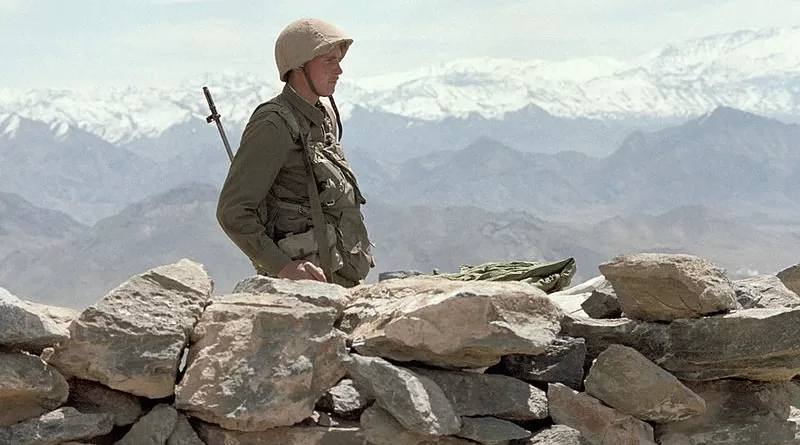
A Russian soldier-internationalist guards roads during the Soviet-Afghan War. Photo Credit: RIA Novosti, Wikipedia Commons.

A Russian soldier-internationalist guards roads during the Soviet-Afghan War. Photo Credit: RIA Novosti, Wikipedia Commons.

Behind the Soviet Retreat: A Cold War Coalition

When Soviet troops withdrew in 1989, it was certainly a landmark moment in Afghan history. But it was not the result of isolated, indigenous resistance. The Mujahideen were backed by a coalition of countries with converging geopolitical interests—chiefly the United States, Pakistan, Saudi Arabia, and China.

Operation Cyclone, the CIA’s covert effort to fund and arm the anti-Soviet insurgency, was one of the most expensive covert operations in U.S. history. Billions of dollars in weapons and intelligence flowed into the country through Pakistan’s Inter-Services Intelligence (ISI), which served both as facilitator and gatekeeper. Saudi Arabia matched U.S. funding dollar-for-dollar and provided ideological backing. China, too, saw the opportunity to undermine Moscow through indirect involvement.

What unfolded in Afghanistan was not a lone insurgency, but a classic proxy war—one shaped, sustained, and ultimately resolved not by local fighters alone, but by the calculations of distant capitals.

The U.S. Withdrawal: Exit by Design, Not Defeat

The images of Taliban fighters entering Kabul in August 2021 gave fresh life to the “graveyard” narrative. But once again, the surface optics obscure the deeper truth.

The United States did not leave Afghanistan because it was militarily defeated. By 2020, U.S. combat deaths were in the single digits annually. The decision to withdraw was a political one, rooted in a sense of strategic fatigue and shifting global priorities. Successive administrations, starting with President Obama and continuing through Trump and Biden, grappled with an enduring question: What was America still doing in Afghanistan, and at what cost?

Washington’s exit was not precipitated by Taliban military dominance, but by a growing belief that a military solution was neither feasible nor affordable. The collapse of the Afghan Republic came not from a final Taliban offensive alone, but from within—a failure of political cohesion, institutional rot, and loss of public confidence.

Collapse from Within

This pattern isn’t new. The People’s Democratic Party of Afghanistan (PDPA), the Soviet-backed regime, didn’t fall immediately when Soviet troops left. It held on until 1992, when the USSR’s collapse ended the flow of support and internal fissures became unmanageable. Similarly, the Western-backed Republic of Afghanistan had years of international support but was undone by factionalism, corruption, and elite disconnect from the broader population.

The fall of these regimes says more about internal fragility than about the strength of those who opposed them.

External Hands in Every Era

From the 19th century Anglo-Afghan Wars to the 21st-century global war on terror, foreign involvement in Afghan conflicts has been constant. During the British invasions of 1839, 1878, and 1919, Afghan rulers capitalized on great power rivalries, sought arms from competing empires, and engaged in complex diplomacy. Even Afghanistan’s eventual assertion of independence in 1919 came as Britain reeled from the exhaustion of World War I.

Afghan resistance has always been shaped by its ability to attract and exploit external support. Heroism alone didn’t win wars—strategy, geography, and foreign alliances did.

Mythmaking and Its Consequences

The mythology of Afghanistan defeating empires may offer a moment of national pride, but it comes at a cost. It obscures the enormous toll exacted on the country itself: millions dead or displaced, generations born into war, cities and institutions reduced to rubble. It feeds a self-image of righteous resistance while ignoring the hard truths of dependence, fragmentation, and lost opportunities.

More importantly, it undermines honest dialogue about what went wrong—and what comes next. A nation that believes it never needed help may not recognize when it needs cooperation. A people told they always win may not prepare for the hard work of building stable institutions and peaceful coexistence.

The future of Afghanistan does not lie in repeating myths, but in confronting realities: that no victory was ever achieved alone, and that no lasting peace can be forged without sober reflection and regional collaboration.
Advocate Mazhar Siddique Khan is a Lahore based High Court Lawyer. He can be contacted at mazharsiddiquekhan@gmail.com.

The ‘Graveyard Of Empires’ Myth Distorts Afghanistan’s Story
read more

Imran Khan calls for extension of Afghan refugee return deadline

Khaama Press


Imran Khan has called for extending the Afghan refugee return deadline, emphasizing the need for continued support and negotiations.

Imran Khan, the former Prime Minister of Pakistan, while being imprisoned, has called for the passage of a resolution in support of Afghan refugees and the facilitation of negotiations with the Taliban administration.

Khan, the leader of the Pakistan Tehreek-e-Insaf (PTI) party, during a meeting with senior members of his party at Adiala Jail in Rawalpindi, urged the extension of the deadline for Afghan refugees to return from Pakistan.

Sheikh Waqas Akram, the spokesperson for PTI, announced that Khan had proposed that the Khyber Pakhtunkhwa Provincial Assembly pass a resolution urging the federal government to facilitate negotiations between the provincial government and the Taliban of Afghanistan.

Khan emphasized that the surge of terrorism has had devastating effects on Khyber Pakhtunkhwa, and direct engagement with Afghan authorities could help reduce the intensity of this crisis. In a message shared by Waqas Akram on social media platform X, Khan said, “The Khyber Pakhtunkhwa Assembly should demand that the federal government extend the deadline for expelling Afghan refugees and grant permission for direct talks with the Taliban.”

Previously, PTI had voiced objections regarding the expulsion of Afghan refugees. Ali Amin Gandapur, the Chief Minister of Khyber Pakhtunkhwa and a senior member of PTI, had also described the policy as unsustainable and harmful.

Since the beginning of April 2025, the Pakistani government has initiated a new wave of expulsions of Afghan refugees without legal documentation. Reports suggest that in the past two weeks alone, over 60,000 refugees have either returned to Afghanistan or been forcibly expelled. The government’s strict policy towards Afghan refugees has sparked widespread domestic and international reactions.

Imran Khan’s call for extending the refugee return deadline and facilitating negotiations with the Taliban reflects growing concerns over Pakistan’s refugee policy and its implications for regional security. The debate surrounding this issue is expected to continue, with significant political and humanitarian consequences.

Imran Khan calls for extension of Afghan refugee return deadline
read more

Millions in Afghanistan lack access to clean water: UN-Habitat

Khaama Press

UN-Habitat reports that millions in Afghanistan, especially in informal settlements, lack access to clean water, requiring urgent intervention.

The United Nations Human Settlements Programme has reported that many Afghanistan’s citizens, particularly those living in informal settlements, lack access to basic healthcare and clean drinking water, requiring urgent intervention.

According to UN-Habitat, the lack of essential infrastructure in numerous regions of Afghanistan has left a significant portion of the population, especially in informal settlements, without access to clean water and primary healthcare services.

In a message shared on social media platform X on Tuesday, April 15, the agency emphasized the importance of clean water and its role in public health and resilient communities.

The message further stated, “UN-Habitat highlights that water is vital for human dignity, health, and resilient communities, yet many in Afghanistan lack access to it.

The agency also added that “The UN-Habitat emphasizes the importance of water resources management and access to safe water and sanitation for eradicating poverty, building peaceful and prosperous societies, and ensuring no one is left behind in sustainable development.”

Afghanistan has faced numerous crises in recent years, including drought, internal migration, the collapse of infrastructure, and reduced international support. This situation has severely impacted access to clean drinking water and healthcare services, particularly in the outskirts of cities and underserved areas.

International organizations have repeatedly called for immediate action to improve living conditions for millions of Afghans, emphasizing the critical need for sustainable water supply and healthcare infrastructure.

Efforts to address these urgent needs are crucial to ensure the well-being and resilience of vulnerable populations in Afghanistan. With ongoing support and collaboration, there is hope to restore essential services and improve the overall quality of life for the people of Afghanistan.

Millions in Afghanistan lack access to clean water: UN-Habitat
read more