Islamic Emirate Cuts 1000s of Governmental Jobs

Mujahid described the reduction of positions as a natural measure, stating that these changes aim to improve operations and reduce bureaucracy.

The spokesperson of the Islamic Emirate, Zabihullah Mujahid, announced a reduction in positions across governmental institutions.

Mujahid described the reduction of positions as a natural measure, stating that these changes aim to improve operations and reduce bureaucracy.

According to documents obtained by TOLOnews, the Ministry of Education has eliminated 90,000 of its positions.

With this reduction, the ministry will now provide educational services with 299,684 positions.

Zabihullah Mujahid said: “Downsizing in government institutions is a natural matter. Authorities know what is in the nation’s best interest and implement accordingly. Some reductions have also occurred in military and civilian sectors to improve efficiency, reduce institutional inflation, and curb bureaucracy.”

Additionally, sources from the Ministry of Economy have confirmed that the ministry plans to reduce its workforce by 13%.

“In a situation where job opportunities in Afghanistan have drastically declined, reducing employees under such conditions increases economic pressure on the people. It is better for the government to also consider job creation strategies alongside downsizing so alternatives can be found,” said Mir Shakir Yaqubi, an economic analyst.

“Excessive reliance on government jobs can restrict economic dynamism. Hence, the Islamic Emirate should focus more on the private sector and implement supportive policies that allow it to grow, create job opportunities, and reduce poverty in the national economy,” said Seyar Quraishi, another economic analyst.

Although the exact number of reduced government employees has not yet been disclosed, reports suggest over 300,000 employees may be laid off, though this figure has not been officially confirmed.

Islamic Emirate Cuts 1000s of Governmental Jobs
read more

Islamic Emirate to Appoint Ambassador to Russia as Bilateral Ties Deepen

In this meeting, both sides emphasized expanding bilateral relations and starting a new phase of cooperation between Afghanistan and Russia.

The acting minister of foreign affairs, in a meeting with Zamir Kabulov, Russia’s special representative for Afghanistan, who visited Kabul, announced that the caretaker government will soon appoint a diplomat at the ambassadorial level to Moscow.

In this meeting, both sides emphasized expanding bilateral relations and starting a new phase of cooperation between Afghanistan and Russia.

Zia Ahmad Takal, head of public relations at the Ministry of Foreign Affairs, said about this meeting: “Respected Mawlawi Amir Khan Muttaqi thanked the Russian Federation for accepting a diplomat from the Islamic Emirate at the ambassadorial level in Russia and promised that the Afghan government will soon introduce a diplomat to Moscow at the ambassadorial level.”

Additionally, Zamir Kabulov announced a meeting to be held in May to establish a permanent bilateral commission between the two countries on the sidelines of the Kazan summit.

Idris Mohammadi Zazai, a political analyst, expressed: “Embassies should be reopened. Economic exhibitions should also be held here. We can now say that the relationship between Afghanistan and Russia has reached a point of interaction, and this point is moving toward the development of the economy, politics, and social relations.”

Muin Gul Samkani, another political analyst, stated: “Accepting an ambassador in Russia is not a new matter, as China has also done the same before. However, if an ambassador is appointed, it shows that relations are becoming more consolidated, though it may still be early to talk about formal recognition.”

Kabulov also met with Khalifa Sirajuddin Haqqani, the acting Minister of Interior.

Abdul Matin Qani, spokesperson of the Ministry of Interior, wrote on X that in this meeting the two sides discussed security, economic, and trade cooperation, as well as strengthening bilateral relations.

Qani said: “Khalifa Sahib praised Moscow’s recent move regarding Afghanistan and considered it a significant step toward acknowledging Afghanistan’s political realities. Both parties also committed to expanding diplomatic relations to the embassy level and mutual security and trade engagement.”

Enayatullah Adel, a political analyst, commented: “In addition to engaging with Russia, relations should also be established with other countries so that the Islamic Emirate may gain recognition. Furthermore, broader interactions in economic, political, and cultural fields should be pursued in various ways.”

Kabulov’s trip to Kabul comes shortly after Russia’s Supreme Court suspended the designation of “Taliban” as a banned group in that country—an action that the Islamic Emirate welcomed.

Islamic Emirate to Appoint Ambassador to Russia as Bilateral Ties Deepen
read more

After a year of hostility, Pakistan and Afghanistan seek diplomatic reboot

.By 

Al Jazeera

Islamabad, Pakistan – When Pakistan’s Deputy Prime Minister and Foreign Minister Ishaq Dar landed in Kabul on April 19 for a daylong visit, it marked the first major trip by a senior Pakistani official to Afghanistan since February 2023.

Dar’s visit came just days after senior military and intelligence officials from both countries had met in Kabul for the first time since January 2024.

These meetings follow months of strained relations between the neighbours amid frequent border skirmishes, Pakistan’s decision to expel Afghan refugees, and repeated border closures that have disrupted business and trade.

Dar’s trip, say analysts, signals a willingness from both sides to reset ties through diplomacy.

According to Pakistan’s Ministry of Foreign Affairs, Dar met Afghanistan’s interim foreign minister, Amir Khan Muttaqi. The two leaders held discussions on “security, trade, transit, connectivity, and people-to-people contacts”.

The statement from the Afghan Foreign Ministry, however, did not mention security concerns and focused on issues such as “situation of Afghan refugees, political relations, economic cooperation, trade, transit, large-scale joint projects, and other matters of mutual interest.”

“We have requested our hosts that we have to work together for the progress, betterment and peace and security of the region. For that, neither will we allow anyone to use our soil to conduct illicit activities in Afghanistan, nor will you allow anyone to use your soil,” Dar said.

Security concerns after 2021

Since the Taliban took control of Afghanistan in August 2021 after the United States withdrew its troops, Pakistan has witnessed a sharp increase in violent attacks, particularly in the northwestern province of Khyber Pakhtunkhwa and the southwestern province of Balochistan, both of which share borders with Afghanistan.

Islamabad has repeatedly alleged that Afghan soil is being used by armed groups, especially the Pakistan Taliban, known by the acronym TTP, to launch attacks across the porous border.

Pakistan Taliban, founded in 2007, is ideologically aligned with the Taliban in Afghanistan but operates independently. The Taliban has repeatedly rejected allegations that it allows its soil to be used for attacks against Pakistan, and has consistently denied any ties with the TTP.

Data from the Pak Institute For Peace Studies, an Islamabad-based conflict research organisation, shows that Pakistan experienced 521 attacks in 2024, a 70 percent increase from the previous year.

These incidents claimed 852 lives, a 23 percent rise, with 358 of those killed being law enforcement personnel. Most of the violence occurred in Khyber Pakhtunkhwa and Balochistan.

Once seen as a benefactor of the Taliban, Pakistan has cited the uptick in violence as the main reason for its crackdown on hundreds of thousands of Afghan refugees, many of whom have lived in the country for decades.

Pakistan has hosted millions of Afghan refugees since the Soviet invasion of Afghanistan in 1979, welcoming several waves of displaced people as conflict continued in the country.

Following the 9/11 attacks and the subsequent US invasion of Afghanistan, thousands of Afghans returned home. However, the Taliban’s dramatic return to power in August 2021 prompted another wave of displacement, with between 600,000 and 800,000 people seeking refuge in Pakistan.

Since the expulsion programme began in November 2023, nearly one million Afghan nationals have been forced to return, with the Pakistani government declaring that it would continue its repatriation drive.

Global rights organisations, as well as the Afghan government, have urged Pakistan to reconsider the decision and ensure the dignity of those being deported.

Revival of diplomatic ties?

Despite rising hostilities between the two countries, including Pakistani air attacks on Afghan soil in December that killed at least 46 people, analysts see Dar’s visit as “significant” and suggestive of a broader resumption of dialogue.

Iftikhar Firdous, co-founder of The Khorasan Diary, a portal that tracks regional security issues, pointed out that this was the highest-level visit from Pakistan to Kabul since former Prime Minister Imran Khan’s trip in November 2020.

“The visit by Dar included discussions on security, ease of business for traders, and continued conversations on cross-border issues,” Firdous told Al Jazeera.

The Islamabad-based analyst added that the recent meeting between military and intelligence officials indicates that backchannel efforts to resurrect diplomacy were under way even before Dar’s trip.

“It was not a start, but instead a culmination of the agenda to re-engage with Afghanistan and break the ice,” he said.

Amina Khan, director of the Centre for Afghanistan, Middle East and Africa at the Institute of Strategic Studies Islamabad (ISSI), said both sides appear to be looking for ways to accommodate each other’s concerns.

“For Pakistan, it is security, and for Kabul, it is trade. However, since both are intertwined, a comprehensive bilateral approach is needed. This trip appears to have initiated a dialogue. One will have to see if both sides can maintain the positive momentum,” she told Al Jazeera.

Khan added that Pakistan recognises the importance of Afghanistan to its own stability.

“Pakistan realises that, in order to achieve this, workable ties with Kabul are paramount, but at the same time it is pivotal for Kabul to address Pakistan’s security concerns emanating from the TTP,” she said.

A United Nations report [PDF] published in February concluded that the Taliban continued to provide logistical, operational and financial support to the TTP. It added that the armed group has set up new training centres in border regions near Pakistan.

In response, Zabihullah Mujahid, the Afghan government spokesperson, denied the allegation, calling it a “regular slander” against the country.

“The stance of the UN is misused. We call on the countries who are members of the UNSC but have good relations with Afghanistan to not allow the reputation of the organization to be harmed,” Mujahid said in February.

On the same page?

Khan of ISSI said the Taliban faces its own challenges while dealing with armed groups like the Pakistan Taliban.

“Pakistan understands the limitations of the Afghan Taliban in taking action against the TTP, who may very well join the ranks of so-called ISIS [ISIL] and take up arms against the government,” she said.

Meanwhile, the Taliban has stressed that the Afghan government is unhappy about the eviction of hundreds of thousands of Afghans by Pakistan.

Raising the issue of their forced repatriation in the meeting with Dar, Minister Muttaqi stressed the need for humane treatment and urged Pakistani authorities to protect the rights of Afghan nationals currently residing in Pakistan or returning from there.

The Pakistan Foreign Ministry statement, meanwhile, focused on the country’s security concerns.

“The Deputy Prime Minister emphasised the paramount importance of addressing all pertinent issues, particularly those related to security and border management, in order to fully realise the potential for regional trade and connectivity,” the ministry’s statement read.

Still, Khan, the analyst, said she believes that Dar’s visit has broken the ice. Now, the key will be to “remain engaged” and pursue a holistic approach to bilateral relations, she said.

“While security is a crucial aspect, it should not be the sole focus. Other aspects, such as diplomatic, economic, and cultural cooperation, must also be considered to build a balanced and sustainable partnership,” Khan said.
Source: Al Jazeera
After a year of hostility, Pakistan and Afghanistan seek diplomatic reboot
read more

Afghanistan, Pakistan Discuss Bilateral Ties, Refugees, Transit

The main topics of discussion included political relations, the status of Afghan refugees, trade, and transit.

A Pakistani delegation led by Mohammad Ishaq Dar, the deputy prime minister and foreign minister of Pakistan, visited Kabul and held talks with officials of the Islamic Emirate on four key issues.

The main topics of discussion included political relations, the status of Afghan refugees, trade, and transit.

Sardar Ahmad Shakeeb, the chargé d’affaires of the Islamic Emirate’s embassy in Islamabad, told TOLOnews that the interim Afghan government assured the Pakistani side that it does not interfere in Pakistan’s internal affairs and does not support opposition groups.

Sardar Ahmad Shakeeb said: “The officials of the Islamic Emirate clearly stated their position: they do not interfere in the internal affairs of any country, and no harm will come from Afghanistan. Those who oppose Pakistan have problems in their own country—we do not interfere or support them.”

Shakeeb added that during his one-day trip, Mohammad Ishaq Dar also pledged to address the problems of Afghan refugees residing in Pakistan.

According to Shakeeb, Afghan refugees are being expelled along with their personal assets.

“Pakistan should clarify its policy toward Afghan refugees to ensure their dignity and property are not harmed,” he said.

Experts also weighed in on the matter:

Political analyst Salim Paigir said: “Afghans generally do not interfere in any country’s internal affairs because they lack the economic, political, and military capacity. Our people live in poverty. Perhaps the Pakistanis have realized that Afghans are not and will not interfere, which is why these talks and understandings are moving forward.”

This visit took place on Saturday, when the deputy prime minister and foreign minister of Pakistan led the delegation to Kabul. During meetings with the prime minister and acting foreign minister of the Islamic Emirate, discussions focused on strengthening political, security, and economic cooperation.

Afghanistan, Pakistan Discuss Bilateral Ties, Refugees, Transit
read more

UNAMA Urges Inclusive Engagement with Islamic Emirate for Afghan Stability

According to her, the aim of this process is the full integration of Afghanistan into the international community.

Roza Otunbayeva, the head of the United Nations Assistance Mission in Afghanistan (UNAMA), said in Kabul that the UN is committed to supporting Afghanistan’s stability and development through a comprehensive and coordinated process with the Islamic Emirate.

According to her, the aim of this process is the full integration of Afghanistan into the international community and the adherence of the caretaker government to global commitments.

Roza Otunbayeva said: “The UN is committed to supporting Afghanistan’s stability and development through the proposed comprehensive approach aimed towards a more coherent, coordinated and structured engagement between the Taliban authorities and the international community. The objective of this process should be clear end state of an Afghanistan at peace with itself and its neighbors fully reintegrated into the international community and meeting international obligations.”

The UNAMA chief also called the work of two task forces—on counter-narcotics and the private sector—crucial, and stressed the importance of active participation from all Central Asian countries.

“As part of this process, the work of the two task working groups of counter-narcotics and the private sector decided in Doha on first of July 2024, Doha, is growing work,” she said.

Najib Rahman Shamal, an international relations expert, said: “We hope that the current Afghan authorities will also facilitate greater international engagement, especially from the United Nations, which has once again reaffirmed its commitment to supporting Afghanistan.”

Meanwhile, the Islamic Emirate has repeatedly called on the United Nations to provide the necessary grounds for official engagement with the international community and to hand over Afghanistan’s permanent UN seat to the Islamic Emirate.

UNAMA Urges Inclusive Engagement with Islamic Emirate for Afghan Stability
read more

Trump administration orders some Afghan refugees to leave US within a week

AMU TV

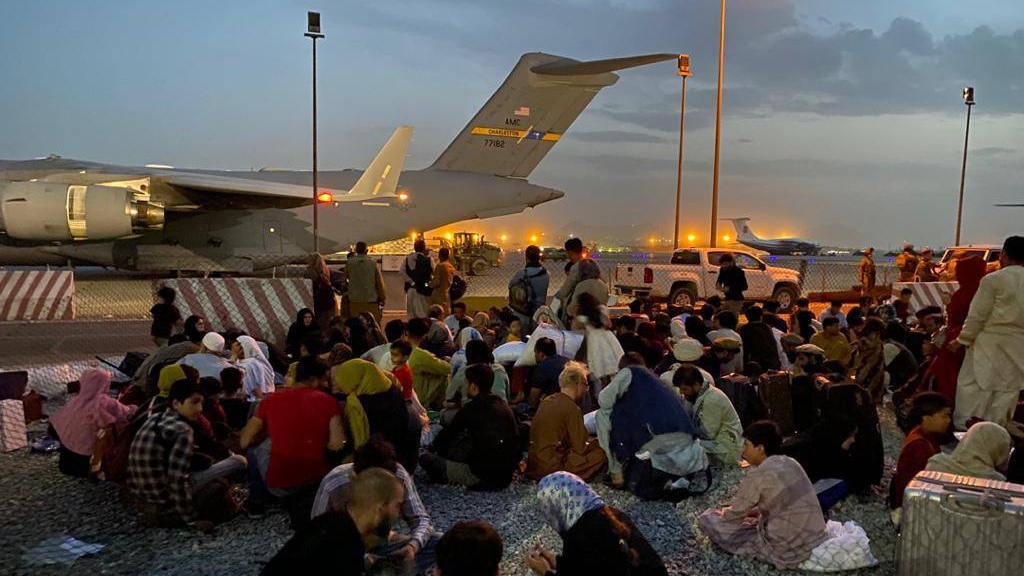
A group of Afghans waiting for their flight at Kabul airport in August 2021 during the evacuation process. Photo: Shakibi Ibrahimi

KABUL, Afghanistan — The Trump administration has ordered some Afghan refugees who legally entered the United States after the Taliban takeover in 2021 to leave the country within a week or face detention and legal action, Newsweek reported Thursday, citing emails and local sources.

According to the report, the Department of Homeland Security has been sending “Notices of Termination of Parole” to Afghan nationals who had been admitted under humanitarian parole programs or other legal pathways. The notices warn recipients to voluntarily depart the country within seven days or face arrest and removal proceedings. US officials said the measures apply to individuals who no longer have a valid legal status to remain.

The move is part of President Donald Trump’s broader immigration crackdown, which he pledged would be the largest mass deportation operation in American history. Since taking office earlier this year, the administration has ramped up enforcement actions, including against Afghans who fled their country fearing Taliban persecution.

Among those who received the notices are Afghans residing in Raleigh, North Carolina, Newsweek reported. One asylum seeker, who spoke anonymously to local broadcaster WRAL, said returning to Afghanistan would be tantamount to “signing a suicide mission.”

The administration is also reportedly taking steps to end Temporary Protected Status (TPS) for Afghan nationals, a designation that shielded tens of thousands from deportation and allowed them to work legally. TPS protections for Afghanistan are set to expire on May 20, and officials have indicated they do not intend to renew them.

Roughly 150,000 Afghans resettled in the United States between August 2021 and August 2024, according to congressional figures.

Refugee advocates and immigration experts have criticized the administration’s moves. Shawn VanDiver, executive director of AfghanEvac, told NPR this week: “Ending temporary protected status for Afghans isn’t just cold, it’s cowardly. We promised them safety. Now we’re pulling the rug out from under them.”

Julia Gelatt, an analyst at the Migration Policy Institute, warned that revoking TPS would flood the already backlogged asylum system. “Most Afghans in the US have strong asylum claims based on their ties to the United States. For Afghan women especially, losing TPS would be devastating,” she told The New York Times.

A senior DHS official told Newsweek that the recent notices were sent primarily to parolees who had failed to adjust their immigration status after arrival. It remains unclear how many Afghans have left the country following receipt of the notices.

Trump administration orders some Afghan refugees to leave US within a week
read more

A Force for Good, or Source of Coercion? An Islamic scholar reflects on the Emirate’s morality law

October 2024
You can preview the report online and download it by clicking here or the download button below.
The full translation of the law can be read here.

This report aims to place the Emirate’s August 2024 Propagation of Virtue and Prevention of Vice Law within a broader Islamic context. John Butt argues that the two basic concepts – amr bil-maruf and nahi an il-munkar – are simple: encourage people to do good and discourage them from wrongdoing. To clarify these concepts, he says, one can make them even simpler: Stand up for good; Take a stand against wrong. Seen in this bare and basic light, amr bil-maruf, he believes, is an upstanding and admirable principle and practice of Islam.

Yet, from this, has emerged a colossal document. The Emirate’s law, in essence a decree by its Supreme Leader, Hibatullah Akhundzada, stands somewhere in the region of 45,000 words when translated into English. Its copious footnotes are used to back up the Emirate’s decisions on what to ban, what to make obligatory and how to determine the powers and responsibilities of those enforcing the law. The authority of the enforcer is wide-ranging and includes the ability to order extra-judicial punishments. Many of the sources cited in the footnotes are in Arabic, a language understood by relatively few Afghans, or non-Arab foreigners, which is one reason why we thought it important to translate the whole law to better understand the thinking behind it.

Butt looks at the meaning and practice of the Emirate’s amr bil-maruf law, first in the context of fundamental Islamic principles, including the obligation of Muslims to present a positive image of their faith to the outside world, and second, as amr bil-maruf has been interpreted at crucial stages of Islamic history. He focuses on the reigns of two caliphs cited in the footnotes of the IEA law, before considering a nineteenth-century Pashtun project to encourage amr bil-maruf. He also hones in on how it affects two groups that see the full weight of the Amir’s decree – women and, to a lesser extent, the media.

Butt’s report clarifies how the Emirate’s version of propagating virtue and preventing vice fits into the wider Islamic and Afghan historical context, asking questions such as: Have those who framed the law referenced a wide range of sources and done so objectively, or have they been selective? Is the establishment of a dedicated ministry, such as the one set up by the IEA, the normal way to conduct amr bil-maruf? And how does the law measure on the scales of the crucial Islamic balance that seeks to steer a course between harshness and leniency?

* John Butt is a graduate of the Darul Uloom Deoband in India. This is the key seminary informing the Islamic thought of most Afghan Sunni clerics, including the Taliban. Butt went on to have a career in journalism and broadcasting – including reporting for the BBC from Kandahar in the early 1990s on the men who would go on to form the Taliban movement – and setting up radio serial dramas. He published an autobiography, A Talib’s Tale: The Life and Times of a Pashtoon Englishman, in 2021 and a previous AAN report, A Taleban Theory of State: A review of the Chief Justice’s book of jurisprudence, was a review of Emirate Chief Justice Abdul Hakim Haqqani’s book, The Islamic Emirate and Its System of Governance, which is the fullest and most authoritative account yet of what the Taliban believe an Islamic state should be like.

Edited by Kate Clark and Roxanna Shapour 

You can preview the report online and download it by clicking here or the download button below.

The full translation of the law can be read here.

A Force for Good, or Source of Coercion? An Islamic scholar reflects on the Emirate’s morality law
read more

A ‘strange dance’: media mogul Saad Mohseni on making TV under the Taliban

Chief reporter
The Guardian
21 April 2025

Once dubbed the ‘Afghan Rupert Murdoch’, Mohseni’s media business was founded after the fall of the Taliban and is now navigating their return

“If a woman menstruates, [the showing of an uncovered female face] is haram [forbidden], right?” Mohseni said. “But as soon as they go through, you know, menopause, then you can have them uncovered. It’s ridiculous, it’s so offensive. So now we try to negotiate with [the Taliban] to do a soap opera that’s going to have these women over the age of 50. We have to try.”

Mohseni, 58, described as Afghanistan’s first media mogul or the ‘Afghan Rupert Murdoch’ is the chief executive of Moby Group.

Founded by Mohseni and his siblings – Afghan emigres who returned to their childhood home from Australia after the removal of the Taliban in 2001 – Moby was the country’s largest media conglomerate until the Taliban returned to Kabul nearly four years ago.

What has been established since 2021 is a hardline Islamic emirate shunned by much of the world. Political and media freedoms have deteriorated sharply but, most glaringly, the rights of women have been swept away. Women have been erased from nearly every aspect of public life: schools, universities and most workplaces.

Yet the company remains, not just hanging on, but a dominant player in the Afghan market, producing TV and radio entertainment shows and a 24-hour news channel that employs about 400 people.

The result is an odd co-existence with the Taliban – a “strange dance”, as Mohseni put it – that offers an insight into the complicated politics in the country.

Mohseni was on a trip out of the country at the time of the chaotic and sudden withdrawal of the US in summer 2021, an event about which he says he had given the former Afghan president Ashraf Ghani repeated warnings. “I was very angry, and I’m still very angry about his arrogance,” he said of the president, who fled Kabul as his administration collapsed.

Mohseni has not been back to Afghanistan since, partly because he does not want to be seen to be endorsing the new regime. “The other [reason] is that there’s always the risk of them saying, ‘You can’t leave, you know, you’ve got important media assets, you’ll be our guest’”, Mohseni said.

Instead, he oversees affairs from his homes in Dubai and London. It was not clear at first whether he would have any affairs in Afghanistan to look after.

He wrote a memoir, Radio Free Afghanistan, after being locked out of his country, believing the empire he had built was dead in the water. But Moby has survived – albeit within tight confines.

The current rules are there is to be no criticism of the Taliban’s reclusive supreme leader, Hibatullah Akhundzada, he says.

Men and women cannot share the same space. A curtain separates the two sexes in Moby’s offices. A split screen is used to facilitate conversation during a show on his Tolo TV network. Female news presenters must have their hair and faces covered.

The first show to be canceled was Afghan Star, the popular music reality show based on American Idol and the X Factor, which was taken off air in 2021 following the Taliban’s ban on music.

“You know, women performing on stage and people voting for them … They are the enemies of fun, right?” Mohseni said. “It was understood that we would not be able to continue with that. With the [ending of] soap operas and so forth it was gradual.”

There has been more latitude given to Moby’s news operation.

“I’m not saying they have an appreciation for free press, but I think there’s an understanding of how important media is,” he said. “I think they need to have their announcements or whatever amplified, echoed. People need to understand. They need to be able to sell their narrative to the public.”

Mohseni’s journalists have been able to push to a degree, at one point confronting ministers over the extra judicial killings of opposition figures.

The male presenters also wore masks in solidarity with their female colleagues for a week and even persuaded a minister to try it out, before he complained that it was too difficult to breathe. “Afterwards, he threatened to lock my guy up,” Mohseni said.

There is, nevertheless, just enough space for the journalists to do their work to make it worthwhile, he said.

The news channel has heavily covered criticism of the Taliban’s ban of secondary education for girls. The regime had initially said the move was a temporary pause to allow it to reorganise the system.

As a result, Unesco reported about 1.4 million girls over the age of 12 have been deliberately deprived of schooling, with that number exceeding 2.5 million when taking into account those already kept out of education by their families.

“In 2024, we counted, we’ve done like two and a half or three thousand stories on girls education: town hall meetings, discussion, current affairs, programs, individual news stories,” Mohseni said. “It’s not just about like [former US secretary of state] Anthony Blinken says, ‘Girls need to go to school’. More importantly it was about Afghan voices and amplifying those voices, Taliban voices, religious voices, saying we need to allow our girls to go back to school.”

They also run educational programs on its Tolo TV network, supported by Unicef, that provides help to boys attending classes and the girls at home with mathematics, physics, biology and chemistry.

“Not even the Taliban will reinvent mathematics,” Mohseni said of the programmes which follow the national curriculum.

“It’s not an alternative to real education,” he added. “It’s sort of a band aid solution between when schools are banned and when they reopen. Whenever that may be, it’s a bridge. It may be a long bridge, but it’s a bridge.”

He is under no illusion the small freedoms could disappear, and that “on this trajectory, eventually, the country is going to become more conservative, more radical”. But there is still time to try to engage with the more reform-minded within the Taliban, he said.

“The movement itself is not monolithic,” Mohseni said. “You have different characters who view things, you know, sometimes more moderately or more pragmatically. And they all have ambitions.”

The country is nevertheless gripped by what Naheed Farid, a former member of the parliament of Afghanistan, has described as a system of “gender apartheid”. Mohseni worries that the lack of international engagement will only exacerbate a trend towards ever greater repression. “You ignore Afghanistan at your peril,” he said.

A ‘strange dance’: media mogul Saad Mohseni on making TV under the Taliban
read more

Delusions of Paradise by Maiwand Banayee review – a compelling rejection of fundamentalism

Born in Kabul, Maiwand Banayee aspired to become a Talib when he was 16. In 1994, living in a Pakistan refugee camp, there was little to do except sleep, eat, pray and dream of the afterlife: “Islam dominated every aspect of life in Shamshatoo. Even during the volleyball and cricket games the spectators were prevented from clapping because it was seen as un-Islamic.” Banayee joined the camp’s madrasa when he was 14 in an attempt “to fit in”. The only educational opportunity open to Afghans at that time, the religious school offered structure and purpose, although “instead of teaching us to live, they were teaching us to die”.

In this illuminating book, Banayee, now resident in England, describes the circumstances that led to his indoctrination, and what eventually saved him. Brutalised by conflict, his Pashtun family lived through the Soviet-Afghan war, followed by the period of bitter infighting between warlords. As a child, Banayee saw his neighbourhood torn apart and corpses rotting in the street: “By the winter of 1994, Kabul had turned into a deserted place, as if hit by Armageddon – a place of daily bombardments, looting and arbitrary arrests. The savagery and violence had no limits.” Banayee, his siblings and brother’s family eventually sought refuge in Pakistan, while his parents remained in Kabul with his disabled sister, Gul, fearing she would not survive the journey.

In the refugee camp, Banayee came to see the west as “a world stripped of miracle and wonder” as opposed to one where “ordinary people could obtain miracles directly from God”. Within a year his greatest desire was to take part in jihad. In 1996, following the Taliban takeover of Kabul, Banayee witnessed a “gruesome and medieval” execution ceremony. This experience of intolerance, his growing realisation that Taliban ideology is utterly “tied to seventh-century Saudi Arabia”, and an opportune period of study in a secular institution, changed Banayee. He feels that impressionable boys in camps were “the victims of bad ideas and indoctrination… In a culture riddled with poverty… abstinence and crazed religious fervour, they turned to [radical] Islam for solace.”

Describing the conflict that followed in the wake of September 11 as one where “boots fought sandals, helmets fought turbans and reality fought myth”, Banayee found himself caught between the two warring sides. Despite having renounced his “infatuation with the Taliban”, he writes how he “was on record as having argued with enough people to leave the impression that I was some fanatical Talib”. Fearing for his safety, Banayee managed to escape to Europe, landed in England, and found refuge in Ireland.

The final third of Delusions of Paradise follows a more familiar refugee narrative about the struggle for acceptance and the relentless threat of deportation while waiting to be granted status. Banayee taught himself to read and write in English in order to tell his story and his eye-opening observations about the lure of jihadism and unflinching descriptions of his own experiences of radicalisation make compelling reading.

  • Delusions of Paradise: Escaping the Life of a Taliban Fighter by Maiwand Banayee is published by Icon (£20).

Delusions of Paradise by Maiwand Banayee review – a compelling rejection of fundamentalism
read more

Kenya Arrests Former Afghan Lawmaker Wanted by the United States

Khaama Press

A court in Nairobi has allowed Kenyan police to detain Abdul Zahir Qadir, a former Afghan lawmaker and prominent political figure, following a formal extradition request from the United States.

Qadir, also known as Haji Abdul Zahir, was arrested at a hotel in Nairobi on April 15 by Kenya’s Directorate of Criminal Investigations (DCI). According to court documents, he is wanted in the United States on multiple charges, including narcotics importation conspiracy and possession of machine guns.

The U.S. Drug Enforcement Administration (DEA) had filed a criminal complaint against Qadir with the United States District Court for the Southern District of New York on March 25, 2025. The complaint led to an official diplomatic note submitted by the U.S. government, requesting Kenya to authorize Qadir’s extradition.

On Monday, Milimani Senior Principal Magistrate Benmark Ekhubi granted the application by Kenya’s Director of Public Prosecutions to hold Qadir in custody while extradition proceedings move forward. The court emphasized that the available information and circumstances justified endorsing the U.S. arrest warrant and the suspect’s return to face charges.

The prosecution stated that Qadir entered Kenya from Kabul on April 14 aboard a Qatar Airways flight and has no fixed residence in the country. Authorities expressed concern that releasing him could pose a significant flight risk and hinder efforts to locate other individuals potentially connected to the case.

Abdul Zahir Qadir, born in 1973 in Nangarhar province, is the son of the late Abdul Qadir, a senior commander in the United Islamic Front and former Vice President of the Afghan Transitional Administration, who was assassinated in 2002. A former general in Afghanistan’s border forces and a member of the Wolesi Jirga, Qadir led the “Peace Karwan” movement and served as First Deputy Speaker of Parliament in 2012.

Qadir’s political career has been marked by his strong opposition to government policies during President Hamid Karzai’s administration. Over the years, he has faced multiple allegations, including accusations of drug trafficking and abuse of authority—claims he has repeatedly denied, describing them as politically motivated attempts to discredit him.

The court in Nairobi is expected to begin formal extradition proceedings in the coming days. Meanwhile, Qadir remains in police custody. Neither the Afghan Embassy in Kenya nor representatives of Qadir’s legal team have issued a public statement regarding the arrest.

This developing case is likely to attract significant attention both within Afghanistan and abroad, given Qadir’s political background and the seriousness of the charges brought against him by U.S. authorities.

Kenya Arrests Former Afghan Lawmaker Wanted by the United States
read more