Iran has ordered over 4 million undocumented Afghan migrants to leave the country by July 6 amid rising migration pressures.
Iranian authorities have announced that all census papers issued to Afghan migrants are no longer valid, requiring undocumented migrants to leave the country by July 6.
Nader Yarahmadi, head of the Center for Refugee and Foreign National Affairs at Iran’s Ministry of Interior, stated that holders of these census papers are now considered illegal migrants. He emphasized that only six specific groups of migrants eligible for temporary residence cards are permitted to stay.
According to Iranian officials, approximately 6.1 million Afghan migrants currently reside in Iran, of whom 4.1 million lack legal residency status.
Yarahmadi also warned that in the upcoming academic year, students whose guardians only hold census papers will be barred from registering in schools.
This decision comes amid increased migration pressures at Iran’s borders. Simultaneously, reports indicate a rise in deportations of Afghan migrants due to the newly imposed restrictions.
The move marks a significant policy shift, intensifying the challenges faced by Afghan migrants in Iran. It also raises concerns over humanitarian impacts, particularly on children’s education and family stability within the large Afghan diaspora in Iran.
Experts and international organizations have called for balanced migration policies that respect migrants’ rights while addressing security concerns. Continued dialogue and cooperation between Iran, Afghanistan, and global bodies remain critical to managing this complex migration issue effectively.
Iran orders over 4 million undocumented Afghan migrants to leave by July 6
Zakharova emphasized that Russia supports efforts to prosecute those responsible for war crimes committed by Western military forces in Afghanistan.
The Russian Foreign Ministry criticized the delays in the process of investigating war crimes committed by foreign forces in Afghanistan.
Maria Zakharova, spokesperson for the Russian Foreign Ministry, said that Western countries, including the UK, have effectively obstructed investigations into war crimes committed by their military forces in Afghanistan.
She added: “Despite public pressure, Western countries have practically delayed the judicial process for crimes committed during the occupation of Afghanistan, let alone compensating the victims’ families. In the case of the UK, a lot of information has recently been released about these horrific events, but there has been no progress in the investigation process.”
Zakharova emphasized that Russia supports efforts to prosecute those responsible for war crimes committed by Western military forces in Afghanistan.
She added: “We welcome the growing efforts of human rights defenders who seek fair punishment for crimes committed by Western troops during the occupation of Afghanistan. These are the same countries that created institutions like the International Criminal Court; but the reality is that a discriminatory logic prevails in these cases — some people are deemed worthy of human rights, while others are not even made aware of such rights.”
Russia’s criticism of the Western approach to investigating war crimes by foreign forces in Afghanistan comes as David McBride, an Australian army whistleblower who revealed information about war crimes by his country’s forces in Afghanistan, failed on Wednesday in his attempt to reduce his five-year prison sentence.
Kieran Pender, an official from a human rights organization in Australia, stated: “Australia’s whistleblowing laws aren’t working. We urgently need comprehensive whistleblower protection reform so we don’t have more Dave Mcbrides and Richard Boyles.”
The UK, Australia, and the Netherlands are among the countries that have acknowledged war crimes by their forces in Afghanistan and have conducted investigations, but these investigations have yet to yield tangible results.
Russia: Western Countries Obstruct War Crimes Investigation in Afghanistan
According to Nader Yar-Ahmadi, aside from six groups who may remain in Iran with temporary cards, all other migrants must leave by the deadline.
Iran’s Ministry of Interior has set a deadline of July 6 this year for Afghan migrants to leave the country.
The head of the National Organization for Migration of Iran’s Ministry of Interior, Nader Yar-Ahmadi, emphasized that all undocumented migrants must leave the country by the given deadline. He also stated that, following the invalidation of Afghan migrants’ census documents, the number of undocumented Afghans in Iran has reached over four million.
Pakistan has set June 30 as the last date for the departure of Afghan migrants holding ACC cards.
According to Nader Yar-Ahmadi, aside from six groups who may remain in Iran with temporary cards, all other migrants must leave by the deadline.
Nader Yar-Ahmadi said: “Two million individuals whose census documents were valid until March 20 last year are now also considered undocumented. This has brought the total number of undocumented migrants in Iran to 4.1 million. Except for the six groups allowed to stay temporarily, all other undocumented Afghans must leave by July 6.”
Enayat Alokozay, an Afghan migrant in Iran, told TOLOnews: “Migrants with census papers have been given until Saratan by the Iranian government to leave. Many of them have lived in Iran for years and have business and trade ties there. This deadline is too short for them.”
Hashem, one of thousands recently deported from Iran with his wife and son, appealed to the interim government: “I was in Iran for a while, but they expelled us. I ask the Islamic Emirate to provide us with shelter and some food.”
Migrant rights activists emphasize that such actions should not be unilateral but coordinated with the interim government to enable a gradual and dignified return.
Mohammad Jamal Muslim, a migrant rights activist, told TOLOnews: “People living in Pakistan, Iran, the US, and European countries were accepted based on host countries’ interests. Unfortunately, the short-term deadlines announced by the US, Pakistan, and Iran until July are not in anyone’s favor.”
The Islamic Emirate has repeatedly urged host countries not to carry out forced deportations of Afghan migrants.
Iran, Pakistan Set Deadlines for Afghan Migrants to Leave
The UN warns that deported migrants are facing a worsening humanitarian crisis, with urgent needs for shelter, food, and medical support.
The United Nations High Commissioner for Refugees (UNHCR) has reported that in April alone, approximately 280,000 Afghan migrants were expelled from neighboring countries Iran and Pakistan.
Al Jazeera reported on Tuesday, May 27, quoting UNHCR, that a worsening crisis is developing in Afghanistan as large numbers of returnees face dire circumstances.
According to the report, many returnees have lost all their possessions and now face an uncertain and dangerous future upon returning to Afghanistan.
Iran and Pakistan have hosted around 5.25 million Afghan migrants for years, but both countries are currently grappling with their own economic crises, leading to increased expulsions.
Returnees also face significant security threats and human rights violations within Afghanistan. Ethnic and religious minorities, human rights activists, and journalists are especially vulnerable to heightened threats upon their return.
UNHCR has called for urgent support, stating that $60 million is needed to provide shelter, cash assistance, healthcare, and food for returnees.
The escalating crisis underscores the urgent need for international cooperation to protect vulnerable populations and address the root causes of displacement in Afghanistan.
Without adequate aid and protection, many returnees risk falling into poverty, violence, and further displacement, deepening the humanitarian emergency in the region.
UN warns deported migrants face escalating humanitarian crisis
UN-Habitat reports 80% of Kabul’s population lives in informal settlements, lacking clean water, healthcare, and safe green spaces.
The United Nations Human Settlements Programme (UN-Habitat) has reported that four out of every five residents in Kabul live in informal settlements and marginalized areas. These communities often lack basic infrastructure and services.
According to a statement posted on Tuesday, children in these areas are among the most vulnerable groups. They have limited or no access to clean water, healthcare facilities, and green spaces.
UN-Habitat emphasized that these children deserve better living conditions and opportunities for growth. The report calls for urgent investments and actions to improve living standards in these underserved communities.
Poverty, ongoing insecurity, and displacement have forced most Kabul residents to settle in unofficial neighborhoods on the city’s outskirts. These areas remain neglected by urban planning and development efforts.
The agency stressed that addressing these challenges is critical to securing a brighter future for Kabul’s population, particularly its youth, who face numerous daily hardships.
Experts say that without immediate intervention, the quality of life for millions in Kabul’s informal settlements will continue to deteriorate, further entrenching poverty and social inequality.
UN-Habitat calls on both local authorities and the international community to collaborate on sustainable urban development projects that prioritize access to essential services and improve living conditions in Kabul’s marginalized neighborhoods.
UN: 80% of Kabul Residents live in vulnerable Informal Settlements
They have called on the host country and the caretaker government of Afghanistan to address the demands of migrants and halt the deportation process.
A number of Afghan migrants in Iran have once again expressed concern over the “intensification of forced deportations” of Afghan citizens from the country.
They have called on the host country and the caretaker government of Afghanistan to address the demands of migrants and halt the deportation process.
Safar Barz, an Afghan migrant in Iran, told TOLOnews: “Unfortunately, the Iranian government has made the deportation process very rapid and severe, and it does not make a clear distinction between those who have legal documents and those who are undocumented.”
Enayat Alokozai, another Afghan migrant in Iran, said: “The forced deportation of Afghan migrants by the Iranian government has intensified once again. The Iranian government is determined to expel all Afghan migrants, even though they have repeatedly appealed to international organizations and the Islamic Emirate government to pressure Iran to stop the deportations. However, it seems these efforts have been ineffective.”
Some activists in the field of migrant rights emphasize the need for dialogue between the caretaker government and the host country to resolve the challenges faced by Afghan migrants in Iran.
Juma Khan Pouya, a migrant rights activist, told TOLOnews: “Host governments must be compelled, based on international documents, to refrain from deporting individuals at risk and from forcibly deporting all migrants.”
Nazar Nazari, another activist in the field, said: “There is a need for a series of talks between Iran and Afghanistan to reach a lasting solution to this crisis. These talks must be conducted in a manner that satisfies both sides.”
Previously, the United Nations reported that since 2023, Iran and Pakistan have forcibly repatriated more than three million Afghan migrants.
Afghan Migrants in Iran: Deportation Process Intensifies
The Islamic Emirate has not officially announced who is representing the interim government at the meeting.
For the first time, officials of the Islamic Emirate have been invited to an international security meeting in Russia.
The Russian news agency TASS, quoting the country’s Security Council, reported that representatives of the Islamic Emirate will attend the 13th Moscow International Security Meeting. This meeting began today at the Russian National Center and will continue until May 29.
Hamidullah Hotak, a political affairs expert, said: “This meeting is held for security in Russia, and the host country invited the Islamic Emirate. Neighboring countries are also present, but Afghanistan has repeatedly said that under no circumstances will it allow its soil to be used to destabilize other countries.”
Although the Islamic Emirate has not officially announced who is representing the interim government at the meeting, experts say participation in such gatherings can be part of efforts to gain international legitimacy and increase political and security engagement.
Hadi Quraishi, a military affairs expert, said: “Overall, Afghanistan’s participation in various forums held in Moscow is beneficial for the country both regionally and internationally, and raises its profile on the global stage.”
Aziz Maarej, a former diplomat, stated: “This is very good and important news, and a good opportunity that for the first time, Afghanistan has been invited to a major meeting called the Moscow Security Conference with a representative from the Islamic Emirate. This shows their intention for security. Taliban also understand the necessity and come up with their own proposals to improve Afghanistan.”
At the 13th Moscow International Security Meeting, senior security officials from BRICS member countries, the Shanghai Cooperation Organization, the Association of Southeast Asian Nations (ASEAN), and the Commonwealth of Independent States (CIS) are participating to discuss regional and global security challenges.
Although Russia has not yet officially recognized the interim government of Afghanistan, earlier Moscow suspended the designation of the Islamic Emirate as a banned organization in Russia—an action that experts believe plays a role in expanding Kabul-Moscow relations.
Islamic Emirate Attends Moscow Int’l Security Meeting for First Time
The administration claims conditions in Afghanistan have markedly improved under Taliban rule. Those who fought in the war say that’s “laughable.”
The Trump administration’s move to end deportation protections for wartime allies who fled to the United States after the fall of Afghanistan has infuriated veterans of the 20-year conflict there, who say the U.S. government is betraying a sacred promise made to some of America’s most vulnerable partners.
This month Homeland Security Secretary Kristi L. Noem announced the administration’s termination of temporary protected status, or TPS, for Afghans, exposing thousands, potentially, to deportation by Immigration and Customs Enforcement (ICE) as soon as July, when the policy is to takeeffect.
The fear, veterans and other advocates say, is that anyone who returns to Afghanistan will almost certainly face reprisal by the Taliban, the extremist militant group that in 2021 overran the U.S.-trained Afghan military and toppled the government in Kabul.
“If they attempt to deport the Afghans, you’re going to see actual physical conflict between veterans and ICE,” predicted Matt Zeller, an Army veteran who became a prominent advocate for America’s Afghan allies after his interpreter saved his life.
Advocacy groups estimate that about 10,000 Afghans in the United States have been dependent on TPS while they navigate the lengthy and complex process for obtaining permanent residency, a process made all the more difficult, they say, by the absolute chaos that defined Afghanistan’s collapse — and by the guidance they received from the U.S. government while trying to escape.
By declaring his intent to end these protections, President Donald Trump risks alienating a key demographic — veterans of the war — at the same time he seeks to court them politically. His administration has intensified its scrutiny of the U.S. withdrawal from Afghanistan and demanded accountability for 13 U.S. troops and an estimated 170 Afghans killed in a suicide bombing at Kabul’s airport as the evacuation, hastily orchestrated by the Biden administration, raced to a tragic end.
The White House did not respond to a request for comment.
Since returning to office, Trump has moved with speed and severity to eliminate legal immigration pathways, particularly humanitarian protections for those who fled crises abroad. In announcing an end to Afghans’ TPS, the administration said there have been “notable improvements” in Afghanistan under the Taliban’s authoritarian rule — a claim the Afghans’ advocates call fundamentally wrong.
“To me as a veteran, that’s incredibly offensive,” said Andrew Sullivan, a former infantry company commander in Afghanistan who works with No One Left Behind, a veterans nonprofit that helps resettle Afghans and Iraqis who risked their lives to serve the U.S. government during its post-9/11 wars.
Sullivan, who last year addressed a Republican-led congressional hearing focused on Taliban reprisals, said he has met with Afghans who were attacked or tortured because of their U.S. affiliation — including one who is now a paraplegic. The Trump administration’s assessment of the safety conditions in Afghanistan, he said, is “laughable.”
“If there was ever a country that deserves TPS,” Sullivan insisted, “it is Afghanistan.”
An international watchdog, Human Rights Watch, wrote in its 2025 report on Afghanistan that the situation there has “worsened” over the past year as “Taliban authorities intensified their crackdown on human rights, particularly against women and girls.” More than half the population needed urgent humanitarian assistance last year, the group found, including nearly 3 million people who faced “emergency levels of hunger.”
CASA, Inc., a national immigrant rights organization, has sued the Trump administration over its decision to end Afghans’ TPS, arguing that Noem, as homeland security secretary, failed to follow “statutorily mandated notice procedures” and callously endangered thousands of people “living and working lawfully in this country.” The U.S. District Court for the District of Maryland, where the case will be heard, has set an expedited schedule.
The war’s deadly endgame has been fiercely politicized. Trump tirelessly attacked President Joe Biden over the scenes of violence and despair that marked the two-week retreat from Kabul. In turn, Biden and his aides faulted Trump, who in his first term as president struck an exit deal with the Taliban that Biden maintained he was forced to carry out. Various investigations have determined that both administrations — and the two that came before them — made costly mistakes.
Many Republicans who took part in the frantic effort to rescue Afghan allies now echo Trump’s skepticism about the evacuees.
Since the FBI arrested an Afghan evacuee last year on charges he was planning an Islamic State-inspired Election Day attack, Trump’s backers and fellowimmigration hard-liners have argued, without evidence, that a broader swath of the evacuee population poses a threat to U.S. national security.
Rep. Brian Mast (R-Florida), an Army veteran who lost both legs in an explosion while serving in Afghanistan and who convened last year’s House hearing on Taliban reprisals, said he sees a stark contrast between Afghans who worked directly with U.S. forces — who he said would not be affected by the TPS termination — and those who did not.
“They’re not one in the same,” Mast said in an interview. “There’s people that maybe worked on a base, maybe they worked at [TGI] Fridays on a base as a waiter or something like that. That doesn’t mean that they were out on missions with me, rolling people up, right?”
The congressman said he was not immediately concerned that the Taliban might seek to execute or punish such people if they returned to Afghanistan. “I’ll think about how I feel about that,” he said.
Shawn VanDiver, president and board chairman of #AfghanEvac, a coalition of groups that have worked to extricate and protect vulnerable Afghans, said he was appalled by what he called the “political amnesia” of those such as Mast. It was only last year that the congressman “sounded the alarm” about what might happen to America’s Afghan allies if the U.S. governmentfailed to keep its promises to protect them.
“These are real lives, not talking points. And the idea that a cook, a janitor or a mechanic at Bagram [air base] deserves less protection than a combat interpreter is both morally bankrupt and strategically foolish,” said VanDiver, a Navy veteran. “The Taliban doesn’t do performance reviews. They don’t check résumés. They kill people for being associated with us.”
“These are people whose only ‘crime’ is having lived, learned or worked in the United States. And now, with TPS terminated and no viable pathway forward, they face an impossible choice: return to persecution or risk deportation from the very country they trusted,” he said.
Many of those who escaped Afghanistan were simply lucky enough to make it through the panicked crowds thronging Kabul’s airport as the Taliban closed in and began meting out violent retribution to those suspected of working with the United States, or with the Afghan government that Washington had supported.
Tens of thousands of other Afghans, who advocacy groups said were eligible for the Special Immigrant Visas reserved for those who served the U.S. mission, were left behind. Others who made it onto evacuation planes were separated from young children, their spouses or their parents, and have sought to bring them to the United States in the years since.
For veterans of the war who say their survival depended on the relationships they built with Afghan partners, Trump’s abrupt cancellation of deportation protections is a deeply, bitterly shameful slight. Some devoted considerable time and personal expense to help evacuate and resettle their former Afghan partners during Kabul’s collapse.
Advocacy groups such as No One Left Behind say they continue to urge members of Congress, Democrats and Republicans, to intervene. But the GOP, which holds majorities in the House and Senate, has yet to demonstrate an appetite to challenge a president who is so determined to lock down U.S. borders and ramp up deportations, no matter the means — and no matter the potential cost.
The Afghans’ plight gained some attention during a recent Senate hearing with Secretary of State Marco Rubio, when Sen. Jeanne Shaheen (New Hampshire), the Senate Foreign Relations Committee’s top Democrat, appealed for clarity on Trump’s plans. America’s Afghan allies, she said, “have been stranded in Qatar and Albania, and Pakistan and Afghanistan,” she said. “Is this administration going to allow them to come to the United States as promised?”
Rubio was vague in his response, citing an ongoing review. “We are determining,” he said, “whether we are properly vetting people.”
Advocates say the Afghans dependent on TPS include women’s rights activists, journalists, humanitarian workers, and former members of the Afghan military and government who are ineligible for Special Immigrant Visas because they did not work directly for the United States. But even for those who are eligible, obtaining them has been extraordinarily difficult because many — at the urging of the Biden administration — sought to evade Taliban detection as they fled and destroyed documents showing their U.S. affiliation.
“Some of these are our closest partners, people that actually worked with us and for us, that are simply using the TPS program because that was the only option,” said Rep. Jason Crow (D-Colorado), a former Army Ranger who fought in Afghanistan and was among the U.S. lawmakers who rallied to help when the evacuation was declared.
“If they’re sent back to Afghanistan,” Crow said, “it would be a death sentence for them.”
Veterans recoil at Trump plan to end Afghans’ deportation protection
The Islamic Emirate is seeking to document its history and shape a narrative that explains and justifies its rise back to power to the Afghan people. In this mini-series on Taliban narratives, part one looked at the Emirate’s written efforts – focusing on newly-published books that explore themes of history, ideology and identity. This second part scrutinises state-sponsored television documentaries that tell stories of Taliban heroism, victory with divine help and the suffering of Afghan civilians at the hands of the infidels. AAN’s Sharif Akram argues that the Emirate’s efforts in the visual realm have multiple aims: discrediting the legacy of the past two decades, legitimising the Taliban’s long armed struggle, their capture of power and continuing to rule, and providing role models for other Afghan men.
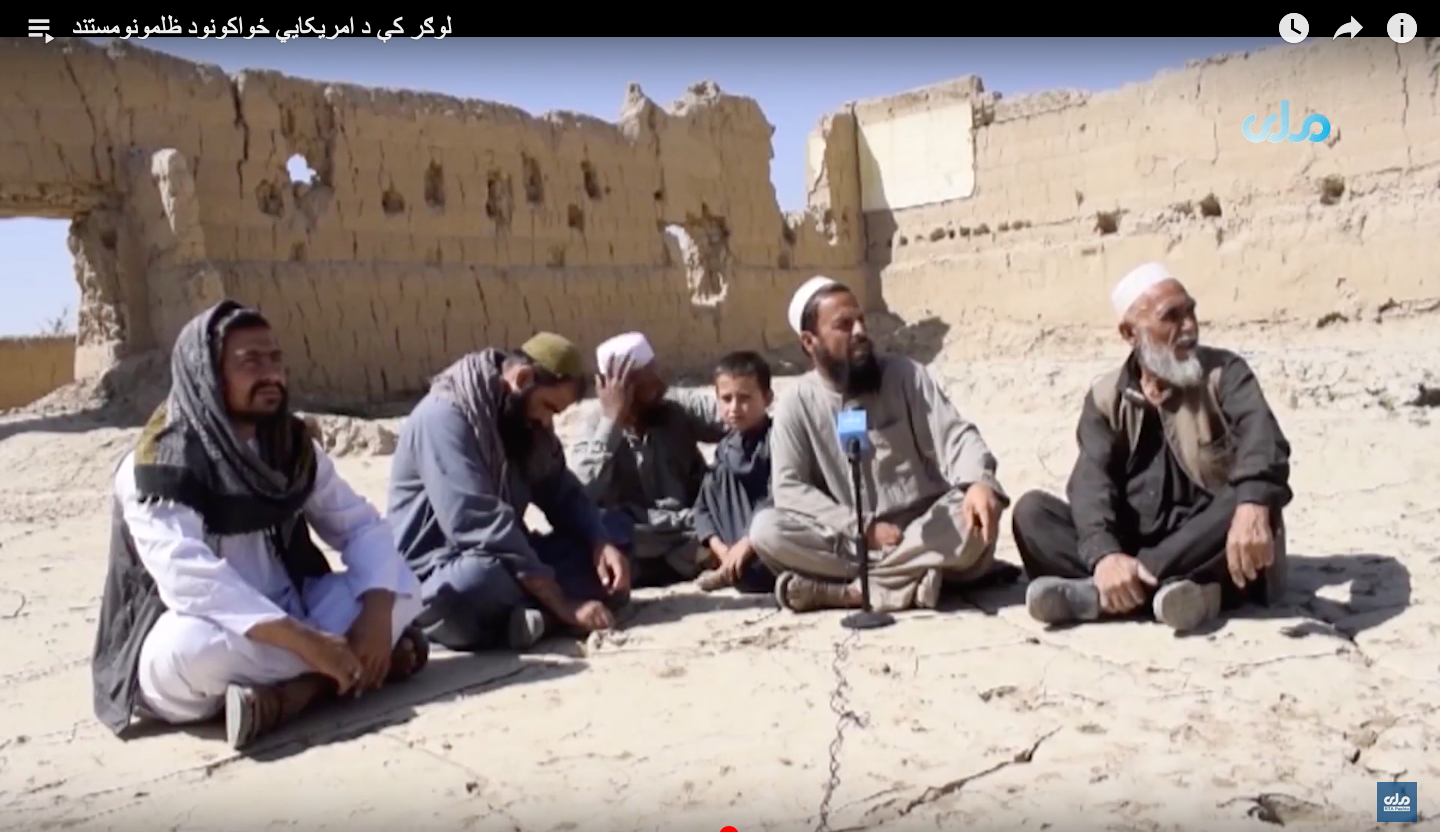
The villagers in Logar province speak to the state-run Radio Television Afghanistan about the US airstrikes in their area. A freeze frame from the “Documentary on American Atrocities in Logar Province”.The first part of this series is available here: “Taliban Narratives (1) Books: “Who we are and why we fought”
Introduction
The author has watched more than a dozen documentaries, interviews and other programmes aired on TV channels and radio stations. They include: a series of documentaries detailing civilian casualties caused by United States and other foreign forces in more than 15 provinces; documentaries on major battles such as in Shahikot, Paktia province (2002) and Marjah (2010) and Shorab (2012), both in Helmand; a series profiling senior Taliban officials, including the now late Minister of Refugees and Repatriation, Khalil Rahman Haqqani,the (also late) commander and former Chief of Military Operations for the southeast, Mullah Sangin Fateh and former commander in Logar and current Ministry of Defence official, Ashraf Malang; and a TV series featuring Taliban members recalling their experiences in prison. Among the material surveyed were also a few ‘shorts’, clips taken from Islamic Republic-era media and repackaged on social media with the aim of discrediting the old regime, as well as radio documentaries and audiobooks.
A brief summary of the different themes of the audio-visual material
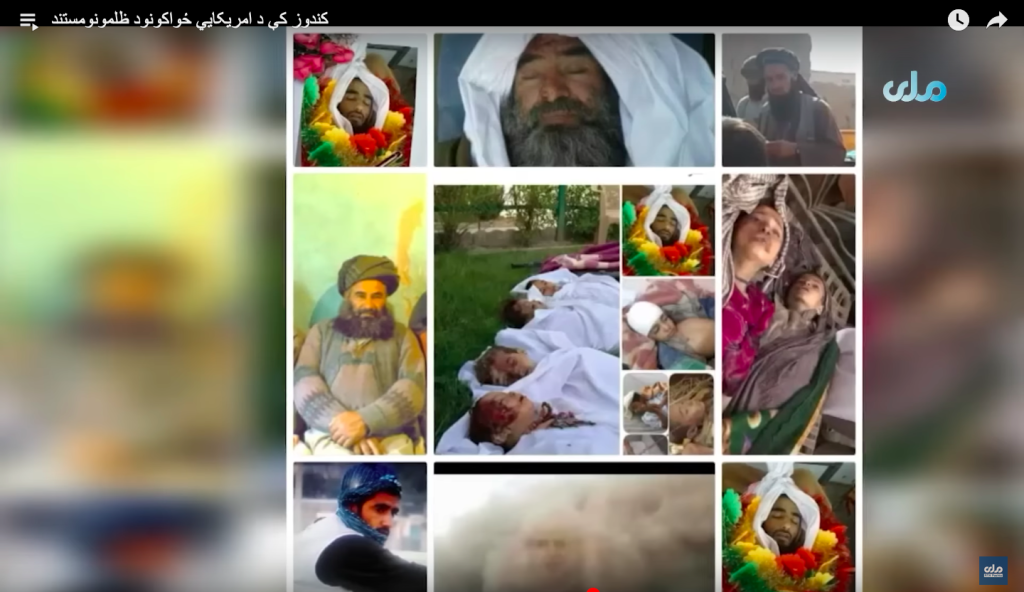
The first category of documentaries are compelling reports on the civilian casualties caused by the forces of the US and other foreign countries and the Islamic Republic in Afghanistan’s rural areas and have mainly been produced by state-run Radio Television Afghanistan (RTA). Those behind the series are well-trained and equipped journalists (many employees of RTA under the Republic who have stayed on in their jobs), who, accompanied by local Taliban officials, travel to provinces and districts and hear from locals about their experiences.[1] These documentaries also tell the visual story of the destruction, integrating footage from the time, where available. Some was filmed by the foreign forces themselves and show their operations – breaking down doors, body-searching civilians, including women, and interacting with locals. The film-makers mostly hear from people who are introduced as non-affiliated civilians and who recount their memories of night raids, bombardments and the killing and imprisonment of civilians. Interviewees often show old wounds and injuries, as well as photos of family members killed. Interestingly, women, mainly aged ones, are also interviewed and shown on camera, often without covering their faces, a choice unexpected from this ultra-conservative movement.
A freeze frame from the documentary ‘Atrocities of Americans in Kunduz Province’.
Major battles the Taliban have fought against US and NATO forces is a second theme often reflected in the documentaries. They show battles mainly from the Taliban perspective but also, to some extent, that of their adversaries, covering operational planning, the heroism of Taliban fighters, how they fought at close quarters and the damage they inflicted upon the foreign forces. They include ‘The Epic of Shahikot’, which recounts the battle, named Operation Anaconda, by the US, in which took place in March 2002 in Zurmat district of Paktia. It could either be seen as the last stand of the Taliban and al-Qaeda after the 2001 collapse of the first Islamic Emirate, or as the Taliban portray it, their first battle in the ’jihad’ against the foreign occupiers. In this, the Taliban managed to take down a US helicopter, kill eight US troops and wound 40 others. An unknown number of Afghans and foreign fighters were also killed and injured (see this CNN report from March 2002). This documentary, which tells the story of the operation from both the Taliban and US point of views, details the number of US soldiers involved in the operation, the aircraft, artillery, tanks and other weapons used as well as the Taliban’s strategy, number and planning from the perspective of those who participated. For example, Mullah Abdul Qayum, a close affiliate of Saif Rahman Mansur, who led the Taliban in the battle, recalls:
When America invaded Afghanistan and the Islamic Emirate retreated, the only district still controlled by the Taliban was Zurmat, led by Saif Rahman Mansur. He went to the Supreme Leader, Mullah Omar, and contacted him through a [two-way] radio and Mullah Omar told him to start the jihad and begin guerrilla operations. Many refugees from different provinces had come to Zurmat district. Saif Rahman Mansur gave me the responsibility to transfer them to a safe place. We [then] brought weapons from Gardez, such as RPGs and DShKs. The enemy planes flew around and patrolled [the Shahikot area] and they got confident that no one was there. And when they came and gathered, thinking no one was there, the commander ordered us to attack them. We launched a sudden attack from all sides and they were killed in large numbers. They panicked because they’d thought the area was empty. The reason they were killed in such large numbers was because the attack came suddenly and from every direction.
Another documentary, ‘The Epic of Shorab’, broadcast by RTA in August 2023, tells the story of a Taliban raid on Camp Bastion, the largest British military base in Afghanistan, in Helmand’s Shorab district carried out in September 2012. In the attack, they killed two US marines and destroyed multiple military helicopters, causing 200 millions dollars’ worth of damage (for more details see detailed contemporary report by The Mighty website). Other documentaries detail multiple battles in a particular location, such as Helmand’s Marjah district, where, after President Barak Obama’s 2010 ‘troop surge’, 30,000 US troops were sent to this one district.
A freeze frame from ‘The Epic of Shorab’, which tells the story of a Taliban raid on Camp Bastion carried out in September 2012.
A third categoryprofiles Taliban leaders and commanders, detailing their personal lives, military achievements and roles in the broader armed struggle. Notable figures include Khalil Rahman Haqqani, the late acting Minister of Refugees and Repatriations, who was killed in a December 2024 Islamic State in Khorasan Province (ISKP) attack in Kabul. ‘The Man Who Came Out Alive from the Flames’ produced by the Haqqani-owned Jalal Foundation in December 2023, highlights Khalil Rahman Haqqani’s role in the war against the Soviets in the 1980s and later against the US, as well as his efforts to mediate between warring mujahedin factions, alongside his brother, Jalaludin Haqqani, in the 1990s. The documentary portrays him as a dedicated servant of the people, with his ministry’s doors always open to visitors – a gesture that ultimately cost him his life, when he was killed by a suicide bomber inside the Ministry’s mosque. Other figures profiled include Ashraf Malang, former Taliban commander in Logar and currently an official at the Ministry of Defence, known for capturing two American soldiers alive, and Mullah Sangin Fateh, who was in charge of military operations in the southeast and oversaw the 2009 abduction of US soldier Bowe Bergdahl.
A freeze frame from the documentary ‘The Man Who Came Out Alive from the Flames’ about Khalil Rahman Haqqani’s role in the war against the Soviets in the 1980s and later against the US.
A fourth category feature interviews with Taliban fighters, broadcast on radio and TV, and audiobooks by Taliban authors. Both RTA and another state-affiliated media platform, Hurryat, have aired programmes where Taliban members share their memories of the war. RTA’s programme, ‘The Twenty-Year Journey: Stories of the Sacred Struggle of Afghans’, features Talibs who recount their personal experiences and reflections on the conflict. Hurryat’s programme, ‘The Battle of Light’, which has been broadcast over its radio and social media platforms, focuses on the stories of Taliban fighters and the key battles in which they were involved: it largely centres on the Taliban’s war against ISKP, rather than the struggle against the Republic and the US. Fighters who were imprisoned by US forces over the last two decades are also given a voice in these programmes. Many speak emotionally about the torture and hardships they endured. They recall both psychological and physical forms of abuse, including beatings, sleep deprivation, electric shocks, insults to religious values and other forms of mistreatment. Other programmes focus on a specific book, which is narrated in audio format for half an hour, six days a week, often in a way that evokes strong emotional responses. Another, recent strategy employed by Taliban-affiliated social media platforms involves undermining and discrediting the Republic and US forces by clipping and re-broadcasting investigations by Western and Afghan media into corruption, crimes and political instability that were made during the Republic.
A freeze frame from the RTA’s programme ‘The Twenty-Year Journey: Stories of the Sacred Struggle of Afghans’.
How documentaries attempt to promote the Emirate
The Taliban’s efforts in documentary-making are deeply rooted in their desire to promote their own narrative both within Afghanistan and beyond (some documentaries have English subtitles for a wider audience in the Muslim world and around the globe), aiming to counter the two decades of foreign, predominantly Western perspectives on their movement and the war. The narratives found in Taliban documentaries are closely aligned with those of their written works, which featured in part 1 of this mini-series on Taliban narratives. Both books and documentaries dwell on the harms done to the Taliban, or by the foreigners to Afghan civilians, side-stepping the harm the Taliban also inflicted. Civilians were killed and injured by all parties to the conflict, including the Taliban: those victims do not appear in these documentaries.[2] There are also gaps in the historical narrative: Dasht-e Laili, the desert in Jawzjan province, for example (see below), was the site of mass graves from three large-scale massacres, two of Taliban (1997 and 2001) and one by Taliban (1998).[3]
Discrediting the US narrative 1: A struggle against the infidels
Central to the strategy is the framing of their struggle as not just a fight for Afghanistan’s liberation, but as a central battle in the larger war between Muslims and infidels, who, according to the Taliban, sought to dismantle a system built on Islamic principles. For example, the head of the Logar Institute of Higher Education is featured in a half-hour programme, ‘The Oppression of American Soldiers in Logar Province’, which aired on RTA in November 2022:
In 2001, when the United States and the NATO coalition decided to attack Afghanistan and US President George W Bush explicitly declared that “Our war is a Crusade” – a war against Islam. From their statements, it was clear that it was Bush, the United States and NATO that started the war against Islam and to confront Muslims. Secondly, they were scared of our dear country, which is the heart of Asia and where, at that time, the Islamic Emirate was in power and there was an Islamic system. Therefore, they feared that if this system were to strengthen, it would become a problem for the infidels and the Western world. For this reason, they began the war against Islam and Muslims.
The Taliban are cautious about specifically referring to the Islamic Republic as a party to the conflict in their documentaries. Their narrative frames the core issue in Afghanistan not as a battle between Afghans, but as a struggle against foreign forces. The Taliban believe the real fight was against foreign invaders who were hostile to the establishment of an Islamic system. The Republic, in their view, was a puppet regime – an unfortunate result of the US presence in the country.
These documentaries often call US military and intelligence capabilities into question. Accounts of key battles like Shahikot in 2002 and Shorab in 2012, highlight how Taliban fighters were successful not only in carrying out significant attacks against the US, but also in successfully defending themselves and resisting US operations directed at them. They showcase how the foreigners’ advanced security measures were disrupted and dismantled, suggesting that military power is no match for faith when the cause is just. The narrators interpret their victories as stemming from divine help that was given because their war was righteous. When describing the battles in Marjah in Helmand, at the height of the US presence in 2010, the narrator in the documentary, ‘The Battle for Marjah, which is produced in October 2024 by UrojPublishing Agency, uses the Pashto equivalent of the present narrative tense to heighten the immediacy of his tale, which pits mighty America against those relying on God:
2010 is one of the bloodiest years for American soldiers, a year that brought bitter memories to thousands of foreign soldiers in Afghanistan. This year, America sends thousands of fresh troops into the Marjah district of Helmand. Barak Obama’s personally leading the war operation and intends to defeat the mujahedin in this district. But he’s unaware that his soldiers are stuck in the bog and death is waiting for them at every step.
Another documentary, ‘Sangin: The British Hell’, also produced by Uroj in December 2024, focuses on the experience of war in Sangin for the Taliban and the British forces, who were responsible for security in this district between 2006 and 2010. The narrator argues that “not only fire from projectile, rockets and homemade bombs, but also the very stones of Sangin district, like the fountains of hellfire, took their toll from the invaders.” It is as if the very land was part of the struggle against the infidels. A Taliban member, speaking with barely a pause for breath, recalls:
Helmand province, especially Sangin district, even the world says was hell for [the British]. Once, an unbeliever asked me why they call this place hell. I answered that you don’t know hell [where] there is no rest, no sleep, no comfort. In Sangin district, we fought against them everywhere from above and below. We used to fight against them with mines and fidayin [fighters willing to sacrifice themselves; in this context, suicide bombers] and in different ways. Even the women were by our side and hid our weapons so that we could pass.
A freeze frame from the ‘Sangin: The British Hell’.
Discrediting the US narrative 2: They brought neither human rights, nor women’s rights, nor development
Another theme shaping the narratives in these documentaries are challenges and attempts to discredit rationales made by the US to try to legitimise its invasion, including America’s claim to have upheld human rights. The documentaries expose the deaths and injuries caused to civilians by the US and its allies, through night raids and drone strikes. Footage of airstrikes, captured at the time, is combined with eye-witness accounts, who describe the unfolding horror of an attack. For example, in the RTA documentary, ‘The Oppression of American Soldiers in Kunduz Province,’ broadcast in November 2022, one interviewee recalls an attack on his village:
It was evening when I heard the firing. I’d been in Iran and didn’t actually know what a raid was like. My brother, who was later martyred, went outside, but fearing the bullets, he came back in. My father got angry with him and told him to come inside quickly. Later, my mother felt pain and fainted. I carried her inside the room. After some time, we were lying down, trying to sleep at home [while the firing continued in the village]. That whole night, there were explosions, both artillery fire and airstrikes.
The narrator, as he continues speaking about the raid, becomes emotional and tearful. He explains even minor details in a soft voice.
An hour passed, and at 12:30 am, the planes dropped a bomb on our house. My father was martyred. My son, who was lying next to me, was hit in the hand with shrapnel. He screamed that his hand had been blown off. When I picked him up, his hand dangled behind him. I told him to run, as another bomb was coming. My mother sat up and asked what was happening. At that moment, another bomb hit the house. We all ran to the walls [seeking some protection], but the walls collapsed. When I got up and picked up my son, I saw my mother, my daughter and my wife buried under the rubble. My son was asking for water and told me he was thirsty. His hand had been [almost completely] severed [from his wrist] and was hanging [by a small piece of tissue]. My mother called out for me to get her out, as she couldn’t breathe and was going to die. When I reached her and pulled her out of the rubble, the planes dropped another bomb and a piece of shrapnel hit me in the back. I fell into the mud. My mother screamed again for me to get her out, saying she was going to die. When I rescued her, my six-month-old daughter also started crying under the rubble. My mother told me to go and get the little girl.
As he was pulling his daughter out, he said, another bomb dropped and a piece of shrapnel hit his face. When he looked into other rooms, his father, brother and nephews were lying in blood and some of them had lost hands or feet and his three-month-old nephew had been struck in the head with shrapnel, which had shattered his head.
To back up the claims, the camera focuses on the interviewee’s son whose hand had had to be amputated and we hear directly from the child:
My hand was severed in the raid. The planes came and bombed in the evening. We were trapped under the rubble and I was hit by shrapnel. Later, they took me to the doctor and my hand was amputated. Now, at night, my hand still comes to me in my dreams and I get scared.
These documentaries explicitly push for a rejection of the claim that the US brought development and prosperity to Afghanistan – which the Taliban perceive as a key US justification for its presence. For example, the narrator on the RTA documentary on Logar says:
In the last two decades, the presence of US air and ground forces brought nothing to Afghans except suffering and poverty. By invading Afghanistan, the United States took away even the most basic opportunities for survival from the people of this land. Instead of reconstruction and development, their night-time operations turned thousands of homes into ruins and it must be said that, in addition to homes, they also bombed hundreds of religious schools, mosques and madrasas. People from all walks of life in this province fell victim to them.
The Taliban also directly refute US claims to have brought human rights and women’s rights to Afghanistan. One approach they have taken is featuring Afghan women, using their voices to challenge the idea that foreign intervention brought them prosperity or rights. Women who have lost their sons and daughters speak on camera, recounting the hard times they endured and the emotional toll of their losses. For example, RTA’s documentary, ‘The Oppression of American Soldiers in Zabul Province’ from October 2022 features an old woman who speaks about an attack on her home:
The Americans raided us one evening, at twelve o’clock midnight. [The raid continued] all that night, the next day and the following night. Now, though we’re poor, we thank God that He saved us from those hardships and hard days. At that time, we’d moved away from here to the neighbouring village and then had come back to our village. After spending two nights here, the raid came upon us. It was very hard and difficult for us. Our lives were in such a state that the Americans would come and enter our homes. Now, thank God, even though we’re poor, we sleep peacefully at night.
A freeze frame from the RTA’s documentary ‘The Oppression of American Soldiers in Zabul Province’.
One element of confronting US claims to be champions of human rights are TV interviews with those who were captured and held prisoner. Former detainees recount disturbing experiences of torture, mistreatment and blatant disregard for their religious values.
Discrediting the Republic
While the Emirate’s film-makers often attempt to avoid referencing the Republic, they have recently sought to discredit the entire two-decade period by highlighting the political instability and mismanagement that characterised those years. To achieve this, they have adopted a new tactic: they use materials and reports produced by independent media during the Republic to delegitimise it. The Emirate has been posting on a newly established account on the social platform X, apparently unrelated to the state and with no explicit affiliation, repackaging old reports on issues such as corruption, civilian casualties, crimes and the worsening situation of women as evidence that the Republic and US forces were responsible for and complicit in the corruption and chaos. They have also gathered footage of abuses and disorder from social media. For example, one post on X, with the video of a victim linked, reads:
Do you remember the times when the arbitrary actions of officials and their men dominated every street and alley? It was a situation where ordinary people were faced not with safety, but with terror. The horrifying incident on Wazir Akbar Khan Street is a clear example: a father and son, who were taking a sick relative to the hospital, were beaten to death without any reason or crime by these arbitrary officials. The situation was so brutal that even the police could not intervene and the perpetrators walked away from the scene without any trouble. According to ordinary citizens, the previous government committed such atrocities against Afghans that even Israel, in its entire history, has not inflicted upon the Palestinians.
In another post on X, Niqab Media references a 2014 TOLO News report (linked to the post) on the number of generals in the Ministry of Interior during Hamed Karzai’s presidency who were promoted based on political interests and who lacked even basic literacy (although it is worth bearing in mind that the Emirate also appoints mullahs with only religious knowledge to even purely technical and professional state positions). The post reads:
During the previous administration, 180 generals were appointed within the Ministry of Interior, most of whom were illiterate and were tied to specific provinces. A report published in 2014 stated that Afghanistan had turned into a factory for producing generals, many of whom neither deserved the rank nor were qualified to hold it.
Promoting the Taliban as exemplars for Afghan men
The documentaries dedicated to the biographies of senior Taliban officials, commanders and fighters mostly feature those with stories of heroism and sacrifice to tell. Here, the personal says something broader about the Taliban movement’s history and identity. The protagonists are mainly portrayed as righteous people who took up arms for a just cause. For example, Mullah Mahbub, a Taliban commander from Herat province, in the documentary about his life, A Lifetime in War, broadcast in January 2024, says he joined the movement in the 1990s, seeing it as a jihad “to eliminate corruption,” bring peace and eliminate chaos.
A freeze frame from the documentary ‘A Lifetime in War’.
Men like Mullah Sangin Fateh, who led the movement’s military operations in the southeast and was a powerful commander with influence stretching beyond the Durand Line to Khyber Pakhtunkhwa on the Pakistani side, are portrayed as heroes whose tactics, sacrifices and command proved crucial to the Taliban’s victory over their enemies. Sangin’s role in abducting US soldier Bowe Bergdahl is given particular emphasis. A September 2024 documentary about his life named after him, ‘Mullah Sangin Fatih’, portrays his kidnap of Bergdahl and success in keeping him for years, despite massive US attempts to locate and rescue him, as an act of heroism. Bergdahl was eventually freed in exchange for five Taliban held in Guantanamo in 2014 (see Guardian reporting from 2009 here). Similarly, a biographical film on Ashraf Malang, ‘Open the Hand’ produced by Jalal Foundation and aired by Shamshad TV in May 2024, highlighted his abduction of one US soldier and killing of another in Logar province (see the Al Jazeera reporting from 2010 here). Malang is portrayed as an extraordinary military leader who was able to avoid being targeted by US raids and operations, despite almost a dozen attacks on him.
These profiles appear intended to serve as models for Afghan men. By showcasing the bravery and leadership of these fighters and commanders, the Emirate aims to present them not merely as figures who will have historical significance, but as ideals to be looked up to and followed should a similar crisis ever arise in the future. They aim also to inform the Afghan public about the cost of establishing the Islamic Emirate. The life stories are presented as evidence that the Emirate is not the result of a mere political struggle or a deal, but rather of massive sacrifice and suffering by their fighters and the entire Afghan nation. They seek to reinforce the idea that the movement is built on the blood of the martyrs and it is said explicitly, that fighters should remember this: it cautions them against straying from the cause, misusing resources, or betraying the sacrifices made by those who have given their lives for the cause.
Strategy, reach and impact
The Emirate appears to be allocating more attention and resources to the production of documentaries than in the past and, comparatively, more attention to documentaries as a means of shaping its narrative than to writing and publishing books. The documentaries are produced professionally and are of high quality. Improved graphics are applied, along with maps. Typically, a narrator speaks off-camera, reading the script and explaining the themes professionally. The teams behind them are well-trained and equipped, often made up of former employees from the Ministry of Information and Culture, RTA and other Taliban-funded media outlets such as Hurryat Radio – which maintain an active online presence – and the Jalal Foundation and Uroj Publishing Agency.
In all these documentaries, interviewers’ questions are edited out and only interviewees’ answers are used. Efforts are made to support claims with as much evidence as possible. Footage, whether captured by the Taliban, US and NATO forces, or independent media, highlights notable events and incidents of destruction. Ongoing signs of devastation are pointed out and even children interviewed to support claims. Eye-witnesses or survivors recount, for example, when they were injured while archive footage shows the event they describe.
What is particularly interesting is that the Emirate chooses not to air some of these documentaries on state platforms. Instead, they may broadcast them through independent media outlets, hoping to reach a broader audience and avoid the label of state propaganda. For example, the documentary on Ashraf Malang was aired on Shamshad TV, the largest Pashto-language network in Afghanistan, which has been active for over a decade. Similarly, a 2023 documentary, ‘The Hidden Side of the War in Helmand’, detailing the civilian harm the war in Helmand province over the past twenty years was produced and aired by Ariana News, a major Afghan media network owned by the Bayat Foundation.
Emirate-affiliated film-makers have proved creative in reaching a broader audience and distancing their narratives from the movement, presenting them as independent. To achieve this, they are actively promoting their documentaries on social media, paying platforms to extend their reach. They have also been targeting independent TV channels and YouTube channels with large followings to air their content. The Taliban have even begun publicly advertising their documentaries before release. For example, in early November 2024, RTA erected over a dozen massive billboards in Kabul city promoting an upcoming documentary, ‘Dasht-e Laili’. It is named after a desert in Jawzjan province where thousands of Taliban fighters were killed by US-allied Northern Alliance forces in late 2001.
Such efforts have had some success, although measuring it precisely is difficult. However, one can gauge their reach through view counts on platforms like YouTube. For example, ‘The Epic of Shahikot’ garnered 288,000 views, although other documentaries tend to receive fewer views. The Ashraf Malang documentary, for instance, only reached roughly 23,000 views on Shamshad TV’s YouTube channel.
In addition, the Emirate has created channels that are officially non-affiliated to portray them as independent. By selecting independent media outlets to broadcast some of their content, they further distance the documentaries from being seen as state-produced. These efforts are aimed at presenting the content in an independent light, possibly in an effort to make it more acceptable to audiences in Afghanistan, the Muslim world and beyond.
How do documentaries and books serve the state’s desire to build its narrative?
For the Emirate, publishing books is mainly about what could be called ‘structural narrative building’ – recording events and trying to ensure that its version of events is embedded as the accepted and official history of the last few decades for future generations. Documentaries and visual programmes may lack the depth and hoped-for permanency of written materials, but can have a far more immediate impact.
Unlike book-reading, which is rare and limited mainly to some Afghans in urban areas, television is popular and social media usage is widespread and increasing. Moreover, the Taliban had already engaged in successful social media campaigns during the insurgency and are well-versed in video. As the Emirate moves to further consolidate its rule, the visual is turning out to be an increasingly important medium for it to disseminate the version of history it hopes will last in the minds of fellow Afghans.
Edited by Kate Clark and Fabrizio Foschini
References
References
↑1
These documentaries are aired by the RTA and published on YouTube and other social media platforms, as well. Here is the link to the YouTube playlist of this series.
The fourth Antalya Conference on Afghanistan began in Turkey, focusing on civil society, democracy, women’s rights, and inclusive political dialogue.
The fourth round of the national dialogue on the role of civil society and democratic forces in Afghanistan’s future—known as the Antalya Process—began on Monday, May 26, in Turkey.
The two-day conference brings together Afghanistan civil society activists, women, and journalists to deliberate on key political, social, and strategic challenges facing the country.
According to the organizers’ statement, this round of discussions is aimed at fostering national dialogue and inclusive consensus as a step toward achieving a legitimate, stable, and people-centered political agreement for Afghanistan.
Participants will also address critical issues such as censorship, exile, misinformation, and safeguarding freedom of expression—particularly in the context of media repression and civil space shrinkage in Afghanistan.
The previous Antalya Conference, held on March 4, 2024, hosted more than 80 participants, including human rights defenders, diplomats, and journalists who collectively emphasized the need for coordinated efforts to secure Afghanistan’s democratic future.
This latest Antalya dialogue reflects growing international and diaspora-led efforts to reinvigorate civil discourse and democratic engagement in Afghanistan. It seeks to provide an inclusive platform for Afghan voices silenced or exiled since the political transition.
As international attention fluctuates, such forums offer a vital opportunity to maintain momentum for rights-based governance and to reaffirm civil society’s pivotal role in shaping Afghanistan’s path forward.
4th Antalya Conference on Afghanistan kicks off in Turkey
The United Nations says aid workers are still in a “race against time” to remove rubble and rebuild after the devastating earthquake struck eastern Afghanistan last month, killing at least 2,200 people and cutting off remote areas.
The 6.0-magnitude quake on Aug. 31 was shallow, destroying or causing extensive damage to low-rise buildings in the mountainous region. It hit late at night, and homes — mostly made of mud, wood, or rocks — collapsed instantly, becoming death traps.
Satellite data shows that about 40,500 truckloads of debris still needs to be cleared from affected areas in several provinces, the United Nations Development Program said Wednesday. Entire communities have been upended and families are sleeping in the open, it added.
The quake’s epicenter was in remote and rugged Kunar province, challenging rescue and relief efforts by the Taliban government and humanitarian groups. Authorities deployed helicopters or airdropped army commandos to evacuate survivors. Aid workers walked for hours on foot to reach isolated communities.
“This is a race against time,” said Devanand Ramiah, from the UNDP’s Crisis Bureau. “Debris removal and reconstruction operations must start safely and swiftly.”
People’s main demands were the reconstruction of houses and water supplies, according to a spokesman for a Taliban government committee tasked with helping survivors, Zia ur Rahman Speenghar.
People were getting assistance in cash, food, tents, beds, and other necessities, Speenghar said Thursday. Three new roads were under construction in the Dewagal Valley, and roads would be built to areas where there previously were none.
“Various countries and organizations have offered assistance in the construction of houses but that takes time. After the second round of assistance, work will begin on the third round, which is considering what kind of houses can be built here,” the spokesman said.
Afghanistan is facing a “perfect storm” of crises, including natural disasters like the recent earthquake, said Roza Otunbayeva, who leads the U.N. mission to the country.
 Afghanistan Peace Campaign


 The villagers in Logar province speak to the state-run Radio Television Afghanistan about the US airstrikes in their area. A freeze frame from the “Documentary on American Atrocities in Logar Province”.The first part of this series is available here: “