Russia and Tajikistan Discuss Afghanistan’s Future in Key Bilateral Talks

It is worth noting that Russia is the first country to have officially recognized the Islamic Emirate of Afghanistan.

The presidents of Russia and Tajikistan held talks on Afghanistan during their recent meeting.

According to a report by RIA Novosti, Russian President Vladimir Putin emphasized the need for an independent and terrorism-free Afghanistan during his discussions with Tajik President Emomali Rahmon.

Enayatullah Hamam, a political analyst, commented: “Afghanistan is considered a key part of the security architecture of Central Asia and the Indian subcontinent. Therefore, all regional concerns are focused on this country.”

While the Islamic Emirate of Afghanistan has not yet commented on the matter, it has consistently stated that Afghanistan seeks peace and stability and that no threats will arise from its territory toward neighboring countries.

Khushhal Hasan Ahmadzai, another political analyst, said: “The Russians also take a strategic and long-term view of Afghanistan, particularly because Russia was the first country to officially recognize the Islamic Emirate.”

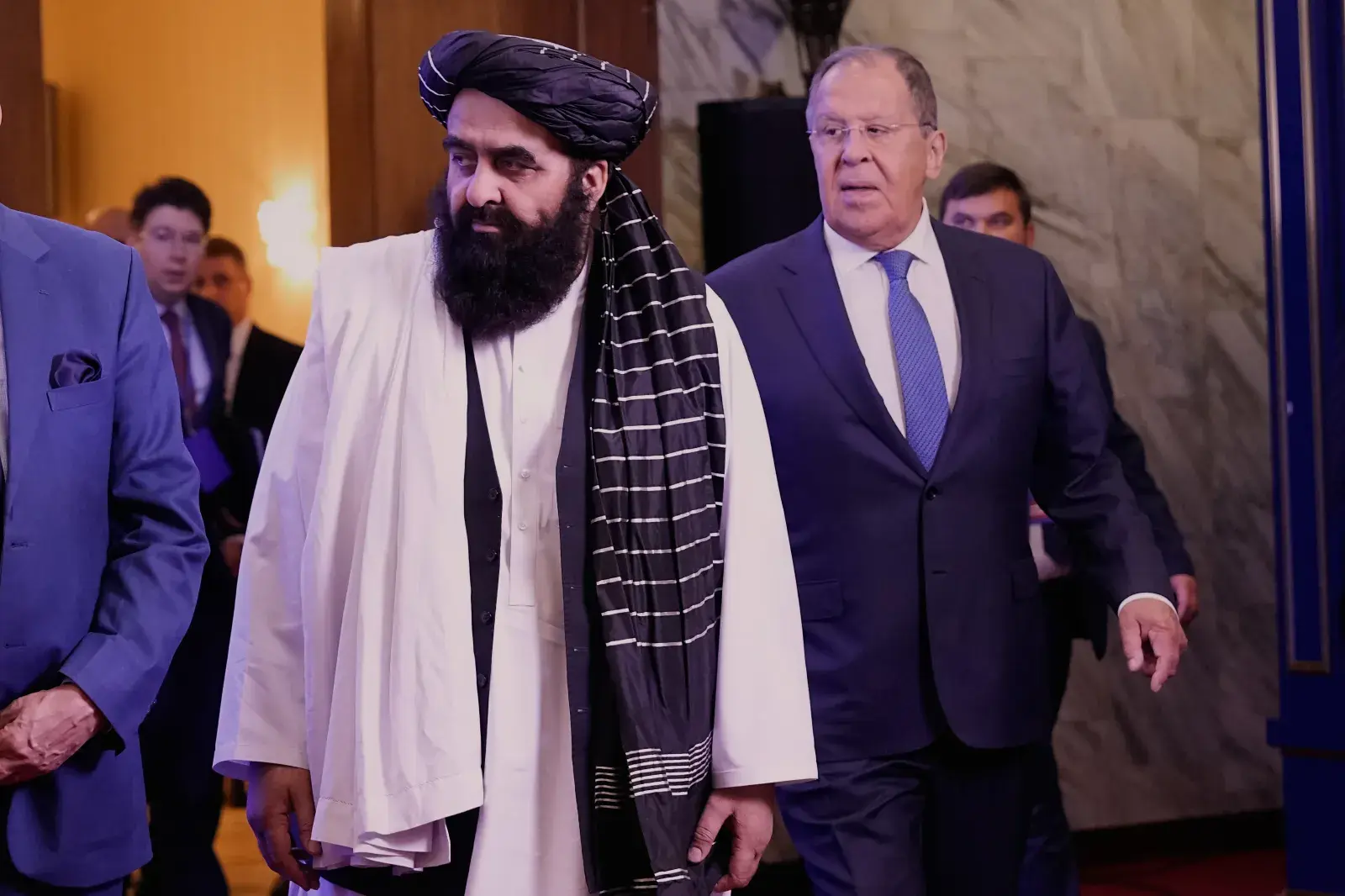
These discussions come as Russia recently hosted the seventh meeting of the Moscow Format, which included representatives from several countries — among them, the Islamic Emirate of Afghanistan.

It is worth noting that Russia is the first country to have officially recognized the Islamic Emirate of Afghanistan.

Russia and Tajikistan Discuss Afghanistan’s Future in Key Bilateral Talks
read more

Russia Issues Afghanistan Warning After Trump Says US Wants Bagram Air Base

By

Breaking News Editor

Newsweek

October 7, 2025

Russia warned Tuesday that it would consider any new foreign military presence in Afghanistan or nearby countries “categorically unacceptable,” delivering the message during a high-level meeting in Moscow that included Afghanistan’s Taliban government.

Why It Matters

The statement came weeks after President Donald Trump said the United States was exploring options to retake Bagram Air Base, the massive military complex abandoned during the chaotic 2021 withdrawal of U.S. and NATO forces.

What To Know

At the opening of the international conference, Russian Foreign Minister Sergey Lavrov praised the Taliban for its efforts to fight Islamic State militants and curb narcotics trafficking but made clear Moscow’s red line against renewed U.S. military involvement in the region.

“The deployment of military infrastructure of any third countries on the territory of Afghanistan, as well as on the territories of neighboring states, is categorically unacceptable under any pretext,” Lavrov said. He warned that any “extra-regional military presence” would only bring new instability, adding that Afghanistan’s history “should have taught everyone the right lessons long ago.”

Newsweek has reached out to the State Department via email on Tuesday afternoon for comment.

Afghanistan’s Foreign Minister Amir Khan Muttaqi, left, and Russian Foreign Minister Sergey Lavrov arrive to pose for a photo prior to their talks 

Russia’s position reflects deep sensitivities shaped by its own history in Afghanistan. The former Soviet Union fought a decade-long war there before withdrawing its troops in 1989, a conflict that left tens of thousands dead and contributed to the USSR’s eventual collapse. Since the Taliban’s return to power in August 2021, Moscow has sought to strengthen ties with Kabul while asserting itself as a key power broker in Central Asia.

In July, Russia became the first country to formally recognize the Taliban government, removing it from its list of banned organizations. At Tuesday’s talks, Lavrov said Moscow wanted to expand business and energy cooperation with Afghanistan and deepen joint efforts against terrorism and drug trafficking. He also condemned Western sanctions and the ongoing freeze of Afghanistan’s foreign assets, calling those measures “hostile and counterproductive.”

Representatives from China, India, Iran, Kazakhstan, Kyrgyzstan, Pakistan, Tajikistan, and Uzbekistan also attended the Moscow gathering, which focused on regional security and economic development. The talks come as the Taliban, still largely isolated on the world stage, continues to seek legitimacy despite widespread condemnation of its treatment of women and girls.

Since seizing power, the Taliban has reimposed many of the restrictions that defined its earlier rule from 1996 to 2001. Women are barred from most jobs and public spaces, including schools, gyms and parks, while girls are prohibited from education beyond the sixth grade. Those policies remain a major obstacle to broader recognition — even as Afghanistan again becomes a stage for global competition over influence and access.

What People Are Saying

Afghan Foreign Minister Amir Khan Muttaqi, who led the Taliban delegation, praised Moscow’s diplomatic outreach: “We appreciate the bold move of the Russian Federation to officially recognize the Islamic Emirate of Afghanistan,” he said. “We wish that all countries follow the same path.” Muttaqi added that his government has created “a good opportunity for investment, economy, transit and connectivity” after decades of conflict and instability.

U.S. President Donald Trump said: “If Afghanistan doesn’t give Bagram Airbase back to those that built it, the United States of America, BAD THINGS ARE GOING TO HAPPEN!!!”

What Happens Next

The dispute over Bagram is expected to remain unresolved, with the Taliban holding firm and the U.S. weighing its options. The standoff is likely to influence U.S.-Afghan relations and broader regional dynamics, particularly regarding strategic interests in South and Central Asia.

This article includes reporting by the Associated Press.


Russia Issues Afghanistan Warning After Trump Says US Wants Bagram Air Base
read more

The Daily Hustle: Muhammad’s last journey – a story of survival, debt and loss

The Islamic Emirate’s ban on poppy cultivation has reshaped life in many areas across Afghanistan, especially in Helmand province, where poppy was fundamental to the economy and to many farmers’ livelihoods. This is the story of one such farmer, Muhammad, who, having lost his main source of income following the poppy ban and finding that persistent drought was frustrating his attempts to grow other crops and pushing him into debt, took the desperate measure of trying to get to Iran for work. He left his wife and seven of his children and set out for Iran with one teenage son. But his journey ended in tragedy: Muhammad was shot dead by Iranian border police and his son was badly injured. In this instalment of The Daily Hustle, Nur Khan Himmat hears from a friend of Muhammad’s about his final journey and the family he left behind.
My friend, Muhammad, was 45 years old, a farmer from Marja district in Helmand province. He owned seven jeribs of land (about 1.4 hectares), and for years, poppy cultivation was his main source of income. He grew opium poppies on most of his land and wheat, just for his family, on a small patch of it. When the Emirate banned poppy cultivation, he took to growing wheat and cotton. But the prolonged drought has ruined one harvest after another. His debts grew and it became nearly impossible for him to put food on the table for his family.

Debt, drought and the struggle for survival in Helmand

About a month ago, Muhammad rented out his land to another farmer for five kharwar of wheat (around 2,200 kg). He sold part of the wheat to repay his debts and kept the rest for his family. Then he joined nine other men from his village and set out for Nimruz province, where a smuggler had promised to take them across the border into Iran. Muhammad had twin 17-year-old sons; he took one with him and left the other behind to look after the family. These days, the journey is riskier than it has ever been and there are no guarantees of finding work or even being able to stay in Iran, if you can get there. The government there is taking a hard stance against Afghans. They’ve been picking people up off the street, even going into their homes or places of work and deporting them. There are even reports of Iranian border guards shooting people as they try to cross into the country. But he felt like he didn’t have a choice but to take on the risk and go there to earn some money.

The journey to Nimruz

By the time they reached Zaranj, the capital of Nimruz, it was already dark. The men from Helmand had already arranged to meet the smuggler who’d take them across the next morning. So, they spent the night in a cheap hotel and, early the next morning, joined another group that was also heading to Iran. But just as they reached no-man’s land between the two countries, they were caught by the Emirate’s border patrols and forced to return to Zaranj. The police made them promise not to try to cross illegally again. This isn’t unusual; many people try multiple times over a week or more, before they can successfully cross into Iran. The smuggler told them it would be better to try the crossing at night, using the cover of darkness to avoid detection by the patrols. After discussing their options, they agreed to try again that evening.

Crossing into danger

It was around nine at night when the group set out again. As they climbed the border wall that had been built by the Iranian government, the Iranian border patrols spotted them and opened fire. We heard what happened from two of the men from Helmand who managed to escape and make their way home to their families – although they had no news of their companions. They said that in the chaos, some of the men escaped, others vanished – no one knew who made it across the border, who had been caught and who had been killed or injured.

Later, we found out that, for my friend Muhammad, the journey ended at the border. He was shot dead, along with another man from Zabul’s Khak-e Afghan district. Muhammad’s son and another man from Zabul were injured. The Iranian police handed the dead and wounded to the Afghan authorities, who took the living to the hospital and the dead to the morgue.

Bringing him home

Later at the hospital, the police asked Muhammad’s son for a phone number so they could contact the family. At first, when they called, the police didn’t tell us what had happened. They only asked us where Muhammad was. We told them that he’d gone to Iran. That was when the man on the phone gave us the devastating news: Muhammad had been shot dead by the Iranian police and his son lay wounded in hospital.

With a heavy heart, I went with some of Muhammad’s relatives to Zaranj to bring them both home. They kept his son in hospital for two more days before they let us take him back to the village to recover. We also brought Muhammad back to his family and buried him in the village. This is how my friend’s story ends. He took a dangerous gamble out of desperation and lost. But for his grieving wife and seven children, the journey is only just beginning. They now face a future marked by grief, poverty and uncertainty, without their beloved husband and father.

The family he left behind

Every migration story is a tale of survival and in places like Afghanistan, survival can be a deadly business. My friend’s story isn’t just about one man’s misfortune – it’s just one story among thousands about the desperate choices that many Afghan families have to make just to survive.

I tell his story because details matter – how he lost his livelihood, the land he leased to pay his debts, the one twin he left behind and the other that he took along, the hopes he had of finding a living and supporting his family and the death of a good man who only wanted his family to survive – they shine a light on the human cost of poverty and the impossible choices people have to make just to keep going.

Muhammad went to Iran looking for financial security and a future for his family, but he found death instead. His children now inherit not security, but hunger, poverty and grief in a world that offered their father no safe path forward.

Edited by Roxanna Shapour 

The Daily Hustle: Muhammad’s last journey – a story of survival, debt and loss
read more

UN to investigate suspected abuses in Afghanistan 

By

Reuters

  • Investigation’s scope includes the Taliban and foreign troops
  • Trump opposed to ‘unlawful jurisdiction’ over US forces
  • China voices doubts over the investigation
GENEVA, Oct 6 (Reuters) – The United Nations Human Rights Council is to investigate abuses in Afghanistan, which could eventually enable criminal investigations into suspected violations by both the Taliban and foreign troops, including those from the United States.
The United States, which had troops in Afghanistan until 2021 within a NATO coalition, has previously opposed scrutiny of its actions, for example, by the International Criminal Court, but backed research into suspected Taliban violations.
President Donald Trump has disengaged from the Geneva rights council and did not take a stance in the negotiations on the EU proposal for the investigation, diplomats said.
However, a State Department spokesperson said late on Sunday, before it was adopted on Monday without a vote: “Under the leadership of President Trump, the United States government will not tolerate international organizations that attempt to exert unlawful jurisdiction over American troops.”

NO TIME LIMIT ON PROBE

The European Union motion calls for investigators to prepare evidence for future court proceedings and is among the strongest form of U.N. rights probe, on a par with existing investigations into suspected crimes in Syria and Myanmar.
For years, both Afghan and international rights groups have sought such a probe. Calls have become louder as the Taliban tightened restrictions on women and freedom of expression.
The Taliban authorities say they respect rights in line with their interpretation of Islamic law.
While the EU proposal for an investigation did not specifically mention abuses by international troops, it is described as “comprehensive” and has no time limit, meaning it could address these, diplomats said. The exact scope will be determined when investigators are appointed.
Investigations launched by the 47-member council can lead to war crimes prosecutions. Some countries which sent troops to Afghanistan, such as Britain and Australia, have initiated inquiries but prosecutions have been rare.
Fereshta Abbasi, Afghanistan researcher at Human Rights Watch, called the launch a “significant step that could break a decades-long cycle of impunity”.
The new investigation would cooperate with an existing ICC probe. The ICC has previously indicated it would deprioritise suspected crimes by U.S. forces after Trump imposed sanctions in 2020 over its Afghanistan work.
China’s delegate Wang Nian criticised the proposal’s cost of $9.2 million over three years amid a U.N. funding crisis and said it was unbalanced.
UN to investigate suspected abuses in Afghanistan 
read more

World Bank Says Afghanistan’s Modest Economic Growth Overshadowed by Rising Poverty and Fragility

World Bank on glass building. 

The World Bank says Afghanistan’s economy shows modest growth, but rising poverty, weak governance, and declining aid continue to threaten long-term stability and recovery.

The World Bank has reported that Afghanistan’s economy shows modest signs of recovery, but deep poverty, displacement, and a fragile humanitarian situation continue to threaten the country’s stability. The findings are part of its latest Middle East, North Africa, Afghanistan, and Pakistan Economic Update, titled “Jobs and Women: Untapped Talent, Unrealized Growth.”

According to the report, Afghanistan’s gross domestic product (GDP) is projected to grow by about 4.3% in fiscal years 2025–2026, driven largely by household and public consumption. Yet, with the population expected to rise by 8.6%, per capita income is forecast to decline by nearly 4%, keeping millions of Afghans in extreme poverty.

The World Bank estimates that between 15.2 and 23.8 million Afghans — almost half the population — live on less than $3 a day, one of the highest poverty rates in the region. The Bank attributes this to overlapping crises, including forced returns of refugees, natural disasters, and weak governance. Since September 2023, more than 4 million Afghans have returned from Pakistan and Iran, with 2.1 million repatriated between January and July 2025, most involuntarily.

The report notes that the August 2025 earthquake in eastern Afghanistan, which killed more than 2,000 people, deepened economic distress. Damages were estimated at $183 million, roughly 1% of GDP, destroying homes, livestock, and vital rural infrastructure. The disaster underscored the country’s limited ability to respond to crises amid declining international aid.

On gender and employment, the World Bank says Afghanistan remains one of the world’s most restrictive environments for women. Social barriers, conflict, and policy restrictions have forced most women into low-paid, informal work. Although women’s participation in the labor force slightly increased between 2020 and 2023, nearly 60% remain inactive, and most new opportunities are in precarious home-based sectors.

Regionally, the World Bank forecasts modest economic growth of 2.8% in 2025 and 3.3% in 2026 for the broader Middle East, North Africa, Afghanistan, and Pakistan region. However, Afghanistan’s recovery remains uncertain due to sanctions, weak governance, and the absence of international recognition. The sharp reduction in aid, the Bank warns, has already led to the closure of hundreds of health centers, depriving millions of essential services.

Roberta Gatti, the World Bank’s Chief Economist for the region, said increasing women’s participation in the workforce could raise per capita GDP by 20–30% in countries like Egypt, Jordan, and Pakistan. Osman Dione, the Bank’s Vice President for the region, called for “bold and comprehensive reforms” to remove structural barriers and empower women economically.

The report concludes that Afghanistan’s outlook remains fragile despite limited growth. “Humanitarian needs are rising rapidly while domestic capacity to respond is severely constrained,” it said. “Without structural reforms and inclusive policies, millions of Afghans — especially women and returning refugees — will remain trapped in poverty.”

World Bank Says Afghanistan’s Modest Economic Growth Overshadowed by Rising Poverty and Fragility
read more

Consequences of the United States’ 20-Year Presence in Afghanistan

After 20 years, the threat of terrorism did not end; instead, the emergence of the ISIS-Khorasan group after 2010 created a new wave of violence in the country.

On October 7, 2001, the United States and its NATO allies entered Afghanistan with three main goals: fighting terrorism, combating narcotics, and nation-building. However, after two decades, these slogans faded amid ruins, widespread corruption, and the blood of countless civilians.

The first motive for the U.S. presence in Afghanistan was counterterrorism. Yet, during this campaign, NATO and U.S. forces carried out night bombings that killed thousands of civilians, including women and children, stories of these tragedies continue to this day.

After twenty years, the threat of terrorism did not end; instead, the emergence of the ISIS-Khorasan group after 2010 created a new wave of violence in the country.

Mohammad Amin Karim, a peace studies researcher, said: “The only real achievement of the U.S. presence was the education of a young, skilled generation. However, after the U.S. withdrawal, around 200,000 to 300,000 of these educated youths left the country, people who could have served Afghanistan today.”

The second official U.S. objective was to combat narcotics. This mission also failed. Despite spending millions of dollars, the production and trafficking of drugs not only continued but, in some years,

increased, turning Afghanistan into one of the world’s largest producers of opium.

Kamran Aman, a military affairs expert, noted: “Their main achievement was containing the influence of China, Russia, and Iran in the region, but all the economic, moral, and human losses fell upon the Afghan people.”

Nation-building and establishing a stable government was the third U.S. goal, but it became the most unsuccessful part of its mission. Widespread corruption, heavy dependency on foreign aid, and deep political divisions led to the collapse of the 20-year republic. As a result, America’s slogan of nation-building ended in complete failure.

Mohammad Omar Nahzat, a political analyst, said: “They only tried to impose populist ideas to deceive people, while their real agenda was geopolitical, aimed at limiting China’s and Russia’s regional influence.”

In total, during two decades of U.S. presence in Afghanistan, more than 150,000 people lost their lives, including foreign troops, Afghan soldiers, and civilians. Among them were over 3,500 foreign troops, 66,000 Afghan security forces, and more than 51,000 Afghan civilians and fighters.

It is worth noting that during these twenty years, the U.S. spent more than 2.2 trillion dollars in Afghanistan.

Consequences of the United States’ 20-Year Presence in Afghanistan
read more

Moscow Format Discusses Afghanistan’s Political and Economic Future

Representatives from Afghanistan, India, Iran, Kazakhstan, China, Kyrgyzstan, Pakistan, Russia, Tajikistan, and Uzbekistan attended the meeting.

The 7th consultative meeting of the Moscow Format on Afghanistan, focusing on national reconciliation and regional cooperation in political and economic fields, was hosted by Russia today (Tuesday).

Representatives from Afghanistan, India, Iran, Kazakhstan, China, Kyrgyzstan, Pakistan, Russia, Tajikistan, and Uzbekistan attended the meeting.

Russian Foreign Minister Sergey Lavrov, in his opening remarks, emphasized the importance of stability and security in the region and warned against the presence of non-regional military forces on Afghan soil, calling it a threat to regional peace and development.

He stated: “We emphasize that over the past four years, the Islamic Emirate’s government has become stronger and is now governing the country with greater confidence and stability. We must acknowledge that despite difficult conditions, Kabul’s leadership has managed to perform effectively to a great extent.”

Islamic Emirate’s Foreign Minister Amir Khan Muttaqi expressed appreciation for Russia’s move to recognize the Islamic Emirate, stressing that Afghanistan has now transformed from a security challenge into a partner for regional stability and an opportunity for economic growth.

Without naming any specific country, Muttaqi said some parties, instead of recognizing the peace and stability achieved in Afghanistan, are trying to portray the country as a regional threat.

“Our view is that this positive transformation should be better supported and managed so that past mistakes are not repeated. Our region must not once again fall victim to insecurity caused by miscalculations and flawed policies of the past,” he added.

On the sidelines of the meeting, the foreign ministers of Afghanistan and Russia met to discuss strengthening political ties, expanding economic cooperation, and addressing regional issues.

Muttaqi said: “After Russia’s recognition of Afghanistan, unprecedented opportunities for developing political, economic, and other relations have emerged, and we can now move forward with genuine cooperation in various areas.”

Lavrov stated: “We can see how your government is working to stabilize the situation in the Islamic Emirate of Afghanistan.”

A quadrilateral meeting between Russia, Iran, China, and Pakistan was also held on the sidelines, where the participants emphasized support for Afghanistan and joint cooperation in combating terrorism.

In a joint statement, the Moscow Format member states reaffirmed their support for Afghanistan as an independent, united, and peaceful state.

The parties also called for strengthening cooperation in the fight against terrorism at both bilateral and multilateral levels, stressing that Afghanistan should be supported in taking comprehensive measures to eliminate terrorism within a short period.

Moscow Format Discusses Afghanistan’s Political and Economic Future
read more

Opinion | Why The Taliban Foreign Minister Is Really Visiting India

Harsh Pant, Shivam Shekhawat

NDTV (India)

Oct 08, 2025
Opinion | Why The Taliban Foreign Minister Is Really Visiting India


The Acting Foreign Minister of the Islamic Emirate of Afghanistan, Amir Khan Muttaqi, will be traveling to New Delhi between October 9-16, after having received a waiver from the UNSC sanctions committee. His previous bid to secure the waiver back in September was not successful. During his visit, he is expected to meet the External Affairs Minister S. Jaishankar and will arrive in New Delhi after having participated in the Moscow Format Dialogue in Russia. The impending visit has raised – and might answer – important questions about how India’s relationship with the Taliban-led regime has evolved in the past four years. While there is an acknowledgement of the inevitability of engaging with the Taliban because of  strategic and security considerations, concerns about what form this engagement would take and whether India can secure its interests for real, persist.

India’s Reaction In 2021

When the Taliban usurped power in August 2021 and anointed themselves at the helm in Afghanistan, India’s response to the developments was simultaneously knee-jerk and gradual. As the fighting intensified, India did not take much time to shut down its consulates and close its embassy. It was also quick in revoking visas and arranging the evacuation of Indian citizens from the country. But there was still a degree of dilly-dallying on how it intended to engage with the regime. A few weeks after the group’s return, the Indian ambassador in Qatar met the head of the political office of the Taliban in Doha in order to seek assurances about protecting India’s security and interests in the country.

Subsequently, after a visit by the then Joint Secretary of the Pakistan, Afghanistan and Iran division in the Ministry of External Affairs to Kabul in June 2022, New Delhi operationalised a technical mission in the country to facilitate and monitor the delivery of aid.  This ad hoc, reluctant engagement has now metastasised into a tacit acceptance of the inevitability of grappling with the reality of the Taliban.

The Dubai Meeting

At the beginning of this year, the Indian Foreign Secretary met Muttaqi in Dubai – the first high-level engagement between the two sides. The meeting saw a discussion over a broad spectrum of issues between the two countries – from humanitarian and development assistance to the importance of the Chabahar port for the purposes of trade and delivery of aid. The Ministry of Foreign Affairs under the Taliban defined India as a key ‘economic and regional player’ in their statement. After the terrorist attack in Pahalgam in April, a delegation led by India’s Joint Secretary in the PAI division also met Muttaqi. This was followed by a telephonic conversation between the Indian External Affairs Minister and Muttaqi, where India expressed gratitude for the Taliban’s condemnation of the attacks in Pahalgam.

The January meeting between Misri and Muttaqi came in the backdrop of Pakistan’s air-strikes in Afghanistan the previous month and New Delhi’s condemnation of the same, while the April meeting and the consequent call happened in the context of the Pahalgam terror attack and India’s retaliatory strikes on Pakistan under Operation Sindoor. The Taliban had condemned the attack and spoken against how it had an adverse impact on regional peace and stability. The deterioration of ties between Pakistan and Afghanistan has consequently given India more space to engage with the Taliban.

What’s Driving India’s Strategy

While India’s relationship with Afghanistan has always been perceived as being based on the long-drawn historical and civilisational ties between the two countries, New Delhi has been cognisant of the security risks that it faces on its north-western frontier. In the immediate aftermath of the Taliban’s return, concerns about the group’s tacit support and assistance to terror groups like the Al Qaeda and the presence of groups like the Islamic State Khorasan Province (ISKP) and those particularly inimical to India’s interests like the Al Qaeda in Indian Subcontinent, the Lashkar-e-Taiba and the Jaish-e-Mohamed had raised New Delhi’s fears.

This, in addition to the growing regional engagement with the Taliban, also persuaded New Delhi to pursue its engagement. In July this year, Russia became the first country to grant de jure recognition to the Islamic Emirate, a first since the group’s return to power. While other countries like China, Iran and the Central Asian Republics haven’t granted de jure recognition, they have all stepped up their engagement – either through the exchange of ambassadors or by handing over the control of their embassies to Taliban appointees.

Breaking From Pak?

For the Taliban, engagement with India allows them to create a perception of legitimacy for their domestic constituents. Since their return to power, they have tried to pitch their approach towards foreign policy-related issues as one based on pragmatism – with its focus on a ‘balanced and economic foreign policy’. The deterioration in ties with Pakistan also allows them to hedge their bets and also show how it is no longer dependent on Islamabad for its survival – carving out an identity separate from their over-dependence on Pakistan. And while this does give India more space to maneuver, it has to be mindful of the China-Pakistan-Afghanistan trilateral as well.

Any position that India takes vis-a-vis Afghanistan is also significant from the perspective of the interests and concerns of the Afghan people. A significant fallout of New Delhi’s decision to shut down its presence in Afghanistan in the aftermath of the Taliban’s return and also its decision to engage with the group has been on the people of Afghanistan. In the last few years, there has been a consistent push for New Delhi to resume the provision of visas, increase its aid and also refocus its attention on development assistance. The Taliban have also been persuading India to resume its infrastructure projects and welcome investments between the two countries. After the recent earthquake on August 31, India was one of the first countries to offer aid; it also facilitated this through the Chabahar port, offering food items, water purifiers, tents and essential medicines, thus bolstering its support to the Afghan people.

What To Expect

The current meeting is expected to see discussions on the appointment of a Taliban-supported ambassador to the embassy in New Delhi, something that the group has been seeking for a while. The Republic-era appointees have already left the embassy, back in November 2023, while the consulate in Mumbai also has an appointee who reports back to the Ministry in Kabul. Thus, the Acting Foreign Minister could push for further institutionalisation of the status quo. Muttaqi could also reiterate their demands for the issuance of more visas, investments and the resumption of infrastructure projects. For India, the priority is the protection of its security interests and extracting security guarantees from the group.

New Delhi’s growing engagement with the Taliban comes at a time when the group’s political reality in Afghanistan has become much more apparent, with more and more countries establishing some form of communication framework with them. The concerns about the proliferation of terror groups and the manifestation of other security risks in the country necessitate this engagement. For India, an expectation about balancing its increasing political engagement with the Taliban regime with its support to the Afghan people will still remain. As more and more high-level engagements become common, there will be an equal expectation of this translating into India increasing its support to the people of Afghanistan and also making a case for the group to dial down their draconian restrictions on women and minorities. How much leverage does India have in pushing for this and the trust it can impose on the Taliban’s ability to support India’s interests is still circumspect.

(Harsh V Pant is Vice President, ORF. Shivam Shekhawat is a Junior Fellow with ORF’s Strategic Studies Programme)

Disclaimer: These are the personal opinions of the author

Opinion | Why The Taliban Foreign Minister Is Really Visiting India
read more

Regional powers signal objection to US reclaiming Afghanistan’s Bagram base

By Stephen Quillen and Reuters

Al Jazeera

In a joint statement on Tuesday, members of the Moscow Format of Consultations on Afghanistan – which includes rivals India and Pakistan – “reaffirmed their unwavering support for the establishment of Afghanistan as an independent, united and peaceful state”. The forum also includes Russia, China, Iran and Central Asian nations, all of whom strongly oppose any US return presence in Afghanistan.

The members “called unacceptable the attempts by countries to deploy their military infrastructure in Afghanistan and neighbouring states, since this does not serve the interests of regional peace and stability”.

Though the statement echoes last year’s forum language, it suggests broad regional opposition to Trump’s push to return to Bagram, which he handed over to Afghanistan’s Taliban five years ago as part of a deal paving the way for the US withdrawal from Kabul.

In backing the statement, India – a longtime US partner – navigates fraying ties with Washington and apparent rapprochement with the Taliban, which it long opposed but has in recent years cultivated ties with.

In the latest diplomatic outreach, India is set to welcome the Taliban’s Foreign Minister Amir Khan Muttaqi for a historic first visit to New Delhi this week, lasting from October 9-16.

After attending the Moscow forum, Muttaqi emphasised that Afghanistan will not accept any foreign military presence. “Afghanistan is a free and independent country, and throughout history, it has never accepted the military presence of foreigners,” he said. “Our decision and policy will remain the same to keep Afghanistan free and independent.”

Last month, Trump threatened “bad things” would happen to Afghanistan if it did not give back Bagram, and cited what he called its strategic location near China. The Taliban has rejected Trump’s calls to return the base.

Bagram is about 800km (about 500 miles) from the Chinese border, and about 2,400km (about 1,500 miles) from the nearest Chinese missile factory in Xinjiang.

Trump has referred to China as a key reason for wanting to retake control of Bagram, saying last month in London that the base is “an hour away from where [China] makes its nuclear weapons”.

Current and former US officials have cast doubt on Trump’s goal, saying that reoccupying Bagram might end up looking like a reinvasion, requiring more than 10,000 troops as well as the deployment of advanced air defences.

“The sheer logistics of negotiating redeployment and handing back would be extremely challenging and lengthy, and it’s not clear that this would serve either side’s strategic interests,” said Ashley Jackson, co-director at the Geneva-headquartered Centre on Armed Groups.

Bagram, a sprawling complex, was the main base for US forces in Afghanistan during the two decades of war that followed the September 11, 2001, attacks in New York and Washington by al-Qaeda.

Thousands of people were imprisoned at the site for years without charge or trial by US forces during its so-called “war on terror”, and many of them were abused or tortured.

The Taliban retook the facility in 2021 following the US withdrawal, which Trump first set in motion in his first term as president, and the collapse of the Afghan government with Joe Biden in the White House.
Regional powers signal objection to US reclaiming Afghanistan’s Bagram base
read more

Social media content restricted in Afghanistan, Taliban sources confirm

Hafizullah Maroof and Doug Faulkner
BBC News
8 Oct 2025

Restrictions have been placed on content on some social media platforms in Afghanistan, Taliban government sources told BBC Afghan.

Filters have been applied to restrict certain types of content on sites including Facebook, Instagram and X, the sources at the Ministry of Communications and Information Technology said.

It is not clear exactly what sort of posts are subject to filtering. Some social media users in Kabul told the BBC that videos on their Facebook accounts are no longer viewable, while access to Instagram has also been restricted.

These restrictions on social media content come a week after internet and telecommunications services were cut off across the country for two days.

The 48-hour blackout disrupted businesses and flights, limited access to emergency services and raised fears about further isolating women and girls whose rights have been severely eroded since the hardline Islamist group swept back to power in 2021.

Social media users in Afghanistan have been complaining about limited access to different platforms in various provinces since Tuesday.

A Taliban government source said: “Some sort of controls have been applied to restrict certain types of content on platforms such as Facebook, Instagram, and X.

“We hope this time there wouldn’t be any full ban on internet.

“The filtering is almost applied for the whole county and most provinces are covered now.”

There is no formal explanation from Taliban government officials for the restrictions.

Cybersecurity organisation NetBlocks said “restrictions are now confirmed on multiple providers, the pattern shows an intentional restriction”. Social sites have been intermittently accessible on smartphones, according to news agency AFP.

A man who works in a government office in eastern Nangarhar province told the BBC he could open Facebook but could not see pictures or play videos.

He said the “internet is very slow as a whole”.

Another user in southern Kandahar province, who runs a private business, said his fibre optic internet had been cut off since Tuesday but mobile phone data was working, with Facebook and Instagram being “severely slow”.

The Taliban government has not given an explanation for the total shutdown last week. However, last month, a spokesperson for the Taliban governor in the northern province of Balkh said internet access was being blocked “for the prevention of vices”.

Since returning to power, the Taliban have imposed numerous restrictions in accordance with their interpretation of Islamic Sharia law.

Afghan women have told the BBC that the internet was a lifeline to the outside world since the Taliban banned girls over the age of 12 from receiving an education.

Women’s job options have also been severely restricted and in September, books written by women were removed from universities.

Social media content restricted in Afghanistan, Taliban sources confirm
read more