Recognition of the Islamic Emirate Tops Agenda of Muttaqi’s Visit to India

According to Indian media reports, Amir Khan Muttaqi will arrive in New Delhi on October 9 after attending the Moscow Format meeting.

During Afghan Foreign Minister Amir Khan Muttaqi’s visit to India, the issue of recognizing the Islamic Emirate of Afghanistan has been identified as one of the main focuses of the trip.

In addition to discussions on the recognition of the Islamic Emirate, the visit is expected to cover topics such as India’s humanitarian assistance to Afghanistan and infrastructure projects.

Indian outlets have written: “India’s humanitarian assistance and the request for recognition of the Islamic Emirate will be the main themes of Afghan Foreign Minister Amir Khan Muttaqi’s visit to India. The Afghan foreign minister wishes for New Delhi to officially recognize the Kabul government.”

Sayed Akbar Sial Wardak, a political analyst, said: “In such a short trip—where Amir Khan Muttaqi is expected to visit India and later Russia—I don’t think the Islamic Emirate will be recognized. There are other issues that India will monitor closely before making any decision.”

This will be the first visit of a senior official of the Islamic Emirate to New Delhi since the group’s return to power in Afghanistan.

Some political observers describe the recent years of relations between New Delhi and Kabul as positive and believe this trip could pave the way for broader engagement between the two countries.

Wahid Faqiri, an international relations analyst, said: “There’s no doubt that relations between India and Afghanistan are improving—and the likelihood of that growth is high. One key reason is that relations between the Islamic Emirate and Pakistan have somewhat deteriorated, and India wants to use this situation to its advantage.”

In the fourth year of the Islamic Emirate’s rule in Afghanistan, Russia became the first country to officially recognize it; however, no other nations have yet followed suit.

Recognition of the Islamic Emirate Tops Agenda of Muttaqi’s Visit to India
read more

A Forgotten Crisis—Mass Forced Returns Are Pushing Afghanistan to a Breaking Point | Opinion

By
Newsweek
October 2, 2025

The Islam Qala reception center is a pit stop for exhausted and disoriented Afghan families. Many are still in shock—unable to understand why they have been uprooted from their lives in Iran, forced to board buses with their children and their belongings, and brought to this gateway point to Afghanistan with little to no money in their pockets and no shortage of worries.

There is nothing voluntary about their return. The overwhelming majority of Afghans say they are being forced to return to Afghanistan for political reasons. After decades of living in Iran and Pakistan, they are being expelled.

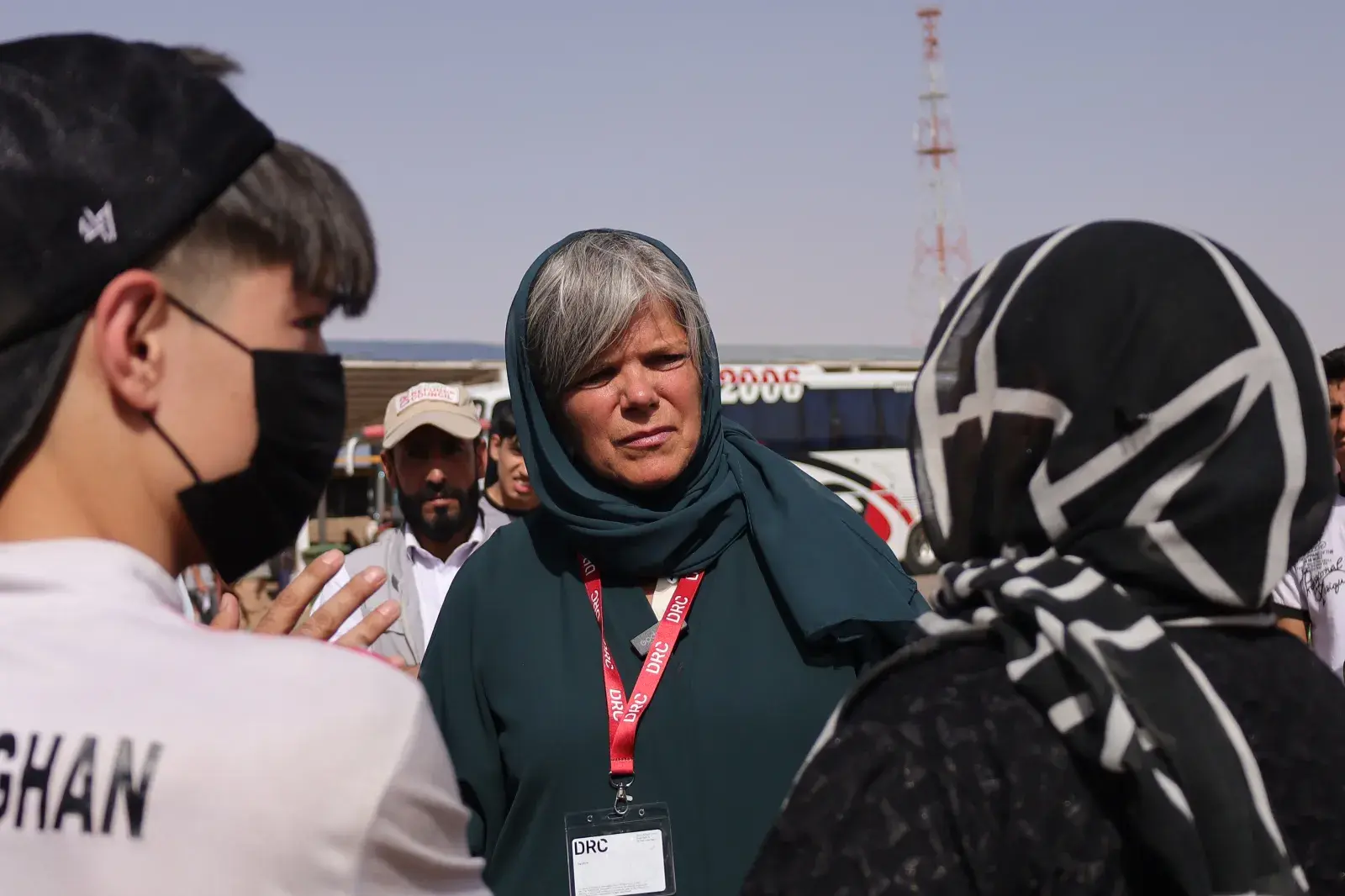
Danish Refugee Council Secretary General Charlotte Slente speaks to Afghans on September 2, 2025, after their arrival from Iran to the Islam Qala rece…| Esmatullah Habibian/Danish Refugee Council

This year alone, more than 2 million Afghans have been forced to return to Afghanistan. What awaits is a country facing multiple overlapping crises.

If only Afghanistan was not in the middle of a crippling humanitarian crisis in which half of the population, or 22.9 million people, is in desperate need of aid and 3.5 million children are acutely malnourished.

If only Afghanistan was not sorting through the rubble of deadly earthquakes in recent weeks that flattened entire mountain villages in the country’s east and killed thousands.

If only Afghanistan was not dealing with sweeping aid cuts and an international community experiencing “Afghanistan fatigue” and turning its back on Afghans.

Afghanistan is simply not ready to handle forced mass returns; they place a burden on a country already at breaking point. Returning families face bleak economic prospects, severe lack of health care, and lack of shelter. Returning women and girls face barriers to study, work, and safe movement.

Zahra, 25, is wearing a black dress and green scarf while clutching her smartphone and blue plastic folder with paperwork. Around her, other Afghan families that have been forced by Iran to return to Afghanistan crowd around private buses for onward journeys to Herat city and beyond.

Zahra’s father is sick and cannot work, and she is responsible for her brother. In Iran, she worked and provided for the family. Now, in Afghanistan, she faces a stark reality: She was a baby when her family took her to Iran in 2000. “This is my first time seeing Afghanistan,” she told me. “I have no shelter; I don’t know anyone.”

Surveys and interviews with more than 700 Afghan returnees in March 2025 by the Danish Refugee Council’s Mixed Migration Centre showed that 65 percent of women reported receiving no assistance—a reminder that in an era of mass expulsions, women and girls are hardest hit, putting their lives at risk and pushing them deeper into despair.

Afghanistan’s crisis intensifies their struggles: Strained resources make it difficult for women and girls to access food, clean water, health care, and education. Female-headed families face extreme poverty, exclusion, and higher risk of exploitation.

“We are happy to return [to Afghanistan], but if we can’t find work what are we to do?” asked Zahra.

DRC is helping Afghans with cash assistance to meet their immediate needs, including food, shelter, and travel. In addition, our staff educate returning Afghans at key border crossings about the silent threat of explosive remnants of war in one of the most contaminated countries in the world.

This assistance is a drop in the ocean of needs.

My biggest worry is that the international community has cut and run at a moment when Afghans need our help. Western funding cuts, including sweeping U.S. reductions, will result in 2.5 million fewer people reached in Afghanistan, according to DRC analysis using the AI-powered Foresight model.

For Zahra, what comes next is a struggle for survival and hard choices. She must choose where to head, find a roof for the night, and come up with a plan. She needs to enroll her brother in school and get her father seen by a doctor and treated.

Most of all, Zahra needs to find work and start earning money. Starting over requires legal identity documentation that many people forced to return to Afghanistan simply do not have. There will be fees to pay for new documents, appointments to attend, and potential delays. Women cannot travel freely to appointments or be served without a male relative.

There is no escaping the heavy truth: Women like Zahra carry the weight of the world on their shoulders. But wealthy nations can lighten that load and still make a difference in the lives of people—including women and girls—by staying committed for the long haul and helping sustain dignified lives for men, women, and children. That is what standing in solidary with Afghans looks like.

Charlotte Slente is the secretary general of Danish Refugee Council (DRC).

A Forgotten Crisis—Mass Forced Returns Are Pushing Afghanistan to a Breaking Point | Opinion
read more

UN: Nine Million in Afghanistan Face Severe Food Insecurity

Khaama Press

The United Nations warns that more than nine million people in Afghanistan face severe food insecurity, with worsening malnutrition threatening children and vulnerable families nationwide.

The World Food Programme (WFP) has warned that recent earthquakes in Afghanistan have worsened an already dire food security and nutrition crisis across the country.

In its Thursday report, the agency said more than nine million people are facing acute food insecurity, while severe malnutrition among children and mothers has reached record levels.

Eastern Afghanistan, particularly Kunar and Nangarhar provinces, has been hardest hit. These areas were already grappling with critical malnutrition before the quakes, and conditions have now deteriorated further.

The return of Afghan families expelled from Pakistan has added pressure on scarce humanitarian resources, compounding the crisis for both displaced populations and host communities.

So far, WFP has provided emergency food assistance to more than 58,000 people in Kunar, Nangarhar, and Laghman provinces. However, it warned that many remote mountain areas remain cut off due to rough terrain, poor roads, and weak communications.

The agency also stressed that funding shortages are severely limiting its response capacity. Current resources allow aid to reach fewer than one million people per month, with a funding gap of about $622 million for the next six months.

Humanitarian experts caution that unless urgent funds are mobilized, Afghanistan’s most vulnerable populations—especially women and children in quake-affected areas—risk facing catastrophic levels of hunger.

The compounded impact of natural disasters, mass displacement, and chronic poverty highlights Afghanistan’s deep reliance on international support. Without significant new funding, relief efforts will remain far short of the country’s desperate needs.

UN: Nine Million in Afghanistan Face Severe Food Insecurity
read more

Global Reactions Positive as Afghanistan Restores Internet

Zabihullah Mujahid added that he himself did not have internet access during the past 48 hours.

The resumption of telecommunications and internet services in Afghanistan has been met with a global welcome.

The spokesperson for the UN Secretary-General, in a press briefing, welcomed the restoration of internet services in Afghanistan, stating that the disruption had caused challenges, including interference in the operations of UN agencies designated by the Security Council.

According to Stéphane Dujarric, the suspension and subsequent resumption of internet services were carried out by the Islamic Emirate of Afghanistan without any stated reason.

He added: “The cut had also disrupted our own work ranging from Security Council mandated work of the UN mission in Kabul to the vital and life saving humanitarian assistance and basic human deeds work of the multiple UN agencies, funds and programs who are all operating in Afghanistan as well as their own international and local partners.”

Zalmay Khalilzad, former U.S. Special Representative for Afghan Peace, who previously described the internet shutdown as a cause of crises in communication, banking, and financial sectors, expressed satisfaction over the restoration of internet services.

Khalilzad said: “I am not sure that the leadership understood the consequences of its decision before taking it. But it now should be clear that it has produced a crisis: 1. Huge disruption of communication among people both inside and outside the country and between and among businesses and institutions. 2. increased financial problems: The banking system already faced obstacles because of sanctions. It is worse with no internet.  People dependent on remittances sent by their relatives abroad will face significant delays.”

Residents of Kabul also emphasized the importance of internet and telecommunications services, urging the Islamic Emirate to improve the quality of these services.

Although the Islamic Emirate has not yet officially explained the reason behind the internet disruption, the group’s spokesperson denied earlier reports attributed to him in the media.

Zabihullah Mujahid added that he himself did not have internet access during the past 48 hours.

He said: “The Associated Press’s claim about the reason for the internet shutdown is false and fabricated and wrongly attributed to me. I hope the media acts responsibly and professionally. If we have a message to announce, we will issue it through our own offices, not through foreign channels.”

This comes after internet and telecommunications services were disrupted across the country on Monday evening for nearly 48 hours, causing widespread difficulties in various aspects of daily life for citizens.

Global Reactions Positive as Afghanistan Restores Internet
read more

UNSC Grants Travel Exemption for Amir Khan Muttaqi to Visit India

According to a statement issued by the UN Security Council Sanctions Committee, Muttaqi is allowed to travel to New Delhi from October 9 to 16, 2025.

The United Nations Security Council has granted permission for Amir Khan Muttaqi, the Foreign Minister of the Islamic Emirate of Afghanistan, to travel to India.

According to a statement issued by the UN Security Council Sanctions Committee, Muttaqi is allowed to travel to New Delhi from October 9 to 16, 2025.

The statement reads: “On 30 September 2025, the Security Council Committee established pursuant to resolution 1988 (2011) approved an exemption to the travel ban for Amir Khan Motaqi (TAi.026) to visit New Delhi, India, from 9 to 16 October 2025.”

Although the objectives of this trip have not been officially announced, some political analysts view the foreign visits of Islamic Emirate officials as a positive step toward improving relations with regional countries.

Janat Faheem Chakari, a political analyst, said: “Until they are granted permission by the UN Security Council, they cannot travel to any country. These sanctions will remain in place until Afghanistan is recognized and the leadership of the Islamic Emirate is removed from the blacklist.”

Earlier, Indian media had reported, citing sources, that India had requested the UN Security Council Sanctions Committee to issue a travel exemption for Mr. Muttaqi.

UNSC Grants Travel Exemption for Amir Khan Muttaqi to Visit India
read more

Afghans rejoice as internet returns after Taliban blackout

Dearbail Jordan, Hafizullah Maroof and Caroline Davies

BBC News
1 Oct 2025

Afghans have taken to the streets to rejoice in the restoration of internet and telecom services after the Taliban government shut them down, provoking widespread condemnation.

Local reporters said communications were resuming, while internet monitor Netblocks said network data showed a “partial restoration” of connectivity.

A source close to the government confirmed to BBC Afghan that the internet was back by order of the Taliban prime minister.

The 48-hour blackout disrupted businesses and flights, limited access to emergency services and raised fears about further isolating women and girls whose rights have been severely eroded since the hardline Islamist group swept back to power in 2021.

On Wednesday evening hundreds of Afghans took the streets in the capital city Kabul to spread the word that the internet was back.

One man told BBC Afghan: “Everyone is happy, holding their cell phones and talking to their relatives.

“From women, to men and Talibs [a member of the Taliban], each was talking on phones after services were restored. There are more crowds now in the city.”

Suhail Shaheen, a senior Taliban spokesman in Qatar, said “all communications” were restored by Wednesday afternoon.

The Taliban government has not given an official explanation for the shutdown.

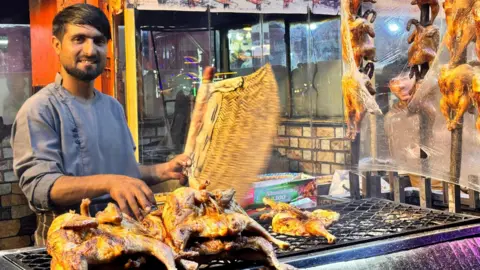
An Afghan man fans grilled chicken at his market stall in Kabul, Afghanistan after an internet shutdown was lifted
People took to the streets in Kabul to celebrate after internet and phone services were restored

Since returning to power, the Taliban have imposed numerous restrictions in accordance with their interpretation of Islamic Sharia law.

Afghan women have told the BBC that the internet was a lifeline to the outside world since the Taliban banned girls over the age of 12 from receiving an education.

Women’s job options have also been severely restricted and in September, books written by women were removed from universities.

Following the internet shutdown on Monday, the UN said it left Afghanistan almost completely cut off from the outside world.

It added that the blackout risked “inflicting significant harm on the Afghan people, including by threatening economic stability and exacerbating one of the world’s worst humanitarian crises”.

During the blackout, the BBC was told that the centre of Kabul was noticeably quieter, with banks closed and shopping centres near empty.

In the money exchange market, all international transfers had been stopped – meaning vital money, often from family members abroad, could not enter Afghanistan.

Afghans living outside the country phoned in to a BBC Afghan radio show in the hopes their messages reached family members still there.

Travel agents were either closed or only partially open to provide customers with information. Flights in and out of the country were cancelled.

“This is the gradual death,” one shopkeeper told us. “When there is no hope, no chances of progress, no freedom of speech, no optimism for the future of your child, no stability for your business, where you can’t benefit from your studies.”

But on Wednesday, the mood lifted when people could use the internet and call each other again.

Delivery driver Sohrab Ahmadi said: “It’s like Eid al-Adha; it’s like preparing to go for prayer.

“We are very happy from the bottom of our hearts.”

Mah, a 24-year-old who fled Afghanistan in 2021 and is now getting an education in the UK, said she was in tears when she could finally speak to her family, who remain there.

“When I spoke to my mum, I cried, I was happy,” she said. “At least I can hear her voice.”

She added: “You don’t know what’s going to happen next in Afghanistan because nothing’s under control.”

Afghans rejoice as internet returns after Taliban blackout
read more

Why reclaiming an Afghan air base is in America’s national interest

When President Trump announced during a press conference in London that he was in the process of trying to regain access to Bagram Air Base, it came as a surprise for some — especially judging by the look on United Kingdom Prime Minister Keir Starmer’s face.

But for those who have followed President Trump’s remarks on Afghanistan, his comments were not unexpected. On several occasions, he had called it a strategic mistake to hand over Bagram to the Taliban in 2021 and has even suggested that the United States should take it back.

That said, President Trump also bears responsibility. His deal with the Taliban during his first term set the stage for America’s full withdrawal. President Biden could have changed course but chose not to.

And now the United States is left with a resurgent Taliban that controls more of Afghanistan than it did on the eve of 9/11 and an al-Qaeda and ISIS that operate freely across the country. President Trump now has an opportunity to correct Biden’s mistake and reestablish America’s position in Afghanistan.

At the press conference, he said one of the reasons Bagram mattered is because it is “one hour away from where China makes its nuclear missiles.” While this may be an exaggeration, Bagram’s strategic location in the 21st century is undeniable.

Within an eight-hour flight of Bagram lies roughly 85 percent of the world’s population and more than half of the Earth’s landmass. Inside this radius are many of the world’s major trade and transit routes, along with the bulk of its strategic resources: an estimated 75 percent of global rare earth mineral reserves, 70 percent of proven oil reserves and 65 percent of proven natural gas reserves.

For the U.S., a foothold in Bagram brings major benefits in the era of great power competition. Afghanistan borders both Iran in the west and China in the east, while to the south lies Pakistan and then India. To the north is Central Asia, where Russia seeks to expand influence.

Bagram’s location has been important since antiquity. When Alexander the Great came through in 329 BC, he established Alexandria in the Caucasus where Bagram is today — so named because he mistakenly believed the nearby mountains were the Caucasus. In fact, they are the Hindu Kush.The Macedonian warrior knew he needed a well-fortified outpost to govern his newly conquered lands, and the terrain made Bagram the best location.

For the Soviets, Bagram’s location was equally critical. Its proximity to Kabul and to the eastern part of the country — one of the main battlegrounds during the Soviet war — made it a centerpiece of their presence. Many of the facilities on the base trace to Soviet construction.

After 9/11, the U.S. modernized and expanded them, including a second 11,800-foot runway designed to handle even the largest and heaviest military transport aircraft.

This layered history underscores why Bagram remains one of the world’s most valuable airfields.

Trump claims that he and his officials are already in contact with the Taliban. The Taliban, however, deny this — likely because of internal infighting. Any hint that one faction is talking to the U.S. would raise suspicions among internal rivals. If an arrangement with the Taliban to access the base fails, the U.S. should consider all options to reestablish a presence in Bagram.

After more than two decades of operations there, U.S. forces know the base and surrounding terrain intimately. It is worth noting that anti-Taliban forces such as the National Resistance Front, led by Ahmad Massoud, maintain a stronghold in the Panjshir Valley less than 50 miles away.

While reentry will be difficult and not without risk, it is certainly doable. Once reestablished, operating and defending the base could be modeled on the U.S. presence at al-Tanf in Syria, where a deconfliction zone ensures safe and secure operations.

Since the early 19th century, there have been 19 instances of American or European intervention in the region, whether militarily or diplomatically — roughly once every decade.

Nobody expects U.S. troops to return anytime soon, but nobody expected an intervention in August 2001, either. Should circumstances require America to reengage, it would be invaluable to have a presence on the ground.

Luke Coffey is a senior fellow at Hudson Institute.

Why reclaiming an Afghan air base is in America’s national interest
read more

New York Times Exposes Double Standards in U.S. War Crimes in Afghanistan

According to the report, cases related to alleged war crimes by American soldiers in Afghanistan have been handled with double standards.

The New York Times, in a recently published investigative report, has revealed the culture of immunity granted to some U.S. forces accused of committing war crimes in Afghanistan.

According to the report, cases related to alleged war crimes by American soldiers in Afghanistan have been handled with double standards.

The report highlights two prominent cases: Matthew Golsteyn, a Green Beret officer, admitted in an interview with the CIA that in 2010, while in Afghanistan, he released a bomb-making suspect and later killed him, burning his body. This case was repeatedly opened and closed, and he was intensely prosecuted.

In contrast, the case in Nerkh district of Kunduz province, which involved the killing and torture of nine Afghan detainees by an ODA team, was eventually closed despite extensive evidence, and no U.S. service member was charged.

Wahid Faqiri, an international relations expert, said: “Nearly four to five recent reports by The New York Times on U.S. war crimes in Afghanistan are truly shocking. They expose a culture of impunity, showing that the U.S. is unwilling to investigate the crimes committed by its soldiers in Afghanistan.”

The findings reveal that the U.S. Special Operations Command has repeatedly opted for silence, cover-ups, and even promotions for the accused. One example is the 2015 airstrike on the Doctors Without Borders hospital in Kunduz, which killed 42 civilians. Although accountability was promised in that case, no senior U.S. official was ever punished.

Ruhullah Hotak, a political analyst, said: “In investigating war crimes committed in Afghanistan over the past two decades, there has been a completely double-standard approach.”

Critics argue that these double standards reflect a culture of blind loyalty and structural immunity within U.S. Special Forces. The revelations raise serious questions about transparency, accountability, and compliance with the laws of war by American elite forces.

Previously, the Islamic Emirate has repeatedly called on countries responsible for committing war crimes in Afghanistan to pay compensation and bring the perpetrators to justice.

New York Times Exposes Double Standards in U.S. War Crimes in Afghanistan
read more

New EU Envoy Pledges Strong Support for Afghanistan’s Women and Girls

Gilles Bertrand, the new EU Special Envoy for Afghanistan, pledged strong support for Afghan women and girls, prioritizing rights protection and humanitarian engagement amid ongoing restrictions.

Gilles Bertrand, the newly appointed European Union Special Envoy for Afghanistan, has declared that supporting Afghan women and girls facing unprecedented restrictions will be his top priority.

In a statement issued on Tuesday, September 30, the EU said Bertrand’s mandate will focus on supporting the Afghanistan people, safeguarding human rights, facilitating humanitarian aid, combating terrorism, and promoting regional stability.

The new envoy emphasized principled engagement with Afghanistan, stating: “One of my key priorities will be to ensure that the European Union remains a strong supporter of the Afghanistan people, especially women and girls.”

Bertrand added that he would work closely with EU member states, international partners, and civil society to ensure the Union’s stance is heard and understood at both regional and global levels.

A seasoned French diplomat, Bertrand previously served as head of the EU’s political section in Kabul from 2003 to 2004. He has also led EU delegations in Syria and Colombia.

Bertrand succeeds Tomas Niklasson, who served as the EU’s Special Envoy for Afghanistan from 2021 until March 2025. His appointment signals a continued EU commitment to Afghanistan issues despite ongoing challenges.

Observers say Bertrand’s experience in conflict and post-conflict environments may prove critical as the EU seeks to balance humanitarian concerns, women’s rights advocacy, and regional stability in its engagement with Afghanistan.

New EU Envoy Pledges Strong Support for Afghanistan’s Women and Girls
read more

How Pakistan misread the Taliban and lost peace on the frontier

By Abid Hussain

Al Jazeera

Islamabad, Pakistan – When Prime Minister Shehbaz Sharif arrived at the military hospital in Bannu in the northwestern province of Khyber Pakhtunkhwa, Pakistan, on September 13, his stoic expression gave way to unmistakable anger.

At least 19 soldiers had died fighting attackers from the armed group, Tehreek-e-Taliban Pakistan (TTP) – commonly known as the Pakistan Taliban – in Khyber Pakhtunkhwa, a province that shares a long and contentious border with Afghanistan.

Flanked by army chief Field Marshal Asim Munir to his left, Sharif delivered a blunt message to the Afghan Taliban, which returned to power in Kabul after the withdrawal of US forces in August 2021, and which he accuses of providing a haven to armed fighters on Afghan soil.

“Today I want to send a clear message to Afghanistan,” he said while speaking to the media outside the hospital. “Choose one of two paths. If they wish to establish relations with Pakistan with genuine goodwill, sincerity and honesty, we are ready for that. But if they choose to side with terrorists and support them, then we will have nothing to do with the Afghan interim government.”

But the violence did not stop. Five more soldiers were killed when an improvised explosive device struck their vehicle on September 16 in the southwestern province of Balochistan, which also borders Afghanistan. Then, on September 30, a suicide bomb ripped through Quetta, the provincial capital of Balochistan, killing at least 10 people and wounding 32.

The death count in August was particularly high, according to Islamabad-based think tank, the Pakistan Institute for Conflict and Security Studies (PICSS). The institute reported a 74 percent increase in violence in the country since July.

“With 143 militant attacks recorded, August became the deadliest month in over a decade, surpassing all monthly figures since February 2014, as per the PICSS Militancy Database,” the think tank’s report said.

The surge has compounded an already bleak picture. The year 2024 was one of the deadliest for Pakistan in nearly a decade, with more than 2,500 casualties of violence in the country recorded. Those targeted by armed groups include civilians and security personnel, and the majority of attacks have taken place in Khyber Pakhtunkhwa and Balochistan.

Sharif was categorical in assigning blame for the rising violence and killings. “Terrorists come from Afghanistan and, together with the Tehreek-e-Taliban Pakistan (TTP), these khawarij join forces to martyr our soldiers, our brothers and sisters, and ordinary citizens,” he said at the hospital.

Emerging in 2007 amid the United States-led, so-called “war on terror”, the TTP has long waged an armed campaign against Islamabad.

The group wants to implement strict Islamic law, has demanded the release of its imprisoned members, and calls for a reversal of the merger of Pakistan’s tribal areas with the Khyber Pakhtunkhwa province.

The Pakistani government insists the TTP – which is distinct from the Afghan Taliban but ideologically aligned in many respects – operates from Afghan territory. It blames Kabul for allowing sanctuary and has repeatedly described the group using the Arabic-derived term “khwarij”, a historical epithet for an extremist sect that branded other Muslims as “apostates”.

Kabul, however, has repeatedly rejected these allegations. Last month, Zabihullah Mujahid, a spokesperson for the Taliban government, warned against “provocative” statements and urged cooperation.

“Pakistan should take steps to foil such attacks”, he said during an interview in Kabul days after Sharif’s statements. “Islamabad should also share information with Kabul so that we can make efforts to counter these threats as well,” he added.

Border tensions deepen

The recent spike in violence followed a lull earlier in the year, while high-level delegations from Pakistan visited Kabul and other meetings with Chinese leaders took place, indicating that progress might be on the cards.

In April, Pakistan’s foreign minister and deputy prime minister, Ishaq Dar, travelled to Kabul, the first major visit by a senior Pakistani official since February 2023.

Then, in May, Dar joined his Chinese and Afghan counterparts, Wang Yi and Amir Khan Mutaqqi, for an informal trilateral meeting in Beijing that aimed to renew diplomatic engagement. The three ministers met again in August in Kabul, with China offering to expand its footprint in the region and to mediate between Islamabad and Kabul.

Yet those diplomatic gestures have produced little concrete action from the Afghan Taliban against the TTP.

Iftikhar Firdous, cofounder of The Khorasan Diary, a portal that tracks regional security developments, was scathing in his comments. “In reality, there has been no overarching commitment by the Afghan Taliban to act against the TTP in Afghanistan, and this is likely to never happen,” he told Al Jazeera.

He described the Afghan Taliban as a “grey entity in a world that no longer differentiates between black and white”.

“I don’t see any end to the TTP while the idea of the Taliban exists. Pakistan’s failed calculus to have a controlled Taliban government in Afghanistan has had detrimental consequences, and the next biggest mistake would be to expect that its internal security challenges will disappear by negotiating with the Taliban,” the Peshawar-based analyst said.

Diplomatic outreach falters

Pakistan was viewed as a patron of the Afghan Taliban during its first rule in the 1990s. The Pakistani army pursued a strategy that sought “strategic depth” in Afghanistan as a hedge against India. But the Taliban’s return to power in 2021 altered the dynamic.

This time around, Kabul has cautiously courted ties with New Delhi at times, while the TTP’s campaign inside Pakistan has continued.

Kabul-based analyst Tameem Bahiss argues that Pakistan’s long-term security rests on constructive engagement with Afghanistan through both bilateral and multilateral channels, despite the obvious obstacles.

“Kabul’s reluctance to act decisively against the TTP is rooted in both cultural and ideological considerations. The Afghan Taliban are unlikely to employ heavy-handed measures against a group with whom they have not just cultural but ideological and historical ties,” he told Al Jazeera.

A complicating factor is TTP’s access to more sophisticated military kit. The group has made use of night-vision devices, quadcopters and heavier weaponry reportedly left behind after international forces withdrew from Afghanistan.

‘Deep scars’

More troubling, analysts say, is that the TTP has continued to recruit inside Pakistan’s tribal districts, where decades of conflict have eroded support for the state.

Fahad Nabeel, who leads the Islamabad-based research consultancy Geopolitical Insights, said counterinsurgency is only successful in any region with local support.

Previous operations by the Pakistani military against armed groups between the mid-2000s and the mid-2010s triggered the displacement of people and economic damage, creating an environment of mistrust towards the authorities.

A lack of coordination between federal and provincial authorities and the army has also been a particular issue, Nabeel said.

“Political ownership of military operations is very important, which has been an issue encountered during the early military operations as well. A case in point is the recently announced Operation Azm-e-Istehkam, which soon became controversial due to the lack of clarity regarding the operation,” he said, referring to an operation announced in June 2024 by Sharif, which was never formally launched.

The tribal belt along the border has endured two decades of trauma, said Bahiss – from US drone strikes in the mid-2000s to early 2010s to violence by armed groups and repeated Pakistani military operations – leaving “deep scars and fostering resentment toward both the Pakistani state, and particularly the security establishment”.

“These grievances have provided fertile ground for the TTP’s revival, as the group has increasingly framed its narrative around Pashtun disenfranchisement,” the analyst said.

Local grievances, national threat

While Pakistan and Afghanistan have been engaged in a simmering conflict for many years, recent actions by other countries, including the US, have made the regional dynamic even more complicated.

On September 18, during a visit to the United Kingdom, US President Donald Trump suggested Washington wishes to regain control of Bagram airbase, a strategic facility outside Kabul that was long a linchpin for foreign military operations in Afghanistan.

Six days later, at a United Nations General Assembly (UNGA) side event in New York, the foreign ministers of China, Iran, Pakistan and Russia urged Afghanistan to take “effective, concrete, and verifiable actions” to dismantle armed groups operating from its soil.

They warned that ISIL, al-Qaeda, the TTP and several others posed a “serious threat” to the region.

Crucially, the resulting four-country statement – part of a quadripartite process that began in 2017 – also opposed “the reestablishment of military bases” such as Bagram in and around Afghanistan by “the countries responsible for the current situation”, language understood as aimed at the US. The Afghan Taliban, for its part, welcomed this statement.

Abdul Sayed, a security researcher in Sweden, said the Afghan Taliban’s primary priority is consolidating governance in its own country.

“But a further expansion of Pakistan’s policy of cross-border strikes or the adoption of more punitive measures against the Taliban and the Afghan population are likely to generate increased support for hostile actors, which could risk intensifying the threat of militancy within Pakistan,” he told Al Jazeera.

Pakistan has conducted multiple air strikes against armed groups on Afghan soil in recent years, with the last such incident taking place in December 2024, in which at least 46 people were killed, mostly civilians.

Islamabad has also pursued a policy of expulsions. Since November 2023, Pakistan has been pushing a three-phase campaign to deport millions of Afghans, citing security concerns. That drive has further heightened tensions with Kabul and added pressure to an already fragile humanitarian situation in Afghanistan, which has been compounded by the recent devastating earthquake in its eastern region.

Nabeel said Islamabad will have to try to build goodwill with ordinary Afghans while making it clear that anti-Pakistan armed groups cannot operate freely, if they have a hope of eradicating the violence.

“Such an approach can allow Pakistan to conduct covert actions against anti-Pakistan militant groups in Afghanistan. However, such activities can only prove to be meaningful if Pakistani authorities undertake actions on Pakistani soil [rather than engaging in cross-border strikes] to discourage the structural factors of violence,” he said.

For Firdous, the Peshawar-based security analyst, however, simmering tensions between Pakistan and Afghanistan will likely persist beyond any resolution to the current crisis around TTP.

“There are perennial problems between the two neighbours which have more to do with existential issues for both countries, and cross-border terrorism happens to be an unresolved variable from the baggage of history,” he said.
How Pakistan misread the Taliban and lost peace on the frontier
read more