The United Nations warned that worsening hunger in Afghanistan is driving desperate coping measures, as unemployment, poverty and funding cuts deepen the humanitarian crisis.
The head of the World Food Programme (WFP) in Afghanistan warned that worsening malnutrition is pushing families into desperate measures, including selling young girls into early marriage to afford food.
John Ayliff, WFP’s country director for Afghanistan, said the deepening hunger crisis is having severe consequences for women and girls, adding that the situation has been largely overlooked by the international community.
He said UN estimates show that five million women and children are expected to suffer from malnutrition over the next 12 months, with nearly four million children requiring urgent treatment.
United Nations data show Afghanistan’s economy remains near collapse, with around 75% of the population unemployed and more than 90% living below the poverty line.
UN agencies said in a report released on Wednesday that poverty levels have deepened nationwide, while restrictions on girls’ education and women’s employment have further reduced household incomes.
Ayliff said funding cuts have forced nutrition clinics to shut down, warning that children with severe malnutrition will die if treatment is unavailable.
International aid groups have linked the crisis to earlier reports from western Afghanistan, including Herat, where families previously sold daughters into marriage as food shortages intensified.
The International Rescue Committee has also warned that reduced U.S. funding has cut humanitarian access in Afghanistan by nearly two-thirds, worsening hunger conditions.
Ayliff said WFP staff increasingly witness children pulled out of school and sent to work, calling it “shocking” when families are told aid agencies no longer have funds to help.
UN officials warn that without urgent funding and policy relief, Afghanistan’s hunger crisis will continue to drive irreversible social harm, with women and children bearing the heaviest cost.
UN Says Hunger in Afghanistan Forcing Families to Sell Girls Into Early Marriage
More than 5.2 million people returned to Afghanistan from Iran and Pakistan in 2025, worsening humanitarian pressures, aid agencies said, urging increased international support.
More than 5.2 million people returned to Afghanistan from Iran and Pakistan between January and November 2025, sharply worsening the country’s already fragile humanitarian situation, the International Federation of Red Cross and Red Crescent Societies (IFRC) said.
Citing humanitarian agencies and the International Organization for Migration, the IFRC said over 3.6 million people returned from Iran, including about 1.2 million who were forcibly deported, while more than 804,000 returned from Pakistan.
The pace of returns increased significantly after April, coinciding with tougher enforcement measures in both countries, and continued despite harsh winter conditions that typically slow cross-border movement.
Aid agencies warned that the scale and speed of returns are overwhelming Afghanistan’s limited reception capacity and placing additional strain on host communities already facing poverty and food insecurity.
Pakistan launched the second phase of its crackdown on undocumented foreigners in April 2025, initially targeting undocumented Afghans and later extending the policy to holders of Afghan citizen cards and registration certificates.
Iran accounted for nearly two-thirds of all returns in 2025, driven by stricter residency controls and economic pressure, with most returnees entering Afghanistan through Islam Qala in Herat and Milak–Zaranj in Nimroz.
Humanitarian agencies said many returnees arrived with minimal belongings, while women, children, unaccompanied minors and people with special protection needs face heightened risks due to limited access to shelter, healthcare and jobs.
They also raised concerns about reports of arbitrary deportations, including of registered refugees and asylum seekers, warning such practices may violate international protection standards.
Aid groups say Afghanistan, already struggling with widespread poverty and food shortages, is ill-equipped to absorb millions of returnees without urgent international support.
They urged donors to increase funding and protection measures, warning that continued mass returns without proper reintegration support could fuel further instability and new waves of displacement.
Over 5.2 Million Return to Afghanistan from Iran and Pakistan in 2025, Aid Groups Warn
The International Committee of the Red Cross says 4.7 million people in Afghanistan are facing hunger, with assessments revealing the depth of the crisis.
The International Committee of the Red Cross (ICRC) said in a new report that 4.7 million people in Afghanistan are facing hunger, with recent assessments revealing the depth of the food crisis in several hard-hit areas.
The ICRC warned that 17 million people nationwide are in urgent need of humanitarian food assistance, underscoring the scale of food insecurity across the country amid prolonged economic collapse.
In response, the organisation said it has expanded emergency food support in the provinces of Bamyan, Kunar and Herat, targeting the most vulnerable households during the harsh winter period.
Afghanistan’s humanitarian crisis is driven by a collapsed economy, with around 75% unemployment nationwide and nearly 90% of the population living below the poverty line, according to international estimates, severely limiting families’ ability to buy food.
Years of conflict, international isolation, frozen assets and declining aid flows have compounded economic hardship, while droughts and natural disasters continue to erode livelihoods in rural and urban areas alike.
The ICRC said 95% of people surveyed showed poor food consumption, reporting severe coping measures such as borrowing money and delaying medical care, while malnutrition rates among infants and young children remain alarmingly high.
The report warned that about 1.2 million pregnant and breastfeeding women are expected to suffer from acute malnutrition in 2026, while 3.7 million children under five are already affected, including one-third with severe acute malnutrition.
ICRC Afghanistan chief Lisa Owen said acute hunger remains a persistent challenge, warning that deep funding shortages are forcing cuts to lifesaving programmes, pushing millions closer to starvation unless urgent international support increases.
The Afghanistan passport has again been ranked the world’s weakest, allowing visa-free travel to only 24 destinations, according to Henley’s latest index.
Afghanistan has once again been ranked as holding the world’s weakest passport, according to the latest assessment by Henley & Partners, extending a decade-long position at the bottom of the index.
The Henley Passport Index shows Afghan citizens can travel visa-free to just 24 destinations, including Cambodia, Mozambique, Kenya, Somalia and Sri Lanka.
The Henley Passport Index ranks passports based on the number of destinations holders can access without a prior visa, using data compiled from global aviation authorities.
Conflict, weak diplomatic ties, sanctions and concerns over migration and security have contributed to limited visa-free access for countries near the bottom of the ranking.
After Afghanistan, the weakest passports belong to Syria, Iraq, Yemen, Pakistan, Somalia, Nepal, Bangladesh and Palestine, according to the index.
Pakistan ranks 98th, three places above Afghanistan, with visa-free or visa-on-arrival access to 31 destinations.
At the top of the 2026 rankings, Singapore holds first place, offering visa-free access to 192 destinations, followed by Japan and South Korea with 188 destinations.
Several European countries, including Denmark, Spain, Sweden and Switzerland, dominate the upper tiers, while the United Arab Emirates ranks fifth after recording the biggest improvement over two decades.
Henley’s analysis shows the gap between the world’s strongest and weakest passports has widened sharply, highlighting growing global inequality in freedom of travel.
The continued low ranking of Afghanistan’s passport reflects broader challenges facing the country, as limited mobility further constrains education, employment and international opportunities for its citizens.
Afghanistan passport ranked weakest worldwide again
A U.S. lawmaker said President Donald Trump plans to close a Qatar-based transit camp for Afghan evacuees, raising concerns about stalled resettlement efforts.
U.S. Representative Gregory Meeks said President Donald Trump has informed Congress of plans to close Camp Al Sayliyah in Qatar, a temporary housing facility for evacuated Afghans, by the end of September.
Meeks, the top Democrat on the House Foreign Affairs Committee, said on Wednesday that the decision would complicate U.S. efforts to relocate and resettle Afghans who worked alongside American forces and institutions.
In a statement, he described the move as the latest “reckless step” by the Trump administration to eliminate remaining pathways for the safe transfer of Afghan allies to the United States.
Camp Al Sayliyah has served as a key transit hub since the U.S. withdrawal from Afghanistan, housing evacuees temporarily while they undergo security vetting and immigration processing.
Thousands of Afghans fled the country after the Taliban takeover, many facing serious threats because of their past work with U.S. and allied missions and now waiting in prolonged uncertainty.
Meeks said shutting the camp amounts to a betrayal of Afghan partners and a breach of America’s commitments, warning it would leave vulnerable families with few options.
Advocates for Afghan evacuees argue the United States has a moral responsibility to protect those who supported its mission, while critics maintain the evacuation process carries security concerns.
AfghanEvac, a group assisting evacuees, estimates about 800 Afghans remain at the camp, many stranded after admissions were halted by the Trump administration last year.
The planned closure has intensified calls from lawmakers and aid groups for Washington to reverse course, warning it could undermine U.S. credibility with future partners worldwide.
Trump plans to shut Afghan evacuee camp in Qatar, U.S. lawmaker says
It was a piece of audio obtained by the BBC that revealed what worries the Taliban’s leader most.
Not an external danger, but one from within Afghanistan, which the Taliban seized control of as the previous government collapsed and the US withdrew in 2021.
He warned of “insiders in the government” pitted against each other in the Islamic Emirate the Taliban set up to govern the country.
In the leaked clip, the supreme leader Hibatullah Akhundzada can be heard giving a speech saying that internal disagreements could eventually bring them all down.
“As a result of these divisions, the emirate will collapse and end,” he warned.
The speech, made to Taliban members at a madrassa in the southern city of Kandahar in January 2025, was more fuel to the fire of rumours which had been circulating for months – rumours of differences at the very top of the Taliban.
It is a split the Taliban leadership has always denied – including when asked directly by the BBC.
But the rumours prompted the BBC’s Afghan service to begin a year-long investigation into the highly secretive group – conducting more than 100 interviews with current and former members of the Taliban, as well as local sources, experts and former diplomats.
Because of the sensitivity over reporting this story, the BBC has agreed not to identify them for their safety.
Now, for the first time, we have been able to map two distinct groups at the very top of the Taliban – each presenting competing visions for Afghanistan.
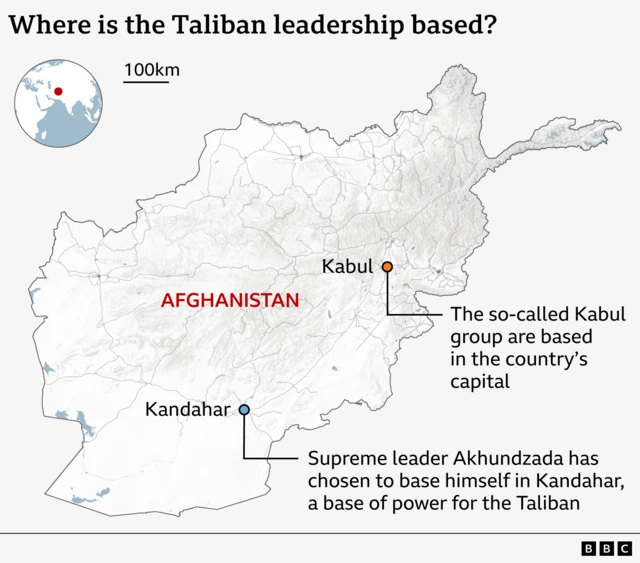
One entirely loyal to Akhundzada, who, from his base in Kandahar, is driving the country towards his vision of a strict Islamic Emirate – isolated from the modern world, where religious figures loyal to him control every aspect of society.
And a second, made up of powerful Taliban members largely based in the capital Kabul, advocating for an Afghanistan which – while still following a strict interpretation of Islam – engages with the outside, builds the country’s economy, and even allows girls and women access to an education they are currently denied beyond primary school.
One insider described it as “the Kandahar house versus Kabul”.
But the question was always whether the Kabul group, made up of Taliban cabinet ministers, powerful militants and influential religious scholars commanding the support of thousands of Taliban loyalists, would ever challenge the increasingly authoritarian Akhundzada in any meaningful way, as his speech suggested.
After all, according to the Taliban, Akhundzada is the group’s absolute ruler – a man only accountable to Allah, and not someone to be challenged.
Then came a decision which would see the delicate tug of war between the most powerful men in the country escalate into a clash of wills.
Video caption,Listen: Audio obtained by the BBC of Taliban supreme leader
In late September, Akhundzada ordered the internet and phones to be shut off, severing Afghanistan from the rest of the world.
Three days later the internet was back, with no explanation of why.
But what had happened behind the scenes was seismic, say insiders. The Kabul group had acted against Akhundzada’s order and switched the internet back on.
“The Taliban, unlike every other Afghan party or faction, is remarkable for its coherence – there have been no splits, not even much dissent,” explains an expert on Afghanistan, who has been studying the Taliban since they were established.
“Bound into the movement’s DNA is the principle of obedience to one’s superiors, and ultimately to the Amir [Akhundzada]. That’s what made the act of turning the internet back on, against his explicit orders, so unexpected, and so notable,” the expert said.
As one Taliban insider put it: this was nothing short of a rebellion.
A man of faith
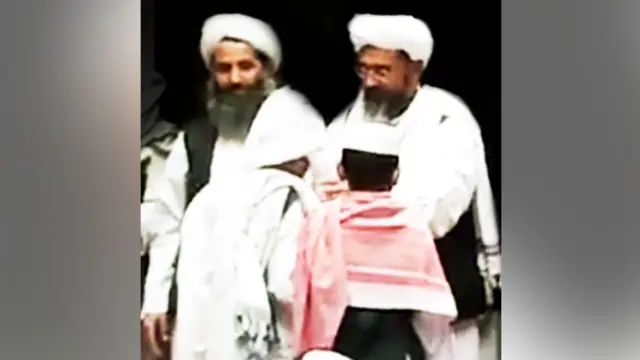
IOnly two confirmed pictures of Akhundzada exist; this one, showing the supreme leader on the left, has been verified by BBC Afghan
Hibatullah Akhundzada did not begin his leadership like this.
Indeed, sources say he was chosen as the Taliban’s supreme leader in 2016 in part because of his approach of building consensus.
Lacking battlefield experience himself, he found a deputy in Sirajuddin Haqqani – the feared militant commander, then one of the US’s most wanted men with a $10m (£7.4m) bounty on his head.
A second deputy was found in Yaqoob Mujahid, Taliban founder Mullah Omar’s son – young, but bringing with him his Taliban bloodline, and its potential to unify the movement.
The arrangement continued throughout negotiations with Washington in Doha to end the 20-year war between Taliban fighters and US-led forces. The eventual agreement, in 2020, resulted in the sudden and dramatic recapturing of the country by the Taliban, and the chaotic withdrawal of US troops in August 2021.
To the outside world, they were a united front.
But both deputies would find themselves quietly demoted to ministers as soon as the Taliban returned to power in August 2021, with Akhundzada now a lone power centre, insiders told the BBC.
Even Abdul Ghani Baradar – the powerful and influential co-founder of the Taliban who had led negotiations with the US – found himself in the role of deputy prime minister instead of prime minister as many had expected.
Instead, Akhundzada – having shunned the capital where the government sits in favour of remaining in Kandahar, a base of power for the Taliban – began surrounding himself with trusted ideologues and hardliners.
Other loyalists were given control of the country’s security forces, religious policies and parts of the economy.
“[Akhundzada], from the outset, sought to form his own strong faction,” a former Taliban member – who later served in Afghanistan’s US-backed government – told the BBC.
“Although he lacked the opportunity at first, once he gained power, he began doing so skilfully, expanding his circle using his authority and position.”
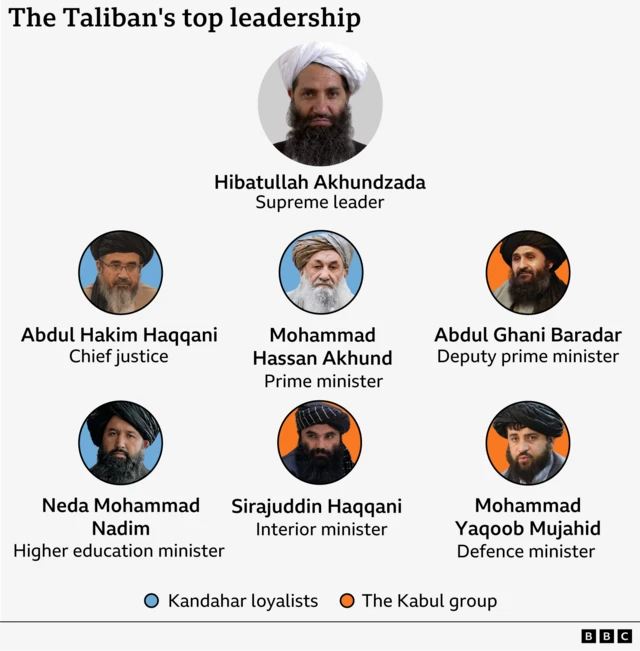
Akhundzada has filled his cabinet with loyalists in line with his vision, but those considered the “Kabul group” maintain their positions. Here, arguably the most influential members of each group are shown
Edicts began to be announced without consultation with Kabul-based Taliban ministers, and with little regard for public promises made before they took power, on issues like allowing girls access to education. The ban on education, along with women working, remains one of the “main sources of tension” between the two groups, a letter from a UN monitoring body to the Security Council noted in December.
Meanwhile, another insider told the BBC that Akhundzada, who had started out as a judge in the Taliban’s Sharia courts of the 1990s, was becoming “even more rigid” in his religious beliefs.
And he is convinced that making the wrong decision could have implications beyond his lifetime, the BBC has been told.
“Every decision he makes he says: I’m accountable to Allah, on judgement day, I will be questioned why I didn’t take an action,” one current Taliban government official explained.
Sorry, we can’t display this part of the story on this lightweight mobile page.
Two people who have been in meetings with Akhundzada described to the BBC how they were faced with a man who barely spoke, choosing to communicate mainly through gestures, interpreted through a team of elderly clerics in the room.
In more public settings, other eyewitnesses said he obscures his face – covering his eyes with a scarf draped over his turban, and often standing at an angle when addressing an audience. Photographing or filming Akhundzada is forbidden. Only two photos of him are known to exist.
Getting a meeting has also become increasingly difficult. Another Taliban member told the BBC how Akhundzada used to hold “regular consultations”, but now “most Taliban ministers wait for days or weeks”. Another source told the BBC the Kabul-based ministers have been told to “travel to Kandahar only if they receive an official invitation”.
At the same time, Akhundzada was moving key departments to Kandahar – including distribution of weapons, which had previously come under the control of his former deputies Haqqani and Yaqoob.
In its December letter, the UN monitoring team noted Akhundzada’s “consolidation of power has also involved a continued build-up of security forces under the direct control of Kandahar”.
Reports suggest Akhundzada issues direct orders all the way down to local police units – bypassing ministers in Kabul.
One analyst argues the result is that “real authority has been transferred to Kandahar” – something Taliban spokesman Zabihullah Mujahid denied to the BBC.
“All the ministers have their power in their ministerial framework, undertaking daily works and making decisions – all the powers are delegated to them and they carry out their duties,” he said.
However, “from a Sharia perspective, he [Akhundzada] has the absolute power”, Mujahid added – saying “to avoid God-forbidden division, his decisions are final”.
Men ‘who have seen the world’
“They [the Kabul group] are people who have seen the world,” one analyst told the BBC. “Therefore, they believe that their government, in its current form, cannot last.”
The Kabul group want to see an Afghanistan which moves towards the model of a Gulf state.
They are concerned about the concentration of power in Kandahar, the nature and enforcement of virtue laws, how the Taliban should engage with the international community and women’s education and employment.
But despite advocating for Afghan women to have more rights, the Kabul group is not described as moderate.
Instead, insiders see them as “pragmatic”, unofficially led by Baradar – the Taliban founding member who still commands great loyalty. He is also thought to be the “Abdul” referred to by Donald Trump as the “head of the Taliban” during a 2024 US presidential election campaign debate. In fact, he was the group’s chief negotiator with the US.
The Kabul group’s shifting positions have not gone unnoticed.
“We remember that they [the Taliban leaders based in Kabul] used to destroy television sets, but now they appear on TV themselves,” one analyst said.
They also understand the power of social media.
Former deputy Yaqoob – whose father led the Taliban during its first rule, when music and television were banned – finds himself increasingly popular with young Taliban members and some ordinary Afghans, evident in gushing TikTok videos and merchandise adorned with his face.
But no one has been more effective in rebranding themselves than his fellow former deputy, Sirajuddin Haqqani. His ability to evade capture as his network orchestrated some of the most lethal and sophisticated attacks in the Afghan war against US-led forces – including a 2017 truck bombing in Kabul which killed more than 90 civilians near the German embassy – elevated him to near-mythical status among supporters.
During this time, only one known photograph of him existed – taken by a BBC Afghan journalist.
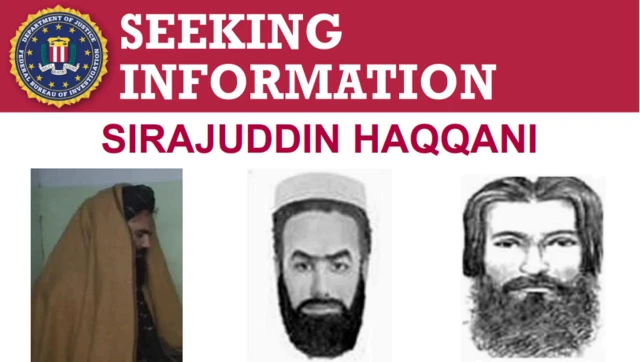
Image source,FBI
Image caption,The bounty on Sirajuddin Haqqani – pictured in his wanted FBI poster, before the Taliban returned to power – was dropped last year
But then, six months after the US withdrawal, Haqqani marched out in front of the world’s cameras at a graduation ceremony of police officers in Kabul, his face uncovered.
It was the first step towards a new image: no longer a militant, but a statesman – one with whom the New York Times would sit down in 2024 and ask: is he Afghanistan’s best hope for change?
Just a few months later, the FBI would quietly drop the $10m bounty on his head.
Yet analysts and insiders repeatedly told the BBC that openly moving against supreme leader Akhundzada was unlikely.
Arguably the most visible opposition to his edicts had been minor and limited – for example not enforcing regulations like the ban on shaving beards in regions controlled by Kabul group-aligned officials. But larger acts of rebellion have always been considered unthinkable.
One former Taliban member emphasised to the BBC that “obedience to [Akhundzada] is considered mandatory”.
Haqqani himself, in his interview with the New York Times, played down any chance of an open split. “Unity is important for Afghanistan currently so we can have a peaceful country,” he said.
Instead, one analyst said, the Kabul group is choosing to send “a message to both the international community and Afghans”, one which says: “We are aware of your complaints and concerns, but what can we do?”
At least, that was the case before the order came to shut down the internet.
A breaking point
The Taliban’s supreme leader is a man with a deep distrust of the internet; he believes its content to be against Islamic teachings, and is so dedicated to his belief that an aide reads out the latest news or social media posts to him each morning instead, his spokesman once explained to the BBC.
The Kabul group believe that a modern country cannot survive without it.
The supreme leader’s internet shutdown order began in provinces controlled by Akhundzada’s allies, before it was expanded to the whole country.
Sources close to the Kabul group and within the Taliban government described what happened next – an almost unprecedented moment in the Taliban’s history.
“It surprised many members of the movement,” one source said.
In short, the Kabul group’s most powerful ministers came together and convinced Kabul-based Prime Minister Mullah Hassan Akhund to order it switched back on.
In fact, the group had already made its unhappiness with the edict known before the internet was cut across the country: the group’s de-facto leader, Baradar, travelled to Kandahar to warn one of Akhundzada’s most loyal governors that they needed to “wake him up” – adding they had to stop being the supreme leader’s “yes” men.
“You don’t tell him the truth openly; whatever he says, you just implement,” he was reported as saying by a Kandahar insider.
His words, the source said, were dismissed. On Monday, 29 September, an order came into the telecommunications ministry directly from the supreme leader to shut everything down. “No excuses” would be accepted, a source in the ministry told the BBC.
On Wednesday morning, a group of Kabul group ministers – including Baradar, Haqqani and Yaqoob – gathered at the prime minister’s office, joined by the telecommunications minister. Here, they urged the Kandahar-aligned prime minister to take charge and reverse the order. According to one source, they told him the full responsibility lay with them.
It worked. The internet returned.
But perhaps more importantly, within those few days, it was as if what Akhundzada had hinted at in that speech months earlier had come to pass: insiders were threatening Taliban unity.
But why this order? One expert points out Taliban members have been happy to follow Akhundzada despite disagreeing with edicts like the ones on girls’ education.
Meanwhile, many of those who had challenged him openly before had paid a price.
In February 2025, the then-deputy foreign minister had to flee the country after warning publicly the leadership was straying from “the path of God” in “committing injustice against 20 million people” – a reference to the female education ban.
UN monitors point to at least two others who have been arrested after questioning Akhundzada’s decrees on girls’ education, in July and September 2025.
But there is also evidence of Akhundzada and his allies moving to keep figures like Haqqani close – despite the latter’s public criticisms of the supreme leader’s consolidation of power.
Even so, tipping over from words into actions and so decisively disregarding an order was arguably another step all together.
As one expert points out, this time it may have been worth the risk.
Their positions come with power and an “ability to make money”, the expert says. But both depended on the internet, now crucial to both governing and commerce.
“Turning off the internet threatened their privileges in a way that keeping older girls out of education never did,” the expert points out.
“Maybe that’s why they were ‘brave’ that one time.”
After the internet was turned back on, speculation was rife about what would happen next.
A source close to the Kabul group suggested the ministers will be slowly removed or demoted.
However, the Kandahar insider suggested it might be the supreme leader who backed down “because he fears such opposition”.
As the year drew to an end, it appeared publicly that nothing had changed.
The letter to the UN Security Council noted some UN member states “have downplayed the division between leaders in Kandahar and Kabul as akin to a family dispute that would not alter the status quo; all senior leaders are invested in the success of the Taliban enterprise”.
Zabiullah Mujahid, the senior Taliban government spokesman, has categorically denied any split.
“We will never allow ourselves to be divided,” he told the BBC in early January 2026. “All officials and leadership know that a split can be harmful for all, for Afghanistan, religiously prohibited and forbidden by Allah.”
However, he did also acknowledge that differences in “opinion” exist among Taliban members, but equated it to “a difference of opinion in a family”.
Half way through December, those “differences” had appeared to surface once more.
Haqqani was filmed addressing a crowd in his home province of Khost during Friday prayers, warning that anyone who “gets to power through the nation’s trust, love and faith and then abandons or forgets the same nation… is not a government”.
The same day, Akhundzada loyalist Neda Mohammad Nadem – the higher education minister – made his own speech to graduating students at a madrassa in a neighbouring province.
“Only one person leads and the rest follow orders, this is a true Islamic government,” he said. “If there are too many leaders then problems will emerge and this government that we have achieved will be ruined.”
After the dispute over the internet, these recent comments are set against a very different backdrop to those made by Akhundzada in the leaked audio at the start of 2025.
Yet whether 2026 will be the year that the Kabul group move to make meaningful change for the women and men of Afghanistan is very much still up for debate.
“As ever… the question remains after apparent disagreement within the Emirate’s top tier – will words ever lead to action?” says one expert.
“They haven’t yet.”
Edited and produced by Zia Shahreyar, Flora Drury and the BBC Afghan Forensics team. Top image shows two members of the Taliban looking out over Kabul in January 2022.
Rift at top of the Taliban: BBC reveals clash of wills behind internet shutdown
Kabulov cited the U.S.’s hostile approach and imposition of sanctions on Afghanistan as the reason for this stance.
The special envoy of the Russian President for Afghanistan has said that Moscow and Washington have not had any direct contact or dialogue regarding Afghanistan so far.
Zamir Kabulov told the TASS news agency that in 2023, during a meeting on Afghanistan led by the UN Secretary-General in Doha, he and China’s representative refused to be part of a team with the United States.
Kabulov cited the U.S.’s hostile approach and imposition of sanctions on Afghanistan as the reason for this stance.
Kabulov added: “Tom West and I were present there. However, the Chinese special envoy for Afghanistan and I told the UN Secretary-General that we cannot be part of a team with a country that has stolen the Afghan people’s money and refuses to return it.”
The Russian President’s special envoy for Afghanistan also stated that Afghanistan’s economic activities are affected by sanctions, and Russia will cooperate with Afghanistan in this area if the opportunity arises.
Janat Faheem Chakari, a political analyst, stated: “What’s important is that in the competitive and tense regional environment, we adopt a policy that allows us to benefit from Russia which has now recognized the Islamic Emirate and also maintain good relations with China and the U.S., including economic and political interactions with them.”
Russia is the only country that has officially recognized the Islamic Emirate of Afghanistan and maintains strong political and economic ties with it.
Russia Rejects Direct Talks with US Over Afghanistan
The Ministry of Refugees and Repatriation says that over the past nine months, 108 Afghan families have returned to the country from Tajikistan.
Amid the large-scale return of Afghan migrants from Iran and Pakistan, a number of Afghan migrants have also returned to Afghanistan from Tajikistan.
The Ministry of Refugees and Repatriation says that over the past nine months, 108 Afghan families have returned to the country from Tajikistan.
The ministry’s spokesperson said assistance to these families is being provided in accordance with established procedures.
Abdulmutalib Haqqani, spokesperson for the Ministry of Refugees and Repatriation, said: “Returning citizens have received assistance in line with the established guidelines after registration. They have also been referred to relevant departments to facilitate access to basic services and are being transported with dignity to their areas of origin.”
While the large-scale return of Afghan migrants from neighboring countries, particularly Iran and Pakistan, continues, it has brought challenges including inadequate infrastructure and a lack of employment opportunities.
Some migrant rights activists are calling for the creation of sustainable resettlement conditions, access to basic services, and job opportunities to support the effective reintegration of returnees into society.
Abdul Razzaq Adil, a migrant rights activist, told TOLOnews: “Tajikistan has never been a major destination for Afghan migrants and has stricter asylum policies. Returns from this country are largely voluntary rather than the result of widespread forced deportations. The role of international organizations regarding returnees from Tajikistan is more supervisory and protective than large-scale humanitarian assistance, as UN aid infrastructure along the northern borders is not as extensive as along the southern and western borders.”
Another migrant rights activist, Ali Reza Karimi, said: “After returning, these families face serious challenges, including unemployment, poverty, lack of job opportunities, inadequate housing, limited access to education, restrictions on basic services, as well as social and security issues.”
Earlier, the United Nations reported that nearly 1,600 Afghan nationals were deported from Tajikistan in 1403 (2024).
Afghan Families Return from Tajikistan Amid Regional Migrant Influx
According to them, the returnees received initial aid, and land has also been allocated to eligible families for shelter.
Officials at the Kandahar Directorate of Refugees and Repatriation say that during the past year (2025), a total of 492,028 individuals, including 32,829 prisoners, returned to Afghanistan via Spin Boldak.
According to them, the returnees received initial aid, and land has also been allocated to eligible families for shelter.
Nematullah Ulfat, Deputy Head of the Kandahar Directorate of Refugees and Repatriation, said: “From the beginning to the end of 2025, 77,394 families, totaling 492,028 individuals, returned from Pakistan through Spin Boldak. Among them, 32,829 were released from Pakistani prisons and repatriated.”
Many of the recent returnees believe Pakistan is no longer a suitable place for Afghans to live.
Jawed Ahmad, 30, who returned after a long and difficult stay in Pakistan, said Pakistani police often find different excuses to harass and deport Afghans.
He told TOLOnews: “There were many problems. I worked as a laborer and bought a motorcycle, but I was shot in the leg by robbers who stole it. I had just enough money at home to pay doctors for treatment. Now I need surgery, but I have no money.”
Another recent returnee, Ali Mohammad, said: “We need support. We have no land, and we lack basic household items.”
According to reports, Pakistan has dismantled refugee camps in Balochistan that had existed for decades and has forcibly removed Afghan refugees from the area, leading to a sharp decrease in the number of Afghans living in Pakistan.
Over 492,000 Afghans Returned via Spin Boldak from Pakistan in 2025
In 2025, AAN followed many major developments in Afghanistan as the Islamic Emirate continued to consolidate its rule, implementing its ‘vice and virtue’ law and making efforts to control the narrative about its rise to power in books, films and on TV. We examined the consequences of the United States stopping all aid and the mass return of Afghans from Iran and Pakistan. We also traced the difficulties now for women trying to get a divorce and the slightly easier situation for those trying to inherit, as well as the slowly mounting international legal efforts to hold the Taliban accountable for curbing the rights of women and girls. Among the 50 reports published last year, we also delved into longer-term trends, such as the changing role of rural mullahs in Afghanistan and how climate change is affecting urban water supply and the all-important wheat harvest. Kate Clark has been taking a look back at 2025 – what we wrote and which reports you were most interested in reading – and, as 2026 begins, introduces some of AAN’s research plans for the coming year.What we wrote in 2025In 2025, the Islamic Emirate of Afghanistan (IEA) celebrated its fourth anniversary of rule. United Nations and United States sanctions remain in place and the Emirate has yet to occupy the country’s UN seat. Although to the north, relations with its Central Asian neighbours look increasingly solid, based on mutual, pragmatic, economic concerns, Pakistan and Iran continued their mass return of Afghans and there were clashes and border closures along the Durand Line. The US also cut all aid. Even so, the IEA appears increasingly confident.
Our coverage looked at many of these issues, drilling down into the IEA promoting its version of recent history in books,films and on TV, and by banning books and closing whole university courses. Allied to the re-establishment of the Emirate, we looked at how members of the Taliban are moving into the private sector in urban areas and at the rise of a once fairly marginal group, rural mullahs, politically and economically and in terms of learning. Part of the consolidation of IEA rule has also been about taking control of resources, including mines and through urban planning, and attempting to control how men and women should dress and behave – see our reports on the IEA’s vice and virtue law, an Islamic scholar’s reading of it, how it is being implemented and a full translation. A dossier of reports on women’s rights brought together all of our publications on women since the re-establishment of the Emirate. We also published two separate reports on women’s struggles to get a divorce (now almost impossible) and secure their inheritance (which the Emirate backs, so now slightly easier, despite continuing opposition from many families and communities).
We also covered some positive stories: drought-resistant wheat seed that saved at least some Afghan farmers from catastrophic crop failure in dry 2025 and a decline in blood feuds in Khost province and areas of life where little seems to have changed since the days of the Republic, such as the maddening struggle that Afghans face trying to negotiate state bureaucracy.
What sort of reports were prominent in 2025?
At AAN, we try to cover a broad range of topics, aiming to cover eight thematic categories:
Culture and Context
Economy, Development and the Environment
International Engagement
Migration
Political Landscape
Regional Relations
Rights and Freedoms
War and Peace
Whether a particular category features more or less strongly in our publications varies from year to year. Before 2021, reports on the theme of War and Peace often topped the list. Last year, we only published one report in that category, on allegations that British special forces had carried out dozens of summary executions in Helmand province in 2010-2013. Instead, reports to do with the Economy, Development and the Environment and Rights and Freedoms dominated our research agenda (see the table below).
Publications by Thematic Category
Economy, Development, Environment
16
Rights and Freedoms
13
Context and Culture
7
Migration
5
Political Landscape
4
International Engagement
1
War and Peace
1
Regional Relations
1
Dossier of reports on women’s rights
1
Resources
(a full translation of the vice and virtue law)
1
Total
50
What you read in 2025
We also monitor how many readers each individual report gets. Looking through the list of AAN reports that were most widely read in 2025 (see the list at the end of this report), some clear themes emerge: reports about women occupied the top four slots, with Afghan men’s thoughts about the curbs on women’s rights also coming into the top-twenty most-read publications.
Reports exploring Taliban policy and thinking also featured strongly: for example, on the vice and virtue law and a 2023 report on how former Taliban fighters had experienced living in the capital – a surprisingly positive read. Analysis of the impact of the US decision to abruptly cut all aid to Afghanistan, when it had supplied 40 per cent of aid in 2024, was widely read. There were also reports with a very long shelf life: two reports on cannabis – production and consumption – published in 2019 and another from 2020 on the largest standing Buddhist stupa in Afghanistan, again made the top-twenty most-read reports. Historic insights, such as the continuing impact of the PDPA, with a piece written on its 60thanniversary, also featured.
As for our readers in Dari and Pashto, a rare look at the portrayal of Afghanistan’s Uzbeks, published in 2015, again topped that most-read list (English version: ‘From ‘Slavers’ to ‘Warlords’: Descriptions of Afghanistan’s Uzbeks in Western writing’), along with reports on how people who live along the Durand Line are faring in the wake of Pakistan fencing the border, the 2024 Herat earthquake and reports on opium and the wider economy (see the list of most-read reports in Dari and Pashto at the end of this report).
The year ahead
Several themes are already emerging for our research this year. Migration looms large, both returns from Pakistan and Iran and potentially from Europe (including what that could mean for Emirate relations with European countries), and the continuing push to leave. We will continue to follow Taliban policies and actions on women’s rights, but also look into less-covered social dynamics, for example, the evolution of authority within families and communities. Climate change will again be a major topic, as will other environmental issues, including how pollution affects people and the economy, and the crucial issue of land ownership.
Early reports on our agenda include a scrutiny of Afghanistan’s police force under the Taliban. Much was written about police during the Islamic Republic, but, as far as we know, this will be the first look at the Emirate’s police force – their numbers, training, priorities and what the Emirate believes the police are for. We are also looking into radio education, a growth sector since the Emirate stopped education for girls beyond grade six, but is it useful and engaging? Is it, in any way, an alternative to school?
We began this year with a review of a book written in the last century and recently translated from Bengali to English, Mujtaba Ali’s Shabnam. The author had been a teacher in Kabul in the 1920s and his novel draws on his experiences at King Amanullah’s court, including during its overthrow, as well as on Persian epic poetry and mystical traditions. The review of Shabnam will be the first of several reports marking 100 years since the failure of that significant period of reform in Afghan history.
Finally, as 2026 begins, we wish all our readers – and Afghanistan – a Happy New Year.
The United Nations says aid workers are still in a “race against time” to remove rubble and rebuild after the devastating earthquake struck eastern Afghanistan last month, killing at least 2,200 people and cutting off remote areas.
The 6.0-magnitude quake on Aug. 31 was shallow, destroying or causing extensive damage to low-rise buildings in the mountainous region. It hit late at night, and homes — mostly made of mud, wood, or rocks — collapsed instantly, becoming death traps.
Satellite data shows that about 40,500 truckloads of debris still needs to be cleared from affected areas in several provinces, the United Nations Development Program said Wednesday. Entire communities have been upended and families are sleeping in the open, it added.
The quake’s epicenter was in remote and rugged Kunar province, challenging rescue and relief efforts by the Taliban government and humanitarian groups. Authorities deployed helicopters or airdropped army commandos to evacuate survivors. Aid workers walked for hours on foot to reach isolated communities.
“This is a race against time,” said Devanand Ramiah, from the UNDP’s Crisis Bureau. “Debris removal and reconstruction operations must start safely and swiftly.”
People’s main demands were the reconstruction of houses and water supplies, according to a spokesman for a Taliban government committee tasked with helping survivors, Zia ur Rahman Speenghar.
People were getting assistance in cash, food, tents, beds, and other necessities, Speenghar said Thursday. Three new roads were under construction in the Dewagal Valley, and roads would be built to areas where there previously were none.
“Various countries and organizations have offered assistance in the construction of houses but that takes time. After the second round of assistance, work will begin on the third round, which is considering what kind of houses can be built here,” the spokesman said.
Afghanistan is facing a “perfect storm” of crises, including natural disasters like the recent earthquake, said Roza Otunbayeva, who leads the U.N. mission to the country.
 Afghanistan Peace Campaign