Recent reports emerging from Kabul indicate that the Afghan Taliban may be adopting a tactic reminiscent of those used during their 1990s insurgency: positioning themselves or allied militants in areas considered too sensitive for opponents to strike, according to the Associated Press of Pakistan.
Security officials and regional analysts say high-ranking figures from globally proscribed militant organisations are allegedly being sheltered by the Taliban within Kabul’s tightly guarded diplomatic quarter, particularly in the Wazir Akbar Khan neighbourhood of the Green Zone.
Critics view this as a deliberate attempt to shield militant leaders from potential targeted operations by Pakistan or other neighbouring states.
The strategy echoes patterns seen during the Afghan civil war. In September 1995, Taliban fighters reportedly used the “German Club” — an international facility in Kabul — as overnight accommodation, knowing rival Afghan factions would avoid attacking the site due to the presence of foreign personnel.
Observers say the current situation appears to mirror that earlier tactic: positioning key militant figures in areas where military action could risk diplomatic fallout or civilian harm.
According to intelligence-based claims circulating in regional media and security circles, several individuals linked to Tehreek-e-Taliban Pakistan (TTP) and other militant networks are believed to be operating from locations within or near Kabul’s diplomatic enclave. Among those reportedly present are TTP leader Noor Wali Mehsud, militant commander Hafiz Gul Bahadur, Baloch militant figure Bashir Zeb, as well as militants originating from Central Asian states.
The area of particular concern is Wazir Akbar Khan, a district that hosts embassies, international organisations and residences of diplomats and United Nations staff. The presence of militant figures in such a location would complicate any attempt by foreign governments to conduct targeted operations against them.
A prominent Pakistani journalist has also publicly referred to similar claims, stating that international organisations and diplomatic personnel working in Kabul have privately raised concerns with Taliban authorities about the presence of armed militants near diplomatic compounds..
According to the journalist, some UN personnel and international NGO staff have expressed security concerns and may consider relocating if the situation deteriorates further. The Afghan Taliban leadership has repeatedly denied that members of TTP operating in Afghanistan should be regarded as terrorists.
In a recent interview, Mullah Mohammad Yaqoob, Afghanistan’s acting defence minister and son of the late Taliban founder Mullah Omar, described TTP members as “refugees” rather than militants. “Who can explain to Pakistan that your terrorist is not our terrorist?” Yaqoob remarked, suggesting that the Taliban government does not share Islamabad’s designation of the group.
However, TTP is widely recognised internationally as a terrorist organisation. The United Nations Security Council, the United States and several other governments have designated the group as responsible for numerous attacks in Pakistan, including suicide bombings and assaults targeting civilians, security forces and educational institutions.
Yaqoob’s remarks effectively acknowledged that TTP members are present in Afghanistan, although he framed their presence as that of displaced individuals rather than organised militants.
Analysts have noted parallels between the Taliban’s current stance and the position adopted by the group prior to the United States-led intervention in Afghanistan in 2001.
Following the September 11 attacks, the international community demanded that the Taliban hand over Osama bin Laden, the leader of al-Qaeda accused of orchestrating the attacks. Taliban leader Mullah Mohammad Omar — father of Mullah Yaqoob — refused, describing bin Laden as a “guest” protected under Afghan traditions of hospitality.
At the time, the Taliban government maintained that bin Laden had taken refuge in Afghanistan and would not be surrendered to the United States without evidence being presented in an Islamic court. The refusal ultimately led to the US-led military intervention in October 2001.
Under the banner of the International Security Assistance Force (ISAF), a coalition of more than 50 countries participated in the campaign against al-Qaeda and Taliban forces.
Nearly a quarter of a century later, critics argue that similar reasoning is again being used by the Taliban leadership to justify the presence of militant groups inside Afghanistan.
Multiple international reports indicate that Afghanistan continues to host a wide range of militant organisations with regional and global agendas.
According to the United Nations Analytical Support and Sanctions Monitoring Team, more than 20 militant groups are believed to be operating in Afghanistan, maintaining training facilities, logistical networks and safe havens across different provinces.
Groups frequently cited in UN and Western intelligence assessments include al-Qaeda, TTP, Islamic State Khorasan Province (ISIS-K), the Islamic Movement of Uzbekistan, the East Turkestan Islamic Movement — also known as the Turkistan Islamic Party — Katibat Imam al-Bukhari, the Islamic Jihad Group and Jamaat Ansarullah, a Tajik militant organisation.
Uzbekistan, Tajikistan, Russia and China have also called on the Afghan Taliban to eliminate militant groups that they view as threats to Central Asia, China, Russia and Pakistan.
However, the Taliban have consistently denied hosting terrorists, arguing that some members of banned organisations have taken refuge in Afghanistan after being outlawed in their home countries, including China, Tajikistan, Uzbekistan, Russia and Pakistan.
The UN Security Council Monitoring Team’s 2023–2024 report noted that al-Qaeda continues to maintain ties with the Taliban and operates training facilities in several Afghan provinces. The report also stated that foreign fighters from Central Asia, the Middle East and South Asia remain active in the country.
Similarly, assessments by the US Department of Defence and the US intelligence community have warned that Afghanistan risks becoming a safe haven for transnational militant groups.
A 2023 US congressional report stated that while ISIS-K remains the most visible external threat, al-Qaeda affiliates and other regional jihadist organisations continue to maintain networks across Afghanistan.
According to the US Treasury Department, al-Qaeda leaders have been able to operate within Afghanistan under Taliban protection, maintaining communication networks and facilitating recruitment and training.
Security analysts warn that the presence of multiple militant organisations in Afghanistan could pose a wider regional threat extending beyond Pakistan.
Central Asian governments have also expressed concern about militant groups composed of Uzbek, Tajik and Uyghur fighters operating within Afghanistan. Russia, China and several Central Asian states have repeatedly raised the issue in international forums.
Observers say the situation presents a complex challenge for the international community.
Unlike the period following the 9/11 attacks, when a large multinational military coalition operated in Afghanistan, there is currently no unified global military presence in the country.
As a result, regional actors — particularly Pakistan — have increasingly found themselves on the frontline in confronting militant groups that operate across porous borders.
Analysts argue that enhanced counter-terrorism cooperation and international engagement will be essential in preventing Afghanistan from once again becoming a hub for transnational militancy.
Taliban under fire for hosting designated terrorists in Kabul’s Diplomatic Hub
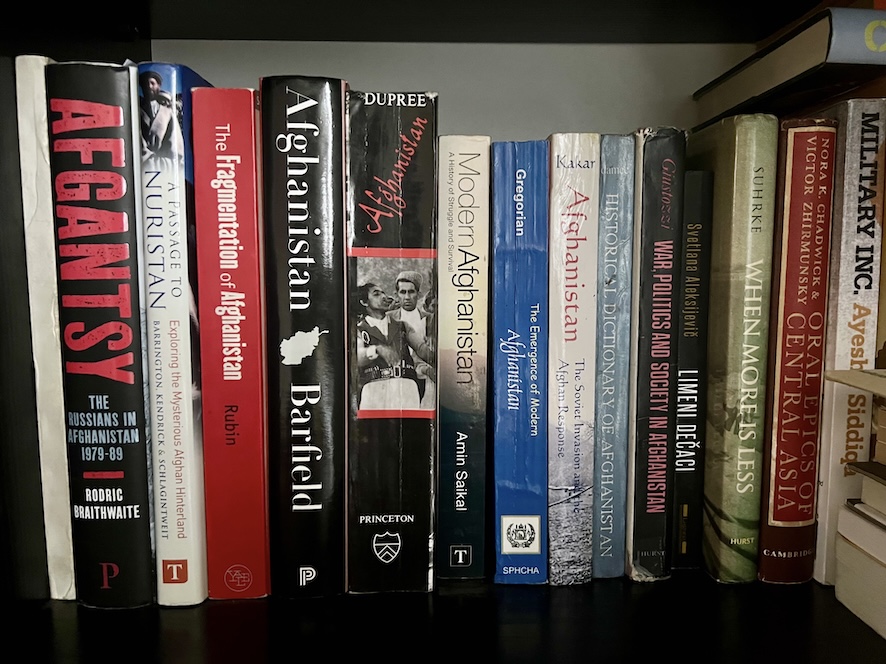
Today, we bring you some book reviews. We asked AAN writers and friends to recommend books about Afghanistan that they had enjoyed. Their choices are an eclectic mix, ranging from the scholarly to the journalistic, memoirs and travelogues to novels and short stories, and even a podcast. Our reviews begin with fiction: a collection of short stories by Afghan women and then three novels, followed by three travelogues (two Swiss women each writing about their journey to Afghanistan in the 1930s and an academic scrutiny of the ‘Hippie Trail’), a world history podcast, which often features Afghanistan, and finally a closer look at the Qatar-hosted negotiations between the Taliban and the United States. As we said, it is an eclectic mix …
Photo: AAN, 2025.
My Pen is the Wing of a Bird: New fiction by Afghan women, Grand Central Publishing, New York/Boston, 2022
My Pen is the Wing of a Bird is a collection of short stories by Afghan women translated into English, with an introduction by the famous BBC chief international correspondent, Lyse Doucet (who was based in Kabul in 1988-89 and has visited Afghanistan ever since) and an afterword by Lucy Hannah, the founder and co-director of Untold Narratives, a social enterprise that seeks to support writers from marginalised communities.
These are powerful and breathtaking stories that take you directly into the heart of society in Afghanistan. Although they are fiction, they reflect the realities of Afghan society, the economic problems Afghans face, and especially the hardship and struggle of Afghan women facing misogyny, patriarchy and domestic abuse.
All the stories are interesting. As I read them, I felt as if I was seeing some of the scenes with my own eyes. One story, ‘Ajah’, written by Fatema Khavari and translated by Zubair Popalzai, caught my attention. In the story, Ajah is a descendant of Ibrahim Khan ‘Gawsawar’(the Bull Rider), the Hazara leader who stood against the oppression of the Afghan king and his prime minister, who were then unfairly taxing Hazaras.[1] She is nicknamed ‘Ajah Ayyub’ in her village because, despite not having children, she has come to be known as ‘grandmother’ (Ajar) and she is patient like the Prophet Ayyub (in English, Job), who resisted Satan’s temptations in the face of God’s trials. The story tells of Ajah’s many trials and how, with patient determination, she overcomes them.
Ajah, born in 1905 in the Chimtal district of Balkh province, was seven years old when a tuberculosis outbreak left her orphaned. The mullah of the village mosque looked after her and took her to see the land she had inherited from her parents. “I am too old now to help you farm this land,” he told her, “but can help you sell it.” Ajah shook her head in disagreement and told him he could help her plan an orchard instead. The imam was surprised and smiled at her: “An orchard is a good idea. The trees will grow together with you.” This short conversation illustrates how smart and ambitious the young Ajah already was and that she had foresight.
The final episode of the story is particularly compelling. An earthquake has struck the area. There are few men in the village because they are off serving in the army, so the women are tending the animals and farming the land. Soon after, Ajah travels to Shah Alborz, a mountain she climbs every year to harvest a medicinal plant, badra, and sees how the earthquake has opened a deep fissure stretching from the base of the mountain right down to her village. The village was in danger. When the snow melted, the new ravine would channel the water directly down to the village, flooding it and destroying both homes and crops.
When she returned home, she gathered the villagers together and showed them the gully, warning them of the impending flood. The village chief, Khalil, dismisses her concerns, saying he had never seen a flood in all his years, while Ajah kept insisting that the landscape had changed. Disaster was imminent.
“So, what do you suggest?” the old man sneered.
“We dig a channel to divert the water and save the village.”
“Who will dig? All the young men are gone. Should children and elders do it?”
“The women will. We’ll take turns.”
“Nonsense, Ajah. Digging is men’s work.”
“Is it?” replied Ajah, adjusting her scarf as she walked away.
Ignoring mockery from Khalil and whispers from other women, Ajah began digging alone at the edge of the village. For a month she worked, until her channel reached the river.
When the heavy rains did come, floodwaters destroyed most of the village, sparing only Ajah’s house and orchard. “Days later,” the story continues, “in the dim morning light, she stood before her mirror, braiding her greying hair. She put on a green and yellow hat, covered it with a red floral scarf, and stepped outside where her chickens pecked in the courtyard.” Ajah had decided to dig a drainage channel from the base of the mountain. She began single-handedly, but not for long.
Other women, initially curious, soon joined her. Together, they dug a long trench. When the heavy rains returned, the new channel successfully diverted much of the floodwater away from the village, protecting their lands and proving the power of their collective work.
The narrative highlights the value of female cooperation and solidarity, since Ajah’s tenacity motivates others to work together with her. Their connections are strengthened and a sense of community is fostered by their shared experiences working together. In addition to saving their farmland, the successful completion of the diversion channel makes a strong statement about the efforts and capacities of women.
Anyone who wants to understand the human spirit behind the headlines should read this. Even after finishing the book, I could not get these stories out of my head. I highly recommend it.
Burnt Shadows by British Pakistani author Kamila Shamsie begins in Nagasaki on the day of the bomb and ends in Guantanamo. The story moves between countries and continents, circling Afghanistan as it does so, before eventually crossing the border in the final third. The characters endure globally significant wars, invasions, occupations, other disasters and the fall of regimes, responding with marriage, migration and learning to live in new lands.
Shamsie draws her characters from different countries and continents. At the start, there is Hiroko, a Japanese teacher whose German fiancé is killed in the atomic blast, his sister, Elizabeth, who is living in pre-Partition Delhi, masquerading as fully English with her British lawyer husband, in the last days of the Raj and his clerk, Sajjad, who ends up teaching Hiroko Urdu. Afghans enter later. This is a big canvas, both in terms of time and geography, but Shamsie is a deft and compelling storyteller, managing to portray places and events for which only her imagination and research can have prepared her. Indeed, the portrayal of her native Pakistan was the least compelling in the book. Maybe she was less interested in it. Or maybe, like a fish swimming in the ocean, she found it more difficult to relay what was distinctive about her homeland, although she did take the reader on a memorable journey to Karachi’s fish market in the early 1980s, all stink and slipperiness.
Home is a major theme of this story of migrants: how a Japanese-Pakistani boy might finally feel at home among Afghans, how people find family among those who should be strangers and how a homeland under threat can drive resistance – and betrayal. The novel is also very much about place – an “impossibly blue sky,” the “light in Afghanistan. Like nowhere else,” recalls a refugee in exile. At the novel’s opening, we find Hiroko, because of the needs of the war, working in a munitions factory, where she “spends her days measuring the thickness of steel with micrometers, images of classrooms swooping into her thoughts the way memories of flight might enter the minds of broken-winged birds.” A place might, possibly, survive the sweep of history. On what the reader knows will be the eve of Partition, Sajjad, who is from Dilly (the local name for old Delhi), insists to his British employer:
‘Either way it won’t matter to me. I will die in Dilli. Before that, I will live in Dilli. Whether it’s in British India, Hindustan, Pakistan that makes no difference to me.’
‘So you keep saying. I think you’re talking nonsense.’
‘Why nonsense? The British have made little difference to the life of my moholla.’ At James’s look of confusion he translated ‘neighbourhood’, barely disguising his impatience at the Englishman’s failure after all this time to understand that all-important Urdu word. ‘It goes on as it has gone on. Yes, there are interruptions – 1857 was one, perhaps the departure of the British will be another – but believe me over the next century Dilli will continue to do what it’s been doing for the last two centuries – fade at a very slow, and melancholically poetic, pace.’
This exchange drives home another of the novel’s themes – who ‘gets’ a new place? Whether it is the British in India, the Americans in Afghanistan, or Afghan refugees in Pakistan and the United States – and whether that place itself will endure, buffeted, like the novel’s characters, by the whims of history.
Reviewed by Kate Clark
The Almond Garden of Kabul, Mandana Hendessi, Afsana Press, London, 2026
Mandana Hendessi’s The Almond Garden of Kabul is not an easy read. It is not meant to be. Set in Kabul’s main women’s prison Badam Bagh (which translates as ‘almond garden’) during the Islamic Republic of Afghanistan, the novel takes the reader inside a world defined by systemic social, cultural and institutional discrimination, a justice system skewed against women – especially if they are poor – and plagued by rampant corruption. Hendessi is a British-Iranian women’s rights advocate who worked in Afghanistan between 2008 and 2016 (biography here). The novel draws on her experiences visiting Afghan prisons and hearing the stories of women she met while working for an international NGO.
An engrossing work of fiction, the novelunfolds like a detective story set within the confines of a prison. The novel follows two inmates – Sultan and Setara – as they join forces with a small group of other prisoners to uncover the truth behind a young inmate’s desperate act of self-immolation. While the story moves with the momentum of an investigation, it is rooted in the real experiences of women Hendessi encountered during her years working in Afghan prisons.
The novel begins with a fire. A teenage prisoner, Niloofar — unable to continue enduring rape and psychological abuse at the hands of a corrupt prison official who traffics young inmates to wealthy Kabuli men, and blackmail from the man who filmed himself assaulting her and now threatens to expose the recording — commits a shocking act of protest. She sets herself on fire in the prison yard. The incident is witnessed by one of the novel’s protagonists, Sultan, a transgender prisoner who “walked like a man and had once killed one – her abusive husband.” Sultan rules the prison “like a tribal chief: part protector, part tyrant, carved from the same stone that had scarred her.”
Determined to understand what drove Niloofar to self-immolate, Sultan forged an unlikely partnership with the prison’s letter writer, Setara – a teacher and artist who is in prison for a murder she did not commit. They are joined by several other inmates in their quest to piece together what happened to Niloofar. In doing so, the women begin to expose deeply entrenched injustices in the very institutions that are meant to protect them.
Niloofar’s shocking act of resistance drives the narrative from an individual act of protest to collective action, some detective work and ultimately to a reckoning – not a complete one, but one that leaves the reader with a measure of hope. While it does not offer a neat resolution, the novel ends with a suggestion that something has shifted, that the women have claimed their voices and that change, however tenuous, is possible. Along the way, there are moments of intimacy and tenderness: sharing a cup of tea and a piece of bolani, caring for a dying inmate, reading poetry together. The bonds that take hold between the women do not erase trauma, but they do transform the women from victims into active rebels.
The name of the prison, Badam Bagh, which also gives the novel its name, comes from the almond trees that surround it. They bloom in winter, something much admired by Sultan, who sees them “daring to bloom at a time when no other fruit tree would challenge the brutal Kabul winters.” The trees are thus more than a setting – they are a subversive presence. The imagery of trees blossoming in winter reminds the reader that survival is possible and that truth can emerge even in the harshest of seasons. This is a novel that lingers in the mind – unsettling, provocative and profoundly moving.
Reviewed by Roxanna Shapour
Jakob Hein, How Grischa Almost Triggered World Peace with a Daring Idea, Galiani, Berlin, 2025
For me, this hilarious novel by Leipzig-born Jakob Hein is the Afghanistan-related book of the season – although, I must be honest, it teaches you more about East and West Germany than Afghanistan.
It is the 1980s and the book’s hero, Grischa Tannberg, is an ambitious, fresh-from-university employee of the East German Ministry of Foreign Trade. He is condemned to what his boss, Ralf Burg, calls “artfully biding your time,” ensuring no one is aware that you actually have nothing to do. Burg tells Grischa why: “The Afghans have nothing. They would like to have books and machines from us and vehicles and consumer goods and fertiliser, everything we produce. But they have: nothing.” He is not fully right, and Grischa, unexpectedly, comes up with a daring idea for how the notoriously cash-strapped GDR can get its hands on some hard currency. It has to do with the variety of cannabis resin widely known as ‘Afghan Black’ (more on which in this AAN report) and it soon appears in the story:
“Put that away!” hissed the woman. “Do you want to get us both in jail? There are surely cameras everywhere here.”
“I know,” said Grischa. “But this is a perfectly legitimate shop, and I sell the medicinal cannabis completely legally. It’s a product of our brother state, the Democratic Republic of Afghanistan, top quality, and directly imported.” He showed her the item on the price list.
“But isn’t that illegal?”
“Perhaps it is in West Germany and West Berlin.”
Grischa’s idea – in order to not spoil the story, I will not outline it further – soon turns into a conundrum for West Germany. In the end, Grischa and his colleague, the attractive but unwavering biologist, Frau Dr Cornelia Frühling, go West, as part of a high-ranking delegation led by the (actual) infamous Stasi chief Erich Mielke to meet their capitalist German counterparts. The secret meeting takes place at the high-end farmstead-cum-restaurant, Alpenrose, owned by Mr Merz (haha!). With puns on the names of the current German chancellor and an actual Bavarian meatpacker (Josef März), the fictional Mr Merz is a character who has become rich (also in his real-life incarnation) selling East German meat in the West as “from the German lands,” without giving away its exact origin. Over dinner, which includes a spiked venison ragout, the two sides – East and West Germany – come to an agreement.
It is difficult to say what is fact and what is fiction in this novel. Afghanistan was indeed ‘democratic’ then, while hashish fields did indeed flourish. Grischa, while a fictional character, feels super real nonetheless. Like him, a fellow student of mine once ended up working at the GDR Solidarity Committee on Afghanistan, where, lacking much to do, he had to artfully bide his time. Another fact is that in 1983, East Germany was almost bankrupt and had to declare that to its creditors, while trying to raise hard currency by all means. That included selling weapons to both sides in the Iran-Iraq war, and possibly, although never proven, to the Afghan mujahedin, via a clandestine foreign trade company and the CIA.[2] Also, fresh meat had become increasingly scarce in East German shops. Erich Mielke was then the chief of the Stasi and – again fully true – while the arch-conservative and famously anti-communist Bavarian Prime Minister Franz Josef Strauss came to the GDR’s rescue with a billion-dollar loan, no one knew why. The loan – again, true – was negotiated by Merz/März through his East German meat-packing connections.
And, when it comes to Afghan Black: the first East German ambassador I served under once told me (long afterwards) that an official of the PDPA government had actually suggested to him to fly hashish to Berlin in the empty planes that were transporting East German aid supplies to Kabul. The ambassador said he refused …
Has author Jakob Hein, the psychiatrist-turned-writer, finally solved the riddle of why the anti-communist Bavarian Prime Minister Franz Josef Strauss, against his ideological convictions, saved the East German communist state for almost another decade? Unfortunately, this is unlikely. Grischa’s idea is just too good to be true.
There is one thing that Grischa’s boss, and Hein, get wrong: the Afghans don’t have nothing, even apart from hashish and opiates. The real-life Afghan-East German trade relationship was much more cynical than Hein presents it: what Afghanistan was then licitly exporting were the same products as today, fruit, dry fruit, carpets, etc. They were able to sell these products for hard currency, and the dollarless East Germans were interested but simply unable to become regular customers. Only before Christmas would Afghan raisins suddenly show up in East Berlin shops, bartered against whatever the Afghans were interested in. East Germany, for its part, wanted to sell Afghanistan ‘everything it produced’, but preferably for hard currency, too. Before Strauss’ mega-loan, many a mickle made a muckle, as the Scots say, for East Berlin.
Finally, there is just one real problem with this book (for most of AAN’s audience): it is only published in German. No English – or Pashto or Dari – translation so far. Any takers out there?
Reviewed by Thomas Ruttig
Ella Maillart, The Cruel Way, William Heinemann, London, 1947
Annemarie Schwarzenbach, All the Roads Are Open: An Afghan Journey, translated by Isabel Fargo Cole, Seagall Books, Calcutta, 2021
Originally published in English in 1947, The Cruel Way by Swiss adventurer and travel writer Ella Maillart is an account of her journey from Switzerland to Afghanistan with Swiss journalist and photographer Annemarie Schwarzenbach. Schwarzenbach’s own account of the journey, a lyrical travelogue, All the Roads Are Open, was published posthumously in German in 2000 and translated into English in 2011. The pair began their journey on 6 June 1939, just three months before the Second World War began in Europe.
Both women came from wealthy Swiss families. Maillart, the daughter of a fur trader, was a gifted sportswoman who competed in the 1924 Summer Olympics in yacht racing, while Schwarzenbach, who came from one of the richest industrialist families, was an accomplished intellectual, earning a doctorate in history at just 23. Both were progressive and modern for their time. However, the timing of their journey left many wondering whether this journey “was a means of escape from the impending doom of the war, especially given that they were both anti-fascists, or whether it was instead an attempt to cure Schwarzenbach of her addictions.”[3]
Despite the ensuing turmoil in Europe, they set off from Geneva on the 6,000-kilometre journey in Schwarzenbach‘s new Ford, a car with 18 horsepower,[4] to journal along the way, sample local cuisine and admire the landscapes. From Switzerland, they travelled to Italy, then through Yugoslavia and Bulgaria to Istanbul, where they took a boat across the Black Sea to eastern Turkey, and from there, via Azerbaijan and Iran, finally to Islam Qala, the Afghan border town. From Islam Qala they drove to Herat, and from there they continued on the then-newly built road, driving to Bala Murghab, Shebarghan, Andkhoi, Balkh and Mazar-e Sharif. They then headed south to Kabul, via Pul-e Khumri, Bamiyan and Band-e Amir and finally from Kabul east to Peshawar.
From the first edition of Maillart’s book, a map on the back inner cover.
Although their travel accounts are very different in style and tone, the two women shared a deep admiration for the rough beauty of Afghanistan’s rugged landscape. Schwarzenbach, for example, wrote:
Travelling journalists like to tell each other: “Spend six weeks in a country, and you’ll blithely write a book about it. Stay six months, and you’ll struggle to finish a few articles. If you stay six years, you’ll have nothing more to say.” … But the exceptions prove the rule, and the first time, coming from the north, from Turkistan’s blazing plain, when I reached the Hindu Kush and crossed its grandiose, historic passes, I was sorely tempted to write a hymn and nothing else. A hymn to its name, for names are more than geographic labels, they’re sound and colour, dream and memory, they’re mystery, magic…
Both authors write about the landscapes, culture, food, customs and people, as well as the difficulties they encounter on the journey, such as having to dig the car out of mud – and the local people who helped them – and the peculiar collection of tools they ended up with from the countries they drove through. Maillart wrote about a car incident in Islam Qala:
We approached a sandy ridge: spreading out like a pleated skirt, its base had covered the track and we launched the car through it since we had to reach a culvert forty feet ahead. It took us three hours to cover that distance.
Would we have started work if we had known our efforts would be so back-breaking? … We played with gears; the wheels backed, sank, whizzed; we sat studying the situation; we blistered our hands on our Yugoslav shovel; we pushed the Teheran gutters under the tyres; sweated like coolies under the hats from Trieste; we cursed in Russian and Swiss-German: each great offensive only gained us the length of the gutter.
Maillart’s book, which also features great photographs from the journey, is full of stories about particular places, be it local legends or historical accounts. For example, she recounts the legend of the Band-e Amir lakes:
King Barbar, an infidel, was oppressing his subjects. A man who had been searching for Hazrat Ali and found him near Haibak [sic], was ordered to bind that saint and bring him as a slave to the king. Ali was then asked to perform three tasks — kill the dragon of Bamian, build dams in a valley and lastly, save his own head. The dragon was killed. With mighty rage a rock was hurled down which built the Band-i-Haibat or Dam of Wrath [usually translated as ‘awe’]; while with his sword he clove the Band-i-Zulfikar, the Dam of the Sword [Zulfikar was the name of Imam Ali’s double-tipped sword]. Then Ali told Barbar to load him with chains. When he had rendered everybody senseless by reciting the Muhammadan profession of faith, he freed himself and converted King Barbar.
Maillart was fascinated by Afghans, much like Dame Rebecca West was by the Serbs (more on her book below) but her sentiments are often knotty and troubling to the modern reader – for example, the use of the derogatory word ‘coolie’ in the quotation above, or so many examples in the paragraph below:
Here, where the pattern of life remains unchanged, where the son thinks as his father did, men are still proud to be men. Meanwhile in the West where there is nothing but change, no-one knows what to think, nobody feels secure – least of all the rich – and that even in so-called peace time. Here, no more high-heeled sluts in short frocks: you’ve come to the country where women are not seen, where men are capped with snowy muslin and walk with heavy shoes like gondolas. You’ve come to a country that has never been subjugated – neither by Alexander the Great nor by Timur the Lame, neither by Nadir nor by John Bull. It is the Switzerland of Asia, a buffer-state without colonies or access to the sea, a country whose great hills shelter five races speaking three totally different languages, a country of simple hillmen and well-bred citizens …”
She admires what she sees as the Afghans’ unchangingness (were they really?) and their unbeaten strength – like her own nation, the Swiss – but also, apparently, that women are in purdah, while at the very same time, she castigates (other) rich European women for being loose, even as she herself enjoys the freedom to travel.
Both of these books belong to a different time and sentiment, a time of great female adventurers to what were then seen as the unknown, mysterious and to some extent savage parts of the world, captured in books like Dame Rebecca West’s Black Lamb and Grey Falcon: A Journey Through Yugoslavia, a book based on a six-week journey through the former Yugoslavia in 1937 (the book was published in 1941). West’s infatuation with my compatriots, the Serbs, which she saw as archetypes of courage and endurance, matches that of Maillart’s views about the Afghans, the fascination with ‘noble savages’. The two books under review are therefore not the smoothest of reads, belonging as they do to the era before Edward Said established Orientalism[5] as a critical lens for viewing Western accounts of ‘the East’ and of wider concerns about ‘othering’ in literature. Even with that caveat, however, they represent European women’s literature and travel writing of the early twentieth century.
Reviewed by Jelena Bjelica
Sharif Gemie and Brian Ireland, The Hippie Trail: A History, Manchester University Press, 2017
“Afghanistan seems to be the country that most affected the hippie trail travellers: it really seems to occupy a special place in their hearts.”
What was the Hippie Trail? Or rather, who were the travellers along this route and what were their experiences? Were they on a journey of spiritual enlightenment, on a hedonistic voyage of sex and drugs, or on an unremarkable tourist trip to foreign lands? The Hippie Trail of the 1960s and 1970s followed an overland route through Turkey, Iran, Afghanistan, Pakistan and India, with about half the travellers continuing on to Nepal. It has a place in Western culture as what the authors describe as a “minority experience” (with long-distance travel not being anything close to a universal European or American experience at that time). The trail was ephemeral and disordered, and as the authors argue, has not been studied in any satisfactory way:
…the trail had no official existence. No ceremony marked its opening or its collapse; no flag identified its territory; no organisation directed its travellers; no leader wrote its manifesto; no prominent philosophers attempted to make sense of it; no major novelists have written about it; and no archive has been created to preserve its memory.
The cultural artfacts left behind are mostly scattered memoirs and interviews with those who made the journey. The authors of The Hippie Trail: A History have assembled and analysed these stories and accounts, showing a diverse range of motivations and experiences of the young Western men and women who travelled east. Sharif Gemie is a retired professor of history who focuses his research on minority experiences in society and the lives of marginalised peoples. Brian Ireland is a cultural historian and former university lecturer whose research interests include popular culture and social transformations in the 1960s. Together, they bring the perfect skill set for researching the phenomenon of Western travellers on the Hippie Trail.
This book is the first academic analysis of the Hippie Trail, with previous publications having been stories of individual journeys, brief anecdotes, or collections of interviews. It is not, however, an attempt to analyse the local societies along the Hippie Trail in any comprehensive way, as the authors admit. Nor does it prominently feature the thoughts and feelings of locals about the foreign tourists travelling through their countries. Rather, for this cultural history of the foreign travellers along the Hippie Trail, the authors created a database of 80 journeys for their analysis of the ‘hippies’, even as they note that the majority of travellers rejected this label and described themselves as backpackers, hitchhikers, overlanders, nomads, shoestring travellers and by various other terms. The interviewees find the label ‘hippie/hippy’ to be a “a plastic, manufactured, artificial word” or to have a negative connotation of having a “wild, disorderly attitude.”
For the Hippie Trail, the authors use a start date of 1957 and an end date of 1978 – with Afghanistan soon entering a state of war and post-revolution Iran to close its borders to tourists. The authors note that eventually “the gentle, exotic dreams of enlightenment or joy in the East no longer made sense.” What is left is a collection of memories and life experiences that many participants found transformative. And in these memories Afghanistan stands out as a travellers’ favourite, versus the hectic and overpopulated India and Pakistan, and – surprisingly to modern travellers who have travelled in Iran and Turkey in recent years – an unfriendly society in Iran and the interviewees’ least favourite: eastern Turkey, with its aggressively unfriendly locals.
For readers looking for stories about travellers’ experiences in 1960s and 1970s Afghanistan, this book provides plenty of anecdotes and accounts. About a quarter of hippie trailers admitted that easy access to affordable narcotics was a motivation for their journey, and Afghanistan provided cheap, easy access to hashish, or harder drugs (like raw opium) if that was desired. However, those few addicted to hard drugs were generally disliked by most other travellers, and “the drug addict was scorned, not admired.”
It is not just drug use that has been over-exaggerated in the popular imagination, but also sex. There was the occasional sexual libertine, but Gemie and Ireland find that in general “There were few signs of a sexual revolution thriving on the trail,” and that “most found the weeks or months they spent on the road surprisingly austere and sexless.” Amusingly, the authors identify the men of the Hippie Trail as generally not being the sort of men to be successful with women or to be sexually active, neither at home nor on the road. In terms of the lack of free-love, accounts by disappointed men emphasised the poor gender ratio even in the later years, when women increasingly appeared on the trail (a 5 to 1 or even 10 to 1 male-to-female ratio, with many of the women not being single), plus the total lack of privacy for budget travellers. For the women, in addition to unwanted attention from fellow travellers, they noted the regular threat of harassment and assault by locals along the journey, but that Afghanistan was a relief compared to other countries along the Hippie Trail, with women often reporting “that they were left mercifully alone there” (mostly, but not completely).
Overall, the authors find that “Afghanistan seems to be the country that most affected the hippie trail travellers: it really seems to occupy a special place in their hearts.” The attitudes of travellers towards locals were usually positive, but obvious contrasts could be found, such as with a group of three Australian men who, annoyed by their bus stopping for prayers, mocked Afghans as “monkeys” and attempted to start a fight with them. The more common sentiment was “a warm affection for Afghanistan,” but not an accompanying admiration for Islam in the same way that the travellers had for the ‘Eastern mysticism’ of Hinduism and Buddhism (with an occasional exception for Sufism).
Gemie and Ireland also briefly entertain the argument by some writers who blame the decadence of the hippies for simultaneously causing the rise of Marxism in Afghanistan, by driving horrified locals into their communist arms, while conversely causing the Islamic Revolution in Iran. They quickly dispatch this idea as it gives far too much credit to tourists for events which were political-historical processes long underway well before their arrival.
The Hippie Trail does however, in the authors’ words, stand out as having a broader important effect on world travel, as “it was based on an astonishing change in attitudes to travel; it could be defined as the moment when young people suddenly became aware that it was possible to travel, without great difficulty, to places which had seemed as impossibly distant as India and Nepal.” For Western Europeans, British, Americans, Australians and others, it became apparent that world travel for purposes of leisure (as opposed to war, trade or religious pilgrimage) was no longer confined to a wealthy elite (eg, the ‘Grand Tour’ of Europe by upper-class young men in the 17th-19th centuries). For the travellers as individuals, they were “near-unanimous in their affirmations of the life-changing nature of the experience,” citing factors such as the exposure to new cultures, gaining an insight into different ways of living, and new forms of community (eg, groups of travellers). The authors’ view is that “the hippy trail should be considered as a form of secular, possibly spiritual, pilgrimage.”
Gemie and Ireland’s book is an academic analysis, with all that means for style of writing, extended argumentation and provision of evidence. Yet it is also an entertaining collection of stories and anecdotes that engages the reader, bringing to life and personalising the experiences of a generation of travellers who experienced the Hippie Trail – all within its appropriate analytical context.
Reviewed by Christian Bleuer
Empire: World History podcast, presented by William Dalrymple and Anita Anand
Empire is a podcast that romps entertainingly through world history, illuminating a great deal of Afghan history along the way. Its hosts are Anita Anand, a lively BBC broadcaster and author, and William Dalrymple, a jovial but renowned historian.
As someone who spent time in rural Afghanistan in the 1980s, I had long seen the country as the back of beyond, a land of tribes little touched by the outside world until the Soviets invaded. I was mistaken. It has been a place of world-shaping, world-shaking cultures and conquests since the time of Alexander. It sat along the world’s richest intercontinental trade routes, perched next to what were then the world’s most developed economies, China and India. Kabul has been a hotspot of learning and the arts for a millennium. It was from Kabul that Babur swept down to conquer much of India and establish the Mughal Empire. All the while, though, he yearned for Kabul and made it his summer capital.
The Empire podcast has touched on Afghanistan’s trade with ancient Rome, the architecture of its Buddhist period, the spread of Islam there, from Genghis Khan’s rampage all the way to Dalrymple’s conversations with former president Hamid Karzai in Kabul. Several episodes explored the blunders of the Great Game and the various Anglo-Afghan wars. The podcast covers many other topics beyond Afghanistan with equal verve. Anand and Dalrymple are especially well-versed in South Asian history and its latest discoveries. Both hosts are thoroughly prepared and bring in guest historians with eye-opening perspectives.
Empire is available on YouTube, Apple Podcasts, Spotify and other platforms. Episodes average about 50 minutes in length.
Reviewed by Roger Helms
Sansom Milton andGhassan Elkahlout, Gulf to Global: The Rise of Qatar in Conflict Mediation, Hurst, 2026
Over more than two decades, the geographically tiny but financially potent Gulf emirate of Qatar has emerged as an active mediator in a number of regional conflicts, from Lebanon and Darfur to Gaza. At times, it has reportedly also used its financial mettle for military purposes; in Sudan, it reportedly backs the regime of General Abdel Fattah al-Borhan in its fight with the paramilitary Rapid Support Forces (RSF) led by Mohamed Hamdan Dagalo ‘Hemedti’(Crisis Group). By contrast, Qatar has managed to disengage itself from Yemen, where it had initially been part of the Saudi-led military coalition against the Houthis.
Most prominently, Qatar hosted the talks between the United States and the Taliban over 11 rounds. Those talks publicly starting on 31 July 2018 and culminated in the highly controversial 29 February 2020 agreement that ended what in the US is called ‘America’s longest war’.[6] In the media, the agreement is usually named after the host city, as the ‘Doha agreement’.
A new book, Gulf to Global: The Rise of Qatar in Conflict Mediation by Sansom Milton and Ghassan Elkahlout of the Qatar-based Arab Center for Research and Policy Studies, published by Hurst, looks at the negotiations related to the five conflicts mentioned above, giving a chapter to each. Over almost 30 pages, the authors deal with Afghanistan and the 2020 agreement. They are informed by access to the “testimonies and experiences of high-level Qatari mediators and the Afghan parties,” as well as the “co-authors’ experience in scholarly and practitioner engagement with the Afghan peace process and their support for various Qatari initiatives in Afghanistan.”
This adds some novelty, as Qatar – like the neighbouring oil-rich Gulf states of Saudi Arabia and the United Arab Emirates – has not been known for transparency about its diplomatic activities. At the same time, it also limits what the reader is able to glean from the Afghanistan chapter as the authors seem largely to reflect what the Qatari authorities want us to know – and what they do not (more about the latter below).
The start of Qatar’s mediation
Qatar’s role in the US-Taliban negotiations did not start in July 2018. “In the early 2010s, Qatar quietly assumed a mediating role, notably by hosting the Taliban’s political mission in Doha,” the authors state. The official request to facilitate and later mediate, they say, came in 2011, “particularly” from the US government.
This is only part of the story. Veteran Pakistani journalist Ahmed Rashid showed in a 2011 Financial Times blog that it was the Taliban who had requested Qatari participation in 2009 after they had successfully approached Germany to facilitate contacts with the US. While the US and Germany both had troops in Afghanistan, the Taliban trusted Qatar, Rashid wrote, as a Muslim country they considered to be “neutral,” as it had never “interfered in Afghanistan, nor has it ever backed any of the regional countries who have taken sides in Afghanistan’s conflicts in the past such as Pakistan, Saudi Arabia, India, Turkey or Iran” (see also AAN reporting). Rashid had been told this story by the German diplomat central to the initiative. After the US became involved, both sides continued without the Germans.
Saudi Arabia and the UAE had recognised the first Taliban regime (1996-2001), but later withdrew that recognition under US pressure following the 9/11 attacks. The UAE later even sent policemen to support ISAF. This diplomatic flip-flopping did not go down well with the Taliban. Qatar, by contrast, had avoided both recognition and its withdrawal, and had not – according to the authors of this book – supported any particular mujahedin party. Nor had it hosted any of the ulema meetings condemned the Taliban’s use of terrorist means as ‘un-Islamic’, as Saudi Arabia did (Atlantic Council briefing)There are some undertones reflecting Qatar’s tense relations with the Saudis and UAE in this book.
The Taliban’s original reach out to Germany may have come through the Qatari royal family, as suggested by the Danish Institute for International Studies. The book under review, however, does not confirm this.
“Qatar accepted the role and agreed to formally host the Taliban’s representation in a political office in Doha in 2011,” the authors write. The office had existed unofficially since January 2012, but its official opening the following year did not go smoothly – this is missing from the authors’ account. Protocol blunders, such as the raising of the Taliban flag and a signboard saying ‘Islamic Emirate of Afghanistan’ (to which the Taliban claimed Qatar had agreed), led to the office having to formally close almost immediately after it opened. A two-year rupture in US-Taliban talks followed, although the office continued to function unofficially. At the time, AAN wrote: “Whatever the cause of the fiasco, and what actually happened, may become clearer (or not) as time passes – one result is that the prospect of holding meaningful negotiations has become significantly slimmer.” In short, precious time was lost and previous confidence-building efforts were wasted. In practice, the office remained operational, much to the chagrin of President Hamed Karzai in Kabul. It finally became the channel through which the US resumed talks in 2015.
The Doha agreement – but no political transition
The authors reveal that Qatar did not only act as hosts for these talks but also at times mediated, and was involved in drafting the 29 February 2020 Doha Agreement, including the withdrawal timeline. At one point, the authors write, the Qataris had literally to hold the Taliban’s then chief negotiator, Mullah Abdul Ghani Baradar’s hand to prevent him walking out after a US general used rude language in his direction. And they remind us that Qatar supported the travel of sanctioned Taliban leaders to the talks in Doha and “subsidised Kabul-Doha flights” for Afghan government delegates, as well.
In their conclusion, the authors note the widespread condemnation the Doha agreement has come under, as it led to the collapse of the internationally recognised government. A paper by the Atlantic Council, for example, pointed out that Qatar’s role as the facilitator of the 2020 US-Taliban agreement has cost it “its untainted image as a neutral third party among some segments of the Afghan population,” particularly those opposing the agreement and the Taliban in general. However, the authors defend the agreement. “Without the Doha Process and the subsequent orderly withdrawal of U.S. forces, the Taliban takeover could have been far more chaotic and violent,” they insist. It had, in their view, saved “numerous lives by supporting a swifter, less violent transition and preventing another cycle of destruction.”
Whether that was due to the agreement and Qatar’s role is questionable. The outcome, namely the Taliban taking Kabul without a fight, was more likely due to President Ashraf Ghani unilaterally leaving the country. This left no one in place to share power with. The authors blame the keenness of the US and its allies to withdraw – and on the Afghan government, which, according to “an agreement, facilitated by Qatar … about the military elements of the transition of power,” had been responsible for securing both the capital and its international airport. They admit that the Taliban’s return to power was “not an expected product of the [Doha] agreement.” Indeed, they say, that Doha, as the mediator in the Intra-Afghan talks, failed to broker a handover of power to a broader government.
Failed intra-Afghan talks
The authors attribute the failure to hand over power to a broad-based government, the authors attribute to both the weakness of Kabul and to the Taliban who “refused to engage constructively,” having been “emboldened by their de facto legitimacy,” provided by the Doha agreement. Indeed, the more the US troop drawdown progressed, the more the Taliban showed “little willingness to compromise … driven … by an expectation that their terms would be met, given their perceived [military] upper hand.” Paradoxically, then, the very success of the Qatari-brokered US-Taliban Doha agreement was the reason Qatar failed to achieve a power-sharing agreement between the Taliban and the then Afghan government.
One would be curious to know what Qatar thought about the US chief mediator, Zalmay Khalilzad’s dropping of the formula he had proclaimed when the negotiations started, that “Nothing is agreed, until everything is agreed” (he unilaterally proclaimed this, ie, without the Taliban’s consent). In any case, this led to the Taliban-driven exclusion of the government in Kabul from the talks. A political transition involving some form of power-sharing between the Taliban and other political forces never happened. Also, Qatar was unable to deliver this. It proved that its ability “to influence the [Taliban]’s behavior” had “limitations,” as a 2025 Stimson Center paper concluded.
Apropos of the ‘transition’ that never was: the authors confirm that “one month prior” to the fall of Kabul, ie, in mid-July 2021, “the Islamic Republic initiated discussions with Taliban negotiators in Doha about a formal transfer of power.” This is not new, as this episode has been rendered by many involved in it, although in contradictory versions. The authors, however, do not specify who exactly spoke in the name of the Islamic Republic and offer no new clarification on this point.
Overall, the book’s Afghanistan chapter provides some interesting insights, but it would have been far more interesting if it had provided some detail that were surprisingly left out. This is particularly, although not exclusively, true for what happened in the aftermath of the Doha agreement.
The authors hail Qatar’s role, after the fall of Kabul, as a transit hub for many nations evacuating citizens and Afghans and that Qatar immediately provided humanitarian aid (no numbers given). They praise Doha becoming a “venue for humanitarian diplomacy” and a “strategic meeting point” for nations which did not want to reopen their embassies in a Taliban-controlled Kabul, as well as for US, UN and humanitarian organisations to maintain contacts with Taliban officials, and they like its role in negotiating the release of a number of Western individuals held by the Emirate, some say as hostages or bargaining chips. They do not, however, mention something described by Sultan Barakat, one of Qatar’s facilitators in the intra-Afghan talks, as Qatar’s laudable “readiness to escort individuals through Taliban-controlled Kabul [which] notably enabled evacuees to access the airports and seek safety” (International Review of the Red Cross). Also missing is any word on Qatar’s role in facilitating the more recent deportation of rejected Afghan asylum seekers from Europe, mainly, so far, from Germany. Also omitted is Germany’s role as co-facilitator in the intra-Afghan talks – through the Berlin-based think tank, the Berghof Foundation, which specialises in conflict mediation.
Aftermath: a cooling of Taliban-Qatar relations?
The authors do not mention that the Taliban do not seem fully grateful for Qatar’s role in brokering the US withdrawal, for example when the Emirate reportedly blocked a group of 14 people from attending a meeting of the Afghanistan Future Thought in Doha, an initiative comprising former government officials, civil society activists, and academics, living both in and outside the country in early 2025 (facilitated by Barakat in his role as professor at the Qatari College of Public Policy).
The authors also make no mention of probably the biggest mystery of Qatar’s reported actions in today’s Afghanistan – whether it has (or has had at some point) access to the Taliban Amir in Kandahar, something other diplomats and the UN have tried, in vain, to get. In mid-2023, Reuters reported that the Qatari prime minister Mohammed bin Abdul Rahman al-Thani had “held secret talks with the supreme leader of the Taliban … on resolving tension with the international community” in Kandahar on 12 May that year, referring to “a source briefed on the meeting.”
Finally, the book does not include one interesting episode attributed to one of the book’s co-authors, Sansom Milton. In a July 2025 Guardian piece by Nesrine Malek, Sansom recounts how “in [early] 2020, the Qataris were able ‘to fly in 400 Taliban delegates to Doha at short notice’ to work on the final stages of the agreement for the US withdrawal from Afghanistan.”
If true, this episode would show just how many Taliban leaders were necessary to underwrite their agreement with the US, despite the presence among the negotiators of the Amir’s main confidant Abdul Hakim Haqqani – aka Abdul Hakim Shar’i, aka Abdul Hakim Ishaqzai – now the Emirate’s Chief Judge and Minister of Justice. It also throws a different light on the Taliban ridiculing the government in Kabul planning to send 250 delegates to intra-Afghan talks in April 2019, when they quipped that the talks were an “orderly and prearranged conference … and not an invitation to some wedding … at a hotel in Kabul” (The New Arab). But maybe that was already too much detail for the Qatari sponsors of this book and its series.
Reviewed by Thomas Ruttig
Edited by Kate Clark
References
References
↑1
The story mistakenly says that Ibrahim Khan stood against Abdul Rahman Khan (r1880-1901), which would fit in with the date of Ajah’s birth (1905) in the story. However, the oppressively taxing king was actually Zahir Shah (r1933-73) and , the prime minister, his uncle, Hashim Khan (1933-46).
↑2
This was ‘Operation Black Eagle’ (1982-85), possibly carried out within the CIA’s Operation Cyclone (1979-89) more on this in this paper by Nolan Kraszkiewicz), which supported the mujahedin, most famously with the delivery of Stinger anti-aircraft missiles. It clandestinely procured Warsaw Pact-made weapons and delivered them to the anti-Soviet fighters, while providing some form of plausible deniability to Eastern European arms sellers, mainly vis-à-vis the USSR. The operation came to light during the 1986 Iran-Contra scandal, which involved covert US arms deliveries to Iran and from whose proceeds the administration of Ronald Reagan financed anti-Sandinista guerrillas (the Contras) in Nicaragua.
Incidentally, the real meatpacker of März’s East German connection was the man who presided over East Berlin’s network of covert hard currency-generating trading companies in East and West, Alexander Schalck-Golodkowski. He was also involved in negotiating a huge loan, so he should have been at the Alpenrose, too. He spent his final years at Bavaria’s Lake Tegernsee, one of Germany’s most affluent regions, and also the neighbourhood of Strauss, März and Merz.
More detail on the CIA-East German arms deals can be found in Thomas Scheuer’s Schalck-Golodkowskis Pipeline zur CIA (Schalck-Golodkowski’s pipeline to the CIA) published by the German news outlet, Die Tageszeitung, on 5 December 1990.
This author was also privy to documents with hints to this particular trade operation when he was a delegate to the Round Table on Development Policy, a multi-party institution installed during the East German transition period in 1990 and operating until 1994 that looked into East Germany’s ‘Third World’ policies. The Round Table did not manage to investigate this further.
To put this in perspective, I once drove from Serbia to Portugal, which is ‘only’ about 3,000 kilometres, in a car with about 100 horsepower on 21st-century European roads, and although it was a great road trip and undertaken with a friend, it was exhausting to drive 500 kilometres every day for about a week. By contrast, it took about eight and a half weeks for Annemarie Schwarzenbach and Ella Maillart to drive 6,000 kilometres in 1939, including crossing the Black Sea by boat.
↑5
Orientalism by Palestinian-American academic, Edward Said, was published in 1978 by Pantheon Books, New York.
↑6
Some sources cite 12 July 2018, when US diplomat Alice Wells met with Taliban representatives in Doha, as the first direct contact preceding the formal negotiation rounds (Military Times).
Recommended Reads on Afghanistan: From travellers’ tales to ‘peace negotiations’ to stories of oppression and resistance
U.S. and Israeli strikes on Iran have set off a crippling energy crisis and sparked deadly protests in one of the world’s most populous Muslim nations.
Prime Minister Shehbaz Sharif of Pakistan stood beside President Trump last October in Egypt and effusively praised him for “saving millions of lives” in the Middle East and stopping eight wars, noting that Pakistan was nominating him for the Nobel Peace Prize.
Many in Pakistan now say that Mr. Sharif’s praise has aged poorly.
Since the United States and Israel began bombing Iran last week, videos of his comments have resurfaced online, highlighting the complications that the war has created for Pakistan — a nuclear-armed nation that has a border with Iran, ties to Gulf Arab states and a brittle relationship with the United States.
On Friday in Islamabad, Pakistan’s capital, hundreds of protesters trampled on portraits of Mr. Trump and of Prime Minister Benjamin Netanyahu of Israel. Some held photographs of Ayatollah Ali Khamenei, the supreme leader of Iran who was killed in U.S.-Israeli strikes last Saturday.
Mr. Sharif’s government now has to justify its overtures to the Trump administration, which it pursued as an economic strategy to yield crypto and critical minerals deals and a geopolitical move to get more clout in South Asia at the expense of its rival, India. Pakistan, home to what is estimated to be the world’s largest Shiite community outside Iran, is now grappling with deadly anti-U.S. protests and an energy crisis sparked by the U.S.-Israeli bombing campaign.
“The Pakistani government is now under a lot of pressure for cozying up to Trump,” said Maleeha Lodhi, a former Pakistani ambassador to the United States and the United Nations.
Arif Hussain Wahidi, a Shiite political leader, told the crowds at Friday’s protests that he was ashamed that Mr. Sharif had nominated Mr. Trump for the Nobel Peace Prize, a move that the Pakistan prime minister made last year after the Pakistani government said Mr. Trump helped stop a short-lived conflict with India.
“The government must now recognize who the real victims of terrorism are and who the terrorists are,” Mr. Wahidi said.
At least 26 people died in anti-U.S. and anti-Israel protests in Pakistan in the past week, including 11 who were shot and killed as demonstrators tried to storm the U.S. Consulate in Karachi. The U.S. Embassy in Islamabad declined to say whether it was U.S. armed personnel or Pakistani security forces who opened fire.
Pakistan has walked a delicate line so far, condemning the strikes on Iran without criticizing the United States directly.
“The prime minister and the field marshal have to find a balance, but a good relationship with the U.S. is good for Pakistan,” said Mosharraf Zaidi, a government spokesman. Referring to Mr. Sharif and to the Pakistani army chief, Syed Asim Munir, he added: “They have the courage to withstand the criticism at home, which they know comes from a place of good will and pain for our Muslim brothers.”
Ms. Lodhi, the former ambassador, said that anger was not limited to the Shiite community. “That anti-U.S. sentiment is a national sentiment, not a sectarian one,” she said.
Pakistan also has had to manage its longstanding ties to the Gulf states that have been hit by Iran’s retaliatory missile and drone strikes. More than half of the $40 billion worth of remittances sent to Pakistan every year comes from the Gulf.
“It cannot be that Iran keeps hitting the Arabs and we say that we are neutral,” said Anwaarul Haq Kakar, a Pakistani senator and former caretaker prime minister.
On Saturday, Field Marshal Munir met with Saudi Arabia’s defense minister, Prince Khalid bin Salman, to discuss “Iranian attacks on the Kingdom and the measures needed to halt them,” according to a Pakistani military statement. Pakistan and Saudi Arabia signed a mutual defense pact last year stipulating that an attack on one is an attack on both, and on Tuesday Pakistan warned Iran that it is bound by that agreement.
Pakistan, a Sunni Muslim-majority country where 15 to 20 percent of the population is Shiite, has had a rocky relationship with Iran since its 1979 revolution. Pakistani officials say they have often tried to mediate between Iran’s leaders, the United States and Arab states.
But the impact of the current conflict is straining those efforts.
To preserve Pakistan’s dwindling energy stocks, which it hasn’t been able to replenish from the Gulf, the government is considering imposing a four-day workweek, and remote school and work. Pakistan has crude oil reserves for less than two weeks and liquefied natural gas through the end of the month, according to the oil ministry.
The chaos in Iran also threatens to spill over into Balochistan, a resource-rich province in southwestern Pakistan along the border with Iran. The United States has pledged $1.25 billion to finance a gold-copper mine in Balochistan, even as a separatist insurgency there has surged. Experts say it carried out more than 200 attacks last year.
“Any security vacuum on the Iranian side would make it easier for militants to move between Iran and Pakistan,” said Pearl Pandya, a senior analyst for South Asia at Armed Conflict Location & Event Data, a conflict-tracking group.
Pakistan is also counting on U.S. support in a conflict with another neighbor — Afghanistan, where it has been carrying out airstrikes on military installations for more than a week. As Pakistan has accused the country’s Taliban government of supporting militant groups that target Pakistani security forces, the State Department said Pakistan had a right to defend itself.
Pakistan “is far better off staying on the right side of the Trump administration particularly in times of instability, so long as it’s able to balance out the domestic side,” said Elizabeth Threlkeld, an analyst at the Stimson Center.
Privately, some Pakistani officials have expressed fears that Mr. Trump is too mercurial to build a lasting partnership. The relationship also remains troubled by a deep-seated view in Washington that Pakistan played a double game during the 20-year U.S. war in Afghanistan by covertly supporting the Taliban.
The latest conflict in the Middle East is likely to threaten that fragile balance, analysts said.
“We’ve had our challenging times with the United States,” said Jauhar Saleem, a Pakistani diplomat and former acting foreign minister. “It’s one of those times.”
Salman Masood and Zia ur-Rehman contributed reporting from Islamabad.
Pakistan Praised Trump. Now It Risks Being Caught Up in His War.
Pakistani and Afghan officials say their forces have launched multiple strikes at each other in cross-border clashes, with each side claiming to have killed dozens more enemy troops in what has been the deadliest fighting yet between the two neighbors
ISLAMABAD — Pakistani and Afghan forces launched multiple strikes at each other in cross-border clashes Friday, and each side claimed to have killed dozens more enemy troops in what has been the deadliest fighting yet between the two neighbors — a conflict that Islamabad has declared to be an “open war.”
Repeated appeals from the international community for restraint had no effect as the fighting, now in its ninth day, continued unabated.
In Afghanistan, the Taliban-run government’s Defense Ministry said its forces “destroyed numerous Pakistani military posts” along the border in Nangarhar, Kandahar, Kunar, Paktia, and Khost provinces, killing dozens of Pakistani soldiers.
Pakistani state-run media said the country’s air force and ground troops inflicted heavy losses in latest strikes targeting Afghan forces and the Pakistani Taliban — a militant group known as Tehrik-e-Taliban Pakistan or TTP.
Islamabad said fighting is ongoing and that the military “inflicted heavy losses” on Afghanistan, without elaborating.
Pakistan has repeatedly accused the Taliban government in Afghanistan’s capital of harboring the TTP, a charge Kabul denies. Since the Afghan Taliban returned to power in Afghanistan in August 2021, the TTP has stepped up its attacks within Pakistan.
Islamabad says its military operations, which started last week, will continue until Afghanistan takes verifiable steps to rein in the TTP and other militants operating from its territory.
The U.N. mission in Afghanistan has urged for a halt in the fighting, saying it’s worsening Afghanistan’s already grave humanitarian situation. On Friday, the mission known as UNAMA said on X that so far, 56 civilians have been killed inside Afghanistan.
Several people were injured Friday when Afghan mortar shells landed in a village in Mohmand, a district in northwestern Khyber Pakhtunkhwa province, local official Mohammad Asif said.
Casualty claims have varied widely. This week, Afghanistan said its forces had killed 150 Pakistani soldiers since the fighting began, while 28 Afghan troops were killed.
On Friday, Pakistan’s Information Minister Attaullah Tarar said on X that Pakistan’s military has killed 527 Afghan soldiers.
The border region, where militant such as al-Qaida and the Islamic State are also active, is largely inaccessible to the media and The Associated Press could not independently verify the conflicting claims.
It remains unclear whether efforts by other Muslim nations will get Kabul and Islamabad to the negotiating table anytime soon.
And a day later, Malaysian Prime Minister Anwar Ibrahim spoke with Afghanistan’s Prime Minister Mullah Mohammad Hasan Akhund, according to the Taliban government spokesman Zabihullah Mujahid.
The ongoing clashes ended an earlier ceasefire brokered by Qatar and Turkey in October, when the two neighbors had again come close to a war. The truce, signed in Qatar at the time, was followed by six days of talks in Istanbul, which resulted in an agreement to extend the truce and hold a third round of negotiations in November.
Afghan reported from Kabul. Associated Press writers Riaz Khan and Rasool Dawar in Peshawar, Pakistan, and Ishtaq Mahsud in Dera Ismail Khan, Pakistan, contributed to this report.
Pakistan, Afghanistan claim killing dozens of other’s troops in relentless fighting
The world has shifted focus away from Afghanistan, much as it did in the lead-up to September 2001, giving dangerous networks room to rebuild.
The Taliban regime is expanding its provision of national sanctuary to terrorist groups with regional and international aspirations, according to the United Nations’ Analytical Support and Sanctions Monitoring Team’s 2025 annual report, issued in December 2025. The report notes that the Taliban continue to allow al‑Qaida and its violent offshoots, such as the Tehreek-e Taliban Pakistan (TTP), to operate. It details the existence of terrorist training camps, extremist religious schools, and safe houses linked to lethal TTP attacks across the border in Pakistan.The Taliban deny this reality. The international community is fooling itself if it assumes that this threat is contained. Avoiding a repeat of 9/11 requires tightening worldwide sanctions on the Taliban, supporting Afghan political forces advocating for non-violent change, and providing safe haven to Afghan allies with a well-founded fear of persecution, torture, or execution if they were returned.The Taliban’s claim that their government has controlled the activities of al‑Qaida, a condition of the 2020 Doha Agreement with the United States, is negated by the U.N.’s findings. The Monitoring Team reports that al‑Qaida “provides ideological guidance” to other terrorist groups and acts as “service provider and multiplier” for them. The report highlighted the operation of religious schools (madrassas) in eastern and northeastern provinces, where al‑Qaida “indoctrinates children and trains them to become fighters.”
The threat therefore is not only immediate but generational. A separate late 2024 report by the Special Inspector General for Afghanistan Reconstruction (SIGAR), highlighted ongoing security challenges in Afghanistan and the limitations of reconstruction and counterterrorism efforts under Taliban control, underscoring concerns about safe havens for extremist groups such as al‑Qaida. Under the al‑Qaida sanctions regime, yet another U.N. report openly referred to the Taliban as “continuing to host and support the group.” Al-Qaida itself in 2024 referred to Afghanistan as a “safe haven.”
Meanwhile, while the Taliban have taken some effective actions against the Islamic State, the U.N. notes that its “Khorasan” or Afghanistan wing is “resilient and continues to pose a threat, both internally in Afghanistan and externally.”
The TTP, linked to al‑Qaida, is particularly a growing and extra-regional threat, experts warn. The Monitoring Team’s report estimates around 6,000 TTP fighters are harbored in Afghanistan. There were more than 600 TTP attacks in Pakistan in 2025 alone, mainly against military and government targets, causing dozens of deaths and many more injured.
The Pakistani government has taken military reprisals against what it claims are TTP targets within Afghanistan, leading to the deaths of at least 50 Afghan civilians, and around $1 million a day in cross-border trade has been lost to the Afghanistan economy by Pakistan’s punitive border closing. These tensions are further inflamed by India-Pakistan rivalry, potentially destabilizing the South Asia region, while attacks from groups within Afghanistan have hit Chinese business interests and cross-border targets in Tajikistan.
The Taliban’s systematic repression of human rights further compounds these risks. The exclusion of women from education, employment, and public life removes moderating social forces and consolidates ideological control at the household and community levels. Early and forced marriages, now widespread, sever girls from education while reinforcing extremist authority structures. The persecution of ethnic and religious minorities deepens grievances that transnational terrorist groups have historically exploited for recruitment. Repression and terrorism are not parallel outcomes; they are mutually reinforcing.
The world has shifted focus away from Afghanistan, much as it did in the lead-up to September 2001, giving dangerous networks room to rebuild. The Taliban are becoming an inspiration to other groups and the safe haven of choice. It is a mistake to consider following Russia’s route of recognizing the Taliban regime while these threat dynamics persist.
Worldwide sanctions are already in place, but tightening those measures is vital. The U.N. Security Council must insist on stronger sanctions, with rigorous monitoring of complaints, until concrete, verifiable counterterrorism progress is made. There are three immediate tasks for the Council: add new Taliban leaders to the pre-9/11 sanctions list; push back on free travel of known terrorist leaders such as Sirajuddin Haqqani; and place the Taliban leadership, especially the intelligence chiefs widely acknowledged as the handlers for foreign terrorists, under the separate al-Qaida sanctions regime.
Sanctions alone will not push back extremism. This takes creativity, patience, and motivated allies. It is time to expand international outreach to members of Afghanistan’s civil society and its leaders in exile, in support of a roadmap to an Afghanistan at peace with itself and committed to regional stability. This was the recommendation of the Independent Assessment presented to the Security Council in 2023, that “sustainable peace and social, cultural and economic development after 45 years of armed conflict” would require the international community to support inclusive and representative Afghan participation in a political dialogue.
Finally, to achieve these goals and learn our 9/11 lessons, those Afghans who believe in inclusivity and human rights must be protected – to the extent possible inside Afghanistan, where they are virtual hostages, and also in countries where they have taken refuge. Sending Afghans who worked with the West back into Taliban control is signing their death sentences in some cases. In other cases, it neutralizes our natural allies in the fight against extremism.
It is time for the United States to pass the “Enduring Welcome Act,” which would protect Afghan relocation and family reunification efforts, while providing transparency through regular reporting to Congress and rigorous national security vetting. It is time to keep our promises, while learning our lessons.
Afghanistan Under Taliban Rule Makes the World Less Safe
Heavy clashes broke out overnight along the Pakistan border in eastern Afghanistan, with local sources reporting intense fighting and heavy weapons fire.
Local sources say fighting has resumed between fighters of the Taliban and forces of the Pakistan Army in eastern Afghanistan.
According to the reports on Thursday that the clashes began in the Dand Patan District of Paktia Province and Zazi Maidan District in Khost Province, along the disputed Durand Line.
According to the sources, both light and heavy weapons were used in the clashes, and the sound of heavy gunfire was heard in several nearby areas.
The fighting reportedly began around 9 p.m. local time, though there has been no confirmed information yet about casualties from the latest confrontation.
The renewed violence comes amid rising tensions along the border between Afghanistan and Pakistan, where sporadic clashes have intensified in recent days.
The United Nations and humanitarian agencies have expressed concern about escalating border tensions and their impact on civilians in eastern Afghanistan.
The United Nations Office for the Coordination of Humanitarian Affairs reported that earlier that at least 56 civilians were killed and 129 wounded.
Observers warn that continued clashes along the Durand Line could further destabilize border communities and worsen the humanitarian situation in eastern Afghanistan.
Clashes erupt again along Pakistan border in Afghanistan’s Paktia and Khost provinces
The United Nations said Friday at least 185 Afghan civilians were killed or wounded during recent cross-border fighting between Taliban forces and Pakistan.
The United Nations Assistance Mission in Afghanistan (UNAMA) said in a report released on Friday, March 6, that 185 civilian casualties were verified between Feb. 26 and March 5. The casualties included 56 killed and 129 wounded, mostly due to airstrikes and indirect fire during clashes along the border with Pakistan.
The mission said more than half of the victims, about 55% — were women and children. UNAMA added that one airstrike in Barmal district of Paktika province alone killed 14 civilians, including four women, two girls, five boys and three men, while six others were wounded.
The figures mark a higher civilian toll than similar clashes between Taliban forces and Pakistan that occurred between Oct. 10 and Oct. 17, 2025, according to the UN report.
UNAMA also said that in the last three months of 2025, at least 70 civilians were killed and 478 others injured in Afghanistan due to conflict-related violence.
Taliban officials claimed their forces killed at least 30 Pakistani soldiers during recent clashes along the disputed border, according to the reports.
Pakistani officials, however, said their forces inflicted heavy losses on Taliban fighters, claiming more than 100 militants were killed during retaliatory operations.
Earlier this year, between Jan. 1 and Feb. 22, another 13 civilians were killed and 12 wounded in airstrikes and cross-border shelling in Nangarhar province, the mission said.
The United Nations urged all parties involved in the fighting to take immediate measures to prevent civilian harm and to comply with international humanitarian law obligations to protect civilians.
UN says 185 Afghan civilians killed or wounded in border clashes with Pakistan
ISLAMABAD (AP) — Pakistani and Afghan forces launched multiple strikes at each other in cross-border clashes on Friday, and each side claimed to have killed dozens more enemy troops in what has been the deadliest fighting yet between the two neighbors — a conflict that Islamabad has declared to be an “open war.”
Repeated appeals from the international community for restraint have had no effect as the fighting, now in its ninth day, continued unabated.
Also on Friday, a suicide car bomber struck a security post in the district of North Waziristan, which borders Afghanistan. One civilian was killed and 18 were wounded, several of them seriously, a local doctor, Mohammad Asif, said.
No one immediately claimed responsibility but suspicion was likely to fall on the Pakistani Taliban, who often target Pakistani forces and civilians in the region.
In Afghanistan, the Taliban-run government’s Defense Ministry said Friday its forces “destroyed numerous Pakistani military posts” along the border in Nangarhar, Kandahar, Kunar, Paktia, and Khost provinces, killing dozens of Pakistani soldiers.
Pakistani state-run media said the country’s air force and ground troops inflicted heavy losses in their latest strikes targeting Afghan forces and the Pakistani Taliban — also known as Tehrik-e-Taliban Pakistan or TTP. Islamabad said the fighting is ongoing and that the military “inflicted heavy losses” on Afghanistan, without elaborating.
Pakistan has repeatedly accused the Taliban government in Afghanistan’s capital of harboring the TTP, a charge Kabul denies. Since the Afghan Taliban returned to power in Afghanistan in August 2021, the TTP has stepped up its attacks within Pakistan
Islamabad says its military operations, which started last week, will continue until Afghanistan takes verifiable steps to rein in the TTP and other militants operating from its territory.
The U.N. refugee agency said in a statement Thursday that the Afghanistan-Pakistan border clashes have so far displaced about 115,000 people in Afghanistan and around 3,000 people in Pakistan.
The U.N. mission in Afghanistan has urged for a halt in the fighting, saying it’s worsening Afghanistan’s already grave humanitarian situation. The mission, known as UNAMA, said Friday on X that so far, 56 civilians have been killed inside Afghanistan.
Several people were injured Friday when Afghan mortar shells landed in a village in Mohmand, a district in Pakistan’s northwestern Khyber Pakhtunkhwa province, local official Mohammad Asif said.
Casualty claims have varied widely. This week, Afghanistan said its forces had killed 150 Pakistani soldiers since the fighting began, while 28 Afghan troops were killed. On Friday, Pakistan’s Information Minister Attaullah Tarar said on X that Pakistan’s military has killed 527 Afghan soldiers.
The border region, where militant such as al-Qaida and the Islamic State are also active, is largely inaccessible to the media and The Associated Press could not independently verify the conflicting claims.
It remains unclear whether efforts by other Muslim nations will get Kabul and Islamabad to the negotiating table anytime soon.
And a day later, Malaysian Prime Minister Anwar Ibrahim spoke with Afghanistan’s Prime Minister Mullah Mohammad Hasan Akhund, according to the Taliban government spokesman Zabihullah Mujahid.
The ongoing clashes ended an earlier ceasefire brokered by Qatar and Turkey in October, when the two neighbors had again come close to a war. The truce, signed in Qatar at the time, was followed by six days of talks in Istanbul, which resulted in an agreement to extend the truce and hold a third round of negotiations in November.
Afghan reported from Kabul. Associated Press writers Riaz Khan and Rasool Dawar in Peshawar, Pakistan, and Ishtiaq Mahsud in Dera Ismail Khan, Pakistan, contributed to this report.
Pakistan and Afghanistan claim killing dozens of the other side’s troops in relentless fighting
The United Nations Population Fund said access to healthcare services for women and pregnant mothers remains severely limited in remote villages of Afghanistan.
In a report released on Wednesday, UNFPA said poor roads, long distances to hospitals and the absence of nearby health facilities often force pregnant women to give birth at home without skilled medical assistance.
The agency said mobile health teams are operating in these areas, providing antenatal care, safe delivery services and postnatal support to women in hard-to-reach communities.
According to the report, families also receive training on maternal recovery, newborn care, nutrition, hygiene and recognition of warning signs during and after pregnancy.
UNFPA said these mobile services have helped reduce childbirth-related risks and brought a sense of safety and hope to families in remote regions.
Afghanistan continues to face one of the world’s highest maternal mortality rates, with decades of conflict, poverty and fragile health infrastructure limiting access to essential reproductive health services.
Since 2021, funding shortages and restrictions affecting female health workers have further strained the healthcare system, particularly in rural areas where women depend heavily on community-based services.
UN agencies warn that without sustained international support, maternal and newborn health indicators could deteriorate further, putting thousands of lives at risk each year.
UNFPA said expanding mobile outreach, strengthening local clinics and ensuring the presence of trained female staff remain critical steps to safeguarding maternal health in Afghanistan’s most isolated communities.
UNFPA warns limited maternal healthcare access endangers women in rural Afghanistan
ISLAMABAD (AP) — Turkish President Recep Tayyip Erdogan on Wednesday offered to mediate for a new ceasefire between Pakistan and Afghanistan as border clashes between Afghanistan and Pakistan entered their sixth day. Pakistan’s army chief said lasting peace depends on Kabul cutting ties with militants targeting his country.
The conflict erupted last week with Afghanistan launching attacks on Thursday in retaliation for Pakistani airstrikes the previous weekend. Since then, Pakistan has carried out operations along the border and declared it was in an “open war” with Afghanistan, alarming the international community.
The ongoing clashes ended an earlier ceasefire brokered by Qatar and Turkey in October, when the two neighbors had again come close to a war. The truce, signed in Qatar at the time, was followed by six days of talks in Istanbul, which resulted in an agreement to extend the truce and hold a third round of negotiations in November.
Those talks, held on Nov. 6 and Nov. 7 failed to produce any breakthrough and the process stalled.
According to a statement from the Turkish presidential office, Erdogan, in a telephone call with Pakistani Prime Minister Shehbaz Sharif “condemned the terrorist attacks in Pakistan” and said Turkey would seek to “contribute to the reestablishment of the ceasefire between Pakistan and Afghanistan.”
Sharif’s office did not directly confirm Erdogan’s offer but said the two leaders discussed tensions along the 2,611-kilometer (1,622-mile) -long Afghan-Pakistan border. It said the two “exchanged views on recent developments” and would remain in closer “contact in our shared pursuit of peace and stability in the region.”
On Wednesday, Pakistan’s army chief Field Marshal Asim Munir said peace between Pakistan and Afghanistan depends on the Afghan Taliban severing ties with militants targeting Pakistan, warning that Islamabad would take “all necessary measures” against threats emanating from Afghan soil.
Munir made the remarks during a visit to a former stronghold of Pakistani Taliban in Wana district bordering Afghanistan. According to a military statement, Munir said the use of Afghan territory by militant groups to launch attacks inside Pakistan was “unacceptable.” He reiterated that “peace could only prevail between both sides if the Afghan Taliban renounced their support for terrorism and terrorist organizations”.
There was also no immediate comment on Erdogan’s offer from the Taliban government in Afghanistan but Kabul may see the Turkish president’s comments as one-sided or even openly supporting Islamabad.
However, Turkish Foreign Minister Hakan Fidan had reached out to Afghan Foreign Minister Amir Khan Muttaqi last week to discuss the cross-border situation, according to the Afghan Ministry of Foreign Affairs. The ministry released no further details.
Since the latest fighting broke out, both sides have since claimed inflicting heavy losses on each other in fighting that has mainly focused in Pakistan’s border regions in the northwestern Khyber Pakhtunkhwa province and southwestern Balochistan province.
Casualty reports have vastly conflicted. The border area — where militant groups, including al-Qaida and the Islamic State group, are also active — is not accessible to the media and the Associated Press could not independently confirm any of the casualty reports.
Afghanistan’s Defense Ministry said Wednesday that its forces had killed or wounded dozens more enemy soldiers as the cross-border fighting continued. On Tuesday, the ministry said Afghan forces had killed 150 Pakistani soldiers over the previous five days, while 28 Afghan troops were killed in the same period.
Pakistan’s Information Minister Attaullah Tarar said Wednesday that 481 Afghan troops had been killed in the past six days. The conflicting reports could not be reconciled.
Pakistan has warned that its military operations will continue until Afghanistan takes verifiable steps to rein in Pakistani Taliban, also known as Tehrik-e-Taliban Pakistan or TTP, and other militants operating from its territory.
Pakistan has repeatedly accused Kabul of harboring the TTP, a militant group responsible for a surge in attacks inside Pakistan since 2021 when the Afghan Taliban returned to power in Afghanistan. Kabul denies the charge, insisting it does not allow its territory to be used against other countries.
Fraser reported from Ankara, Turkey. Associated Press writers Riaz Khan and Rasool Dawar in Peshawar, Pakistan, Ishtiaq Mahsud in Dera Ismail Khan, Pakistan, Abdul Qahar Afghan in Kabul, Afghanistan, contributed to this report.
Turkey’s Erdogan offers to try to revive a truce as Pakistan-Afghan border clashes enter sixth day
The United Nations says aid workers are still in a “race against time” to remove rubble and rebuild after the devastating earthquake struck eastern Afghanistan last month, killing at least 2,200 people and cutting off remote areas.
The 6.0-magnitude quake on Aug. 31 was shallow, destroying or causing extensive damage to low-rise buildings in the mountainous region. It hit late at night, and homes — mostly made of mud, wood, or rocks — collapsed instantly, becoming death traps.
Satellite data shows that about 40,500 truckloads of debris still needs to be cleared from affected areas in several provinces, the United Nations Development Program said Wednesday. Entire communities have been upended and families are sleeping in the open, it added.
The quake’s epicenter was in remote and rugged Kunar province, challenging rescue and relief efforts by the Taliban government and humanitarian groups. Authorities deployed helicopters or airdropped army commandos to evacuate survivors. Aid workers walked for hours on foot to reach isolated communities.
“This is a race against time,” said Devanand Ramiah, from the UNDP’s Crisis Bureau. “Debris removal and reconstruction operations must start safely and swiftly.”
People’s main demands were the reconstruction of houses and water supplies, according to a spokesman for a Taliban government committee tasked with helping survivors, Zia ur Rahman Speenghar.
People were getting assistance in cash, food, tents, beds, and other necessities, Speenghar said Thursday. Three new roads were under construction in the Dewagal Valley, and roads would be built to areas where there previously were none.
“Various countries and organizations have offered assistance in the construction of houses but that takes time. After the second round of assistance, work will begin on the third round, which is considering what kind of houses can be built here,” the spokesman said.
Afghanistan is facing a “perfect storm” of crises, including natural disasters like the recent earthquake, said Roza Otunbayeva, who leads the U.N. mission to the country.
 Afghanistan Peace Campaign