Reporting from the Afghanistan-Iran border and Herat, Afghanistan.
The New York Times
March 23, 2026
Fatima Sajjadi crossed the Iran-Afghanistan border last week after a two-day journey, still coughing from the smoke of burning oil in Tehran. A 26-year-old Afghan graduate student in the southern Iranian city of Bushehr, Ms. Sajjadi initially resisted going home when the war in Iran started, in part, she said, because of the many restrictions on women imposed by the Taliban government.
But as her dormitory was evacuated, her university closed and her health deteriorated, her parents pressed her to relent.
“We wanted to put up with the war, but after three weeks, fear weighs in,” Ms. Sajjadi said on a recent afternoon as she stepped back into Afghanistan.
Ms. Sajjadi, an M.B.A. student at Persian Gulf University, is one of thousands of students, construction workers, families and others from Afghanistan who have fled the conflict in Iran.
Afghanistan has received the largest influx of people from Iran since the war began in late February — more than 70,000 people over the first two weeks of March, according to the United Nations’ migration agency.
Although they have escaped the immediate danger of U.S.-Israeli strikes in Iran, Afghans are returning to a country struggling with extreme poverty and where the Taliban’s tightening grip on society stifles the futures they were trying to build abroad.
They have also left a country at war only to risk being caught in the middle of another, with Afghanistan and another neighbor, Pakistan, embroiled in conflict.
In interviews with 20 people at the border crossing of Islam Qala in western Afghanistan, and in Herat, the largest city near the border, Afghans said the war has disrupted their educations and jobs, wiping out the safety nets they provided for relatives back home.
With 1,500 people crossing daily, the pace of returns has so far been much lower than last year, when Iran forced nearly two million Afghans out and up to 50,000 people crossed every day.
Yet Iranian officials have warned their Afghan counterparts and humanitarian organizations that they should brace for an increase in returns. Expulsions spiked shortly after Iran’s 12-day war with Israel last June amid a surge of xenophobia that aid groups fear may pick up again.
Iran became Afghanistan’s main trading partner last year after Pakistan closed its border with Afghanistan. But the U.S.-Israeli war in Iran has disrupted this partnership.
“Many Afghans rely on daily labor in Iran that can quickly disappear amid the ongoing conflict, and which could become a major driver of returns,” said Charlie Goodlake, a spokesman for the U.N. refugee agency in Afghanistan. “The country is already at breaking point in terms of reintegration capacity.”
Ms. Sajjadi was traveling with a friend, Khalida Ahmadi, and the two women said they were aware of the bleak future awaiting them. The Taliban have banned women from public spaces and most jobs, and nearly half of Afghanistan’s 44 million people need humanitarian assistance. In recent weeks, its cities, including the capital, Kabul, have been hit by airstrikes from Pakistan, which accuses the Afghan government of harboring terrorist groups.
“Kabul has been through war and at the moment, it’s not as bad as Tehran,” said Ms. Ahmadi, whose family lives in Kabul. Both said they would go back to Iran as soon as the war there recedes.
Afghan and Iranian officials have said that trade has continued uninterrupted, and a steady flow of trucks has come and gone through the border. More than 22,000 people also crossed from Afghanistan into Iran over the first two weeks of March.
But Afghan drivers said that products imported from third countries through Iranian ports are not coming through. And with money exchangers in both countries unable to communicate with one another, Afghans working in Iran have been unable to send money back home.
“It all goes through us, but we can’t make transfers,” said Abdul Qudos, a money exchanger in Herat, one of Afghanistan’s largest cities and an important hub for trade with Iran.
The U.S.-Israeli strikes have also injured dozens of Afghan workers, returnees said.
Khalil Ahmad lay on a mattress in his mud brick home near Herat one afternoon last week, surrounded by four of his six young children, who had not seen their father in months. Mr. Ahmad worked as a street cleaner for the municipality of Tehran, and as he stepped outside one evening recently to go to the bathroom, shrapnel from a strike on a nearby factory hit his left leg and foot, he said.
Mr. Ahmad, 35, had been sending $160 home monthly — the family’s only source of income. He made the 700-mile journey from Tehran to the border by bus, on crutches, uncertain if he could ever return to Iran to work.
Internet blackouts in Iran have also cut off families and pushed relatives to travel to the border edge, hoping to catch Iranian cell signals for news of a son or brother.
Abdul Ghafar sat on a mound of gravel by the border and tried to call his brother, who sent the equivalent of $200 a month from his construction job in Iran.
“Those who are in Iran can’t work, or not enough, because of the war,” said Mr. Ghafar, as he smoothed wrinkled papers with relatives’ numbers scribbled on them. “Families like us, on the other side, aren’t receiving the money our relatives usually send.”
The war in Iran is likely to deal the economy yet another blow, analysts say.
The Afghan economy grew by 4.3 percent last year, according to the World Bank, driven by higher demand for basic goods and housing from returnees. But that sharp population increase has also made individuals poorer: Growth domestic product per capita fell by 4 percent.
“Iran provided stability and assurance to the Afghan economy, and money transfers were the backbone of household survival,” said Nassim Majidi, the co-founder of Samuel Hall, a research firm based in Nairobi that recently released a report on the cost of deportations in Afghanistan. “It was an informal social protection system in a country where you don’t have any.”
Many Afghans crossing the border last week were coming home to celebrate Eid as part of the holy month of Ramadan. But many others cited fear and insecurity as the main reasons for leaving.
Barakat Ibrahimi, 36, came back with his two aging parents because his mother had issues breathing after the bombing of a petroleum depot in Tehran.
Masouma Husseini, 16, an art student, also fled with her family because of the war. “Painting requires patience, and I wasn’t able to focus,” she said. She said she planned to continue studying painting in Afghanistan online.
But many also said they didn’t know whether they would or could go back to Iran.
Javid Arwati, an Afghan business management student in Tehran, said he had to leave his degree unfinished. “We’ve lost three years,” he said, as he crossed the border.
Ms. Sajjadi, the graduate student at Persian Gulf University, said university officials had evacuated their dormitories on the first day of the war out of fear of airstrikes. “We thought civilians might also be targeted,” Ms. Sajjadi said, mentioning the U.S. strike on an Iranian school that killed at least 175 people. “Americans do not show mercy.”
Returning to Afghanistan puts her in another bind. “We can’t implement here the knowledge we’ve learned there,” Ms. Sajjadi said.
It took only hours for her and her friend, Ms. Ahmadi, to face restrictions in Afghanistan. When they reached Herat, a bus company refused Ms. Ahmadi a ticket to Kabul, citing a Taliban-imposed rule that bans women from traveling without a male companion.
Yaqoob Akbary and Kiana Hayeri contributed reporting.
Elian Peltier is The Times’s bureau chief for Pakistan and Afghanistan, based in Islamabad.
However difficult it may be, the world needs to re-engage with the troubled region
In the nearly five years since the Taliban retook power in Afghanistan the world has paid scant attention to developments in the region, still less managed to influence them. In that time the hardline Islamic movement has reimposed grim restrictions on women in public life and education. It has also fallen out badly with its old sponsor, neighbouring Pakistan. With the two states now close to all-out war the world has no option but to re-engage with the region — however difficult the options and distasteful the Taliban’s governing ethos.
There is a bleak irony to Pakistan’s dire relations with its neighbour. During the two decades of the ill-fated US-led Nato intervention in Afghanistan, which ended with an ignominious withdrawal in 2021, Islamabad played a double game: it worked with Washington while also backing the Taliban, assuming it would be able to control it. But since 2021, relations with its old proxy have deteriorated rapidly. Islamabad accuses Kabul of hosting separatist militants who have killed 4,000 people in Pakistan in the last four years. Taking advantage of the west’s disengagement from the region, Pakistan has in recent months taken matters into its own hands and launched a series of air strikes across the border. More than 1,000 people are estimated to have been killed in the past three weeks of fighting between the two states, and over 100,000 people have been displaced. In the single bloodiest incident, 400 people were killed last week, Afghan officials say, in an air strike on a Kabul drug rehabilitation centre. Pakistan denies responsibility.
The Taliban, just as unconvincingly, denies it shelters the militants who have been destabilising swaths of western Pakistan. Against the backdrop of the war in the Gulf, the west is distracted. So are the regional powers such as China, Qatar, Saudi Arabia and Turkey who have tried ineffectually in the past few years to reduce the tensions. But this crisis cannot be allowed to metastasise. An all-out war in Afghanistan threatens stability across south and central Asia. There is also the very real risk that it becomes, again, an incubator for terrorism.
Pakistan seems to think it can shore up its security by a bombing campaign. But that will never quell the insurgencies. A shaky truce is in place for the festival of Eid al-Fitr. A first step is for this to endure. Then there have to be face-to-face talks. This will require the intervention of both the great powers, the US and China. The Trump administration has close ties with the most powerful figure in Pakistan, the military leader Field Marshal Asim Munir. It needs to lean on him to stop the cross-border attacks. Maybe privately it can make clear to Islamabad that the war with Afghanistan complicates the war on Iran. Simultaneously, if it is to crack down on the militants, the Taliban will have to be presented with both sticks and carrots; it is desperate for funds.
In all this there is also an important role and opportunity for China as the emerging superpower. Pakistan is a client state. Beijing equally has strategic interests in Afghanistan: it hopes to extend its Belt and Road Initiative south through Afghanistan. It also worries Afghanistan could become a haven for Uyghur separatists. China has long floated the idea of itself as a responsible great power and a leader of the global south. It has tried shuttle diplomacy, but could this be the moment for it to step forward and prove itself as a serious mediator on the world stage? The precedents for a settlement are not inspiring. A truce last autumn did not last long. The Taliban is a mercurial movement. Pakistan is enraged. But the stakes are too high for the world to keep looking away.
Pakistan and Afghanistan tensions reach breaking point
Few Afghan politicians from the era of the Soviet-backed People’s Democratic Party of Afghanistan (PDPA) regime combined technocratic skill with a clear focus on combatting ethnic inequality, as Sultan Ali Keshtmand did. Born into a modest Hazara family, he rose to the top echelons of the party, navigating imprisonment, internal PDPA purges and shifting Soviet strategies to twice become head of government during one of the country’s most turbulent decades. For some, he symbolised opportunity and the potential for political inclusion, but for critics, he remains inseparable from the broader record of the Soviet-backed PDPA – a loyal functionary complicit in its failures and excesses. AAN’s Thomas Ruttig, with contributions by Rohullah Sorush, examines Keshtmand’s legacy, which sits at the crossroads of ethnic politics, state-building and the Cold War, as well as his contested place in Afghanistan’s political memory.
PDPA leaders at a 1 May rally in Kabul, from left to right: Mir Akbar Khaibar, Anahita Ratebzad, Babrak Karmal, Sultan Ali Keshtmand. Photo: Archive Thomas Ruttig
Sultan Ali Keshtmand, who died aged 90 in exile in London on 13 March 2026 (Khaama Press), was an Afghan politician of Hazara origin who reached one of the highest positions ever attained by a Hazara in the Afghan government.[1] He served twice as head of the government, a position then officially called Chairman of the Council of Ministers. From May 1990 to 8 April 1991, he also served as Najibullah’s First Vice President.
Keshtmand’s first taste of government had come right after the PDPA seized power, when he briefly served as Minister of Planning, from April 30 to 23 August 1978, (AAN). He lost that position in one of the many factional PDPA power struggles (more about this below), but returned as head of government on 11 June 1981 during the presidency of Babrak Karmal (1979-86). This job had become vacant when state and party leader Babrak Karmal shed the dual role as head of state and head of government that he had held since the December 1979 Soviet invasion and the toppling of the Khalqi regime of Nur Muhammad Tarakay and Hafizullah Amin. Keshtmand held this position until 1986, when Najibullah replaced Karmal, and continued under Najibullah till 26 May 1988. His second tenure lasted only 15 months, from 21 February 1989 to 8 May 1990. Najibullah was then pursuing his National Reconciliation policy, a central plank of which was to bring in more non-party figures, resulting also in Keshtmand’s replacement by Fazl Haq Khaleqyar, the first non-PDPA member to hold that position.[2]
Keshtmand later served as First Vice President for a further five months (May 1990-January 1991), but later claimed he had virtually no authority in that role (quoted in Afghanistan International).
Keshtmand’s upbringing
In his memoir,[3] Keshtmand said he was born “in spring 1935” in the Chahardehi area of Kabul. Today the area, which was then countryside just south of Afghanistan’s capital, is part of Kabul’s urban Police District 6 (AAN). Keshtmand described his home village, Qala-ye Sultan Jan, as a “green island” in the middle of then uninhabited land on the eastern edge of Dasht-e Barchi. Today, Dasht-e Barchi has grown into a sprawling suburb of Kabul. The village was centred around a fort “with six towers,” owned by the largest local landowner – a Pashtun connected to the royal court.It was home to 20 families: two Tajik families and the rest Hazaras, most of whom were “landless or had little land.”
Keshtmand’s parents named him Sultan and added Ali, in keeping with a generations-long family tradition. His father was Najaf Ali. He doesn’t mention his mother’s name (AAN), but in his memoir, he spoke of her with warmth and respect. The family traced its origins to Ajrestan district in Ghazni province.[4] His great-grandfather, Sher Ali, and great-great grandfather Muhammad Ali, had migrated to the Kabul region after they were displaced from their lands in the wake of the Hazara wars during the reign of the ‘Iron Amir’, Abdul Rahman (1880-1901).[5] On their way, they spent some unspecified time in Daymirdad, today a district in Maidan Wardak province, in the village of Keshtmand’s mother’s ancestors.
Keshtmand wrote that his great-grandfather, Sher Ali, farmed other people’s land his entire life, and only managed to buy “a few jeribs”[6] of land in Chahrdehi late in life. From him, Keshtmand’s father inherited five and a half jeribs of irrigated land and eight jeribs of rain-fed land (lalmi). To make ends meet, he also worked on land belonging to a Kabul shopkeeper. In his youth, Keshtmand wrote, he and his brothers helped out by working and irrigating the land. Keshtmand described his family as a khanwada-ye dehqani (farming family) with “small” landholdings (kam-zamin) and referred to his father as a dehqan zahmatkash (toiling farm labourer). He later adopted the pen name, Keshtmand, as a nod to these roots (Khaama Press).
In his memoirs, he recounts the heavy tax burden imposed on Hazaras, which affected not only his family but also others, as well as the forced labour (begar) they had to endure. This burden was particularly high in Chahrdehi, he wrote, because of its geographical proximity to central government and its many local officials. As a result, his father lost his land, piece by piece, to the Pashtun nomads who traded daily necessities – such as cloth, salt or tea – often extending credit to the cash-strapped local population who thereby accumulated debts. Eventually, the family had to leave Qala-ye Sultan Jan and move to Kabul city proper, where his father ended up running a shop and the family had to live in a number of rented houses consecutively, reflecting a decline in social status in the Afghan context.
Keshtmand’s parents were illiterate, according to Anthony Arnold’s 1983 book, Afghanistan’s Two-Party Communism, but – in Keshtmand’s words – they were “very keen to educate their children.” All of his five brothers and three sisters would reach at least the lisans level (class 13). Keshtmand wrote that his mother’s grandfather, Mirza Ghulam Haidar, had been an educated man (roshanfikr), which had bolstered the idea that the children in the family should also be educated. Mirza Ghulam, he wrote, learned to read and write from a mullah when both were in jail during Amir Habibullah’s (1901-19) reign and, after his release, found a job as a clerk (munshi) in a government office.
Education and political activism
Keshtmand was initially educated at home before attending primary school in Chahrdehi, starting in year four, and later Ghazi High School, one of Kabul’s most prestigious schools, where he also learned English, as the High School had been established by the British Council in 1944 (Rah-e Parcham).
He then enrolled in Kabul University’s Faculty of Law and Political Sciences in the economics department, which became a faculty in its own right during his time there. Keshtmand wrote that he earned a living by writing and translating for newspapers and working as a private tutor. After graduating in 1961, he found employment at the Ministry of Mines and Industry, where he worked in various departments overseeing the country’s industries until 1972.
His interest in political and social issues began when he was a student at Ghazi High School. In his memoirs, he recalls that this was influenced by some of his teachers who had been involved in the earlier political and student movements of the 1940s-50s (AAN). During his final years at Ghazi and later at university, he and a group of his fellow students realised that “things could not remain as they were,” he wrote in his memories. As there was only limited freedom of expression, they began by organising “semi-political conferences and performances” and meeting progressive politicians. From these activities, a “small study circle” emerged. (Keshtmand does not provide the exact year.) Some participants, such as Abdul Samad Azhar, Dr Shah Wali and Keshtmand himself, would later become ministers in PDPA governments.
These circles were part of a broader scene of emerging political groups, the most famous of which, according to Keshtmand, was led by Karmal, who also attended several other circles as a guest, and to network. This is how Keshtmand came to know Karmal. He later described the future president, in his memoirs, as a bridge builder between the newly politicised youth circles and older activists, who were remnants of earlier reformist movements, to which Karmal, then a student leader, had also belonged.
Entry into politics and the formation of PDPA
On 1 January 1965, at the age of 30, Keshtmand took part in the secret founding congress of the PDPA. He was elected to its seven-member Central Committee. Later that year, he ran unsuccessfully for a seat in Afghanistan’s parliament in his home district, Chahrdehi. While he did not win, five other PDPA members, including Karmal, were elected.
Around this time, Keshtmand, already working as a government employee, joined students and leftist groups in mass protests outside parliament during the so-called ‘decade of democracy’, which had begun with King Muhammad Zaher’s 1963 constitution, which introduced elements of parliamentarism. The protesters demanded ‘genuine democracy’, and after delivering a speech, Keshtmand was briefly imprisoned for the first time.
Before long, tensions emerged within the PDPA. In September 1966, Keshtmand was one of three Central Committee members to be dismissed as a result of their support for Karmal in his dispute with Hafizullah Amin, as recounted by two Russian authors, historian and journalist Vladimir Snegirev and retired KGB colonel Valery Samunin,[7] in their book Virus A: How we got into the torments of Afghanistan (published in English in 2012, as The Dead End: The Road to Afghanistan). These conflicts culminated in Karmal, Keshtmand and the other two Central Committee members formally leaving the party. In 1967, this split the PDPA into two main factions, Khalq and Parcham. Keshtmand aligned himself with the Parcham faction, led by Karmal.
PDPA rule, arrest, imprisonment and intrigues
In 1977, shortly before the ‘Saur Revolution’ of April 1978 that brought the PDPA to power, the party, pushed by the Soviet Communist Party through regional communist parties, reunited. Keshtmand became a member of the new PDPA Politburo following the reunification. However, soon after the PDPA capture of power, tensions between the two factions reemerged. The Khalqi leadership, headed by Nur Muhammad Tarakay, who was head of state and party, and his deputy, Hafizullah Amin, again moved to sideline the Parchamis. A handful of leading Parcham figures, including Karmal, were sent abroad as ambassadors; Keshtmand remained in the country as Parcham’s head in Karmal’s absence.
Facing increasing repression, Keshtmand turned to the Soviet embassy for help, according to Snegirev and Samunin. But Amin’s intelligence got wind of it, and in August 1978, he was arrested, along with the other remaining Parchami leaders and charged with participating in an alleged plot. He was tortured by the head of the country’s intelligence service (AGSA), Assadullah Sarwari. It was reported that his wife was also being tortured, which prompted him to sign a confession that was then published in the media. Keshtmand was sentenced to death. (In his memoir, he denied having confessed.)
After Amin overthrew and killed Tarakay in September-October 1979, he released many political prisoners and commuted the sentences of others, including Keshtmand, who was given 15 years. This was part of Amin’s efforts to shift the blame for the regime’s mass atrocities (AAN), which had cost it any initial popular support, solely onto his predecessor, Tarakay.
The Soviet invasion of Christmas 1979, which then removed Amin from power, also freed Keshtmand and many others from prison. He returned to the now Parcham-dominated PDPA Politburo and re-entered government. He became deputy head of the ruling Revolutionary Council (with Karmal at its top now), astonishingly serving alongside his erstwhile torturer Sarwari, who had managed to survive the transition.[8]
During his time in government, Keshtmand earned respect for his professional competence, even among those who opposed the PDPA regime and his political views. Keshtmand was an “able manager” with “excellent economic understanding,” an Afghan politician and economist in exile, told AAN. As de facto planning minister, from late 1979 onwards, the economist said, “he built up a large professional support staff that travelled with him to survey the situation in the provinces.” Notably, in 1988, when differences between him and Najibullah emerged, Keshtmand’s first premiership was cut short, but the president had to bring him back because he needed his economic management skills.
The distinguished Afghan Hazara writer, Sayed Askar Mousavi, also once said: “When you meet Sultan Ali Keshtmand, even if you are his opponent or enemy, you … respect him; because this person himself is a very excellent example of politeness and ethics” (Facebook). One such opponent, former second vice president Sarwar Danesh (a former member of the Shia/Hazara mujahedin party, Hezb-e Wahdat-e Islami), wrote in his obituary for Keshtmand: “With his background in the political struggle, expertise in economic affairs, political thought and managerial experience,” he had “a character that set him apart from many of his contemporaries” (Afghanistan International).
The front page of Kabul New Times from 1 January 1980, showing the new Afghan leadership under Babrak Karmal after the Soviet invasion, Sultan Ali Keshtmand in the first row, second from left. Photo: Archive Thomas Ruttig
An advocate for Hazara rights
Another aspect of the respect Keshtmand earned, even among Hazaras opposed to the PDPA regime, was his commitment to Hazara empowerment. Immediately after the Saur coup in 1978, he reportedly said, “Brothers, today the five long centuries of Pashtun political domination has come to an end” (Khaama Press). In his memoirs, he wrote: “In the 1980s, the struggle to ensure legal and practical equality among all nationalities, tribes and ethnic groups was considered an inviolable and urgent duty of the party and the government,” reflecting what at the time was called “a principled approach to the national issue” in multi-ethnic Afghanistan. In a 2021 article published by the website Haqiqat,Keshtmand elaborated on the PDPA’s plans to federalise Afghanistan’s political system, noting that this “raised the question of autonomy for Hazaristan [as a first step].”[9]
During his time in government, several institutions were established to empower Hazaras politically, economically and militarily. The Shura-ye Ali-ye Melliyat-e Hazara (High Council of the Hazara Nationality)[10] as a political and social umbrella organisation, followed in 1989 by the Markaz-e Ensejam-e Omur-e Melliyat-e Hazara (Centre for the Coordination of the Affairs of the Hazara Nationality), a governmental structure, were designed to bring educated Hazaras into administrative and government positions.[11] Additionally, separate Hazara-only army units were created, some of which were composed of former mujahedin who had crossed over to the government side (Ibrahimi), and a new law on local government providing for elected local councils from the village to the provincial level was promulgated, although never implemented. There were also plans to create new ‘Hazara’ provinces. These, however, never came to fruition. In the end, only Sar-e Pul was created in 1988; only around one-third of its population is Hazara, but its first governor was from this community.
Efforts were also made during Keshtmand’s time in government to promote Hazara history and identity in the academic and public spheres. Research on Hazara history was advanced, notably through the academic journal, Gharjestan, whose editor, Professor Ali Akbar Shahrestani, headed Kabul University’s Faculty of Languages and Literature and later became Deputy Chairman of the Afghan Senate in 1988 (Facebook). New university teaching materials on Hazara history were introduced, largely based on a translation of Soviet-Tajik historian Lutfi Temirkhanov’s 1972 book, Khazareytsy, translated into English as National History of the Hazaras and in Dari as Tarikh-e Melli-ye Hazara.
For the first time, the media published articles about the repression and discrimination suffered by Hazaras under the monarchy, particularly after their violent incorporation into the Afghan state by Amir Abdul Rahman at the end of the 19thcentury.[12] The official media spoke of the ‘melliyat-e zahmatkash-e Hazara’ (the hard-working Hazara ‘nationality’), in order to counter deep-rooted societal biases.
On the war front, Keshtmand and other PDPA politicians had previously reached a tacit non-aggression agreement with Hazara mujahedin parties after they had liberated most of the Hazarajat. (The PDPA was only able to maintain a garrison in Bamyan that was barely active.) This allowed the Hazaras to develop local grassroots self-rule under the Coordination Council (Shura-ye Ettefaq), which was destroyed after four years by Iran-backed factions (Ibrahimi). This also kept the flow of food and other necessities open to the geographically isolated Hazarajat and spared the government from fighting on another front during the war with the mujahedin.
Responses, controversies and criticisms
Keshtmand’s initiatives have received widespread praise. Sarwar Danesh called him a “pioneer of federalism.” Another political activist, Jawad Waqar, recalled meeting Keshtmand, Najibullah and the president’s senior Soviet adviser in 1989, when, as an envoy sent by Abdul Karim Khalili (AAN), who was then a leader of Sazman-e Nasr (Victory Organisation), a Shia/Hazara mujahedin party (Ibrahimi), he travelled to Kabul to open a channel for negotiations (Etilaat-e Ruz, June 2026). Waqar said he expressed, in Khalili’s name, appreciation that Najibullah had said his government “has provided many privileges for the deprived and noble Hazara nationality, which is unprecedented” and even “recognised the right to autonomy in Hazarajat for the Hazara people, something that the Peshawar-based parties … will never accept.”
There was some convergence between Kabul – and Hazara politicians there such as Keshtmand – and the Shia mujahedin parties (AAN). Kabul was able to make political use of the fear among those parties about the widespread anti-Shia bias among their Pakistan-based and -supported Sunni counterparts (which became visible when they neglected the Shia parties in various mujahedin governments-in-exile formed in Pakistan). This enabled Keshtmand and others in Kabul to reach out to the Shia parties and drive a wedge into the mujahedin camp. At the same time, Kabul told envoys of the Shia parties that also Pakistan-based mujahedin parties were accepting arms and money from the government, as Waqar reported.
Keshtmand also claimed in his memoirs that Parcham had already prepared its own draft of a constitution based on a “federal parliamentary system” during President Muhammad Daud’s Republic (1973-78). According to his account, the Parcham draft was written largely by himself, “printed in a limited number,” and circulated directly and indirectly among party members, intellectual circles, members of the commission and other interested parties. The government was angry at the publication of this draft, but could not prevent its spread and instead, arrested and imprisoned several party activists for a while.
Danesh wrote that it was expected – among supporters of federalism – that Parcham would revisit the idea after coming to power. However, as he added, “political sensitivities and the circumstances of the time” prevented this and federalism was not included in the provisional constitution, “Basic Principles of the Democratic Republic of Afghanistan,” nor in the formal constitution adopted later by Najibullah.
What was both locally driven and state-sponsored, top-down Hazara emancipation was resented by some as ethnic favouritism, with some opponents holding a less-than-favourable view of Keshtmand. Afghan historian Hassan Kakar called him “one of Moscow’s yes men.”[13] American journalist Henry S Bradshaw cited Anthony Arnold in his Cold War-time book Afghan Communism and Soviet Intervention, to say that Keshtmand “was known as excessively corrupt, even by Kabul’s low standards and he helped establish a wealthy merchant class of his fellow Hazara Shi’ites.”[14]
Yet there were many who had only praise for Keshtmand’s integrity. Malek Setiz, an MP during the Islamic Republic of Afghanistan (2001-21), described him in a Facebook post as one of the cleanest politicians of his era, who lived in a simple apartment in Kabul. Ex-vice president Danesh, also a member of Khalili’s party, highlighted his struggles for federalism in Afghanistan (see Afghanistan International article cited above). Muhammad Mohaqeq, leader of a Wahdat breakaway party, also praised Keshtmand’s plans for the Hazara areas in his recently published memoir.
Other reactions following Keshtmand’s death included positive comments online about his integrity and humility, including from users who said they had worked under him (see, for example, this YouTube obituary by someone calling themselves an ‘Etahad (sic) Jawanan e Hazara’). Khaama Press editor Fidai Rahmati wrote that “Keshtmand was considered an important political figure within the country’s Hazara community and broader political landscape,” adding that his “leadership marked a historic moment for the Hazara community, representing a people who had long been marginalized from political power.”
Soviet withdrawal and transition of leadership
In 1982, as the Soviet leadership under Yuri Andropov (1982-84), for the first time, began to explore a possible withdrawal from and political solution for Afghanistan, Keshtmand was mentioned as a possible successor to the Soviet invasion-tainted Karmal, apparently even to Pakistan (which rejected the idea).[15] In early 1986, Mikhail Gorbachev invited the Afghan party leadership, including Keshtmand, to a private, unofficial meeting in Moscow, where he explained the Soviet Union’s plan to withdraw its forces and urged the party to prepare for this eventuality. While Karmal opposed Gorbachev’s plan, Keshtmand and others supported it, according to the memoirs of another PDPA co-founder and later minister, Karim Misaq, who was also a Hazara.
During this visit, Keshtmand also held separate discussions with Soviet Prime Minister, Nikolai Ryzhkov, on economic issues, including the management of the continued promised Soviet aid. When the group returned to Kabul, Misaq wrote, the Central Committee assigned a group of members, including Keshtmand, to persuade Karmal to resign, but they failed. Ultimately, the Soviets worked through Khalqi generals such as Sayed Muhammad Gulabzoy and Nazar Muhammad to secure Karmal’s agreement to the leadership change (see also this AAN report).
Danesh wrote in his article, cited above, that “many expected Sultan Ali Keshtmand to take over the leadership of the party and the government in Karmal’s place. However, for reasons – perhaps including ethnic considerations – Najibullah … was chosen as Karmal’s successor.”
In exile after the fall
In July 1991, after President Najibullah replaced Keshtmand as head of government for the second time, Keshtmand “quit the party, which he accused of being authoritarian [he likely meant Najibullah personally, a view shared by many] and of not truly believing in political pluralism,” according to American journalist Henry S Bradshaw (p343). Keshtmand then went to the Soviet Union but returned to Afghanistan in early 1992. Shortly after his return, he was attacked at a fatiha (funeral) prayer ceremony, sustaining serious head injuries and was transferred to Moscow for treatment, as he wrote in his memoirs.
From Russia, he went to the United Kingdom, where he was granted political asylum by the conservative government of John Major (The Guardian). There, he reportedly became even more outspoken about the rights of Hazaras and other minorities, arguing that the Pashtuns in Afghanistan had held too much power across successive Afghan regimes, past and present (Khaama Press). In the 2021 Haqiqat article quoted above, he joined those advocating for the establishment of a federal system in Afghanistan, arguing:
From my perspective, a political system that can provide the proper foundation for the convergence, solidarity and ensure unity of all peoples in the presence of different ethnic groups in Afghanistan, in a single and united country and to establish a lasting peace and justice, is a federal system.
He believed that such a system should be established by “the true and elected representatives from the villages to the cities,” and argued, “the time has come to end the practice and idea of centralism in the government structure.”
Marriage to Karima Badakhshi
In 1966, Keshtmand married Karima Badakhshi, who was born in September 1946 in Kabul and was the sister of Taher Badakhshi, like Keshtmand, a PDPA co-founder and a member of its first Central Committee.[16]
Keshtmand and Badakhshi had been classmates at Kabul University and their families were closely linked: Badakhshi married Keshtmand’s sister, Jamila. Karima Badakhshi had also studied at Kabul University’s faculty of economics. Later, she became a secondary school teacher and subsequently worked in the Ministry of Mines and Industries, like her future husband.
Under the PDPA government, Karima led the PDPA’s Democratic Organisation of Afghan Women and later served, until 1990, as head of the General Directorate of Kindergartens at the Ministry of Education. During her tenure, the ministry established 400 (up from 4) mainly workplace-based childcare facilities at government institutions and the few existing state-owned industrial enterprises, enabling women to find jobs – essential for both the PDPA’s policy of women’s emancipation and to the war effort, when many men were away fighting and labour was scarce. With support from East German advisors, Karima Keshtmand endeavoured to emulate the German Democratic Republic (GDR) kindergarten system.
Keshtmand’s life and career echoed both the possibilities and limits of reform within Afghanistan’s Soviet-backed state, as well as the enduring struggle for political inclusion among its marginalised communities.
Sultan Ali Keshtmand is survived by his wife, Karima, and their four children (Morning Star).
Edited by Roxanna Shapour and Kate Clark
References
References
↑1
The highest-ranking Hazaras before Keshtmand were two ministers during the monarchy: Abdul Wahed Sarabi, who served as Minister of Planning from 1969 to 1973 and Muhammad Yaqub Lali, the Minister of Public Works from 1969 to 1971. After the Soviet invasion of Afghanistan, Keshtmand joined the Revolutionary Council. In May 1988, during President Najibullah’s policy of national reconciliation, he was appointed one of two vice presidents and 1990, Deputy Prime Minister. Years later, in 2001, Sima Samar made history as the first Hazara woman to hold a senior government position when she was appointed Deputy Head of Afghanistan’s Transitional Authority under Chairman Hamid Karzai. There were also two Hazara Second Vice Presidents during the Islamic Republic – Abdul Karim Khalili, 2004-2014, under President Karzai and Muhammad Sarwar Danesh, 2014-2021, under President Ashraf Ghani.
↑2
Muhammad Hassan Sharq, who served from May 1988 to February 1989, between Keshtmand’s two tenures, was also officially not a member of the PDPA. However, he was widely viewed as close to the party and was rumoured to have been a secret member. Sharq was eventually sacked due to his perceived ineffectiveness, particularly in handling economic affairs
↑3
Sultan Ali Keshtmand, Yad-dasht-ha-ye siasi wa ruidad-ha-ye tarikhi [Political Notes and Historical Events], 2nd edition, Kabul, Maiwand, 2003, (online version).
↑4
Ajrestan, a district in the western part of Ghazni province, is according to Keshtmand, inhabited by Mullakhel and Akakhel Pashtuns.
↑5
See Sayed Askar Mousavi, The Hazaras of Afghanistan, Curzon, Richmond, 1998.
↑6
Five jeribs equals one hectare.
↑7
Vladimir Snegirev and Valery Samunin, Virus A: How we got into the torments of Afghanistan, published in English by the National Security Archive in 2012, as The Dead End: The Road to Afghanistan.
↑8
Sarwari, a pro-Tarakay Khalqi, was removed by Amin after his takeover and, in October 1979, was accused of plotting a coup and imprisoned. During the Soviet invasion, he was released and brought back into government to placate the anti-Amin Khalqis. Over the following years, Sarwari held and lost various positions, eventually ending up in quasi-exile as the Afghan ambassador to Mongolia. After returning to Afghanistan in 1992, he was arrested and spent 13 years in detention before finally being tried for crimes against humanity, albeit under unfair circumstances (AAN). He initially received the death penalty, but his sentence was later commuted to 19 years in prison. He was released from jail in January 2017, after serving his full sentence.
↑9
In his memoir, he uses “Hazaristan (Hazarajat)”.
↑10
According to Soviet-style ‘nationalities’ policy’, a nation – which could be multi-ethnic – was called ‘mellat’ in Dari/Persian, while a ‘melliyat’ would be one of the larger ethnic groups, referring to what in former times would be translated into English as ‘national minority’.
↑11
Other key Hazara politicians in the PDPA regime were Ewaz Nabizada, head of the Nationalities Affairs in the Council of Ministers’ administration under Keshtmand, and Sheikh Ali Ahmad Fakkur, head of the Centre for Coordination of the Affairs of the Hazara people. Both were in touch with Hezb-e Wahdat and their predecessor parties such as Sazman-e Nasr, Shura-ye Ettefaq, Harakat-e Islami and others.
↑12
See Mousavi, The Hazaras of Afghanistan, [FN 8], p176.
↑13
See M. Hassan Kakar, Afghanistan: The Soviet Invasion and the Afghan Response, 1979-1982, University of California, 1995, p180.
↑14
Whether Arnold’s assessment was entirely unbiased is open to question, given that he had been “an intelligence officer specializing in Soviet affairs who served in Afghanistan in the 1970s” and “since his retirement in 1979 … has written and lectured on Russian-Afghan relations” (University of Nebraska). After all, US intelligence agencies were involved in the conflict over Afghanistan, including using forms of psychological warfare, at the time Arnold and Bradshaw were writing.
↑15
This is recalled former Washington Post foreign correspondent Selig S Harrison in Out of Afghanistan: The Inside Story of the Soviet Withdrawal, a 1995 book, he co-authored with UN special envoy Diego Cordovez who negotiated the Soviet pullback. (Oxford University Press, p98, p128).
↑16
Taher Badakhshi left the party in 1967 (or 1968, according to some sources) to set up his own faction. It became known as Settam-e Melli([Against] National Oppression) as Badakhshi believed that ethnic divisions, rather than the class divide, as the main issue facing Afghanistan, in contrast to the mainstream PDPA. He was arrested in 1978 and murdered in jail in October 1979 during Amin’s rule.
Obituary for Sultan Ali Keshtmand (1935-2026): Afghanistan’s Soviet-era political leader and Hazara rights advocate
The mandate of the United Nations Assistance Mission in Afghanistan (UNAMA) is due to be renewed by the UN Security Council on Monday, 16 March. Although the penholder on Afghanistan, China, had not initially suggested any changes to the mandate, following urging by the United States, the mandate will be extended only for three months, until 17 June. The US had made several public calls for the mandate to be reassessed, including by US ambassador to the UN, Mike Waltz, who accused the Emirate of using ‘hostage diplomacy’, ie detaining Americans (and other foreigners) in the hope of extracting policy concessions. In light of this and in relation to UNAMA funding, Waltz said that international assistance and engagement in Afghanistan must be “carefully evaluated.” The US believes this should happen before the mandate comes up for renewal again. AAN’s Jelena Bjelica examines UNAMA’s mandate, recent budget cuts and the dynamics within the UN Security Council and what that might mean for the next three months of discussions. The Security Council meeting on the situation in Afghanistan. Photo: UN Photo/Eskinder Debebe, 9 March 2026.
As the UNAMA mandate renewal approached, Afghanistan was receiving little international attention amid much larger crises in the Middle East. Security Council members, who began negotiations on a draft resolution on 3 March, had largely converged on a straightforward renewal of the mandate with no alteration to UNAMA’s priorities and tasks. The current mandate focuses on coordinating humanitarian aid, monitoring and reporting on human rights, advocating specifically for the rights of women, girls and children, providing “good offices” for dialogue, supporting inclusive governance and promoting the rule of law and regional cooperation. It had been expected that this mandate would be renewed for a year. However, on 11 March, the US requested a three-month technical rollover, arguing that a shorter extension would allow the Council to conduct a comprehensive review of UNAMA’s mandate before committing to a longer renewal (Security Council Report). Although the draft resolution will not be made public before it is voted on, Security Council Report, an organisation whose mission is to advance the transparency and effectiveness of the UN Security Council, has reported that members have agreed to the three-month technical rollover.
Although US policy on Afghanistan has yet to be defined, the US request for a short mandate and reassessment comes as no surprise. Since December 2025, the US has been openly calling for the mandate to be reassessed as part of a broader repositioning of the US towards the UN (more on this below). In this report, we take a closer look at the discussion at the recent UN Security Council’s regular quarterly briefing on the situation in Afghanistan, held on 9 March, the evolution of UNAMA’s mandate to date and budget cuts that affect the UN as a whole and UNAMA in particular.
UN Security Council quarterly briefing
Every three months, the UN Security Council meets for a briefing on Afghanistan given by the UN representative in Kabul, the head of UNAMA or his/her deputy. The frequency of these briefings is set out in the UNSC Resolution, which also defines UNAMA’s mandate and is usually renewed annually.
The latest briefing (UN Web TV), held on 9 March, was important because it preceded a decision on the mandate. Acting head of UNAMA Georgette Gagnon said: “Afghanistan’s continued alienation from the international system remains the central issue,” adding that this has hindered progress on economic recovery, counter-terrorism cooperation and human rights. She noted that regional instability, particularly tensions between Afghanistan and Pakistan, and wider Middle Eastern conflicts, are increasing economic pressure on the country. Prices for basic goods are rising, humanitarian needs remain extremely high and international aid is falling short. While some positive developments exist – such as the Taliban maintaining a ban on opium poppy cultivation and starting infrastructure projects – serious concerns remain, especially the exclusion of women and girls from education and public life, including the ban on Afghan women working at the UN.
The US ambassador to the UN, Mike Waltz, castigated the Islamic Emirate of Afghanistan (IEA) for human rights abuses, restrictions on women, interference in humanitarian work and the detention of foreign nationals, terming this “hostage diplomacy”(USUN). “The Deputy SRSG,” he said, “cited a $1 billion shortfall, a requirement for humanitarian aid. I would submit that perhaps the international community would be more willing to fill that shortfall if the Taliban were not excluding half of its own population from basic rights and responsibilities.” He also said:
In light of the Taliban’s intransigence, we must carefully evaluate the utility of international assistance and engagement in Afghanistan. UNAMA’s budget is the largest of any special political mission in the world. Even after a reduction in its 2026 budget by 15%, this Council must consider carefully the funds we collectively provide for this mission’s budget when the mission’s female national staff are not even able to go into the office to work.
By contrast, China and Russia called for greater engagement with the Emirate.[1] China’s ambassador, Fu Cong, called for increased humanitarian aid, the return of Afghanistan’s frozen financial assets and the lifting of sanctions to support economic recovery, while also urging the IEA to improve women’s rights. “All concerned parties,” he said, “should work together to promote stabilisation and development in Afghanistan and its early integration into the international community.” Russia’s ambassador, Vasily Nebenzya, argued that pressure and isolation would not work and that pragmatic dialogue with the IEA was necessary to stabilise the country. “[D]espite all of the difficulties and the suffocating sanctions,” he praised the Emirate for undertaking “painstaking work … to solve the problems accumulated over the years of occupation.”
The briefing ended with sharp exchanges between Pakistan, India and (less so) Afghanistan over the ongoing Pakistan-Afghanistan fighting. Pakistan’s representative, Asim Iftikhar Ahmad, said Pakistan had acted in self-defence after witnessing “a surge in terrorist attacks, planned, financed and orchestrated from Afghan soil under the Taliban regime’s direct watch.” The more emollient Afghan representative to the UN, Naseer Faiq, a hangover from the Republic and not representing either it or the Emirate (AAN), rejected Taliban rule as illegitimate and argued that the Emirate’s repressive policies – especially against women and political opponents – had pushed Afghanistan towards isolation and instability. He urged Pakistan to cease strikes against civilian infrastructure and mourned Afghan civilian casualties, but also inferred that Pakistani attacks were “the dangerous spillover” of the Taliban having “provided a permissive environment for international terrorist groups.” Nevertheless, a furious Ahmad accused Faiq of being “sequestered in New York” and “completely cut off from ground realities,” and complained that Ahmad had said nothing about Pakistani casualties, including civilians.
The statement of India’s representative, Parvathaneni Harish, had mainly highlighted their humanitarian assistance to Afghanistan, but also posited that only coordinated international efforts could deal with “terrorism … a global scourge afflicting humanity.” He also accused Islamabad of “flagrant violations of international law.” Ahmad then, in turn, accused India of complicity and collusion, asserting that India had “always played the role of a spoiler in Afghanistan,” while Pakistan had “engaged responsibly in promoting peace, stability and prosperity in Afghanistan.” Naseer Faiq, responding to his “dear friend Ambassador Ahmad,” said he just wanted to say that “the current status quo in Afghanistan is the result of the wrong policies of our neighbouring countries, particularly those who provided support to the same groups in the past two decades.”
These bitter and longstanding regional rivalries ended the discussion, but overall, it showed broad agreement that Afghanistan faced severe economic and humanitarian problems, and concern about the cross-border fighting. It had also revealed, however, deep disagreements among the Security Council members about how to deal with the Emirate and how the country might be reintegrated into the global community. It again showed that women’s rights and human rights do not bear the same priority and importance for all member states and that for some, such as Russia and China, these should not be used as conditionalities in UN resolutions.
Following further closed-door negotiations on the new UNAMA mandate, it appears, however, that the US view that the mandate needed to be reassessed had consequences – a three-month technical rollover.
The acting head of UNAMA, Georgette Gagnon, briefs the Security Council meeting on the situation in Afghanistan. Photo: UN Photo/Eskinder Debebe, 9 March 2026.
UNAMA mandate to date and its renewal
UNAMA, established by UN Security Council Resolution 1401 in March 2002, was originally mandated to support the implementation of the Bonn Agreement (December 2001).[2] Key priorities included: political reconciliation; humanitarian coordination; human rights promotion; state-building; and security sector reform.[3] Over time, this mandate has evolved to reflect the country’s needs and UNSC priorities.[4]UNAMA has undergone several reviews and evaluations to adapt its role to changing conditions in Afghanistan.[5]
After the fall of the Islamic Republic and the re-establishment of the Emirate, the Security Council unanimously adopted Resolution 2596 (2021) on 17 September 2021, extending UNAMA’s mandate for a six-month ‘technical’ period rather than the standard year. The new technical mandate narrowly focused on humanitarian aid coordination and the safety of UN personnel, as the previous ‘state-building’ objectives had become obsolete. In March 2022, the renewed mandate for one year reaffirmed that UNAMA’s role should be centred on humanitarian coordination and human rights.
The Council has not comprehensively discussed or adjusted UNAMA’s mandate and priorities since 2022. However, the mandate did come under close scrutiny in early 2023, when complex negotiations over its renewal shone a light on longstanding divisions within the Security Council over certain issues – human rights, women’s rights, peace and security, and governance (AAN). On 16 March 2023, Council members resolved their differences by passing two Afghanistan-related resolutions: one extended the UNAMA mandate until 17 March 2024, the other requested an independent assessment of in-country efforts.
The independent assessment presented to the UNSC on 9 November 2023 was driven by a desire to establish consensus on how the Security Council should deal with Taliban-ruled Afghanistan (AAN). While it generated a dynamic discussion about Afghanistan, the responses to its recommendations have degenerated into regular UNAMA-convened working groups on the least contentious topics, counter-narcotics and the private sector, rather than anything like the grand pathway of political engagement leading to the full reintegration of Afghanistan into the international community envisaged by the assessment
The discussion on how to engage with the Emirate, which underpins policy decisions on the UNAMA mandate, has pitted permanent Security Council members China and Russia on one side and the US, UK and France on the other. This division of views on how to deal with the Emirate remains to this day and is often reflected in the UNSC debates, as shown above. While Russia became the first country to recognise the Islamic Emirate in July 2025 (BBC) and China continues to have a good working relationship with Kabul, especially concerning business, based also on security concerns (AAN), the US has become more uncompromising in its policies towards the Emirate since Donald Trump became president for a second time.
First, a series of orders made as soon as Trump got into office in January 2025 halted refugee admission programmes in general, and terminated temporary protection status for Afghans in particular (AAN). Second, as of mid-2025, the Trump Administration terminated all foreign assistance awards with activities in Afghanistan,” per the Special Inspector General for Afghanistan Reconstruction (SIGAR), itself terminated in January 2026 (US Congress, AAN analysis). Other countries also suffered cuts in US aid, many severely, but only Afghanistan and Yemen saw all their aid cut in 2025.[6] (The US agency responsible for delivering civilian aid, USAID was also closed down in 2025, its remaining functions transferred to the State Department.)
A clearly defined US policy on Afghanistan has yet to be published and the discourse seems to be evolving, as evidenced by the US desire to see changes to UNAMA’s mandate already voiced at the UNSC’s previous quarterly briefing on Afghanistan in December 2025. The US representative to the United Nations for Special Political Affairs, Jennifer Locetta, told the Security Council that international engagement with the Emirate had so far produced no meaningful results and that UNAMA’s mandate must be reassessed (USUN).“[T]he United States’ top priority in Afghanistan,” she said, “remains the protection of US citizens and the homeland, which includes mitigating terrorist threats emanating from Afghanistan and securing the release of all of those unjustly detained.” As for UNAMA’s mandate, she said:
[W]e have to bear in mind the lack of results from international assistance and engagement in Afghanistan. As this Council considers the future of UNAMA, it must be sceptical of the Taliban.
All special political missions, including UNAMA, need to adapt to changing conditions on the ground. If Taliban conditions prevent UNAMA from carrying out these tasks, then the Council should consider realigning its mandate to these realities. In the future, it should focus on core peace and security issues guided by clear and achievable benchmarks.
Ambassador Locetta also called out the IEA for engaging in hostage-diplomacy, a curious accusation by a country which held 225 Afghan men and boys in Guantanamo, not charging them with any crime, nor holding them according to the laws of war, and indeed still detains one Afghan, Muhammad Rahim from Nangrahar, who was picked up by Pakistan in 2007, handed over to the US. He was the last man to be rendered by the CIA and tortured in one of its black sites before being taken to Guantanamo (AAN).
Locetta also complained about the Taliban’s lack of progress on “counterterrorism commitments.” Counterterrorism was one of the key issues negotiated in Doha in 2018-20 between the then-first Trump administration and the Taliban, talks from which the US also sidelined the then Afghan government and the UN, deciding to negotiate the unilateral pull-out of its troops and, consequently, other NATO troops from Afghanistan. What became known as the Doha Agreement, signed on 29 February 2020, included some promises by the Taliban not to allow individuals or groups that “pose a threat to the security of the United States and its allies” to operate from Afghanistan.[7] If there was a more detailed, standalone counterterrorism agreement negotiated in Doha, it has never been made public.
The country leading the way on negotiations to renew UNAMA’s mandate holds a very different position on Afghanistan. For the first time, China is the sole penholder on Afghanistan (SC Procedure).[8] Beijing has established greater vested interests in Afghanistan since the Taliban returned to power (AAN). When it indicated that it wished to act as a penholder on Afghanistan at the end of Japan’s mandate in late 2024/early 2025,[9] it almost turned into a major row between Beijing and Washington,[10] as the US, both under President Joe Biden and the newly-elected Donald Trump, firmly opposed China’s pitch (Just Security).
Despite such opposition, China has now officially assumed the penholder role, and negotiations on a new draft resolution to extend UNAMA’s mandate began on 3 March (Security Council Report). The initial draft of the resolution, originally by China to all members, sought a one-year renewal of the mission’s mandate and was largely identical to Resolution 2777 of 17 March 2025, with only minimal additions, mostly in the preamble. This was followed by an expert-level meeting on 5 March, one revised draft, and two rounds of comments. On Tuesday, 10 March, China placed a second revised draft under ‘silence procedure’, until the following day (11 March), meaning it would be assumed that members had accepted the draft unless they spoke up during that time period (Security Council Report). It was further reported by the Security Council Report on 13 March:
The US subsequently broke silence, requesting a shorter extension of the mandate. China then engaged in bilateral consultations with Council members before placing a third revised draft under the silence procedure on 12 March, which remained in effect until later that day, when it was again broken by the US. A further revised draft was subsequently placed under silence procedure until this morning (13 March). The draft text passed in silence and was put in blue [meaning the resolution was agreed] earlier today.
The current policy approach of the US administration towards UN special political missions is, as Locetta said, to “focus on core peace and security priorities guided by clear and achievable benchmarks.” US arguments over only giving UNAMA a three-month technical rollover had apparently centred on ‘value for money’. Security Council Report on 13 March, reported that:
It seems that the US argued that since UNAMA is one of the UN’s most costly special political missions and operates in a highly complex environment, the Council should first examine whether the mandate remains appropriate and fully implementable. In this regard, it apparently argued that a three-month technical rollover was the most viable path forward, providing the Council with additional time to hold discussions with all concerned stakeholders, including on streamlining the mandate and bringing it in line with current realities on the ground.
China and several other Council members objected to the US proposal, arguing, Security Council Report said, that a short-term renewal of UNAMA’s mandate could signal uncertainty about the mission’s future and might risk undermining its standing on the ground. Some members cautioned that such an approach might discourage engagement by the Taliban authorities if they perceive that the mission lacks firm backing from the Security Council, while also creating uncertainty among UNAMA staff. During the 9 March closed consultations on Afghanistan, UNAMA’s Georgette Gagnon made similar arguments, Security Council Report said. At that meeting, she called for support for a one-year extension of the mission’s mandate, noting that a short-term renewal could undermine confidence in the mission and the UN’s work in the country. Despite all of this, the US held firm to its position in favour of a short-term mandate, Security Council Report reported on 13 March that:
It [the US] also expressed scepticism about UNAMA’s role and its future. It seems that at the time of the expert-level meeting, there was limited clarity from Washington regarding its position on the question of UNAMA’s future. After China circulated the second revised text, it seems that the US permanent mission in New York received updated instructions from Washington, which indicated that the US was unable to support a year-long extension of UNAMA’s mandate, while indicating that its intention was not to end the mission. Rather, it apparently sought to streamline it so that it would better reflect the situation on the ground and allow the mission to effectively carry out its mandate.
What the US means exactly by ‘streamlining’ the UNAMA mandate is only likely to become clear in June and the lack of clarity about current US policy on Afghanistan makes it difficult to predict the ultimate consequences of it pushing for a three-month technical rollover.
Cuts in the budget
However, it is not only UNAMA’s mandate that has been under scrutiny; its funding has also been dwindling. UNAMA is funded through the regular UN budget, authorised by the General Assembly. The mission’s proposed budget for 2026 is USD 105 million (UN), a 15 per cent reduction from 2025. This represents a further decrease from previous years, for example USD 132.5 million approved for 2023 or over USD 140 million in 2019 and 2018. The proposed number of staff for 2026 across all UNAMA offices, both inside and outside the country, is 1,049 personnel, down from 1,136 in 2025 (UN).
This comes as no surprise, as the United Nations at large is struggling financially after the Trump administration refused to pay the annual contribution that about 60 member states normally make by the 8 February due date. President Trump has said the United Nations has not lived up to its potential and his administration has paid about USD 160 million of the nearly USD 4 billion it owes to the United Nations for 2025 and 2026 (AP). The US owes USD 2.196 billion to the UN’s regular operating budget from which missions like UNAMA are financed, including USD 767 million for 2026, Associated Press reported. The UN has said that 95 per cent of the arrears to the UN’s regular budget are owed by the United States (AP).
The US also owes USD 1.8 billion to the separate budget for UN peacekeeping operations (AP). On 2 March, Security Council Report said that “the US has sought to overhaul UN peace operations as part of a ‘go back to basics strategy’,[11] designed to cut costs and to reduce the UN to its vision of the UN’s core peace and security mandate.” Security Council Report also said that the US had pushed for some missions to wind down their operations and withdraw. It further said:
During several mandate renewal negotiations of missions … the US has also called for strategic reviews and benchmarks to assess mission progress and performance, as well as for the Secretary-General to present options for determining the future of specific missions. … [d]espite concerns expressed by some members about a hasty drawdown and the implementation of benchmarks that may not be in sync with realities on the ground, among others.
The US is not only shaping the future of UN peacekeeping, it has also effectively withdrawn from, or put under scrutiny, a number of UN entities dealing with development, climate change, humanitarian assistance and trade.[12] This followed two presidential actions. First, a 4 February Executive Order 14199 removed the United States from the UN Human Rights Council and initiated a review of US involvement in other entities such as the UN Educational, Scientific and Cultural Organization (UNESCO) and the UN Relief and Works Agency for Palestinian Refugees in the Near East (UNRWA). It also stopped funding these agencies and called for a broader review of other funding and membership devoted to international intergovernmental bodies. Second, a Presidential Memorandum, signed by Trump on 7 January 2026, ordered the US to withdraw from 66 international organisations that he said no longer served American interests (White House). Among these 66 organisations are 31 UN entities that, according to the White House, “operate contrary to US national interests, security, economic prosperity, or sovereignty.”
There are also other dynamics at play in the background. On 22 January 2026, President Trump launched the Board of Peace in January at the 57th World Economic Forum in Davos. Set up to oversee Gaza’s reconstruction, and with the US saying it will commit USD 10 billion towards establishing the Board (PBS). There was later talk that it would also address other global conflicts (White House press release, Reuters explainer, UK House of Commons Library explainer). This sparked fears that the new entity had been set up to undermine the UN (see, for example, The New York Times),[13] especially in light of the United States’ moves against the United Nations. For Human Rights Watch’s Executive Director, Philippe Bolopion, the US risks further undermining the rules-based multilateral system that has been the dominant world order since World War II, although it is not the only actor placing “the global human rights system is in peril,” (HRW World Report):
Under relentless pressure from US President Donald Trump, and persistently undermined by China and Russia, the rules-based international order is being crushed, threatening to take with it the architecture human rights defenders have come to rely on to advance norms and protect freedoms.
In this context, it can be seen that, as well as UNAMA’s mandate coming under scrutiny, the future of the UN, as a whole, in the current political climate is unclear.
Looking ahead to June
The 13 March Security Council Report said the recent discussions over renewing UNAMA’s mandate did appear to show “a shared understanding among Security Council members regarding the importance of UNAMA’s continued presence and the need to ensure effective implementation of its mandate.” Council members also seem to share some, but not all values and principles regarding human and women’s rights, as evident from the negotiated language of the resolution’s preamble. However, trying to discern the future of UNAMA, especially the tasks and priorities it may be mandated to carry out after June, remains unclear. Without a clear position on Afghanistan from Washington, it is a guessing game how this will all evolve. What can be said is that divisions in international forums, such as the UN, as well as an unclear US position on key issues, is not helping Afghans.
Edited by Kate Clark and Roxanna Shapour
References
References
↑1
Despite their political disagreements over how to engage with the Taliban, UNSC members still want to maintain some oversight of sanctions and security issues in Afghanistan, as seen on 12 February 2026 during the vote on a 12-month extension of the Monitoring Team supporting the Taliban Sanctions Committee (UNSC Resolution 2816). China, Russia and the US all voted anonymously for the resolution. The resolution highlighted the monitoring team’s vital role, including providing critical analysis and enhancing the Council’s understanding of the situation in Afghanistan, especially as it relates to human rights violations and the plight of women and girls. The Resolution also highlighted the unacceptable use of hostage-taking as a leverage point in negotiations. It said that the Security Council strongly condemns “kidnapping and hostage taking for any purpose, including with the aim of raising funds or gaining political concessions.”
↑2
The core of the UN mission’s mandate entailed: (a) Fulfilling the tasks and responsibilities, including those related to human rights, the rule of law and gender issues, entrusted to the United Nations in the Bonn Agreement; (b) Promoting national reconciliation and rapprochement throughout the country; (c) Managing all United Nations humanitarian relief, recovery and reconstruction activities in Afghanistan. See also UNSC Resolution 1401 (2002), 28 March 2002.
↑3
In fact, the UNAMA mandate consolidated the UN Special Mission on Afghanistan (UNSMA)’s political mandate (UNSMA was established by the UN Secretary-General at the request of the UN General Assembly in 1993) and all UN humanitarian, relief, recovery and reconstruction activities in Afghanistan into a single mission.
↑4
For example, in 2003, election support and assistance to Afghanistan’s Independent Human Rights Commission, as well as a counter-narcotics component, were emphasised as the mission’s priorities. In 2005, the mandate emphasised, among other things, the rule of law and justice reform, including the reconstruction and reform of the prison sector. The 2006 mandate focused on the Afghanistan Compact, the outcome of the London Conference on Afghanistan held in January 2006 and the establishment of the Joint Coordination and Monitoring Board (JCMB), an oversight mechanism for the implementation of the said Compact. In 2008, the UNAMA mandate was further sharpened by Resolution 1806 (adopted on 20 March 2008), which established a broad country presence, expanded field offices and placed the Special Representative of the Secretary-General (SRSG) at the head of all UN activities in Afghanistan to ensure a more unified international approach. In 2010, the mandate included support for the Afghan-led reconciliation and transition process. In 2015, UNAMA was tasked with supporting the government in implementing its reform agenda, focusing on accountability, transparency and the rule of law. In 2019, the UNAMA mandate was renewed twice by the Security Council to maintain stability amid a high-stakes political transition and escalating conflict and in 2020 and early 2021, UNAMA was tasked with supporting the intra-Afghan negotiations.
↑5
In 2011, the UN Security Council requested a comprehensive review of the mission’s activities and field presence to align it with the evolving international presence and the transition of security responsibilities. In 2015, the Council called for a comprehensive examination of the roles, structures and activities of all UN entities in Afghanistan to support the country during the “Transformation Decade” and strengthen Afghan sovereignty and leadership. This led to the 2016 mandate, which emphasised a “One UN” approach aimed at improving coordination and effectiveness among UN agencies, funds and programmes in supporting Afghan national priorities. It also underwent a strategic review in 2017, which focused on optimising the UN’s structure and resources in Afghanistan and improving the mission’s field presence in line with the country’s evolving needs.
↑6
Seven African countries also lost all their US aid on 12 February 2025 – Burkina Faso, Cameroon, Malawi, Mali, Niger, Somalia, and Zimbabwe – according to an email sent to US officials because “there is no strong nexus between the humanitarian response and U.S. national interests.” (The Atlantic).
↑7
Mentioning al-Qaeda by name and then only once, the text largely stuck to the formula of individuals or groups that “pose a threat to the security of the United States and its allies.” The Taliban promised not to allow them to use the soil of Afghanistan, to cooperate with them, to give them visas, passports or travel permits and not to allow them to fundraise, recruit or train (see Part Two of the Doha Agreement).
↑8
As of 2026, China is the sole penholder on Afghanistan. A penholder at the UN Security Council (UNSC) is the member state leading the drafting and negotiation of resolutions on a specific agenda item. The nation that holds the pen on a given file has significant leeway to set the terms for how the Council approaches certain issues.
↑9
Japan was a penholder on Afghanistan in 2024.
↑10
In early 2025, China was a co-penholder with Pakistan on the Resolution extending UNAMA’s mandate up to March 2025. This caused major dispute at the UN, as Council members tussled over the penholdership of the file. See Richard Gowan, US-China Standoff on Who Runs the Afghanistan File at UN Signals Greater Tensions Ahead, Just Security, 14 February 2025.
↑11
The quote is from a 9 September 2025 letter from then acting US Representatives to the UN, John Kelley, to President Trump.
↑12
These include among others, UNESCO, UNHCR, the Department of Economic and Social Affairs, the International Law Commission, International Trade Centre, Peacebuilding Commission, Peacebuilding Fund, UN Conference on Trade and Development, UN Democracy Fund, UN Energy, UN Framework Convention on Climate Change (UNFCCC), UN Oceans, UN Population Fund, UN Water (see this Al Jazeera report for the full list).
↑13
The Board of Peace’s 20 founding members, in addition to the United States, include Argentina, Hungary, Indonesia, Israel Pakistan, Saudi Arabia, Turkey, Jordan, the United Arab Emirates, Uzbekistan and Qatar. Countries must contribute more than USD 1 billion to become permanent board members, but can join without cost for at least the first three years (New York Times).
US pressure on the UN: UNAMA gets only a three-month mandate renewal
The Afghanistan Journalists Center said Mahdi Ansari, a Kabul-based local journalist, has been released after spending one and a half years in Bagram prison, marking the end of a lengthy detention.
In a statement issued on Friday, the media watchdog welcomed his release and said Ansari’s fundamental rights had been seriously violated during his imprisonment on allegations linked to media work.
The center said Ansari had been detained over accusations of cooperating with foreign media outlets, describing his case as another troubling example of mounting pressure on journalists in Afghanistan.
According to the report, Ansari disappeared on October 6 last year after returning from work in Kabul’s Dasht-e-Barchi neighborhood, before his family confirmed his arrest three days later.
Press freedom groups and media support organizations have repeatedly voiced concern over the detention, intimidation, and harassment of journalists since the political changes in Afghanistan in 2021.
Many Afghan journalists have faced threats, arbitrary arrests, censorship, or exile for reporting on sensitive political, security, and human rights issues in an increasingly restrictive media environment.
Ansari’s release is expected to be welcomed by advocates of press freedom, but it also highlights continuing concerns about journalist safety and shrinking space for independent reporting in Afghanistan.
Afghan Journalist Mahdi Ansari Released From Bagram Prison After 18 Months in Custody
The political situation in Afghanistan needs to be examined through its historical background and ethnic diversity which exists throughout the country. The area which now exists as Afghanistan contained various ethnic groups that included Pashtuns and Tajiks and Uzbeks and Hazaras before any central Afghan government established control over the territory. The groups operated through their tribal connections and family networks and their regional systems of governance instead of following a national government. The people maintained multiple power centers which operated independently from their centralized system of authority while their national identity developed through regional and ethnic ties that overshadowed any sense of shared national identity.
The 18th century saw Ahmad Shah Durrani establish modern Afghanistan through his unification efforts which created a new unified state. His consolidation of power relied on Pashtun tribal alliances and military expansion as his main sources of strength. The state framework created through this process established a system of governance which allowed Pashtuns to dominate all areas of power. The state included non-Pashtun groups as members, yet the groups maintained limited access to power within the governmental system. The resulting imbalance created a foundation which would later produce enduring complaints from the affected parties.
The death of Durrani led to Afghanistan experiencing difficulties in maintaining its national unity. The rulers who followed him maintained only superficial authority across territories that extended beyond primary cities. The majority of the country functioned as independent territory with local leaders sustaining control over their specific areas. The pattern of divided governance continued into current times which resulted in a weak central government that lacked the ability to enforce common regulations and preserve national cohesion.
The ethnic geography of Afghanistan creates additional challenges for the country’s political systems. The south and east regions of Afghanistan have been under Pashtun control since ancient times while Tajiks have held power over the northeastern regions and major cities and Uzbeks control the northern plains and Hazaras dominate the central highland areas. The spatial divisions between different groups have created separate identity groups who refuse to interact with each other which hampers the process of national integration. Central government’s attempt to change demographic patterns through forced migration and political manipulation but these methods create more tensions between groups instead of resolving conflicts.
The problem extends beyond Afghanistan’s borders. Afghanistan’s ethnic groups share deep cultural and linguistic connections with their respective neighboring nations. Tajiks share affinities with Tajikistan Uzbeks with Uzbekistan and Pashtuns with populations across the border in Pakistan. The cross-border relationships between countries have determined political alliances while they brought outside powers into Afghan internal matters. Domestic conflicts in Afghanistan extend into regional territories which makes it harder to achieve stabilization goals through conflict resolution.
The central authority of Afghanistan has faced persistent challenges during the last thirty years which resulted in serious security problems. Militant and extremist groups operate in territories that remain uncontrolled by government authorities according to existing conditions of the country. The country has become especially susceptible to becoming a base for such groups because of its challenging landscape, unguarded international boundaries, and disorganized governmental system. The internal unrest in Afghanistan has created dangers that extend beyond its borders to endanger regional and international safety.
Analysts have recommended a complete transformation of Afghanistan’s territorial organization as they assess the situation. One such proposal involves the peaceful reorganization of the country along ethnic and regional lines. The framework allows areas populated by Uzbek and Tajik majorities to connect with their neighboring states while Pashtun-majority regions have the option to join Pakistan. The remaining territories, which Hazaras and other minorities primarily inhabit, will establish a new state.
Proponents argue that such a restructuring could address the root causes of conflict by aligning political boundaries with ethnic realities. The proposal would diminish intergroup competition within a single state which would lead to better social harmony by stopping perception of one group dominating and another group being pushed to the sidelines. The smaller political units which contain similar populations will have greater chances to develop successful governmental systems which will protect their territories.
The method presents major operational difficulties which need to be resolved. The border redrawing process requires careful handling because it involves dealing with various complicated issues which touch upon delicate matters. The newly established entities would need to address various issues which include determining minority rights establishing resource allocation systems and handling potential conflicts that could arise in the future. The neighboring countries will probably refuse to cover additional territories because of their economic and political and security issues.
The idea demonstrates a growing trend which shows that traditional state-building methods in Afghanistan have failed to achieve success. The attempt to create centralized governance systems in Afghanistan has faced challenges because the country operates as a decentralized society which contains many distinct ethnical groups. The country requires a solution which needs to address its diverse ethnic groups and regional power structures at a fundamental level.
The Afghan future requires a solution which achieves equilibrium between national unity and ethnic diversity together with executive control and regional self-government. The fundamental factors that cause division in Afghan society must be resolved through either border adjustments or new governing methods to establish sustainable peace. The ongoing conflict will persist because Afghanistan needs to take action which will affect both its own security and the stability of its neighboring countries.
Umair Khan has a Master’s in International Relations from Quaid-e-Azam University and is an independent researcher from Islamabad, Pakistan.
Reimagining Afghanistan Through Ethnic Realities And Political Change
As attention focuses on Iran, the conflict between two of its neighbors is escalating.
ISLAMABAD, Pakistan — A Pakistani airstrike on a crowded drug rehabilitation center in Kabul killed more than 400 people earlier this week, Afghanistan’s health ministry said, amid an escalating conflict between countries that neighbor Iran.
Pakistani authorities acknowledged striking what it says were military targets in the Afghan capital but denied attacking the rehab center.
A funeral for dozens of people whose remains could not be identified drew mourners to the streets of Kabul on Wednesday. Sirajuddin Haqqani, the interior minister in Afghanistan’s Taliban government, decried the attack but warned against the impulse to seek revenge.
Pakistani officials said Wednesday they would pause strikes on Afghanistan in observance of Eid al-Fitr, the celebration that marks the end of Ramadan, at the urging of Qatar, Saudi Arabia and Turkey.
U.S.-Israeli war on Iran is posing challenges for Afghanistan and Pakistan as energy prices surge and remittances come under pressure. At least 10 people were killed in clashes with security forces during anti-war protests this month outside the U.S. Consulate general in Karachi, Pakistan, authorities there said.
Pakistan, facing security threats along multiple borders, has increased its attacks in Afghanistan.
Relations between Afghanistan and Pakistan have deteriorated since U.S. forces withdrew in 2021 and the Taliban returned to Kabul. Islamabad accuses the Taliban of harboring Tehrik-e-Taliban Pakistan, a militant group that pledges loyalty to the Taliban’s leader in Afghanistan and has repeatedly attacked Pakistan. Days before the United States and Israel launched their campaign against Iran, tensions between Afghanistan and Pakistan flared again into open conflict. With attention focused on Iran, Pakistan has carried out increasingly deadly strikes in Afghanistan.
Footage broadcast by Afghan television and verified by The Washington Post showed first responders carrying wounded people out of the ruins of the Omid Addiction Treatment Hospital late Monday. Two hundred sixty-five people were wounded, the Afghan health ministry said; 491 survived.
Pakistani authorities called the Afghan figures propaganda. Pakistani forces, they said, attacked only military facilities Monday night.
“The addiction? The Afghan Taliban’s constant lies,” said Mosharraf Zaidi, a spokesman for Pakistan’s prime minister. “The cure? Pakistan’s counterterrorism operations.”
“No hospital, no drug rehabilitation center, and no civilian facility was targeted,” Pakistani Information Minister Attaullah Tarar said. He posted a video of what he said were Pakistani strikes on “military installations in Kabul” on Monday night.
Trevor Ball, a conflict researcher for the investigative group Bellingcat, said the strikes seen in Tarar’s video could be geolocated to buildings within 400 meters of the rehab center. An overhead photo of the treatment center issued by Afghanistan’s national disaster management authority shows a wide path of wreckage that includes the buildings targeted in the video and most of the rehab center.
Former Afghan president Hamid Karzai told Sky News the strikes shook his house.
The Norwegian Refugee Council said “hundreds” of people were killed. “Civilians and civilian infrastructure must never be a target.”
Richard Bennett, the U.N. special rapporteur for human rights in Afghanistan, called for an investigation. “Scores” of people died, he said.
The State Department said it was aware of reports of an attack on a rehab facility, but would not confirm details. “The Pakistani people have suffered greatly at the hands of terrorists, including the Taliban, who continue to allow Afghanistan to be used as a launching pad for horrific cross-border attacks,” the department told The Washington Post in a statement Wednesday. “The United States does not condone military targeting of civilians and supports Pakistan’s right to defend itself against attacks from the Taliban, a Specially Designated Global Terrorist group.”
Nawaz Khan reported from Peshawar, Pakistan. Meg Kelly in Washington and Imogen Piper in London contributed to this report.
Pakistani strike killed hundreds, Afghanistan says, as regional conflicts boil
Former Pakistan special envoy for Afghanistan Asif Durrani has warned that the current ceasefire between the Taliban and Islamabad will not last unless concrete action is taken against Tehrik-i-Taliban Pakistan, or TTP.
Writing on X on Thursday, Durrani said the pause in hostilities could turn into a durable truce only if the Afghan Taliban carry out a series of specific and practical measures.
He said the first step should be the formal confirmation and real enforcement of an order attributed to Taliban leader Hibatullah Akhundzada declaring jihad in Pakistan to be forbidden.
Durrani stressed that the reported order should not remain a symbolic statement and must be seriously implemented at every level of the Taliban structure.
He also called the disarmament of TTP members inside Afghanistan essential, saying the current situation weakens state authority and threatens wider regional stability.
Durrani said the Taliban should also stop fundraising by TTP members and supporters, especially through mosques and informal religious networks.
He added that TTP leaders should not be allowed to use Afghanistan soil to plan or carry out attacks inside Pakistan, while Afghan citizens should be clearly barred from joining such operations.
The Taliban have denied supporting TTP and say they will not allow Afghanistan territory to be used against neighboring countries, but Durrani said lasting calm depends on visible action.
Ex-Pak envoy says Kabul truce will not last without action on TTP
The conflict between Pakistan and the Taliban might escalate. It might also be the new normal.
Editor’s Note: The Pakistan-Afghanistan conflict is escalating, with Pakistani air strikes killing hundreds of Afghan civilians and rhetoric on both sides heating up. My Center for Strategic and International Studies colleague Alexander Palmer explains the dynamics of war on both sides and why the crisis could spin further out of control, with dangerous implications for the United States and the region, as well as Afghanistan and Pakistan.
While the world focuses on the joint U.S.-Israel war against Iran, another conflict is escalating right next door. In the early hours of Feb. 26, Pakistani Defense Minister Khawaja Muhammad Asif posted online that the country was at “open war” with Afghanistan’s Taliban government. The statement accompanied a series of air strikes in Kabul and Kandahar, as well as against targets in Paktia province.
In the weeks since Asif’s statement, Pakistan claims to have struck a variety of military and insurgent targets in Afghanistan, while the Taliban claim that Pakistan has struck mainly civilian infrastructure. Meanwhile, the Taliban have attacked Pakistani border posts and claimed to have conducted incursions deeper into Pakistan, although Islamabad has disputed whether this has occurred. On March 13, the United Nations estimated that more than 75 civilians have been killed, but the bombing of an apparent drug rehabilitation clinic in Kabul during the night of March 16 has probably increased that total many times over. Taliban authorities have claimed that the air strike killed more than 400 people. The Taliban have also threatened retaliation for the attack, risking further escalation in the conflict.
The violence is the most serious escalation between Afghanistan and Pakistan since the Taliban took power in Kabul in August 2021. Americans who do not follow the region closely may find the violence surprising—Pakistan was the Taliban’s patron since the 1990s and provided a haven for the group in the decades after 9/11, when the United States sought to destroy it. Asif’s statement suggests a shift in how Pakistan sees the Taliban, which it has supported for decades to maintain influence in Afghanistan.
From Allies to Adversaries
Pakistan has long seen Afghanistan as critical terrain for its security policy. Pakistan’s interest in Afghanistan is usually described as “strategic depth”—territory into which its forces could withdraw in case of an attack from India. Islamabad also wants a friendly government in Kabul to minimize the threat Pakistan faces from the west and allow it to focus on India. For decades, Pakistan has often pursued its Afghanistan policy through non-state proxies. An important aspect of this policy has been to direct militant groups west toward Afghanistan to prevent them moving east into Punjab.
The Taliban have been Pakistan’s most effective proxy in Afghanistan since Islamabad helped facilitate the group’s rise in the 1990s. During the first period of Taliban rule, Pakistan was one of only three countries to recognize the Taliban regime. After the U.S. intervention in Afghanistan, Pakistan continued to support the Taliban with funding, training, and safe haven. The group’s reliance on Pakistani territory was so widely known that the Taliban’s two most important leadership organs were known as the Quetta and Miran Shah shuras. The group’s long-standing ties to the Pakistani state are presumably what led multiplePakistani politicians to publicly laud the Taliban victory in Afghanistan.
Despite decades of support, Pakistan never controlled the Taliban. And since the Taliban have achieved their main goal of expelling foreign forces from Afghanistan, Islamabad has even less influence over the group than when it needed Pakistan to survive. Since 2021, militants based in eastern Afghanistan have increasingly targeted Pakistan in a reversal of pre-2021 dynamics. Violence has surged, and Pakistan has grown increasingly unstable. This instability has been concentrated in the western provinces but also reached Islamabad, where two suicidebombings have occurred in the past six months.
Pakistan is now experiencing the consequences of the Taliban pursuing their interests as seen from Kabul and Kandahar, rather than from Quetta and Miran Shah.
The Other Taliban
Pakistan’s war against Afghanistan is motivated primarily by the Taliban’s support for the Tehreek-e-Taliban Pakistan (TTP, also frequently called the Pakistani Taliban). The TTP is an increasingly centralized coalition of Pakistani militant groups united by their desire to create a Taliban-style government in Pakistan to enforce a hardline interpretation of Sharia, although it has also signaled that it would accept local autonomy in negotiations with Pakistan.
The TTP has significantly escalated its insurgency since 2021, increasing the tempo of its attacks and expanding what it considers to be legitimate targets to include commercial interests controlled by the Pakistani military. In recent years, the group has stepped up its attacks against Pakistani security forces, including suicide attacks. In 2023, the group even assassinated a senior Pakistani intelligence official from the same agency that spearheaded Islamabad’s support of the Taliban. Despite frequent Taliban denials, the TTP enjoys at least safe haven in Afghanistan, from which it has launched attacks on Pakistani military positions across an expanding area. The TTP has also benefited from the Taliban’s capture of weapons from the U.S.-backed Afghan government, which may have increased the lethality of its attacks.
Underlying the relationship between the Taliban and TTP is a web of ideological, tribal, and battlefield ties between members of the two groups. Both the Taliban and TTP are committed to a similar ideology. The TTP’s emir, Noor Wali Mehsud, celebrated the Taliban victory in Afghanistan in a statement released two days after the fall of Kabul, praising the Taliban victory as a triumph for the broader jihadist movement and reaffirming the TTP’s allegiance to the Taliban. Both groups are also dominated by Pashtuns, and the TTP has increasingly positioned itself as fighting to end the Islamabad government’s marginalization of Pakistan’s Pashtun minority. This ideological and ethnic bond has been reinforced through cooperation. The TTP participated in the Taliban’s war against U.S. forces in Afghanistan, and the Taliban openly thanked the TTP for its support following the fall of Kabul.
The Taliban’s opposition to Pakistan also helps the group stay in power. Taliban leaders almost certainly believe that the greatest threat to their rule is the breakdown of internal cohesion. Although the Islamic State-Khorasan Province (ISKP) is attempting to wage an insurgency against Taliban authorities, it lacks the strength to meaningfully challenge Taliban rule. The Taliban’s victory in 2021 has also probably cured most foreign governments of any desire to topple the Taliban as the United States did in 2001. Instead, the greater concern for the Taliban is internal. The links between the Taliban and TTP mean that cracking down too hard on the TTP could threaten Taliban cohesion. Some Taliban fighters want to join the TTP’s war against Pakistan, and the Taliban may fear they will defect to the Islamic State if the group restrains the TTP.
In addition to preventing the Taliban’s authority from fracturing, the TTP’s campaign serves other Taliban interests as well. The Taliban have never accepted the legitimacy of the Durand Line, as the border between Afghanistan and Pakistan is known, and have faced criticism from within Afghanistan for being a Pakistani proxy, with some Afghans referring to the group as “Punjabis” rather than Afghans. Opposing Pakistan allows the Taliban to bolster their Afghan nationalist credentials and build unity by fighting against an unpopular adversary.
No Good Options
Islamabad has no appealing options for resolving the threat emanating from Afghanistan. The core problem is that Pakistan’s most important tool for influencing the threat from Afghanistan is the Taliban, but the Taliban are helping drive the insecurity Pakistan hopes to reduce.
Pakistan has repeatedly turned to negotiations to stabilize the situation along the Durand Line. After the fall of Kabul, the Taliban mediated talks between Islamabad and the TTP on several occasions, but the talks failed and violence has continued to increase. It is possible that Pakistan sees its current campaign as a way to increase pressure on both the Taliban and TTP in order to extract concessions at the negotiating table and achieve a more stable outcome. However, attempting to bomb the Taliban into an agreement failed for the United States, and Pakistan has little reason to assume it can do with airpower in weeks what the United States failed to do with both air and ground forces over the course of two decades. Even so, negotiations have led to temporary ceasefires and may remain the most viable pressure valve for Pakistani leaders hoping to manage the problem rather than resolve it.
Pakistan may also come to see the TTP much as Israel saw the armed Palestinians on its borders before the Oct. 7 attacks: as a threat to be managed by periodic operations to keep their capabilities below a certain level. This approach, known in Israel as “mowing the grass,” would involve periodic flare-ups in violence that look much like the conflict playing out today. The goal, however, would not be to bring the Taliban and TTP to the negotiating table but to prevent the TTP from growing strong enough to further destabilize northwest Pakistan and carry out attacks in the country’s major cities. A major problem with this approach, though, is that the Israeli intelligence services, critical in planning and implementing the “mowing the grass” strategy, are much more effective than those of Pakistan. Another is that the “lawn” Israel faced in Gaza, the West Bank, and southern Lebanon was much smaller than Afghanistan, which sprawls over an area roughly the size of Texas characterized by some of the world’s most difficult terrain.
In the past, Pakistan has tried to directly pacify insurgent groups in its western province. In 2014, for example, Pakistan undertook a massive, 32-month operation against the TTP in North Waziristan called Zarb-e-Azb. Although the short-term gains were significant, the offensive clearly did not end the TTP insurgency and may have contributed to the rise of ISKP in Afghanistan. In a smaller-scale version of this strategy, the military undertook a weeklong air-ground offensive in February against separatist insurgents in Balochistan province in response to a wave of coordinated attacks.
Pakistan’s military efforts have not been particularly successful. Even if Islamabad can eject militants from their strongholds in Pakistan, the safe haven they enjoy over the border in Afghanistan could allow them to resurge if Islamabad is unable to build a sustainable security architecture and win over key populations in northwest Pakistan. This dynamic should be familiar for Islamabad. After all, the Taliban’s ability to operate freely in Pakistan allowed the group to rebuild after the U.S. invasion and eventually overthrow the U.S.-backed government in Kabul.
Probably the least appealing option for Pakistan is to bring the fight to Afghanistan on the ground. A large ground offensive in Afghanistan might, in theory, push the Taliban to make greater concessions at the negotiating table or directly eliminate the TTP’s ability to take advantage of its Afghan safe havens by creating a buffer zone. But the manpower required for such a task would be enormous and would face many of the same problems as an offensive in Pakistan, although those problems would be magnified by the greater distances involved as well as the increased hostility such an offensive would engender among Afghans.
What Happens in Afghanistan …
Some Americans may have a sense of schadenfreude watching Pakistan struggle against the Taliban after having backed the group against the United States. However, the United States has both humanitarian and security interests in deescalation. What happens in Afghanistan does not always stay in Afghanistan.
Instability will provide room for the region’s international terrorist groups to rebuild and plot. Afghanistan and Pakistan are home to at least 20 terrorist organizations, some of which have international ambitions. ISKP and al-Qaeda are the two most dangerous of those groups. ISKP has conducted several mass casualty attacks in Afghanistan and beyond in the past few years—most notably the attack on Crocus City Hall in Moscow, which killed about 150 people. It has been under significant military pressure from the Taliban since 2021, and continued conflict with Pakistan could sap Taliban security forces’ strength and draw their attention away from ISKP, allowing the organization to focus on increased plotting rather than survival.
The relationship between regional stability and al-Qaeda’s capabilities is more complex. Unlike ISKP, al-Qaeda is allied with the Taliban and a serious blow against it could negatively affect the group. However, the Taliban have allegedly restricted al-Qaeda activities in the country, and conflict with Pakistan could weaken both their ability and willingness to enforce those restrictions. Al-Qaeda has served as a force multiplier for the Taliban and could bargain for greater latitude if the services it offers the Taliban—especially training—become more useful. Al-Qaeda has also supported TTP operations in Pakistan in the past and could potentially do so again.
Of course, al-Qaeda could also become bogged down in a conflict, diverting resources away from external plotting to supporting the Taliban. In general, however, it is in the U.S. interest that the Taliban never again see al-Qaeda as a strategic asset after decades of trying to turn the relationship into a liability.
The “open war” between Pakistan and its former Taliban allies could mark the end of Islamabad’s decades-long strategy of supporting militant proxies to exert influence over Afghanistan. Islamabad lacks a clear path to eliminating the threat posed by the TTP, now backed by an Afghan government that was once dependent on Pakistan for its survival. While outside powers like the United States may see the conflict as peripheral, the presence of international terrorist organizations, most notably al-Qaeda and ISKP, means that chaos in the region could lead to attacks outside of it.
Daily life around Afghanistan moves forward as U.S.Army Soldiers of the 2nd Battalion 19th Special Forces Group of the W.Va, Army National Guard conduct missions around the country in support of Operation Enduring Freedom XIII.
Afghanistan has again been ranked the world’s unhappiest country, while Finland was named the happiest nation for the ninth consecutive year in the latest World Happiness Report. The report says Afghanistan has moved in the opposite direction since 2013, with Afghan women recording the lowest average life satisfaction levels.
The annual report is based on Gallup World Poll data collected through interviews with people in more than 147 countries. It measures life evaluations as well as positive and negative emotions, and ranks countries using factors including quality of life, economic conditions, life expectancy, freedom, trust, fairness and confidence in government.
According to the report, Afghanistan had the lowest level of positive emotions and was also among the five countries with the highest negative emotions. It said the average life evaluation for Afghan women stood at just 1.2 out of 10, underscoring the extreme hardship many women face in the country.
Iceland, Denmark and Costa Rica followed Finland among the top-ranked countries, while Sweden, Norway, the Netherlands, Israel, Luxembourg and Switzerland also placed in the global top 10. Costa Rica’s rise to fourth marked the best result ever recorded for a Latin American country in the report.
At the bottom of the ranking, Sierra Leone was listed as the second unhappiest country after Afghanistan with a score of 3.2, while Botswana, Zimbabwe and Malawi were also among the least happy countries. Afghanistan was the only country in the report to score below 3 points overall, highlighting how far it fell behind even other low-ranked states.
The report was produced in partnership with Gallup, the University of Oxford’s Wellbeing Research Centre, the U.N. Sustainable Development Solutions Network, and an editorial board for the annual publication. Its findings are closely watched because they combine survey responses with broader indicators that shape how people judge their lives.
For Afghanistan, the findings add to a growing body of international evidence showing deep distress across society, especially among women. Researchers have repeatedly linked low wellbeing to insecurity, economic collapse, social restrictions, weak public trust and the loss of opportunities, all of which continue to weigh heavily on everyday life.
The latest ranking reinforces the scale of Afghanistan’s human crisis and the widening gap between it and the rest of the world on basic wellbeing. While Finland’s result reflects stability and strong social trust, Afghanistan’s position points to a country where daily life remains defined by hardship, fear and very limited hope for improvement.
Afghanistan Again Ranked World’s Unhappiest Country
The United Nations says aid workers are still in a “race against time” to remove rubble and rebuild after the devastating earthquake struck eastern Afghanistan last month, killing at least 2,200 people and cutting off remote areas.
The 6.0-magnitude quake on Aug. 31 was shallow, destroying or causing extensive damage to low-rise buildings in the mountainous region. It hit late at night, and homes — mostly made of mud, wood, or rocks — collapsed instantly, becoming death traps.
Satellite data shows that about 40,500 truckloads of debris still needs to be cleared from affected areas in several provinces, the United Nations Development Program said Wednesday. Entire communities have been upended and families are sleeping in the open, it added.
The quake’s epicenter was in remote and rugged Kunar province, challenging rescue and relief efforts by the Taliban government and humanitarian groups. Authorities deployed helicopters or airdropped army commandos to evacuate survivors. Aid workers walked for hours on foot to reach isolated communities.
“This is a race against time,” said Devanand Ramiah, from the UNDP’s Crisis Bureau. “Debris removal and reconstruction operations must start safely and swiftly.”
People’s main demands were the reconstruction of houses and water supplies, according to a spokesman for a Taliban government committee tasked with helping survivors, Zia ur Rahman Speenghar.
People were getting assistance in cash, food, tents, beds, and other necessities, Speenghar said Thursday. Three new roads were under construction in the Dewagal Valley, and roads would be built to areas where there previously were none.
“Various countries and organizations have offered assistance in the construction of houses but that takes time. After the second round of assistance, work will begin on the third round, which is considering what kind of houses can be built here,” the spokesman said.
Afghanistan is facing a “perfect storm” of crises, including natural disasters like the recent earthquake, said Roza Otunbayeva, who leads the U.N. mission to the country.
 Afghanistan Peace Campaign
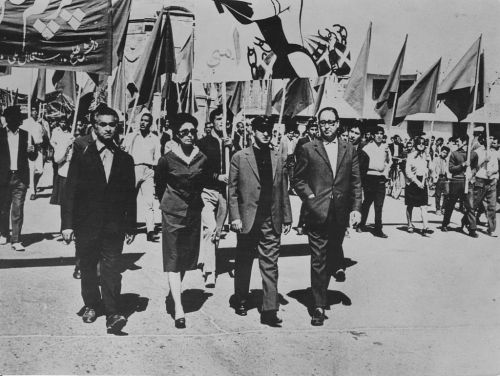
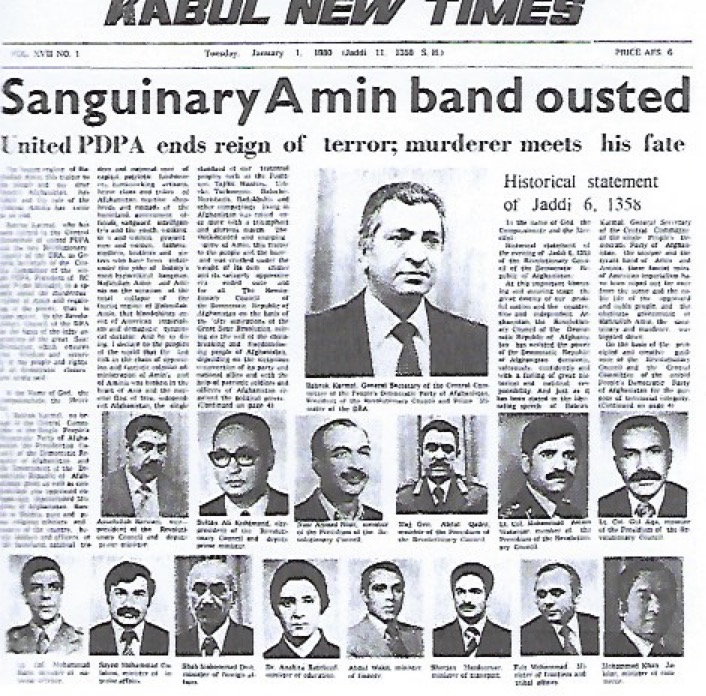
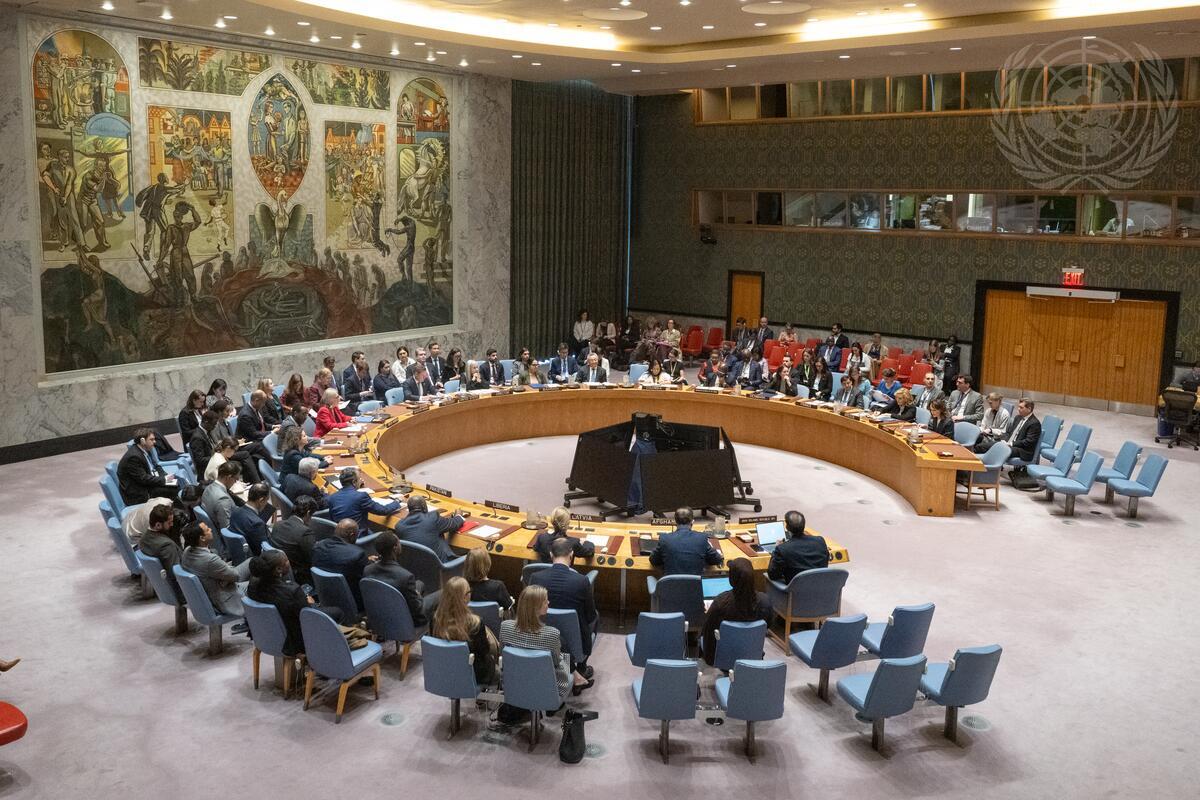 The Security Council meeting on the situation in Afghanistan. Photo: UN Photo/Eskinder Debebe, 9 March 2026.


