After the Islamic Emirate of Afghanistan returned to power in August 2021, women and girls were barred from continuing their education beyond grade six. Women were also banned from working in most government jobs and NGOs, leaving many without employment or a way to support themselves. The opportunities that had seemed within reach during the Republican years suddenly vanished, leaving many women struggling to chart a course for themselves. Some families set out to secure their daughters’ futures, often by marriage, and to men they had never met. In this instalment of The Daily Hustle, AAN’s Rohullah Soroush hears from one young woman whose family married her to a man living in Europe. She was sent to live with her in-laws in Afghanistan, despite never having met him. What followed was a life of anguish, before she found her way back to her own family and began to rebuild her life.A bride arrives in a car at the wedding hall for a mass marriage ceremony in Kabul. Photo: Sahel Arman/AFP, 13 June 2022.
Growing up too fast
I was born in Mazar-e Sharif into a modest family. We didn’t have much money and we lived in the shadow of financial worries. I grew up knowing that life wasn’t going to be easy. I learned that some kids don’t really get to be children – they have to grow up faster than everyone else and take on responsibilities beyond their years.
Still, our home was filled with love and my parents tried their best to make us happy. They were determined that I should go to school. They said it was the only way for me to have a better life. So I went to school in worn-out clothes, taking the second-hand notebooks the extended family or our neighbours had given my mother for me. Even then, I had dreams. I wanted to stand on my own two feet.
In the afternoon, when I got home from school, I helped my mother with chores around the house. I helped her cook our family meals, cleaned the kitchen in the evenings, and on Fridays helped her with the laundry.
Later, when I was still in high school, I started working at a pharmacy. I learned how to check patients’ blood pressure and give injections when needed. I gave most of my earnings to my mother, but I kept a little for my own expenses. After graduating from high school, I took the university entrance exam. The day I got into university was the happiest day of my life. It felt like everything I’d worked for was finally paying off and my life was moving in the right direction.
Alongside my studies, I worked on a project run by an NGO in our area. The salary covered my college fees and other expenses and I was gaining practical experience for the future.
When everything changed
Then the Taliban came back and suddenly everything fell apart. The new government banned girls from going to university. Then, they banned women from working for NGOs and I lost my job. Just like that, it was all gone. It felt like the world had gone dark. I stayed at home with nothing to do and no future to work towards. It felt like my life was over.
It was during this time that my family decided I should marry. They told me there was a man who lived in Europe. They said he came from a family of means, that he had a stable job, that he would take me abroad and give me a secure future.
They talked about security, not happiness. No one asked me what I wanted. No one asked if I was ready.
The marriage I didn’t choose
This is how I agreed to marry a man I’d never seen. It was not my heart’s choice. It was what my parents thought best for me and I went along with their wishes as girls in Afghanistan tend to do.
I don’t blame my family for my misfortune. They thought they’d secured a better future for me – that I’d be happy and eventually go to Europe. Many Afghan families think this way. When someone who lives in the West shows up at their door and asks for their daughter’s hand, families are often blinded by the opportunity and the false hope. So it wasn’t unusual for my family to agree to the match and push me to accept it.
This is how I became a bride, but I felt no joy on my wedding day. After the wedding, my in-laws took me to their house in Kabul. No one welcomed me into that house and that family. There was no warmth, no kindness. From the very beginning, they made it clear that they didn’t like or respect me. They humiliated and abused me – emotionally, sometimes physically. I was expected to serve, to obey and to stay silent. That was my life, day in, day out.
My husband was in Europe and I had to stay in Kabul with his family while I waited for him to come and fetch me. I kept telling myself that he was busy, that he didn’t know how I was being treated by his family. I held on to the hope that one day he’d come, take me away and we’d finally start our life together in Europe.
But the days turned into weeks, then months. I waited for my husband, imagining what he might be like and wondering if he even thought of me. But he never came. I never saw him.
A house without kindness
Life in that house became unbearable. My in-laws treated me harshly. Their words were humiliating and even my small mistakes were met with anger. I learned to move carefully, to speak less, to make myself invisible.
Although my in-laws were rich, they didn’t support me. They didn’t cover my expenses and forced me to work from dawn till dusk to earn my keep. So I started working as a maid in a clothing factory. The factory was noisy and suffocating and everyone was busy meeting their quotas. No one there knew my story. No one seemed to notice my pain. No one asked.
My in-laws wouldn’t let me contact my family. It was the most alone that I’d felt in my life. The situation started to take its toll. I was always tired and I kept getting sick. My spirit was broken and my body was growing weaker by the day, until finally, I was diagnosed with diabetes. I remember going to the doctor by myself, paying the bill out of my meagre earnings and knowing that even my illness was something I had to face by myself. When I got home from the clinic, no one asked after my health. No one cared.
The night it ended
Then, one night, everything changed suddenly. It was late at night when my in-laws pulled me out of bed and turned me out of the house. They said they didn’t want me living with them anymore. The street was dark and empty. I remember standing there in the dark, shaking, trying to understand what had just happened. I had nothing with me and nowhere to go. That night could have ended very differently, but someone saw me – a kind neighbour who took pity on me and opened the door to their home to me.
The next day, they let me use their phone to call my family and let them know what had happened. They helped me get back to my family and even paid for the bus fare to Mazar-e Sharif.
Finding my way back
It wasn’t an easy journey. I was physically weak, emotionally exhausted and not sure how my family would react. I knew there would be talk in the family and the neighbours would gossip.
In Afghanistan, it’s not uncommon for a girl to disappear into the family she marries into. It’s not even unusual for her to be mistreated by her in-laws. But when a girl is sent back, tongues will wag. People will look for a reason and often they blame the girl. She must’ve done something, they’ll say in disapproving tones. Rooms will go quiet when she walks in – the silence is damning and pitying all at once.
But when I arrived in Mazar-e Sharif and stepped into my parents’ home, they embraced me. I’d been worried for nothing. For the first time in a long while, I felt safe and I knew I wasn’t alone. With their support, I began again from scratch. It wasn’t easy, but I didn’t lose hope. Being back with my family gave me the strength to start taking small steps to rebuild my life.
Still standing
Today, I am still standing.
I’ve known hardship, loss, and pain, but I didn’t disappear. I didn’t surrender to what had happened to me.
To other girls and women in Afghanistan, I say this: Stay strong, even when life feels impossible. Don’t lose yourself. If you fall, get back up, because you’re stronger than you think.
Edited by Roxanna Shapour and Kate Clark
A Marriage I Didn’t Choose: An Afghan girl’s journey into despair and back
Fighting along the Afghanistan-Pakistan border has disrupted education for 12,000 students, as displacement and damage to schools worsen humanitarian conditions.
The United Nations said clashes between the Taliban and Pakistan have disrupted education for around 12,000 Afghan students in border areas.
Many children have been displaced or are unable to continue schooling, particularly in Kunar Province, where villages have been partially emptied and schools damaged.
According to reports, at least 22 schools in Kunar have been affected or destroyed, leaving thousands of children without access to classrooms and basic educational services.
The border has remained volatile for nearly two months, with both sides exchanging accusations, as Islamabad claims militant groups operate from Afghanistan territory, which the Taliban denies.
The escalation has triggered a broader humanitarian crisis, with thousands of families forced to flee their homes and seek shelter in temporary camps under harsh conditions.
Local educators say school buildings have been damaged and students who were previously attending classes are now cut off from learning opportunities.
Displaced families report severe hardship, with limited access to shelter, food, and education, and have called on the international community to provide urgent assistance.
The UN has also warned that hundreds of civilians have been killed since the clashes began, underscoring the growing impact of insecurity on vulnerable communities.
Pakistan clashes disrupt education for 12,000 students in Afghanistan
Trump says he is reviewing plans to relocate Afghan refugees in Qatar, as bipartisan criticism grows over proposals to send them to Congo.
Donald Trump said he is considering options for around 1,100 Afghan refugees stranded in Qatar, including possible relocation to Democratic Republic of the Congo.
Speaking to reporters, Trump said he was not fully briefed on the plan and would need to review available options before making a decision on the future of the group.
According to reports, the proposal could force refugees to choose between relocation to Congo or returning to Afghanistan under Taliban rule, a move widely criticized in Washington.
The refugees are among Afghan nationals evacuated after the 2021 collapse of Kabul, many of whom assisted US military operations and have since remained in temporary facilities awaiting resettlement.
A US program approved by Congress previously aimed to relocate eligible Afghans to the United States after security vetting, but implementation has slowed, leaving hundreds in uncertainty.
Lawmakers from both parties have opposed the Congo proposal, urging the administration to restore the resettlement pathway and honor commitments made to Afghan allies.
Chris Coons called the plan “a betrayal,” while Jeanne Shaheen said sending families to unstable environments would be unacceptable.
Democrats argue the proposal risks exposing vulnerable refugees, including women and children, to insecurity either in Congo or under Taliban governance in Afghanistan.
Trump reviewing Congo option for Afghan refugees, sparks concern
United Nations Assistance Mission in Afghanistan has called on the Taliban to lift restrictions on Afghan girls, marking the International Girls in ICT Day with renewed concern over access to education.
UNAMA said more than four years have passed and an entire generation of Afghan girls remains excluded from formal schooling, limiting their future opportunities.
The mission stressed that education, particularly in information and communication technology, is critical for employment, innovation and long-term stability in Afghanistan.
The International Girls in ICT Day, observed annually on April 23, promotes equal access to digital skills, yet Afghan girls have been denied schooling for over 1,600 days.
Humanitarian agencies warn that restrictions on female education risk deepening poverty, weakening economic prospects and widening gender inequality across the country.
UN Office for the Coordination of Humanitarian Affairs said returning Afghan women and girls face major barriers in accessing education and essential services due to ongoing restrictions.
Aid groups say the continued bans have disrupted not only education but also healthcare access and livelihoods, increasing vulnerability among women-led households.
The Taliban have maintained limits on girls’ education since regaining power, despite sustained international pressure to reopen schools and expand access for women and girls.
UNAMA urges lifting curbs on girls’ education as Afghanistan marks ICT Day
Local sources in Kunar Province say fresh Pakistani strikes have damaged several homes in the Sarkano district, as cross-border hostilities continue to escalate.
Residents reported that the attacks began around midnight and continued into Wednesday morning, with explosions heard across multiple regions of the district.
Sources added that Pakistani forces also targeted areas in Asadabad, though no casualties were immediately reported there. Video footage shared with local media shows at least one residential house heavily damaged.
Officials from the Taliban administration in Kunar have not yet commented on the latest strikes, and independent verification of the extent of damage remains limited.
Tensions between Taliban and Pakistan have intensified over the past two months, with repeated exchanges of fire reported along the disputed border areas.
Islamabad has accused militant groups operating from Afghanistan territory of launching attacks inside Pakistan, while Taliban authorities deny providing safe havens and blame Pakistani forces for violating Afghanistan sovereignty.
Over recent weeks, Kunar has emerged as a key flashpoint, with multiple reports of artillery shelling and airstrikes targeting border districts, forcing families to flee their homes.
Residents in affected regions say repeated attacks have disrupted daily life, damaged infrastructure, and heightened fears of a broader humanitarian crisis if clashes continue.
Pakistan strikes damage homes in eastern Afghanistan as border tensions persist
Once promised a move to the United States, Afghan refugees who helped U.S. forces say they face ‘bad or worse’ options: resettlement to Congo or returning home to live under the Taliban.
Afghan refugees who once helped U.S. forces and have been stranded for years at a former U.S. military base in Qatar, say they are being forced to choose between returning to Taliban-ruled Afghanistan or resettling in a third country that some have never heard of.
The New York Times reported this week that the Trump administration has been in talks with the government of the Democratic Republic of Congo to send as many as 1,100 Afghans to the Central African country.
Camp officials deny that any decision has been made, even as they have, for months, pushed Afghans to return to Afghanistan by offering free airfare and a stipend, according to camp residents and screenshots of messages from camp officials seen by The Times.
Officials at the facility, Camp As Sayliyah in Qatar, told residents on Wednesday that no deal had been finalized.
“Please be aware NO third country has been confirmed or officially announced for resettlement,” read a message sent to a WhatsApp group that officials have used to communicate with residents. “The U.S. government continues discussions to identify and secure voluntary resettlement opportunities.”
For months, the Afghans had lived under a cloud, hearing from camp officials and aid workers that they might be relocated to either an African or Asian country.
“Now we are stuck between bad and worse options,” said Arash Pahlavi, a camp resident.
Zabiullah Mujahid, a Taliban government spokesman, said Afghan authorities would welcome the return of camp residents.
“Now they have realized how much importance the Americans give them, and how much value they place on those who worked with them,” Mr. Mujahid said.
He did not respond to questions about reports of human rights abuses — including extrajudicial killings, imprisonment, and torture — against members of the former Afghan administration and allies of U.S. forces.
If implemented, the relocation to Congo would be the latest measure taken by the Trump administration to prevent Afghan refugees who helped U.S. forces in Afghanistan from reaching the United States. In November, the Trump administration froze a special visa program for Afghans, and in January, said it would close the camp in March.
Mr. Pahlavi has family in the United States, but his plans to join them fell apart when President Trump suspended a refugee admission program last year.
Since U.S. officials running the camp began offering free plane tickets and stipends late last year, over 200 people have gone back, according to Shawn VanDiver, the president of the aid group AfghanEvac, who was briefed on the State Department’s plan to relocate camp residents to Congo. Six residents confirmed that dozens of families have left.
Those still at the camp include former interpreters for the U.S. military, Afghan special operations forces, and relatives of American service members, many of whom would be at risk of human rights abuses if repatriated.
The U.S. plan adds to a growing list of coercive measures implemented by countries across the world to send Afghan refugees back home. Iran and Pakistan forced nearly three million Afghans back home last year. The European Union is in talks with the Taliban government to repatriate undocumented Afghans. A notable exception has been Brazil, which has received hundreds of Afghan refugees since last year.
It is unclear whether the deal with the Congolese government would include some or all of the 1,100 residents. More than half of them are women and children.
Aid workers and U.S. politicians opposing the plan say relocation to Congo would be anything but secure and voluntary. Congo is in the grip of one of the world’s most severe displacement crises and is in conflict with its neighbor, Rwanda.
“The option to be deported to the Taliban or to move to a catastrophic humanitarian crisis in the Democratic Republic of Congo is not a choice,” said Representative Sydney Kamlager-Dove, Democrat of California, who is a member of the House Foreign Affairs Subcommittee that oversees Afghanistan issues.
The State Department and the Congolese government did not respond to a request for comment.
Residents of As Sayliyah went through at least one round of preliminary vetting, according to Jon Finer, a former deputy national security adviser under the Biden administration. Some have had English and driving lessons and taken courses on American culture, residents said.
However, not all had been cleared for U.S. relocation before Mr. Trump suspended the program.
Some residents said they would be ready to go back to Afghanistan if Congo were the only other option, or would accept resettlement to Congo.
“I will choose Congo over Afghanistan because I don’t feel safe there in Afghanistan,” said Salem, a former Afghan Air Force pilot.
But Zahra, 15, would be unable to go to school or travel long distances without a male companion, under restrictions imposed on women and girls by the Taliban government.
She and Salem spoke on condition that only their first names be used to avoid retaliation if they were sent back to Afghanistan.
“Afghanistan is my homeland — I respect it,” Zahra said. “But I’m not ready to go back.”
Safiullah Padshah and Yaqoob Akbary contributed reporting.
Afghans Who Helped U.S. Forces Say They’re Being Pushed Back to the Taliban
EU envoy visits Kabul for talks with Taliban officials, focusing on aid, diplomacy, and cooperation as Afghanistan faces a dire humanitarian crisis.
The European Union’s special envoy for Afghanistan, Gilles Bertrand, visited Kabul on Wednesday and held talks with Taliban officials, the Taliban foreign ministry said.
During the meeting with Deputy Foreign Minister Mohammad Naeem, both sides discussed political, economic and trade ties, as well as prospects for expanding cooperation through dialogue and diplomacy.
Taliban officials welcomed EU humanitarian assistance but called for increased aid, urging a shift toward long-term development projects to address unemployment and economic hardship.
The EU envoy stressed continued engagement and described dialogue as the most practical path forward, while the EU has yet to issue an official statement on the visit.
Afghanistan is facing a dire humanitarian and economic crisis, with millions dependent on international aid amid widespread poverty, food insecurity, and limited access to basic services. The situation has worsened following political changes and reduced international funding.
The United Nations and aid agencies have repeatedly warned of a deepening human crisis, highlighting urgent needs in healthcare, food supply, and employment as winter shocks and economic stagnation persist.
Separately, EU sources confirmed that a Taliban technical delegation is expected to visit Brussels for talks, even as the bloc considers controversial plans to return rejected asylum seekers to Afghanistan despite human rights concerns.
The visit marks the envoy’s third trip to Kabul, underscoring ongoing but cautious engagement between the EU and Taliban authorities amid mounting humanitarian pressure.
Megha Rajagopalan reported from London, Eileen Sullivan from Washington and Zolan Kanno-Youngs from Islamabad, Pakistan.
The New York Times
After halting a U.S. resettlement program for Afghans who helped the American war effort, President Trump is in talks to send as many as 1,100 of them to the Democratic Republic of Congo, an aid worker briefed on the plan said Tuesday.
The group includes interpreters for the U.S. military, former members of the Afghan Special Operations forces and family members of American service members. More than 400 children are among them.
The Afghans have been living in limbo in Qatar for over a year. They were taken there after being evacuated by the United States for their own safety because they supported American forces during the war against the Taliban that began in 2001.
Shawn VanDiver, the president of the aid group AfghanEvac, said he had been briefed on the Congo plan by State Department officials. He said that the Afghans would be given a choice between returning to live under the Taliban or being sent to Congo, which is suffering one of the world’s worst humanitarian crises.
More than 600,000 refugees, mostly from the Central African Republic and Rwanda, are currently in Congo, according to the United Nations. Human rights activists say that the country is not equipped to take in more in the midst of fighting with neighboring Rwanda that has displaced even more people because of attacks on refugee camps.
“We think this is just them wanting to send these people back to Afghanistan, where they know they will face certain death,” said Mr. VanDiver. “They know that Afghans are not going to accept the D.R.C. Why would you go from the world’s No. 1 refugee crisis to the world’s No. 2 refugee crisis?”
The discussions highlight the longstanding tension between America’s obligation to Afghans who face grave danger in retaliation for helping U.S. forces during the war, and the Trump administration’s pledge to curtail immigration.
Much is unknown about the plans taking shape, including whether all the Afghans would go to Congo or whether deals were coming together in other countries. Negotiations like this have stalled before.
A Congolese government spokesman did not immediately respond to a message seeking comment. Tommy Pigott, a State Department spokesman, accused the Biden administration of moving hastily in bringing Afghan allies to the United States. He said the Trump administration was working to find options for the remaining Afghans.
“The American people have had to pay the price for the irresponsible way hundreds of thousands of Afghans were brought into the United States,” he said. “Our focus now is on restoring accountability by advancing responsible, voluntary resettlement options.”
American diplomats have been asking countries in Africa to take in the Afghans for months. But talks fell apart in many places, according to Mr. VanDiver and diplomats with knowledge of the discussions.
More than 190,000 Afghans who aided the U.S. effort resettled in the U.S. between August 2021 and mid-2025, after passing background checks.
But a group of more than 1,100 Afghans are being housed in a former U.S. military base in Qatar known as Camp As Sayliyah. The American government brought them there in late 2024 and promised them a path to settlement in the United States if they passed further checks.
“They had the expectation that within weeks they’d be relocated to the U.S.,” said Rina Amiri, a former senior diplomat working on Afghan human rights issues. “Who is going to fight alongside the U.S. when the U.S. betrays the people who stood alongside us?”
The Congo negotiations follow behind-the-scenes pressure from the Qatari government to find the remaining Afghan refugees a new home.
Some of the people left at the camp have been fully vetted; others have not, Mr. VanDiver said. But Mr. Trump’s immigration policies have made it impossible for any of them to come to the United States now. In November, the government froze the special visa program after a National Guard member was shot in Washington last year by an Afghan man allowed into the United States after the Taliban took power again. In January, the administration said it would close the transit camp without saying what would happen to the people there.
Many of the Afghans in Doha have told officials that they would not voluntarily agree to being sent to Congo, according to a person familiar with the planning, who spoke on the condition of anonymity to describe confidential discussions. Some Afghans questioned whether they would be protected there. Others asked why they would go to Congo when their loved ones are in the United States.
Andrew Sullivan, a military veteran and the executive director of No One Left Behind, a nonprofit group that has been working to resettle Afghans to America, said some had been deemed ineligible for reasons that have nothing to do with national security. For example, one woman turned 21 and is no longer eligible to be included on her father’s visa, he said.
But, he said, the administration has other options available to bring them to the United States, including the ability to issue exemptions to the policy.
“Our belief is that if, if they can pass security vetting, they should be coming to the United States,” Mr. Sullivan said. “If they can’t, and they’re not going to come to the United States, I do believe the U.S. government has an obligation to ensure that they’re going to a third country where they’re going to be secure, they’re going to be supported, and there aren’t ongoing humanitarian rights issues.”
American diplomats have been meeting with Democratic Republic of Congo officials for months. Recently, the Trump administration struck an agreement with the country to accept migrants from other countries who face deportation from the United States. Part of that deal included a $50 million grant to the U.N. refugee agency to provide assistance in the country.
Discussions over the Afghans are separate from the deportation deal, but both are examples of what has become a hallmark of Mr. Trump’s immigration strategy: moving people to faraway places, even when those countries have human rights abuses or authoritarian governments.
Pranav Baskar in New York contributed reporting.
Trump Is Said to Be in Talks to Send Afghans Who Aided U.S. Forces to Congo
An Afghan proverb, tang amad, ba jang amad sums up the circumstances which led to rebellion in a northeasterly corner of Afghanistan, the poor and isolated Shughnan district of Badakhshan province, a century ago: When your back is against the wall, you will fight back – no matter how weak your side and how unlikely your chances of success. In 1925, the residents of Shughnan, who belong to the tiny and hitherto peaceful Ismaili community, revolted against the oppression of state officials.Ismailis, like other Afghan Shia Muslim communities, had often been subjected to various degrees of discrimination or exclusion from power in the context of the mostly Sunni-dominated polities that asserted their dominance in the region. What made things different this time was that the increased burden of state oppression was an indirect consequence of Amir Amanullah’s reformist policies. Their progressive goals included integrating the country’s different communities and granting the same rights to all its citizens. As often in Afghanistan, the location of the turbulence in a border area considered strategic by international powers resulted in contrasting interpretations of facts. Fabrizio Foschini has pieced together the story of this lesser-known episode based on oral and archival sources.Introduction: exploring the legacy of a fateful decade from a remote corner of AfghanistanOver the past few years, AAN has published several reports revolving around events or texts from the period between 1919 and 1929, an eventful and at times tumultuous decade in Afghan history coinciding with the reign of King Amanullah.[1] Although occasional in output, the idea of such recurring publications has been grounded in the assumption that the reforms attempted during the so-called Amani decade in both international relations and the internal administration of the country, together with the reactions that they engendered and which culminated with the ejection of the reformist king, continue to be of huge significance for comprehending the contemporary history of Afghanistan. Indeed, many of the points of contention of that era, from national independence vis-à-vis foreign powers to girls’ education and minority rights to tax collection, remain relevant to the politics of the country, largely informing the current debate.Continuing this series, we offer here a different take on the major topic of the conflict of state vs society by looking at a lesser-known and atypical episode of open rebellion that took place in the northeastern border district of Shughnan in 1925. In the spring of that year, residents took up arms against oppressive local government. After a military expedition was sent from the provincial capital, the rebels were forced to disband and submit, or flee across the border into Soviet territory.
The subject of this report, coming after AAN’s previous study of the Khost Rebellion that took place a year earlier, should not surprise readers. The point contended here is not that the interest in the legacy of the Amani era consists mostly of studying the causes for revolts and the way these were dealt with, but rather that rebellions, as traumatic events, often constitute recorded moments in the otherwise ‘invisible’ history of marginal areas, and thus provide rare glimpses of the material and intellectual life of non-elites in a country’s history, including of subaltern groups such as the Afghan Ismailis.[2] Also, a rebellion in Shughnan can be seen as coming from an unexpected direction, especially in light of the population’s later political and social orientation, which was markedly progressive and pro-government.
Despite being peripheral inside Afghanistan at both the political and economic levels, Shughnan and its adjoining districts were important in their own right to international observers because of their border with Russian-held territories. After the formation of the Soviet Union, previous British concerns about Tsarist Russia’s meddling in that region had turned into fears of communist propaganda spreading among Afghans.
Finally, in the light of what is happening to some border areas of Badakhshan province these days, a comparison can be made about the dynamics of communal mobilisation against a central government perceived as oppressive and unfairly appropriating local resources, although in the name of a better good such as increasing the state’s revenue (and arguably public services) through the exploitation of mines.
A note on methodology
The bulk of the report consists of a narrative of the events before, during and after the rebellion, as related by people in Shughnan to the author in 2009, contemporary diplomatic material coming mostly from British archival sources and the few academic studies that take into account the impact of Amanullah’s reforms on the region and on the Shughnan rebellion, in particular.
Oral traditions such as those revolving around the Shughnan rebellion of 1925 present some fixed features (words, themes) which are literally handed down through generations of tellers and re-tellers and act as backbones to the narrative, exemplifying its chief meanings and making it easier to remember. Over time, they also, inescapably, come to include broader perspectives, filtered through the later experience of local communities, which come into play in modern interpretations, to enhance or diminish certain aspects and leitmotifs.[3]
Written historical sources such as archival material left by colonial polities active in the areas surrounding Afghanistan have long been considered more authoritative, but come with the same risks of selective emphasis and blindness attached. ‘Hot border’ regions such as Shughnan, especially in times of heightened political tensions and polarisation, such as the advent of Soviet communism in the 1920s that gave a new spin to the Russian threat to British India, regularly increase this blur, requiring a cautious interpretation of even the most precise archival sources.
The peculiarities of a peripheral district
Nowadays, Shughnan is a district of Badakhshan province, fairly large in terms of area but with a population numbering only around 35,000, due to the high-altitude terrain that makes up most of it. The majority of the settlements are found along the Panj Valley, where the river forms the international border between Afghanistan and Tajikistan, a situation common to the other districts of Badakhshan bordering Tajikistan, from Wakhan downstream all the way to Shahr-e Bozorg.
Map of Shughnan district of Badakhshan showing places mentioned in the report together with its location inside Afghanistan and the broader region as they were called in 1925. The district boundaries of Shughnan showed in the map are as of 2018. Map: Roger Helm for AAN, 2026.
Before its definitive annexation to Afghanistan[4] in the 1880s, Shughnan had held a paramount position among the petty principalities of the upper reaches of the Panj and Kokcha river valleys, mostly inhabited by followers of the Ismaili Shia branch of Islam. The Ismailis inhabiting these high mountain areas at the feet of the inhospitable Pamirs were usually comparatively poor and vulnerable communities, their heterodox faith exposing them moreover to the risk of being carried off to the Central Asian slave markets by their Sunni neighbours.[5] The mirs of Shughnan, however, did manage to keep a dignified status in the closed-doors dynastic game of the ruling potentates of the area. They claimed descent from Alexander the Great and intermarried on a regular basis with the (Sunni Muslim) rulers of Faizabad. The latter were the nominal lieges, but the Shughni mirs often intervened in the affairs of Faizabad from a prominent position and their Ismaili faith – the same as their subjects’ – did not seem to have posed a major hurdle to their political and commercial relations with the Sunni-inhabited areas of central Badakhshan.
Things, however, changed with the incorporation of Shughnan into Afghanistan. The last Shughni mir was deposed in 1883, and by the 1920s, the traditional feudal leadership structure of Shughnan had long gone. The Afghan governors of Badakhshan, after an initial soft approach, more in line with pre-existing forms of indirect political control and allegiance, had sought to change local leaders deemed untrustworthy and uncooperative and replace them with their own appointees. Increasingly, these were Muhammadzai Pashtuns or anyway, individuals from outside the region and closely linked to the court in Kabul. This trend accelerated after 1888, when the amir, Abdul Rahman Khan, began to suspect that many northern notables had either conspired with his cousin Ishaq Khan, who that year had staged a revolt against him, or were in communication with Russia and its protectorate in Bukhara, which was then competing with Kabul for influence over Badakhshan and other northern provinces. A new dynamic set in: state repression was now able to reach not only the old ruling families, who were arrested or deported away from their former turfs, but also a broader class of local headmen, called aqsaqal and arbab,[6] or indeed anybody suspected of wielding dangerous influence over the local populations.
When in 1893, the northeastern border in its Shughnan section was finally demarcated following the course of the River Panj, Shughnan lost half its population and most of its territory to Russia. Against the backdrop of general waning local autonomy, the district’s relevance and political weight was particularly diminished. The local leadership void would, in the next few decades, be gradually filled by religious networks composed of pirs (spiritual leaders) and khalifas (their local representatives), who played a major role in organising society, eventually in cooperation with the transnational institutions led by the paramount Ismaili leader, the Aga Khan. Much later, after 1940, Shughnan’s population embraced teaching as a survival strategy and attained high standards of education and the political consciousness that went with it. That contributed to emancipating the people from their district’s poverty and marginality (AAN). In 1925, however, the situation was bleak and, furthermore, the capacity, locally, to lobby Afghan state actors was at a minimum.
Shughnan and the other Ismaili districts in Badakhshan were never able to exploit their arguably strategic location on the border to their advantage. That could, to some extent, have made up for the trauma caused by colonial border-making or even improved their standing and importance at the national level, as some Pashtun tribes along the Durand Line managed to do.[7] Contrary to the broad ‘Frontier’ buffer separating Afghanistan from the settled areas of British India, the border with Russia was not a particularly porous one that easily allowed local communities to benefit from smuggling, raiding or abetting escapees from the other side. Indeed, its demarcation along the Panj River was actually a tragedy for local communities, which saw themselves torn apart, their social connections and viable economies destroyed. However, the demarcation proved rather practical for the purposes of state control. The difference between the two border areas was augmented by the different attitude and balance of power in the Afghan state: the heavily-armed border Pashtun tribes on the one hand and the tiny, poor and vulnerable – from both military and religious perspectives – minorities living along the Panj, on the other.
Who pays for the reforms?
Amanullah is often remembered and celebrated as the king who secured Afghanistan’s complete independence by wresting it from the British in the Third Anglo-Afghan War (1919), or, as Afghans more aptly call it, the War of Independence (AAN). Beyond the fanfare of military glory and diplomatic activism, however, the real meaning of Afghan independence was that, for the first time in forty years, and possibly for the longest span over a much longer period, both before or after Amanullah, the Afghan king, and the state he managed, had to do without a foreign subsidy that guaranteed them a minimum of military superiority over possible rivals or rebels and partially freed them from the need to seriously tax subjects in order to have a budget.
Public finances were not the only revolutionary aspect of Amanullah’s reign. From progressive ideals to his ambition to achieve the fast modernisation, technical and cultural, of a ‘backward’ country, many aspects of his reign aimed to be revolutionary. However, the big changes in store were thus to be financed only through taxation, and direct taxation on agricultural produce was to be the pivotal part of that. There were attempts to revive international trade and, with it, one of the traditionally major sources of income for the Afghan rulers – transit fees and customs. Even so, at least two-thirds of the revenue paid to the Afghan state under Amanullah was derived from taxes on farmers.
It has been estimated that between 1919 and 1929, Amanullah’s decade in power, the tax rate on land increased fourfold and on livestock fivefold, and that up to 45 per cent of the value of the harvest was taken from farmers.[8] Furthermore, contrary to what had happened in the past, payments were to be made largely in cash and not in agricultural products, which entailed greater difficulties and, for the inhabitants of areas with virtually no monetary economy, such as the Ismaili districts of Badakhshan, the frightening risk for farmers of going into debt.
Statistics for 1923 published by the Afghan newspaper Ittihad-e Mashriqi give an idea of the scale of tax revenues in a poor region such as Badakhshan: even excluding Crown lands, out of a total revenue of 1,293,000 rupees, 1,020,000 came from taxes on agriculture and livestock. That sum had increased by 211,000 rupees compared to the previous year, an increase of a sixth. Furthermore, the proportion of taxes paid in cash had already reached almost three to one compared with taxes paid in goods.[9]
Within all peripheral areas, there are different layers of marginality. Some of the residents of central Shughnan, or at least some of those from the district centre of Qalah-e Bar Panj, had in due time been able to forge some relationships with their new Afghan masters. Provision of lodgings, government employment, trade ventures and the occasional intermarriage had contributed to create a minimum of common interests that ran above qawmi divisions.[10] Even though these interests were diluted by those of language and confession, they still proved sufficient to shield a group of local residents from the worst aspects of state power. The degree of such commonality grew thinner as an individual lived further away from the centre of the district. Remote areas may have enjoyed greater quiet due to their isolation in normal times, but would face the brunt of state impositions, entirely unprotected, once these were unleashed.
In the context of the state apparatus’s renewed efforts to expand into rural areas under Amanullah, it is no surprise that the area of Shughnan that fared the worst would be Roshan, the northernmost and most remote part of the district. It was from Roshan – a toponym which carries the ancient Persian root connected to ‘lightening’ or ‘brightening’ – that the spark of the rebellion would ignite.
The rebellion of Mahram Beg
Let us first introduce the eponymous hero of the rebellion. Mahram Beg, hailing from Robat village, the last village of Roshan before Shughnan proper, was in his forties and a man of some local importance. He was already listed among the notables of Roshan by the Afghan functionary and writer Burhanuddin Kushkaki in 1923, and had been appointed around that time an arbab in a village a short distance downstream from his own village, Chasnud-e Payan. There, an alaqadar, a sub-district state official appointed by the central administration and often coming from outside, had been posted, arguably, for the first time. Local oral sources claim this particular official was originally from Wardak.[11] His character plays a major part in the oral history of the rebellion, triggering the action in the first place. In the oral narrative handed down among locals, the mere burden of heavy taxes was not considered a sufficient explanation for the revolt. Rather, the abuse of power by the state was coupled with other types of abuse and oppression couched in terms of immorality, as was relayed to the author:
At the time of Mahram Beg, there was such oppression that he was forced to make the people revolt. He went down to Chasnud-e Payan, where an alaqadar had arrived. The alaqadar exercised power with such tyranny that his men were snatching bread from people’s ovens: “Bring forth the butter!” they would shout, while, meanwhile, they helped themselves, picking the loaf of bread of their choice. Such was the level of tyranny. Then, one evening the alaqadar said to Mahram, who was arbab there, to bring him a woman. Mahram was flustered, he said: “Why, how could I bring you a woman?! You yourself must have nang, some namus [honour] of yours – a sister, your mother…” But the other insisted, adamant: “These arguments don’t touch me.”
Mahram Beg (or his contemporary impersonator) is here trying to reason with the Pashtun official by playing up specific concepts — namus and nang — that he hopes he may value. The Arabic-origin word namus connects mostly to honour in terms of one’s family’s reputation through the respectability (henceforth seclusion) of its female members. Nang(coming from Middle Persian but quite obsolete in modern Iranian Farsi), refers to honour as well, but more with the nuance of individual pride. Both terms are widely used in Afghan Dari, the language in which the related conversation arguably took place, but hold a special conceptual centrality for Pashtuns as enshrined in Pashtunwali (about which, read this AAN paper). Having failed to connect with his interlocutor on these terms, Mahram feigned compliance:
So, one day Mahram told the alaqadar he was leaving; he was travelling down the valley to get women for him. But instead, he went to a village downstream and sat in an assembly with people whom he had secretly gathered and told them: “Look, that’s how bad things are, how oppressed we are. But now you can decide to help me rebel. If you are with me, we take over Shughnan.
Those gathered agreed to stage a revolt and Mahram toured nearby villages to enlist men for the action. Wherever there was an arbab he trusted, he would task him with selecting a man and sending him to Chasnud-e Payan, disguised as a woman under a full chador. Then, when he had thus managed to assemble his strike force unnoticed:
[T]hat night, when required to, Mahram introduced fifteen men thus disguised into the alaqadar’s guesthouse for his after-dinner programme, and told them “Go get him and give him a beating.” The alaqadar cried, “What are you doing?!” but those men, burqa-clad as they were, jumped on him and thrashed him with sticks. Then they dragged him outside, put an old furry coat and hat on him, forced him to wear a pair of coarse homespun trousers, tied him to a tree and left him there until morning. The next morning, they strapped him onto an ass, a black ass, and paraded him around.
The use of a chador as a disguise by warriors is a common expedient in the so-called ayyar literature, once widespread, mostly through oral transmission, across India, Iran and Central Asia.[12] As such, it will return later in the same narrative. However, here it also serves the purpose of making the retribution meted out to the villain, whose chief crime was to threaten the honour of women, more fitting. The theme of the disguise takes on another level of meaning immediately afterwards: the ordeal to which the alaqadar is subjected includes nullifying his exalted status as a state official – likely conveyed by clothes of a different style or superior quality – by having him dressed as a commoner in coarse local fabric. The symbolic reversal of roles and the exposure to public mockery, in many parts of the world, a cliché of peasant rebellions vis-à-vis the powers governing them, is completed by a parody of another major status symbol of the powerful, the mount.
After this early success, with the critical adhesion of some local hunters who provided the only firearms to the war party, Mahram set to conquer, or better, to free Shughnan, the centre of his people’s universe and the logical ultimate target of their action.
Then Mahram and his men marched towards Shughnan. They went to Yarkh and then to Chawid and so on and everywhere people would join them. For weapons, they had only some siahkaman (matchlocks) and the rest had spades and forks. At the time, guns and ammo, nobody had it, only the security forces. So when the rebels reached the district centre of Shughnan, the local garrison and the border guards barricaded themselves into the government fortress, sealing the doors and windows. Mahram told his followers: “Do not attack them now, they’ll eventually surrender, let’s not damage both sides with a fight.” Then, he positioned his men on the hilltop where nowadays the district office is located.
The stalemate lasted over a week. The few hunting rifles that Mahram’s men had at their disposal were totally ineffective against the stone and mud walls of the government compound. Besides, they lacked any ammunition reserves and had to rely mostly on dry beans as bullets. Mahram not only prevented them from launching a risky attack, but he also sought to keep those inside the fort in check and prevent sallies from their part. He had water boiled over a fire beyond the hilltop, and by heating spades that they would then hit with stones, his men produced loud bangs which sounded a bit like the voice of artillery, which scared the besieged garrison into inaction. With water running scarce, it was a matter of days before they surrendered. Meanwhile, news of the revolt had reached Faizabad, and a military force had been dispatched to suppress the revolt. Probably, this news began to cool local enthusiasm for the revolt, as some residents of central Shughnan who suspected the rebellion could not resist state power indefinitely came to fear the reprisals they would face once government control was re-established[13]
News came that an army was coming from the way of Ishkashim. Mahram asked the people “And what do we do with those?” and they replied “Well, you should go meet them.” “Very well” he said, “I’ll go to Gharan. If I manage, I’ll crush those soldiers. You stay here and do not attack. If the government forces surrender, take them prisoner, but don’t expose yourself in the open.” Then he went to Gharan and selected a narrow spot to set an ambush. When the troops arrived, his men suddenly opened fire and forced them to retreat, they ran back to Ishkashim.
After the successful ambush,[14] prospects for the rebels were looking more favourable, but treachery was to undo Mahram’s military success. While he was away, says the oral history, a local resident, a man from Bashohr,[15] managed to slip into the government fort at night.
He told the government forces there: “Those people don’t have rifles, they’ve got nothing. Mahram has left for Gharan and they only make the sound of guns, don’t let yourself be fooled.” When they did not believe him, he added, “Ok, I’ll have you sent women’s clothes, a chador, right? One of you can put it on and go have a look at how things are.” So, the next day one of the soldiers disguised himself as a woman and went around Mahram’s camp. He saw that the situation was exactly as reported: they had no weapons and only made the sound of a gun from time to time. He went back and reported to his commander, and the next day at dawn, those in the fort rushed out and attacked the camp of the rebels.
Without weapons, how could they resist? They fled, half towards Gharan, to Mahram, and half towards Roshan. The government troops arrived in Bashohr and let their 303. rifles do the talking. They did not make distinctions between those who had fought with Mahram and those who had not. They killed, they arrested, they looted. Then those who had fled towards Mahram ran into him at the springs near Darmarakht. He asked them, “How come you are here?” and they said “We narrowly escaped from their clutches” and they told him what had happened. “Very well” said he. “All that has happened has been out of the will of those people who don’t need freedom, those who don’t cherish freedom. Now it’s up to you. Do as you wish. I jump to the other side. I can’t stay here, there’s no place left for me to go, I’ll cross to the Soviet side of the river.” And then, near Wyar, he jumped into the water and reached the other bank. Many of those who had fled, men and women, followed him: the lucky ones made it, others vanished in the river.
Exit Mahram, pursued by the Russian bear. Detained by the suspicious Soviet authorities for around three years, the unlucky leader of the short-lived revolt would never see his homeland again. Well, not quite literally, as from Khorog, the Russian-held Shughni town just across the Panj, where he was settled for some time, he would be able to do so every day, but he never set foot again on Afghan soil and was eventually given a place of residence in central Tajikistan by the Soviet authorities.
Different was the fate of those who had followed him into exile. Their number is unclear. Boyko, on account of a petition sent to the Soviet authorities by the refugees themselves, gives the staggering number of eight thousand. That would have amounted to virtually all the inhabitants of Shughnan and Roshan put together, according to the data collected by Kushkaki in 1923. The desertion of an entire district constituted a significant problem for the state, especially in a border area, where it could exacerbate political differences or result in external interference, and all the more so in a territory that, because of the extreme environmental conditions, would prove nearly impossible to repopulate. Already, one month after the revolt, Amanullah had issued a general pardon and an invitation to those who had fled to return. According to Soviet sources, some accepted, but it seems not too many, as in the next few months, several Afghan officials travelled to the Soviet side to try and persuade the remaining refugees to return. Even if not comprising the total population, the exodus must have been massive, as it stirred diplomatic activities across the Panj. It is well remembered by people nowadays and forms part of the oral narrative of events connected to the rebellion:
[After the revolt] on this side of the river, nobody was left. Those people remained over there [on the Soviet side] for nine months. To all the government people who went there to look for them, they would say: “No, we don’t come back.” Eventually, there came a person called Mir-e Muqil, he was an arbab in Shiduwj village. So, this man went to the other side and the commanders, the Soviets, they told him: “The people don’t accept it, they won’t come back to your side.” He said: “Well, gather them so that I can speak to them. If it works, fine, otherwise it’s over.” Then all the refugees gathered there, in Khorog. And the Soviet official questioned them: “People, are you going to Afghanistan or are you staying?” And they answered: “With him, we shall go, without him, we won’t.” And the Soviet officer would go like: “How come? Until now, you were saying that you’ll never go back there, that you’d rather be killed here and that this was the place you belonged to!” And so they told him: “This man has done many good services for us back there, he helped us a lot. In Afghanistan, in Shughnan, he is a civil servant, a good man. With him, we can face everything: be it water or fire.” All those people were saying thus. Then they started back with that man; they came back to this side.
Bazaar in Bashohr area of Shughnan district centre. Photo: Fabrizio Foschini, 2009
The interpretations of events internationally and locally
The Shughnan rebellion of 1925, together with the temporary occupation by Soviet troops of the river island of Urta Tagai later that year, was one major development in the Great Game along the northern Afghan border. For decades, British and Russian agents had been spying on each other’s moves or absence thereof, and after the variation in the game brought about by the 1917 October Revolution and takeover of Central Asian territories by the Soviets, it had developed new categories to interpret old patterns.
The British were, for example, convinced that all unrest inside Afghanistan could be put down to foreign (ie Russian) hidden hands. “During April a local insurrection took place in Badakhshan… It is possible that Russian agents may have been in part responsible for the outbreak,” was the laconic comment by the British envoy in Kabul.[16]
By the mid-1920s, moreover, they had become convinced that the Soviets were actively spreading Marxist propaganda into Amanullah’s kingdom and that the Ismailis, with their seeming absence of religious fanaticism, had easily fallen prey to communist doctrine: “The area affected seems to be in the part of Afghanistan marked for corruption and penetration by the ethnologically-allied Tazik [sic] province recently established on the Russian side.”
From the cold welcome they offered to Marham, we may instead assume that the Soviet authorities, although newcomers to the Great Game, likely followed in the footsteps of their predecessors in most everyday decisions and were equally suspicious of all local leading men, irrespective of which side of the border they came from.
Throughout the 1920s, the Soviets became increasingly suspicious of the links maintained by the Ismaili religious leaders, the pirs, and their representatives, the khalifas. Given that their devotees could often be found in faraway villages, they were at the centre of networks through which money and information travelled. The authorities concluded that these were being actively used by British intelligence through the good services of the Ismaili spiritual leader and British subject, the Aga Khan. Oppression of Ismaili pirs and khalifas had already started in the early 1920s and would increase in intensity towards the end of the decade, both to satisfy the hostility of Soviet authorities towards religious leadership, indeed, any leadership rival to their own and to frustrate the ‘machinations of Western capitalism’, to the point that several Ismaili religious leaders would be forced, in turn, to take shelter on the Afghan side to escape arrest by Soviet authorities. “The Sayid inhabitants of Russian Wakhan are alleged to be very badly treated by the Bolsheviks authorities,” said one report of the British political agent in Gilgit in his Diary for September-October 1922. “Their property is being confiscated and distributed among the lay public” (L/P&S/10/973). Another report, from the Intelligence Bureau North-Western Frontier Province n° 14 (week ending 16.07.1928) said: “There has been much religious oppression in Shighnan [sic] and Russian Wakhan and the people, while secretly retaining their Maulai [Ismaili] faith, have been forced to become overt converts to Bolshevism.”
Leaving aside the foreign and often flawed takes on the rebellion, it may also be useful to contrast the oral narrative as told by local people in Shughnan with the official account of the incident given by a state-controlled newspaper, Tulu-e Afghan:[17]
At the beginning of the current year, the inhabitants of Shughnan fell out with the alaqadar of that place regarding the payment of poor-rate on their cattle. At the instigation of certain malefactors, they resisted the payment of the poor-rate. When the local ruler came out to realise that tax and applied force upon the inhabitants, they flatly disobeyed his order, congregated in one place and demonstrated against the civil and military officials of that place. On this occasion, it was the day of the month of Hamal (20th April) that the report on this event was received through the proper channel by Muhammad Suleiman Khan, Naib ul-Hakuma of the Province of Qataghan and Badakhshan. The Governor, who is a perfect man and a true servant to the state, despatched forthwith to Shughnan a committee, composed of certain experienced and influential personages with full instructions to enquire into the causes of the disturbance and to make every effort for its removal. Also he gave orders to the force at Badakhshan to hold themselves in readiness for the march. As soon as the committee in question reached Shughnan, crowds of inhabitants who had besieged the local Government Departments after exchanging shots with the local military dispersed and the malefactors who were the cause and instigators of this trouble fled. To sum all up, the enquiry committee brought necessary arrangements into force. The deserters returned to their place, the quarrel and dispute came to an end and all submitted to Government. Peace and order began to reign supreme on every side and the matter was settled without any further trouble and loss of life and property.
Both narratives recognise one common key point – the role of the local authorities. The role they played in unfolding of events, however, is told very differently by the Kabul newspaper and local people. They are mirror opposites of the other. The weak link where the chain of social peace in Shughnan was broken in that April of 1925 lay precisely in the part taken by the Afghan provincial authorities. The new tax burden fell heavily on rural areas, but even more so, it disrupted social customs. The dependence on taxes collected from rural areas and the drive for modernisation inherent in Amanullah’s political project led him to reform the district administration at the same time as he launched his tax reforms. In 1921-22, a travelling commission had mapped the entire national territory to establish new tax rates based on products and soil type. Until then, this had been the prerogative, at the local level, of the old aqsaqal class, who, deprived of their role as village administrators, nevertheless retained the informal role of providing the provincial governor with tax data on their territories, agreeing on the quotas that individual families had to pay and supervising the delivery of the tribute.[18]
This function, which the aqsaqals, as members of the old local elites, carried out in a manner that was as conciliatory as possible with the needs of what ultimately remained their patronage network, was taken over at the sub-district level by the alaqadars, the state officials appointed by the central administration, who were also often outsiders. The loss of control over local relations with the state apparatus, previously managed through traditional, albeit hierarchical, mechanisms via the mediation of the aqsaqals, was as intolerable to the peasants as the increased tax burden itself, to which it was, in fact, closely linked. This was probably one of the underlying reasons for the Shughnan uprising in 1925. The presence of ‘foreign’ district authorities was not entirely new, nor was it a characteristic only of Amanullah’s reign. Certainly, their predatory behaviour towards the population could have justified an even earlier violent reaction, but as long as they had been assisted by local figures in the exercise of power, abuses had been, if not avoided, at least mitigated.
Things would actually worsen for Shughnan in the years following the reform. In the words of an Indian Muslim, a Shia doctor from Calcutta who visited the region a few months after the rebellion: “All officials are Kabulis. No official knows when he may be ‘axed’, consequently bribery and extortion are relied on to bring in as much money in as short a time as possible. Taxes are very heavy. Every tree, animal and field is taxed twice a year. Any criminal can escape punishment by payment. Only the poor are punished.”
The importance of residents having the possibility to access and connect with local authorities to shield their households from excessive burdens and survive becomes apparent from some of the leitmotifs in the history of the revolt of Mahram Beg, as related across Shughnan. Unlike the state media, which sought to highlight the loyalty, efficiency and generosity of the provincial officials appointed by the government, people in Shughnan chose to remember those arbabs, that is, intermediaries whom they had chosen or who, anyway, had come from among their ranks, who would stand up and risk everything to try and shield them from state oppression.
With the elimination of the residual role held by the aqsaqals in assessing taxes, the last vestiges of the social structure of the indigenous elites in Shughnan had disappeared. Only the arbabs remained as potential leaders around whom to rally. Their status was hardly exalted or idealised. Their tasks, in fact, consisted mainly of organising the accommodation and meals of visiting state officials or military personnel, and representing the village before the institutions. This association with the state could bring small economic benefits if one sought them, but not necessarily respectability within the community, as it often led to accusations of corruption and partiality. Hence, the people’s choice of remembering those arbabs who did what they were expected to do, honestly, or who had played an outstanding role – one by starting a rebellion against external officials who transgressed social norms and decency and another by successfully mediating the homecoming of the exiled Shughni people.
Conclusions
Among the modern public of Shughnan, well-educated and (although it took longer than British colonial officials presumed) often left-oriented, today’s re-telling of the 2025 revolt causes a curious series of re-positionings. There is but little sympathy or nostalgia for the autonomous Shughnan before the Afghan annexation, as that era is widely associated with the feudal rule of the mirs and thus viewed negatively from many perspectives. Moreover, Shughnis generally hold a high opinion of Amanullah and praised his reformist attempts and political ideals. However, the poverty and helplessness experienced by the local population at that time amply justify, in their eyes, the need for Mahram to revolt. More recent periods of oppression and destitution, especially during the early times of the mujahedin takeover after 1991, have, moreover, left an indelible mark on the collective memory of the population. For example, during discussions with the author, people in Shughnan sometimes linked the revolt of 1925, in spirit, to a series of revolts staged by local people in 1996-97. They were aimed at throwing off the yoke of the most predatory of the mujahedin commanders, who came from the Sunni central area of Badakhshan and had established themselves as authorities in the district: the parallels, from the Shughnis’ perspective, were clear.
The attention of a small community may be focused on extraordinary times of strife and activism and these events may be fixed in its collective memory. However, the long-term truth about Shughnan is that, like its neighbouring Ismaili districts, it has, since its annexation to Afghanistan and especially since its remarkable achievements in education, proved one of the most peaceful and law-abiding areas of the country. It continues to be so, even in the face of increasing difficulties, such as the restrictions on female education which have seriously damaged its teacher economy, and the growing reports of discrimination towards Ismailis by at least some among the IEA officials (Hasht-e Subh).
But beyond the heroes and symbols that are passed down through generations in a community’s oral history lie always the roots and material causes of the actions that immortalised them. Those very causes that spurred the people of Roshan and Shughnan to rebel a century ago, namely the oppressive behaviour of the authorities imposed from the outside and the lack of local lobbying power to negotiate with a seemingly all-powerful government, are today found in many parts of Afghanistan. Centralising attempts, pushed through with haste and force, can easily cause grave imbalances when, in many Afghan rural areas, the local balance of power and established relationships of reciprocity help people cope with fragile economic conditions. Not to stray away from the banks of the Panj, the continuing tensions and clashes (Radio Free Europe/Radio Liberty) downstream of Shughnan in the gold-mining districts of Badakhshan and Takhar[19] are clear proof that Afghanistan’s central governments, even a hundred years later and no matter what common good or best ideal they claim has motivated their actions, are still unable to consider these border areas as anything but up for grabs.
The term ‘subaltern’ can be broadly defined as indicating groups inside a polity which are relegated to an inferior status because of their ethnicity, religious affiliation, class or gender, and thus denied voice and agency in politics and society. First introduced by Antonio Gramsci in the 1920s, it has been popularised in historiography starting from the 1980s by a group of scholars mostly focusing on Indian colonial and post-colonial history. Despite the subsequent debate on the limits of its applicability, the author finds its use in relation to the Ismailis of the Pamir and the Hindu Kush as particularly fitting in the light of the politically and economically marginal areas they inhabit, their heterodox religious affiliation and the multiple cultural hegemonic centres (Sunni-dominated indigenous powers, British and Russian colonial officials, Western explorers) by which they have been objectified in the available historical sources – often following a centuries-old tradition portraying Ismailis in a highly-stereotyped fashion (on this, see Farhad Daftary, The Assassins Legend: Myths of the Ismailis, Tauris, 1995).
↑3
In the author’s experience, the obvious existence of such processes at play, at least in an educated and politically self-aware context such as today’s Shughnan, allowed for self-questioning and interpretation by the very interviewees and local fellow-listeners, rather than resulting in a mere alteration of the contents.
↑4
The principality of Badakhshan, and thus those connected to it by loose links of vassalage such as in Shughnan, had once already fallen under Afghan sovereignty when the troops of Ahmad Shah Durrani entered Faizabad in the early 1750s. The area had, however, slipped out of the control of Kabul a few decades later and had remained largely independent – despite suffering repeated raids from the Uzbek rulers of Kunduz – until the reign of Sher Ali (1869-79). After 1873, the rulers of Faizabad were replaced by an Afghan governor, but it took until the reign of Abdul Rahman (1880-1901) for the change to be applied to the Ismaili principalities too.
↑5
From a doctrinal point of view, enslaving fellow Muslims was prohibited, hence the preference by Sunni raiders for targeting if not non-Muslim, at least heterodox communities such as the Ismailis. However, even marginal Sunni communities such as the Kirghiz of the Pamirs or the Chitralis were at risk of kidnap and being ‘marketed’ as Siahposh Kafirs (the then not-yet converted inhabitants of today’s Nuristan). The mirs of Shughnan themselves occasionally engaged in selling slaves, Ismaili, Sunni and non-Muslim.
↑6
Although the Uzbek-origin term aqsaqal (white beard) is identical with its Pashto (spingir) and Dari (rishsafed) counterparts, the role of such individuals had traditionally represented in Badakhshan a more formalised position, that of a village administrator on behalf of the local ruler, compared to that of spingiri or rishsafedan in many other parts of Afghanistan, where the terms more often refer just to senior members of the local council. Arbab is also used in many parts of Afghanistan and more closely refers to individuals agreed upon by the community and the state to act as representatives and middlemen.
↑7
The Pashtun tribes living on the border with British India (which was then progressively encroaching on former Afghan territories) suffered heavily throughout the second half of the 19th century and the first decades of the 20th century – militarily, economically and socially. They bore the brunt of colonial wars and reprisals, seeing their normal trade and pastoralist routes disrupted and being left with an increasingly polarised, militant and underdeveloped society as a result of the constant state of conflict and of colonial policies that prioritised security and containment. If communities from both sides of the Durand Line suffered from the violence that this process engendered (the long-term results of which are still haunting the region), some tribes from the Afghan side were eventually able to extract some benefits from the Afghan state by virtue of their special position as keepers of the border, such as being exempt from taxes and compulsory military service.
↑8
Amin Saikal, Modern Afghanistan: A History of Struggle and Survival, Bloomsbury Academic, 2004, p278.
↑9
Diaries of the Kabul military attaché WAK Fraser, 1922-24 (L/P&S/10/1085), India Office Record, British Library.
↑10
Qawm points on one hand to an immediate solidarity group often based on kinship (family, clan) and more rarely on other shared identities (professional guild, religious affiliation, village) not altogether unrelated to the practice of intermarriage; on the other, it can refer to a broader community based on regional or ethnolinguistic characters when at a more political or national level.
↑11
A scholar who researched the rebellion mostly drawing on Russian sources named the alaqadar as Tahir Muhammad Khan. Boyko, Vladimir, ‘On the Margins of Amanullah Era in Afghanistan: The Shughnan Rebellion of 1925’, International Journal of Central Asian Studies, vol 7,2002, p79.
↑12
Ayyars (robbers, rogues, considered by some scholars to approach in the popular conscience of Central Asia and Iran the idealisation of social ‘Robin Hood’ bandits in many European pre-modern societies) have become the unconventional heroes of many collections of tales, such as the Adventures of Amir Hamza. Standing beside – or confronting – more conventional heroes, such as the kings and their paladins borrowed from historical chronicles and epic lore, ayyars resort to a more down-to-earth type of tactics and weapons, way beyond the rules of honour and fair fight, thus playing a trickster role akin to that of ninjas in Japanese samurai literature.
↑13
There is hardly a division between Roshan and Shughnan proper that would have acted as a rationale for the failure of the rebellion in the district centre. In older times, Roshan had always been a constituent part of Shughnan, although usually it was administered by the eldest son of the mir, acting as viceroy, and allowed some degree of autonomy. People of the two areas speak the same language, hold the same religious tenets and devotional affiliations and most importantly, regularly intermarry. Any trace of such a divide would also probably have vanished in popular memory, given that later political vicissitudes and social transformations further strengthened the common identity between the two halves of Shughnan. The divide here is more one of proximity – in terms of allegiance but also of spatial location, to state power – with its pros and cons depending on their particular situation, something that is typical and very relevant across Afghanistan up to today.
↑14
The place of the ambush, Gharan, is the area that separates the southernmost villages of Shughnan from Ishkashim. It is only sparsely populated as, here, the Panj valley closely resembles a gorge, with very limited amounts of horizontal expanses before it widens up again before Ishkashim. The road on the left bank, the Afghan side, climbs up to mid-slope, away from the riverbed, and becomes at points a narrow path that a group of men can only cross in single line and with caution. The people of Shughnan used to call this passage ‘their father’ on account of the protection it offered from the danger of invading troops.
↑15
Bashohr, where the unnamed traitor lived, is one of the hamlets making up the district centre of Shughnan. As it commanded a good view over the besieged government buildings, it was the place that Mahram had selected to put up his camp.
↑16
Minister in Kabul’s Summary of Events from February to July 1925 (L/P&S/10/1051).
↑17
Translation of an article from the Tulu-i-Afghan n°40, 07-06-1925 (L/P&S/11/258), file 1667.
↑18
Holzwarth, Wolfgang, ‘Segmentation und Staatsbildung in Afghanistan: Traditionale sozio-politische Organisation in Badakhshan, Wakhan und Sheghnan’, in Grevemeyer and Greussing, Revolution in Iran und Afghanistan, 1980, pp179-181.
More than 360 journalists, media workers and rights activists have voiced deep concern over the situation of detained reporters in Afghanistan, calling for their immediate and unconditional release in an open letter.
The signatories said responsibility for the health and safety of jailed journalists lies with the authorities in Kabul, warning that continued detention raises serious human rights concerns.
The letter, addressed to the United Nations, the European Union and international media watchdogs, names several detained journalists, including Shakeeb Ahmad Nazari, Bashir Hatef and Hamid Farhadi.
The signatories said their colleagues are enduring harsh prison conditions despite their work being limited to informing the public, stressing that detention for professional journalism is a violation of fundamental freedoms.
They added that imprisoning journalists for their reporting contradicts international human rights standards and undermines principles of free expression and access to information.
Press freedom in Afghanistan has sharply deteriorated in recent years, with increasing restrictions on media outlets, reporters and civil society groups.
International organisations have repeatedly warned that arbitrary arrests, censorship and restrictionsا on reporting have created a climate of fear among journalists.
The broader humanitarian crisis in Afghanistan has further complicated the situation, with economic collapse and reduced international funding affecting both media institutions and independent reporting.
Rights groups say shrinking civic space and pressure on media have limited the ability of journalists to operate freely, particularly on sensitive political and social issues.
The letter highlights concerns about the physical and mental health of detained journalists, particularly Nazari and Hatef, whose conditions are described as deteriorating.
Signatories warned that indifference to their situation would be unjustifiable, urging stronger international action to prevent further harm.
They called on organisations such as the Committee to Protect Journalists and Reporters Without Borders to intensify diplomatic pressure and take concrete steps to secure the release of Afghan journalists.
They also urged local and international media outlets to amplify the issue, saying wider coverage could help mobilise support and protect those still in detention.
Analysts say sustained international pressure and visibility will be key to improving conditions, as concerns grow over the independent of press freedom in Afghanistan.
Over 360 rights activists call for immediate release of jailed reporters in Afghanistan
The United Nations says aid workers are still in a “race against time” to remove rubble and rebuild after the devastating earthquake struck eastern Afghanistan last month, killing at least 2,200 people and cutting off remote areas.
The 6.0-magnitude quake on Aug. 31 was shallow, destroying or causing extensive damage to low-rise buildings in the mountainous region. It hit late at night, and homes — mostly made of mud, wood, or rocks — collapsed instantly, becoming death traps.
Satellite data shows that about 40,500 truckloads of debris still needs to be cleared from affected areas in several provinces, the United Nations Development Program said Wednesday. Entire communities have been upended and families are sleeping in the open, it added.
The quake’s epicenter was in remote and rugged Kunar province, challenging rescue and relief efforts by the Taliban government and humanitarian groups. Authorities deployed helicopters or airdropped army commandos to evacuate survivors. Aid workers walked for hours on foot to reach isolated communities.
“This is a race against time,” said Devanand Ramiah, from the UNDP’s Crisis Bureau. “Debris removal and reconstruction operations must start safely and swiftly.”
People’s main demands were the reconstruction of houses and water supplies, according to a spokesman for a Taliban government committee tasked with helping survivors, Zia ur Rahman Speenghar.
People were getting assistance in cash, food, tents, beds, and other necessities, Speenghar said Thursday. Three new roads were under construction in the Dewagal Valley, and roads would be built to areas where there previously were none.
“Various countries and organizations have offered assistance in the construction of houses but that takes time. After the second round of assistance, work will begin on the third round, which is considering what kind of houses can be built here,” the spokesman said.
Afghanistan is facing a “perfect storm” of crises, including natural disasters like the recent earthquake, said Roza Otunbayeva, who leads the U.N. mission to the country.
 Afghanistan Peace Campaign

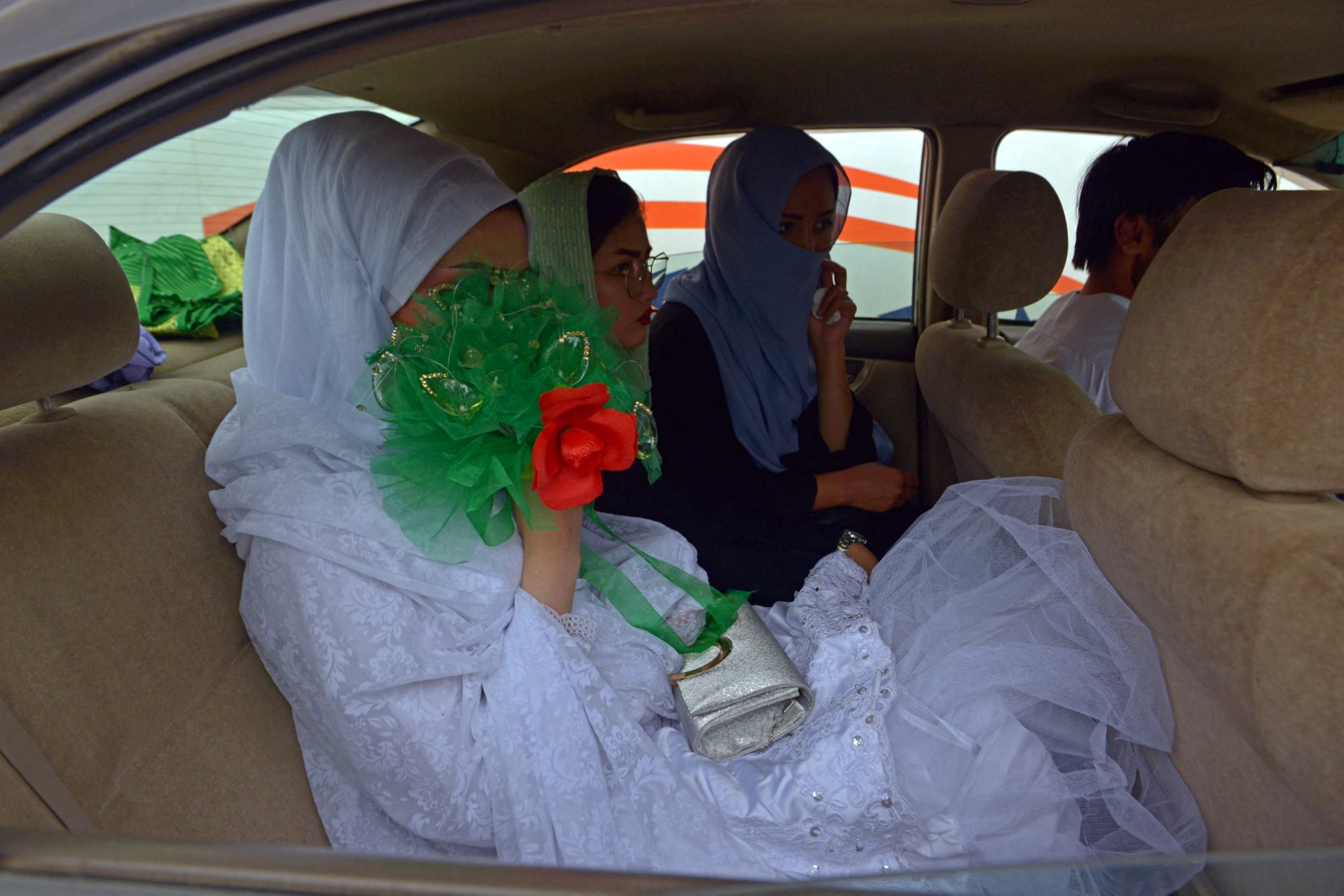 A bride arrives in a car at the wedding hall for a mass marriage ceremony in Kabul. Photo: Sahel Arman/AFP, 13 June 2022.


