ICC Prosecutors Seek Resumed Afghan War Crimes Probe

There is no set deadline for judges to rule on the prosecution’s request to resume the ICC investigation. 

(Reuters) – A year into the Islamic Emirate’s rule, war crimes prosecutors in The Hague have urged judges to rule promptly on their request to resume investigations into atrocities in Afghanistan and warn that crimes are continuing, court documents showed. 

The International Criminal Court’s Afghanistan investigation has been on hold for more than two years. In March 2020 the previous Afghan government had asked it to be suspended while they investigated suspected war crimes themselves.

In documents released on ICC’s website this week and dated Aug. 26, prosecutor Karim Khan argued Afghanistan’s request to suspend the probe should be rejected, citing a lack of effort by authorities there to pursue justice in domestic courts.

He said the Islamic Emirate “have not continued, cannot continue and do not intend to continue the relevant investigations and prosecutions” that formed the basis of the request for suspension by the ousted government.

“To the contrary, the available information suggests that serious crimes within the jurisdiction of the court (…) continue to be committed,” he added, urging judges to allow the probe the be “promptly resumed.”

In September last year, Khan already announced he would ask judges to resume the probe into crimes by the Islamic Emirate and ISIS-K. He added prosecutors would “deprioritize” looking into suspected crimes by US forces and Afghan government troops.

Zabiullah Mujahid, Islamic Emirate spokesman responding to the ICC prosecutor remarks on resuming probe into war crimes in Afghanistan, said that Kabul does not support the decision, which may be a conspiracy against the Islamic Emirate.

Mujahid said that a number of countries, especially the US, that were involved in the war in Afghanistan in the last twenty years and are accused of committing war crimes, rejected the investigation of this court.

In July, the UN mission in Afghanistan said that the ruling Islamic Emirate were responsible for extrajudicial killings, torture, arbitrary arrests and inhumane punishments in the months since they toppled the previous government and seized power after Washington’s withdrawal from the country.

There is no set deadline for judges to rule on the prosecution’s request to resume the ICC investigation.

ICC Prosecutors Seek Resumed Afghan War Crimes Probe
read more

UN warns 6 million Afghans at risk of famine as crises grow

By EDITH M. LEDERER

Associated Press
August 30, 2022

UNITED NATIONS (AP) — Warning that Afghanistan faces deepening poverty with 6 million people at risk of famine, the U.N. humanitarian chief on Monday urged donors to restore funding for economic development and immediately provide $770 million to help Afghans get through the winter as the United States argued with Russia and China over who should pay.

Martin Griffiths told the U.N. Security Council that Afghanistan faces multiple crises — humanitarian, economic, climate, hunger and financial.

Conflict, poverty, climate shocks and food insecurity “have long been a sad reality” in Afghanistan, but he said what makes the current situation “so critical” is the halt to large-scale development aid since the Taliban takeover a year ago.

More than half the Afghan population — some 24 million people — need assistance and close to 19 million are facing acute levels of food insecurity, Griffiths said. And “we worry” that the figures will soon become worse because winter weather will send already high fuel and food prices skyrocketing.

Despite the challenges, he said U.N. agencies and their NGO partners have mounted “an unprecedented response” over the past year, reaching almost 23 million people.

But he said $614 million is urgently required to prepare for winter including repairing and upgrading shelters and providing warm clothes and blankets — and an additional $154 million is needed to preposition food and other supplies before the weather cuts access to certain areas.

Griffiths stressed, however, that “humanitarian aid will never be able to replace the provision of system-wide services to 40 million people across the country.”

The Taliban “have no budget to invest in their own future,” he said, and “it’s clear that some development support needs to be started.”

With more than 70 percent of Afghan’s living in rural areas, Griffiths warned that if agriculture and livestock production aren’t protected “millions of lives and livelihoods will be risked, and the country’s capacity to produce food imperiled.”

He said the country’s banking and liquidity crisis, and the extreme difficulty of international financial transactions must also be tackled.

“The consequences of inaction on both the humanitarian and development fronts will be catastrophic and difficult to reverse,” Griffiths warned.

Russia called the U.N. Security Council meeting on the eve of the first anniversary of the U.S. withdrawal from Afghanistan and its ambassador, Vassily Nebenzia, sharply criticized the “ignominious 20-year campaign” by the United States and its NATO allies.

He claimed they did nothing to build up the Afghan economy and their presence only strengthened the country’s status “as a hotbed of terrorism” and narcotics production and distribution.

Nebenzia also accused the U.S. and its allies of abandoning Afghans to face “ruin, poverty, terrorism, hunger and other challenges.”

“Instead of acknowledging their own mistakes and supporting the reconstruction of the destroyed country,” he said, they blocked Afghan financial resources and disconnected its central bank from SWIFT, the dominant system for global financial transactions.

China’s U.N. Ambassador Zhang Jun also accused the U.S. and its allies of “evading responsibility and abandoning the Afghan people” by cutting off development aid, freezing Afghan assets and imposing “political isolation and blockade.”

U.S. Ambassador Linda Thomas-Greenfield accused the Taliban of imposing policies that “repress and starve the Afghan people instead of protecting them” and of increasing taxes on critically needed assistance.

She asked how the Taliban — which has not be recognized by a single country — expect to build a relationship with the rest of the world when it provided a safe haven for the leader of al-Qaida, Ayman al-Zawahiri, in downtown Kabul. He was killed by a U.S. drone strike on July 31.

Nonetheless, Thomas-Greenfield said, the United States is the world’s leading donor in Afghanistan, providing more than $775 million in humanitarian aid to Afghans in the country and the region in the last year.

As for Afghan frozen assets, President Joe Biden announced in February that the $7 billion in the U.S. was being divided — $3.5 billion for a U.N. trust fund to provide aid to Afghans and $3.5 billion for families of American victims of the 9/11 terror attacks in the United States.

“No country that is serious about containing terrorism in Afghanistan would advocate to give the Taliban instantaneous, unconditional access to billions in assets that belong to the Afghan people,” Thomas-Greenfield said.

To Russia’s claims that Afghanistan’s problems are the fault of the West and not the Taliban, Thomas-Greenfield asked, “What are you doing to help other than rehash the past and criticize others?”

She said Russia has contributed only $2 million to the U.N. humanitarian appeal for Afghanistan and China’s contributions “have been similarly underwhelming.”

“If you want to talk about how Afghanistan needs help, that’s fine. But we humbly suggest you put your money where your mouth is,” Thomas-Greenfield said.

Russia’s Nebenzia took the floor again, calling the suggestion “stunning.”

“We are being asked to pay for the reconstruction of a country whose economy was essentially destroyed by 20 years of U.S. and NATO occupation?” he asked. “You are the ones who need to pay for your mistakes. But first of all, you need to return to the Afghan people the money that has been stolen from them.”

Thomas-Greenfield, the U.S. ambassador, had the last word.

“If the Russian Federation believes that there was an economy in Afghanistan to be destroyed, it’s been destroyed by the Taliban,” she said.

UN warns 6 million Afghans at risk of famine as crises grow
read more

US to revise resettlement policy for Afghans: Official

Al Jazeera

1 September 2022

The US will stop – with a few exceptions – admitting Afghans on humanitarian parole that grants temporary entry but no lawful permanent residence.

The US administration is stopping – with a few exceptions – the temporary relocation of Afghans to the United States and focusing on reuniting immediate family members with pathways to permanent residence, says a senior official.

The policy revision follows criticism by some lawmakers, refugee organisations and veterans groups that the administration failed to properly plan the evacuation of Afghans at risk of Taliban retribution when it pulled the last US troops out of Afghanistan a year ago.

The administration says the evacuation – marred by chaos at Kabul airport and a suicide bombing that killed 13 US service members and more than 170 Afghans – was a success, with nearly 90,000 Afghans resettled in the US in one of the largest operations of its kind.

The administration’s “commitment to our Afghan allies is enduring”, the senior administration official said on Wednesday while briefing reporters on changes to the relocation policy, according to a report by Reuters news agency.

“This commitment does not have an end date,” added the official, whose identity was not revealed in the report.

The revised policy, dubbed Enduring Welcome, begins on October 1.

Under the changes, the official said, the US will stop – with a few exceptions – admitting Afghans on humanitarian parole, a special programme that grants temporary entry but no pathway to lawful permanent residence.

The revised policy, the official said, will focus on relocating to the US immediate family members of US citizens, green card holders and Afghans with Special Immigrant Visas (SIVs) granted to those at risk of Taliban retaliation because they worked for the US government.

Family members admitted from those categories will have “durable, long-term immigration status,” allowing them to “more quickly settle and integrate into their new communities”, the official said.

“We know family reunification remains a really high priority for Afghans themselves and for the communities who care about them and for advocates across the country, veterans groups as well,” said the official. “It is for us, too.”

The revised policy follows months of talks between the administration and the AfghanEvac coalition of groups that help evacuate and resettle Afghans in the US.

“It’s a massive deal for us,” said Shawn VanDiver, the coalition head, adding that the government still needs to improve processing SIV applications and increase relocation flights.

SOURCE: NEWS AGENCIES
US to revise resettlement policy for Afghans: Official
read more

Taliban official says Islam grants women right to education, work

Al Jazeera

31 August 2022

A top Taliban official tells Al Jazeera that the group is working to create a so-called ‘safe environment’ for girls in schools and the workplace.

A Taliban official has said that Islam grants women the right to education, work, and entrepreneurship, and reiterated that the group is working to create a so-called “safe environment” for girls and women in secondary schools and the workplace.

“I must say that Islam has given women the right to education, Islam has given women the right to work, Islam has given women the right to entrepreneurship,” Taliban spokesperson of the Ministry of Vice and Virtue, Sadeq Akif Muhajir, told Al Jazeera.

“If Islam has allowed it, who am I to ban it,” he said during the interview.

The comments by Muhajir came more than a year after the armed group took over the country and imposed several limitations on women’s freedoms, including a ban on secondary education for girls.

The move has drawn international condemnation and sanctions.

Since returning to power, the Taliban has among other things, shut down girls’ secondary schools across the country, ordered women to wear hijabs in the workplace and to cover their faces in public, and has banned women from travelling long distanced without a close male relative.

The restrictions on freedoms and movements are reminiscent of the Taliban’s last time in power in the 1990s, when the group denied girls and women the right to education and barred them from public life.

The armed group had promised women’s rights and media freedom after returning to power on August 15, 2021. But it has since backed away from its pledge.

The Taliban has defended its decision, saying such restrictions have been done to preserve “national interest” and women’s “honour”.

Afghanistan’s economic woes

Muhajir said there are currently “many women’ working in various ministries, including “people from the previous government”.

“I am working to create a situation where they can work in a way that protects their honour,” he said. “It shouldn’t be in a way like it was in the previous administration.”

But a study by the International Labor Organization (ILO) this year found that Afghan women’s employment levels fell by an estimated 16 percent in the months immediately following the Taliban takeover. In contrast, male employment dropped by 6 percent.

“In the pessimistic scenario in which restrictions intensify and women do not feel they can safely show up at their workplaces, the scale of job losses for women could reach 28 percent,” the report said.

Working Afghan women have previously told Al Jazeera that while the Taliban has not directly fired female government employees, it has restricted women from entering workplaces and has paid them a notably reduced salary to remain at home.

The Taliban’s return to power has exacerbated Afghanistan’s economic woes. The country has been reeling from a humanitarian crisis with more than half of the population facing hunger.

The Western-imposed sanctions and the freezing of nearly $10bn in Afghan central bank assets by the US have largely contributed to the collapse of the economy.

The Taliban has been criticised for imposing restrictions on women instead of focusing on saving Afghanistan from economic ruin.

The diplomatic isolation of the government led by the Taliban has further worsened the situation, with Western nations pressing the group to allow more freedoms to women as a condition for engagement.

SOURCE: AL JAZEERA
Taliban official says Islam grants women right to education, work
read more

In a country where women had few options, Fati found freedom playing soccer.

The New York Times

When the Taliban rolled into Kabul, she knew they might kill her and her family.

She had one shot at freedom, if only she could make it to the airport.

A chance at happiness awaited half a world away.

The Keeper

How an Afghan soccer player and her teammates fled their homes, outran a murderous regime and forged the uncertain beginnings of a new life.

To begin her goodbye, Fatima stood inside her family’s walled-in courtyard in Kabul, Afghanistan, shovel in hand, and pierced a patch of soil with the tip of its sharp blade.

Fighting back tears, she began to dig.

In the shade of a grapevine, with the sweet smell of rose bushes hanging heavy, she made a hole about two feet deep and just as wide, and placed some items into it.

Four soccer jerseys lovingly tucked into a plastic bag. Five golden trophies in the shape of a goalkeeper’s glove. They symbolized her accomplishments as the goalkeeper for the Afghanistan women’s national soccer team, and she adored them, once even telling her mother, “These are the things that keep me alive.”

But on this day in mid-August 2021, they might get her killed.

Just days before, in a whir of trucks and rifles, the Taliban had conquered Kabul and begun searching for anyone considered an enemy. Government workers. Human rights activists. Judges. The targeted groups, now rushing to hide and save themselves, included female athletes like Fatima, who, according to the Taliban’s fundamentalist views, had defied Islam by playing a sport in public. The jerseys and trophies would identify her as a traitor.

If the Taliban found them, she and her family could be tortured and killed.

Just 19 years old, Fatima struggled to comprehend that her life, her country and all the gains Afghanistan had made in the 20 years since the Taliban last ruled were collapsing.

She feared that she would never finish her bachelor’s degree in economics, never open a business as she had hoped and never return to the soccer field or help bring about the day when Afghan women could thrive as equals to men.

Even more terrifying was the thought that she was about to die after barely having lived.

As she dug the hole in her backyard, she felt like she was digging her own grave.

Growing up, Fatima — who is called Fati (pronounced FAH-tee) by family and friends — was faced with constant reminders that women in Afghanistan had limited options. (At the request of Fati and her teammates, The New York Times is not using their last names because they fear retribution from the Taliban.)

Like many Afghan women, Fati’s mother never learned to read or write. She was engaged to be married at 13 and had the first of her five children a few years later. While raising her family, she moonlighted as a seamstress, sewing cushions that Afghans use as seating.

Seeing how her mother was forced to live, Fati, the second child, set out to do more and be more. She read and wrote for her mother. She tended to Kawsar, her youngest sister. She recalled once fixing the electricity in her house by fiddling with the wires as her mother stood by, holding her breath and whispering prayers.

Fati became proficient in English when she and her sister Zahra binge-watched Marvel films. Her father, who worked as a night guard in an apartment building, was so proud of Fati that he often called her his son.

At school, some students teased her because she was Hazara, an Afghan ethnic minority that is overwhelmingly Shiite Muslim and remains a prominent target for Sunni militants like the Taliban. Fati bristled when they called Hazara people useless and stupid. She grew tough inside.

“If you are strong and hard, no one can beat you,” she recalled thinking, “and then you can always find your way.”

Then one day, three classmates waved her over and invited her to play soccer.

“You are so tall!” shouted Bahara, one of those girls. “Come join us. You will be a good goalkeeper!”

Until then, Fati was not even aware that women in her country played organized soccer.

For Afghan girls, playing sports in public had long been risky. Religious hard-liners say women violate the Quran when they play soccer because men can still see the shape of their bodies even if they wear hijabs, long sleeves and pants. They call them prostitutes and threaten their fathers and brothers, saying they should be punished for letting a family member dishonor them.

But among more progressive Afghans, particularly women who had seen their rights curtailed under the Taliban’s first rule, from 1996 to 2001, there was a persistent push to allow girls and women to think and behave in ways once forbidden.

Fati said later that she basked in the moments on the soccer field when she could be aggressive, diving to save a shot or walloping the ball with a thunderous goal kick. She found it exhilarating to show her power by staring down an opponent who dared to think that scoring on her was a possibility.

Fati’s mother supported Fati’s love of soccer, telling her: “I don’t want you to be like me. Don’t rush to get married and end up kind of like a slave in the house.” She convinced Fati’s father that soccer was a worthy endeavor for a teenager who had aspirations of life beyond the kitchen.

Fati rose quickly in the sport.

After a national team scout saw her play at a high school tournament, he invited her to practice with the national squad. There, she learned to be agile and fearless, but most of all to be a leader. In a country that had been at war her whole life, Fati finally felt free, safe and in control.

Six months later, she was promoted to the senior national team, joining her friends Bahara, Mursal and Somaya on the squad.

They were the girls who had first invited Fati to play the game, and their relationship would reach much further and deeper than what happened on the field.

Fati’s club team celebrated a victory. Najiba Noori/Agence France-Presse

It wasn’t long before soccer became a mooring for Fati’s whole life. It gave her the confidence to chase her goals.

Mornings, she worked at an organization called Good Neighbors, where she taught English to girls and women. Evenings, she studied economics at a university. Her older brother, Khaliqyar, feeling a duty to protect her, often escorted her there.

Other times, she remembered, she walked alone by moonlight, her hands shaking with nerves because the route was unsafe even in daylight. To go unnoticed, Fati dressed like a boy, wearing sneakers and baggy clothes, and covered her head with a hoodie.

The rest of her time was devoted to soccer. It was too dangerous for her team to play at home, so it traveled to countries like India, Tajikistan and Uzbekistan, facing squads that practiced more, on better fields, with better coaches. Fati’s team lost again and again. Commenters on social media said the team was bad because Afghan women weren’t meant to play soccer.

The pressure to prove critics wrong became so great that once, after losing to Uzbekistan, Fati went back to her hotel and considered flinging herself off the fourth-floor balcony.

A teammate soothed Fati as she pleaded: “God, why aren’t there results? I want to win just one time.”

Back home, she looked everywhere for inspiration. Scouring YouTube for documentaries, she was moved by the story of Colonel Sanders, the founder of Kentucky Fried Chicken.

“He tried so much to be accomplished, make his business bigger and make his recipe taste just right,” she said. “It really motivated me to try harder.”

Her team won its first game, finally, in 2019. Fati never wanted to let go of the feeling.

On social media, positive comments began to appear. She and her teammates were interviewed on television, becoming role models for other girls.

Her family was delighted. The soccer federation was paying Fati $100 a month to play on the national team and she received another $150 to head the women’s grass-roots effort and help manage the under-15 team.

Yet even as her life seemed on an upswing, a fault line was spreading throughout Afghanistan.

Terrorist attacks increased, with the violence reaching hospitals, schools and wedding halls. Hundreds of people, including many members of the Hazara community, were killed by both the Taliban and the Afghan branch of the Islamic State.

In the spring of 2021, President Biden announced the U.S. military would withdraw from Afghanistan. But when Fati heard about the Taliban making advances in the provinces, she told her teammates not to worry. The Taliban would never take over Kabul.

One day in August, Fati was working inside the women’s soccer department of the Afghanistan Football Federation when an employee from the president’s office burst in, shouting that the Taliban were closing in on Kabul. Gather every document they could find, he said, and put the paperwork in a pile. They needed to destroy anything the Taliban could use to target female athletes.

“Hurry!” the man said. “We’re going to burn everything.”

Fati said she and a half-dozen other female workers began opening drawers, grabbing all the papers they could, sometimes stacking them to their chins as they carried them away.

Registration forms. Girls’ photos. Uniform order forms. Travel documents. The entire history of the women’s national team program, which began in 2007, soon lay in an unruly heap.

When Fati and her co-workers were done, they stopped to take a breath. It dawned on them: Their lives were really in danger.

Before leaving, Fati grabbed some passports and ID cards that players had left behind and slid them into her backpack. She knew those girls would be stranded in Afghanistan without them.

Three days later, Fati was headed to a final soccer practice for her local club when her phone began sounding off. Frantic messages were popping into the team’s group chat.

“Don’t go outside, girls.”

Bahara, her former high school classmate who became a defender on the national team, shared a video she had made of the Taliban arriving in one of Kabul’s squares. She had been on her way from dental school when she saw trucks flying white Taliban flags, with soldiers honking horns and shooting guns.

“It’s real, girls,” Bahara wrote in Dari, the players’ native language. “They’re here.”

The city became almost unlivable, especially for women.

Stores and schools closed. Women shut themselves in their homes. The Taliban roamed the streets with paint cans to cover any evidence of shops like beauty salons.

Every day on Facebook, Fati read about killings and more killings. It was impossible to know what was true. Social media posts showed bloody images stamped 24 hours ago. And then one hour ago. And then one minute ago.

Fati and her teammates knew they needed to leave Afghanistan.

“Just be united and let’s see how we can get out of here and find a way,” Fati said in a text to her team. “Inshallah, there will be a way.”

One evening, the team received a text from a veteran player named Nilab. She was a team captain known for being outspoken about women’s rights.

She had received an anonymous text: Somehow if we see you, we will capture you and tie you up like a dog and we will not release you. We will kill you.

Nilab warned the group: Girls, you know they are going to kill the athletes. They will kill them and hang them from the goal in the Olympic Stadium, just like the Taliban did with people before.

Fati, who was at home, felt a chill go through her body as her family slept in the adjacent room. Nilab sounded scared. And Nilab, who several times had been abducted and beaten by militants who tried to silence her, was never scared.

Looking for help, Nilab tried to reach leaders of the Afghan Football Federation and FIFA, the international governing body of soccer, but they didn’t respond.

At last, a breakthrough. Perhaps the team’s only hope.

Nilab received a text from Khalida Popal, a former captain of the Afghan women’s national team who had fled the country because of death threats prompted by her activism. In 2018, she had exposed a sexual abuse scandal involving Afghan soccer officials who were molesting members of the senior national team, which at the time was the level above Fati’s.

“I’m a little worried about you,” Popal wrote to Nilab in Dari. “Are you OK?”

Nilab responded with a harrowing voice message: “No, Khalida, I swear to God, we are locked in the house. You know that enemies are on every side of our house.”

She ended by saying, “We have no way to escape. If you can do anything for us, please help us.”

Within hours, Popal was added to the group chat and introduced herself.

I’m sorry for you girls that you can’t play soccer anymore. I am in contact with you from Denmark. I am going to try to find a way for you to get out of Afghanistan. I’m trying to get you out.

And wherever you end up, the U.S.A. or wherever, after that you can help your family.

But not now.

As the Taliban closed in on Fati’s world, Popal was in her apartment north of Copenhagen, pulling together a trusted group of lawyers, sports officials and human rights activists who could help get the national team out of Afghanistan. She had worked with many of them, including Kat Craig, a British human rights lawyer, on the sexual abuse case.

The first task was to convince governments that the team needed saving.

Popal and the former Afghanistan women’s coach Kelly Lindsey rallied current and former players living outside Afghanistan to talk to the news media and spoke to reporters about the urgency of getting the girls to safety.

“Now our players are totally helpless,” Popal told CNN. “The biggest nightmare is that they are identified and they are taken by the Taliban.”

She told the girls to burn their national team jerseys and delete or lock their social media accounts. After years of encouraging them to speak out for the right of women to play sports, she was begging them to go quiet.

At the same time, Popal’s soccer connections searched for a country that would take the players. Maybe the United States. Or Canada. How about Germany or Belgium?

Nikki Dryden, an Olympian and immigration lawyer in Australia, called Craig Foster, a human rights activist and former captain of Australia’s national soccer team. Foster had connections in the Australian government. On a video call, he told a group that included Popal, “I’ll get Australia to take the players.”

Within days, Fati and her teammates received a thrilling text from Popal.

“We have a country,” it said.

Fati had no idea how far Australia was from Afghanistan. It seemed like another planet. But she was grateful to go anywhere that wasn’t under Taliban rule.

Popal issued instructions to the players: Start packing. Bring only what you need. Your passport and cellphone. Water. Some biscuits for a snack. A power pack to charge your phone.

Crucial documents would need to go along too.

Jonas Baer-Hoffmann, the general secretary of FIFPRO, the international union for professional soccer players, supplied a letter titled, “EXTREMELY URGENT: Request for Airport Access for Women Football (Soccer) Player,” saying that the Australian government had agreed to take national team members on its next flight out of Kabul.

Fati had everything she needed to get out of the country. She just had to wait for word from Popal that she should go to the airport.

Fati asked her old high school friends Bahara and Mursal to come over and collect their passports, which Fati had taken from the soccer federation. The two players arrived with Somaya, their former classmate.

Fati dragged a rug from the house to her backyard, beneath the grapevine where she loved to read and study, so the friends could sit and talk, drink cold water in the heat and eat Afghanistan’s famously delicious apples — for maybe the last time.

As military flights out of the country roared above them, the friends made a promise: If one of them made it out of Afghanistan, that person would work her whole life to save the rest.

“You will have the responsibility to help the others,” Fati said, as they all nodded. “You should do your best. I want to make that clear.”

Looming over them, Fati and her friends recalled, was the fear that there was no hope for any of them. They treated their goodbyes as final.

“We should have this last hug,” Mursal said, and they embraced.

Fati led her friends to the door and watched them depart. In their black dresses and full hijabs, they looked like dark floating clouds that slowly faded into the distance.

Fati went inside, grabbed her soccer trophies from the top of the refrigerator and headed to the backyard. The spot under the grapevine was a perfect place to dig.

After many restless hours, she fell into a deep sleep. At about 8:50 a.m., Bahara called, shouting into the phone: “Fati, wake up! Didn’t you get the messages? We have to be at the airport at 9 a.m.!”

Escape From Kabul

On the day she would leave her old life behind, Fati could hardly think because she had a headache from lack of sleep. But within minutes of Bahara’s phone call, it was like a bomb of energy had exploded inside her brain.

She opened her blue school backpack and began tossing things in. A handful of markers. A necklace and earrings given to her by her closest friends. Old soccer credentials from tournaments. Photos of her family.

With each item she shoved into the bag, she could feel her heart pounding.

Her parents and siblings gathered around, flooding her with questions. Where are you going? Can we go with you? Popal had said she could not guarantee that any family member would be let into the airport, especially without a visa application. But she said the players could at least try.

Like a platoon commander, Fati began shouting orders.

“Everybody get ready to go!” she yelled. “Forget worrying about what to bring. Right now your life is the most important thing.”

Her mother started crying, and Fati told her to focus. Her mother’s assignment was to get cash and important documents, like Khaliqyar’s driver’s license and everyone’s ID cards. Fati’s brother Ali Reza, 15, sprinted to a store to buy food. Fati’s mother shoved pounds of provisions into her own bag, including chocolate chip cookies and juice boxes.

Zahra, 18, asked what she should wear. Fati told her to find the longest, darkest dress because they didn’t want to anger the Taliban.

Fati’s sister Kawsar, 4, repeatedly asked in her lilting voice if they were really going to Australia. With a forced smile, Fati said yes while combing Kawsar’s hair.

Fati put on a Spider-Gwen T-shirt she loved because it represented girl power. Over that, she donned a long robe-like covering she had bought at a secondhand store.

This was no abaya, the traditional Muslim dress. This was more like a black cloak Harry Potter would wear. Fati fastened it with a pin at the chest. The hood was so huge that when she draped it over her head, she couldn’t see.

Fati and her family were ready.

Before heading out the door, Fati said, she toured her house and courtyard one last time, examining everything so she would remember the details.

Goodbye, grapevine. Goodbye, jerseys and trophies, now safe beneath the ground. Goodbye, dreamy-looking mountains in the distance.

Goodbye, childhood.

As their taxi drove off, Fati turned to see her aunt, who had stayed behind. In the Afghan tradition of bidding people good luck when they take a trip, the aunt was splashing water onto the road with a watering can.

This time, more than ever, Fati would need all of that good luck.

Hidden under one baggy sleeve of Fati’s cloak, written in blue ballpoint pen on her arm, was the phone number of Haley Carter, a former assistant coach of the Afghanistan women’s program who was at home in Texas.

Carter, a former Marine Corps officer who served two tours in Iraq, had inside information to help players navigate Taliban checkpoints. Fati became her contact because she spoke the best English.

About a week before, the two had connected on WhatsApp.

From the start, Carter could tell Fati was a born leader because Fati was already coordinating logistics for some of her teammates. That put Carter at ease. She knew that the best partners in life-or-death situations were the ones who calmly take charge.

Before leaving for the airport, Fati thanked Carter for her help.

Carter responded: “There’s no reason to thank me. You are a player and I am a coach. It’s my job to work to make sure you are protected.”

When the national team players convened at their meeting place, a gas station outside the airport, they laughed. The group of mostly teenagers had never seen one another so hidden in fabric. Nilab looked like a spy in her abaya, gloves that covered her tattoos and sunglasses. Fati and the others were dripping sweat beneath their layers.

All around them was chaos, with thousands of people clambering to get into the airport and onto the final planes leaving Afghanistan.

Taliban soldiers repeatedly beat people with whips and electric cattle prods as the sound of gunshots echoed. Children wailed. A faint smell of gunpowder lingered.

Bahara shot video of Taliban fighters threatening people with rifles and firing into the air.

For two days, Fati joined a group of players and some of their families — more than 100 people in all — on a miles-long trek around the airport, trying to find a way in. Her teammates asked: “What’s the plan? Where are we going?” Fati kept answering: “We’re close right now. Don’t worry. Almost there.” Carter was sending maps that showed the location of entry gates and Taliban checkpoints.

During the day, the temperature soared to the 90s, making the players and their families woozy with dehydration. Though some of them brought water, there wasn’t nearly enough. A national team member lived nearby, so some girls headed to her house to drink or use the bathroom.

At night, the temperatures dropped to the 60s and the group crowded together to stay warm and nap. But Fati stayed awake. She wanted to be alert when Carter texted her with instructions.

The North Gate was completely blocked, so at Carter’s suggestion, Fati led the group back to the gas station where the team had first assembled. From there, she and her brother Khaliqyar, 23, decided to check out the Abbey Gate, a different airport entrance. A player named Farida joined them.

Fati’s mother began to sob as they parted, saying, “Don’t go, why can’t someone else go?” and Fati almost cried, too.

“Please stop, you are making me weak,” she told her mother, handing her backpack to her because it had gotten too heavy to carry. She promised to return soon.

Players began texting the group chat, asking for directions to the best gate of entry.

We cannot do this much longer.

The Taliban is beating me.

Popal, coordinating the evacuation from Denmark, saw the desperate messages and insisted that everyone calm down. Writing in Dari, she told them to pretend it was the Champions League soccer final, but one without fouls or red cards. Use your elbows! Punch and hit people! Do anything to get to the gate!

To get inside the airport, Fati would have to pass through two Taliban checkpoints and a Taliban-laden area just before the main entrance.

Approaching the first checkpoint, she wasn’t sure how she would move even a single foot ahead. Two young girls, crushed by the crowd, gasped: “We don’t want to go here. We just want to be alive.” They reminded Fati of her little sister, Kawsar.

Fati yelled, “Give them air, don’t push them, they are just little!” as she used the hood of her cloak to fan them. Khaliqyar put one of the girls on his shoulders.

One Talib shot his gun so close to Fati that her ears rang for 15 minutes. Everything went black. Khaliqyar ran off to buy water from a vendor and revived Fati by splashing it in her face.

After a few minutes, they waded back into the crowd and pushed past the first checkpoint. Fati said she felt men’s hands groping her as she struggled to protect herself. She lashed out at one man, slapping him hard.

“This is embarrassing for you, look at yourself, you animal,” she said. “Our country is almost done and this is what you choose to do?”

The second checkpoint was even harder to pass. Two cars were parked nose-to-nose in the road, with Taliban soldiers standing guard. One man in the crowd recognized Fati and yelled, “Hey, that’s the national team player!”

As the Taliban edged toward Fati with their guns pointed at her, the crowd surged forward. The force was so powerful that one Talib was knocked down and trampled, splayed on the dirt beneath a sea of stampeding feet. Fati could see his bloody head as she passed. The other Taliban fighters began shooting toward the crowd.

In the confusion, Fati and Farida slid across the hoods of the cars, past the checkpoint. But Khaliqyar was stuck behind. A Taliban soldier slammed the butt of a rifle into Khaliqyar’s shoulder, knocking him down.

With 20 feet between them that now seemed like 20 miles, Khaliqyar made a choice. “Just get out of here, go! Save yourself!” he said, urging Fati forward.

He waved goodbye and then pointed to the sky, looking up to God.

Popal had texted the players, urging them to push ahead on their own if they were to make it to the plane. Many were already separated from their families. Fati, now alone in the crowd, realized that she hadn’t said goodbye to her parents and siblings. She hadn’t even kissed Kawsar’s little cheeks.

Her body and mind were numb. Her parents, sisters and younger brother were who knows where, with her backpack. And Khaliqyar, her brother, friend and loyal protector, was also gone.

The voice in her head was relentless and harsh: It was such a long journey for nothing, and now your family will be in danger because of you. You’re a failure. You are the weakest person in the world.

Fati felt a hand on her shoulder. It was Farida, telling her not to cry.

Embarrassed, Fati snapped back into tough-girl mode.

“I’m the decision maker here. I’m stone-hearted,” she repeated to herself after stomping away. “I should listen to my sixth sense that’s telling me to go forward.”

Two checkpoints down. One last effort to get to the airport gate.

Fati’s group grew to six after she and Farida bumped into other women they knew. Nilab, their fearsome friend, was among them. The whole group looked ready for a fight, with dirt caked onto their hair and clothing, and hands black with filth.

The women forced their way through the crowd inch by inch, crouching low and scurrying forward, just as Nilab had learned in military school. Fati briefly separated from the others and was punched and kicked in the back by a Taliban fighter.

Now close to the gate, they stood and waved empty water bottles at American soldiers inside the airport. Those soldiers beckoned them forward. But Taliban fighters wouldn’t let them through.

So the women held hands and formed a chain, each player grasping so tightly that it hurt, and bulldozed their way toward the door.

Somehow they made it. An Australian soldier greeted them: “This is the end of the road for the Taliban and the end of the danger.”

All around her, Fati saw teammates, many with at least one family member. Standing there by herself, she didn’t feel happy to have conquered the crowds. She felt crushed.

After keeping her phone off to save a dying battery, she turned it on and called Khaliqyar. When he answered, she exhaled.

Her big brother had gone home after parting with Fati at the second checkpoint. Their parents and Kawsar were already there. Khaliqyar said they had given up trying for the airport gate after the Taliban beat Fati’s father with a cattle prod as he clutched a screaming Kawsar in his arms. Fati’s teenage siblings, Zahra and Ali Reza, were still outside the airport somewhere.

Fati told Khaliqyar he should come back and described the best way to get in. “Oh God, just come,” she told him.

She checked her messages. A group of players and family members, including Bahara and Mursal, were stuck just outside the gate, standing in a sewage ditch, knee-deep in watery muck, as American soldiers stood guard atop the high wall.

In her voice messages, Bahara was crying and begging for help, saying she couldn’t get in touch with any teammates. Mursal would later describe how she had tried to show a soldier her visa letters, only to have him kick her, point his rifle at her and threaten to shoot her.

Safe inside the airport, Fati remembered the promise she and her friends had made to one another. She had to try to save them.

After pleading to soldiers that she needed to leave the airport briefly to help her friends, she found an Australian officer to accompany her outside.

With her Harry Potter cloak flowing behind her, Fati walked along the outside wall to look for teammates. They found her first.

“Fati! Fati! We are here!” they shouted. When the people nearby heard those calls, they also started shouting, “Fati, help me! Please help me, Fati!” She tried her best to tune out those other people as she pointed to five teammates and at least three of their family members, whom the soldier lifted out of the river of sewage. To Mursal, it was as if an angel had come for them. She had been sure that Fati, whom she called her “bestie,” would never leave them behind.

And then, a miracle. Behind those girls, standing tall and looking stunningly clean because he had gone home and showered, was Khaliqyar. He had made it to the gate after following people to the sewage ditch, as Fati had instructed him to do. The only items he carried for himself were two sweatshirts and an extra pair of pants.

And he had her backpack.

After spending a day in a processing area, the group of around 80 national team players and family members, smelling of sewage and sweat, boarded a military plane and huddled together inside its giant metal belly. They were bound for Dubai, the first stop before heading to Australia.

Carter, the former coach and Marine Corps officer, had demanded photographic proof that Fati and her teammates had boarded the plane. So Fati texted her a snapshot of the mass of passengers in front of her. The image made its way to thousands of people after Carter shared it on social media.

During takeoff, Fati and other players recalled, the sound of weeping rose above the sound of the engines. The next day, at a processing center in Dubai, Fati and Khaliqyar cried again when their teenage siblings, Zahra and Ali Reza, unexpectedly showed up. The two had been in the sewage water for more than a day before Alison Battisson, an Australian lawyer who was part of Popal’s group of helpers, got them out of the country, coordinating with a soldier to identify Ali Reza, who was wearing a mustard-colored vest that made him stand out in the crowd.

Fati was finally able to talk by phone to her mother, who thanked her for saving Khaliqyar, Zahra and Ali Reza.

“You saved my children when I could not,” her mother told her. “Take care and be strong.”

Those words echoed inside Fati’s head throughout the 14-hour plane ride to Australia.

When she arrived at her hotel in Sydney, Fati closed the door of her room, put her back against it and sank to the ground.

“Finally,” she said to herself. “I’m safe.”

A Fractured Soul

Seven thousand miles from her family’s home in Afghanistan, Fati tried to distract her siblings and make them smile.

She brought them to her window to show them what Australia looked like, telling them it would be a wonderful place to live. They weren’t buying it. The city was on lockdown because of the pandemic — a zombie apocalypse, as Fati later described it — and they were still struggling to process what they’d been through.

Ali Reza had seen his father beaten with a whip and Zahra was devastated by the news that 130 people, including one of the Marines who had helped her out of the sewage ditch, had been killed in a suicide bombing. She was so overwhelmed with grief that she had been fainting during long sessions of sobbing.

Moya Dodd, a former member of the FIFA executive committee and former national team player from Australia, helped provide support.

“Could you bring Zahra some coloring books?” Fati texted Dodd, hoping that the distraction of coloring would make Zahra “stronger and fresher.”

But even Fati sometimes sat alone and asked why me, and why did all of this happen? She asked God for mercy.

“Sometimes I feel so much broken,” she said.

In Australia, Fati hoped to become the woman and soccer player she had always wanted to be, free of a Taliban regime that would deny her and all women their humanity.

But those bigger goals would have to wait. First, she would need to be the head of a household, a surrogate mother to her siblings, a breadwinner, a translator.

Because of her English skills, she became an unofficial spokeswoman for the refugee group. One of her first tasks was compiling clothing sizes for everyone so that Dodd’s soccer charity, Women Onside, and other nonprofits could buy those items. Fati also fielded requests from her teammates and their family members. Like for more pistachios. Or body spray. Or oil made for curly hair.

A lot of people wanted to help the team after its escape made news around the world. Asma Mirzae, a former Afghan refugee on the board of Women Onside, was one of them. She drove more than 500 miles from Melbourne to deliver food to them made by her mother and others in her Afghan community.

Fati said that the first whiff of Mirzae’s dish of rice with raisins and carrots transported her back to dinnertime with her family. While she and other players ate, tears dripped from their cheeks onto their plates.

To thank those who rallied around the team, Fati drew an Afghan girl on sketch paper Dodd had given to her. The girl was dressed in a blue burqa, with a soccer ball in her hands and a broken heart. To one side was the Australian flag.

Fati was grateful to be in Australia, but essentially still had no home. From Sydney, most of the Afghan national team players moved to Melbourne, where they began their long wait for permanent visas so they could stay in the country.

After three months in a hotel, Fati chose a four-bedroom house in a suburb with a thriving Afghan community because her siblings wanted to be near other Afghans. Bahara left Kabul with no family, so Fati invited her to live with her. Paying bills was hard, even though everyone in the house received subsistence money from the government. Several times, Fati fell behind on rent and utilities, with her bank account once dipping to just $5.

Each morning, she woke to a colorful collage of sticky notes on the wall next to her twin bed. It was her to-do list, and it grew by the day.

Fill out school forms for Ali Reza. Help Khaliqyar find a job. Call her refugee services case manager to answer yet more questions, hours of questions, about herself and her siblings as they awaited their visas.

“I left my childhood back in Afghanistan,” Fati said one day, choking up but quickly composing herself.

Life in a new country was especially hard for Fati’s younger siblings. Back home, she and her family — like many Afghan families — slept on the floor in the same room. Now, on many mornings, Fati would nearly step on Zahra, who was sleeping on the floor next to her bed. And if Fati heard rustling at night, it would often be Ali Reza dragging his comforter downstairs, where he would set up camp on the living room floor.

Fati did her best to make her house a home. She stored the dining table in the garage because many Afghans prefer to eat while sitting on the floor. On top of the two Persian-style rugs she had received from a local soccer referee, she spread out a vinyl tablecloth so her family and friends could share meals the way they did in Kabul.

To break the day’s Ramadan fast one night in April, Bahara whipped up roast chicken and vegetables from a YouTube recipe. Fati made a batch of firni, an Afghan custard.

During the meal, Fati leaned on one of the donated couches in her living room and lamented that this didn’t feel like home because Afghans don’t use couches. They sit on large cushions, the kind Fati’s mother made.

When Bahara said they could eventually buy cushions for the house, Fati quickly said no.

“My mom will make them for us when she finally comes here,” she said, as the room grew quiet.

Fati and her teammates had access to mental health experts who could help them process the trauma of being ripped from their country. But she and many others decided that holding unofficial, friends-only therapy sessions was a better idea.

In those sessions, they reminded themselves that it was a miracle they were alive and safe. But they felt guilty that so many people in their country — so many of their friends and relatives — were still suffering.

Mursal shared that her brother who was in the Afghan special forces was kidnapped, but managed to run away from his captors. Bahara, whose forearms were Popeye-level strong after working in her family’s sandal-making business, shared that she missed her family so much that her chest hurt.

“Did you hear about the bombing at the mosque?” Bahara said one day as she scanned her social media feed. Dozens of people, including many children, were killed or wounded when a roof collapsed on worshipers. The mosque was in an area where many Hazara lived, and Fati rushed to call her mother to see if everyone was OK.

Fati was sick about her little sister Kawsar, who had no future in Afghanistan beyond becoming a housewife. There was no school for girls after the sixth grade. No sports for girls and women. All the rights that Fati and her teammates had fought for had disappeared.

Yet during the daily calls with her mother and Kawsar, Fati remained upbeat. Her mother did, too, though Afghan life had grown arduous because food, jobs and money were now scarce. They put on a strong front for each other.

“Now that you are in Australia you can laugh, and I like that,” her mother told her one night, when Fati had friends over who were making a ruckus. “Remember those days back here when you had to wear a scarf and sit in the corner? It’s good that you are not here.”

But Fati felt torn inside. She had a recurring nightmare in which Taliban fighters were searching her home in Kabul, and her mother and Kawsar were frozen with fear. In the dream, her sister screamed, and Fati tried to scream, too, but nothing came out. When she awoke, she was soaked in sweat and shaking.

One day, Kawsar jumped into the frame of Fati’s video call with her mother and showed off drawings she had made in kindergarten.

“A fish!” the little girl said in Dari, pointing to a little blue fish. “The number 2! Another fish! The number 1!” She stopped and stared at Fati. “When can I show you these in person?”

“Soon, my darling, soon,” Fati said, changing the subject as she felt the tears coming. “Hey, what color do you like the best?”

In Afghanistan, Fati had been somebody. As the national team’s starting goalkeeper, she was often in the news. When traveling internationally for matches, she promoted a woman’s right to participate in sports and society.

In Australia, the new Fati was in blueprint stages.

As one of the national team’s captains, she was given opportunities to speak publicly about the team’s dramatic exit from Kabul, including addressing one crowd at the Australian Open and another at a human rights conference. Yet she was caught in a typical refugee limbo, unsure of where her life was going.

Twice a week, she and her sister Zahra worked at an Indian restaurant. They slipped on hairnets and long rubber gloves to spoon concoctions of curry into plastic bags for hours. The jobs allowed them to send money to their family. But as with so many refugees, those jobs took up their time when they needed to be studying English, crucial to success in their new lives.

Popal, the former player responsible for rescuing Fati and her teammates, continued to check in with the players. During one of those calls with Fati this spring, she noticed that Fati looked unsettled, so she asked how she was doing.

“If you want me to say a lie, I am good,” Fati said.

After the team left Afghanistan, the Taliban continued to search houses for anyone considered a traitor to the new regime. Days before Fati’s conversation with Popal, it had been Fati’s family’s turn.

When the soldiers asked how many people were living in the house, her father answered: “Three. We are just three. Always three.” They didn’t find anything incriminating.

Her mother told Fati that as a precaution she had deleted all of the photos of Fati from her phone. All evidence of Fati’s existence in the house was gone. Fati felt shattered.

She stopped sleeping. She ate junk food. Once again, she felt useless to do anything to help her family, and her mind started to swim with anxiety and remorse.

At least one thing could boost her mood, and Popal made it happen.

Popal had been hosting Sunday night video calls with the players to talk about things such as how to fit into Australian culture (don’t go swimming with all of your clothes on, for example). But Popal had made another call that ended up bringing Fati and the rest of the team much-needed joy.

She had called Foster, the man with so many Australian connections, and said, “It’s time that the team starts playing together again.”

Fati didn’t know anything about Melbourne Victory, the club that stepped up to sponsor the Afghan women’s national team. But she quickly learned that it was a top-notch business that set out to give her and her teammates the best of everything.

Melbourne Victory assigned the players a coach who had just won the women’s championship for the club, bus transportation to and from practices and games, and trainers to get them back into shape after not playing an official match since early 2021.

One day, the club invited the team to a jersey presentation held at a soccer store.

Fati had never felt so appreciated. She and her teammates posed for photos, taped video interviews and received a pile of equipment, including cleats that cost more than $250. “Ooh, so professional,” she whispered to Bahara before they were given game jerseys that were branded Melbourne Victory but also honored their home country.

When Fati discovered a small Afghan flag on the back of her jersey, she ran her finger over it and remembered how proud she had been to represent her country.

After the ceremony, John Didulica, director of football for Melbourne Victory, said the club supported the team playing together again because it would be “the ultimate act of defiance to the Taliban.”

The team had its first game, against ETA Buffalo soccer club, in late April in Melbourne. That morning, Fati and her teammates received a text from Popal, in Dari:

I wish you success in the season. Be like a lion when you go on the field. Show all of them your power and your unity as Afghan women. Inshallah, you will be a success and success will be ours.

FIFA had not recognized the squad as a national team in exile, so the Afghan players were left to play in a state soccer league. About 75 fans, most of them supporting the other team, lined up against a chain-link fence that surrounded the field. A backdrop of chirping from white cockatoos and green lorikeets broke the pregame silence.

To the Afghan players, the game was as important as a championship final. Most were playing on empty stomachs because they were fasting for Ramadan. Yet they remained aggressive and fierce, relentlessly pushing the ball up the field. After one shot ricocheted off the opposing team’s left post, Fati yelled, “Why is this happening?”

The score was still 0-0 in the second half when an attacking Afghan midfielder took the ball on a breakaway run and sent it flying into the net. The players erupted in cheers, jumping on one another in celebration.

The sound of the referee’s whistle broke their hearts. An Afghan player had been offside. The official trotted to the team’s bench, saying, “I can’t sleep if I allow that.”

The game ended, 0-0. Coach Jeff Hopkins told the team he was content with the result, particularly because the players hadn’t had much time to practice together. Fati translated.

“No sad faces, OK? No sad faces,” he said to a group of players with sad faces. “It’s so good for us just to see you out there playing football.”

Fati was the last to board the bus back home, greeted by applause for her performance in goal.

“Our Batman!” Bahara shouted because Fati had fended off every shot that came her way. Fati laughed, waving off the compliments.

In the months after that day, Fati remained fractured, her soul in two places. Her parents and Kawsar were still a world away, and she worried that she would never see them again. No one knew when, or if, they would get visas.

But on this day, on the bus after her first soccer game in her new country, among her teammates, Fati saw new possibilities.

“It was powerful for us to play together again,” she said, propping her knees on the seat in front of her. “I feel like we are here and alive.”

She paused before adding, “I have the power to be me again.”

Juliet Macur spent a year reporting the story of Fati’s life in soccer, her escape from Kabul and her time in Australia. Macur, a New York Times staff writer since 2004, interviewed more than three dozen people, including current and former members of the Afghan women’s national soccer team.

During her reporting, Macur spoke to members of the group that arranged for the safe passage of Fati and her teammates to Australia. Among that group was a former national team captain, Khalida Popal, whom Macur interviewed for dozens of hours in Europe and Washington, D.C. Others were the lawyers, human rights advocates and sports officials who helped orchestrate the escape.

The scenes depicting Fati’s early life and her flight from Afghanistan are based on more than 200 hours of interviews with Fati and her family, close friends and teammates. Many details were confirmed through interviews with people involved in the team’s evacuation, text and voice messages, emails and written calendar notes. For additional information, Macur examined photos, videos, documents, social media feeds and news reports.

In April, Macur and Gabriela Bhaskar, a Times photographer, traveled to Australia, where they observed the players’ lives firsthand, shadowing them as they prepared for and then played their first game together in more than a year.

Safiullah Padshah provided translation from Kabul and Wajma Ibrahimi Parwak from Melbourne.

Editing by Mike Wilson and Ken Plutnicki.  Additional production by Jonathan Ellis, Meg Felling, Dahlia Kozlowsky and Matt Ruby.

In a country where women had few options, Fati found freedom playing soccer.
read more

Mujahid Says US is Preventing Intl Community From Recognizing Govt

Mujahid made the remarks in an interview with TOLOnews’ Sebghat Sepehr.

Islamic Emirate’s spokesman Zabiullah Mujahid said that Washington has been preventing the international community from recognizing the caretaker government of Afghanistan.

Mujahid made the remarks in an interview with TOLOnews’ Sebghat Sepehr.

“They have been defeated here and suffered a lot of human and financial loss and were politically damaged. In such a situation, they might not be ready to engage but there is a need for both sides. They would benefit from it and it is in the interest of Afghanistan and the region,” Mujahid said.

The Islamic Emirate’s spokesman said they want to have an official interaction with the international community.

“The policy of the Islamic Emirate with the world is to engage with all countries based on mutual respect and legal manners. This is our right and no one should look down at our independence and should not inflict damage on us. They may recognize us as an independent country and should engage officially within the world’s norms,” Mujahid said.

According to Mujahid, the world’s demand to create an inclusive government in Afghanistan is interfering with Afghanistan’s internal issues and the time for negotiations is over.

“Its time has passed. We were saying to solve the issue via negotiations before military actions and solve it via agreement, thus the situation would have been better now,” he said.

Mujahid said that the Resistance Front is not a serious threat for Islamic Emirite, and the group is just active on social media.

Mujahid Says US is Preventing Intl Community From Recognizing Govt
read more

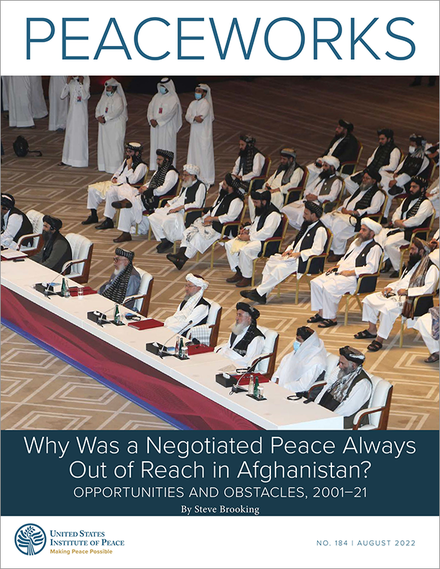
Why Was a Negotiated Peace Always Out of Reach in Afghanistan?: Opportunities and Obstacles, 2001–21

BY: Steve Brooking

United States Institute of Peace

August 30, 2022, marks the one-year anniversary of the last US troops leaving Afghanistan. During America’s 20-year military intervention, there were several opportunities to negotiate peace among the Taliban, the Government of the Islamic Republic of Afghanistan, and the United States—but these opportunities were missed, went unrecognized, or were deliberately spurned by one or more of the parties. In this important history, Steve Brooking, the first British official sent into Afghanistan after 9/11, examines why the three parties were unable or unwilling to reach a negotiated settlement.

Summary

Peace efforts in Afghanistan from 2001 to 2021 required the willingness of three main parties to negotiate: the Taliban, the Government of the Islamic Republic of Afghanistan (“the Republic”), and the United States. But as political and military advantages shifted, each party’s perceived and relative interests differed over time, preventing the alignment that was necessary for a genuine peace process to take root.

In the early years of the war, with the Taliban on the run, the United States and its Afghan allies chose not to include the Taliban in discussions on the country’s political future or in the new Afghan government. While the United States prioritized military operations against terrorists over statebuilding, abusive warlords and corruption undermined the authority of the fledgling Republic. The US military surge in 2010 arguably led to the kind of mutually hurting stalemate that might have encouraged negotiation, but the US policy machine was slow to acknowledge that a negotiated settlement was likely needed to end the war. By the time the US view had changed, the Taliban could see a path to military victory unobstructed by the need for serious political negotiations with the Republic.

A decisive shift occurred in 2018, when the United States appointed a special envoy to negotiate with the Taliban and enable a withdrawal. But President Donald Trump’s clear intention to leave without any real conditions weakened the United States’ and Republic’s hands in negotiations. Moreover, the Republic leadership distrusted the envoy, was concerned chiefly about its own positions, underestimated US intentions to withdraw, and overestimated the Republic’s own strength—and consequently made no concessions that could advance talks.

The United States negotiated its own deal with the Taliban, excluding the Republic. But the decision to de-link the US-Taliban deal from results in an overall peace process precipitated the speed of the Taliban victory. So, too, did President Joe Biden’s announcement of a complete US military withdrawal by September 2021. By midsummer 2021, Taliban advances across the country demonstrated that victory was within their grasp. The option of a political settlement thus became moot, and in August 2021, as President Ashraf Ghani fled the country, the Taliban took full control.

Ultimately, the three parties, as well as Pakistan, put their own short-term interests above those of the Afghan people, eliminating hopes for a negotiated, inclusive, and durable peace in Afghanistan.

About the Report

This report examines why negotiations involving the United States, the Government of the Islamic Republic of Afghanistan, and the Taliban between 2001 and 2021 failed to produce a political settlement of the conflict. The report, which was commissioned by the United States Institute of Peace, draws on primary and secondary sources, interviews with participants, and the author’s firsthand experience in Afghanistan as a diplomat and adviser.

About the Author

Steve Brooking was the first British official sent into Afghanistan after 9/11; he attended the Bonn Conference in 2001 and was political counsellor and chargé d’affaires ad interim at the British Embassy in Kabul from 2001 to 2004, before working in the private sector and as a senior adviser in the Afghan government. From 2015 until October 2021, he was the United Nations’ special adviser on peace and reconciliation, leading UN efforts in engagements with the Taliban.

Why Was a Negotiated Peace Always Out of Reach in Afghanistan?: Opportunities and Obstacles, 2001–21 Report Cover
Why Was a Negotiated Peace Always Out of Reach in Afghanistan?: Opportunities and Obstacles, 2001–21
read more

After a Year of Taliban Rule, Advances for Afghan Women and Youth Have All but Evaporated

Despite prior assurances that they had moderated their positions, the past year of Taliban rule has been marred by a disturbing rollback of women’s and girl’s basic rights as 20 years of advancements have nearly evaporated. Meanwhile, the current economic crisis has forced young Afghans out of the workforce and left them in dire financial and humanitarian straits. USIP’s Belquis Ahmadi and Matthew Parkes examine how the Taliban’s oppressive policies have affected Afghan women, girls and youth over the last 12 months and offer ways for the United States and international community to support Afghanistan’s next generation.

How have women’s lives changed since the Taliban takeover?

Ahmadi: Since returning to power last year, the Taliban have enforced restrictions on women’s access to education, employment and other economic resources, and severely limited women’s mobility generally. These restrictions have been introduced through official edicts, orders and letters at both the national and local levels.

While the landscape prior to the Taliban takeover was problematic, the World Economic Forum’s 2022 Global Gender Gap Report ranked Afghanistan 146 out of 146 for women’s education attainment and economic participation and opportunity.

The Taliban’s methods of enforcement include direct warnings, intimidation, detention and, as applicable, dismissal from government positions. According to a U.N. Women report: “In practice, restrictions on women’s freedom of movement often go beyond what is prescribed in decrees,” due to the culture of fear and intimidation associated with the Taliban.

Almost immediately after taking control of the country, the Taliban ordered women employees of government to stay home. Universities remained closed for several months, and girls in most areas remain unable to attend school beyond sixth grade.

The Taliban’s governmental reorganization included abolishing the Ministry of Women’s Affairs and replacing it with the Ministry of the Propagation of Virtue and Prevention of Vice, which was an infamously oppressive ministry during the Taliban’s previous rule in the 1990’s.

The ministry soon ushered in further restrictions on mobility — and access to services like health care — by requiring women to be accompanied by a male blood relative when leaving their home. Women can no longer be issued a driver’s license. And in a development that demonstrates both the Taliban’s ignorance on women’s issues and their inability to effectively govern a modern state, the Taliban ordered women employees at the Ministry of Finance to send a male family member to replace them, regardless of the man’s qualification or education level. Taliban decisions and orders make clear the group sees women as second-class human beings, and they are very willing to try and erase women’s presence in the public square.

What are the social and psychological impacts of the erosion of women’s rights in Afghanistan?

Ahmadi: The Taliban’s behavior and subsequent policies toward women have dire consequences for women’s social status and their lifelong psychological wellbeing. Treatment of women as less of a human being or as a second-class citizen affects how society as a whole — particularly young men and boys — views and treats women at home and in public.

Coupled with Afghanistan’s already patriarchal society, it validates efforts to exert ever-increasing control over women’s mobility, education and professional choices — even their choice of what to wear, access to everyday services and their ability to exercise their fundamental rights.

It harms women’s self-worth, confidence and agency. Enforcers from the Ministry of Vice and Virtue often go in communities, gather people in markets and use radio and television platforms or mosque loudspeakers to call for the public to be their eyes and ears in ensuring women abide by the Taliban’s rules of behavior.

In terms of justice, what mechanisms are there through which women can access justice?

Ahmadi: Prior to August 15, 2021, there were laws, special commissions and family dispute resolution mechanisms that provided some level of protection and support to women. Institutions such as the Ministry of Women’s Affairs (which had a presence in every province), the Afghan Independent Human Rights Commission, and an ever-growing list of women’s rights groups, special commissions and NGOs have been shut down or banned.

Under the Taliban, women have also been barred from practicing law or serving as a judge, prosecutor or defense lawyer. Of the roughly 300 women judges in Afghanistan prior to the takeover, 244 of them have been evacuated from the country entirely.

The Taliban have eroded mechanisms and services that were in place to provide protection and legal counselling to women. The Taliban made the Afghanistan Independent Bar Association (AIBA) part of the Ministry of Justice. By merging AIBA with the ministry, the Taliban have deprived Afghans, particularly women, of a previously robust mechanism to access independent defense attorneys.

Predictably, the Taliban have replaced experienced judges with their own members — most of whom have no formal legal education. Courts have stopped taking cases that relate to divorce, separation or domestic violence. Many women who had pending divorce cases prior to the Taliban takeover cannot proceed with their cases. In rural areas, most family and property related cases are heard and decided by male elders and Taliban. Unsurprisingly, cases involving women are decided in favor of the male party.

All of this is forcing women victims of domestic violence to suffer their abuse in silence and often isolation. In the absence of female justice actors, combined with the Taliban’s policies that embolden patriarchal norms, women are left with no support and options for navigating the justice sector.

Afghanistan has a very young population, with over 60 percent of its citizens under the age of 25. How has life changed for them over the past year?

Parkes: The rise of a new generation of Afghan scholars, activists and civil servants was one of the greatest achievements of the past 20 years. There was hope that a new era would be ushered in as the old guard of powerbrokers were replaced with educated and reform-minded men and women.

But thousands of Afghans from this generation fled the country due to fear of Taliban persecution and decreasing opportunities. Many of those that remain struggle to find employment and keep a low profile to avoid the Taliban’s oppressive ire. Many from this new generation are experiencing immense trauma, grief and fear — a tragic consequence of the Afghan republic’s rapid collapse and an inherited legacy of long and brutal conflict.

And while there rightfully is significant international media attention on the challenges facing Afghan women and girls, young men have also faced persecution and a decrease in their livelihoods. Many young people of all genders have not had the opportunity to attend school and lack basic literacy, which can leave them more vulnerable to recruitment by the Taliban and other extremist groups due to lack of other viable economic opportunities.

In addition to the ban on secondary education for girls, the ongoing economic crisis has left many Afghan families unable to pay the modest entrance expenses to send any of their kids to school. And while girls are not prohibited from taking university courses, officials warn that the lack of a new generation of high school graduates, coupled with the economic barriers, will soon create a “de facto ban.”

The Taliban have also announced their intentions to reform school curricula at all public schools and universities to promote their interpretation of Sharia and national propaganda, which may decrease the overall quality of the education while possibly indoctrinating impressionable youth with the Taliban’s extremist beliefs. In some areas, they have already begun replacing certain lessons and faculty.

The continued decrease in employment and education opportunities for Afghan youth, coupled with the economic and humanitarian crises, will undoubtedly have drastic negative consequences on the long-term stability of Afghanistan. Some families have resorted to child marriage and labor to keep food on the table.

Given the restrictions on women’s employment and movement, the burden of feeding the family can fall on male children and adolescents. This in turn leads to lost opportunities for them to pursue their education, extracurricular activities and develop their potential.

Extreme malnourishment, which experts predict may remain endemic for the foreseeable future, will cost countless lives, and stunt the physical and mental development of countless more, putting the post-takeover generation at an even greater disadvantage while fueling further displacement throughout the region.

How can the U.S and international community continue to support the next generation of Afghans?

Parkes: The U.S and international community must continue to support educational opportunities in Afghanistan to prevent further deterioration and collapse, as well as try to persuade the Taliban and the region that an educated society is crucial to the long-term stability and prosperity of the country.

Donors should think creatively on ways to safely support and elevate young Afghan activists still in Afghanistan, giving them the tools to foster reform at both the community and national level. Providing resources through online education and community-based education initiatives can help youth close the gap caused by school closures and lack of access. Numerous universities and learning centers have already adopted online learning platforms and practices that were developed during the pandemic to ensure education can safely continue. They also should consider online courses and campaigns to advise youth activists both inside and outside the country on how to safely engage politically with authoritarian regimes.

And should the formal education system continue to deteriorate, ensuring that these initiatives can expand and sustain themselves over time will be even more critical. Additional donor funding for the formal education system should be used as an incentive for allowing all girls to return to school, and to mitigate against interference in curriculum development. Increased support for agricultural development and vocational programs can boost employment while improving community livelihoods.

Alleviating the humanitarian and economic crisis is of paramount importance to child development, preventing further youth displacement and ensuring Afghans can go back to school.

Donors should also consider funding trauma healing and psychosocial support programs for Afghans both in-country and throughout the diaspora. This will not only help improve livelihoods but will lay the groundwork for reconciliation through addressing the shared legacies of war.

Matthew Parkes is a senior program specialist for USIP’s Afghanistan and Central Asia teams.

After a Year of Taliban Rule, Advances for Afghan Women and Youth Have All but Evaporated
read more

Belquis Ahmadi on Afghanistan a Year After the Taliban Takeover

BY: Belquis Ahmadi

United States Institute of Peace

A year on, the situation in Afghanistan is “looking really grim” as women and girls have lost the gains made over the past two decades and the country’s humanitarian crisis continues to spiral, says USIP’s Belquis Ahmadi.  “The Taliban are trying to erase women from society.”

U.S. Institute of Peace experts discuss the latest foreign policy issues from around the world in On Peace, a brief weekly collaboration with SiriusXM’s POTUS Channel 124.

Transcript

Julie Mason: Belquis Ahmadi is senior program officer for the United States Institute of Peace. Here to discuss women’s rights in Afghanistan, and hopefully her own experiences there. Belquis, welcome back.

Belquis Ahmadi: Thank you. Thanks for having me.

Julie Mason: Really good to have you. I know that you were in Afghanistan from 2006 to 2009. Seems to me that was a time of some great improvements for women.

Belquis Ahmadi: Indeed, yes. I was just talking to someone the other day; those were the days that we could just walk around in this city and go shopping and do stuff like normal people.

Julie Mason: Right, sit in a café, go to school, have a job, normal stuff.

Belquis Ahmadi: Those are considered normal stuff and very distant right now.

Julie Mason: It’s terrible to think of the advances and then the terrible setback for Afghan women.

Belquis Ahmadi: Don’t get me started on that. I can go on for hours on that.

Julie Mason: I mean, what the Taliban is doing, and of course, part of the shame of it is that the U.S. promise is unfulfilled, and well, and world promises to Afghanistan, really, unfulfilled.

Belquis Ahmadi: Yes, yes. What [the] Taliban [is] doing [is] basically trying to erase women from the society. I have been on your shows before and we have talked about the gains of Afghan women in the past 20 years, or even more, longer than 20 years. The legal rights, the fact that the constitution of the country recognized women as equal citizens of the country. So, right now, that’s gone. Family laws that provided some level of protection to women, gone. [The] elimination of violence against women law that was put in place to support and protect women, gone. That does not exist. The national action plan for the implementation of the UN Security Council Resolution 1325 on Women, Peace and Security does not exist anymore.

Julie Mason: Meanwhile though, the people are starving.

Belquis Ahmadi: The people are starving. Especially women because they don’t have opportunities to earn an income, do the jobs that they have prepared for so many years. If you recall, in one of the previous programs I was in, I talked about the number of judges, prosecutors, defense lawyers, and police and army. Six thousand women serve in these entities, one thousand journalists – I’m talking about women alone – and more than one thousand women owned small and medium businesses that created 80,000 jobs for men and women, invested their own money, $70 million. None of those exist right now. Women served as ministers, as ambassadors, as legislators.

Julie Mason: Yeah, we were speaking on the show recently with an Afghan journalist about how perhaps the greatest metaphor for this is how in Kabul, there was like a Ministry of Women or Department of Women’s Rights, it was an agency devoted to the advancement of women in Afghanistan and achieving that, and that has been emptied, you know, stripped of all meaning, and is now the Ministry of Vice and Virtue, which enforces these terrible laws against women, even riding in a taxi with a man not a family member.

Belquis Ahmadi: That was in fact one of the first decisions [the] Taliban made to replace the Ministry of Women’s Affairs, and all their departments throughout the country, with their Ministry of Vice and Virtue. By the way, the Taliban are the only creatures on the face of the Earth who believe that there has to be a ministry dedicated to vice and virtue.

Julie Mason: And yet they can’t govern and, you know, I think what U.S. policymakers are struggling with is obviously the U.S. does have a responsibility to Afghanistan, but how do you help the people without helping the Taliban?

Belquis Ahmadi: I believe there are different ways to do that. We just have to be creative and think out of the box. And there are certain decisions that require, how should I put it in a more diplomatic way, decisive decision, such as targeted sanctions on Taliban leaders. This current sanction hurts Afghan people more than the Taliban. [The] Taliban make money. They have revenue. They are not hurt. So, my suggestion would be strongly, of course, to target sanctions on Taliban leaders. They have businesses outside the country, they have bank accounts everywhere. Freeze their bank accounts, so they feel the pinch, not the people.

Julie Mason: That’s so interesting because, you know, they seem so primitive. You never think of those guys as having foreign investments.

Belquis Ahmadi: They like to be perceived that way. But they are, at the end of the day, they are human beings. They also have needs to fulfill and they have lived, the leaders have lived outside the country for years and years. I mean, how do you survive in a place like Pakistan if you don’t have an income, and if you don’t have a bank account? They own houses. They own properties in different countries.

Julie Mason: So, there’s ways to go after them that are meaningful.

Belquis Ahmadi: That would be one of the and then reinstate [a] travel ban. Because we live in the twenty-first century, you don’t have to meet face-to-face. You don’t have to meet or travel thousands of miles – by the way, in private jets and business class – in order to go and meet with an official in Qatar or Uzbekistan or somewhere else. During the pandemic, we have been meeting, we continued living, conducted businesses through Zoom and so many other tools. Why can’t the Taliban do that? And if there is an argument that, “Oh well, certain things have to be discussed in person, and so…” Yes, do that for that specific meeting. Bring them out and then let them go back and let them travel, like, economy class. Who in their right mind would decide to send a private jet to pick up Taliban from Kabul and take them to Norway, to Qatar and other places?

Julie Mason: Okay, so where do you think the situation is heading in Afghanistan?

Belquis Ahmadi: Not well. Let’s start with the humanitarian crisis. Both man-created – by “man,” I mean Taliban-created and also by natural disasters. You heard about the earthquake a few months ago and now flash floods everywhere displaced thousands and thousands of people. It’s looking really grim. It requires out-of-the-box thinking and decisions, and Taliban sympathizers and supporters in Afghanistan [and] outside Afghanistan, they have to be pressurized. I can think of Pakistan to begin with and other countries.

Julie Mason: Of course, the return of al-Qaida, or the resumption of al-Qaida, activities in Afghanistan is worrisome as well.

Belquis Ahmadi: [This is] something that [the] Taliban denied for years and years. And there you go, an al-Qaida leader shows up under their nose. And they still deny his existence. I mean, how do you deal with people with so many lies? They are governing based on lies, basically. While in fact, I take it back, they are ruling, they are not governing because to govern, you have to have certain skills and resources. [The] Taliban have replaced every single judge in Afghanistan with their own mullahs. The majority of them have no legal background. They don’t even know the constitution of the country, which is, by the way, suspended. The Minister of Health is a mullah, the Minister of Technology is a mullah. How do you govern?

Julie Mason: You don’t. I mean, as you say, it’s not governance. It is merely rule. For governance, you have to have values. You have to have…right. There has to be more to it than just authority. But that’s all they have is authority. Belquis Ahmadi, thank you so much for joining me this morning.

Belquis Ahmadi: Thank you for having me.

Julie Mason: Good to have you.

Belquis Ahmadi on Afghanistan a Year After the Taliban Takeover
read more

From a world away, a U.S. volunteer guides Afghan allies left behind

FAIRPORT, N.Y. — Kim Staffieri woke before dawn to find the latest in the seemingly never-ending stream of desperate text messages and voice mails from Afghanistan.

It was a Monday, one of the four days a week that Staffieri devotes her full attention to helping men and women who once helped the United States during its longest war, but could not leave their country before Taliban militants took over a year ago.

“I have three small children and I’m scared,” read one message. “Please help me.”

At a glance, Staffieri, 56, might seem an unlikely candidate for the volunteer role that consumes so much of her life. She has no law degree, has never been to Afghanistan and never served in the U.S. military. She’s an accountant, which is what pays the bills.

But over the past five years, she has donated thousands of hours of her time to helping Afghans navigate the U.S. government’s program for Special Immigrant Visas (SIVs) — the visas set aside for Afghans who worked for the U.S. government, at their own peril, during 20 years of war.

The aid gained greater urgency last summer, when the United States withdrew from the country and left the majority of those SIV-seekers behind.

Staffieri, who in 2019 had co-founded the Association of Wartime Allies (AWA) to help SIV applicants, estimated in a February report that 96 percent of them were still in Afghanistan.

“It’s so disheartening to see the U.S., [which] had the biggest interest in this war of any country in the world, turn their backs on people,” she said. “If we don’t take care of the folks who worked with our troops, who kept our troops safe, who made our troops effective over there, the next time we step into a conflict zone, who is going to help?”

Staffieri comes from a military family and started volunteering six years ago to resettle SIVs in her area of Upstate New York as a way to “help the folks who helped our folks.”

“Then I learned about the massive difficulties people were having getting their visas approved,” she said. The work sent her down a rabbit hole of need that never let up.

The Afghan SIV program, created by Congress in 2009, is one of the most heavily vetted visas in the U.S. immigration system — partly a product of the U.S. government’s discriminatory suspicion of Muslims in the post-9/11 era, and partly a product of America’s more broadly dysfunctional immigration bureaucracy, advocates say. Its 14 steps are sometimes redundant and hard to understand — for Afghans and U.S. officials alike.

In the years after the program began, Afghanistan grew more dangerous, and the SIV backlog grew exponentially, slowed further by a Trump administration opposed to immigration and a global pandemic. U.S. officials say SIV processing still takes, on average, more than a year and a half.

The subject of allies left behind has been a sore point for the Biden administration, which has weathered broad criticism from Republicans and Democrats alike for the chaotic way the United States left Afghanistan.

Republican members of the House Foreign Affairs Committee on Sunday disclosed findings in a report criticizing the Biden administration’s failure to evacuate many of its allies last year. The White House dismissed the report as “partisan” and “riddled with inaccurate characterizations, cherry-picked information and false claims.”

Despite the urging of nonprofits, veterans and volunteers, the administration did not create a mass evacuation plan for the estimated 81,000 Afghans — SIV applicants and their dependents — who advocates say were waiting for the visas last summer.

A year later, the estimated backlog of SIV applicants and their dependents has surpassed 346,000 people.

While President Biden hailed the successful mass evacuation of tens of thousands of Afghans during the pullout, the administration has repeatedly declined to say how many SIV applicants it evacuated.

Meanwhile, officials say they have continued to move more Afghan allies to safe resettlement in the United States. A senior State Department official said many allies weren’t “queued up for us to move them” ahead of the withdrawal.

A few thousand people already had SIVs in their passports but had previously chosen not to leave, department officials said, and the collapse of President Ashraf Ghani’s government took everyone by surprise.

“Nobody in Afghanistan, including all of us who were there, felt or knew that the Ghani administration was going to collapse when it did,” said the State Department official, who spoke on the condition of anonymity, under terms set by the department.

Staffieri is part of a loose network of a couple hundred organizations and scores of volunteers, who came together amid the withdrawal to form the Evacuate Our Allies Coalition and the Afghan Evac Coalition in an effort to get allies to safety.

A year later, many of them are still working toward that goal, with Staffieri and others — like the attorneys from the nonprofit International Refugee Assistance Project (IRAP) — filling a void of information for thousands of desperate Afghans.

More than 18,000 SIV applicants now claim membership in AWA’s Facebook page, flooding its private chat forum and Staffieri’s inbox daily with pleas for help.

Staffieri and her colleagues provide answers and raise recurrent problems with the government. The senior State Department official credited the volunteers and nonprofits with being fantastic “partners” in providing applicants with guidance.

But the advocates are frustrated. They say the administration has been slow to address problems, and too many Afghans remain stranded.

“What we are seeing are small improvements, improvements that can make all the difference for an individual, but that are not nearly commensurate with the size and gravity of the task,” Sunil Varghese, the policy director of IRAP, recently told reporters on a call with other advocates. “The U.S. military and diplomatic presence in Afghanistan may have ended last August, but the U.S. government’s obligations did not.”

‘I just want to cry because I’m so scared’

Among those still in Afghanistan, there is a profound sense of abandonment.

“They promised me that whatever happened, they would take me to the United States, or take me out of the country,” said Mohammed, 60, who said he worked for a CIA contractor for 15 years. The Washington Post is using his middle name to protect his identity.

With SIV applications pending at the time of the withdrawal, his family tried to make it onto an evacuation flight, but couldn’t get through the chaos.

“We are 13 people,” he said in a phone interview from Kabul, the Afghan capital. His employer gave him $5,000 before departing for the United States last summer, he said. “But that has run out … We have had to sell a lot of our belongings to be able to afford meals.”

There is no longer a U.S. Embassy in Kabul; no clear instructions on how to get evacuated; and no U.S. guidance on how long SIV applicants will need to survive — many of them now a year without income — before they might get out.

Mohammed, who spoke by phone late at night, said he has tried to keep a low profile since the Americans left.

He grew his beard long and tries to dress conservatively “so the Taliban don’t interrogate me when I go out,” he said. “Most of my [former] co-workers conceal themselves now.”

Fearful that the Taliban would kill him if they knew about his work, he has moved his family around Kabul several times. He spoke from the basement apartment they are currently renting, where he had closed the windows against the summer heat, kept his voice low and asked his wife to turn on the fan “so that my neighbors can’t hear my voice carry,” he said.

“I just want to cry because I’m so scared,” he said.

In June, a year after he applied for the SIV, he received a case number. That means the State Department has received it.

‘They need a place to point their anger’

Staffieri, who has not been involved in Mohammed’s case, hears pleas from other SIV applicants in similar circumstances.

They write that they are running out of money; that they have new babies who need to be added to case files; that they think the Taliban is looking for them. They say the U.S. government never responded to paperwork filed long ago, or that they responded with the wrong information.

“My interview was scheduled in Doha … They thought I was in Doha,” wrote one applicant in Kabul. “Now I am in a bubble of confusion, and I don’t know what to do.”

Some have used their dwindling resources to fund their temporary relocation to Pakistan so that the U.S. Embassy there can finish processing their SIVs. But they’re not allowed to work there, and the costs of visas, rent and mandatory SIV-related medical checks add up.

U.S. officials say the government has no responsibility for the financial woes of those waiting on visas.

But the biggest obstacle, Staffieri says, is the SIV process itself — and that few Afghans have dedicated and competent advocates to push their cases through to completion.

Nearly half of SIV applicants receive denials on their first try. Among the reasons for application denials at the earliest — “Chief of Mission” approval — stage is missing or incomplete paperwork, or a lack of sufficient documentation of employment from a supervisor, who may be difficult or impossible to reach, particularly if the contracting company is no longer in existence.

State Department officials recently said that of the 77,000 Afghans — which, including their dependents, would amount to an estimated 346,500 people — who have currently pending SIV applications, more than 85 percent have incomplete applications. A department official declined to say whether those applicants had yet been notified.

In 2016, Staffieri took up the case of Sayyed, a military interpreter, who had been waiting two years for a visa.

In 2021, as Staffieri pressed for progress from the government, Sayyed’s application suddenly hit a snag; denied because of what officials described as new “derogatory” information. Attorneys say such information can be as innocuous as having missed a day of work.

It took a carefully drafted appeal — by Staffieri — along with the re-submission of letters from six U.S. military officers all vouching for Sayyed’s loyalty, service and character, to get the decision reversed.

“Most people don’t have that,” Staffieri said. “If they’re lucky, they have one supervisor who writes a letter. He had six, sending letter after letter and calling their Congress members and making a fuss.”

Even then, it took eight years in all for Sayyed to receive his SIV. The Taliban arrived nine months before the visas did, forcing the family to seek temporary refuge in India.

Now they are settling into a new life in Rochester, N.Y., about a 15-minute drive from Staffieri’s house.

Applicants like Mohammed who don’t speak English, are less computer literate or don’t have former colleagues or attorneys advocating for them, face a greater disadvantage, she said.

Sometimes the people begging Staffieri for help get angry with her; that she’s not helping enough, or fast enough. Some are angry at her because they didn’t get evacuated — as if she holds that power. She understands.

“They need a place to point their anger,” she said.

Her dining room has become a small testament of her passion for this country that she has never seen and this specific group of people, many of whom she will never meet. A bookshelf contains Dari and Pashto phrase books, and there is a framed photo of a U.S. military C-17 airplane on the tarmac of the Kabul airport last August, a long line of Afghans visible in the plane’s shadow.

Her computer background is a picture of Sayyed and his children.

“It’s that picture and those little faces that keep me going,” she said.

From a world away, a U.S. volunteer guides Afghan allies left behind
read more