Afghanistan’s Hunger Crisis Is a Human-Made Catastrophe

Afghanistan’s Hunger Crisis Is a Human-Made Catastrophe

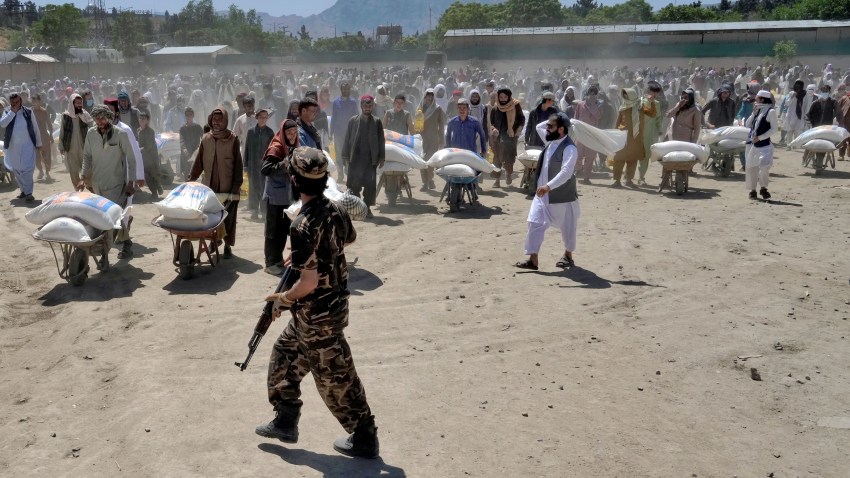
A Taliban fighter stands guard as people receive food rations distributed by a Chinese humanitarian aid group, in Kabul, Afghanistan, April 30, 2022 (AP photo by Ebrahim Noroozi).

Just as Americans began to gather for Thanksgiving dinner two weeks ago, the BBC reported that families in Afghanistan are selling their daughters into early marriage to pay for food and feeding their children tranquilizers and anti-depressants because the pills are cheaper than bread. According to ToloNews, Afghanistan’s unemployment rate stood at 40 percent in October. A recent Gallup poll from inside the country shows that, as they face their second winter since the Taliban returned to power in August 2021, 86 percent of Afghans say they have trouble getting enough food.

While Western governments often focus on the Taliban’s record on political freedoms and gender apartheid, access to food is also an international human right that national governments are beholden to provide to their citizens. Yet who is to blame for Afghanistan’s inability to obtain sufficient food for its citizens depends on whom you ask. The Taliban—and more than a few commentators—argue Afghanistan’s food shortage is the fault of the West, which has cut off bilateral aid and frozen Afghanistan’s foreign reserves. Western countries point out that they would loosen aid restrictions if the Taliban would allow girls to return to school, cut ties to al-Qaida and cease other highly restrictive policies that violate fundamental human rights. If anything, some observers say, current efforts to isolate the Taliban do not go far enough.

What almost every observer can agree on, though, is that this is a manufactured disaster stemming from multiple, interrelated policy-driven causes, exacerbated by drought, COVID-19 and the war in Ukraine. Ultimately, the blame game only adds a political layer to the problem, making it even more difficult to determine how to fix it.

When the Taliban took over the country last year, they immediately reverted to a draconian system of rule that imperiled minorities, restricted press freedom and other basic human rights, and removed women and girls from most jobs, schools and public life. In response, Western countries made two moves that themselves directly contributed to food insecurity in Afghanistan.

First, the U.S. froze the Afghan Central Bank’s $9 billion in foreign reserves. A country’s foreign reserves function as a rainy day fund that can be used to finance imports and shore up local currency. Without them, inflation tends to spike, and bank runs are frequent. This is why in one of his last acts before fleeing the country ahead of the Taliban takeover, the Afghan Central Bank’s former governor imposed a withdrawal limit, which his Taliban successor then strengthened and enforced. Afghans can now remove no more than $400 per week from the bank, standing in line for up to three days to get their money out. Nor can the Taliban easily print Afghanis, the country’s currency, because in the past they imported the bank notes and coins from third countries.

Half of Afghanistan’s foreign reserves are still set aside pending the resolution of domestic lawsuits in the U.S., but the other half now sits in a Swiss trust fund, ostensibly “for the use of the Afghan people.” But what this means in practice is still unclear. Though the trust fund was set up in September, the trustees met for the first time only two weeks ago and have much work to do to figure out how to use the money.

U.S. President Joe Biden’s initial executive order on the issue had implied that the money would be used to fund humanitarian aid, but this would have meant using it to solve the wrong set of problems. Humanitarian aid is meant to be a form of charitable giving by international donors, not something Afghans pay for out of their own rainy-day fund.

Instead, according to Reuters, the fund’s statute states that the money will more appropriately be used “for macroeconomic purposes, such as foreign exchange rate and price stabilization.” Yet other nonmonetary purposes are also on the table, and some fear they may have perverse side effects. If the funds were used to pay for electricity imports, for example, this could allow the Taliban to continue charging ordinary Afghans for electricity and use their payments for other purposes. Substituting services to the Afghan people that the Taliban then won’t have to provide also risks inadvertently shoring up the Taliban’s legitimacy.

What makes Afghanistan’s food crisis so intractable is also what makes hunger so difficult to solve globally: The multifaceted nature of the problem, and the lack of consensus on who is to blame and what should be done.

If the use of the reserves is limited purely to monetary policy, however, price stabilization itself could have a huge and beneficial impact for ordinary Afghans. The Taliban has done better than expected at collecting taxes and import tariffs, but without its foreign reserves, the Central Bank can’t easily fight inflation, now at 15 percent, or stabilize its currency. Putting these monies to work as the rainy day fund they are meant to be, rather than holding them in abeyance or spending them to pay national bills, can only help. If a judge releases the other half of the foreign reserves that did not go into the trust fund—rather than awarding them to families of the victims of the 9/11 attacks, as Biden’s executive order stipulated—so much the better for Afghans, who have mobilized to argue against the seizure of the reserves for this purpose.

Nonetheless, unfreezing the reserves alone will not solve Afghanistan’s food crisis, because the freezing of the reserves is only one cause of the Afghan economy’s collapse. The wider issue is that after the Taliban takeover, the West halted the influx of development aid dollars that paid Afghans’ salaries and fueled the Afghan economy. This meant that nearly $8 billion dollars of development aid and almost as much military aid evaporated overnight, in a country almost entirely dependent on these funds.

Emergency humanitarian aid still trickled in from donors through multilateral contracts to NGOs and United Nations agencies; the U.S. itself has provided over $1 billion as of September 2022. But this only creates a deeper cycle of dependence, as Afghans formerly paid to work are now dependent on cash or in-kind handouts. And while humanitarian aid may keep people alive, it is development aid that fuels economies and provides for long-term infrastructure and economic growth.

This leads us to the bigger ethical question: Are economic sanctions and aid conditionality the right tools to promote political rights when they generally harm the very people they are trying to help? Or do steps taken to lessen the impact of sanctions on those vulnerable people just then encourage human rights violations? After all, the international community has few other tools for addressing the kind of massive human rights violations inflicted by the Taliban on its people, which the U.N. recently characterized as “crimes against humanity.”

Notably, Afghans themselves disagree as to whether aid conditionality on Afghanistan should continue or be lifted. A survey conducted in Afghanistan this spring by the Human Security Lab, of which I am the director, showed that approximately a third of roughly 3,750 Afghan internet users randomly surveyed on this question wanted to keep the economic pressure on the Taliban, with a third opposing that view and another third undecided. Notably, women in the survey were 5 percentage points less likely than men to argue that international food support should be conditional on human rights.

At the same time, political science research shows that economic sanctions generally worsen human rights violations like killings, torture or arbitrary arrest, rather than improve them. And even if sanctions are effective in the long term at improving human rights conditions or achieving other goals like preventing terrorism, there are ethical questions about whether the ends justify the means.

Ultimately, part of what makes Afghanistan’s food crisis so intractable is the same thing that makes hunger as a global social problem so difficult to solve: The multifaceted nature of the problem, and the lack of consensus on who is to blame and what should be done instead, can drive apathy. As political scientist Michelle Jurkovich shows in her book “Feeding the Hungry,” this problem is not limited to Afghanistan’s current circumstances. Rather, it is endemic to global economic and social rights advocacy more generally—what human security experts refer to as the “freedom from want” agenda.

According to Jurkovich, global social policy on guaranteeing the right to food is stymied by disagreements among anti-hunger organizations about who should do what to fix the problems contributing to food insecurity. And so far, every fix in one area seems certain to cause trouble in another. The case of Afghanistan is currently and tragically an example that illustrates this wider rule. But while the West’s political standoff with the Taliban continues, Afghans are either going hungry or, in many instances, resorting to tragically desperate acts not to.

Charli Carpenter is a professor of political science and legal studies at University of Massachusetts-Amherst, specializing in human security and international law. She tweets at @charlicarpenter.

Afghanistan’s Hunger Crisis Is a Human-Made Catastrophe
read more

Delawar: No Need For National Discourse in Afghanistan

The head of the “Commission for the Return and Communications with Former Afghan Officials and Political Figures” said that after several decades, national sovereignty has been established in Afghanistan and there is no need for a national discourse in the country.

“We should all work together to build our homeland; everything is fine and every Afghan has the right to serve his country; there is no need to start another process and put into question the national security and sovereignty” Delawar said.

The head of the commission said that between 400 and 500 prominent political figures have already returned to the nation and that more will return in the near future.

“We are in touch with our people who are abroad, some popular figures will return to the nation soon. So far, the information that we have indicates that 400 to 500 prominent people have returned to the country and this process is ongoing,” Delawar said.

Meanwhile, some international relations experts said they consider a national discourse would be effective in solving the country’s current problems.

“The only way out of this situation is national reconciliation, forming a national consensus, and beginning national dialogues in order to get out of the crisis and addressing the challenges,” said Sayed Javad Sajadi, an expert in international relations.

“Afghanistan is now the shared home of all Afghans, and each and every member of this nation has rights. National reconciliation means developing a new system model,” said Mohammad Bashar, a political expert.

Earlier, Thomas West, the US special envoy for Afghanistan, and a number of other political figures, including Gulbuddin Hekmatyar, the leader of the Hizb-e-Islami party; former High Council for National Reconciliation Chairman Abdullah Abdullah, and former President Hamid Karzai, have stressed the need for a national dialogue to be established in order to solve the country’s current issues.

Delawar: No Need For National Discourse in Afghanistan
read more

IS suspect arrested in Pakistan Embassy attack in Kabul

By RAHIM FAIEZ

Associated Press
5 Dec 2022

ISLAMABAD (AP) — A member of the militant Islamic State group has been arrested in last week’s shooting attack targeting the Pakistani Embassy in Afghanistan’s capital of Kabul, the spokesman of the Taliban government said.

The attack, in which shots were fired at the embassy from a nearby building, triggered anger in Pakistan, and increased tensions between the two South Asian neighbors.

Pakistan’s top diplomat in Kabul was walking across the lawn inside the embassy compound at the time of the attack. He was unharmed but one of his Pakistani guards was wounded.

The regional affiliate of the Islamic State group, known as the Islamic State in Khorasan Province and a rival of Afghanistan’s ruling Taliban, has claimed responsibility for Friday’s attack.

The Islamic State group said two of its fighters attacked “the renegade Pakistani ambassador and his guards” while they were inside the embassy’s yard. The statement gave no further details.

The chief spokesman for the Taliban government, Zabihullah Mujahid, announced the arrest of a suspect in a tweet Monday.

Mujahid said the suspect is a foreign national and that the attack was organized jointly by IS and “rebels,” apparently a reference to anti-Taliban groups in Afghanistan.

“Some foreign circles are behind the attack and the aim was to create distrust between the two brotherly countries Afghanistan and Pakistan,” Mujahid wrote, without elaborating.

The Taliban took over Afghanistan in August 2021 as U.S. and NATO forces were in the final weeks of their pullout from the country after 20 years of war. They established their own administration, the Islamic Emirate of Afghanistan.

IS suspect arrested in Pakistan Embassy attack in Kabul
read more

The Daily Hustle: Going to the bank

Afghanistan Analysts Network

2 Dec 2022

In the wake of the Taleban takeover in August 2021, the Afghan banking system, which up to then had been linked to the global banking network, collapsed. Reportedly very little money had been left in the treasury, and then overnight, the United States stopped flying in dollars, the central bank’s reserves held in the US and Europe were frozen and US and United nations sanctions made getting money into Afghanistan difficult. Along with the sudden shortage of dollars afghani bank notes also began to wear out and could not, until recently, be replaced with newly printed ones. The new Taleban authorities closed the banks to stop people taking out all their savings, thereby saving the banking sector. Eventually, they lifted some, but not all restrictions. For Afghans trying to use the banking system, it remains a hellishly difficult proposition. In this episode of our series on how one aspect of a person’s daily life has changed since the takeover, we hear from a young man about going to the bank.

Afghans queue outside a bank in Kabul. Photo: Hoshang Hashimi/AFP, 31 August 2021.Once a week at 11:30 at night, after dinner and the evening prayer, after the nightly buzz of my siblings playing around has given way to the steady breathing of sleep, my mother watches me with anxious eyes as I leave the house to go the bank.
The journey in the middle of the night from my house in west Kabul to the bank in the city centre is a daunting one. Robberies are common these days, especially late at night when people travelling in cars are easy prey for criminals who use the cover of darkness to rob them of their money, mobile phones, vehicles and other valuables. My mother worries about my safety. So she stays up and calls to check on me several times until I get home.

You may ask why I am going to the bank at this late hour. You would be correct in saying that banks are not open in the middle of the night. In Afghanistan, however, the collapse of the Republic in August 2021 touched off a banking crisis and the banks closed for a short time. After they reopened, they imposed restrictions on customers’ access to their own money in order to stay afloat and avoid a run on the banks. That included limits on when and how much money customers could withdraw.

Each bank has its own arrangements for making appointments. This is the procedure at the bank – one of Afghanistan’s largest – that the organisation I work for uses: commercial customers – businesses and NGOs – must send an authorised representative to queue up at night and wait until 1 am when a bank employee takes down names and gives out numbers to the lucky 55 people who will be able to conduct banking transactions the following morning.

This is why I, the finance officer of a small NGO in Kabul, find myself making this night-time visit to the bank once a week.

How much money can you get out?

There are other banking limitations; each week, commercial customers can withdraw only five per cent of the amount they had in their accounts before the Taleban takeover. There are no restrictions on funds deposited after 15 August 2021. You don’t have to queue up if you only want a statement or a letter from the bank, but you do have to go the day before to book an appointment.

Customers with personal bank accounts can withdraw only up to 200 USD or 20,000 Afs each week. They can book an appointment at any branch and they’re usually two to three days from when they’re booked. On the day of the appointment, the customer must arrive at the branch in the morning when it opens and wait several hours and sometimes an entire day for their turn. There are, of course, ATM machines, but I haven’t personally heard of anyone who’s managed to withdraw money from one since last August.

Transactions, for all account holders, are usually in the local currency, the afghani, but you can ask for dollars if the funds were deposited in dollars and if the bank has dollars available. Otherwise, you can take your cash in afghanis at the bank’s exchange rate, which is usually about 0.5 Afs lower than the market rate. It might not sound like much, but it adds up. For example, if someone earns 500 USD a month, they stand to lose 250 Afs, or about three dollars in the exchange – that’s the same as what it costs to buy 25 pieces of bread.

The waiting game at the bank

The morning after I’ve stayed up to book an appointment, I must arrive back at the bank by 9 am. I nod to the familiar faces from the previous evening and go inside to take a seat. If all goes well, it usually takes about two hours to finish my business, but if the bank has no cash, we must wait until it’s delivered. Sometimes, after we’ve been waiting until well into the afternoon, they tell us that the bank won’t receive cash that day and that we should try another day. There are also lucky days when I’m not withdrawing money and only have to make payments via bank transfers. On those days, I don’t have to wait for the cash to arrive at the bank, and I can put my hand up and ask to make the transfers.

To pass the time while I wait, I play games on my mobile phone, read the news, go on Facebook, or call friends to chat. The long wait is tiring, and it’s not unusual to see people napping in their seats while they wait. Sometimes, especially when the battery on my phone runs out, I talk to the person sitting next to me – light chatter to pass the time. We talk about our jobs, where we went to school or what part of Afghanistan we’re from. Sometimes, we talk about how simple things used to be before, under the Republic, when you didn’t have to go to the bank in the middle of the night to get a number, when you could transfer and withdraw money without any limitations from any bank branch, you could walk in, take a number and finish your transaction within an hour, even if it was super busy.

There are also usually three to four women in the waiting room. Women cannot register in the evenings themselves and must send a male colleague or relative to register on their behalf. I look at them and wonder what they do. Are they, like me, employees of an organisation, or do they own a business? But it’s not possible for me to ask them. I contemplate the possibilities for a moment and then I let the thought go.

When it’s finally my turn, I walk to the teller and hand over the transaction slips and other documents. As he’s processing the payment, I ask again about the restrictions and the possibility that they might be lifted. The teller looks at me impatiently and explains that there’s not enough cash, either in afghanis or dollars, to give free access to the thousands of customers who have funds on deposit with the bank.

Queuing up for a spot  

So, as long as the banks keep up their restrictions on how much you can withdraw and what you must do to book an appointment, I must keep queuing up once a week around midnight. There are three checkpoints on the way from my house to the bank. I come to a stop at each one and the Taleban soldier manning it asks where I’ve been, where I’m going and why. I tell him I’m going to the bank. The soldier shrugs and waves me through.

By the time I get to the bank, it’s usually gone midnight and there are already about 25 to 30 people in the queue because people start queuing as early as ten o’clock to make sure they get one of the 55 coveted places that the bank gives out each day. Last week, when I arrived on a cold winter night, the queue was in disarray. The men were huddled together to get some protection from the cold, the fog from their breath floating up to the streetlight above. I joined the queue to wait with the others.

Finally, at one o’clock in the morning, a bank employee came out to take down our names. He noted the information in a small spiral notebook and told us to come back in the morning. As I walked back to my car, I could hear the sound of voices getting louder and more intense. I turned back to look. An older man was upset and complaining that this was his third night running in the queue. He said he’d come a long way from one of Kabul’s eastern suburbs. The bank employee gave him a gentle nudge and told him to try again tonight, maybe come a little earlier.

When I walked in the front door around 2 am, my mother was awake, reading in the living room and waiting for me to come home. I could see the relief in her tired eyes as she greeted me and got up to head for bed. She pointed to the clock on the wall and said I could still get about three hours sleep before the call for prayer and the start of a new day. I knew what the day had in store for me; after prayers and breakfast with the family, I would have to hurry back to the bank and start the long wait. A day of idleness awaited me until it was my turn to walk up to the bank teller.

Edited by Roxanna Shapour and Rama Mirzada


The Daily Hustle: Going to the bank
read more

Pakistan Condemns ‘Assassination Attempt’ on Its Kabul Embassy

The New York Times

Dec. 3, 2022

The gunfire, which critically injured one security guard, comes amid increased tensions between the two countries.

Pakistan’s embassy in Kabul, Afghanistan, came under gunfire on Friday, Pakistani and Taliban officials said, amid already heightened tensions over security issues between the two countries.

One security guard was critically injured in the attack, according to Pakistani officials, who called it an assassination attempt on their country’s chief diplomat to Afghanistan.

“I strongly condemn dastardly assassination attempt on Pakistan Head of Mission, Kabul,” Prime Minister Shehbaz Sharif of Pakistan wrote in a tweet.

The attack came days after militants who have sought shelter in Afghanistan ended a monthslong cease-fire with the Pakistani government, stoking fears of a renewal of violence by the group, Tehrik-i-Taliban Pakistan.

It was also the second major attack on a foreign mission in Kabul in three months, and added to a steady drumbeat of targeted attacks and suicide bombings in Afghanistan that have offered reminders of the dangers that persist in the country despite the end of the 20-year war.

Most attacks over the past year have targeted Taliban members and mosques belonging to Shiites and Sufis, two of the country’s minority groups. In September, a suicide bomber from the Islamic State’s affiliate in Afghanistan attacked the Russian Embassy in Kabul, killing two employees and four Afghan civilians.

Russia and Pakistan are two of a limited number of countries that have maintained a diplomatic presence in Afghanistan after the Taliban takeover.

The attack on Friday afternoon began around 3:30 p.m., when several shots were fired at the embassy from a nearby apartment building, according to eyewitnesses and Khalid Zadran, a spokesman for the Kabul police force.

About 15 minutes later, Taliban security forces arrived at the scene and exchanged fire with at least one attacker for around 40 minutes, said Abdullah Abdulrahimzai, a resident in the area who saw the attack unfold.

“The Taliban were shooting at the apartments from a car repair market, and they were also climbing on the roofs around the apartments and shooting,” Mr. Abdulrahimzai said. A helicopter took off from the Pakistani embassy about half an hour after the attack began, he added.

After a brief lull in the gunfire, Taliban security forces entered the building and heavy gunfire erupted, according to Mr. Abdulrahimzai. Taliban security forces apprehended one suspect, Mr. Zadran, the police spokesman, said.

No group has claimed responsibility for Friday’s attack, which was condemned by Taliban officials.

The Islamic Emirate of Afghanistan “will not allow any malicious actors to pose a threat to the security of diplomatic missions in Kabul,” a spokesman for the Afghan Foreign Ministry, Abdul Qahar Balkhi, said on Twitter. “Our security will conduct a serious investigation, identify perpetrators & bring them to justice.”

In an interview, the Pakistani state minister for foreign affairs, Hina Rabbani Khar, said that the Pakistani authorities have called on the Taliban to “take all necessary measures to ensure the safety and security of our personnel and diplomatic premises.” Ms. Khar met with Taliban officials in Kabul on Tuesday to discuss tensions over violence at the Afghanistan-Pakistan border.

The attack on the Pakistani embassy added to increasing tensions between the new Taliban government and neighboring Pakistan. For months, Pakistani officials have claimed that newly emboldened militants have launched more frequent attacks in Pakistan from Afghan soil since the Taliban seized power last year.

Those strains were heightened earlier this week when Tehrik-i-Taliban Pakistan, responsible for some of Pakistan’s deadliest recent terrorist attacks, announced that it would no longer abide by a cease-fire with the Pakistani government. A day later, the group carried out a suicide bombing by militants in southwest Pakistan that killed four people and injured more than 30.

The Taliban government in Afghanistan, which had been facilitating peace talks between the militants and the Pakistani government since late last year, has denied sheltering militants on Afghan soil.

Safiullah Padshah, Najim Rahim and Salman Masood contributed reporting.

Christina Goldbaum is a correspondent in the Kabul, Afghanistan, bureau. @cegoldbaum

Pakistan Condemns ‘Assassination Attempt’ on Its Kabul Embassy
read more

Civil Society Activists Share Demands with Government, World

They said Afghan women should have the right to working and education same as women in other Muslim nations.

At a gathering in the city of Herat, hundreds of civil society activists from the west zone of the country, half of whom were women, shared their demands with the current government and the international community.

They called for the reopening of girls’ schools, the return of women to work in government institutions and the removal of other restrictions on women in the country.

“Make the voice of the people from every area of Afghanistan heard with the relevant authorities, including the Islamic Emirate and the international community,” said Abdul Rahim Khuram, the deputy of a Sadai Mardum association.

Women in the gathering asked the Islamic Emirate to ensure their basic rights.

They said Afghan women should have the right to working and education same as women in other Muslim nations.

“As a woman in this society, they have not ensured anything for us as they should have,” said Masoma Jami, a civil society activist.

“Women in Nimroz also raised their voices and want to say that education should be the top priority for women. They should be protected, and they should work for their society with men under the regulations of the holy religion of Islam,” said Shah Gul Noorzada, another civil society member.

Meanwhile, local officials in Herat said the Islamic Emirate supports civil activities in the country.

“The Islamic Emirate of Afghanistan supports every act, movement, or effort that raises the voices of the people before the authorities without any shortage,” said Naeemulhaq Haqqani, director of information and culture of Herat.

The organizers of the event said that they will hold such gatherings across the country.

Civil Society Activists Share Demands with Government, World
read more

Karzai Leaves Kabul for UAE

Former president Hamid Karzai will stay in the UAE for at least three days before leaving for Germany, his aide said.

Former president Hamid Karzai left Kabul for the United Arab Emirates on Saturday where he will stay for three days before traveling to Germany, his close aide Shahzada Massoud said.

This is Karzai’s first trip abroad after the establishment of the Islamic Emirate in Afghanistan.

Karzai’s trip also comes on the same day as a delegation of the Islamic Emirate led by acting defense minister Mawlawi Mohammad Yaqub Mujahid traveled to the UAE.

The Defense Ministry said that on this trip, the acting defense minister will meet with UAE leaders and Afghans who live in UAE and that it is also aimed at strengthening relations between the Islamic Emirate and Gulf States.

Karzai Leaves Kabul for UAE
read more

West Discusses Afghan Political Dialogue with Japan Officials

Earlier the US Department of State said in a statement that West would visit Japan, India and UAE and will discuss issues related to Afghanistan.

The US special envoy for Afghanistan, Thomas West, said that in his two-day visit to Japan he discussed the way ahead on humanitarian needs, human rights, and political dialogue with Japan’s Foreign Ministry.

Some political figures stressed the need to start national dialogues and implement the Doha agreement.

“The Islamic Emirate should invite Afghans and talk to them, particularly the Afghans based inside the country because they can talk with the Afghans abroad ,” said Sayed Ishaq Gailani, leader of National Solidarity Movement of Afghanistan.

A political analyst, Stanagul said: “The whole world wants the Taliban to form an inclusive government and preserve the basic human rights and other rights of the Afghans.”

Earlier the US Department of State said in a statement that West would visit Japan, India and UAE and will discuss issues related to Afghanistan.

According to the statement, the US envoy will also meet Afghans diaspora.

West Discusses Afghan Political Dialogue with Japan Officials
read more

‘Assassination attempt’ on Pakistan envoy in Afghan capital

Al Jazeera

2 Dec 2022

Attacker failed to harm the Pakistani diplomat, but shot and wounded his security guard outside its mission in Kabul.

An “assassination attempt” targeted Pakistan’s top diplomat in Afghanistan, Pakistan’s prime minister has said, as tensions between the neighbouring countries simmer.

The head of mission, Ubaid Ur Rehman Nizamani, was the target of an attack on its embassy compound, Pakistan’s foreign ministry said on Friday, adding that a Pakistani security guard was critically injured in the attack.

“The Interim Government of Afghanistan must immediately hold thorough investigations in this attack, apprehend the culprits, hold them to account, and take urgent measures to ensure the safety and security of Pakistani diplomatic personnel and citizens in Afghanistan,” it said in a statement.

“I strongly condemn the dastardly assassination attempt on Pakistan Head of Mission, Kabul,” Pakistan Prime Minister Shehbaz Sharif said on Twitter.

The attack comes days after Pakistan Foreign Minister Hina Rabbani Khar visited Kabul to hold talks with her Afghan counterpart Amir Khan Muttaqi amid border tensions between the two neighbours.


The attacker failed to harm the Pakistani diplomat, but shot and wounded his security guard, Sharif added. No immediate confirmation of the security guard’s condition was available.

“I demand immediate investigation & action against perpetrators of this heinous act,” Sharif tweeted.

An embassy official said a lone attacker “came behind the cover of houses and started firing”.

“The ambassador and all the other staff are safe, but we are not going outside of the embassy building as a precaution,” he said.

Nizamani arrived in Kabul last month to take up the role at one of the few embassies that had remained operational throughout the period after the Taliban took over the country in August 2021.

Taliban condemnation

A spokesman for the Taliban’s ministry of foreign affairs denounced the attack.

“Islamic Emirate of Afghanistan strongly condemns the attempted shooting and failed attack on the Pakistani embassy in Kabul,” said spokesman Abdul Qahar Balkhi on Twitter.


The shooting comes a day after Pakistan’s government demanded Afghanistan’s Taliban rulers prevent “terrorist” attacks coming from their soil. The Tehreek-e-Taliban Pakistan (TTP) armed group, also known as the Pakistani Taliban, claimed responsibility for a suicide bombing earlier in the week in southwestern Pakistan that sent a wave of shock and anger across the nation.

The bombing killed four people and appeared to be aimed at police protecting polio workers in the area.

Pakistani Taliban is ideologically aligned with the Afghan Taliban, which seized power last year after the last US and NATO troops withdrew from Afghanistan.

Pakistan blames the Afghan Taliban for not doing enough to control armed fighters sheltering in their country who stage attacks across the border – a charge denied by the Taliban.

Abdul Syed, an expert on Pakistan and Afghanistan, said that it appears that a new threat for Pakistan from its western neighbour is rapidly emerging.

“Contrary to Pakistan’s expectations, the Afghan soil is being used by Pakistani Taliban openly. Additionally, various Afghan Taliban leaders have expressed their reservations towards Pakistan, blaming it for the ills in their country,” Syed told Al Jazeera.

“When the recent cross-border flare-up happened in Pakistan’s southwestern province Balochistan, the Afghan Taliban only issued a symbolic statement of condemnation. Yet on Afghan social media, the attack on Pakistan’s border forces was praised,” the Sweden-based scholar said.

Thwarted attack

A prominent politician and strongman, Gulbuddin Hekmatyar, also escaped unhurt in a separate attack on the same day in Kabul, his office said in a statement. Security guards killed the two attackers as they tried to enter a mosque where Hekmatyar and his supporters had gathered for Friday prayers, the statement said.

Hekmatyar later said in a video message that the attackers were suicide bombers disguised in women’s burqas who intended to blow him up.

“I assure my countrymen, a failed attempt happened here by those who have done it many times but have failed,” Hekmatyar said, adding it was not yet clear who was behind the attack.

“It cannot lower our morale or our resistance … we will stand with our nation,” he said.

No one immediately claimed responsibility for either of the attacks in Kabul.

Hekmatyar, who battled US forces after the 2001 invasion and nursed a bitter rivalry with other Afghan factions, agreed to lay down arms in 2017 and join a peace deal with former President Ashraf Ghani.

Hekmatyar stayed in Kabul after the Taliban took power last year, even as Ghani and other former leaders fled.

Hekmatyar founded Hezb-i-Islami in the mid-1970s as one of the main mujahideen groups fighting the Soviets in the 1980s. He then took part in the civil war that erupted after their withdrawal, clashing with the so-called Northern Alliance, before the Taliban first seized power in the late 1990s.

Several bombing and shooting attacks have taken place in Afghanistan in recent months, some of which have been claimed by the ISIL (ISIS) group. A blast at a religious school on Wednesday in northern Afghanistan killed at least 15 people.

SOURCE: AL JAZEERA AND NEWS AGENCIES
‘Assassination attempt’ on Pakistan envoy in Afghan capital
read more

Global Media Watchdog Condemns Taliban Ban on VOA, RFE/RL Broadcasts

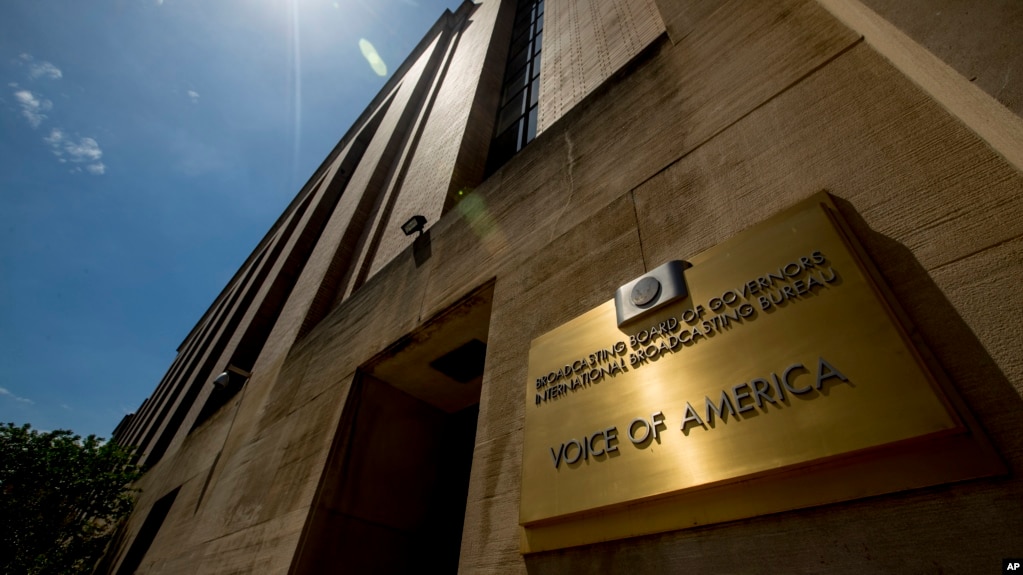
FILE - The Wilbur J. Cohen building in Washington, where Voice of America is based.
FILE – The Wilbur J. Cohen building in Washington, where Voice of America is based.
The Committee to Protect Journalists has condemned the Afghan Taliban’s decision to ban FM transmissions of two U.S.-funded news media and urged an immediate resumption of their broadcasts.

The Islamist Taliban government’s ban went into effect December 1. A day earlier, the Taliban’s Ministry of Information and Culture said it had received complaints about programming content but shared no specifics.

In a statement, the press freedom watchdog called on the Taliban to “cease their intensifying crackdown” on media in Afghanistan.

“This latest crackdown on media clearly shows the Taliban is going back on their word about guaranteeing press freedom in Afghanistan,” said Beh Lih Yi, CPJ Asia program director.

Despite ban, broadcasters still reach listeners

The ban on FM and medium-wave transmissions in the country came months after the Taliban stopped TV broadcasts by Voice of America, also known as VOA. The broadcasters still have shortwave and medium-wave transmissions from outside the country reaching Afghan listeners, as well as digital and satellite operations, but the in-country FM transmissions were considered critical for reaching large, local audiences.

Abdul Qahar Balkhi, a spokesperson for the Taliban foreign ministry, explained in written comments to VOA why the group is banning the broadcasters.

“VOA and Azadi Radio failed to adhere to these laws, were found as repeat offenders, failed to show professionalism and were therefore shut down,” Balkhi wrote.

VOA and RFE/RL routinely cover issues such as human rights, girls’ education, press freedom, economic troubles, and the deep humanitarian crisis in Afghanistan. They present a variety of views, including those critical of the Taliban.

In a written statement, VOA’s Afghan Service Chief Hasib Alikozai rejected the allegations about the programming and said the agency had not received any complaints about the content.

“These are made-up reasons for taking our stations off the air. The truth is that we were effective in our reporting of issues, which local media outlets could not cover because of their fears of retribution by the Taliban,” Alikozai said.

The Biden administration has also condemned the Taliban’s decision. In an interview with VOA, John Kirby, the National Security Council coordinator for strategic communication, said the Taliban’s suppression of free media will hinder its goal of seeking legitimacy.

“We’re going to continue to stand up … for freedom of the press and for the right of citizens around the world to be able to access press and news information,” Kirby said.

It has been almost 16 months since the Taliban took control of Afghanistan, and no country has recognized their government.

U.S. Special Representative for Afghanistan Thomas West, who is traveling in Asia to discuss humanitarian support for the country, said Afghans need access to independent media.

VOA has said it will continue programming for Afghan audiences.

“Removing VOA from the domestic airwaves will not silence us. It will only increase the importance of serving the captive audience inside Afghanistan,” wrote Acting Director Yolanda Lopez.

Leadership of Radio Free Europe/Radio Liberty — also known as RFE/RL — also rejected the Taliban’s criticism and said the broadcaster will not change its editorial line to stay on air.

“We know from experience that our audiences make great efforts to find us. The truth cannot be completely suppressed,” said RFE/RL President and CEO Jamie Fly.

In March, the Taliban stopped VOA’s Ashna TV news shows, which had been broadcast on Afghan National Television, Tolo, Tolo News and Lamar for a decade, VOA Pashto reported.

Many VOA programs are anchored by women. The Taliban have banned women from appearing on television without covering their faces.

Since the Taliban reclaimed power in August 2021, dozens of private television channels, radio stations and print media have ceased operation because of economic hardships and Taliban restrictions.

According to the press advocacy group Reporters Without Borders (RSF), 219 video, audio and print shops have closed in Afghanistan since the reestablishment of Taliban rule. Before then, 547 media outlets operated in the country, RSF said.

Global Media Watchdog Condemns Taliban Ban on VOA, RFE/RL Broadcasts
read more