
What the United States Owes Afghan Women

IN THE EARLY days of the U.S. war in Afghanistan, alleviating the plight of Afghan women under the Taliban was a major part of the campaign to sell the conflict to the American public — and eventually to justify an open-ended military occupation. Whether the United States did much to help Afghan women is a debatable point, largely dependent on which women you ask.

Yet there is no question that today, under the Taliban, a young, educated, and urbanized generation of Afghan women who enjoyed a period of opportunity over the past 20 years is experiencing a catastrophic attack on their basic rights.

The Taliban’s recent decision to ban girls’ education past the sixth grade is only the latest outrage to be inflicted on Afghan women, and another step in a campaign to drag Afghan society back to the climate of medieval repression that reigned during the last Taliban government of the 1990s.

There is one thing that could easily be done to ease the suffering of Afghans under Taliban rule: giving a home to Afghan refugees.

This unhappy situation was not inevitable. There are ideological divisions inside the Taliban, particularly between its leaders who spent the war years abroad mingling in foreign capitals, and those who spent it fighting a grueling insurgency inside the country.

While the Taliban government showed initial hints of pragmatism upon coming to power, today it has become clear that the extremist faction of its leadership is in control and willing to sacrifice the well-being of Afghans and the goodwill of the international community to fulfill its ideological mission.

The United States has scant leverage left to change the calculus of an organization so dead set on its goals. If the words about human rights and women’s empowerment that justified the war for 20 years had any meaning at all, there is one thing that could easily be done to ease the suffering of Afghans under Taliban rule, without risking more harm in the process: giving a home to Afghan refugees.

Last week, Congress failed to pass the Afghan Adjustment Act, a measure that would have given the tens of thousands of Afghans who escaped to the U.S. after the fall of Kabul a path to permanent legal residency. The measure had been supported by everyone from former senior U.S. military officials, who issued a letter calling protection of the refugees a “moral imperative,” to human rights organizations. The Afghan Adjustment Act, however, was left out of the omnibus spending bill passed at the end of the year, reportedly due to opposition from 89-year-old Iowa Republican Sen. Chuck Grassley.

These Afghans arrived in the U.S. on flights hastily arranged by the U.S. military as the Taliban marched on Kabul last summer. They remain in the U.S. on a precarious legal status known as temporary humanitarian parole that places them at risk of deportation.

Many of these refugee families include those who fought with the U.S. during the war or supported the U.S.-backed government — making them and their families prime targets of the new Taliban regime.

The failure to pass the law also leaves Afghans who worked with the U.S. military but remain trapped in Afghanistan today out in the cold, denying them eligibility for Special Immigrant Visas that could provide a legal hope of immigrating to the U.S. if they escape the country.

If they are not provided a path to permanent status and are thus left to their fate, the ex-U.S. military officials warned in their letter, in future conflicts, “potential allies will remember what happens now with our Afghan allies.”

THE TALIBAN’S RECENT decision to kick women out of school has been met with outrage by the international community and international Muslim religious figures, but most of all from ordinary Afghans. Many Afghans, including many men, have staged inspiring walkout protests from their classes to denounce the measure.

Having done more than anyone to take advantage of the opportunities afforded by the U.S. presence in their country, these are the people who deserve whatever support can be provided to them and their families. In the absence of that support, their future is likely to be grim.

Donald Trump’s recent anti-immigrant presidency and the general tenor of Republican politics means that any effort to resettle refugees — those here today and those who may arrive in the future — is inevitably going to be a political fight. That said, a Democratic president will be in office for at least the next two years and will have an opportunity to use their political capital to right an obvious wrong that was done to Afghans by the U.S. — particularly if, as seems likely, the Taliban continue down a course of provocative repression against Afghan women and minorities.

Amid the terrible events now unfolding, it is worth remembering that, for a few months last year, when they appeared to send the world’s most powerful military into a scrambling retreat, the Afghan Taliban enjoyed a strange kind of recognition — maybe even popularity — around the world. Everyone loves a winner, and the triumphant march of the Taliban into Kabul was greeted warmly by everyone from former Pakistani Prime Minister Imran Khan, who said that the group was “breaking the shackles of slavery,” to the American alt-right who projected their own idealized vision of hypermasculinity onto the new social-media-savvy militants.

Even mainstream conservative politicians like Rep. Matt Gaetz, R-Fla., claimed at the time that the Taliban was “more legitimate than the last government in Afghanistan or the current government here” — a statement made with apparent relish at the humiliation of a sitting Democratic president who presided over the final defeat.

The U.S. has done a great deal of harm to the Afghan people, using their country as a proxy battlefield, subjecting them to sanctions, and killing them in huge numbers during the war. The least it can do today is give safe haven to those, particularly women, fleeing the collapse of the shoddy government in Kabul that the U.S. government had propped up, and who are now suffering a harrowing attack on their basic freedoms by a Taliban regime that grows more draconian with each passing day.

Murtaza Hussain is a reporter at The Intercept who focuses on national security and foreign policy. He has appeared on CNN, BBC, MSNBC, and other news outlets.
What the United States Owes Afghan Women
read more

The Guardian view on Afghanistan’s suffering: the war against women

The Guardian

2 Jan 2023

Families are in desperate straits, the security situation is worsening – but the Taliban’s priority is punishing half the population

The Taliban’s relentless campaign against women is not only a matter of rights, but of survival. It is not only cruel and oppressive, but deadly. In a country already on its knees, where 97% of the population live in poverty, two-thirds need humanitarian assistance, 20 million face acute hunger and parents sell kidneys to feed their families, it has made life still more desperate. By banning women from working for NGOs, they are denying essential, life-saving services to women and children. Almost all the large aid agencies have suspended operations and the United Nations has paused some “time-critical” programmes. Major world powers have urged the Taliban to immediately reverse their “reckless and dangerous” decision, while UN agency chiefs described female staff as key to every aspect of the humanitarian response.

In many cases, these staff – who number in the tens of thousands – are also the only breadwinners in their households. Denying them their salaries ensures that women, children (and, incidentally, men too) will starve. The Taliban’s earlier decision to bar women from universities – and reportedly even primary education – means that no more female doctors or teachers will be trained. Teenage girls have already been kept out of school for almost a year and a half.

The Taliban strove to create the impression of a more moderate “Taliban 2.0” before their return to power, promising not to repeat the cruelties of the 1990s regime. But the new Taliban look more and more like the old one. If there are more moderate figures in the ranks, they are unable to prevail. Last month, there was the first public execution since their return to power. Women have been among those punished in public floggings. If the Taliban’s priorities were not so horrific, they would be bizarre: this viciousness appears to be all they care about, despite the country’s parlous state in every possible regard.

Relations with Islamabad are breaking down as cross-border attacks by the Pakistani Taliban (TTP) increase. In December, members of the TTP – separate to but allied with the Afghan Taliban – overpowered guards at a counter-terrorism facility in Pakistan and seized control. As the security situation deteriorates, Islamic State has claimed responsibility for attacks on the Pakistani and Russian embassies in Kabul. The Chinese ambassador ordered all nationals to leave the country after gunmen attacked a hotel used by Chinese businessmen. These developments are not merely a diplomatic problem for the Taliban; hopes of income to help replace the vanished foreign aid that shored up the country for so long have disappeared. Now the last props are being removed as aid operations halt, at terrible cost.

In these grim times, women have demonstrated extraordinary courage and resilience in challenging the Taliban’s harsh rule. Men have taken a stand beside them. They deserve not only admiration, but support. The UK did extremely poorly at evacuating Afghans before Kabul fell last year. As of early December, not one person had been accepted and evacuated under the Home Office’s Afghan citizens resettlement scheme, which was launched in January for those at risk because they had worked for or were affiliated with the British government. Afghans, and especially those brave enough to challenge this regime, need more than words from the British government.

The Guardian view on Afghanistan’s suffering: the war against women
read more

Retirees in Kabul Protest Unpaid Pensions

“We have served this country with honesty. We are all facing economic challenges and all of us have families,” said Mohammad Omar, a retiree.

Dozens of retired officials held a protest in Kabul on Monday to criticize unpaid pensions, saying they have not been paid over the past 16 months.

The rally was conducted by retirees from military and civil servants of previous governments who said they are faced with severe challenges amid freezing winter.

“There is nothing to heat our rooms. I pay 4,000 Afs for house rent and we are three families. I have my daughter in laws with me, and we have nothing to eat,” said Alina, a former government employee.

The rally members called on the Islamic Emirate to pay their pensions.

“If we say their children are affected by malnutrition, you can go and check it at their houses,” said Meer Alam, a retiree.

“It has been around one and a half years since the Islamic Emirate gave us promises to pay our pensions, but we are yet to be paid,” said Zabiullah, a retiree.

“We have served this country with honesty. We are all facing economic challenges and all of us have families,” said Mohammad Omar, a retiree.

The Ministry of Finance said it has prepared a plan for payment of pensions to the retirees and that they are waiting for its approval by relevant authorities.

“We have allocated around four billion Afghanis for the retirees in the (fiscal) budget of the current year. We are waiting for its approval. The payments will be the same as in the past based on accounts and their cards,” said Ahmad Wali Haqmal, a spokesman for the Ministry of Finance.

Based on statistics by the Ministry of Finance, at least 149,000, including 10,000 women, have not yet received their pensions for the past year.

Retirees in Kabul Protest Unpaid Pensions
read more

Pakistani Official: Deporting of Afghans Will Start in January

Fatema Adeebo

Tolo News

1 Jan 2023

A prison official in Karachi, Pakistan, said they would start deporting Afghan women who had been sentenced for living in the country without legal documents from the first week of January.

Pakistani police in multiple raids detained at least 1,200 Afghan nationals, including women and children, who had entered the southern port city of Karachi without valid travel documents, officials said Thursday.

“In the first week of January, the process to deport around 58 of them will start,” said Sheeba Shah, the superintendent for the Central Prison for Women in Karachi as quoted by AP.

Some imprisoned women said that they will return to Afghanistan after their release from prison.

“Please let us go. We have been here for over two months. For God’s sake let us go now. Please release us. We have served our two-month sentence. We should be released now. Have mercy on us for God’s sake,” said Gul Khanda, 65, prisoner in Pakistan, from Paktia, Afghanistan.

“We came from Afghanistan. We are poor. My husband is old. He can’t work. My two sons used to work for a brick kiln. If you don’t want us to work here, let us go back to Afghanistan. We have a house there. We will go back home. I am sick and so are my two daughters in law. For God’s sake, release us so we may go back home.” said Nilofar, 67, prisoner in Pakistan, from Parwan.

Meanwhile, the charge d’affaires of the Afghan embassy in Pakistan, Sardar Ahmad Khan Shekib, in an interview with TOLOnews said that nearly 2,000 Afghans are imprisoned in Pakistani prisons and that their situation is concerning.

“Some of them don’t have documents, and some of them have been detained in Karachi previously. There are about 2,000 of them. They were arrested by the police because they did not have legal documents, and were put in jail,” he said.

Following the fall of the previous government, a large number of Afghans went to Pakistan in the past 16 months.

Islamabad has recently stepped up the process of arresting Afghans without legal documents.

Pakistani Official: Deporting of Afghans Will Start in January
read more

UN official meets Taliban deputy premier over women NGO ban

Associated Press

1 Jan 2023

KABUL, Afghanistan (AP) — A senior U.N. official in Afghanistan met on Sunday the deputy prime minister of the Taliban-led government to discuss a ban on women working for non-governmental groups that Afghan authorities have announced in a series of measures rolling back women’s rights.

The decision by the Taliban government to bar women from NGO work has prompted major international aid agencies to suspend operations in the country. The ban has raised fears that people will be deprived of food, education, healthcare and other critical services, as over half of Afghanistan’s population needs urgent humanitarian assistance.

Aid agencies have warned the ban will have catastrophic consequences and “hundreds and thousands” of Afghans will die because of the Taliban decision.

The deputy head of the U.N. Mission in Afghanistan, Potzel Markus, met Maulvi Abdul Salam Hanafi in the capital Kabul to discuss the ban, as well as other measures including barring women from universities.

“Banning women from working in non-governmental organizations, denying girls and women from education and training, harms millions of people in Afghanistan and prevents the delivery of vital aid to Afghan men, women, and children,” the U.N. mission said.

Potzel is the latest U.N. official to meet the Taliban’s leadership amid mounting international concern over the curtailing of women’s freedoms in Afghanistan.

Last Monday, the acting head of the U.N. mission Ramiz Alakbarov met Economy Minister Qari Din Mohammed Hanif.

Hanif issued the NGO ban on Dec. 24, allegedly because women weren’t wearing the Islamic headscarf, or hijab, correctly. He said any organization found not complying with the order will have its license revoked.

Aid agencies have been providing essential services and support in the face of a worsening humanitarian crisis in Afghanistan.

The Taliban takeover in 2021, as U.S. and NATO forces were in the final weeks of their pullout after 20 years of war, sent Afghanistan’s economy into a tailspin and transformed the country, driving millions into poverty and hunger. Foreign aid stopped almost overnight.

Sanctions on the Taliban rulers, including a halt on bank transfers and the freezing of billions in Afghanistan’s foreign assets have already restricted access to global institutions. Funds from aid agencies helped prop up the country’s aid-dependent economy before the Taliban takeover.

U.N. aid chief Martin Griffiths is due to visit Afghanistan to discuss the ban.

Potzel’s meeting with Hanafi came as a U.N. survey showed that a third of NGOs headed by women in Afghanistan have been forced to stop 70% of their activities due to the ban and around a third have stopped all their activities.

The U.N. Women’s Department said 86% of the 151 organizations surveyed have either stopped or are functioning partially.

It also said the lack of women in the distribution of aid has had a significant impact on the Afghan population.

UN official meets Taliban deputy premier over women NGO ban
read more

Several dead and wounded in blast outside Kabul military airport

Al Jazeera

1 Jan 2023

No one has claimed responsibility for the explosion that caused multiple casualties, according to the Taliban.

Interior Ministry spokesman Abdul Nafi Takor said the blast on Sunday left several people dead and wounded, adding that an investigation was under way. He did not specify the nature or target of the explosion.

Local residents said a loud explosion was heard before 8am (03:30 GMT) in the vicinity of the military side of the heavily fortified airport. They said the area had been sealed off by security forces, and all roads had been closed.

A Kabul resident said late on Sunday his brother, an air force officer, was killed in the explosion.

“He had worked in the previous government too as an air force officer,” Abdul Noor told AFP news agency, referring to the removed, Western-backed government of former President Ashraf Ghani.

“He and some of his colleagues were in a queue waiting to enter the military airfield when the blast occurred,” Noor said, indicating the explosion had caused more casualties.

Security concerns

There was no immediate claim of responsibility for the blast, but the regional affiliate of ISIL (ISIS) – known as the Islamic State in Khorasan Province, ISKP (ISIS-K) – has increased its attacks since the Taliban stormed back to power in August 2021. Targets have included Taliban patrols and members of Afghanistan’s Shia minority.

“ISIS-K is the only enemy claiming the illegality of the Islamic emirate in Afghanistan [Taliban],” Nasratullah Haqbal, a journalist and political commentator, told Al Jazeera.

Last month, at least five Chinese nationals were wounded when ISIL-linked attackers stormed a hotel popular with Chinese nationals in Kabul.

Hundreds of people, including members of Afghanistan’s minority communities, have been killed and wounded in attacks since the Taliban returned to power.

Haqbal told Al Jazeera that these attacks have left Afghans questioning the Taliban’s claims of bringing security to the country.

“It challenges the only privilege that the Islamic emirate of Afghanistan [Taliban] has – all the time that it raises that we brought security, incomparable security to Afghanistan,” he said.

“The second point is it creates concerns among the public of Afghanistan because we know the situation is not good economically, politically and socially, so such type of explosions and attacks bring these questions that the current government is unable to secure the people.”

SOURCE: AL JAZEERA AND NEWS AGENCIES
Several dead and wounded in blast outside Kabul military airport
read more

Taliban Hold Firm to Ban on Afghan Female Aid Workers

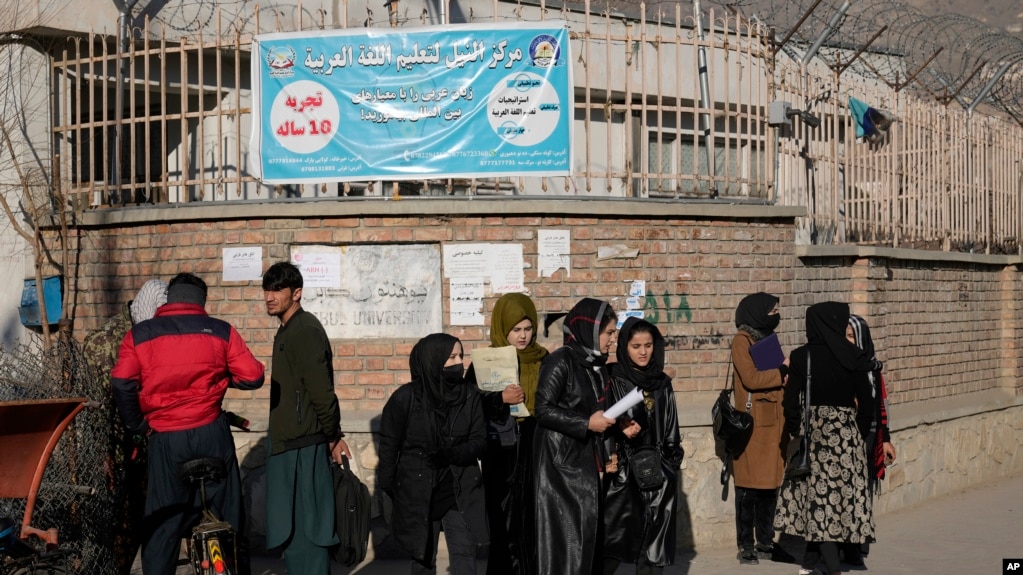
FILE - Afghan women stand outside Kabul University in Kabul, Afghanistan, on Dec. 21, 2022. The Taliban has increased restrictions on women in 2022 — including barring females from attending universities and banning women humanitarian workers — saying Islamic law mandates it.
Afghan women stand outside Kabul University in Kabul, Afghanistan, on Dec. 21, 2022. The Taliban has increased restrictions on women in 2022 — including barring females from attending universities and banning women humanitarian workers — saying Islamic law mandates it.

The Taliban leadership in Afghanistan remained unmoved Friday by relentless global calls to remove a ban on women humanitarian workers, insisting their Islamic law or Shariah-based governance mandates it.

The hard-line rulers ordered international and national nongovernmental organizations (NGOs) last Saturday to immediately suspend Afghan female staff for allegedly not observing Islamic hijab and breaching mandatory gender segregation at work.

The ban has prompted the United Nations to temporarily halt some “time-critical” programs, and several of the largest foreign NGOs in Afghanistan have suspended their operations, saying they cannot reach the millions of children, women and men in need of assistance without female staff.

Women in Afghanistan Facing Numerous Taliban Restrictions in 2022

Zabihullah Mujahid, the chief Taliban spokesman, defended the ban Friday, arguing that it is strictly in accordance with Islamic law. He told VOA by phone that female government employees working in “unnecessary fields” were ordered to stay at home soon after the Taliban seized power in August 2021.

“The Islamic Emirate has now reached a conclusion that women do not need to work in NGOs in areas where there is no need for them,” Mujahid said, using the official title for his men-only Taliban administration in Kabul.

“In line with a general Islamic Emirate edict seeking implementation of Shariah in the country, it is mandatory for women not to go to NGO offices, just like government institutions, which have been functioning without women for the past year-and-a-half.”

Mujahid argued that Taliban authorities are responsible for the safety and security of all Afghans but that they are unable to do so for women working in NGOs because they are independent of government control.

Barring health and a couple of other departments, female government staff have largely been confined to their homes since the Taliban takeover of Afghanistan. Mujahid asserted the women are still being paid salaries.

Early last week, the Taliban abruptly barred female students from attending universities until further notice. The move effectively imposed a complete ban on girls’ education in Afghanistan after the Islamist rulers in March banned teenage girls from attending secondary schools across the country.

A group of independent U.N. experts in a statement Friday denounced the Taliban’s order barring women from working in NGOs as an “outrageous violation” of women’s rights.

“The ban on women working in NGOs not only deprives women workers of their fundamental rights and livelihood, but also prevents them from supporting their communities. It will further push women out of jobs and completely erase them from the public sphere,” the group lamented in a statement.

Ramiz Alakbarov, the U.N. resident coordinator in Afghanistan, told reporters in New York on Thursday that it would not stop providing humanitarian aid to millions of Afghans despite the ban on women NGO workers, citing “absolutely enormous” humanitarian needs in the South Asian nation.

“Let me make it very clear that the United Nations and humanitarian partners are very committed to the delivery of life-saving services to the people of Afghanistan,” Alakbarov said.

He acknowledged that it is not possible to deliver humanitarian aid, particularly delivery of health services to women and girls, without the participation of female workers, but he stressed “it’s important that we continue to stay and deliver.”

U.N. and other aid agencies estimate about 28 million people – more than half the population – including 14 million children, are in need of humanitarian assistance in Afghanistan. About 97% of Afghans are at risk of falling below the poverty line this year, with more than 1 million children younger than 5 acutely malnourished.

Alakbarov said that the U.N. Emergency Relief Coordinator and other U.N. officials will visit Afghanistan in the coming weeks to discuss the issues with the Taliban rulers and find solutions.

“We are working under one thing only, and that is resolution of the bottleneck and getting negotiations going so the women can go back to work and girls can go back to school, based on an understanding that this is an absolutely essential right of other people,” Alakbarov said.

“I believe from my interaction with the Taliban, the best way of coming to the solution is not a pressure. It is a dialogue. This movement has not responded well to the pressure in the past,” he cautioned.

The international community has not yet formally recognized the Taliban administration, mainly over human rights concerns and the treatment of women.

Taliban Hold Firm to Ban on Afghan Female Aid Workers
read more

Her Escape From Kabul Was Supposed to Be the Hardest Part

The New York Times

The New York Times Sports department is revisiting the subjects of some compelling articles from the last year or so. In August, we reported on a soccer player who fled her home in Afghanistan to begin a new life. Here is an update.

When her new life in Australia becomes too overwhelming, Fati, the goalkeeper for the Afghanistan national women’s soccer team, heads to the beach in the nighttime.

She walks along the shoreline of Port Phillip Bay, where the skyline of Melbourne glows in the distance. She shines a flashlight on the colorful fish darting around the shallow water. And listening to the gentle lapping waves, she takes a deep breath and exhales.

There in the darkness and solitude, it’s Fati’s time to reflect. And to mourn.

“I try hard to relax and be calm, but I always end up thinking about all the things that have happened to me and all the things I’ve lost,” she said. “I see that the water is endless, like my problems are endless.”

(The New York Times is not using the last names of Fati and her teammates at their request because they fear retribution from the Taliban.)

About 16 months have gone by since Fati and her teammates on the national team risked their lives to escape Afghanistan after the Taliban took over the country. After The New York Times featured Fati in an article in late summer, she was offered paid speaking engagements, including one opportunity to speak at a law school graduation in California in 2023.

There is also a chance that her story will be turned into a dramatic film after more than a half-dozen people showed interest in buying the TV and film rights.

“Sometimes I feel like so strong and I want to keep sharing my story and motivating other people,” she said. “I’m making a difference, I hope.”

But none of that can magically heal her body and mind after running for her life from the Taliban, and then having no choice but to leave her parents and youngest sister behind.

Fati and most of her teammates on the national soccer squad were forced to leave Afghanistan without both parents because large groups often couldn’t make it past the Taliban checkpoints and chaotic crowds on the way to the Kabul airport, and to freedom.

Fati, 19, now lives in a suburb of Melbourne with her older brother, a younger brother and a younger sister, and she has become their stand-in parents. Their parents and 5-year-old sister, Kawsar, are back in Kabul, barely making ends meet amid the country’s economic collapse.

Some of Fati’s teammates’ families have left Afghanistan for relative safety in neighboring countries like Iran or Pakistan while they await Australian visas. But Fati’s family has not had such luck. Her parents and Kawsar do not have passports, complicating a difficult situation.

Their immigration case has stalled in the system, and the potential cost for Fati to secure their exit from Afghanistan through backdoor channels is too much for her to pay. She and her family are Hazara, an ethnic group that is often discriminated against and targeted by the Taliban, and the price for those families to leave the country is in the thousands and can be more than twice the cost for non-Hazara families, she said.

“I try not to be negative, but if you want me to tell the truth, I am losing my hope that my family will get a visa,” she said.

The thought of never seeing her family again, or waiting many years to see them, is unbearable, she said, because time already is going by so quickly. She is crushed that Kawsar is growing up without her.

Through daily video calls, Fati has noticed that her little sister has changed so much since they last saw each other in the melee outside the Kabul airport. Kawsar’s hair is long now, and the English that Fati taught her is slipping away. No longer does Kawsar watch Disney animated films to learn English and improve her own prospects in life, the way Fati did. Kawsar also has stopped going to school because it is just too dangerous. The Taliban have barred girls and women from playing sports and also have barred girls from going to school past the sixth grade.

“She’s not the same Kawsar as I knew,” Fati said, choking up.

Fati does her best to help her family in Kabul by sending them money. And while once she was supporting just her parents and Kawsar there, now she is supporting nine people who live in her family’s house. In recent months, her aunt moved in with her five children.

Already, there is not that much money to go around. Fati must pay the bills for her house in a suburb of Melbourne where she lives with her siblings, two teammates and one teammate’s father.

Fati also wants to relocate into the city to save herself the hourlong commute to work and soccer training, but the housing in Melbourne is too expensive.

Her bank account balance bottomed out, once again, several months ago after her older brother, Khaliqyar, bought a car. She began working two jobs to help pay that bill.

Her first job was in the IT department at a financial services company that is a sponsor for the Afghan national team, now that the team plays for the Melbourne Victory professional soccer club in a state league in Australia. From that IT job, Fati would go straight to her second job, an overnight shift at a pizza restaurant, preparing food and washing dishes until 4 a.m.

The schedule was so grueling that Fati often had headaches and could hardly keep her eyes open, and began to oversleep and miss days at her office job. So when Khaliqyar landed a steady job at a painting company, she quit the pizza place.

Now, Fati is able to focus on her soccer training and leadership activities, which include being a spokeswoman for her national team, a squad that is frustrated because it hasn’t been able to play any international matches.

The Afghanistan Football Federation deactivated the women’s national team program when the players left the country, a spokesman there said, and FIFA, the global governing body of the sport, has ignored the team’s request to be reinstated.

“I’m trying not to cry about the team anymore, but it’s hard,” she said. “I just want to turn on my Afghani mode and work hard to be a good goalkeeper and keep dreaming about playing in the World Cup someday.”

In August, the anniversaries of Fati leaving Kabul and arriving in Australia were among her toughest days in recent years.

During that time, she found it too hard to focus on her English class and dropped out of the course, which she said made her even more distraught and depressed. Several weeks later, there was an attack on an education center in Kabul that killed many Hazara students, including one of her teammate Bahara’s relatives.

Fati, Bahara and some of the other players went to the beach that night to find solace, and the women spent the night wiping their tears.

“I look at the water and I know the water is so cold, and I’m afraid that my heart is also getting cold,” Fati said that night.

These days, she is applying for scholarships to a local university so she and her sister Zahra can start classes next semester. It’s time to jump-start life, Fati said.

When she was a teenager, she wanted to be an archaeologist, and Fati still wants to see the pyramids in Egypt and visit China’s Great Wall. She also wants to play soccer for her country again.

“I’m so much afraid of time and I think about dying, so I know I have to use every opportunity,” she said. “What if all of my time goes by and I never see my family? What if I die without reaching my dreams?”

Her Escape From Kabul Was Supposed to Be the Hardest Part
read more

Afghanistan: Woman protests Taliban’s education ban with single word of God

By Noor Gul Shafaq
BBC World Service
30 Dec 2022

“I did not feel any fear because I believed that my demand is just,” said a defiant 18-year-old Afghan woman whose ambition to get a university degree has been frustrated by the Taliban’s ban on women in higher education.

Angered at the prospect of seeing her future disappear, the woman (whose name we have changed for her safety) staged an extraordinary solo protest in front of Kabul University, invoking words from the Quran.

On Sunday 25 December, Adela stood in front of the entrance holding up a board with a particularly powerful word written on it in Arabic – iqra, or ‘read’. Muslims believe this was the first word revealed to the Prophet Muhammad by God.

“God has given us the right to education. We need to be afraid of God, not the Taliban who want to take away our rights,” she told the BBC Afghan service.

“I knew that they treat the protesters very badly. They beat them, hit them, use weapons – they used Tasers and water cannon on them. But still I stood in front of them.

An onlooker watches Adela holding a placard
Adela wants more Afghan men to join women in their fight for education

“At first they didn’t take me seriously. Later, one of the gunmen asked me to leave.”

Initially, Adela refused to go and stood her ground, but the paper board she was holding gradually caught the attention of the armed guards around her.

While clutching the placard, she started engaging a member of the Taliban.

“I asked him, ‘Can’t you read what I have written?’,” she said.

He said nothing, so Adela went further: “Can’t you read the word of God?”

Iqra meaning "read written" in Arabic
Muslims believe the first word of revelation given to Prophet Muhammad was the Arabic word iqra, or “read”

“He became angry and threatened me.”

Her placard was taken away and she was forced to leave after about 15 minutes of her lone demonstration.

While she was protesting, her elder sister had been sitting in a taxi taking pictures and recording a video of the protest.

“The taxi driver became very scared of the Taliban. He was pleading with my sister to stop filming. Fearing trouble, he asked her to leave the car,” Adela said.

Increasing restrictions on women

Following the hasty withdrawal of the American-led international forces, the Taliban returned to power in Afghanistan in August 2021.

First they banned girls from going to secondary schools. In September this year, they banned girls from studying certain subjects and told them they could only choose universities within their province.

On 20 December, they banned women from attending university, provoking international condemnation, and then a few days later from working for local and international NGOs.

Women, especially university students have been protesting against the ban on education ever since.

Some have used the slogan “women, life, freedom” popularised by the recent demonstrations in Iran.

Officials at Kabul University, where four faculties are currently headed by women, told the BBC that female professors were not allowed to enter the campus now.

Calling on men

Protesting against the Taliban is not easy for women such as Adela. She wants men to show similar courage, but it can come with a cost.

“During my protest, a young man wanted to make a video of me to support me. They hit him hard,” she said.

One male professor tore up his educational diplomas on a live TV show to register his protest and sources have told the BBC that more than 50 university teachers have resigned in protest.

One teacher who gave up his job said that he withdrew his resignation after he was beaten up by the Taliban.

But Adela believes that it is crucial that Afghan men join the struggle.

“There are very few men in Afghanistan who stand with us now. In Iran, men stand with their sisters and support women’s rights. If we also stand together for the right to education, we will be 100% successful,” she said.

Continuing defiance

There is external pressure on the Taliban as well: the UN Security Council said on Tuesday that the banning of girls and women from education “represents an increasing erosion for the respect of human rights and fundamental freedoms”.

But Taliban leaders seem unfazed. Education minister Nida Mohammad Nadim was quoted in the Guardian as saying the decisions would not be reversed “even if they drop an atomic bomb on us”.

Adela is similarly determined.

“If I cannot fly, I will run. If I cannot run, I will take slow steps. If I cannot do that either, I will crawl. But I will not stop my struggle, my resistance,” she said.

She says she can count on the support and appreciation of her friends. “You are so brave and we all are with you,” they tell her.

Adela also believes that women in Afghanistan today are better placed to win this fight than in previous generations.

“We don’t want to go back to the dark ages of 20 years ago. We are braver than the women of that time, because we are more educated and know our rights,” she said.

Afghanistan: Woman protests Taliban’s education ban with single word of God
read more

OIC Asks IIFA to Unify Clerics’ Stance on Girls’ Education in Afghanistan

But the Islamic Emirate said they are looking for a solution for women’s jobs at NGOs.

Following the reactions of Islamic countries to banning women and girls from education, the Organization of Islamic Cooperation (OIC) in a statement on Thursday called on the International Islamic Fiqh Academy (IIFA) to quickly launch a global campaign to unite scholars and religious authorities in the Islamic world against the Islamic Emirate’s decision to prevent girls from education.

“The decision of the Taliban government to prevent girls from education, including university education, and to dismiss female faculty members from their positions on the pretext that this contradicts Islamic law, was the latest challenge to be reviewed by the IIFA in addition to issues of minorities, escalating hostility to Muslims in Western countries, and other pressing issues,” OIC Secretary-General Hissein Brahim Taha said.

According to the OIC’s statement, the call of the OIC secretary-general came at the opening of the second meeting of the 2022 IIFA Bureau held via video conferencing on Thursday.

“Mr. Taha stressed the priority of the Afghan dossier in the OIC and IIFA agendas. He also pointed out that the Taliban’s decision was not based on texts in Islamic law,” OIC statement reads.

Meanwhile, lecturers asked the Islamic Emirate to reopen all educational institutions across the country.

“The people of Afghanistan call on the Islamic Emirate to understand the realities and consider the benefit of the people and open secondary schools to students at the start of the education year (in April 2023),” said Abdul Naser Shafiq, a university lecturer.

“I think, keeping girls’ schools closed could increase the gap between Afghans and the Islamic Emirate and the nation. At the international level, it will undermine the Taliban’s credibility and bring them into direct conflict with the world over challenges relating to women’s and human rights,” said Farhad Abrar, a university lecturer.

But the Islamic Emirate said they are looking for a solution for women’s jobs at NGOs.

“Problems regarding education and women’s employment will be resolved. We are working on them,” said Zabiullah Mujahid, the spokesman of the Islamic Emirate.

Ahmed el-Tayeb, the Grand Imam of Al-Azhar, said in a statement that it is not acceptable to prevent women from attending school.

He urged Afghanistan’s current government to reconsider its decision on the matter.

OIC Asks IIFA to Unify Clerics’ Stance on Girls’ Education in Afghanistan
read more