OIC: Agreements Signed for Projects for Afghanistan

The OIC said that on May 12, 2023, an official ceremony was held by the Islamic Development Bank (IsDB) at the Ritz-Carlton Hotel in Jeddah

The Organization of Islamic Cooperation (OIC) said in a statement that a series of agreements have been signed to carry out a group of projects under the Humanitarian Trust Fund for Afghanistan. 

The OIC said that on May 12, 2023, an official ceremony was held by the Islamic Development Bank (IsDB) at the Ritz-Carlton Hotel in Jeddah “where the signing took place.”

The ceremony was attended by Hissein Brahim Taha, the OIC Secretary-General, Muhammad Sulaiman Al-Jasser, Chairman of the Board of Directors of the IsDB Group, Sultan Al-Murshid, CEO of the Saudi Fund for Development (SFD), and Fahad Al-Osaimi, Director of the Emergency Relief Department at KSRelief in Saudi Arabia.

Additionally, Tarig Ali Bakheit, the Special Envoy of the OIC Secretary-General for Afghanistan, and other representatives from international organizations and partners attended the meeting, according to the statement.

The OIC Secretary-General “emphasized that the OIC’s commitment to humanitarian aid in Afghanistan is demonstrated through the signing of agreements that facilitated the implementation of specific projects.

He also highlighted the need for sustained involvement, which can be achieved by securing additional financial support from both Members and non Members of the OIC, as well as regional and international financial institutions,” the statement said.

OIC: Agreements Signed for Projects for Afghanistan
read more

Mujahid: Afghan Soil Will Not Be Used to Threaten Other Countries

Political analysts said that such pressures will cause tension in the region.

Zabiullah Mujahid, Islamic Emirate’s spokesman, reiterated that Afghan soil will not be used against anyone including regional countries.

This comes as “The Express Tribune” cited sources saying that China has leverage over the “Afghan Taliban” and that Pakistan wants China to use financial and economic leverage over the “Afghan Taliban” to address the issue of terrorist sanctuaries.

“The commitment of the Islamic Emirate of Afghanistan existed previously: We don’t want Afghan soil to be used against any country, and our neighboring countries, in particular China and Pakistan, can be assured that we never allow security to be violated from Afghan soil or for anyone to pose a threat,” Mujahid said.

Political analysts said that such pressures will cause tension in the region.

“The internal problem of Pakistan belongs to itself. Before the Islamic Emirate came to power, the TTP was active. I hope their intelligence network solves their problems themselves and does not mount pressure through Afghanistan,” said Mohammad Zalmai Afghanyar, a political analyst.

Earlier, speaking at the Institute of Strategic Studies Islamabad ISSI, acting Foreign Minister Amir Khan Muttaqi said that the remarks about the presence of terrorist groups in Afghanistan is propaganda against the Islamic Emirate.

He said that Afghanistan, China and Pakistan committed to not allow the use of their soil or airspace against each other.

Mujahid: Afghan Soil Will Not Be Used to Threaten Other Countries
read more

Ban on Afghan Women in NGOs Affecting Aid Delivery: Niklasson

Referring to the UN meeting in Doha, Niklasson said that the meeting was a welcome initiative by the UN to once more put Afghanistan in focus.

The European Union’s Delegation in Afghanistan released a press statement by Tomas Niklasson, EU Special Envoy for Afghanistan.  

Referring to the UN meeting in Doha, Niklasson said that the meeting was a welcome initiative by the UN to once more put Afghanistan in focus.

“In the discussions, there was a consistent view that the conditions were not in place to allow for recognition by the international community of the de facto authorities as a legitimate government, but that engagement with the de facto authorities and other Afghans must continue to address shared concerns – including security and counter-terrorism, the need for inclusive governance, upholding human rights, preventing irregular migration and human trafficking, countering narcotics production and smuggling, and stabilising the Afghan economy,” he said.

Niklasson also referred to the ban on Afghan women working for NGOs, saying that this “challenges fundamental principles” and is having “immediate consequences,” as “critical assistance delivered by such organizations cannot reach women and children in need.”

“Afghan girls and women are still prevented from attending secondary school or university due to decisions taken by the de facto authorities, while a very large number of Afghan boys can also not access primary or other forms of education due to lack of availability or opportunity,” he said.

The EU special envoy voiced concerns about the humanitarian situation, saying that more than 28 million vulnerable Afghans are in need of humanitarian assistance.

“The UN humanitarian appeal for USD 4.6 billion, the largest in the world, has only received pledges to cover 7.2%, whereas to compare the four largest humanitarian appeals after Afghanistan have by now received pledges covering more than 20%,” he said.

Niklasson said he reiterates the “EU’s clear position not to provide support – political, material or otherwise – for Afghan armed resistance, while I also encourage the de facto authorities to offer an alternative, by engaging in dialogue with all parts of the population – men and women.”

Niklasson said that the Afghan caretaker officials have reiterated their commitment that Afghan soil would not be used to threaten the security of other countries.

“They also confirmed, once more, their firm commitment to fight Da’esh (ISIS-KP), and many other Afghans recalled that in terms of security Ramadan had been much less challenging than in many years,” he said.

Ban on Afghan Women in NGOs Affecting Aid Delivery: Niklasson
read more

China, Pakistan urge Afghan aid be delinked from ‘political considerations’

By

Reuters

8 May 2023

KARACHI, Pakistan, May 8 (Reuters) – China and Pakistan on Monday urged donors to bridge gaps in humanitarian funding for Afghanistan, saying aid should be delinked from “political considerations”.

Aid to Afghanistan will drop sharply this year as donor countries seek to challenge curbs on female aid workers imposed by the Taliban administration and try to cope with an increase in crises around the world, international officials say.

The United Nations said last week it would continue to keep its staff at home after the administration in Kabul began enforcing a ban on Afghan women working for the world body.

“The Ministers underlined that humanitarian support to the people of Afghanistan must remain delinked from any political considerations,” the foreign ministers of China, Pakistan and the Taliban administration said in a joint statement.

They called for the lifting of unilateral sanctions against Afghanistan to create opportunities “for economic development and prosperity in the country,” the ministers said after a trilateral meeting in Islamabad.

The statement noted the Afghan Interim Government’s repeated assurances to respect women’s rights and urged donors to support Afghanistan’s reconstruction so as to protect the rights and interests of all Afghans “including women and children”.

According to U.N. data, the United States was the largest donor to the U.N. appeal last year, giving nearly $1.2 billion. So far the United States has given the most money to the 2023 U.N. appeal: $75 million; despite that funding is drying up with a $4.6 billion U.N. appeal less than 7% funded.

The United Nations Development Programme has said the Afghan economy is at risk if aid continues to dry up.

Since toppling the Western-backed government in 2021, the Taliban administration has also tightened controls on women’s access to public life, including barring women from university and closing girls’ high schools.

The Taliban says it respects women’s rights in accordance with its strict interpretation of Islamic law. Taliban officials said decisions on female aid workers are an “internal issue.”

China, Pakistan urge Afghan aid be delinked from ‘political considerations’
read more

Reluctant critic China urges Afghan changes on women’s roles

Associated Press
10 May 2023

BEIJING (AP) — China on Wednesday called on Afghanistan to reform its radical policies excluding women from education and public life and “adopt a more resolute attitude in combating terrorism.”

The comments from Foreign Ministry spokesperson Wang Wenbin came on the heels of a Pakistan-hosted mini-summit of China, Afghanistan and Pakistan that sought to promote trade and lower border tensions amid a surge of attacks inside Pakistan.

Wang said China hopes the Taliban-appointed Afghan interim government will “take solid steps in the right direction, make practical efforts to gain the understanding and trust of the international community, and create favorable conditions for Afghanistan to further develop good neighborliness with its neighbors and integrate into the international community.”

China generally refrains from commenting on the internal policies of nations with which it wishes to curry favor, or can use as leverage in its campaign to combat the dominance of global affairs by the U.S. and other liberal democracies.

China has also made halting efforts to extend its Belt and Road Initiative to Afghanistan that could see construction of railways and bridges, but is chiefly concerned with Afghanistan harboring separatists opposed to Chinese control in its northwestern region of Xinjiang.

“The international community still has a lot of concerns and expectations for the Afghan interim government, including hoping the Afghan side will make more progress in implementing moderate and prudent internal and external policies and safeguarding the rights and interests of women and children, and adopt a more resolute attitude in combating terrorism so as to produce more visible results,” Wang said at a daily briefing.

Wang praised a joint statement issued Monday at the end of the trilateral meeting as the first time the Taliban had put in writing a commitment to disallow terrorist groups to use Afghanistan as a base of operations.

“As a traditional friendly neighbor of Afghanistan, China believes that Afghanistan should not be excluded from the international community,” he said. “The well-being and interests of the Afghan people deserve attention, the peace and reconstruction process of Afghanistan should be encouraged, and its sovereignty and territorial integrity should be respected.”

The joint statement said the three sides stressed the need to prevent any individual, group or party “to use their territories to harm and threaten regional security and interests or conduct terrorist actions and activities.”

These include the Pakistani Taliban and a nebulous militant group claiming to represent the Uyghur ethnic group in China’s Xinjiang region, called the East Turkestan Islamic Movement. Several hundred, possibly thousands, of Chinese Muslims are believed to live in Pakistan’s largely ungoverned northern territories, but terrorism experts question whether the ETIM exists in any form other than on paper.

The Taliban have been shunned by most of the international community for sweeping restrictions on political opposition and civic life imposed after they seized power in August 2021. Those measures have rolled back educational and cultural gains made during the 20-year presence of NATO and U.S. forces, despite earlier pledges by the group that it would moderate its hard-line interpretation of Islam that have left if an outlier in the Muslim world.

Most notably, girls have been banned from education beyond the sixth grade and women banned from most jobs outside the home and kept away

A U.N. report on Monday strongly criticized the Taliban for carrying out public executions, lashings and stonings since seizing power in Afghanistan, and called on the country’s rulers to halt such practices.

At the mini-summit, the diplomats from the three nations agreed “to further deepen and expand their cooperation in the security, development and political domains based on the principles of mutual respect, equal-footed consultation and mutual benefit.”

The involvement of China’s Foreign Minister Qin Gang in the talks represented a further expansion of Chinese diplomacy into the Muslim communities following Beijing’s hosting of talks resulting in the resumption of diplomatic ties between Saudi Arabia and Iran.

In Pakistan, Beijing is bankrolling the so-called China-Pakistan Economic Corridor, or CPEC — a sprawling package that includes road works, crop production and power plant construction.

The package is considered a lifeline for impoverished Pakistan, which is currently facing one of its worst economic crises amid stalled talks on a bailout with the International Monetary Fund.

During his visit, Qin met with President Arif Alvi, Foreign Minister Bhutto Zardari and Pakistan’s powerful army chief, Gen. Asim Munir. Qin was assured that Pakistan will boost security for Chinese nationals working in the country, a major concern since a suicide bomber killed nine Chinese and four Pakistanis in an attack in Pakistan’s volatile northwest in 2021.

Reluctant critic China urges Afghan changes on women’s roles
read more

TOLOnews Interviews Isobel Coleman, USAID Deputy Administrator

Coleman outlined the ongoing American assistance to the people of Afghanistan, especially for women and girls.

In an exclusive interview with TOLOnews, USAID Deputy Administrator for Plans and Programming Isobel Coleman said that the current bans on women’s activity will harm Afghanistan’s economic future. She said the world has condemned it, not just Western countries.

“It is intense condemnation by everyone in the international community, not just Western countries, but Muslim majority countries around the world, from Saudi Arabia to Egypt, to Indonesia. Even Iran and China issued a joint condemnation a few months ago on this rollback in women’s rights in Afghanistan. So, I think you see very broad-based international criticism and condemnation of this move. I can’t speculate on what the Taliban will do, they seem to have been quite committed to this path of economic self-destruction, frankly, and pain that they are inflicting on people,” she said.

Coleman outlined the ongoing American assistance to the people of Afghanistan, especially for women and girls.

The deputy head of the USAID further said that the USAID is trying to provide more aid to women in Afghanistan in accordance with international laws.

“We continue to do work in not just the humanitarian sector but also in health care, in education, in the WASH sector, in agriculture. We are continuing to work with farmers on helping them increase their productivity and improve their agribusinesses in many different parts of the country,” she said.

In the interview, Coleman criticized the lack of transparency in how the interim government in Afghanistan is spending the tax revenue it is collecting.

“We understand that the Taliban has been collecting taxes, but we have concerns about where the money is actually going and I think more transparency in how the Taliban is distributing funds would be very helpful because we have concerns that they are not investing as much as they can or should be in health care,” she said.

“The collected revenue is spent completely transparently and in accordance with the priorities of the people. The Islamic Emirate understands the nation’s priorities better than anyone and it is obvious to them. We spend money in accordance with these priorities,” said Ahmad Wali Haqmal, a spokesperson for the Ministry of Finance.

Previously, the US Special Inspector General for Afghanistan Reconstruction (SIGAR), reported that the US is still the largest donor to Afghanistan.

TOLOnews Interviews Isobel Coleman, USAID Deputy Administrator
read more

Students Call for Reopening of Girls’ Schools

The Islamic Emirate has said that the closing of girls’ schools is temporary, but there has been no specific date of reopening provided.

Schools above sixth grade in Afghanistan have been closed for females for nearly twenty months, but there has been no news about when they will reopen.

Female students once again urged the Islamic Emirate to open schools for them.

The Islamic Emirate has said that the closing of girls’ schools is temporary, but there has been no specific date of reopening provided.

Nazita, a student in 12th grade, is reviewing her past school lessons in a group with other female students.

“We need to come here and study our lessons because schools are closed. We will fall behind in our lessons if we don’t study, we must study. We are now still far behind in our courses,” Nazita told a TOLOnews reporter.

These girls expressed their unhappiness about the ban on their schooling.

“It’s been 600 days since we attended school. Why don’t you open the doors of schools to us? what is the problem? Learning is our right. Men and women are two wings of one society,” said Sara, a student.

“Let us learn, getting an education is our right,” Nadia, a student, told TOLOnews.

Women’s rights activists said the closing of schools will harm the country.

“It’s been 600 days since schools have been closed to girls in Afghanistan. The closing of schools is a terrible and irreparable disaster in the educational field,” said Sahar Baresh, a women’s rights activist.

This comes as the acting foreign minister of the Islamic Emirate said at the Institute of Strategic Studies of Pakistan that women’s education is not forbidden, and this ban is not permanent.

Students Call for Reopening of Girls’ Schools
read more

Female Afghan employees detained since Taliban ban, UN says

Al Jazeera

9 May 2023

‘Discriminatory and unlawful measures’ restrict Afghan women’s and girls’ participation in public life, report says.

Afghanistan’s Taliban rulers informed the UN early last month that Afghan women employed with the UN mission could no longer report for work.

“This is the most recent in a series of discriminatory – and unlawful – measures implemented by the de facto authorities with the goal of severely restricting women and girls’ participation in most areas of public and daily life in Afghanistan,” the UN said in a report released on Tuesday.

Taliban authorities continue to crack down on dissenting voices, in particular those who speak out on issues related to the rights of women and girls, it said.

The UN report cited the March arrest of four women who participated in a Kabul protest demanding access to education and work and the arrest of Matiullah Wesa, head of PenPath, a civil society organisation campaigning for the reopening of schools for girls.

It also highlighted the arrest of a women’s rights activist and her brother in February in the northern province of Takhar.

Several other civil society activists have been released, reportedly without being charged, after extended periods of arbitrary detention by the Taliban’s intelligence service, the report said.

The measures will have disastrous effects on Afghanistan’s prospects for prosperity, stability and peace, the UN Assistance Mission in Afghanistan (UNAMA) said.

The Taliban previously banned girls from going to school beyond the sixth grade and blocked women from most aspects of public life and work. In December, they banned Afghan women from working at local and non-governmental organizations, a measure that at the time did not yet extend to UN offices.

Public executions, lashings

The report also pointed to ongoing extrajudicial killings of individuals affiliated with the former government.

On March 5 in southern Kandahar province, Taliban forces arrested a former police officer at his home, then shot and killed him, according to the report. During the same month in northern Balkh province, a former military official was killed by unknown armed men in his house.

“Arbitrary arrests and detention of former government officials and Afghanistan National Security and Defense Force members also occurred throughout February, March and April,” the report said.

In a separate report released on Monday, the UN strongly criticised the Taliban for carrying out public executions, lashings and stonings since seizing power in Afghanistan and called on the country’s rulers to halt such practices.

The Taliban foreign ministry said in response that Afghanistan’s laws are determined in accordance with Islamic rules and guidelines and an overwhelming majority of Afghans follow those rules.

The Taliban began carrying out such punishments shortly after coming to power almost two years ago despite initial promises of a more moderate rule than during its previous stint in power in the 1990s.

Under the first Taliban regime from 1996 to 2001, public punishment and executions were carried out by officials against individuals convicted of crimes, often in large venues such as sports stadiums and urban intersections.

SOURCE: AL JAZEERA AND NEWS AGENCIES
Female Afghan employees detained since Taliban ban, UN says
read more

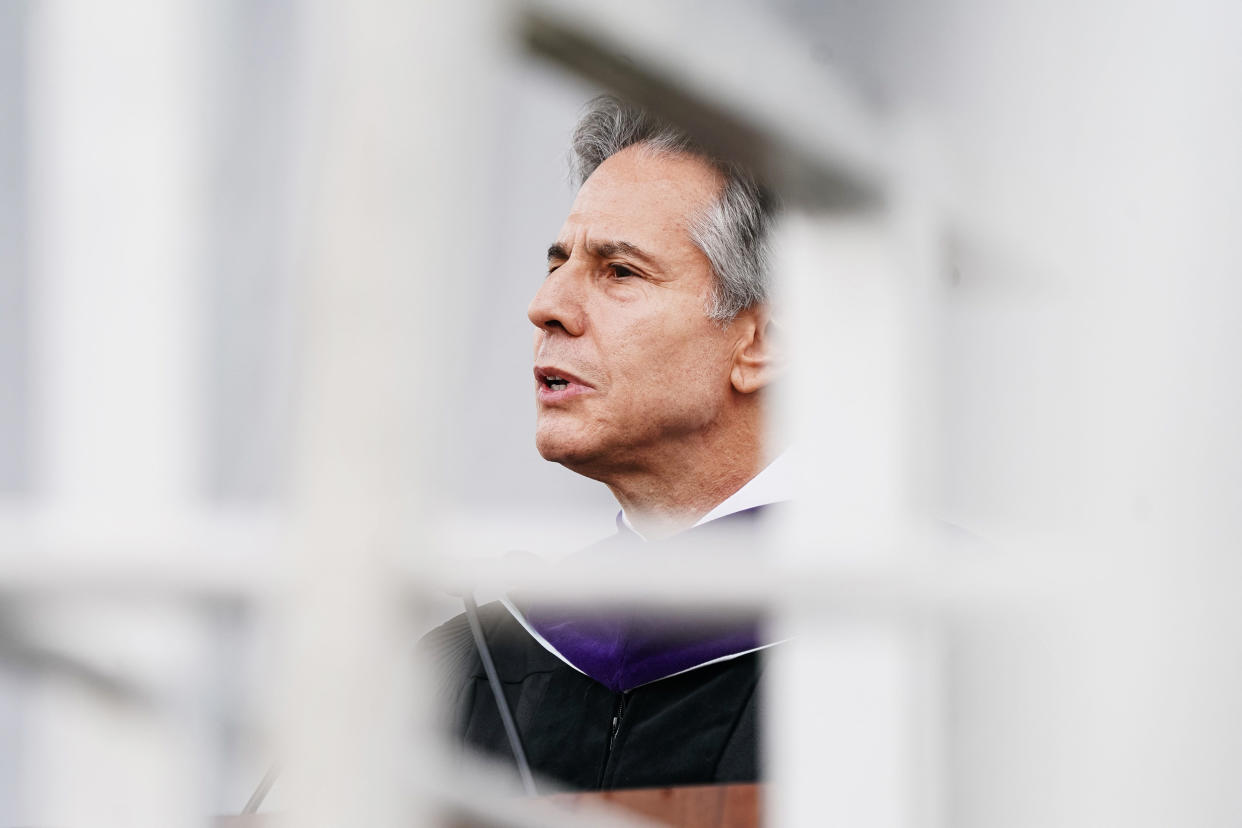
GOP panel chair pressures Blinken on Afghan withdrawal document

Elijah Nouvelage

The House Foreign Affairs Committee chair has threatened to hold Secretary of State Antony Blinken in contempt of Congress if he does not turn over a classified cable reportedly warning that Kabul could collapse soon after the August 2021 U.S. withdrawal from Afghanistan.

The letter escalates a monthslong standoff between the House committee and the Biden administration, which has so far been unwilling to turn over the document to Congress. Rep. Michael McCaul, R-Texas, on Monday released a May 5 letter demanding the State Department provide Congress with an unredacted version of the July 13, 2021, cable and its official response.

McCaul threatened Blinken with contempt of Congress and a possible civil enforcement proceeding if he does not comply with the committee’s request by 6 p.m. Thursday or provide a legal basis for withholding the document.

“The dissent cable and official response are critical and material to the Committee’s investigation into the catastrophic Afghanistan withdrawal,” McCaul wrote in his letter.

State Department employees can use the “dissent channel” to communicate dissenting foreign policy views with senior officials. A Wall Street Journal article said the cable warned that the Taliban could seize control of Kabul soon after U.S. troops withdrew from Afghanistan.

In late March, the committee issued a subpoena to Blinken over the cable. On April 27, the State Department gave the committee a briefing on the cable’s contents and its official response. The department also provided Congress with a one-page summary of the dissent cable, as well as with a summary of the official response that came in at just under one page, according to McCaul’s letter. The letter adds that the actual cable is four pages long.

“It is inherently problematic for the Department, which is the subject of the Committee’s investigation, to be permitted to withhold key material evidence and substitute its own abbreviated characterizations of that evidence for the original documents,” McCaul wrote in his letter.

He claimed that the State Department officials who led the briefing were “unwilling or unable” to answer several of the committee’s questions on the topic.

In a statement, a State Department spokesperson said the committee’s actions were “unnecessary and unproductive,” as the panel had received a classified briefing and summary of the cable.

“We will continue to respond to appropriate oversight inquiries and provide Congress the information it needs to do its job while protecting the ability of State Department employees to do theirs,” the spokesperson said.

The administration has previously expressed concerns that releasing the cable could compromise the identity of the cable’s signatories.

The cable is one part of McCaul’s investigation into the withdrawal from Afghanistan, which saw 13 U.S. service members killed at Kabul’s airport. Last month, the Biden administration released a summary of its assessment of the withdrawal from Afghanistan, largely faulting the Trump administration for the chaos that unfolded.

GOP panel chair pressures Blinken on Afghan withdrawal document
read more

Lashing, Beating, Stoning: UNAMA tracks corporal punishment and the death penalty in Afghanistan

A new United Nations report on capital and corporal punishment has detailed the widespread use of corporal punishment delivered ad hoc by non-judicial authorities, such as the police and ‘Vice and Virtue’ officials. It also documents a rise in corporal punishment ordered by judges since November 2022 when the Taleban’s Supreme Leader encouraged the use of such measures where they are considered divinely mandated. Judicially-ordered death sentences have so far been few in number. However, there may soon be a sharp rise in the number of Afghans given the death penalty: in recent days, the Deputy Chief Justice has announced that the courts have delivered hundreds of such verdicts. AAN’s Kate Clark says the UNAMA report is significant not only for documenting the use of corporal and capital punishment under the Emirate but also setting this in the context of International Human Rights Law and the practice of the Islamic Republic. The report also details who is receiving corporal punishments – generally, those committing ‘moral crimes’ and with high numbers of women offenders. 

UNAMA’s new report, “Corporal Punishment and the Death Penalty in Afghanistan”, can be read here.

UNAMA has recorded just two instances of capital punishment ordered by judges or officials since the Taleban took over Afghanistan in August 2021. One was an old case of murder from 2017 in Farah province, which was revived following the complaint of the victim’s family, and passed through all three judicial levels before being signed off by Amir ul-Mu’minin, Mullah Hibatullah Akhundzada; the accused was reportedly shot dead by the victim’s father in December 2022. The second was the stoning to death on 14 February 2023 of two people accused of adultery in Nusay district of Badakhshan province as ordered by the district governor. UNAMA has detailed many more cases of corporal punishment, defined as when “physical force is used and intended to cause some degree of pain or discomfort, however light.” Some were issued by the courts or by non-judicial authorities such as governors, and others were carried out without any formal procedure, ad hoc, by police, officials from the Ministry for the Promotion of Virtue and Prevention of Vice and the General Directorate of Intelligence (GDI) and others.

All those numbers may, however, be set to rise sharply if sentences announced by Deputy Chief Justice Abdul Malek Haqqani are implemented. Haqqani detailed hundreds of verdicts involving capital and corporal punishments in a video posted on the Emirate’s Supreme Court YouTube channel on 4 May. He categorised the offences and sentences according to Islamic law’s three-way classification (also used in the Republic’s body of law).

First are hudud offences, whose punishments are viewed as fixed by the Qur’an or Hadith and are classed as offences against God; they include zina (sex outside marriage, including adultery, which the UNAMA report tends to mention separately), accusing someone falsely of zina, drinking alcohol and some types of theft.

Second are qisas punishments, which are retributive penalties, and allow equal retaliation in cases of intentional bodily harm, including most types of murder; these crimes may also be forgiven by the victim or their family or resolved between the families with blood money.

A third class of punishments in Islamic law, tazir, are for all other offences and are decided according to the discretion of a judge or ruler. 

Different offences within these three categories may receive corporal, capital or other types of punishment.

The Deputy Chief Justice listed the following verdicts as having been ordered since the Taleban’s takeover and the establishment of their courts and procedures.

  • 175 verdicts of murder; those convicted have been sentenced to death
  • 79 verdicts of monetary compensation to the victim or their family (di’et)
  • 37 sentences of stoning to death (rajam) (crime not mentioned)
  • 4 sentences of having a wall collapsed onto the perpetrator (crime not mentioned)
  • 103 cases of hudud punishments (not specified)
  • 1,562 taziri punishments (neither crimes nor sentences specified).

Some of the taziri punishments have already been carried out. However, with regard to qisas and hudud offences, the Deputy Chief Justice said that because they are so serious, the High Council (Aali Shura) and cabinet have to scrutinise each case and concur with the court’s verdict. The sentences will only be carried out, he said, after the Amir ul-Mu’mimin has confirmed them.

If these sentences are implemented, it would represent a massive increase in the use of corporal punishment and judicially ordered death sentences. UNAMA has already reported a rise in judicially ordered sentences of corporal punishment since November 2022 when Mullah Hibatullah encouraged the implementation of hudud and qisas punishments, as referred to in this tweet by Emirate spokesman Zabihullah Mujahed:

His Excellency the Amir-ul-Momineen in a meeting with Qazis [judges]: ‘You should examine well the dossiers [case files] of thieves, kidnappers, and those causing fitna [strife/sedition/conflict etc]. You are obligated to apply Hudud and Qisās [punishments] in those cases where all Shariah conditions for Hudud and Qisās are met because this is the order. [Translation from Pashto by UNAMA].

However, in Afghanistan today, the courts are not the only state body ordering punishments, as UNAMA’s report has documented.

Who orders the punishments?

In its analysis, UNAMA breaks down punishments according to who ordered them and gives these details when it comes to corporal punishment.

1. Judicial corporal punishment: punishments carried out in accordance with a court decision 

In the fourteen months between the Taleban takeover on 15 August 2021 and the tweet announcing Hibatullah’s meeting with the judges on 13 November 2022, UNAMA says it documented at least 18 instances of judicially ordered corporal punishment, with Ghor province recording the highest number (six). Of those 18 documented instances, 33 men, 22 women and two under-age girls were punished. “The vast majority of punishments, for both men and women,” it reported, “related to zina, adultery or ‘running away from home’.” All the women and girls who were punished were reportedly convicted of such offences. Punishments typically consisted of 30-39 lashes for each convicted person. In some cases, as many as 80 to 100 lashes were given.

In the almost six months since the tweet about the Amir’s meeting with the judges (up to 30 April 2023, the cut-off point for this report), UNAMA documented at least 435 instances of judicial corporal punishment. Of those, 58 women, 274 men and one boy were lashed for various offences, including zina, running away from home, theft, homosexuality, consuming alcohol, fraud and drug trafficking. As before, the majority of punishments administered related to convictions of zina, adultery and running away from home. Again, the punishments were typically 30 to 39 lashes, but as many as 100 lashes were also reported.

After 13 November 2022, UNAMA also said there was:

[A]n observable increase in the number of people punished in a single gathering and in the public nature of punishments, with the de facto authorities favouring large capacity sports stadiums and drawing in significant crowds of local residents as spectators for punishments. For example: 14 people lashed in a football stadium [in] Logar province on 23 November; 21 people lashed in a courtroom of the de facto Primary Court in Kabul on 1 December; 27 people lashed in the sports stadium in Parwan on 8 December.

2. Corporal punishment handed down by non-judicial entities: punishments carried out following a formal decision announced by a non-judicial official, eg a Provincial Governor

UNAMA recorded several instances where state authorities issued formal decisions about punishments, largely for moral crimes.

  • A 16-year-old female and 18-year-old male, arrested for zina, were lashed 50 times each, based on a decision by religious elders and de facto police in Moradi village, Freng district, Baghlan province. (27 December 2021)
  • The Wama district governor in Nuristan province ‘convicted’ a 17-year-old male of stealing cooking oil and publicly lashed him 60 times. The decision was made following an interrogation of the boy, conducted in the presence of some ulema. (19 November 2022)

3. Ad hoc corporal punishment: punishments carried out by a non-judicial official in the absence of any formally announced decision

UNAMA has recorded ad hoc corporal punishments used by Vice and Virtue personnel, the police, GDI and others. Those carried out by Vice and Virtue against women, it said, were most often meted out for not wearing the style of hijab mandated by the Emirate and leaving the house without a mahram (a close male relative), even though according to the Emirate’s own rules, this is allowed up to 78 km from a woman’s home. For men, punishments were typically meted out, reported UNAMA, to barbers for trimming men’s beards, to men with trimmed beards, to shopkeepers for allowing women into their stores without a mahram and to men for failing to attend congregational prayers in a mosque. UNAMA gave a number of examples of such ad hoc punishments, including:

• Military personnel lashed and beat two men with the butt of a gun, accusing them of gambling and using drugs in Burka district, Baghlan province. (16 December 2022)

• Vice and Virtue officials slapped and kicked a group of shopkeepers for allowing women to shop in their stores unaccompanied by a mahram in Lashkargah, Helmand province. (12 April 2022)

• Vice and Virtue inspectors lashed two girls and one woman because they were not wearing burqas in Bamyan city. (13 August 2022)

• Vice and Virtue officials detained a group of six young women and beat them with sticks and cables on their legs, because their ankles were visible under their clothes in Kabul city. (6 November 2022)

• Police stopped two adult men and beat them because they were playing music inside their car in Lashkargah. (14 November 2022)

UNAMA reports that one person was killed as a result of such punishment. Police in Aybak city, Samangan province, beat two people, a man and a woman, on charges of adultery and running away on 30 November 2022. They beat the woman so badly that she died of her injuries. UNAMA said the woman’s body was handed to her family the following day.

Human Rights Watch has pointed out that many ‘ad hoc punishments’ are also carried out by the Taleban to silence critics or perceived critics, for example, beating protesters and journalists. Musicians as a group have also been subject to ad hoc violence from the state, as a recent AAN report detailed. Human Rights Watch also stresses that when it comes to killing by the state, the number of judicially-ordered death sentences are “eclipsed by the Taliban’s extrajudicial executions, mostly of members of the former government’s security forces, whose number is estimated in the hundreds.”

The legal frameworks and the experience of the Republic

Under the Republic, both corporal punishment and the death penalty were lawful. Article 3 of the Penal Code stated that its purpose was to regulate “principles, rules and provisions related to Taziri crimes and penalties,” and that perpetrators of hudud and qisas would be “punished in accordance with the provisions of Hanafi jurisprudence of Islamic Sharia.” Hudud and qisas punishments, noted UNAMA, were “therefore allowed under the Penal Code, but not codified or defined therein.”

In 2010, the Republic confirmed that corporal punishment could be imposed for zina, under the Penal Code.[1] In 2013, a Ministry of Justice working group proposed amendments to the Penal Code which would have established stoning or lashing as punishment for the offence of adultery. The amendments were not passed. The 2004 Constitution and the Penal Code both allowed for the imposition of the death penalty: tazir punishments for murder were only to be applied where the conditions for the application of a qisas punishment were not available. Article 170 of the Penal Code listed the crimes for which the death penalty should be applied “unless otherwise stipulated in law.” They included: genocide, crimes against humanity, war crimes, crimes of aggression against the state, assassination and explosion, kidnapping and taking hostages or highway robbery resulting in the death of person(s); murder in conditions anticipated in the Penal Code; crimes causing the territory of Afghanistan partly or entirely to fall under the sovereignty of a foreign country or which harm the national sovereignty, territorial integrity, or independence of the country; gang rape of a female; gang rape of male that results in death.

In the years of the Republic, between 2001 and 15 August 2021, says UNAMA, the state reportedly executed at least 72 people by hanging or shooting.[2] The Republic of Afghanistan stopped executing people by shooting after a public outcry following a botched mass execution in October 2007.

UNAMA says there is a lack of good data on instances of corporal punishment ordered by the judiciary or government entities during those years. It cites two examples from what it says are isolated public reports of judicially ordered corporal punishment: a man publicly whipped by a judge inside the courtroom as a punishment for drinking alcohol in Jalalabad, Nangrahar province in May 2011 and; a woman and man publicly lashed 100 times each by a primary court judge, who had convicted them of adultery on 30 August 2015

The United Nations Commission on Human Rights (predecessor to the Human Rights Council), along with human rights treaty bodies and special procedures, “have all stated that corporal punishment constitutes a form of torture or cruel, inhuman or degrading treatment or punishment, in contravention of international human rights standards, and have called for its abolition,” writes UNAMA.

As to the death penalty, while not prohibited under international human rights law, UNAMA says the International Covenant on Civil and Political Rights strictly limits its application by State parties which have not abolished its use; it should only be imposed for the “most serious crimes,” interpreted by the Human Rights Committee, as crimes of extreme gravity involving intentional killing and any person sentenced to death should have the right to seek a pardon or commutation.

During the Republic, UNAMA Human Rights and other bodies called on the government to abolish corporal punishment and establish a moratorium on executions. They do so again today. UNAMA Human Rights, Fiona Fraser, said in a tweet:

Corporal punishment is a violation of the Convention against Torture & must cease. The UN is strongly opposed to the death penalty & encourages the DFA [de facto authorities] to establish an immediate moratorium on executions.

She also tweeted:

UNAMA welcomes the de facto authorities’ engagement with and response to the report. We call for more to be done to respect international human rights standards.

How fair is the system, especially to women?

International standards, writes UNAMA, make it clear that all accused persons must receive a fair trial. It lists some of the violations of fair trial guarantees seen in Afghan courts: the use of forced confessions, lack of effective legal representation, general lack of fairness in the criminal justice process and lack of independence or impartiality of the court. UNAMA argues:

The legal system in Afghanistan is currently failing to safeguard minimum fair trial and due process guarantees, with defence lawyers reporting difficulties in meeting with clients, accessing places of detention and being sidelined in judicial processes. 

If offenders do get to court, women are at a particular disadvantage there. The legal system in Afghanistan was always heavily skewed towards male staffing, but that has worsened sharply since the Taleban took power, as UNAMA describes:

The de facto authorities’ refusal to grant licences to women defence lawyers and exclusion of women judges from the judicial system has a specific impact on women and girls’ ability to obtain legal representation, their equality before the law and access to justice.

UNAMA also points out that women who are publicly punished for zina and other moral crimes are at increased risk of violence from their families and communities after the punishment, due to the “extreme levels of stigma towards women accused of extramarital relationships.” Those punished for homosexuality, it says, are in similar danger of additional punishments.

Typically, women feature little in courts and prisons in Afghanistan, as elsewhere in the world; most criminals are men. Yet, the proportion of men to women accused and punished of the types of moral crimes that receive corporal punishments is far more even. Many, if not most, women in prison in Afghanistan are also there having been accused of moral crimes; according to a 2012 Human Rights Watch report, I Had To Run Away”: The Imprisonment of Women and Girls for “Moral Crimes” in Afghanistan”, 95 per cent of girls and 50 per cent of women then imprisoned in Afghanistan had been incarcerated for such crimes.

One offence can only be carried out by women and girls – running away from home – but is it even a crime? After being challenged that it is not recognised as such in Afghan law, the Supreme Court issued a statement in 2010 that it could be a criminal act if a woman ran away to a stranger’s house (rather than to relatives or government institutions) as this act could result in zina. (See the just-quoted Human Rights Watch for more on this.) When women and girls run away from home, even if it is because of violence, abuse or forced marriage, they have always been in grave danger of further punishment and being returned to the abusive situation. Perpetrators, meanwhile, have always been unlikely to be punished.

Indeed, another way of looking at the use of corporal punishment against women and girls, as outlined in the UNAMA report, is how it has always been part of the constellation of types of male violence. When AAN has reported on this issue in the past, it has been clear that the punishment of ‘wayward’ girls and women may be from their own families, from other families who feel wronged in some way, by the courts, or other authorities – police, district and provincial governors – or commanders, both Taleban and others. See, for example, our reporting from Ghor in 2016, “Reality Check: No justice for women in Ghor province”. It is a hard read, detailing heartbreaking cases of suffering, as it delves into how “conservative attitudes and customary practices, combined with insecurity and a failing justice system, result in an environment of near-constant violence against Afghan girls and women, where perpetrators literally get away with murder.”

With the advent of the Taleban’s second Islamic Emirate, the chances for women and girls to get justice have surely worsened, given the absence of female court officials, policewomen and female prosecutors, and the lack of women in government and parliament who might be more likely to speak up for victims than their male counterparts. The use of corporal punishment against women, as outlined in this report, would appear to be one other element in how Afghan women are now more tightly controlled and restricted. As to the death sentences detailed by Deputy Chief Justice Haqqani, he gave no breakdown according to gender. However, during the first Emirate, women were among those killed by the state for ‘moral crimes’. Little suggests that their treatment by the courts of the second Emirate will be any different.

Edited by Roxanna Shapour

References

References
↑1 UNAMA says that: 

Article 427 of the Penal Code makes sexual intercourse outside the marriage (zina) or adultery punishable by ‘long term’ imprisonment…Article 426, however, provides that zina shall be punished under article 427 only if it is not punished as hudud [sic]. Hudud, not defined in the Penal Code, thereby refers to another source of law (Sharia Law) for the harshest punishment of zina (including whipping and stoning).”

↑2 See also this AAN report about capital punishment from 2016

Lashing, Beating, Stoning: UNAMA tracks corporal punishment and the death penalty in Afghanistan
read more