Local dentist lives on $1,000 a month to fund Afghanistan dental project

Posted at 5:00 PM, Feb 02, 2024
Living on $1,000 a month in Santa Barbara may seem impossible, but for one local dentist, it’s just a way of life.

Dr. Rolfe isn’t a typical dentist — he’s 84, makes crowns by hand, has funky art and musical instruments in his office, and lives on just $1,000 a month.

“I’m not sacrificing, I’m just living the way I feel is important to live. I’m not needing to have a fancy house, I just need a place to sleep and something to eat, so I’ve been able to lower my needs to less than $1,000 a month,” he said.

Dr. Rolfe’s lifestyle is one of resourcefulness, finding most things he needs in the urban environment by repurposing unused and discarded items instead of buying new ones.

“And I grow almost all of my own produce in my own garden,” he adds.

His approach to a conscious lifestyle allows Dr. Rolfe to fund humanitarian efforts worldwide, which all started after a visit to Afghanistan left a profound impression on the dentist.

“I saw people dying from their teeth. I came back and constructed this clinic in a shipping container, sent it there, hired a dentist and a nurse to work in it, then started a school for more dentists, and I’ve been building clinics there now for 20 years,” he explained.

Dr. Rolfe founded the Afghanistan Dental Relief Project in 2003, which has treated more than 200,000 patients. It provides free dental care to all Afghan people which, according to Dr. Rolfe, is most difficult for Islamic women due to modesty rules strictly enforced by the Taliban.

“I feel like we have to really be the change we wish to see in the world… The more aware you become, the more you seek solutions for the limits that come into your consciousness,” he said.

To learn more about the Afghanistan Dental Relief Project, visit ADRPINC.org.

Local dentist lives on $1,000 a month to fund Afghanistan dental project
read more

The Daily Hustle: Mission impossible – the quest for passports and visas in Afghanistan

AAN Team • Roxanna Shapour

Afghanistan Analysts Network

print sharing button

Afghans who got onto evacuation lists may have the chance to go to Europe or North America, if they can get passports and visas for Pakistan. Their first dilemma is whether to go; it is not easy leaving one’s homeland. But there is a second dilemma – whether to spend savings or go into debt to get the necessary travel documents. Many families have faced repeated disappointments and staggering costs trying to get those documents. In this instalment of the Daily Hustle, AAN hears from one Afghan about his painful decision to emigrate and then his, so far unsuccessful, efforts to get passports and visas for all the family. 
I’m 46 years old. My wife and I have four children – three sons, aged 16, 14 and 11, and a five-year-old daughter, who’s the apple of my eye. I’ve been working for an international NGO for about 13 years, working my way up the ranks until I was a programme manager. My family and I had a good life. I had a good job and a steady income, which allowed me to provide for my family, put the kids in private school and lend a helping hand to our extended family and people back in our village when they needed it. The future looked bright.
But in spring 2021, as the Taleban were capturing district after district across Afghanistan, everything changed. In the weeks and days before the Taleban took over, the atmosphere in Kabul was tense. All over the city, people who were worried about the coming changes were making preparations to leave Afghanistan. Families were selling up everything they owned to pay for their move abroad. The shops that traded in used goods were bursting with household goods – furniture, appliances, kitchen utensils, clothes – their wares spilling onto sidewalks. Driving through the city, you could see people rummaging through what was on offer, looking to pick up bargains. Traffickers were doing a booming business smuggling people to Pakistan, Iran and further afield to Turkey and on to Europe.

Finally, on 15 August 2021, the Republic fell and the Taleban took over the country. They would soon re-establish the second Islamic Emirate of Afghanistan. I was concerned about the future. I’m old enough to remember what it was like during the first Islamic Emirate and I didn’t want that life for my children. I considered leaving the country, but I didn’t think my family and I were at any particular risk. I’d never worked for the government or the Afghan security forces. I still had a job and was earning a good income. I thought my NGO job would also offer me a measure of protection from any ill effects that the change in government might bring. The Taleban fighters who were now everywhere in the city were nice enough, even helpful and, at times, good-humoured. So, I thought we should wait and see what happens. After all, Afghanistan was home.

The decision to leave 

Things, however, were not looking great. The economy went into freefall almost immediately after the takeover. For a time, my NGO had trouble paying salaries because of the banking crisis and the cost of basic goods was rising at a dizzying rate. Luckily, we had some savings that helped us through the difficult days and enough money to help our siblings and parents, who were in dire financial circumstances.

The announcement of a general amnesty by Supreme Leader Hibatullah Akhundzada that offered protection to members of the former government and security forces gave me hope. And, to be honest, the security situation was much better. The conflict had ended and people were travelling around the country. They were going back to their villages, some of them for the first time in years, or to places they had always wanted to visit. I thought maybe this time it would be different. Maybe the new Emirate would have space for all Afghans to live in peace and prosperity.

Meanwhile, the NGO I worked for had submitted the names of all staff members to a European country for evacuation. My managers weren’t sure if they could continue operating in the new environment and were very concerned about the safety of the people working here. They asked if I wanted my family to be put forward for evacuation. I said that I did, thinking that I could make a final decision later when the time came. Things were still uncertain both on the ground and in my head and heart. I kept having conversations in my head weighing up the pros and cons of staying versus leaving.

The pull of home was strong, and the idea of leaving my parents and siblings behind was unbearable. There were days when I felt the need to leave and secure a future for my family with a sense of urgency. On other days, I thought I should stay home in Afghanistan. It’s true things were getting more difficult and so many things were uncertain, but the boys could go to school and, as for my daughter, she’s only five years old. She could still go to primary school in Afghanistan and maybe by the time she was ready to go to high school, the Emirate would have re-opened them for girls. And I still had a job.

Finally, the NGO I worked for told me that we had been accepted for evacuation by a European country. A few days later, I received an email from that country asking me to resubmit all our identity documents and start preparing to be evacuated. We had to settle our affairs, obtain passports and gather all the documents we would need in our new home in Europe.

It was time to make a decision. I talked things over with a friend and told him that I was thinking of staying in Afghanistan. He said I was being short-sighted. This, he said, was a once-in-a-lifetime opportunity to secure a good future for my family. If I passed it up, I might never have the chance to immigrate again and I owed it to my children, especially my daughter, to take it.

That evening, as I watched my daughter play with her doll in the living room, I thought about her future in the new Afghanistan. One of the first things the Emirate had done was to close girls’ high schools, and while they had been promising that this was only temporary, there had been no movement on this front. Eventually, they would bar women from attending university.

Would the Emirate make good on its promise to reopen girls’ high schools and allow women back into universities? Or would she be sentenced to a life of illiteracy and dependence? There was too much at stake. My friend was right. I owed it to my little girl to give her every chance at a better future.

The trials and tribulations of getting a passport in Afghanistan

Getting passports for myself and my family proved to be a difficult task. I tried unsuccessfully for more than six months to get them using the official process. The lines at the passport office were long and the process arduous. When we didn’t hear back, I went to the passport office several times and queued up on the street overnight, but the answer was always the same: We are very busy, there are a large number of passport requests to process and you must wait your turn. Finally, after several months of waiting, I gave up on the idea of getting a passport through the normal channels and started looking for a wasetaI (contact) at the passport office. My friend told me he knew someone who worked there and arranged for a meeting at a teahouse in central Kabul. The wasetal asked for 500 USD for each passport. It was a lot of money, 3,000 USD for six passports, but it seemed to be the only way for us to get them. I agreed to pay and he delivered the passports, as promised, two weeks later.

Time to get visas

Once we had our passports, I contacted the EU country which had agreed to take us for further instructions. They told me to apply for visas to Pakistan, which I did at the Pakistani embassy in Kabul. The visa applications were affordable (180 USD for the six of us or 30 USD per person), but our applications were denied. I then went to a travel agency which acts as a broker for visas to Pakistan and charges 300 USD per visa after it has successfully obtained them. But the visa broker was only able to get one visa. I had to find a way to get the other five visas. I contacted another person who said he could get the visas, again for 300 USD per person. We agreed that I would pay him 300 USD in advance and the remaining 1,200 USD when the visas were secured. This man never came through with the visas. I waited for a month for him to contact me, but he never did, nor would he answer my many phone calls. In the end, I lost the 300 USD I had given him.

Finally, I emailed the European country and explained my difficulties in getting a Pakistani visa. They wrote back quickly and told me that I should get an Iranian visa. It took three weeks to get our visas from the Iranian embassy, which cost 300 USD per person (1,800 USD for my family of six). After that, I was instructed to proceed to Iran’s capital, Tehran, but as we were making the final preparations to leave, they emailed me to say that they were having some issues with processing evacuation applications at their embassy in Tehran. They told me to wait for further instructions. About two weeks later, they wrote again to tell me that the only option was for us to travel to Pakistan.

We were back where we started. I applied again for Pakistani visas for the five of us. I decided to try my luck with the embassy again rather than pay the hefty fees of a visa broker. I paid 30 USD per visa and waited. It took three months for the embassy to issue only two visas, which are valid for 90 days, but the other four applications were rejected. The race is on now. I have no choice but to pay a visa broker 1,050 USD per visa (4,020 USD in total) and hope against hope that these visas arrive before the other ones expire.

Today, the future seems as uncertain as it did that fateful night when I made the decision to leave Afghanistan. Over the months, I’ve spent nearly 10,000 USD from our savings to get passports and visas for us to leave. I try to manage my expectations; we’ve had so many setbacks, and things could still go wrong. But still, I’m hopeful that this time everything will work out. If the Pakistani visas come through, and if the European country is still willing to take us, then hopefully we will soon be on our way to Islamabad and then onwards to our new home in Europe – hopefully.

Edited by Roxanna Shapour 

 

The Daily Hustle: Mission impossible – the quest for passports and visas in Afghanistan
read more

IBHARI launches ‘Gender Apartheid’ Investigation in Afghanistan and Iran

Written By: Hakim Bigzaam

The International Bar Association’s Human Rights Institute (IBAHRI) reports that, in coordination with several members of the British Parliament, it has launched an investigation into the situation of women in Afghanistan and Iran. The IBAHRI currently has this issue under scrutiny.

While international law does not explicitly criminalize “gender apartheid,” the IBAHRI states on its website that what women in Afghanistan and Iran experience qualifies as “gender apartheid.”

According to the institute, women lawyers, politicians, scholars, and human rights defenders in Afghanistan and Iran, along with international activists and experts, are demanding the recognition of the status of women and girls in both countries as a form of gender apartheid.

The institute’s website highlights that women in Afghanistan and Iran are at a stage of societal exclusion, and an examination of their situation as “gender apartheid” is deemed essential.

It should be noted that United Nations experts have referred to the restrictions imposed on women’s lives in Afghanistan as “sexual harassment.” However, Richard Bennett, the UN Human Rights Rapporteur on Afghanistan, stated in his April report that what women in this country endure could be reconsidered as an instance of gender apartheid.

Richard Goldstone, a retired judge from the Constitutional Court of South Africa, stated: “In South Africa, systematic discrimination against the majority of its population based on race was practised. That was apartheid. Therefore, in Afghanistan and Iran, systematic discrimination against all women and girls is practised.”

Mr. Goldstone added that the recognition of gender apartheid in international law is considered essential.

In Iran, women do not have free choice in selecting their fields of study, while in Afghanistan, educating and teaching girls is prohibited. In the former, women are banned from working, entering public places such as parks and restaurants, and traveling under the rule of the Taliban regime.

IBHARI launches ‘Gender Apartheid’ Investigation in Afghanistan and Iran
read more

Posting of UN Special Envoy for Afghanistan Against UN Law: Mujahid

The political analysts give various opinions regarding the appointment of the UN special envoy for Afghanistan.

The Islamic Emirate spokesman Zabiullah Mujahid said that the appointment of the UN special envoy for Afghanistan—a vacancy approved in the 2721 resolution by the UNSC in December 2023– is contrary to the law of the United Nations.

Mujahid said that the UN seeks to display Afghanistan as a country involved in crisis and war.

He argued that the situation in Afghanistan is normal and that there is no need for a special envoy.

“It is an unnecessary step. Based on the UN law, it is also unnecessary. Secondly, the UN may be trying to show Afghanistan as a country involved in a crisis and war. It is not a good intention and Afghanistan will not allow any such thing,” he said.

Meanwhile, the Chargé d’Affaires of Afghanistan’s Permanent Mission to the UN, Naseer Ahmad Faiq, said that the appointment of the special envoy for Afghanistan is within the authority of the UN Secretary-General.

“The task of the special envoy would be implementation of the proposals for formation of an international consensus and also for formation of a legitimate government. So that Afghanistan can integrate into the international…,” he said.

The political analysts give various opinions regarding the appointment of the UN special envoy for Afghanistan.

“If the UN wants to solve our problems, they should reach an agreement with the Islamic Emirate and then appoint the envoy because the Islamic Emirate is now a side,” said Amanullah Hotak, a political analyst.

“This delegation can open the path for the intra-Afghan dialogue and as long as we know, the problems of Afghanistan are internal. As long as a consensus is not formed among the Afghans, the problems of Afghanistan cannot be solved,” said Wahid Faqiri, political analyst.

In December 2023, the UN Security Council adopted a resolution which was co-penned by the UAE and Japan that focuses on a path for Afghanistan’s reintegration into the international community referencing the recently completed independent assessment on Afghanistan.

The resolution was adopted after 13 members of the Security Council voted in favor, while Russia and China abstained.

Posting of UN Special Envoy for Afghanistan Against UN Law: Mujahid
read more

Ulema, Elders in North Bring Up Education in Meeting With Kabir

The religious clerics and tribal elders of the northern provinces called for attention to education and health issues in their meeting with the deputy prime minister for political affairs, Mawlawi Abdul Kabir, according to a statement of the Arg.

They mentioned their problems and requested the interim government reconstruct the roads and provide job opportunities for the youth.

“They ask for attention to the schools and seminaries. There are not enough seminaries in some provinces. There was discussion in many areas,” said Abdul Jamil Shirani, a tribal elder.

Meanwhile, the Islamic Emirate’s spokesman, Zabiullah Mujahid, told TOLOnews that Mawlawi Kabir stressed that the current government has been established as a result of sacrifice.

Mawlawi Kabir stated that the interim government is committed to reconstruction, economic empowerment and fundamental projects that will solve the majority of people’s problems.

“The tribal elders and religious clerics had a meeting with him. He heard their wishes and problems and instructed the relevant organizations to solve their problems. Some people shared problems of roads and some shared problems in agriculture and effects of drought,” Mujahid said.

Earlier, during his visit to Khost province, Mawlawi Abdul Kabir said that the Islamic Emirate will not compromise on Islam and people’s rights in order to be recognized by the world.

Ulema, Elders in North Bring Up Education in Meeting With Kabir
read more

US Exploring Consular Return to Afghanistan Without Recognizing Taliban Rule


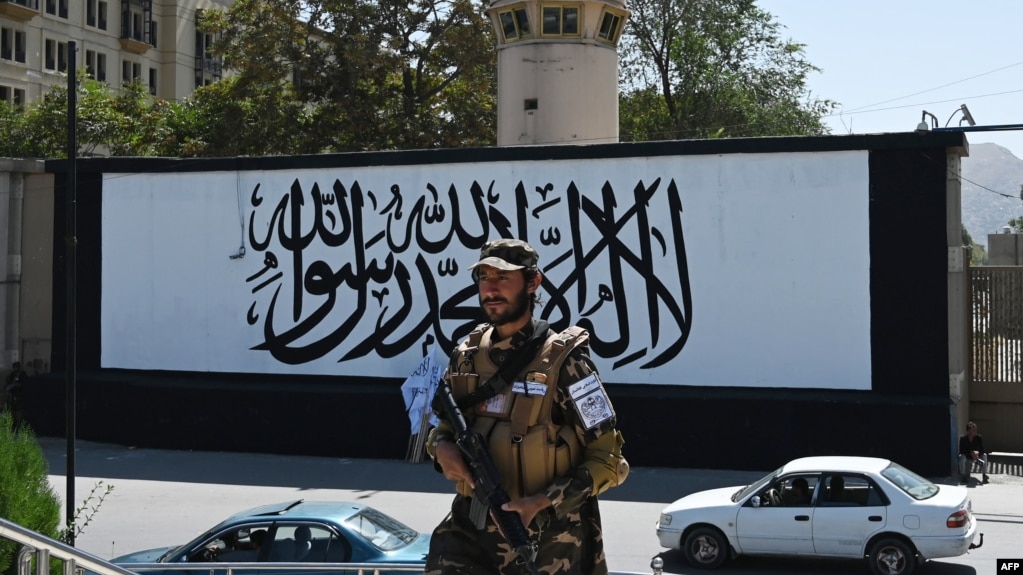
FILE - A member of the Taliban's Fateh, a special forces unit, stands guard outside the U.S. embassy in Afghanistan, now with a Taliban flag painted on its outer concrete wall, in Kabul, Sept. 8, 2021.
FILE – A member of the Taliban’s Fateh, a special forces unit, stands guard outside the U.S. embassy in Afghanistan, now with a Taliban flag painted on its outer concrete wall, in Kabul, Sept. 8, 2021.

The United States is cautiously exploring the possibility of consular access to Taliban-controlled Afghanistan, according to a newly released strategy document from the State Department.

The move signals a potential shift in U.S. policy toward limited engagement with the isolated Islamist regime, while aiming to achieve multiple security, political and economic objectives.

“With the Taliban, we advocate for consular access, transparency and accountability for Americans; we also support the work of the Special Presidential Envoy for Hostage Affairs to obtain the release of Americans unjustly detained,” reads the Integrated Country Strategy Afghanistan, which was approved in October 2023.

A State Department spokesperson told VOA there has been no change in the U.S. position and there are “no near-term plans to return any diplomatic functions to Kabul.”

While the strategy paper mentions “Return-to-Kabul” planning, the spokesperson did not answer questions about the physical location and operations of possible a consular access mission to Kabul in the future.

With the fall of the Afghan government in August 2021, the U.S. shut down its embassy in Kabul, marking a symbolic end to two decades of military and political engagement with Afghanistan.

Since then, U.S.-Taliban interactions have been limited to sporadic meetings outside of Afghanistan, mainly in Doha, Qatar, where the U.S. has stationed a charge d’affaires to Afghanistan.

“Even as — and for as long as — the United States does not recognize the Taliban as the legitimate government of Afghanistan, we must build functional relationships that advance our objectives and further our understanding of the Taliban’s readiness and ability to fulfill their commitments to us,” the strategy paper states.

The new U.S. strategy outlines four strategic mission areas, namely counterterrorism, economic assistance, local engagement and consular services for U.S. citizens inside Afghanistan and assisting Afghans who want to migrate to the United States.

The strategy maintains that Washington will “continue to speak out for basic rights of the Afghan people, especially women and girls.”

U.S. officials have repeatedly said that any normalization with the Taliban, including ending decadeslong sanctions on their leaders, depends on the reversal of Taliban’s repressive policies and the formation of an inclusive Afghan government.

Security, political risks

While not recognizing the Taliban’s interim government, some countries, including U.S. allies such as India, Japan and Turkey, have maintained diplomatic missions in Kabul.

The United Nations, including its political mission, has also remained operational in the country.

Last year, an independent assessment sponsored by the United Nations called for increased and direct engagement by the international community with de facto Taliban authorities.

“From a logistical standpoint, it would be easier for the U.S. to help Afghans seeking paths to the U.S. if it had consular staff and facilities open on the ground,” Michael Kugelman, South Asia Institute director at the Wilson Center, told VOA.

However, Kugelman cautioned about the political and security risks of a return to Afghanistan, especially during a U.S. election year.

“The Biden administration would likely feel the security risks are prohibitive,” he said.

Terrorism-related violence in Afghanistan has plummeted by 75% over the past two years, according to a 2023 Global Terrorism Index from the Institute for Economics & Peace.

The drop appears to have resulted from an end of the Taliban’s war against the former U.S.-backed Afghan government.

Despite the Taliban’s claim of restoring peace, terrorist groups such as the Islamic State’s Khorasan branch have perpetrated attacks in Afghanistan, killing hundreds of people, mostly religious minorities.

“Security does not appear to be the issue but how to decide the relationship with the Taliban is,” Kathy Gannon, former Associated Press bureau chief in Afghanistan and Pakistan, told VOA.

Gannon argued that the United States, like other countries, needs to engage with 40 million Afghans inside the country in order to charter an effective policy.

US Exploring Consular Return to Afghanistan Without Recognizing Taliban Rule
read more

Kakar: Central Govt in Afghanistan ‘Absent,’ Kabul Reacts

The spokesperson for the Islamic Emirate said that there exists a central government in Afghanistan which is leading the entire affairs of the country.

The Islamic Emirate reacted to the remarks of Pakistan’s interim Prime Minister saying that the Afghan caretaker government possesses control over the entire territory of the country.

The spokesperson for the Islamic Emirate said that there exists a central government in Afghanistan which is leading the entire affairs of the country.

“There exists a central government in Afghanistan and there is no problem in this regard. No one should worry about this, in general, there is a lot of difference between the Islamic Emirate and the previous Afghan government. The previous government was neither self-reliant nor independent. It was dependent on occupiers,” the spokesperson for the Islamic Emirate, Zabiullah Mujahid, told TOLOnews.

Speaking in an interview with a Pakistani media outlet, Pakistan’s PM Anwar ul-Haq Kakar said that the Islamic Emirate has yet to gain control over the whole country and that they [Islamic Emirate] are in the process of establishing a central government.

Kakar added that such a government will take time and that this is a phased process.

“Two trillion US dollars were spent, a lot of weapons and military equipment were used but Ashraf Ghani couldn’t establish a central government. Now, the Taliban are expected to do so in seven to eight months, it is not possible,” Pakistan’s interim Prime Miniser, Anwar ul-Haq Kakar said.

Contrary to Pakistan’s previous allegations about potential terror threats from Afghanistan’s soil to the country, Anwar ul-haq Kakar said that Afghanistan poses no threat to Pakistan and that Afghans have never posed any threat to the country.

The Pakistani caretaker PM further added that ensuring that Afghanistan’s soil is not used against other countries will benefit the Islamic Emirate in its engagement with the international community.

“They [Pakistan] do not have a good understanding of the region, and make these remarks to deviate public opinion. These remarks have no political and informative root so that they can act based on them,” said Rashid Qutbzada, an international relations expert.

“There main problem is that Pakistan and countries like Pakistan have not yet understood how to seek their interests through stability in the region. They do not consider the stability and security of the region as their stance,” said Najibullah Jame, a political analyst.

Anwar ul-Haq Kakar also said the decision to recognize the Islamic Emirate will be taken in line with the international community.

Kakar: Central Govt in Afghanistan ‘Absent,’ Kabul Reacts
read more

Swiss Federal Council Signs Agreement With Afghan Trust Fund

We have collected $7.25 billion and $2.25 billion in assets,” said Sayed Masoud, an economist.

The Federal Council and the foundation “Fund for the Afghan People” (Afghan Fund) have signed an agreement on privileges and immunities of the Foundation in Switzerland, which entered into force on February 1, 2024, the Federal Council of Switzerland said in a statement.

“With this agreement, the Federal Council recognizes the international significance of the Afghan Fund and ensures the protection and preservation of the fund’s assets in Switzerland,” the statement stated.

According to the statement, the agreement on privileges and immunities between the Federal Council and the Afghan Fund, was approved by the Federal Council on 15 December 2023.

“The conclusion of this agreement is based on the Host State Act and enables the Afghan Fund’s independence and functionality of the Foundation to be guaranteed and its assets to be protected and preserved,” the statement reads.

The Afghan Trust Fund was established in September 2022 under Swiss law, tasked with the secure preservation of assets totaling approximately $3.6 billion for the benefit of the Afghan people.

“The board of trustees of the Afghan Fund is responsible for determining the specific allocation of the funds. It ensures that the assets are utilised in a manner that benefits the people of Afghanistan, while also adhering to all relevant sanctions regimes,” the statement said.

“The board also ensures that funds are only transferred to the central bank of Afghanistan if the bank can demonstrate its independence from political influence. Furthermore, the central bank of Afghanistan must guarantee that it has taken appropriate measures to combat money laundering and terrorist financing.”

This comes as the Islamic Emirate stressed that the Afghan assets held in the Afghan Trust Fund belong to the people of Afghanistan and that it should be handed over to the Islamic Emirate.

“The assets of Afghanistan belong to our beloved people and without any condition, it should be handed over to the Islamic Emirate so we can use it as a strategic support to boost our economy,” said Abdul Latif Nazari, deputy Minister of Economy.

The economists said that considering the conditions mentioned in the agreement, the transfer of the assets to the Central Bank is difficult.

“The fulfillment of the conditions enforced will be very difficult and unacceptable. But there are concerns about the fraudulence of the Afghan assets and the Central Bank under the control of the Taliban,” said Mir Shikib Mir, an economist.

“Reduction of assistance for Afghanistan drives these assets to be spent. I think we will witness a situation like 2002. We didn’t have any money in Afghanistan in 2001.

We have collected $7.25 billion and $2.25 billion in assets,” said Sayed Masoud, an economist.

When the Islamic Emirate came to power, more than $9.5 billion of Afghanistan’s assets were frozen.

Swiss Federal Council Signs Agreement With Afghan Trust Fund
read more

Pakistan Extends Afghan Refugees’ Stay Until March: Media

The refugees rights activists called on the Islamic Emirate to pay attention to the challenges of the Afghan refugees in Pakistan.

The caretaker government of Pakistan has granted approval for the extension of the residency of 1.3 million undocumented Afghan refugees, Pakistani media reported. 
 

The extension allows these refugees to stay in Pakistan until March 2024, Khyber News reported, adding that the cabinet division had raised objections to the initial summary submitted by the Safran ministry.

Meanwhile, the consulate of the Islamic Emirate in Karachi, Abdul Jabar Takhari, also told TOLOnews that the Pakistani government gave a two-month deadline for the 1.4 million undocumented Afghan refugees.

“According to the interim government of Pakistan, 1.4 million undocumented Afghan refugees still exist in Pakistan who have a deadline until the end of March to live in Pakistan and after that either leave Pakistan or there will be a new plan for them,” he said.

The refugees rights activists called on the Islamic Emirate to pay attention to the challenges of the Afghan refugees in Pakistan.

“Extension of residency of Afghan refugees in Pakistan is a good step but there is need for an organized plan for the Afghan refugees,” said Mohammd Khan Talibi Mohammadzai, a refugee rights activist.

Meanwhile, the Afghan refugees in Pakistan complained about facing severe challenges in the country.

“They should not deport us, we will extend our visa and we will stay here,” said Nikzai, an Afghan refugee in Pakistan.

“The Afghan refugees are facing a lot of challenges in Afghanistan. They also face economic problems,” said Shaheen, an Afghan refugee in Pakistan.

Based on the statistics of the consulate of the Islamic Emirate in Pakistan, nearly 600,000 Afghan refugees have been either deported or have returned to Afghanistan within the last three months.

Pakistan Extends Afghan Refugees’ Stay Until March: Media
read more

UK FCDO Advises Against All Travel to Afghanistan

However, the Islamic Emirate’s spokesman, Zabihullah Mujahid, said that security is ensured in the country and the safety of foreign nationals is also ensured.

The UK’s Foreign, Commonwealth & Development Office (FCDO) in a statement advised British nationals to not travel to Afghanistan.

According to FCDO statement, there is a “significant risk of detention of British nationals” and “terrorists are very likely to try to carry out attacks” in Afghanistan during the month of Ramadan.

“You should not travel to Afghanistan. Terrorists are very likely to try to carry out attacks in Afghanistan. There is a heightened threat of terrorist attacks in or around religious sites and during religious events and celebrations, such as the month of Ramadan. The security situation in Afghanistan is volatile. There is an ongoing and high threat of terrorist attacks throughout Afghanistan, including around airports. There is a significant risk of detention of British nationals,” the statement reads.

However, the Islamic Emirate’s spokesman, Zabihullah Mujahid, said that security is ensured in the country and the safety of foreign nationals is also ensured.

“We assure that there is no threat to any foreign national in Afghanistan. There are dozens of institutions, embassies and international institutions in Afghanistan and even tourists, they are living in Afghanistan, they are traveling, and there have been no security threat to anyone and will never be,” Mujahid said.

Meanwhile, some political analysts asked the Islamic Emirate to do more to assure the security of foreign nationals in Afghanistan.

“The Islamic Emirate should listen to all the demands of the eastern and western countries and chose a correct and rational policy towards the world,” said Salim Paigir, a political analyst.

“They [the Islamic Emirate] should convince western and neighboring countries that Afghanistan will never be a threat to the countries of the region,” said Sayed Moqadam Amin, a political analyst.

Earlier, the US State Department asked its citizens not to travel to Afghanistan.

UK FCDO Advises Against All Travel to Afghanistan
read more