
America’s 20-Year War in Afghanistan Is Over, but Some of the U.S. Military’s Waste May Last Forever

Interview by Jenni Doering

A farmer from Khoshob village walks near his water reservoir near Kandahar airfield, in southern Afghanistan. Credit: Kern Hendricks

JENNI DOERING: The war in Afghanistan was the longest the U.S. military has engaged in with the last of American troops withdrawing in 2021. Over twenty years, the U.S. military dropped tens of thousands of bombs in Afghanistan and more than 70,000 Afghan and Pakistani civilians died as a direct result of the war.

The prolonged conflict also left many Afghan people without adequate food, clean water, and shelter, making them vulnerable to natural disasters, including the devastating earthquakes that have taken thousands of lives in recent days. But there is another cost to the war that is often overlooked.

Afghan civilians are now living among dangerous pollutants left behind in the wake of the fighting, according to reporting from Lynzy Billing. She’s a freelance journalist who was born in Afghanistan and dug into this for our media partner Inside Climate News and New Lines Magazine.

Lynzy, welcome to Living on Earth!

Lynzy Billing reported on environmental and public health issues around three former U.S. military bases in Afghanistan in 2022. Credit: photo courtesy Lynzy Billing.

LYNZY BILLING: Thank you for having me.

DOERING: So we often think of the direct injuries that bombs and other weapons can inflict during a war, but they can also leave behind dangerous chemicals. So what kinds of toxic substances can munitions have?

BILLING: I think that beyond the obvious impacts of the bombs and weapons during the American war in Afghanistan, there was a longer lasting effect that came with the war. And that really is the chemicals and residue attached to these weapons and munitions. If we’re speaking about bombs alone, tens of thousands of bombs were dropped on Afghanistan over the last 20 years. And most of these included explosives like RDX. And RDX has been described as being potentially carcinogenic. There’s a whole array of munitions that are left behind.

But it’s also the bases themselves, the military bases, and their waste disposal practices, and their activities during the war that also left behind the environmental effects that really we haven’t had a chance to look at properly until now. I think I really wanted to get away from just talking about the weapons that are still left half buried or uncovered and really look at the longer lasting health impacts from the war in general, which are in soil and are in water and in the air and in people’s food and what they eat and drink from on a daily basis.

DOERING: Yes, from what I understand, the U.S. military consistently dumped sewage into agricultural fields where Afghan people were growing their food. What pollutants were in that sewage, and what kinds of impacts did that have?

BILLING: One of the things that kept coming up around the three bases that I visited, which were in Nangarhar, Kandahar, and Parwan provinces, these were three of the largest US bases in the country, it was a lot of agricultural land, and farmers working in that land were telling me the same story, which was that U.S. military contractors were bringing tankers out to their fields and dumping sewage or wastewater in them. And they all relayed that either the sewage was blue, or it was gray.

And the gray wastewater and black wastewater comes from toilet facilities at the base. So it could be like sinks and showers. And it’s like grey water, and it has a residue in it, which contains phosphates and other chemicals. The blue that they were seeing was a dye that comes from portable toilets, which also had an array of chemicals that can have different levels of toxicities that are harmful to human health. So I started looking at studies that were done on wastewater and sewage sludge in other countries where, for example, sewage would go through a treatment process. And even that sewage had chemicals in it that couldn’t be removed, such as PFAS, which are also known as forever chemicals, just because they have a really long shelf life.

A water outflow from Bagram Airfield, formerly America's largest military base in Afghanistan. Credit: Kern Hendricks
A water outflow from Bagram Airfield, formerly America’s largest military base in Afghanistan. Credit: Kern Hendricks

And those chemicals have been linked to a whole array of health problems: kidney problems, cancer. So I started to realize that this sewage and wastewater that was being dumped in the fields was, you know, incredibly harmful to the farmers who were working there. And children that were working there as well.

DOERING: Those PFAS “forever chemicals,” municipalities here in the U.S. are spending many millions of dollars per facility to install systems that remove those chemicals. And we know that military bases often use these chemicals in their operations. So I can only imagine how much more difficult it would be in Afghanistan.

BILLING: As well as the residents living around the bases, I spoke with contractors who were tasked with the job of hauling this waste off the bases and finding somewhere to dump it. And they just relayed a really big problem just because of the amount of waste the bases were producing. Some of them had 40,000 troops on them at one point. And there was just so much waste, it couldn’t all be burned in a burn pit. It had to go somewhere. And one of the other areas aside from fields for sewage was waterways. And for the contractors, one of the reasons one relayed was that they could save on fuel if they found somewhere close by to dump. And in terms of those in charge at the bases, the waste really wasn’t their priority at the time, they were fighting a war, and the responsibility really went with the contractors to come up with their own solution of where to put the waste. No one was really checking it or thinking about any long term impacts at the time. And there were no laws or any prohibitions, really, from a U.S. military perspective, or international perspective, that was stopping them from dumping in waterways and fields and land or burning in areas around, also.

DOERING: A couple of years ago, when the U.S. finally did pull out of Afghanistan, there was a lot of talk about how important it was, this moral obligation that we had to help out some of the Afghans who had helped us during the war, and who had worked with the U.S. military, interpreted for the U.S. military, done a whole range of different things. So some of those people were able to come to the U.S. and flee the Taliban. But it seems like there’s kind of a lack of understanding of the obligation that we have to protect Afghans from the environmental degradation that we’ve caused there.

BILLING: Absolutely. I don’t think there’s any responsibility from the American military to protect Afghans. And I think that one of the reasons that we don’t know much about the U.S. military waste is that they’re not required to share what they do with their waste. There’s this whole black box on responsibility just because they don’t actually have to share that information. And I think on top of that, there’s actually a DOD prohibition that means the U.S. military doesn’t actually have to clean up its bases when it leaves a country overseas. And that it’s then the host nation’s responsibility to clean up.

And you know, you look at the amount of bases in Afghanistan and the size of them. They are still sitting exactly the same today as August 2021 when America left. You can see it on satellite today, you can still see the amount of scrap and broken tanks and engines. And then on top of that, you can still see the burn pits, some as big as three football fields, still scorched and charred from how they were left. So there was a lack of care when they were there at the bases for both their own service members and for the entire Afghan population, but then a definite lack after they left because they don’t need to, there’s no requirement for them to care about the environmental damage that they had on the country.

DOERING: What kinds of health impacts did you see on the ground while in Afghanistan? Can you tell us a story or two from Afghan civilians that really stood out to you?

BILLING: There were a lot, a lot of stories. I spoke to a lot of people. One thing, though, that does come up is that there’s definitely a pattern with the same health problems, which very much mirror the health problems of U.S. service members who were returning from deployment. One around Jalalabad airfield, there was a farmer and his name’s Khan Mohammad.

He had been working there for 20 years in a field just by the base, and his whole family helped him work in this field. And he had two sons, who were five and seven, who both have kidney problems. He had another son who had other health problems, their cousins had kidney problems, his mother had a skin rash, a persistent skin rash, and she was working the land as well in that field.

And so you have this whole family working in this field where tankers are dumping sewage waste, and they’re coming down with really serious kidney problems, even at the ages of five and seven.  And they really believe that they’re sick from the waste being dumped in their fields. But the reality is that they can’t afford the medical treatment they need, or they can’t afford to constantly go and see doctors. And there’s really not much they can do. And then you’d go to speak with a farmer next to Khan Muhammad. There was another  one next to him called Wali Rahman. He had the exact same problem. He had the same kidney problems. Doctors in that area know what’s happening. They know the waste is being dumped there. And they say, “There’s a pattern here. People are getting sick from the same things. They’re drinking and washing in the same rivers. They’re working on the same land, they’re eating the food they grow in the fields. It’s all connected.”

DOERING: And like you say, they don’t really have the resources to get the medical help they need. In your story, there was somebody who maybe would need a kidney transplant at some point. But that’s several thousands of dollars.

BILLING: And also, there are people in areas that didn’t have the possibility to travel to get the medical treatment they needed before, because there was ongoing fighting going on. A lot of people traveled to Pakistan to get treatment just because Afghanistan doesn’t have the resources or medicines available for it, as well.

DOERING: I think in your story, you came upon a couple of kids who were collecting scrap metal from one of the piles of  waste that was left behind. Can you tell us about that?

BILLING: They had a little shop across the road from Kandahar airfields. And they’d moved there after their father had died. And they were making a living off scrap metal collecting. And outside of bases in Jalalabad, Kandahar and Bagram are just rows and rows of little shops, with a whole array of scrap in them, all of which comes from the bases. And these two boys, you know, they had everything from broken motors and seats from Humvees to grenades, like whole grenades still, and—

DOERING: Live grenades?

BILLING: Live grenades, still with the key hole. And, you know, unexploded artillery shells. So there’s all these dangers of them collecting these things. The scrap metal collectors, not just in Kandahar, had persistent skin rashes and problems as well. And the doctors were telling me about this also. And this is just because of the materials that they’re dealing with on a daily basis.

DOERING: This is really heavy reporting, Lynzy. What keeps you going back to Afghanistan to report stories like this, about the environmental pollution left behind by the U.S. military?

BILLING: I think I’ll keep going back to Afghanistan until I can’t get in anymore. And it is getting harder to get in. I think that Afghanistan is a country in which the effects of this kind of environmental damage, and the effects of the war in general, they didn’t go away when the U.S. left in 2021. And they’re still there, and people are still there waiting for answers and some level of accountability.

An Afghan scientist collects soil samples from a family farm near the site of a former American base in Jalalabad. Credit: Kern Hendricks

And this is an American war in Afghanistan. And I think, especially Americans should really know about what happened there and what happened with these waste disposal practices. And also just because the U.S. military is in so many countries around the world using the exact same waste disposal practices, and right now there is no law saying they have to clean up, there is nothing that’s stopping it.

DOERING: Lynzy Billing is a freelance journalist who wrote about this for Inside Climate News and New Lines Magazine. Thank you so much, Lynzy.

BILLING: Thank you so much for having me.
America’s 20-Year War in Afghanistan Is Over, but Some of the U.S. Military’s Waste May Last Forever
read more

India says inclusive government in Afghanistan is top priority for SCO

The National Security Advisor of India stated on Wednesday at the Shanghai Cooperation Organization (SCO) meeting that the formation of an inclusive government and the protection of women’s and minority rights are immediate priorities of this organization in Afghanistan.

The National Security Advisor of India, Ajit Doval, speaking at the meeting held in Astana, the capital of Kazakhstan, added that providing humanitarian assistance and combating terrorism and drug trafficking are other priorities of this organization.

Meanwhile, he added that his country is concerned about the presence of terrorist groups in Afghanistan.

He stated that India, as a neighboring country to Afghanistan, has legitimate security and economic interests in the country.

Ajit Doval, at the Shanghai Cooperation Organization meeting, referred to the indiscriminate attacks by terrorist groups and stated that such attacks, regardless of the group, motive, or location, are unjustifiable.

This senior security official of India emphasized the need to avoid double standards and hold financial backers and facilitators of terrorism accountable, stating, “Effective and swift action must be taken against terrorism, including those involved in cross-border terrorism.”

India has consistently accused Pakistan of supporting terrorist groups responsible for several bombings and attacks on Indian soil. However, Pakistan denies these accusations and, conversely, accuses Delhi of supporting terrorist groups like the Tehreek-e-Taliban Pakistan.

Referring to the deadly Moscow attack, the issue of the continued threat posed by various terrorist groups in the region, including Al-Qaeda and its affiliates, ISIS and its branches, Lashkar-e-Taiba, and Jaish-e-Mohammad, was raised by the Shanghai Cooperation Organization.

Meanwhile, Doval stated that India has invested three billion dollars in Afghanistan and has also provided assistance such as 50,000 tons of wheat, 250 tons of medical supplies, and 40,000 liters of Malathion pesticide to combat the locust threat in Afghanistan.

India says inclusive government in Afghanistan is top priority for SCO
read more

We Still Haven’t Figured Out How to Beat ISIS

The New York Times

March 31, 2024

Mr. Costa was the special assistant to the president and senior director for counterterrorism at the National Security Council from 2017 to 2018. Mr. Clarke is the director of research at the Soufan Group.

For all of the counterterrorism wins that the United States has had in its fight against the Islamic State — and there have been many — we still have not figured out how to defeat it.

A terrorist attack targeting a concert hall in the Russian capital of Moscow on March 22 killed more than 130 people and left many others severely wounded. It served as the latest deadly reminder that the Islamic State — and particularly its Khorasan branch, ISIS-K, which is active in Afghanistan, Iran and Pakistan — remains a potent threat. It’s a painful lesson Afghans and Americans alike learned in August 2021, when ISIS-K conducted a complex suicide operation that killed at least 170 Afghan civilians and 13 American service members in Kabul, in the midst of a chaotic U.S. withdrawal from Afghanistan.

Since the start of the new year, ISIS-K has launched lethal assaults in Iran and Turkey. Several ISIS-K plots in Europe have been disrupted, with arrests in Austria, France, Germany and the Netherlands. On Tuesday, four days after the Moscow attack, the ISIS-affiliated al-Battar Media published a message threatening Italy, France, Spain and Britain: “Who’s next?” Both France and Italy have since raised their terror threat levels.

All of these events point to what we now know: Stripping the Islamic State of its self-proclaimed caliphate is not the same as beating it. At its peak, the caliphate was as large as the territory of Britain, stretching from the Levant to Southeast Asia, and boasted over 40,000 foreign fighters from more than 80 countries. Forced from this redoubt, ISIS has reconstituted itself in other countries, going underground in less detectable — but more dangerous — forms.

To stop that threat from reaching America and its allies, the United States must prevent two decades of counterterrorism expertise from atrophying. There are other serious threats that deserve Washington’s attention, including Chinese adventurism and the challenge of artificial intelligence. But to keep Americans safe, counterterrorism must remain a strategic priority — and that includes finding a way to keep eyes on the Islamic State in parts of the world where we no longer have a footprint.

After the terrorist attacks by Al Qaeda of Sept. 11, 2001, the American public was told to brace itself, that the war on terror would be a generational one. The United States made some profound blunders in the decades-long fight that followed, and eventually, Washington turned its national security focus to different geopolitical threats. But neither of those facts obviated the need to remain committed to countering transnational terrorism. By pulling back troops and intelligence assets from active conflict zones, the United States has allowed groups like ISIS-K to rebound. It’s not the time to let up, or predictably, we will find ourselves facing a resurgent adversary.

The Islamic State is nothing if not resilient. Aggressive Western military campaigns helped dismantle the caliphate and have in recent years severely curtailed the operations of ISIS militants in other countries, including the Philippines and Syria. Rather than disappear, they have gone on to rebrand, enlist new fighters under the same banner and plot new attacks. Some have reappeared in other countries, better trained and harder to find and protect against. Some are intent on committing acts of terrorism like those we’re witnessing now, traveling across borders to infiltrate target countries.

How did a jihadist group operating from a remote region of Afghanistan manage to expand its networks and begin planning external operations with such global reach?

Part of the answer is that we left. Before the United States withdrew, ISIS-K was far more constrained, particularly its ability to launch external attacks. In a 2020 agreement between the United States and the Taliban signed in Doha, Qatar, the Taliban agreed to prevent terrorist groups from using Afghan soil to threaten the United States and its allies. In return, Washington agreed to fully withdraw its forces from the country. The stipulation to prevent terrorist groups from using Afghanistan asian operating base was primarily relevant to the Taliban’s longstanding, cozy relationship with Al Qaeda. The Taliban and ISIS-K, on the other hand, are mortal enemies and have been fighting each other since ISIS-K started operating in the country in 2015, at the apex of the Islamic State’s so-called caliphate.

Either way, it’s unrealistic to expect the Taliban to be a reliable counterterrorism partner in an international effort to defeat ISIS-K. But some level of cooperation, however unappealing, is necessary. The human intelligence so critical in counterterrorism can only be gathered on the ground. With no American footprint left in the country, our counterterrorism interests would be better served with intelligence derived from Taliban security and intelligence operations directed against ISIS-K — a mutual enemy. The cooperation should remain limited to information sharing and should not extend to training or the provision of equipment.

Intelligence history is replete with examples of marriages of convenience between intelligence services for sharing threat information, even between adversarial countries. Although a “shadow war” has played out between Iran and the United States for decades, the United States still reportedly shared threat warnings on an impending terrorist attack with the Iranians in January. Washington did the same with Moscow two weeks before the ISIS-K attack on the concert hall.

Of course, coming to any kind of agreement with the Taliban is a deeply complicated and controversial endeavor. Even a highly restricted relationship with the Taliban would be distasteful and fraught with ethical dilemmas, given the regime’s human rights record.

But it’s been considered before. And the alternative is worse: a devastating attack directed at Americans overseas or at home.

We Still Haven’t Figured Out How to Beat ISIS
read more

Asfandyar Mir on Why ISIS-K Attacked Moscow

U.S. Institute of Peace experts discuss the latest foreign policy issues from around the world in On Peace, a brief weekly collaboration with SiriusXM’s POTUS Channel 124.

Transcript

Laura Coates: Asfandyar Mir is the USIP senior expert for South Asia. There’s really been a thought process and a lot of pieces surrounding what happened at that Moscow concert hall attack. Our guest says it will have far reaching impact and he is here today to give us a little more information about that very point. Asfandyar, welcome. How are you?

Asfandyar Mir: Good. Thanks for having me on, Laura.

Laura Coates: Thank you for being here today. Now, there are a lot of questions that people have. One is, what exactly ISIS-K is and what was its intent in Moscow. They, of course, have claimed responsibility for the attack. And I wanted to understand more about this organization, if we can even call it that this group, what is ISIS-K?

Asfandyar Mir: Sure. So, ISIS-K is the Afghanistan based branch of ISIS in the Middle East, which has now been around for roughly 10 years. It first emerged in early 2015. And ever since, it has been active in the region, it has been fighting there. The Taliban, of course, you know, back when the United States had a presence in the region, you know, ISIS-K was attacking the United States. And around the time that the U.S. evacuated from Afghanistan, if you remember, in August 2021, there was a big attack. A terrorist attack during the evacuation, which killed around 13 service members, as well as 200 or so Afghans who were trying to evacuate. And ISIS-K was responsible for that attack as well. So, this is a nasty group. It is doggedly persistent. And now it is attacking countries both in the region. It has struck Iran, it has struck Pakistan, it has attacked in Central Asia. And it has finally managed to reach parts of Europe as well. We heard about some foiled plots, terrorist plots in Europe and more recently, we saw this attack in Moscow.

Laura Coates: Why now? It’s not an emergence, but why do you think it is becoming so much more active now?

Asfandyar Mir: Look, it has been active, it’s just not been in our news cycle, as much. But the group seems to have this goal of punishing disbelievers and infidels, you know, as per its doctrine. And in line with that it has been actively consistently plotting in the region, outside of Afghanistan, but also aiming for parts of Europe. The U.S. military has been warning that we could see an attack against Western states, U.S. interests, which is code for targets in Europe, in six months, with little to no warning. And this attack is very much in line with that warning.

Laura Coates: When What do you think the intent was in Moscow, specifically, obviously, Putin a very strong force in the region, why there?

Asfandyar Mir: I think multiple motivations were at play for one, ISIS and Russia have, you know, have sort of sparred with each other. Remember Russia backed the regime of Bashar Al Assad in the Syrian Civil War, in which the Assad regime was also fighting ISIS. And the Russians came on the side of Assad in a big way. And ISIS has not forgotten that ISIS-K is angry and upset about that. Another motivation is competition with the Taliban, which now runs the government of Afghanistan. And ISIS-K, wants to show that it is the most audacious terrorist group around, that it sort of holds the mantle of the global jihadi vanguard. And it really seeks to outperform, you know, militants like the Taliban who tend to reserve themselves or limit themselves to the boundaries of Afghanistan or its immediate neighborhood. By reaching Moscow ISIS-K is trying to signal that, that it has the geographic reach to hit anywhere in the world in the way that the Taliban won’t.

Laura Coates: Really, really important. Thank you so much for joining us today, Asfandyar Mir, for all of your expertise. Thank you.

Asfandyar Mir: Thanks for having me, Laura.

Asfandyar Mir on Why ISIS-K Attacked Moscow
read more

More Than Just Islamic State: Rising Militancy in Afghanistan and Pakistan

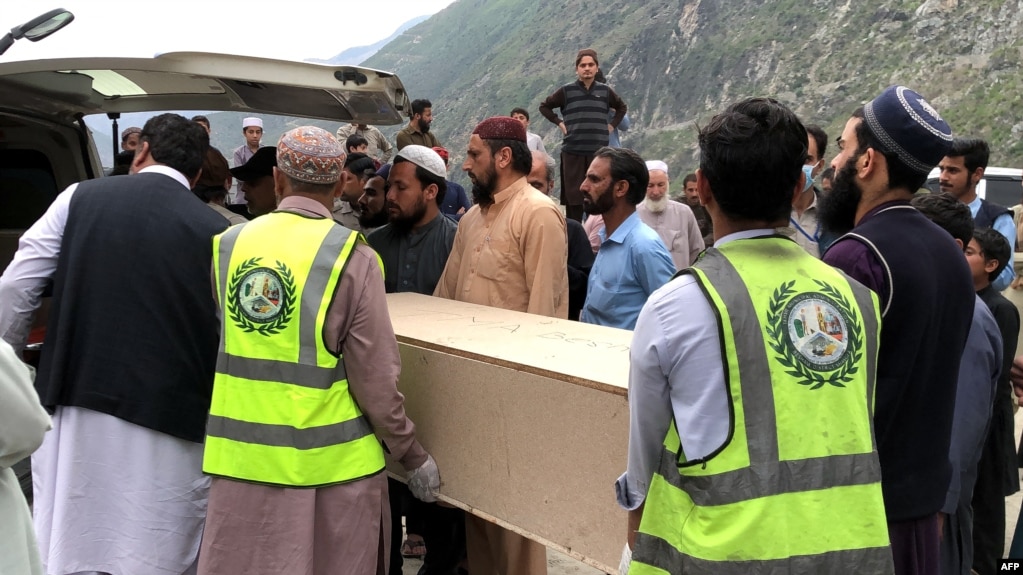
Volunteers transport the coffins of Chinese nationals from a hospital following a suicide attack in Besham city in the Shangla district of Pakistan's Khyber Pakhtunkhwa province on March 26, 2024.
Volunteers transport the coffins of Chinese nationals from a hospital following a suicide attack in Besham city in the Shangla district of Pakistan’s Khyber Pakhtunkhwa province on March 26, 2024.

There has been a wave of attacks across Pakistan in recent weeks by militant groups operating in the region that have widely varying objectives.

This week, a suicide attacker killed five Chinese nationals and their Pakistani driver in a convoy in Pakistan’s northwest. Pakistani Taliban, Tehreek-e-Taliban Pakistan, or TTP, is the usual suspect for such attacks in the northwest, but in a statement on Wednesday, it denied being behind targeting the Chinese workers.

Earlier, two suicide attacks in Pakistan’s restive Khyber Pakhtunkhwa province killed nine Pakistani troops in the third week of March.

In the southwest, militants carried out a brazen attack on Pakistan’s second-largest naval airbase and a port complex near the Arabian Sea in the volatile Balochistan province. The Pakistan army said two soldiers and 14 militants were killed in the attacks. Designated terrorist group Baloch Liberation Army, or BLA, accepted the responsibility.

The attacks by suspected regional militant groups came as the most active terrorist group in the region, Islamic State-Khorasan, was blamed by Washington for the attack in Moscow a week ago that killed more than 140 concert-goers.

“The recent surge in attacks is deeply concerning because it represents an escalation in militant tactics,” said Elizabeth Threlkeld, senior fellow and director for South Asian affairs at the Washington-based Stimson Center.

Who are the militant groups now active in the region, and what are their goals?

Islamic State-Khorasan, or IS-K, is leading the current wave of terror across the region.

The group was formed in 2015 by disgruntled Pakistani Taliban members. It considers itself a branch of the larger Islamic State, or IS, in what it calls the Khorasan, a reference to the historic region comprising parts of Afghanistan, Pakistan, Turkmenistan, Tajikistan, Uzbekistan and Iran.

IS-K, like its parent organization IS, is a Sunni organization. IS-K claims it is working to enforce Salafi sharia throughout its region of influence. The group opposes Shia Islam, and fighters have taken credit for hundreds of deaths of Shiites in Pakistan and Afghanistan in recent years.

A U.N. report last year in June said IS-K’s family members and fighters in the region number between 4,000 and 6,000.

“IS-K is attracting disgruntled militants from Taliban and members of the Tajikistan-based radical group Jama’at Ansarullah, Islamic Movement of Uzbekistan, East Turkistan Islamic Movement and those inspired by the Salafi ideology,” said Syed Fakhar Kakakhel, a Pashtun journalist in Pakistan who covers militancy in Afghanistan and Pakistan.

IS-K has not claimed responsibility for the attack in Moscow, but its statement in Pashto last Monday glorified the attackers. The 30-page statement was a fierce polemic against the ruling Taliban in Afghanistan, scolding them for their relations with the U.S., Russia, China and other countries.

IS-K has claimed responsibility, though, for two recent suicide attacks, one each in Afghanistan’s Kandahar city on March 21 and the suicide bombings on January 3 at the memorial services for the Iranian commander Qassem Soleimani in Kerman city, Iran. More than 100 people were killed in the latter attack. Soleimani was killed in a U.S. drone attack in Iraq in 2020.

Russian, Iranian and Afghan Taliban identified the attackers of Moscow, Kerman and Kandahar as nationals of Tajikistan.

Tehreek-e-Taliban Pakistan: umbrella syndicate of militants

Analysts say TTP has gotten smarter in its tactics, techniques, and weapons since the withdrawal of U.S.-led NATO forces from Afghanistan in August 2021. A U.N. report early this year said al-Qaida is conducting suicide bomber training to support TTP, a U.S.-designated terrorist group.

Kakakhel said TTP’s new strategy includes delegating powers to its proxies, adding sophisticated weapons such as M24 sniper rifles and M16A4 rifles with thermal scopes and night vision, along with targeted ambushes to its playbook.

“We had reported suicide attacks where a candidate came to press the button and blew himself off. But now, they fight for the last breath inflicting maximum casualties to forces and then pressing the button at the right time,” Kakakhel said.

“I assess the TTP’s threat to be more severe, especially as the TTP has sanctuary in Afghanistan and support of the Taliban. TTP also has a bigger fighting force,” said Asfandyar Mir, senior expert for South Asia with a focus on Afghanistan and Pakistan, at the Washington-based U.S. Institute for Peace.

The militants carried out 97 attacks in February this year and about 789 attacks last year in Pakistan alone, the highest since 2018, according to Islamabad-based Center for Research and Security Studies. Pakistani officials attribute a higher percentage of the attacks to the TTP or its proxies.

The Pakistan military and civilian government representatives engaged the TTP leadership in talks in 2021, but they couldn’t reach a deal. The government officials later said TTP wanted power in regions close to Afghanistan to impose their Sharia on the style of Afghan Taliban.

“Pakistani security forces should be commended for holding off attacks on Gwadar and Turbat naval station, but the broader challenge remains that the military and police are taking heavy losses across the western border region,” Elizabeth Threlkeld told VOA.

She said Pakistan’s leaders badly miscalculated in assuming a Taliban government in Kabul would support Pakistan’s interests. “As Pakistan seeks a way out of this difficult diplomatic and security challenge, it would benefit from conducting a thorough review of the analysis and decision-making that drove its Afghan policy for the past two decades to draw lessons going forward,” she said.

Balochistan: home for militant separatist groups

Baloch separatist groups, several of which are designated as terrorist groups by Britain and the United States, are largely secular but for nearly 20 years have been embroiled in an active insurgency against Pakistani troops. The feud started after the Pakistani army killed a prominent Baloch leader and former chief minister, Balochistan Akbar Bugti, in 2006.

As many as five known Baloch separatist groups are coordinating their attacks against Chinese-funded projects and Pakistani forces in the restive province under the banner of the “Baloch Raji Aajoi Sangar,” a Baloch name translated as Baloch National Freedom Movement.

The most lethal faction is the Majeed Brigade, a sub-group of the Baloch Liberation Army. The Majeed Brigade has accepted responsibilities for some of the lethal attacks on the Chinese nationals and Pakistani troops. Other Baloch separatist groups engaged in insurgency include Baloch Republican Army, Baloch Republican Guards, Baloch Liberation Front and Bashirzeb Baloch Group.

Balochistan-based analyst Syed Ali Shah said Baloch militants are different from Islamic militants: “In Balochistan, this is a political insurgency. They are not fighting for the implementation of Sharia; rather, [they fight] for greater control over Baloch coast and resources.”

Pakistani media has reported 11 major attacks on Chinese nationals and projects in Balochistan and other parts of the country since 2018. Most of these attacks were claimed by Baloch separatist groups.

Some analysts consider the Islamist militants a bigger threat for regional security because of their transnational presence and higher number of fighters. “As for the Baloch militants, they have been trying to target Chinese interests for several years now and are in no mood to relent,” said senior expert Mir.

He said he thinks Pakistan will probably continue to exert pressure on the Afghan Taliban to reduce the threat of both TTP and Baloch militants.

More Than Just Islamic State: Rising Militancy in Afghanistan and Pakistan
read more

‘I wanted to end my life’: ‘Bookseller of Kabul’ rebuilds destroyed business

The Guardian

Wed 3 Apr 2024 06.35 EDT

After the Taliban stormed Kabul in 2021, Rais fled to the UK, telling the Guardian last year that he feared the group would destroy his cherished business. His fears came true.

Last December, the Taliban turned up at the bookshop, locked the doors and ordered the employees to hand over all the passwords for Rais’s website and catalogue, before destroying the archive he had been building since he first opened the shop.

“When I heard what had happened I couldn’t talk, I was frozen. My mind was not working,” said Rais, who is now almost blind. He was so grief-stricken that he considered taking his own life.

“For two weeks after this happened I wanted to end my life. But suddenly I got my energy back,” he said. He resolved to rebuild his unique collection from scratch. Because his online business was global, he already had many contacts in countries such as Iran and Pakistan and across central Asia. Rais, who speaks six languages, signed a deal with an Indian IT company to create a new website – Indo Aryana Book Co.

Now new books are being printed in India from pdfs and mailed into Afghanistan. Recently an online order was placed by someone in Mexico to deliver a copy of The Little Prince by Antoine de Saint-Exupéry to an address in Kabul. The book is banned in Afghanistan, but the order was placed in the morning and had been delivered to the Kabul address by the afternoon.

Rais is especially keen to help give girls and women in Afghanistan access to books despite the Taliban ban on their education. He is using his contacts to get free or subsidised books to them in their homes or hidden schools. Even bus drivers help: secreting in their vehicles packages of books needing to be delivered discreetly, while driving across Afghanistan.

He says that whatever book-banning edicts the Taliban issues, a population thirsty for books are finding ways around them. He describes himself as a “proud Muslim” but says he abhors all forms of extremism and believes that people from all faiths and cultures can live together in harmony. “Books are a good, cheap weapon to fight against extremism,” he said.

“When I was released from jail by the Soviets, I wiped the dust off the bookshelves in my shop and started again,” he said. Like Ray Bradbury’s dystopian 1953 novel Fahrenheit 451, which stands against censorship and in defence of literature, and is a book previously stocked in his shop, Rais says his resolve to keep books alive will not falter. His message to the Taliban is a defiant one.

“If you destroy my bookstore a hundred times I will rebuild it.”

‘I wanted to end my life’: ‘Bookseller of Kabul’ rebuilds destroyed business
read more

Does Counter-Terrorism Work? by Richard English review – a thoughtful and authoritative analysis

The Guardian

In January 2002, during his State of the Union address, President George W Bush said that in “four short months” the US had “rallied a great coalition, captured, arrested and rid the world of thousands of terrorists … and terrorist leaders who urged followers to sacrifice their lives are running for their own”.

The term “war on terror” had been coined a few days after al-Qaida’s attacks of 9/11 to describe the most extensive and ambitious counter-terrorism operation the world had seen. As Bush spoke, it all seemed to be going rather well.

Two decades later, with more than 300,000 people killed in Iraq, according to some estimates, and perhaps 240,000 deaths in Afghanistan, the violence of the “war on terror” can be seen to have created further chaos and carnage. Even excluding Iraq and Afghanistan, the numbers killed in terrorist attacks around the world rose from 109 a month in the years before 9/11, according to one study, to 158 a month during the six years that followed. Meanwhile, some of those whom Bush said were running for their lives are now in power in Kabul.

In Northern Ireland, on the other hand, the conflict came largely to an end – after 30 years – once British governments began to use the military and police to contain, rather than attempt to brutally extirpate, anti-state violence. Security forces patiently developed their intelligence-gathering capacities, while government ministers acknowledged the political causes of terrorism and, eventually, formed partnerships with those whom they had been fighting.

Richard English, the author of Does Counter-Terrorism Work?, is a professor of political history at Queen’s University Belfast, and has dedicated decades to the analysis of terrorism and to governments’ efforts to overcome it. Given that the choices made in counter-terrorism policy impact directly upon each of us every day, it is a vitally important area of study.

His previous work includes a 2016 volume, Does Terrorism Work?, and a highly regarded history of the IRA. Here, he offers a thoughtful and authoritative dissection of the counter-terrorism efforts of the “war on terror”, Northern Ireland’s Troubles and the Israel-Palestinian conflict, and the lessons that each can offer.

English believes that post-9/11 counter-terrorism was far too short-termist, that the histories of Afghanistan and Iraq were “substantially ignored in a disgraceful fashion” and that the US became overly impressed with its own early military successes in both countries.

In Iraq, the claim that the removal of Saddam Hussein from power was a necessary part of a global counter-terrorist campaign was, of course, founded on the false claim that Saddam was supporting al-Qaida and the mistaken belief that he possessed weapons of mass destruction. Moreover, English writes, the assumption that the Middle East could be recast “through naive invasion” took no account of the region’s past, its complex allegiances, or the possibility of something simply going wrong.

He cautions that very few counter-terrorism campaigns will ever achieve complete strategic success. Unconvinced by those who claim bullishly that the Provisional IRA was “defeated”, he argues persuasively that the republican movement’s sustainable campaign of violence was suspended only because its pragmatic leaders decided that they might more likely achieve their objective – a united Ireland – by peaceful means. Equally, he is sceptical of those among his fellow academics who argue that counter-terrorism operations will inevitably promote terrorism.

However, he writes, there are times when “those who criticise counter-terrorists for worsening their state’s strategic position regarding terrorism, and those who celebrate tactical-operational successes against terrorist adversaries, might shout past each other while yet both being right”.

English judges that if any counter-terrorism campaign is to achieve even partial strategic victory, it must be conducted in a patient, well-resourced manner, with clear objectives. Given that terrorists often seek to provoke outrage and overreaction, the public should be encouraged to be realistic about the limits to what can be accomplished.

He also concludes that to avoid failure, counter-terrorist efforts must be integrated into broader political initiatives: “We should not mistake the terrorist symptom for the more profound issues that are at stake.”

Although this book was written before the Hamas attacks of 7 October and the war in Gaza, English was already convinced that Israeli counter-terrorism tactics, no matter how carefully conceived or brilliantly executed, will not resolve the conflict unless there is a strategic engagement with Palestinian grievances and desire for statehood.

Finally, he cautions that his three case studies present serious warnings about the self-harm that can be inflicted by state actions judged to lack morality. All three have involved the abuse of prisoners; that an overreliance on aggressive military methods can shatter public support; that technical surveillance should be lawful and proportionate; and, as a senior British police officer warned in a report published this month, that there are serious questions to be asked about the morality and legality of allowing informants within terrorist organisations to commit serious crimes.

“A successful counter-terrorism will be a just counter-terrorism,” English writes: legally bound, accountable and proportionate. To stray from this, he says, risks delegitimising the objectives of the state. Or as a mural in Northern Ireland used to say: “When those who make the law, break the law, in the name of the law, there is no law.”

Ian Cobain is the author of Anatomy of a Killing: Life and Death on a Divided Island (Granta)

  • Does Counter-Terrorism Work? by Richard English is published by Oxford University Press (£25). To support the Guardian and Observer order your copy at guardianbookshop.com. Delivery charges may apply

Does Counter-Terrorism Work? by Richard English review – a thoughtful and authoritative analysis
read more

Hanafi: Strong Intl Consensus Needed Against Daesh

2 April 2024

This official of the Islamic Emirate once again stated that the Islamic Emirate wants good relations with all countries

The deputy prime minister for administrative affairs, Abdul Salam Hanafi, highlighted the fight against Daesh by regional and other international countries.

Speaking at an Iftar program attended by political representatives of various countries, Abdul Salam Hanafi said that Daesh has been completely suppressed in Afghanistan and does not exist anywhere in the country.

“The forces of the Islamic Emirate have suppressed Daesh in Afghanistan, and Daesh does not exist anywhere in the country. However, due to the menace of Daesh, it is necessary for all neighboring,  regional and beyond regional countries to have strong and close understanding with each other,” Hanafi added.

This official of the Islamic Emirate once again stated that the Islamic Emirate wants good relations with all countries of the world and that countries should not interfere in Afghanistan’s internal affairs.

According to him, security in Afghanistan is important and beneficial for Afghans and all regional and beyond regional countries.

“The Islamic Emirate of Afghanistan seeks positive and good relations with all neighboring countries,regional and beyond regional countries,” he said.

A number of political analysts emphasized the positive relations of the Islamic Emirate with the world. They believe that dialogue can be the solution to the current challenges of Afghanistan.

“The relations of the Islamic Emirate with countries around the world are not only beneficial to the citizens but also in other areas, and the caretaker government should have good relations with countries,” Gul Mohammaddin Mohammadi, a political analyst, told TOLOnews.

“We must strengthen our domestic policy; domestic policy is a principle for foreign policy, and in that case, we can have good relations with some countries,” said Sayed Akbar Agha, another political analyst.

Abdul Salam Hanafi has also asked regional and beyond regional countries to cooperate and support the caretaker government in the fight against drugs and ensuring stability to prevent the illegal migration of Afghan youth.

Hanafi: Strong Intl Consensus Needed Against Daesh
read more

Ordnance Still Claiming Lives in Afghanistan

The United Nations International Children’s Emergency Fund (UNICEF) said the majority of the victims of unexploded ordnance and mines in Afghanistan are children.

UNICEF reported that Afghanistan was among countries most contaminated with mines, saying that the primary victims of mines and unexploded ordnance in Afghanistan are children.

“Afghanistan is one of the most weapon-contaminated nations, children bear the brunt of the consequences,” UNICEF said.

On the eve of the International Day for Mine Awareness, the office of the United Nations Assistance Mission (UNAMA) also stated that over 3,000 square kilometers of land have been cleared by mine-clearing organizations in Afghanistan.

UNAMA said that every year, tens of thousands of people, including women and children, lose their lives due to mines and unexploded ordnance.

“Thousands of landmines and explosive remnants of war remain a threat to hundreds of communities in Afghanistan. Tens of thousands of civilians in Afghanistan, including women & children, have been killed or injured by landmines & explosive remnants of war,” UNAMA said.

This comes as on Sunday, due to the detonation of unexploded ordnance in the provinces of Ghazni and Herat, ten boys and girls lost their lives, and five other children were injured.

“The other day, when an unexploded mine detonated in the Giro district, it inflicted harm on many children, including both boys and girls,” said Saifullah, a resident of Ghazni.

“We hope that the government will make an effort to clean these areas and improve the lives of the nation,” said Gul Rahman, a resident of Ghazni.

Similarly, the spokesperson for the Islamic Emirate has also expressed concern about the presence of mines in the country and said they are striving to address this challenge in cooperation with demining agencies.

“We are concerned about mines because Afghanistan has gone through forty years of war, and there exist mines or unexploded ordnance which unfortunately harm people. The Islamic Emirate cooperates with institutions working in this direction, provides their security, and facilitates the environment for them,” said Zabihullah Mujahid, spokesperson for the Islamic Emirate.

Previously, the United Nations Office for the Coordination of Humanitarian Affairs (OCHA) has stated that since 1989, nearly 57,000 civilians have been killed or injured as a result of the explosion of mines and unexploded ordnance.

Ordnance Still Claiming Lives in Afghanistan
read more

Afghan Migrants Complain of Mistreatment by Iranian Police

Some Afghan migrants deported from Iran complain about what they perceive as mistreatment by the police of that country.

According to them, the Iranian police, after arresting and beating Afghan migrants, forcibly deport them back to their country.

Noorullah and his friends, who have recently been deported from Iran, say that despite being forcibly returned to their country by Iran numerous times, economic challenges and unemployment compelled him to return to that country again.

Noorullah, deported from Iran, said: “I went back to work, to finish my jobs and settle my accounts. They arrested me and took me to a camp. They took us there, seized our passports, and said you will be released tomorrow. They did not release us the next day and detained us for twenty days. In those twenty days, there was neither water nor bread.”

Eimal, another deportee from Iran, said: “They came at night, tied up about ten to twelve of us, and took us to a camp, and we were in the camp for four to five nights. It’s very miserable in Iran, going there is a problem, coming back another.”

Meanwhile, the Ministry of Refugees and Repatriations said that in the past day, three thousand Afghan migrants have been returned to the country from the Islam Qala and Nimroz borders.

Abdul Matin Haqani, the spokesperson for this ministry, said that deputy prime minister for administrative affairs, Abdul Salam Hanafi has assured the Acting Minister of Refugees and Repatriations of addressing the challenges faced by migrants.

Haqani said: “With the arrival of spring and after Eid, many families may voluntarily and in groups return to the country. Mullah Abdul Salam Hanafi also assured that all these challenges have been shared with the leadership authority, and the cabinet members are also striving to facilitate these processes.”

Previously, Iranian media reported, quoting the Director-General of Foreign Nationals of Kermanshah, Iran, that according to a plan, all illegal migrants will be deported from this country.

Afghan Migrants Complain of Mistreatment by Iranian Police
read more