The acting Foreign Minister did not name any countries; however, he reiterated that Daesh does not exist in Afghanistan.
Amir Khan Muttaqi, the acting Foreign Minister, during the opening ceremony of the Afghan-Kazakh exhibition said that three neighboring countries are supporting Daesh.
The acting Foreign Minister did not name any countries; however, he reiterated that Daesh does not exist in Afghanistan.
Muttaqi said, “There is no safe haven for Daesh in Afghanistan. Unfortunately, in these three neighboring countries, one provides manpower, another is a route for destructive individuals to pass through, and a third has provided them with financing and planning centers on its soil. If these three countries fulfill their responsibilities, there will be no problems in Afghanistan or the region.”
The political deputy of the Prime Minister, Mawlawi Abdul Kabir, said: “As you can witness, thank God, Afghanistan has positive relations with countries in the region and its neighbors, and these relations are flowing smoothly.”
Amir Khan Muttaqi added that the Islamic Emirate has consistently endeavored over the past three years to expand its relations with the world. He emphasized that Kabul has recently hosted high-level delegations from the Organization of Islamic Cooperation, Russia, Malaysia, the European Union, and Kazakhstan.
The acting Foreign Minister said: “In recent days, Kabul has hosted high-ranking delegations from other countries including Russia, Malaysia, the European Union, Kazakhstan, and the Organization of Islamic Cooperation.”
Speaking at the opening of the Afghan-Kazakh exhibition, this acting government official announced his support for the people of Palestine and accused the United States of America of violating human rights in Gaza. He added, “The USA accuses the Islamic Emirate of violating human rights in their declarations, we tell them to look at what they have done in Palestine and in Gaza?”
According to information from officials of the Islamic Emirate, diplomatic representation of the Islamic Emirate is currently active in 38 countries and these representations continue their work normally.
Three Neighboring Countries Support Daesh: Muttaqi
Former President Hamid Karzai emphasized the importance of girls’ education during a meeting with Iran’s ambassador and special representative, Hassan Kazemi Qomi. He said the education of girls was a “vital issue” for Afghanistan.
Karzai highlighted that peace and stability in the region benefit all neighbouring countries. He stressed the significance of regional cooperation to achieve lasting peace and prosperity.
However, despite such discussions on education and regional stability, oppressive restrictions persist in Afghanistan, particularly concerning women’s rights. Women are facing severe limitations on education beyond the sixth grade, hindering their access to higher education and opportunities for personal growth and development.
Additionally, oppressive policies restrict women’s employment opportunities, depriving them of economic independence and the ability to contribute fully to society. These restrictions perpetuate gender inequality and hinder Afghanistan’s progress towards a more inclusive and equitable society.
Furthermore, freedom of expression and access to free media are increasingly constrained in Afghanistan, limiting the dissemination of diverse perspectives and critical information.
At the age of 10, while still in the third grade, I received news from my mother and stepfather that we would travel to Helmand province for my brother’s wedding. Little did I know, it was to be my own wedding, as my family had arranged my marriage to my cousin and sold me for 40,000 Afghanis [£500], without my knowledge or consent.
That night, after the wedding, I went to sleep beside my mother and little brother, only to wake up next to my cousin. Trembling from confusion and fear, I fled the room in tears and screams. But my mother and her sister coerced me back into that room. It was then that I was told I had been married to my cousin.
It was the beginning of an agonising nightmare that shattered my childhood and adult life.
Two years later in 2007, aged 12, I became a mother for the first time, but my child was born premature and disabled. She soon passed away. The next year, I gave birth to and lost another daughter. My husband’s family had refused to take her to the doctor when she was unwell because she was a girl, and not the boy that they had wanted so much.
In 2010, when I was still only 14, my third daughter was born. She was also sick and below average weight. She got weaker day by day and her skin was getting increasingly yellow.
Relentless abuse from my husband for the misfortune I kept bringing to the family left me exhausted, but the fear of losing my child gave me the strength to flee to my mother’s home in Kabul. After months of treatment at a public hospital, my daughter recovered from jaundice.
After leaving the hospital, I knew I did not want to return to Helmand. Eventually, a compromise was reached and my husband was convinced to live with us in Kabul and we rented a humble room on the outskirts of west Kabul. I gave birth to a son in 2019.
I thought moving away from his family, who had encouraged him to mistreat me, might put an end to the physical and mental abuse but it continued nonstop. The fear of losing my children kept me from leaving or seeking a divorce.
Kabul presented a fresh start and better opportunities, especially for my daughter, Zahra, who began attending school. From then on, my primary focus shifted to her education. I would study alongside her, reading her lessons before teaching them to her every evening.
Today, at 14, she excels in English and has a great talent for drawing. When she was younger – and before the Taliban takeover in 2021 – she was invited to participate on television programmes and often talked about the hardships I and many women like me endure in Afghanistan. I relived my childhood and dreams by bringing up such a strong and smart child as Zahra.
At this time, I also took tailoring and beauty courses that led to me gaining work at a nearby salon. Starting with basic tasks such as eyebrow trimming, I eventually established my own beauty parlour in Kabul. Unfortunately, my only source of income and hope was closed by the Taliban after they regained power in 2021.
During this period, the abuse from my husband worsened. As I educated myself about my rights as a woman through the media and reading books, I tried several times to request a divorce. Every time, my family and my husband would threaten me for bringing disgrace to the tribe, saying they would take away my children and kill me.
“If you breathe, you belong to me; otherwise, you belong to the earth,” he told me.
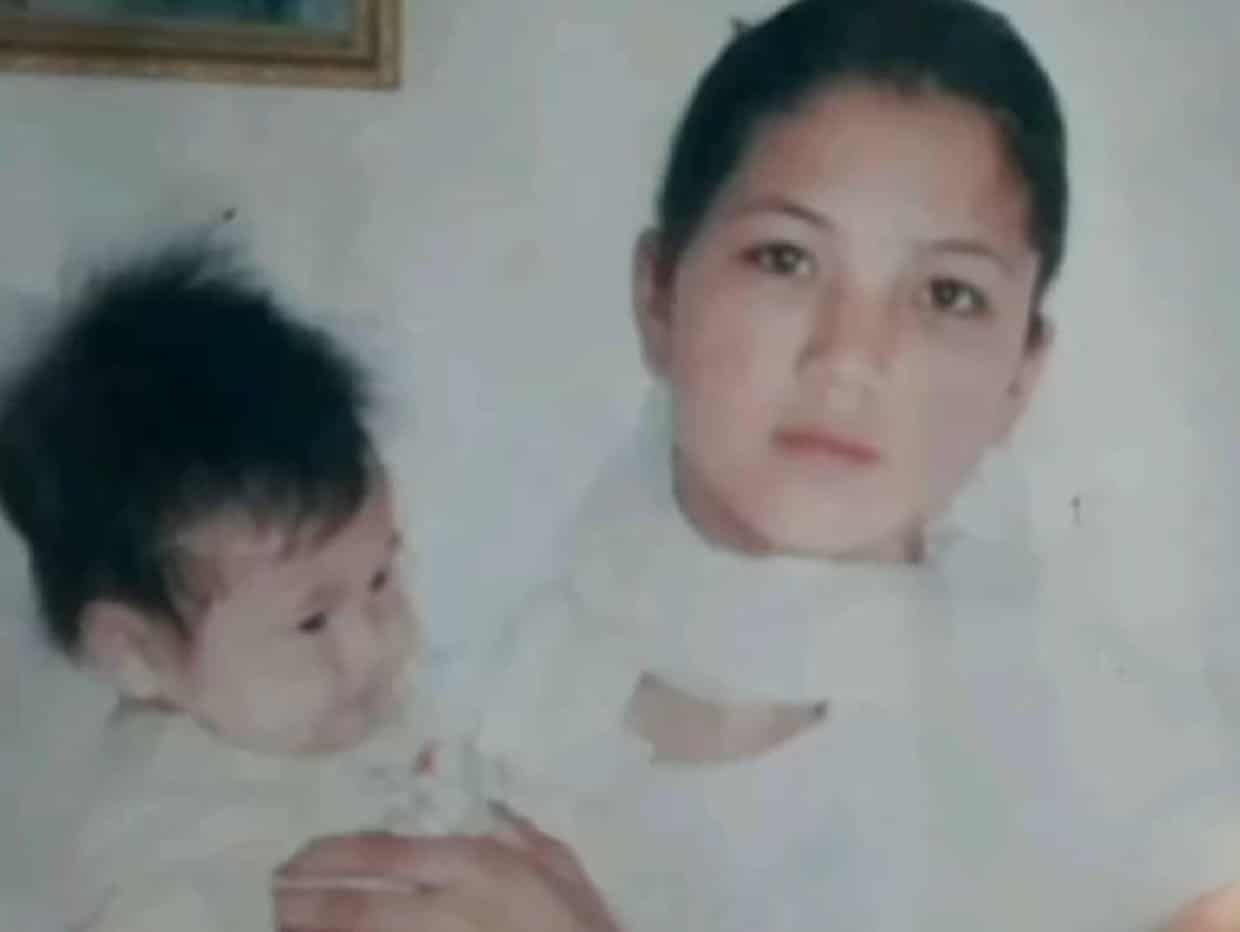
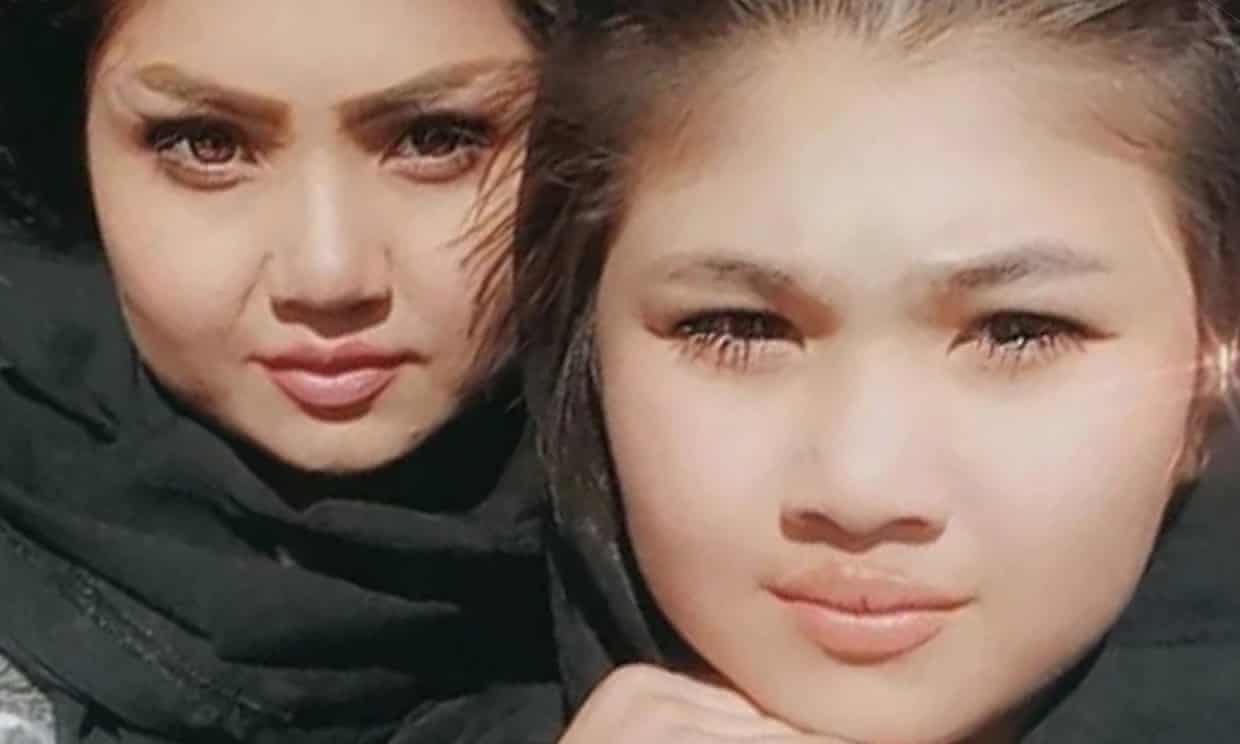
Mahtab Eftekhar, pictured with her daughter Zahra, who is now 14 years old and still living in Afghanistan. Photograph: Handout
After the Taliban regained power, my daughter was also barred from attending school. As the physical and verbal abuse from my husband intensified, I submitted a formal complaint at the Taliban’s police station, detailing the abuse and how I was forced into a child marriage.
When my husband learned of this, he took my children to Helmand and asked me to drop the case if I wanted to live with them again.
After many days apart from my children, I couldn’t bear it any more and reached out to my daughter. I coordinated with her on the phone to set a meeting time. I travelled to Helmand and, with the help of a family that I met on the bus, I passed all the Taliban checkpoints and was able to reunite with my children.
But on the journey back, near Kandahar city, the Taliban forced me and my children out of the vehicle and took us to a police station. Instead of helping me they beat and verbally abused me for travelling alone.
At first, I did not tell them anything, but then I saw my husband and his family at the police station and understood that they had reported me to the Taliban. My husband’s mother hit me with a rock and accused me of adultery, and abandoning the house and my responsibilities.
I froze as I knew what the consequences of such an accusation could mean for me. If it was proven that I had committed adultery, I would be flogged or stoned to death by the Taliban. I felt as though the entire world was against me.
I tried to defend myself and told the Taliban about my complaint and request for divorce. I pleaded my innocence with the authorities at the station, but they did not listen to me. They had already judged me guilty without any proof. As punishment, they beat me with rifle butts, plastic pipes and whips.
Fearing the consequences of defying the Taliban, I reluctantly agreed to go back with my husband’s family. They told me that my husband would divorce me and that I could keep my daughter but they would take my son. Hoping to secure at least my daughter’s future, I agreed.
But my trials were far from over. During my divorce hearing, the mullahs [Taliban clerics] decided that as a woman who had demanded a divorce, I lost all rights, including obtaining the mahr [dowry] and custody of my five-year-old son. The mahr refers to the money or assets given by the husband to his wife. It is considered the exclusive property of the wife, which she can use to support herself during the marriage or after divorce.
Although I tried to appeal against the verdict in other courts, I got nowhere.
After my divorce was finalised in 2023, I joined women protesting against the Taliban and their oppression of women. Despite my activism, my thoughts never strayed far from my son. Unfortunately, my husband took my son back to Helmand, leaving me devastated.
I sought help from the Taliban’s police, but each time, they refused. Instead, they accused me of adultery and flogged me as a punishment.
Soon after our divorce, my husband brought our son to visit me in Kabul, only to use the opportunity to kidnap our daughter, taking them both back to Helmand.
Mahtab with her daughter, Zahra, who was kidnapped by her father and taken to back to his family in Helmand province. Photograph: handout
I have not seen either of my children since then. Going back to Helmand could cost me my life, because I have demonstrated and spoken out against the Taliban so many times.
I was left with no reason to live. No one would rent me an apartment due to my being alone and single and I could not work as women were barred from jobs. So, I put away all my belongings – and the sorrow of losing my children – and left for Iran.
I am now 26 and I have lost everything: my childhood, youth, health and my children. Yet I am grateful to have found my voice. In Iran, I am earning a living working in a tailors’ shop and, at the same time, advocating and amplifying the voices of women in my country.
I am not afraid of dying on this journey to justice. Rather I embrace it, knowing that at least I will be an example for thousands of women enduring similar hardships and inspire them to stand against tyranny.
Married at 10, abused and forced to flee without her children: an Afghan woman on life under the Taliban
The presidents of Iran and the prime minister of Pakistan have called the presence of terrorist organizations in Afghanistan a serious threat to regional and global security.
In a joint statement, the President of Iran, Ebrahim Raisi and the Prime Minister of Pakistan, Shehbaz Sharif also emphasized a peaceful and stable Afghanistan, stating that greater participation of all Afghan factions in fundamental decision-making would strengthen peace and stability in the country.
The statement was published by the Ministry of Foreign Affairs of Pakistan at the end of the Iranian president’s three-day visit to Pakistan.
The joint statement said: “Both sides reaffirmed their commitment to the development of Afghanistan as a peaceful, united, sovereign and independent state, free from the threats of terrorism and drug trafficking. Noting that the existence of terrorist organizations in Afghanistan poses a serious threat to regional and global security, the two sides reaffirmed their willingness to enhance cooperation on counter-terrorism and security and to develop a united front against terrorism. The two sides also noted the relevance of coordinating regional and international efforts to ensure security and stability in the region, and emphasized the positive contribution of existing regional forums towards this end. While respecting the sovereignty and territorial integrity of Afghanistan, the two sides recognized that increasing participation of all strata of Afghans in basic decision-making will lead to the strengthening of peace and stability in this country.”
Although the Islamic Emirate has not yet commented on this matter, it has previously dismissed claims about the existence of terrorist groups in Afghanistan as baseless.
But what role do Iran and Pakistan play in ensuring security and stability in Afghanistan?
“Understanding between them and dialogue aimed at combating terrorism and bringing peace and stability to the region, especially assistance in this regard to Afghanistan, is in the interest of the region as well as the countries of Iran, Pakistan, and Afghanistan,” said Aziz Maarej, a former diplomat.
The early resumption of activities of the regional contact group and the Shanghai Cooperation Organisation for coordination and efforts to maintain stability and develop economic relations in the region are other topics mentioned in this statement.
Iran, Pakistan Pledge Commitment to Afghan Stability in Joint Statement
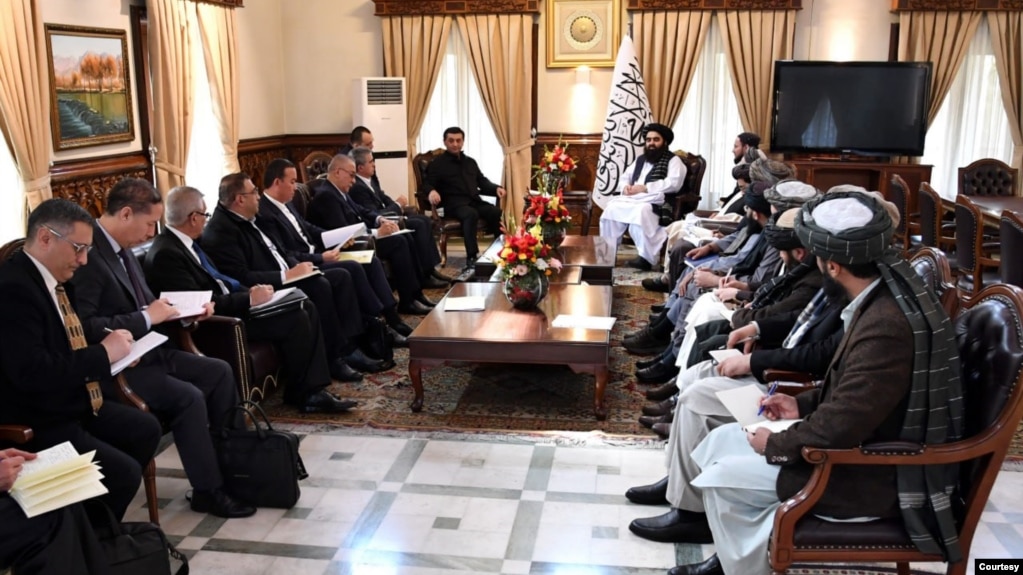
The Uzbek delegation, led by Foreign Minister Bakhtiyor Saidov, holds talks in Kabul with the Taliban leaders, March 12, 2024. (Uzbekistan MFA)
WASHINGTON — Afghanistan’s Central Asian neighbors are holding out hope that America, based on its pledges at September’s C5+1 summit, will expand its role in this neighborhood. The wish list includes delivering more humanitarian assistance to the Afghan people, facilitating the expansion of trade, and combating the threats of terrorism emanating from Afghanistan.
Officials speaking with VOA suggest that more aid could be channeled into Afghanistan via Uzbekistan. Additionally, Washington could offer more military assistance to Central Asian states and tangibly support their regional connectivity initiatives.
While no country has formally announced diplomatic recognition of the Taliban government, Central Asian nations have been engaging with the Taliban based on mutual interests, such as security, trade, and water sharing. Uzbekistan, which has extensive political and economic ties with Kabul, has been urging the West and the larger international community not to isolate Afghanistan.
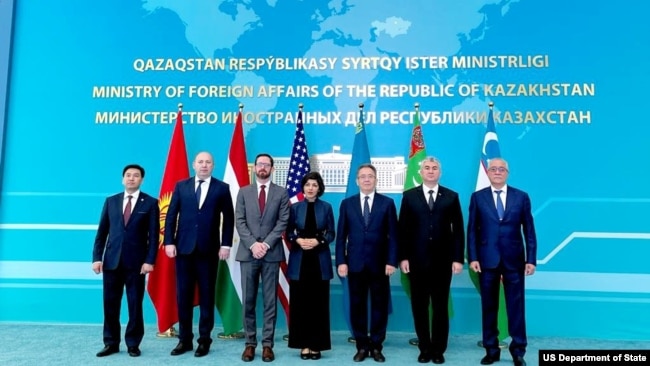
FILE – Special representatives on Afghanistan from Kazakhstan, Kyrgyzstan, Tajikistan, Turkmenistan, and Uzbekistan discuss joint efforts to support the Afghan people, in Astana, July 27, 2023. (U.S. State Department)
Nearly three years since the withdrawal of American forces, U.S. officials insist that they have not abandoned Afghanistan, pointing to ongoing efforts and consultations with Central Asian counterparts. However, they admit Washington’s priorities have shifted to other issues, such as Russia’s war on Ukraine.
“It will take the U.S. a decade or two to recover from the fact that we lost the war,” said David Sedney, a veteran diplomat and former deputy assistant secretary of defense for Afghanistan, Pakistan and Central Asia. “It took us 20 years before we were able to engage in Vietnam in a productive way,” he told VOA.
US Eyes Closer Ties to Central Asia After New York Summit
Scott Worden, who heads the Afghanistan and Central Asia programs at the U.S. Institute of Peace, thinks that Central Asian governments overestimate Washington’s leverage.
“There are a lot of issues in the world that have to be addressed simultaneously,” he noted in an interview with VOA. “They [the U.S.] are balancing the leverage that they have against issues that are manageable and maybe achievable versus ones like women’s rights, which I think the administration cares strongly about.”
“It’s just a really tough situation,” Worden added. “In my view, you should not condition humanitarian assistance. Any economic sanctions wind up hurting the Afghans that we want to support. It’s a difficult balance, and so I don’t think there is any obvious additional tool or leverage that could be deployed that they’re withholding.”
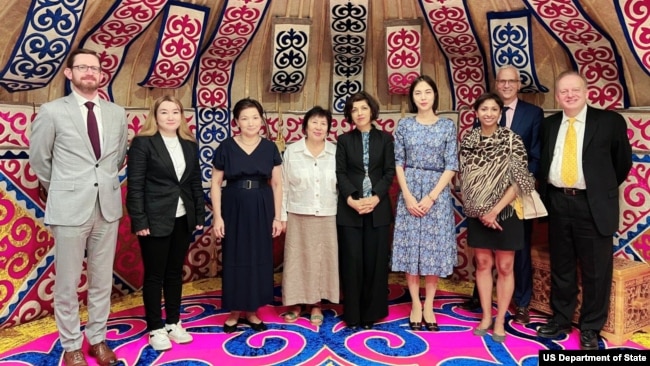
FILE – U.S. officials meet with Kazakh professionals promoting women’s economic empowerment in Central Asia, including Afghanistan, July 27, 2023. (U.S. State Department)
Some Western nations including the United States, however, have filtered humanitarian aid programs through partner organizations that circumvent Taliban officials and deliver aid directly to Afghan civilians.
According to USAID, the U.S. supplied nearly $81 million in Afghan humanitarian aid in fiscal year 2024 and has supplied total funding for Afghanistan of “more than $2 billion since August 2021 … including more than $1.5 billion in [USAID’s Bureau for Humanitarian Assistance] funding and nearly $550 million in [the State Department’s Bureau of Population, Refugees, and Migration] funding.”
“Provided through international partners on the ground,” says USAID, this assistance helps “meet the needs of the most vulnerable through food and cash support, nutrition, health care, protection for women and children, and agricultural inputs to support Afghans in meeting their immediate food needs.”
Uzbek Border Town Adjusts to the Taliban as Neighbors
Like Sedney, Worden suggests being realistic. “There is ample opportunity for the U.S. and other international partners to talk to the Taliban when they want to.”
“This is all part of a very difficult global conversation,” he said.
But for Frederick Starr, chairman of the Central Asia-Caucasus Institute, known for advocating closer ties with the region, Afghanistan is “utterly ignored right now.”
Starr emphasizes that this country is critical for regional integration and stability, two goals the U.S. has long vowed to support.
Sedney observes that “not many people want to talk about Afghanistan,” not just in Washington but in other Western capitals as well.
Speaking last week at the American Foreign Policy Council, these experts stressed that America’s two decades of involvement in Afghanistan left it with an obligation to go beyond the status quo.
Starr approves of the steps Kazakhstan, Turkmenistan and Uzbekistan have taken with Afghanistan, particularly regarding commerce, energy supply and water resources.
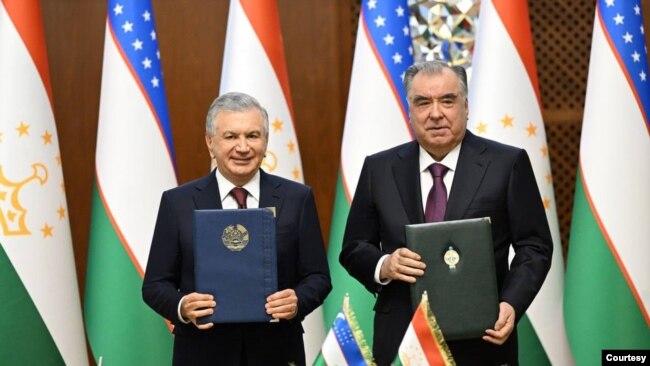
Presidents Shavkat Mirziyoyev, left, and Emomali Rahmon are seen after signing the Uzbekistan-Tajikistan Alliance Treaty and other strategic documents aiming to strengthen bilateral ties as well as cooperation on regional issues, Dushanbe, April 18, 2024. (president.uz)
Other observers, however, warn about tensions between the Taliban and Tajikistan, which officially supports the National Resistance Front, an armed alliance of anti-Taliban forces that is loyal to the previous regime and carries out guerrilla attacks in Afghanistan. Dushanbe continues to host the previous government’s ambassador.
US Cast as Villain During Meeting of Afghan Neighbors
Worden identifies several key interests and objectives for Washington, most of which align with those of the region. The first and most important objective is counterterrorism, ensuring that Afghan territory is never again used to launch attacks on the U.S. or its allies.
Others include negotiations on American hostages; the evacuation of Afghans that the U.S. promised to help following its withdrawal; women’s rights and other human rights; humanitarian assistance; and economic development.
Perhaps the most abstract interest, according to Worden, “is trying to maintain an international diplomatic consensus on the broad conditions and expectations that we have for the Taliban, which include in the endgame a more inclusive society that is not a threat to itself and for its neighbors as well as these U.S. interests.”
“It’s remarkable that no country in the world has recognized the Taliban,” he said, adding, however, that he sees a divergence between Western-allied emphasis on human rights and women’s rights and the neighboring countries’ economic and security concerns.
In Worden’s view, the U.S. is pursuing a policy of “quiet engagement” on humanitarian assistance and counterterrorism. At the same time, there is a firm position of non-recognition and not wanting to legitimize the Taliban.
“Can this dualism sustain over time?” asked Worden, who also sees a cleavage developing, where countries in the region will over time increase engagement with those in power in Afghanistan to achieve their economic and security interests. “Not that they like the Taliban, but they feel like talking to them is better than not.”
Uzbekistan Seeks to Engage Taliban Without Alienating West
Regardless of who inhabits the White House next January, Worden doubts that U.S. attention toward Afghanistan will increase unless there is an “acute crisis.”
Republicans tend to “prefer coercion to engagement when you’re talking about regimes that we don’t have much in common with,” he said. “So yes, there is the wild card of potentially making a great deal, but I think the odds of support for armed opposition would increase.”
U.S.-based Afghan journalist Samy Mahdi, who runs Amu Television out of Virginia, points out that the Taliban enjoy close relations with America’s adversaries, such as Iran, Russia and China. He argues that U.S. assistance has brought about minimum results, and that the Taliban is as radical and dangerous as it was in the 1990s.
Mahdi recommends a full review of U.S. policy.
“More communication and transparency are needed on Afghanistan,” he said at the American Foreign Policy Council forum. “We don’t hear much from the U.S. administration about Afghanistan.”
No longer a US priority, is Afghanistan a Central Asia problem now?
BY ERIC TUCKERAssociated Press8:00 PM EDT, April 25, 2024
WASHINGTON (AP) — Lawyers for an American believed to be held by the Taliban for nearly two years are asking a United Nations human rights investigator to intervene, citing what they say is cruel and inhumane treatment.
Ryan Corbett was abducted Aug. 10, 2022, after returning to Afghanistan, where he and his family had been living at the time of the collapse of the U.S.-backed government there a year earlier. He arrived on a valid 12-month visa to pay and train staff as part of a business venture he led aimed at promoting Afghanistan’s private sector through consulting services and lending.
Corbett has since been shuttled between multiple prisons, though his lawyers say he has not been seen since last December by anyone other than the people with whom he was detained.
In a petition sent Thursday, lawyers for Corbett say that he’s been threatened with physical violence and torture and has been malnourished and deprived of medical care. He’s been held in solitary confinement, including in a basement cell with almost no sunlight and exercise, and his physical and mental health have significantly deteriorated, the lawyers say.
Corbett has been able to speak with his family by phone five times since his arrest, including last month. His family has not been able to see him — his only visits have been two check-ins from a third-party state delegation — and their characterizations of his mistreatment are based on accounts from recently released prisoners who were with him and his openly dispirited tone in conversations.
“During Mr. Corbett’s most recent call with his wife and children, Mr. Corbett indicated that the mental torture and anguish have caused him to lose all hope,” said the petition, signed by the Corbett family attorneys, Ryan Fayhee and Kate Gibson.
The petition is addressed to Alice Edwards, an independent human rights investigator and the special rapporteur for torture in the Office of the High Commissioner for Human Rights at the U.N. It asks Edwards, who was appointed by the U.N. Human Rights Council, to “urgently reach out to the Taliban to secure Mr. Corbett’s immediate release and freedom from torture, as guaranteed by international law.”
“This situation is just dragging on, and I’m increasingly concerned and taking steps that I hope will make a difference and help the situation — just increasingly concerned and panicking about Ryan’s deteriorating health and physical and mental health,” Corbett’s wife, Anna, said in an interview. “And that was leading me to take this next step.”
The U.S. government is separately working to get Corbett home and has designated him as wrongfully detained. A State Department spokesman told reporters last month that officials had continually pressed for Corbett’s release and were “using every lever we can to try to bring Ryan and these other wrongfully detained Americans home from Afghanistan.”
A spokesperson for the Interior Ministry in Afghanistan said this week that it had no knowledge of Corbett’s case.
Corbett, of Dansville, New York, first visited Afghanistan in 2006 and relocated there with his family in 2010, supervising several non-governmental organizations.
The family was forced to leave Afghanistan in August 2021 when the Taliban captured Kabul, but he returned the following January so that he could renew his business visa. Given the instability on the ground, the family discussed the trip and “we were all pretty nervous,” Corbett’s wife said.
But after that first uneventful trip, he returned to the country in August 2022 to train and pay his staff and resume a business venture that involved consulting services, microfinance lending and evaluating international development projects.
While on a trip to the northern Jawzjan province, Corbett and a Western colleague were confronted by armed members of the Taliban and were taken first to a police station and later to an underground prison.
Anna Corbett said that when she learned her husband had been taken to a police station, she got “really scared” but that he was optimistic the situation would be quickly resolved.
That, however, did not happen, and Anna Corbett, who has three teenage children and makes regular trips to Washington, said she’s trying to advocate as forcefully as she can while not letting “anxiety take over.”
“I feel like it’s the uncertainty of all of it that just is so difficult because you just don’t know what’s going to come at you — what call, what news,” she said. “And I’m worried about Ryan and the effect of the trauma on him and then also on my kids, just what they’re experiencing. I’ve tried to protect them the best I could, but this is so difficult.”
Associated Press writer Riazat Butt in Kabul, Afghanistan, contributed to this report.
Family of American man believed to be held by Taliban asks the UN torture investigator for help
On April 28, 1991, the Mujahideen came to power after the People’s Democratic Party of Afghanistan, led by Dr. Najibullah, collapsed.
On Saur 7, 1357 (solar calendar), following a coup by the People’s Democratic Party, the first republic regime in Afghanistan was overthrown.
Friday marks the 46th anniversary of the day the People’s Democratic Party assassinated Mohammad Daoud Khan, who had established the country’s first republic, along with 18 members of his family at the presidential palace, effectively toppling the first republic regime in the country.
The morning of Saur 7, 1357, began with the alarming sounds of cannons and gunfire.
46 years ago today, tanks and helicopters from the army stormed the presidential palace from both ground and air, marking the first coup against the first republic regime.
Sultan Mahmoud Telayie, a relative of Sardar Mohammad Daoud Khan, said: “A president who was trying to keep Afghanistan together, wearing a helmet, along with all his family members, was attacked at the presidential palace by the regime of the People’s Party and communists trained by the Russians, and at nine o’clock in the morning of Saur 7, 1357, all his family members were martyred.”
The coup on Saur 7, 1357 is regarded as a significant event in Afghanistan’s history and marked the beginning of years of conflict and rebellion in the country.
After the assassination of Sardar Mohammad Daoud Khan, Noor Mohammad Taraki, one of the leaders of the People’s Democratic Party, seized power and initiated another major political shift in Afghanistan.
This rebellion in 1358 led to the entry of the Soviet Red Army into Afghanistan, resulting in a decade-long war between the Mujahideen and the Soviets.
Tariq Farhadi, a political analyst, told TOLOnews: “Saur 7, 1357 (solar calendar) changed the course of Afghanistan; the communist coup led to the entry of the Soviet Union into Afghanistan and subsequently brought America into the Afghan internal wars.”
During these conflicts, which lasted nearly ten years, approximately two thousand military and civilian individuals in the country lost their lives, and millions more were forced to flee the country.
On April 28, 1991, the Mujahideen came to power after the People’s Democratic Party of Afghanistan, led by Dr. Najibullah, collapsed.
Remembering the Fall of Afghanistan’s First Republic
ISLAMABAD (AP) — Neighbors Pakistan and Iran on Wednesday pledged to enhance efforts at a “united front” against Afghanistan-based militants, saying their presence poses a serious threat to regional and global security.
The countries, which share a long and porous border, made the commitment in a joint statement issued after a three-day visit by Iran’s President Ebrahim Raisi to Islamabad.
The visit was aimed at mending ties that were strained in January when each carried out strikes in the other’s territory, targeting militants accused of attacking security forces.
The Iranian president met with Pakistani President Asif Ali Zardari, Prime Minister Shehbaz Sharif and other officials, including powerful army chief Gen. Asim Munir.
The joint statement said the two sides “reaffirmed their willingness to enhance cooperation on counter-terrorism and security and to develop a united front against terrorism.”
Pakistan has witnessed a surge in militant violence in recent months, mostly blamed on Afghanistan-based Pakistani Taliban and insurgents who also target security forces in Iran.
Pakistan often says Pakistani Taliban have stepped up attacks since 2021 when the Afghan Taliban came to power. The Pakistani Taliban, known as Tehreek-e-Taliban Pakistan, or TTP, is a separate group but allied with the Afghan Taliban.
However, Afghanistan’s Taliban government insists it does not allow the Pakistani Taliban — or any other militant group — to use Afghanistan’s soil to launch attacks against any other country. In March, the Pakistan Air Force targeted multiple suspected hideouts of the Pakistani Taliban inside Afghanistan. The Afghan Taliban said the attacks killed eight people and prompted return fire from their forces. Tehran has also blamed an Afghanistan-based Islamic State affiliate for recent attacks in Iran. The affiliate is also active in Pakistan’s southwestern Baluchistan bordering Iran.
In recent years, Pakistan has urged Tehran to take stern action against Pakistani insurgents living inside Iran near the border. They often target security forces in Baluchistan, the scene of low-level insurgency by separatists for more than two decades.
Pakistan and Iran also agreed that their common border should be the “border of peace and friendship,” and reiterated the importance of regular cooperation between political, military and security officials to combat other threats such as narcotics smuggling, human trafficking, hostage-taking and money-laundering.
The countries also agreed to expand trade and economic cooperation, pledging to set up new border markets, new border crossings and economic free trade zones.
The two sides also condemned the suspected Israeli strike on April 1 targeting a consular building next to the Iranian Embassy in Syria which killed two Guard generals and others. Iran responded with unprecedented direct strikes on Israel.
Authorities also said Pakistan and Iran also discussed how to go ahead with their gas pipeline project, which has been on hold mainly because of fears of U.S. sanctions. The project — opposed by Washington as a violation of sanctions imposed on Tehran over its nuclear program — launched in 2013 to supply Iranian natural gas to energy-starved Pakistan.
Pakistan and Iran vow to enhance efforts at a ‘united front’ against Afghanistan-based militants
The U.S. State Department asserts it’s pressuring the Taliban alongside allies and partners to rescind discriminatory laws against Afghan women and girls.
It states that any significant steps toward normalizing relations with the Taliban are contingent upon a profound change in their behaviour.
The State Department wrote in its annual report on the status of women in Afghanistan that the Taliban have effectively excluded women from the public sphere with their directives.
The report highlights widespread violations of women’s rights and sexual violence against them. In one section, it mentions that 16 women out of 90 imprisoned women in Jawzjan, Faryab, and Samangan became pregnant after being raped by Taliban members. According to the report, the Taliban have executed at least four women in Samangan after repeated assaults.
The U.S. State Department added that in response to the Taliban’s actions restricting women, in February 2023, it imposed restrictions on visa issuance for some current and former Taliban officials and individuals involved in suppressing and depriving Afghan women and girls of education and work opportunities in non-governmental organizations.
The department stated that on December 8th of last year, the U.S. Treasury Department imposed sanctions on two Taliban members for their involvement in serious human rights violations, including restricting girls’ access to secondary education.
According to the department, Khalid Hanafi, the Taliban Minister of Virtue and Vice, was sanctioned for his involvement in serious human rights violations, including murder, kidnapping, lashing, and beating Afghan citizens, including women and girls.
The department mentioned that Mawlawi Faridudin Mahmood, the head of the Afghanistan Institute of Sciences, was sanctioned for his involvement in serious human rights violations related to regulating, publishing, and enforcing regulations to restrict access for all women and girls in Afghanistan solely based on their gender.
Khaama Press
24 April 2024
US State Dept pressures Taliban to revoke discriminatory decrees against Afghan women
The Islamic Emirate has not yet commented on this matter, it has previously dismissed claims about the existence of terrorist groups in Afghanistan as baseless.
The presidents of Iran and the prime minister of Pakistan have called the presence of terrorist organizations in Afghanistan a serious threat to regional and global security.
In a joint statement, the President of Iran, Ebrahim Raisi and the Prime Minister of Pakistan, Shehbaz Sharif also emphasized a peaceful and stable Afghanistan, stating that greater participation of all Afghan factions in fundamental decision-making would strengthen peace and stability in the country.
The statement was published by the Ministry of Foreign Affairs of Pakistan at the end of the Iranian president’s three-day visit to Pakistan.
The joint statement said: “Both sides reaffirmed their commitment to the development of Afghanistan as a peaceful, united, sovereign and independent state, free from the threats of terrorism and drug trafficking. Noting that the existence of terrorist organizations in Afghanistan poses a serious threat to regional and global security, the two sides reaffirmed their willingness to enhance cooperation on counter-terrorism and security and to develop a united front against terrorism. The two sides also noted the relevance of coordinating regional and international efforts to ensure security and stability in the region, and emphasized the positive contribution of existing regional forums towards this end. While respecting the sovereignty and territorial integrity of Afghanistan, the two sides recognized that increasing participation of all strata of Afghans in basic decision-making will lead to the strengthening of peace and stability in this country.”
Although the Islamic Emirate has not yet commented on this matter, it has previously dismissed claims about the existence of terrorist groups in Afghanistan as baseless.
But what role do Iran and Pakistan play in ensuring security and stability in Afghanistan?
“Understanding between them and dialogue aimed at combating terrorism and bringing peace and stability to the region, especially assistance in this regard to Afghanistan, is in the interest of the region as well as the countries of Iran, Pakistan, and Afghanistan,” said Aziz Maarej, a former diplomat.
The early resumption of activities of the regional contact group and the Shanghai Cooperation Organisation for coordination and efforts to maintain stability and develop economic relations in the region are other topics mentioned in this statement.
Iran, Pakistan Pledge Commitment to Afghan Stability in Joint Statement
The United Nations says aid workers are still in a “race against time” to remove rubble and rebuild after the devastating earthquake struck eastern Afghanistan last month, killing at least 2,200 people and cutting off remote areas.
The 6.0-magnitude quake on Aug. 31 was shallow, destroying or causing extensive damage to low-rise buildings in the mountainous region. It hit late at night, and homes — mostly made of mud, wood, or rocks — collapsed instantly, becoming death traps.
Satellite data shows that about 40,500 truckloads of debris still needs to be cleared from affected areas in several provinces, the United Nations Development Program said Wednesday. Entire communities have been upended and families are sleeping in the open, it added.
The quake’s epicenter was in remote and rugged Kunar province, challenging rescue and relief efforts by the Taliban government and humanitarian groups. Authorities deployed helicopters or airdropped army commandos to evacuate survivors. Aid workers walked for hours on foot to reach isolated communities.
“This is a race against time,” said Devanand Ramiah, from the UNDP’s Crisis Bureau. “Debris removal and reconstruction operations must start safely and swiftly.”
People’s main demands were the reconstruction of houses and water supplies, according to a spokesman for a Taliban government committee tasked with helping survivors, Zia ur Rahman Speenghar.
People were getting assistance in cash, food, tents, beds, and other necessities, Speenghar said Thursday. Three new roads were under construction in the Dewagal Valley, and roads would be built to areas where there previously were none.
“Various countries and organizations have offered assistance in the construction of houses but that takes time. After the second round of assistance, work will begin on the third round, which is considering what kind of houses can be built here,” the spokesman said.
Afghanistan is facing a “perfect storm” of crises, including natural disasters like the recent earthquake, said Roza Otunbayeva, who leads the U.N. mission to the country.
 Afghanistan Peace Campaign